By
WORK PERMIT GUIDE · UPDATED OCTOBER 27, 2026
Your category determines your timeline.
Quick answer: There is no single Form I-765 processing time. Your Employment Authorization Document (EAD) timeline depends on your eligibility category, whether the application is initial or a renewal, and the USCIS workload handling it. Check the current estimate for your category in the USCIS processing-times tool. A pending application alone generally does not authorize employment.
For someone waiting to start a job—or trying to keep one—the most useful question is not simply “How many months?” It is: Which rule applies to my application, and what can I do before my work authorization expires? This guide separates the wait for a decision, the validity of your card, and the rules for working during a pending renewal.

By Richard T. Herman, Esq.
Immigration lawyer with more than 30 years of experience and founder of Herman Legal Group. Attorney profile · Why trust Richard?
Book a Confidential Consultation Call 216-696-6170
Checking a delayed EAD? First verify the latest receipt-number update with HLG’s USCIS Case Status guide, then compare the I-765 processing time and inquiry eligibility below.
I-765 processing time by EAD category
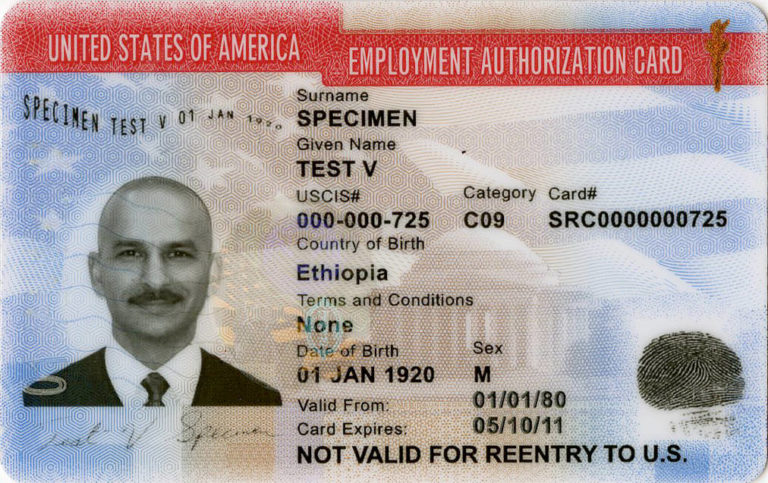
Find your eligibility code on your EAD and your Form I-765 filing. A card may show C09 while the form instructions use (c)(9); those identify the same category. Initial and renewal applications can follow different procedures. Use the current I-765 instructions to confirm which category fits your case.
| Applicant / category | How to check the wait | Key distinction |
|---|---|---|
| Pending adjustment of status (c)(9) |
Select the pending I-485 category in the USCIS tool. | The I-765 and green-card application have separate decisions. An I-485 or I-130 receipt does not itself authorize work. |
| F-1 OPT (c)(3)(A) or (c)(3)(B) |
Select the applicable F-1 student category; check premium-processing availability separately. | A requested start date is not permission to work. OPT approval, the authorized dates, and student employment rules matter. |
| STEM OPT extension (c)(3)(C) |
Check the F-1 category and confirm the STEM filing requirements with your designated school official (DSO). | A qualifying, timely STEM application can extend employment for up to 180 days while pending under a separate rule. |
| Eligible H-4 spouse (c)(26) |
Select the H-4 spouse category. Review any related I-539 and H-1B filings. | H-4 status alone does not authorize work. Eligibility and the current EAD renewal rules must both be satisfied. |
| Pending asylum (c)(8) |
Distinguish the first asylum EAD from a renewal. Initial applications have a separate regulatory adjudication period. | The asylum EAD clock and the I-765 processing period are different clocks. |
| Refugee / granted asylum (a)(3) or (a)(5) |
Use the category for an admitted refugee or a person already granted asylum. | These applicants are generally authorized to work because of their status. Evidence for Form I-9 is a separate issue. |
| TPS (a)(12) or (c)(19) |
Check the applicable TPS category and the current USCIS country page. | Country-specific notices, court orders, and exact card expiration dates can affect authorization and document validity. |
| DACA (c)(33) |
Review the linked I-821D and I-765 process and current DACA instructions. | A pending DACA renewal does not itself extend employment authorization. |
| Parole-based application (c)(11), where applicable |
Use the correct parole category and program instructions. | Parole expiration and EAD expiration are separate facts; some parolees have special work-authorization rules. |
Why this table has no universal “average”: A wait-time estimate can change, and one category’s experience does not predict another’s. The USCIS tool provides the current published estimate; this guide explains how to select it and what legal protections may apply while you wait. Category rules are grounded in 8 CFR 274a.12 and USCIS’s I-765 processing information.
E and L spouses: check whether you need an EAD at all
Many qualifying E and L spouses are authorized to work incident to their valid status. An unexpired Form I-94 showing an appropriate spouse classification, such as E-1S, E-2S, E-3S, or L-2S, can serve as employment-authorization evidence with the required identity document for Form I-9. Children do not receive the same benefit. See USCIS guidance for H-4, E, and L spouses before treating a delayed EAD as a required work stoppage.
How to check your own I-765 processing time
Have your receipt notice and a copy of your application available. You need the form number, eligibility category, receipt date, and relevant USCIS office or workload.
- Open the official tool. Go to USCIS Check Case Processing Times and choose Form I-765.
- Choose the category that matches your filing. Do not select asylum if your application is based on a pending I-485, even if you also have an asylum case.
- Select the office or workload the tool asks for. USCIS is consolidating some listings under “Service Center Operations” (SCOPS). Follow the current menu and case correspondence; a receipt-number prefix alone may not identify where the case is now being processed.
- Read the estimate and any category notes. The standard published figure generally reflects how long USCIS took to complete 80% of adjudicated cases during the preceding six months. It is neither a personal countdown nor a promised decision date.
- Enter your receipt date in the inquiry section. Use the date USCIS received the application. The tool will show when you may inquire or provide an inquiry link. That threshold is separate from the displayed processing estimate.
Save the result and the date you checked it. USCIS explains its methodology and inquiry process on its processing-times explanation page. If your category has special inquiry instructions, follow those rather than applying another category’s threshold.
Processing time, case status, and myProgress answer different questions
- Processing times: How long has the relevant group of completed cases taken?
- Case status: What is the latest recorded action on your application? Enter your receipt number at Case Status Online.
- Your USCIS account: Where can you review notices and case information? Check myUSCIS. Any estimated countdown is not employment authorization or a guaranteed deadline.
A biometrics appointment, reused fingerprints, or “actively reviewed” message does not establish how many days remain until approval. If a notice requests evidence, follow its deadline and instructions.
Does filing an EAD renewal automatically extend work authorization?
H-4 spouses should also check our October 2026 H-4 EAD renewal and work-authorization update, including older filing exceptions and the H-4 I-94 limit.
Generally, a renewal filed on or after October 30, 2025 does not receive the former broad automatic extension. DHS ended that renewal-based protection in an October 30, 2025 interim final rule and adopted it without change in a final rule published and effective October 14, 2026. The final rule did not move the October 30, 2025 cutoff. However, qualifying earlier filings and separate legal provisions can still matter. Read the distinctions below before deciding whether an expired card prevents continued employment.
| Situation | What to check |
|---|---|
| Qualifying renewal filed before October 30, 2025 | The prior extension of up to 540 days may apply if the filing, category, and other requirements are met. It is not a fresh 540 days from today, and denial or another terminating event can end protection sooner. |
| Renewal filed on or after October 30, 2025 | Do not assume the receipt extends the EAD. Determine whether another law, applicable notice, or court order specifically protects you. |
| Timely, qualifying STEM OPT extension | A separate rule provides up to 180 days of continued employment while the STEM application is pending, ending earlier upon USCIS’s decision. |
| TPS-related extension | Read the current country notice and USCIS guidance. Match the covered category and expiration dates; do not apply another country’s extension. |
| Employment authorized incident to status | Determine whether status itself authorizes work and which documents satisfy Form I-9. An expired card and expired work authorization are not always the same thing. |
The governing renewal provisions are 8 CFR 274a.13(d)–(e); the STEM provision is 8 CFR 274a.12(b)(6)(iv). Also consult the October 30, 2025 interim final rule, the October 14, 2026 final rule (91 FR 65306) and USCIS automatic-extension guidance. For an H-4 spouse relying on a qualifying earlier extension, the I-94 expiration can be an earlier cutoff.
What happened to the 540-day automatic extension?
Since 2016, a timely EAD renewal in many categories automatically extended the expiring card for up to 180 days. A May 2022 temporary rule raised that to 540 days, and a December 13, 2024 final rule made 540 days permanent (89 FR 101208, effective January 13, 2025). DHS then removed the automatic extension for renewals filed on or after October 30, 2025 (90 FR 48799). The October 14, 2026 final rule kept that change. For most categories the rule did not go back to 180 days: a renewal filed on or after October 30, 2025 gets no automatic extension at all, unless a law or Federal Register notice provides one, as TPS notices do. The separate STEM OPT rule described above is not part of that change.
Which categories had the automatic extension? It never covered every EAD. It applied only to timely renewals in the categories USCIS listed, such as refugees and asylees ((a)(3), (a)(5)), TPS ((a)(12), (c)(19)), pending asylum ((c)(8)), pending adjustment of status ((c)(9)), and E, L-2 and H-4 spouses ((a)(17), (a)(18), (c)(26)). DACA ((c)(33)) was never on the list, so a DACA renewal did not carry an automatic extension before or after October 30, 2025; file within the window in the current DACA instructions. If USCIS rejects a renewal, for example for a missing signature or the wrong fee, it gets no receipt date, and the filing date is the date a corrected filing is accepted.
Employers and Form I-9
- For a renewal filed on or after October 30, 2025, the Form I-797C receipt notice together with the expired card is no longer acceptable evidence of continued employment authorization.
- Employers must reverify employment authorization no later than the date it expires (8 CFR 274a.2(b)(1)(vii)). An employee who cannot show a new EAD or other acceptable document by then must stop working until one is issued. Check USCIS I-9 Central for current reverification guidance.
- For a qualifying renewal filed before October 30, 2025, the receipt notice with the expired card can still be accepted for up to 540 days after the card’s expiration date, if the categories match.
- If your card has already expired, you can still file, but there is no automatic extension, so the gap lasts until USCIS approves the new card. Filing as early as your category allows is the main way to avoid a gap.
Court-order caution: Relief protecting named plaintiffs does not automatically protect every EAD holder. Before relying on litigation to continue working, have the actual order and its current scope checked for your situation.
When should you file a renewal?
Prepare early and file within the window USCIS permits for your category. For many EAD renewals, USCIS generally permits filing up to 180 days before expiration. That is not a universal instruction: STEM OPT, DACA, and TPS follow distinct filing rules. Check the current form instructions, your program’s rules, and your underlying status dates. Filing early reduces avoidable risk; it does not guarantee uninterrupted employment.
If your authorization is close to expiring, coordinate an evidence review with counsel and your employer before the expiration date. HLG’s unauthorized-employment guide explains why continuing work without a valid legal basis can affect an immigration case. Certain employment-based adjustment applicants also need to understand the limits of INA section 245(k); it is not permission to work without authorization.
If your work-permit question overlaps with travel, a job change or student status, use our work, travel and status evidence worksheet to organize the records for review.
Asylum EAD processing: the 150-day, 180-day, and 30-day rules
For an initial EAD based on a pending asylum application, the current regulation generally permits filing after 150 countable days and prohibits issuance before 180 countable days. Applicant-caused delays can stop time from counting. The regulation separately gives USCIS a 30-day adjudication period for a qualifying initial application, subject to the applicable clock and procedural rules. This is not a promise that every applicant receives a card 30 days after filing.
Check 8 CFR 208.7 and the special initial-asylum instructions on the USCIS case-inquiry page. A renewal is not the same as an initial asylum EAD. DHS’s February 23, 2026 asylum EAD proposal should not be treated as an effective replacement rule merely because it was proposed. As of October 27, 2026, we found no final rule replacing the current asylum EAD clock; check the Federal Register before relying on either version.
Processing time is different from EAD validity
Processing time measures the wait for a decision. Validity is the period of authorization or documentation after approval. A shorter card validity period means earlier renewal planning; it does not mean USCIS will decide the application faster.
USCIS’s December 2025 policy reduced the maximum validity of several categories—including pending adjustment of status and pending asylum—from five years to 18 months, for covered requests pending or filed on or after December 5, 2025. TPS and parole categories have separate limits. See the USCIS policy alert and current adjudication guidance. HLG’s 18-month work-permit explainer provides additional planning context.
Read the dates on the card USCIS actually issues, together with any applicable extension or termination notice. The policy change alone does not mean every previously issued five-year EAD became an 18-month card.
What to do if your I-765 is delayed
- Check for a notice or missing response. Review your online account, receipt, address, and any request for evidence. A rejected filing is not the same as a pending application.
- Use the correct inquiry route. Follow the processing-times tool’s inquiry date or the special instructions for your category. Keep the service-request number and response.
- Assess a documented expedite request. If the situation is urgent, gather evidence showing why it meets USCIS’s criteria.
- Consider premium processing if eligible. Availability is limited; a paid upgrade is not offered for every I-765.
- Review further options if the delay continues. Counsel can evaluate case-specific follow-up, congressional constituent assistance, or a federal delay lawsuit. None guarantees approval, and litigation requires analysis of the facts and available remedies.
Expedite requests: prove the urgency
USCIS considers expedite requests individually. Grounds can include severe financial loss, emergencies or urgent humanitarian circumstances, qualifying nonprofit interests, government interests, or clear USCIS error. The ordinary need to work does not, by itself, establish an expedite basis. Review USCIS expedite criteria and request instructions.
A useful evidence packet may include an employer letter with a specific termination date, documented household expenses and resources, medical bills, or evidence of the urgent impact on an organization. Explain the connection between the delay and the harm. USCIS may request more evidence or deny the request; there is no standard “two-to-three-week” approval promise.
Premium processing: limited eligibility, measured in business days
Eligible F-1 students seeking pre-completion OPT, post-completion OPT, or a STEM OPT extension can request premium processing using Form I-907. Check the current USCIS eligibility list before filing or paying. Do not assume an H-4, adjustment-based, or asylum-based EAD qualifies simply because the regulation discusses Form I-765.
The premium period for an eligible I-765 is 30 business days, beginning when the required prerequisites are met. USCIS must take a qualifying adjudicative action, which can include an approval, denial, request for evidence, or notice of intent to deny. This is not a guarantee of approval or card delivery within that period. The premium processing fee for an eligible I-765 is $1,780. See 8 CFR 106.4 (eCFR current as of October 23, 2026).
Is your work authorization about to expire?
Bring your current EAD, I-765 receipt, I-94, underlying-case notices, and any employer deadline to a consultation. Herman Legal Group can assess the category, possible extension protection, and next steps for the delay.
After approval: card production and delivery
An approval is followed by card production and mailing. USCIS says an EAD should generally be produced within two weeks after I-765 approval, with delivery time additional. Review the I-765 card-delivery guidance and your case’s tracking information; delays can occur.
If the card does not arrive, use USCIS’s non-delivery inquiry instructions and its stated waiting period. Keep your USCIS address current. An approval notice or online screenshot is not automatically an acceptable substitute for the employment-verification documents your employer must examine.
Before filing: a short checklist that can prevent avoidable delays
- Confirm the eligibility category and whether the request is initial, renewal, or replacement.
- Use the form edition, filing method, address, and payment instructions currently accepted for that category.
- Check the current fee. Under 8 CFR 106.2 the base I-765 fee is generally $520, or $260 if you filed a fee-paid I-485 after April 1, 2024 that is still pending. Asylum, parole and TPS work permits also carry separate H.R. 1 fees, and several initial amounts rose on October 16, 2026; see our October 2026 fee update. Some categories are exempt. Do not rely on an old flat-fee table.
- Include the required category evidence, signatures, and compliant photos or digital image when instructed.
- Check your mailing address and retain a complete filing copy, delivery confirmation, and receipt notice.
- Track the EAD expiration, I-94 expiration, and any separate program deadline on your calendar.
Use the USCIS I-765 page and USCIS Fee Calculator immediately before submitting. Online filing can make notices and records easier to manage, but it does not establish a guaranteed faster decision.
Frequently asked questions about I-765 processing
How long does Form I-765 take right now?
There is no single wait for every EAD. Use the USCIS processing-times tool for your eligibility category and the listed office or workload. Check initial-versus-renewal instructions and the case-inquiry date separately.
Can I work while my first I-765 is pending?
Filing an initial I-765 does not itself authorize employment. You need an independent basis for work authorization or the required approval and employment-verification documents before starting work.
Does an I-765 receipt give me a 540-day extension?
Not automatically. The former broad renewal extension generally does not apply to renewals filed on or after October 30, 2025, and the October 14, 2026 final rule kept that cutoff. Qualifying earlier filings, separate STEM or TPS provisions, and applicable court orders require individual analysis.
Can I work with a pending I-485 or an approved I-130?
Those filings or approvals alone do not authorize employment. A person adjusting status generally needs an approved EAD or another valid, applicable basis for work authorization.
How long after biometrics will my EAD arrive?
There is no universal number of days from biometrics to EAD approval or delivery. Biometrics completion or reuse does not mean USCIS has finished reviewing eligibility.
Does EAD approval mean my green card is approved?
No. USCIS can approve a work permit based on a pending adjustment application before deciding the green-card case. Each application has its own requirements and decision.
Can premium processing guarantee my EAD by a job start date?
No. Premium processing is available only for designated categories and requires qualifying USCIS action within the applicable period. It does not guarantee approval or delivery of the card by a particular employment start date.
Can I travel internationally using only an EAD?
An EAD alone is not permission to reenter the United States. Travel and reentry depend on your immigration circumstances and required documents. Check whether separate travel authorization is needed before leaving.
EAD help in Ohio and nationwide
Herman Legal Group assists individuals, families, students, and employers with U.S. immigration matters. Its Cleveland and Columbus teams can help assess a work-permit problem in the context of the underlying case. For a broader filing or denial issue, see HLG’s USCIS problems, denials, and appeals services.
Book a Confidential Consultation 216-696-6170
General information, not advice for a particular case. Processing estimates, eligibility rules, and court orders can change. Source check: October 27, 2026; the cited eCFR fee and premium-processing pages displayed regulations current as of October 23, 2026.