


Deportation & Immigration Court
Motion to Reopen Immigration Court Lawyer
A removal order is not always the end of the case. A motion to reopen asks the immigration judge or the Board of Immigration Appeals to take the case back and consider facts the record never had. A motion to reconsider says the decision got the law wrong.
Herman Legal Group reads the order and its service history, identifies which body has jurisdiction, counts the deadline, and tells you whether a motion is available before you spend a filing fee on it.
Consultations in English, Español, 中文, العربية, Français, Русский, دری, پښتو and more · Languages we speak
If you are detained or removal is scheduled, say so when you book. A motion generally does not stop a removal, and booking a consultation does not extend a deadline.
Updated November 10, 2026. Published by Herman Legal Group. Related practice team: HLG Immigration Litigation Team and HLG Removal Defense Team. Attorney subject-matter context: Vania Stefanova, Head of HLG’s Immigration Litigation Division, and Richard T. Herman, Esq.
Primary authorities: 8 CFR § 1003.23, 8 CFR § 1003.2, and EOIR/BIA rules applicable to the specific order and forum.
Short answer: the deadline and the forum depend on what kind of order you have and who entered it. Your own order and its service history control.
- Motion to reopen: one motion, generally within 90 days of the final administrative order, supported by new facts and evidence.
- Motion to reconsider: one motion, generally within 30 days, pointing to errors of law or fact in the decision. See motion to reopen vs. motion to reconsider.
- Order entered after a missed hearing: 180 days for exceptional circumstances, or no deadline if you never got notice or were in custody through no fault of your own.
- One motion means one, total. In 2026 the Board held that a person gets a single statutory motion to reopen across the immigration court and the Board combined.
- Filing usually does not stop removal. Only motions attacking an order entered in your absence for lack of notice or custody carry an automatic stay, and a separate stay request is otherwise required.

Who decides your motion to reopen?
The motion goes to whichever body last decided your case, and sending it to the wrong one wastes the filing and the fee. The rule is simple to state and easy to get wrong, because the answer turns on what happened after the immigration judge ruled.
| What happened in your case | Where the motion goes |
|---|---|
| The immigration judge decided and nobody appealed | The immigration court that entered the order. |
| You were ordered removed in your absence | The immigration court that entered the order, by motion to reopen and rescind. |
| The Board decided your appeal on the merits | The Board of Immigration Appeals. |
| An appeal is pending at the Board right now | The Board, where a motion to reopen is treated as a motion to remand. |
| The Board dismissed your appeal as untimely or for lack of jurisdiction | The Board can consider only a motion to reconsider that dismissal. A motion to reopen the case itself goes back to the immigration judge. |
| The Board remanded and the judge ruled again | The immigration judge, unless the Board kept the case. |
These allocations come from 8 CFR 1003.23(b)(1) and the Board’s own practice rules. The Board cannot hear a motion in a case that was never before it.
One trap deserves naming. When the Board remands only so the Department of Homeland Security (DHS) can complete background checks, the remand is limited to the relief already granted. If you want the judge to consider a different form of relief at that point, the Board held in 2026 that you need a separate motion to reopen with its own fee, not a request inside the remanded proceeding.
If your appeal is still live at the Board and you want the appeal itself explained, see our Form EOIR-26 BIA appeal service. Motions filed with USCIS on Form I-290B are a different system with different rules; that is our I-290B motion to reopen or reconsider service.
Deadlines and the one-motion rule
The statute gives you one motion to reopen and ninety days. Under INA 240(c)(7), 8 U.S.C. 1229a(c)(7), a motion to reopen “shall be filed within 90 days of the date of entry of a final administrative order of removal,” must “state the new facts that will be proven at a hearing,” and must “be supported by affidavits or other evidentiary material.” A motion to reconsider gets thirty days and must “specify the errors of law or fact in the previous order.”
What changed in 2026 is how strictly the number limit is read. In Matter of M-M-L-J-, 29 I&N Dec. 843 (BIA 2026), a case that arose in the Sixth Circuit, the Board held that a person is allowed only one statutory motion to reopen “whether with the Immigration Court or the Board,” and that equitable tolling does not apply to the number bar at all. A motion spent on a weak theory is gone, and the one motion limit holds no matter how strong the next theory turns out to be.
“The first statutory motion should be treated as a scarce procedural asset.”
Richard T. Herman, Esq., in HLG’s analysis of Matter of M-M-L-J-
The Board also held in 2025 that a “supplement” to a pending motion that raises fundamentally different claims counts as a second motion, not an addition to the first. Filing early and amending later is not a safe plan.
Counting the ninety days
- The clock runs from the date the final administrative order was entered, not from the day you read it or the day you found a lawyer.
- Where the Board decided your appeal, that decision is ordinarily the final administrative order.
- A deadline that lands on a weekend or a legal holiday rolls to the next business day. The Supreme Court confirmed that approach for voluntary departure deadlines in Monsalvo Velázquez v. Bondi (2025).
- Filing a motion with the immigration judge or the Board does not extend the separate 30-day deadline to petition a federal court of appeals for review. That has been the rule since Stone v. INS (1995), and it is the single most expensive mistake in this area. See our petition for review service.
Once the motion is filed, DHS ordinarily has ten days to oppose it unless the judge sets another date, and EOIR has told its judges that ninety-five percent of motions should be decided within thirty days of filing. In practice, timing varies by court.
Orders entered after a missed hearing
An order entered in your absence has its own rules, and they are better than the ordinary ones. Under INA 240(b)(5)(C), an in absentia removal order can be rescinded on a motion filed:
- within 180 days if you can show that the failure to appear was because of “exceptional circumstances” — serious illness, a death in the immediate family, or something comparable and beyond your control; or
- at any time if you did not receive proper notice of the hearing, or if you were in federal or state custody and “the failure to appear was through no fault of the alien.”
There is one more advantage. Filing a motion to rescind an in absentia order automatically stays your removal while the immigration judge decides it. The statute says the filing “shall stay the removal of the alien pending disposition of the motion by the immigration judge,” and 8 CFR 1003.23(b)(4)(ii) repeats it, while adding that “an alien may file only one motion pursuant to this paragraph.”
Two limits on that stay matter enormously and are widely misunderstood:
- The automatic stay lasts until the immigration judge rules. In removal cases it does not continue while you appeal a denial to the Board.
- A motion based on exceptional circumstances rather than lack of notice is treated differently for fee purposes, as explained below.
Why notice arguments got harder
Lack-of-notice arguments used to be the strongest route to rescission. They are now the hardest, for four reasons that all post-date 2023.
- In Campos-Chaves v. Garland, 602 U.S. 447 (2024), the Supreme Court held that a single compliant notice — either the Notice to Appear or a later hearing notice — defeats rescission. A later notice telling you the correct time and place for the hearing you missed is generally enough, even if the original Notice to Appear left time and place blank.
- In Matter of Diji, 30 I&N Dec. 1 (BIA 2026), decided en banc, the Board held that DHS may mail the Notice to Appear to the most recent address you provided, including an address you gave before the Notice to Appear was issued, and overruled Matter of G-Y-R-.
- In Matter of Lopez-Orellana, 29 I&N Dec. 533 (BIA 2026), the Board held that an objection to a defective Notice to Appear belongs to the respondent and is forfeited if it is not raised on time.
- The Sixth Circuit held in Vargas-Rodriguez v. Bondi, 156 F.4th 708 (6th Cir. 2025), that a later notice changing the hearing date does not make the original Notice to Appear defective, and that relief still requires showing the failure to appear was not your fault.
Pereira and Niz-Chavez are still good law, but they govern the stop-time rule for cancellation of removal, not rescission of an order entered in your absence. Arguments built on them need to be aimed at the right target.
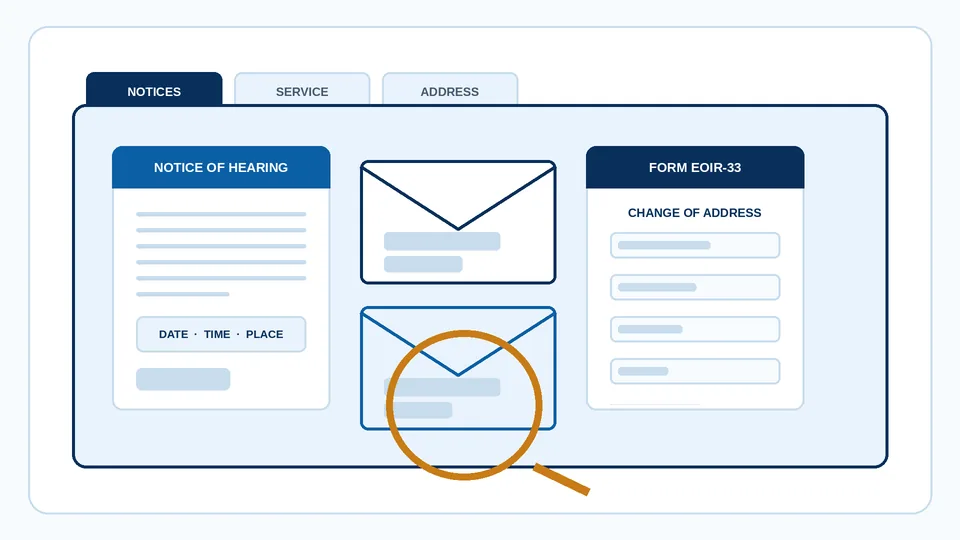
Keeping your address current with the court on Form EOIR-33 is not a formality. It is often the fact that decides whether a notice argument exists at all.
When the 90-day and one-motion limits do not apply
Four exceptions survive, and each has its own proof problem.
Changed country conditions
There is no time limit on a motion seeking asylum or withholding of removal based on changed conditions in the country of removal.
The evidence must be “material” and must not have been available or discoverable at the earlier hearing. Conditions that merely continued are not changed conditions.
Joint motions with DHS
If your case is still pending, our motion to terminate removal proceedings lawyers can assess OPLA negotiations, DHS dismissal and current termination authority. Reopening an existing final order follows different rules.
The time and number limits do not apply to a motion “agreed upon by all parties and jointly filed.”
This is the cleanest route on paper and the hardest in practice. The prosecutorial-discretion framework that supported these requests was rescinded in early 2025, and there is no published successor policy.
VAWA: battered spouses, children and parents
A special rule allows reopening within one year of the final order, waivable for extraordinary circumstances or extreme hardship to the applicant’s child.
In 2025 the Board held that the waiver reaches only the time limit, not the number limit. The motion must be accompanied by the application or self-petition, and you must be in the United States.
Sua sponte reopening, and what is left of it
Both the immigration judge and the Board retain authority to reopen a case on their own motion at any time. The regulatory text has not changed. What has changed is the Board’s view of when the authority should be used, and the trend is firmly against it:
- Matter of Yadav, 29 I&N Dec. 438 (BIA 2026): marrying a U.S. citizen after the removal order, even with an approved I-130, is not an exceptional situation warranting reopening.
- Matter of Herrera-Nunez, 29 I&N Dec. 695 (BIA 2026): equities built up in the years after the order do not qualify.
There is also a review problem. The Sixth Circuit has held that it lacks jurisdiction to review a refusal to reopen sua sponte, most recently in Herrera v. Bondi (2025). A request that depends on discretion alone is a request with no appeal.
Equitable tolling, and ineffective assistance of prior counsel
The ninety-day deadline can sometimes be tolled; the one-motion limit cannot. In the Sixth Circuit, tolling follows the framework of Barry v. Mukasey and Mezo v. Holder, and the court restated the requirements in Zhou v. Bondi, 134 F.4th 946 (6th Cir. 2025): the movant must show both prejudice and due diligence, and the delay must come from an exceptional circumstance beyond the movant’s control.
The most common tolling theory is that the previous lawyer failed the client. Matter of Lozada still governs those claims, and the Board tightened its requirements in 2026: in Matter of L-R-M-C- & V-A-M-M-, 29 I&N Dec. 757 (BIA 2026), it held that the motion must include “a copy of the bar complaint … and proof of the filing of that complaint, or an explanation why a bar complaint was not filed.” Our guide to ineffective assistance of prior counsel explains what those filings involve.
Does filing a motion stop your removal?
No, with narrow exceptions. Filing does not by itself stop you from being deported. Outside the in absentia situation described above, the regulations are explicit. Before the Board, 8 CFR 1003.2(f) states that “the filing of a motion to reopen or a motion to reconsider shall not stay the execution of any decision made in the case.” Before the immigration judge, 8 CFR 1003.23(b)(1)(v) says the same thing “except in cases involving in absentia orders.” The VAWA stay is statutory and applies only to qualified applicants.
So a stay has to be asked for separately, in writing, as its own motion. There is no fee for a motion that only requests a stay. The Board will entertain one only while a motion to reopen or reconsider, or an appeal of a judge’s denial of one, is pending.
New in 2026: the Board held in Matter of Herrera-Nunez, 29 I&N Dec. 691 (BIA 2026), that a person with a final removal order should first ask DHS for a stay before the Board will consider a stay request tied to a motion. The movant must submit proof of the request to DHS and DHS’s response, or explain why neither is available. A DHS denial does not bar an EOIR stay, and there is an exception for detained people facing imminent removal. The published practice manuals have not caught up with this decision; do not rely on them alone.
Emergency stays are considered only when the person is in DHS physical custody and removal is imminent. The Board’s Emergency Stay Unit takes calls on non-holiday weekdays during business hours; for an order from an immigration judge, the request goes to the court that entered it.
“A legally strong motion to reopen and a legally sufficient strategy to prevent removal while the motion is pending are not necessarily the same thing.”
Richard T. Herman, Esq., in HLG’s analysis of Matter of M-M-L-J-
Reopen or reconsider? They are not interchangeable
A motion to reopen is about facts. A motion to reconsider is about law. Choosing the wrong one usually means the motion is denied on its own terms, and it still counts against your limit.
| Motion to reopen | Motion to reconsider | |
|---|---|---|
| What it argues | New facts that the earlier record did not contain. | That the decision misapplied the law or misread the record it had. |
| Deadline | Generally 90 days from the final administrative order. | Generally 30 days from the final administrative order. |
| Number allowed | One, across the immigration court and the Board combined. | One. |
| Evidence | Affidavits and documents are required, and the evidence must not have been available earlier. | No new evidence. It must cite pertinent authority. |
| Automatic stay of removal | Only for in absentia motions based on lack of notice or custody, and for qualified VAWA applicants. | None. |
Filing both at once is possible but rarely wise, because each consumes a one-time allowance. Which motion fits is a question about the decision in front of you, not a matter of preference.
What does a motion to reopen cost to file?
EOIR filing fees rose sharply, and they now adjust every October 1. The One Big Beautiful Bill Act of July 2025 added a statutory fee on top of EOIR’s own fee, with an annual inflation adjustment. The figures below apply to filings made on or after October 1, 2026.
| Filing | Total fee |
|---|---|
| Motion to reopen or reconsider before an immigration judge | $1,095 |
| Motion to reopen or reconsider before the Board | $1,060 |
| Notice of Appeal to the Board, Form EOIR-26 | $1,060 |
| Motion based exclusively on an application that carries no fee | $950 |
Three points here catch people who last looked at this in 2024.
- Asylum-based motions are no longer free. The exemption for motions seeking only asylum was removed by rule in June 2026.
- Not every in absentia motion is fee-exempt. Motions based on lack of notice or on federal or state custody are exempt. Motions based on exceptional circumstances require the fee.
- Payment is electronic only. EOIR stopped accepting checks and money orders in February 2026; fees go through the EOIR payment portal, not to DHS.
Other filings remain fee-exempt: motions requesting only a stay, jointly filed and DHS motions, motions filed while the case is still pending before that body, and bond appeals.
A fee waiver request is still available on a showing of inability to pay. It is harder to get than it was: in Matter of Garcia Martinez, 29 I&N Dec. 169 (BIA 2025), the Board held that a person who is not detained and has retained private counsel is presumed able to pay, and that a waiver request reporting zeros across the board is presumptively invalid. A deficient request gets a short cure period that tolls the deadline.
What a serious motion to reopen contains
Reopening is discretionary, and the Supreme Court has called these motions “disfavored.” Under INS v. Abudu, 485 U.S. 94 (1988), a motion can be denied on any of three independent grounds: no prima facie case for the relief sought; no previously unavailable material evidence; or discretion, even where the first two are satisfied. The Board restated the test in 2026: reopening “will only be granted if the evidence was not previously available and would likely change the result.”
That shapes what the filing has to do.
What goes into the filing
- The order and its service historyThe decision, the envelope, the certificate of service and every notice the court sent, with the addresses used.
- The new facts, in affidavitsSworn statements from the people who know them, plus the supporting documents that back them up. Argument without evidence is not a motion to reopen.
- Prima facie eligibilityThe application for the relief you want, completed and supported, so the judge can see the case would be worth hearing.
- Why it could not have come earlierThe diligence record: when you learned the facts, what you did, and what prevented an earlier filing.
Common fact patterns that can support reopening include a criminal conviction vacated for a procedural or substantive defect, newly available relief through a family petition or a humanitarian application — a green card through a spouse or parent, for example — country conditions that genuinely deteriorated after the hearing, and a prior lawyer’s failure documented under Lozada. Each of these has been narrowed by recent decisions, so the question is never whether the category exists but whether your proof fits it.
Voluntary departure, leaving the country, and reinstated orders
If you were granted voluntary departure
Filing a motion to reopen or reconsider during the voluntary departure period automatically terminates the grant. Under 8 CFR 1240.26(e)(1), the alternate order of removal takes effect immediately — but the penalties for failing to depart do not apply. In Dada v. Mukasey (2008), the Supreme Court held that a person must be allowed to withdraw the voluntary departure request before the period expires. There is no automatic tolling, so the choice has to be made deliberately and on time.
A motion filed after the period has run does not affect it, and penalties already triggered stay triggered. Those penalties are real: a civil penalty of not less than $1,000 and not more than $5,000, presumptively $3,000, plus a ten-year bar on voluntary departure, cancellation of removal, adjustment of status, change of status and registry. The Board upheld a $3,000 penalty in Matter of R-P-L-, 29 I&N Dec. 859 (BIA 2026).
If you have already left the United States
The regulations contain a post-departure bar: a motion “shall not be made by or on behalf of a person who is the subject of” proceedings after departure, and departing after filing is treated as a withdrawal. The Sixth Circuit rejected that reading for statutory motions in Pruidze v. Holder, 632 F.3d 234 (6th Cir. 2011), holding that the Board may not disclaim jurisdiction over a statutory motion to reopen because the movant has left. The law is not uniform across circuits, and the court that would review your case matters.
If your old order was reinstated after a reentry
This is the hardest posture. Under 8 U.S.C. 1231(a)(5), a prior removal order reinstated after an illegal reentry “is not subject to being reopened or reviewed,” and the person “is not eligible and may not apply for any relief under this chapter.” The Sixth Circuit applied that bar strictly in Sanchez-Gonzalez v. Garland (2021), even where the underlying conviction had been vacated, and declined to create a miscarriage-of-justice exception. Withholding of removal and protection under the Convention Against Torture may still be available through a separate process. Before anyone files anything in a reinstatement case, the prior order and the reentry history have to be examined closely. Our pages on inadmissibility after a prior removal and the I-212 permission to reapply explain the consequences that follow a removal.
If the motion is denied
A denial is reviewable, but the route depends on who denied it.
- An immigration judge denied the motion. The denial can be appealed to the Board on Form EOIR-26. The appeal deadline is 30 calendar days. A 2026 rule would have cut it to 10 days, but a federal court vacated that provision before it took effect and EOIR confirmed in a policy memorandum that 30 days still applies. Note that the published regulation text has not been corrected and still prints 10 days — do not rely on it. Our EOIR-26 appeal service covers that filing.
- The Board denied the motion. The next step is a petition for review in the federal court of appeals, filed within 30 days. Federal courts do have jurisdiction to review denials of motions to reopen, under Kucana v. Holder (2010), and that jurisdiction survives even where the Board relied on untimeliness or rejected equitable tolling, under Mata v. Lynch (2015). Discretionary refusals to reopen sua sponte are a different matter and are generally unreviewable in the Sixth Circuit.
An appeal from the denial of a motion ordinarily does not create the automatic stay that a direct appeal from a merits decision can. If removal is a live risk, the stay strategy has to be built alongside the appeal, not after it.
How HLG helps with a motion to reopen
We start with the order and the service record, not a template. In this area, the answer to “is a motion available” is usually found in documents the client already has and has not read closely.
- Order and jurisdiction review: what was decided, by whom, when it became final, and which body can hear a motion now.
- Deadline and number analysis: the governing deadline, whether any exception applies, and whether a prior motion has already been used.
- Service-record audit: every notice the court sent, the addresses used, your Form EOIR-33 filings, and whether a notice argument exists after Campos-Chaves and Diji.
- Relief assessment: what you would actually apply for if the case reopened, and whether the evidence establishes prima facie eligibility.
- Removal-risk and stay plan: whether a stay request has to go to DHS first, and what to file if removal is scheduled.
- Preparation and filing: the motion, affidavits, exhibit list, fee or waiver request, and proof of filing.
Three ways to work with HLG
Consultation: $245
One hour with an HLG immigration attorney to review your order, your deadline and whether a motion is available.
A consultation does not include preparing or filing a motion.
Document review: $595
A one-hour attorney review of a motion you prepared yourself, before you file it.
On the booking page, choose “Document Review: Online” and open “See Details” for the scope and preparation steps.
Representation
HLG prepares and files the motion, any stay request, and an appeal if the motion is denied.
The scope and fee are set in a written agreement after we review the order and the record.
No attorney can promise that a court will reopen a case. A motion to reopen, a Board appeal, a bond or custody matter and federal-court litigation are separate pieces of work and may require separate engagements.
HLG’s removal-defense team includes Vania Stefanova, who heads the firm’s Immigration Litigation Division and handles removal defense and Board appeals; Luis Villarroel, who leads the Columbus-area office in Worthington and works in English and Spanish; and Tameem Ansari, whose practice includes removal defense and who previously served as a prosecutor. Richard T. Herman founded Herman Legal Group in Cleveland in 1995 and has practiced immigration law for more than 30 years. The attorney and the scope of work for your matter are confirmed before representation begins.
Attorney consultations are available in Spanish, Russian, Bulgarian, Serbian, Croatian, Dari and Pashto. HLG paralegals who speak Arabic, French and Chinese can join a consultation.
Where does HLG handle motions to reopen?
Nationwide. Motions to reopen and reconsider are written filings submitted to an immigration court or to the Board, so HLG represents people with removal orders in every state by video and phone, in addition to in-person meetings in Cleveland and the Columbus area.
In Ohio, removal cases are heard at the Cleveland Immigration Court, and HLG appears there regularly. Our Columbus removal-defense page covers central Ohio. The Board of Immigration Appeals sits in Falls Church, Virginia and decides cases on the written record from anywhere in the country, and the federal court of appeals for Ohio is the Sixth Circuit in Cincinnati.
What should you bring to the consultation?
Bring the order and everything the court ever mailed you, including the envelopes. If removal is scheduled or you are calling about someone in detention, say so when you book.
- The complete decision or order, every page, with the date it was issued.
- Every notice of hearing, the Notice to Appear, and the envelopes they arrived in.
- Any Form EOIR-33 address changes you filed, and the addresses DHS and the court used.
- Board decisions, appeal paperwork and any motion filed before, with proof of filing.
- Proof of what kept you from the hearing, if you missed one: medical records, hospital records, a death certificate, custody records, transport records.
- Papers from the prior lawyer, including the retainer agreement and all correspondence, if the claim involves prior counsel.
- Certified court records for any arrest, charge, conviction or vacatur.
- Documents for the relief you would seek if the case reopened: approved or pending petitions, asylum evidence, country-conditions evidence, family records.
- Passport, I-94 record and your entry and departure history.
- Any ICE paperwork, check-in notices, ankle-monitor or supervision documents, and a removal date if one has been given.
Is this the right HLG service for your problem?
This service is for an existing order or decision from an immigration judge or the Board. If your situation is different, another page will fit better.
- Your case is still open in immigration court: see deportation defense.
- You want to appeal a judge’s decision rather than reopen it: see the Form EOIR-26 BIA appeal service.
- The Board has already denied your appeal or your motion: see the petition for review service. The deadline is 30 days and a motion does not extend it.
- USCIS denied an application and you want to move to reopen that: see the Form I-290B service. USCIS motions are a separate system.
- Someone is in ICE custody: see immigration detention, bond hearings and habeas corpus.
- The case involves criminal charges or a conviction: see crimmigration.
- Your case was administratively closed and has been put back on the docket: that is a recalendaring issue, not a motion to reopen; see our guide to closed and recalendared immigration court cases.
Common questions about motions to reopen in immigration court
How long do I have to file a motion to reopen a removal order?
Generally 90 days from the date the final administrative order was entered. If the order was entered after you missed a hearing, you have 180 days to show exceptional circumstances, or no deadline at all if you never received the required notice or were in federal or state custody through no fault of your own. A deadline falling on a weekend or legal holiday moves to the next business day.
How many motions to reopen can I file?
One. In Matter of M-M-L-J- (BIA 2026), the Board held that the statute allows a single motion to reopen across the immigration court and the Board combined, and that equitable tolling does not apply to that number limit. The exceptions are narrow: jointly filed motions with DHS, motions based on changed country conditions in an asylum or withholding case, and the special rule for battered spouses, children and parents.
Does filing a motion to reopen stop my deportation?
Usually not. The regulations say that filing a motion to reopen or reconsider does not stay the execution of the decision. The main exception is a motion to rescind an order entered in your absence, which stays removal while the immigration judge decides it. Otherwise a separate written stay request is needed, and since 2026 the Board expects you to ask DHS for a stay first.
I missed my immigration court hearing. Can the order be undone?
Possibly. The two routes are exceptional circumstances within 180 days, or lack of required notice or qualifying custody with no deadline. Notice arguments have become much harder since Campos-Chaves v. Garland (2024), because a single compliant notice defeats rescission, and since Matter of Diji (BIA 2026), which allows DHS to use the most recent address you provided. Whether an argument exists usually depends on the service record and your address filings.
What does it cost to file a motion to reopen in immigration court?
For filings on or after October 1, 2026, $1,095 before an immigration judge and $1,060 before the Board. A motion based exclusively on an application that carries no fee is $950. Motions based on lack of notice or on custody in an in absentia case are fee-exempt; motions based on exceptional circumstances are not. These amounts adjust each October 1, and payment is electronic only.
Are asylum-based motions to reopen still free?
No. The exemption for motions seeking only asylum was removed by rule in June 2026. Older government pages and practice materials still describe those motions as fee-exempt.
Can I file a motion to reopen if I already left the United States?
Possibly, depending on the circuit. The regulations contain a post-departure bar, but the Sixth Circuit held in Pruidze v. Holder (2011) that the Board may not refuse jurisdiction over a statutory motion to reopen simply because the person has departed. If your order was reinstated after an illegal reentry, a separate statute says the prior order is not subject to being reopened.
Does a motion to reopen extend my deadline to go to federal court?
No. Under Stone v. INS (1995), a motion to reopen or reconsider does not toll the 30-day deadline to file a petition for review of the underlying removal order. If federal review may matter, the petition has to be filed on its own schedule, and review of the motion denial is then consolidated with it.
My previous lawyer mishandled the case. Is that enough to reopen?
It can support reopening and equitable tolling, but the requirements are strict. The Sixth Circuit requires both prejudice and due diligence. The Board held in 2026 that a Lozada motion must include a copy of the bar complaint and proof that it was filed, or an explanation of why it was not.
Can the judge or the Board reopen my case on its own motion?
In theory, at any time. In practice, recent Board decisions have closed off the most common requests: a marriage and an approved I-130 after the order is not enough (Matter of Yadav, 2026), and equities acquired after the order are not enough (Matter of Herrera-Nunez, 2026). The Sixth Circuit also holds that it cannot review a refusal to reopen on the agency’s own motion.
Do I need a lawyer to file a motion to reopen?
You are not required to have one. The practical difficulty is that you get one motion, the fee is now over a thousand dollars, the law changed substantially in 2025 and 2026, and filing does not stop a removal. Those four facts together are why most of these filings are worth having reviewed before they go in.
How many removal orders are being entered?
According to TRAC’s analysis of EOIR data, immigration judges issued about 741,870 removal and voluntary departure orders in fiscal year 2026 through August 2026, out of roughly 899,741 completed cases. EOIR recorded 311,130 in absentia removal orders in fiscal year 2025. TRAC also reported that only 24.2 percent of people had an attorney when a removal order was issued in August 2026.
Official sources
- INA 240, 8 U.S.C. 1229a: removal proceedings, motions to reopen and reconsider, in absentia orders
- 8 CFR 1003.2: reopening and reconsideration before the Board of Immigration Appeals
- 8 CFR 1003.23: reopening and reconsideration before the immigration judge
- 8 CFR 1103.7: EOIR fees
- EOIR: types of appeals and motions and required fees
- Inflation adjustment for EOIR fees, fiscal year 2027
- EOIR Policy Manual, Part III, Chapter 4: motions before the Board
- EOIR Policy Manual, Part III, Chapter 5: stays before the Board
- EOIR Policy Manual, Part II, Chapter 4.7: motions before the immigration court
- Campos-Chaves v. Garland, 602 U.S. 447 (2024)
- Matter of M-M-L-J-, 29 I&N Dec. 843 (BIA 2026)
- Board of Immigration Appeals precedent decisions, Volume 30
- TRAC: immigration court quick facts
Sources checked October 12, 2026. This page provides general information about immigration law, not legal advice about your case. Deadlines, fees and available relief depend on your own order and circumstances, and the law in this area changed substantially in 2025 and 2026. Reading this page does not create an attorney-client relationship.
Legal content reviewed by Richard T. Herman, Esq. Last attorney review: October 12, 2026.