


Deportation & Immigration Court
Petition for Review Lawyer: Federal Appeals of Removal Orders
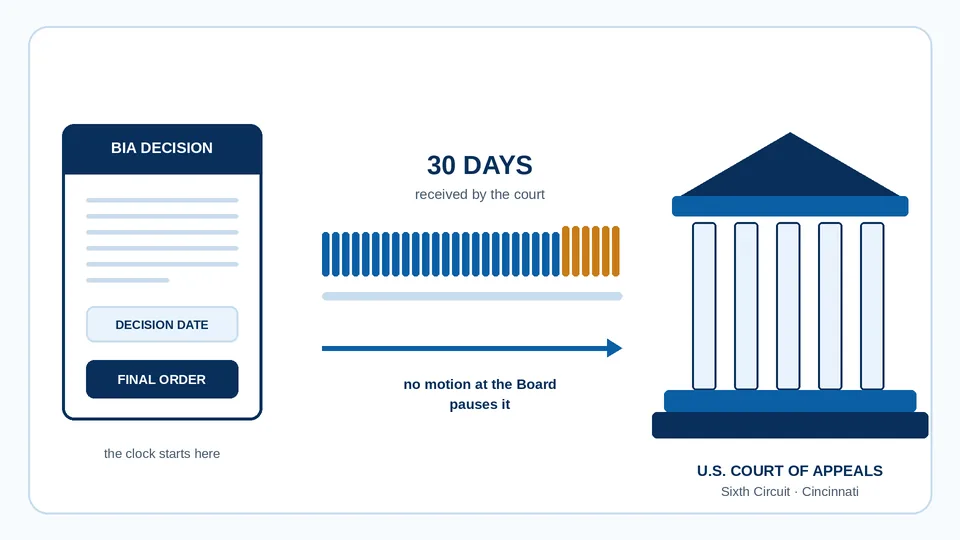
When the Board of Immigration Appeals rules against you, the next step is not another appeal inside the immigration system. It is a petition for review in a United States court of appeals — for Ohio, the Sixth Circuit in Cincinnati. The deadline is 30 days, and almost nothing extends it.
Herman Legal Group identifies the order that starts the clock, assesses whether a federal court has jurisdiction over the issues your case presents, and files the petition and any stay request.
If the Board has already decided your case, call with the decision date. Filing a petition does not stop a removal, and a motion at the Board does not extend the 30 days.
Short answer: a petition for review is a federal lawsuit about the agency’s legal errors, decided on the record the agency made.
- Deadline: 30 days from the final order of removal. It is no longer treated as jurisdictional, but it is still enforced.
- A motion at the Board does not extend it. Review of a motion denial is consolidated with review of the order, but the clock on the order keeps running.
- Court: the circuit where the immigration judge completed proceedings. Cleveland Immigration Court cases go to the Sixth Circuit.
- Filing does not stop removal. A separate stay motion is required, and the Sixth Circuit grants no automatic stay.
- The court reviews law, not facts. It cannot re-weigh the evidence, and when you win it sends the case back to the Board rather than granting status itself.
What a petition for review is, and what it is not
A petition for review takes your removal case out of the immigration system and puts it in front of federal judges. It is a two-page document that opens a federal appellate case. Under 8 U.S.C. 1252(a)(5), it is “the sole and exclusive means for judicial review of an order of removal.”
What it is not:
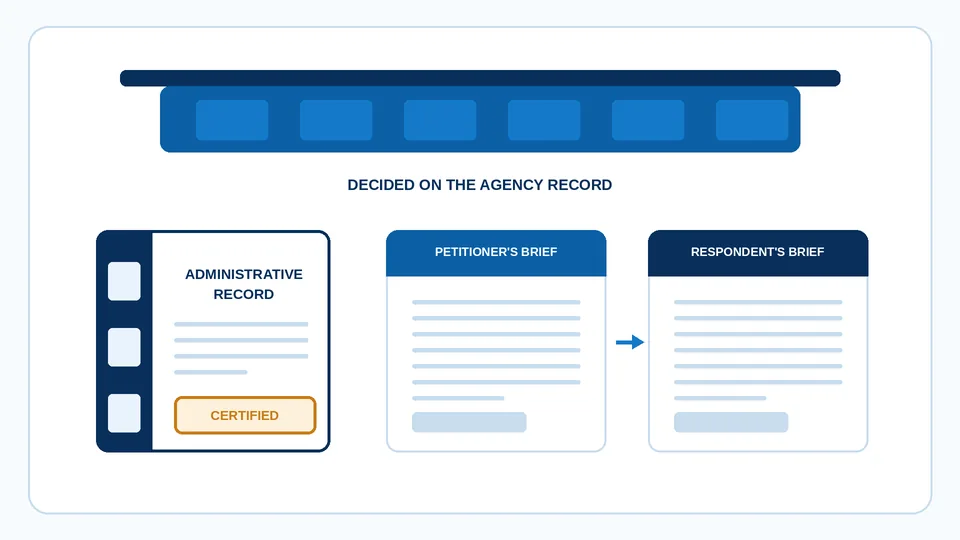
- Not a new hearing. The court decides the case “only on the administrative record on which the order of removal is based.” You cannot submit new evidence.
- Not a second appeal inside the agency. The Board of Immigration Appeals, part of the Executive Office for Immigration Review and seated in Falls Church, Virginia, is the last stop inside the Department of Justice. It reviews an immigration judge’s decision on the written record, through a single Board member or a three member panel, and that ruling is what a federal court then examines. If you have not taken a BIA appeal, you generally cannot petition for review at all, because the statute requires that you exhaust the administrative remedies available to you as of right.
- Not a way to get a green card from a judge. If you win, the court sends the case back to the agency to decide again.
- Not a challenge to your detention. Custody is litigated by habeas corpus in a federal district court, a different case in a different court.
The practical consequence is that the strength of a petition is decided by what is already in the record and whether the error is a legal one. That assessment should happen before the petition is filed, not after.
The 30-day deadline
The statute is one sentence: “The petition for review must be filed not later than 30 days after the date of the final order of removal.” 8 U.S.C. 1252(b)(1).
Three mechanics decide whether a filing is timely.
- The clock runs from the date of the order, not from the day it reached you or your lawyer.
- The court must receive it by day 30. Under the appellate rules, a filing is not timely unless the clerk receives it within the time fixed for filing. If the thirtieth day is a weekend or a legal holiday, it rolls to the next business day, and electronic filing closes at midnight in the clerk’s time zone.
- A motion at the Board does not toll it. Stone v. INS, 514 U.S. 386 (1995) remains the rule. If you file a motion to reopen and wait for it, the deadline to challenge the underlying order expires while you wait. The correct sequence is often to file the petition and pursue the motion, because 1252(b)(6) then consolidates review of the motion denial with review of the order.
What changed: the deadline is no longer jurisdictional
In Riley v. Bondi (2025), the Supreme Court held unanimously that the 30-day deadline is a claim-processing rule rather than a jurisdictional bar. That matters in two concrete ways, and the Sixth Circuit has now spelled both out in Oxlaj-Perez v. Blanche (6th Cir. 2026):
- The deadline can be equitably tolled. The court held expressly that “the 1252(b)(1) deadline is subject to equitable tolling,” which requires diligence plus an extraordinary circumstance.
- The government bears the burden of raising untimeliness, and can forfeit the defense by not raising it.
None of this makes a late petition safe. In Oxlaj-Perez itself the court applied the new rule and then dismissed the petition anyway, because the Board’s notice had stated the deadline and seventy-nine days of delay went unexplained. Other circuits have taken a stricter view of the same statute. Treat 30 days as a hard deadline and tolling as an argument of last resort.
Which order starts the clock
This is the question Riley actually turned on, and it catches experienced practitioners. The 30 days run from the “final order of removal,” and in several common postures that order is not the decision you were waiting for.
| Your posture | What generally starts the 30 days |
|---|---|
| Ordinary removal case, Board decided your appeal | The Board’s decision. |
| Board denied your motion to reopen or reconsider | The denial, for review of the denial. The clock on the underlying order ran separately and is not revived. |
| Withholding-only proceedings after an administrative removal order | The earlier DHS removal order, not the later protection decision. This is Riley’s holding. |
| Reinstated removal order after a reentry | The reinstatement order itself, on the same reasoning. |
| Board affirmed removability but sent the case back on relief | Potentially the removability decision. This needs case-specific analysis. |
Where the protection case is still running, the usual approach is to file the petition within 30 days of the order that started the clock and ask the court to hold it in abeyance until the agency finishes. That requires recognizing the problem at the outset. A client who waits for the withholding decision has, under Riley, already missed the deadline on the removal order.
Which court hears your case
The petition goes to “the court of appeals for the judicial circuit in which the immigration judge completed the proceedings.” 8 U.S.C. 1252(b)(2). Not where you live, and not where the Board sits.
The Sixth Circuit covers Kentucky, Michigan, Ohio and Tennessee, and sits in Cincinnati. Three immigration courts fall inside the circuit: Cleveland, Detroit and Memphis. If your hearings were completed at the Cleveland Immigration Court, the Sixth Circuit is your court.
Two wrinkles are worth flagging. The Louisville immigration court closed in 2021 and is now a hearing location administered from Memphis, so older guidance naming it as a court is out of date. And where a case is heard by video with the judge and the respondent in different circuits, the correct venue has not been squarely settled; the Sixth Circuit has treated venue as non-jurisdictional rather than resolving the question. Both points are reasons to check the record before filing rather than assume.
Our page on immigration lawyers in Cincinnati describes the firm’s work in the Sixth Circuit’s home city.
Filing the petition does not stop your removal
The statute is unambiguous: service of the petition “does not stay the removal of an alien pending the court’s decision on the petition, unless the court orders otherwise.” 8 U.S.C. 1252(b)(3)(B). A separate stay motion is required, and the Sixth Circuit is not among the circuits that grant a temporary stay automatically when one is filed.
The governing standard comes from Nken v. Holder, 556 U.S. 418 (2009): a strong showing of likely success on the merits, irreparable injury, the injury a stay would cause other parties, and the public interest. Courts have held that removal alone is not categorically irreparable injury, so a conclusory motion fails even when the government does not oppose it.
What is new: the Sixth Circuit adopted Rule 18(b) effective July 1, 2025, “due to an immediate need.” Under it:
- A stay motion must include any known information about the status and timing of the removal.
- Within 24 hours of the motion being docketed, the government must file a notice stating whether removal is scheduled and the earliest date, and must keep that notice updated.
- The court then decides whether to expedite the motion and whether to stay removal administratively while it considers it.
In practice this means the stay motion is the urgent filing, not the petition, and it has to be built with facts about the client’s actual removal posture. If someone is in U.S. Immigration and Customs Enforcement (ICE) custody with a removal date, that is the first thing to tell us.
The sequence in an urgent case
- Identify the final orderConfirm which order starts the 30 days, and whether any days are already gone.
- File the petitionTwo pages, the fee, the order attached, served on the Attorney General.
- Move for a stayWith the Nken factors, the record, and what is known about the removal date.
- Brief the meritsOpening brief due no later than 40 days after the administrative record becomes available.
If removal happens anyway, the petition does not disappear. The case can continue after the person has been removed, and a longstanding ICE policy directive addresses facilitating the return of someone who prevails after removal. That is a thin safety net, not a plan.
If you were granted voluntary departure
Filing the petition ends it. Under 8 CFR 1240.26(i), “any grant of voluntary departure shall terminate automatically upon the filing of the petition,” and the alternate order of removal “shall immediately take effect.” The regulation provides a narrow safe harbor: a person who departs the United States no later than 30 days after filing the petition, and provides the Department of Homeland Security (DHS) with proof of departure, is not treated as having been removed.
So a person holding voluntary departure faces a genuine choice with consequences on both sides — preserve federal review and lose the voluntary departure grant, or depart and keep its benefits. That decision should be made with advice, before anything is filed.
What the court can review, and what it cannot
Congress narrowed judicial review in 1996, and the Supreme Court has been drawing the lines ever since. The short version: legal questions are in, factual re-weighing is out, and the boundary between them is where these cases are won and lost.
| Reviewable | Not reviewable |
|---|---|
| Constitutional claims and questions of law, which the statute preserves at 1252(a)(2)(D) even for people with criminal convictions. | Factual findings made as part of discretionary-relief proceedings, under Patel v. Garland (2022). |
| The application of a legal standard to established facts — a “mixed question” — under Guerrero-Lasprilla v. Barr (2020). | The ultimate discretionary decision whether to grant relief. |
| The hardship determination in cancellation of removal, which Wilkinson v. Garland (2024) held is a reviewable mixed question. | New evidence of any kind. Review is confined to the administrative record. |
| Denials of motions to reopen, under Kucana v. Holder (2010), including where the Board found the motion untimely. | Refusals to reopen a case on the agency’s own motion, in the Sixth Circuit. |
Three further developments matter in 2026.
- Exhaustion is not jurisdictional. In Santos-Zacaria v. Garland (2023), the Court held that 1252(d)(1) is not a jurisdictional requirement and that a petitioner need not file a motion to reconsider in order to exhaust. That removed a trap that used to end cases.
- No deference to the Board’s reading of a statute. After Loper Bright (2024), courts interpret the immigration statutes themselves. The Sixth Circuit applied that in Moctezuma-Reyes v. Garland, 124 F.4th 416 (6th Cir. 2024), holding that it must independently determine what “exceptional and extremely unusual hardship” means — and then reading it the same way the Board had. The court left open what deference attaches to the Board’s application of that standard to the facts. Independent interpretation is not the same as a better outcome.
- Persecution determinations get deferential review. In Urias-Orellana v. Bondi (2026), a unanimous Supreme Court held that the substantial-evidence standard applies to whether undisputed facts amount to persecution. For asylum petitioners this is a meaningful narrowing: Wilkinson and Guerrero-Lasprilla govern whether a question can be reviewed, not how closely.
Even for questions the court can reach, the statutory standard is demanding: administrative findings of fact “are conclusive unless any reasonable adjudicator would be compelled to conclude to the contrary.” 1252(b)(4)(B).
How the case proceeds
A petition for review is federal appellate litigation, with federal appellate requirements.
- The filing. The petition must name each petitioner individually, name the respondent, and specify the order under review. The respondent is the Attorney General, and the case is defended by the Department of Justice rather than by the ICE Office of the Principal Legal Advisor and the assistant chief counsel who appeared against you in immigration court. The petition must attach a copy of the order and state whether any court has upheld its validity.
- The fee. The docketing fee in the courts of appeals is $600. A petitioner who cannot pay may move to proceed in forma pauperis with a financial affidavit.
- Electronic filing. Sixth Circuit rules require a petition for review and all later documents to be filed electronically, with case-initiating documents submitted to the clerk as directed. Counsel must be admitted to the bar of the court of appeals to appear.
- The record. EOIR certifies and files the administrative record. There is no separate appendix in the Sixth Circuit.
- Briefing. The opening brief is due no later than 40 days after the administrative record becomes available; the reply is due 14 days after the government’s brief; and extensions are available only on motion for good cause shown.
- Oral arguments. Most agency cases are decided on the briefs. A party may request oral argument and explain in its brief why the case warrants one, but in the year ending September 30, 2025 the Sixth Circuit heard argument in only 10 of the 111 agency appeals it decided on the merits.
- Timing. For agency appeals, the Sixth Circuit’s median time from docketing to final decision was 9.7 months, against a national median of 13.7 months.
Volume is worth knowing too, because it tells you how unusual this step is. In the year ending September 30, 2025, 4,492 petitions seeking review of BIA decisions were filed nationwide and 109 in the Sixth Circuit — against hundreds of thousands of removal orders. Nationally, courts of appeals reversed in about 6 percent of the agency appeals they decided on the merits. Federal review is narrow, slow and rarely successful, which is exactly why the issues have to be chosen rather than asserted.
What winning means
The court does not grant asylum, cancellation or a green card. Under INS v. Ventura, 537 U.S. 12 (2002), “the proper course, except in rare circumstances, is to remand to the agency” so it can decide the question correctly in the first instance.
So the realistic outcomes are: the petition is denied; it is dismissed for lack of jurisdiction or as untimely; it is granted and the case is remanded to the Board; or the government moves to remand before the court rules. A remand is a second chance inside the agency, not a grant of immigration relief: the applicant still has to win on the grounds the court sent back. That is still worth a great deal when the alternative is removal, but it should be understood for what it is.
If you prevail, the Equal Access to Justice Act can allow a fee award against the government where its position was not substantially justified, subject to a net-worth limit and a 30-day application deadline after the judgment becomes final.
Orders that are reviewed somewhere else
Not every immigration problem is a petition for review, and filing the wrong case can cost the right one.
- Detention and bond. A challenge to custody is a habeas corpus petition under 28 U.S.C. 2241 in a federal district court. In 2026 the Sixth Circuit affirmed orders requiring bond hearings for certain detainees, and these cases have become common. See immigration detention, bond hearings and habeas corpus.
- Expedited removal. Review is limited to a narrow habeas provision, and the Supreme Court upheld that limitation in DHS v. Thuraissigiam (2020). Expedited removal was expanded nationwide in 2025, and after the D.C. Circuit’s 2026 rulings the expansion is operating. There is generally no petition for review of an expedited removal order.
- USCIS delays and denials. Those are district-court cases under the Administrative Procedure Act or mandamus, not petitions for review. See our USCIS delay and mandamus service.
- You never appealed to the Board. Then there is usually nothing to petition from, because the statute requires exhaustion of administrative remedies available as of right.
Federal litigation also requires admission to the specific federal court, or that court’s permission to appear in a single case. Richard T. Herman is admitted to the U.S. District Court for the Northern District of Ohio and to the U.S. Court of Appeals for the Sixth Circuit. Those admissions do not mean every HLG attorney can appear in every federal court; the firm confirms the attorney assigned to an accepted matter.
How HLG helps with a petition for review
The first conversation is about the calendar and the jurisdiction, in that order. Everything else follows from whether a timely petition is available and whether the issues are ones a court can reach.
- Deadline analysis: which order is the final order of removal under Riley, what date it bears, and how many days are left.
- Jurisdiction screen: whether the issues are constitutional claims, questions of law or reviewable mixed questions, or whether they are facts and discretion a court cannot touch.
- Exhaustion and preservation review: whether the arguments were raised below and survive on this record.
- Removal-risk and stay strategy: whether a stay motion must be filed immediately, and what the record can support under Nken.
- Parallel-filing advice: whether a motion to reopen at the Board, a habeas petition or a district-court case belongs alongside the petition.
- Filing and briefing: the petition, the stay motion, and the merits briefs on the certified record.
Three ways to work with HLG
Consultation: $245
One hour with an HLG immigration attorney to review the Board’s decision, the deadline and whether federal review is available.
A consultation does not include preparing or filing a petition.
Document review: $595
A one-hour attorney review of a filing you prepared yourself, before it goes to the court.
On the booking page, choose “Document Review: Online” and open “See Details” for the scope and preparation steps.
Representation
HLG files the petition, any stay motion, and the briefs on the administrative record.
Federal litigation is a separate engagement from immigration court work, with its own written agreement, scope and fee.
No attorney can promise a particular outcome in a federal court. Immigration-court representation, a Board appeal, a custody case and a petition for review are distinct pieces of work and are evaluated and engaged separately.
“A legally strong motion to reopen and a legally sufficient strategy to prevent removal while the motion is pending are not necessarily the same thing.”
Richard T. Herman, Esq., in HLG’s analysis of Matter of M-M-L-J-
Richard T. Herman founded Herman Legal Group in Cleveland in 1995 and has practiced immigration law for more than 30 years; his practice includes removal defense and federal immigration litigation. Vania Stefanova heads the firm’s Immigration Litigation Division and handles removal defense and Board appeals. Attorney consultations are available in Spanish, Russian, Bulgarian, Serbian, Croatian, Dari and Pashto, and HLG paralegals who speak Arabic, French and Chinese can join a consultation.
Where does HLG handle petitions for review?
Ohio cases go to the Sixth Circuit, and HLG is based in it. Removal cases heard at the Cleveland Immigration Court are reviewed by the U.S. Court of Appeals for the Sixth Circuit in Cincinnati, and HLG meets clients in person in Cleveland and in the Columbus area as well as by video and phone.
Because venue follows the immigration court that completed the proceedings rather than where the client now lives, people who have moved away from Ohio may still belong in the Sixth Circuit — and people now living in Ohio whose hearings finished elsewhere may not. That is one of the first things to check. For cases outside the Sixth Circuit, HLG will say plainly what it can and cannot take on, including whether admission to another court of appeals would be required.
What should you bring to the consultation?
Bring the Board’s decision and the immigration judge’s decision, with their dates. If a removal is scheduled or someone is detained, say so when you book — those cases are handled on a different timetable.
- The Board of Immigration Appeals decision, every page, with the date on it.
- The immigration judge’s decision or oral decision transcript, and the Notice to Appear.
- Your notice of appeal and the briefs filed at the Board, if you have them.
- Any decision on a motion to reopen or reconsider, and the date.
- Which immigration court completed your hearings, and where they were held.
- Any grant of voluntary departure, with the departure deadline.
- ICE paperwork: check-in notices, supervision documents, travel-document requests, and any removal date you have been given.
- Papers from the prior lawyer, including the retainer agreement and correspondence.
- Passport, I-94 record, and your entry and departure history.
Is this the right HLG service for your problem?
This service is for federal court of appeals review of a final removal order. If your situation is different, another page will fit better.
- Your case is still in immigration court: see deportation defense.
- You want to appeal the immigration judge’s decision to the Board: see the Form EOIR-26 BIA appeal service. The deadline there is 30 days as well.
- You have new facts rather than a legal error: see the motion to reopen service. A motion does not extend the petition deadline, so the two may need to run in parallel.
- Someone is in ICE custody: see immigration detention, bond hearings and habeas corpus.
- USCIS denied an application or has not decided one: see USCIS Denials & Appeals or the mandamus service.
- The case involves a criminal conviction: see crimmigration.
Common questions about petitions for review
How long do I have to file a petition for review?
Thirty days after the date of the final order of removal. The court must receive the petition within that time. If day 30 falls on a weekend or legal holiday, it moves to the next business day. Since Riley v. Bondi (2025) the deadline is not jurisdictional, and the Sixth Circuit held in 2026 that it can be equitably tolled, but late filings are still routinely dismissed.
Does filing a motion to reopen give me more time to petition for review?
No. Under Stone v. INS, a motion to reopen or reconsider does not toll the 30-day deadline for the underlying order. Filing the petition and pursuing the motion at the same time is often the correct approach, because review of a motion denial is then consolidated with review of the order.
Which court do I file a petition for review in?
The court of appeals for the circuit where the immigration judge completed your proceedings. Cases completed at the Cleveland Immigration Court go to the Sixth Circuit, which covers Ohio, Michigan, Kentucky and Tennessee and sits in Cincinnati. Where you live now does not control.
Will filing a petition for review stop my deportation?
No. The statute says service of the petition does not stay removal unless the court orders otherwise, and the Sixth Circuit does not grant an automatic stay. A separate stay motion is required, decided under the Nken v. Holder factors. Since July 2025 a Sixth Circuit rule requires the government to tell the court within 24 hours whether a removal is scheduled.
What can a federal court actually review in a removal case?
Constitutional claims, questions of law, and the application of legal standards to established facts. It cannot re-weigh evidence or review the factual findings behind discretionary relief, and it decides the case only on the administrative record. Denials of motions to reopen are reviewable; refusals to reopen on the agency’s own motion generally are not in the Sixth Circuit.
What happens if I win a petition for review?
The court ordinarily sends the case back to the Board of Immigration Appeals to decide again under the correct law. It does not grant asylum, cancellation of removal or permanent residence itself.
What does it cost to file a petition for review?
The court of appeals docketing fee is $600. A petitioner who cannot afford it may ask to proceed in forma pauperis with a financial affidavit. Attorney’s fees for federal litigation are set separately from immigration court representation, in their own written agreement.
I was granted voluntary departure. What happens if I file a petition for review?
The grant terminates automatically when the petition is filed, and the alternate removal order takes effect immediately. There is a narrow exception for a person who leaves the United States within 30 days of filing and gives DHS proof of departure. This is a decision to make with advice before filing.
Can I file a petition for review if I never appealed to the Board of Immigration Appeals?
Generally no. The statute requires that you exhaust the administrative remedies available to you as of right, which normally means a Board appeal. Since Santos-Zacaria v. Garland (2023) that requirement is no longer jurisdictional and does not require a motion to reconsider, but skipping the Board entirely still ordinarily forecloses review.
Can I challenge my immigration detention in a petition for review?
No. Custody is challenged by habeas corpus in a federal district court, which is a separate case. The two can run at the same time, and in some cases they should.
What if ICE removes me while the petition for review is pending?
The case can continue. Removal does not moot a petition for review, and a longstanding ICE policy directive addresses facilitating the return of a person who prevails after being removed. Relying on that is far worse than obtaining a stay.
How often do petitions for review succeed?
Rarely, and the numbers are worth knowing before you spend money. In the year ending September 30, 2025, 4,492 petitions from the Board were filed nationwide, 109 of them in the Sixth Circuit. Nationally, courts of appeals reversed in about 6 percent of agency appeals decided on the merits. The Sixth Circuit’s median time to decide an agency appeal was 9.7 months.
Official sources
- INA 242, 8 U.S.C. 1252: judicial review of orders of removal
- Riley v. Bondi (2025)
- Oxlaj-Perez v. Blanche (6th Cir. 2026)
- Nken v. Holder, 556 U.S. 418 (2009)
- Patel v. Garland, 596 U.S. 328 (2022)
- Wilkinson v. Garland (2024)
- Santos-Zacaria v. Garland (2023)
- Urias-Orellana v. Bondi (2026)
- Sixth Circuit Rules with the Federal Rules of Appellate Procedure
- Court of appeals miscellaneous fee schedule
- FRAP 15: review of an agency order and FRAP 18: stay pending review
- EOIR immigration court administrative control list
- U.S. Courts Judicial Business, Table B-3: petitions from the Board of Immigration Appeals
Sources checked October 12, 2026. This page provides general information about immigration law, not legal advice about your case. Deadlines, jurisdiction and available relief depend on your own order and circumstances, and the law governing judicial review changed substantially in 2025 and 2026. Reading this page does not create an attorney-client relationship.
Legal content reviewed by Richard T. Herman, Esq. Last attorney review: October 12, 2026.