


Herman Legal Group · Immigration waivers
J-1 Waiver Lawyer for the Two-Year Home Residency Requirement
Finished, or finishing, a J-1 program and want to stay in the United States? If you are subject to the two-year home residency requirement under INA 212(e), you cannot move to H-1B, L-1 or a green card until you return to your home country for at least two years or obtain a waiver. Attorneys Richard T. Herman and Luis C. Villarroel assess whether the rule applies to you, which of the five waiver routes fits, and how to protect your status and job start date while the waiver is pending.
We help every J-1 and J-2 holder subject to the two-year rule: students, research scholars, professors, trainees and interns, teachers, specialists, physicians, and their spouses and children. Tell us your program end date, how your program was funded and what you plan to do next. Consultations in English and Spanish.
Book a $245 J-1 Waiver Assessment
Call 216-696-6170 · Who we help · J-1 physicians · Check your waiver status
Short answer: A J-1 waiver removes the two-year home residency requirement of INA 212(e). There are five bases: a no-objection statement from your home government, a request by an interested U.S. government agency, the Conrad State 30 program for physicians, persecution, and exceptional hardship to a U.S. citizen or permanent resident spouse or child. You apply to the State Department on Form DS-3035 ($120 fee); hardship and persecution cases also require Form I-612 with USCIS. The State Department recommends and USCIS makes the final decision. Foreign medical graduates who came for graduate medical training cannot use the no-objection route.
Are you subject to the two-year home residency requirement?
A J-1 visa holder in an exchange visitor program, and any J-2 family members, may be subject to the foreign residence requirement for one or more of three reasons:
- Government funding. Your exchange program was financed, directly or indirectly, by the U.S. government or your home government.
- Graduate medical education. You came in J-1 status to receive graduate medical education or training, such as a residency or fellowship sponsored by ECFMG.
- The Exchange Visitor Skills List. Your field appeared on your country’s list when you entered or obtained J status.
The DS-2019 and the visa annotation are a starting point, not a final answer; they are sometimes wrong in both directions. The State Department revised the Exchange Visitor Skills List effective December 9, 2024, and applied it retroactively, so many people who were subject only because of the Skills List no longer are. Funding and graduate medical training remain separate triggers. When the answer matters, request an advisory opinion from the State Department or have the records reviewed before you plan around it.
If you are subject, the Immigration and Nationality Act bars H and L status, a K visa and lawful permanent residence, whether through adjustment of status or an immigrant visa, until you spend at least two years, in total, physically present in your home country (your country of nationality or last residence), or receive a waiver. You also generally cannot change status inside the United States. For a deeper explanation, see HLG’s guide to the J-1 two-year home-country physical presence requirement.
Who we help: every J-1 category subject to the two-year rule
The two-year home residency requirement is not only a physician issue. It attaches to the person, not the program category, so any J-1 exchange visitor can be subject if the program was government funded, involved graduate medical training or matched the Skills List. HLG represents:
- University and college students, including Fulbright and other funded graduate students
- Research scholars, postdoctoral researchers and professors
- Short-term scholars and specialists
- Trainees and interns placed with U.S. employers
- Teachers in K-12 exchange programs
- International and government visitors
- Foreign medical graduates in residency or fellowship
- J-2 spouses and children of a subject J-1
- U.S. employers, universities and hospitals that want to hire or keep a J-1
- Former J-1 holders now abroad who need an immigrant or H-1B visa
Spanish-speaking exchange visitors can meet directly with attorney Luis C. Villarroel. Whatever your category, the first step is the same: confirm whether you are subject, then choose the waiver basis that fits your facts and timeline.
The five J-1 waiver bases
| Waiver basis | Who requests it | Key limits | HLG guide |
|---|---|---|---|
| No-objection statement | Your home government, through its embassy in Washington or a designated ministry | Not available to foreign medical graduates who came for graduate medical training. Funded programs may still draw an unfavorable recommendation. | No-objection statement |
| Interested government agency (IGA) | A U.S. federal agency that finds your departure would harm its interests | For physicians, tied to clinical service in shortage or underserved areas or to specific research programs. | Interested agency waivers |
| Conrad State 30 | A state public health department | Physicians who came for graduate medical training; 30 waivers per state each fiscal year; three-year, full-time service contract. | Conrad 30 waiver lawyer |
| Persecution | You, on Form I-612 to USCIS | Fear of persecution based on race, religion or political opinion; USCIS must make a finding first. | Form I-612 |
| Exceptional hardship | You, on Form I-612 to USCIS | Hardship to a U.S. citizen or lawful permanent resident spouse or child; mere separation from family is not enough. | Form I-612 |
The choice is strategic. A no-objection waiver may be the fastest route for a researcher, but it depends on your home government’s practice and timing. An exceptional hardship claim needs medical, financial, educational and country evidence about the U.S. citizen or permanent resident spouse or child, not only about the applicant. Some people qualify under more than one basis, and the order matters.
J-1 physicians: waiver and career planning
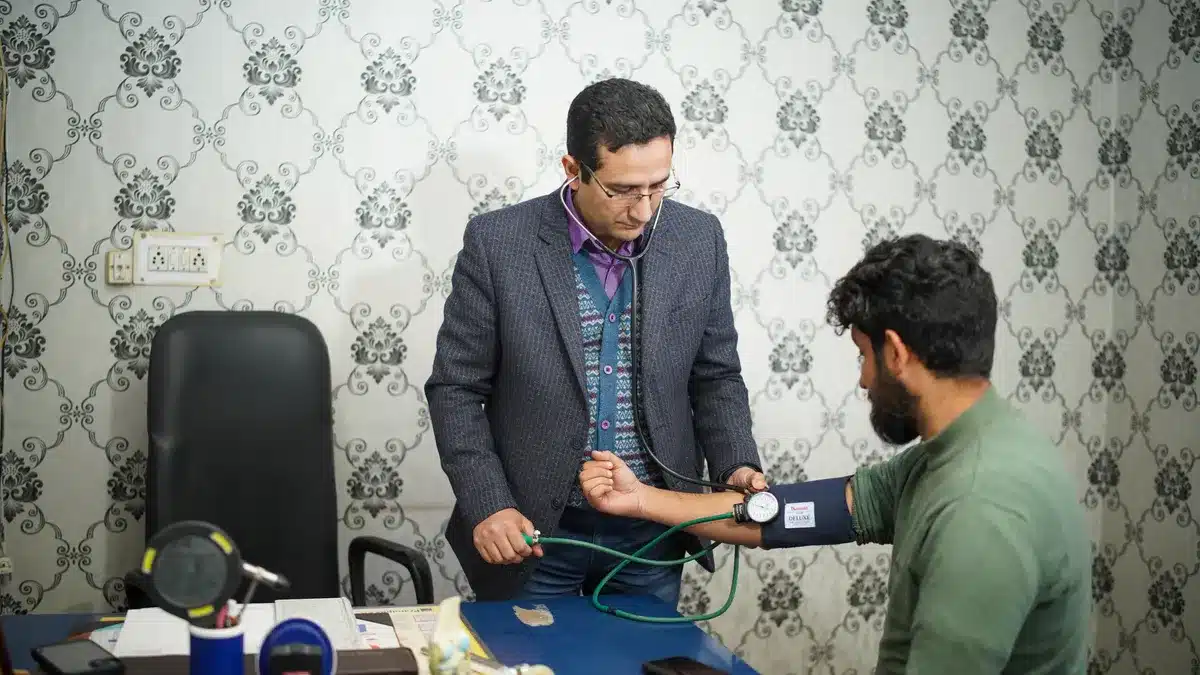
Foreign medical graduates who came for residency or fellowship training are subject to the requirement and cannot use the no-objection route. For most, the waiver is part of a job decision: you accept a qualifying position, commit to a period of service, and move to H-1B status for that employer. Planning should start well before the final year of training.
Conrad State 30
Each state public health department may request up to 30 waivers per federal fiscal year, and up to 10 of those may be for facilities that serve patients from a designated shortage area rather than being located in one. The physician needs a full-time job offer at a qualifying health care facility in a health professional shortage area, a medically underserved area or one serving a medically underserved population, must begin employment within 90 days of the waiver, and must sign a contract to work at least 40 hours per week for at least three years. States set their own priorities, specialties, application windows and documentation rules, and many receive more applications than they have slots. Congress authorizes Conrad 30 for limited periods and most recently extended it in September 2026 stopgap legislation; confirm the program’s current status before relying on it. Our Conrad 30 waiver lawyer page covers eligibility, Ohio’s program rules, contract review and the cap-exempt H-1B in detail.
Federal interested-agency programs
Federal agencies can also request physician waivers when they find a waiver is in the public interest. The Department of Health and Human Services runs clinical and research waiver programs, regional commissions such as the Appalachian Regional Commission and the Delta Regional Authority sponsor physicians in their service areas, and the Department of Veterans Affairs can request waivers for its facilities. Each program sets its own specialties, location rules and service terms. A federal waiver can leave your state’s Conrad slots for other physicians and may suit specialists who do not fit a state’s priorities.
What HLG reviews before you sign
- Whether the facility and location qualify under the program you plan to use, and the program’s current cycle and capacity.
- The employment contract: hours, start date, location, termination terms and any restrictive covenant that could affect the service obligation.
- Timing against your training end date, your J-1 grace period, licensing and the H-1B filing.
- Your spouse’s and children’s status during and after the transition.
- Your long-term route to a green card, such as a physician national interest waiver or employer sponsorship, after the service commitment.
Leaving the position early without an approved reason can bring back the two-year requirement. If a job ends unexpectedly, get advice before agreeing to a new arrangement. HLG also has a guide to H-1B and work visa options for physicians.
Students, researchers, scholars, trainees and other exchange visitors
Most non-physician waivers, whether for a funded graduate student, a postdoc, a visiting professor, a trainee or a teacher, use a no-objection statement. The usual sequence is to open the DS-3035 case and request a no-objection statement from your home government after receiving your waiver case number. The statement must reach the Waiver Review Division through the prescribed embassy or ministry channel. Some foreign governments issue statements quickly; others require ministry approval or have long queues. If your program was funded by the U.S. or your home government, explain the funding history, because funding can weigh against a favorable recommendation.
An exceptional hardship waiver may fit when a U.S. citizen or permanent resident spouse or child would face serious medical, psychological, educational or financial harm if you left, or if the family relocated with you. A persecution waiver requires evidence that you would be persecuted on account of race, religion or political opinion. A federal agency that employs or funds your research may also act as an interested government agency. If you are moving to H-1B, see our guide on changing from J-1 to H-1B with a two-year requirement.

How the J-1 waiver application process works
- Confirm you need a waiver. Review the DS-2019 forms, visa, funding and training records, and request an advisory opinion if your status is uncertain.
- Complete Form DS-3035 online. The J-1 visa waiver recommendation application generates a case number and a barcoded cover page.
- Mail the application and fee together. Send the printed DS-3035 with its barcode, legible copies of every DS-2019 or IAP-66 ever issued to you, and the required fee. Use the current State Department address for your mailing method. Sending the application or fee separately, or using the wrong address, can prevent processing.
- Arrange third-party documents. The no-objection statement, the interested agency’s request or the state health department’s Conrad request is sent by that government office, citing your case number. The Waiver Review Division does not follow up on missing third-party documents, so confirm that the required submission was received.
- File Form I-612 for hardship or persecution. USCIS decides first whether exceptional hardship or persecution exists; the State Department proceeds only after a favorable USCIS finding.
- Recommendation and decision. The Waiver Review Division sends its recommendation to USCIS, part of the Department of Homeland Security, which makes the final decision on the waiver.
Official instructions: State Department J-1 waiver page, waiver eligibility and USCIS Form I-612. HLG’s guide to the J-1 waiver application procedure covers the paperwork in more detail.
How to check your J-1 waiver case status
Track the State Department part of the case with your DS-3035 case number through the State Department’s J visa waiver status system, which is also where you report a change of address. If you filed Form I-612 for hardship or persecution, track that application with its USCIS receipt number through USCIS case status. A favorable State Department recommendation is not the final decision; the waiver is approved only when USCIS acts.
Status taking longer than expected?
Before sending inquiries, confirm that the third-party document actually reached the Waiver Review Division, that your address is current and that your J-1 status, grace period and job start date are protected. A $245 consultation can sort a normal wait from a missing document or a status problem.
How a J-1 waiver lawyer at HLG helps
J-1 waiver assessment
$245 / one hour
Whether you are subject, which basis fits, the evidence needed, the risks, and a timeline built around your program end date and job start. Online or in Cleveland or Columbus/Worthington.
Prepared packet review
$595 / one hour
An attorney goes through your DS-3035, statement of reason, hardship evidence or physician contract with you before you submit. Advance reading and written comments are not included unless agreed before booking.
Full waiver representation
Quoted in writing
Preparation and filing of the waiver, coordination with the home government, agency or state program, Form I-612 where needed, and follow-up, under a written engagement.
Career and status planning
Quoted in writing
Waiver timing coordinated with your next step (H-1B, O-1, a green card or a Conrad 30 or federal physician program), contract review and your family’s status, for exchange visitors and the universities, hospitals and employers that hire them.
Your J-1 waiver attorneys

Richard T. Herman, Esq.
Founder of Herman Legal Group (1995). More than 30 years advising exchange visitors, physicians, researchers, employers and families on waivers, work visas and green cards.

Luis C. Villarroel, Esq.
Born in Venezuela and fluent in English and Spanish. J.D., Capital University Law School; admitted in Ohio; AILA member. Leads HLG’s Columbus-area office in Worthington, Ohio.
Richard T. Herman founded Herman Legal Group in 1995. HLG’s attorneys handle family, employment and waiver cases for clients across the United States and abroad, with consultations available in English, Spanish, Russian, Bulgarian, Serbian, Croatian, Dari and Pashto, and paralegal support in Arabic, French and Chinese. If you have another waiver question, see our immigration waiver services.
J-1 waiver questions
Do I need a J-1 waiver lawyer?
Not always. A no-objection waiver for a researcher with a clear record is often straightforward. Counsel is most useful when you are a physician choosing between Conrad 30 and federal programs, when you need an exceptional hardship or persecution waiver, when your status or a job start date is at risk, or when you are not sure you are subject to the two-year rule at all.
Do you only handle J-1 waivers for physicians?
No. HLG represents any J-1 or J-2 holder subject to the two-year home residency requirement, including students, research scholars, professors, trainees, interns, teachers, specialists and their families, as well as the employers and universities that sponsor them. Physicians have extra options, such as Conrad 30, but every category can use the no-objection, interested agency, hardship or persecution bases that apply to it. Consultations are available in English and Spanish.
How long does a J-1 waiver take?
It depends on the basis. The State Department’s Waiver Review Division must first make a recommendation, and USCIS then decides the waiver. No-objection cases also depend on how long your home government takes to issue the statement. Hardship and persecution cases begin with a USCIS finding on Form I-612. Check the State Department’s current processing-time page rather than relying on a fixed estimate.
What does the J-1 30-day grace period allow?
After you successfully complete the program, the usual 30-day period is for settling your affairs and preparing to leave the United States. It does not authorize work or continued exchange activities. If your sponsor terminates the program for cause, you do not receive that post-completion period. Review your program end date and any separate status or work authorization before committing to a job start date.
How much does a J-1 waiver cost?
The State Department charges a $120 non-refundable processing fee for the DS-3035 waiver recommendation application. A hardship or persecution waiver also requires Form I-612 with USCIS, which has its own fee. At HLG, a waiver assessment consultation is $245 and a one-hour attorney review of a prepared packet is $595; full representation is quoted in writing.
Can I change from J-1 to H-1B without a waiver?
No, not while the two-year home residency requirement applies. A person subject to INA 212(e) cannot obtain H or L status, a K visa or permanent residence until the requirement is satisfied or waived, and generally cannot change status inside the United States.
Does the two-year rule stop me from getting an O-1?
The two-year rule does not list O-1, but a person subject to it generally cannot change status inside the United States. O-1 is therefore usually obtained by applying for the visa abroad. Have the timing and travel risk reviewed before relying on that route.
Am I still subject after the 2024 Skills List change?
Possibly not. The State Department’s revised Exchange Visitor Skills List took effect December 9, 2024 and applies retroactively. If you were subject only because of the Skills List and your country is no longer listed for your skill, you may no longer be subject. Government funding and graduate medical training are separate triggers that still apply. An advisory opinion can confirm your status.
Can a J-1 waiver be denied?
Yes. The State Department can issue an unfavorable recommendation, and USCIS can deny an exceptional hardship or persecution application. A hardship claim based mainly on ordinary family separation is a common weakness, because the State Department says mere separation from family is not enough.
Do my J-2 spouse and children need their own waiver?
Family members in J-2 status are generally subject to the requirement when the J-1 principal is, and they usually benefit from the principal’s waiver. A J-2 spouse who later wants an independent status should have that analyzed before the principal’s case is filed.
Plan your J-1 waiver before your program ends
Bring your DS-2019 forms, visa, funding information, program end date and any job offer. We will tell you whether a waiver is needed, which route fits and what to do first.
Official sources: U.S. Department of State, Waiver of the Exchange Visitor Two-Year Home-Country Physical Presence Requirement · Waiver eligibility · USCIS Form I-612 · USCIS Policy Manual, waiver of the foreign residence requirement
Reviewed by Richard T. Herman, Esq. · Last updated October 2026. General information only, not legal advice. Program rules, fees and authorizations change; eligibility and results depend on the individual case.