
 By
By
Starting October 16, 2025, the U.S. State Department will require all entrants to the Diversity Visa (DV) Lottery—often called the green card lottery—to pay a $1 electronic registration fee. This new rule is intended to help offset the operational costs of administering the diversity visa lottery program. This fee applies to everyone submitting an entry, not just those selected. The change is designed to cover program costs, reduce fraud, and could generate about $25 million annually. The new rule also shifts the burden of funding the lottery program from the government to all applicants, aiming to fairly place the costs among those who benefit.

Understanding the Diversity Visa (DV) Lottery
The Diversity Immigrant Visa Program was created by the Immigration Act of 1990 to increase diversity in U.S. immigration flows. Each year, up to 55,000 immigrant visas are made available to applicants from countries with historically low immigration to the United States.
Key facts about the DV Lottery:
- Eligibility: Limited to nationals of qualifying countries (published annually by DOS).
- Selection Process: Applicants are chosen randomly by computer draw, but only successful registrants are ultimately eligible to apply for a visa.
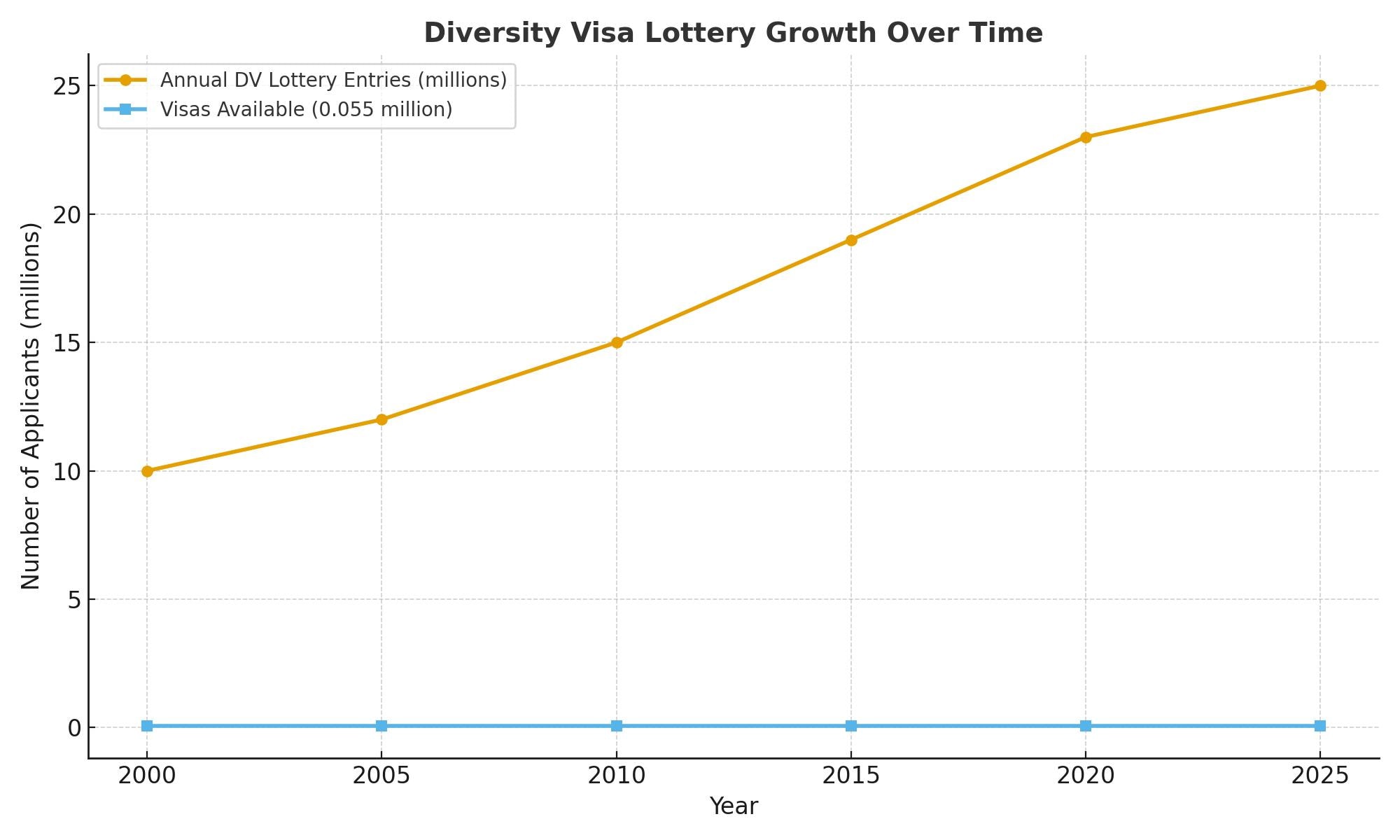
- Annual Demand: Typically 20–25 million entries for 55,000 visas, with tens of millions of participants reflecting the global interest in gaining access to the program.
- Purpose: To diversify immigrant streams and provide opportunities for individuals seeking to immigrate from underrepresented regions.
Did you know? In the 2024 registration cycle, more than 23 million people entered the DV lottery, making it one of the most competitive immigration programs in the world.
For official eligibility details, visit the U.S. Department of State’s DV Program page.
What Is Changing in 2025?
Beginning with the 2027 DV lottery registration period, all who register for the diversity visa lottery (which opens in early October 2025), must pay a $1 fee at the time of entry.
Key details of the new fee system:
- Mandatory Payment: $1 fee per entry through the official Electronic Diversity Visa Entry system (E-DV).
- Non-Refundable: No refunds, regardless of lottery outcome.
- Not Transferable: Cannot be rolled over to future years.
- Application Fee Unchanged: The $330 DV application fee (for only those selected through the lottery) remains the same and is paid as part of the dv application process.
Previously, only the small percentage of successful registrants paid the application fee, but now the registration fee applies to all who register for the diversity visa lottery. This change aims to distribute operational costs more fairly, rather than having only those selected bear the expense.
The exact dates for the opening and closing of the registration period will be announced by the State Department.
Why Introduce a DV Registration Fee?
The DOS provided several justifications for this change:
- Administrative Costs
- Processing tens of millions of free entries each year requires staffing, technology, and security systems.
- The $1 fee distributes these costs across all registrants.
- Revenue Generation
- Estimated 25 million registrants × $1 = $25 million annually.
- Funds will cover system upgrades, cyber-security, and fraud detection.
- The fee ensures that those who benefit from the program help fund its operation.
- Fraud Prevention
- In past years, scammers submitted duplicate or fraudulent entries on behalf of applicants.
- A fee may deter high-volume abuse and fake submissions.
- The fee is also intended to reduce specious registrations and deter actors seeking to exploit unsuspecting potential entrants, helping to protect the process from abuse.
Historical Context: How the DV Lottery Has Evolved
- 1990s: Created as part of a bipartisan immigration reform package. The Diversity Visa lottery program was implemented in 1995, establishing a new pathway for immigrant visas.
- 2000s: Online registration replaced paper entries.
- 2010s: DOS added digital photo requirements and increased fraud detection measures.
- 2020s: Program faced calls for elimination, but also strong support as a tool of soft diplomacy. Recent changes were implemented by the State Department’s Bureau of Consular Affairs, which is responsible for administering the program and adjusting consular services fees.
DV Lottery Growth Over Time
The Bigger Picture: U.S. Immigration Fees on the Rise
This change fits into a broader trend: shifting immigration service costs to applicants.
- USCIS Fee Increases (2024–2025): Higher costs for family petitions, naturalization, and work visas.
- New H-1B $100,000 Fee (September 2025): Aimed at employers sponsoring foreign workers.
- Passport Fee Hikes: DOS increased certain passport processing costs in 2024.
This pattern reflects a “user-pays” approach: the government increasingly funds immigration services through applicant fees rather than taxpayer dollars.
How the $1 Fee Affects Applicants
Potential Benefits
- Improved Odds: Slight decline in total entries may boost chances for serious applicants.
- Reduced Fraud: Fewer fake or duplicate entries.
Potential Barriers
- Access to Banking: Many applicants in Africa, Asia, and Latin America lack access to electronic payment systems.
- Currency Conversion Costs: A $1 fee may cost significantly more once international fees are added.
- Equity Concerns: The DV program’s purpose is diversity; even small barriers may discourage participation from disadvantaged regions.
Visual: Regional Banking Access vs. DV Lottery Participation
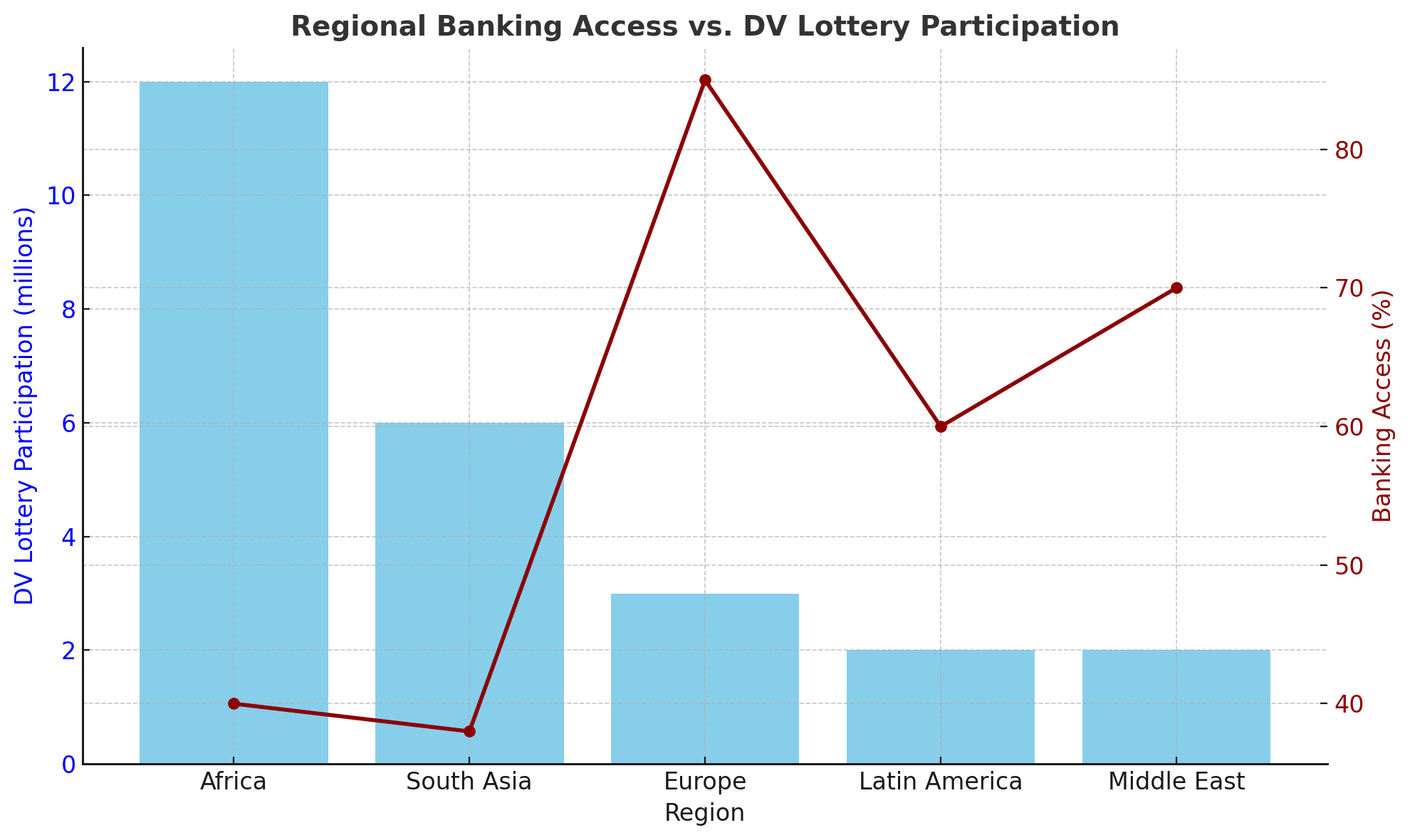
Bar chart comparing high participation regions like Africa and South Asia with low banking access percentages.
How to Successfully Register for the DV Lottery
Here’s a step-by-step preparation guide:
- Check Eligibility: Review the official list of qualifying countries (For Lottery 2026).
- Prepare Your Documents: Valid passport, digital photo, and accurate biographical details.
- Plan for Payment: Ensure access to accepted payment methods.
- Use Only Official Website: DV Program
- Submit Early: Avoid last-minute technical issues or payment failures.
- Keep Confirmation Number: Needed to check selection results.
Risks of Fraud and Scams
With the introduction of the fee, experts warn of increased scam activity:
- Fake websites charging more than $1.
- “Lottery agents” offering to submit entries for inflated fees.
- Phishing scams targeting confirmation numbers.
Scammers and other actors seeking to exploit unsuspecting potential entrants often create fraudulent schemes, making it crucial to protect genuine applicants from these risks.
🔗Read the State Department’s DV Lottery Fraud Warning.
Broader Impact on Global Migration
- For Applicants: A new—but modest—financial hurdle.
- For the U.S.: Improved efficiency, stronger fraud prevention, and program sustainability.
- For Diplomacy: The DV program has long been seen as a goodwill tool; critics argue barriers may undercut that goal.
FAQ: $1 Diversity Visa Lottery Registration Fee
General Questions
What is the new $1 Diversity Visa Lottery registration fee?
The U.S. State Department is now requiring all DV Lottery entrants to pay a $1 electronic registration fee when submitting their entry. This is the first time in program history that applicants are charged to enter the lottery.
When does the $1 DV Lottery fee go into effect?
The rule takes effect on October 16, 2025, for the DV-2027 registration cycle.
Why was a $1 registration fee introduced?
The fee helps cover administrative costs, generates about $25 million annually, and deters fraud by discouraging fake or duplicate entries.
Does this fee replace the $330 visa application fee?
No. The $330 Diversity Visa application fee still applies to those selected for the lottery. The $1 fee is an additional cost just to enter.
Is the $1 registration fee refundable?
No. The fee is non-refundable under all circumstances, even if your entry is not selected or if you made an error on your application.
Payment & Processing
How can I pay the $1 DV Lottery registration fee?
Payment must be made electronically through the official U.S. government registration portal at the time of submission.
What payment methods are accepted?
The State Department has indicated that credit cards, debit cards, and some online banking methods will be accepted. Exact details will be published in the Federal Register.
Can someone else pay my fee for me?
Yes, another person can submit payment on your behalf, but the entry must still be completed and submitted through the official government website.
What happens if my payment is declined?
Your DV Lottery entry will not be accepted. You must resubmit a new entry with a successful payment, and each submission requires another $1 fee.
Can I pay the $1 fee after submitting my entry?
No. Payment must be made at the time of registration. Incomplete entries without payment will be rejected.
Will I get a receipt for my $1 payment?
Yes. The system will generate a confirmation number and payment acknowledgment. Applicants should save both.
Refunds & Transfers
Is the DV Lottery registration fee refundable if I withdraw my entry?
No. Once submitted, the fee is non-refundable, even if you later withdraw your entry.
Can I transfer my $1 fee to a future DV Lottery year?
No. Each year requires a new payment. The fee is valid only for the entry submitted in that registration cycle.
What if I accidentally submit multiple entries—do I get my extra fees back?
No. Duplicate entries are grounds for disqualification, and fees for those entries are not refunded.
Family & Group Applications
Do children included in a parent’s entry require a separate $1 fee?
No. The $1 fee applies only to the principal registrant. Children listed as derivatives on the parent’s entry do not require additional payment.
If both spouses apply separately, do they each need to pay $1?
Yes. Each spouse applying as a principal registrant must pay $1 for their individual entry.
If I’m listed as a derivative on my spouse’s entry, do I also need to pay for my own?
Only if you submit a separate entry as a principal applicant. Otherwise, the $1 applies only to the primary applicant’s submission.
Impact on Selection Odds
Does the $1 fee change my chances of being selected?
No. The lottery remains random. However, since the fee may reduce fraudulent or duplicate entries, genuine applicants could see slightly improved odds.
Will fewer people apply because of the $1 fee?
The State Department expects a slight decline in applications, particularly in regions where electronic payment access is limited.
How does the $1 fee help fight fraud?
Previously, scammers submitted multiple free entries. The $1 requirement makes high-volume fraud costlier and less sustainable.
Technical & Access Issues
What if I live in a country without international credit card access?
Applicants in such regions may need to rely on trusted relatives or intermediaries to process payments, but only through the official U.S. portal.
What if I lose internet access during payment?
Your entry will fail. You must resubmit and pay again. Always ensure a stable connection before starting.
Can I pay the $1 fee in cash or at a U.S. embassy?
No. Payment is strictly electronic, through the online registration portal.
What if the website crashes after I’ve paid?
You should still receive a confirmation number if your payment was processed. If not, you may need to resubmit and pay again.
Advanced/Not-So-Common Questions
Does the $1 fee apply to all DV Lottery applicants worldwide?
Yes. Every applicant must pay, regardless of their country of origin.
Can I submit one entry with multiple family members and pay just $1?
Yes. Only the principal applicant pays. Derivatives listed under that entry are included without additional charges.
What happens if I mistakenly pay twice?
Each payment corresponds to one submission. If you accidentally submit multiple entries, all but one will be invalid, and the extra fees will not be refunded.
Does the $1 fee fund visas directly?
No. The fee supports administrative costs like IT systems, fraud detection, and staffing—not visa issuance.
Will the $1 fee increase in the future?
It is possible. Immigration fees often increase over time. The DOS may adjust the fee depending on program costs.
Does the new fee affect countries with high numbers of applicants like Nigeria, Ghana, or Nepal?
Yes. While $1 is modest, payment access issues in high-participation countries could reduce the number of entries.
Can a third-party DV Lottery service legally charge more than $1 to submit my entry?
No. The official fee is $1. Any third-party service charging more is adding extra costs. Applicants are urged to register directly.
Does the $1 fee guarantee my entry is valid?
No. Your entry must still meet eligibility requirements (correct photos, accurate details, one entry per person). Paying does not guarantee acceptance.
Does the $1 fee apply if I’m selected as an alternate and later called up?
Yes. All initial entries require the fee, regardless of outcome.
Fraud Prevention & Scams
How will the $1 fee affect common DV Lottery scams?
The State Department expects the fee to reduce fraudulent mass entries by scammers, but warns that fake websites may try to overcharge applicants.
How do I avoid scams when paying the $1 fee?
- Register only through DV Program.
- Do not trust third-party emails or links.
- Be wary of anyone charging more than $1.
Can scammers still misuse my information if I pay the $1 fee?
Yes. Applicants should only provide details directly to the official site. Do not give personal information or payments to third-party agents.
Legal and Policy Context
Does the new $1 fee have legal authority?
Yes. The Department of State is authorized to establish fees for visa-related services under U.S. law.
Does this align with the Trump administration’s immigration policies?
Yes. The administration has emphasized cost-sharing and fraud prevention across immigration programs, including new fees in USCIS and DOS services.
Does this mean the Diversity Visa Lottery is here to stay?
Not necessarily. The program has been targeted for elimination by some policymakers, but the fee suggests DOS intends to maintain and strengthen it for now.
Preparation Tips for Applicants
How should I prepare for the $1 DV Lottery registration fee?
- Secure an accepted payment method before registration opens.
- Budget for the fee as part of the process.
- Submit early to avoid technical issues.
- Keep records of payment and confirmation numbers.
What documents should I have ready before paying?
- Valid passport information (if required).
- Recent compliant digital photo.
- Biographical details (name, date of birth, country, education).
- Payment method details.
What if I can’t afford the $1 fee?
Unfortunately, there are no waivers. Applicants unable to pay will be unable to register.
Key Takeaway
The $1 DV Lottery registration fee is a small but significant change. It creates a modest cost barrier for global applicants, while funding fraud prevention and administrative improvements. To succeed, applicants must:
- Pay the $1 fee through official channels
- Avoid fraudulent services
- Plan ahead for banking and internet access challenges
- Keep confirmation numbers safe
Ready to Navigate the Diversity Visa Process with Confidence?
The new $1 registration fee may seem simple, but it’s part of a much larger immigration system that is constantly evolving. One mistake—whether with registration, documentation, or understanding eligibility—can cost you your chance at a green card.
For over 30 years, Attorney Richard T. Herman and the Herman Legal Group have guided immigrants from around the world through complex U.S. immigration challenges. Our firm is known nationally as The Law Firm for Immigrants—with experience spanning the Diversity Visa program, family immigration, employment visas, and deportation defense.
When you schedule a consultation with Richard Herman, you’ll get:
- Clear guidance on DV lottery registration and next steps if selected.
- Protection from fraud and scams that target applicants every year.
- Personalized strategies if you have unique challenges, such as prior visa denials or eligibility questions.
- Trusted advocacy from a law firm that has stood with immigrant families and businesses for three decades.
Don’t take chances with your future in America. Book your confidential consultation today.
👉Schedule your consultation with Richard Herman now
Comprehensive Resource List on the $1 DV Lottery Registration Fee
Government Resources (Official)
- The Electronic Diversity Visa (E-DV) Portal is the only official website where applicants can submit entries and later check their lottery results.
- Information about how winners are chosen is provided at DV Selection & Notifications.
- The U.S. government also maintains a consumer-friendly USA DV Program Portal.
2025 Rulemaking on the $1 Fee
- The official source establishing the new fee is the Federal Register Final Rule (September 16, 2025).
Instructions & Photo Requirements
- Applicants should review the latest DV Program Instructions.
- Photo specifications are detailed in the Digital Photo Requirements, with examples available at DV Photo Examples.
- General image guidance is also provided under Visa Photo Rules.
Fraud Prevention & Reporting
- The State Department offers a DV Fraud Warning.
- Suspected fraud can be reported through the Diplomatic Security Service Fraud Reporting Portal.
- The Federal Trade Commission has also published a Consumer Alert on DV Lottery Scams.
- Some embassies publish local advisories, such as the U.S. Embassy in Iran’s DV Scam Warning.
If You Are Selected
- Detailed next steps are explained in the State Department’s If You Are Selected Guide.
- For a plain-language resource, see USA.gov’s DV Results and What to Do Next.
Context & Cross-Agency Resources
- The U.S. Citizenship and Immigration Services (USCIS) has a helpful page on Green Cards through the DV Program.
- Eligibility and registration basics are also summarized at USA.gov DV Lottery Eligibility.
Professional Associations & Nonprofits
- The American Immigration Lawyers Association (AILA) regularly publishes consular and DV-related updates for practitioners.
- AILA also offers a client-friendly explainer: What Is the Diversity Visa?.
- The American Immigration Council provides a comprehensive fact sheet on the Diversity Visa program, as well as a broader guide on How the U.S. Immigration System Works.
- The Catholic Legal Immigration Network, Inc. (CLINIC) highlights common scams and offers resources on the Role of the Visa Office. CLINIC also runs a training hub
- The Immigrant Legal Resource Center (ILRC) provides practitioner materials and a community resources hub.
- The NAFSA: Association of International Educators offers policy tracking and advocacy, with its Visa and Immigration Policy Reform Principles.
Regional Embassy Resources
- Many U.S. embassies publish Diversity Visa pages. For example, the U.S. Embassy in Burkina Faso maintains a dedicated DV program page with local instructions.