
 By
By
Immigration enforcement is a legitimate government function. Most conservatives agree on that.
But here is the hard truth many Americans are confronting in 2025–2026:
When immigration enforcement becomes militarized, indiscriminate, and unaccountable, it stops being “rule of law” and starts looking like government overreach.
That is why a growing number of conservative-leaning voters—especially libertarian conservatives, constitutional conservatives, and business conservatives—are raising alarms about ICE overreach.
This isn’t a left-wing argument.
This is the core conservative warning that has existed since the founding era:
Government power must be limited, transparent, and restrained—or it will expand until it harms everyone.
Fast Facts: The Conservative Case Against ICE Overreach (Quick Summary)
Bottom line: Conservatives can support immigration enforcement and still oppose ICE overreach.
Key conservative objections in 2025–2026:
-
Unaccountable federal power (raids, surveillance, escalating tactics)
-
Due process erosion (detain first, sort later)
-
Sweeping operations that harm communities and local economies
-
Militarized enforcement culture that increases risk of tragedy
-
Weak transparency (who is accountable when something goes wrong?)
Conservative “middle path” solution:
-
Focus enforcement on serious public safety threats
-
Require de-escalation and constitutional compliance
-
Expand oversight and transparency
-
Modernize immigration pathways so enforcement isn’t used as a substitute for policy
If you are worried about your rights during enforcement operations, start with:
What to Do If ICE Comes to Your Door: 10 Smart Things

A Conservative Starting Point: Enforcement Is Not a Blank Check
Conservatism is not “whatever the government wants, as long as the target is unpopular.”
True conservatism is:
-
limited government
-
individual liberty
-
due process
-
transparent enforcement
-
constitutional boundaries
That means conservatives can support immigration laws while still insisting:
Enforcement must be restrained
Enforcement must be accountable
Enforcement must not become political theater
If you’re looking for a detailed overview of how enforcement is changing, see:
Why Is ICE So Aggressive and Militaristic?

What “ICE Overreach” Means (In Plain English)
ICE overreach typically means enforcement tactics that go beyond targeted public safety goals and begin to resemble indiscriminate, high-pressure policing, such as:
-
sweeping workplace raids targeting non-violent workers
-
enforcement quotas and volume-driven arrest targets
-
tactics that escalate rather than de-escalate
-
operations that undermine trust in local institutions
-
detention expansion that becomes punishment-like rather than administrative
In 2025–2026, concerns are growing that enforcement is being driven by political demands and optics rather than public safety prioritization.
For example, HLG has examined enforcement priorities and concerns about “volume” enforcement here:
Does the ICE Quota Put Me at Increased Risk? What Trump’s 3,000 Daily Arrest Mandate Means

The Conservative Argument in One Sentence
A government powerful enough to raid, detain, and surveil large groups of people with minimal transparency is powerful enough to do that to citizens too.
That’s the conservative concern.
Not “no enforcement.”
But no unchecked enforcement.
Major Conservative Celebrities and Respected Voices Opposing ICE Overreach (2025–2026)
For years, Trump’s immigration agenda was treated as a loyalty test inside conservative politics: if you were “tough,” you supported aggressive enforcement—no questions asked.
But in 2025–2026, that automatic support is cracking.
A growing number of conservative and conservative-adjacent voices are publicly warning that ICE’s tactics—especially when militarized, escalation-prone, or sweep-based—aren’t “law and order.”
They’re government overreach.
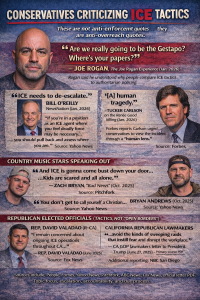
Joe Rogan: “Are we really going to be the Gestapo?”
One of the most high-impact conservative-adjacent critiques came from Joe Rogan, a cultural heavyweight who previously endorsed Trump and whose audience is heavily male, independent, and right-leaning.
After the Minneapolis ICE operation that ended with the killing of Renee Nicole Good, Rogan condemned the escalation and the broader direction of immigration enforcement—explicitly comparing ICE tactics to authoritarian policing:
“Are we really going to be the Gestapo? Where’s your papers?”
He described the situation as “horrific” and warned that militarized enforcement risks turning communities into “papers please” zones where ordinary people can be “snatched up” in public without real accountability.
Read more coverage here: Axios: Rogan blasts Trump’s “Gestapo” immigration tactics and The Guardian: Rogan questions Trump’s immigration enforcement after Minneapolis shooting.
Tucker Carlson: Conservatives should view the shooting through a “human lens”
In a rare break from hardline enforcement messaging, conservative pundit Tucker Carlson publicly criticized the right’s reaction to the same incident—pushing conservatives to treat the death as a human tragedy rather than propaganda fuel.
According to reporting, Carlson called the killing a “human tragedy” and asked why Republicans weren’t viewing it through a “human lens.”
Source: Forbes: Tucker Carlson blasts conservative response to Renee Good’s death.
Bill O’Reilly: “ICE needs to de-escalate”
Another major conservative voice to break from the “ICE can do no wrong” line was Bill O’Reilly, who argued that federal agents should not escalate situations into deadly force encounters.
O’Reilly stated bluntly:
“ICE needs to de-escalate.”
He went further, arguing that when an operation reaches a point where deadly force feels likely, agents should pull back instead of pushing forward into a confrontation that can spiral into tragedy.
Source: Salon: “ICE needs to de-escalate”: O’Reilly calls on DHS to tone down tactics.
Republicans breaking with Trump over sweeping raids (2025): “Avoid the kinds of sweeping raids…”
Not all opposition to ICE tactics is coming from media celebrities.
In 2025, six California Republican lawmakers issued one of the clearest GOP statements against the enforcement approach itself—urging Trump to stop broad workplace raids and refocus on violent offenders.
In their formal letter to the President, the lawmakers called on DHS:
“…to focus their enforcement operations on criminal immigrants, and when possible to avoid the kinds of sweeping raids that instill fear and disrupt the workplace.”
They also urged modernization of immigration policy to allow certain long-term, non-criminal undocumented residents a pathway toward legal status.
Primary source letter (PDF): California GOP letter to President Trump (June 27, 2025)
Additional coverage: Los Angeles Times: California Republicans tell Trump ICE raids should focus on criminals, not ordinary workers.
Why these conservative quotes matter
These voices aren’t arguing for “open borders.”
They’re making a different—and deeply conservative—claim:
-
Enforcement has limits
-
State power must be restrained
-
Militarized raids create backlash and instability
-
Sweeping operations hurt families, workplaces, and trust
-
Deadly force incidents destroy public legitimacy
In other words:
A conservative can support immigration enforcement and still oppose ICE overreach.
That is not weakness.
That is constitutional principle.
Conservative Rights Checklist (Do This, Not That)
This checklist is designed for conservative and independent-minded Americans who believe in the Constitution, respect law enforcement, and still want to protect liberty.
DO: Demand constitutional enforcement
-
Ask whether actions require a judge-signed warrant
-
Demand transparency about what authority is being used
Start here:
Can ICE Enter My Home Without a Warrant?
DO: Stay calm and use silence strategically
-
You do not have to answer questions beyond identifying information
-
Do not guess or “talk your way out of it”
-
Ask for a lawyer
Practical guide:
What to Do If ICE Comes to Your Door (10 Smart Things)
DO: Document encounters safely (without interfering)
If you witness enforcement activity, you can often record from a safe distance—but do not obstruct.
Helpful legal guidance:
ACLU — Filming and Photographing the Police
DO: Protect your family and paperwork
Have a plan:
-
emergency contacts
-
childcare plan
-
attorney contact information
-
key documents secured
Ohio-specific planning resource:
How to Prepare for an ICE Arrest in Columbus, Ohio
DON’T: Assume “only criminals” are at risk
In practice, enforcement can sweep broadly, especially during crackdowns and quota-driven periods.
DON’T: Confuse administrative warrants with judicial warrants
This is one of the most misunderstood issues. A “warrant” is not always a judge warrant.
DON’T: Take the government’s “public safety” framing at face value
Ask:
-
Is this targeted?
-
Is this lawful?
-
Is this necessary?
-
Is there oversight?
The Business Conservative Case: Sweeping Raids Are Bad for Markets and Community Stability
Even many pro-enforcement conservatives believe sweeping workplace raids:
-
disrupt labor markets
-
destabilize industries (restaurants, hotels, construction, agriculture)
-
push workers underground
-
reduce community cooperation with police
-
increase chaos without improving safety
That is why you are increasingly seeing conservative-leaning “workforce realism” arguments emerge in 2025–2026—even among Republicans who do not support broad legalization.
The Due Process Conservative Case: Detention Should Not Become Punishment
Many Americans do not realize how much immigration enforcement relies on detention power.
When detention becomes routine and prolonged, the conservative question becomes:
Is the government using detention as a tool of administrative process—or as coercion and punishment?
HLG has covered the record growth in detention and its impact here:
New Record: ICE Detainee Population Reaches High (2025)
The “Door Knock” Reality: Rights Matter Most When You’re Afraid
Rights do not matter in the abstract.
They matter in the moment:
-
when agents are at your home
-
when a parent is terrified
-
when a spouse doesn’t know what happens next
-
when someone is detained and the family cannot locate them
Start here:
What to Do If ICE Comes to Your Door
If You’re Facing Enforcement: Talk to a Lawyer Before You “Do Something Permanent”
In the panic of an enforcement threat, people often make irreversible mistakes:
-
leaving the U.S. without advice
-
withdrawing valid applications
-
missing court deadlines
-
signing papers without understanding them
If you need guidance, you can book directly here:
Book a Consultation with Herman Legal Group
Frequently Asked Questions (Conservative ICE Overreach FAQ)
1) Is opposing ICE overreach the same as supporting open borders?
No. Many conservatives support immigration enforcement but oppose sweeping raids, militarized tactics, and due-process shortcuts.
2) Can ICE enter my home without a warrant?
Often not legally, unless they have valid authority. A key issue is whether the document is a judge-signed judicial warrant versus an ICE administrative form.
Start here:
Facing an Immigration Crackdown in Your City? What Non-Citizens Must Know
3) What should I do if ICE comes to my door?
Stay calm, do not open the door without verifying authority, do not consent to entry, and contact counsel.
Step-by-step:
What to Do If ICE Comes to Your Door: 10 Smart Things
4) Do I have the right to remain silent?
In many scenarios, yes—you should avoid answering substantive questions without an attorney.
5) Can I record ICE activity?
Recording government officials performing duties in public is often protected, but you must not interfere.
Guidance:
ACLU — Filming and Photographing the Police
6) What is an “ICE administrative warrant”?
Many ICE documents are not signed by a judge. That difference can be critical for home entry authority.
7) Are green card holders at risk during enforcement crackdowns?
Yes. LPRs can face detention or removal in certain situations (old convictions, travel issues, alleged abandonment, etc.).
See:
Facing an Immigration Crackdown in Your City? What Non-Citizens Must Know
8) Are workplace raids really happening in 2025–2026?
Yes—enforcement activity and fear spikes have been widely reported, including local impacts in Ohio.
Ohio example:
ICE Arrests in Columbus, Ohio: Explosive Effects
9) What is an immigration bond?
An immigration bond may allow a detained person to be released while their case continues in immigration court.
Ohio example:
Operation Buckeye: ICE Arrests in Columbus Ohio
10) Does ICE prioritize only “criminal immigrants”?
Not always in practice—especially during high-pressure enforcement periods.
11) What is “ICE overreach” in practical terms?
Usually it means enforcement that becomes:
-
overly broad
-
escalation-first
-
quota-driven
-
detention-heavy
-
weak on transparency and oversight
For more detail:
Why Is ICE So Aggressive and Militaristic?
12) What should families do before an arrest happens?
Prepare documents, emergency plans, and legal strategy in advance.
Ohio guide:
How to Prepare for an ICE Arrest in Columbus, Ohio
13) What if ICE arrests someone at a USCIS interview?
That risk has been documented in 2025–2026 in at least some field office contexts.
See:
Married to a U.S. Citizen but Still Handcuffed? (San Diego Interview Arrests)
14) What are my rights if I want to protest ICE activity?
You generally have First Amendment protections, but there are lawful limits and safety issues.
See:
ACLU — Protesters’ Rights
15) When should I talk to an immigration lawyer?
Immediately—especially before:
-
traveling
-
signing anything
-
leaving the U.S.
-
withdrawing an application
-
skipping a hearing
Consultation link:
Book a Consultation
Closing: The Conservative Bottom Line
Conservatives don’t have to choose between:
-
“no enforcement,” and
-
“unchecked enforcement.”
The conservative position is clearer than that:
Enforce the law—within the Constitution.
Keep power limited.
Keep it transparent.
Keep it accountable.
And if your family is facing enforcement risk, preparation matters more than panic.
Start here:
What to Do If ICE Comes to Your Door
Or book help here:
Book a Consultation
Resource Directory: ICE Militarization, Use of Force, Constitutional Rights, and Lawful Boycotts (2025–2026)
A) Herman Legal Group (HLG) Resources
ICE Militarization, Raids, and Enforcement Escalation
Know-Your-Rights: Home Visits, Door Knocks, and Arrest Preparation
Ohio / Columbus: Enforcement Activity + Community Response
“Arrest at USCIS” and Enforcement Trap Risks
Action / Help
B) Constitutional Rights When ICE Shows Up (External)
Right to Film / Record ICE (First Amendment)
Filming Police / Government Officials (General)
C) Use of Force Standards (Government / Primary Sources)
DHS Department-Wide Use of Force Policy
ICE Detention Use-of-Force / Restraints Standard
ICE Use of Force (Historical Policy Source via AILA)
Federal Standards (Context)
D) Masked/Unidentified Agents, “Secret Police” Concerns, Militarized Tactics (External Reporting)
These sources are useful for explaining the controversy around masked enforcement, lack of accountability, and public fear:
-
Washington Post: ICE Chief Stands By Mask Use in Immigration Raids (2025)
-
TIME: California Bans ICE Agents From Wearing Masks to Conceal Identity
E) ICE Enforcement at Courthouses (Policy Document)
F) Lawful Boycotts, “Corporate Accountability,” and First Amendment Protection
The Right to Boycott (Core Constitutional Protection)
-
ACLU: It’s Time to Reaffirm Our First Amendment Right to Boycott
-
ACLU: The First Amendment Protects the Right to Boycott (Anti-Boycott Laws Explained)
-
ACLU Press Release: Supreme Court Declines to Review Challenge to Law Restricting Boycotts
Boycott-Related Legal Challenges (Example State-Level)
G) “Safe Boycott” + Verifying ICE Contractors (Best Practice Sources)
If you publish boycott content, the safest approach is verifiable facts + authoritative records:
Federal Contract Verification
“Do Not Guess” / Use Evidence Standards
-
Use award records (recipient, award ID, obligated amount, agency)
-
Archive screenshots
-
Use neutral language if you cannot confirm
H) Quick “One-Click” Mini Index
Militarized ICE / raids
Use of force / deadly force standards
Recording ICE / protesting
Boycotts
Get help / plan ahead