Top 40 Famous U.S. Brands Founded (or Co-Founded) by Immigrants (2026)
By Richard T. Herman (Co-Author, Immigrant, Inc.) | Herman Legal Group
Quick Answer
Some of America’s most iconic, job-creating brands—including leaders in AI, semiconductors, payments, biotech, communications, retail, logistics, and food—were founded or co-founded by immigrants. This is not a branding slogan. It is a repeatable American pattern: immigrants arrive, build companies, hire at scale, and generate new industries that employ millions of U.S. workers.
The strategic risk for the U.S. economy is straightforward: if the United States makes it harder for immigrant builders to study here, work here, and remain here legally, then the next wave of immigrant founders will build somewhere else—meaning fewer startups, fewer scaling companies, and fewer American jobs.
Fast Facts / Key Takeaways (Shareable)
- Many of the most recognizable U.S. brands were built by immigrant founders or immigrant co-founders.
- Immigrant entrepreneurs are disproportionately represented in high-growth industries like AI, semiconductors, biotech, payments, and cloud infrastructure.
- Immigrants are nearly twice as likely to become entrepreneurs in the U.S. than U.S.-born Americans.
- A National Foundation for American Policy (NFAP) policy brief reported immigrants founded 55% of U.S. startup companies valued at $1 billion+ in their dataset.
- Immigrants are more likely to have earned a U.S. patent than U.S.-Born Americans.
- 46% of Fortune 500 companies (230 companies) were founded by immigrants or their children
- Immigrant founders create jobs directly through payroll—and indirectly through suppliers, contractors, and local economic spillovers.
- Innovation follows ecosystems. When founders cannot get stable status, they build elsewhere.
- The U.S. system is still not consistently optimized for founders and startups—and the current policy environment adds new friction to the founder pipeline. (migrationpolicy.org)
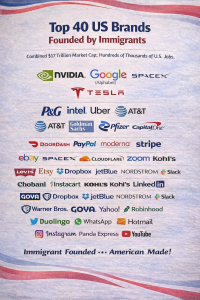
Top 40 Famous U.S. Brands Founded (or Co-Founded) by Immigrants (2026)
Exploring the top immigrant-founded companies reveals their significant impact on the U.S. economy and innovation landscape.
-
NVIDIA — Jensen Huang — Taiwan
-
Google (Alphabet) — Sergey Brin — Soviet Union/Russia
-
Tesla — Elon Musk — South Africa
-
Procter & Gamble (P&G) — William Procter; James Gamble — England; Ireland
-
Uber — Garrett Camp — Canada
-
Intel — Andrew Grove — Hungary
-
AT&T (Bell System origins) — Alexander Graham Bell — Scotland
-
Goldman Sachs — Marcus Goldman — Germany
-
Pfizer — Charles Pfizer — Germany
-
Capital One — Nigel Morris — United Kingdom
-
SpaceX — Elon Musk — South Africa
-
DoorDash — Tony Xu — China
-
PayPal — Peter Thiel; Max Levchin — Germany; Ukraine
-
Kraft (Kraft Heinz legacy) — James L. Kraft — Canada
-
Moderna — Noubar Afeyan — Lebanon
-
Stripe — Patrick Collison; John Collison — Ireland
-
eBay — Pierre Omidyar — France
-
Cloudflare — Michelle Zatlyn — Canada
-
Zoom — Eric Yuan — China
-
Robinhood — Baiju Bhatt — India
-
Instacart (Maplebear) — Apoorva Mehta — India
-
Kohl’s — Maxwell Kohl — Poland
-
Levi’s — Levi Strauss — Germany
-
Etsy — Rob Kalin — Canada
-
Duolingo — Luis von Ahn — Guatemala
-
Dropbox — Arash Ferdowsi — Iran
-
JetBlue — David Neeleman — Brazil
-
Nordstrom — John W. Nordstrom — Sweden
-
Chobani — Hamdi Ulukaya — Turkey
-
Panda Express — Andrew Cherng; Peggy Cherng — China; Myanmar
-
Goya Foods — Unanue family — Spain
-
LinkedIn — Konstantin Guericke; Eric Ly — Germany; Vietnam
-
WhatsApp — Jan Koum — Ukraine
-
Instagram — Mike Krieger — Brazil
-
YouTube — Jawed Karim; Steve Chen — Germany; Taiwan
-
Slack — Cal Henderson — United Kingdom
-
Yahoo! — Jerry Yang — Taiwan
-
Oscar Mayer — Oscar F. Mayer — Germany
-
Warner Bros. — Harry Warner; Albert Warner; Sam Warner; Jack Warner — Eastern Europe / Poland region
-
Hotmail (Microsoft) — Sabeer Bhatia — India
Important note on accuracy: Many major companies are “co-founded” (not solely founded) by immigrants. This article intentionally uses founded or co-founded, because precision matters.
Below, each company includes estimates on market cap, number of employees, and a description of the founder’s innovation.
Top 40 Immigrant-Founded American Brands: A Look at the Top Immigrant-Founded Companies
1) NVIDIA
- Immigrant founder/co-founder: Jensen Huang (born in Taiwan)
- Why it matters: The most consequential semiconductor company of the AI boom—powering modern data centers, generative AI, and advanced computing.
- Market cap: Approx. $2T–$4T (varies)
- Employees: ~30,000+
- Company history: NVIDIA — About
2) Google (Alphabet)
- Immigrant co-founder: Sergey Brin (born in the Soviet Union/Russia)
- Why it matters: Built the modern search economy and became a dominant platform in advertising, cloud, and AI.
- Market cap: Approx. $3T–$4T (varies)
- Employees: ~190,000+
- Company history: Google — Our Story
3) Tesla
- Immigrant founder / founding leader (widely recognized): Elon Musk (born in South Africa)
- Why it matters: Mainstreamed EV adoption and forced the global auto industry toward software + electrification.
- Market cap: Approx. $500B–$1.5T (varies)
- Employees: ~140,000+
- Company history: Tesla — About
4) Procter & Gamble (P&G)
- Immigrant founders: William Procter (England), James Gamble (Ireland)
- Why it matters: Built America’s archetypal household consumer brands across home, hygiene, and personal care.
- Market cap: Approx. $300B+ (varies)
- Employees: ~100,000+
- Company history: P&G — Our History
5) Uber
- Immigrant co-founder: Garrett Camp (born in Canada)
- Why it matters: Reshaped global transportation and delivery logistics, redefining on-demand mobility.
- Market cap: Approx. $100B–$200B+ (varies)
- Employees: ~30,000+ (drivers/couriers not employees)
- Company history: Uber — About
6) Intel
- Immigrant co-founder / defining leader: Andrew Grove (born in Hungary)
- Why it matters: A core engine of modern computing—helped power PCs, enterprise infrastructure, and the chip ecosystem.
- Market cap: Approx. $100B–$250B (varies)
- Employees: ~100,000+
- Company history: Intel — Company Overview
7) AT&T (Bell System origins)
- Immigrant origin inventor: Alexander Graham Bell (born in Scotland)
- Why it matters: A foundational telecom institution with deep roots in the modern communications network.
- Market cap: Approx. $100B+ (varies)
- Employees: ~150,000+
- Company history: AT&T — Our History
8) Goldman Sachs
- Immigrant founder: Marcus Goldman (born in Germany)
- Why it matters: A defining Wall Street institution shaping global investment banking and capital markets.
- Market cap: Approx. $100B+ (varies)
- Employees: ~45,000+
- Company history: Goldman Sachs — History
9) Pfizer
- Immigrant founder: Charles Pfizer (born in Germany)
- Why it matters: A global pharmaceutical leader known for R&D scale and public health impact.
- Market cap: Approx. $100B+ (varies)
- Employees: ~80,000+
- Company history: Pfizer — Our History
10) Capital One
- Immigrant co-founder (widely credited): Nigel Morris (born in the United Kingdom)
- Why it matters: A major consumer bank that modernized credit + banking through tech investment and data strategy.
- Market cap: Approx. $50B–$150B (varies)
- Employees: ~50,000+
- Company history: Capital One — About
11) SpaceX
- Immigrant founder: Elon Musk (born in South Africa)
- Why it matters: Transformed U.S. launch capacity and commercial space with reusable rockets and Starlink.
- Valuation: Private (varies by funding round)
- Employees: Not consistently reported publicly
- Company history: SpaceX — About
12) DoorDash
- Immigrant co-founder: Tony Xu (born in China)
- Why it matters: Built a defining on-demand logistics network for restaurants and local commerce.
- Market cap: Approx. $40B–$100B (varies)
- Employees: ~20,000+ (excluding contractors)
- Company history: DoorDash — About
13) PayPal
- Immigrant co-founders: Peter Thiel (Germany), Max Levchin (Ukraine)
- Why it matters: A foundational fintech platform that mainstreamed digital payments for global e-commerce.
- Market cap: Approx. $50B+ (varies)
- Employees: ~25,000+
- Company history: PayPal — About
14) Kraft (Kraft Heinz legacy)
- Immigrant founder (brand origin): James L. Kraft (born in Canada)
- Why it matters: A century-defining consumer food brand that shaped American packaged goods.
- Market cap: Approx. $30B–$60B (varies)
- Employees: ~30,000–40,000+
- Company history: Kraft Heinz — Our Heritage
15) Moderna
- Immigrant founding leader / co-founder (widely credited): Noubar Afeyan (born in Lebanon)
- Why it matters: Helped validate mRNA as a platform for modern vaccines and therapeutics.
- Market cap: Approx. $30B–$80B (varies)
- Employees: ~5,000+
- Company history: Moderna — About
16) Stripe
- Immigrant founders: Patrick Collison (Ireland), John Collison (Ireland)
- Why it matters: Dominant internet payments infrastructure for startups and online commerce.
- Valuation: Private (varies)
- Employees: Not consistently disclosed publicly
- Company history: Stripe — About
17) eBay
- Immigrant founder: Pierre Omidyar (born in France)
- Why it matters: One of the first major internet marketplaces—defining consumer e-commerce at scale.
- Market cap: Approx. $20B–$40B (varies)
- Employees: ~10,000+
- Company history: eBay — Our History
18) Cloudflare
- Immigrant co-founder: Michelle Zatlyn (born in Canada)
- Why it matters: Core internet backbone provider for security, performance, and reliability worldwide.
- Market cap: Approx. $20B–$40B (varies)
- Employees: ~3,000+
- Company history: Cloudflare — About
19) Zoom
- Immigrant founder: Eric Yuan (born in China)
- Why it matters: Became a global communications utility for remote work, education, and meetings.
- Market cap: Approx. $15B–$40B (varies)
- Employees: ~7,000+
- Company history: Zoom — About
20) Robinhood
- Immigrant co-founder: Baiju Bhatt (born in India)
- Why it matters: Expanded retail investing access and normalized commission-free trading.
- Market cap: Approx. $10B–$40B (varies)
- Employees: ~2,000+
- Company history: Robinhood — About
21) Instacart (Maplebear)
- Immigrant founder: Apoorva Mehta (born in India)
- Why it matters: Popularized app-based grocery delivery across the U.S. at national scale.
- Market cap: Approx. $10B–$30B (varies)
- Employees: ~3,000+ (excluding contractors)
- Company history: Instacart — Company
22) Kohl’s
- Immigrant founder: Maxwell Kohl (born in Poland)
- Why it matters: One of America’s best-known department store chains and a nationwide retail anchor.
- Market cap: Public company (varies)
- Employees: ~90,000+
- Company history: Kohl’s — History
23) Levi’s
- Immigrant founder: Levi Strauss (born in Germany)
- Why it matters: Iconic American apparel brand strongly tied to U.S. cultural identity and workwear history.
- Market cap: Public company (varies)
- Employees: ~10,000+
- Company history: Levi Strauss — Who We Are
24) Etsy
- Immigrant founder: Rob Kalin (born in Canada)
- Why it matters: Leading marketplace for handmade goods—supporting millions of micro-entrepreneurs.
- Market cap: Approx. $5B–$20B (varies)
- Employees: ~2,000+
- Company history: Etsy — About
25) Duolingo
- Immigrant co-founder: Luis von Ahn (born in Guatemala)
- Why it matters: Most recognized language-learning app—gamified education at massive scale.
- Market cap: Approx. $10B–$25B (varies)
- Employees: ~700–1,000+
- Company history: Duolingo — About
26) Dropbox
- Immigrant co-founder: Arash Ferdowsi (born in Iran)
- Why it matters: Major cloud storage/collaboration platform that normalized “work-from-anywhere” files.
- Market cap: Public company (varies)
- Employees: ~2,000+
- Company history: Dropbox — About
27) JetBlue
- Immigrant founder: David Neeleman (born in Brazil)
- Why it matters: Customer-first airline brand that reshaped U.S. low-cost air travel expectations.
- Market cap: Public company (varies)
- Employees: ~20,000+
- Company history: JetBlue — About
28) Nordstrom
- Immigrant founder: John W. Nordstrom (born in Sweden)
- Why it matters: Flagship American retailer known for service-driven strategy and premium positioning.
- Market cap: Public company (varies)
- Employees: ~50,000+
- Company history: Nordstrom — Company History
29) Chobani
- Immigrant founder: Hamdi Ulukaya (born in Turkey)
- Why it matters: Built one of the biggest modern American food success stories in dairy and beyond.
- Valuation: Private (varies)
- Employees: Several thousand (varies)
- Company history: Chobani — Our Story
30) Panda Express
- Immigrant founders: Andrew Cherng (China), Peggy Cherng (Myanmar)
- Why it matters: The most influential Chinese-American fast-casual brand in U.S. history.
- Valuation: Private
- Employees: ~40,000+
- Company history: Panda Express — Our Story
31) Goya Foods
- Immigrant founders: Unanue family (Spanish immigrants)
- Why it matters: A defining U.S. Hispanic pantry brand and iconic immigrant success story in food retail.
- Valuation: Private
- Employees: ~4,000+
- Company history: Goya — Our History
32) LinkedIn (Microsoft)
- Immigrant co-founders: Konstantin Guericke (Germany), Eric Ly (Vietnam)
- Why it matters: The world’s dominant professional identity and recruiting platform.
- Market cap: Not separately traded (owned by Microsoft)
- Employees: Not consistently disclosed standalone
- Company history: LinkedIn — About
33) WhatsApp (Meta)
- Immigrant co-founder: Jan Koum (born in Ukraine)
- Why it matters: One of the world’s most used messaging platforms—core to global communications.
- Market cap: Not separately traded (owned by Meta)
- Employees: Not disclosed standalone
- Company history: WhatsApp — About
34) Instagram (Meta)
- Immigrant co-founder: Mike Krieger (born in Brazil)
- Why it matters: A dominant social platform shaping media, branding, commerce, and culture.
- Market cap: Not separately traded (owned by Meta)
- Employees: Not disclosed standalone
- Company history: Instagram — About
35) YouTube (Google)
- Immigrant co-founders: Jawed Karim (Germany), Steve Chen (Taiwan)
- Why it matters: The most important video platform—reshaping entertainment, education, and creator economies.
- Market cap: Not separately traded (owned by Alphabet)
- Employees: Not disclosed standalone
- Company history: YouTube — About
36) Slack (Salesforce)
- Immigrant co-founder (credited in early history): Cal Henderson (born in the United Kingdom)
- Why it matters: Helped define modern workplace messaging and team operations.
- Market cap: Not separately traded (owned by Salesforce)
- Employees: Not disclosed standalone
- Company history: Slack — About
37) Yahoo!
- Immigrant co-founder: Jerry Yang (born in Taiwan)
- Why it matters: A landmark early internet brand central to portals, email, and web discovery.
- Valuation: Owned/held via corporate structures (varies)
- Employees: Not consistently disclosed publicly
- Company history: Yahoo — About
38) Oscar Mayer
- Immigrant founder: Oscar F. Mayer (born in Germany)
- Why it matters: One of the most recognized U.S. packaged meat brands in American food history.
- Market cap: Not separately traded (brand within larger corporate structure)
- Employees: Not disclosed standalone
- Company history: Oscar Mayer — About
39) Warner Bros.
- Immigrant founders: Harry, Albert, Sam, and Jack Warner (Eastern Europe / modern Poland region)
- Why it matters: One of America’s most iconic studios—shaping film, TV, and global media for 100+ years.
- Market cap: Not separately traded (brand within WBD)
- Employees: Not disclosed standalone
- Company history: Warner Bros. — About
40) Hotmail (Microsoft)
- Immigrant co-founder: Sabeer Bhatia (born in India)
- Why it matters: One of the first major webmail brands—changed how the world accessed email remotely.
- Market cap: Not separately traded (brand within Microsoft/Outlook)
- Employees: Not disclosed standalone
- Company history: Microsoft — About
The Core Economic Point: Immigrant Founders Create Jobs for Americans
This is the chain too many arguments skip:
- A founder starts a company →
- The company hires workers (often locally) →
- Workers spend money in the community →
- Suppliers and service businesses expand →
- Innovation increases competitiveness →
- Growth compounds into more jobs
In Immigrant, Inc., my co-author and I made the case that immigrant entrepreneurship is not a niche issue. It is a recurring driver of American job creation and global advantage.

References: Immigrant, Inc. (Wiley) | HLG page on the book
Quick Fact: Where New Jobs Come From in the U.S.
Most net new jobs in the U.S. economy come from new and young firms, not from older incumbent companies. The Kauffman Foundation has shown that young firms (often under five years old) account for a dominant share of net job creation in key datasets. In BLS data, establishment births can account for roughly 1 million jobs in a single quarter, illustrating how powerful startup formation is for job growth.
References: Kauffman — Where Will the Jobs Come From? | BLS — Business Employment Dynamics Summary
This is why immigrant entrepreneurship matters as an American jobs strategy: immigrant founders help increase the number of new businesses formed in the U.S., and new businesses are the pipeline for future employers.
The Policy Risk: Trump’s Agenda Can Choke the Founder Pipeline
If the United States wants the next Google, the next NVIDIA, the next Stripe, and the next Chobani, it has to protect the pipeline that produces immigrant founders:
Student visas → education and networks → work authorization (OPT) → early-career employment (often H-1B) → scaling → entrepreneurship and job creation.
When government policy injects instability at any point in that chain, the predictable outcome is that some founders will not build here—especially in sectors where the U.S. competes globally for talent.
Below are concrete examples of how the current policy environment can raise friction for future immigrant founders.

1) H-1B obstacles can disrupt the “early-career builder” stage
Many immigrant founders do not start as founders. They start as engineers, researchers, product leaders, and operators—often after F-1 study and OPT—then shift into entrepreneurship once they have network density and domain credibility.
Policy actions that restrict H-1B entry or raise costs can reduce the odds that top talent stays in the U.S. long enough to become founders. For example:
- The White House issued a proclamation titled “Restriction on Entry of Certain Nonimmigrant Workers” that targets H-1B entry, and the State Department published implementation guidance. (The White House)
- The American Immigration Council has also described the administration’s $100,000 H-1B fee policy and USCIS implementation details, which can function as a significant barrier for many employers—especially startups and smaller innovation firms that often become the “training ground” for future founders. (American Immigration Council)
Policies that restrict or destabilize H-1B status reduce the ability of the U.S. economy to retain future founders long enough for them to build here.
Reference: Presidential Proclamation — Restriction on Entry of Certain Nonimmigrant Workers
Reference: U.S. Department of State — Implementing Presidential Proclamation on H-1B and other nonimmigrant classifications
Why this matters for job creation: when early-career high-skill talent cannot predict status continuity, the U.S. loses not only workers—it loses the downstream chance that those workers become job-creating founders.

2) F-1 constraints and SEVIS vulnerability can deter the “study-to-founder” pathway
The modern founder ecosystem is tightly coupled to U.S. universities—especially in AI, biotech, and advanced computing. Policies that increase student visa friction reduce the inflow of future founders and co-founders.
Recent developments illustrate this pressure:
- DHS announced a proposal framed as ending “foreign student visa abuse,” signaling a tighter posture around student status controls. (Department of Homeland Security)
- Reporting has also described significant increases in visa revocations, including student visas, in the context of intensified enforcement and “continuous vetting” posture. (Reuters)
Even when students are fully compliant, an environment perceived as unpredictable can influence where top students choose to study—and where they later build companies.
America’s top universities are not just educational institutions—they are founder pipelines. If the U.S. makes student status less stable, or creates a climate of heightened scrutiny and unpredictability, the rational response from many top international students is to go elsewhere.
Reference: DHS — “DHS Proposes Rule to End Foreign Student Visa Abuse”
3) OPT risk is a direct threat to the founder pipeline
For many international students, Optional Practical Training (OPT) is the bridge between education and early-career experience in the U.S. That experience is often what later converts into entrepreneurship: co-founder matching, investor access, and industry credibility.
OPT is one of the most important legal bridges in the U.S. immigration system for entrepreneurship outcomes. It enables international graduates to work in their field after graduation—often the very stage where they build the U.S. experience and relationships that later convert into entrepreneurship.
If OPT is ended or materially restricted, the U.S. loses one of its most productive founder “funnels.” Reporting and policy commentary have highlighted the risk of proposed rules that would end or restrict practical training for international students. (Forbes)
If OPT is ended or sharply restricted, the U.S. should expect fewer people staying long enough to become founders—and fewer jobs created as a result.
Reference: ICE/SEVP — Practical Training (OPT)
Reference: Congressional Research Service — “Foreign Students in the United States: Policies and Legislation”
Practical consequence: if students cannot work here after graduating, many will choose to study elsewhere or will leave immediately after graduating—taking their talent, patents, and startups with them.

4) A broader “friction stack” makes the U.S. look less founder-friendly
Founder decisions are comparative. Talented builders can increasingly choose between the U.S., Canada, the UK, the EU, and other innovation hubs.
Measures that widen uncertainty—expanded vetting, aggressive revocation posture, or shifting criteria—can have a chilling effect even on people who fully intend to follow the rules. Analysts have described the administration’s first-year posture as using executive power in new ways across immigration and enforcement. (migrationpolicy.org)
The economic impact is predictable: fewer immigrant founders means fewer American jobs
The U.S. economy is not harmed by immigrant entrepreneurship. It is strengthened by it. When immigrant founders start companies in the U.S., they hire Americans, pay taxes, build supply chains, and expand the economic pie.
That is why immigrant entrepreneurship is an American worker issue, not a “special interest” issue.
The Founder Pipeline: How International Students and High-Skill Immigrants Become American Job Creators
Most immigrant founders don’t arrive in the U.S. on “a startup visa.” They enter through normal, lawful pathways—then build their careers until entrepreneurship becomes possible.
Step 1 — Enter the U.S. legally to study or work
Many future founders arrive in the United States through F-1 student status (college, graduate programs, research programs) or other lawful temporary categories.
Step 2 — Build U.S. credentials, technical skills, and networks
They gain U.S. education, research experience, internships, and professional networks—often in innovation-heavy fields (AI, biotech, advanced computing, manufacturing, and finance).
Step 3 — Use lawful work authorization to get real U.S. experience (often OPT)
A common bridge is Optional Practical Training (OPT) (including STEM OPT), which allows graduates to work and gain the U.S. experience that investors and co-founders tend to require.
Reference: DHS — Optional Practical Training (OPT) for F-1 Students
Step 4 — Enter the “builder stage”: get hired and learn the U.S. market
Many future founders spend years working as engineers, researchers, product leaders, analysts, and operators. This is where the raw talent becomes founder-ready through market exposure and execution experience.
Step 5 — Stabilize status to stay long enough to grow (often H-1B or other categories)
Many transition into longer-term work pathways, frequently including H-1B sponsorship or other employer-supported options.
Step 6 — Launch a company (or join as a co-founder)
The founder moment often comes after U.S. work experience: identifying a market gap, recruiting a team, raising capital, and taking the risk of building.
Step 7 — Job creation begins and compounds
Startups hire early employees, then expand into departments (sales, engineering, compliance, customer support, HR, operations). Later, scaling companies drive large payrolls, vendor contracts, and local community spillover growth.
Bottom line: If policy disrupts any part of this pipeline—F-1, OPT, or H-1B—the U.S. doesn’t simply “lose talent.” It loses future American companies and the American jobs those companies would have created.
Founders Are Mobile—The U.S. Competes Globally for Builders
The modern world has changed: founders and elite technical talent are increasingly mobile. When the U.S. injects instability into lawful pathways like F-1, OPT, and H-1B, it doesn’t stop entrepreneurship—it relocates it. The startup that could have been built in Ohio, California, or Texas gets built in Canada, the UK, or the EU instead. And when the company is built elsewhere, the jobs, tax base, and downstream supply chain benefits tend to follow.

Where New Jobs Come From in the U.S. (Startups vs. Established Companies)
If the goal is more jobs for Americans, we have to be honest about how job creation actually happens.
The U.S. labor market runs on constant job churn—jobs are created and destroyed every year as companies open, grow, automate, merge, outsource, downsize, or shut down. The policy question is not whether layoffs happen. They do. The real question is:
Where do net new jobs come from over time?
The pattern: established firms employ most workers — young firms create net new jobs
Large, established companies employ a massive share of America’s workforce. But the strongest research shows that net new job creation comes disproportionately from young firms—especially those under five years old.
The Kauffman Foundation’s “Where Will the Jobs Come From?” analysis (drawing on Census data) found that young firms (1–5 years old) accounted for roughly two-thirds of job creation in a key dataset year examined.
Reference: Kauffman — Where Will the Jobs Come From?
This doesn’t mean established employers don’t matter—they obviously do. But it does mean the U.S. job engine depends on new firm formation and young company scaling, not just preserving the existing corporate landscape.
Startups create huge numbers of jobs — and the government measures it
This isn’t theory. It’s measurable.
The Bureau of Labor Statistics (BLS) tracks job gains and job losses through its Business Employment Dynamics data. In the BLS Business Employment Dynamics Summary for Q1 2025, the BLS reported:
- 328,000 establishment births, and
- 1.0 million jobs associated with those births
Reference: BLS — Business Employment Dynamics Summary
That’s the job engine in plain English:
New establishments are created → Americans get hired → payroll jobs appear.
Older firms often shed jobs through churn — young firms are the growth fuel
The U.S. economy is constantly reallocating labor. Some sectors contract while others expand. Established companies routinely reduce headcount because of restructuring, consolidation, offshoring, automation, and market shifts.
The Census Bureau has published analysis explaining that startups create jobs at higher rates, while older and larger firms employ many workers but may have lower net job creation rates.
Reference: U.S. Census Bureau — U.S. Startups Create Jobs at Higher Rates
This is also why the Census Bureau’s Business Dynamics Statistics (BDS) dataset matters: it tracks job creation and job destruction patterns by firm age and size over time.
Reference: U.S. Census Bureau — Business Dynamics Statistics (BDS)
What this means for immigration policy and job creation
Once you accept that America’s job growth depends heavily on new firms, the immigration policy implications become obvious:
- Immigrants are disproportionately likely to become entrepreneurs
- Immigrant founders are overrepresented in high-growth sectors
- High-growth firms become major American employers
- Therefore, cutting off immigrant founders cuts off future American job creation
That’s why this is not a charity argument. It is an American jobs argument.
When the U.S. blocks or discourages immigrant founders—by disrupting lawful pathways like F-1, OPT, and H-1B—it is not merely reducing immigration.
It is reducing future American job creation capacity.
This Is an American Jobs Issue—Not Charity
This is not charity. This is an American jobs issue.
The United States doesn’t generate long-term job growth mainly by squeezing marginal hiring out of old firms. It generates job growth by enabling new businesses and young firms that scale—creating entirely new demand for workers.
When policy makes it harder for international students and other high-skill immigrants to study here, work here, and remain here legally, the U.S. shrinks the pool of future founders. The predictable result is fewer startups formed in the United States, fewer scaling companies headquartered in American communities, and fewer jobs for Americans—not because immigrants “take jobs,” but because the U.S. loses the creation of job engines.
The Data: Immigrants Are Disproportionately Likely to Start Businesses in the U.S.
Immigrants start businesses at higher rates than U.S.-born Americans
The Kauffman Foundation’s entrepreneurship research consistently shows immigrant entrepreneurship is higher than native-born rates.
Immigrants Are Overrepresented Among Billion-Dollar Companies
Immigrant entrepreneurship isn’t only “small business.” It is a major driver of high-growth firms.
- A National Foundation for American Policy (NFAP) policy brief reported immigrants founded 55% of U.S. startup companies valued at $1 billion+ in their dataset.
Source: NFAP policy brief
Additional context:
Source: American Immigration Council summary | Forbes coverage
Immigrants Drive U.S. Innovation: Patents, Research, and Breakthroughs
Immigrants contribute disproportionately to U.S. patent output
Additional Proof: Children of Immigrants Also Build the Biggest American Companies (Fortune 500)
Now that we’ve established that immigrants directly founded or co-founded many of the most recognizable U.S. brands, there’s a second economic reality worth highlighting:
America’s immigrant entrepreneurship advantage does not end with the first generation.
The American Immigration Council’s New American Fortune 500 (2024) analysis found:
- 46% of Fortune 500 companies (230 companies) were founded by immigrants or their children
- 108 Fortune 500 companies were founded by immigrants
- 123 Fortune 500 companies were founded by children of immigrants
- These “New American” Fortune 500 companies generated $8.6 trillion in revenue (FY2023)
- They employed more than 15.5 million people globally
Source: New American Fortune 500 in 2024.
Why this matters for Trump-era policy choices: restricting the pipeline today does not only reduce immigrant founders in the next 2–5 years; it can reduce the second-generation entrepreneurship and leadership that shows up 10–25 years later.
Immigration Law Reality Check: The U.S. System Is Not a “Startup Visa” System
America benefits from immigrant entrepreneurship—but the immigration framework often treats founders like a mismatch, and policy instability adds a second layer of risk.
Common friction points include:
- uncertainty about long-term work authorization
- timing issues (OPT, cap gaps, renewal gaps)
- “employee/employer” requirements that don’t map cleanly onto founders
- inconsistent processing and adjudication timelines
- travel/consular unpredictability and enforcement posture shifts (migrationpolicy.org)
For readers trying to stay safe and compliant, start here:
Immigration pathways commonly relevant to founders (overview)
This is not legal advice—just a map of categories that often come up:
- H-1B
- O-1
- E-2
- L-1
- EB-2 / NIW
- EB-5
Practical Guidance: What to Do Next (Immigrants, Employers, Families)
If you are an immigrant entrepreneur or founder
Do these early:
- document achievements, publications, awards, and speaking
- build organized evidence files and governance records
- confirm work authorization before taking compensation
- avoid “internet strategy” immigration planning
- assume policy volatility and build a “status continuity plan” (Plan A / Plan B / Plan C)
Learn more:
FAQ: Immigrant-Founded Companies, American Jobs, and the Founder Pipeline (2026)
1) What is the clearest takeaway about immigrant-founded companies in the U.S.?
Immigrants have founded or co-founded many of America’s most recognizable and job-creating brands. This is not a niche phenomenon or a cultural talking point. It is a repeatable U.S. growth pattern: immigrants build companies, those companies hire Americans, and the economic impact compounds through payroll, suppliers, and local communities.
2) Why should policymakers treat immigrant entrepreneurship as an “American jobs” issue?
Because new jobs in the U.S. economy come disproportionately from new firm formation and young firms that scale. When immigrant founders are blocked from entering, working, or staying long enough to build, the U.S. loses future startups and future employers—which means fewer jobs for Americans.
This is not charity. It is economic strategy.
3) What is the “founder pipeline” that policymakers keep missing?
Many immigrant founders do not arrive as founders. They follow a predictable legal and economic pathway:
F-1 student → OPT work experience → longer-term work authorization (often H-1B) → leadership → founder/co-founder → job creation.
Disrupting any step in this pipeline reduces how many founders can build in the United States—and reduces future U.S. job creation.
4) Why do international students matter so much to entrepreneurship and innovation?
Because international students are a major part of the U.S. talent and founder supply chain, especially in STEM-heavy fields like AI, advanced computing, biotech, and engineering. Universities are not just educational institutions—they are startup formation ecosystems where co-founders meet, research becomes commercialized, and talent networks form.
5) What happens economically if OPT is restricted or eliminated?
OPT is the bridge between U.S. education and U.S. job experience. If OPT is restricted, many graduates will leave immediately or never come in the first place. That means fewer “builder years” inside U.S. companies—and fewer people staying long enough to become founders.
Result: fewer startups built in America, fewer scaling employers headquartered in U.S. communities, and fewer jobs for Americans.
6) How do H-1B restrictions reduce job creation if H-1B workers “take jobs”?
That framing is backwards. Many future immigrant founders spend years inside U.S. companies before founding startups. If H-1B policy restricts their ability to stay and grow in the U.S., America doesn’t just lose a worker—it loses the chance that this person becomes a future founder who hires dozens, hundreds, or thousands of Americans.
The economic question is not “one job today.” The economic question is “how many jobs will exist tomorrow.”
7) What is the strongest argument that immigrant entrepreneurship benefits native-born workers?
Immigrant-founded companies create jobs directly (hiring Americans) and indirectly (vendors, contractors, service providers, local spending). When a company scales, it creates entire departments and supply chains—operations, sales, HR, compliance, customer support, logistics, and management.
The net impact is job expansion, not job displacement.
8) Are immigrant-founded companies mostly tech companies?
No. Tech is highly visible, but immigrant entrepreneurship shows up across sectors including:
- manufacturing
- retail
- finance and payments
- food and consumer brands
- logistics and transportation
- biotech and life sciences
Immigrant-founded companies are part of the entire American economy, not just Silicon Valley.
9) Do immigrant founders mainly build “small businesses,” or do they build major employers?
Both. Immigrants start small businesses at high rates, but immigrant founders are also overrepresented among high-growth companies and billion-dollar startups. These are the firms most likely to scale into major American employers.
10) Why do journalists keep hearing “immigrants take jobs” if the economic record shows job creation?
Because the public debate often treats immigration as a zero-sum labor argument instead of a business formation and economic growth argument. The U.S. economy grows when new firms form and scale. Immigrant founders are a measurable part of that system.
11) How does anti-immigrant rhetoric alone affect entrepreneurship—even without legal changes?
Founders are mobile and risk-sensitive. Entrepreneurship requires long-term planning—funding, hiring, leases, regulatory compliance, and travel. Even without formal law changes, a climate of hostility or unpredictability can push founders to choose other countries where the rules are clearer and the status outlook is stable.
Entrepreneurship doesn’t stop. It relocates.
12) What does “America loses jobs” actually mean in real terms?
It means:
- fewer startups launched in the U.S.
- fewer new employers scaling payrolls in the U.S.
- fewer headquarters and engineering hubs located in U.S. cities
- less downstream vendor and service job growth
- weaker tax base growth for local communities
It is not an abstract loss. It is lost economic compounding.
13) What is the policy mistake in treating immigration enforcement as “separate” from economic growth?
The mistake is ignoring how immigration status rules shape business feasibility. If founders cannot predict lawful work authorization continuity, travel safety, and long-term stability, they cannot responsibly build companies in the U.S.
Immigration policy is economic infrastructure policy.
14) What’s the simplest way to explain the economic logic to voters?
A one-sentence explanation:
When immigrants build companies in America, they hire Americans—so shutting down the founder pipeline shuts down future job growth.
15) Do children of immigrants matter to the U.S. economy as well?
Yes. The economic impact of immigration compounds across generations. When the U.S. attracts immigrant talent today, it often produces second-generation entrepreneurship and leadership tomorrow—building long-term resilience into the U.S. economy.
16) What should policymakers do if they want “more American jobs” without ideological framing?
Focus on policies that strengthen the founder pipeline:
- protect the student-to-work transition
- keep lawful work authorization predictable and stable
- reduce unnecessary friction and uncertainty
- support legal pathways for high-skill builders who will form or scale companies
The aim should be more firm creation, more scaling firms, and more American payroll jobs.
17) What should employers understand about the immigrant founder pipeline?
Employers are not just hiring workers—they are investing in future industry builders. Many immigrant founders start as employees and later become founders, partners, innovators, and job creators.
Work authorization stability is a business continuity issue—not a political issue.
18) What should international students and future founders do now (practically)?
Three practical priorities:
- Don’t guess about work authorization rules
- Plan early for OPT/H-1B timing and alternatives
- Document achievements and leadership evidence from day one
Founders should treat immigration compliance as a core business risk—like cash flow or regulatory exposure.
19) What is the best short quote a journalist can use from this article?
Here are three “ready-to-quote” options:
Quote #1: “This is not charity. Immigrant entrepreneurship is an American jobs strategy.”
Quote #2: “When policy blocks the founder pipeline, the U.S. loses future companies—and the jobs those companies would have created for Americans.”
Quote #3: “Entrepreneurship doesn’t stop when the U.S. turns founders away. It relocates—and the jobs relocate with it.”
20) What is Herman Legal Group’s role in this conversation?
Herman Legal Group helps immigrants, founders, and employers navigate complex U.S. immigration rules in a way that supports lawful compliance, long-term stability, and sustainable growth planning—especially for entrepreneurs and high-skill talent whose work contributes directly to U.S. competitiveness and job creation.
Action: Schedule a consultation
What This Means Going Forward
Immigrants have repeatedly built American companies that hire, innovate, and scale—across technology, biotech, communications, retail, logistics, finance, and food manufacturing.
The practical takeaway is not ideological:
America’s job engine depends on new company formation. Immigrant founders are a proven driver of new company formation. Therefore, restricting the immigrant founder pipeline reduces future job creation for Americans.
This is why policies that undermine the student-to-worker-to-founder pathway—especially pressure on F-1 students, potential restrictions on OPT, and barriers to H-1B continuity—should be understood as economic self-sabotage.
If you are an immigrant entrepreneur, a family planning long-term stability, or an employer relying on global talent, get individualized legal guidance early:
Schedule a consultation
Resource Directory: Immigrant Entrepreneurship, American Jobs, and the Founder Pipeline (2026)
Media / Press Resources (For Journalists and Editors)
Contact + Why Richard Herman Is a Strong Expert Source
Immigrant Entrepreneurship + Author Expertise
Start Here
Fortune 500 Proof of Economic Impact
Best Research on Immigrant Entrepreneurship
Kauffman Foundation (Entrepreneurship + Job Creation Engine)
Billion-Dollar Startup Evidence (NFAP)
Innovation + Patents (Academic / Policy Grade)
U.S. Government Data
Job Creation and Firm Dynamics
Founder Pipeline Sources (International Students → OPT → Work → Founders)
F-1 and OPT
Policy Background (Nonpartisan)
Company Verification Links
Tier 2 / Tier 3
Internal HLG Action Links (Founders + Employers + Students)
“For Journalists” Quick Grab
Best report citation:
Best job creation framing:
Best immigrant unicorn evidence:
Best Book that connects the data to the human stories behind immigrant entrepreneurship