
Effective January 21, 2026, the U.S. Department of State will pause immigrant visa issuance for nationals of 75 countries while it reviews its public charge-related policies and guidance. Applicants may still be able to submit applications and attend interviews, but no immigrant visas will be issued to affected nationals during the pause. This situation is referred to as the immigrant visa issuance pause. The correct next step is to confirm whether you are on the list and identify your case stage (NVC, interview scheduled, approved, issued).
Official source: U.S. Department of State announcement
The pause begins January 21, 2026.
It applies to immigrant visa issuance for nationals of 75 listed countries.
Interviews may still occur, but immigrant visas will not be issued during the pause.
The immigrant visa issuance pause has significant implications for those affected, as it alters the expected timelines and processes for obtaining a visa.
Tourist visas are not included because they are nonimmigrant visas.
No immigrant visas have been revoked as part of this guidance, according to the State Department.
Dual nationals using a non-listed country passport may be exempt.
Your outcome depends on where your case is: NVC → interview → issuance → travel.
Source for these key terms and rules: U.S. Department of State announcement

On January 14, 2026, the State Department posted guidance stating that, effective January 21, 2026, it is pausing all immigrant visa issuances for immigrant visa applicants who are nationals of specified countries.
This is not simply a “rumor” or a generic media characterization. It is a formal State Department policy notice published on travel.state.gov.
Official reference: Immigrant Visa Processing Updates for Nationalities at High Risk of Public Benefits Usage
This policy does not mean “all immigration stops.”
It means:
If you are a national of a listed country and you need an immigrant visa from a U.S. consulate abroad, the U.S. government may:
let you proceed with steps like submission and interview, but
refuse to issue the immigrant visa while the pause is in effect.
The State Department’s own FAQ states that applicants may still attend interviews and be scheduled, but no immigrant visas will be issued during the pause.
Official wording: State Department FAQ on the pause

You are likely affected if all of the following apply:
You are applying for a U.S. immigrant visa (green-card type visa)
You are processing through a U.S. embassy or consulate abroad
You are a national of one of the listed countries
This impacts high-intent, real-life immigrant pathways such as:
spouse and family immigrant visas
employment-based immigrant visas via consular processing
certain other immigrant categories processed abroad
The State Department explicitly states this pause is specifically for immigrant visa applicants and that tourist visas are nonimmigrant visas.
Official source: State Department FAQ — “Does this apply to tourist visas?”
The State Department states: “No immigrant visas have been revoked as part of this guidance.”
Official source: State Department FAQ — “Does this affect my current valid visa?”
The State Department states that dual nationals applying with a valid passport of a country that is not listed are exempt from this pause.
Official source: State Department FAQ — “Are there any exceptions?”
This policy is about immigrant visa issuance abroad through consular processing.
If you are in the United States pursuing a USCIS process (like adjustment of status), your case is not the same pipeline as immigrant visa issuance at a consulate. That does not mean “no risk”—it means you need process-specific analysis.

This is where families lose months (or years) because they rely on incorrect assumptions.
In practice, families often use “approved” to mean:
“My petition was approved by USCIS”
“NVC accepted my documents”
“My interview is done and the officer said yes”
“My visa is printed in my passport”
These stages are not the same.
Below is a high-clarity decision tree you can follow.
Likely outcome: You may be able to travel normally before the visa expires.
What to do right now:
Check the expiration date printed on the visa
Do not delay entry past validity
Travel with copies of your civil documents and approval history
Important: The State Department says it has not revoked immigrant visas as part of this guidance.
Official source: State Department FAQ
Risk level: HIGH.
Under the State Department’s posted rule, the main operational reality is: no immigrant visas will be issued to affected nationals during the pause.
Official source: State Department announcement
What to do right now:
Save screenshots of “issued / refused / administrative processing” updates
Do not buy nonrefundable tickets
Email the embassy a short confirmation request (use the script below)
The State Department states interviews may still occur and appointments may still be scheduled, but issuance will pause for affected nationals.
Official source: State Department FAQ — interview appointment question
What to do right now:
Keep preparing your documentation
Attend the interview if instructed
Expect the possibility of “we cannot issue now” even if the case is otherwise approvable
If you are documentarily complete at NVC, your case may be ready for scheduling—but issuance may still be paused if you are a national of a listed country.
What to do right now:
Make sure civil documents are correct, legible, translated, and current
Check if any police certificates might expire before issuance
Preserve all communications and upload confirmations
Per the U.S. Department of State, the pause applies to nationals of the following countries:
Afghanistan
Albania
Algeria
Antigua and Barbuda
Armenia
Azerbaijan
Bahamas
Bangladesh
Barbados
Belarus
Belize
Bhutan
Bosnia and Herzegovina
Brazil
Burma
Cambodia
Cameroon
Cape Verde
Colombia
Cote d’Ivoire
Cuba
Democratic Republic of the Congo
Dominica
Egypt
Eritrea
Ethiopia
Fiji
The Gambia
Georgia
Ghana
Grenada
Guatemala
Guinea
Haiti
Iran
Iraq
Jamaica
Jordan
Kazakhstan
Kosovo
Kuwait
Kyrgyz Republic
Laos
Lebanon
Liberia
Libya
Moldova
Mongolia
Montenegro
Morocco
Nepal
Nicaragua
Nigeria
North Macedonia
Pakistan
Republic of the Congo
Russia
Rwanda
Saint Kitts and Nevis
Saint Lucia
Saint Vincent and the Grenadines
Senegal
Sierra Leone
Somalia
South Sudan
Sudan
Syria
Tanzania
Thailand
Togo
Tunisia
Uganda
Uruguay
Uzbekistan
Yemen
Official source for this list: U.S. Department of State announcement
The U.S. government says the 75-country immigrant visa issuance pause is tied to a public benefits / public charge risk framework, meaning it is targeting nationalities it considers statistically more likely to rely on certain public assistance programs after immigrating. The stated rationale is administrative and policy-based, not individualized to a particular applicant’s personal finances.
Official source: U.S. Department of State announcement
In the State Department’s published guidance, the Department frames the pause as an immigrant visa issuance suspension while it reviews policies, regulations, and guidance connected to nationalities it describes as being at “high risk of public benefits usage.”
Official source: State Department guidance
This matters because the “public charge” concept has historically been used as a screening mechanism in immigrant visa adjudications—often focusing on whether the applicant is likely to become primarily dependent on government support.
Although the legal and policy details can evolve, “public charge”-style screening typically centers on factors such as:
income and assets
employment history
sponsor support (e.g., Affidavit of Support in many family cases)
household size
health considerations
history of receiving certain benefits (when relevant under applicable rules)
The key point for families: the policy targets nationality groups categorically, not the individualized strength of a particular applicant’s sponsorship package.
Readers will immediately ask why the list includes countries that are:
politically diverse
geographically broad (Latin America, Africa, Eurasia, Middle East, Caribbean)
not limited to any single region or single conflict zone
From a legal-process perspective, a list structured this way suggests a risk-model approach, meaning the government is grouping countries it believes meet a threshold of “risk indicators” for public benefits usage.
What is known (high certainty):
The list exists and is published in the State Department guidance.
State Department list and FAQ
What is not publicly explained in detail (low certainty):
The precise weighting formula or internal data model used to select the countries
Whether the list will expand or shrink based on new metrics
What agency-to-agency inputs were used (State, DHS, OMB, etc.)
If your nationality is listed, the most productive response is not panic—it is document strength and case readiness:
build a clean proof-of-support package (where relevant)
ensure sponsor documentation is complete and consistent
prepare for longer timelines
avoid nonrefundable travel and irreversible job decisions
The State Department describes the policy as a pause while it reviews policies, regulations, and guidance, and it does not provide a guaranteed end date. Families should treat this as an open-ended suspension until official updates state otherwise. The best predictor of change is not rumor—it is new State Department announcements, embassy practice changes, and Federal Register or White House updates.
Official source: State Department guidance
When an agency uses terms like “pause pending review,” the real-world effect is usually:
cases can remain “alive,” but stuck
interview scheduling can become inconsistent
approvals can occur, but issuance is withheld
families experience extended separation and uncertainty
This is not a denial. It is a processing/issuance shutdown for affected nationals.
To make the article extremely useful, give readers three planning horizons:
confirm affected status
identify case stage
preserve records/screenshots
avoid irreversible decisions
re-check police certificate validity windows
keep translations updated
watch for expiring medical exam timing (if applicable)
maintain sponsor/employment documentation
housing plans
childcare planning
employment arrangements
school enrollment decisions
mental health and family support planning during extended separation
Tell readers to watch for these specific triggers, not vague “news”:
A revised State Department FAQ
State Department guidance page
Embassy interview issuance behavior changing
interviews resume with issuance
“issued” status begins appearing again for affected nationals
Formal publication updates
changes referenced through official U.S. government channels such as:
State Department Visa News index
Note: Until the government publishes an official update lifting or narrowing the pause, affected applicants should assume immigrant visa issuance will not occur—even if an interview is scheduled.
This is best described as an immigrant visa issuance pause, not a traditional “travel ban.” A travel ban usually restricts entry, while this policy restricts visa issuance at consulates for affected nationals. The practical impact can be similar (people cannot immigrate), but the legal mechanism is different.
For official classification and scope, use:
State Department guidance
Most viral coverage tells people what to think. Immigrant families need a plan.
Start here and do not rely on reposted lists:
Use one label only:
USCIS petition approved
NVC case created
Documentarily qualified
Interview scheduled
Interview completed (pending issuance)
Visa issued
Screenshot your status page
Save all emails from NVC and the embassy
Create a dated folder for every update
Common case-killers during delayed issuance:
missing translations
expired police certificates
wrong civil document format
name mismatch across records
missing proof of relationship (for family cases)
Do not quit jobs based on “we think the visa will arrive”
Do not buy nonrefundable flights
Do not move children out of school until you have an issued visa and a travel plan
If you will request any expedited review later, the quality of documentation matters:
medical records
physician letters
caregiver needs
disability/dependency proof
time-sensitive employer documentation
If your family has deadlines (birth, surgery, caregiver crisis, expiring eligibility), a case-specific plan matters.
If you need individualized guidance, you can schedule here:
Use this exactly. Keep it neutral and short.
Subject: Request for Status Confirmation – Immigrant Visa Issuance Pause Effective Jan. 21, 2026

Dear Sir/Madam,

I am requesting confirmation regarding my immigrant visa case status in light of the U.S. Department of State announcement regarding a pause in immigrant visa issuance for nationals of certain countries effective January 21, 2026.

Case Number:
Applicant Name:
Date of Birth:
Visa Category:
Interview Date (if scheduled):
Embassy/Consulate Location:

Could you please confirm whether my case is affected and whether any additional action is required at this time?

Thank you for your assistance.

Sincerely,
[Full Name]
[Phone]
[Email]
Official link to reference (optional):
Risk level: HIGH if the spouse is a national of a listed country.
Likely outcome: Interview may occur, but visa issuance may not happen during the pause.
What to do now:
keep documents current
preserve proof of relationship
prepare for timeline extension
Risk level: HIGH (timelines already constrained).
What to do now:
monitor NVC updates
maintain eligibility documentation
prepare for delay-based family hardship planning
Risk level: MEDIUM to HIGH depending on role urgency.
What to do now:
employer should plan for start-date disruption
preserve job offer/support letters
maintain communication logs
Risk level: HIGH.
What to do now:
monitor case status daily
request written confirmation
avoid irreversible relocation steps
Risk level: HIGH (queue stall risk).
What to do now:
keep police certificates current
maintain updated contact details
prevent document expiration issues
Risk level: LOW to MEDIUM depending on eligibility.
What to do now:
confirm eligibility before taking action
avoid travel that forces consular processing
preserve lawful status strategy where possible
Many readers are asking: “Is this the same thing as the 2025 travel bans?”
It is related in effect (restriction), but different in mechanism.
This 2026 action is explicitly about immigrant visa issuance by consulates.
A classic “travel ban” is typically framed as entry restrictions, sometimes by nationality and category, sometimes with broader scope.
Both models involve categorical rules tied to nationality.
A travel/entry ban creates the question:
“Can I enter the U.S. at the airport?”
A visa issuance pause creates the question:
“Can the embassy issue the visa at all?”
That is why “already-approved but not yet issued” cases feel especially urgent under this model.
If you want a reader-friendly comparison for context, major outlets have described this as a modern travel-ban iteration:
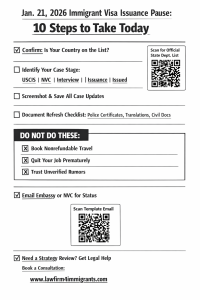
Title: “Jan. 21, 2026 Immigrant Visa Issuance Pause: 10 Steps to Take Today”
Style: black-and-white, printable, checkbox blocks, one page
Sections:
Confirm your nationality is on the official list (QR to State Dept page)
Identify your case stage (USCIS / NVC / Interview / Issuance / Issued)
Screenshot and save all case updates
Document refresh checklist (police certs, translations, civil docs)
“Do NOT do these 3 things” (nonrefundable travel, job resignation, relying on rumors)
Copy/paste email script QR
Consultation/strategy reminder for urgent cases
Official list source for QR: State Department announcement

When immigrant visa issuance pauses unexpectedly, the hardest part is often not the paperwork—it is the life disruption: children in school, leases ending, job start dates approaching, aging parents needing care, and families forced to live in two countries at once.
This section is a calm, practical playbook for protecting your family, finances, and stability during an extended visa delay.
If your family is separated during an indefinite visa freeze, prioritize four things: (1) stable housing, (2) school continuity for children, (3) income and job protection, and (4) caregiver coverage for elderly or medically vulnerable relatives. Document all decisions, avoid irreversible moves based on optimistic timelines, and build a 90-day plan that can extend to six months or longer.
Most families lose money and stability by planning for the best-case timeline only.
Create a simple plan for the next 90 days that answers:
Where will each family member live?
Who will pay which bills?
Who can pick up children from school?
Who has legal authority to make medical decisions if needed?
What happens if the delay continues another 90 days?
Rule of thumb: If your plan only works when the visa is issued “soon,” it is not a plan.
Housing is usually the biggest financial shock during a separation.
Do not terminate U.S. housing too early based on predicted issuance.
If you are keeping a U.S. residence, avoid signing a lease that requires a long commitment unless you can carry it comfortably.
If you must relocate temporarily, choose a housing option with flexibility (month-to-month if possible).
Before making that decision, confirm:
the impact on your job and income stability
childcare and school continuity
insurance coverage
whether the move could create new immigration complications later (case-specific)
Negotiate lease extensions early
Put all landlord communications in writing
Keep proof of payments and notices
Avoid co-signing new housing obligations for others unless you can sustain it
Children experience immigration delays as uncertainty and disruption. Your goal is continuity.
Do not change schools mid-year unless necessary.
Maintain:
consistent attendance
stable routines
one primary caregiver responsible for school communications
updated emergency contact lists
Avoid telling schools or children that relocation is imminent unless it is certain.
Instead, plan in phases:
Phase 1 (0–90 days): stay enrolled, remain stable
Phase 2 (90–180 days): contingency decisions (transfer planning if truly required)
Keep digital and printed copies of:
report cards and transcripts
enrollment letters
IEP/504 plans (if applicable)
immunization records
custody documentation (if relevant)
emergency contact authorization letters
Visa freezes often cause families to lose money in predictable ways:
job start dates collapse
spouses stop working “to prepare” and lose income unnecessarily
travel purchases become unrecoverable
Treat it like a business risk problem:
communicate early with HR
ask for flexibility in writing
request a revised start window rather than a fixed date
Do this immediately:
review your monthly expenses line-by-line
pause optional spending
avoid new major purchases
build a three-month cushion where possible
Use a one-paragraph, neutral statement such as:
“Immigrant visa issuance has been paused for nationals of certain countries. We are monitoring the consular timeline and can provide updates as we receive official guidance.”
If the family separation affects a parent, child, or spouse with a medical need, the delay becomes more than inconvenient—it becomes operationally dangerous.
Identify the primary caregiver and backup caregiver
Confirm transportation capacity (appointments, pharmacy access)
Create a medication list and refill schedule
Gather medical records and provider contact information
Confirm insurance status and coverage restrictions
Put a permission letter in writing if a caregiver needs authority to act
Plan alternatives early:
paid home care (if financially feasible)
relative support with defined responsibilities
temporary local assistance networks
Do not wait until a medical crisis forces rushed decisions.
During long delays, families often “patch” problems in ways that create new legal exposure.
Do not submit inconsistent information across forms “to move faster”
Do not rely on fake documents or shortcuts
Do not make relocation decisions that require later backtracking without understanding legal consequences
Do not ignore expiration-sensitive documents (police certificates, passports, civil documents)
keep all originals and certified copies organized
maintain a “one folder” digital archive
record all case updates (screenshots with date/time)
keep translations consistent and professional
Separation creates predictable pressure points:
resentment about delays
arguments about timelines and money
blame and miscommunication with relatives
Set two routines:
Weekly planning call (30 minutes): logistics only (money, school, care)
Daily check-in (10 minutes): connection, not case speculation
Avoid: turning every conversation into “any news yet?”
That pattern exhausts everyone and changes nothing.
Even stable families can spiral financially during long waits.
Use these controls:
one shared budget sheet
a spending pause rule for non-essential expenses
cash reserve priority (even small amounts)
cancel or renegotiate subscriptions temporarily
avoid adding new debt if possible
If travel was booked:
request airline credits/refunds immediately
save denial confirmations for future dispute options
During an indefinite visa freeze, families should prioritize reversibility.
Examples of reversible decisions:
temporary housing extensions
remote work requests
delaying school transfers
postponing travel
Examples of hard-to-reverse decisions:
quitting a job
breaking a lease without a plan
selling a home prematurely
withdrawing children from school too early
moving internationally without financial stability
A good guiding sentence is:
“If we do this today and the visa is delayed another six months, will we still be okay?”
Consider a legal strategy review if any of these are true:
your case is already at the interview/issuance stage
you have an urgent medical or caregiver situation
a child’s school year or custody plan is affected
an employer deadline cannot move
you have multiple nationalities or complex travel history
a mistake could trigger unlawful presence or other bars
If you need a plan tailored to your specific timeline and risk exposure, you can schedule here:
Book a consultation with Herman Legal Group
A visa freeze is not just a government policy change—it becomes a family operations problem. The families who do best are the ones who treat separation as a planning challenge: stabilize housing, protect children’s school continuity, preserve income, and build caregiver coverage now rather than later.
If the pause lifts quickly, the plan was still worth it. If it lasts months, the plan prevents crisis.
Yes. The U.S. Department of State posted guidance stating that effective January 21, 2026, it is pausing immigrant visa issuance for nationals of 75 listed countries.
Source: State Department announcement
Immigrant visa applicants who are nationals of one of the listed countries and would need issuance through a U.S. embassy or consulate abroad are affected. The impact depends heavily on case stage (NVC, interview, issuance pending, issued).
Source: State Department announcement
Many applicants are not affected, including people who are not nationals of the listed countries, and applicants using different visa categories or processes. Dual nationals using a passport from a non-listed country may be exempt.
Source: State Department FAQ
No. The State Department states this pause is specifically for immigrant visa applicants and tourist visas are nonimmigrant visas.
Source: State Department FAQ
The State Department states affected nationals may still submit applications and attend interviews and that the Department may continue scheduling appointments, but no immigrant visas will be issued during the pause.
Source: State Department FAQ
The State Department states no immigrant visas have been revoked as part of this guidance. For admission questions, it refers individuals to DHS.
Source: State Department FAQ
If you are a national of a listed country, the key issue is that issuance is paused. Even if the interview proceeds, issuance may not occur during the pause. You should preserve proof, avoid nonrefundable travel, and request written clarification.
The State Department describes the action as a pause while it reviews policies, regulations, and guidance. If no end date is specified, families should plan for uncertainty and monitor official updates.
Source: State Department announcement
The State Department states that dual nationals applying with a valid passport of a country not listed are exempt from this pause.
Source: State Department FAQ
Confirm whether the applicant is a national of a listed country, identify the case stage, preserve documentation and screenshots, stop irreversible travel/job decisions, keep civil documents current, and seek a case-specific plan for urgent situations.
Employers should expect start-date disruption for consular immigrant cases involving listed-country nationals, preserve documentation, and consider contingency planning. A written timeline plan reduces operational risk.
Sometimes—but only if you are eligible and physically present in the U.S. with a lawful path to file. This is case-specific and should not be attempted without strategy review, because mistakes can trigger bars or denials.
Refugee and asylum processes are legally distinct from standard immigrant visa issuance. People should not assume the same rules apply without verifying the exact pathway and authority governing that case.
Use the official State Department list:
Assuming “approved” means “visa will be issued soon.” Visa issuance depends on the final issuance stage—and this policy is specifically an issuance pause for affected nationals.
The State Department’s January 2026 policy creates immediate uncertainty for many families and employers pursuing consular immigrant visas. The most important move is to confirm whether the applicant is a national of a listed country, identify the case stage, and preserve all documentation and communications. Until official guidance changes, affected applicants should plan for delays and avoid irreversible travel, relocation, or employment commitments based on optimistic timelines.
If your case is urgent or already at a late stage, you may benefit from a case-specific plan:
Use these links to confirm the policy scope, affected nationalities, and any updates.
U.S. Department of State — U.S. Visas News (All official visa policy updates)
Federal Register — Presidential Documents (Official proclamations and federal actions archive)
These are the tools that matter most when a case is stuck at the “waiting” stage.
For readers trying to understand the government’s stated rationale, these provide grounding context.
U.S. Department of State — Official “Public Benefits Usage” rationale and FAQ
U.S. Citizenship and Immigration Services (USCIS) — Public Charge resources hub
These outlets help readers confirm what’s happening and monitor developments, but the government links above remain the primary authority.
Financial Times — U.S. to pause immigrant visa processing for nationals of 75 countries
The Guardian — Full list of 75 countries (reader-friendly presentation)
These are high-risk moments for mistakes, especially when families assume “approved” means “safe to travel.”
HLG — Is it safe to travel while an immigration case is pending?
HLG — Can I travel on a B-2 visa while my I-130 is pending? (2025 guide)
HLG — Best practices for extending or changing to B-1/B-2 visitor status (I-539 guidance)
Even when the topic is visa processing, families often need broader “what to do right now” guidance.
These sources help journalists, researchers, and families track whether the pause is narrowing, expanding, or converting into a broader entry restriction framework.
U.S. Department of State — Visa News (monitor for updates lifting or expanding the pause)
Federal Register — Presidential Documents (watch for new proclamations)
If your case is time-sensitive (medical needs, expiring documents, child schooling, job start dates, urgent reunification), individualized legal planning can prevent months of preventable delay.
If you’re waiting for a green card, the Visa Bulletin for February 2026 is one of the most important monthly updates to review—because it determines when you can file (in many cases) and when USCIS or a U.S. consulate can actually approve your green card. Stay informed about the latest updates in the visa bulletin February 2026.
To verify every cutoff date and footnote directly from the source, start here:
U.S. Department of State (DOS) – Visa Bulletin for February 2026:
https://travel.state.gov/content/travel/en/legal/visa-law0/visa-bulletin/2026/visa-bulletin-for-february-2026.html
And for general reference:
DOS – Visa Bulletin main page:
https://travel.state.gov/content/travel/en/legal/visa-law0/visa-bulletin.html
February 2026 shows modest movement overall. Most family-based categories remain stable, and most employment-based categories are essentially unchanged—except EB-3 (Skilled/Professional) for “All Other Areas,” Mexico, and the Philippines, which moves forward three months.
USCIS filing rule for February 2026: applicants should use the “Dates for Filing” chart for both family-based and employment-based adjustment filings.
USCIS – Adjustment of Status Filing Charts for February 2026 (AILA summary page):
https://www.aila.org/library/uscis-adjustment-of-status-filing-dates-for-february-2026

The Visa Bulletin controls two separate timelines:
This is the chart that determines when a green card can be approved (or when an immigrant visa can be issued at a U.S. consulate).
This chart determines when you may be allowed to submit your full green card application package, even if you cannot be approved yet.
For applicants inside the U.S., the filing chart matters because it can unlock:
Work permits (EAD)
Advance Parole travel permission
A pending I-485 “in process” status
Family preference categories saw limited movement in February 2026.
Notable changes:
F-2A (spouses/minor children of green card holders) moves forward by one month across all listed countries.
Mexico moves forward by three months in:
F-1 (unmarried adult children of U.S. citizens)
F-2B (unmarried adult children of LPRs)
No meaningful changes were reported in F-3 and F-4 for the listed countries.
Employment-based categories were largely stable with two notable themes:
All Other Areas
For more insights, refer to the visa bulletin February 2026 updates.
Mexico
Philippines
(+3 months)
China (back 2 weeks)
India (back 2 weeks)
Everything else in EB-2, EB-4, and EB-5 remains essentially unchanged in the published summary.
Below are February 2026 changes in the family-based preference categories.
| Country | New Cut-Off Date (Feb 2026) | Old Cut-Off Date (Jan 2026) | Movement |
|---|---|---|---|
| All Other Areas | 1-Sep-17 | 1-Sep-17 | No Change |
| China | 1-Sep-17 | 1-Sep-17 | No Change |
| India | 1-Sep-17 | 1-Sep-17 | No Change |
| Mexico | 1-Dec-07 | 1-Sep-07 | +3 Months |
| Philippines | 22-Apr-15 | 22-Apr-15 | No Change |
| Country | New Cut-Off Date (Feb 2026) | Old Cut-Off Date (Jan 2026) | Movement |
|---|---|---|---|
| All Other Areas | 22-Jan-26 | 22-Dec-25 | +1 Month |
| China | 22-Jan-26 | 22-Dec-25 | +1 Month |
| India | 22-Jan-26 | 22-Dec-25 | +1 Month |
| Mexico | 22-Jan-26 | 22-Dec-25 | +1 Month |
| Philippines | 22-Jan-26 | 22-Dec-25 | +1 Month |
| Country | New Cut-Off Date (Feb 2026) | Old Cut-Off Date (Jan 2026) | Movement |
|---|---|---|---|
| All Other Areas | 15-Mar-17 | 15-Mar-17 | No Change |
| China | 15-Mar-17 | 15-Mar-17 | No Change |
| India | 15-Mar-17 | 15-Mar-17 | No Change |
| Mexico | 15-Feb-10 | 15-Nov-09 | +3 Months |
| Philippines | 1-Oct-13 | 1-Oct-13 | No Change |
| Country | New Cut-Off Date (Feb 2026) | Old Cut-Off Date (Jan 2026) | Movement |
|---|---|---|---|
| All Other Areas | 22-Jul-12 | 22-Jul-12 | No Change |
| China | 22-Jul-12 | 22-Jul-12 | No Change |
| India | 22-Jul-12 | 22-Jul-12 | No Change |
| Mexico | 1-Jul-01 | 1-Jul-01 | No Change |
| Philippines | 1-Feb-06 | 1-Feb-06 | No Change |
| Country | New Cut-Off Date (Feb 2026) | Old Cut-Off Date (Jan 2026) | Movement |
|---|---|---|---|
| All Other Areas | 1-Mar-09 | 1-Mar-09 | No Change |
| China | 1-Mar-09 | 1-Mar-09 | No Change |
| India | 15-Dec-06 | 15-Dec-06 | No Change |
| Mexico | 30-Apr-01 | 30-Apr-01 | No Change |
| Philippines | 15-Jan-08 | 15-Jan-08 | No Change |
Now, the February 2026 employment-based breakdown.
(Extraordinary Ability, Outstanding Researchers/Professors, Multinational Executives/Managers)
| Country | New Cut-Off Date (Feb 2026) | Old Cut-Off Date (Jan 2026) | Movement |
|---|---|---|---|
| All Other Areas | Current | Current | No Change |
| China | 1-Aug-23 | 15-Aug-23 | -2 Weeks |
| India | 1-Aug-23 | 15-Aug-23 | -2 Weeks |
| Mexico | Current | Current | No Change |
| Philippines | Current | Current | No Change |
Why this matters: even a small EB-1 retrogression can disrupt timing for adjustment approvals, consular scheduling, and dependent planning.
| Country | New Cut-Off Date (Feb 2026) | Old Cut-Off Date (Jan 2026) | Movement |
|---|---|---|---|
| All Other Areas | 15-Oct-24 | 15-Oct-24 | No Change |
| China | 1-Jan-22 | 1-Jan-22 | No Change |
| India | 1-Dec-13 | 1-Dec-13 | No Change |
| Mexico | 15-Oct-24 | 15-Oct-24 | No Change |
| Philippines | 15-Oct-24 | 15-Oct-24 | No Change |
| Country | New Cut-Off Date (Feb 2026) | Old Cut-Off Date (Jan 2026) | Movement |
|---|---|---|---|
| All Other Areas | 1-Oct-23 | 1-Jul-23 | +3 Months |
| China | 1-Jan-22 | 1-Jan-22 | No Change |
| India | 15-Aug-14 | 15-Aug-14 | No Change |
| Mexico | 1-Oct-23 | 1-Jul-23 | +3 Months |
| Philippines | 1-Oct-23 | 1-Jul-23 | +3 Months |
This is the biggest forward movement in the published February summary.
If your EB-3 priority date is near this range, February may materially improve your strategy and timing.
| Country | New Cut-Off Date (Feb 2026) | Old Cut-Off Date (Jan 2026) | Movement |
|---|---|---|---|
| All Other Areas | 1-Dec-21 | 1-Dec-21 | No Change |
| China | 1-Oct-19 | 1-Oct-19 | No Change |
| India | 15-Aug-14 | 15-Aug-14 | No Change |
| Mexico | 1-Dec-21 | 1-Dec-21 | No Change |
| Philippines | 1-Dec-21 | 1-Dec-21 | No Change |
| Country | New Cut-Off Date (Feb 2026) | Old Cut-Off Date (Jan 2026) | Movement |
|---|---|---|---|
| All Countries Listed | 15-Mar-21 | 15-Mar-21 | No Change |
(EB-4 is often sensitive to statutory and program-specific constraints, so applicants should always review DOS footnotes carefully.)
| Country | New Cut-Off Date (Feb 2026) | Old Cut-Off Date (Jan 2026) | Movement |
|---|---|---|---|
| All Other Areas | Current | Current | No Change |
| China | 22-Aug-16 | 22-Aug-16 | No Change |
| India | 1-May-24 | 1-May-24 | No Change |
| Mexico | Current | Current | No Change |
| Philippines | Current | Current | No Change |

Based on February 2026’s pattern, here are the most reasonable expectations:
February’s limited movement suggests DOS is carefully controlling monthly demand—especially early in the calendar year.
EB-3 “All Other Areas” moved meaningfully in February. That can continue, but historically it often comes in waves rather than smooth monthly progress.
Even when Worldwide moves, India and China may remain flat due to sustained inventory and per-country limits—particularly in EB-2 and EB-3.
When DOS moves too fast, it sometimes needs to correct course later. Applicants should stay alert for that risk in spring/summer.
Even highly qualified applicants lose months—or trigger avoidable rejections—because they misunderstand how the Visa Bulletin works. Below are the most common mistakes we see, and how to avoid them.
The Visa Bulletin includes two different charts, and they do not mean the same thing.
Final Action Dates control when a green card can actually be approved (or an immigrant visa can be issued).
Dates for Filing may allow you to submit your I-485 (Adjustment of Status) or begin later-stage processing steps earlier.
Fix: Always verify the correct chart on the official DOS bulletin and then confirm which chart USCIS is using for that month.
Official bulletin: https://travel.state.gov/content/travel/en/legal/visa-law0/visa-bulletin/2026/visa-bulletin-for-february-2026.html
USCIS “When to File”: https://www.uscis.gov/green-card/green-card-processes-and-procedures/visa-availability-priority-dates/when-to-file-your-adjustment-of-status-application-for-family-sponsored-or-employment-based-121
Many applicants mistakenly use the wrong column because they assume it’s based on citizenship.
In most cases, Visa Bulletin “country” refers to country of chargeability, which is typically your country of birth—not your passport.
Fix: Confirm your country of chargeability before you compare your priority date to the cutoff date.
“Current” only means a visa number is available. It does not mean:
USCIS will approve your case instantly, or
your consular interview will be scheduled right away.
Your case can still be delayed by:
missing evidence,
background/security checks,
medical exam issues,
backlogs at USCIS or the consulate.
Fix: Treat “Current” as “you may proceed,” not “you are done.”
A frequent and costly mistake is filing an I-485 before your priority date is current under the correct chart USCIS requires.
This can lead to:
rejection,
returned filings,
wasted time,
and sometimes lost momentum if documents expire and must be redone.
Fix: Confirm chart eligibility first, then file quickly and correctly.
Some applicants become current and delay filing because they assume the window will remain open.
But Visa Bulletin movement can slow, freeze, or retrogress later—especially in categories where demand surges unexpectedly.
Fix: If you become eligible to file, act promptly with a complete, attorney-reviewed filing strategy.
Applicants sometimes believe that being current under Dates for Filing guarantees green card approval soon.
In reality:
Dates for Filing = permission to submit documents (in many months)
Final Action Dates = approval/issuance eligibility
Fix: Use Dates for Filing to gain strategic benefits (like EAD/AP), but keep expectations realistic until Final Action becomes current.
Consular processing depends on:
National Visa Center (NVC) document review speed,
embassy/consulate appointment availability,
post-specific backlogs.
Even if your category is current, interviews may still take time to schedule.
Fix: Ensure your CEAC/NVC case is complete and document-ready.
CEAC portal: https://ceac.state.gov/
Spouses and children often file as derivatives, but timelines matter—especially if a child is near age 21.
If you wait too long, you can run into:
“aging out”
complicated Child Status Protection Act (CSPA) calculations
derivative eligibility disputes
Fix: If a child is close to age 21, get individualized legal advice early.
Many adjustment applicants don’t realize that leaving the U.S. while an I-485 is pending can trigger abandonment of the application unless an exception applies.
Fix: If you filed I-485, confirm travel authorization before leaving the U.S. (often Advance Parole is required).
Visa Bulletin misinformation spreads fast—especially when dates move unexpectedly.
Fix: Always confirm directly with official government sources:
DOS Visa Bulletin hub: https://travel.state.gov/content/travel/en/legal/visa-law0/visa-bulletin.html
USCIS adjustment filing guidance: https://www.uscis.gov/green-card/green-card-processes-and-procedures/visa-availability-priority-dates
The Visa Bulletin is not just a calendar—it’s a legal timing system. The biggest mistakes come from using the wrong chart, the wrong column, or waiting too long after eligibility opens. When in doubt, verify using DOS and USCIS directly, and build a filing plan that assumes movement can change from month to month.
Step 1 — Confirm the official February 2026 Visa Bulletin cutoffs
DOS February 2026 Visa Bulletin (official):
https://travel.state.gov/content/travel/en/legal/visa-law0/visa-bulletin/2026/visa-bulletin-for-february-2026.html
Step 2 — Confirm which chart USCIS allows this month (this controls I-485 filings)
USCIS “When to File” page (official):
https://www.uscis.gov/green-card/green-card-processes-and-procedures/visa-availability-priority-dates/when-to-file-your-adjustment-of-status-application-for-family-sponsored-or-employment-based-121
Step 3 — Find your priority date
Usually found on your I-797 approval notice (I-130 / I-140) or PERM record.
Now choose the branch that matches your situation.
If YES → proceed to A2
If NO → skip to A4
Priority actions
Prepare I-485 + required supporting documents
Consider concurrent filings for:
I-765 (work permit / EAD)
I-131 (Advance Parole travel)
Core USCIS resources
USCIS forms hub:
https://www.uscis.gov/forms
USCIS visa availability overview:
https://www.uscis.gov/green-card/green-card-processes-and-procedures/visa-availability-priority-dates
That is normal. You may still be able to:
file I-485,
get EAD/AP,
and “lock in” your case while you wait for Final Action to become current.
Do this now to avoid losing time later
Confirm your priority date is correct
Build a “rapid response” filing packet
Track monthly movement (especially if you’re close)
Best practice: plan a full filing strategy before your month opens.
Use the DOS February 2026 Visa Bulletin (official):
https://travel.state.gov/content/travel/en/legal/visa-law0/visa-bulletin/2026/visa-bulletin-for-february-2026.html
If YES → proceed to B2
If NO → proceed to B4
Your case can still be delayed if you have not completed:
DS-260 (immigrant visa application)
civil documents
financial sponsorship documents (if applicable)
NVC / CEAC portal
That may be due to:
consulate appointment capacity
local workload/backlogs
administrative timing
Action tip: do not assume “current” means “immediate interview.”
Best approach
keep your documents updated
monitor monthly Visa Bulletin changes
avoid triggering delays with expired civil docs/passports
DOS immigrant visa overview
This branch applies to many applicants in:
EB-2 India
EB-3 India
EB-2 China
EB-3 China
and certain family-preference categories
Reality check: even when Worldwide moves forward, India/China may remain flat due to:
per-country caps
extremely high inventory
Prepare for fast filing (do not wait until the last minute)
medical planning
employer letters
updated civil documents
dependent paperwork
Strategic planning options to discuss with counsel
whether an EB-2 ↔ EB-3 strategy makes sense in your case
priority date retention questions
job change rules and I-140 withdrawal timing risk
family age-out risk (CSPA timing)
India/China categories are more vulnerable to:
sudden stalls
backward movement (retrogression)
long “no movement” streaks
Anchor source (official): DOS Visa Bulletin hub
https://travel.state.gov/content/travel/en/legal/visa-law0/visa-bulletin.html
This branch includes most applicants not chargeable to:
China
India
Mexico (sometimes separately listed)
Philippines (sometimes separately listed)
EB-3 Skilled/Professional for All Other Areas showed meaningful movement (month-to-month), which can create filing opportunities for applicants near the cutoff.
Do this immediately
build a ready-to-file I-485 packet (if in the U.S.)
confirm employer support documentation
line up medical exam timing
prepare dependent filings
Be ready for two realities at once:
your category can become current,
but interview scheduling can still lag by weeks/months depending on post capacity.
Use:
DOS February 2026 Visa Bulletin (official)
https://travel.state.gov/content/travel/en/legal/visa-law0/visa-bulletin/2026/visa-bulletin-for-february-2026.html
CEAC portal
https://ceac.state.gov/
Do not assume you have “plenty of time.”
When DOS advances EB-3 ROW, filing windows can open quickly—and then tighten later.
Pick the statement that matches you:
“My spouse/parent/child filed for me” → likely family-based
“My employer filed for me” → likely employment-based
“I have an I-140” → employment-based
“I have an I-130” → family-based
“I’m waiting at NVC” → consular processing (abroad)
“I’m in the U.S. and want to file I-485” → adjustment of status (USCIS chart selection matters)
Start with the official bulletin:
If you’re close to becoming current—or facing backlog/retrogression/CSPA risks—professional timing strategy can make the difference between months saved and avoidable delays.
Book a Consultation (HLG):
https://www.lawfirm4immigrants.com/book-consultation/
The Visa Bulletin is a monthly publication from the U.S. Department of State (DOS) that announces which immigrant visa (green card) categories are “current” and which are backlogged based on priority dates.
Official source:
https://travel.state.gov/content/travel/en/legal/visa-law0/visa-bulletin.html
The official DOS page is here:
“Current” means there is no backlog for that category and country—so a green card can generally be approved immediately once the case is otherwise ready.
Your priority date is the date your immigration case “got in line.”
Typically:
Family-based cases: the date USCIS received the Form I-130
Employment-based PERM cases: the date the PERM was filed with the DOL
Employment-based non-PERM cases: the date USCIS received the Form I-140
You can usually find it on:
the I-797 approval notice, or
your receipt notice (for pending cases)
If you are not sure, a qualified immigration lawyer can confirm it from your filings.
Final Action Dates determine when a green card can actually be approved by USCIS (for adjustment cases) or when a visa can be issued by a U.S. consulate.
Dates for Filing are earlier cutoff dates that (in some months) allow applicants to submit their green card application packet even though final approval cannot happen yet.
For February 2026, USCIS directs applicants to use the Dates for Filing chart for both:
family-based cases
employment-based cases
Reference (AILA summary of USCIS posting):
https://www.aila.org/library/uscis-adjustment-of-status-filing-dates-for-february-2026
No. USCIS decides each month whether applicants must use:
Final Action Dates, or
Dates for Filing
You must verify what USCIS says for your month.
Not immediately.
It means you can often file the I-485 package, but approval still requires:
visa number availability under Final Action Dates
case completion and eligibility
If your filing is accepted, you may be eligible to apply for:
Work authorization (EAD)
Advance Parole (AP) travel document
This can be a major benefit, even while waiting for final approval.
Retrogression means the cutoff date moves backward in a later month.
This can happen when DOS or USCIS determines that too many applicants are becoming eligible at once and visa numbers may run out.
Yes. That is exactly what retrogression means.
A category can move forward, stall, or even move backward depending on demand and visa number availability.
Because U.S. immigration law applies:
annual numerical limits, and
per-country caps
If more people apply from certain countries than available numbers allow, those countries build longer lines.
Because the backlog levels and demand patterns can be radically different.
DOS can often advance “All Other Areas” faster while keeping India/China cutoff dates stable due to heavy demand.
No. Movement can slow or stop.
A smart strategy is to prepare your filing package early so you can file as soon as you become eligible.
Yes.
The Visa Bulletin governs:
consular immigrant visa issuance, and
USCIS adjustment approvals
Not always immediately.
Even if you become current, NVC scheduling depends on:
whether your case is “documentarily complete,” and
the U.S. consulate’s interview capacity
It means NVC has accepted your submitted:
civil documents
financial documents (if required)
application forms (like the DS-260)
Only then can your case be placed into the interview scheduling queue.
It varies by post.
Even with current dates, local conditions such as staffing and backlog affect scheduling speed.
No.
Premium processing can speed up petition decisions (like I-140), but it cannot change:
visa number limits, or
Visa Bulletin cutoffs
Sometimes, but not always.
In many employment-based cases:
you can keep your priority date if you qualify under the rules
certain changes can create risk if the underlying petition is withdrawn early or invalidated
This is a legal strategy question worth attorney review.
Sometimes yes, but it depends on:
your qualifications,
your job requirements,
the employer’s willingness to sponsor, and
whether EB-2 is actually faster for your country of chargeability
Often yes.
Spouses and unmarried children under 21 can typically be included as derivatives in many employment-based categories and some family preference contexts.
The Child Status Protection Act (CSPA) is a law that can protect some children from “aging out” (turning 21) while the immigration case is pending.
CSPA is complicated and timing-sensitive—legal guidance is strongly recommended if a child is near 21.
No. Filing when you are not eligible can lead to:
rejection,
delays,
or lost filing fees (depending on circumstances)
You should file only when your priority date is current under the correct chart USCIS requires.
Only if you have:
a valid dual intent status (in some cases), or
Advance Parole approved (in many cases)
Travel without proper authorization can result in abandonment of the I-485.
Not always.
A properly filed I-485 can place you in a “period of authorized stay,” but lawful status issues depend on your exact history and category.
Yes.
Even if your priority date is current, you can still be denied for:
inadmissibility issues
criminal grounds
fraud/misrepresentation
prior immigration violations
Visa availability is only one piece of eligibility.
Yes. In many family-based cases, the sponsor must file an Affidavit of Support (Form I-864) and show financial ability to support the immigrant.
Public charge issues depend heavily on the category, timing, and facts.
No.
Naturalization is based on:
lawful permanent resident status duration,
physical presence,
good moral character,
and other statutory requirements
The Visa Bulletin applies to getting the green card first.
Because it combines multiple moving parts:
category caps
per-country limits
two charts
USCIS monthly chart selection
annual quota pacing
It’s normal to need professional guidance.
Use blogs only as explanations, not as the source of truth.
Always verify dates through DOS:
https://travel.state.gov/content/travel/en/legal/visa-law0/visa-bulletin.html
Not necessarily.
Some months show no movement, followed by a larger jump later. Other times movement is slow but steady.
The best approach is tracking trends over 3–6 months.
Planning matters. Many applicants use the waiting period to:
maintain lawful status
avoid travel mistakes
plan job mobility carefully
prepare documents early
protect children from aging out
DOS updates monthly here:
https://travel.state.gov/content/travel/en/legal/visa-law0/visa-bulletin.html
The U.S. government is expected to pause immigrant visa processing for nationals of 75 countries, reportedly beginning January 21, 2026, based on multiple major news reports. The reported rationale is that applicants from certain countries are perceived as having a higher risk of welfare dependency, which connects to the U.S. immigration concept commonly called “public charge.” The pause, referred to as the immigrant visa pause, is reported to focus on immigrant visas processed through U.S. consulates abroad, not most temporary visas like tourist or student visas.
Reporting sources:
The U.S. is expected to pause immigrant visa processing for applicants from 75 countries starting January 21, 2026, according to reports.
This immigrant visa pause reflects growing concerns regarding immigration policy and its impact on various nations.
Early reporting suggests the pause may be indefinite (no public end date announced).
The stated reason involves perceived risk that migrants from certain countries may rely on public benefits (the “public charge” concept).
The pause appears aimed at immigrant visas issued through consular processing, not most nonimmigrant visa categories.
USCIS approvals of petitions like the I-130 or I-140 are a different step from State Department visa issuance.
Families should prepare for longer separation timelines and possible interview disruptions.
Financial sponsorship and documentary readiness are likely to be more important if/when processing resumes.
As of current reporting, a complete official list of all 75 countries has not been consistently published in one public government release. However, major outlets have named several countries as examples included in the reported pause. These include:
HLG editorial note: This is a partial list only and reflects countries specifically named in reporting, not the full set of 75.
Immigrant visas are issued by the U.S. Department of State and allow a person to enter the United States as a lawful permanent resident (green card holder).
If immigrant visa processing is paused for a country, it can mean:
immigrant visa interviews may not be scheduled,
scheduled interviews may be canceled or delayed,
completed cases may sit without a final decision,
visas may not be issued even when the underlying petition is approved.
A key point for families: a pause in visa processing does not always mean a petition is denied. It typically means the last stage—consular issuance—is delayed or stopped.
For official baseline information about immigrant visa steps, see:
Many families confuse two separate systems:
USCIS decides whether a petition is valid, such as:
The State Department controls:
National Visa Center (NVC) document collection
Consular interview scheduling
Immigrant visa issuance abroad
If the U.S. pauses consular processing, a family can be “approved” on paper (petition stage) but still unable to complete the visa issuance step.

According to the reporting above, the immigrant visa processing pause is expected to begin January 21, 2026.
The reporting describes the measure as open-ended or without a publicly confirmed end date. That is important because families cannot reliably plan around a fixed reopening timeline.
At this stage, the most responsible guidance is:
prepare your case for delay, and
avoid missing deadlines for your underlying petition or NVC requests.
For general State Department guidance and updates, start here:
The pause is reported as an immigrant visa processing suspension. In real life, this tends to affect cases like:
U.S. citizen sponsoring a spouse abroad (IR-1/CR-1)
U.S. citizen sponsoring a parent abroad (IR-5)
Lawful permanent resident sponsoring a spouse or child (F2A/F2B)
Employment-based immigrant visa cases (EB-1/EB-2/EB-3) requiring consular issuance
If your case is in the consular pipeline, your steps typically run through NVC:
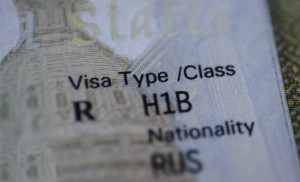
Current reporting indicates the policy primarily impacts immigrant visas, not typical nonimmigrant visa categories such as:
B-1/B-2 (tourist/business visitors)
F-1 (students)
J-1 (exchange visitors)
H-1B (specialty occupation workers)
O-1 (extraordinary ability)
However, applicants should understand this nuance:
A nonimmigrant visa category may remain “open,” but
consular appointment availability and administrative processing delays can still change rapidly.
For baseline information:
“Public charge” is a U.S. immigration concept that generally refers to whether a person is likely to become primarily dependent on the government for support in the future.
In everyday terms, the government may scrutinize:
whether an immigrant has strong financial support,
whether a sponsor meets income requirements,
whether the person has realistic ability to work or be supported,
whether household resources are strong enough to prevent long-term dependence.
USCIS explains public charge (and related inadmissibility concepts) here:
Even when a policy is described broadly, individual decisions often turn on concrete evidence.
In many family-based immigrant visa cases, the government focuses heavily on:
the sponsor’s income level
household size
work stability
assets and savings
consistency of documentation
whether a joint sponsor is needed
This is why your documentation quality matters as much as your eligibility.
If your case requires an Affidavit of Support, review:
The policy rationale in reporting ties to perceived welfare dependency/public charge concerns.
Country-level targeting implies the government is making group-level risk judgments rather than purely individualized evaluations.
Even then, a person from a targeted country may have a strong case with strong sponsorship evidence.
If you are still in the USCIS stage, you may still be able to:
proceed with the petition,
respond to Requests for Evidence (RFEs),
reach approval.
But you may face a future bottleneck at consular issuance.
Start here:
HLG related guidance:
Herman Legal Group (HLG home)
Many applicants are at one of these NVC stages:
“submitted documents”
“documentarily complete”
“documentarily qualified”
“ready for interview scheduling”
If immigrant visa processing is paused for your country, then:
interviews may not be scheduled,
previously scheduled interviews may be delayed,
cases may remain pending even if everything is correct.
If you have a scheduled appointment date coming up, you must plan for outcomes such as:
cancellation,
rescheduling,
administrative hold,
delay in issuance.
Do not assume the interview will happen.
Also do not assume your case is denied.
In many consular interruptions, the result is simply time.

Withdrawing and refiling can:
reset your priority date (in some categories),
create new documentary burdens,
delay reunification even longer.
In most cases, keeping the case alive is the best move.
Even if interviews pause, many families lose time later because they are not ready when the consulate restarts.
You should gather and organize:
most recent tax return and/or IRS transcript
W-2s / 1099s
employment verification letter
pay stubs (recent)
proof of assets (if needed)
joint sponsor documentation (if needed)
Official starting points:
Create a secure folder with:
passport biographic page
birth certificates
marriage certificates (if applicable)
divorce decrees (if applicable)
police certificates (watch expiration practices)
translations (if not in English)
Avoid relying on social media summaries.
Start here:
Risk level: Medium
What likely happens: Documentarily qualified cases may wait indefinitely for scheduling.
Best next step: Build a “perfect sponsorship packet” and preserve relationship evidence.
Risk level: Medium to High (depending on visa bulletin category)
What likely happens: Even if your priority date becomes current, consular issuance may be paused.
Best next step: Monitor timing and avoid document lapses.
Start here:
Risk level: High
What likely happens: The employee cannot enter as an immigrant until visas are issued.
Best next step: Employers should explore alternate lawful work options where available and plan staffing contingencies.
Risk level: Low to Medium
What likely happens: Delay is policy-driven, not fact-driven.
Best next step: Stay document-ready and avoid avoidable errors that create extra delays later.
Risk level: High
What likely happens: Rescheduling or consular hold.
Best next step: Follow the consulate’s instructions and preserve proof of appointments and submissions.
What changed: The administration issued Executive Order 14161, directing enhanced screening/vetting priorities and related implementation across immigration and visa systems.
Resource links:
What changed: A June 4, 2025 proclamation imposed/expanded country-based entry restrictions, effective June 9, 2025, citing national security and vetting deficiencies.
Resource links:
What changed: A September 19, 2025 proclamation restricted entry/visa issuance for certain H-1B workers and introduced a $100,000 payment requirement for specified new H-1B-related filings/issuance mechanics (implementation details discussed in agency guidance and litigation reporting).
Resource links:
What changed: The State Department moved toward stricter rules and warnings that applicants should generally apply in their country of nationality or residence, making it harder to use third-country processing as a workaround for long waits at home.
Resource links:
What changed: The State Department updated interview waiver eligibility effective October 1, 2025, increasing the likelihood of in-person interviews and slowing overall processing capacity.
Resource links:
What changed: The administration expanded screening infrastructure linked to Executive Order–driven vetting priorities, including more scrutiny around digital identity and social media.
Resource links:
What changed: DHS proposed rescinding the 2022 regulatory framework and moving toward broader discretion under the “public charge” concept—raising the risk of more subjective adjudication and more evidence demands.
Resource links:
What changed: Reporting and policy analysis indicates consular officers were directed to weigh factors such as age and health, including chronic conditions, when assessing public charge likelihood—raising concerns for applicants with conditions requiring long-term management.
Resource links:
What changed: A December 16, 2025 proclamation expanded/modified country-based restrictions, with implementation effective January 1, 2026, supported by a White House fact sheet and State Department implementation guidance.
Resource links:
What changed: The State Department announced a pause on immigrant visa processing for nationals of 75 countries, beginning January 21, 2026, tied to public assistance/public charge concerns.
Resource links:
A “visa processing pause” is often described as a temporary administrative measure. In real life, it can operate like a denial without paperwork: families remain separated, employers lose predictability, and cases become trapped in document expiration cycles even when the applicant is otherwise eligible.
When immigrant visa processing slows or stops at U.S. consulates, the cost is measured in months or years of forced separation, even for close relatives of U.S. citizens.
Common consequences include:
Spouses living apart indefinitely, often forced to maintain two households and two sets of expenses
Children growing up with one parent missing, creating childcare and schooling stress
Missed life events (births, medical crises, funerals, weddings) that cannot be rescheduled
Financial strain from travel changes, repeated document fees, and continued overseas living costs
Mental health impacts (anxiety, depression, chronic stress) created by prolonged uncertainty and lack of timeline certainty
Even “routine” delays can become severe when families must repeatedly update the same evidence because the government’s required documents have limited validity.
One of the most overlooked harms of consular slowdowns is the expiration loop—when the case becomes harder to complete the longer it sits.
Examples include:
Police certificate validity limitations depending on the country and consular practice
Medical exam timing and re-exams
Updated financial sponsorship evidence needed repeatedly
Re-upload and re-review delays through the National Visa Center pipeline
For baseline consular processing mechanics, see:
When immigration becomes unpredictable, U.S. businesses experience operational harm that is measurable and immediate.
Typical business impacts include:
Delayed start dates for key hires
Project disruption and missed deliverables
Lost contracts when deadlines cannot be met
Higher legal and administrative costs due to repeated rescheduling and re-documentation
Long-term recruiting damage, as global candidates choose more predictable countries
In practice, visa slowdowns discourage companies from hiring internationally at all—especially for specialized positions that require careful timing.
A processing pause does not mean a person is inadmissible. It means the government is using timing and friction as a control mechanism. That distinction is critical for families deciding whether to keep going.
If a case requires an Affidavit of Support (common in family immigration), the sponsor should prepare for heightened scrutiny and documentation demands:
HLG internal resources (I-864 + sponsorship):
Many readers have asked whether a country-based visa suspension tied to “welfare dependence” concerns is truly about individualized financial risk—or whether it is being used as a broader tool to shape who can immigrate to the United States.
It is important to separate two questions:
What does the policy do in practice (impact)?
Why was it adopted (intent)?
Even when a policy is described as neutral on paper, it can create unequal outcomes depending on which countries are targeted and how standards are applied.
A visa policy that pauses entire nationalities functions as group-based screening. That makes “public charge” less about individual documents and more about country-level assumptions—a shift that can disproportionately affect applicants from lower-income regions.
If the affected list is weighted toward countries outside Western Europe, then the result is predictable:
immigrant visas become harder to obtain for many applicants from the Global South, and
comparatively easier for applicants from regions not subject to similar friction.
Even without a formal “race” classification, national-origin restrictions frequently map onto race, ethnicity, and global inequality.
Concerns about disparate treatment are heightened by long-standing public reporting that President Trump has favored immigration from certain countries while disparaging others.
For example, Trump has been repeatedly linked in public reporting to derogatory remarks about immigrants from “shithole countries,” and comments suggesting preference for immigrants from countries like Norway.
Why this matters for “public charge” policies:
When a government uses “welfare dependence” narratives while simultaneously endorsing preference-based immigration rhetoric, critics may argue the policy is not merely about financial self-sufficiency—but about reshaping immigration flows by nationality and region.
“Public charge” is a real legal concept, but broad country-based processing pauses tied to welfare-dependence concerns can operate like a proxy for:
wealth screening
health screening
perceived future employability
and assumptions about public benefit usage
This is especially consequential because consular processing already involves discretion, and evidence standards can vary between posts.
For baseline public charge resources:
Separate from any one policy announcement, many observers evaluate visa slowdowns in light of broader transition-era policy frameworks—especially Project 2025 materials that describe how to transform federal immigration infrastructure quickly.
Primary-source document:
Analytical overview (useful for journalists and researchers):
How this connects:
Even when policy does not announce a “ban,” restrictions can be implemented by:
tightening interview waivers,
limiting third-country visa processing,
increasing security screening burdens,
expanding documentary demands, and
slowing consular issuance capacity.
A country-based immigrant visa processing pause tied to “public charge” concerns can be understood as a form of immigration restriction by delay, not merely immigration restriction by statute.
That is why the practical consequences matter:
who can realistically survive multi-year separation,
who can maintain documentation and sponsorship standards repeatedly, and
which regions face the greatest friction.
My observation:
“Whether framed as ‘public charge prevention’ or ‘security vetting,’ a national-origin processing pause shifts the immigrant visa system away from individualized evidence and toward country-level exclusion by delay.”
As of initial reporting, the U.S. is expected to pause immigrant visa processing for nationals of 75 countries, but a single complete official list has not been consistently published in public reporting. Applicants should monitor the U.S. Department of State and their local U.S. consulate for confirmed country-specific implementation.
Major news outlets report the pause begins on January 21, 2026. If your case is close to interview scheduling, you should plan for delays and keep all documentation current.
Based on reporting, it is best described as a processing pause—meaning visa issuance steps may stop or slow. A pause does not necessarily mean your petition is denied, but it can stop final visa approval at a consulate.
Current reporting indicates this measure targets immigrant visa processing, not most temporary visas such as tourist (B-1/B-2) or student (F-1) visas. Still, consulate appointment availability and processing times can change at any time.
An approved I-130 is only one step. If consular immigrant visa processing is paused for your spouse’s country, the case may be delayed at interview scheduling or visa issuance.
If you are documentarily qualified, your case may still wait for an interview slot and final issuance. A processing pause can stop interviews or prevent visas from being issued even after a successful interview.
In many cases, there is no reliable way to force consular processing during a broad pause. The best strategy is to keep documents current, strengthen sponsorship evidence, and follow official consulate instructions carefully.
Public charge generally refers to whether an applicant is likely to become primarily dependent on government assistance in the future. In many cases, strong financial sponsorship evidence and consistent documentation reduce concerns and improve case clarity.
Not always. Public charge analysis is complicated and depends on the specific benefit, the person receiving it, and the case type. Applicants should get case-specific legal advice before assuming the case is “unfixable.”
Keep your passport valid, protect your civil documents, track official consular instructions, and prepare updated financial sponsorship materials. When processing resumes, the most prepared applicants often move faster.
Usually not. Withdrawing can increase delays, create new paperwork requirements, and introduce unnecessary risk. Many families are better served by preserving the current case and preparing for eventual resumption.
Yes. A lawyer can help keep your case “document-ready,” avoid missed deadlines, identify alternative strategies, and prepare stronger financial sponsorship evidence so the case is positioned to move as soon as processing restarts.
This reported immigrant visa processing pause—tied to perceived “public charge” or welfare-dependence concerns—could change quickly depending on internal government instructions, litigation, or revised diplomatic guidance. For families and employers, the most important thing is to stay ready: protect your documentation, monitor official updates, and avoid avoidable mistakes that cause additional delays once processing resumes.
If your family’s case is time-sensitive or you are unsure how this may affect your country or visa category, you can speak with an immigration attorney to plan next steps. You may schedule a consultation here:
Herman Legal Group – Book a Consultation
Reuters — U.S. to suspend visa processing for 75 nations (report)
The Washington Post — Immigrant visa processing pause coverage
CNN — U.S. suspending immigrant visa processing for 75 countries