
On January 7, 2026, Renée Good, a 37-year-old U.S. citizen, was fatally shot by an ICE agent in Minneapolis, Minnesota during a confrontation that has triggered protests, national headlines, and serious questions about federal accountability.
Now some Minnesotans may be asking a different kind of question—one that rarely makes headlines but matters deeply in modern immigration enforcement:
Did a Minnesota-based ammunition manufacturer sell the bullets that killed Renée Good (or related weapons supply) that ICE used in the killing of Renée Good?
At this moment, the honest answer is:
We do not yet know—and we may never know—exactly which ammunition was used, who manufactured it, or which contract vehicle supplied it.
But what we can do right now is follow the public money.
Because ICE does not manufacture its own firearms or ammunition. Its armed enforcement operations—its ability to deploy agents with lethal force—depends on private vendors.
That’s where Minnesota enters the story.
What We Know So Far About Renée Good’s Death
Public reporting has established key facts about the incident:
-
Renée Good was shot and killed by an ICE officer in Minneapolis.
-
Federal officials have described the event as self-defense, while critics dispute that framing and demand independent scrutiny.
-
Her family has retained prominent civil rights counsel and is pursuing accountability pathways.
-
The U.S. Department of Justice reportedly declined to open a civil rights investigation into the killing, sparking resignations and public alarm.
This is a fast-moving story, and facts may evolve as investigations proceed.
The Hard Truth: We Probably Won’t Learn the Bullet Manufacturer Soon (If Ever)
When a federal law enforcement shooting occurs, the public often asks:
-
What weapon was used?
-
What ammunition was used?
-
Was the shooting avoidable?
-
Was policy followed?
But federal agencies often resist disclosing technical details—especially when those details could create:
-
political fallout
-
procurement scrutiny
-
legal exposure
-
consumer backlash against contractors
So if you’re waiting for a clean public statement like:
“The ammunition used was manufactured by Company X under Contract Y…”
You may be waiting a long time.
That is why we look at federal contracting data.
Why Minnesota Matters in ICE Contracting
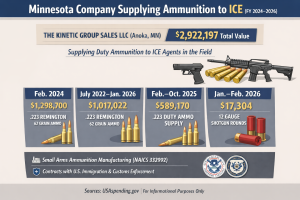
Minnesota is home to major firearms and ammunition manufacturing infrastructure. And federal award data shows that a Minnesota-based company has supplied duty ammunition connected to ICE’s operational supply chain.
This does not prove that the ammunition used in Renée Good’s killing came from a Minnesota company.
But it does raise a legally and morally significant possibility:
If Minnesota companies are supplying live duty ammunition for armed ICE agents, then Minnesota-based industry may be helping enable the enforcement conditions that make tragedies like this possible.
If the investigation reveals that bullets that killed Renée Good were supplied by a Minnesota company, it could lead to significant legal and ethical discussions.

Minnesota Ammunition Manufacturer Contracts With ICE (FY 2024–FY 2026)
Based on FY 2024–FY 2026 federal award records from USAspending.gov, filtering for Minnesota recipients connected to ICE contracting, one Minnesota entity appears repeatedly in ammunition delivery orders.
This review focuses on prime awards (not indirect subcontractors or downstream vendors).
Primary Minnesota ICE Ammunition Contractor (Prime Awards)
The Kinetic Group Sales LLC
Business location: 1 Vista Way, Anoka, Minnesota 55303
Industry classification (as reflected in federal award data):
-
NAICS: 332992 — Small Arms Ammunition Manufacturing
-
PSC: 1305 — Ammunition, Through 30mm
Across multiple delivery orders, The Kinetic Group supplies duty ammunition for armed ICE agents—making it a key Minnesota company supporting ICE enforcement capacity through weapons procurement.
ICE Contracts Awarded to The Kinetic Group (Detailed Breakdown)
1. .223 Remington Duty Ammunition (62 Grain)
Prime Award ID: 70CMSW24FR0000013
Total obligations: $1,298,700
Award type: Delivery Order
Period of performance: February 6, 2024 – December 31, 2025
Primary place of performance: Anoka, Minnesota
Purpose:
Procurement of .223 Remington caliber duty ammunition (62 grain) to support armed ICE agents operating in the field.
2. .223 Remington Duty Ammunition for ICE Firearms Programs
Prime Award ID: 70CMSW22FR0000074
Total obligations: $1,017,022.14
Outlays: $1,009,571.04
Award type: Delivery Order
Period of performance: July 7, 2022 – January 31, 2026
Primary place of performance: Anoka, Minnesota
Purpose:
Purchase of .223 Remington duty ammunition in support of ICE firearms and training programs.
3. .223 Duty Ammunition for ICE-Serviced Agencies
Prime Award ID: 70CMSW25FR0000004
Total obligations: $589,170.96
Award type: Delivery Order
Period of performance: February 19, 2025 – October 13, 2025
Primary place of performance: Fort Benning, Georgia (manufactured in Minnesota)
Purpose:
Procurement of duty ammunition for ICE and ICE-serviced federal agencies, coordinated through ICE’s Office of Firearms and Tactical Programs.
4. 12-Gauge Projectile Ammunition
Prime Award ID: 70CMSW26FR0000007
Total obligations: $17,304.12
Award type: Delivery Order
Period of performance: January 12, 2026 – February 28, 2026
Primary place of performance: Anoka, Minnesota
Purpose:
Supply of 12-gauge projectile ammunition to support ICE operational needs.
Total Minnesota ICE Ammunition Contract Value (Estimated)
Across these four delivery orders:
-
Total ICE obligations to The Kinetic Group: approximately $2.92 million
-
Nature of goods: live duty ammunition
-
End use: armed ICE enforcement, training, and tactical operations
What These Contracts Support in Practice
ICE firearms contracts are not administrative or logistical in nature. They support:
-
armed field operations
-
fugitive apprehension teams
-
tactical enforcement units
-
firearms training programs
-
officer safety and use-of-force readiness
These contracts directly enable physical enforcement capacity, not just paperwork or detention administration.
Who Owns The Kinetic Group? Corporate Structure, Parent Company, and the People Behind It
When the public sees a federal contract recipient name like “The Kinetic Group Sales LLC”, it can sound like a small, local supplier operating independently.
But in reality, The Kinetic Group is part of a large corporate ecosystem in the ammunition industry, with significant ownership ties and global footprint.
Understanding that structure matters because federal weapons procurement is rarely just “local business”—it is often part of long-term corporate strategy, mergers and acquisitions, defense-adjacent portfolios, and international investment.
The Kinetic Group’s Ownership Changed in 2024
As of late 2024, The Kinetic Group became owned by Czechoslovak Group (CSG), a major industrial and defense-focused corporate group based in Europe.
The Kinetic Group itself publicly described this as an ownership change and stated that CSG is the new owner of The Kinetic Group.
This matters for transparency because it means that even though ICE delivery orders may list a Minnesota business address, the revenue from federal contracts can ultimately flow upward into a foreign-owned parent structure.
How The Kinetic Group Was Formed (And What It Used to Be)
The Kinetic Group did not appear out of nowhere.
It is closely tied to the former structure of Vista Outdoor, a well-known “house of brands” company in shooting sports and outdoor products.
Vista Outdoor publicly described the transition in its own investor communications, explaining that its sporting products/ammunition business was being rebranded as “The Kinetic Group” as part of corporate separation planning.
Later, Vista Outdoor announced that stockholders approved the transaction for CSG to acquire The Kinetic Group.
The Kinetic Group: A “House of Brands” in Ammunition
The Kinetic Group is not simply a contracting entity—it is a major ammunition business with multiple consumer-facing brands under its control.
On its own website, The Kinetic Group identifies its portfolio of brands and presents itself as a leading ammunition manufacturer.
This is relevant because it means ICE contracting may not just involve an obscure vendor name in a database—it may connect to widely recognized ammunition brands operating at national scale.
“The Kinetic Group Sales LLC” Is the Contracting Entity in Federal Award Records
In federal contracting systems, the contracting party may appear as a specific legal entity such as an LLC.
USAspending award records list THE KINETIC GROUP SALES LLC as a recipient entity (including a UEI identifier and award details).
This is an important distinction:
-
The “brand name” (The Kinetic Group) is what people recognize
-
The “legal contracting entity” (The Kinetic Group Sales LLC) is what appears in federal procurement systems
What About the Individuals Behind the Company?
Corporate ownership matters, but so does leadership.
While company leadership can change over time, public reporting and corporate disclosures have identified executive leadership connected to The Kinetic Group and its parent structure.
For broader corporate ownership context, multiple public sources have discussed CSG leadership, including that CSG is controlled by Czech billionaire Michal Strnad.
HLG note: This is not cited here to endorse any characterization—only to acknowledge the publicly stated ownership structure as part of transparency analysis.
Who Is Michal Strnad? The Billionaire Arms Executive Behind CSG (Owner of The Kinetic Group)
If The Kinetic Group Sales LLC is a Minnesota-based contracting entity supplying ammunition to ICE through federal delivery orders, the next transparency question is simple:
Who ultimately owns The Kinetic Group—and who profits when ICE buys duty ammunition?
The answer points to Michal Strnad, a Czech billionaire industrialist and defense-sector executive.
Michal Strnad Is the Owner and Chairman of CSG
Michal Strnad is publicly identified by Czechoslovak Group (CSG) as its owner and Chairman of the Board of Directors. CSG describes itself as a major industrial holding group with significant operations in defense and aerospace, among other sectors.
In other words, while ICE’s contract records may list a U.S. entity such as “The Kinetic Group Sales LLC,” corporate ownership can trace upward to a global parent group controlled by a single individual.
Why Some Media Describe Strnad as an “Arms Dealer”
Michal Strnad has been described in international business reporting as a powerful figure in Europe’s weapons and defense manufacturing market, with high-level involvement in military procurement and defense contracting.
A well-known profile from Forbes referred to Strnad as an “arms dealer,” emphasizing his company’s role in the defense economy and the scale of its military business.
HLG note: “Arms dealer” is a media shorthand that can refer broadly to someone who owns and controls large defense and weapons-producing businesses—not necessarily an individual who personally sells weapons in a retail sense.
He Leads One of Europe’s Most Important Defense Manufacturing Groups
CSG presents itself as a major European industrial group with extensive defense-related production and acquisitions.
CSG has published its own interview-style features describing Strnad’s leadership of the company and its growth into a defense manufacturing powerhouse.
Strnad has also been profiled as one of the wealthiest individuals in the Czech Republic, tied directly to CSG’s defense industrial expansion.
CSG’s Ownership of The Kinetic Group Connects European Defense Capital to U.S. Ammunition Production
This is where Minnesota becomes central to a much bigger story.
CSG publicly announced and confirmed its acquisition of The Kinetic Group, which includes large-scale U.S. ammunition manufacturing operations and brands historically connected to Vista Outdoor’s sporting products portfolio.
That means when ICE buys ammunition through federal contracts tied to “The Kinetic Group Sales LLC,” the economic reality may be larger than a single Minnesota vendor:
the revenue can ultimately flow into a global defense holding company owned by a foreign billionaire.
The Enforcement Accountability Question This Raises
Even if we never learn exactly what ammunition was used in the killing of Renée Good, the federal procurement record still forces a legitimate public question:
If ICE’s armed enforcement capacity depends on private ammunition suppliers, who profits from that capacity—and how far up the ownership chain does the money go?
This is why corporate structure matters in immigration enforcement reporting.
Because armed enforcement is not just policy.
It is also an industry.
Strnad Has Been Reported as the Richest Person in the Czech Republic (Ranking Changes Over Time)
Michal Strnad is not just a defense-industry executive—he has also been described in major business reporting as the richest person in the Czech Republic, reflecting the enormous growth and valuation of CSG.
For example:
-
In May 2025, Bloomberg reported that Strnad overtook Renata Kellnerová to become the richest Czech, describing him as an “arms billionaire.”
-
In August 2025, Czech Radio similarly reported that Strnad topped the Czech rich list, reflecting his position at the center of one of Europe’s fastest-growing defense-focused industrial groups.
HLG note: Billionaire rankings can shift quickly based on markets, deal timing, and valuation methods. But the public takeaway is consistent: Strnad’s wealth and influence place him among the most powerful industrial owners in Central Europe, and that matters when tracing who profits from ICE’s ammunition supply chain through The Kinetic Group’s ownership structure.
Why This Ownership Profile Matters in an ICE Shooting Accountability Story
Even if the public never learns what ammunition was used in the killing of Renée Good, federal procurement still raises legitimate accountability questions:
-
Who profits from ICE’s armed enforcement growth?
-
Which corporate groups are embedded in the enforcement supply chain?
-
How much contracting revenue flows through local subsidiaries into parent organizations?
-
Are consumers and investors aware of the relationship between these companies and ICE?
When people ask, “Who sold ICE the bullets?” they are often really asking:
Who built and financed the enforcement infrastructure that makes lethal encounters more likely?
Understanding the ownership and corporate structure behind ICE suppliers is one way to ask that question using facts, public records, and verifiable data.
Did a Minnesota Company Sell the Bullets Used Against Renée Good?
The truthful answer: We do not know.
Right now, there is no confirmed public record identifying:
-
the caliber used in this shooting
-
the manufacturer of the ammunition involved
-
the procurement path (ICE inventory vs. tactical unit loadout vs. training allocation)
-
the specific contract vehicle tied to the incident
But here is what we can responsibly say
If federal contracting records show that ICE has purchased duty ammunition from a Minnesota company, then Minnesota-based private sector manufacturing may be part of the enforcement supply chain that equips ICE agents who carry out armed operations.
That possibility matters.
Because when lethal force is used by a federal agency, “who supplied the tools” becomes part of the accountability conversation.
Why Public Transparency Matters
ICE does not manufacture its own weapons or ammunition. Its ability to conduct armed enforcement depends on private-sector suppliers.
State-specific transparency allows the public to understand:
-
which local companies are part of federal enforcement infrastructure
-
how much public money is being spent
-
what type of enforcement capacity is being funded
This information is relevant to:
-
journalists
-
researchers
-
policymakers
-
investors
-
consumers
-
community advocates
Lawful Civic Response and Consumer Choice
It is legal to:
-
research federal contracts
-
publish factual information
-
express opposition to ICE enforcement policy
-
choose not to support companies that supply ICE
-
encourage others to make informed consumer decisions
It is not appropriate to engage in harassment, threats, or illegal activity. Peaceful, factual advocacy and ethical boycotts are lawful forms of civic participation.
How to Verify This Data Yourself
Anyone can independently confirm or expand this research by using USAspending.gov and applying filters for:
-
Funding Agency: U.S. Immigration and Customs Enforcement
-
Award Type: Contracts
-
Recipient Location: Minnesota
-
Fiscal Year: 2024–2026
Each award record includes:
-
contract ID
-
dollar amount
-
product description
-
place of performance
-
NAICS and PSC codes
Key Takeaway
As of FY 2026, Minnesota’s role in ICE contracting is concentrated in one area: ammunition manufacturing.
Through multiple delivery orders, a Minnesota-based company supplies live duty ammunition used by armed ICE agents nationwide.
Understanding this supply chain is essential for any serious discussion of:
-
immigration enforcement
-
federal spending priorities
-
corporate accountability
-
ethical consumer response
The Procurement Pipeline: How ICE Buys Ammunition (And Why It’s Hard to Trace One Shooting)
One reason the public may never learn “whose bullet was used” in a specific ICE shooting is that federal weapons procurement is typically structured as a multi-layer supply system, not a single purchase tied to one incident.
Even when federal records identify a contractor like The Kinetic Group Sales LLC, that does not automatically tell the public:
-
which ICE field office or unit received the ammunition
-
what batch or lot numbers were issued
-
whether the ammunition was deployed for training, stockpiling, or field operations
-
whether the ammunition was distributed through ICE tactical programs or inter-agency procurement channels
-
how long the ammunition sat in inventory before being issued
This creates a predictable transparency problem:
The public can sometimes identify who sold ammunition to ICE, while still being unable to prove whether that ammunition was used in a specific confrontation.
ICE contract descriptions don’t always equal incident-level traceability
Even when contract descriptions are detailed (for example, “.223 Remington duty ammunition”), they typically do not include:
-
the serial-numbered weapon it was paired with
-
the individual agent or team it was issued to
-
chain-of-custody details connecting it to a future shooting incident
-
internal inventory distribution logs
That is why a single shooting can raise unanswered questions even in a world of “open data” and public award databases.
Why this matters in the Renée Good case
In the wake of Renée Good’s death, public attention is understandably focused on the agent, the encounter, and the immediate legal aftermath.
But procurement matters because it tells the larger story:
-
armed enforcement depends on suppliers
-
suppliers depend on federal purchasing decisions
-
federal purchasing decisions create infrastructure that does not disappear when administrations change
In short: weapons procurement is part of immigration enforcement policy, even when politicians pretend it is not.
The Accountability Standard: What the Public Should Demand After a Federal Law Enforcement Killing
If Renée Good’s killing is going to be treated as anything more than another tragedy that fades from the headlines, the public must insist on a credible accountability framework.
This is not about speculation or harassment.
It is about the minimum transparency expected when the federal government uses lethal force.
Core questions ICE and DHS should answer publicly
1. What mission was ICE conducting that day?
Was this a targeted apprehension operation? A surveillance action? A warrant execution? A joint task force operation?
The public deserves clarity on what ICE was doing in Minneapolis and why the encounter occurred in the first place.
2. What use-of-force policy governed the agent’s conduct?
Every enforcement agency claims to have policies governing escalation and lethal force.
The public should know:
-
what policy was applied
-
whether the agent complied
-
who reviews compliance
-
whether violations are investigated independently
3. Was body-worn camera footage captured and preserved?
If body-worn video exists, it is one of the most important pieces of evidence for accountability.
If footage does not exist—or was not activated—the public deserves to know why.
4. What weapon and ammunition were used?
These are not “technical details.”
They are part of:
-
forensic reconstruction
-
use-of-force review
-
public transparency
-
public oversight
Even if identifying the weapon and ammunition does not automatically prove wrongdoing, the refusal to disclose these details often signals a deeper transparency breakdown.
5. Was immediate medical aid provided?
In many federal use-of-force cases, the minutes after a shooting become critical.
A legitimate investigation should establish:
-
whether medical aid was rendered immediately
-
how quickly EMS arrived
-
whether any delay contributed to the outcome
Why this standard matters beyond one case
Renée Good’s death is about more than one encounter.
It raises larger questions about the expansion of armed immigration enforcement, including:
-
when ICE chooses to deploy armed teams
-
what safeguards exist (and whether they work)
-
how quickly deadly force becomes “normalized” in civil immigration operations
-
how accountability fails when internal investigations replace independent oversight
What this means for corporate and financial accountability
When ICE carries out armed enforcement, it does so using:
-
public funding
-
federal procurement pipelines
-
private weapons and ammunition suppliers
That means the accountability conversation is bigger than one agent.
It includes the ecosystem that enables armed enforcement—including the contractors who supply duty ammunition, tactical equipment, and training infrastructure.
How to Investigate ICE Weapons and Ammunition Contracts: A Step-by-Step OSINT Guide (Public Records Only)
If you want to move beyond speculation and verify what companies supply ICE, you can do it using lawful, public sources.
This is a “follow-the-money” approach that journalists, researchers, and advocates can use without relying on rumors or unverified claims.
Below is a step-by-step investigative method using public contracting data.
Step 1: Start With USAspending.gov (The Official Public Database)
The best starting point is:
USAspending is the federal government’s official open database for award-level spending transparency.
Recommended search filters for ICE contracts
In the USAspending search interface, apply filters such as:
-
Funding Agency: U.S. Immigration and Customs Enforcement (ICE)
-
Award Type: Contract
-
Recipient Location: (choose a state, like Minnesota)
-
Time Period: FY 2024, FY 2025, FY 2026
-
Keywords: “ammunition,” “firearms,” “tactical,” “duty,” “training”
What you should capture from each award record
Each award record can include:
-
contract / award ID
-
recipient name (legal entity)
-
total obligations and outlays
-
period of performance
-
place of performance
-
product/service codes (NAICS and PSC)
-
award description language
This gives you the foundational “paper trail” showing which entities are being paid.
Step 2: Identify the Contracting Entity (Not Just the Brand Name)
Many defense and weapons businesses operate as:
-
LLCs
-
subsidiary corporate entities
-
sales entities separate from manufacturing entities
That means what appears in a database may not match what the public recognizes as the “brand.”
Example pattern:
-
brand / business group name appears publicly
-
procurement record lists a specific sales LLC as the recipient
This is not unusual in federal contracting.
It is why corporate structure research matters.
Step 3: Cross-Check the Entity in SAM.gov
Next, verify and cross-reference contractors using:
SAM (System for Award Management) helps confirm entity registration and often provides additional identifying information, such as:
-
official business identifiers
-
registration status
-
entity type and address
-
data useful for verifying corporate relationships
This step helps reduce errors, especially when multiple similarly-named entities exist.
Step 4: Use NAICS and PSC Codes to Find Similar Contracts
Two codes that frequently show up in ammunition procurement include:
-
NAICS 332992 (Small Arms Ammunition Manufacturing)
-
PSC 1305 (Ammunition, Through 30mm)
Once you locate those codes in an award, you can:
-
search other awards using the same codes
-
find other vendors supplying the same class of product
-
detect patterns in procurement concentration
This is how procurement research evolves from “one company” to “an enforcement supply chain map.”
Step 5: Confirm the Parent Company (Corporate Ownership and Control)
If you want to understand who ultimately profits from ICE contracting, you must identify:
-
the parent company
-
controlling ownership
-
acquisition history
-
corporate subsidiaries
Good places to verify ownership include:
-
official company press releases
-
investor relations pages
-
corporate “About” pages
-
reputable business reporting
For example, ownership connections involving The Kinetic Group have been documented through:
This matters because the public can mistakenly assume:
“A Minnesota company is getting paid”
when the economic reality may be:
“A Minnesota entity is receiving the award, but profits ultimately flow to a larger parent group.”
Step 6: Separate Prime Awards From Subcontracting
USAspending is most useful for identifying prime awards (direct awards issued by the federal government).
But modern procurement often includes:
-
prime contracts
-
subcontractors
-
resellers and distributors
-
indirect support companies
So if a company is not visible as a recipient on USAspending, it may still be in the supply chain through subcontracting or indirect services.
That is why investigative claims must be careful and evidence-based.
Step 7: Keep the Advocacy Lawful, Peaceful, and Fact-Based
Finally, it must be said plainly:
The public has the right to research contracts, publish facts, and engage in consumer choice.
But this must never include:
-
harassment
-
threats
-
doxxing
-
intimidation
-
violence
The most effective accountability work is:
-
verified
-
calm
-
documented
-
legally safe
-
repeatable
That is how research becomes impact—without becoming misconduct.
Practical Takeaway
If you want to investigate “who supplies ICE,” you do not need insider leaks or speculation.
You can start with public records and build an evidence-based map of the supply chain using:
-
corporate ownership statements
-
reputable business reporting
And in an era of expanding armed enforcement, these procurement records are not “background details.”
They are the infrastructure behind the policy.
How to Lawfully Boycott Companies Doing Business With ICE
Boycotts are a lawful expression of consumer choice and free speech when conducted peacefully and without coercion. If you oppose a company’s role in supporting ICE operations, you may choose not to purchase its products or services—and encourage others, respectfully and factually, to do the same.

What a Lawful Boycott Looks Like
-
personal consumer decisions: choosing alternatives and withholding spending
-
fact-based communication: citing verified public records
-
clear objectives: requesting transparency, review, or non-renewal of contracts
-
peaceful expression: no threats, intimidation, or harassment
What a Boycott Is Not
-
harassment or repeated unwanted contact
-
threats, intimidation, or doxxing
-
property damage, trespass, or disruption of lawful operations
-
violence or encouragement of violence
Step-by-Step: Starting a Peaceful, Effective Boycott
1. Define the ask
Be specific about what you want (disclosure, policy review, or non-renewal). Vague demands reduce impact.
2. Verify the facts
Confirm contract amounts, dates, and services using public sources. Accuracy builds credibility.
3. Lead with your own choices
Explain your decision not to support the company, and why, without attacking employees or customers.
4. Communicate respectfully with the company
Send a concise, polite message requesting transparency or reconsideration. Keep it factual and non-threatening.
5. Educate before mobilizing
Share short explainers citing public records so others can decide for themselves.
6. Set guardrails
Publish a code of conduct: respectful tone, no harassment, no threats, no illegal activity.
Joining Existing Boycott Efforts (Instead of Starting From Scratch)
Often, it is more effective to join or support existing campaigns than to duplicate them.
-
research current initiatives focused on ICE vendors
-
follow organizers’ rules and messaging guidelines
-
contribute constructively (research, education, amplification)
-
avoid targeting individual employees or private persons
-
verify claims before sharing
Coordination increases reach while reducing misinformation.
Using Social Media Responsibly
Social platforms can amplify awareness when used carefully.
Best practices
-
share verified links and concise summaries
-
use calm, values-based language
-
frame posts as personal consumer choice
-
encourage transparency and peaceful action
Avoid
-
insults, threats, or inflammatory language
-
tagging individual employees or unrelated people
-
sharing personal information
-
coordinated harassment or “dogpiling”
Frequently Asked Questions: Minnesota Companies Contracting With ICE
1. Which Minnesota companies currently contract with ICE?
Based on federal contracting records covering FY 2024–FY 2026, the Minnesota prime contracts identified here involve ammunition manufacturing and supply.
2. What types of products do Minnesota companies provide to ICE?
The Minnesota contracts identified here involve:
-
.223 Remington duty ammunition (62 grain)
-
12-gauge projectile ammunition
3. How much federal money is involved in Minnesota ICE ammunition contracts?
Across multiple delivery orders in this dataset, total ICE obligations are approximately $2.9 million.
4. How can I verify Minnesota ICE contracts myself?
Use USAspending.gov and filter by:
-
Funding Agency: U.S. Immigration and Customs Enforcement
-
Awarding Agency: Department of Homeland Security
-
Recipient Location: Minnesota
-
Award Type: Contracts
-
Fiscal Year: 2024–2026
5. Is it legal to boycott companies that do business with ICE?
Yes. Peaceful boycotts and ethical consumer advocacy are lawful, provided they do not involve harassment, threats, intimidation, property damage, or violence.
6. Can I contact Minnesota companies to express concerns?
Yes. Members of the public may lawfully and respectfully contact companies to request transparency and express disagreement with ICE contracting.
7. Does Herman Legal Group support harassment or violence?
No. Herman Legal Group supports lawful, peaceful civic engagement only.
Resource Directory: Minnesota, ICE Contracts, and Lawful Civic Response
Federal Transparency and Contract Verification
ICE Enforcement and Oversight
Lawful Advocacy and Free Speech Education
Minnesota Context and Reporting
Herman Legal Group (HLG) Related Resources