
 By
By
What Are the New Amounts and Who Pays?
By Richard T. Herman, Esq.
Overview: Why Travel Fees Are Rising in 2025
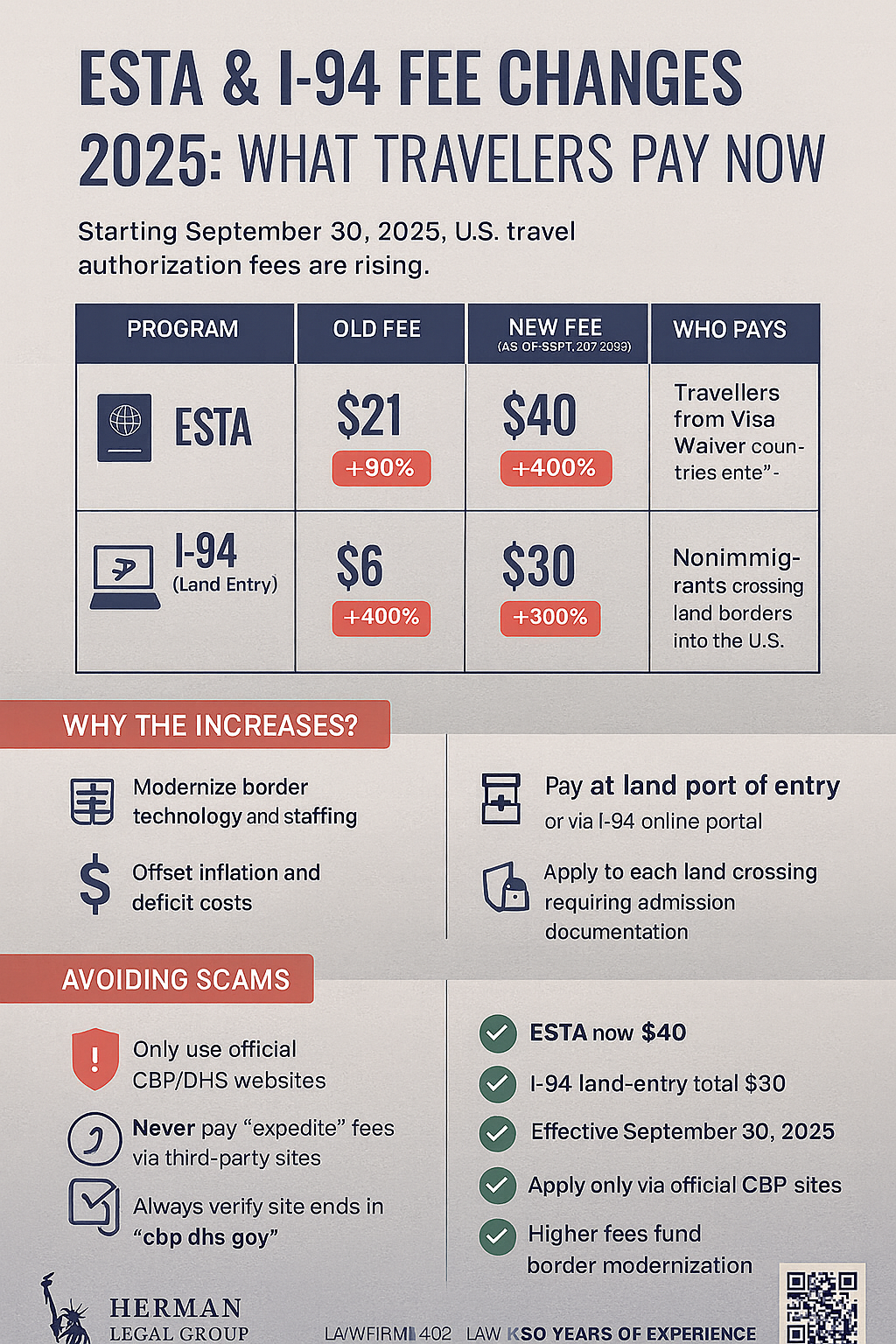
Yes — ESTA and I-94 fees increased in 2025, marking the steepest travel-entry fee hike in more than a decade. While fee adjustments have occurred periodically over the past several decades, the 2025 increase is the most significant in recent history. As of September 30, 2025, ESTA costs $40 and I-94 land-entry fees total $30, reflecting new DHS surcharges to support border modernization.
These new fees were implemented on September 30, 2025, coinciding with the start of the new fiscal year.
The changes stem from the “One Big Beautiful Bill Act,” signed July 4, 2025, which raised multiple U.S. immigration and border fees to help fund U.S. Customs and Border Protection (CBP) and Department of Homeland Security (DHS) operations.
This move shifts more costs to international travelers while strengthening CBP infrastructure, data systems, and staffing across U.S. ports of entry.
What Is the ESTA Fee and Who Must Pay It?
The Electronic System for Travel Authorization (ESTA) is an automated screening system for visitors from Visa Waiver Program** (VWP)** countries who travel to the U.S. for tourism or business stays under 90 days. Eligibility for ESTA is defined by the criteria set for Visa Waiver Program countries and the purpose and duration of travel. Eligible travelers must enroll in the ESTA system before travel.
Who must pay the ESTA fee:
- Citizens of the 40 VWP countries entering by air or sea.
- Travelers transiting through the U.S.
- Individuals applying at least 72 hours before travel.
Who does not pay:
- Travelers entering by land from Canada or Mexico.
- Holders of valid U.S. visas.
ESTA authorization is valid for two years (or until the passport expires). It is not a visa and does not authorize employment or extended stays.
What Is the New ESTA Fee Amount in 2025?
| Fee Type | Previous | New (as of Sept 30, 2025) | Purpose |
|---|---|---|---|
| ESTA Application | $21 | $40 | Funds CBP operations, Brand USA tourism promotion, and U.S. Treasury deficit reduction |
The increase was published in the Federal Register after DHS approval. The new ESTA fee applies to applications submitted in the 2025 tax year and beyond. ESTA applications submitted before September 30 remain at $21; those filed afterward incur $40. This marks a significant rise from the previous fee of $21, effective September 30, 2025. The Electronic System for Travel Authorization (ESTA) fee will increase from $21 to $40 starting September 30, 2025.
After payment, travelers are advised to keep a printed copy of their ESTA confirmation or payment receipt for their records.
How to pay:
Only through the official CBP ESTA website using a debit or credit card.
Avoid unofficial “third-party” sites that overcharge or collect traveler data.
The ESTA fee rose to $40 on September 30, 2025, payable only on the official CBP portal.
What Is the I-94 Fee and What Changed in 2025?
The Form I-94 is a record issued by CBP for all aliens who are lawfully admitted or granted parole into the U.S., confirming lawful admission and authorized stay period. Travelers who are admitted or paroled can access and print their electronic I-94 record from the CBP website.
Travelers entering by air or sea automatically receive an electronic I-94.
Those entering by land or manually applying must pay the fee. The I-94 fee increase applies only to travelers crossing at a land border; there is no fee for travelers arriving by air or sea. I-94 filers—those submitting the form for land entry—are directly affected by the new fee structure.
New fee structure:
- Existing I-94 fee – $6
- New surcharge – $24
- Total (land entry) – $30
This increase, up from the previous $6 fee, significantly impacts frequent cross-border travelers. The fee for I-94 land border entries has increased to $30 per trip, up from $6, affecting frequent cross-border travelers.
Air and sea arrivals are not affected by the surcharge at this time.
Implementation date:
September 30, 2025.
The surcharge revenue supports land-border operations, staffing, and inspection technology.
The new I-94 land-entry fee totals $30, combining a $6 base fee plus a $24 surcharge.
Who Pays Each Fee — and When
| ESTA (visa waiver) | I-94 (nonimmigrant land entry) | |
|---|---|---|
| Who pays | VWP travelers entering by air/sea | Travelers crossing by land needing an I-94 |
| When | Before departure (online) | Upon entry or pre-arrival online |
| Where | Official ESTA website | I-94 portal or port of entry |
| Cost 2025 | $40 | $30 ( $6 + $24 surcharge ) |
The sum of the base fee and surcharge for I-94 land entry is $30.
These increased fees may have a greater impact on lower-income earners and travelers with modest incomes, as the fixed costs represent a larger share of their travel budget compared to higher earners. This highlights how changes in travel fees can disproportionately affect people across different incomes.
Quick comparison:
ESTA covers short-term visa-waiver visits; I-94 applies to broader nonimmigrant entries and land crossings.
Relation of ESTA and I-94 Fees to Taxes
While the ESTA and I-94 fees are not part of the federal income tax system, they do represent an additional cost for individuals seeking entry to the United States. These fees are administrative charges collected through the Electronic System for Travel Authorization and at land border ports, and are separate from any income taxes paid by travelers or U.S. residents.
For travelers using the Visa Waiver Program, the recent ESTA fee increase—from $21 to $40 as of September 30, 2025—means a higher upfront expense for travel authorization. Nearly half of all international travelers to the U.S. use the Visa Waiver Program and are thus subject to the ESTA fee. Although this fee does not affect your income tax liability or how much you pay in federal income taxes, it does add to the overall cost of international travel. This can be especially significant for individuals and families with lower income levels, as the fee represents a larger share of their earnings compared to higher-income travelers. In contrast, the impact on wealthy travelers is relatively minor, as the fixed fee constitutes a much smaller proportion of their income.
Unlike taxes, which are based on income and are part of the broader U.S. tax code, ESTA and I-94 fees are fixed amounts applicable to all eligible travelers, regardless of their income or tax status. These fees are not offset by refundable credits, which are sometimes available for taxes but not for administrative fees like ESTA or I-94. Additionally, unlike some tax systems where high-income earners may pay a lower rate due to deductions or preferences, these fixed fees apply equally to all. These fees do not qualify as tax credits or deductions, and paying them does not impact your tax return or benefits under the U.S. tax system.
In summary, while ESTA and I-94 fees are not taxes, the increase in these costs is a reality that travelers must account for in their budgets. As travel expenses rise, it’s important for individuals to consider how these fees fit into their overall financial planning, especially when evaluating the total cost of visiting or working in the United States. Evidence from recent studies and reports shows that fixed travel fees disproportionately affect lower-income travelers, highlighting the regressive nature of such charges.
Why DHS Raised the Fees
Several factors drove these increases:
- Border modernization. Upgrading databases, kiosks, and biometric systems.
- Operational costs. Hiring and training CBP officers amid rising cross-border traffic, supporting the creation of new jobs for border security personnel.
- Inflation adjustments. Future fees will tie to CPI starting FY 2026.
- Deficit offset. A portion of each fee now flows directly to the U.S. Treasury. Previous legislative changes, such as the 2017 Tax Cuts and Jobs Act (TCJA), have influenced federal funding priorities and contributed to the need for increased travel fees to offset reduced revenue.
Lawmakers enacted these changes as part of broader immigration and border reforms designed to address funding gaps and ensure the sustainability of border operations. The implications of these fee increases extend beyond travelers, affecting the public by influencing access to cross-border movement and the funding of public services. While the travel industry warns that higher fees could dampen tourism, DHS argues they are vital to sustain border technology and security. Employers managing cross-border employees need to budget for higher travel costs due to new I-94 and ESTA fees.
Heavy tax cuts deprive state coffers of adequate revenue for programs and services that build opportunity and improve well-being for families and communities. Most state tax systems are regressive, meaning lower-income people are taxed at higher rates than top-earning taxpayers. In contrast, the U.S. income tax system is designed with some degree of progressivity, while fixed travel fees remain regressive and place a proportionally higher burden on lower-income travelers.
How to Avoid ESTA and I-94 Scams
Every fee increase brings fake websites posing as official CBP pages. Protect yourself:
- Apply only through domains ending in “.cbp.dhs.gov.”
- Never use third-party services that charge “expedite fees.”
- Use secure payment methods and print the receipt for records.
- Verify ESTA or I-94 status directly through the CBP portals.
warning:
The only official ESTA and I-94 sites end with “.cbp.dhs.gov.” Avoid any other websites charging extra.
Compliance and Penalties for ESTA and I-94
Staying compliant with the requirements of the Electronic System for Travel Authorization (ESTA) and Form I-94 is essential for all travelers seeking entry to the United States. With the increased fees that took effect in September 2025, it’s more important than ever to understand the rules and ensure that all travel authorization applications are submitted correctly and on time.
To comply with the visa waiver program and the U.S. tax system’s administrative requirements, travelers must pay the applicable fees for ESTA, Form I-94, and, where relevant, the Electronic Visa Update System (EVUS) before their journey. These three fees are mandatory for many international visitors and must be paid in advance to avoid any disruptions at the port of entry. Submitting accurate and complete applications through the official electronic system is crucial, as errors or omissions can result in delays, denial of entry, or even future restrictions on travel to the U.S.
The implications of non-compliance are significant. Travelers who fail to pay the required fee or provide accurate information on their ESTA or I-94 application may face penalties such as denial of travel authorization, fines, or being barred from future entry. The U.S. government enforces these requirements to maintain national security and ensure the efficient processing of arrivals at land, air, and sea ports. The fees collected help fund the ongoing maintenance and modernization of these electronic systems, supporting the broader goals of the tax code and border management.
Lawmakers regularly review and update the tax code, visa waiver program, and electronic visa update system to keep pace with changing security needs and technological advancements. As a result, travelers should expect that requirements and fees may continue to evolve in the future. Staying informed about these changes is essential—monitoring official updates and submitting applications through the correct channels will help travelers remain compliant and avoid unnecessary complications.
In summary, compliance with ESTA and I-94 requirements is not just about paying a fee—it’s about ensuring a smooth entry process and avoiding penalties that could impact future travel. By paying the required fees in advance, submitting accurate applications, and keeping up with changes to the tax system and visa requirements, travelers can protect themselves from the implications of non-compliance and enjoy a hassle-free visit to the United States.
Frequently Asked Questions About ESTA and I-94 Fees
When did the new ESTA and I-94 fees take effect?
Both increases took effect September 30, 2025. ESTA applications filed before that date were charged the old rate.
How much is the ESTA fee now?
The ESTA fee is $40 for applications submitted on or after September 30, 2025.
Who must pay the I-94 fee?
Nonimmigrants entering the U.S. by land who require an I-94 form must pay the $30 total fee.
Do Canadians pay the I-94 fee?
Most Canadian citizens are exempt for short visits. Those seeking certain nonimmigrant statuses (e.g., TN, L-1) may be charged the new fee.
Can I reuse an existing ESTA after the increase?
Yes. Valid ESTAs remain usable for up to two years or until passport expiration, whichever comes first. Employees can save costs by applying for ESTA before the increased fee takes effect in September 2025.
Why did the fees increase so much?
DHS and Congress restructured fees to fund border infrastructure, expand staffing, and offset federal costs without raising taxes.
Traveler Takeaways for 2025
- ESTA: Now $40 for Visa Waiver Program travelers.
- I-94: Now $30 for land border entries ($6 + $24 surcharge).
- Effective Date: September 30, 2025.
- Purpose: Fund border security and technology modernization.
- Apply Safely: Use only official CBP and DHS portals. States without broad-based personal income taxes often rely more heavily on sales and excise taxes that disproportionately impact lower-income families. States that rely heavily on consumption taxes increase the regressivity of their tax systems.
In 2025, the U.S. significantly increased ESTA and I-94 fees to fund border modernization — affecting most foreign travelers entering the United States.
Author Profile

Richard T. Herman, Esq. is a nationally recognized immigration lawyer with over 30 years of experience representing individuals and businesses worldwide. He is the co-author of the book Immigrant, Inc.: Why Immigrant Entrepreneurs Are Driving the New Economy, and founder of the Herman Legal Group — a multi-state law firm dedicated to immigration law, business immigration, and family visa services.
For media inquiries or case consultations, contact Richard directly through his website at LawFirm4Immigrants.com to schedule a confidential one-on-one consultation by phone or video