
Overview — What Just Happened and Why It Matters
For the first time since 2021, the U.S. government looks ready to to reopen the Deferred Action for Childhood Arrivals (DACA) program to accept new first-time applications. The DACA program was created by the Obama administration in 2012. This marks a pivotal moment in U.S. immigration policy — one that could impact hundreds of thousands of young immigrants, often known as Dreamers, who entered the United States as children and have lived here for most of their lives.
The Department of Homeland Security (DHS) and U.S. Citizenship and Immigration Services (USCIS) is sending signs the agency will once again accept and process initial DACA applications and initial DACA requests, following a years-long legal battle. This legal battle included Texas suing the federal government to challenge DACA, with the district court in the Southern District of Texas playing a key role in the proceedings. The new DACA position by the government, which addresses previous legal concerns raised in court, now allows USCIS to process initial DACA requests under the updated daca rule.

This development offers renewed hope for undocumented youth who have long awaited a chance to gain protection from deportation and obtain a work permit.
***Immigration Attorney Richard Herman: *** “For the first time since 2021, the U.S. government appears ready to reopen the DACA program to first-time applicants, giving Dreamers renewed hope for protection and work authorization. Stay tuned”
Understanding DACA — Origins and Legal Background
The Deferred Action for Childhood Arrivals (DACA) program was established in June 2012 through executive action by President Barack Obama, during the Obama administration. DACA was created through a regulatory process, often referred to as the DACA rule. It was designed as a temporary form of protection — a promise not to deport certain undocumented immigrants who were brought to the U.S. as children and who met specific conditions. Under DACA, eligible individuals can request consideration for deferred action, which temporarily defers removal from the U.S. and provides work authorization, but does not grant lawful immigration status. The program has remained legally vulnerable, facing a years-long legal battle over its legitimacy and implementation.
What DACA Does
- Protects eligible individuals from deportation for renewable two-year periods. DACA is a form of deferred action that defers removal (deportation) for those who qualify.
- Grants recipients eligibility for work authorization and certain state benefits.
- Does not provide a pathway to citizenship or permanent residency.
- Public safety concerns, such as certain criminal convictions, can disqualify applicants from DACA.
- Undocumented students are among the primary beneficiaries of DACA.
Since its creation, nearly 800,000 Dreamers have benefited from DACA, allowing them to pursue education, careers, and community involvement in the only country many have ever known.
However, DACA’s legal foundation has always been fragile, resting on prosecutorial discretion rather than congressional statute. That vulnerability led to years of lawsuits, policy reversals, and federal court injunctions.
Key Legal Challenges
One of the most significant legal cases is Texas v. United States, which was heard in the district court for the Southern District of Texas. In this case, Texas sued the federal government to challenge the legality of the DACA rule. Judge Hanen presided over the case and issued key rulings that have shaped the program’s future. This years-long legal battle has involved challenges to different versions of the DACA rule, including the new DACA rule, and has resulted in ongoing litigation. Courts have repeatedly found procedural faults in how the program was implemented, limiting USCIS’s ability to process new applications while allowing renewals to continue, especially during the relevant fiscal year(s) when these court decisions took effect.
Why New DACA Applications Were Blocked for Years
From 2021 through 2025, federal injunctions prevented USCIS from approving any new first-time DACA requests. During this period, USCIS was allowed to process only renewals and not initial applications. DACA renewal requests continued to be accepted and processed, meaning that current DACA recipients and other DACA recipients could maintain their status by submitting renewal applications before their expiration date. USCIS continued to process DACA renewal requests but could not process initial DACA requests. Here’s why: In early October 2025, the DOJ filed a plan with a federal court aiming to restart the acceptance of new, initial DACA applications.
Timeline of Legal Barriers
- 2020–2021: The Supreme Court temporarily revived DACA after the Trump administration’s attempt to end it was ruled “arbitrary and capricious.” This marked another chapter in the years-long legal battle over the DACA rule.
- July 2021: Judge Hanen, presiding in the district court for the Southern District of Texas, ruled that DACA was unlawful, halting approval of new applications.
- 2022–2024: The Fifth Circuit Court of Appeals upheld much of the lower court’s reasoning, sending the case back for further review in the Southern District, continuing the protracted years-long legal battle.
- 2025: With administrative reforms and updated DHS rules, the federal government gained room to resume processing new requests under the new DACA rule, which introduced regulatory changes differing from the original DACA rule.
During this period, renewals remained intact, but new applicants — those who had aged into eligibility — were left in limbo.
What Changed in 2025 — The Legal and Political Shift
In 2025, several key developments converged to make reopening possible:
- DHS Final Rule (New DACA Rule): The Department of Homeland Security issued a final rule, known as the new DACA rule, codifying DACA into formal regulation. This regulatory process established the DACA rule and addressed procedural concerns raised by courts.
- Court Guidance: The district court in the Southern District of Texas, presided over by Judge Hanen, provided guidance on the implementation of the new DACA rule. While litigation continues, the district court allowed limited reopening under the updated framework. As a result, the government can now process initial DACA requests under the new rule, and new applicants outside of Texas may finally have their requests processed if the federal judge approves the government’s plan.
- DOJ Strategy: The Department of Justice (DOJ) adopted a narrower litigation position emphasizing executive discretion.
- Advocacy Pressure: Civil rights organizations — including the National Immigration Law Center and National Immigration Project of NLG — pushed for immediate reinstatement.
Politically, both Congressional inaction and state-level lawsuits shaped the outcome. While Congress has yet to pass the Dream Act, administrative reform provided temporary relief.
Who Can Apply Now — DACA Eligibility Criteria for First-Time Applicants
Under potential 2025 DHS guidance, first-time applicants must meet the following eligibility criteria:
- Be an undocumented student or individual who entered the U.S. before their 16th birthday and has continuously resided in the U.S. since June 15, 2007.
- Be physically present in the U.S. on June 15, 2012, and at the time of making a request for consideration of deferred action for childhood arrivals (DACA).
- Have no lawful status on June 15, 2012.
- Meet certain educational requirements, such as being enrolled in school, having graduated, obtained a GED, or being an honorably discharged veteran of the Coast Guard or Armed Forces.
- Have not been convicted of a felony, significant misdemeanor, or three or more other misdemeanors, and do not otherwise pose a threat to national security or public safety.
If the program is relaunched, undocumented students and others who meet these criteria may request consideration for DACA. If approved, the applicant becomes a DACA recipient, is granted deferred action, and DHS will defer removal (deportation) from the U.S. for a renewable period. DACA recipients are also eligible for work authorization, providing protection from deportation and the ability to work legally in the United States.
Basic Requirements
- Must have entered the U.S. before age 16.
- Must have continuously resided in the U.S. since June 15, 2007.
- Must have been physically present in the U.S. on June 15, 2012.
- Must be under age 31 as of June 15, 2012.
- Must currently be in school, have graduated, obtained a GED, or be an honorably discharged veteran.
- Must have no felony convictions, significant misdemeanors, or multiple minor offenses.
Learn more about getting legal help for your immigration issues.
Inadmissibility and Risk Factors
Applicants with serious criminal records, national security issues, or fraudulent documents may be disqualified. Public safety concerns, such as certain criminal convictions, can also lead to denial of DACA. A significant misdemeanor conviction is disqualifying for DACA eligibility. Minor traffic offenses typically do not bar eligibility, but legal screening is vital before applying.
Immigration Lawyer Richard Herman: “To qualify for DACA in 2025, you must have entered before age 16, lived in the U.S. since 2007, and have a clean criminal record.”
Step-by-Step Guide to Applying for DACA in 2025
Here’s how eligible Dreamers can prepare for DACA 2025:
Applicants must request consideration for deferred action by submitting the required forms and supporting documents to USCIS. As of now, USCIS is able to process initial DACA requests, allowing first-time applicants to participate in the application process.
Step 1: Complete Required Forms
Applicants must file three forms together:
- Form I-821D – Consideration of Deferred Action for Childhood Arrivals
- Form I-765 – Application for Employment Authorization
- Form I-765WS – Worksheet establishing economic need
These forms are available at the USCIS DACA Hub.
Step 2: Gather Supporting Evidence
Include:
- Proof of identity (passport, school ID)
- Proof of entry before age 16
- Proof of continuous residence since June 15, 2007
- Education or military service records
Step 3: Pay Filing Fees (when program reopens)
The current total fee is $495, which covers both deferred action and the work authorization.
Step 4: Submit to USCIS (when program reopens)
Mail the full package to the correct USCIS Lockbox address, depending on your location.
Step 5: Attend Biometrics Appointment (when program reopens)
Expect a notice for fingerprints and background checks.
Step 6: Wait for Decision
Processing times may vary, especially for first-time applicants. Applicants should monitor their USCIS account for updates.
Advance Parole — Traveling Abroad as a DACA Applicant
Advance Parole is a special travel authorization that allows current DACA recipients to leave the United States temporarily and return lawfully, provided their trip is for educational, employment, or humanitarian reasons. Under the DACA program, eligible recipients can apply for an Advance Parole document by submitting Form I-131, Application for Travel Document, to U.S. Citizenship and Immigration Services (USCIS). This process enables DACA recipients to participate in study abroad programs, attend work conferences, or visit family members in emergencies without jeopardizing their immigration status.
It’s important to note that traveling outside the U.S. without an approved Advance Parole document can result in the loss of DACA protections and denial of re-entry. The Trump administration previously restricted the issuance of Advance Parole for DACA recipients, but current policy allows those with active DACA status to apply. However, due to ongoing litigation and the recent Fifth Circuit Court of Appeals ruling, new applicants may face additional hurdles in obtaining Advance Parole, especially as the courts continue to review the DACA program’s legality.
Current DACA recipients should always consult with an accredited representative or experienced immigration attorney before making any travel plans. Legal guidance is essential to ensure compliance with all requirements and to avoid unintended consequences. As of now, the Fifth Circuit’s decision has not eliminated Advance Parole for current DACA recipients, but the situation remains fluid, and future court decisions could impact availability. For the latest updates, applicants should monitor official USCIS and Department of Homeland Security announcements.
Employment Authorization Document — Work Rights for DACA Recipients
The Employment Authorization Document (EAD) is a cornerstone benefit of the DACA program, granting recipients the legal right to work in the United States. DACA recipients can apply for an EAD by submitting Form I-765, Application for Employment Authorization, typically alongside their DACA renewal request. Once approved, the EAD is valid for two years and can be renewed as long as the recipient maintains DACA status.
Recent legal developments have introduced uncertainty for some DACA recipients, particularly those residing in Texas. In January 2025, the Fifth Circuit Court of Appeals ruled that the work permit component of DACA may be unlawful for Texas residents, creating challenges for those seeking to renew their employment authorization documents. While this decision currently affects only Texas, DACA recipients in other states can continue to apply for and renew their EADs through the standard process.
The Biden administration has called on Congress to enact a legislative solution that would provide permanent legal status and work authorization for DACA recipients, recognizing the vital role Dreamers play in the U.S. workforce and economy. Until such legislation is passed, the ability of new applicants to obtain work authorization remains uncertain and subject to ongoing court appeals and administrative guidance.
For now, current DACA recipients outside Texas can continue to work lawfully and renew their work permits, while those in Texas should seek legal advice to understand their options. All applicants are encouraged to stay informed about changes in DACA policy and to consult with an immigration attorney before submitting a renewal request or initial application for employment authorization.
What This Means for Dreamers and Immigrant Families
For thousands who turned 15 after 2021, this reopening is life-changing. Both new and current DACA recipients will benefit, gaining access to work permits, college aid, driver’s licenses, and protection from deportation. However, other Dreamers who do not meet the criteria remain ineligible and still require legislative solutions.
Human Impact
- Families gain stability and safety.
- Employers retain skilled workers.
- Students can pursue higher education without fear.
According to estimates from the Migration Policy Institute, more than 400,000 additional Dreamers may now become eligible under DACA 2025.
Potential Challenges and Future Court Battles
Despite optimism, the future of DACA remains legally uncertain due to ongoing efforts to end DACA through lawsuits and court challenges. The DACA rule and the new DACA rule are at the center of litigation, with the district court in the Southern District of Texas—presided over by Judge Hanen—playing a pivotal role in these cases. Texas sued the federal government to challenge DACA, leading to a years-long legal battle that has affected DACA processing and protections in each fiscal year. The Texas Attorney General’s office has signaled plans to challenge the new rule, arguing executive overreach.
Possible Outcomes
- Favorable Ruling: Courts may uphold the 2025 regulation, preserving protections.
- Partial Block: Courts could freeze new approvals while allowing only renewals. In this scenario, current recipients can continue renewing their status, and USCIS may continue to accept and process DACA renewal requests, even if new applications are blocked.
- Adverse Decision: If deemed unlawful, even renewals may be jeopardized.
Because DACA is not a statute, Congressional action remains the only permanent solution. Immigration advocates continue urging passage of the Dream Act to provide lawful status.
DACA Renewals vs. New Applications — What’s Different?
| Feature | Renewal | New Application |
|---|---|---|
| Forms Required | I-821D, I-765, I-765WS | Same |
| Background Check | Simplified | Full review |
| Evidence | Updated proof of presence | Full historical documentation |
| Processing Time | 1–3 months | 6+ months |
| Risk of Denial | Low | Higher |
| Work Permit Timing | Immediate upon approval | After USCIS review |
| Important Note | Submit DACA renewal requests well before the expiration date of your current EAD to avoid a lapse in status. USCIS continues to process DACA renewal requests for eligible recipients, even as initial applications remain restricted. |
Renewals remain straightforward, but new applications may undergo deeper scrutiny due to untested documentation.
The Broader Political Context — DACA Under Trump vs. 2025 Landscape
During President Trump’s first term, the administration sought to end DACA, rescinding it in 2017 and triggering a years-long legal battle that created ongoing uncertainty and litigation.
In contrast, the 2025 policy environment has focused on stabilizing DACA within lawful bounds. Still, Trump’s re-election and policy directives have emphasized restrictive immigration frameworks, so the reopening may exist in a fragile balance — driven more by court order compliance than executive enthusiasm.
Without bipartisan legislation, Dreamers remain vulnerable to future reversals. The Biden vs. Trump DACA debate underscores how easily policy shifts with each administration.
Economic and Social Impact of DACA Reopening
Reopening DACA could reshape communities and local economies. In the most recent fiscal year, DACA recipients contributed billions in estimated tax revenue and played a significant role in supporting the workforce.
Projected Impacts
- Workforce Growth: Dreamers fill key roles in education, health, and tech sectors.
- Tax Contributions: DACA recipients contribute billions annually in state and federal taxes.
- Educational Gains: Legal work status encourages college completion.
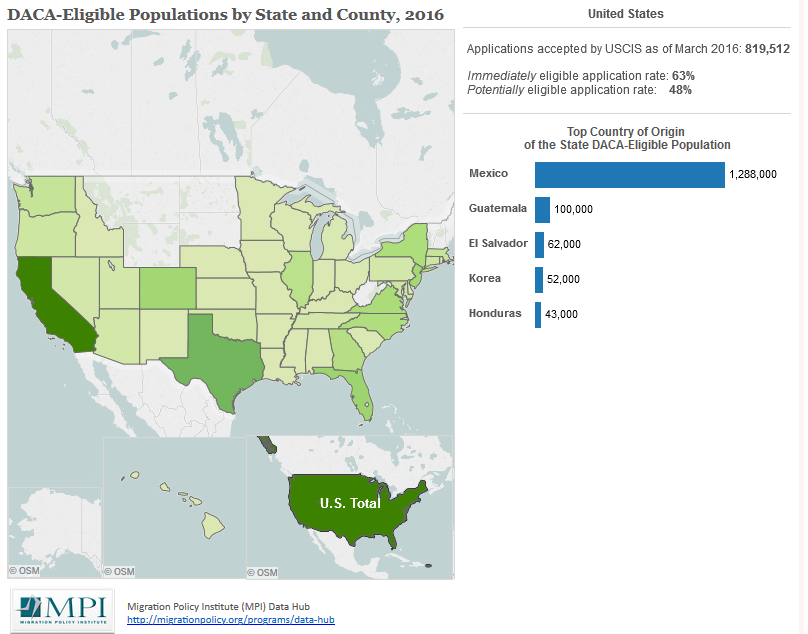
(Graph: DACA-Eligible Population 2025 by State — California, Texas, Florida, New York lead in eligible populations.)
Estimated New Beneficiaries
The Pew Research Center estimates 300,000–400,000 new potential applicants — primarily from Mexico, Central America, and Asia.
Frequently Asked Questions (FAQs) on the Resumption of New DACA Applications in 2025
What is DACA and why was it created?The Deferred Action for Childhood Arrivals (DACA) program was created in 2012 to protect certain undocumented immigrants who were brought to the United States as children. Through DACA, eligible individuals can request consideration for deferred action, which temporarily defers removal (deportation) and allows them to obtain work authorization, provided they meet strict eligibility criteria.
Why did the federal government stop processing new DACA applications?In 2021, a federal judge in Texas ruled that the original DACA program was unlawful, halting the processing of all new, first-time applications. While renewals continued, court injunctions prevented USCIS from approving new requests until the government addressed procedural deficiencies in the program.
What changed in 2025 to allow new DACA applications again?In 2025, DHS issued updated regulations and procedural reforms that satisfied court requirements, allowing USCIS to resume accepting and processing new DACA applications. The federal government also received clearance from appellate courts to reopen filings under a revised rule.
When did USCIS officially begin accepting new DACA applications again?USCIS will likely resume accepting new DACA applications in late 2025 following a public announcement and updated filing instructions. Applicants should monitor the USCIS DACA webpage for current submission dates and procedural guidance.
Who qualifies for DACA in 2025?To qualify, applicants must have entered the U.S. before age 16, continuously resided in the country since June 15, 2007, and been present in the U.S. on June 15, 2012. They must be under age 31 as of that date, meet educational or military service requirements, and have no significant criminal convictions. Undocumented students are a key group who may qualify for DACA.
Can I apply for DACA if I have never applied before?Yes. As of 2025, first-time applicants who meet all eligibility requirements can submit their initial DACA applications. This marks the first opportunity to do so since 2021.
What forms are required to apply for DACA in 2025?Applicants must submit Form I-821D (Consideration of Deferred Action for Childhood Arrivals), Form I-765 (Application for Employment Authorization), and Form I-765WS (Worksheet establishing financial need). All three must be filed together.
How much does it cost to apply for DACA?The total filing fee for DACA in 2025 is $495. This fee covers both the deferred action request and the employment authorization document (EAD).
What supporting documents should I include with my DACA application?Applicants should include proof of identity (such as a passport or school ID), proof of entry before age 16, evidence of continuous residence since June 15, 2007, educational or military records, and any documents showing physical presence on June 15, 2012.
How long does it take for USCIS to process a new DACA application in 2025?Processing times may vary, but new DACA applications generally take several months due to background checks, document verification, and court-related oversight. Applicants can check real-time processing estimates on the USCIS website.
Can I work legally in the U.S. after applying for DACA?Once approved, DACA recipients receive an Employment Authorization Document (EAD), allowing them to work lawfully in the United States for a renewable two-year period.
Does DACA provide a path to a green card or U.S. citizenship?No. DACA is a temporary policy that grants protection from deportation and work authorization but does not lead directly to lawful permanent residency or citizenship. Legislative action, such as the Dream Act, would be required for that.
What happens if my DACA application is denied?If denied, USCIS will issue a notice explaining the reason. There is no formal appeal process, but applicants may reapply if they become eligible or address the issue cited in the denial. Legal guidance is recommended before refiling.
Are DACA applicants protected from deportation while their application is pending?No automatic protection exists while a case is pending. Deferred action is granted only after approval. Applicants without lawful status remain subject to removal proceedings until USCIS grants DACA.
Can DACA recipients travel abroad?Yes, but only with an approved Advance Parole document. Without Advance Parole, leaving the U.S. could result in losing DACA status and re-entry denial.
Will the reopening of DACA face new legal challenges in 2025?Yes. State-led lawsuits, particularly from Texas and allied states, continue to challenge the legality of DACA. The outcome may depend on ongoing litigation in federal courts, including potential Supreme Court review.
Could the new DACA policy be reversed again in the future?It’s possible. Because DACA was created through executive action, future administrations could modify or rescind it. Legislative reform remains the only way to secure permanent protections for Dreamers.
How does DACA 2025 differ from earlier versions?The 2025 version is codified through formal DHS rulemaking, addressing procedural flaws cited by courts. It strengthens the legal basis for the program but retains the same core eligibility criteria and benefits.
Can people with minor criminal offenses apply for DACA?Yes, depending on the offense. Applicants must not have any felonies, significant misdemeanors, or three or more misdemeanors. Minor traffic violations or isolated low-level offenses may not disqualify an applicant, but legal review is essential.
What education requirements must I meet for DACA 2025?Applicants must currently be in school, have graduated from high school, earned a GED, or have been honorably discharged from the U.S. military or Coast Guard.
What if I don’t have continuous proof of presence since 2007?Applicants should submit as much documentation as possible, including rent receipts, medical records, school transcripts, or utility bills. If evidence is incomplete, affidavits from credible witnesses may help fill gaps.
Can I apply for DACA if I have Temporary Protected Status (TPS)?Possibly. Having TPS does not automatically disqualify you from DACA, but eligibility depends on your age, entry history, and presence on required dates.
Does DACA approval protect my family members from deportation?No. DACA protections apply only to the individual recipient. Family members must apply separately if eligible under their own circumstances.
Is DACA the same as the Dream Act?No. DACA is an executive program offering temporary relief, while the Dream Act is proposed legislation that would provide a permanent legal pathway to residency for eligible Dreamers. Congress has not yet passed the Dream Act.
How many people are expected to apply for DACA in 2025?Experts estimate that between 300,000 and 400,000 individuals could become newly eligible under DACA 2025, representing a significant expansion of the protected population.
What risks should I consider before applying for DACA?Applicants must disclose personal information, which could be accessible to DHS. While USCIS has generally not used DACA data for enforcement, the policy could change in the future. Consulting an immigration attorney before filing is crucial.
What are the benefits of applying for DACA in 2025?Benefits include protection from deportation, work authorization, access to a Social Security number, and in many states, eligibility for driver’s licenses and in-state college tuition.
How often must I renew my DACA status?DACA must be renewed every two years. USCIS recommends filing a renewal 120 to 150 days before the expiration date to avoid work authorization lapses.
Where can I find official updates on DACA 2025?Applicants should rely on official government websites, such as USCIS, DHS, and the Department of Justice, for accurate updates. Avoid information from unverified social media sources.
Should I hire an immigration lawyer to help with my DACA application?Yes. Because eligibility can be complex and rules may change, consulting an experienced immigration lawyer can ensure proper filing, minimize errors, and protect your legal interests.
What happens if the courts strike down DACA again after I apply?If courts halt the program, USCIS may stop approving new requests. However, applications already granted are typically honored for their approved term. Legal challenges often take months or years to resolve, allowing time for contingency planning.
Will applying for DACA affect my chances of getting other immigration benefits later?Usually not. DACA is considered an exercise of prosecutorial discretion, not a formal admission or visa. However, each case is unique, so applicants should seek individualized legal guidance.
Can undocumented youth who arrived after 2007 qualify for DACA?No. DACA’s continuous residence requirement begins June 15, 2007. Those who arrived later do not meet eligibility criteria under current DHS rules.
What should I do if I’m a potential DACA applicant but uncertain about eligibility?Schedule a consultation with an immigration attorney who can review your history, documents, and risks. Legal screening ensures applicants don’t expose themselves to unnecessary enforcement risks.
Why is DACA still controversial after all these years?Opponents argue that DACA exceeds executive authority, while supporters say it’s a vital humanitarian and economic policy. Courts continue to review its legality, reflecting broader divisions over immigration reform.
Will Congress pass the Dream Act in 2025?While advocates are pushing for a permanent solution, no legislation has passed yet. The resumption of DACA underscores the urgency for Congress to enact long-term protections for Dreamers.
What’s the most important thing for new applicants to know in 2025?The reopening of DACA is a rare and potentially temporary opportunity. Applicants should act quickly, prepare complete documentation, and seek legal assistance to ensure their applications are properly filed and safeguarded.
✅ The federal government resumed processing new DACA applications in 2025, allowing first-time applicants who meet strict eligibility requirements to apply for deportation protection and work authorization. Current DACA recipients should continue to monitor renewal deadlines and apply before their expiration date to maintain continuous protection.
How to Protect Your Rights — Get Legal Help
Because of ongoing litigation and shifting criteria, consulting an immigration lawyer is critical before applying.
Why You Need Legal Support
- Lawyers can confirm eligibility and risk factors.
- Legal experts help gather accurate evidence and avoid rejections.
- They protect applicants from notario fraud and scams.
For individualized assessment, applicants can schedule a consultation with an experienced immigration attorney.
Take the Next Step — Get Trusted Legal Guidance on Your DACA Application
If you have questions about filing a new DACA application in 2025, don’t go through this complex process alone. With changing rules, court challenges, and evolving eligibility criteria, it’s more important than ever to have a trusted immigration lawyer by your side — someone who understands both the law and your dreams.
For over 30 years, Attorney Richard T. Herman has helped thousands of immigrants secure their futures in the United States. As a nationally recognized immigration lawyer, media commentator, and co-author of Immigrant, Inc. (available on Amazon), Richard Herman has spent decades championing the economic and community benefits of welcoming immigrants. His deep experience and compassion make him the ideal advocate for Dreamers navigating this new DACA chapter.
When you work with Richard Herman and his team at the Herman Legal Group, you gain more than legal guidance — you gain a dedicated ally who will help you:
- Understand whether you qualify for new DACA protections
- Prepare and submit a strong, error-free application
- Avoid common mistakes that lead to delays or denials
- Protect your rights amid ongoing federal court challenges
Don’t risk your future or delay your opportunity. Every DACA application is time-sensitive and must be filed with precision and care.
Contact Attorney Richard T. Herman today for a confidential consultation and personalized guidance on your DACA eligibility and filing strategy. His firm has built a reputation for excellence, empathy, and results — helping clients across the U.S. turn uncertainty into opportunity.
👉 Schedule your consultation now and take the first step toward securing your future in America with one of the nation’s most respected immigration advocates by your side.
Official U.S. Government Resources
- USCIS DACA Hub — Official Policy, Forms, and Updates: USCIS DACA hub
- Form I-821D (DACA) — Filing Page: Form I-821D
- USCIS Newsroom — Agency Announcements: USCIS Newsroom
Federal Register (Rules & Notices)
- 2022 DACA Final Rule (Preserve and Fortify DACA): 2022 DACA Final Rule
- 2021 DACA Proposed Rule (NPRM): 2021 DACA NPRM
- 2024 CMS Rule — Marketplace Access for DACA Recipients: CMS Marketplace access rule
Department-Level Portals
- Department of Homeland Security (DHS): DHS homepage
- Department of Justice (DOJ): DOJ homepage
Court Opinions & Neutral Government Research
- Fifth Circuit Opinion in Texas v. United States (DACA): Fifth Circuit DACA opinion (PDF)
- Congressional Research Service (CRS) — DACA Overview/FAQ: CRS DACA overview
Professional Associations & National Legal Networks
- American Immigration Lawyers Association (AILA): AILA
- National Immigration Law Center (NILC): NILC DACA resources
- National Immigration Project of NLG (NIPNLG): NIPNLG
- MALDEF — Litigation & Statements: MALDEF DACA updates
- Justice Action Center — Litigation Tracker: DACA litigation tracker
Community-Facing Guides (Practitioner-Verified)
- Immigrants Rising — DACA Hub: Immigrants Rising DACA
- Informed Immigrant — DACA Court Timeline: Informed Immigrant DACA timeline
- Northwest Immigrant Rights Project (NWIRP) — DACA Resources: NWIRP DACA
Authoritative Reporting (Context & Timing)
- Associated Press — Processing Resumption Coverage: AP coverage on DACA reopening
- CBS News — DOJ Filing & Mechanics: CBS News on DACA applications
- AP Background — Earlier Illegality Ruling: AP background on Texas ruling