

Bringing Your Parents to the U.S. on an IR-5 Visa
You love your parents. They sacrificed so much to raise you, educate you, and instill the proper values. You came to the U.S., studied, worked hard, and achieved the American Dream. Much of this success story is due to your parents’ love and life-long commitment to you.
As your parents age, it is natural that you yearn to bring them to the U.S. so that you can now take care of them. They are getting older and will need your support, guidance, and funding.
Fortunately, the U.S. immigration system allows you to reunite with your parents through the IR5 Immigrant Visa (Parent Green Card). The IR-5 visa is a family-based Green Card specifically for parents of U.S. citizens aged at least 21 years. The process requires both you and your parent to complete specific steps and provide documentation to ensure a successful application.
Sponsoring your parents for a U.S. green card involves various considerations, including immigration procedures, financial aspects related to healthcare, concerns about your parents’ adaptability to U.S. culture, potential homesickness for their home country, language barriers, and mobility issues. As the U.S. citizen child, your eligibility as the sponsor is crucial to the success of the IR5 visa process.
In this article, we will guide you through the immigration requirements and offer insights to assist you in overcoming any challenges that may arise. If your parent has minor children abroad, keep in mind that separate petitions are required for each child, as they cannot be included in the IR5 application.

What is the IR5 Parent Visa?
This visa permits foreign-born parents to live and work in the US without an EAD. The IR5 parent visa has no annual cap, resulting in shorter wait times than other visa categories. This means there is no limit on the number of parents who can be granted this visa each year.
Benefits of the IR-5 Visa
-
Living and Working in the US: Parents with an IR5 visa can live and work anywhere in the US without restrictions. They can choose their residence and employment without needing additional work authorization.
-
Travel and Permanent Resident Status: IR5 visa holders can travel in and out of the US without a separate visa. However, they must maintain their permanent resident status by not staying outside the US for extended periods.
-
Public Benefits: Depending on eligibility and state laws, IR5 visa holders may have access to public benefits including healthcare, Social Security, and retirement benefits.
-
Sponsoring Other Family Members: Once they become permanent residents, parents can sponsor their spouse and unmarried children under 21 for green cards.
-
Pathway to Citizenship: After five years of continuous residence in the U.S., IR5 visa holders can apply for U.S. citizenship, provided they meet the naturalization requirements, including passing the citizenship test and demonstrating good moral character.
Note: While deep in the weeds, the green card for the IR-5 parent visa will contain category IR5. If the parent adjusted status based on an I-130 relative petition filed by their sponsoring child, the green card will contain category IR0.
Family Based Visas
-
Immediate Relatives Visas: The IR5 visa for parents of U.S. citizens falls under the Immediate Relative visa category, which is for close family members of US citizens, such as spouses, children, and parents. Since this category is not subject to annual caps, processing times are generally faster.
-
Family Preference VisasFamily Preference visas are for more distant relatives of US citizens and certain relatives of US Lawful Permanent Residents (LPRs). These visas are subject to annual limits so wait times are longer.
Eligible Petitioners:-
U.S. Citizens: Can file immigrant visa petitions for their spouse, children (both married and unmarried), parents, and siblings. To sponsor a parent, the petitioner must be at least 21 years old.
-
Lawful Permanent Residents (LPRs): Can only petition for their spouse and unmarried children.
-
IR5 Visa Requirements
Eligibility Requirements for the IR-5 Visa
To ensure that the IR-5 visa is the right pathway for you, both the sponsoring child and the parents must meet specific requirements:
-
Sponsor Age: The sponsoring U.S. citizen must be at least 21 years old to apply.
-
Financial Capacity: The sponsor must have the financial ability to support the parent(s) upon arrival. This involves demonstrating that you can meet or exceed the minimum income requirements set by the U.S. government (125% of the Federal Poverty Guidelines). If your income is not sufficient, you may need to find a co-sponsor who meets the requirements.
-
Proof of Relationship: The relationship between the sponsor and the parent must be proven with official documentation, typically a birth certificate or adoption decree. The documents must show the legitimate parent-child relationship.
-
Parent’s Birth Certificate: The parent must provide an official certificate or alternative documents if it is unavailable. The documentation must be acceptable to U.S. immigration authorities.
-
Proof of Sponsor’s U.S. Residency: The sponsor must either reside in the U.S. or provide evidence of plans to relocate to the U.S. before or alongside the parent’s immigration. This is typically demonstrated through utility bills, lease agreements, or employment letters.
-
Admissibility to the U.S.: The parent must be admissible to the U.S., meaning they should not have any disqualifying factors such as prior immigration violations, misrepresentation, criminal convictions, or removal orders.
Applying for an IR-5 visa requires specific documentation depending on the relationship between the sponsor and the parent. The required documents for fathers may vary depending on whether the father lives inside or outside the United States, as different supporting documents may be needed based on the father’s residency status. Below are the document requirements based on various scenarios:
|
Applicant Type |
Required Documents from Sponsoring Child |
|---|---|
|
Mother Applying from Outside the U.S. |
– Valid Birth certificate (showing both their name and mother’s name.)\ – Certificate of Naturalization or U.S. passport (if they were not born in the US) |
|
Father Applying from Outside the U.S. |
– Birth certificate (showing their name and both parents’ names)\ – Certificate of Naturalization or U.S. passport (if they were not born in the US)\ – Parents’ civil marriage certificate |
|
Father (Born Out of Wedlock, Not Legitimated Before Age 18) |
– Birth certificate (showing sponsor’s name and father’s name)\ – Certificate of Naturalization or U.S. passport (if they were not born in the US)\ – Evidence of an emotional or financial bond existed with the father before the sponsor was married or 21, whichever came first.\ – A completed Affidavit of Support (Form I-864) |
|
Father (Born Out of Wedlock, Legitimated Before Age 18) |
– Birth certificate (showing their name and father’s name)\ – Certificate of Naturalization or U.S. passport (if they were not born in the US)\ – Evidence of legitimation before the sponsor’s 18th birthday, through marriage of the natural parents or under the laws of the birth state/country of the sponsor or father |
|
Stepparent |
– Birth certificate (showing the names of their birth parents)\ – Certificate of Naturalization or U.S. passport (if they were not born in the US)\ – Civil marriage certificate of birth parent and stepparent (showing the marriage occurred before the sponsoring child’s 18th birthday)\ – Copies of any divorce decrees, death certificates, or annulment decrees to prove any previous marriage entered of the natural or stepparent were legally terminated |
|
Adoptive Parent |
– Birth certificate\ – Certificate of Naturalization or U.S. passport (if they were not born in the US)\ – Certified adoption certificate (showing adoption before sponsor’s 16th birthday)\ – Statement outlining the dates and places where the sponsor and their adoptive parents have lived together |
Is the IR-5 Visa Right for You?
The IR 5 visa is ideal for US citizens who want to bring their non-citizen parents to live in the US. This visa allows parents to enjoy the benefits of living in the US, such as better healthcare, closer family ties, and improved living conditions. The renewable green card allows parents to live in the U.S. as permanent residents without needing a separate work authorization document.
Key Considerations for the IR-5 Visa
-
Who Should Apply?: The IR-5 visa is ideal if you are a U.S. citizen, at least 21 years old, and wish to have your parents live with you in the U.S. permanently. It allows parents to access the rights and privileges of permanent residents, including the ability to live, work, and eventually apply for U.S. citizenship.
-
Filing for Each Parent Separately: When sponsoring both parents, you must file two separate I-130 petitions, one for each parent. Filing for one parent does not automatically include the other. Each parent’s visa application will require its own set of documentation and fees.
Adjustment of Status (AOS) vs. Consular Processing
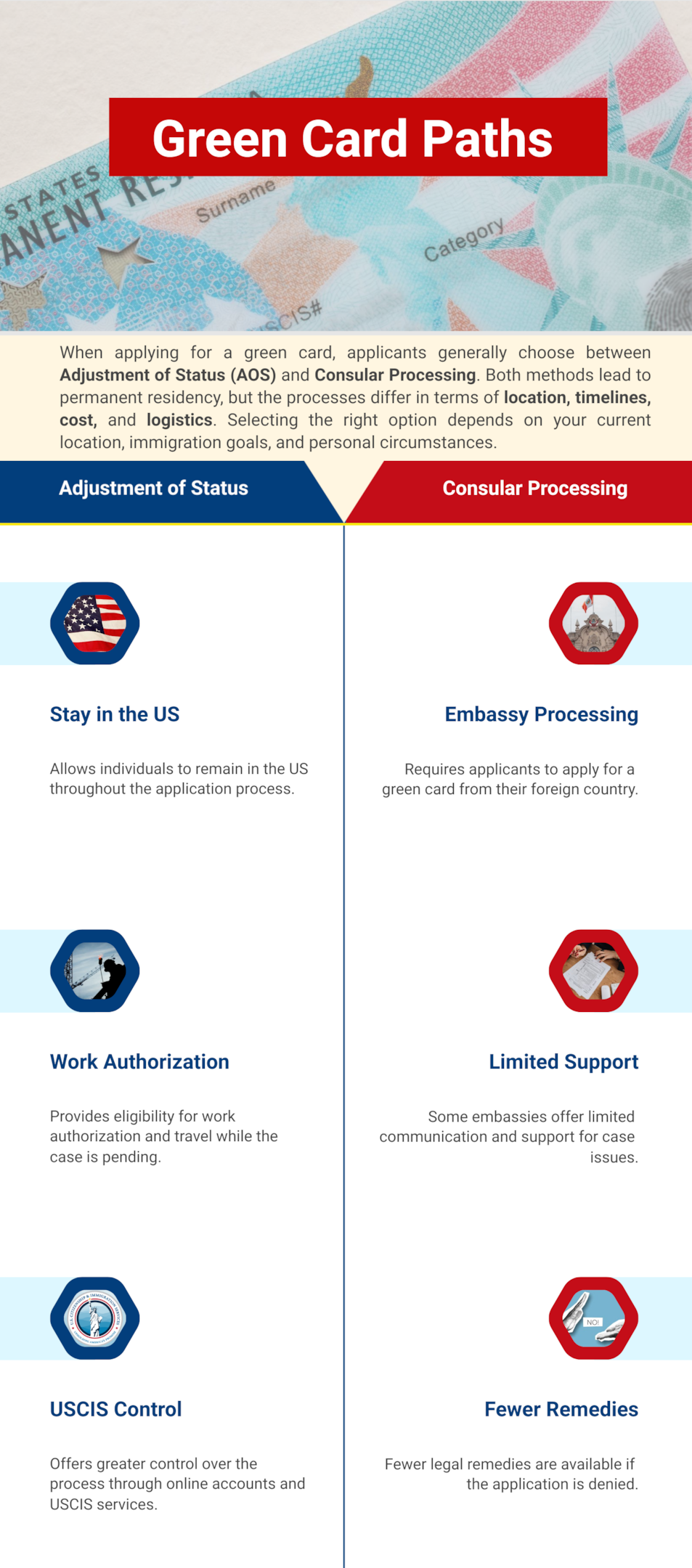
When applying for a green card, applicants generally choose between Adjustment of Status (AOS) and Consular Processing. Both methods lead to permanent residency, but the processes differ in terms of location, timelines, cost, and logistics. Selecting the right option depends on your current location, immigration goals, and personal circumstances.
What is Consular Processing?
Consular Processing requires applicants to apply for a green card from their foreign country. By visiting a U.S. embassy or consulate in their home country. This method is often chosen by those living abroad who are not eligible for AOS or those required to leave the U.S. due to visa violations or ineligibility issues. This process begins with filing the I-130 petition for each parent with U.S. Citizenship and Immigration Services (USCIS). Once the petition is approved, the case is transferred to the National Visa Center (NVC) and eventually to the U.S. embassy or consulate in the parent’s home country.
Processing Time: This route can take 18 to 24 months, so planning and patience are necessary.
Disadvantages of Consular Processing:
-
Some U.S. embassies have limited communication and support, making it harder to address case issues.
-
If denied, there are fewer legal remedies available, and it can take longer to reopen or appeal the case.
What is Adjustment of Status (AOS)?
Adjustment of Status allows individuals already in the U.S. to apply for a green card without needing to leave the country. Some parent beneficiaries are already in the US, perhaps after entering as B-2 tourists and then deciding to remain in the US, they may apply for adjustment of status to become a permanent resident. This option is appealing because it avoids the travel, expense, and uncertainty associated with visiting a U.S. consulate abroad. With AOS, the application is processed by USCIS.
Advantages of AOS:
-
Stay in the U.S. throughout the process.
-
Apply for employment authorization (EAD) and advance parole to work and travel while your case is pending.
-
Greater control over the process through USCIS tools like online accounts and USCIS Ombudsman services.
-
Avoid potential delays and limited support from some U.S. consulates.
Important Caution: If the U.S. Customs & Border Protection (CBP) or USCIS decides that the parents were attempting to enter the US as tourists while misrepresenting their true intentions to immigrate on that trip, the parents could be charged with fraud, denied green cards and deported. It is essential to be transparent and adhere to immigration regulations carefully to avoid such consequences. Please review the information below regarding the 90 Day Rule.
Consular Process Step by Step
Step 1: File Form I-130 (Petition for Alien Relative)
-
Filing the I-130:
-
The U.S. citizen sponsor files Form I-130 with U.S. Citizenship and Immigration Services (USCIS) to establish a legal relationship with the parent.
-
Filing Fee: $675 for each parent.
-
-
Supporting Documents:
-
Proof of Relationship: A copy of the sponsor’s U.S. birth certificate or naturalization certificate.
-
Identification: A copy of the sponsor’s U.S. passport.
-
Photos: Two identical, passport-sized photos of both the sponsor and the parent.
-
Name Changes (if applicable): Proof of any name changes, such as marriage certificates or court orders.
-
-
Processing Time for I-130:
-
Regular Processing: 6 to 12 months.
-
Expedited Processing (if eligible): In certain emergencies (e.g., medical emergencies or military deployment), you may request expedited processing with all the supporting documents.
Once USCIS approves the I-130, the petition is transferred to the National Visa Center (NVC), where it receives a visa number. You will receive a Case Number from the NVC to begin the next step.Tip: Avoid delays by filing all required documents correctly and ensuring all forms are signed. Any missing information could result in a Request for Evidence (RFE), which can slow down the process.
-
Step 2: Fill out DS-260 and DS-261 Forms
-
DS-261 (Choice of Address and Agent): After receiving an immigrant visa number from the National Visa Center, the parent must fill out Form DS-261 which designates how the parent wants to be contacted during the visa process.
-
DS-260 (Immigrant Visa Electronic Application): The parent then fills out Form DS-260, the official online visa application. Submitting the DS-260 form is a key part of the immigrant visa application for parents applying from outside the U.S. Submit all required documents, such as civil documents (birth certificates, marriage certificates) and police clearance certificates, to the NVC. Once the petition is approved, the parent can begin the official IR5 Visa application process by completing the DS-260 form. After submitting the DS-260, the parent will receive a confirmation page, which must be printed and included with the supporting documents for the visa interview.
-
Fees:
-
DS-260 Fee: $325.
-
Affidavit of Support Fee: $120.
-
Total Fees for Step 2: $445.
-
After visa issuance, a $235 USCIS immigrant fee is required for green card processing.
Step 3: Medical Exam
-
Scheduling the Exam: The parent must schedule and complete a medical examination with a U.S. government-authorized doctor before the visa interview.
-
Cost: Typically ranges from $300 to $500, depending on the location and healthcare provider.
-
-
Required Documents for the Exam:
-
Interview Letter: The green card interview letter from the NVC.
-
Vaccination Records: A record of all vaccinations and a copy of the parent’s medical history.
-
Identification: A government-issued photo ID.
-
Payment: Bring the exam fee; some providers may also accept health insurance cards.
-
If applicable, a letter from the parent’s regular doctor outlining any ongoing treatment plans.
-
-
After the Exam:
-
The doctor will provide a sealed envelope with the medical records, which must be submitted unopened at the visa interview.
-
Step 4: Attend the Biometrics Appointment and Verify Identity
-
Purpose: The parent must attend a biometrics appointment to provide fingerprints and photographs for identity verification and background checks by USCIS and the FBI.
-
Requirements:
-
Appointment Notice: Bring the biometrics appointment notice (Form I-797C).
-
Identification: A government-issued photo ID, such as a passport or driver’s license.
-
Additional Documents: Any USCIS receipt notices or documents mentioned in the appointment letter.
-
Step 5: Green Card Interview
-
Scheduling: The visa interview is usually scheduled 7 to 15 months after filing the I-130 petition. The NVC will schedule an interview at the U.S. embassy for the applicant once all necessary documents have been submitted.
-
The Interview: Conducted by a USCIS officer or consular official to verify information in the visa application and ensure all documents are in order.
-
Bring to the Interview:
-
Valid Birth Certificate and any supporting document used in the application.
-
Military Records: If applicable.
-
Proof of Legal Entry: If the parent has been to the U.S. before.
-
-
-
Legal Representation (Optional):
-
Consider bringing an immigration lawyer, especially if there are previous immigration issues that need to be addressed.
-
Step 6: Post-Interview and Visa Issuance
-
After the Interview:
-
If the interview is successful, the parent will be issued the IR-5 visa.
-
-
Entering the U.S.:
-
Upon arrival, the parent presents a sealed package provided by the consulate to U.S. Customs and Border Protection at the point of entry.
-
-
Receiving the Green Card:
-
USCIS will mail the green card to the U.S. address provided in the visa application.
-
Adjustment of Status (AOS) Step-by-Step
Step 1: Check Your Eligibility
To apply for AOS, you must:
-
Be physically present in the U.S.
-
Have lawfully entered the U.S. (exceptions apply for certain categories).
-
Ensure you have no disqualifying factors such as unauthorized employment or visa overstay (unless you qualify for exceptions like marriage to a U.S. citizen).
Tip: Consult with an attorney if you have concerns about eligibility. Some disqualifiers may be waived under specific conditions.
Step 2: File an Immigrant Petition
-
Family-Based Green Card: Form I-130, Petition for Alien Relative.
Step 3: Concurrently File Form I-485
If your priority date is current, you can file Form I-485, Application to Register Permanent Residence or Adjust Status, either alongside (concurrently) or after your immigrant petition is approved.
-
Supporting Documents:
-
Form I-485: Application to Register Permanent Residence or Adjust Status.
-
I-94 Arrival/Departure Record: Showing your lawful entry into the U.S.
-
Immigrant Petition: Copy of your approved or pending Form I-130
-
Form I-864: Affidavit of Support, showing your sponsor can financially support you.
-
Medical Examination Results: Form I-693, Report of Medical Examination and Vaccination Record, sealed by a USCIS-approved doctor.
-
Passport Photos: Two passport-sized photos that meet USCIS photo requirements.
-
Optional Forms: I-765 for employment authorization and I-131 for a travel document.
-
Step 4: Set Up a USCIS Online Account
After filing Form I-485, you will receive a Form I-797 receipt notice from USCIS. Follow the instructions on the receipt to set up an online USCIS account. This allows you to:
-
Track your case status in real time.
-
Receive notifications promptly, avoiding issues with delayed or lost mail.
-
Upload documents if USCIS requests additional evidence.
Step 5: Attend a Biometrics Appointment
USCIS will schedule you for a biometrics appointment at a local Application Support Center (ASC). During this appointment, your fingerprints, photograph, and signature will be collected for background checks.
Step 6: Prepare for an Interview (If Required)
Some applicants may be required to attend an in-person interview at a local USCIS office.
-
Bring original documents
-
Be prepared to answer questions about your application to confirm eligibility and clarify any discrepancies.
-
Interviews are typically brief, but preparation is essential to avoid issues or delays.
Step 7: Respond to RFEs or NOIDs
USCIS may send a Request for Evidence (RFE) or Notice of Intent to Deny (NOID) if additional information is needed to process your case.
Pro tip: Respond promptly to any USCIS requests to prevent unnecessary delays.
Step 8: Receive a Decision
USCIS will notify you in writing. If approved, your status will be adjusted to that of a lawful permanent resident and your green card will be mailed to you. In the meantime, if you need evidence of your permanent residency to travel, for employment, or a driver’s license application, you can set up an Info Pass appointment with USCIS, requesting an I-551 ADIT stamp which is temporary evidence of your permanent residency.
Cost of Adjustment of Status (AOS)
The AOS process involves several fees:
-
I-130 Petition: $675
-
I-485 Application (includes biometrics): $1,440
-
Optional I-765 (Employment Authorization) + I-131 (Advance Parole): $1,150
-
Total AOS Package (without attorney fees): Approximately $3,265
Additional Expenses:
-
Passport photos: Required for submission.
-
Certified translations: If any documents are not in English.
-
Attorney fees: Range from $3,000–$7,000 depending on the complexity of the case.
Timeline for Adjustment of Status (AOS)
The AOS process takes 6 to 18 months after Form I-485 is filed but this can vary depending on:
-
USCIS Workload: Processing times can vary depending on how many applications USCIS is processing at the time.
-
Interview: If an interview is required, this will add to the processing time.
-
Request for Evidence: If additional documentation is required, this will delay the process.
-
Priority Date Waiting Period: Depending on your visa category, waiting for your priority date to become current can add to the overall timeline.
Disqualifiers for Adjustment of Status
You will be disqualified from AOS:
-
Unlawful Entry: Entering the U.S. without inspection or a valid visa will make you inadmissible.
-
Unauthorized Employment: Working in the U.S. without proper authorization will disqualify you unless you qualify for a waiver.
-
Criminal Record: Certain criminal convictions will bar you from adjusting your status.
-
Nonimmigrant Visa Violations: Violating the terms of your current visa, such as overstaying, will get you denied.
-
Misrepresentation/Fraud: Providing false information to the U.S. Embassy, U.S. Customs and Border Protection, or USCIS will disqualify you from adjustment of status.
Note: Waivers and exceptions may be available for certain disqualifications. Consult with an immigration attorney to discuss your options.
The 90-Day Rule for Adjustment of Status: What You Need to Know
When applying for adjustment of status in the U.S., one important concept to be aware of is the “90-Day Rule”. This is a guideline used by (USCIS) to determine if an individual who entered the U.S. on a non-immigrant visa had a pre-conceived intent to immigrate. This is crucial, especially for those who plan to marry a U.S. citizen or take other steps toward permanent residency shortly after entering the U.S.
What is the 90-Day Rule? is a USCIS policy to determine the intent of non-immigrant visa holders when they enter the United States. This rule applies to individuals who entered the U.S. on a non-immigrant visa such as B-2, F-1, or H-1B and then marry a U.S. citizen or take other major steps towards getting permanent residency within 90 days of their arrival.
The Presumption of Preconceived Intent: Under the 90-Day Rule, if a non-immigrant visa holder marries a U.S. citizen or applies for adjustment of status within 90 days of their entry to the United States, USCIS may assume that the individual had a preconceived intent to immigrate when they entered the country.
For example, if someone enters the U.S. on a tourist visa which is for short-term term visits and not for immigration purposes, and then marries a U.S. citizen within the first 90 days, USCIS will question whether the individual intended to go back to their home country or if they always planned to stay in the U.S. permanently.
Rebutting the Presumption: The good news is that the presumption of preconceived intent is rebuttable. This means applicants can provide evidence to USCIS that, they did not have an intent to immigrate when they initially entered the U.S. on a non-immigrant visa.
Some ways to rebut the presumption include:
-
Providing a detailed explanation of circumstances: Applicants can explain the circumstances that led to their marriage or application for adjustment of status within 90 days. For example, if the marriage was spontaneous and not planned before entering the U.S., this should be clearly stated.
-
Offering evidence of changed circumstances: In some cases, events or circumstances may have changed after the individual arrived in the U.S. that prompted their decision to marry or apply for adjustment of status. Documenting these changes can help rebut the presumption of preconceived intent.
-
Submitting affidavits: Affidavits from the applicant, the U.S. citizen spouse, and other individuals who can attest to the legitimacy of the relationship or change in circumstances can help rebut the presumption.
What if the Presumption is Not Rebutted? If an applicant cannot rebut the presumption of preconceived intent, their adjustment of status application will be denied. In some cases, USCIS may also find that the individual committed fraud or willful misrepresentation which can have serious consequences including being barred from re-entering the U.S. in the future.
What to Do If You Are Affected by the 90-Day Rule: If you are planning to marry a U.S. citizen or apply for adjustment of status and you entered the U.S. on a non-immigrant visa within the last 90 days, you should be aware of the 90-Day Rule. Here’s what you can do:
-
Seek advice: Given the complexity of U.S. immigration law and the consequences of denial, it’s highly recommended to consult with an experienced immigration attorney before you take any step that can trigger the 90-day Rule.
-
Document your intent: If you decide to marry or apply for adjustment of status within the 90-day period, ensure you have all the documentation of your intent and the circumstances surrounding your decision. This documentation can help rebut the presumption of preconceived intent.
-
Be ready to provide evidence: USCIS may request additional evidence or an interview to review your case. Be ready to provide a detailed explanation to prove that your actions were not pre-planned before entering the U.S.
Additional Requirements When Sponsoring a Parent for U.S. Immigration

Income Requirements for Sponsor
To sponsor a parent for a green card, the sponsoring child must demonstrate they have sufficient financial resources to prevent their parent from becoming a public charge. Below are the key financial requirements and options if the sponsor’s income falls short. The sponsoring child must provide evidence of their income, usually through tax returns, pay stubs, or bank statements, to show they meet the minimum financial thresholds set by the U. S. government. If the sponsor’s income is insufficient, there are options available such as obtaining a co-sponsor who can contribute additional financial support. Understanding the nuances of green card holder parent sponsorship is essential to ensure that all criteria are met, enabling a smoother application process.
Income Guidelines for Sponsors
The sponsoring child’s income must meet or exceed 125% of the Federal Poverty Guidelines for their household size, including:
-
The sponsor, their dependents, and the parent(s) being sponsored.
-
Any joint sponsors (if applicable).
Example: If the household size is 4 (including the sponsor, one dependent, and both parents being sponsored), the total income must meet the 125% guideline for a family of four.
If the sponsor’s income is insufficient, they can:
-
Use Assets: Include personal assets (such as savings, real estate, or stocks). If the sponsoring child’s income does not meet the Federal Poverty Guidelines, they may use the value of assets to compensate for the difference.
-
Seek a Joint Sponsor: A joint sponsor with sufficient income can file an additional Form I-864.
-
Use Assets: Include personal assets (such as savings, real estate, or stocks).
-
Seek a Joint Sponsor: A joint sponsor with sufficient income can file an additional Form I-864.
Form I-864: Affidavit of Support
The sponsor must complete Form I-864, Affidavit of Support, demonstrating their financial ability to support the parent. This form is a binding legal document that ensures the sponsor will financially support the parent if necessary.
Using Assets to Meet Income Requirements
If the sponsor’s income is below 125% of the Federal Poverty Guidelines, assets can make up the shortfall. To qualify:
-
Total net assets must be five times the difference between the sponsor’s income and the 125% guideline. The total net value of assets must equal five times the difference between the sponsor’s income and the 125 percent of the poverty level for the household size.
-
Assets must be readily convertible to cash within 12 months. For more information or legal assistance regarding immigration sponsorship requirements, visit the Herman Legal Group homepage.
Example: If the sponsor’s income falls $10,000 short, their assets must total at least $50,000.
Acceptable assets include:
-
Savings accounts or investments
-
Real estate equity
-
Vehicles (if not essential for daily use)
Healthcare and Travel Considerations for Elderly Parents
Sponsoring elderly parents requires planning for healthcare and travel needs. The U.S. healthcare system can be costly, and frequent travel abroad could jeopardize their green card status.
Healthcare Insurance in the U.S. for Elderly Immigrants
Newly arrived immigrant parents often do not qualify for Medicare right away. Below are some healthcare options to explore:
Medicare Eligibility
-
Medicareis a federal health insurance program for individuals aged 65 or older. However, to qualify, beneficiaries typically need 40 quarters (10 years) of payroll tax contributions in the U.S.
-
Elderly parents can only apply for Medicare after five years as permanent residents. After this period, they may qualify for Medicare Part A (hospital insurance) and Part B (medical insurance), but they may need to pay higher premiums if they haven’t accumulated the necessary work credits.
Private Health Insurance Options:
Before they are eligible for Medicare, parents may need to purchase private health insurance. If your situation also involves bringing a Nigerian spouse to the US, you may find this CR1/IR1 Visa Process for Nigerian Spouse Applicants guide helpful.
-
Marketplace Plans (Affordable Care Act): Immigrant parents can purchase insurance through the Health Insurance Marketplace. Depending on household income, subsidies may be available to reduce premiums.
-
Short-Term Health Insurance: Offers temporary coverage but often excludes pre-existing conditions.
-
Medigap or Medicare Advantage Plans: Once parents are eligible for Medicare, these plans offer additional coverage, but they involve extra premiums.
Medicaid for Low-Income Immigrants
Some states offer Medicaid for low-income elderly immigrants, but eligibility criteria and benefits vary by state. Waiting periods may also apply to new immigrants.
Long-Term Care (LTC)
Long-term care, such as nursing home care, is not covered by Medicare. Medicaid may cover long-term care for those who qualify but there are strict eligibility requirements including income and asset limits.
Who Pays for Healthcare?
Healthcare costs are generally the responsibility of the parent or family. Here are possible sources of funding:
-
Parent’s Savings or Income: Personal savings, pensions, or other income sources can be used to cover healthcare expenses.
-
Sponsor’s Financial Responsibility: The sponsoring child is legally bound by the Affidavit of Support (Form I-864) to ensure the parent does not rely on public benefits.
-
State and Federal Programs: Depending on income and residency status, the parent may qualify for Medicaid or other state-level healthcare assistance.
Tip: It’s crucial to plan ahead for healthcare expenses, as sponsors may be held financially responsible if parents incur medical debt they cannot pay.
Travel Concerns and Risk of Green Card Abandonment
Homesickness is common for elderly immigrants and many want to travel back to their homeland periodically. However, this can have serious implications for their U.S. immigration status.
Maintaining Permanent Resident Status
A green card holder must reside in the U.S. as their primary residence. If a parent stays outside the U.S. for an extended period, immigration officials may assume they have abandoned their permanent residency.
-
Absences of 6 months or more can raise red flags during reentry.
-
Absences of 12 months or more are generally presumed to be abandonment unless the parent can prove they intended to maintain U.S. residency.
How to Avoid Abandoning Permanent Residency
-
Apply for a Reentry Permit:
-
If the parent is going to be outside the U.S. for an extended period they should apply for a reentry permit before leaving. This permit allows them to be outside the U.S. for up to two years without being considered to have abandoned their green card.
-
Note that a reentry permit does not guarantee reentry and each time the parent returns to the U.S. they may be questioned about their intent to maintain permanent residency.
-
-
Returning Resident Visa (SB-1):
-
If the parent remains outside the U.S. for more than a year without a reentry permit, they may need to apply for a Returning Resident Visa (SB-1)to regain entry as a permanent resident.
-
This process is complex and requires the parent to demonstrate extenuating circumstances that prevented their timely return.
-
Impact of Travel on Naturalization Eligibility
-
Extended absences can also affect the parent’s eligibility for U.S. citizenship. To apply for naturalization, the parent must maintain continuous residence in the U.S. for at least 5 years.
-
Absences of 6 months or more can disrupt the required continuous residence.
-
If disrupted, the parent’s naturalization eligibility will reset, delaying their ability to apply for citizenship.
Pro Tip: Encourage parents to limit overseas travel or plan it strategically to avoid interrupting their green card status and future naturalization goals.
-
What to Do If the Form I-130 is Denied
If Form I-130 is denied, the denial letter will include detailed instructions on how to appeal the decision.
-
File an Appeal:
-
Appeals must be filed within the specified time frame indicated in the denial notice.
Appeals are reviewed by the Board of Immigration Appeals (BIA).
-
Next Steps After Appeal:
-
Pay the required appeal fee and submit supporting documents.
-
The case will be re-adjudicated, and the decision may be reversed or upheld based on the new evidence provided.
-
FAQ
Can I apply for an IR-5 if my parent is already in the U.S. on a tourist visa?
Yes, if your parent is already in the U.S. on a valid tourist visa or another type of nonimmigrant visa they may be able to adjust their status to a lawful permanent resident without leaving the U.S. This involves filing Form I-485 (Application to Register Permanent Residence or Adjust Status) along with Form I-130. Make sure your parent maintains legal status in the U.S. while the adjustment of status application is pending. Read above about the 90-Day Rule and pre-conceived intent issues.
What should I do if my parent’s IR-5 visa is denied?
You can appeal the denial to the Board of Immigration Appeals (BIA) within the time frame specified in the denial letter. It’s a good idea to consult with an immigration attorney to understand the denial and prepare a strong appeal with the necessary documents and evidence.
My parents are divorced. Can I sponsor both of them separately for an IR-5?
Yes, you can sponsor both parents, even if they are divorced. Each parent must have a separate Form I-130, and you’ll need to provide legally recognized proof of your relationship with each parent (such as birth certificates). Make sure to include all necessary documents for both petitions.
Will my parent’s criminal records affect their IR-5 application?
Yes, criminal records can affect eligibility for the IR-5 visa. USCIS and consular officers will review your parent’s background to determine if any offenses make them inadmissible. Crimes such as drug offenses or crimes of moral turpitude may lead to denial. In some cases, a waiver of inadmissibility may be available. It’s essential to work with an immigration attorney to evaluate your parent’s options and prepare a statement showing any mitigating circumstances.
Can my parent include my siblings in the IR-5 visa application?
No, the IR-5 visa only applies to immediate relatives, specifically the parent(s) of a U.S. citizen. Siblings cannot be included in the same petition. However, after your parent becomes a lawful permanent resident, they can file visa applications for their minor children (your siblings) under the Family Preference category. This process may take several years due to visa quotas.
I was born out of wedlock, and my father did not legitimate me before I turned 18. Can I still sponsor my father for an IR-5?
Yes, you can still sponsor your father for an IR-5 visa even if you were born out of wedlock and not legitimated before turning 18. However, you will need to provide additional evidence to establish a legally recognized parent-child relationship. USCIS requires proof of an emotional or financial bond between you and your father before you turn 21.
Can I sponsor my adoptive parents for an IR-5?
Yes, you can sponsor your adoptive parents if the adoption was finalized before you turned 16, and you lived with them for at least two years. Be sure to submit a certified adoption decree along with other necessary documents to prove the relationship. For information about what happens when you report a fake marriage to USCIS, including the process and possible consequences, review official guidance.
How long does it take to process the IR-5 visa?
On average it takes 18-24 months. However, delays can occur due to incomplete visa applications, security clearances, and administrative processing. Check the USCIS website for current processing times and plan accordingly.
What are the costs for the IR-5 visa application?
The cost for the IR-5 application includes:
-
Form I-130 filing fee: $675
-
DS-260 processing fee: $325 (if applicable)
-
Form I-864, Affidavit of Support: $120
-
USCIS Immigrant Fee: $235 (if applicable)
-
Form I-485 (Adjustment of Status): $1,440 (if applying in the U.S.)
-
Medical exam and vaccinations: Varies depending on the provider.
Additional costs may be for obtaining official documents, translations, and travel for the interview. Be sure to budget for these and track application deadlines to avoid delays.
Can my parents travel while the IR-5 is pending?
If your parent is outside the U.S. and applying for the IR-5 through consular processing they should not travel to the U.S. on a tourist visa while their application is pending as this may raise questions about their intent. If your parent is already in the U.S. and has applied for adjustment of status they can apply for advance parole (Form I-131) to travel abroad while their application is pending. Traveling without advance parole will abandon the adjustment of the status application.
How can my parent renew their green card or apply for U.S. citizenship?
The green card issued through the IR-5 visa is valid for 10 years. Your parent should apply for renewal 6 months before it expires by filing Form I-90 (Application to Replace Permanent Resident Card).
After 5 years of continuous residence, your parent may apply for naturalization by filing Form N-400. Make sure your parent meets all eligibility requirements before applying.
Can I sponsor my parents if I am under 21?
No, only an adult child who is at least 21 years old can sponsor a parent for the IR-5 visa.
Can I sponsor my siblings along with my parents?
No, siblings must be sponsored separately. Once your parent becomes a lawful permanent resident, they can file visa applications for their other children (your siblings), but this process can take several years due to visa backlogs.
Bring Your Parent Closer, Sooner — Talk to Immigration Attorney Richard T. Herman
Caring for an elderly parent from a distance is more than logistics—it’s sleepless nights, last-minute flights, hospital waiting rooms, and the ache of missing everyday moments. If you’re exploring how to sponsor a green card for a parent—whether they’re living abroad or visiting the U.S.—you deserve a plan that honors both family and time.
Richard T. Herman has spent 30+ years guiding U.S. families through the parent sponsorship process with compassion and precision. As co-author of Immigrant, Inc. and a national advocate for the benefits of welcoming immigrants, Richard pairs deep legal expertise with an understanding of what’s really at stake: being close enough to care.
Snippet Callout: “Parents of U.S. citizens are ‘immediate relatives’—no annual visa caps—so strategy and completeness often matter more than the queue.”
Why families trust Richard Herman with parent cases
-
Clear roadmap from day one: Understand the best path—consular processing abroad vs. adjustment of status in the U.S.—and the tradeoffs for seniors (travel, health, timing).
-
Paperwork done right the first time: Tight, RFE-resistant submissions for I-130, I-485 (when eligible), I-864 Affidavit of Support, medical exams, and civil documents.
-
Elder-focused strategy: Guidance on medical considerations, humanitarian or expedite requests, and minimizing stress during interviews and travel.
-
Pitfall prevention: Avoid issues tied to visitor intent, overstays, or misrepresentation—especially critical when a parent is already in the U.S. on a B-2.
-
End-to-end support: From priority dates (not applicable to parents) and NVC document collection to interview prep and post-approval next steps.
-
Multilingual team, nationwide reach: Culturally fluent support that keeps your parent informed and comfortable.
Snippet Callout: “A well-documented, consistent record—relationship proofs, finances, and medical readiness—can shave months off avoidable delays.”
What you’ll leave your consultation with
-
A personalized timeline for your parent’s case
-
A precise document checklist tailored to your family and country of origin
-
A clear strategy for faster, cleaner processing—and what to do if delays arise
-
Answers to the questions that keep you up at night: “Can we adjust status now?” “Should we file abroad?” “How do we avoid RFEs?”
When your parent needs you, every month matters. Give your family the advantage of a trusted, veteran immigration attorney who treats your case with the urgency and care it deserves.
👉 Book a Consultation with Richard T. Herman
Or call (216) 696-6170 to speak with the Herman Legal Group today.
Because this isn’t just a case—it’s your parent, your peace of mind, and your chance to be there when it counts.
Authoritative Government Resources (USCIS, DOS, NVC, CBP, DHS)
Eligibility & Pathways (Parents of U.S. Citizens – IR5)
-
Green Card for Immediate Relatives of U.S. Citizens (Parents/IR5)
https://www.uscis.gov/green-card/green-card-eligibility/green-card-for-immediate-relatives-of-us-citizen
Core Petition & Supporting Forms
-
Form I-130 — Petition for Alien Relative (overview + filing)
https://www.uscis.gov/i-130 -
Form I-130 Instructions (PDF)
https://www.uscis.gov/sites/default/files/document/forms/i-130instr.pdf -
Form I-485 — Adjustment of Status (if parent is in the U.S.)
https://www.uscis.gov/i-485 -
Concurrent Filing (I-130 + I-485) Guidance
https://www.uscis.gov/forms/filing-guidance/concurrent-filing-of-form-i-485 -
Form I-864 — Affidavit of Support
https://www.uscis.gov/i-864 -
Form I-864P — Poverty Guidelines
https://www.uscis.gov/i-864p -
Form I-693 — Medical Exam (AoS cases)
https://www.uscis.gov/i-693 -
Form G-1145 — e-Notification of Application/Petition Acceptance
https://www.uscis.gov/g-1145 -
Form AR-11 — Change of Address
https://www.uscis.gov/ar-11
Adjustment of Status (Inside the U.S.)
-
Adjustment of Status Overview
https://www.uscis.gov/greencard/adjustment-of-status -
Find a USCIS Field Office (interview location)
https://www.uscis.gov/about-us/find-a-uscis-office/field-offices -
I-94 Admission Record (proof of lawful entry)
https://i94.cbp.dhs.gov/I94/#/home -
Advance Parole — Form I-131 (travel while AoS pending)
https://www.uscis.gov/i-131 -
Work Authorization — Form I-765 (EAD while AoS pending)
https://www.uscis.gov/i-765
Consular Processing (Parent Outside the U.S.)
-
Immigrant Visa Process (step-by-step)
https://travel.state.gov/content/travel/en/us-visas/immigrate/the-immigrant-visa-process.html -
National Visa Center (NVC) — Role & Communication
https://travel.state.gov/content/travel/en/us-visas/immigrate/nvc.html -
CEAC — Pay Fees, DS-260, Upload Docs, Check Status
https://ceac.state.gov/IV -
Find a U.S. Embassy/Consulate
https://www.usembassy.gov/ -
Visa Appointment & Interview Wait Times
https://travel.state.gov/content/travel/en/us-visas/visa-information-resources/wait-times.html -
Reciprocity Schedule (civil documents by country)
https://travel.state.gov/content/travel/en/us-visas/visa-information-resources/reciprocity-and-civil-documents-by-country.html -
Medical Exam Abroad (panel physicians)
https://travel.state.gov/content/travel/en/us-visas/immigrate/the-immigrant-visa-process/prepare/medical-examination.html
Visa Availability, Priority Dates, and Policy
-
Visa Bulletin (monthly) — IR5 is typically current
https://travel.state.gov/content/travel/en/legal/visa-law0/visa-bulletin.html -
Visa Availability & Priority Dates (USCIS)
https://www.uscis.gov/green-card/green-card-processes-and-procedures/visa-availability-and-priority-dates -
USCIS Policy Manual — Family-Based (evidence, relationship, adjudication)
https://www.uscis.gov/policy-manual/volume-6-part-b -
USCIS Policy Manual — Adjustment of Status
https://www.uscis.gov/policy-manual/volume-7 -
USCIS Forms (master index)
https://www.uscis.gov/forms
Processing Times, Status, and Problem-Solving
-
USCIS Case Status (receipt number lookup)
https://egov.uscis.gov/casestatus/landing.do -
USCIS Processing Times (I-130 & I-485)
https://egov.uscis.gov/processing-times/ -
Outside Normal Time — e-Request
https://egov.uscis.gov/e-request/Intro.do -
Expedite Criteria & Requests
https://www.uscis.gov/forms/filing-guidance/how-to-make-an-expedite-requestUSCIS Contact Center / Ask Emma
https://www.uscis.gov/contactcenter -
CIS Ombudsman — Case Assistance (DHS)
https://www.dhs.gov/cisombudsman -
USCIS FOIA — Request Your Records
https://www.uscis.gov/records/request-records-through-the-freedom-of-information-act-foia
Professional Associations & Trusted Nonprofits
-
American Immigration Lawyers Association (AILA)
https://www.aila.org/ -
American Immigration Council
https://www.americanimmigrationcouncil.org/ -
CLINIC (Catholic Legal Immigration Network, Inc.)
https://cliniclegal.org/ -
Immigrant Legal Resource Center (ILRC)
https://www.ilrc.org/ -
National Immigration Law Center (NILC)
https://www.nilc.org/ -
ABA Commission on Immigration
https://www.americanbar.org/groups/public_interest/immigration/