 By
By
F-1 Students Green Cards 2026: Can International Students Still Adjust Status Under the New USCIS I-485 Memo?
By Richard Herman, Immigration Attorney with More Than 30 Years of Experience

International students across the United States are asking the same urgent question right now: “Can F-1 students still get green cards under the new USCIS memo?”
That fear exploded after USCIS issued a new adjustment-of-status policy memorandum in May 2026 emphasizing that adjustment of status is discretionary, approval is not automatic, and officers should conduct broader discretionary review of Form I-485 applications.
The memo has created enormous anxiety among F-1 students, OPT and STEM OPT workers, Day 1 CPT students, H-1B applicants, employment-based immigrants, and marriage-based green card applicants. Many students now fear I-485 denials, visa revocations, social media vetting, SEVIS scrutiny, travel risks, or being forced into consular processing abroad.
For many international students, the question is no longer “How do I get a green card?” It is now “Will USCIS still allow me to adjust status inside the United States?”
This article explains whether F-1 students can still get green cards in 2026, what the new USCIS memo means for international students, who may be most at risk, common I-485 denial risks, how SEVIS and status issues may affect adjustment, and what students should do immediately.
Richard Herman Discusses the New USCIS Memo on NPR This Week
This week, immigration attorney Richard Herman appeared on multiple NPR-affiliated programs discussing the administration’s new adjustment-of-status policies and the growing fear among immigrants, including international students.
Listen here:
- Ideastream Public Media / NPR – Trump Administration Changes Rules to Obtain Green Cards
- NPR Illinois – Trump Administration Changes Rules to Obtain Green Cards
- Texas Public Radio / NPR – Trump Administration Changes Rules to Obtain Green Cards
During the interviews, Richard Herman explained that many immigrants are now requesting “immigration risk assessments” before filing Form I-485, changing status, traveling internationally, or making long-term immigration decisions. The interviews focused heavily on discretionary denials, social media vetting, increased immigration scrutiny, and pressure toward consular processing.
Richard Herman also recently discussed growing fear among international students in another NPR-affiliated interview: WBUR / NPR – Immigration Lawyer Says International Students Are Nervous to Come Study in the U.S. In that interview, Herman explained that many students are now deeply worried about immigration “risk scoring,” social media review, visa denials, and future green card eligibility.
What Is the New USCIS I-485 Memo?
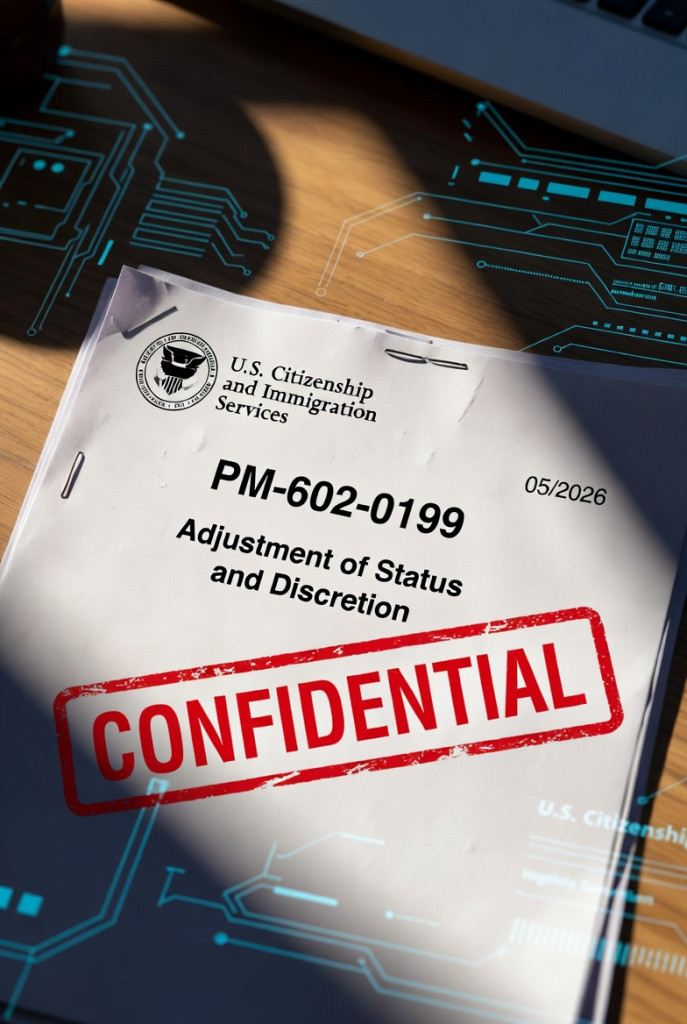
On May 21, 2026, USCIS issued USCIS Policy Memorandum PM-602-0199 – Adjustment of Status and Discretion.
The memo repeatedly emphasizes that adjustment of status is discretionary and states that adjustment is an “extraordinary act of grace.” The memo strongly suggests that eligibility alone may not be enough, officers should evaluate discretionary equities, and consular processing is the “ordinary” immigration pathway.
Official USCIS guidance:
• USCIS Policy Manual – Adjustment of Status Discretion
Can F-1 Students Still Get Green Cards in 2026?
Yes — many F-1 students can still obtain green cards. However, scrutiny is increasing dramatically under the new memo.
F-1 students may still pursue green cards through marriage to a U.S. citizen, employment sponsorship, EB-2 NIW, EB-1 extraordinary ability, asylum, family sponsorship, or other immigration pathways.
However, USCIS officers may now more aggressively review maintenance of status, unlawful employment, CPT/OPT compliance, SEVIS history, immigrant intent, social media activity, and prior immigration filings.
Why F-1 Students Are Especially Vulnerable?
F-1 visas are single-intent visas. That means students must generally maintain an intention to study temporarily and eventually depart the United States. This creates tension when students later pursue H-1B, PERM, marriage-based adjustment, or employment-based green cards.
Under the new memo, many lawyers fear USCIS officers may scrutinize whether the student truly maintained F-1 intent, prior statements made at visa interviews, or conduct inconsistent with student status.
What Are the Biggest Green Card Risks for F-1 Students in 2026?
Unauthorized Employment — Unauthorized work remains one of the biggest risks. Potential issues may include off-campus employment, unauthorized internships, CPT abuse, or unauthorized freelancing. Official guidance: USCIS Students and Employment.
SEVIS Problems — Potentially dangerous issues include terminated SEVIS records, status violations, unauthorized course loads, or enrollment gaps. Related: F-1 Student Visa Resources.
Day 1 CPT Scrutiny — Many lawyers expect increased USCIS scrutiny regarding Day 1 CPT, hybrid schools, attendance compliance, and employment authorization legitimacy.
Social Media Vetting — Students increasingly fear social media review, political screening, and online activity analysis. These concerns were specifically discussed in Richard Herman’s NPR interviews this week. Related: USCIS Vetting Center High-Risk Countries and Social Media Screening.
Immigrant Intent Concerns — USCIS officers may increasingly examine prior visa applications, travel history, social media, and statements suggesting immigrant intent during F-1 status.
Travel Risks — International travel may now carry significantly greater risk for students with pending I-485 applications, status questions, or prior immigration issues. Many lawyers now recommend individualized legal review before travel.
Could USCIS Deny an F-1 Student’s I-485 Even If Eligible?
Potentially yes. This is one of the biggest fears surrounding the new memo. The memo strongly suggests that eligibility alone may no longer be enough. USCIS officers may now weigh discretion, compliance history, credibility, positive equities, and “totality of circumstances.”
Are Some F-1 Students Safer Than Others?
Potentially yes. Students who may receive more favorable discretionary consideration could include physicians, STEM researchers, AI professionals, healthcare workers, national-interest applicants, and immigrants with strong humanitarian equities.
However, no category appears completely immune from increased scrutiny under the new memo.
Could USCIS Force F-1 Students Into Consular Processing?
Not directly. However, denial of adjustment may effectively leave consular processing as the only remaining option. For some students, this may be extremely dangerous because leaving the United States could potentially trigger unlawful presence bars, visa denials, administrative processing, or inability to return.
What Should F-1 Students Do Right Now?
F-1 students should begin by carefully reviewing their full immigration history for any status gaps, SEVIS problems, unauthorized work, or inconsistencies. Early identification of issues allows for better preparation and strategy.
It is also essential to preserve all documentation, including I-20s, SEVIS records, CPT/OPT approvals, transcripts, employment records, and previous immigration filings. Organized records help demonstrate compliance and positive equities.
Students should avoid international travel without first obtaining legal advice, as travel risks have increased significantly under the new memo. Departure can trigger serious consequences for those with pending applications or prior issues.
Strengthening positive equities is equally important. Students should prepare evidence showing academic achievement, national-interest contributions, humanitarian hardship, community involvement, and good moral character.
Finally, speak with an experienced immigration attorney. Strategic planning matters more than ever under the current policy environment.
Richard Herman’s Predictions About F-1 Green Card Cases
Based on more than 30 years practicing immigration law, I expect increased RFEs, more NOIDs, expanded social media vetting, greater scrutiny of CPT/OPT history, and broader discretionary review of student adjustment cases.
I also expect increased fear among international students, more “risk assessment” consultations, and increased federal litigation challenging arbitrary denials.
The implications of F-1 Students Green Cards 2026 are being felt across various sectors of the immigration landscape.
International students considering adjustment of status also need to account for the proposed end of duration of status. Review our guide to the 2026 F-1 four-year admission and I-539 extension rules. For adjustment strategy, see what USCIS’s latest guidance means in our analysis of whether USCIS walked back the I-485 memo.
It is essential to grasp the significance of F-1 Students Green Cards 2026 for those considering their permanent residency options.
As international students evaluate their options, F-1 Students Green Cards 2026 will play a crucial role in their planning.
Understanding the details surrounding F-1 Students Green Cards 2026 can empower students to make informed decisions.
The future of F-1 Students Green Cards 2026 remains uncertain, but staying updated is crucial.
Those who are well-informed about F-1 Students Green Cards 2026 will likely have a better chance of success.
Concerns about F-1 Students Green Cards 2026 are reaching new heights as policies continue to change.
F-1 Students Green Cards 2026 are becoming a focal point for many who seek to establish their lives in the United States.
Understanding the implications of F-1 Students Green Cards 2026 can help students navigate their immigration paths more effectively.
Ss=”rank-math-highlight” style=”background-color: #fee894″>Many international students are uncertain about how F-1 Students Green Cards 2026 will impact their future in the U.S.
The landscape regarding F-1 Students Green Cards 2026 continues to evolve, making it essential to stay informed about recent changes.
Understanding the process for F-1 Students Green Cards 2026 is critical for many international scholars looking for permanent residency.
Understanding F-1 Students Green Cards 2026