By
By
ICE’s Billion-Dollar Warehouse Gamble · News analysis
GAO documents more than $20 million in unrecoverable warehouse costs. A comprehensive detention-expansion strategy is still expected in August 2027.
The government bought the buildings. The comprehensive strategy is still coming.
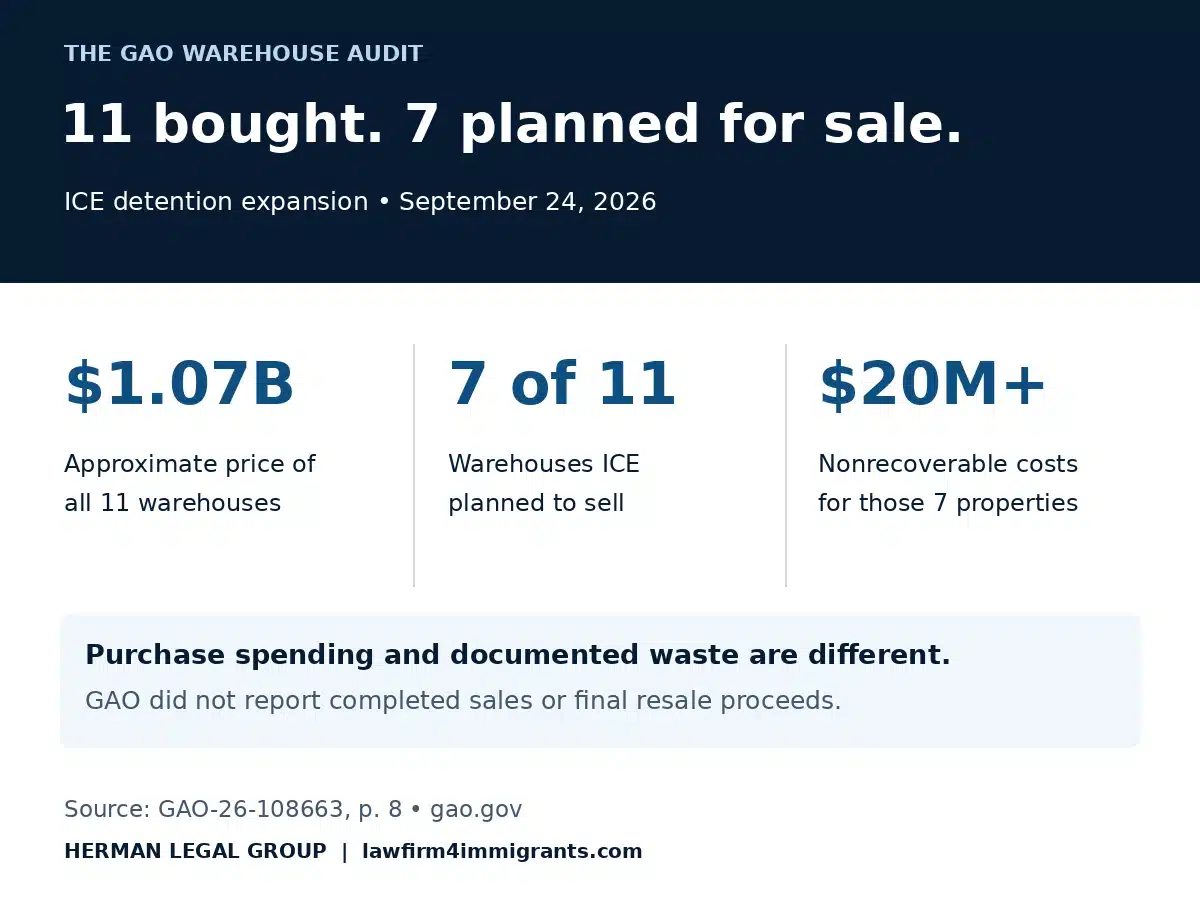
U.S. Immigration and Customs Enforcement purchased 11 warehouses for about $1.07 billion between January and April 2026. By June, ICE officials said they were working to sell seven. Along the way, the agency incurred more than $20 million in costs associated with those seven properties that it cannot recover, according to the Government Accountability Office’s September 24, 2026 report.
The report gives taxpayers a concrete question, regardless of their position on immigration enforcement: What did the government know about the buildings it was buying before committing the money? Its findings reach beyond warehouses to six detention-expansion initiatives and a recurring failure to establish needs, compare options, and assess long-term costs.

Immigration law and public accountability
Richard T. Herman, Esq., founder of Herman Legal Group, has practiced immigration law since 1993 and co-authored Immigrant, Inc. Learn more about his background and work.
Concerned about someone in immigration detention?
The spending: purchase price, sunk costs, and money at risk
The strongest way to understand the report is to keep its financial categories separate. Buying a property creates an asset that may later be sold. Paying for security or an assessment creates an expense. A contract obligation commits funds but does not necessarily mean all the money has already been paid.
| Figure | What it represents | How to interpret it |
|---|---|---|
| About $1.07 billion | Purchase price of all 11 warehouse facilities. | Capital spent on properties; the entire amount is not a documented loss. |
| $707 million | Purchase price of the seven warehouses ICE planned to sell. | A subset of the $1.07 billion. Sale proceeds will determine whether there is an additional loss on the purchases. |
| About $7.7 million | Nonrecoverable acquisition-related costs for those seven warehouses, including zoning assessments and title insurance. | Costs already incurred. |
| About $12.8 million | Utilities, security, and other services for those seven warehouses, estimated through August 2026. | Additional costs already incurred; they are separate from the $7.7 million. |
| $426 million | Combined renovation obligations for warehouses in Hagerstown, Maryland, and Surprise, Arizona. | Contract commitments for two retained properties; GAO does not classify this entire amount as waste. |
Source: GAO-26-108663, page 8. The approximate $20.5 million total is HLG’s addition of GAO’s rounded $7.7 million and $12.8 million figures. The rows should not be added into one grand total.
Seven of eleven is approximately 64% of the warehouses purchased. That is the share ICE intended to sell, not the share of the purchase money proven lost. GAO warns that selling those seven properties for less than their $707 million purchase price would create additional waste. Its report does not supply completed sale prices.
How the warehouse plan became a resale plan
The initiative began in December 2025 under the name Detention Reengineering Initiative. ICE announced plans to open 24 warehouse facilities by November 2026: 16 regional processing centers with capacity for up to 1,500 people each, and eight larger facilities capable of holding up to 10,000 each.
The agency bought 11 warehouse facilities between January and April. In June, the Homeland Security Secretary acknowledged that DHS was reevaluating the model because appropriate due diligence and planning had not been conducted. ICE told GAO it was working with the General Services Administration to sell seven properties.
That chronology matters. The decision to purchase preceded the reassessment that put most of those purchases on a disposal track. GAO’s criticism concerns the analysis behind the decisions, as well as the expenses those decisions generated. A large building does not, by itself, establish that a detention project is practical or financially sound.
HLG’s earlier warehouse-detention explainer examines the model’s implications for families. This September 2026 audit supplies a newer accounting of the government’s purchases and planning failures.
Hagerstown and Surprise: $426 million in renovation obligations
The four warehouses ICE intended to retain also carry financial exposure. GAO identified March 2026 renovation obligations of $113 million in Hagerstown, Maryland, and $313 million in Surprise, Arizona. Together, those commitments total $426 million.
GAO reported that conversion work at the two locations was largely on hold as of September because of legal challenges. Its page 8, footnote 30 describes the Maryland preliminary injunction and the Arizona agreement to pause conversion efforts while environmental reviews proceeded. These were different legal mechanisms, and the report does not establish a permanent nationwide ban on warehouse detention.
The unanswered financial question is how much of those obligations will ultimately be spent, adjusted, or recovered if the projects change. The audit supports asking that question. It does not support calling all $426 million a completed loss.
Six initiatives reveal a larger planning problem
The warehouse purchases are one part of the audit. GAO reviewed six new detention-expansion approaches and found that ICE had scaled back four as of July 2026. The report distinguishes identified waste from initiatives that create a risk of future waste.
| Initiative | Finding and financial significance |
|---|---|
| Guantanamo Bay | About $2.85 million was spent assembling tents that did not meet detention standards and were never used to house detained noncitizens. The much larger planned expansion was deemed infeasible. |
| Domestic military installations | At Camp East Montana, ICE paid about $7.1 million for meals it did not need between October 1, 2025, and March 12, 2026. As of August, the contract still lacked the recommended cost-saving measures. |
| Warehouses | Eleven purchased for about $1.07 billion; seven planned for sale, with more than $20 million in nonrecoverable costs. |
| Existing detention facilities | ICE bought two operating facilities for approximately $1.5 billion in July 2026 without assessing the long-term affordability of ownership. That creates a risk of waste; it is not a finding that the entire purchase price was wasted. |
| Florida facilities | The federal grant arrangement authorized a $249 daily bed rate, approximately 171% above the $92 median GAO calculated for ICE’s comparison portfolio. ICE had not used its normal contracting process to negotiate costs. |
| Federal Bureau of Prisons facilities | The eight facilities had a median daily bed rate of $182, compared with $92 in ICE’s comparison portfolio. Reimbursement obligations and staffing costs raised concerns about expense. |
Sources: GAO’s September report, pages 6–11, and its June 9 Camp East Montana report. The $92 figure is a median bed rate for specified facility types, not a universal all-in cost per detainee. GAO explains the exclusions and assumptions on page 4, footnote 14. These figures are not a single additive waste estimate.
The common accountability test is whether the government established what it needed and compared realistic options before committing resources. A more expensive facility is not automatically unnecessary. But an agency needs evidence to explain why it chose that facility and what additional value taxpayers receive.
The bill does not end when the government owns the building
GAO found that ICE’s facility acquisition plan included purchase and renovation estimates and three years of operating costs. ICE had not projected costs beyond those first three years, even though the major funding sources discussed in the report are available for obligation only through fiscal year 2029.
That creates an obvious question for future budgets: Who funds staffing, medical care, maintenance, utilities, and other recurring costs after the temporary funding window? Buying a facility changes who owns the asset. It does not eliminate the cost of running it.
The audit also found that ICE had not adequately specified the characteristics of the beds it needed, including location, gender, security classification, and medical requirements. Officials described shortages of space for women and people with complex medical issues. A national bed count can rise while the system still lacks the right capacity in the right place.
HLG’s analysis is that the public needs an accounting of what each site cost, what it can safely do, and what taxpayers will still owe after 2029. Readers following the commercial side can also consult HLG’s background on who receives money in the detention economy.
What DHS says—and why August 31, 2027 matters
DHS agreed with GAO’s recommendation to develop a comprehensive strategic plan. In its September 15 written response, reproduced in the report, DHS said it remained committed to immigration enforcement and meeting demand for detention space, including through facilities designed for ICE’s needs.
The response says the plan will identify expansion goals, activities, resource requirements, milestones, and responsibilities. It will also address facility requirements, staffing, contracts, funding, and coordination with stakeholders. The stated completion date is August 31, 2027.
GAO warned that earlier completion may be warranted because substantial funding is already available and further waste remains possible. That date is ICE’s estimated completion date in response to an audit recommendation; it is not a court-ordered deadline. The recommendation remained open on the report’s release page when reviewed for this article.
For the public, the next useful question is what controls will govern new purchases and operating commitments while the comprehensive plan is being prepared. A promise to plan should be accompanied by an explanation of how current spending decisions are being tested.
Six questions local reporters and taxpayers can ask now
The audit gives local communities a practical reporting agenda. These questions are HLG’s analysis of the records that would help establish whether a particular project is justified; they are not findings that every listed defect exists at every facility.
- What was purchased, and at what price? Request the property description, appraisal, acquisition approval, closing date, and purchase documents. Distinguish the seller, building owner, renovation contractor, and detention operator.
- What was checked before closing? Seek environmental assessments, utility-capacity reviews, projected renovation costs, and evaluations of alternative sites. Ask which questions remained unresolved when funds were committed.
- What is the cost after acquisition? Ask for separate totals for purchase, renovation obligations, payments, security, utilities, maintenance, and termination charges. Separating these categories helps prevent double counting.
- What happens if the project changes? Ask whether a site is retained, under review, declared excess, offered for sale, or actually sold. Request the expected proceeds and identify any continuing liabilities.
- Can the facility deliver the services its population requires? Ask about medical staffing, confidential attorney communication, visitation, transportation, and accommodation of specific medical needs—not simply maximum occupancy.
- What happens after fiscal year 2029? Request a longer-term operating forecast, the anticipated funding source, and the assumptions used if occupancy or enforcement priorities change.
This approach also gives Ohio readers a national spending story they can evaluate without assuming the report identifies an Ohio warehouse. The warehouse discussion names Hagerstown and Surprise as retained sites; it does not provide a complete site-by-site list of all eleven purchases. A reliable local follow-up needs the underlying property and agency records.
Why planning failures matter for people in detention
For detained people, a facility’s location, staffing, medical capacity, and attorney access are immediate concerns. GAO’s separate June report found that Camp East Montana initially opened without space for attorney and family visitation and without meeting other key detention standards. Financial oversight and the conditions people experience inside facilities are connected.
The September audit does not itself order anyone’s release or decide an individual’s immigration case. Families should obtain case-specific advice about custody, transfers, access to counsel, and any available legal challenge. HLG’s deportation and removal defense services explain how the firm assists people facing immigration enforcement.
The next receipt taxpayers need is a property-by-property accounting: purchase price, carrying costs, sale proceeds, and remaining obligations.
Frequently asked questions
Did ICE lose $1.07 billion on warehouses?
GAO did not make that finding. Approximately $1.07 billion was the purchase price of 11 warehouses. GAO identified more than $20 million in nonrecoverable costs associated with seven properties ICE planned to sell and warned of additional waste if those properties sold below their $707 million purchase price.
Has ICE already sold seven warehouses?
The report says ICE intended to sell seven and was working with the General Services Administration. It does not establish that seven sales were completed or report final sale proceeds. A planned sale and a completed transaction are different events.
Is the $426 million for Hagerstown and Surprise proven waste?
No. It is the combined amount obligated for renovations at two properties ICE intended to retain: $113 million in Hagerstown and $313 million in Surprise. GAO reported that conversion efforts were largely on hold as of September 2026. It did not classify the entire obligated amount as waste.
When will ICE complete its detention expansion plan?
DHS’s response to GAO gives August 31, 2027 as the estimated completion date for a comprehensive strategic plan. GAO said more timely completion may be warranted. The date is an agency estimate, not a court-imposed deadline.
Does this report prove fraud or corruption?
The report documents waste and inadequate planning. Those findings do not, by themselves, establish fraud, bribery, or criminal wrongdoing. Any allegation against a particular official, seller, or contractor requires separate supporting evidence.