 By
By
On August 30, Cleveland gathered in one of the most beautiful civic spaces in America to tell an old story about itself.
As we explore the theme of immigrant belonging Cleveland, we recognize the contributions of diverse communities to the city’s heritage.
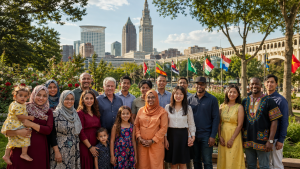
At One World Day in the Cleveland Cultural Gardens, new Americans were welcomed in a naturalization ceremony. The Parade of Flags moved through the gardens. Families came for music, dance, food, memory, and pride. For a few hours, Cleveland looked like the city it often says it wants to be: international, generous, colorful, rooted in many histories and open to many futures.
The Cleveland Cultural Gardens are not civic decoration. They are a monument to the people who came from somewhere else and made Cleveland home. They remind us that this city was built by migration: by families carrying languages, recipes, grief, faith, ambition, labor, and hope into neighborhoods that became Polish, Slovenian, Irish, Italian, Jewish, Hungarian, Arab, African, Asian, Latino, and so many other versions of Cleveland.
The ongoing narrative of immigrant belonging Cleveland reminds us of the importance of inclusion and representation in our civic life.
But there is a question behind the flags that Cleveland has never fully answered.
Is immigrant heritage something Cleveland is comfortable celebrating mainly after it becomes history? Or is immigrant power something Cleveland is willing to share now?
That is the harder issue. Immigrants are often welcomed into Cleveland’s cultural life long before they are welcomed into Cleveland’s governing life. They are invited to bring food, music, color, gratitude, work ethic, entrepreneurial energy, and a hopeful story about the city. But when the conversation shifts from heritage to power — to budgets, policing, surveillance, economic development, housing, schools, workforce strategy, legal protection, public contracts, board appointments, and political influence — immigrant communities too often remain near the edge of the room.
Cleveland does not have an immigrant-history problem. It has an immigrant-power problem.
The city knows how to honor immigrants once they are safely folded into the past. It is less comfortable sharing power with the immigrants who are reshaping Cleveland now.
The Old Immigrant Story and the New Immigrant Exclusion
Cleveland often tells its immigrant story through the success of earlier European communities. That story is real, and it deserves respect. Irish, Polish, Italian, Slovenian, Czech, Hungarian, Jewish, Greek, Ukrainian, and other European immigrants did not merely bring culture to Cleveland. They arrived in large numbers. They built neighborhoods, churches, unions, newspapers, mutual-aid societies, businesses, political clubs, and voting blocs. Over time, they gained civic power.
That older immigrant power helped shape modern Cleveland. Leaders such as Ralph Perk, George Voinovich, and Dennis Kucinich emerged from ethnic-white political worlds where immigrant-descended communities had numbers, neighborhood concentration, institutional muscle, and electoral influence. Those communities were not simply invited to dance at festivals. They fought their way into City Hall, labor leadership, business networks, party politics, and the public life of the city.
That is the distinction Cleveland must face honestly.
The newer immigrant communities remaking Cleveland today — Asian, Latino, Arab, African, Caribbean, and others — do not stand in the same position. Many are smaller in number, more internally diverse, more geographically scattered, more legally vulnerable, and less embedded in the old machinery of Cleveland politics. They are arriving not into an open frontier of urban power, but into a city where most institutions, budgets, relationships, and leadership pipelines are already controlled by longstanding civic networks.
So the issue is not whether Cleveland has ever been an immigrant city. Of course it has. The issue is whether Cleveland is willing to let today’s immigrants become more than a cultural memory for tomorrow.
Ultimately, the question of immigrant belonging Cleveland challenges us to redefine what it means to be part of this community.
Earlier immigrants eventually gained power. Newer immigrants are still too often asked to provide culture without receiving power, labor without voice, diversity without authority, and gratitude without leverage.
Robert L. Smith Saw the Tension Early
The history of Global Cleveland shows that this tension has been present from the beginning.
In the Encyclopedia of Cleveland History at Case Western Reserve University, Robert L. Smith, my co-author of Immigrant, Inc., described Global Cleveland as a nonprofit economic-development agency launched in 2011 by young civic and business leaders to boost Cleveland’s population and economy by attracting new residents from around the world. Smith noted that other cities, including Chicago, Philadelphia, and Boston, had already created offices or welcome centers to attract immigrants and international students.
That was the right instinct. Cleveland needed people then, and Cleveland needs people now.
I write this history not as a distant observer. I was one of the people who helped start Global Cleveland because I believed, and still believe, that Cleveland cannot reverse decline without becoming more serious about attracting, retaining, protecting, and empowering immigrants. Smith’s encyclopedia entry notes that I promoted immigrant attraction as a way to boost population and revive urban neighborhoods. It also records that I later resigned from the board after concluding that the organization had become too cautious and ineffective.
That personal history does not make the critique easier. It makes it more necessary.
Smith recorded the caution that surrounded the effort. Civic leaders reached for safer words like “newcomers” and “boomerangers,” even when the real subject was immigrants and refugees. He wrote that support was weak among politicians, that the business establishment was slow to embrace the idea, and that skepticism was especially strong in the African American community, where many feared that immigrants might compete for jobs.
Former Mayor Frank Jackson joined Global Cleveland as an honorary board member, but Smith wrote that Jackson’s support was “never enthusiastic or certain.” When asked in 2013 about attracting immigrants, Jackson answered: “I believe in taking care of your own.”
That line deserves to be taken seriously, not mocked. Jackson and other skeptics were speaking from a city where many longtime residents, especially Black Clevelanders, had endured decades of disinvestment, poverty, segregation, abandoned housing, school struggles, violence, and broken promises. Any immigrant-growth strategy that ignores those realities is morally thin and politically naïve.
But the concern also reveals the trap.
Cleveland allowed immigrant attraction to be framed as a threat to existing residents rather than as a strategy for shared growth. It treated newcomers as potential competitors for scarce opportunity rather than as future neighbors, taxpayers, workers, entrepreneurs, parents, homeowners, and civic partners. It allowed a shrinking city to debate immigration as if the main danger was too many people wanting in, when the deeper danger was too few people choosing Cleveland at all.
Smith’s entry also noted how cautious Global Cleveland became. That linguistic retreat mattered. A city that cannot say clearly whom it is trying to attract is unlikely to build the power, programs, and public confidence needed to attract them.
The result was a softer version of the original vision. Global Cleveland survived and became associated with welcoming immigrants and supporting multiculturalism. But it never became the insurgent civic force Cleveland needed to make immigrant growth central to the city’s future.
That is the larger lesson. Cleveland did not reject immigrants outright. It did something more complicated. It celebrated immigrant heritage, softened immigrant language, underbuilt immigrant infrastructure, and left political power largely where it already was.
The Immigrant Dividend Is Not a Slogan
The economic case is already clear.
A New American Economy report, now part of the American Immigration Council, prepared with Global Cleveland, found that immigrants in Northeast Ohio paid more than $1.5 billion in taxes and held $3.9 billion in spending power in 2019. Immigrant households paid roughly $1 billion in federal taxes and $520.8 million in state and local taxes.
That is the immigrant dividend. It is not sentiment. It is revenue, demand, entrepreneurship, labor, family formation, and neighborhood stabilization.
Yet Cleveland has not fully converted the immigrant dividend into immigrant power.
Immigrants are still too often described as contributors, not decision-makers. They are praised as workers, taxpayers, entrepreneurs, students, caregivers, and symbols of diversity. But contribution without influence is not belonging. If immigrant families help sustain the city, they should also help shape the city.
This has been central to my own work for years. As co-author of Immigrant, Inc., I have long argued that immigrant entrepreneurship is not a side story in American economic life. It is one of the engines of growth. More recently, writing in The Land after Heinen’s announced its downtown Cleveland closure, I argued that Cleveland should be asking who will still bet on the city — and pointed to immigrant entrepreneurship as one of the overlooked answers.
John Sibley Butler Understood the Link Between Black and Immigrant Entrepreneurship
This is also why Cleveland should not allow immigrant growth to be framed against Black economic power.
John Sibley Butler, one of America’s leading scholars of Black business history and minority entrepreneurship, has a personal connection to Cleveland through his wife, who is from here. His work offers a way out of the false choice Cleveland has too often made between immigrant growth and Black economic power.
In Entrepreneurship and Self-Help among Black Americans, Butler traced the development of Black enterprises and community organizations from before the Civil War into the modern economy. His work treated African American enterprise not as an accident or a side note, but as a survival strategy and a community-building strategy created under conditions of hostility and exclusion.
Butler’s broader work on Immigrant and Minority Entrepreneurship: The Continuous Rebirth of American Communities made the connection even clearer. The book studies immigrant and minority entrepreneurship together, including African American entrepreneurship from the 1910 Census, New York’s Chinatown, Arab American entrepreneurs, and minority communities as natural business incubators. Its publisher’s description notes that analysis of 1910 data found Black Americans were more likely than white Americans to be employers and almost as likely as whites to be self-employed.
That history matters for Cleveland.
African American entrepreneurs and immigrant entrepreneurs may come from different histories, but they are cut from similar American cloth. Both groups often built businesses because mainstream institutions denied them full access to jobs, capital, housing, networks, licensing, and opportunity. Exclusion forced self-help. Self-help became entrepreneurship. Entrepreneurship became community infrastructure.
The city should not ask whether immigrant entrepreneurs will compete with Black entrepreneurs for scarce attention and resources. It should ask what Cleveland could build if Black entrepreneurs and immigrant entrepreneurs were treated as natural allies in neighborhood revival, commercial-corridor development, vacant-property reuse, small-business lending, procurement, workforce training, and local ownership.
The politics of scarcity says one group’s opportunity must come at another group’s expense. The politics of growth says the opposite: communities that have been excluded from power can build power together.
Trump, MAGA, Mass Deportation, and the Shrinking Circle of “Our Own”
This failure matters even more in the Trump era.
Donald Trump and the MAGA movement did not invent the fear that newcomers compete with existing residents, but they have nationalized and weaponized it. “America First” can sound like a promise to protect “our own,” but in practice it too often becomes a way to tell immigrants, refugees, asylum seekers, international students, mixed-status families, workers, and even naturalized citizens that their belonging is conditional.
Mass deportation politics goes further. It does not merely argue that fewer immigrants should arrive. It threatens to remove people already embedded in American communities: parents, employees, caregivers, students, neighbors, taxpayers, church members, small-business owners, and spouses of U.S. citizens. It turns ordinary life into a legal vulnerability and tells immigrant families that stability can be taken away.
This is where the national politics of Trump and MAGA and the older local politics of “take care of our own” begin to rhyme. One is louder and more punitive. The other is more cautious and civic. But both can shrink the circle of belonging. Both can make immigrants useful without making them central. Both can welcome immigrant labor, immigrant taxes, immigrant food, immigrant music, and immigrant success stories while keeping real power somewhere else.
Cleveland should reject that bargain.
Global Cleveland Cannot Be Only the Polite Face of Welcome
This is where Global Cleveland faces its hardest test.
Global Cleveland was created because Cleveland needed a more ambitious immigrant future. It was supposed to help the city attract people, talent, entrepreneurs, workers, students, and families from around the world. But an organization funded by and dependent on the same civic establishment it may need to challenge will always face a difficult question: can it speak with enough independence when Cleveland’s immigrant future requires more than polite welcome?
That question is not theoretical. In 2024, Cleveland City Council increased its recurring annual allocation to Global Cleveland from $150,000 to $175,000, and the underlying ordinance authorized city contracts with Global Cleveland to provide services to immigrants, refugees, international students, and new citizens of Cleveland. Axios Cleveland reported that the funding increase came as Cleveland’s recent population gains were being tied largely to immigration.
The issue is not whether that funding is bad. It is not. Cleveland should fund immigrant work at a much higher level. The issue is whether city-funded immigrant infrastructure becomes too cautious to challenge City Hall, business leadership, philanthropic partners, or older political networks when challenge is necessary.
Global Cleveland is good at appearing at the ceremonial end of the immigrant journey. Naturalization ceremonies matter. They are emotional, patriotic, and deeply earned. When a person finally takes the oath, receives the certificate, and becomes a U.S. citizen, that moment deserves celebration.
But naturalization is the end of a long journey.
Where is the institution during the hard part?
Where is it when families are afraid of ICE? When immigrants are detained after traffic stops? When asylum seekers cannot find lawyers? When international students are trying to stay after graduation? When foreign-trained doctors and nurses are blocked from using their skills? When immigrant entrepreneurs cannot access capital? When city surveillance technology threatens trust? When a Chinese American civic participant is asked whether she is even a citizen? When Washington threatens mass deportation and cities like Cleveland need to defend the very people they claim to welcome?
Global Cleveland cannot be mainly the organization that shows up at the end of the journey with a table, a logo, a welcome packet, and a keepsake. It must be present in the middle of the struggle, when belonging is still contested and when immigrants need protection, power, legal security, economic opportunity, and political voice.
That is the danger of cooptation. Not corruption. Not bad faith. Something quieter. The immigrant-welcoming institution becomes absorbed into the city’s existing civic machinery. It learns the language that keeps funders comfortable. It avoids fights that might offend the people who control money, access, appointments, contracts, and civic legitimacy. It becomes a bridge into the establishment, but not enough of a force to change it.
Cleveland needs more than a bridge. It needs leverage.
A true immigrant-belonging organization should be able to praise Cleveland when it welcomes immigrants and challenge Cleveland when it merely uses immigrant culture as decoration. It should be able to celebrate One World Day and still ask who controls the budgets. It should be able to work with City Hall and still demand clearer limits on local cooperation with civil immigration enforcement. It should be able to honor Cleveland’s immigrant past and still insist that immigrants have a real voice in Cleveland’s future.
Global Cleveland does not need to become hostile to City Hall. But it cannot become the city’s immigrant alibi — the institution that allows Cleveland to say it welcomes immigrants while avoiding the harder work of sharing power, protecting families, confronting surveillance, retaining talent, funding immigrant entrepreneurs, and fighting for federal immigration tools such as the Heartland Visa.
In a mass-deportation era, timid welcome is not enough.
Oakland Shows Coalition Does Not Happen by Accident
Other cities show that immigrant power does not have to compete with the claims of longstanding communities, but they also show that coalition does not happen by magic.
Oakland is not Cleveland, and Cleveland should not pretend it can import another city’s politics whole. But Oakland offers a useful lesson. Organizations such as the Black Alliance for Just Immigration emerged because Black immigrants and African American communities were too often left out of the national immigration conversation and needed a shared power-building strategy. BAJI describes its work as educating, engaging, and organizing African American and Black immigrant communities to advance racial and immigrant justice.
Oakland Rising offers another example of civic infrastructure built around multiracial power. It describes its mission as using the civic process to build political power for and with Black, Indigenous, immigrant, working-class, formerly incarcerated, and other communities historically excluded from power.
Oakland’s lesson is not that Black leaders instantly partnered with immigrants or that multiracial politics arrived without conflict. The lesson is that coalition had to be built. It required organizing, trust, shared campaigns, and a willingness to treat immigrant communities as part of the same struggle for power, safety, dignity, and economic opportunity.
That is the lesson for Cleveland. Immigrant belonging will not happen because a parade looks inclusive. It will happen only when immigrant communities are organized into real power and when longstanding communities are invited into a growth strategy that does not ask them to disappear, yield, or trust blindly.
The “Stay in Your Lane” Problem
The message is rarely spoken plainly. But many immigrants understand it.
Celebrate your heritage. Be grateful for welcome. Start businesses. Work hard. Pay taxes. Bring color and culture to the city. Help Cleveland look international. Help Cleveland feel diverse. Help Cleveland tell a better story about itself.
But do not demand too much power. Do not challenge entrenched institutions too directly. Do not expect immigrant communities to control real budgets. Do not expect immigrant leaders to shape the city’s economic-development agenda. Do not expect immigrant voices to be treated as central to Cleveland’s political future.
That is the “stay in your lane” problem.
It does not mean Cleveland is anti-immigrant. It means Cleveland has too often been comfortable with immigrants as culture, labor, symbolism, and economic contribution, while remaining less comfortable with immigrants as power.
Political influence and public resources still tend to flow through longstanding civic brokers: public institutions, private-sector networks, neighborhood power structures, philanthropic tables, political clubs, and advocacy organizations that predate the modern immigrant-growth conversation. Many of those institutions include good people doing important work. But the structure remains the structure.
Immigrants are welcomed into the ceremony of Cleveland before they are fully welcomed into the governance of Cleveland.
The Teri Wang Citizenship Question Shows the Danger
The recent public incidents involving former Cleveland Community Police Commissioner Teri Wang show why this is not theoretical.
Wang is not some unknown outsider wandering into Cleveland civic life. When Mayor Justin Bibb announced nominees for the new Community Police Commission, the City of Cleveland described Wang as a writer and academic consultant living in Tremont, noted that she attended Harvard University for biochemistry and art history, and identified her as chair of community partnerships for the Asian American Coalition of Ohio. Cleveland City Council later approved the commission nominees, including Wang.
And yet even that record did not protect her from the oldest question directed at perceived outsiders: Are you really one of us?
Signal Cleveland reported that an August 2026 Community Police Commission meeting was derailed by conflict and that Pastor Aaron Phillips asked Wang whether she was an American citizen. Cleveland 19 reported the same confrontation, including the question, “Are you even a citizen of the United States?”
Separately, Spectrum News reported that during a Cleveland City Council discussion over the Flock license-plate-reader contract, Council Member Richard Starr asked Wang whether she is an American citizen after Wang criticized the surveillance proposal and compared practices in China and Cleveland. Wang responded by pointing to her prior candidacies as evidence of citizenship and called Starr’s comments xenophobic and racist.
Wang’s conduct can be debated. Meeting decorum can be debated. Police oversight can be debated. Public-records disputes can be debated. Surveillance policy can be debated.
But asking a Chinese American civic participant whether she is an American citizen is not ordinary disagreement. It is citizenship-baiting. It changes the question from whether her argument is right to whether she belongs in the room.
That is exactly the civic culture Cleveland must reject. No Cleveland resident should have to prove citizenship before being heard in public debate. No Asian American critic should be treated as foreign because her criticism is uncomfortable. No immigrant or perceived immigrant should receive the message that civic participation is conditional.
If Cleveland wants immigrant talent, immigrant investment, immigrant families, immigrant workers, and immigrant entrepreneurs, it must also accept immigrant dissent.
Belonging includes the right to challenge power.
From “Bowling With Strangers” to Questioning Citizenship
The irony is that Teri Wang had appeared in Cleveland’s immigrant-growth story long before the recent citizenship-baiting incidents.
In a 2013 FreshWater Cleveland essay titled “Bowling with strangers: emerging patterns of desegregation foretell a vibrant economy”, Richey Piiparinen argued that successful cities depend on “demographic dynamism” — the movement of new people and new perspectives into a region. The article warned that Cleveland lacked that dynamism and needed fresh ideas to move beyond its old industrial habits.
Wang appeared in that story as exactly the kind of person Cleveland said it needed: a 34-year-old Tremont resident who had arrived from Shanghai by way of Akron, a Harvard graduate, and someone pressing Cleveland to become more intellectually ambitious and more open to change. FreshWater quoted her saying she wanted a city that was intellectually stimulating and noted that she sat on the board for the inaugural One World Festival in Rockefeller Park while also working with MotivAsians, a network of young professionals trying to energize Cleveland’s Asian community.
The article’s larger metaphor still matters. Cleveland, it suggested, had to stop “bowling with buddies” and start “bowling with strangers” — not because strangers should remain strangers, but because new relationships, new networks, and new residents are how a city breaks out of old patterns.
That makes what happened later even more revealing. A globally minded Chinese American woman who had been held up years earlier as part of Cleveland’s needed future was later asked in public whether she was an American citizen.
That is the belonging failure in miniature. Cleveland says it wants demographic dynamism, but when new voices challenge old systems, they can still be treated as outsiders.
Surveillance Is Also an Immigrant-Belonging Issue
The Flock license-plate-reader debate raises another question: trust.
Across the country, automated license-plate-reader systems have drawn scrutiny over privacy, data access, public oversight, and immigration-related searches. In Cleveland, Cleveland Scene reported that Cleveland City Council’s Safety Committee advanced the Flock renewal after earlier debate, and that Cleveland.com had reported 2,500 immigration-related lookups of Cleveland’s Flock cameras the prior year despite previous assurances.
For immigrant communities, this is not an abstract civil-liberties conversation. If people believe city technology can expose them to immigration enforcement or quietly place their movements inside systems they do not understand and cannot control, they will change how they live. They may avoid public meetings, police contact, services, courts, schools, hospitals, and civic leadership.
Trust is part of a city’s infrastructure. Without it, welcome becomes fragile.
A city cannot build immigrant belonging while building systems immigrant communities fear. If Cleveland wants immigrants to participate fully in civic life, it must be clear about how city data, police technology, vendor systems, and public-safety tools can and cannot be used. Immigrant trust should be part of procurement, oversight, and public-safety policy, not an afterthought.
I raised a related warning recently in The Land, arguing that Cleveland appeared to have built a stronger system for tracking immigrants than for attracting them. That was not merely a technology critique. It was a belonging critique: immigrant communities cannot fully participate in civic life if they fear the city’s systems may expose them.
Cleveland Needs Federal Immigration Tools, Not Just Local Festivals
Cleveland also needs to stop acting as if immigration law is someone else’s issue.
A city that lobbies for roads, bridges, broadband, housing, transit, brownfield cleanup, airports, and economic-development grants should also lobby for the legal tools to recruit new residents. The Heartland Visa and other place-based immigration proposals belong at the center of Cleveland’s agenda because they speak directly to cities that have lost population but still have infrastructure, institutions, employers, neighborhoods, and room to grow.
The Heartland Visa Act of 2024, introduced by Senators Todd Young and Joe Manchin, proposed allowing eligible distressed communities to opt into a program to attract high-skilled immigrants with good-paying U.S. job offers. The Economic Innovation Group describes Heartland Visas as a place-based immigration pathway that gives communities the choice to opt into a new route for highly skilled workers, entrepreneurs, and innovators.
If Washington can use federal power to remove immigrants from cities that need workers, families, entrepreneurs, students, caregivers, and taxpayers, then cities like Cleveland should demand federal power to recruit immigrants who want to live, work, invest, and raise families here.
Immigration is not separate from Cleveland’s future. It is workforce policy, housing policy, school-enrollment policy, small-business policy, neighborhood policy, and tax-base policy.
It is infrastructure.
The question is whether Cleveland is willing to act like it.
What Cleveland Should Build Now
Cleveland does not need another symbolic immigrant initiative. It needs a practical power-sharing agenda that connects immigrant growth with longstanding community investment.
The first step should be an immigrant-and-neighborhood economic council with real authority, not a ceremonial advisory group. It should include immigrant entrepreneurs, Black entrepreneurs, neighborhood development leaders, workforce organizations, international students, faith leaders, labor voices, small-business lenders, housing groups, and city officials. Its job should be concrete: identify commercial corridors where immigrant and Black entrepreneurs can grow together, match vacant properties with local ownership opportunities, and recommend where city, county, philanthropic, and private capital should flow.
Second, Cleveland should build a joint Black-and-immigrant entrepreneurship fund. If Butler’s scholarship teaches anything, it is that excluded communities often build businesses because they are denied full access to mainstream opportunity. Cleveland should honor that history by funding entrepreneurs who know what exclusion feels like and are willing to rebuild neighborhoods from the ground up. This fund should support storefronts, restaurants, service businesses, professional firms, contractors, caregivers, logistics companies, technology startups, and neighborhood-serving businesses owned by both longtime residents and newcomers.
Third, Cleveland should create a formal immigrant leadership pipeline. Immigrant communities should not appear only at festivals or emergency meetings. They should be recruited, trained, and appointed to boards, commissions, nonprofit boards, civic task forces, school partnerships, public-safety conversations, and economic-development tables. The city should measure representation and publish the results.
Fourth, Cleveland should build a foreign-trained professional strategy. Many immigrants arrive with medical, engineering, legal, educational, scientific, technical, and business experience that Cleveland fails to use. Hospitals, universities, licensing bodies, employers, community colleges, and immigrant organizations should work together to help foreign-trained professionals return to their fields or move into related work.
Fifth, Cleveland should retain international students. Case Western Reserve University, Cleveland State University, Cuyahoga Community College, the Cleveland Institute of Art, the Cleveland Institute of Music, nearby universities, hospitals, startups, and employers should treat international students as future Clevelanders. The city should help connect them to internships, mentors, employers, immigration guidance, housing, and civic networks before they leave.
Sixth, Cleveland should make immigrant trust part of public-safety policy. Before approving surveillance technology, data-sharing systems, or policing tools, the city should ask how those systems affect immigrant families, naturalized citizens, mixed-status households, refugees, asylum seekers, and people with pending immigration cases. Trust should not be repaired after the fact. It should be designed into the policy.
Seventh, Cleveland should create a legal-protection and family-stability strategy. For immigrants and families trying to navigate local agencies, courts, nonprofit services, and legal resources, Herman Legal Group maintains a Cleveland immigration resources guide. But legal resources alone are not enough. In a mass-deportation era, the city also needs rapid-response legal triage, know-your-rights education, legal defense and bond funds, family-preparedness planning, employer guidance, and clear limits on local cooperation with civil immigration enforcement.
Eighth, Cleveland should become a national voice for place-based immigration reform. Global Cleveland, City Hall, the Greater Cleveland Partnership, hospitals, universities, neighborhood groups, and immigrant organizations should jointly advocate for the Heartland Visa, state-sponsored visa pilots, physician and healthcare workforce visas, startup visas, international-student retention, backlog reform, and stable work authorization for people with pending cases.
Finally, Cleveland should build a shared story. Immigrant growth should not be sold as a replacement for longstanding communities. It should be offered as a way to strengthen them. The message should be direct: Black entrepreneurs and immigrant entrepreneurs can rebuild commercial corridors together. Longtime residents and newcomers can fight for safer neighborhoods together. Workers and business owners can demand federal immigration tools together. A city weakened by population loss can widen its circle without erasing those who were already here.
That is what collaboration would look like.
Not immigrants invited to perform culture while others hold power.
Not longtime residents told to trust a strategy they did not help design.
Not welcome without representation.
But a deliberate civic bargain: shared growth, shared protection, shared investment, and shared power.
Cleveland Must Share the Future
Cleveland should keep the Cultural Gardens, One World Day, the Parade of Flags, ethnic festivals, naturalization ceremonies, and public celebrations of immigrant heritage. Those traditions are meaningful. They honor what immigrants have already given Cleveland.
But Cleveland must also ask what it is willing to give immigrants in return.
Not charity. Not flattery. Not an annual invitation to perform heritage. Real belonging. Real protection. Real representation. Real influence over the future of the city.
Cleveland should celebrate immigrants when they become citizens. But it must also stand with them before the oath, before the certificate, before the applause — when the journey is uncertain, the law is unforgiving, and belonging is still being denied.
Frank Jackson’s sentence still deserves an answer: take care of our own.
Yes. Cleveland must take care of its own. But “our own” cannot be a closed category in a city built by migration and weakened by population loss. “Our own” must include the people who arrived last century and the people arriving now. It must include longtime residents and new residents, families who stayed and families who chose Cleveland, naturalized citizens and refugees, international students and foreign-trained professionals, Black entrepreneurs and immigrant entrepreneurs, people pushed to the margins and people who still believe Cleveland can become something larger.
A city does not become stronger by guarding a shrinking circle. It becomes stronger by widening the circle.
That is the difference between immigrant celebration and immigrant belonging. Celebration remembers the immigrants who built Cleveland yesterday. Belonging gives power to the immigrants who can help rebuild Cleveland tomorrow.
Cleveland should keep waving the flags.
But it must also share the future.
FAQ on Cleveland Immigrant Belonging
What is immigrant belonging?
Immigrant belonging means immigrants and perceived immigrants are treated as full members of civic life, not merely as guests, workers, service recipients, or cultural representatives. It includes public dignity, legal protection, political representation, and shared decision-making power.
How is immigrant belonging different from immigrant celebration?
Immigrant celebration honors heritage through food, flags, festivals, parades, music, and cultural events. Immigrant belonging means immigrants also have voice, resources, legal protection, and influence over the decisions that shape the city.
How is today’s immigrant exclusion different from Cleveland’s older European immigrant story?
Earlier European immigrant communities arrived in larger numbers and built dense neighborhoods, churches, unions, newspapers, businesses, political clubs, and voting blocs. Over time, they gained civic power. Newer Asian, Latino, Arab, African, Caribbean, and other immigrant communities are often smaller, more diverse, more dispersed, more legally vulnerable, and less embedded in Cleveland’s old political machinery.
Why does immigrant power matter for Cleveland?
Cleveland faces population decline, workforce needs, housing vacancy, school-enrollment pressure, and tax-base challenges. Immigrants can help rebuild the city, but they should also have a real voice in policies affecting public safety, economic development, housing, workforce strategy, and civic life.
What was Global Cleveland created to do?
According to Robert L. Smith’s Encyclopedia of Cleveland History entry, Global Cleveland launched in 2011 as a nonprofit economic-development agency to help boost Cleveland’s population and economy by attracting new residents from around the world.
What is the “take care of our own” debate in Cleveland immigration policy?
Former Mayor Frank Jackson’s “take care of your own” comment reflected concern that Cleveland should focus on existing residents. The better view is that immigrant attraction and investment in longtime Clevelanders are not competing goals. A shrinking city takes care of its own by growing its population, workforce, business base, and tax capacity.
What is the immigrant dividend?
The immigrant dividend is the economic and civic value immigrants bring through taxes, spending power, entrepreneurship, labor, school enrollment, homeownership, caregiving, innovation, and neighborhood revitalization. In Northeast Ohio, immigrants paid more than $1.5 billion in taxes and held $3.9 billion in spending power in 2019.
Why mention John Sibley Butler?
John Sibley Butler’s scholarship connects African American entrepreneurship, immigrant entrepreneurship, self-help, exclusion, and community-building. His work helps show that Black entrepreneurs and immigrant entrepreneurs should be seen as natural allies in Cleveland’s economic future, not competitors for scarce civic attention.
Why mention Teri Wang?
Teri Wang’s story shows the difference between immigrant celebration and immigrant belonging. A Chinese American civic participant who had been discussed years earlier as part of Cleveland’s needed “demographic dynamism” was later asked publicly whether she was an American citizen. That kind of citizenship-baiting turns civic disagreement into a question of belonging.
What is the Heartland Visa?
The Heartland Visa is a proposed place-based immigration program that would allow eligible distressed communities to attract high-skilled immigrants with good-paying U.S. job offers.
What should Cleveland do to build immigrant belonging?
Cleveland should expand immigrant representation on boards and commissions, fund immigrant-led organizations, protect immigrant residents from civil immigration enforcement overreach, review surveillance technology for immigrant-trust risks, retain international students, support immigrant entrepreneurs, build Black-and-immigrant business coalitions, and advocate for federal immigration tools such as the Heartland Visa.