 By
By
Why a Xenophobic Immigration Policy Will Do Serious Damage to U.S. Innovation & Entrepreneurship
Overview
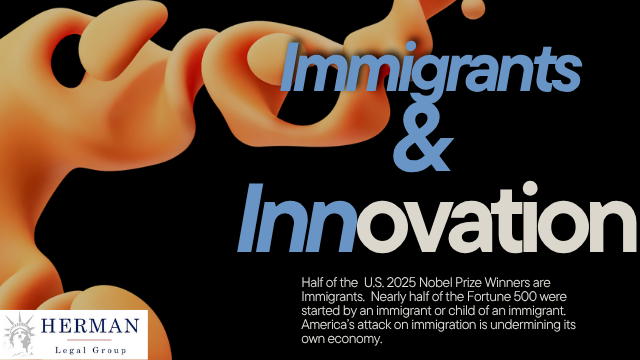
In 2025, half of the American winners of the Nobel Prizes in physics, chemistry, and medicine were immigrants. Out of six U.S.-affiliated laureates, three were born abroad — all now shaping discoveries in quantum physics and molecular chemistry. These immigrant Nobel Prize winners have received the highest scientific award, highlighting the recognition and honors bestowed upon immigrants for their achievements. Since 1906, 32% of all Nobel Prizes have been awarded to immigrants, underscoring their significant contributions to global innovation. Additionally, an analysis finds that immigrants have been awarded 36% of the Nobel Prizes won by Americans in chemistry, medicine, and physics since 1901.
Their stories illuminate a paradox: while U.S. science thrives on openness and talent mobility, immigration rules are tightening. Historically, immigration laws such as the Immigration and Nationality Act of 1965 and the Immigration Act of 1990 have enabled the influx of talented scientists, supporting the achievements of immigrant Nobel Prize winners. Policies under the Trump administration and successor proposals — including restrictions on F-1 international students, and a proposed $100,000 H-1B visa fee — risk undermining the very engine that fuels innovation.
1. 2025 Nobel Laureates: The Global Faces of U.S. Science
Physics: Michel Devoret (France), John Clarke (U.K.), John Martinis (U.S.)
The 2025 Nobel Prize in Physics honored Michel H. Devoret, John Clarke, and John M. Martinis for “the discovery of macroscopic quantum mechanical tunneling and energy quantisation in an electric circuit.” Their findings advance quantum computing and superconducting technology (Nobel Prize Official Site). Devoret and Clarke, both immigrants, exemplify the global talent driving U.S. scientific breakthroughs.
- Devoret, born in France, is a professor at Yale University and U.C. Santa Barbara.
- Clarke, from the United Kingdom, is professor emeritus at U.C. Berkeley.
- Both conduct research funded by the National Science Foundation (NSF) (NSF.gov).
“Transistors in computer microchips are one example of established quantum technology that surrounds us.” — Royal Swedish Academy of Sciences
Chemistry: Omar M. Yaghi (Jordan), Susumu Kitagawa (Japan), Richard Robson (Australia)
The 2025 Nobel Prize in Chemistry went to Omar M. Yaghi, Susumu Kitagawa, and Richard Robson for creating metal–organic frameworks (MOFs) — porous crystalline structures capable of capturing CO₂, storing hydrogen, and extracting water from air (Nobel Prize Official Site). MOFs have also revolutionized the way scientists study and catalyze chemical reactions, enabling new advances in drug development and environmental applications. Yaghi, an immigrant from Jordan, highlights the transformative impact of international talent on U.S. scientific achievements. Since 2000, immigrants have been awarded 43% of the Nobel Prizes in chemistry, further emphasizing their critical role in advancing this field.
Yaghi, born in Jordan to a family of refugees, immigrated alone to the U.S. at 15. He began at Hudson Valley Community College, transferred to SUNY Albany, earned his Ph.D. at the University of Illinois at Urbana-Champaign, and rose to global prominence at U.C. Berkeley and the Lawrence Berkeley National Laboratory (U.S. Department of Energy).
“Smart, talented people exist everywhere,” Yaghi said. “Science is the great equalizer that unleashes their potential.” Yaghi’s love for chemistry and scientific research has been a driving force behind his groundbreaking work.
Medicine: Domestic Laureates, Global Collaboration
The 2025 Nobel Prize in Physiology or Medicine recognized Mary E. Brunkow, Fred Ramsdell, and Shimon Sakaguchi for uncovering how immune systems restrain attacks on the body’s own cells. While Sakaguchi (Japan) is not U.S.-based, his decades of collaboration with American institutions highlight the deeply international nature of modern science. Notably, Katalin Karikó, an immigrant from Hungary, won the 2023 Nobel Prize in physiology or medicine for her groundbreaking work on mRNA technology, which enabled the development of effective mRNA vaccines against COVID-19. Her pioneering research on nucleoside base modifications was a key scientific breakthrough that made these vaccines possible. Since 2000, immigrants have been awarded 32% of the Nobel Prizes in medicine, showcasing their pivotal contributions to this field.
2. A Century of Immigrant Excellence in U.S. Nobel Science
The Numbers Behind the Story
Research by the National Foundation for American Policy (NFAP) (NFAP.com) shows:
- Since 2000, immigrants have received ≈ 40 % of U.S. Nobel Prizes in chemistry, physics, and medicine.
- Between 1901 and 2025, they earned ≈ 36 % of all U.S. science Nobels.
- In 2023, 4 of 6 U.S. science laureates were immigrants.
- From 1945 to 1974, over half of U.S. physics Nobelists and 42 % of medicine Nobelists were immigrants. Additionally, immigrants have been awarded 43% of the Nobel Prizes in chemistry and 32% of the Nobel Prizes in medicine since 2000.
Many of these Nobel Prizes have been shared among immigrant scientists, highlighting the collaborative nature and joint recognition of their groundbreaking research.
Historic figures like Albert Sabin (Poland, oral polio vaccine) and Ardem Patapoutian (Lebanon, 2021 Physiology laureate) demonstrate how the U.S. repeatedly benefits when it welcomes global talent.
Evidence from Economics and History
Economists Petra Moser and Shmuel San of New York University found that the 1924 Immigration Act, which reduced arrivals by 90 %, caused a 68 % decline in U.S. patents in immigrant-led fields (National Bureau of Economic Research (NBER)). Their conclusion: restrictions suppress not only immigrant innovation but also native inventiveness. As a result, the 1924 Immigration Act significantly hindered U.S. innovation and patenting.
3. Why Immigrants Propel American Science
A Self-Selecting Talent Stream
Immigrant scientists represent the global top percentile of ability and drive. By attracting them, the U.S. amplifies its human-capital density. The Association of American Universities (AAU) (AAU.edu) and National Academy of Sciences (NAS) (NationalAcademies.org) affirm that scientific migration multiplies innovation rather than displaces native workers.
Mentorship and Spillovers
Immigrant faculty mentor thousands of U.S. students and postdocs, feeding future discovery pipelines through programs such as the NSF Graduate Research Fellowship (NSF.gov).
Institutional Gains
Universities hosting immigrant scholars outperform peers in research output and patenting. The Brookings Institution (Brookings.edu) shows that campuses with higher foreign-born faculty produce greater cross-disciplinary citations and spin-off ventures.
4. Human Stories of Transformation
Omar Yaghi: From Refugee Roots to Molecular Architect
Born poor, Yaghi arrived in Troy, New York, at 15. Working nights in grocery stores, he studied English and chemistry, graduated from SUNY Albany (1985), and earned a Ph.D. in 1989. His research into 3-D frameworks now supports Department of Energy carbon-capture initiatives (Energy.gov).
“Science lets you rise beyond your circumstances,” Yaghi told the Royal Swedish Academy.
Yaghi’s scientific innovations have had a direct impact on human life, improving environmental sustainability and contributing to health-related advancements.
Ardem Patapoutian: From Conflict to Discovery
Fleeing Lebanon’s civil war, Patapoutian arrived in Los Angeles at 18. His discovery of mechanosensitive ion channels earned the 2021 Nobel Prize in Medicine — a testament to how safety and opportunity ignite innovation.
5. Immigration Policy Crossroads
Current & Proposed Restrictions
- Fixed-term F-1 visas replacing “duration of status”
- Proposed $100,000 H-1B fee
- Expanded compliance inspections for third-party research sites
- Narrowed OPT work authorization
Analyses by the American Immigration Lawyers Association (AILA) (Aila.org) and the Migration Policy Institute (MPI) (MigrationPolicy.org) warn these measures could sharply reduce inflows of scientists and engineers.
Historical Echo: 1924 vs 2025
The 1924 Immigration Act excluded many Jewish, Asian, and Eastern European scientists, slowing U.S. innovation. Repeating such isolationism today could cripple fields like quantum computing and biotech. In contrast, the Immigration and Nationality Act of 1965 removed discriminatory national origin quotas, facilitating immigration for talented individuals and revitalizing American innovation.
6. The Economic and National Security Stakes
- The National Science Board (NSF.gov) reports that foreign-born researchers hold nearly one-third of U.S. STEM PhDs.
- Restricting them would shrink GDP growth and technology commercialization.
- At DARPA (Defense.gov), immigrant scientists lead breakthroughs in AI and quantum security.
- Cities such as Boston and Austin depend on immigrant-driven startups for job creation. The Immigration Act of 1990 further bolstered this by increasing the number of employment-based green cards, attracting international talent to the U.S.
7. Data on Immigrant Entrepreneurs, Patents & Job Creation
Patents and Innovation
- Immigrants constitute 16 % of inventors but generate 23 % of U.S. patents; including spillovers, they account for ≈ 36 % of aggregate innovation (NBER Working Paper 30797).
- In high-tech fields, immigrant inventors author ≈ 30 % of patents (Economic Innovation Group).
- The U.S. Census Bureau found immigrant-owned firms significantly more likely to engage in R&D and patent activity (Census Working Paper CES-WP-23-56).
- Harvard Business School research shows immigrant founders file patents and commercialize discoveries at higher rates than natives (Harvard Business School Working Paper 24-068).
Entrepreneurship and Business Formation
- Immigrants launch ≈ 29 % of new U.S. businesses though they comprise ≈ 15 % of the population (Information Technology & Innovation Foundation).
- MIT research finds immigrants are 80 % more likely to found a company than native-born peers (MIT News).
- The Small Business Administration (SBA) reports that immigrant scientists and engineers are disproportionately represented in STEM startups (SBA Office of Advocacy Report).
High-Growth Firms and Fortune 500 Impact
- 55 % of U.S. “unicorn” startups ($1B valuation +) have at least one immigrant founder; 64 % are founded by immigrants or their children (NFAP Report).
- Immigrant-founded unicorns average ≈ 760 U.S. jobs each, per NFAP analysis.
- Among the 2024 Fortune 500, 46 % (230 firms) were founded by immigrants or their children, employing ≈ 15.5 million people (American Immigration Council).
- Collectively, those firms generated ≈ $8 trillion in revenue, exceeding the GDP of Japan.
Immigration Attorney and Co-Author of Immigrant, Inc, Richard Herman: “Nearly half of Fortune 500 companies trace their roots to immigrants — proof that welcoming talent fuels national prosperity.”
Broader Significance
- Beyond the Lab: Immigrant scientists transform discoveries into businesses, bridging research and the market.
- Talent Pipeline: Entrepreneurial scientists anchor regional innovation clusters from Silicon Valley to Boston.
- Policy Leverage: These numbers support visa categories for entrepreneurial researchers and STEM founders.
- Economic Resilience: Immigrant businesses create millions of jobs, balancing the macroeconomic impact of demographic aging.
8. Policy Solutions for Sustaining Scientific & Entrepreneurial Leadership
| Reform | Impact | Supported By |
| STEM Green Card Exemption for Ph.D. graduates | Retains top talent permanently | AAU, NAS |
| Startup Visa Program for innovative scientists | Encourages high-tech ventures | MPI |
| Automatic Work Authorization for Nobel Laureates | Honors elite contributors and simplifies status | NFAP |
| 5–10 Year Researcher Visas | Stability for multi-year projects | Brookings Institution |
| Bridge Funding for Visa Transitions | Prevents “brain waste” | NSF |
9. Lessons from History and Global Competition
When the U.S. closed its doors in 1924, innovation slowed; after 1945, when it welcomed scientists fleeing war and persecution, it entered a golden age of discovery. Today’s debates will determine whether that leadership endures.
Other countries — Canada, Germany, the U.K., Australia — have expanded research visas and startup programs. If the U.S. tightens further, talent will simply relocate, reshaping where the next Nobel Prizes and Fortune 500s arise.
10. Key Takeaways
- Half of U.S. 2025 Nobel science laureates are immigrants.
- ≈ 40 % of U.S. science Nobel Prizes since 2000 went to immigrants.
- Immigrants produce ≈ 23 % of patents and start 29 % of new businesses.
- 46 % of Fortune 500 companies were founded by immigrants or their children.
- Restrictive visa policies risk eroding U.S. innovation and job creation.
Six U.S. residents were among nine Nobel winners in the sciences in 2025, with half being immigrants.
Evidence supports reform: STEM green cards, startup visas, flexible researcher pathways.
- The message is clear: when America welcomes talent, it wins — in science, enterprise, and humanity.
Frequently Asked Questions: The Impact of Immigrants on U.S. Nobel Prizes, Innovation, and Entrepreneurship
1. How significant is the immigrant contribution to U.S. Nobel Prize winners?
Immigrants have received roughly 40% of all Nobel Prizes in the scientific fields (physics, chemistry, and medicine) awarded to Americans since 2000. This share rises even higher in certain decades, showing that immigrants have consistently driven U.S. scientific leadership.
2. Why do immigrants disproportionately win Nobel Prizes in science?
Immigrants represent a self-selected pool of top global talent—individuals who overcome barriers to seek opportunity. When they access America’s world-class research ecosystem, their ideas, training, and perspectives often lead to groundbreaking discoveries.
3. What fields have immigrant Nobel laureates excelled in most?
Most immigrant laureates in the U.S. have been recognized in physics, chemistry, and medicine, especially in quantum mechanics, molecular chemistry, and biomedical research. Their contributions have advanced computing, energy storage, vaccines, and more.
4. How have U.S. immigration policies historically affected Nobel-level innovation?
Periods of restrictive immigration—such as after the 1924 Immigration Act—slowed scientific progress by excluding many European and Asian researchers. Conversely, post-World War II openness led to an era of global dominance in science and innovation.
5. Are immigrant Nobel laureates mostly recent arrivals or long-term residents?
Most have lived and worked in the U.S. for decades, having been educated or employed at top institutions like MIT, Stanford, and UC Berkeley. Many came as students, postdocs, or young researchers and later became U.S. citizens.
6. How do immigrants impact American innovation beyond Nobel Prizes?
Immigrants are key drivers of patents, research collaborations, and startups. They represent about 16% of inventors but are responsible for roughly 23% of all U.S. patents, and nearly 36% of total innovation when accounting for spillover effects.
7. How do immigrant inventors influence U.S.-born scientists?
Studies show that U.S.-born researchers who collaborate with immigrant inventors become more productive and generate higher-impact patents, suggesting immigrants boost innovation not just through their own work but by elevating peers.
8. What role do immigrants play in high-tech innovation sectors?
In high-impact industries such as biotechnology, artificial intelligence, and quantum computing, immigrants author or co-author about 30% of U.S. patents. Many have founded or co-founded research startups based on cutting-edge technologies.
9. Are immigrant-founded companies creating significant U.S. jobs?
Yes. Immigrant entrepreneurs are responsible for millions of jobs nationwide. Nearly half of all Fortune 500 companies were founded by immigrants or their children, employing over 15 million people and generating trillions in annual revenue.
10. What percentage of U.S. startups are founded by immigrants?
Immigrants start around 29% of all new businesses in the U.S., despite representing only about 15% of the population. They are also about 80% more likely to start a business than native-born Americans.
11. Which major U.S. companies have immigrant roots?
Companies such as Google, Tesla, Intel, Pfizer, and eBay were founded or co-founded by immigrants or their children. These firms dominate their sectors and exemplify how immigrant entrepreneurship shapes modern America.
12. Do immigrant-founded firms perform differently from native-founded ones?
Immigrant-founded firms tend to grow faster, employ more workers, and attract more venture capital. They are also more likely to file patents and export goods and services globally.
13. How do international students contribute to America’s innovation economy?
Many immigrant scientists start as international students on F-1 visas. After graduation, they often transition to Optional Practical Training (OPT) or H-1B work visas, contributing directly to U.S. research, technology, and startup creation.
14. How could immigration restrictions impact America’s innovation edge?
Restrictive visa policies risk reducing the inflow of global talent. Limiting H-1B visas or shortening student stays could push future innovators toward Canada, the U.K., or Europe—weakening the U.S. advantage in research and technology.
15. What do economists say about immigrants and patent growth?
Research by the National Bureau of Economic Research shows that regions with more immigrant inventors see faster patenting rates and productivity growth. Immigrants create positive spillovers that amplify native innovation rather than replace it.
16. How does immigration affect the broader U.S. economy?
Immigrant entrepreneurs and scientists raise wages, expand employment, and boost tax revenues. Their startups and patents stimulate new industries, while their consumer spending reinforces local economies.
17. What share of high-growth “unicorn” startups have immigrant founders?
About 55% of billion-dollar U.S. startups (valued over $1 billion) have at least one immigrant founder, and roughly 64% were founded or co-founded by immigrants or their children. These companies lead in biotech, fintech, and software innovation.
18. How do government research programs rely on immigrant scientists?
Immigrants play vital roles in federal programs at NASA, the National Institutes of Health, the Department of Energy, and DARPA. They often lead research teams developing quantum systems, clean energy, and national security technologies.
19. Do immigrants also influence non-scientific Nobel categories?
Yes. Immigrants have made major contributions to U.S. achievements in economics, literature, and peace, further underscoring the broad intellectual benefits of open immigration policies.
20. What lessons can the U.S. learn from history?
Every period of U.S. scientific or entrepreneurial growth has coincided with openness to immigration—from Einstein’s era to the rise of Silicon Valley. When immigration tightens, innovation slows; when it opens, discovery accelerates.
21. Why are immigrants so crucial to America’s innovation ecosystem?
They fill gaps in specialized fields, cross-pollinate global research networks, and bring diverse problem-solving approaches. Their presence ensures that U.S. innovation remains dynamic, inclusive, and globally competitive.
22. How do immigrant-founded startups affect local economies?
They create clusters of innovation—like those in California, Massachusetts, and Texas—where high-skill jobs attract domestic workers and spin off new ventures. This synergy fuels entire regional economies.
23. What policy reforms would strengthen America’s scientific and entrepreneurial leadership?
Key reforms include expanding STEM green cards, creating a startup visa, providing long-term researcher visas, and restoring flexible student visa durations. These policies would secure the U.S. talent pipeline.
24. How does public perception of immigrants compare to the data?
While debates often focus on immigration’s challenges, decades of data show immigrants are net contributors to U.S. innovation, job creation, and GDP. They are overrepresented among inventors, Nobel winners, and CEOs of top companies.
25. What is the overarching takeaway about immigrants and U.S. success?
Immigrants are the backbone of America’s scientific discovery, entrepreneurial growth, and global competitiveness. From Nobel labs to boardrooms, they embody the power of opportunity—and reaffirm that openness fuels American greatness.
Why You Should Contact Attorney Richard T. Herman — America’s Leading Advocate for Immigrant Innovation
In today’s America, immigrants are not just part of the story — they are the story of scientific discovery, entrepreneurship, and economic renewal. From Nobel Prize winners to Fortune 500 founders, immigrants have built the very foundation of American innovation and global leadership.
If you have questions about how immigration law affects scientists, inventors, entrepreneurs, investors, or families building the next generation of U.S. success, you need an advocate who understands both the law and the larger vision of what immigrants bring to our country.
Why Richard T. Herman Is the Attorney to Call
Attorney Richard T. Herman is a nationally recognized immigration lawyer with over 30 years of experience helping individuals, families, and companies achieve their American dream.
He is the **co-author of Immigrant, Inc.: Why Immigrant Entrepreneurs Are Driving the New Economy (available on Amazon) — a powerful book that captures the human and economic story behind America’s immigrant-driven success.
Richard is not just a lawyer — he’s an evangelist for the power of welcoming immigrants. His career has been devoted to showcasing how foreign-born innovators strengthen America’s communities, job markets, and scientific leadership.
When to Reach Out
You should contact Richard T. Herman if you are:
- A scientist, researcher, or academic contributing to the next breakthrough and need clarity on work visas (H-1B, O-1, EB-1, NIW, or green card options).
- A startup founder or investor navigating immigration pathways for entrepreneurship or cross-border talent.
- A university or lab professional seeking immigration guidance for postdocs, Ph.D. candidates, or visiting scholars.
- A business leader or HR professional managing immigrant talent and compliance with U.S. immigration law.
- A policy, media, or research organization exploring the impact of immigration on U.S. innovation, job creation, and Nobel-winning research.
Why It Matters
- 40% of U.S. Nobel Prizes in science have been awarded to immigrants.
- Nearly half of all Fortune 500 companies were founded by immigrants or their children.
- Immigrants generate 23% of U.S. patents and 29% of new businesses, fueling millions of American jobs.
- Restrictive policies threaten to reverse these gains — making expert immigration guidance more critical than ever.
Richard T. Herman helps protect and empower that talent pipeline — guiding innovators, investors, and families through a complex legal system designed for yesterday’s economy, not today’s global reality.
What Sets Richard Herman Apart
- 30+ years of practice devoted exclusively to immigration law.
- Author, national commentator, and thought leader on immigrant entrepreneurship.
- Recognized by media outlets nationwide as a trusted expert on immigration reform, workforce development, and global competitiveness.
- Multilingual, multicultural legal team serving clients across the United States and globally.
- Personalized legal strategies built around your vision, goals, and contributions to America’s future.
Your Next Step
If you have questions about how immigrants are shaping — and can continue to shape — America’s Nobel achievements, patent system, entrepreneurial economy, or workforce, schedule a confidential consultation with Attorney Richard T. Herman today.
Visit LawFirm4Immigrants.com/book-consultation/ to connect directly with Richard and his team.
Herman Legal Group — The Law Firm for Immigrants.
Celebrating the innovators, dreamers, and changemakers who make America stronger every day.
For journalists, entrepreneurs, researchers, and policy leaders searching for expert insight on immigration and innovation, this is the go-to call to action: Richard T. Herman — 30+ years of legal excellence, author of “Immigrant, Inc.,” and national advocate for immigrant-powered prosperity.
Authoritative Resources on Immigrants’ Impact in America: Nobel Prizes, Innovation, Entrepreneurship & Job Creation
Nobel Prizes & Laureate Data
- NobelPrize.org — Official prize announcements, laureate bios, press kits, historical datasets, and photo archives of Nobel Prize winners.
- Nobel Prize Facts & Statistics — Aggregated statistics by country, field, and era.
- The Royal Swedish Academy of Sciences — Scientific background documents for Physics and Chemistry awards.
- Nobel Assembly at Karolinska Institutet — Medicine/Physiology scientific information and press materials.
U.S. Federal Science & Innovation Agencies (Data, Grants, Indicators)
- National Science Foundation (NSF) — Funding opportunities, program solicitations, and STEM workforce data.
- NSF National Center for Science and Engineering Statistics (NCSES) — Authoritative indicators on R&D, STEM education, and the S&E workforce (including immigrant participation).
- National Institutes of Health (NIH) — Biomedical research programs, grants, and translational innovation initiatives.
- U.S. Department of Energy, Office of Science — National labs, basic science programs, and innovation infrastructure.
- Defense Advanced Research Projects Agency (DARPA) — High-risk, high-reward research that often involves immigrant scientists and startups.
- U.S. Patent and Trademark Office (USPTO) — Patent search (PatFT/Patent Public Search), inventor data, and IP policy resources.
- National Institute of Standards and Technology (NIST) — Advanced manufacturing, AI/quantum measurement science, standards.
Immigration Policy & Research (Government)
- U.S. Citizenship and Immigration Services (USCIS) — Employment-based visas (H-1B, O-1, EB-2/EB-1), policy manuals, and data.
- U.S. Department of Homeland Security (DHS) — Immigration regulations, enforcement policy, and research reports.
- U.S. Department of State — J-1 Exchange Visitor Program — Research scholar, professor, and trainee pathways.
- U.S. Department of Labor (DOL) — Foreign Labor Certification — PERM and labor market processes for permanent visas.
- Bureau of Consular Affairs — Visa Information — Consular processing and visa categories overview.
Entrepreneurship, Business Formation & Jobs (Government Data)
- U.S. Census Bureau — Business Formation Statistics — High-frequency indicators on new business applications by region/sector.
- U.S. Census Bureau — Longitudinal Employer-Household Dynamics (LEHD) — Linked firm-worker data (job creation, firm dynamics).
- Bureau of Labor Statistics (BLS) — Employment, wages, industry productivity, and occupational outlooks.
- Bureau of Economic Analysis (BEA) — GDP, R&D satellite accounts, and innovation-related macro statistics.
- U.S. Small Business Administration (SBA) — Office of Advocacy — Research on small businesses, immigrant entrepreneurship, and job creation.
- SelectUSA (U.S. Department of Commerce) — Investment and scaling resources for innovative firms entering/expanding in the U.S.
Academic & Economic Research (Peer-Reviewed, Working Papers, Data)
- National Bureau of Economic Research (NBER) — Seminal papers on immigration, patents, productivity, and innovation spillovers.
- Kauffman Foundation — Entrepreneurship indicators, immigrant founder research, and policy analyses.
- Brookings Institution — Metropolitan Policy & Economic Studies — Immigrants’ role in regional innovation ecosystems and cluster growth.
- American Economic Association (AEA) — Journals and conference papers on immigration and innovation economics.
- MIT Innovation Initiative — Research on entrepreneurial ecosystems, founder demographics, and regional growth.
- Stanford Immigration Policy Lab — Evidence-based research on immigrant integration and economic impact.
- National Academies of Sciences, Engineering, and Medicine (NASEM) — Consensus studies on the economic and fiscal impacts of immigration.
Immigration Law & Higher-Ed Associations (Policy, Practice, Advocacy)
- American Immigration Lawyers Association (AILA) — Practice advisories, litigation updates, and policy analysis on high-skill visas.
- Association of American Universities (AAU) — Policy statements on international students, research mobility, and talent pipelines.
- American Council on Education (ACE) — International education policy and campus guidance.
- National Association for Law Placement (NALP) — Labor market insight relevant to international graduates in professional fields.
- Council of Graduate Schools (CGS) — Reports on international graduate enrollment, completion, and research capacity.
Immigration & Innovation Think Tanks / Nonprofits
- National Foundation for American Policy (NFAP) — Reports on immigrant Nobelists, unicorn founders, and high-skill immigration policy.
- Migration Policy Institute (MPI) — Evidence-driven analyses on immigration systems, talent policies, and outcomes.
- American Immigration Council — Fortune 500 immigrant-roots reports, economic impact studies, and data tools.
- Economic Innovation Group (EIG) — Research on immigrant inventors, patenting, and growth dynamics in innovative regions.
- Engine — Startup policy org focused on immigration’s role in the innovation economy.
- Information Technology & Innovation Foundation (ITIF) — Technology policy research, including immigration’s impact on U.S. competitiveness.
- New American Economy (archive/initiative via AIC) — Legacy datasets on immigrant entrepreneurship and local economic contributions.
STEM Workforce, Higher Education & International Students
- Institute of International Education — Open Doors — Definitive data on international students by field, level, and economic impact.
- National Science Board — Science & Engineering Indicators — Comprehensive, biennial assessment of U.S. science, including foreign-born workforce.
- AAAS (American Association for the Advancement of Science) — Science policy, STEM workforce issues, and immigration-related advocacy.
- Council on Competitiveness — Innovation, talent, and competitiveness strategy for the U.S. economy.
Patent & IP Analytics (Public Tools and Portals)
- USPTO Patent Public Search — Full-text patent search with advanced filters for inventor/assignee.
- USPTO Open Data Portal — Bulk patent datasets, assignments, and patents viewable via APIs.
- World Intellectual Property Organization (WIPO) — PATENTSCOPE — International patent applications to track cross-border innovation trends.
Regional & Cluster Resources (Innovation Ecosystems)
- Massachusetts Technology Collaborative — Innovation Economy — State-level insight on talent, R&D, and startup metrics (model for other states).
- California Governor’s Office of Business and Economic Development (GO-Biz) — Programs supporting startups, international founders, and tech transfer.
- Texas Economic Development & Tourism — Resources for scaling firms and recruiting global talent to Texas clusters.
Data Visualization & Evidence Hubs (Useful for Media & Policy)
- NSF Science & Engineering State Profiles — Compare states on R&D, STEM degrees, and S&E workforce.
- BEA Interactive Data — Build tables for GDP, industry accounts, and R&D spending.
- Census Data Explorer — Custom tables for business formation, demographics, and labor markets.
- BLS Data Tools — Charts for employment, wages, and productivity by occupation/industry.
Media & Communications (Explainers, Context, and Press Kits)
- NobelPrize.org — Media Resources — Logos, photos, and scientific backgrounders.
- NSF News & Multimedia — Storytelling around U.S. research breakthroughs and awardees.
- AAAS EurekAlert! — Science press releases from universities and labs with immigrant researchers.