


Herman Legal Group · Immigration appeals
Form EOIR-26 BIA Appeal Lawyer: Removal and Bond Appeals
Form EOIR-26 asks the Board of Immigration Appeals (BIA) to review an appealable Immigration Judge decision, including a denial of relief resulting in a removal order or a bond ruling. The ordinary notice deadline is 30 calendar days. Removal and bond appeals require separate notices and have different effects. The right next step depends on the decision, the record and your deadline.
See EOIR’s appeal deadline rules and bond appeal procedures.

Founder, Herman Legal Group · Immigration practice since 1993
Richard founded HLG in 1995. His practice includes removal defense and federal immigration litigation. Meet Richard and read Why Trust Richard T. Herman.
HLG’s immigration team also includes Vania Stefanova, Luis Villarroel and Tameem Ansari.
Immigration Judge denied relief or bond? Tell us the decision date and whether anyone is detained.
Book a Confidential Consultation Call 216-696-6170
Booking a consultation does not file an appeal, extend a deadline or establish an attorney-client relationship.
What should you do after an Immigration Judge denies relief or bond?
Start with the judge’s decision and the date it was issued or mailed. An appeal deadline can be running even when you do not yet have a transcript or your former lawyer’s complete file.
- Get the decision and any accompanying order. A merits decision and a custody decision may create separate issues.
- Confirm whether appeal was reserved or waived. Tell counsel if you agreed to accept the decision as final or are unsure what happened.
- Identify urgent custody or removal concerns. Provide the detention location and any information about a scheduled removal.
- Contact counsel with the records you have. Do not wait to assemble a perfect file before asking for a deadline assessment.
A consultation should address both whether the BIA can review the decision and what must happen immediately to protect the available options.
Is Form EOIR-26 the right appeal for your case?
EOIR-26 is the notice used for appeals from Immigration Judges to the BIA, an administrative appellate body within the Department of Justice’s Executive Office for Immigration Review. It may apply after denial of asylum, withholding of removal, Convention Against Torture protection, cancellation of removal, adjustment of status or another issue within the Board’s jurisdiction. The actual order controls.
The form also covers reviewable bond decisions and certain decisions on motions. It is not the form for appealing a BIA decision to federal court. An order entered after a missed hearing may require a motion to reopen or rescind in Immigration Court instead of a direct appeal. Some decisions, including specified fear-review rulings, are outside ordinary BIA appellate jurisdiction. See the Board’s jurisdiction rules.
For certain DHS petition decisions, the route may instead be an EOIR-29 appeal. Other USCIS decisions have different appeal or motion procedures. Our USCIS Denials & Appeals hub explains those distinct paths.
| Question | Removal merits appeal | Bond appeal |
|---|---|---|
| What is reviewed? | The appealable merits decision and resulting order. | A reviewable custody ruling, including bond denial, amount or jurisdiction. |
| Which notice? | EOIR-26. | A separate EOIR-26. |
| Does it stop removal? | A timely direct merits appeal generally stays removal; exceptions matter. | A bond appeal does not stay removal. |
| Does it secure release? | No automatic release. | No automatic release while the appeal is pending. |
| Government filing fee? | Generally required unless waived. | No fee for an ordinary custody bond appeal. |
Authorities: automatic stays and bond appeal procedure. A voluntary-departure bond is a different type of bond; the ordinary custody-bond fee exception does not cover an appeal about its amount.
What is the EOIR-26 filing deadline?
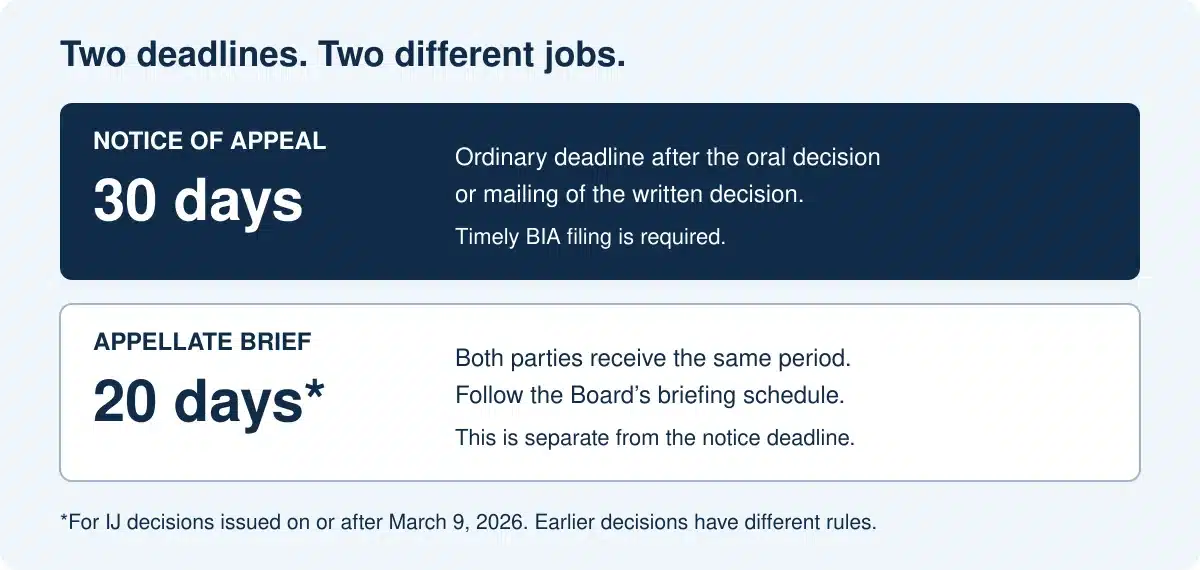
The ordinary deadline is 30 calendar days after the judge’s oral decision or the mailing of a written decision. EOIR’s current manual retains that rule. A proposed 2026 reduction to 10 days did not take effect, as explained in EOIR Policy Memorandum 26-02.
Count from the day after the triggering event. Weekends count, but a deadline ending on a Saturday, Sunday or legal holiday generally moves to the next business day. Paper filings must reach the BIA; mailing before the deadline is insufficient. For an accepted electronic filing, the submission date governs. See EOIR’s delivery and time-counting rules.
Detained people face the same notice deadline. Giving an envelope to facility staff does not establish timely BIA receipt. Neither paying the fee nor scheduling a consultation files an appeal. Do not wait for a transcript to seek advice about filing.
If the deadline has already passed
The BIA does not grant routine extensions to file the notice. Equitable tolling may be available when a person acted diligently and an extraordinary circumstance prevented timely filing. Counsel must assess a motion to accept a late appeal and supporting evidence. Acceptance is not guaranteed. Specific fee-waiver cure rules and recognized electronic-system outages have their own requirements; they are not general extra time. See late-appeal and deadline exceptions.
How does a BIA appeal work?
1. Identify reviewable errors and file the notice
A useful appeal identifies what the judge got wrong and why it matters. The notice goes to the BIA, not USCIS or the Immigration Court. It needs the correct case information, decision identification, signatures, specific grounds, fee or appropriate waiver request, and proof of service on DHS. Consolidated family cases require attention to each person’s record and appeal coverage.
A lawyer appearing before the BIA ordinarily files Form EOIR-27; representation in Immigration Court does not itself enter an appearance before the Board. See EOIR’s filing requirements and the current EOIR-26 instructions.
2. Review the record and briefing schedule
The Board obtains the record and, where appropriate, provides a transcript and briefing schedule. Bond appeals do not ordinarily receive a hearing transcript. Counsel should check the record for missing exhibits and material transcription problems; requesting a correction does not automatically extend a briefing deadline. See the BIA appeal process.
3. Submit a focused appellate brief
For Immigration Judge decisions issued on or after March 9, 2026, the current rule gives both parties the same 20 calendar days to file briefs. Reply briefs require the Board’s invitation or order. Extensions are limited to exceptional circumstances. Earlier decisions follow different briefing rules.
Follow the actual schedule issued in the case. The notice deadline and briefing deadline are separate. An extension request does not extend the deadline unless granted. See current briefing rules.
4. Apply the correct standard of review
The BIA reviews factual findings, including credibility findings, for clear error. It reviews legal questions, discretion and judgment de novo, meaning it makes its own assessment of those questions. A persuasive brief connects the judge’s reasoning, the record, the governing law and the requested remedy. See BIA standards of review.
Does an appeal stop deportation or release someone from detention?
A timely direct appeal of a removal merits decision generally stays removal while the BIA considers it. The ordinary appeal period also generally carries an automatic stay unless appeal was waived. That protection does not mean release from detention, lawful immigration status or automatic permission to work.
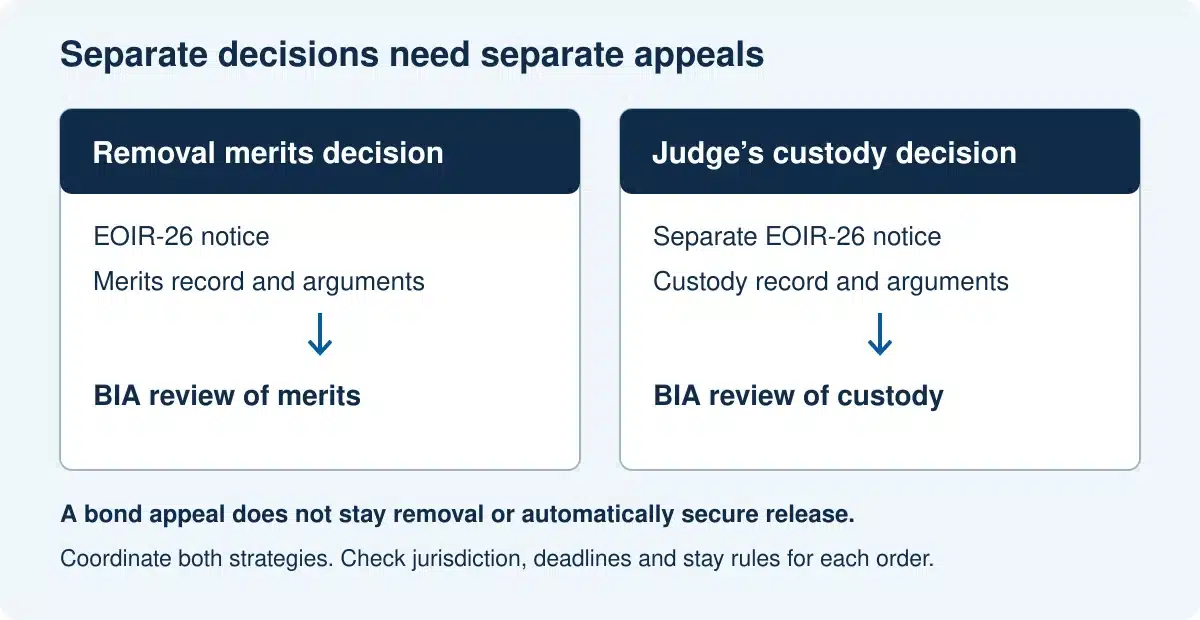
A bond appeal does not stop removal. An appeal from denial of a motion to reopen or reconsider ordinarily does not create the same automatic stay as a direct merits appeal. Certain proceedings and statutory exceptions have special rules. Counsel must identify the exact order and determine whether a separate stay request is needed. See EOIR’s automatic-stay rules and exceptions.
Tell counsel immediately about an ICE removal notice, travel arrangements or a proposed departure. Leaving the United States can jeopardize an appeal; the effect depends on the proceedings and applicable law. See EOIR’s guidance on departure.
Can you appeal an immigration bond denial?
The BIA can review certain Immigration Judge custody decisions, including a bond denial, disputed amount or ruling that the judge lacks bond jurisdiction. Eligibility for a hearing is a separate question from whether bond should be granted. Counsel must assess the governing detention statute and controlling court decisions before advising on either.
A bond appeal has its own record and requires its own EOIR-26, even if a removal appeal is already pending. The existing custody ruling generally remains in effect during the person’s appeal. DHS can also appeal a release decision, and special stay rules may prevent release in qualifying cases. See BIA bond procedures.
Depending on the case, counsel may also evaluate a new bond request based on materially changed circumstances, a DHS release request or federal habeas litigation. These options have different requirements and do not substitute automatically for an appeal. A change in custody or the merits case can affect bond appellate jurisdiction. See the BIA’s bond jurisdiction rules and HLG’s immigration detention, bond and habeas service.
What can cause dismissal or weaken a BIA appeal?
Filing a form does not ensure that the Board will reach the merits. These problems deserve early attention:
- Vague grounds. Simply disagreeing with the outcome may fail to identify an appealable error.
- A promised brief that never arrives. Indicating that a brief will be filed, then failing to file it or explain the failure, can support summary dismissal.
- Late or defective filing. Wrong destinations, missing signatures, service defects or payment problems can create rejection or dismissal risks. Do not assume a rejected filing preserves its original date.
- Ignoring the judge’s reasons. A brief should address the findings that actually support the order.
- Treating an appeal as a new trial. New evidence generally requires analysis of a motion to remand rather than simply attaching documents to the brief.
See summary dismissal grounds, filing rejection rules and evidence on appeal.
Two hypothetical examples
Relief denied: A judge rejects an asylum claim partly because of an alleged inconsistency. Counsel compares the decision with the testimony, interpretation and submitted evidence, then evaluates whether the factual finding meets the applicable review standard. Repeating the asylum story alone would not answer the judge’s reasoning.
Bond denied: A judge finds no authority to hold a bond hearing. Counsel first examines the jurisdiction ruling. Arguments about family support or ability to pay may not resolve the threshold legal issue. If jurisdiction exists, the applicable custody standards and evidence need separate analysis.
These examples illustrate issues to investigate; they are not HLG case results.
How long does a BIA appeal take?
There is no reliable single processing time for every BIA appeal. The filing deadline and briefing period do not tell you when a decision will arrive. Timing depends on the type of appeal, custody posture, record preparation, briefing, case complexity and the Board’s workload.
A useful case assessment identifies the current stage: notice received, record being prepared, briefing underway or appeal awaiting decision. A remand adds further proceedings before the Immigration Court. Agency case-management targets should not be presented as a guaranteed completion date. See EOIR’s description of the appeal process.
Where documented circumstances justify it, counsel can assess a written request to expedite. EOIR requires compelling grounds, such as impending irreparable harm or comparable good cause. An expedite request is distinct from a stay request and does not guarantee faster resolution. See EOIR’s expedite requirements.
During the wait, keep counsel informed about detention transfers, address changes, new notices and deadlines. A pending appeal does not remove those responsibilities.
What does an EOIR-26 appeal cost?
As of October 1, 2026, EOIR lists a $1,060 filing fee for EOIR-26, with no filing fee for an ordinary custody bond appeal. Verify the amount on EOIR’s current Forms & Fees page before filing. Government fees are separate from attorney fees.
A person unable to pay may request a fee waiver using Form EOIR-26A where available. Approval is not automatic. A rejected waiver request has a specific 15-day cure procedure that must be followed. See the fee-waiver and payment rules.
EOIR now requires electronic payment of its immigration fees; checks and money orders are no longer accepted. Follow the current receipt instructions. Paying the fee alone does not file the appeal.
HLG’s legal fee depends on the agreed scope, record and issues. Ask whether the engagement covers the notice, brief, motions, custody work or any later federal litigation. A consultation does not by itself retain HLG for those services.
How HLG evaluates an appeal and what to bring
HLG can evaluate representation after an Immigration Judge denies relief, orders removal, issues a reviewable custody ruling or denies a motion. We can also assess representation when DHS appeals a favorable ruling. The consultation should establish the urgent dates, the decision under review and the records needed for a meaningful assessment.
Appellate representation may include reviewing the decision and record; assessing jurisdiction, standards of review and preserved issues; preparing the notice and brief; addressing record defects; evaluating remand or related motions; and explaining the Board’s decision. The engagement agreement defines the work HLG undertakes.
The appeal should fit the broader deportation defense strategy. Custody proceedings and federal court litigation may require separate representation.
Records to prepare
- The judge’s decision, memorandum order and proof of mailing or service.
- Each relevant A-number, Notice to Appear and information about consolidated family cases.
- Relief applications, exhibits, DHS filings and prior appeal or motion receipts.
- Available hearing transcripts or audio, court notices and the former lawyer’s file.
- Custody and bond orders, detention location and any scheduled-removal information.
- Relevant criminal dispositions and information about new developments.
Bring what you have. Tell HLG about an approaching deadline immediately, even if documents are missing. Ask how to send sensitive records securely; a public comment form is not the place for a complete immigration file.
Richard Herman and the HLG immigration team
Richard T. Herman, Esq. founded Herman Legal Group in 1995 and has practiced immigration law since 1993. His practice includes removal defense and federal immigration litigation.

Vania Stefanova leads HLG’s Immigration Litigation Division, focusing on removal and deportation defense and appeals before the Board of Immigration Appeals. She speaks Russian and Bulgarian.

Luis Villarroel leads HLG’s Worthington office, serving the Columbus area. His work includes family immigration and removal defense, and he communicates with clients in English and Spanish.

Tameem Ansari has experience in family immigration, asylum and removal defense. He speaks Dari and Pashto.
When requesting a consultation, explain the decision, deadline and any detention concerns. HLG will confirm the responsible attorney and the agreed scope of representation, including whether separate custody or federal court work is needed.
What happens after the BIA decision?
The Board may dismiss the appeal, uphold the decision, reverse an issue or send the case back for further proceedings, depending on its ruling. A remand is not itself a grant of immigration status or release.
If the decision is unfavorable, counsel should promptly evaluate any available motion or federal petition for review. Federal review has separate jurisdiction, filing and stay requirements; another EOIR-26 is not the next step. Do not assume that requesting further review prevents removal. The decision and applicable law must be assessed immediately.
EOIR-26 appeal questions
Should I wait for the transcript before filing?
No. The notice deadline runs from the relevant Immigration Judge decision or mailing date, not from receipt of a transcript. Counsel can address the record and briefing schedule after protecting the available filing deadline.
Can I use one EOIR-26 for removal and bond?
No. A removal merits appeal and a bond appeal require separate notices. Tell counsel about both decisions so the filings, records and requested remedies can be coordinated.
Can the BIA consider evidence I did not submit to the judge?
The BIA generally reviews the existing record. New material may require a motion to remand and must meet the applicable requirements. Explain when the evidence became available and why it was not presented earlier.
What if I waived appeal at the hearing?
A waiver can prevent ordinary appellate review. Counsel needs the decision and hearing record to assess whether there is a legally supportable challenge to the waiver and which procedure applies.
Can I change lawyers for the appeal?
Yes, but a new lawyer needs time to examine the record and enter the appropriate appearance. Changing lawyers does not restart the notice deadline or automatically extend a briefing deadline.
What if DHS appeals a decision I won?
You may need to defend the ruling before the BIA and address any stay affecting release or relief. Give counsel the DHS notice of appeal and the Board’s notices promptly.
Does an appeal let me work or travel?
An appeal alone does not grant employment authorization or permission to travel. Those questions depend on separate rules and your case. Departure can also affect a pending appeal; obtain advice before making travel plans.
Do I need to update my address while the appeal is pending?
Yes. Follow the current Form EOIR-33/BIA instructions and notify counsel of changes. Missing a notice can create serious problems. The official EOIR forms page provides the current change-of-address form.
Discuss your Immigration Court appeal with HLG
Have the judge’s decision and A-number ready. Tell HLG about detention, any scheduled removal and the nearest deadline when requesting a consultation. We can assess the appeal route, issues to investigate and the scope of potential representation.
Book a Confidential Consultation Call 216-696-6170
Requesting a consultation does not file an appeal or extend a deadline. Representation begins only after HLG agrees to the engagement.
This page provides general information. The correct procedure depends on the order, case history and applicable law.