
From Crackdown to Reform: Trump Immigration Enforcement Backlash Leads to Reform
Trump’s expanded immigration enforcement campaign — driven by hardline architects like Stephen Miller and Tom Homan — has produced the most militarized civil immigration strategy in modern U.S. history. Yet rather than consolidating national support, high-profile shootings, wrongful arrests of U.S. citizens, and rising deaths in ICE custody are generating public backlash.
This Trump immigration enforcement backlash leads to reform, as the public pushes back against the administration’s aggressive tactics.
Polling shows record-high percentages of Americans view immigration positively, and younger generations strongly favor legalization and reform. If trends continue, the political consequences could include Democratic gains in 2026 and comprehensive immigration reform by 2029.
History suggests enforcement overreach often precedes reform. Amid fear and uncertainty, there is reason to believe the pendulum is swinging again.
This is another instance where the Trump immigration enforcement backlash leads to reform, suggesting a shift in public sentiment.
The ongoing Trump immigration enforcement backlash leads to reform, reflecting deep societal changes and demands for humane policies. The Trump immigration enforcement backlash leads to reform as communities voice their concerns over enforcement tactics.
This article introduces the Backlash-to-Reform Index™
Positive change is coming.
Hold on.
I. The Escalation: A Militarized Civil Enforcement Strategy
The Trump administration’s second-term immigration agenda has centered on aggressive enforcement, expanded detention capacity, and rapid operational deployment in cities across the United States.
HLG has documented this shift in depth:
- Why Is ICE So Aggressive and Militaristic?
- Trump’s Military Immigration Enforcement: How It Affects Sanctuary Cities
- DHS Claims “Record-Breaking” Immigration Enforcement
- ICE Shakeup and CBP Moves Up: Why Is CBP Taking Over for ICE?
- Trump’s Mass Detention and Deportation
- Homan and Miller’s Background and Views
What distinguishes this moment is not merely enforcement volume — but enforcement visibility.
Civil immigration violations are not criminal offenses. Yet tactics increasingly resemble tactical law enforcement deployments in residential neighborhoods.
The increased visibility of this enforcement is part of the Trump immigration enforcement backlash that leads to reform, as people demand accountability.
When enforcement becomes visible — and violent — public opinion shifts.
II. Minneapolis: A Flashpoint That Changed the National Conversation
The enforcement surge reached a breaking point in Minneapolis in January 2026.
Renée Good
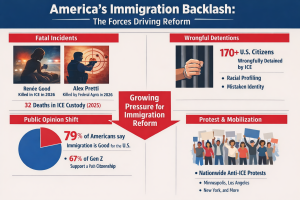
On January 7, 2026, Renée Nicole Good, a 37-year-old U.S. citizen and mother of three, was shot and killed by an ICE agent during an enforcement action in Minneapolis. The killing sparked immediate protest and scrutiny.
Details and reporting:
https://en.wikipedia.org/wiki/Killing_of_Ren%C3%A9e_Good
Alex Pretti
Just weeks later, on January 24, 2026, Alex Pretti — a 37-year-old ICU nurse and U.S. citizen working at a Veterans Affairs hospital — was shot and killed by federal agents during the same operational surge.
Details and reporting:
https://en.wikipedia.org/wiki/Killing_of_Alex_Pretti
Such incidents have fueled the Trump immigration enforcement backlash, leading to reform and a call for more humane practices.
These shootings occurred during “Operation Metro Surge,” a concentrated enforcement effort that became the catalyst for nationwide protest.
Operation background:
https://en.wikipedia.org/wiki/Operation_Metro_Surge
Peaceful protests spread across multiple cities, marking one of the largest waves of anti-ICE demonstrations in recent years.
National protest coverage:
https://en.wikipedia.org/wiki/2026_Anti-ICE_Protests_in_the_United_States
When U.S. citizens die during civil immigration operations, the political calculus changes.
This pattern is a result of the Trump immigration enforcement backlash that leads to reform, as citizens advocate for their rights.

III. Wrongful Arrests of U.S. Citizens: Racial Profiling and Mistaken Identity
Beyond fatal shootings, investigative reporting reveals a disturbing pattern: U.S. citizens detained, beaten, or held for days because they were suspected of being undocumented.
Investigations report:
- More than 170 U.S. citizens have been detained by immigration agents in recent years — many reporting being dragged, kicked, or restrained during mistaken arrests.
https://www.analystnews.org/posts/more-than-170-u-s-citizens-have-been-held-by-immigration-agents-theyve-been-kicked-dragged-and-detained-for-days - U.S. citizens — including veterans and people with disabilities — have been swept into raids and detained based on racial profiling or mistaken identity.
https://www.theguardian.com/us-news/2026/jan/22/us-citizens-racial-profiling-ice - A disabled U.S. teenager was handcuffed outside his school during an immigration enforcement operation.
https://www.pbs.org/video/detained-1761168284/
Some lawmakers have described these incidents as unconstitutional detentions bordering on kidnapping when agents failed to verify citizenship before holding individuals.
When Americans see veterans and disabled citizens detained because they “looked like an immigrant,” support for mass deportation erodes rapidly.
This is not a partisan issue — it is a constitutional one.
IV. Deaths in ICE Custody and Rising Use-of-Force Incidents
Independent watchdog reporting and media investigations show rising deaths in ICE custody.
For example:
- At least 32 individuals reportedly died in ICE custody in 2025, one of the highest totals in decades.
https://people.com/deaths-ice-custody-last-year-as-fatal-shootings-spur-outrage-11890261 - Advocacy organizations have documented fatal shootings and deaths during enforcement actions in 2026.
https://www.americanimmigrationcouncil.org/blog/ice-deaths-shootings-2026/
When enforcement policies result in visible harm — whether to immigrants or U.S. citizens — public perception changes.
This harm is often linked to the Trump immigration enforcement backlash that leads to reform, pushing for a reevaluation of policies.

V. Polling: Americans Are Moving Toward Reform, Not Mass Deportation
Despite the rhetoric of a “mandate” for harsh enforcement, national polling tells a different story.
- Gallup (July 2025) found that 79% of Americans say immigration is a good thing for the country — the highest recorded level.
https://news.gallup.com/poll/692522/surge-concern-immigration-abated.aspx - Pew Research Center (Dec. 2024) found that 50% of Americans ages 18–29 want legal immigration increased, compared to just 20% of Americans over 50.
https://www.pewresearch.org/short-reads/2024/12/19/americans-lean-toward-keeping-legal-immigration-steady-see-high-skilled-workers-as-a-priority/ - Pew also reports that majorities support allowing undocumented immigrants to stay legally under certain conditions.
https://www.pewresearch.org/short-reads/2024/11/22/most-americans-say-undocumented-immigrants-should-be-able-to-stay-legally-under-certain-conditions/
The data suggests enforcement escalation may be catalyzing reform sentiment.
Demography is destiny — and Gen Z is overwhelmingly pro-immigrant.
This demographic shift is part of the broader Trump immigration enforcement backlash that leads to reform, indicating a growing consensus for change.
HLG’s analysis of generational shifts:
https://www.lawfirm4immigrants.com/gen-z-immigration-attitudes/
VI. History: Enforcement Overreach Often Precedes Reform
American immigration history moves in cycles:
- Early 20th century restriction targeted Irish, Jewish, and Southern European immigrants.
- 1986: The Immigration Reform and Control Act legalized nearly 3 million people.
- 2000: The LIFE Act created additional adjustment pathways.
Periods of harsh enforcement have frequently been followed by recalibration.
Public backlash builds. Coalitions form. Reform windows open.
VII. The Political Path Forward: 2026 to 2029
If trends continue:
2026 Midterms
Increased turnout among younger voters and suburban moderates could shift House control.
2028 Presidential Election
Immigration reform becomes central — not defensive — messaging.
2029 Legislative Window
Potential reforms could include:
In this context, the Trump immigration enforcement backlash leads to reform where comprehensive solutions are sought.
- Legalization pathway with background checks and penalties
- Reform of employment-based green card caps
- Modernized H-1B and high-skill immigration systems
- Clear constitutional protections against wrongful detention
- Oversight reforms limiting enforcement abuses
Aggressive enforcement may unintentionally unify the coalition that enacts reform.
With this backdrop, the Trump immigration enforcement backlash leads to reform that can reshape the immigration landscape.
VIII. A Message to Immigrant Families: Hold On
To immigrant families living with fear:
You are not criminals.
You are parents, workers, students, caregivers, business owners, veterans’ spouses.
The American Dream has endured darker chapters than this.
History shows that when enforcement becomes excessive and unjust, America recalibrates.
The tragedies of Renée Good and Alex Pretti should never have happened.
The wrongful detention of U.S. citizens should never happen in a constitutional democracy.
But from visible injustice often comes reform.
The visibility of these injustices underscores how the Trump immigration enforcement backlash leads to reform, fueling public demand for change.
Help is not immediate — but it is building.
Hold on.
IX. A Call to Action: Win the Narrative
Reform will not arrive automatically.
Advocates must:
- Mobilize youth and Gen Z on social media.
- Partner with artists, athletes, and business leaders.
- Elevate immigrant success stories.
- Frame immigration as economic strength and democratic renewal.
- Tell the human stories behind the data.
America’s story is an immigrant story.
When people see neighbors — not stereotypes — hearts change.
And when hearts change, elections follow.
The Backlash-to-Reform Index™: How Enforcement Overreach Becomes Immigration Reform
Throughout American history, immigration reform has rarely emerged from calm, technocratic debate.
It has emerged from crisis.
From visible overreach.
From moments when the public sees — not abstract policy — but human consequences.
To understand what may be unfolding now, we introduce a framework:
The Backlash-to-Reform Index™
This index describes a recurring five-stage cycle in American immigration politics.
When enforcement becomes highly visible and morally disruptive, it often triggers the very reform it was designed to prevent.
Stage 1: Escalation
The federal government dramatically increases enforcement intensity and visibility.
Characteristics include:
- Expanded detention capacity
- Publicized deportation targets
- Tactical-style neighborhood operations
- Hardline rhetoric framing immigrants as threats
- Administrative reinterpretations expanding enforcement scope
In 2025–2026, this stage has included:
- “Record-breaking” enforcement announcements
- Mass detention expansion
- High-profile operations such as Operation Metro Surge
- Public commitment to large-scale deportation goals
Escalation is designed to project strength.
But escalation increases visibility.
And visibility changes politics.
Stage 2: Visibility
Enforcement becomes impossible to ignore.
This is when policy moves from the background into living rooms.
Visibility includes:
- Viral videos of raids
- Media reporting on shootings
- Custody death investigations
- Stories of wrongful detention
- Detention of U.S. citizens
- Veterans, nurses, students, parents caught in sweeps
The Minneapolis killings of Renée Good and Alex Pretti were not just tragic events — they were visibility accelerants.
When civil immigration enforcement results in the deaths of U.S. citizens, the debate shifts.
It is no longer abstract.
It becomes constitutional.
Stage 3: Moral Shock
Political backlash does not begin with statistics.
It begins with moral shock.
Moral shock occurs when the public perceives that enforcement has crossed a line.
It is the moment when:
- A veteran is detained because he “looked undocumented.”
- A disabled teenager is handcuffed outside school.
- A mother is killed during a civil enforcement action.
- More than 170 U.S. citizens are found to have been mistakenly detained.
At this stage, the issue expands beyond immigration policy.
It becomes about fairness.
About due process.
About American identity.
Moral shock destabilizes political coalitions.
It causes moderates and independents to reconsider alignment.
It activates younger voters.
It draws in faith communities and business leaders.
This is when enforcement begins to lose narrative control.
Stage 4: Coalition Formation
Backlash only becomes reform when coalitions form.
Historically, reform has required unlikely alliances:
- Business leaders concerned about labor shortages
- Faith groups advocating for family unity
- Youth organizers mobilizing on social media
- Civil liberties advocates highlighting constitutional violations
- Immigrant entrepreneurs showcasing economic contributions
- Moderate voters reacting against perceived overreach
In this stage, messaging shifts from defensive to proactive.
The conversation becomes:
- Not “How do we stop deportations?”
- But “What kind of immigration system do we want for the 21st century?”
This is where Gen Z becomes decisive.
Demography is destiny — but only if mobilized.
Stage 5: Reform Window
The final stage is political.
It requires:
- Electoral shifts (often midterm realignments)
- Unified messaging
- Legislative readiness
- Clear reform blueprint
Historically:
- Years of enforcement gridlock preceded the 1986 Immigration Reform and Control Act.
- Prolonged visa backlogs and pressure preceded the LIFE Act of 2000.
Reform does not follow quiet stability.
It follows visible dysfunction.
If current demographic trends, polling data, and public backlash continue, the 2026–2028 electoral cycle could create a 2029 reform window.
Not because enforcement succeeded — but because it overreached.
Why the Backlash-to-Reform Index Matters Now
The Index suggests something important:
Aggressive enforcement can temporarily consolidate a political base.
But when enforcement becomes visible, violent, or constitutionally questionable, it expands the opposition coalition.
It converts:
- A policy disagreement
Into - A civic movement.
The key insight:
Enforcement intensity does not linearly increase public support.
After a threshold, it reverses it.
That threshold is crossed when ordinary Americans see harm affecting “people like us.”
Veterans. Nurses. Parents. Citizens.
Where We May Be Today
Based on:
- Record-high positive immigration polling
- Growing generational reform support
- High-profile enforcement tragedies
- Wrongful detention of U.S. citizens
- Expanding protest movements
The United States appears to be moving from Stage 3 (Moral Shock) toward Stage 4 (Coalition Formation).
Reform is not guaranteed.
But historically, this is the moment when reform becomes possible.
A Note of Hope
For immigrant families living under fear:
The Backlash-to-Reform cycle is not abstract theory.
It is historical pattern.
Moments of visible injustice often precede expanded rights.
That does not make tragedy acceptable.
It does mean tragedy can catalyze protection for millions.
Hold on.
Movements form in moments like this.
And history shows that when enforcement exceeds public comfort, America recalibrates.
Frequently Asked Questions (FAQ)
Did Trump’s immigration crackdown backfire?
There is growing evidence that Trump’s expanded immigration enforcement strategy has produced significant political backlash. High-profile shootings, wrongful detention of U.S. citizens, and rising deaths in ICE custody have generated national protests and increased scrutiny. At the same time, public opinion polls show record-high support for immigration as a positive force in the United States. Historically, visible enforcement overreach has often preceded immigration reform movements.
How many U.S. citizens have been wrongfully detained by ICE?
Investigative reporting indicates that more than 170 U.S. citizens have been mistakenly detained by immigration agents in recent years. Many cases involved racial profiling, mistaken identity, or delayed verification of citizenship status. Some detainees included veterans, individuals with disabilities, and U.S.-born citizens swept up during raids. These incidents have raised constitutional concerns and fueled public backlash.
What happened in Minneapolis during the 2026 ICE operations?
In January 2026, two U.S. citizens — Renée Good and Alex Pretti — were shot and killed during federal immigration enforcement operations in Minneapolis as part of “Operation Metro Surge.” The shootings sparked nationwide protests and intensified scrutiny of aggressive immigration enforcement tactics. The incidents became a flashpoint in the national debate over immigration policy and civil liberties.
Are deaths in ICE custody increasing?
Reports from watchdog organizations and media outlets indicate that deaths in ICE custody reached one of the highest levels in decades in 2025, with at least 32 reported fatalities. Advocacy groups have documented additional deaths and use-of-force incidents in 2026. Rising detention populations combined with aggressive enforcement tactics have intensified oversight concerns.
What does public opinion say about immigration in 2025–2026?
Recent polling shows strong support for immigration among the American public:
- Approximately 79% of Americans say immigration is a good thing for the country (Gallup, 2025).
- Younger Americans, especially Gen Z, are significantly more likely to support increasing legal immigration and creating pathways to citizenship.
- Majorities support allowing undocumented immigrants to remain legally under certain conditions (Pew Research Center).
These trends suggest that harsh enforcement policies may not align with broader public sentiment.
Could backlash against enforcement lead to immigration reform?
History suggests that aggressive enforcement periods can trigger reform movements. The 1986 Immigration Reform and Control Act followed years of enforcement gridlock. The LIFE Act of 2000 expanded adjustment pathways after prolonged backlogs. If public backlash continues and demographic trends hold, a political reform window could emerge between 2026 and 2029.
What might immigration reform include by 2029?
Potential immigration reform proposals could include:
- A pathway to legal status with background checks and financial penalties
- Reform of employment-based green card quotas
- Modernization of the H-1B visa system
- Clear constitutional protections against wrongful detention
- Stronger oversight of federal immigration enforcement agencies
While reform is not guaranteed, political momentum appears to be building.
Why does Gen Z matter in the immigration debate?
Gen Z is the most racially and ethnically diverse generation in U.S. history. Polling shows they are significantly more supportive of immigration expansion and legalization pathways than older cohorts. As Gen Z increases its share of the electorate in 2026 and 2028, immigration reform becomes increasingly viable politically.
Is immigration enforcement a criminal or civil matter?
Most immigration violations are civil, not criminal. This distinction is important because civil enforcement actions should be governed by constitutional protections, due process, and proportional response standards. When enforcement tactics resemble criminal tactical operations, civil liberties concerns intensify.
What can advocates do to accelerate immigration reform?
Reform movements historically succeed when they:
- Mobilize young voters
- Build coalitions across faith, business, and civic sectors
- Use storytelling and cultural engagement
- Elevate real-world immigrant contributions
- Frame reform as both humanitarian and economically beneficial
Public persuasion — not just policy drafting — determines reform outcomes.
Conclusion: From Tragedy to Transformation
Trump’s enforcement strategy was designed to demonstrate power and control.
Instead, it may be accelerating a backlash rooted in:
- Civil liberties concerns
- Deaths and shootings
- Wrongful detention of citizens
- Generational demographic shifts
- Rising public support for reform
History suggests the pendulum swings.
The events of 2025 and 2026 may ultimately be remembered not as the high-water mark of enforcement — but as the inflection point that led to reform.
Immigration reform is not inevitable.
Thus, the Trump immigration enforcement backlash leads to reform, representing a pivotal moment for immigration policy in America.
But it is more possible now than it was before the overreach.
And that is where hope lives.