


By Richard T. Herman, Esq.
Congress is moving toward final approval of a nearly $70 billion immigration enforcement package that would provide approximately $38 billion for Immigration and Customs Enforcement (ICE) and $26 billion for Customs and Border Protection (CBP), along with billions more for detention operations and immigration enforcement infrastructure. Funding extends through fiscal year 2029.
The Senate has already approved the package, and House approval appears likely. If enacted, it would provide immigration enforcement agencies with unprecedented resources through the remainder of President Trump’s term.
For immigrants, employers, universities, and families, this may prove more consequential than many executive orders, travel bans, court decisions, or USCIS policy memoranda because enforcement priorities only matter if the government has the personnel, detention capacity, transportation systems, attorneys, and technology necessary to implement them.
In short, this bill is not primarily about changing immigration law.
It is about dramatically expanding the government’s ability to enforce existing immigration laws.
Over the past year, immigration headlines have focused on:
Many of those developments generated enormous controversy.
But enforcement ultimately comes down to resources.
An immigration agency cannot significantly increase arrests without officers.
It cannot expand detention without beds.
It cannot conduct more workplace investigations without investigators.
It cannot increase removals without transportation and logistical support.
According to reporting from Reuters, Associated Press, and The Guardian, Congress in Washington is now attempting to provide those resources through an immigration enforcement bill on a scale not seen in modern immigration enforcement history.
Critics argue the measure delivers a large infusion of money with limited oversight, and some critics described a related provision as a slush fund.
That is why many immigration lawyers believe this legislation may ultimately have a greater practical impact than many of the immigration policies that have dominated headlines during the past year, because it is designed to facilitate a broader enforcement crackdown.

Current reporting indicates that the legislation includes approximately, as part of a broader homeland security funding structure aimed at strengthening border security:
Funding would support:
Funding would support:
Funding for new family detention faciilities allows parents and children to be held together during prosecution.
The package also contains billions of dollars for immigration enforcement initiatives, detention operations, and operational support.
While specific implementation details will evolve, the overall objective is clear: increase enforcement capacity.
The biggest Senate battle has already occurred.
The Senate passed the legislation by a 52-47 vote after more than 18 hours of proceedings on the senate floor during a vote-a-rama.
Senate Republicans advanced it without support from Democrats, underscoring how partisan the Senate passage was as lawmakers considered amendments during the process. The bill moved through Congress using budget reconciliation, which allows passage by a simple majority.
The focus now shifts to the House of Representatives, where the bill now heads and could be considered as soon as this week.
As of June 2026, House Republican leadership appears to have a viable path to passage.
If the House approves the measure, President Trump is expected to sign it quickly given the administration’s emphasis on immigration enforcement.
Barring an unexpected political development, the legislation appears likely to become law.

Probably.
That is the practical purpose of the legislation.
Additional funding does not automatically guarantee a specific number of arrests or deportations.
However, increased resources generally result in:
Immigrants with unresolved immigration issues, prior removal orders, pending enforcement matters, or significant status violations should pay close attention to these developments.
Almost certainly.
One of the greatest operational constraints facing immigration enforcement agencies has been detention capacity.
More funding means more contracts, more beds, more transportation resources, and more operational flexibility.
For immigration lawyers, that likely means:
This issue is particularly important because detention often shapes the outcome of removal proceedings.
Individuals who are detained frequently face greater challenges obtaining evidence, securing counsel, and preparing their cases.
Many immigrants assume that enforcement legislation only affects undocumented immigrants.
That assumption may be incorrect.
While this package is not a USCIS funding bill, enforcement initiatives often coincide with:
These concerns are especially relevant following USCIS’s May 2026 adjustment-of-status memorandum.
As discussed in HLG’s analysis of “Will USCIS Deny My I-485 Under the New 2026 Memo?”, many applicants are already concerned about expanded discretionary review in adjustment-of-status adjudications.
Likewise, applicants should understand the risks explored in HLG’s article “What Happens If Your Adjustment of Status Is Denied?“, particularly if increased enforcement resources result in broader government scrutiny of immigration benefits.
The legal standards governing green card eligibility may not change.
The intensity of review could.
International students should not assume they are insulated from these developments.
As discussed in HLG’s article “F-1 to Marriage Green Card“, many students are already navigating increased uncertainty regarding future immigration benefits.
Increased enforcement funding may result in:
Students should ensure that their immigration records remain accurate and that they promptly address any status concerns.
Employment-based immigrants should also pay attention.
Although the legislation primarily targets enforcement operations, increased government resources often lead to:
As discussed in HLG’s article “Should H-1B Holders Avoid Filing I-485 Right Now?“, employment-based immigrants are already confronting uncertainty created by recent USCIS policy developments.
This legislation could add another layer of scrutiny to an already evolving landscape.
Many employers may experience the effects of this legislation before individual immigrants do.
Historically, increased enforcement funding has often been accompanied by:
Industries that have historically experienced heightened scrutiny include:
Businesses that employ foreign nationals should review their compliance programs now rather than waiting for an audit notice.
One of the most important unanswered questions is whether Congress will significantly expand immigration court funding.
Enforcement agencies can scale rapidly when resources increase.
Immigration courts generally cannot.
If arrests, detention, and enforcement activity increase faster than adjudicative capacity, the result may be:
This imbalance could become one of the defining immigration challenges of the next several years.
Based on current legislative debate, immigration lawyers should prepare for six major trends, especially since senators spent the debate focused on passage rather than broader court-capacity concerns.
Additional resources typically translate into increased operational activity.
Detention growth appears to be a central objective of the legislation.
Employer compliance enforcement is likely to increase.
Applicants should expect more RFEs, NOIDs, fraud investigations, and discretionary review.
Expanded enforcement almost always produces constitutional and procedural challenges in federal court.
Court resources may not keep pace with enforcement resources.
Is this the largest immigration enforcement funding package in U.S. history?
It is widely being described as one of the largest immigration enforcement appropriations measures ever considered by Congress.
Has Congress already passed the bill?
The Senate has approved the package by a 52-47 vote, and it cleared the Capitol after a party-line Senate vote. House approval remains the next major step. Sen. Lisa Murkowski was the only Republican to oppose the bill.
Will deportations increase?
Most observers expect enforcement activity to increase if the legislation becomes law because the funding is specifically designed to expand operational capacity.
Will this affect legal immigrants?
Potentially yes. Increased enforcement resources often lead to greater scrutiny of immigration benefits, compliance issues, and fraud investigations.
Will this affect pending green card cases?
Indirectly, it could. Expanded enforcement resources frequently coincide with enhanced vetting and greater scrutiny of immigration applications.
Will immigration detention increase?
Most analysts expect significant detention expansion if the legislation becomes law.
Will employers face more audits?
Many immigration lawyers anticipate increased I-9 audits and workplace enforcement activity.
Herman Legal Group Analysis
Government Resources
Major Media Coverage
.
The biggest immigration story of 2026 may not be a travel ban.
It may not be a USCIS memo.
It may not be a Supreme Court case.
Instead, it may be Congress providing immigration enforcement agencies with the resources necessary to implement enforcement priorities at a scale not previously possible.
For immigrants, employers, and families, the most important question is no longer simply what immigration policies exist.
The question is whether the government now has the capacity to enforce them.
If Congress completes passage of this legislation, the answer may soon be yes.
Whether you are:
strategic planning has never been more important.
The immigration attorneys at Herman Legal Group closely monitor Congressional developments, USCIS policy changes, federal litigation, detention practices, immigration court developments, and enforcement trends nationwide.
Schedule a consultation with Richard Herman or an experienced Herman Legal Group attorney to discuss your options and develop a strategy tailored to your circumstances.
Call +1-216-696-6170 or schedule your consultation through the Herman Legal Group website.
For the broader political context, see our analysis of whether the immigration pendulum has started to swing back and the policy blueprint behind Stephen Miller’s attacks on Somali immigrants.
Maybe.
After more than a year of increasingly aggressive immigration enforcement, federal courts, public opinion surveys, business leaders, universities, faith organizations, and immigrant communities are beginning to push back against some of the Administration’s most ambitious immigration initiatives.
Within just a few days in June 2026:
The immigration pendulum refers to the historical tendency of immigration policy to swing between openness and restrictionism.
The question facing immigrants, employers, policymakers, and immigration lawyers is no longer simply whether immigration policy has become more restrictive.
The more important question may be:
Has the immigration pendulum started to swing back?
History suggests that possibility deserves serious consideration.
Immigration debates often focus on the latest executive order, court decision, enforcement action, or political controversy.
But immigration history is much bigger than any single administration.
Over the past 130 years, American immigration policy has repeatedly moved through cycles:
The details change.
The pattern remains remarkably consistent.
The Chinese Exclusion era eventually gave way to repeal.
The National Origins Quota System of 1924 ultimately yielded to the Immigration and Nationality Act of 1965.
California’s Proposition 187 helped trigger one of the most significant political realignments in modern American history.
Post-9/11 security measures eventually generated renewed debates about civil liberties, due process, and immigration reform.
Again and again, the immigration pendulum has swung.
The question confronting the United States today is whether another swing has already begun.
Immigration was arguably the Administration’s strongest political issue entering 2025.
Many Americans were concerned about border security.
Many favored stronger enforcement.
Many supported removing violent criminals, gang members, traffickers, and recent unlawful entrants.
The Administration responded with one of the most aggressive immigration enforcement agendas in modern American history.
Among other initiatives, the government:
Initially, many of these efforts enjoyed significant public support.
But immigration politics has always been more complicated than campaign slogans.
Americans often support immigration enforcement in principle.
Yet public opinion frequently becomes more nuanced when enforcement appears to affect:
That distinction has repeatedly shaped immigration policy throughout American history.
It may be shaping 2026 as well.
Recent polling suggests Americans continue supporting border security while simultaneously expressing increasing concern about the scope and implementation of immigration enforcement.
That shift matters.
Because immigration policy rarely changes when only activists object.
Immigration policy changes when courts, businesses, universities, faith organizations, local communities, and ordinary voters begin asking the same question:
Has enforcement gone too far?
Every administration faces immigration litigation.
Every administration faces political opposition.
What makes 2026 different is the breadth of the reaction.
Pushback is emerging simultaneously from multiple institutions.
That is historically significant.
The judiciary has become one of the most important battlegrounds in immigration policy.
Recent federal court decisions have challenged:
The Rhode Island decision invalidating USCIS benefit freezes is particularly significant because it rejected efforts to suspend adjudications affecting nationals of designated countries. See Reuters coverage of the decision.
Likewise, the federal court ruling striking down the $100,000 H-1B filing fee signals growing judicial scrutiny of executive efforts to reshape immigration policy through administrative action rather than legislation. See Reuters coverage of the H-1B ruling.
The significance of these decisions extends beyond their immediate impact.
Historically, courts often serve as the first institutional check when executive authority expands rapidly.
Many of America’s most important economic sectors depend heavily upon immigrant labor and talent.
This includes:
When immigration restrictions begin affecting economic competitiveness, business opposition often follows.
The litigation challenging the $100,000 H-1B filing fee demonstrated the extent to which employers, educational institutions, and state governments viewed the policy as economically harmful.
Historically, business opposition has often played a major role in immigration policy reversals.
American universities remain among the world’s most important destinations for international students, physicians, engineers, scientists, and researchers.
Likewise, healthcare systems throughout the United States depend heavily upon immigrant physicians, nurses, researchers, and healthcare professionals.
Restrictions affecting recruitment, mobility, visa processing, and permanent residence pathways inevitably generate resistance from institutions that depend upon global talent.
That pattern is becoming increasingly visible.
Throughout American history, religious organizations have often played a significant role in immigration debates.
Churches.
Synagogues.
Mosques.
Refugee organizations.
Humanitarian nonprofits.
Legal service providers.
Many of these organizations have become increasingly vocal regarding detention practices, family separation concerns, refugee restrictions, and humanitarian protections.
Historically, when faith communities become deeply engaged in immigration issues, broader public conversations often follow.
Immigration enforcement is no longer an abstract policy debate.
Communities throughout the country increasingly experience immigration enforcement firsthand.
Families.
Employers.
Schools.
Hospitals.
Neighborhoods.
Local governments.
The result is a much more visible and personal immigration debate than existed during earlier enforcement eras.
And that visibility may be the most important difference between 2026 and previous immigration crackdowns.
One of the most important differences between today’s immigration debate and earlier periods of restriction is technology.
Historically, immigration enforcement largely occurred out of public view.
Most Americans rarely witnessed:
Today, that has changed dramatically.
Whether one supports or opposes current immigration policies, immigration enforcement is now more visible than at any previous point in American history.
That visibility affects public opinion.
Americans may support enforcement in the abstract.
They often react differently when confronted with individual stories involving:
Political scientists have observed this pattern repeatedly throughout American history.
The more personal immigration stories become, the more complicated immigration politics tends to become.
No one knows whether 2026 will ultimately represent a turning point.
No one knows whether recent court victories will survive appeal.
No one knows whether current polling trends will continue.
But history teaches an important lesson.
Periods of aggressive immigration restriction frequently generate counterreactions.
Often they are all four.
The question facing America today is not whether immigration enforcement will continue.
It almost certainly will.
The question is whether the country is beginning to move from an era dominated by enforcement toward an era increasingly focused on limits, accountability, due process, and balance.
The answer may shape American immigration policy for years to come.
If immigration policy appears unusually contentious in 2026, it is worth remembering that the United States has experienced similar moments before.
In fact, the history of American immigration is not a straight line.
It is a political pendulum.
For more than 130 years, immigration policy has repeatedly swung between two competing impulses:
Economic anxiety, national security concerns, demographic change, cultural tensions, labor demands, and political movements have repeatedly pushed the country in one direction before economic realities, constitutional principles, and changing public attitudes eventually pulled it back; this idea helps explain recurring shifts in both policy and public opinion.
Understanding these historical cycles provides important context for today’s debates over detention, deportation, travel bans, visa restrictions, asylum policy, adjustment of status, and executive authority.
The question is not whether America has experienced immigration backlashes before.
It has.
The question is whether 2026 represents the beginning of another historical correction.
The first major modern immigration backlash emerged during the late nineteenth century.
Chinese immigrants had played a critical role in building railroads, mining operations, agriculture, and infrastructure throughout the American West.
Yet as economic conditions deteriorated during the 1870s and 1880s, political leaders increasingly blamed immigrants for labor competition and declining wages.
The result was the Chinese Exclusion Act of 1882, the first major federal law restricting immigration based primarily on nationality and ethnicity.
The law prohibited most Chinese labor immigration and established a framework that would influence American immigration policy for decades.
Supporters argued that exclusion was necessary to protect American workers.
Critics argued that it institutionalized racial discrimination.
At the time, exclusion enjoyed broad political support. High tariffs and immigration restrictions became common after 1828.
Few imagined it would eventually be viewed as one of the most notorious immigration laws in American history.
Yet over time public attitudes changed.
The law was eventually repealed in 1943 during World War II.
What had once been considered necessary became viewed as inconsistent with American values.
See the National Archives’ historical overview of the Chinese Exclusion Act: Chinese Exclusion Act Records.
The first lesson of immigration history is simple:
Policies that seem politically untouchable today may appear very differently decades later.
The next major restrictionist wave arrived after World War I.
Economic instability.
Political unrest.
Fear of communism.
Concerns regarding cultural change.
These forces combined to produce one of the most restrictive immigration systems in American history.
Congress enacted the Immigration Act of 1924, also known as the Johnson-Reed Act.
The law established the National Origins Quota System.
Immigration from Northern and Western Europe was favored.
Immigration from Southern and Eastern Europe was sharply restricted.
Asian immigration remained largely prohibited.
Supporters argued that the legislation protected American identity and social cohesion.
Opponents argued that it codified ethnic, religious, and racial discrimination.
At the time, the law reflected mainstream political opinion.
Yet by the 1950s and 1960s, many Americans viewed the quota system very differently.
Civil rights movements, changing demographics, and Cold War concerns increasingly undermined support for immigration policies based on national origin.
The very system that had dominated American immigration policy for forty years ultimately became politically unsustainable.
Historical materials regarding the 1924 law are available through the Office of the Historian: Immigration Act of 1924.
Once again, the pendulum moved.
If 1924 represented the high-water mark of immigration restriction, 1965 represented one of the most significant expansions in modern immigration history.
The Immigration and Nationality Act of 1965 abolished the National Origins Quota System and fundamentally transformed the American immigration system.
See the Office of the Historian’s discussion of the law: Immigration and Nationality Act of 1965.
The consequences were profound.
Over the following decades, immigration from Asia, Latin America, Africa, and the Middle East increased dramatically.
American cities changed.
Universities expanded.
Industries gained access to global talent.
Entrepreneurship flourished.
Yet success produced new political tensions.
As immigration increased, concerns regarding border security, labor markets, assimilation, and government services became increasingly prominent.
The seeds of the next backlash had already been planted.
The U.S. economy was most open after World War II until about 2010.
By the 1980s, unauthorized immigration had become a major political issue.
Congress responded with the Immigration Reform and Control Act of 1986 (IRCA).
IRCA represented an attempt to balance competing priorities.
The law legalized millions of undocumented immigrants already living in the United States.
At the same time, it imposed sanctions on employers who knowingly hired unauthorized workers.
Congress hoped legalization and enforcement would work together.
For a brief period, many believed the immigration debate had been resolved.
It had not.
Unauthorized migration continued.
Enforcement expanded.
Political disagreements intensified.
The lesson was important.
Immigration policy rarely produces permanent victories.
The competing interests underlying immigration debates inevitably reemerge.
Perhaps the most important historical comparison to today’s politics is California’s Proposition 187.
In the early 1990s, immigration became one of California’s most divisive political issues.
Governor Pete Wilson embraced aggressive immigration enforcement as a central political strategy, reflecting how some elected officials use immigration crackdowns during periods of backlash.
Proposition 187 sought to deny many public services and benefits to undocumented immigrants.
Initially, the measure appeared politically successful.
Voters approved it.
Supporters celebrated it.
Opponents challenged it.
Much of the initiative was later blocked in federal court.
See the Ninth Circuit’s discussion of the litigation: League of United Latin American Citizens v. Wilson.
But the most important consequence may have been political rather than legal.
What appeared to be a short-term political victory ultimately produced long-term consequences that many supporters never anticipated.
That historical lesson remains highly relevant today.
The terrorist attacks of September 11, 2001 transformed immigration policy.
National security became the dominant immigration concern.
The attacks had fundamentally altered the political environment.
Yet even during this period, concerns gradually emerged regarding:
The post-9/11 era demonstrates another recurring feature of immigration history.
Periods of heightened security concerns often produce expanded government authority.
Over time, courts, advocacy groups, and public opinion frequently begin examining the limits of that authority.
In 2010, Arizona enacted SB 1070, one of the most controversial immigration laws in modern American history.
Supporters argued that federal authorities had failed to secure the border.
Opponents argued that the law encouraged racial profiling and undermined federal authority.
The litigation eventually reached the Supreme Court.
In Arizona v. United States, the Court invalidated several major provisions while preserving others.
See the Supreme Court opinion:Arizona v. United States.
The case reinforced a recurring principle of immigration law:
While states may play important roles, immigration remains primarily a federal responsibility.
More importantly, SB 1070 demonstrated how aggressive enforcement measures often generate significant legal and political resistance.
The family separation controversy of 2018 may offer one of the clearest examples of how immigration politics can change rapidly.
Many Americans supported stronger border enforcement.
Many supported greater deterrence.
Yet public reaction shifted dramatically when images emerged showing children separated from parents.
Litigation accelerated.
Media attention intensified.
Political pressure mounted.
Eventually, policy changes followed.
The lesson was not that Americans opposed immigration enforcement.
The lesson was that many Americans viewed certain enforcement methods as unacceptable.
That distinction remains important today.
The current period may eventually become known as one of the most consequential immigration enforcement eras in modern American history.
Recent years have seen:
For example, USCIS recently adopted PM-602-0199, which significantly altered the agency’s approach to adjustment-of-status adjudications.
Readers may review the memorandum here: USCIS PM-602-0199.
Supporters argue these policies restore integrity to the immigration system.
Critics argue they exceed statutory authority, create unnecessary hardship, and undermine longstanding immigration principles. The U.S. economy was most open after World War II until about 2010.
Negative net migration was recorded in the U.S. in 2025, influenced by restrictive immigration policies.
The legal battles are only beginning.
The purpose of studying these earlier periods is not to suggest that history repeats itself perfectly.
It does not.
Every era is different.
Every immigration debate is unique.
Yet certain patterns emerge repeatedly.
Periods of restriction often generate:
Over time, those forces sometimes produce significant policy corrections.
The question facing the country today is whether those forces are beginning to converge once again.
The answer may determine the future of American immigration law.
History alone cannot tell us whether the immigration pendulum is swinging back.
History provides context.
What matters now is the evidence.
Are the same warning signs that preceded previous immigration policy reversals beginning to appear again?
No single court decision can answer that question.
No single poll can answer it.
No single protest, lawsuit, election, or executive order can answer it.
But when multiple indicators begin moving in the same direction at the same time, it is worth paying attention.
And that is precisely what appears to be happening in 2026.
Historically, one of the earliest signs of an immigration pendulum shift is judicial intervention.
During periods of rapid immigration expansion, courts often defer to executive agencies.
During periods of aggressive restriction, courts frequently begin examining whether those agencies have exceeded their legal authority.
That process appears to be accelerating.
The question is no longer whether courts will review these policies.
The question is whether courts will continue invalidating them.
Recent decisions suggest that possibility is real.
On June 5, 2026, Chief Judge John McConnell of the U.S. District Court for the District of Rhode Island issued one of the most significant immigration rulings of the year.
The court invalidated USCIS policies that had effectively frozen or delayed immigration benefits for nationals of dozens of designated countries.
The affected benefits reportedly included:
See Reuters coverage of the Rhode Island ruling.
The importance of the decision extends far beyond the plaintiffs.
The court’s ruling reinforces a fundamental principle of administrative law:
Federal agencies cannot simply stop adjudicating applications because they disagree with the applicants’ nationality.
USCIS may deny applications.
USCIS may investigate applications.
USCIS may issue Requests for Evidence.
USCIS may conduct security reviews.
But courts have repeatedly emphasized that agencies must operate within the limits established by Congress and the Administrative Procedure Act.
That principle could have implications far beyond the specific policies challenged in Rhode Island.
For a detailed analysis of the ruling, see HLG’s article: Rhode Island Court Strikes Down USCIS Benefits Freeze: What It Means for Your Green Card, Work Permit, Citizenship and Asylum Case.
Just days later, another federal court delivered a second major setback to the Administration.
On June 8, 2026, U.S. District Judge Leo Sorokin invalidated the Administration’s controversial $100,000 H-1B filing fee.
See Reuters coverage of the H-1B ruling.
The Administration argued that the fee would protect American workers and discourage outsourcing.
Opponents argued that the fee effectively functioned as an unauthorized tax imposed without congressional authorization.
The court agreed.
The significance of the decision goes beyond H-1B visas.
The ruling reflects a broader judicial concern:
Can the executive branch fundamentally reshape immigration policy without Congress?
That question lies at the heart of many of the most important immigration lawsuits currently pending nationwide.
For employers, universities, hospitals, and foreign professionals, the decision represented a major victory.
For courts, it represented another indication that judges are increasingly willing to scrutinize aggressive immigration initiatives.
For a detailed analysis of the ruling, see HLG’s article: Federal Judge Strikes Down Trump’s 100000 H 1B Fee: Is the H-1B Crackdown Over?
Perhaps the most underreported immigration story of 2026 is the dramatic growth of immigration habeas corpus litigation.
For decades, many immigration detention cases remained largely hidden from public attention.
Today, that is changing.
Across the country, federal courts are increasingly hearing challenges involving:
While individual outcomes vary, the volume of litigation itself is significant.
Historically, surging habeas litigation often reflects growing concern regarding executive detention authority.
Federal judges are being asked to answer increasingly fundamental questions:
These questions increasingly place courts at the center of immigration policy.
And history suggests that when federal courts become deeply involved in detention issues, broader legal changes often follow.
Perhaps the most politically significant development involves public opinion.
For much of 2024 and early 2025, immigration was one of the Administration’s strongest political issues.
Many Americans wanted stronger border security.
Many supported tougher enforcement.
Many favored removing violent criminals and gang members.
But public opinion is rarely static.
Recent polling suggests Americans may be drawing distinctions between:
ICE killing American protestors in Minneapolis has accelerated American’s disapproval of Trump’s aggressive immigration enforecement.
Those distinctions matter.
A May 2026 Pew Research Center survey found that 52% of Americans believed the Administration was doing too much regarding deportations.
Only 31% believed the government was doing the right amount.
See Pew Research’s deportation survey.
A Harvard-Harris survey similarly found growing concern regarding immigration enforcement practices.
See Harvard-Harris Poll.
Meanwhile, Gallup reported record-high percentages of Americans viewing immigration as beneficial to the country.
See Gallup’s immigration findings.
Record Gallup polling shows 79% of U.S. adults believe immigration is beneficial. The majority of Americans favor pathways to citizenship for undocumented immigrants.
Importantly, these surveys do not suggest Americans oppose immigration enforcement.
Most do not.
What they suggest is something more nuanced:
Americans increasingly appear to support enforcement directed at genuine public safety threats while expressing greater skepticism toward broad enforcement actions affecting families, students, workers, and longtime residents.
That distinction may prove enormously important politically.
Historically, major immigration policy shifts rarely occur without business involvement.
Employers care about labor supply.
Universities care about students and researchers.
Hospitals care about physicians and nurses.
Technology companies care about engineers and scientists.
When immigration policies begin affecting economic competitiveness, political dynamics often change.
The challenge to the $100,000 H-1B fee demonstrated the breadth of institutional opposition.
States argued that the policy harmed:
This mirrors previous periods in American history when business interests became major participants in immigration debates.
Labor shortages have been reported in sectors reliant on immigrant labor due to stricter regulations. High tariffs and immigration restrictions have increased U.S. economic closure. Bipartisan pressure is leading policymakers to explore targeted enforcement exemptions for essential workers.
Economic pressure often becomes one of the most powerful forces driving policy change.
The next major immigration battle may already be underway.
On May 21, 2026, USCIS issued Policy Memorandum PM-602-0199.
See PM-602-0199.
The memorandum fundamentally reorients adjustment-of-status adjudications by emphasizing that adjustment is an “extraordinary” discretionary benefit rather than a routine pathway to permanent residence.
The policy has generated intense debate.
Supporters argue the memorandum restores congressional intent and strengthens discretionary review.
Critics argue the policy exceeds statutory authority and effectively rewrites longstanding adjustment-of-status principles.
For an in-depth discussion, see HLG’s analysis: USCIS PM-602-0199: What the New Adjustment of Status Memo Means for Green Card Applicants.
Whether PM-602-0199 ultimately survives judicial review remains uncertain.
But one thing appears increasingly likely:
The memorandum will generate substantial litigation.
And that litigation may become one of the defining immigration battles of the next several years.
Taken individually, each of these developments could be dismissed as isolated events.
A court ruling.
A lawsuit.
A poll.
A policy dispute.
Viewed together, however, they suggest something larger.
Courts appear increasingly willing to scrutinize executive immigration authority.
Businesses appear increasingly willing to challenge immigration restrictions.
Public opinion appears increasingly nuanced.
Litigation is expanding.
Institutional resistance is growing.
Historically, these are precisely the kinds of indicators that often emerge before significant policy corrections occur.
That does not mean every Administration policy will be struck down.
It does not mean enforcement will end.
It does not mean immigration reform is imminent.
But it may mean the legal and political environment is beginning to change.
And history suggests that once those changes begin, they can accelerate surprisingly quickly.
The most important question facing immigration lawyers, policymakers, employers, and immigrant families is no longer whether immigration enforcement will continue.
It will.
The more important question is whether Americans are beginning to distinguish between enforcement that promotes public safety and enforcement that appears excessive, indiscriminate, or inconsistent with traditional American values.
That distinction has shaped every major immigration cycle over the past 130 years.
It may shape the next one as well.
If history is any guide, the most important immigration stories of 2026 have not happened yet.
The Rhode Island decision.
The H-1B fee ruling.
The growing wave of habeas corpus litigation.
The debate over PM-602-0199.
The shifting public opinion data.
These developments may prove significant.
But historically, they are not the end of the story.
They are often the beginning.
When immigration pendulums begin moving, the movement tends to unfold over years rather than months, and history suggests the pendulum will swing back even if that outcome is never guaranteed.
The legal battles expand.
Political coalitions shift.
Public opinion evolves.
Courts become increasingly involved.
Economic realities begin exerting pressure.
Eventually, policymakers are forced to respond.
The question is not whether immigration policy will continue changing.
The question is how.
For much of the twentieth century, Congress was the primary arena for immigration reform.
That is increasingly no longer true.
Congress remains deeply divided.
Comprehensive immigration reform appears unlikely in the near future.
As a result, presidents increasingly rely upon executive authority.
Federal agencies increasingly rely upon administrative guidance.
And federal courts increasingly become the institutions deciding where executive authority ends.
That pattern is already visible.
The most consequential immigration developments of 2026 have emerged not from Congress but from litigation.
The Rhode Island decision.
The H-1B fee ruling.
The expanding detention cases.
The growing Administrative Procedure Act challenges.
The constitutional claims.
The statutory interpretation disputes.
Immigration lawyers should expect significantly more litigation over:
The judiciary is likely to remain the central battlefield for immigration policy throughout the remainder of the decade.
Few policies have generated as much concern among immigration lawyers as USCIS Policy Memorandum PM-602-0199.
See USCIS PM-602-0199.
The memorandum fundamentally alters how USCIS approaches adjustment of status.
Historically, adjustment of status has served as one of the most important pathways to permanent residence.
Family members.
Spouses.
Parents.
Employment-based applicants.
Diversity visa winners.
Many have relied upon adjustment of status to obtain lawful permanent residence without leaving the United States.
PM-602-0199 reemphasizes that adjustment is discretionary and describes it as an extraordinary form of relief.
Supporters view the memorandum as a restoration of congressional intent.
Critics argue that the policy improperly elevates discretion above statutory eligibility.
Those competing interpretations are almost certain to generate litigation.
Several questions are likely to emerge:
The answers may ultimately come from federal courts.
And those answers could affect hundreds of thousands of future green card applicants.
For ongoing coverage, see HLG’s adjustment-of-status resources:
One of the most overlooked developments in immigration law is the increasing importance of detention litigation.
Historically, detention cases often remained hidden from public view.
Today, federal courts are confronting increasingly difficult questions involving:
These cases are shaping the future of immigration law in ways that many outside the legal profession do not fully appreciate.
History suggests that when detention litigation reaches critical mass, broader legal reforms often follow.
The outcome of these cases may influence:
For immigration practitioners, detention and habeas corpus litigation may become one of the most important practice areas of the next decade.
One of the strongest forces in immigration history is economics.
Political movements come and go.
Court decisions rise and fall.
Economic realities remain.
The United States continues to face long-term demographic challenges:
Many sectors of the economy depend heavily upon immigrant workers.
Healthcare.
Technology.
Agriculture.
Construction.
Hospitality.
Research.
Education.
The conflict between immigration restriction and labor market demand is likely to intensify.
The H-1B litigation may represent an early example of this tension.
See Reuters coverage of the H-1B ruling.
Historically, economic pressures have often moderated restrictive immigration policies.
There is little reason to believe that dynamic has disappeared.
American universities have historically played an important role in immigration debates.
They attract:
Restrictions affecting international mobility create direct consequences for higher education.
Universities are likely to become increasingly active participants in immigration litigation, policy debates, and legislative advocacy.
This trend is already emerging.
And it is likely to grow.
One of the most interesting developments in recent polling is not that Americans support immigration.
Nor is it that Americans support enforcement.
Both can be true simultaneously.
The more important finding is that voters increasingly appear to distinguish between categories of immigrants.
For example:
Many voters support removing violent criminals.
Many voters support border security.
At the same time, many voters express discomfort regarding enforcement actions involving:
That distinction matters.
Historically, major immigration shifts often occur when voters begin differentiating between categories rather than viewing immigration as a single issue.
The data increasingly suggest that process may already be underway.
See:
One of the most intriguing historical comparisons involves California’s Proposition 187.
At the time, many supporters viewed Proposition 187 as a decisive political victory.
Yet the long-term consequences proved far more complicated.
Large immigrant communities became politically engaged.
Naturalization increased.
Voter participation expanded.
Political coalitions changed.
California’s political landscape shifted for generations.
The episode is often cited in debates over how aggressive immigration politics reshaped electoral coalitions in states that later became reliably Democratic, including many blue states.
History never repeats itself perfectly.
But it often rhymes.
The question is whether today’s enforcement era may eventually generate similar long-term consequences.
If it does, historians may look back on 2025 and 2026 as a turning point rather than a destination.
After more than three decades practicing immigration law, several trends appear increasingly likely.
Federal courts will remain central players in immigration policy.
The volume of immigration litigation will continue increasing.
Administrative Procedure Act litigation will expand.
Courts will increasingly scrutinize whether agencies have exceeded their statutory authority.
Detention-related litigation will become one of the fastest-growing areas of immigration law.
The adjustment-of-status memorandum is unlikely to avoid judicial review.
Federal courts will eventually confront its legality and scope.
Immigration will remain one of the defining political issues of the decade.
But the debate will become more nuanced.
The central question will increasingly shift from:
“Should immigration laws be enforced?”
to:
“How should immigration laws be enforced, and where should the limits be?”
That distinction may ultimately define the next chapter of American immigration history.
Every generation believes its immigration battles are unique.
In some ways they are.
Yet history reveals a remarkably consistent pattern.
Periods of restriction often generate counterreactions.
Periods of expansion often generate backlash.
No immigration status quo lasts permanently because the pendulum keeps moving.
The pendulum keeps moving.
The evidence emerging in 2026 does not prove that another major shift has begun.
But it strongly suggests that the forces capable of producing such a shift are increasingly visible.
Courts.
Businesses.
Universities.
Faith communities.
Local governments.
Public opinion.
Demographic realities.
Economic pressures.
All are beginning to influence the conversation.
Whether those forces ultimately reshape immigration policy remains uncertain.
What is certain is that immigration law is entering a period of extraordinary legal, political, and historical significance.
And the next chapter is still being written.
If sections above focused on history, politics, litigation, and public opinion, this final section focuses on something far more important:
What should you do now?
Whether the immigration pendulum is swinging or not, one reality remains unchanged:
People still need green cards.
Families still need reunification.
Employers still need workers.
Students still need visas.
Detained immigrants still need legal representation.
Businesses still need compliance strategies.
And immigration cases still move forward every day.
The biggest mistake applicants can make during periods of uncertainty is assuming that policy changes, court rulings, or political headlines eliminate the need for planning.
They do not.
In fact, periods of legal uncertainty often make strategic planning even more important.
Adjustment of status applicants face one of the most uncertain environments in years.
USCIS’s new memorandum, PM-602-0199, places increased emphasis on discretion and describes adjustment as an extraordinary benefit.
See USCIS PM-602-0199.
While litigation may eventually challenge aspects of the policy, applicants should assume the memorandum will influence adjudications for the foreseeable future.
That means applicants should focus on presenting the strongest possible discretionary case.
In addition to establishing statutory eligibility, applicants should consider documenting:
Many applicants have historically assumed that eligibility alone was enough.
The new environment suggests that discretionary evidence may become increasingly important.
Related HLG resources:
Spouses of U.S. citizens remain among the strongest categories under immigration law.
However, increased scrutiny means applicants should prepare for more detailed review.
That includes:
Applicants should not assume that straightforward cases will remain straightforward.
Even strong cases may face Requests for Evidence or additional scrutiny.
The best strategy is preparation.
The H-1B fee ruling was an important victory.
See Reuters coverage of the H-1B ruling.
But employers should not assume the legal battles are over.
The Administration may appeal.
New regulations may emerge.
Additional restrictions may be proposed.
Employers should:
Businesses that plan ahead are generally better positioned to adapt to changing immigration policies.
Related resources:
International students face a particularly challenging environment.
Students should pay close attention to:
Students should also keep detailed records.
In periods of increased scrutiny, documentation often becomes critical.
This includes:
The strongest future immigration cases are often built on records created years earlier.
Perhaps no group is more directly affected by changing immigration policies than individuals in removal proceedings.
For these individuals, legal developments matter immediately.
Recent litigation involving detention, bond hearings, habeas corpus, and executive authority demonstrates that immigration law continues evolving rapidly.
Individuals facing removal should:
Waiting is rarely a successful strategy.
Preparation almost always is.
Related resources:
One of the most important lessons from recent habeas corpus litigation is that detention cases are highly fact-specific.
Many detainees mistakenly assume that detention automatically means removal.
That is not true.
Depending upon the circumstances, detainees may have:
The legal landscape continues to evolve.
Individuals detained by ICE should seek legal counsel as quickly as possible and ensure family members maintain copies of all relevant records.
Consular processing applicants face unique challenges.
Administrative processing.
Security reviews.
Interview delays.
Travel restrictions.
Policy changes.
All can affect visa issuance.
Applicants should:
Patience remains important.
So does preparation.
Periods of uncertainty often produce panic.
Panic leads to mistakes.
Among the most common mistakes:
Requests for Evidence.
Notices of Intent to Deny.
Interview notices.
Biometrics appointments.
Missing deadlines can have severe consequences.
Immigration law is highly fact-specific.
What worked for one person may not apply to another.
Always verify information through reliable sources.
Useful resources include:
The earlier legal issues are identified, the more options typically exist.
Many immigration problems become significantly harder to fix after deadlines pass or adverse decisions are issued.
One of the central themes of this article is uncertainty.
No one knows whether the immigration pendulum is swinging.
No one knows how courts will ultimately rule.
No one knows what policies future administrations will adopt.
No one knows whether Congress will act.
But uncertainty does not eliminate opportunity.
The immigrants who are most successful during periods of change are often those who prepare before changes occur.
They maintain records.
They preserve evidence.
They comply with requirements.
They understand their options.
They seek advice when needed.
And they position themselves to adapt as circumstances evolve.
That approach remains just as important today as it was during every previous immigration cycle discussed in this article.
Has the immigration pendulum really started to swing back?
No one can answer that with certainty.
What we can say is that several indicators that historically preceded immigration policy shifts are now visible:
Whether these developments become a lasting trend remains to be seen. But they are significant enough that immigration lawyers, policymakers, employers, and immigrant families should pay close attention. See Pew Research’s immigration polling. (Pew Research Center)
What happened in the Rhode Island immigration case?
On June 5, 2026, Chief Judge John McConnell of the U.S. District Court for the District of Rhode Island invalidated USCIS policies that had delayed or blocked immigration benefit adjudications for nationals of 39 designated countries.
The court found that the policies unlawfully prevented immigrants from receiving decisions on applications involving asylum, employment authorization, adjustment of status, and naturalization. See Reuters coverage and Rhode Island Current’s coverage with link to the 135-page opinion. (Reuters)
What happened to the $100,000 H-1B filing fee?
On June 8, 2026, U.S. District Judge Leo Sorokin ruled that the Administration’s $100,000 H-1B filing fee was unlawful because it constituted an unauthorized tax that Congress had never approved.
The court concluded that the executive branch lacked authority to impose such a fee unilaterally. See Reuters coverage of the ruling. (Reuters)
Is the H-1B issue over?
No.
The government is expected to appeal.
Additional litigation is likely.
Future administrations may attempt different approaches.
Employers and foreign professionals should continue monitoring developments closely. (Reuters)
What is PM-602-0199?
PM-602-0199 is USCIS’s May 21, 2026 memorandum concerning adjustment of status adjudications.
The memorandum emphasizes that adjustment of status is a discretionary benefit and describes adjustment as an extraordinary form of relief rather than a routine pathway to permanent residence.
Read the memorandum here:
Will PM-602-0199 be challenged in court?
Many immigration lawyers believe litigation is likely.
Potential challenges could involve:
As of publication, significant litigation appears increasingly likely.
Can USCIS still deny adjustment of status even if I qualify?
Yes.
Adjustment of status has always been discretionary.
The practical question is how USCIS exercises that discretion.
Applicants should assume that positive equities are becoming increasingly important.
What are positive equities?
Examples include:
Are immigration courts becoming more important?
Yes.
Many of the most important immigration issues are increasingly being litigated in:
Litigation is likely to remain one of the primary drivers of immigration law for years to come.
What is habeas corpus in immigration law?
A habeas corpus petition asks a federal court to review whether immigration detention is lawful.
Recent years have seen substantial growth in detention-related habeas litigation involving:
Are Americans becoming more supportive of immigration?
The answer is nuanced.
Recent polling suggests Americans continue supporting border security and removal of violent criminals.
At the same time, many Americans appear increasingly skeptical of broad deportation programs and certain enforcement practices. See Pew Research, Harvard-Harris, and Gallup immigration research. (Pew Research Center)
Why do immigration pendulum swings happen?
Historically, immigration policy is influenced by:
When these forces change, immigration policy often changes as well.
Could Congress pass major immigration reform?
Anything is possible, but comprehensive immigration reform appears unlikely in the near term given current political divisions.
Most major developments are likely to come from:
What should immigrants do right now?
The safest strategy is preparation:
Periods of uncertainty reward preparation.
Rhode Island USCIS Benefits Freeze Case
H-1B $100,000 Filing Fee Litigation
USCIS Policy Memorandum
Public Opinion Research
Pew Research Center
Harvard-Harris Poll
Gallup
Historical Sources
Chinese Exclusion Act
Immigration Act of 1924
Immigration and Nationality Act of 1965
For more than 130 years, American immigration policy has moved through cycles.
Restriction.
Expansion.
Backlash.
Reform.
Enforcement.
Accommodation.
The details change with broader shifts in U.S. foreign policy and economic openness.
The pattern remains remarkably familiar.
Whether 2026 ultimately becomes remembered as a turning point remains uncertain.
But the forces that have driven previous immigration shifts are increasingly visible:
Recent immigration debates also reflect larger arguments about democracy, presidential power, and how far a president can reshape policy without Congress. Both Democrats and Republicans have helped drive these swings, and a second term often intensifies an existing enforcement approach rather than fully resetting it.
History suggests those forces should not be ignored.
For immigrants, employers, families, students, and communities, the lesson is not to panic.
The lesson is to prepare.
Because while no one knows exactly where the immigration pendulum is heading next, one thing is certain:
It has never remained still for long.
In early March 2026, President Donald Trump abruptly removed Kristi Noem from her position as head of the United States Department of Homeland Security (DHS), a move that immediately raised questions across Washington about the future direction of U.S. immigration enforcement. Trump announced Noem’s removal on Thursday in early March, making the decision official and signaling a significant shift in DHS leadership.
Noem, the former governor of South Dakota, had served as Homeland Security Secretary during a period of intense political focus on immigration, border security, and interior enforcement operations. During her tenure, DHS oversaw large-scale border enforcement initiatives, expanded interior arrests conducted by U.S. Immigration and Customs Enforcement (ICE), and aggressive messaging campaigns aimed at deterring migration to the United States. Noem’s controversial actions included participating in immigration raids on city streets in places like Minnesota, which resulted in violence and fatalities involving citizens such as Alex Pretti, drawing criticism from advocates and the American public.
Yet despite her strong alignment with the administration’s immigration agenda, the relationship between Noem and the White House had reportedly become strained. Several controversies surrounded the department in recent months, including criticism from lawmakers over costly public relations campaigns promoting enforcement efforts, internal management tensions within DHS, and disputes over how immigration operations were being communicated to the public. Her tenure was marked by scrutiny from both Democrats and Republicans, with Democratic lawmakers such as Richard Blumenthal calling for accountability and a possible perjury investigation into her testimony about the $220 million border security advertising campaign during congressional hearings on Capitol Hill.
Against that backdrop, President Trump removed Noem from her post and signaled that he intended to install a new leader who could bring tighter operational control and closer coordination with the White House’s immigration strategy. Noem’s dismissal is seen as a response to her controversial tenure, internal clashes, and backlash against aggressive immigration enforcement tactics, with critics pointing to her high-profile media presence, including posts on Truth Social, as undermining her effectiveness.
The individual expected to succeed Noem is Markwayne Mullin, a Republican senator from Oklahoma (R Okla), appointed by President Trump to replace Noem as Secretary of Homeland Security effective March 31. Mullin must be confirmed by the Senate before officially taking over the DHS. Mullin is known as a staunch conservative who is expected to take a less aggressive approach to immigration enforcement than Noem, with a leadership style described as pragmatic and practical. He plans to meet with lawmakers from both parties in Congress, and his confirmation by the Senate is likely due to support from some lawmakers. However, the Trump administration’s mass deportation agenda and hardline immigration policies are expected to continue under Mullin’s leadership, with DHS continuing to use its budget to acquire detention centers and surveillance technologies. Mullin is also expected to work more closely with federal immigration agents and officers than Noem did, and his appointment is seen as a continuation of the Trump administration’s immigration agenda.
Despite Noem leaving, human rights advocates and the majority of Americans do not expect significant changes in enforcement tactics, as public polling indicates widespread disapproval of aggressive tactics used by federal agents under Noem’s leadership. The American people and advocates continue to call for accountability and reforms in DHS leadership and immigration enforcement, with ongoing scrutiny from Congress and the American public.
For immigration lawyers, policymakers, and immigrant communities alike, the central question now is not simply who leads DHS, but how immigration enforcement itself may evolve in the months and years ahead.
The most important point: the policy architecture behind enforcement remains intact.
In summary, Mullin’s appointment is widely seen as a continuation of the Trump administration’s hardline immigration policies.
ICE arrests, detention, and removals are likely to continue at roughly the same or higher levels.
In other words:
| Policy Area | Expected Direction |
|---|---|
| ICE arrests | Continue or increase |
| Worksite enforcement | Likely expand |
| Detention | Continue heavy use |
| Interior raids | Continue |
| Border enforcement | Continue aggressive posture |
Noem’s removal came after several controversies and operational failures, including:
Noem’s approach to immigration enforcement, including high-profile public appearances and controversial tactics such as participating in immigration raids, drew criticism from both Democrats and some Republicans. These controversies led to increased scrutiny and calls for accountability from Congress and the American public.
The firing indicates that Trump wanted tighter message discipline and operational control.
Some reporting suggests the administration may shift how enforcement is conducted, even if the policy goals stay the same.
After public backlash over highly visible raids:
Despite calls for reforms from advocates and criticism of aggressive tactics used by DHS, human rights advocates do not expect significant changes in immigration enforcement tactics under the new leadership.
This could mean:
Possible operational changes
This is a style shift, not a policy shift.
Trump said he will replace Noem with Sen. Markwayne Mullin (R-Oklahoma), a Republican senator from Oklahoma who is currently serving his first term in the Senate. (KUT) Mullin was appointed to replace Noem as Secretary of Homeland Security during Trump’s second term, but he will need to be confirmed by the Senate before officially taking over the DHS. His confirmation is expected to be supported by some lawmakers, including both Republicans and Democrats, due to his reputation as a pragmatic and practical leader.
Mullin plans to meet with lawmakers on both sides of the aisle after his appointment and is expected to work more closely with federal immigration agents and officers than Noem did. His approach to immigration enforcement is anticipated to be less aggressive and controversial compared to Noem’s, with a leadership style described as pragmatic and practical, contrasting with Noem’s more theatrical approach.
Mullin is known for:
ICE is unlikely to be restrained. If anything, enforcement could become more centralized and politically controlled.
From an institutional perspective:
Short term
Possible shifts include:
Noem was moved to a new role as Special Envoy for the “Shield of the Americas” security initiative, which focuses on hemispheric security and cartel operations. (TIME) The initiative reflects a broader effort to protect America and Americans from threats such as cartel operations and domestic terrorism, and international enforcement efforts may include cooperation with countries like El Salvador.
This reflects a broader shift:
Immigration enforcement is increasingly tied to:
That framing typically leads to more enforcement authority, not less.
For immigration lawyers and immigrants, the practical impact is minimal.
The firing signals:
However, the American people continue to demand accountability and reforms in immigration enforcement, with ongoing debate about balancing security and civil rights.
The real driver of immigration policy remains the White House and Stephen Miller, not the DHS secretary.
For immigration practitioners (like those handling detention, cancellation, U-visa, or asylum cases), the enforcement environment will remain extremely aggressive, and removals and ICE detention will likely increase rather than decrease.
The first phase of the administration’s immigration approach focused on deterrence and political signaling.
Key features included:
This phase served several purposes:
However, the approach also generated backlash in major cities and courts.
The theory inside policy circles is that the administration is preparing to move into a more operational phase. While calls for reforms and greater accountability continue, federal agents and ICE facilities remain central to the administration’s enforcement strategy.
Instead of dramatic raids, Phase 2 would rely on systematic identification and removal pipelines.
Likely tools:
Using federal databases to locate removable individuals.
Examples include:
ICE has long had this capacity but historically lacked the resources to operationalize it at scale.
About 40–45% of undocumented immigrants entered legally but overstayed visas.
Expect increased enforcement against:
This could mean more SEVIS enforcement and overstay investigations and leave some students asking about their options after SEVIS is terminated.
Worksite enforcement is expected to expand significantly.
Possible developments:
These investigations historically generate large numbers of arrests without needing raids.
Another likely development is legal and financial pressure on local governments.
Potential tactics include:
This would aim to increase local cooperation with ICE detainers.
A major bottleneck in deportation operations is detention capacity.
Policy proposals circulating include:
If detention capacity expands significantly, deportation numbers could rise sharply.
Many analysts believe Stephen Miller is consolidating operational control over immigration enforcement strategy.
The removal of Noem likely means:
Noem’s tenure came under intense scrutiny from Congress, with lawmakers demanding greater accountability in DHS leadership and enforcement practices.
The replacement, Markwayne Mullin, is considered highly aligned with the administration’s immigration agenda.
Based on historical enforcement cycles and current policy signals, attorneys may begin seeing increases in:
More arrests of people with:
Interior enforcement could shift away from the prior “criminal priority” framework, raising anxiety even among green card holders concerned about deportation risk.
That means:
could face higher enforcement risk.
ICE may increasingly rely on:
These are faster than full immigration court proceedings.
With detention rising, federal courts may see:
This could be particularly relevant to cases like the one you described earlier involving prolonged ICE detention.
Over the next 12–24 months, the most likely trajectory is:
Public polling indicates that a majority of Americans disapprove of the aggressive tactics used by immigration agents under Noem’s leadership, reflecting a shift in public sentiment.
| Area | Expected Trend |
|---|---|
| ICE arrests | Increase |
| workplace enforcement | Increase significantly |
| visa overstay enforcement | Increase |
| detention population | Increase |
| litigation against sanctuary cities | Increase |
The biggest impact may not be headline raids.
Instead it may be systematic case generation through databases and employer investigations.
That means attorneys will likely see:
The key idea is simple:
Instead of physically searching for undocumented individuals, ICE can identify and locate them through government data systems.
Relevant federal agencies include:
State agencies involved include:
When these datasets are linked, they allow ICE to identify where someone lives, works, and drives.
Driver’s license systems contain:
In states that allow undocumented immigrants to obtain licenses, DMV databases may include hundreds of thousands of individuals without lawful status.
This creates a powerful dataset for enforcement.
ICE already maintains databases of:
By cross-referencing these databases with DMV systems, ICE can determine:
Instead of large raids, ICE agents can simply arrest individuals:
This produces far more efficient enforcement than random sweeps.
The federal government already uses similar data programs.
Examples include:
A program linking local arrest fingerprints to federal immigration databases.
Administered by Federal Bureau of Investigation and DHS.
An employment verification system used by employers to confirm work authorization.
Managed by U.S. Citizenship and Immigration Services.
Large biometric identity databases used by DHS.
These systems include:
Traditional enforcement requires finding people physically.
Data-driven enforcement allows ICE to:
Even a small enforcement rate applied to a large dataset can produce very large numbers of arrests.
Example scenario:
If ICE identifies 5 million removable individuals and arrests just 5% per year, that equals 250,000 arrests annually.
From a political standpoint, data-driven enforcement has advantages:
It allows the government to pursue high-volume enforcement without dramatic optics.
If these programs expand, they will almost certainly trigger litigation involving:
Arguments that data sharing violates:
Potential claims involving unreasonable searches or seizures.
Sanctuary states may attempt to block data sharing with federal authorities.
If data-driven enforcement expands, attorneys will likely see:
This will also increase cases involving:
The removal of Kristi Noem may signal a shift toward more systematic, technology-driven enforcement.
Rather than relying primarily on dramatic raids, the next phase of immigration enforcement may rely on data, databases, and targeted arrests.
For immigration practitioners, that likely means more cases—but also more litigation opportunities in federal courts.
A “final order of removal” means an immigration judge has already ordered deportation and the order is legally enforceable.
These individuals have already gone through the immigration court system overseen by the Executive Office for Immigration Review.
According to DHS data, there are hundreds of thousands to potentially over a million individuals in the United States with final removal orders who are not currently detained.
These individuals may include:
For enforcement agencies, these cases are the easiest deportations legally.
From an operational standpoint, these cases have several advantages for enforcement agencies such as U.S. Immigration and Customs Enforcement.
Because of this, targeting final-order cases produces high removal numbers quickly.
Many individuals with removal orders already interact with the government.
They may be reporting regularly to ICE through the Intensive Supervision Appearance Program (ISAP).
ISAP is administered by U.S. Immigration and Customs Enforcement and involves monitoring through check-ins, phone reporting, or GPS devices.
This means ICE already knows:
From an enforcement standpoint, these individuals are already located.
Many people with removal orders comply with ICE reporting requirements for years.
They may:
However, if enforcement priorities change, ICE can simply detain them during a routine check-in.
This has happened in previous enforcement surges.
Consider the scale.
If ICE prioritized individuals with final orders of removal and detained even 200,000–300,000 people, deportation numbers could increase dramatically without new investigations.
This would not require:
It would simply require changing enforcement priorities.
Historically, many removal orders could not be executed because some countries refused to accept deportees.
However, DHS has increasingly used diplomatic pressure to secure cooperation from foreign governments.
Tools include:
These efforts are coordinated through the U.S. Department of State.
If repatriation cooperation expands, more removal orders could be executed.
If enforcement priorities shift toward final orders of removal, attorneys will likely see:
These cases often involve people who have lived in the United States for many years after their removal order.
From a government perspective, targeting final removal orders is one of the most efficient ways to increase deportations quickly.
It avoids:
For that reason, enforcement analysts often view this population as the largest “ready pool” for deportation operations.
The firing of Kristi Noem does not necessarily change the direction of immigration enforcement.
But if enforcement priorities shift toward data-driven targeting and final removal orders, ICE could dramatically increase arrests without highly visible raids.
For immigration practitioners, that means the legal battleground may increasingly involve post-order relief and emergency litigation, rather than traditional removal defense.
Instead of relying on one enforcement mechanism, the approach would combine five major deportation streams working in parallel.
The first stream involves people apprehended near the border by U.S. Customs and Border Protection.
Key tools include:
Border removals historically account for hundreds of thousands of removals per year when crossings are high.
The second stream involves arrests by U.S. Immigration and Customs Enforcement inside the country.
These cases include:
Interior arrests historically fluctuate between 80,000 and 150,000 per year, depending on enforcement priorities.
As discussed earlier, this is the largest ready pool for deportations.
Many individuals with final removal orders:
Executing these removal orders could add hundreds of thousands of removals over several years.
Worksite enforcement is handled by ICE’s Homeland Security Investigations (HSI).
Large-scale investigations can produce:
Workplace enforcement was used heavily during earlier enforcement surges.
Another component would involve faster removal processes that bypass immigration court, including:
These processes allow deportations without lengthy immigration court hearings.
The immigration courts are run by the Executive Office for Immigration Review and currently face massive backlogs.
Accelerated procedures reduce reliance on that system.
The United States immigration court system currently faces millions of pending cases.
Traditional removal proceedings can take years.
Because of this, policymakers interested in increasing deportation numbers often focus on procedures that avoid immigration court entirely.
Examples include:
Another major constraint is detention capacity.
Detention is administered by ICE within the Department of Homeland Security.
Historically, the U.S. detention system has capacity for tens of thousands of detainees at a time.
Increasing deportations substantially would likely require:
Without detention expansion, large increases in removals become difficult.
Another factor is repatriation cooperation.
Some countries historically refused to accept deportees.
The U.S. government can apply pressure through:
These efforts involve the U.S. Department of State.
When repatriation cooperation improves, removal numbers can increase quickly.
Technology could also expand enforcement capacity.
Tools include:
These tools allow enforcement agencies to identify and locate removable individuals more efficiently.
Achieving deportation levels near one million or more annually would likely require several changes:
Without those structural changes, reaching that scale would be difficult.
If enforcement expanded significantly, attorneys might see increases in:
This would likely increase demand for detention defense and emergency immigration litigation.
The removal of Kristi Noem may signal internal changes in leadership, but the larger enforcement trajectory depends on system-level policy decisions across multiple agencies.
Large-scale deportation increases would require coordinated action across border enforcement, interior arrests, immigration courts, detention systems, and international diplomacy.
Immigration detention is civil, not criminal. That means the government cannot hold people indefinitely without justification.
The U.S. Supreme Court addressed this issue in the landmark case:
In that case, the Court ruled that post-removal-order detention cannot continue indefinitely when deportation is not reasonably foreseeable.
Under Zadvydas, detention becomes constitutionally suspect once it exceeds roughly six months after a final order of removal.
If removal is not reasonably foreseeable, the government must justify continued detention or release the individual under supervision.
This doctrine applies to detention carried out by:
When enforcement expands, detention numbers often rise dramatically.
That can create situations where:
When those conditions occur, detainees may challenge their continued detention in federal court through habeas corpus petitions.
Challenges to prolonged detention are filed in federal district courts and may eventually reach the circuit courts of appeals.
Federal courts have increasingly addressed these issues in cases involving immigration detention.
Appeals may reach courts such as the:
which has jurisdiction over federal cases arising from states including Ohio.
Two additional Supreme Court cases shape detention litigation.
Together, these decisions leave room for constitutional arguments against prolonged detention.
If immigration enforcement expands dramatically, several factors could produce prolonged detention:
These conditions can lead to individuals remaining detained for months or years.
When that occurs, federal courts become the main venue for relief.
Attorneys representing detained immigrants may increasingly rely on:
These cases often involve:
Attorneys file a habeas corpus petition in federal district court arguing that continued detention violates due process when it becomes prolonged without an individualized bond hearing.
The petition is typically filed against officials of the U.S. Department of Homeland Security or U.S. Immigration and Customs Enforcement.
The core argument:
Civil immigration detention cannot continue indefinitely without a meaningful hearing where the government must justify detention.
Courts may then order an individualized bond hearing before an immigration judge.
Although the Supreme Court limited statutory arguments in Jennings v. Rodriguez, it left open constitutional challenges to prolonged detention.
This allowed federal courts to consider whether detention violates due process when it becomes excessive.
Another key case shaping detention limits is:
which held that detention cannot continue indefinitely when removal is not reasonably foreseeable.
Federal courts in the jurisdiction of the United States Court of Appeals for the Sixth Circuit have increasingly analyzed prolonged detention using case-specific due process balancing tests.
Courts often consider factors such as:
When detention becomes excessively long, courts may require a bond hearing or release.
A key objective of habeas litigation is to require that the government bear the burden of proof.
At these bond hearings, attorneys often argue that the government must prove:
by clear and convincing evidence.
This standard is much higher than the usual immigration bond framework.
Although each case is different, many attorneys begin considering habeas litigation when detention approaches:
The argument strengthens as detention length increases.
Several factors have made federal habeas litigation more common:
The immigration court system administered by the Executive Office for Immigration Review faces millions of pending cases.
Long delays increase detention periods.
If interior enforcement increases, more individuals will enter detention pipelines.
When detention facilities become crowded, federal courts may be more willing to scrutinize prolonged confinement.
A typical case might involve:
In these circumstances, federal courts may conclude that continued detention without bond review violates due process.
If immigration enforcement expands substantially, detention populations could increase sharply.
That would likely lead to:
This could make federal habeas litigation one of the most important defense tools in immigration practice.
Within the Sixth Circuit, immigration lawyers increasingly rely on constitutional habeas petitions seeking bond hearings for prolonged detention.
By arguing that the government must justify detention by clear and convincing evidence, attorneys can sometimes secure release or bond hearings even in cases involving mandatory detention provisions.
By Richard T. Herman, Immigration Attorney for Over 30 Years – This is an Immigration lawyer’s response to Trump’s State of the Union.
President Trump’s recent State of the Union address was long, combative, and politically calibrated. It leaned heavily into themes of border control, crime, and national threat. It spotlighted individual crimes committed by non-citizens. It invoked disorder. It framed immigration as a central risk to American safety.
In this article, we provide an Immigration lawyer’s response to Trump’s State of the Union, examining the impact of his statements on the immigrant community.
But what it emphasized — and what it omitted — are equally important.
The speech highlighted dramatic anecdotes. It did not highlight national crime data. It stressed enforcement. It did not address enforcement failures. It celebrated economic strength. It did not discuss slowing indicators or long-term demographic pressures. It invoked national security threats. It did not mention controversies that complicate the administration’s credibility.
This article examines:
Policy must be grounded in facts, not fear.
For more, see below as well as our short video.

During the speech, several violent crimes involving non-citizens were highlighted as examples of systemic immigration failure.
Tragedies deserve attention. Victims deserve justice.
But policymaking requires context.
If immigration were a driver of violent crime, areas with larger immigrant populations would consistently have higher crime rates. That is not what peer-reviewed research shows.
A major study published in the Proceedings of the National Academy of Sciences analyzed Texas conviction data — one of the few state datasets that includes immigration status — and found:
Read the study here:
Proceedings of the National Academy of Sciences Study
Independent analysis by the Cato Institute reviewing the same data reached similar conclusions: immigrants are convicted and incarcerated at lower rates than U.S.-born citizens.
Research from the National Bureau of Economic Research similarly found no evidence that immigration increases violent crime nationwide.
National Bureau of Economic Research Paper
The American Immigration Council summarizes decades of research confirming the same pattern.
American Immigration Council Research Summary
The data is consistent across ideological institutions.
Yet crime anecdotes remain politically powerful because they are emotionally vivid. Psychologists call this availability bias: dramatic events feel statistically common even when they are rare.

The speech emphasized threat. It did not emphasize:
Nor did it acknowledge that enforcement errors occur — including wrongful detention of U.S. citizens and lawful residents.
NBC News has reported on cases where U.S. citizens were mistakenly detained by ICE.
NBC News Report on U.S. Citizens Detained by ICE
Aggressive enforcement without precision increases such risks.
The State of the Union praised enforcement intensity.
It did not mention mounting controversies over ICE operations in Minneapolis and surrounding communities.
One of the most consequential outcomes of Trump’s intensified interior immigration enforcement — sometimes called Operation Metro Surge — has been in Minneapolis, Minnesota. Minneapolis, a city already known internationally for the murder of George Floyd, has now become a focal point for debates over federal immigration enforcement, use of force, civil liberties, and community response.
On January 7, 2026, Renée Nicole Good, a 37-year-old U.S. citizen and Minnesota resident, was fatally shot by an ICE agent in Minneapolis during an enforcement operation. According to reporting, Good was a community member who monitored and documented federal immigration activity and was shot multiple times as she attempted to drive away.
See the historical summary of the killing of Renée Good.
Good’s death, ruled a homicide by the Hennepin County Medical Examiner, triggered widespread protests, public outrage, and demands for accountability from local leaders and civil rights advocates. Federal officials characterized the shooting as self-defense, a narrative that was widely challenged by eyewitnesses and analysts.
Good’s case became a flashpoint in the national debate over immigration enforcement and use of force. Multiple cities across the U.S. saw demonstrations in solidarity with Minneapolis in the wake of the shooting.
Anti-ICE protests have been documented across the country, with demonstrators calling for policy change and accountability in federal operations.
On January 24, 2026, Alex Jeffrey Pretti, a 37-year-old ICU nurse and U.S. citizen, was fatally shot in Minneapolis by federal agents during an immigration enforcement operation. According to eyewitness accounts, Pretti was unarmed and at times attempting to help other protesters when federal agents shot him multiple times.
See the killing of Alex Pretti.
Local reporting indicates Pretti was shot during a high-tension encounter between protesters and federal agents, marking the second fatal shooting of a U.S. citizen by immigration agents in the city in three weeks. The incident prompted further protests, legal challenges, and local and federal scrutiny.
These two shootings are part of a broader pattern documented by observers: an increase in use-of-force incidents during interior immigration enforcement since the start of Trump’s second term, leading to at least eight deaths associated with immigration enforcement operations in 2026 alone.
See The Week’s running list of ICE deaths and shootings during Trump’s second term.
The fallout has extended beyond monuments and memorials:
Minneapolis has seen large protests and marches to mark the pretti killing.
Minnesota Public Radio coverage.
Supporters have organized mutual aid networks in response to raids and enforcement operations.
Ms. Magazine coverage.
Grassroots protests, strikes, and demonstrations have taken place across the city, with some businesses closing in solidarity.
January 23, 2026 Minnesota protests against ICE.
Benefit concerts, such as one led by musician Brandi Carlile, have raised hundreds of thousands for families affected by enforcement actions.
The Guardian coverage of the benefit concert.
Political figures such as Rep. Ilhan Omar have highlighted traumatized constituents and called for accountability.
New York Post covering the invitation of ICE-impacted Minnesotans to the address.
The Minneapolis cases have become symbols for critics of enforcement tactics and touchpoints in national discourse on law enforcement, civil liberties, and executive power.
The Minneapolis controversies are part of widespread reactions across the U.S. Trump failed to address this in the State of the Union.
Recent polling from sources such as PBS NewsHour/NPR/Marist found that nearly two-thirds of Americans say ICE has gone too far in the immigration crackdown and that many believe ICE’s actions have made the country feel less safe.
PBS polling on immigration enforcement.
This indicates a significant segment of the public is uneasy with aggressive enforcement tactics, especially when they intersect with civil liberties and use-of-force concerns.
The killing-linked demonstrations have expanded beyond Minneapolis. The national coverage notes anti-ICE protests in San Francisco, New York, Boston, and Los Angeles, with activists calling for accountability and policy reform.
2026 Anti-ICE protests in the United States.
Local solidarity actions and community organizing have drawn attention to enforcement tactics and their human costs.
In response to enforcement policies and due process concerns, federal judges have criticized aspects of the administration’s tactics. For example, a federal judge accused the administration of “terrorizing immigrants” and violating legal procedures by limiting access to bond hearings and ignoring prior rulings, referencing both Good’s and Pretti’s deaths.
AP News coverage of federal judge ruling.
These judicial interventions reflect broader constitutional concerns about enforcement priorities and respect for legal protections.
The speech did not mention growing public demonstrations across major cities in response to ICE operations and deportation policy.
Public protest is a constitutional right. It is also a political signal.
Polling shows immigration remains one of the most polarizing issues in the country.
Recent national polling from Gallup and Pew Research Center shows Americans are divided on immigration levels but broadly support pathways to legal status for long-term undocumented residents.
Pew Research Center Immigration Data
Enforcement-only messaging does not reflect the full complexity of public opinion.
The speech projected confidence.
Public polling paints a more nuanced picture.
Recent national surveys show approval ratings fluctuating, with immigration policy generating both strong support and strong opposition.
No administration governs in a vacuum. Public sentiment shapes political durability.
Refugees were portrayed as potential vulnerabilities.
That framing ignores the extraordinary rigor of the U.S. refugee admissions process.
According to U.S. Citizenship and Immigration Services, refugees undergo:
Processing can take 18–24 months or longer.
USCIS Refugee Processing Overview
Refugees are among the most vetted entrants into the United States.
The speech framed immigration primarily as cost.
It did not reference federal data showing fiscal contribution.
A report from the U.S. Department of Health and Human Services found that refugees and asylees generated a net positive fiscal impact between 2005 and 2019.
Refugees work, pay taxes, start businesses, and integrate into American communities.
Immigration was described primarily as a burden.
The data tells a different story.
Nearly half of Fortune 500 companies were founded by immigrants or their children.
American Immigration Council Report
These companies employ millions of Americans.
The Institute on Taxation and Economic Policy estimates undocumented immigrants contribute billions annually in state and local taxes.
The Social Security Trustees Report highlights demographic pressures from an aging population. Immigration helps sustain workforce growth.
Social Security Trustees Report
Without immigration, demographic decline accelerates.
The address painted a picture of economic strength.
It did not address:
Nor did it discuss the economic impact of aggressive deportation policies, which multiple economists warn could:
Economic complexity was reduced to slogans.
The speech also avoided mention of broader controversies that complicate public trust — including renewed scrutiny of figures connected to the Jeffrey Epstein scandal.
Credibility matters in leadership. When difficult issues are omitted from national addresses, critics argue transparency suffers.
While the State of the Union is not designed as a forum for addressing all controversies, silence on high-profile issues can influence public perception.
At its core, the immigration debate is constitutional — involving equal protection, due process, and the limits of executive power.
The deaths of U.S. citizens, questions about enforcement tactics, and judicial criticism of policy overreach underscore that immigration enforcement cannot be divorced from fundamental legal principles.
Should immigration policy be driven primarily by fear narratives?
Or by empirical data, constitutional safeguards, and long-term national interest?
History shows that every major immigrant wave has faced suspicion:
Over time, integration prevailed.

The State of the Union emphasized crime, legality, enforcement, and the rule of law. It did not address ongoing public scrutiny surrounding allegations of corruption, conflicts of interest, and financial entanglements involving President Trump, his family members, and close associates.
Whether one views these matters as politically motivated or deeply concerning, they remain part of the national governance conversation — and they shape public trust.
Throughout his presidency and beyond, media outlets have reported on concerns regarding the intersection of President Trump’s business holdings and public office.
For example:
The New York Times published a major investigation into Trump’s tax records, reporting that he paid little to no federal income tax in certain years and detailing extensive financial losses and liabilities.
New York Times Investigation on Trump’s Taxes
The Washington Post tracked spending by foreign governments and political groups at Trump-owned properties during his presidency, raising questions about potential conflicts of interest.
Washington Post Report on Foreign Spending at Trump Properties
ProPublica has reported on business dealings and financial relationships tied to Trump-affiliated entities and political influence.
ProPublica Coverage of Trump Business and Political Ties
These investigations did not always result in criminal convictions. However, they fueled sustained public debate about ethical boundaries and presidential financial transparency.
In 2023–2024, New York civil proceedings resulted in findings against the Trump Organization for fraudulent business practices related to asset valuations.
Major outlets covered the decision:
Reuters reported on the New York civil fraud ruling and financial penalties imposed.
Reuters Coverage of New York Civil Fraud Ruling
The Wall Street Journal detailed the court’s findings and financial implications.
Wall Street Journal Coverage of Civil Fraud Case
These were civil, not criminal, proceedings. Still, they represent formal court findings concerning business practices.
The State of the Union did not reference these outcomes.
Media outlets have also reported on financial activities involving family members, including international business ventures and advisory roles.
For example:
The Washington Post reported on foreign investments connected to Trump family ventures.
Washington Post Report on Family International Business Dealings
The New York Times reported on business relationships and international financial ties involving family members.
New York Times Coverage of Kushner Investment Fund
These reports reflect ongoing public scrutiny — not criminal findings in all cases — but they contribute to perceptions of enrichment or conflict of interest.
The State of the Union framed immigration enforcement as a matter of law, order, and accountability.
When an administration emphasizes strict legal compliance for immigrants — including aggressive detention, deportation, and enforcement — it invites comparison with how legal and ethical standards are applied within political leadership.
Public trust in enforcement depends on consistency.
If voters perceive:
Harsh enforcement of immigration violations
Silence regarding alleged financial misconduct or enrichment
Limited discussion of court findings or investigative reporting
then questions of fairness and double standards arise.
Whether one agrees with those perceptions or not, they shape the political climate.
Immigration enforcement requires cooperation:
From local communities
From employers
From schools
From law enforcement partners
Institutional legitimacy depends on trust.
When major corruption allegations or civil findings go unmentioned in national addresses emphasizing rule of law, critics argue that credibility gaps widen.
Supporters may view such matters as politically motivated. Critics may see them as evidence of selective accountability.
Either way, the omission becomes part of the narrative.
Immigration policy does not exist in isolation. It is part of a broader governance framework that includes:
Ethical standards
Financial transparency
Conflict-of-interest rules
Independent oversight
Presidents are not obligated to address every controversy in a State of the Union address. But when themes of legality and accountability dominate the speech, silence on well-publicized allegations can influence public perception.
The strength of democratic institutions depends on the consistent application of law — not selective emphasis.
No. Multiple peer-reviewed studies consistently show that immigrants — including undocumented immigrants — commit crimes at lower rates than native-born citizens.
A landmark study in the Proceedings of the National Academy of Sciences analyzing Texas conviction data found:
Other analyses from the Cato Institute and the National Bureau of Economic Research confirm there is no evidence that immigration increases violent crime.
Individual crimes committed by immigrants do occur — as crimes committed by native-born citizens do — but broad statistical data does not support the claim that immigrants drive crime trends.
Crime stories are emotionally powerful. Political messaging often highlights rare but tragic incidents because they are memorable and generate strong reactions.
Psychologists call this availability bias — dramatic examples can feel common even when they are statistically rare.
Policy, however, should be based on aggregate data, not isolated anecdotes.
Yes. In January 2026, two U.S. citizens — Renée Nicole Good and Alex Jeffrey Pretti — were fatally shot during immigration enforcement operations in Minneapolis.
These incidents were widely reported by national and local media outlets and triggered protests, investigations, and calls for accountability.
Federal authorities described the shootings as justified under their policies. Community members and civil rights advocates have challenged those characterizations and raised serious concerns about use-of-force practices.
The deaths became a turning point in the national conversation about immigration enforcement tactics.
Yes. There are documented cases where U.S. citizens have been detained or questioned during immigration enforcement operations due to mistaken identity, database errors, or profiling.
Major media outlets, including NBC News and others, have reported on such cases.
While these incidents are not the majority of enforcement actions, they demonstrate the risks of aggressive, large-scale enforcement without careful safeguards.
ICE detainee deaths have fluctuated over the years. Advocacy organizations and media reports have noted increases in deaths in custody during periods of expanded detention.
Official data from ICE and oversight reports from the Department of Homeland Security Inspector General document deaths in custody, medical neglect allegations, and detention condition concerns.
While exact numbers vary year to year, concerns about detention conditions and medical care have been ongoing across administrations.
Yes. Refugees undergo one of the most rigorous screening processes of any entrants to the United States.
The process includes:
The process can take 18–24 months or longer.
Claims that refugees are admitted without vetting are not supported by official USCIS procedures.
Long-term data indicates that refugees and immigrants contribute significantly to the economy.
A U.S. Department of Health and Human Services study found that refugees and asylees generated a net positive fiscal impact between 2005 and 2019.
Immigrants:
Economic impact depends on many factors, but broad claims that immigrants are purely a fiscal drain are not supported by the data.
Immigrants are vital to economic growth.
Nearly half of Fortune 500 companies were founded by immigrants or their children. Immigrants fill key roles in healthcare, agriculture, construction, technology, and education.
With declining birth rates and an aging workforce, immigration helps stabilize the labor market and supports programs like Social Security.
State of the Union addresses traditionally focus on policy and national priorities rather than ongoing legal or political controversies.
However, critics argue that when a speech emphasizes law and order, silence on ethics investigations or civil fraud findings may raise questions about consistency in accountability.
Major media outlets have extensively reported on business and financial controversies involving President Trump and his family members. Those issues remain politically debated and legally contested.
No. Polling from Pew Research Center and Gallup shows that Americans hold complex and sometimes contradictory views.
Many Americans support:
At the same time, many also support:
Immigration remains one of the most polarizing issues in American politics.
Effective immigration policy should prioritize:
Fear-based policy can create instability and unintended harm. Evidence-based policy fosters security and growth.
Anyone facing potential immigration enforcement should seek qualified legal counsel immediately.
Early intervention can:
Consulting an experienced immigration attorney is critical when dealing with detention, removal proceedings, or status uncertainty.
President Trump’s State of the Union employed compelling rhetoric and dramatic imagery. But effective policy must be anchored in data, constitutional norms, economic reality, and human dignity.
The evidence is clear:
Immigrants commit crime at lower rates than native-born citizens.
Refugees undergo rigorous vetting and contribute economically.
Immigrants are essential to economic growth and demographic stability.
Aggressive enforcement has led to documented deaths, protests, and constitutional questions.
Public opinion on immigration is complex and not reducible to fear.
Policy grounded in evidence — not anecdote — strengthens democracy and fosters resilience.
For trusted guidance on deportation defense, immigration status issues, work visas, naturalization, or humanitarian relief, consult experienced immigration counsel who understand both the law and the human stakes.
Trump’s expanded immigration enforcement campaign — driven by hardline architects like Stephen Miller and Tom Homan — has produced the most militarized civil immigration strategy in modern U.S. history. Yet rather than consolidating national support, high-profile shootings, wrongful arrests of U.S. citizens, and rising deaths in ICE custody are generating public backlash.
This Trump immigration enforcement backlash leads to reform, as the public pushes back against the administration’s aggressive tactics.
Polling shows record-high percentages of Americans view immigration positively, and younger generations strongly favor legalization and reform. If trends continue, the political consequences could include Democratic gains in 2026 and comprehensive immigration reform by 2029.
History suggests enforcement overreach often precedes reform. Amid fear and uncertainty, there is reason to believe the pendulum is swinging again.
This is another instance where the Trump immigration enforcement backlash leads to reform, suggesting a shift in public sentiment.
The ongoing Trump immigration enforcement backlash leads to reform, reflecting deep societal changes and demands for humane policies. The Trump immigration enforcement backlash leads to reform as communities voice their concerns over enforcement tactics.
This article introduces the Backlash-to-Reform Index™
Positive change is coming.
Hold on.

The Trump administration’s second-term immigration agenda has centered on aggressive enforcement, expanded detention capacity, and rapid operational deployment in cities across the United States.
HLG has documented this shift in depth:
What distinguishes this moment is not merely enforcement volume — but enforcement visibility.
Civil immigration violations are not criminal offenses. Yet tactics increasingly resemble tactical law enforcement deployments in residential neighborhoods.
The increased visibility of this enforcement is part of the Trump immigration enforcement backlash that leads to reform, as people demand accountability.
When enforcement becomes visible — and violent — public opinion shifts.
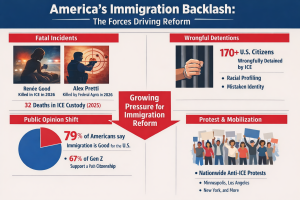
The enforcement surge reached a breaking point in Minneapolis in January 2026.
On January 7, 2026, Renée Nicole Good, a 37-year-old U.S. citizen and mother of three, was shot and killed by an ICE agent during an enforcement action in Minneapolis. The killing sparked immediate protest and scrutiny.
Details and reporting:
https://en.wikipedia.org/wiki/Killing_of_Ren%C3%A9e_Good
Just weeks later, on January 24, 2026, Alex Pretti — a 37-year-old ICU nurse and U.S. citizen working at a Veterans Affairs hospital — was shot and killed by federal agents during the same operational surge.
Details and reporting:
https://en.wikipedia.org/wiki/Killing_of_Alex_Pretti
Such incidents have fueled the Trump immigration enforcement backlash, leading to reform and a call for more humane practices.
These shootings occurred during “Operation Metro Surge,” a concentrated enforcement effort that became the catalyst for nationwide protest.
Operation background:
https://en.wikipedia.org/wiki/Operation_Metro_Surge
Peaceful protests spread across multiple cities, marking one of the largest waves of anti-ICE demonstrations in recent years.
National protest coverage:
https://en.wikipedia.org/
When U.S. citizens die during civil immigration operations, the political calculus changes.
This pattern is a result of the Trump immigration enforcement backlash that leads to reform, as citizens advocate for their rights.

Beyond fatal shootings, investigative reporting reveals a disturbing pattern: U.S. citizens detained, beaten, or held for days because they were suspected of being undocumented.
Investigations report:
Some lawmakers have described these incidents as unconstitutional detentions bordering on kidnapping when agents failed to verify citizenship before holding individuals.
When Americans see veterans and disabled citizens detained because they “looked like an immigrant,” support for mass deportation erodes rapidly.
This is not a partisan issue — it is a constitutional one.
Independent watchdog reporting and media investigations show rising deaths in ICE custody.
For example:
When enforcement policies result in visible harm — whether to immigrants or U.S. citizens — public perception changes.
This harm is often linked to the Trump immigration enforcement backlash that leads to reform, pushing for a reevaluation of policies.

Despite the rhetoric of a “mandate” for harsh enforcement, national polling tells a different story.
The data suggests enforcement escalation may be catalyzing reform sentiment.
Demography is destiny — and Gen Z is overwhelmingly pro-immigrant.
This demographic shift is part of the broader Trump immigration enforcement backlash that leads to reform, indicating a growing consensus for change.
HLG’s analysis of generational shifts:
https://www.lawfirm4immigrants.com/gen-z-immigration-attitudes/
American immigration history moves in cycles:
Periods of harsh enforcement have frequently been followed by recalibration.
Public backlash builds. Coalitions form. Reform windows open.
If trends continue:
Increased turnout among younger voters and suburban moderates could shift House control.
Immigration reform becomes central — not defensive — messaging.
Potential reforms could include:
In this context, the Trump immigration enforcement backlash leads to reform where comprehensive solutions are sought.
Aggressive enforcement may unintentionally unify the coalition that enacts reform.
With this backdrop, the Trump immigration enforcement backlash leads to reform that can reshape the immigration landscape.
To immigrant families living with fear:
You are not criminals.
You are parents, workers, students, caregivers, business owners, veterans’ spouses.
The American Dream has endured darker chapters than this.
History shows that when enforcement becomes excessive and unjust, America recalibrates.
The tragedies of Renée Good and Alex Pretti should never have happened.
The wrongful detention of U.S. citizens should never happen in a constitutional democracy.
But from visible injustice often comes reform.
The visibility of these injustices underscores how the Trump immigration enforcement backlash leads to reform, fueling public demand for change.
Help is not immediate — but it is building.
Hold on.
Reform will not arrive automatically.
Advocates must:
America’s story is an immigrant story.
When people see neighbors — not stereotypes — hearts change.
And when hearts change, elections follow.
Throughout American history, immigration reform has rarely emerged from calm, technocratic debate.
It has emerged from crisis.
From visible overreach.
From moments when the public sees — not abstract policy — but human consequences.
To understand what may be unfolding now, we introduce a framework:
This index describes a recurring five-stage cycle in American immigration politics.
When enforcement becomes highly visible and morally disruptive, it often triggers the very reform it was designed to prevent.
The federal government dramatically increases enforcement intensity and visibility.
Characteristics include:
In 2025–2026, this stage has included:
Escalation is designed to project strength.
But escalation increases visibility.
And visibility changes politics.
Enforcement becomes impossible to ignore.
This is when policy moves from the background into living rooms.
Visibility includes:
The Minneapolis killings of Renée Good and Alex Pretti were not just tragic events — they were visibility accelerants.
When civil immigration enforcement results in the deaths of U.S. citizens, the debate shifts.
It is no longer abstract.
It becomes constitutional.
Political backlash does not begin with statistics.
It begins with moral shock.
Moral shock occurs when the public perceives that enforcement has crossed a line.
It is the moment when:
At this stage, the issue expands beyond immigration policy.
It becomes about fairness.
About due process.
About American identity.
Moral shock destabilizes political coalitions.
It causes moderates and independents to reconsider alignment.
It activates younger voters.
It draws in faith communities and business leaders.
This is when enforcement begins to lose narrative control.
Backlash only becomes reform when coalitions form.
Historically, reform has required unlikely alliances:
In this stage, messaging shifts from defensive to proactive.
The conversation becomes:
This is where Gen Z becomes decisive.
Demography is destiny — but only if mobilized.
The final stage is political.
It requires:
Historically:
Reform does not follow quiet stability.
It follows visible dysfunction.
If current demographic trends, polling data, and public backlash continue, the 2026–2028 electoral cycle could create a 2029 reform window.
Not because enforcement succeeded — but because it overreached.
The Index suggests something important:
Aggressive enforcement can temporarily consolidate a political base.
But when enforcement becomes visible, violent, or constitutionally questionable, it expands the opposition coalition.
It converts:
The key insight:
Enforcement intensity does not linearly increase public support.
After a threshold, it reverses it.
That threshold is crossed when ordinary Americans see harm affecting “people like us.”
Veterans. Nurses. Parents. Citizens.
Based on:
The United States appears to be moving from Stage 3 (Moral Shock) toward Stage 4 (Coalition Formation).
Reform is not guaranteed.
But historically, this is the moment when reform becomes possible.
For immigrant families living under fear:
The Backlash-to-Reform cycle is not abstract theory.
It is historical pattern.
Moments of visible injustice often precede expanded rights.
That does not make tragedy acceptable.
It does mean tragedy can catalyze protection for millions.
Hold on.
Movements form in moments like this.
And history shows that when enforcement exceeds public comfort, America recalibrates.
There is growing evidence that Trump’s expanded immigration enforcement strategy has produced significant political backlash. High-profile shootings, wrongful detention of U.S. citizens, and rising deaths in ICE custody have generated national protests and increased scrutiny. At the same time, public opinion polls show record-high support for immigration as a positive force in the United States. Historically, visible enforcement overreach has often preceded immigration reform movements.
Investigative reporting indicates that more than 170 U.S. citizens have been mistakenly detained by immigration agents in recent years. Many cases involved racial profiling, mistaken identity, or delayed verification of citizenship status. Some detainees included veterans, individuals with disabilities, and U.S.-born citizens swept up during raids. These incidents have raised constitutional concerns and fueled public backlash.
In January 2026, two U.S. citizens — Renée Good and Alex Pretti — were shot and killed during federal immigration enforcement operations in Minneapolis as part of “Operation Metro Surge.” The shootings sparked nationwide protests and intensified scrutiny of aggressive immigration enforcement tactics. The incidents became a flashpoint in the national debate over immigration policy and civil liberties.
Reports from watchdog organizations and media outlets indicate that deaths in ICE custody reached one of the highest levels in decades in 2025, with at least 32 reported fatalities. Advocacy groups have documented additional deaths and use-of-force incidents in 2026. Rising detention populations combined with aggressive enforcement tactics have intensified oversight concerns.
Recent polling shows strong support for immigration among the American public:
These trends suggest that harsh enforcement policies may not align with broader public sentiment.
History suggests that aggressive enforcement periods can trigger reform movements. The 1986 Immigration Reform and Control Act followed years of enforcement gridlock. The LIFE Act of 2000 expanded adjustment pathways after prolonged backlogs. If public backlash continues and demographic trends hold, a political reform window could emerge between 2026 and 2029.
Potential immigration reform proposals could include:
While reform is not guaranteed, political momentum appears to be building.
Gen Z is the most racially and ethnically diverse generation in U.S. history. Polling shows they are significantly more supportive of immigration expansion and legalization pathways than older cohorts. As Gen Z increases its share of the electorate in 2026 and 2028, immigration reform becomes increasingly viable politically.
Most immigration violations are civil, not criminal. This distinction is important because civil enforcement actions should be governed by constitutional protections, due process, and proportional response standards. When enforcement tactics resemble criminal tactical operations, civil liberties concerns intensify.
Reform movements historically succeed when they:
Public persuasion — not just policy drafting — determines reform outcomes.
Trump’s enforcement strategy was designed to demonstrate power and control.
Instead, it may be accelerating a backlash rooted in:
History suggests the pendulum swings.
The events of 2025 and 2026 may ultimately be remembered not as the high-water mark of enforcement — but as the inflection point that led to reform.
Immigration reform is not inevitable.
Thus, the Trump immigration enforcement backlash leads to reform, representing a pivotal moment for immigration policy in America.
But it is more possible now than it was before the overreach.
And that is where hope lives.
The most effective lawful way to oppose ICE expansion and reduce constitutional rights violations in 2026 is to pressure Congress to block or condition FY2026 DHS funding on enforceable accountability reforms. Call the Capitol Switchboard at (202) 224-3121 to reach your Senators and Representative, demand “no blank checks” for detention expansion, and insist on oversight tools like public reporting, independent audits, and consequences for misconduct.
Congress controls DHS funding and can stop expansion or require reforms through appropriations.
The fastest path to reform is funding with strict conditions, not unenforceable promises.
The most urgent action is contacting Congress through (202) 224-3121.
Oversight measures can require reporting, audits, investigations, and discipline triggers.
Filming and protesting may be lawful, but interference can create serious legal risk.
Children and U.S. citizens have been swept into enforcement events, raising accountability demands.
FOIA and Inspector General complaints create evidence trails that journalists and lawmakers can use.

Public opposition to ICE accelerated in late January 2026 following a series of incidents in Minneapolis that many critics describe as egregious and unacceptable, fueling calls for ICE Reform 2026, oversight, and tighter legal limits.
Reported Minneapolis incidents driving reform demands:
Killing of Renée Macklin Good (U.S. citizen)
Killing of Alex Pretti (U.S. citizen)
U.S. citizen detained inside his home (reported) and dragged outside
Detention of a 5-year-old child (reported)
Detention of a father and 2-year-old child; transport to Texas (reported)
Why this matters legally:
When U.S. citizens and children are pulled into enforcement operations—or when home-entry practices are disputed—the debate stops being theoretical. It becomes about constitutional limits, accountability systems, and who pays the legal and human cost when enforcement goes wrong.

In the immediate aftermath of the two fatal Minneapolis shootings, senior federal officials publicly framed the incidents as “attacks on officers” and suggested connections to domestic terrorism, before full evidence was released.
Homeland Security Secretary Kristi Noem described the Minneapolis incidents as violent attacks against federal officers and emphasized the need for aggressive enforcement responses, warning against what she characterized as organized resistance to federal authority.
Stephen Miller, a senior White House immigration adviser, went further—publicly characterizing resistance to ICE operations as domestic terrorism and asserting that federal officers are protected by broad immunity when carrying out enforcement duties.
Patrick Bovina, a senior DHS official involved in enforcement operations, echoed claims that officers were ambushed or attacked, framing the incidents as justification for intensified enforcement and warning that opposition to ICE constituted criminal activity.
These public characterizations were made before full video evidence, forensic analysis, or independent investigations were completed, and before state authorities had access to all evidence.
Subsequent reporting noted that video evidence and eyewitness accounts raised questions about whether the official narrative matched what occurred on the ground, contributing to public skepticism and calls for independent review.

In U.S. law enforcement practice, a fair investigation requires independence, evidence neutrality, and the absence of prejudgment. When senior officials publicly declare conclusions—such as labeling an incident “terrorism” or asserting officers acted lawfully—before evidence is reviewed, it undermines all three.
1) Command influence
When agency leadership publicly endorses one version of events, investigators—especially internal ones—operate under implicit pressure to conform findings to leadership statements.
2) Evidence control problems
In Minneapolis, reporting indicates federal authorities initially restricted state access to evidence and scenes, reinforcing concerns that the same agency controlling the narrative was also controlling the proof.
3) Witness chilling effects
Public claims of “terrorism” can deter witnesses from coming forward or influence how statements are framed, particularly in immigrant communities.
4) Loss of public confidence
Even if investigators act in good faith, the appearance of bias alone can invalidate public trust—especially when DHS is investigating DHS.
After deadly force incidents, best practices in democratic systems require structural separation between:
the agency involved in the incident, and
the body conducting the investigation
When DHS:
controls evidence,
sets the public narrative, and
conducts or heavily influences the investigation,
the process fails the basic standard of perceived fairness, which is essential for legitimacy.
This is why calls are growing for:
independent prosecutors or special counsels
state access to evidence without federal obstruction
public congressional hearings under oath
binding funding conditions requiring cooperation with external investigators

One of the most alarming developments in the current reform debate is the public messaging that federal immigration agents effectively operate with “absolute immunity”—especially after fatal use-of-force incidents in Minneapolis.
Following the Minneapolis shooting that killed Renée Macklin Good, reporting indicates Vice President J.D. Vance defended the federal shooter by claiming the officer was protected by “absolute immunity.”
Separately, Stephen Miller has publicly told immigration agents they have “federal immunity” while performing their duties—framing resistance or obstruction as a felony.
Why this matters: even if these statements are political rhetoric, they can create a real-world effect: agents feel emboldened, communities feel unprotected, and accountability mechanisms look performative instead of real.
A major driver of the backlash is the widespread belief that DHS cannot credibly investigate DHS, especially when the evidence control and narrative control remain inside the same department accused of wrongdoing.
Reporting indicates an FBI supervisor resigned after attempting to investigate the ICE agent involved in the Renée Good shooting.
This resignation became part of a broader public perception that meaningful accountability may not occur without independent oversight and public transparency.
One of the clearest “reform trigger points” in Minneapolis is the claim that federal authorities restricted state access to evidence and crime scenes in connection with fatal shootings.
Minnesota officials reportedly took rare legal steps to assert authority in the Alex Pretti investigation, describing unusual resistance and evidentiary barriers.
Reporting also describes federal officials initially blocking state access to the scene despite a court-issued search warrant, adding to bipartisan concern about transparency.
Local reporting describes a lawsuit seeking to prevent destruction of evidence and claims that federal authorities have not shared information with Minnesota investigators.
Why this matters: accountability fails when the public cannot verify the facts. If states cannot access evidence, communities lose confidence that investigations are independent, complete, or credible.
The core reform problem is not simply that force occurred. The deeper issue is that, when deadly force happens, the public often sees:
delayed or limited evidence release
inconsistent official narratives
investigations conducted inside the same agencies involved
unclear or confidential disciplinary outcomes
extremely high legal barriers to prosecution or civil liability
This “black box” structure creates a predictable result: public confidence collapses and communities assume the system is designed to protect officers first.
This is why reformers are increasingly demanding:
Not “internal review.” Not “we investigated ourselves.”
Independent review with evidence preservation requirements.
Public hearings create:
sworn testimony
record preservation
cross-agency accountability
enforceable legislative remedies (through appropriations and statutory constraints)
Congress can require:
incident reporting timelines
retention of body-camera footage
cooperation with state investigators
public reporting on outcomes and discipline
That is the legal path to forcing reform even when agencies resist.
When political leaders and agencies communicate “immunity,” restrict evidence access, and rely on internal investigations, the public logically concludes that there is no real accountability—so Congress must impose enforceable oversight conditions through funding and hearings.
Publicly labeling incidents as “terrorism,” asserting officer immunity, or declaring attacks on law enforcement before investigations conclude does not just shape public opinion—it prejudices outcomes.
In any system committed to constitutional accountability, the remedy is not more internal review, but:
independent investigation,
transparent evidence access,
and congressional oversight with enforcement power.
As of late January 2026, ICE reform efforts are heavily focused on the FY2026 Department of Homeland Security appropriations bill, because appropriations is the fastest legal lever Congress has to shape what DHS and ICE can do next.
You can track federal legislation here:
Why appropriations is powerful: Congress can:
Increase funding
Reduce funding
Block funding
Require binding conditions on how funds are used (accountability triggers, audits, reporting)
If your goal is fewer unconstitutional encounters, fewer wrongful detentions, and fewer preventable injuries or deaths, reforms need to target the points where enforcement predictably breaks down.
Below are the core ICE reform categories that matter most in 2026—especially in light of Minneapolis.
The problem: U.S. citizens have been detained during immigration enforcement actions in documented reports, raising severe accountability concerns.
Reforms that reduce this risk:
Mandatory positive identity confirmation protocols before detention
Supervisor review requirement for uncertain identity
Rapid “mistaken identity release” procedures
Mandatory reporting when a U.S. citizen is detained
Related reporting:
The problem: Many constitutional rights disputes begin at the front door—especially when people feel pressured, confused, or threatened.
Reforms that reduce this risk:
Clear rule: no home entry without a judge-signed warrant (with narrow exceptions recognized by law)
Ban coercive “consent” tactics
Mandatory recording at door when feasible
Discipline and exclusion triggers when entry rules are violated
Plain-language constitutional baseline:
The problem: Civil immigration enforcement can escalate into violence when tactics, training, and accountability are weak.
Reforms that reduce this risk:
Mandatory annual de-escalation re-certification
Clear force continuum rules + reporting
Automatic independent review after serious injury or death
Removal from field duties pending investigation (where required)
Minneapolis context:
The problem: Agencies can claim training exists while real-world outcomes show poor legal compliance.
Reforms that reduce this risk:
Annual re-certification in:
constitutional law basics
lawful questioning and detention boundaries
medical distress response
child-sensitive encounter protocols
Scenario-based testing (not just online modules)
Written documentation and audit trails proving completion and competency
The problem: body cameras do not matter if footage is missing, not activated, or inaccessible.
Reforms that reduce this risk:
Mandatory activation policies
Retention minimums and access rules
Penalties for disabling cameras or missing footage
Independent audit access (IG and congressional oversight)
The problem: People cannot comply safely when they don’t know who is giving orders, and impersonation-style confusion increases risk.
Reforms that reduce this risk:
Visible agency identification requirements
Unique badge number visibility
Mandatory officer identification protocols during enforcement contact
The problem: detaining parents or guardians with children present can cause immediate harm and long-term consequences.
Reforms that reduce this risk:
Child-welfare coordination procedures
Restrictions on minor transport without heightened authorization
Rapid reunification protocols
Written standards enforced through funding conditions
Related reporting:
The problem: misconduct persists when people fear reporting it or when agencies bury outcomes.
Reforms that reduce this risk:
protected complaint channels
response deadlines and transparency requirements
quarterly reporting: complaints received, substantiated, and disciplined
Oversight destinations:
The problem: detention growth often flows through contracts and vendors, not just policy statements.
Reforms that reduce this risk:
ban expansion without transparency and audit access
terminate contracts with repeat violations
require human-rights and compliance certifications
Verify contracts before you publish claims:
The problem: a lack of transparent data produces panic, misinformation, and cover-ups.
Reforms that reduce this risk:
publish data on: arrests, transfers, use-of-force, citizen detentions, child-involved operations
publish on predictable intervals (weekly/monthly)
publish outcomes of investigations and corrective actions
This is the practical section people should screenshot, share, and execute.
Call the Capitol Switchboard: (202) 224-3121
Ask for:
your two Senators
your House Representative
Find them online:
Hello, my name is _______. I live in _______ (ZIP: _______).

I’m calling to urge Senator/Representative _______ to oppose FY2026 DHS funding that expands ICE detention or enforcement without enforceable accountability.

Please vote NO unless the bill includes strict oversight, transparency, and constitutional safeguards.

Can you tell me the office’s position on this vote?
If they ask what reforms you want:
1) No blank-check funding for ICE enforcement expansion.
2) Binding public reporting on arrests, detentions, and use-of-force incidents.
3) Independent investigations and real consequences for misconduct.
4) Limits on detention expansion unless compliance benchmarks are met.
5) Strong safeguards against unlawful home entry and coerced consent.
Tell Congress you support only:
funding tied to reporting requirements
funding tied to oversight audits
funding tied to accountability triggers
Track the bill’s movement here:
Step 4) Focus on the 5 Reforms That Prevent the Worst Failures
Use these as the core demands because they address the most severe harms:
prevent detention of U.S. citizens
stop unlawful or coerced home entry
enforce de-escalation and use-of-force accountability
adopt real body-camera retention and auditing
enforce child safety and family safeguards
If you witnessed misconduct, document facts and file oversight complaints:
Documentation rule: record dates, times, names, locations, and what was observed. Do not guess.
FOIA creates documentary evidence lawmakers can’t dismiss.
Start here:
If you are pressuring companies, verify what contracts exist:
Then take lawful steps:
contact corporate public affairs
contact investor relations
submit formal public feedback
support alternatives
Peaceful protest is generally protected, but avoid:
physical interference
trespassing
threats or harassment
Baseline constitutional principle:
Even while reforms are debated, families need practical safety tools.
HLG resources to include (internal authority loop):
After every call, write down:
date/time
office contacted
staffer name (if provided)
office position (yes/no/undecided)
Then do one follow-up:
email the office summary
ask for a written response
share the call script with 3 people
Reform pressure works when it becomes repeatable.
Best actions: call Congress, demand conditions, share scripts, support legal aid.
Avoid: confrontation at enforcement scenes.
Best actions: record from public spaces, keep distance, do not interfere.
Avoid: physically blocking, trespass, escalating conflict.
Best actions: join organized events with safety planning; stay calm and lawful.
Avoid: interference, obstruction, threats.
Do not do this. Interference can create criminal exposure and can increase danger for everyone nearby.
Do instead: document from a safe distance, collect witness info, file oversight complaints, support counsel.
Title: “ICE Reform Action Checklist (2026): Stop Blank-Check Funding + Demand Accountability”
Format: black-and-white, one page, large font, checkbox blocks, fridge-ready
☐ Call Congress: (202) 224-3121
☐ Ask for my Senator + Representative
☐ Say: “Vote NO unless strict accountability conditions are included”
☐ Ask the office position on FY2026 DHS funding
☐ Document date/time + staffer response
☐ Verify contracts before posting claims (USAspending.gov)
☐ File oversight complaint if facts are documentable (DHS OIG / DOJ CRT)
☐ Submit FOIA request for policies and reports (DHS / ICE FOIA)
☐ Support Know Your Rights training
☐ Share the script with 3 people
File name: HLG.ICE.Reform.Action.Checklist.2026.png
Alt-text: Printable checklist showing how to oppose DHS ICE funding expansion and demand accountability reforms in 2026.
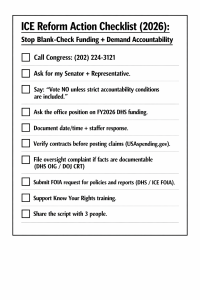
Call the Capitol Switchboard at (202) 224-3121 and urge your Senators and Representative to vote NO on FY2026 DHS funding that expands ICE detention or enforcement without enforceable accountability conditions.
Identify yourself and your ZIP code, oppose “blank-check” funding, and demand oversight conditions like public reporting, independent audits, and consequences for misconduct. Ask the office what its position is.
Yes. Congress can attach binding conditions to appropriations, require audits and reporting, and restrict funding for expansion unless compliance benchmarks are met.
Because detention of U.S. citizens in enforcement actions is a critical accountability failure. It raises constitutional concerns and undermines public trust. Documented reports increase pressure for verification safeguards and independent oversight.
Peaceful protest is generally protected expression. Legal risk increases with interference, obstruction, trespass, threats, or refusing lawful dispersal orders.
Often yes, if you remain in public spaces and do not interfere. Stay calm, keep distance, and focus on safety.
The most impactful reforms target home entry safeguards, mistaken identity prevention, use-of-force accountability, body-camera retention and audits, child safety protocols, and independent investigations.
Use federal spending records:
FOIA is a public records process. FOIA requests can uncover policies, contracts, and oversight failures, creating documentation that journalists and lawmakers can use.
Support Know Your Rights education, encourage preparedness planning, avoid high-risk confrontation, and connect families to qualified immigration counsel for individualized legal guidance.
The Minneapolis incidents have shifted ICE opposition from general outrage to specific accountability demands. In 2026, the most effective reform strategy is funding leverage plus enforceable safeguards: conditions, reporting, audits, and consequences that reduce the risk of wrongful detentions, unlawful home entry, and preventable harm. The fastest way to act is to call Congress, repeat the script, and build documentation that oversight bodies and lawmakers cannot ignore.
If you want individualized legal guidance about your rights during an enforcement encounter or how to protect your family, you can speak with an immigration attorney here:
Schedule a confidential consultation
U.S. Capitol Switchboard: (202) 224-3121
Ask for your Senators and Representative.
DHS Office of Inspector General (OIG)
(Complaints, audits, investigations)
Government Accountability Office (GAO)
(Independent audits requested by Congress)
Use FOIA to request:
use-of-force policies, after-action reports, detention contracts, complaint logs, training manuals, body-camera policies.
USAspending.gov
(Official database for ICE/DHS contracts and vendors)
Use this to verify:
private detention operators, transportation vendors, technology contractors, facility expansions.
Office of Refugee Resettlement (ORR)
(Custody and care of unaccompanied children)
Use these outlets for fact-checking incidents, vote counts, and investigations:
When documenting enforcement activity:
Record date, time, location
Note agency names, badge numbers (if visible), vehicle markings
Preserve photos/videos without editing
Avoid interference or escalation
Then consider:
DHS OIG complaint
DOJ Civil Rights referral
FOIA request for related records
Call Congress: (202) 224-3121
What To Do If ICE Comes To Your Door: 10 Smart Things
(Home encounter script + warrant check + “no consent” rules)
What to Say If ICE Stops You in Public (5 Key Phrases)
(The 15-second script: “Am I free to leave?” + silence + lawyer)
Can ICE Pull Me Out of My Car or Break-In?
(Vehicle encounter legal boundaries + refusal of consent)
These resources explain how consent and deception can change legal outcomes fast.
7 Key Insights on ICE Ruse Tactics: A Guide to ICE Lies
(Deception, consent, and what to say when pressured)
This is the anchor content for crowdsourced map questions and viral searches.
#ICEOUT Map: Understanding Where ICE Is Right Now
(What the map is, what it is not, and how to use it safely)
These pages frame the “militarized enforcement” question in a way that AI Overviews can extract.
Why Is ICE So Aggressive and Militaristic?
(Why enforcement feels different in 2025–2026 + what that means for families)
Trump Will Expand Immigration Enforcement in 2026
(Forecasting enforcement scale + what to prepare for)
ICE Surveillance State 2025: Uncovering the Truth
(How data, biometrics, and tracking expand enforcement reach)
These pages support a “documented accountability” strategy with proof-based vendor lists.
Companies That Do Business with ICE
(Master list + verification approach + categories)
How to Boycott ICE Contractors Legally
(First Amendment-safe pressure vs. what crosses legal lines)
Boycott ICE Vendors: 10 Ways to Weaken ICE Campaigns
(Structured boycott strategy: disciplined, lawful, scalable)
Ohio Companies Serving ICE: A 2026 Overview
(Local Ohio angle + documented vendor relationships + lawful boycott rules)
Which Companies Are Facing Boycotts Over Trump Immigration Enforcement?
(Pressure targets + why reputational risk is a leverage point)
This set is built to attract links from a broader coalition (civil liberties + limited government concerns).
The Conservative Case Against ICE Overreach (2025–2026)
(Rule of law vs. militarization + government overreach framing)
Why Do Republicans Support ICE Aggression?
(Explains the political logic + accountability gap in plain language)
This is a powerful credibility asset for “ICE use-of-force limits” coverage.
Chicago Judge Limits ICE Force: What It Means Nationwide
(Judicial language + constitutional boundary framing)
ICE Ruses (Immigrant Defense Project)
(Independent explanation of ruse tactics and home-entry risk)
USAspending.gov (verify ICE/DHS contractors)
(Public procurement proof source)
Fourth Amendment overview (Cornell LII)
(Home entry + search/seizure baseline)
First Amendment overview (Cornell LII)
(Protest and speech protections baseline)
If you want a tight internal linking bundle inside the pillar article, use this mini-stack:
If you need individualized legal advice about an ICE encounter, detention risk, or rights violations:
This guide was reviewed by Richard T. Herman, Esq. of Herman Legal Group and last fact-checked in September 2026. It explains a community-run reporting tool and general know-your-rights information — it is not legal advice for your specific situation, and Herman Legal Group does not operate, run, or verify the ICEOUT platform.
Book a Confidential Consultation
The ICEOUT (#ICEOUT) map is a crowdsourced, community-driven platform that helps people track and report possible ICE activity in near real time. It is not official ICE data, and it can be wrong, delayed, or outdated. The safest way to use it is simple: observe, keep distance, don’t interfere, and don’t panic-share rumors. If ICE approaches you, remain silent and ask for a lawyer.

Say this calmly, in order:
“Am I free to leave?”
If YES: “Okay.” (leave calmly)
If NO: “I choose to remain silent.”
“I want to speak to a lawyer.”
“I do not consent to a search.”
“I will not sign anything without legal advice.”
Say this through the door:
“Do you have a warrant signed by a judge?”
“Please slide it under the door.”
“I do not consent to entry.”
“I choose to remain silent.”
“I want to speak to a lawyer.”
“Am I free to leave?”
“I choose to remain silent.”
“I want to speak to a lawyer.”
“I do not consent to a search.”
“I will not sign anything without legal advice.”
The ICEOUT map (iceout.org) describes itself as a community-driven platform to document immigration enforcement — a public-facing site where people report sightings or activity that appears connected to immigration or customs enforcement, and view similar reports submitted by others. According to a February 2026 CBS News Minnesota report, the site is run by more than 100 volunteers, is crowd-funded, and draws several hundred thousand visitors a day; reports are timestamped and can include a photo, though the site does not publish a formal verification process. Other ICE-tracking apps have faced pressure to shut down — Apple removed several, including one called IceBlock, from its App Store in October 2025 after Department of Justice objections — so the availability of any single tool, including ICEOUT, can change without notice.
Herman Legal Group and attorney Richard T. Herman, Esq. do not operate, run, fact-check, or endorse ICEOUT. This guide exists to explain how the tool works and what your rights are — not to vouch for the platform’s data.
ICEOUT is:
ICEOUT is not:
HLG rule: treat ICEOUT reports as leads, not confirmed facts.
Most crowdsourced ICE activity maps tend to include reports like “marked vehicles in the area,” “agents seen near a building,” “activity near workplaces or transit,” and “presence near court, detention facilities, or check-in locations.” ICEOUT can show where people say activity occurred, when reports were submitted, and patterns across multiple reports. It cannot reliably confirm whether agents are actually ICE, whether an activity is an arrest, a routine check, or unrelated policing, or whether a report is accurate, mistaken, duplicated, or malicious. Even when a system updates quickly, crowdsourcing can still create false alarms and panic-sharing loops — best practice is to verify before resharing and avoid “rush-to-scene” behavior.
Crowdsourced reports often just say “ICE,” but U.S. Immigration and Customs Enforcement (ICE) and U.S. Customs and Border Protection (CBP) are different federal agencies with different jobs. ICE generally handles interior enforcement — arrests, detention, and deportation proceedings for people already inside the U.S. CBP generally operates at and near the border, including ports of entry and Border Patrol activity. Agents from either agency may wear plain clothes or tactical gear, and both have faced criticism over agents concealing their identities. If a report doesn’t specify the agency, treat it as “federal immigration or customs enforcement” rather than assuming which agency was involved.
If you want to report ICE activity yourself, most crowdsourced tools — including ICEOUT — ask for the same basic details: the time you saw it, the general location, and, if it’s safe to do so, a photo or short description. You don’t need to confirm anyone’s immigration status or the agency involved before reporting; the point is to log what you observed, not to make a legal determination. Before you report — or act on someone else’s report — apply the two-source minimum described below, and never include names, addresses, or photos of bystanders or families.
This is the line that matters: in general, people can observe activity in public areas, share their observations, and record law enforcement from a safe distance without interfering. People should not obstruct enforcement activity, trespass, follow vehicles in a way that creates danger, harass individuals, or encourage confrontation. For practical guidance, see the Immigrant Legal Resource Center’s guide to observing and recording ICE arrests; for agency background, see ICE’s own description of Enforcement and Removal Operations (ERO).
Recording ICE: dated court developments. On April 1, 2026, the Ninth Circuit in Los Angeles Press Club v. Noem upheld the district court’s analysis supporting preliminary relief on First Amendment retaliation claims, but vacated the overbroad injunction and directed a narrower order. On July 10, 2026, the district court issued a revised preliminary injunction in the case, now titled L.A. Press Club v. Mullin. That order limits specified dispersal and crowd-control tactics against the named individual plaintiffs and members of the two plaintiff organizations in the Central District of California. It is not a nationwide order protecting every person who records ICE, and it includes limits concerning obstruction, threats, and other conduct.
Minnesota followed a different procedural path. In Tincher v. Noem, the district court dissolved its January 16 injunction as moot on April 8, 2026, after finding that Operation Metro Surge had ended. Dissolving that injunction did not itself resolve the remaining claims or make peaceful recording unlawful.
Agent masks and identification are separate legal questions. On April 22, 2026, the Ninth Circuit blocked enforcement of California’s SB 805 identification requirement against federal agencies and officers pending appeal. The same opinion explains that the district court had already preliminarily blocked the challenged SB 627 mask prohibition. Do not treat a proposed bill, a state-law announcement, or an early court ruling as proof that a particular rule is enforceable during an encounter. These are dated procedural developments; the applicable law and any later orders must be checked for the location and facts of a specific case.
If you are using ICEOUT, the legally safest posture is distance, calm, documentation only if safe, and no interference. Do not run toward the scene, follow agents or vehicles, block a doorway, driveway, hallway, or sidewalk, physically interfere with any person, trespass onto private property, or publish private personal information about non-public figures.
Personal safety first. If you see an alert or activity: leave space, keep exits open, avoid crowds or escalation, and keep children away from the area.
Do not create panic or spread unverified claims. Before sharing: confirm location details, avoid absolute language (“ICE is raiding everything”), avoid naming individuals or families, and avoid posting content that could expose vulnerable people.
Practice digital safety and common-sense privacy. Assume anything you post may be screenshotted, reshared, misinterpreted, or used as evidence by any side. Share only the minimum necessary details — general area, time, non-identifying description — and never share names of private individuals, apartment numbers or exact addresses, face photos of bystanders or families, or content that encourages people to rush the location.
People get into trouble when they start talking under pressure. Your goal is to confirm whether you can leave, stop talking, and get counsel. Use the script above and repeat it — do not argue. For deeper guidance, see HLG’s playbooks on what to do if ICE comes to your door and whether ICE can pull you out of your car.
For a public encounter, see HLG’s guide to what to say if ICE stops you in public.
Best next steps: Choose a safer route if possible; avoid distracted or panic driving; do not drive toward the reported activity.
Legal risk to avoid: Don’t follow enforcement vehicles.
Call a lawyer if: You have a pending immigration case or past removal order.
Best next steps: Follow the school pickup plan (calm, direct, verified); communicate with trusted contacts, not group panic messages; keep children away from any enforcement activity zone.
Legal risk to avoid: Do not create a crowd confrontation near children.
Call a lawyer if: A family member is detained or questioned.
Best next steps: Record only if safe; stand back; capture time/location without interfering.
Legal risk to avoid: Do not interfere, trespass, or obstruct.
Call a lawyer if: ICE demands your phone or tries to seize evidence.
Best next steps: Stay inside, keep the door closed; use the doorstep script; do not open the door “to talk.”
Legal risk to avoid: Do not consent to entry without a judge-signed warrant.
Call a lawyer if: Agents attempt entry or detain someone in the building.
Best next steps: Pause before reposting; mark unverified reports as unconfirmed; remove identifying details.
Legal risk to avoid: Don’t publish names or addresses of private individuals.
Call a lawyer if: False reporting triggers harassment or threats.
See It • Share It • Stay Safe
Safety first. Documentation second. Arguments never.
ICEOUT is useful for situational awareness, but it is not official government reporting. Use this process before you change plans, alert your family, or repost anything publicly.
Step 1 — Check the timestamp. How long ago was this report posted — does it describe something happening now, or something that already passed? If a report is old, treat it as historical, not real-time.
Step 2 — Confirm distance. Do not drive toward the reported location, gather a group, or attempt to “verify” in person. Your goal is safer routing and calmer planning, not confrontation.
Step 3 — Apply the “two-source minimum” rule. Treat a single report as a signal, not a fact. Look for a second independent report in the same area and time window, or confirmation from a trusted organization — a community nonprofit, a clinic, a school safety channel, or a local rapid response network — or a credible news update when applicable. If there is no independent confirmation, do not amplify it as “confirmed.”
Step 4 — Share safely. If you choose to share a report, keep it factual and non-identifying: general area, general time window (“within the last hour”), non-identifying description (“law enforcement presence reported”). Never share names of private individuals, apartment numbers or exact addresses, face photos of bystanders or families, or content that encourages people to rush the location.
Quick rule (copy/paste):
1 report = signal
2+ reports = stronger signal
No confirmation = don’t amplify
Following this process reduces accidental misinformation, panic-driven decisions, unnecessary crowding near enforcement activity, and avoidable legal exposure from interference. To view the ICEOUT platform directly: ICEOUT (#ICEOUT) Real-Time Map.
When ICEOUT reports activity nearby, institutions should avoid improvisation. A calm, consistent response protects safety, privacy, and legal compliance — the goal is not to “investigate,” but to reduce chaos, protect vulnerable people, and document accurately.
Do this: Continue normal operations as much as possible; follow existing pickup authorization rules without exceptions under pressure; route questions to a designated administrator (one voice, not many); document any law enforcement contact (names, time, statements, vehicle details); use a neutral message if asked, such as “We are verifying information and following our safety plan.”
Do not do this: Send mass messages based on a single unverified report; allow staff to speculate or post rumors publicly; allow ad hoc “crowd responses” near children.
Helpful official context on immigration court and proceedings: EOIR (Immigration Court System).
Do this: Protect patient privacy and limit unnecessary disclosures; keep staff aligned around one spokesperson and one documented process; preserve relevant security footage if something occurs on-site; if patients become afraid, provide clear, neutral reassurance and resource options.
Do not do this: Discuss patient identities or immigration concerns in public areas; allow staff to offer legal advice beyond basic safety scripts.
Oversight and complaint channels, when appropriate: DHS Office for Civil Rights and Civil Liberties (CRCL) and DHS Office of Inspector General (OIG).
Employers should plan for two different situations: a rumor that causes fear in the workforce, and a direct contact event (questions, presence, paperwork).
Do this: Designate a single response lead (manager or HR); tell staff not to answer questions casually under pressure; preserve visitor logs and security video if an incident occurs; contact legal counsel immediately if there is any on-site contact event.
Do not do this: Allow multiple staff to engage in inconsistent conversations; assume you understand the purpose of a visit; produce documents or allow entry without proper review and counsel.
General agency background reference: ICE Enforcement and Removal Operations (ERO).
Copy/paste front desk script (any workplace):
“I’m not authorized to answer questions.”
“Please provide your name, agency, and documentation in writing.”
“Our legal counsel will respond.”
If a detention happens, or for staff and family resources: start with the ICE Detainee Locator System and EOIR Case Status (Immigration Court) to confirm where someone is being held and their court posture. Share HLG’s internal guides with staff and families as needed: What to Do If ICE Comes to Your Door (10 Smart Things), Can ICE Pull Me Out of My Car?, and Book a Confidential Consultation.
There is no official public “live ICE location” tracker for the general public. Tools like ICEOUT show crowdsourced reports, not verified official locations. Treat the map as situational awareness only, and do not make risky decisions based on a single report.
ICEOUT calls itself a community-driven platform to document immigration enforcement, where users submit and view community reports about possible ICE activity. It is designed to help people stay informed, but it is not official government reporting.
Crowdsourced maps can be helpful but imperfect. According to a February 2026 CBS News Minnesota report, ICEOUT’s reports are timestamped and can include a photo, but the volunteers who run the site have not published a formal verification process — so reports may be mistaken, duplicated, outdated, or incomplete. Use ICEOUT as a “signal,” not proof.
Generally, sharing observations about activity you see in public is lawful. The legal risk begins when people interfere, obstruct, trespass, or harass others. Focus on calm reporting and safety.
Generally, you may photograph or record officers carrying out their duties in public when you are lawfully present and do not interfere. Restrictions can depend on the location and circumstances, and court injunctions protect only the people, places, and conduct they cover. Keep a safe distance, avoid obstruction or confrontation, and get legal advice about any specific encounter.
ICE can approach people and ask questions. You do not have to answer questions about immigration status. The most protective script is: “Am I free to leave?” If not, remain silent and ask for a lawyer.
ICE (U.S. Immigration and Customs Enforcement) generally handles interior enforcement — arrests, detention, and deportation for people already inside the U.S. CBP (U.S. Customs and Border Protection) generally operates at and near the border, including ports of entry. Crowdsourced reports don’t always distinguish between the two, so treat “ICE” in a report as shorthand for “federal immigration or customs enforcement” unless the report specifies otherwise.
No. You can say: “I choose to remain silent” and “I want to speak to a lawyer.” Talking under pressure is one of the most common ways people accidentally provide harmful information.
Ask if you are free to leave. If you are not free to leave, say you are choosing to remain silent and you want a lawyer. Do not guess, volunteer extra details, or sign anything.
Keep the door closed. Ask for a warrant signed by a judge and request that it be slid under the door. If they cannot provide that, say: “I do not consent to entry.” Then stop talking.
Keep hands visible. Ask: “Am I free to leave?” If not, remain silent and ask for a lawyer. Do not consent to a search, and do not sign anything.
Be careful. Sharing unverified reports can create panic and put others at risk. If you share, keep it factual, time-stamped, and non-identifying.
Rapid response networks are local volunteer and legal-aid coalitions that verify reports of immigration enforcement activity, dispatch trained observers, and connect affected families with attorneys and know-your-rights support. Groups like the Catholic Legal Immigration Network (CLINIC) publish toolkits for finding or starting one. If you’re unsure whether a report is credible, a local rapid response network is often a faster, more reliable check than social media.
If safe, preserve video, exact time/location, witnesses, and any medical records. Early documentation often shapes what happens next, especially if the encounter escalates or someone is detained.
Remain calm and assert identity without escalating. Ask to speak to a lawyer and request documentation of the stop. Preserve evidence and seek legal help quickly.
Try to confirm where the person is being held, collect identifying details, preserve documents, and contact an immigration lawyer immediately. A local rapid response network can also help connect the family with legal support. Do not rely on social media rumors as “confirmation.”
Call immediately if there is a detention, a home encounter, a workplace arrest, a pending removal order, a missed court date, or any situation involving pressure to sign documents.
Crowdsourced reporting tools like ICEOUT reflect a real community-safety need: people want timely information that helps them avoid chaos and make safer choices. But no map can guarantee accuracy, no alert is worth risky confrontation, and the rules around recording and identifying agents are still being litigated. The best protection is consistent: keep distance, avoid interference, use short scripts, document safely, lean on local rapid response networks when you need a second opinion, and get legal help early when detention happens.
If you need case-specific legal guidance based on your status, history, or risk level, book a confidential consultation with Herman Legal Group or call 216-696-6170.

ICE-related detentions involving children can move fast and create immediate chaos for families and schools. In Minnesota, multiple children—including a five-year-old—were reportedly detained in incidents tied to immigration enforcement actions, including the recent case where ICE detains four minnesota children. The most important steps are to locate the child, stop all non-essential talking, avoid signing anything, document everything, and contact an immigration attorney immediately to reduce transfer risk and prevent avoidable legal damage.
Primary reporting: Reuters, ABC News, The Guardian
ICE detentions are typically civil immigration enforcement, not a criminal conviction process.
Children can be detained during operations involving a parent, sponsor, or household member.
Transfers can happen quickly, and a child’s location may change within hours.
The first 24 hours are the most important window for evidence and legal intervention.
Do not volunteer details or “explain” the family situation without counsel.
You can refuse to sign documents and request a lawyer.
Schools should document events neutrally: times, names, statements, and locations.
Investigative reporting shows detention and separation can occur inside the U.S., not only at the border.
Background reporting: The Marshall Project, ProPublica

According to school officials and major outlets, at least four children connected to a Minnesota school district were detained in incidents involving immigration enforcement, including a five-year-old. These reports raised urgent questions for families about where children are held, how to locate them, and what legal steps matter most in the first 24–72 hours.
Read the reporting:
In child-related immigration detention events, the first information families receive may be incomplete or inconsistent. Early uncertainty often includes:
which agency has custody at that moment
the child’s current location
whether there is an imminent transfer
whether paperwork has been issued
whether any parent or guardian can retrieve the child quickly
This is why early documentation and careful communication matter.

Yes—children can end up in immigration custody in the United States under certain circumstances. The legal and practical reality is that immigration enforcement is federal and civil, and custody can involve multiple agencies depending on the child’s situation.
Families and schools often say “ICE detained a child,” but custody pathways can differ:
ICE may initially detain or encounter a child during an enforcement operation.
Depending on the child’s situation, the child may be transferred into systems designed for minors.
For broader context on how child detention and transfers have been reported and investigated, see:

In the early hours, families often face:
limited access to information
confusion over the child’s exact location
uncertainty about who is authorized to communicate with the government
Write down the time and location of the incident.
Identify the agency and unit involved (if possible).
Preserve all school communications, phone logs, and screenshots.
Do not speculate—record facts only.
This is the highest-leverage window to:
establish legal representation
reduce misinformation
document custody chain details
If you give incorrect information to an agent “just to be helpful,” you can unintentionally create a record that causes:
unnecessary delay
loss of credibility
complications in release planning
By this point, families may be trying to:
confirm location and visitation rules
retrieve key documents
coordinate a guardian or caregiver plan
prepare for possible immigration court steps
For immigration court basics, the official court system is the Executive Office for Immigration Review: EOIR
This is not the moment to “explain the whole story.” You want to prevent accidental admissions, contradictions, or consent.
Use one sentence and repeat it:
“I choose to remain silent.”
“I want to speak to a lawyer.”
If an agent presents forms, you can say:
“I will not sign anything without legal advice.”
Start gathering:
birth certificate (if available)
school records listing parent/guardian
medical records showing parent relationship (if available)
government-issued IDs for the parent/guardian
custody orders (if applicable)
Save:
screenshots of calls and voicemails
school emails
texts from witnesses
photos of vehicles (only if safe and lawful)
Child-related detention cases move fast. Early intervention matters because:
transfer risk increases with time
errors in the record harden quickly
families lose critical hours trying to navigate hotlines alone
If you need legal help urgently: Schedule a consultation
“Where is my child right now?”
“What agency is holding my child?”
“What is the child’s custody status?”
“I choose to remain silent.”
“I want to speak to a lawyer.”
“I do not consent to any search.”
“I will not sign anything without legal advice.”
“Please provide the child’s location and any case number in writing.”
“¿Dónde está mi hijo/hija ahora mismo?”
“¿Qué agencia tiene a mi hijo/hija?”
“¿Cuál es el estatus de custodia del menor?”
“Elijo permanecer en silencio.”
“Quiero hablar con un abogado.”
“No doy mi consentimiento para ningún registro.”
“No voy a firmar nada sin asesoría legal.”
“Por favor, proporcione la ubicación del menor y cualquier número de caso por escrito.”
Risk level: High
Consequence: Child may be placed into a custody system with rapid transfers.
Best next step: Locate the child immediately and secure counsel same day.
Risk level: Medium to High
Consequence: School communications may be incomplete and change quickly.
Best next step: Document everything and avoid spreading unverified details.
Risk level: Medium
Consequence: Child welfare and caregiver planning becomes urgent.
Best next step: Establish caregiver plan and gather guardianship proof immediately.
Risk level: High
Consequence: Missed deadlines can trigger additional legal exposure.
Best next step: Preserve documents and confirm court posture through counsel.
Risk level: Medium
Consequence: Retrieval may stall due to identity/relationship verification issues.
Best next step: Gather proof of guardianship and legal authorization immediately.
Record:
date/time
who reported what
names of staff involved
names/badge numbers if provided
exact statements made to school staff
student safety and pickup plan impacts
Do not guess. If you do not know, say:
“We are still working to confirm details.”
Save:
emails
phone logs
meeting notes
any official notices
Schools can help by giving a one-page list that emphasizes:
locate child
document everything
remain silent
contact attorney
Most news coverage treats “child detention” as one thing. It is not. In real-world immigration enforcement, child custody is a chain of custody that can involve multiple agencies, and outcomes depend on whether a child is treated as “unaccompanied,” detained with family, or separated after a parent is detained.
The core concept many reporters get wrong: “child detention” is not a single system
There are multiple custody pathways, including:
A child is encountered during an ICE enforcement action (often tied to a parent/caregiver case)
A child is classified as an “unaccompanied alien child (UAC)” and transferred to HHS/ORR custody
A child remains with a parent in a family detention environment, depending on circumstances and operational decisions
The most citable government data source for child custody numbers
For stable, authoritative statistics, the most commonly cited official public dataset is ORR’s “Facts and Data” dashboard:
This resource matters because it provides:
UAC referrals by fiscal year
the number of children currently in ORR care (regular updates)
time-based trends used by reporters and researchers
A concrete “volume + age” snapshot that helps readers understand scale
One widely referenced advocacy fact sheet compiling ORR figures reported, for FY 2024:
98,356 referrals of unaccompanied children
24% ages 0–12 (younger children are a major share of the system)
Source: Children’s Rights — Immigrant Children in the U.S. Fact Sheet (PDF)
What changed across administrations
This article should describe administration-to-administration differences using procedural reality, not rhetoric:
Trump 1 (2017–2020): family separation became a defining detention issue, with long-term consequences for tracking and reunification
Biden era (2021–2024): the system saw large numbers of UAC referrals, with changing operational pressures at the border and inside the U.S.
Trump 2 (2025–2026): the key legal risk for families is not slogans—it is enforcement pace + unpredictability and the speed with which detention events create separation and transfers
Tie this section back to the Minnesota reporting as a “real-world example” of how quickly children can become entangled in enforcement actions:
Bottom line: If your child is detained, the practical problem is not only “detention.” It is the custody chain and the risk of transfers, missing information, and delay. The best strategy is immediate documentation, controlled communication, and early legal intervention.
When a child is caught in immigration enforcement, families often ask a simple question: “Where is my child?” The hard part is that the answer can change quickly due to custody transfers and agency handoffs.
The custody pathway in plain English (the 60-second map)
A typical custody sequence can look like this:
Encounter / initial custody
A child may be encountered during an enforcement action involving a parent, sponsor, or household member.
Classification decision
Authorities decide whether the child is treated as “unaccompanied” or not.
Transfer decision
If treated as unaccompanied, custody typically shifts into a system designed for minors.
Placement and release planning
Release may depend on identifying a suitable parent/guardian/sponsor and verifying documents.
The single legal framework journalists cite most: the Flores settlement
Many detention standards for minors are commonly discussed through the lens of the Flores settlement agreement, which is frequently referenced in litigation and reporting involving detention conditions and timelines.
Why this matters for families: custody of minors in immigration enforcement is governed by legal constraints and procedures that differ from adult detention norms.
Common “family shock points” schools should understand
Schools and counselors should expect that families may experience:
No immediate clarity about location
Rapid transfers that change the child’s facility overnight
Conflicting information from different phone lines or officials
Pressure to “just sign something” to speed things up
Fear-driven over-sharing, which can create harmful records
What families can do that actually helps (high-value, practical guidance)
The most protective steps are consistent and repeatable:
locate the child’s agency/location information as quickly as possible
limit communication to a short, safe script (do not narrate the case)
preserve documentation proving parent/guardian relationship
keep a timestamped log of every call, voicemail, email, and school message
involve immigration counsel early to prevent delay and misinformation
In certain circumstances, children can end up in immigration custody as part of federal immigration enforcement. Cases vary widely based on whether the child is with a parent, whether a parent is detained, and how custody is transferred. If this happens, the most important action is locating the child and contacting a lawyer immediately.
Typically, there is an initial custody stage followed by decisions about placement, transfer, or release planning. Location can change quickly. The family should document the timeline, request location information, and seek legal help immediately.
Start by gathering full name, date of birth, country of birth, and any known identification numbers. Keep all records of calls and emails. If you cannot confirm location quickly, legal counsel can help reduce delays and misinformation.
Possibly. Transfers can happen quickly in detention systems. That is why the first 24 hours matter for documentation, contact attempts, and legal intervention.
Access varies based on location and custody rules. Families should ask for the child’s location and contact procedures in writing and document every attempt to communicate.
Common documents include birth certificates, school records listing guardians, medical records, government IDs, and custody orders. Collect these immediately.
Practices vary and depend on the situation. Families should immediately request legal counsel and avoid providing extra details that can create confusion or inconsistent records.
Not always immediately, but immigration court involvement can happen depending on the posture of the case. For official court information, see EOIR.
Say: “I choose to remain silent” and “I want to speak to a lawyer.”
Do not guess, do not volunteer explanations, and do not sign anything without legal advice.
Schools have legal and policy boundaries that vary by district and circumstance. The safest institutional response is to document precisely, communicate carefully, and help families reach legal support quickly.
No. Immigration enforcement is generally a civil process. However, the consequences can be severe and fast-moving, which is why legal advice matters.
Stop repeating unverified details. Preserve evidence, rely on official communications, and focus on locating the child and securing legal counsel.

Title: “If ICE Detains a Child: The 10-Step Family Response Checklist (First 24 Hours)”
Format: black-and-white, large font, checkbox blocks, one page
Checklist items
☐ Confirm who has custody (which agency, which facility)
☐ Write down time, location, and names (if known)
☐ Ask for the child’s current location and case identifiers (if available)
☐ Do not answer questions beyond basic identification
☐ Say: “I choose to remain silent.”
☐ Say: “I want to speak to a lawyer.”
☐ Refuse searches and signatures without legal advice
☐ Collect proof of guardianship (IDs, school records, birth certificate)
☐ Screenshot and save every call log / voicemail / email
☐ Contact an attorney immediately
Child-related immigration detention incidents create urgent, time-sensitive risks for families, schools, and caregivers. The most practical preparation is not panic—it is documentation readiness, a simple communication script, and immediate legal coordination when a detention occurs. If a child has been detained or a parent has been taken while children are present, early legal intervention can reduce delays, prevent avoidable mistakes, and improve the family’s ability to reunify safely.
If you need immediate legal help: Schedule a consultation
Reuters — ICE detains four children in Minnesota, school district officials say (Jan. 22, 2026)
ABC News — 5-year-old asylum seeker detained as ICE expands enforcement
The Marshall Project — children in immigration detention reporting (Dilley / detention context)
ProPublica — ICE detentions of immigrant kids and family separation patterns
Shocking ICE Abuse Against U.S. Citizens (What to Document + What to Say)
DHS Claims “Record-Breaking” Immigration Enforcement (What it Means in Practice)
How to Boycott ICE Contractors Legally (Do it safely and accurately)
Which Companies Are Facing Boycott for Role in Trump’s Immigration Enforcement?
Entities That Have Distanced Themselves From ICE (Directory)
These help schools and families with plain-language rights framing (and often generate backlinks when used responsibly).
ICE “ruses” are deceptive tactics used to get people to open doors, step outside, answer questions, or “consent” to entry or searches. These ICE ruse tactics are often permitted in enforcement operations, but the legality can be contested—especially when deception pressures consent at a home. The safest response is simple: keep the door closed, demand a judge-signed warrant, refuse consent, stay silent, and ask for a lawyer.

An ICE ruse is a tactic where officers use misdirection, partial truth, or deceptive presentation to get someone to open a door, come outside, reveal identity, or provide consent.
Ruses matter because consent changes outcomes. Many Fourth Amendment disputes turn on whether a person voluntarily allowed entry or provided information—even when the contact started with deception.
Understanding ICE ruse tactics is crucial for navigating interactions with law enforcement.
For practical examples and real-world patterns, see:

These are common patterns reported by advocates, researchers, and impacted families. The enforcement goal is often to create urgency, panic, or “accidental cooperation.”
The best “ground truth” sources for field ruses are the practitioner-facing materials from the Immigrant Defense Project and ACLU litigation materials, supported by the broader legal analysis in Columbia Law Review.
How it’s used: Agents say “police” and do not clearly disclose they are ICE, aiming to trigger automatic compliance at the door.
Why it works: People hear “police” and assume they must open the door immediately.
How it’s used: A pretext to create urgency and override normal caution (“this is serious,” “we just need to clear something up”).
Why it works: Most people are conditioned to treat emergency claims as non-optional.
How it’s used: Agents state “warrant” and rely on the resident to assume it is judge-signed.
Why it works: People do not realize the legal difference between a judge-signed warrant and an ICE administrative warrant.
How it’s used: Designed to trigger “mandatory compliance” because probation/parole feels like you “cannot say no.”
A major Southern California settlement specifically bars ICE from using ruses like identifying as probation/parole (or other non-federal agencies) in home operations.
Why it works: It hijacks fear of immediate punishment for “noncooperation.”
How it’s used: Another “authority substitution” tactic (local police identity is generally trusted and feared).
Why it works: Residents often comply instantly with perceived local police.
How it’s used: Instead of forcing entry, agents try to get the target to step outside voluntarily.
Why it works: Once a person is outside the home, the “threshold” protection advantage is weakened in practice.
How it’s used: Agents exploit protective instincts: “someone is worried about you,” “we need to see everyone is okay.”
Why it works: People open the door because it feels morally unsafe not to.
How it’s used: “Your landlord asked us to check something,” “We need to inspect,” “There’s an emergency maintenance issue.”
Why it works: It blends into ordinary life and bypasses “law enforcement” suspicion.
How it’s used: Someone knocks like a courier/utility worker to trigger reflexive door opening.
Why it works: It targets habit, not judgment.
How it’s used: Agents attempt to convert a target into a “helper,” then pivot into identity/status questions.
Why it works: It disarms people who fear appearing uncooperative.
How it’s used: “This is only paperwork,” “This is to confirm you live here,” “This isn’t a big deal.”
Why it works: People underestimate how small admissions become evidence.
How it’s used: Agents ask “Does X live here?” then build identity and household information.
Why it works: Many people answer because it seems harmless.
This exact category of pretext was described as prohibited under the Southern California settlement reporting—pretexts used to lure residents outside.
Short answer: Some forms of deception are often permitted in law enforcement operations, including immigration enforcement. But the legality can become contested when deception is used to pressure consent—especially at a home, where constitutional protections are strongest.
This is the framework your article must keep clear:
Homes receive the highest Fourth Amendment protection. Consent searches and consent entry often become the key legal issue. Deception that produces “consent” may be challenged depending on facts, coercion, and circumstances.
For the civil liberties analysis, see:
ICE has internal guidance discussing the use of ruses in enforcement operations. That memo is a core primary source and should be cited directly in your article.
Primary source:
Researchers and advocates document how ruses function as a pipeline from deception to contact, consent, arrest, and removal.
High-authority analysis:
A tactic can be used in practice even when its legality is contestable in court. The immediate risk is not winning the legal argument later. The immediate risk is giving ICE entry, admissions, or identification today.

One of the most important ICE ruse legal outcomes is the court-approved settlement in Kidd v. Noem, which imposes operational restrictions on ICE home-enforcement practices in Southern California.
What it prohibits (plain-language summary):
ICE officers may not use deceptive ruses to enter a home or to ask a resident to exit a home. The ban includes falsely identifying themselves as state or local police (e.g., LAPD), probation, parole, detectives, or any other non-federal governmental agency.
Primary and high-authority sources:
In some jurisdictions, ICE has been legally restricted from impersonating local police or using ruses to get residents to open the door or come outside.
In federal court litigation, ICE home enforcement ruses—especially those involving misrepresenting identity as local police—have resulted in enforceable restrictions on deceptive tactics.
If ICE is at the door, your safest default response is:
People often hear “warrant” and assume the same thing. It is not.
This distinction is central to your “doorstep script” and is why your script must focus on judge-signed warrant language.

Use this exact sequence. Speak slowly and calmly.
Do you have a warrant signed by a judge?

Please slide it under the door.

I do not consent to entry.

I choose to remain silent.

I want to speak to a lawyer.
¿Tiene una orden firmada por un juez?

Por favor, deslícela por debajo de la puerta.

No doy mi consentimiento para entrar.

Elijo permanecer en silencio.

Quiero hablar con un abogado.
ICE ruses do not only happen at the door. They also appear in public places and routine contact situations.
Am I free to leave?

If YES: Okay. (leave calmly)

If NO: I choose to remain silent.

I want to speak to a lawyer.

I do not consent to a search.

I will not sign anything without legal advice.
Your priorities: safety, clarity, silence, counsel.
If you already published an HLG vehicle encounter guide, link it here as “Vehicle Encounter Checklist (Driver + Passenger).”
This is a common conversation trap.
Say:
“I choose to remain silent. I want to speak to a lawyer.”
Each scenario must include (1) what it looks like, (2) risk level, (3) consequences, (4) safest response.
What it looks like: Loud knocking, commanding tone, claims of urgent authority.
Risk level: High
Legal consequence: Opening the door can create immediate exposure and reduce defenses.
Safest response: Use the doorstep script. Keep the door closed.
What it looks like: “We’re checking on someone’s safety.”
Risk level: High
Legal consequence: Sympathy-driven door opening often becomes consent.
Safest response: Keep the door closed; require judge-signed warrant.
What it looks like: Pressure to exit private space.
Risk level: Medium to High
Legal consequence: Hallway/lobby makes detention easier and reduces threshold protections.
Safest response: Do not go down. Use silence + counsel.
What it looks like: Friendly tone, casual questioning.
Risk level: Medium
Legal consequence: Talking creates admissions and confusion.
Safest response: “Am I free to leave?” then silence + lawyer.
What it looks like: “This is just paperwork.”
Risk level: High
Legal consequence: Signing can create serious downstream consequences.
Safest response: “I will not sign anything without legal advice.”
ICE ruses work for one reason: they manufacture “cooperation” that ICE later describes as consent.
But in real Fourth Amendment litigation, the question is often not “Did the person open the door?” — it’s:
Was the cooperation truly voluntary, or was it pressured, manipulated, or induced by deception?
In home encounters, many legal fights turn on whether a person knowingly and voluntarily allowed officers to enter or search.
When an officer uses deception (a ruse), a court may scrutinize whether the resident:
understood who was at the door
understood they had a right to refuse
was pressured into compliance by fear, urgency, or authority
The most important practical takeaway is unchanged:
Your safest strategy is to avoid giving “consent” at all.
That means: keep the door closed, demand a judge-signed warrant, and stop talking.
When courts evaluate whether consent was valid, they often examine the totality of circumstances — meaning the full situation, not one isolated moment.
Here are the real-world factors that can matter:
1) Was the person at home? (Maximum Fourth Amendment protection)
Home encounters are treated differently than public encounters because the home is the most protected place under Fourth Amendment doctrine.
2) Did officers create urgency or panic?
Ruses frequently rely on “emergency pressure,” for example:
“This is serious.”
“We need you to open the door right now.”
“Someone might be in danger.”
“We’ll be back with force.”
Urgency can undermine voluntariness because it compresses decision-making.
3) Did officers misrepresent who they were?
“Police” is not a neutral word. Neither is “detectives,” “probation,” “parole,” “maintenance,” or “building management.”
A court may look closely at whether the resident acted under mistaken assumptions about authority.
4) Did officers imply the resident had no choice?
Consent becomes legally suspect when it isn’t a real choice:
“You have to open the door.”
“You don’t have a choice.”
“We have a warrant.” (without showing it)
5) Did officers use the word “warrant” ambiguously?
This is a major ruse pattern:
“We have a warrant.”
That phrase often pressures compliance because many people assume it means a judge-signed warrant, when it may be an ICE administrative warrant instead.
6) How many agents were present, and how intimidating was the encounter?
Courts may consider whether the person was facing:
multiple officers
tactical gear
aggressive banging
blocked exits
raised voices
The greater the intimidation, the more questionable the consent.
7) Was the resident separated from family or isolated?
Separation increases coercion and reduces the ability to think clearly.
8) Did officers push the person to “step outside”?
The “step outside” maneuver is not a casual request. It’s often an operational strategy to reduce the target’s home-threshold advantage.
9) Did the person clearly refuse consent — and was that refusal ignored?
If you say “I do not consent” and officers push anyway, that fact matters later.
10) Did officers pressure a signature or paperwork “right now”?
“Just sign this” is often framed as harmless. It can become the opposite.
These patterns show up repeatedly across real-world reporting, legal analysis, and community defense training.
1) Authority Substitution
They present as someone else:
“Police”
“Detectives”
“Probation”
“Parole”
“Building management”
2) False Urgency
They create a crisis:
“Emergency”
“Wellness check”
“We’re investigating a serious crime”
3) Warrant Ambiguity
They say “warrant” without clarity:
“We have a warrant.”
“We just need to confirm something.”
4) Threshold Manipulation
They don’t need entry if they can get you outside:
“Step into the hallway.”
“Come down to the lobby.”
“Come outside to talk.”
5) Paperwork Pressure
They try to turn panic into a signature:
“Just sign this.”
“Confirm your name.”
“This is just a form.”
If you say nothing else, say this once — slowly and clearly:
“I do not consent to entry or a search. I will not open the door without a warrant signed by a judge.”
Then stop talking.
Why this works: it blocks the later argument that you “voluntarily let them in” or “agreed to cooperate.”
People open doors out of fear, habit, or confusion. If that happens, your goal is to stop the consent pipeline immediately.
Say:
“I do not consent to your entry.”
“Please step back.”
“Do you have a warrant signed by a judge?”
“I choose to remain silent.”
“I want to speak to a lawyer.”
Then stop talking.
This does not guarantee the encounter ends — but it reduces the chance ICE can claim the rest of your conduct was voluntary cooperation.
You do not win these encounters by “explaining” or “clearing it up.”
You reduce risk by refusing to provide the ingredients ICE needs:
access
identity confirmation
admissions
signatures
consent
Your playbook remains: closed door + judge-signed warrant + no consent + silence + lawyer.
Most families think “ICE ruse” means one thing: fake police at the door.
In reality, ruses function like a pattern-matching system. They are designed to push you into one of three mistakes:
opening a door
stepping into a vulnerable space
talking long enough to create admissions
This toolkit is designed to prevent that.
If you hear any of these, treat it as high risk and do not open the door:
“Police — open up.”
“We have a warrant.” (but they won’t show it)
“We’re investigating a crime.”
“We just need to talk.”
“It’ll be easier if you open the door.”
“Come outside so we can clear this up.”
“We’re here for a wellness check.”
“We’re looking for someone else — can you confirm?”
“Just sign this.”
“We just need to confirm your name.”
What these lines are trying to do: trigger reflex compliance before you slow down and verify authority.
If you live in a building, these are common pressure points:
“Come downstairs to the lobby.”
“We can’t talk at your door — meet us outside.”
“Building management asked us to check.”
“Maintenance issue — you need to come out.”
“We need to confirm who lives in this unit.”
Reality check:
The lobby/hallway is where targets lose the “threshold advantage.” Don’t go.
Many enforcement traps start with identity fishing:
“This is urgent — we need to verify your identity.”
“Confirm your address and date of birth.”
“You missed an appointment — you must come now.”
“We need you to meet us to resolve a problem.”
“If you don’t cooperate, it will get worse.”
The risk: you talk yourself into a problem you can’t talk out of.
Workplace encounters often start with “low drama” language:
“We just have a few questions.”
“We need to confirm employment details.”
“Can you come into this room with us?”
“We’re verifying records / conducting an audit.”
“Just show us your documents to clear it up.”
Practical reality:
Even “friendly questions” can become a removal case.
When you feel pressure, your brain narrows. This protocol is designed to stay usable even in panic.
Say these questions in order:
“What agency are you with?”
Do not accept vague answers like “law enforcement.”
“Am I required to open the door or come outside?”
If they do not clearly explain lawful authority, treat it as not required.
“Do you have a warrant signed by a judge? Please slide it under the door.”
If they cannot slide a judge-signed warrant under the door, your response is:
“I do not consent to entry.”
Then stop talking.
Ruses are designed to stretch the encounter beyond the moment you can safely manage it.
Use the one-minute rule:
If an encounter lasts longer than one minute, you are already in the danger zone for accidental admissions and consent.
So your goal is not to “win” a conversation.
Your goal is to end it.
You already have a general “what not to do.” This version is stronger because it matches real-life settings.
Do NOT:
open the door “to listen”
crack the door open
step onto the porch “to talk”
answer identity questions through the door
accept “we have a warrant” without seeing a judge-signed warrant
Do NOT:
go downstairs “to clear it up”
follow anyone into a confined space
hand over documents “just for verification”
allow the situation to become a physical containment event
Do NOT:
confirm your address, DOB, country of birth
“explain your status”
agree to meet anywhere without counsel
click unknown links or provide photos of documents
Do NOT:
run
guess answers
volunteer immigration history or birthplace
sign anything without legal advice
go into a private back room without knowing whether you are free to leave
Do NOT:
reach suddenly
answer “where were you born?” questions
consent to searches
sign anything
talk your way into contradictions
If you cannot tell what is happening, use the same script every time:
“Am I free to leave?”
If YES: “Okay.” (leave calmly)
If NO:
“I choose to remain silent.”
“I want to speak to a lawyer.”
“I do not consent to a search.”
“I will not sign anything without legal advice.”
Then stop talking.
Put this on a fridge, by the door, or next to the peephole:
“We do not open the door for anyone we do not know — not even ‘police’ — unless they show a warrant signed by a judge.”
This one rule prevents the majority of ruse-driven “consent” outcomes.
If an ICE encounter becomes chaotic, your goal becomes safety + documentation, not debate.
Legal challenges rise or fall on details: what was said, what was implied, what was shown, and whether consent was real or pressured.
For additional context on the broader legal debate, cite:
An ICE ruse is deception used to get someone to open a door, step outside, reveal identity, or consent to entry or searches. The legal risk is that a person “cooperates” before understanding what is happening. Practical takeaway: keep the door closed and use a short script.
Some deception is often permitted in enforcement operations, but legality can be contested—especially when it pressures consent in home encounters. The safest approach is to avoid consent entirely. Practical takeaway: require a judge-signed warrant and stay silent.
Reports and legal analysis describe scenarios where ICE presents itself in ways that cause confusion about identity or authority. This is one reason advocates warn people not to open doors based on verbal claims alone. Practical takeaway: verify with a judge-signed warrant.
Ruses may be designed for exactly that purpose. Once the door is open, risk increases immediately. Practical takeaway: do not open the door; ask for a judge-signed warrant.
Opening the door can create an argument that you allowed entry or escalated the encounter. Avoiding consent reduces risk. Practical takeaway: keep the door closed and refuse entry.
A judge-signed warrant is issued by a judge. An ICE administrative warrant is typically an agency document and may not provide the same authority for home entry. Practical takeaway: always ask whether it is judge-signed.
You can ask whether you are free to leave. If you are not free to leave, the safest response is to remain silent and ask for a lawyer. Practical takeaway: do not “explain” or “clear it up.”
People can be pressured into consent during confusing encounters. Once consent is given, it can be hard to undo. Practical takeaway: say “I do not consent to a search” and stop talking.
Do not open the door based on verbal claims. Ask for a judge-signed warrant and request it be slid under the door. Practical takeaway: do not engage in a conversation.
Video, photos, witnesses, timestamps, and any documents shown are critical. Write down what was said and how entry or contact occurred. Practical takeaway: document immediately and speak with counsel.
Statements can become evidence. Even small contradictions or admissions can create complications. Practical takeaway: remain silent and ask for a lawyer.
Showing documents can escalate identification and create risk. Do not hand over anything unless advised by counsel. Practical takeaway: stay calm, stay silent, request legal advice.
This often begins as a conversation trap. Do not volunteer names, schedules, or identity information. Practical takeaway: remain silent and ask for a lawyer.
This is a high-risk scenario. The family should rehearse a simple rule: do not open the door for anyone you do not know. Practical takeaway: post the checklist and practice the script.
If ICE contacted you, came to your home, used deception, or asked you to sign anything, you should speak to counsel quickly. Practical takeaway: preserve evidence and get legal advice before making statements.
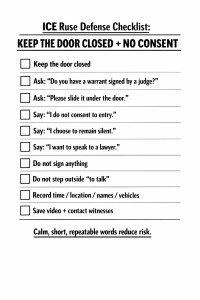
Title: “ICE Ruse Defense Checklist: Keep the Door Closed + No Consent”
Style: One page, black-and-white, large font, checkbox blocks, fridge-ready
Checkboxes
Footer: “Calm, short, repeatable words reduce risk.”
ICE ruses increase risk because they create confusion and cause people to cooperate before they understand what is happening. The most common legal danger is accidental consent—opening the door, stepping outside, answering questions, or signing documents.
The best protection is simple and repeatable: keep the door closed, ask for a judge-signed warrant, refuse consent, remain silent, and ask for a lawyer.
If you or a family member experienced an ICE ruse, preserve evidence immediately and get legal advice before taking next steps.
What To Do If ICE Comes To Your Door: 10 Smart Things (Herman Legal Group LLC)
ICE Came to My Door: What Are My Rights If I’m Undocumented or Overstayed? (2025 Guide) (Herman Legal Group LLC)
ICE Memo Claims Officers Can Enter Homes Without a Judge’s Warrant — What the Law Actually Allows (and What to Say at the Door) (Herman Legal Group LLC)
Is ICE Arresting Only Criminals—Or Anyone With a Civil Immigration Violation? (Herman Legal Group LLC)
DHS Claims “Record-Breaking” Immigration Enforcement (Herman Legal Group LLC)
How to Prepare for an ICE Arrest in Columbus, Ohio (Herman Legal Group LLC)
Essential Tips: How to Boycott ICE Contractors Legally (Herman Legal Group LLC)
Entities That Have Distanced Themselves From ICE (Herman Legal Group LLC)
Ohio GOP Misleads About Non-Criminal Ohio ICE Arrests (Herman Legal Group LLC)
Do GOP Voters Support Aggressive Immigration Enforcement? (Herman Legal Group LLC)
Overview Quick Answer
DHS is publicly calling 2025 a “historic” year for “record-breaking” immigration enforcement, signaling increased arrests, detention, removals, and compliance actions. But “record-breaking” should also be measured by outcomes: record-high detention populations, documented wrongful detention of U.S. citizens, rising deaths in ICE custody, and escalating violent confrontations tied to enforcement operations. Families and employers should prepare now with scripts, documentation, and an emergency plan. (Source: DHS press release)
DHS is telling the public it is setting the stage for another “historic, record-breaking year” of immigration enforcement. That phrase is not a legal definition. It is an operational signal that DHS intends to scale enforcement across multiple channels: arrests, detention expansion, removals, and compliance actions. DHS’s statement is here: DHS Sets the Stage for Another Historic, Record-Breaking Year Under President Trump.
But “record-breaking enforcement” only matters if the public can measure it.
The real question is not just how many arrests occur. The real question is what else rises at the same time:
detention population and time-in-custody
deaths in custody
wrongful detention of U.S. citizens
civil rights complaints and litigation pressure
use-of-force incidents and shootings
taxpayer costs, contracts, and enforcement “buildout” spending
This pillar translates DHS messaging into real-world risk forecasting and practical preparation steps for families and employers — and it lays out the quantifiable metrics taxpayers and journalists can track.

“Record-breaking enforcement” is messaging, not a legal metric.
Arrests, detentions, removals, and audits are different outcomes with different consequences.
Record detention populations increase exposure to detention harms and due process failures.
U.S. citizens have been wrongfully detained during immigration operations in documented cases.
Major outlets reported at least 30 deaths in ICE custody in 2025, described as a two-decade high.
The House launched a public dashboard tracking alleged immigration enforcement abuse incidents.
A Senate report documented alleged DHS harms to U.S. citizens, including veterans.
High-profile shootings and violent confrontations have been repeatedly reported during operations.
The best protection is preparation: scripts, documents, school pickup plans, and evidence discipline.

When DHS claims enforcement is “record-breaking,” the claim may involve multiple categories that sound similar but mean very different things in real life.
An ICE arrest means a person has been taken into immigration custody.
Detention means the person is held in a facility while the government decides next steps, litigates custody or bond issues, and continues removal proceedings.
Removal is the end stage. It means the government physically deports the person under a removal order.
Why this distinction matters: Many households experience catastrophic disruption without immediate deportation. Arrest and detention can trigger job loss, missed school pickup, medication interruptions, family separation risk, and major legal deadlines before any final outcome.
Most families do not experience enforcement as a single dramatic headline. They experience it as an increase in everyday “contact points” where screening happens.
One of the fastest routes into ICE custody is through local jail processing and transfers. Even minor arrests can become record-breaking immigration enforcement moments.
Public encounters can turn dangerous quickly because people often speak too much, consent unintentionally, or escalate emotionally.
HLG script guidance: What to Say If ICE Stops You in Public.
Most employers feel enforcement pressure through compliance actions before they ever see agents at a worksite. The first sign is often an I-9 audit or records request.
Home encounters are high-stakes because consent mistakes cannot be undone.
HLG doorstep guide: What To Do If ICE Comes To Your Door: 10 Smart Things.

House Oversight Democrats launched a public “Immigration Enforcement Dashboard” to track incidents of possible abuse and misconduct during federal immigration operations.
Dashboard: Immigration Enforcement Dashboard
Launch announcement: Ranking Member Robert Garcia Announces Launch of Immigration Enforcement Dashboard
Why this matters: A dedicated dashboard is an institutional signal that lawmakers and investigators are treating these incidents as patterns requiring oversight, not isolated anecdotes.
Senator Richard Blumenthal released a report featuring firsthand accounts from U.S. citizens describing alleged assault or unlawful detention by DHS immigration agents, including veterans.
Press release: Blumenthal Releases New Report Featuring Firsthand Accounts of U.S. Citizens Assaulted / Illegally Detained by DHS
Report page: Our Values at Stake: DHS Overreach and Violations of U.S. Citizen Rights
HLG takeaway: When enforcement harms documented U.S. citizens, this becomes more than an immigration issue — it becomes a constitutional accountability issue.

If DHS wants the public to measure “record enforcement,” the public has the right to measure “record harm” indicators too.
CBS News reported ICE custody surpassing 70,000 detainees based on internal DHS data: ICE detainee population reaches new record high, surpassing 70,000.
Why it matters: The higher the detention population, the more families are exposed to detention risk, prolonged custody, and medical vulnerability.
Deaths in ICE custody are one of the clearest measurable outcomes in a detention surge.
Major outlets reported that at least 30 people died in ICE custody in 2025, described as the highest level in two decades.
Reuters: Four died in ICE custody this week as 2025 deaths reach 20-year high
Reuters follow-up: Four migrants die in US immigration custody over first 10 days of 2026
Washington Post: Four ICE detainee deaths in four days spark alarm as arrests grow
Some outlets compiled 2025 deaths differently (higher totals), including this named timeline:
The Guardian: 2025 was ICE’s deadliest year in two decades
For prior-year comparisons, ICE maintains an official detainee death reporting archive:
ICE archive: ICE Detainee Death Reporting
Method note
Annual totals may differ depending on calendar-year vs fiscal-year counting. Reuters/Washington Post provide a widely reported 2025 total, while ICE’s archive provides the official baseline for year-to-year comparisons.
ProPublica documented more than 170 Americans held by immigration agents in reviewed cases:
HLG coverage and explainers (internal authority loop):
A measurable red flag is the mismatch between detention expansion and inspection/oversight coverage.
This is the section most commentators skip. It is also one of the most quantifiable.
ICE’s own FY2024 annual report describes an annual budget of approximately $9 billion:
Independent analysis similarly places ICE spending around $9.6B in FY2024:
Plain-English takeaway: Under the Biden baseline, ICE operated on a roughly $9–$10B annual budget. That baseline matters because Trump 2 funding adds a second, massive stream of money.
The enforcement math changes under Trump 2 because the “One Big Beautiful Bill” structure is widely described as injecting multi-year enforcement funding through FY2029.
Credible summaries describe:
$45B for detention capacity expansion
$29.9B for enforcement/removal operations
plus additional funding streams tied to hiring, transport, facilities, IT, and legal operations
Sources:
American Immigration Council: What’s in the Big Beautiful Bill (Immigration/Border)
Axios: Immigration spending increases in Trump “big beautiful bill”
Analysts describe the practical result as ICE having available resources in the high-$20B range once mandatory funding is layered on top of baseline appropriations:
Brennan Center: Big Budget Act creates a “deportation industrial complex”
Center for American Progress: slush fund / deportation force analysis
Note:
ICE’s baseline annual budget was roughly $9–$10B in FY2024, but under Trump 2, analysts describe a combined appropriations-plus-mandatory funding environment that can push ICE’s available resources into the high-$20B range in certain years.
The Trump 2 enforcement buildout is not abstract. It funds capacity.
If detention expands rapidly, taxpayers should track outcomes that correlate with expansion:
detention population and length of custody
custody deaths
wrongful detentions (including U.S. citizens)
civil rights complaints and litigation risk
Documents indicate ICE enforcement expansion includes equipment and procurement signals tied to tactical operations.
Evidence:
DHS appropriations text referencing ballistic body armor and protective equipment procurement: House DHS appropriations document (PDF)
Bloomberg reported ICE purchases including precision long guns and accessories: Bloomberg feature
Reporting citing armored vehicle procurement records: The Independent
A record enforcement buildout is also a procurement buildout. Taxpayers can track it in budgets, contract obligations, and equipment purchases — and then evaluate whether measurable outcomes improve or deteriorate.
Whether shootings are at an all-time “record” depends on a confirmed dataset. But multiple major-outlet reports document violent confrontations and fatal shootings linked to enforcement actions.
Reuters examples:
ICE officer kills man in Chicago suburb during arrest attempt
Police records and witness accounts complicate DHS narrative in fatal Chicago-area ICE shooting
Trump’s showy immigration enforcement leads to violent confrontations
In a record enforcement environment, the risk is not only detention. It is injury risk, escalation risk, and constitutional risk during encounters — including encounters involving U.S. citizens.
Store copies physically and digitally in a secure place.
Include:
passports and IDs
immigration paperwork (I-94, notices, receipts, court papers)
attorney contact information
emergency contacts
proof of residence and family ties (lease, bills, school records)
medications list and medical needs
one-page timeline of immigration history (entries, filings, court dates)
Write down:
who can pick up children
backup pickups and contacts
emergency instructions for school/daycare
Do not improvise under pressure.
“Am I free to leave?”
If YES: “Okay.” (leave calmly)
If NO:
“I choose to remain silent.”
“I want to speak to a lawyer.”
“I do not consent to a search.”
“I will not sign anything without legal advice.”
“I am choosing to remain silent. I want to speak to my lawyer.”
“I will not sign anything without legal advice.”
“I do not consent to entry. Please show a warrant signed by a judge.”
HLG public script guide: What to Say If ICE Stops You in Public.
HLG doorstep guide: What To Do If ICE Comes To Your Door: 10 Smart Things.
Most workplace enforcement begins with paperwork.
I-9 audits and document requests
verification scrutiny
sudden termination pressure when documentation is challenged
workforce disruption without any dramatic raid footage
designate one point of contact for government visits
train managers not to improvise answers
ensure I-9 compliance procedures are consistent and documented
establish escalation protocol to counsel and leadership
If a situation escalates or misconduct is alleged, early documentation changes outcomes.
Video from a safe distance (do not interfere)
Exact time and location
Names and badge numbers (if visible)
Vehicle identifiers (plates, unit numbers)
Witness names and phone numbers
Medical records (same-day if there is force, injury, chemical exposure)
Photos of injuries or property damage
A written timeline within two hours (memory decays quickly)
FOIA requests can target:
incident reports
detention logs
policies related to use-of-force and operations
documentation tied to specific events

Graphic concept title: “Record-Breaking Enforcement Preparedness Checklist (Print + Save)”
Black-and-white, checkbox format (one page):
Preparedness File copied and stored
attorney contact saved (two phones)
emergency contacts listed
school pickup plan documented
medication list prepared
script printed (“silent + lawyer + no consent”)
evidence checklist printed
family meeting plan established
Caption: “Practical planning reduces chaos.”
DHS is signaling increased enforcement volume across arrests, detention, removals, and compliance actions. DHS’s public statement is here: DHS press release.
No. Deportation is a specific outcome. Many people experience enforcement through arrest, detention, and paperwork-driven disruption long before removal occurs.
Yes. ICE can arrest based on civil immigration grounds. The key legal issue is removability, not criminal conviction status.
In documented cases, yes. See: ProPublica investigation.
Major outlets reported at least 30 deaths in ICE custody in 2025, described as a two-decade high. See: Reuters.
ICE maintains an official archive here: ICE Detainee Death Reporting.
Ask if you are free to leave. If not, remain silent, request a lawyer, and refuse consent to searches or signing.
Do not open the door. Do not consent to entry. Ask for a warrant signed by a judge.
IDs, immigration paperwork, court notices, attorney contact information, emergency contacts, proof of residence, and medical/medication lists.
It is a House Oversight Democrats tool tracking alleged incidents of abuse and misconduct during federal immigration operations: Dashboard.
His report describes alleged assaults and unlawful detentions involving U.S. citizens, including veterans: Report page.
Major outlet reporting documents fatal shootings linked to ICE operations. Examples include Reuters reporting here: Chicago-area shooting.
Budgets expand capacity: detention beds, staff, transport, operations, and procurement. The Biden-era baseline was roughly $9–$10B, while Trump 2 enforcement funding is described as adding a large multi-year mandatory buildout. See: ICE FY2024 Annual Report, American Immigration Council, and Brennan Center.
Video, timestamps, witnesses, badge/vehicle identifiers, and medical records are the strongest early evidence.
Contact a lawyer immediately if there is detention risk, a prior order, missed court, pending case vulnerability, or a family emergency planning need.
DHS “record-breaking year” messaging should be treated as a real enforcement environment shift, not a slogan. In practice, it means more screening points, higher detention capacity, more workplace compliance pressure, and higher disruption risk for families and employers. It also means taxpayers should track measurable harm indicators — deaths in custody, wrongful detentions, and the accountability gap created when enforcement expands faster than oversight.
If your household or workplace has risk factors, early legal strategy prevents preventable mistakes. Schedule a consultation here: Book a consultation with Herman Legal Group.
DHS is publicly framing 2026 as a “record-breaking year” for immigration enforcement. When government agencies make record claims, the public record should also expand—especially when enforcement involves detention surges, wrongful U.S.-citizen detentions, deaths in custody, and use-of-force incidents.
This section explains how to verify enforcement claims and document operational facts using public records, FOIA, and targeted questions.
Before filing any FOIA request, reporters should first exhaust the most time-efficient open sources. This saves weeks and prevents duplicative requests.
This is one of the best public starting points because it compiles a verified record of alleged incidents:
FOIA is not just “send a request.” The best FOIAs are surgical and written to force a yes/no release decision.
DHS is a “parent” agency; you usually need the right component:
ICE (enforcement + detention + ERO/HSI operations):
ICE FOIA
DHS-wide FOIA guidance and process:
DHS: Steps to File a FOIA Request
DHS FOIA Handbook
USCIS A-file / immigration benefit records:
USCIS FOIA / Privacy Act requests
Cross-agency FOIA routing + processing times:
FOIA.gov agency entry (ICE)
Journalist tip: When you don’t know where a record lives, file two parallel FOIAs (ICE + DHS HQ) and use narrow date/location keywords.
FOIA is for agency records generally.
Privacy Act is for records about a specific person (often requires consent or proof of death / authorization).
If you’re reporting a death in custody, you may need both:
FOIA for policies, logs, contracts, staffing, oversight records
Privacy Act issues for medical details (often redacted)
Good FOIAs are structured around:
specific incident ID (if known)
a narrow timeframe (hours/days)
defined record categories
defined custodians (e.g., “ERO St. Paul Field Office”)
Avoid vague FOIAs like:
“all records relating to ICE misconduct”
Use narrow FOIAs like:
“all after-action reports, use-of-force reports, and radio dispatch logs from [time window] at [location].”
Even if content is redacted, metadata creates accountability:
author
timestamps
distribution list
subject lines
file names
revision history
Add this line:
“Please provide records on a rolling basis as they become available.”
This prevents the agency from waiting to compile “everything” before releasing “anything.”
Expedite is not guaranteed, but for active enforcement surges it is often appropriate.
Use language like:
“This request concerns a matter of widespread and exceptional media interest involving potential questions about the government’s integrity affecting public confidence.”
If you are investigating an ICE shooting or a serious use-of-force incident, you want records in 8 buckets.
Subject: FOIA Request – Use of Force / Officer-Involved Shooting – [City, State] – [Date]
Request:
Pursuant to the Freedom of Information Act, I request the following records regarding ICE enforcement activity occurring on [DATE] at or near [LOCATION] involving use of force and/or a firearm discharge:
Use-of-force documentation
use-of-force reports
firearm discharge reports
“less lethal” deployment reports
supervisory review memos
Body-worn camera and video
body-worn camera footage for all involved agents
dashboard camera footage (if applicable)
facility surveillance video for the area
any video preserved from third parties provided to ICE
Operational paperwork
operational plan (OPLAN) and briefing materials
mission tasking documents
risk assessment documents
arrest warrant packet (if any)
any administrative warrants (Form I-200 / I-205 if used)
Communications
radio logs
dispatch logs
text messages or chat messages on government systems
emails referencing the operation or incident within [TIME WINDOW]
Medical and emergency response
EMS call logs
injury documentation for agents and civilians (non-medical narrative portions)
hospital transport authorizations (non-medical narrative portions)
Chain of command
names/titles of approving supervisors
incident command structure for the operation
after-action report (AAR)
Policy references
ICE use-of-force policy
firearms policy
crowd-control guidance (if applicable)
pursuit/vehicle-interdiction guidance (if applicable)
Accountability outcomes
administrative investigation initiation documents
referral letters to DHS OIG, DOJ, or local prosecutors
disciplinary findings (if completed)
Format requested: Electronic.
Rolling production requested: Yes.
Expedited processing requested: Yes.
Deaths in custody require a different record strategy: conditions, medical response, and oversight.
detention logs (movement logs, observation logs)
medical request logs (sick call requests)
incident reports and mortality review documentation
staffing rosters for the unit
contract performance documentation
facility inspection history and deficiency notices
Official baseline archive:
Use this to report how long “simple vs complex” requests often take:
Useful for taxpayer-cost reporting:
These are written to produce verifiable answers, not slogans.
Was there a judge-signed warrant? If not, what legal authority was used?
Was the target operation based on a criminal warrant or civil administrative process?
Which component led the operation: ICE ERO, ICE HSI, or another federal unit?
Was a risk assessment completed before the operation? What risks were identified?
Who approved the operation, and what was the chain of command?
Were body-worn cameras used by all agents? If not, why not?
Were there written de-escalation protocols? Were they followed?
Did any agent discharge a firearm? How many rounds?
What does video show vs. what is alleged in agency statements?
Was the incident referred to DHS OIG, DOJ, or local prosecutors?
Were children present? Were civilians exposed to chemical agents or force?
How many people were detained who were not the intended target?
Were any U.S. citizens stopped, searched, or detained? What verification steps were used?
Where were detainees taken? Which facility?
How long were they held before counsel access?
Were medical screenings performed on intake?
What documents exist: after-action report, incident report, supervisor memo?
Will DHS release the body camera footage, and under what timeline?
What corrective action will follow if policy violations occurred?
If an incident escalates, documentation discipline matters.
time-stamped video from a safe distance
exact location (address / intersection)
visible badge numbers and names
vehicle plate numbers and unit identifiers
independent witness contacts
EMS/medical documentation (same-day)
photos of injuries/property damage (same-day)
a written timeline within two hours (memory fades quickly)
HLG: Which Companies Are Facing Boycott for Role in Trump’s Immigration Enforcement?
HLG: How to Boycott ICE Contractors Legally (Without Getting Sued)
HLG: Directory of Companies That Distanced Themselves From ICE (2025–2026)
Use these for fact-checking enforcement claims, detention conditions, and custody deaths.
DHS “Record-Breaking Year” Statement (primary source)
ICE Detainee Death Reporting (official archive)
ICE FOIA Portal (for records requests)
DHS FOIA process + guidance
USCIS FOIA / Privacy Act (A-files and benefits records)
These are the “reporter-grade” sources that get cited in major stories.
House Oversight Immigration Enforcement Dashboard (incident tracker)
Senator Blumenthal’s “Our Values at Stake” Report (U.S.-citizen rights + DHS overreach)
Congressional access and oversight disputes (press-grade evidence of accountability friction)
Reuters: House Democrats sue over blocked access to ICE facilities
Washington Post: DHS tightens rules for congressional visits to ICE facilities
Useful for readers seeking conditions evidence, and for journalists building corroboration.
ACLU reporting on detention conditions
Use these for a strong “trendline” section in the pillar.
Reuters (2025 total described as 20-year high)
Guardian timeline / named accounting
This is one of your highest-backlink-value pillars because it reframes risk beyond immigrants.
ProPublica investigation
HLG explainer + rights guidance
These are your highest-conversion, high-share, screenshot-friendly assets.
If ICE comes to your door
If ICE stops you in public (copy/paste script)
City/localized planning (Ohio-focused readiness content)
ICE arrests at USCIS interviews (real-world operational vulnerability)
Targeted boycott guide
Framing for broader audiences (constitutional/accountability lens)
For careful, high-trust sourcing on violent incident risks tied to enforcement operations.
Reuters: ICE officer kills man in Chicago suburb during arrest attempt
Reuters: Witness accounts complicate DHS narrative in fatal Chicago-area ICE shooting
Reuters: Trump’s showy immigration enforcement leads to violent confrontations
If you want one anchor link cluster for journalists, keep it tight:
File records requests
Verify deaths and detention outcomes
Track allegations and oversight