
 By
By
Quick Answer
No—ICE generally cannot legally force entry into a private home without a judge-signed warrant or a recognized legal exception, even if officers show an ICE “warrant of removal” like Form I-205. A newly disclosed ICE memo reportedly claims broader authority, but an administrative ICE warrant is not the same as a judicial warrant. Keep the door closed, refuse consent, stay silent, and ask for a lawyer.
Many people wonder if ICE can enter home without warrant and if ICE enter home without warrant is even legal.

Fast Facts (Key Takeaways)
- A home has the highest Fourth Amendment protection against warrantless entry.
- ICE paperwork is often administrative (agency-signed), not judge-signed.
- Form I-205 is a “Warrant of Removal/Deportation,” tied to a final removal order—not a search warrant.
- Opening the door can create a “consent” dispute that changes the legal situation instantly.
- You can say: “I do not consent to entry.”
- You can say: “I choose to remain silent. I want a lawyer.”
- If officers force entry anyway: do not physically resist—repeat non-consent once and stop talking.
- Document what happened immediately (time, place, names, witnesses, video if safe).
What This Article Covers (in plain English)
- What the newly reported ICE memo claims about home entry authority
- The difference between an ICE administrative warrant and a judge-signed warrant
- A copy/paste doorstep script families can use in real time
- A printable checklist concept you can post, share, or screenshot

What the memo reportedly authorizes (and why it triggered alarm)
Major outlets report that a newly disclosed ICE memo encourages or trains officers to treat administrative immigration paperwork—including Form I-205—as sufficient authority to enter homes and make arrests, even without a judge-signed warrant. See reporting by:
- Associated Press coverage
- Washington Post coverage
- The publicly posted memo file: DocumentCloud: “DHS ICE memo 1-21-26”
This is significant because “home entry” is the red-line constitutional issue—and the gap between what enforcement agencies claim and what courts ultimately allow is where families can get hurt.

Administrative warrant vs. judicial warrant (this is the entire case)
1) What Form I-205 is
Form I-205 is titled a “Warrant of Removal/Deportation.” It is a DHS/ICE document used to execute a final removal order. ICE hosts a sample here:
A regulation describing I-205 exists here:
2) What Form I-205 is not
Form I-205 is not a judge-signed search warrant. It is not a judicial finding of probable cause authorizing forced entry into a private residence.
That distinction matters because the Constitution treats the home differently than a street stop, vehicle encounter, or public place.
3) The practical rule families should follow
Do not decide based on what ICE says the paper “means.”
Decide based on whether the document is signed by a judge and clearly authorizes entry.
If officers cannot show a judge-signed warrant through the door (or slide it under the door), families should default to:
- keep the door closed
- refuse consent
- remain silent
- request counsel
What to do if ICE comes to your door (the safest, simplest playbook)
Copy/Paste Doorstep Script (English)
Use this exact sequence. Speak slowly and calmly.
Do you have a warrant signed by a judge?

Please slide it under the door.

I do not consent to entry.

I choose to remain silent.

I want to speak to a lawyer.
Copy/Paste Doorstep Script (Español)
¿Tiene una orden firmada por un juez?

Por favor, deslícela por debajo de la puerta.

No doy mi consentimiento para entrar.

Elijo permanecer en silencio.

Quiero hablar con un abogado.
What NOT to do (common mistakes)
- Do not open the door “to talk”
- Do not argue about immigration status
- Do not answer identity questions
- Do not sign anything
- Do not physically interfere, block, or resist
If officers force entry anyway
Your goal becomes safety + documentation, not debate.
Say once:
- “I do not consent to entry.”
Then stop talking. Ask for a lawyer again.

Scenario-Based Guidance (Real Life, Not Theory)
Scenario 1: ICE says they have a “warrant of removal” (I-205)
Risk level: High
What ICE may do: claim I-205 authorizes entry and removal pickup
What you should do: keep door closed; demand judge-signed warrant; refuse consent; stay silent
Next step: call counsel immediately; document everything; do not sign paperwork
Reference: ICE Form I-205 sample
Scenario 2: Mixed-status home (U.S. citizens + noncitizens inside)
Risk level: High
What ICE may do: pressure family members to open door or “confirm who lives there”
What you should do: do not open the door; do not answer residency questions; ask for judge warrant
Legal consequence: statements about who lives where can become evidence in later proceedings
Next step: preserve names/badge info; contact counsel
Scenario 3: Wrong address / mistaken identity
Risk level: Medium–High
What ICE may do: push for entry “to verify”
What you should do: do not consent to entry; do not provide IDs through door; remain silent
Next step: record interaction; get witness names; call lawyer if anything escalates
Scenario 4: Roommates / landlord / shared building entry
Risk level: Medium
What ICE may do: attempt entry through common areas, building staff, or another tenant
What you should do: do not authorize entry into private unit; do not let staff “consent” for you
Next step: if you are a tenant, document lease address and any forced entry damage

“But ICE says they can do it.” What matters legally?
Two things can be true at the same time:
- ICE may attempt aggressive interpretations of authority, including relying on internal guidance.
- Courts may later rule the entry unlawful, which affects suppression motions, civil liability, and damages.
This is why your words matter. Your best protection is:
- no consent
- no statements
- no signatures
- immediate documentation
Evidence Checklist (If a Door Encounter Happens)
Gather these ASAP (same day if possible):
- Video (phone or door camera), saved in 2 locations
- Names, badge numbers, agency markings, vehicles
- Timestamp + exact location
- Witness contact info
- Photos of damage (door, frame, locks)
- Medical records if anyone was injured or had breathing distress
- Copies/photos of any paperwork left behind
- Written timeline while memories are fresh
For general guidance on warrants/subpoenas and what documents mean, see:
FAQ
1) Can ICE enter my home without a judge-signed warrant?
Generally, ICE needs either a judge-signed warrant or a valid legal exception to force entry into a home. ICE may carry administrative immigration paperwork, but that is not automatically the same as judicial authority to enter a residence.
2) Do I have to open the door for ICE?
No. You can keep the door closed and ask them to show a judge-signed warrant. Many rights are lost the moment a door is opened and “consent” is disputed.
3) What if ICE shows a “warrant of removal” (Form I-205)?
Form I-205 is an ICE form tied to executing a final removal order. You can still say: “I do not consent to entry” and request a judge-signed warrant.
See: ICE Form I-205 sample and 8 C.F.R. § 1241.32.
4) What does “I do not consent to entry” actually do?
It creates a clear record that you did not voluntarily allow entry. That can matter later if lawyers challenge the legality of what happened and whether any “consent” was manufactured.
5) What if ICE says, “We just want to talk”?
Do not open the door. Talking can lead to admissions and confusion. Use the script: ask for a judge warrant, refuse consent, remain silent, request counsel.
6) What if ICE threatens to break the door?
Do not physically resist. Repeat once: “I do not consent to entry.” Then remain silent and ask for a lawyer. Document everything afterward.
7) Can ICE arrest me if I step outside?
Stepping outside removes the “home-entry” issue and can increase risk. If you step outside, ask: “Am I free to leave?” If not, remain silent and request counsel.
8) Can ICE search my home?
A lawful search generally requires proper legal authority (often a judge-signed warrant or a recognized exception). Do not consent to any search.
9) Should I sign anything ICE gives me?
No. Do not sign anything without legal advice. You can say: “I will not sign anything without my lawyer.”
10) What should I record if this happens?
Record names, badge numbers, vehicles, time, location, witnesses, and any damage. Save video files in at least two places.
11) Can ICE question children or other family members?
Officers may try. Families should avoid discussing immigration status or household details. Keep the door closed and request counsel.
12) What if I have a pending asylum case or immigration court case?
Do not assume you are “safe.” Do not open the door. Contact counsel immediately to evaluate risk, posture, and options.
Printable Checklist Image Concept (Save + Print)
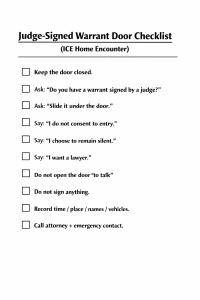
Title: “Judge-Signed Warrant Door Checklist (ICE Home Encounter)”
Format: black-and-white, one page, checkbox blocks
Checkboxes:
- ☐ Keep the door closed
- ☐ Ask: “Do you have a warrant signed by a judge?”
- ☐ Ask: “Slide it under the door”
- ☐ Say: “I do not consent to entry”
- ☐ Say: “I choose to remain silent”
- ☐ Say: “I want a lawyer”
- ☐ Do not open the door “to talk”
- ☐ Do not sign anything
- ☐ Record time / place / names / vehicles
- ☐ Call attorney + emergency contact
Sources & Records (For Journalists, Researchers, Fact-Checkers)
Primary:
- DocumentCloud: “DHS ICE memo 1-21-26”
- ICE Form I-205 sample PDF
- 8 C.F.R. § 1241.32 (Cornell Law School)
Major reporting:
- AP: Memo tells ICE officers they can enter homes without a judge’s warrant
- Washington Post: ICE memo allows agents to enter homes without judge’s warrant
- Reuters: Minneapolis enforcement tactics and memo context
Rights education:
Related HLG Resources (Internal Links)
To strengthen your safety plan and reduce risk of “one bad moment” turning into a case disaster, also read:
- What to Do If ICE Comes to Your Door (10 Smart Things)
- Can ICE Pull Me Out of My Car? What Drivers Need to Know
- What to Say If ICE Stops You in Public (Use This Exact Script)
What This Means Going Forward
The headline risk is not panic—it’s confusion at the door. Families reduce danger by rehearsing a short script, refusing consent, staying silent, and documenting the encounter.
If you or a loved one has had prior ICE contact, has a final order, is in removal proceedings, or lives in a mixed-status household, a short legal strategy consult can help prevent avoidable mistakes. You can schedule here:
HLG BLOGS
A) ICE Boycott / Corporate Pressure
- How to Boycott ICE Contractors Legally (Without Getting Sued) (Herman Legal Group LLC)
- Boycott ICE Vendors: 10 Ways to Weaken ICE Campaigns (Herman Legal Group LLC)
- Which Companies Are Facing Boycott for Role in Trump’s Immigration Enforcement? (Herman Legal Group LLC)
- Black Friday ICE Boycott 2025: Targeted Companies (Herman Legal Group LLC)
B) Companies Doing Business With ICE (Vendor/Contractor Infrastructure)
- Companies That Do Business With ICE (Herman Legal Group LLC)
- Ohio Companies Serving ICE: A 2026 Overview (Herman Legal Group LLC)
- How to Verify a Company Has an ICE Contract (USAspending.gov Steps) (Herman Legal Group LLC)
- Directory of Companies That Distanced Themselves From ICE (Herman Legal Group LLC)
C) Conservative Criticism / Rights-Based Opposition to ICE Overreach
- The Conservative Case Against ICE Overreach (2025–2026) (Herman Legal Group LLC)
- Do GOP Voters Support Aggressive Immigration Enforcement? (Herman Legal Group LLC)
- Why Do Republicans Support ICE Aggression? (Herman Legal Group LLC)