
 By
By
Quick Answer
ICE “ruses” are deceptive tactics used to get people to open doors, step outside, answer questions, or “consent” to entry or searches. These ICE ruse tactics are often permitted in enforcement operations, but the legality can be contested—especially when deception pressures consent at a home. The safest response is simple: keep the door closed, demand a judge-signed warrant, refuse consent, stay silent, and ask for a lawyer.
Fast Facts (Key Takeaways)
- An ICE ruse is deception used to trigger contact, consent, or exposure.
- Opening the door can change your legal risk immediately.
- A judge-signed warrant is not the same as an ICE administrative warrant.
- Say “I do not consent” once, clearly, then stop talking.
- Silence + lawyer is the safest default response in uncertain encounters.
- Do not sign anything or “step outside to talk.”
- Document the encounter immediately: video, witnesses, timestamps, vehicles.

What Are “ICE Ruses”?
An ICE ruse is a tactic where officers use misdirection, partial truth, or deceptive presentation to get someone to open a door, come outside, reveal identity, or provide consent.
Ruses matter because consent changes outcomes. Many Fourth Amendment disputes turn on whether a person voluntarily allowed entry or provided information—even when the contact started with deception.
Understanding ICE ruse tactics is crucial for navigating interactions with law enforcement.
For practical examples and real-world patterns, see:

What Are the Most Common ICE Ruses Reported in the Real World?
These are common patterns reported by advocates, researchers, and impacted families. The enforcement goal is often to create urgency, panic, or “accidental cooperation.”
The best “ground truth” sources for field ruses are the practitioner-facing materials from the Immigrant Defense Project and ACLU litigation materials, supported by the broader legal analysis in Columbia Law Review.
A. “We’re police” (or “Police—open up”)
How it’s used: Agents say “police” and do not clearly disclose they are ICE, aiming to trigger automatic compliance at the door.
- See: IDP ICE Ruse Flyer (English PDF)
- See also: ACLU — This deceptive ICE tactic violates the Fourth Amendment
- Background legal analysis: Columbia Law Review — ICE Ruses: From Deception to Deportation
Why it works: People hear “police” and assume they must open the door immediately.
B. “We’re investigating a crime” / “We need to talk about an emergency”
How it’s used: A pretext to create urgency and override normal caution (“this is serious,” “we just need to clear something up”).
- Example pattern discussed in ruse reporting and analysis: Columbia Law Review — ICE Ruses
Why it works: Most people are conditioned to treat emergency claims as non-optional.
C. “We have a warrant” (without saying what kind)
How it’s used: Agents state “warrant” and rely on the resident to assume it is judge-signed.
- ICE’s internal framing around ruses: ICE FOIA memo — Use of Ruses in ICE Enforcement Operations (08/22/2006)
Why it works: People do not realize the legal difference between a judge-signed warrant and an ICE administrative warrant.
D. “We’re probation/parole” / “Your officer needs you”
How it’s used: Designed to trigger “mandatory compliance” because probation/parole feels like you “cannot say no.”
A major Southern California settlement specifically bars ICE from using ruses like identifying as probation/parole (or other non-federal agencies) in home operations.
Why it works: It hijacks fear of immediate punishment for “noncooperation.”
E. “We’re detectives” / “We’re local law enforcement”
How it’s used: Another “authority substitution” tactic (local police identity is generally trusted and feared).
- Settlement language summary: ACLU SoCal — Settlement prohibits deceptive tactics
Why it works: Residents often comply instantly with perceived local police.
F. “Come outside to talk” (the hallway/lobby trap)
How it’s used: Instead of forcing entry, agents try to get the target to step outside voluntarily.
- Field warning and tactics: Immigrant Defense Project — ICE Ruses
Why it works: Once a person is outside the home, the “threshold” protection advantage is weakened in practice.
G. “Wellness check” / “We’re here for a safety check”
How it’s used: Agents exploit protective instincts: “someone is worried about you,” “we need to see everyone is okay.”
- Civil liberties critique (deception at the home threshold): ACLU — Deceptive ICE tactic violates the Fourth Amendment
Why it works: People open the door because it feels morally unsafe not to.
H. “Building management / landlord / maintenance”
How it’s used: “Your landlord asked us to check something,” “We need to inspect,” “There’s an emergency maintenance issue.”
- Field pattern recognition and warnings: Immigrant Defense Project — ICE Ruses
Why it works: It blends into ordinary life and bypasses “law enforcement” suspicion.
I. “Delivery worker / package / utilities”
How it’s used: Someone knocks like a courier/utility worker to trigger reflexive door opening.
- Community warnings include this style of misdirection: IDP ICE Ruse Flyer (English PDF)
Why it works: It targets habit, not judgment.
J. “We need your help with another case” / “You’re a witness”
How it’s used: Agents attempt to convert a target into a “helper,” then pivot into identity/status questions.
- Broader ruse mechanics: Columbia Law Review — ICE Ruses
Why it works: It disarms people who fear appearing uncooperative.
K. “Just sign this” / “Just confirm your name”
How it’s used: “This is only paperwork,” “This is to confirm you live here,” “This isn’t a big deal.”
- Why this is dangerous (consent and admissions): Immigrant Defense Project — ICE Ruses
Why it works: People underestimate how small admissions become evidence.
L. “We’re looking for someone else” (wrong-person or “neighbor” pretext)
How it’s used: Agents ask “Does X live here?” then build identity and household information.
- Field guidance and warnings: Immigrant Defense Project — ICE Ruses
Why it works: Many people answer because it seems harmless.
M. “Your car has an issue / step outside” (lure-out tactics)
This exact category of pretext was described as prohibited under the Southern California settlement reporting—pretexts used to lure residents outside.
- Settlement reporting context: ACLU SoCal — Settlement prohibits ICE officers’ use of deceptive tactics
- Additional coverage discussing “pose as police” prohibitions: Long Beach Post — Settlement bars ICE from impersonating police
Are ICE Ruses Legal?
Short answer: Some forms of deception are often permitted in law enforcement operations, including immigration enforcement. But the legality can become contested when deception is used to pressure consent—especially at a home, where constitutional protections are strongest.
This is the framework your article must keep clear:
Law (What the Constitution Generally Protects)
Homes receive the highest Fourth Amendment protection. Consent searches and consent entry often become the key legal issue. Deception that produces “consent” may be challenged depending on facts, coercion, and circumstances.
For the civil liberties analysis, see:
Policy (What ICE Says It Allows)
ICE has internal guidance discussing the use of ruses in enforcement operations. That memo is a core primary source and should be cited directly in your article.
Primary source:
Practice (What Is Reported and Studied)
Researchers and advocates document how ruses function as a pipeline from deception to contact, consent, arrest, and removal.
High-authority analysis:
- Columbia Law Review: ICE Ruses—From Deception to Deportation
- American University repository (Digital Commons)
The Core Legal Risk: Consent
A tactic can be used in practice even when its legality is contestable in court. The immediate risk is not winning the legal argument later. The immediate risk is giving ICE entry, admissions, or identification today.

The clearest “ICE ruse = unlawful” outcome (Kidd v. Noem)
Kidd v. Noem (SoCal) — Court-approved settlement banning deceptive home ruses
One of the most important ICE ruse legal outcomes is the court-approved settlement in Kidd v. Noem, which imposes operational restrictions on ICE home-enforcement practices in Southern California.
What it prohibits (plain-language summary):
ICE officers may not use deceptive ruses to enter a home or to ask a resident to exit a home. The ban includes falsely identifying themselves as state or local police (e.g., LAPD), probation, parole, detectives, or any other non-federal governmental agency.
Primary and high-authority sources:
- ACLU SoCal press release — Settlement prohibits ICE officers’ use of deceptive tactics
- ACLU SoCal case page — Kidd v. Noem
- Settlement agreement PDF (Kidd v. Noem)
In some jurisdictions, ICE has been legally restricted from impersonating local police or using ruses to get residents to open the door or come outside.
In federal court litigation, ICE home enforcement ruses—especially those involving misrepresenting identity as local police—have resulted in enforceable restrictions on deceptive tactics.
The Single Most Important Rule: Do Not Open the Door
If ICE is at the door, your safest default response is:
- Keep the door closed
- Ask for a judge-signed warrant
- Tell them to slide it under the door
- Say you do not consent
- Stay silent and ask for a lawyer
Judge-Signed Warrant vs. ICE Administrative Warrant (Plain English)
People often hear “warrant” and assume the same thing. It is not.
- A judge-signed warrant is issued by a judge and is legally significant for home entry.
- An ICE administrative warrant is typically an agency document and does not automatically carry the same authority for home entry.
This distinction is central to your “doorstep script” and is why your script must focus on judge-signed warrant language.

Copy/Paste Script: What to Say If ICE Uses a Ruse at Your Door
Use this exact sequence. Speak slowly and calmly.
Doorstep Script (English)
Do you have a warrant signed by a judge?

Please slide it under the door.

I do not consent to entry.

I choose to remain silent.

I want to speak to a lawyer.
Doorstep Script (Español)
¿Tiene una orden firmada por un juez?

Por favor, deslícela por debajo de la puerta.

No doy mi consentimiento para entrar.

Elijo permanecer en silencio.

Quiero hablar con un abogado.
What NOT to do (common mistakes)
- Do not open the door “to talk”
- Do not argue about immigration status
- Do not answer identity questions
- Do not sign anything
- Do not physically interfere, block, or resist
What If ICE Uses a Ruse in Public, at Work, or in a Car?
ICE ruses do not only happen at the door. They also appear in public places and routine contact situations.
If approached in public (15-second script)
Am I free to leave?

If YES: Okay. (leave calmly)

If NO: I choose to remain silent.

I want to speak to a lawyer.

I do not consent to a search.

I will not sign anything without legal advice.
If ICE approaches you in a car
Your priorities: safety, clarity, silence, counsel.
- Keep hands visible.
- Ask if you are free to leave.
- If not free to leave: stop talking.
- Do not consent to searches.
- Do not sign anything.
If you already published an HLG vehicle encounter guide, link it here as “Vehicle Encounter Checklist (Driver + Passenger).”
If ICE shows up at your workplace
- Do not run.
- Do not answer questions about identity, birthplace, or status.
- Ask if you are free to leave.
- Ask for a lawyer.
- Do not sign anything without legal advice.
If ICE says they are “looking for someone else”
This is a common conversation trap.
- Do not guess.
- Do not provide names.
- Do not “help them clear it up.”
Say:
“I choose to remain silent. I want to speak to a lawyer.”
Scenario-Based Risk Ratings (Real-World Examples)
Each scenario must include (1) what it looks like, (2) risk level, (3) consequences, (4) safest response.
Scenario 1: “Police—open up”
What it looks like: Loud knocking, commanding tone, claims of urgent authority.
Risk level: High
Legal consequence: Opening the door can create immediate exposure and reduce defenses.
Safest response: Use the doorstep script. Keep the door closed.
Scenario 2: “Wellness check”
What it looks like: “We’re checking on someone’s safety.”
Risk level: High
Legal consequence: Sympathy-driven door opening often becomes consent.
Safest response: Keep the door closed; require judge-signed warrant.
Scenario 3: “Come to the lobby—building management”
What it looks like: Pressure to exit private space.
Risk level: Medium to High
Legal consequence: Hallway/lobby makes detention easier and reduces threshold protections.
Safest response: Do not go down. Use silence + counsel.
Scenario 4: “We just have questions” (public)
What it looks like: Friendly tone, casual questioning.
Risk level: Medium
Legal consequence: Talking creates admissions and confusion.
Safest response: “Am I free to leave?” then silence + lawyer.
Scenario 5: “Sign this”
What it looks like: “This is just paperwork.”
Risk level: High
Legal consequence: Signing can create serious downstream consequences.
Safest response: “I will not sign anything without legal advice.”
What Courts Look At — When “Consent” Is NOT Real Consent (Even If Someone Opened the Door)
ICE ruses work for one reason: they manufacture “cooperation” that ICE later describes as consent.
But in real Fourth Amendment litigation, the question is often not “Did the person open the door?” — it’s:
Was the cooperation truly voluntary, or was it pressured, manipulated, or induced by deception?
The Core Legal Issue: “Voluntary Consent” vs. “Consent Created by Confusion”
In home encounters, many legal fights turn on whether a person knowingly and voluntarily allowed officers to enter or search.
When an officer uses deception (a ruse), a court may scrutinize whether the resident:
-
understood who was at the door
-
understood they had a right to refuse
-
was pressured into compliance by fear, urgency, or authority
The most important practical takeaway is unchanged:
Your safest strategy is to avoid giving “consent” at all.
That means: keep the door closed, demand a judge-signed warrant, and stop talking.
The “Voluntary Consent” Checklist (Plain-English Court Factors)
When courts evaluate whether consent was valid, they often examine the totality of circumstances — meaning the full situation, not one isolated moment.
Here are the real-world factors that can matter:
1) Was the person at home? (Maximum Fourth Amendment protection)
Home encounters are treated differently than public encounters because the home is the most protected place under Fourth Amendment doctrine.
2) Did officers create urgency or panic?
Ruses frequently rely on “emergency pressure,” for example:
-
“This is serious.”
-
“We need you to open the door right now.”
-
“Someone might be in danger.”
-
“We’ll be back with force.”
Urgency can undermine voluntariness because it compresses decision-making.
3) Did officers misrepresent who they were?
“Police” is not a neutral word. Neither is “detectives,” “probation,” “parole,” “maintenance,” or “building management.”
A court may look closely at whether the resident acted under mistaken assumptions about authority.
4) Did officers imply the resident had no choice?
Consent becomes legally suspect when it isn’t a real choice:
-
“You have to open the door.”
-
“You don’t have a choice.”
-
“We have a warrant.” (without showing it)
5) Did officers use the word “warrant” ambiguously?
This is a major ruse pattern:
“We have a warrant.”
That phrase often pressures compliance because many people assume it means a judge-signed warrant, when it may be an ICE administrative warrant instead.
6) How many agents were present, and how intimidating was the encounter?
Courts may consider whether the person was facing:
-
multiple officers
-
tactical gear
-
aggressive banging
-
blocked exits
-
raised voices
The greater the intimidation, the more questionable the consent.
7) Was the resident separated from family or isolated?
Separation increases coercion and reduces the ability to think clearly.
8) Did officers push the person to “step outside”?
The “step outside” maneuver is not a casual request. It’s often an operational strategy to reduce the target’s home-threshold advantage.
9) Did the person clearly refuse consent — and was that refusal ignored?
If you say “I do not consent” and officers push anyway, that fact matters later.
10) Did officers pressure a signature or paperwork “right now”?
“Just sign this” is often framed as harmless. It can become the opposite.
The 5 “Consent Killers” (The ICE Ruse Playbook in One Box)
These patterns show up repeatedly across real-world reporting, legal analysis, and community defense training.
1) Authority Substitution
They present as someone else:
-
“Police”
-
“Detectives”
-
“Probation”
-
“Parole”
-
“Building management”
2) False Urgency
They create a crisis:
-
“Emergency”
-
“Wellness check”
-
“We’re investigating a serious crime”
3) Warrant Ambiguity
They say “warrant” without clarity:
-
“We have a warrant.”
-
“We just need to confirm something.”
4) Threshold Manipulation
They don’t need entry if they can get you outside:
-
“Step into the hallway.”
-
“Come down to the lobby.”
-
“Come outside to talk.”
5) Paperwork Pressure
They try to turn panic into a signature:
-
“Just sign this.”
-
“Confirm your name.”
-
“This is just a form.”
The Single Most Important Sentence to Prevent “Implied Consent”
If you say nothing else, say this once — slowly and clearly:
“I do not consent to entry or a search. I will not open the door without a warrant signed by a judge.”
Then stop talking.
Why this works: it blocks the later argument that you “voluntarily let them in” or “agreed to cooperate.”
If You Already Opened the Door: The “Damage Control” Script
People open doors out of fear, habit, or confusion. If that happens, your goal is to stop the consent pipeline immediately.
Say:
-
“I do not consent to your entry.”
-
“Please step back.”
-
“Do you have a warrant signed by a judge?”
-
“I choose to remain silent.”
-
“I want to speak to a lawyer.”
Then stop talking.
This does not guarantee the encounter ends — but it reduces the chance ICE can claim the rest of your conduct was voluntary cooperation.
The Best Legal Strategy Is the Best Safety Strategy
You do not win these encounters by “explaining” or “clearing it up.”
You reduce risk by refusing to provide the ingredients ICE needs:
-
access
-
identity confirmation
-
admissions
-
signatures
-
consent
Your playbook remains: closed door + judge-signed warrant + no consent + silence + lawyer.
Ruse Detection Toolkit — Red Flags + Verification Steps (Door, Lobby, Phone, Work)
Most families think “ICE ruse” means one thing: fake police at the door.
In reality, ruses function like a pattern-matching system. They are designed to push you into one of three mistakes:
-
opening a door
-
stepping into a vulnerable space
-
talking long enough to create admissions
This toolkit is designed to prevent that.
The Ruse Red Flag Phrase Bank (Copy/Paste Recognition)
A) Home / Doorstep Red Flags (Highest Risk)
If you hear any of these, treat it as high risk and do not open the door:
-
“Police — open up.”
-
“We have a warrant.” (but they won’t show it)
-
“We’re investigating a crime.”
-
“We just need to talk.”
-
“It’ll be easier if you open the door.”
-
“Come outside so we can clear this up.”
-
“We’re here for a wellness check.”
-
“We’re looking for someone else — can you confirm?”
-
“Just sign this.”
-
“We just need to confirm your name.”
What these lines are trying to do: trigger reflex compliance before you slow down and verify authority.
B) Apartment Buildings / Lobbies / Hallways (The “Step Outside” Trap)
If you live in a building, these are common pressure points:
-
“Come downstairs to the lobby.”
-
“We can’t talk at your door — meet us outside.”
-
“Building management asked us to check.”
-
“Maintenance issue — you need to come out.”
-
“We need to confirm who lives in this unit.”
Reality check:
The lobby/hallway is where targets lose the “threshold advantage.” Don’t go.
C) Phone Calls / Text Messages / “Urgent” Contact Ruses
Many enforcement traps start with identity fishing:
-
“This is urgent — we need to verify your identity.”
-
“Confirm your address and date of birth.”
-
“You missed an appointment — you must come now.”
-
“We need you to meet us to resolve a problem.”
-
“If you don’t cooperate, it will get worse.”
The risk: you talk yourself into a problem you can’t talk out of.
D) Workplace Ruse Language (Friendly Tone, Serious Outcome)
Workplace encounters often start with “low drama” language:
-
“We just have a few questions.”
-
“We need to confirm employment details.”
-
“Can you come into this room with us?”
-
“We’re verifying records / conducting an audit.”
-
“Just show us your documents to clear it up.”
Practical reality:
Even “friendly questions” can become a removal case.
The 3-Question Verification Protocol (Use This Under Stress)
When you feel pressure, your brain narrows. This protocol is designed to stay usable even in panic.
Say these questions in order:
Step 1 — “Who are you?”
“What agency are you with?”
Do not accept vague answers like “law enforcement.”
Step 2 — “Am I required to cooperate?”
“Am I required to open the door or come outside?”
If they do not clearly explain lawful authority, treat it as not required.
Step 3 — “Do you have a warrant signed by a judge?”
“Do you have a warrant signed by a judge? Please slide it under the door.”
If they cannot slide a judge-signed warrant under the door, your response is:
“I do not consent to entry.”
Then stop talking.
The “One-Minute Rule” (Stop the Conversation Before It Becomes Evidence)
Ruses are designed to stretch the encounter beyond the moment you can safely manage it.
Use the one-minute rule:
If an encounter lasts longer than one minute, you are already in the danger zone for accidental admissions and consent.
So your goal is not to “win” a conversation.
Your goal is to end it.
What NOT to Do — By Location (This Is Where People Slip)
You already have a general “what not to do.” This version is stronger because it matches real-life settings.
At Home (Door)
Do NOT:
-
open the door “to listen”
-
crack the door open
-
step onto the porch “to talk”
-
answer identity questions through the door
-
accept “we have a warrant” without seeing a judge-signed warrant
In the Lobby / Hallway
Do NOT:
-
go downstairs “to clear it up”
-
follow anyone into a confined space
-
hand over documents “just for verification”
-
allow the situation to become a physical containment event
On the Phone / Text
Do NOT:
-
confirm your address, DOB, country of birth
-
“explain your status”
-
agree to meet anywhere without counsel
-
click unknown links or provide photos of documents
At Work
Do NOT:
-
run
-
guess answers
-
volunteer immigration history or birthplace
-
sign anything without legal advice
-
go into a private back room without knowing whether you are free to leave
In a Car (Driver or Passenger)
Do NOT:
-
reach suddenly
-
answer “where were you born?” questions
-
consent to searches
-
sign anything
-
talk your way into contradictions
The “If You’re Not Sure, Default to Safety” Script (Universal)
If you cannot tell what is happening, use the same script every time:
“Am I free to leave?”
If YES: “Okay.” (leave calmly)
If NO:
“I choose to remain silent.”
“I want to speak to a lawyer.”
“I do not consent to a search.”
“I will not sign anything without legal advice.”
Then stop talking.
Your House Rule (For Families): One Sentence, Zero Confusion
Put this on a fridge, by the door, or next to the peephole:
“We do not open the door for anyone we do not know — not even ‘police’ — unless they show a warrant signed by a judge.”
This one rule prevents the majority of ruse-driven “consent” outcomes.
What to Do After an ICE Ruse Encounter (Evidence Checklist)
If an ICE encounter becomes chaotic, your goal becomes safety + documentation, not debate.
What evidence matters most
- Video (your phone or neighbors’ cameras)
- Photos (vehicles, plates, uniforms, door damage)
- Witness names and contact info
- Medical records (if anyone is injured)
- Written timeline (same day, while memory is fresh)
What to write down immediately
- Date and exact time
- Address/location (door, lobby, parking lot)
- Names, badge numbers (if visible)
- Statements made (“police,” “wellness check,” “sign here”)
- Whether anything was slid under the door
- Whether anyone entered (and how)
Why early documentation changes outcomes
Legal challenges rise or fall on details: what was said, what was implied, what was shown, and whether consent was real or pressured.
For additional context on the broader legal debate, cite:
- Columbia Law Review: ICE Ruses—From Deception to Deportation
- ACLU: Deceptive ICE tactic and Fourth Amendment concerns
FAQ
1) What is an ICE ruse?
An ICE ruse is deception used to get someone to open a door, step outside, reveal identity, or consent to entry or searches. The legal risk is that a person “cooperates” before understanding what is happening. Practical takeaway: keep the door closed and use a short script.
2) Are ICE ruses legal?
Some deception is often permitted in enforcement operations, but legality can be contested—especially when it pressures consent in home encounters. The safest approach is to avoid consent entirely. Practical takeaway: require a judge-signed warrant and stay silent.
3) Can ICE pretend to be police?
Reports and legal analysis describe scenarios where ICE presents itself in ways that cause confusion about identity or authority. This is one reason advocates warn people not to open doors based on verbal claims alone. Practical takeaway: verify with a judge-signed warrant.
4) Can ICE lie to get me to open the door?
Ruses may be designed for exactly that purpose. Once the door is open, risk increases immediately. Practical takeaway: do not open the door; ask for a judge-signed warrant.
5) If I open the door, can ICE come in?
Opening the door can create an argument that you allowed entry or escalated the encounter. Avoiding consent reduces risk. Practical takeaway: keep the door closed and refuse entry.
6) What is the difference between an ICE warrant and a judge-signed warrant?
A judge-signed warrant is issued by a judge. An ICE administrative warrant is typically an agency document and may not provide the same authority for home entry. Practical takeaway: always ask whether it is judge-signed.
7) Do I have to answer ICE questions in public?
You can ask whether you are free to leave. If you are not free to leave, the safest response is to remain silent and ask for a lawyer. Practical takeaway: do not “explain” or “clear it up.”
8) Can ICE use deception to get consent to search my phone or home?
People can be pressured into consent during confusing encounters. Once consent is given, it can be hard to undo. Practical takeaway: say “I do not consent to a search” and stop talking.
9) What should I do if ICE says they are doing a wellness check?
Do not open the door based on verbal claims. Ask for a judge-signed warrant and request it be slid under the door. Practical takeaway: do not engage in a conversation.
10) What evidence should I collect after an ICE ruse encounter?
Video, photos, witnesses, timestamps, and any documents shown are critical. Write down what was said and how entry or contact occurred. Practical takeaway: document immediately and speak with counsel.
11) Can anything I say be used against me in immigration proceedings?
Statements can become evidence. Even small contradictions or admissions can create complications. Practical takeaway: remain silent and ask for a lawyer.
12) Should I show my documents to “clear it up”?
Showing documents can escalate identification and create risk. Do not hand over anything unless advised by counsel. Practical takeaway: stay calm, stay silent, request legal advice.
13) What if ICE is looking for someone else?
This often begins as a conversation trap. Do not volunteer names, schedules, or identity information. Practical takeaway: remain silent and ask for a lawyer.
14) What if my child opens the door?
This is a high-risk scenario. The family should rehearse a simple rule: do not open the door for anyone you do not know. Practical takeaway: post the checklist and practice the script.
15) When should I speak to an immigration lawyer?
If ICE contacted you, came to your home, used deception, or asked you to sign anything, you should speak to counsel quickly. Practical takeaway: preserve evidence and get legal advice before making statements.
Printable Checklist Image Concept
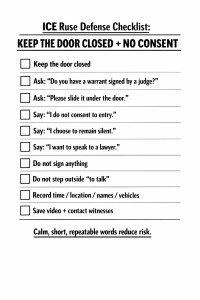
Title: “ICE Ruse Defense Checklist: Keep the Door Closed + No Consent”
Style: One page, black-and-white, large font, checkbox blocks, fridge-ready
Checkboxes
- ☐ Keep the door closed
- ☐ Ask: “Do you have a warrant signed by a judge?”
- ☐ Ask: “Please slide it under the door.”
- ☐ Say: “I do not consent to entry.”
- ☐ Say: “I choose to remain silent.”
- ☐ Say: “I want to speak to a lawyer.”
- ☐ Do not sign anything
- ☐ Do not step outside “to talk”
- ☐ Record time / location / names / vehicles
- ☐ Save video + contact witnesses
Footer: “Calm, short, repeatable words reduce risk.”
What This Means Going Forward
ICE ruses increase risk because they create confusion and cause people to cooperate before they understand what is happening. The most common legal danger is accidental consent—opening the door, stepping outside, answering questions, or signing documents.
The best protection is simple and repeatable: keep the door closed, ask for a judge-signed warrant, refuse consent, remain silent, and ask for a lawyer.
If you or a family member experienced an ICE ruse, preserve evidence immediately and get legal advice before taking next steps.
Sources & Primary References (For Reporters, Researchers, and Fact-Checkers)
- Immigrant Defense Project: ICE Ruses
- IDP ICE Ruse Flyer (English PDF)
- ICE FOIA memo: Use of Ruses in ICE Enforcement Operations (08/22/2006)
- Columbia Law Review: ICE Ruses—From Deception to Deportation
- ACLU: Deceptive ICE tactic violates the Fourth Amendment
- ACLU SoCal: Settlement prohibits ICE officers’ use of deceptive tactics
- American University repository (Digital Commons)
HLG Blog Directory
Doorstep Encounters (Home Ruses + Warrant Verification)
-
What To Do If ICE Comes To Your Door: 10 Smart Things (Herman Legal Group LLC)
-
ICE Came to My Door: What Are My Rights If I’m Undocumented or Overstayed? (2025 Guide) (Herman Legal Group LLC)
-
ICE Memo Claims Officers Can Enter Homes Without a Judge’s Warrant — What the Law Actually Allows (and What to Say at the Door) (Herman Legal Group LLC)
Public Stops (15-Second Script)
Vehicle Stops (Car Encounter Rights)
Reality Check: Who ICE Is Actually Arresting
-
Is ICE Arresting Only Criminals—Or Anyone With a Civil Immigration Violation? (Herman Legal Group LLC)
Enforcement Context + Family Risk Planning
-
DHS Claims “Record-Breaking” Immigration Enforcement (Herman Legal Group LLC)
-
How to Prepare for an ICE Arrest in Columbus, Ohio (Herman Legal Group LLC)
Accountability / Corporate / Advocacy
-
Essential Tips: How to Boycott ICE Contractors Legally (Herman Legal Group LLC)
-
Entities That Have Distanced Themselves From ICE (Herman Legal Group LLC)
Cleveland / Ohio Lens
-
Ohio GOP Misleads About Non-Criminal Ohio ICE Arrests (Herman Legal Group LLC)
-
Do GOP Voters Support Aggressive Immigration Enforcement? (Herman Legal Group LLC)