
 By
By
By Richard T. Herman, Esq. · Herman Legal Group · September 24, 2026
A closer look at Richard Herman’s new Springfield News-Sun column—and what the debate means for Ohio families, employers and international students.
Quick answer: Springfield, Ohio, could influence the next U.S. immigration reform debate by showing how enforcement decisions affect established communities and employers. In his September 24, 2026 Springfield News-Sun column, Richard T. Herman argues that a backlash could create an opening for reform. That political forecast does not change anyone’s immigration status or work authorization.
Read the original column: “Springfield may be showing America what’s next on immigration,” Springfield News-Sun, September 24, 2026.

Richard T. Herman is an Ohio immigration attorney, founder of Herman Legal Group and co-author of Immigrant, Inc. He brings more than 30 years of immigration-law practice to his analysis of policy and its consequences. See Richard’s professional background and documented work.
Have a question about your own case or workforce? Book a Confidential Consultation or call 216-696-6170.

What does Richard Herman argue in the Springfield News-Sun?
Richard’s column responds to Gov. Mike DeWine’s argument that President Donald Trump could use his standing on border enforcement to advance legal immigration reform. Richard offers a different possibility: the costs of enforcement overreach could strengthen the coalition that eventually demands a different system.
Springfield’s Haitian community is central to that argument. The column connects uncertainty over Temporary Protected Status (TPS) with Ohio’s need for workers and talent, then asks whether employers, universities and families might find common ground on reform. Readers can follow the full argument in the original Springfield News-Sun opinion article.
Why Ohio’s economic stake extends beyond Springfield
The economic question reaches from a local employer’s staffing plan to a university’s ability to recruit internationally. An immigration system affects both who can arrive and whether people already studying or working here can plan their next step.
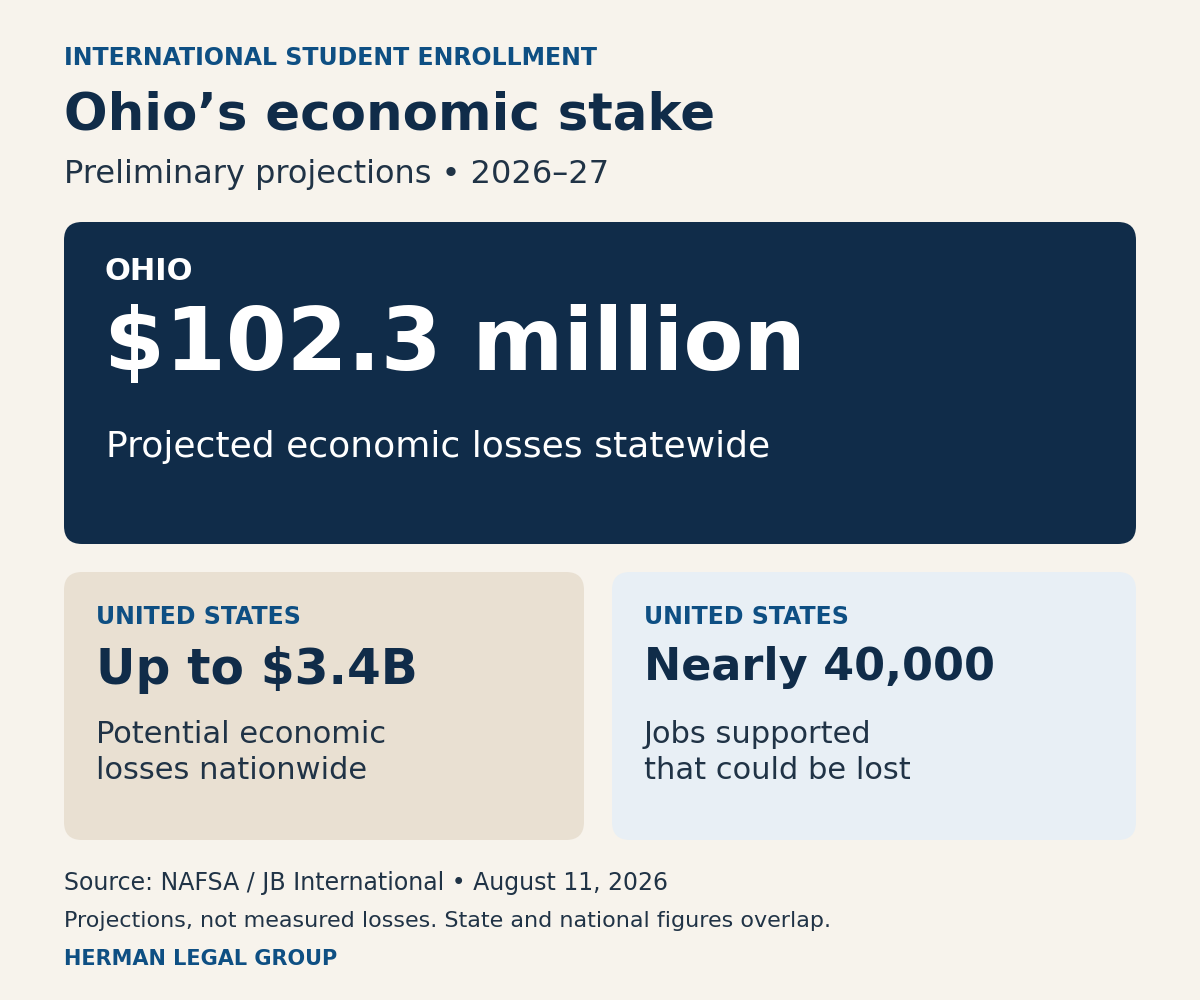
NAFSA: Association of International Educators and JB International’s Fall 2026 enrollment and economic outlook, published August 11, 2026, projects losses associated with declining international enrollment:
| Measure | NAFSA/JB International projection |
|---|---|
| Potential loss in U.S. economic contributions | Up to $3.4 billion |
| Estimated loss in Ohio for 2026–27 | $102.3 million |
| U.S. jobs supported that could be lost | Nearly 40,000 |
These are preliminary projections based substantially on institutions’ enrollment expectations, with acknowledged data limitations. They exclude direct contributions from students on Optional Practical Training (OPT).
The Ohio figure concerns international students statewide. It is not an estimate of Springfield’s economy or the effects of Haitian TPS policy. The connection is a policy question: how should immigration rules account for the people that employers, campuses and surrounding businesses depend on?
HLG’s separate analysis of Ohio’s share of projected mass-deportation costs examines another part of that debate. The two estimates measure different things and should not be added together as one economic-loss total.
What would turn the reform debate into a legal change?
For a family or employer, the useful question is: What legal authority changed, when does it take effect, and who qualifies? Those questions apply even when a proposal has substantial public support.
The U.S. House of Representatives explains the legislative process: proposals move through Congress before becoming law. Advocacy for expanded visas or a new route to permanent residence should be evaluated against the actual legislative text and its progress.
| What you are reading | What it establishes |
|---|---|
| A newspaper opinion or political speech | An argument or proposal; no new immigration benefit by itself |
| An introduced bill | Proposed legislation; introduction alone does not make someone eligible |
| An enacted law | A legal change whose eligibility rules and effective dates must be examined |
| An agency action or court order | A potentially consequential development that must be read for its scope, timing and effect on the individual case |
Reform can also involve narrower changes rather than one comprehensive bill. Each development deserves its own analysis. A promising headline is a reason to check the underlying document before changing a filing, travel or employment plan.
What should Haitian families and Ohio employers do now?
For TPS holders: review the documents that control your case
USCIS explains that Temporary Protected Status is a temporary benefit and does not itself confer lawful permanent residence. Some people may qualify for another immigration option independently; the answer depends on the requirements of that option and their individual history.
Start with your approval notices, employment authorization documents, pending applications and any immigration-court paperwork. Have an attorney identify the dates and legal developments that apply to you, including the relevance of the current USCIS Haiti TPS information. Do not infer your protection or work-authorization end date from the date on an opinion article.
An individual review can address whether family-based immigration or another existing route is available. A political forecast cannot answer that question for a particular person.
For employers: use a consistent employment-verification process
An employer hearing about possible status changes should identify the applicable Form I-9 requirements before taking action. The Department of Justice’s Form I-9 and E-Verify guidance explains that employers must apply the rules consistently and cannot demand particular or additional documents based on citizenship status or national origin. Employees have a choice among acceptable documents, including when reverification is required.
A practical review should establish who manages lawful reverification, what notices or extensions are relevant, and when legal advice is needed. Employers considering sponsorship can also review HLG’s employment and talent immigration services. Workforce planning and employment-verification compliance need to work together.
For international students: plan the next step under the applicable rules
A student deciding whether to accept a job or begin another program needs a case-specific plan. Discussions about retaining graduates do not establish that a particular person can work, change status or obtain a green card.
Bring your program dates, immigration documents, work-authorization history and proposed employment to a discussion with your designated school official and immigration counsel. HLG’s student visa services address the connection between educational decisions and immigration planning. For a proposed employer-sponsored job after study, see HLG’s H-1B guidance for employers and workers as a starting point for that discussion.
Need help applying the rules to your situation? Herman Legal Group’s Ohio immigration lawyers serve clients throughout the United States, including families and employers in the Dayton and Springfield region. Book a Confidential Consultation.
What would make the next reform effort credible?
HLG’s practical test is whether a proposal gives people usable answers. An employer should be able to identify the available category, requirements and realistic hiring timetable. A family should be able to understand eligibility, costs and the consequences of applying. A university should be able to explain how a student’s education connects to authorized training and employment.
Readers can watch for three concrete developments: legislative text with defined eligibility, support that survives disagreement over the details, and an implementation plan that agencies can administer. Those signals are more useful for planning than a prediction about which politician will ultimately claim credit.
Springfield is a useful place to ask these questions because immigration policy is being discussed in terms of people’s daily lives. The measure of a workable system is whether its rules can be understood and followed by the families, employers and communities that live with them.
Questions readers may have
Does this article announce a new immigration reform law?
No. It explains Richard Herman’s published opinion and offers practical context. The column itself creates no new visa category, filing opportunity or protection from removal.
Is Ohio’s $102.3 million figure a confirmed loss?
No. It is NAFSA and JB International’s preliminary projection for the effects of declining international student enrollment in 2026–27. It is not a measurement of Haitian TPS policy’s impact on Springfield.
Should I wait for possible reform before reviewing my options?
Review your existing options and deadlines now. A consultation can identify what is available under the rules that apply to your case; possible future legislation should be treated as uncertain.
Read more from Richard T. Herman
Read the Springfield News-Sun column and explore Richard’s independently published articles and op-eds. For advice about a particular immigration matter, schedule a confidential consultation or call 216-696-6170.
This article provides general information and policy analysis. Individual immigration advice requires a review of the relevant facts and documents.