


Commentary · Depopulation, immigration & Rust Belt revival
Guilty as Charged: A Cleveland Immigration Lawyer Answers Joel Kotkin on Depopulation
Kotkin says immigration lawyers push immigration to fix shrinking cities. He is right about the lawyers. He is wrong about the math, because he leaves out the immigrant who starts the company.

What is Joel Kotkin missing? In “The Politics of Depopulation”, Kotkin treats immigrants almost entirely as workers competing for jobs. He leaves out the immigrant as founder: the person who starts the company, builds the AI lab, buys the retiring owner’s business and hires native-born Americans. Immigrants start firms at about 80% higher rates than U.S.-born Americans. In Cleveland, which has lost about 60% of its population since 1950, immigration is the only thing keeping the county from shrinking. The answer to depopulation is not less immigration but smarter, place-based immigration, and a legal system that stops pushing away high-skilled talent.
- 80%Higher rate of business founding among immigrants than U.S.-born Americans
- ~60%Share of top U.S. AI startups with an immigrant founder (2025 Forbes AI 50)
- −60%Cleveland’s population decline since its 1950 peak of 914,808
- 6 millionSmall and midsize businesses facing ownership transitions by 2035
Yes, Joel, immigration lawyers have been saying this for years
In his September 23 essay, Joel Kotkin writes that bringing in foreign workers at the expense of Americans is an approach “widely promoted by immigration lawyers” and tech companies.
I plead guilty, with one correction. For more than twenty years I have argued, as an immigration lawyer in Cleveland, that immigrants are the fastest way for shrinking American cities to repopulate and reboot their economies. But the case I have made was never mainly about importing cheaper labor. It was about importing founders.
Joel should know, because I made that case in his own publication. In March 2010, New Geography, a joint venture of Kotkin’s where he served as executive editor, published my essay “Will a Dying City Finally Turn to Immigrants?” I pointed out that Cleveland, once close to one-third foreign-born, had fallen to about 5% foreign-born while bleeding residents every year, and that newcomers bring entrepreneurs, investors and home buyers into neighborhoods everyone else has left.
It is a notable shift. In his 2010 book The Next Hundred Million, Kotkin argued that immigration would keep the United States relatively young and dynamic while Europe, Japan and China aged. The demographic facts have only sharpened since then. What has changed is his willingness to count immigrants as part of the solution.
Cleveland’s trajectory: Kotkin’s Italy on Lake Erie
Kotkin opens his essay in Rome, with elderly residents struggling over broken pavement. He could have opened it on Euclid Avenue.
Cleveland had 914,808 residents in 1950, when it was America’s seventh-largest city. Today it has roughly 364,000. Between 2013 and 2023 alone, the city lost more than 27,000 residents, and Cuyahoga County lost nearly 44,000.
Without immigrants
Cuyahoga County had more deaths than births (about −777) and lost about 4,235 residents to other states in the year ending July 2025.
With immigrants
About 4,237 people arrived from abroad, and the county grew. Immigration, not fertility, is holding the line.
Those Census Vintage 2025 components of change are Kotkin’s depopulation story, already under way in Northeast Ohio.
The closing of downtown Heinen’s is the warning sign

On July 31, 2026, Heinen’s closed its grocery store in the historic Cleveland Trust rotunda, the only full-service grocery in the city center. It had opened in 2015, received $250,000 in city incentives in 2022 and shut its second floor in 2024. Its co-president says the store lost $18 million over more than 11 years.
When that store opened, downtown ran on a weekday population of office workers who bought lunch, ran errands and shopped before driving home. That population never fully came back. By mid-2024, downtown worker activity had recovered to only about 72% of 2019 levels, and brokers counted roughly 22 office buildings struggling or in receivership. Downtown Cleveland Inc.’s latest report puts office occupancy at about 80%. Hybrid and remote work mean many employees will not return five days a week, and artificial intelligence may shrink the office workforce further.
As I wrote in “Cleveland Tried Buildings Harder Than It Tried People” (CoolCleveland), a daytime population can disappear the moment employers change their workplace policies. A residential population does not. Amenities are not a population strategy. A downtown grocery needs neighbors who shop there every day, and Cleveland is still only about 6.3% foreign-born. I have made the same case in “After Heinen’s, Who Will Still Bet on Downtown Cleveland?” and “Cleveland Built a Better System for Tracking Immigrants Than Attracting Them” in The Land.
This is where Kotkin’s prescription fails Cleveland. Getting idle workers back into jobs and encouraging seniors to work longer are worthy goals. But neither adds a single resident to a downtown that lost its commuters or a neighborhood that lost its families. Only new residents do that, and in Cleveland today, the only group adding residents at scale is immigrants.
Where Kotkin is right
A fair rebuttal starts with what the other side gets right, and Kotkin gets a lot right:
- Depopulation is real. Fertility is below replacement in most of the world, and U.S. fertility is at record lows.
- Volume is not a strategy. Large inflows without good selection, integration and pathways to work can strain housing and public budgets.
- Seniors are an asset. Older Americans volunteer, work longer and start businesses.
- Native-born workers matter. Getting disengaged young Americans back into work and school should be a national priority.
None of that is in dispute. The problem is the model underneath his immigration section.
What Kotkin is missing: the immigrant as job creator
Kotkin looks at immigration through one lens: labor supply. Immigrants, in his telling, fill low-wage jobs, compete with poor Americans or displace native-born tech workers. That is half of the economics. The other half is labor demand. Immigrants do not just take jobs. They make them.
- Immigrants start businesses about 80% more often. A 2022 study in American Economic Review: Insights by economists at MIT, Northwestern, Wharton and the U.S. Census Bureau found 0.83% of immigrants founded a firm from 2005 to 2010, compared with 0.46% of U.S.-born workers. Their conclusion: immigrants act more as “job creators” than “job takers.”
- Their firms create more jobs and patents. Relative to population, immigrant-founded firms created about 42% more jobs and were about 35% more likely to hold a patent.
- Nearly half of the Fortune 500. According to the American Immigration Council, 231 of the 2025 Fortune 500 (46.2%) were founded by immigrants or their children, employing more than 15 million people.
- Most billion-dollar startups. The National Foundation for American Policy’s 2026 study found immigrants founded or co-founded 455 of 775 privately held U.S. startups worth $1 billion or more, averaging about 833 jobs each.
When an immigrant engineer co-founds a company that later employs 800 people, most of those jobs go to Americans. You cannot count the immigrant as a competitor for one job and ignore the hundreds of jobs the company creates.
Who built American AI?
Kotkin argues that artificial intelligence and robots will reduce the need for immigrants. But the American AI industry he is counting on was built, to a remarkable degree, by immigrants.
- Most top U.S. AI startups have an immigrant founder. An Institute for Progress analysis of the 2025 Forbes AI 50 found that 25 of the 42 U.S.-based companies, about 60%, had at least one immigrant founder. NFAP’s 2023 analysis found 65%, and 77% when counting children of immigrants.
- The frontier labs. OpenAI’s co-founders include immigrants born in South Africa, the former Soviet Union and Poland. NFAP’s 2026 study lists OpenAI, Anthropic, Databricks, Safe Superintelligence and Anysphere among the most valuable U.S. companies with at least one immigrant founder.
- The chips. NVIDIA was co-founded by Taiwan-born Jensen Huang, and AMD is led by Taiwan-born Lisa Su.
- The pipeline ran through student visas. NFAP found 42% of top AI companies had a founder who first came as an international student. Georgetown’s Center for Security and Emerging Technology found more than half the U.S. AI workforce was born abroad and roughly 90% of international AI PhDs stay to work here.
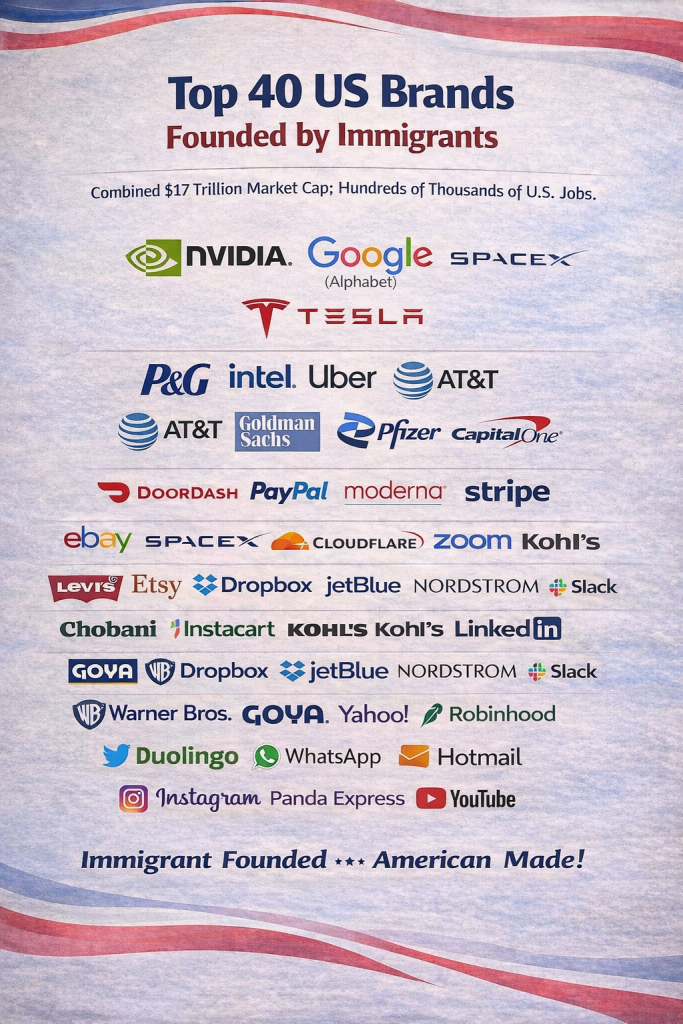
The same technology Kotkin cites as a reason to need fewer immigrants is being invented, funded and led in large part by immigrants, many of whom arrived as students on exactly the visas now under attack.
What Peter Drucker saw that Kotkin misses
Kotkin is right that demographics will shape the century. Peter Drucker said so first, and drew the opposite lesson. In “The Next Society” (The Economist, 2001), Drucker wrote that the dominant factor in developed countries would be a fast-growing older population and a fast-shrinking younger one.
But Drucker never treated demographic change as a problem to be managed. In Innovation and Entrepreneurship (1985), he called demographics the most reliable external source of innovative opportunity, precisely because decision-makers ignore it. I first applied that lesson to Northeast Ohio in January 2009, in “Demographic, Drucker, and the Entrepreneurial Society” for ILW.com’s Immigration Daily.
“The lead times are known. The events themselves have already happened.”
Peter F. Drucker, Innovation and Entrepreneurship (1985)What is slow is the response. Cleveland is a textbook case. The warnings were public by 2010: Becky Gaylord’s report Cleveland Needs Immigrants, my essay in Kotkin’s New Geography and the Census numbers themselves. City Hall chose to stay the course. Sixteen years later, the county records more deaths than births and the downtown grocery store has closed.
Kotkin’s own prescriptions share the timing problem. A revival of family formation that began tomorrow would not produce a single new worker or business owner until the late 2040s. Raising the retirement age delays exits; it does not replace them. Immigration is the one demographic lever that works on the timescale of the problem: a founder who arrives this year can buy a retiring owner’s business this year.
Drucker offered one more lesson in that book: a country cannot build high-tech entrepreneurship alone. Without a broad economy of low-, middle- and no-tech ventures around it, he wrote, a high-tech sector is like a healthy brain in a dead body. Immigrant entrepreneurship works the same way. The immigrant engineer who co-founds a software company and the immigrant family that buys a retiring owner’s machine shop are parts of the same entrepreneurial economy.
Main Street’s succession problem, and Kotkin’s seniors
Kotkin rightly notes that baby boomers are working longer. But he stops before the next chapter: those owners are about to retire. The McKinsey Institute for Economic Mobility estimates about 6 million small and midsize businesses will face ownership transitions by 2035, with more than 1 million viable for sale, worth up to $5 trillion. A 2026 Zelle survey found 41% of owners over 50 would shut down if no buyer appeared.
Immigrants are already the buyers and builders on Main Street. As I wrote in “Can Immigrant Entrepreneurs Save Main Street?” (Planetizen), Immigration Research Initiative data show immigrants are about 21% of all U.S. business owners and 27% of Main Street business owners. Many are ready to buy an existing company with customers, employees and a trusted name.
In “Passing the torch” (FreshWater Cleveland), I proposed a Greater Cleveland business-succession pipeline that identifies owners planning to retire in the next five to ten years and prepares immigrant, Black and first-generation buyers to acquire their companies. Global Cleveland, ECDI, JumpStart, COSE and Team NEO already have most of the pieces. What is missing is the pipeline that connects them.
Detroit shows what newcomers can do. Over roughly 13 years, the metro area’s native-born population fell by 58,693 while its foreign-born population grew by 109,154, and Wayne County recorded its first population gain since the early 1990s. I helped found Global Cleveland and served as a founding adviser to Global Detroit on exactly this premise.
Place-based immigration: the answer to Kotkin’s “volume” problem
Kotkin’s strongest objection is to mass, untargeted immigration. The best answer is immigration targeted by place: controlled, lawful and chosen by the communities that need people. The idea has bipartisan roots.
| Proposal | What it would do |
|---|---|
| “High-skill immigration zone” (Northeast Ohio, 2008) | Immigration incentives for skilled workers and foreign companies that locate in the most distressed cities, described in my 2009 ILW.com piece. |
| “Visas for the Heartland” (National Review, 2019) | The magazine that first ran Kotkin’s essay published economist Michael Strain’s case for place-based visas for struggling interior communities. |
| Heartland Visa Act (Young–Manchin, 2024) | S. 5644, built on the Economic Innovation Group’s model: opt-in counties facing decline could host up to 50,000 visa holders a year, free to work for any employer or themselves, with a path to a green card. Needs reintroduction. |
| State-Sponsored Visa Pilot Program Act (Curtis–Kelly, 2026) | S. 5197 from Sens. John Curtis (R-Utah) and Mark Kelly (D-Ariz.): a new “W” visa that states can sponsor, starting at 5,000 per state, with legislative approval and protections for U.S. workers. |
Place-based visas are precisely the policy Kotkin’s essay should want: immigration aimed at the depopulating places he describes, chosen by those communities, with guardrails for native-born workers. Cleveland’s needs are not Miami’s or Phoenix’s, yet every American community competes under the same national system.
The hostility has reached the engineers, too
Kotkin writes as if the immigration debate were mainly about the border. It is not anymore. The same anti-immigrant politics now shapes the legal, high-skill system that brings in the founders, scientists and engineers this article describes.
Consider an Indian-born engineer working at Google, or in a Cleveland Clinic research lab. She came on a student visa, earned an advanced degree here and was sponsored for a green card. She did everything right. Then she waits, often for decades. A 1990 law caps employment-based green cards at 140,000 a year, counting spouses and children, and no country may receive more than 7%.

A National Foundation for American Policy analysis released in August 2026 found nearly 1 million Indian nationals stuck in the first three employment-based categories, about 79% of the backlog. An Indian professional filing in EB-2 today faces a projected wait of 179 years. In July 2026, the Visa Bulletin listed India EB-2 green cards as unavailable for the rest of the fiscal year.
New barriers followed. A September 2025 proclamation imposed a $100,000 fee on many new H-1B petitions; a federal court vacated the policy implementing it in June 2026 and the First Circuit refused to reinstate it, but employers spent most of a year unable to plan. NAFSA’s fall 2026 outlook projects Ohio alone could lose $102.3 million as international enrollment falls.
The message to the world’s most mobile talent is hard to miss: you are not welcome, even if you follow every rule. And these people have options. They can take the job in Toronto, London or Bangalore, go home after training here, or never come at all. I made this case in “America’s Scientific Brain Drain Is No Longer Hypothetical” (RealClearScience).
This also answers Kotkin’s charge that employers use foreign professionals to undercut Americans. A worker waiting decades for a green card is tied to one sponsor and cannot easily change jobs or start a company. That dependence, not immigration itself, gives employers leverage. Give her a green card and she becomes a free agent, and quite possibly the founder who hires Americans.
Kotkin’s own framework points the other way. Kotkin, author of The Coming of Neo-Feudalism, has spent years warning about a “neo-feudal” America in which tech oligarchs gain power and the middle class loses its path to ownership. He is right to worry. But immigrant entrepreneurs are one of the strongest forces against that future. They buy the corner store, the machine shop and the retiring owner’s business, and they start the companies that compete with incumbents. The real feudal arrangement in American immigration is the green card backlog, which ties a skilled worker to a single sponsoring employer for a decade or more. If Kotkin wants to weaken the oligarchs, he should want those workers free to change jobs, start companies and own something.
Family, faith and the culture of the immigrant founder
Kotkin ends by calling for a revival of family, faith and community. He even cites research that Mexican immigrant children, surrounded by large family networks, show fewer mental health problems than their U.S.-born peers.
That is the same culture Robert L. Smith and I described in Immigrant, Inc.: education, thrift, family loyalty and ambition. Immigrant families are not a threat to the values Kotkin wants to restore. In many American neighborhoods, they are the people still practicing them.
What a pro-growth depopulation policy would look like
- Create a real startup visa for founders who raise capital and hire U.S. workers.
- Staple green cards to advanced STEM degrees so the scientists and engineers we train here can build companies here.
- End the decades-long green card backlog by lifting per-country caps and counting spouses and children outside the annual limit.
- Let regions compete for talent by reintroducing the Heartland Visa and advancing the Curtis–Kelly state-sponsored visa pilot.
- Build business-succession pipelines so retiring owners’ companies change hands instead of closing.
- Invest in native-born workers at the same time. Apprenticeships, reskilling and immigrant-founded job growth are complements, not competitors.
Conclusion
Joel Kotkin is right that demographics may shape the century, and right that government handouts alone will not reverse falling birth rates. But an essay about depopulation that leaves out the immigrant entrepreneur has left out one of America’s biggest advantages over Italy, China and Japan.
Cleveland learned this the hard way. The lead times were known for two decades, and the city spent them losing people while hoping new buildings would bring them back. As Drucker taught, the places that grow in an aging century will be the ones that act on the change they can already see, and welcome the people most likely to build something new.
Yes, immigration lawyers have been making this argument for years. We made it because we sit across the table from the founders, engineers, doctors and small-business owners who want to build their lives in American cities that need them.
More from Richard T. Herman on population, entrepreneurship and Cleveland:
- Passing the torch: Cleveland’s next generation of small-business owners may already be here (FreshWater Cleveland, Aug. 2026)
- Cleveland’s Enrollment Cliff Is Becoming a Talent Cliff (Crain’s Cleveland Business, Aug. 2026)
- Can Immigrant Entrepreneurs Save Main Street? (Planetizen, Aug. 2026)
- The Resource We’re Throwing Away: Entrepreneurial Immigrants (Governing, 2015)
- Full archive of Richard’s public writings
Frequently asked questions
What does Joel Kotkin argue in “The Politics of Depopulation”?
Kotkin argues that falling birth rates are shrinking and aging much of the world, that mass immigration has not solved the problem in Europe or Canada, and that countries should focus on native-born workers, seniors and a revival of family values.
What is the main criticism of Kotkin’s argument?
He treats immigrants mainly as workers who compete for jobs and largely ignores immigrant entrepreneurs, who start businesses at about 80% higher rates than U.S.-born Americans and create jobs for native-born workers.
Can immigration help Rust Belt cities like Cleveland and Detroit?
Yes. In the year ending July 2025, Cuyahoga County grew only because of international migration. Over roughly 13 years, metro Detroit’s foreign-born population grew by more than 109,000 while its native-born population fell. Initiatives like Global Cleveland and Global Detroit were built on this premise.
Why did the downtown Cleveland Heinen’s close?
Heinen’s closed its downtown store on July 31, 2026, saying it never reached long-term sustainability in a downtown retail environment. Downtown’s weekday office population had recovered to only about 72% of 2019 levels by mid-2024, and the store depended on that foot traffic.
How many top U.S. AI companies were founded by immigrants?
About 60%. An Institute for Progress analysis found that 25 of the 42 U.S.-based companies on the 2025 Forbes AI 50 list had at least one immigrant founder. OpenAI, Anthropic, Databricks and NVIDIA all have immigrant co-founders.
What did Peter Drucker say about demographics?
In Innovation and Entrepreneurship (1985), Drucker called demographic change the most reliable external source of opportunity, because its lead times are known in advance, and warned that decision-makers routinely ignore it until it is too late.
What is a place-based or Heartland visa?
A place-based visa lets communities losing population or workers recruit immigrants who agree to live and work there. The Heartland Visa Act of 2024 would have allowed opt-in counties to host up to 50,000 visa holders a year. The 2026 Curtis–Kelly bill would let states sponsor workers on a new “W” visa.
How long do Indian professionals wait for employment-based green cards?
Often decades. A 1990 law caps employment-based green cards at 140,000 a year and limits each country to 7%. An August 2026 NFAP analysis projected a 179-year wait for new Indian EB-2 filers.
How can immigrant entrepreneurs come to the United States?
There is no dedicated U.S. startup visa. Founders often use the O-1 extraordinary-ability visa, the EB-2 National Interest Waiver, the EB-1A green card, E-2 treaty investor visas, EB-5 investor green cards or employer-sponsored routes such as H-1B. The right path depends on the person’s background and business.
Related reading
Sources
- Joel Kotkin, “The Politics of Depopulation” (Sept. 23, 2026); The Coming of Neo-Feudalism (2020); “How MAGA Lost Its Way” (Jan. 2026)
- Richard T. Herman, “Will a Dying City Finally Turn to Immigrants?”, New Geography (2010)
- Richard T. Herman, “Demographic, Drucker, and the Entrepreneurial Society”, ILW.com (2009)
- Richard T. Herman, “Cleveland Tried Buildings Harder Than It Tried People”, CoolCleveland (2026)
- Azoulay, Jones, Kim & Miranda, “Immigration and Entrepreneurship in the United States”, AER: Insights (2022)
- American Immigration Council, New American Fortune 500 (2025)
- NFAP, Immigrants and U.S. Billion-Dollar Companies (2026) and AI and Immigrants (2023)
- Institute for Progress, Most of America’s top AI companies were founded by immigrants (2025)
- Georgetown CSET, Keeping Top AI Talent in the United States (2019)
- Peter F. Drucker, “The Next Society” (2001); Innovation and Entrepreneurship (1985)
- Axios Cleveland, Cleveland and Cuyahoga population data; Hoodline, Vintage 2025 estimates
- Supermarket News, Heinen’s downtown closing; Cleveland 19, downtown worker return; Downtown Cleveland Inc., State of Downtown
- McKinsey Institute for Economic Mobility, The Great Ownership Transfer (2026)
- Immigration Research Initiative, The Entrepreneurial Spirit
- Michigan Advance, Detroit’s population is growing; Detroit News, immigration driving Michigan growth
- Heartland Visa Act of 2024 (S. 5644); National Immigration Forum, State-Sponsored Visa Pilot Program Act of 2026
- NFAP, Employment-Based Immigration Backlogs (Aug. 2026); Ogletree, July 2026 Visa Bulletin; Klasko, H-1B fee litigation; NAFSA, Fall 2026 outlook
This article provides general information and commentary, not legal advice. Reading it does not create an attorney-client relationship.