
ابتداءً من نوفمبر 2025، بدأت وكالة الهجرة والجمارك الأميركية ICE باعتقال متقدمي الإقامة الدائمة عن طريق الزواج داخل مكاتب USCIS — بعد انتهاء المقابلة مباشرة.
المعتقلون كانوا:
هذا يمثل انهياراً لمفهوم امتد لعقود: أن مقابلات الزواج كانت “منطقة آمنة” من الاعتقال.
ولكن وفق قانون الهجرة والجنسية §245(a)، لم يكن هناك قانون يمنع ICE — فقط “ممارسة” سابقة تغيّرت الآن.
لتحليل أعمق:
👉 دليل اعتقالات التخلف عن الإقامة في مقابلات الزواج (2026)
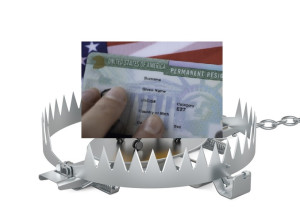

هذا ما قالته إحدى المواطنات الأميركيّات بعد أن دخل ضباط ICE غرفة المقابلة في مكتب USCIS بسان دييغو.
سيدة أخرى تم اعتقالها بينما كانت تحمل طفلها الرضيع.
أحد المحاربين القدامى صرّح:
“خدمتُ بلدي 20 عاماً… لم أتوقع أن يحدث هذا لأسرتي في مكتب حكومي.”
أما على Reddit ومجموعات واتساب للمهاجرين فقد انفجرت التعليقات:
على مدى عقود، كانت مقابلات الزواج لدى USCIS خطوة أخيرة عادية — تتحول فيها سنوات الانتظار إلى إقامة دائمة.
لكن في 2025–2026، تغيّر كل شيء.
HLG كانت أول من حذّر من هذا الاتجاه:
👉 الحرب الهادئة على بطاقات الزواج

🚨 مقابلة الإقامة القائمة على الزواج لم تعد آمنة.
ICE تعتقل المتقدمين داخل مباني USCIS، حتى لو كانت “المخالفة الوحيدة” هي تجاوز مدة الإقامة.
اقرأ التحليل الكامل:
👉 دليل اعتقالات مقابلة الزواج (2026)
| قبل 2025 | بعد نوفمبر 2025 |
|---|---|
| تجاوز الإقامة يغتفر تحت §245(a) | التجاوز = سبب للاعتقال |
| المقابلات مناطق آمنة | المقابلات مواقع إنفاذ |
| فصل بين USCIS و ICE | مشاركة بيانات لحظية |
| الاعتقالات شبه معدومة | حالات موثقة ومتكررة |

لا يوجد أي بند قانوني يمنع ICE من دخول مكتب USCIS.
الممارسة القديمة كانت “عرفاً” — وليس حماية قانونية.
حتى لو كان المتقدم:
فإن مجرد تجاوز الإقامة يكفي لاعتقاله.
هذا خلاف ما اعتادت عليه USCIS لعقود طويلة.
ما يحدث عند وصولك:
تمكّن ICE من اعتقال أي شخص قابل للترحيل بدون مذكرة قاضٍ.
توقيع إداري — وليس قضائي — لكنه كافٍ لدخول مكاتب USCIS.
يمكن لـ ICE اعتقالك ثم تحديد ما إذا كنت ستحصل على كفالة أو جلسة.
غالباً ما تحيل USCIS المتقدمين إلى ICE بعد المقابلة.
يمكن أن يصدر حتى بدون اعتقال فوري.
الخلاصة:
كل هذا قانوني — حتى لو كان غير مسبوق.

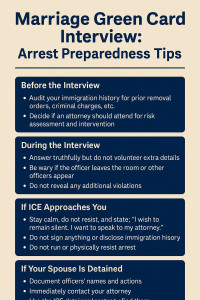
(النص الكامل جاهز لطباعته في PDF — تم تضمينه سابقاً.)
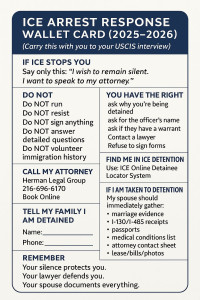
“لأول مرة منذ عقود، يجب على الأزواج التعامل مع مقابلة الزواج باعتبارها نقطة إنفاذ محتملة.”
“إعفاء تجاوز الإقامة لم يعد يعمل كما كان.”
“هذه الاعتقالات يمكن أن تنتشر إلى أي مكتب USCIS في البلاد.”
نعم، حدث ذلك بالفعل في مكتب USCIS في سان دييغو في نوفمبر 2025.
لا. الزواج لا يوفر أي حصانة من ICE.
نعم. تجاوز الإقامة يعتبر “قابلية للترحيل” ويمنح ICE صلاحية الاعتقال.
نعم — كلما طالت مدة التجاوز، ارتفع مستوى الخطر.
الخطر أقل، لكنه لا يزال موجوداً.
قد يزيد ذلك المخاطر، خاصة إذا رُبط بتجاوز الإقامة.
نعم — تجاوز ESTA بالذات من أكثر الحالات التي تؤدي لاعتقال فوري.
يجب أن يقوم محامٍ بإجراء FOIA و EOIR check لمعرفة ذلك.
نعم — ويمكن أن يحدث أثناء المقابلة.
نعم جداً — هذا يؤدي غالباً لاعتقال فوري.
ليس إذا تجاوزت الإقامة أو كان لديك أمر ترحيل سابق.
يعتمد على ما إذا رُفض طلب اللجوء أو أُغلق.
لا. الضباط غالباً لا يخبرون المتقدمين.
عادةً لا.
لا — يمنع التصوير والتسجيل داخل مباني USCIS.
الإجابة يجب أن تكون بحدود القانون وبوجود محامٍ.
كن صادقاً، لكن يجب أن تكون مُهيأً قانونياً قبل المقابلة.
نعم — ويُنصح بذلك في جميع الحالات عالية الخطر.
لا، لكنه يستطيع حماية حقوقك بعد الاعتقال.
نعم.
نعم.
نعم.
نعم — وهذا شائع.
نعم — يحدث كثيراً.
نعم — بمجرد فحص هويتك عند الوصول.
ليس بشكل تلقائي.
على الأغلب نعم.
يعتمد على نوع دخولك وتاريخك.
يعتمد على سجلك وخطرك القانوني.
قد تُؤخذ بعين الاعتبار — لكن ICE ما زالت تحتجز الكثير من المرضى.
قد يؤدي ذلك إلى رفض الطلب بسبب “التخلي عن المقابلة”. يجب استشارة محامٍ أولاً.
نعم — لكن يجب وجود مبرر قوي.
نعم — هذا مهم للغاية.
نعم — إذا كان لديك أي علم خطر (Flag).
تجاوز الإقامة الطويل، الدخول غير القانوني، أوامر الترحيل، السجل الجنائي.
الزواج الحقيقي لا يمنع الاعتقال.
لا.
ما زال الاعتقال ممكناً.
لا، إذا تجاوزت الإقامة فأنت معرض للاعتقال.
نعم — من أعلى مستويات الخطر.
قد يساعد، لكنه لا يمنع الاعتقال.
ليس عند لحظة الاعتقال.
يعتمد على المركز.
قد يستمر، لكن الأمر يصبح معقداً.
يمكنه البدء فوراً إذا كان مستعداً مسبقاً.
حسب نوع الاعتقال والمركز.
يعتمد على مشكلتك القانونية.
حتى الآن — لكنها قد تنتشر.
نعم على الأغلب.
مرجح.
نعم — نظام تبادل البيانات يسمح بذلك.
ليس إلزامياً، لكنه ينصح به كثيراً.
نعم — بشدة.
لا — لكنه يحميك قانونياً بعده.
نعم — للتأكد من عدم وجود تناقضات.
نعم — هناك مؤشرات قوية.
نعم — المحاكم تعتبر الاعتقال الإداري قانونياً.
ليس بعد — لكن لا توجد حماية تمنعهم.
نعم — وربما بشكل أكبر.
ليس بالضرورة — لكن يجب التخطيط القانوني السليم.
Read at: NBC San Diego – Families Detail ICE Arrests at Green Card Interviews
Read at: NBC San Diego – ICE Arrests Military Spouses at Interviews
Read at: NBC San Diego – Members of Congress Question Arrests
Read at: NBC San Diego – ICE Making Arrests at Interviews
Read at: ABC 10 News – Norwegian Diabetic Woman Detained at USCIS Interview
Read at: Daylight San Diego – ICE Arrests at Green Card Appointments
Read at: India Today – ICE Detaining Foreigners at Interviews
Read at: NDTV – Green Card Hope to Handcuffed Reality
Read at: Business Standard – Interview Can End in Arrest
Read at: People Magazine – UK Woman Freed After Arrest at Interview
Read at: New York Post – UK Woman Arrested After Interview
Read at: Visa Lawyer Blog – ICE Detentions During Interviews
Read at: Mebane Enterprise – Mother Detained at Interview
Read at: ACLU Rhode Island – ICE May Arrest Immigrants at Interviews

ما حدث في سان دييغو يمكن أن يحدث في أي مدينة.
وما كان آمناً لسنوات… لم يعد كذلك اليوم.
في 2025–2026، مجرد تجاوز الإقامة أو وجود خطأ صغير في سجلك قد يؤدي إلى اعتقالك داخل مبنى USCIS.
ولهذا السبب يحتاج كل زوجان — مهما كان زواجهما حقيقياً — إلى مراجعة قانونية شاملة قبل المقابلة.
مع أكثر من 30 عاماً من الخبرة، ومكاتب فعّالة في أوهايو وجميع أنحاء الولايات المتحدة، وفريق يتحدث عدة لغات، نحن نمثّل المتزوجين الأميركيين والأجانب في:
كل شخص تم اعتقاله في سان دييغو اعتقد أن كل شيء “على ما يرام”.
ولا أحد يجب أن يمرّ بما مرّوا به.
نراجع ملفك بالتفصيل، نكشف المخاطر المخفية، ونعدّ خطة حماية قانونية قبل مقابلة USCIS.
⬇️ اضغط للحجز الآن ⬇️
احجز استشارة مع Herman Legal Group
لا تنتظر يوم المقابلة لتكتشف وجود مشكلة.
التحضير القانوني اليوم أفضل من الندم غداً.

Required HLG resources for this topic (must be read together with this guide):
Beginning in November 2025, ICE began arresting marriage-based green card applicants inside the USCIS San Diego Field Office immediately after interviews — including military spouses, parents of U.S. citizen children, and long-term visa overstays with no criminal record.
This marks the collapse of a decades-long understanding that marriage interviews were “safe zones.” They never were protected by law, only custom.
In 2025–2026, overstays — once forgiven under INA §245(a) for spouses of U.S. citizens — are now treated as active grounds for ICE detention, as documented in:
USCIS Marriage Interview Overstay Arrest Guide (2026)
Couples in all major immigration hubs should consider their interview a potential enforcement event unless fully vetted beforehand.
“We walked in expecting a green card. We walked out without my husband.”
That’s how one U.S. citizen described the moment ICE entered the interview room at the USCIS San Diego office.
Another spouse described:
“My wife was holding our baby when they handcuffed her.”
A Marine veteran told reporters:
“I served 20 years. My family never imagined this could happen.”
Reddit communities (r/immigration, r/USCIS, r/sandiego), WhatsApp immigrant groups, and TikTok exploded within hours:
For decades, marriage interviews were predictable and safe.
In 2025–26, this is no longer the case.
HLG warned earlier in:
👉 The Quiet War on Marriage-Based Green Cards
Now the warning is reality.
ICE arrests have occurred inside USCIS offices, even when the only issue is an overstay.
Full analysis:
Overstay Arrest Guide (USCIS Marriage Interviews 2026)
| Before 2025 | After Nov 2025 |
|---|---|
| Overstay forgiven under §245(a) | Overstay → ICE detention trigger |
| Interviews considered safe | Interviews now enforcement points |
| USCIS and ICE separation | USCIS → ICE data pipeline |
| Arrests rare | Arrests confirmed in multiple cases |
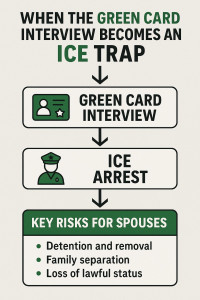
There has NEVER been a federal law that protects applicants at USCIS offices.
The “no ICE at interviews” assumption was custom, not statute.
ICE always had authority to arrest inside USCIS.
2025 is the first year ICE is using that authority aggressively.
Under INA §245(a), spouses of U.S. citizens could adjust status despite:
ICE is now treating overstays as active unlawful presence, making you removable on the spot.
HLG analysis:
Overstay Arrest Breakdown
What happens when you check in at your interview:
This is “interoperability” — a DHS initiative expanded in 2025.
Media reports confirm:
This is not rumor.
It is documented, photographed, and publicly reported.
Allows ICE to arrest any removable person without a judge’s warrant.
Signed by ICE, not a court. Legally valid for arrest at USCIS.
Allows ICE to detain individuals after the arrest.
USCIS can refer your case to ICE, triggering an NTA.
ICE can issue detainers even if they don’t arrest immediately.
There is no law stopping ICE from arresting at USCIS.
This is why the San Diego arrests are controversial — but legal.
Even “low risk” applicants are not immune.
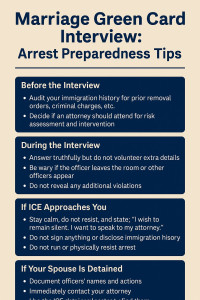
If ANY of these apply, you must speak to an attorney before attending:
These require caution + legal prep:
You may still face ICE if DHS finds certain flags:
(Carry this with you to your USCIS interview)
Say only this:
“I wish to remain silent. I want to speak to my attorney.”
Herman Legal Group
216-696-6170
Book Online
(Write your spouse/partner emergency contact below)
Name: ____________
Phone: ___________
Use: ICE Online Detainee Locator System
My spouse should immediately gather:
Your silence protects you.
Your lawyer defends you.
Your spouse documents everything.
“For the first time in decades, immigrant spouses must treat USCIS interviews as possible ICE enforcement zones.”
“Overstay forgiveness under INA 245(a) is no longer functioning in practice the way it did for decades.”
“Families believed these interviews were safe. They’re not.”
“This pattern can spread to any USCIS office nationwide.”
“Couples must conduct a pre-interview risk audit. It’s now essential.”
A: Yes. Multiple arrests occurred in San Diego in November 2025.
A: No. Marriage offers no protection from ICE.
A: Yes. Overstay = removable = ICE jurisdiction.
A: Yes. Long overstays consistently trigger ICE attention.
A: Lower risk but still possible.
A: Unauthorized work may trigger secondary questioning; ICE focuses more on overstay + removal history.
A: ESTA overstays are high-risk because ESTA = no court hearing.
A: Many people don’t know; you need an attorney FOIA/EOIR check.
A: Yes. ICE may resurrect cases from years ago.
A: Yes. Very dangerous.
A: Not if you overstayed or have prior orders.
A: Possibly. Asylum denials or withdrawals can create exposure.
A: No.
A: No. Officers often don’t know until ICE arrives.
A: No. Federal buildings prohibit recording devices.
A: Only with attorney guidance.
A: Be truthful—but statements can be used by ICE.
A: Yes. Strongly recommended for risk cases.
A: No, but they can respond immediately and prepare defense.
A: Yes.
A: Yes.
A: Yes.
A: Yes. This is common.
A: Yes. Arrests often occur after interviews.
A: Yes. Check-in triggers database scans.
A: Not automatically.
A: Likely yes.
A: Depends on ESTA, prior orders, or expedited removal.
A: Possibly, depending on criminal and immigration history.
A: ICE still detains many with conditions; documentation is essential.
A: That risks denial for abandonment; consult attorney.
A: Possibly, if justification is valid.
A: Yes.
A: Yes—if ANY red flag exists.
A: Overstay, prior removal, entry without inspection, criminal history.
A: Bona fide marriage does not prevent civil detention.
A: Filing does not grant legal status or immunity.
A: ICE can still detain you.
A: Still removable if you overstayed.
A: High-risk situation; USCIS may refer to ICE.
A: Helpful, but ICE may still detain.
A: Not during the arrest stage.
A: Depends on the facility.
A: Possibly, but logistics become complex.
A: Immediately if prepared.
A: Sometimes, depending on detention legality.
A: It depends on the charge and proceedings.
A: For now—but likely to spread.
A: Yes—high immigrant population.
A: Likely.
A: USCIS/ICE integration suggests it could.
A: Not mandatory, but increasingly wise.
A: Yes—recommended.
A: No—but it provides protection.
A: Yes—consistency matters.
A: Enforcement patterns suggest increased scrutiny.
A: Courts have upheld civil immigration arrests in federal buildings.
A: Not yet.
A: Potentially yes; high-tension situations.
A: Not necessarily—just proceed with strategic planning.
Read at: NBC San Diego – Families Detail ICE Arrests at Green Card Interviews
Read at: NBC San Diego – ICE Arrests Military Spouses at Interviews
Read at: NBC San Diego – Members of Congress Question Arrests
Read at: NBC San Diego – ICE Making Arrests at Interviews
Read at: ABC 10 News – Norwegian Diabetic Woman Detained at USCIS Interview
Read at: Daylight San Diego – ICE Arrests at Green Card Appointments
Read at: India Today – ICE Detaining Foreigners at Interviews
Read at: NDTV – Green Card Hope to Handcuffed Reality
Read at: Business Standard – Interview Can End in Arrest
Read at: People Magazine – UK Woman Freed After Arrest at Interview
Read at: New York Post – UK Woman Arrested After Interview
Read at: Visa Lawyer Blog – ICE Detentions During Interviews
Read at: Mebane Enterprise – Mother Detained at Interview
Read at: ACLU Rhode Island – ICE May Arrest Immigrants at Interviews
If you or your spouse is overstayed, has status gaps, prior visa issues, unauthorized work, or you simply feel unsafe after the San Diego ICE arrests, you cannot treat your USCIS interview like a routine appointment.
Today, a marriage interview can be:
— and couples have almost no way to know which without a legal risk assessment.
Richard is a nationally recognized immigration attorney with 30+ years of experience, and he:
When ICE can legally walk into a USCIS interview anywhere in the country, experience matters more than ever.
A risk assessment could determine whether:
One conversation can change everything.
👉 Schedule a Confidential Consultation
(Available Nationwide — Zoom, Phone, WhatsApp, or In-Office)
Because when a marriage green card interview becomes an ICE trap,
your lawyer is your shield.
Desde noviembre de 2025, ICE empezó a arrestar solicitantes de green card por matrimonio dentro de las oficinas de USCIS, inmediatamente después de la entrevista.
Entre los detenidos había:
Durante décadas, las entrevistas de matrimonio eran consideradas lugares “seguros”.
Ese tiempo ya terminó. Y no existe ninguna ley que las proteja como tales.
Según analiza HLG aquí:
👉 Guía: Arrestos por Overstay en Entrevistas de Matrimonio (2026)
la práctica ha cambiado drásticamente en 2025–2026.
Eso dijo una ciudadana estadounidense después de que ICE entró a la sala de entrevista en la oficina de USCIS en San Diego.
Otra esposa contó:
“Mi esposa cargaba a nuestro bebé cuando la esposaron.”
Un veterano de la Marina dijo:
“Serví 20 años. Jamás pensé que esto podía pasarle a mi familia.”
Reddit, WhatsApp, TikTok y Facebook estallaron con mensajes de pánico:
HLG advirtió esto meses antes en:
👉 La Guerra Silenciosa Contra Green Cards de Matrimonio
Hoy ya es realidad.
🚨 USCIS ya no es un lugar seguro.
ICE está arrestando a solicitantes de green card por matrimonio dentro de USCIS por simples overstays.
Análisis completo:
👉 Arrestos por Overstay en Entrevistas (2026)
| Antes de 2025 | Después de nov 2025 |
|---|---|
| El overstay se perdonaba | Overstay = causa de arresto |
| Entrevista = “zona segura” | Entrevista = punto de detención |
| Datos de USCIS aislados | USCIS comparte datos con ICE |
| Arrestos raros | Arrestos confirmados |
Nunca existió una ley que prohibiera a ICE actuar dentro de USCIS.
Era solo una costumbre, no una protección legal.
En 2025, ICE comenzó a usar su autoridad dentro de las oficinas de USCIS.
Bajo INA §245(a), los cónyuges de ciudadanos podían ajustar estatus pese a quedarse más tiempo de lo permitido.
En 2025–2026, ICE trata el overstay como:
Al registrarte para tu entrevista:
Los medios documentaron:
No son rumores: hay fotos, videos y testimonios.
Otorga poder para arrestar personas deportables sin orden judicial.
Firmadas por ICE, válidas para arrestos en USCIS.
Permite detener a personas mientras se decide su caso.
USCIS puede enviar casos a ICE, generando una orden de comparecencia.
ICE puede solicitar que otras agencias retengan a alguien.
Ninguna ley protege a quienes asisten a entrevistas.
Incluso “bajo riesgo” no significa “sin riesgo”.
“Por primera vez en décadas, los esposos deben tratar la entrevista de USCIS como una posible zona de detención.”
“El perdón del overstay bajo INA 245(a) ya no funciona igual que antes.”
“Las entrevistas dejaron de ser seguras—y nadie le avisó a las familias.”
“Esto puede ocurrir en cualquier oficina de USCIS en el país.”
“Una revisión legal previa a la entrevista ya no es opcional; es esencial.”
1. ¿Puede ICE arrestarme dentro de una entrevista de green card?
Sí. Ya ocurrió varias veces en la oficina de USCIS en San Diego en noviembre de 2025.
2. ¿Estos arrestos son legales?
Sí. La ley no protege las oficinas de USCIS como “zonas seguras”.
3. ¿Por qué ICE está entrando a las entrevistas?
Porque USCIS comparte la información del solicitante al momento del check-in.
4. ¿Esto puede pasar en cualquier oficina de USCIS?
Sí. No hay ninguna ley que limite esta práctica a San Diego.
5. ¿Cuáles fueron los primeros casos reportados?
Cónyuges de ciudadanos, incluso esposas de militares y madres con bebés.
6. ¿Se necesita tener récord criminal para que ICE me arreste?
No. La mayoría de los arrestados no tenía antecedentes.
7. ¿Qué tipo de caso activa un arresto?
Principalmente overstay, órdenes previas o entradas irregulares.
8. ¿Pueden arrestarme aunque mi matrimonio sea real?
Sí. La legitimidad del matrimonio no impide una detención migratoria.
9. ¿Puede ICE estar dentro de la oficina?
Sí. Puede estar en la sala, pasillos o en la entrada.
10. ¿Puede ICE arrestarme saliendo de la entrevista?
Sí. Muchos arrestos han ocurrido justo al salir.
11. ¿Un simple overstay es suficiente para que ICE me arreste?
Sí. Overstay = presencia ilegal = motivo de detención.
12. ¿Un overstay corto (menos de 6 meses) también es riesgoso?
Menos riesgo, pero todavía posible.
13. ¿Soy un ESTA overstay? ¿Estoy en alto riesgo?
Sí. Los overstay de ESTA son de los más riesgosos.
14. ¿El trabajo sin autorización puede causar arresto?
Por sí solo no, pero combinado con overstay sí.
15. ¿Qué pasa si tuve un encuentro previo con ICE o CBP?
Eso aumenta el riesgo significativamente.
16. ¿Qué pasa si tengo un caso de deportación antiguo?
ICE puede reactivarlo inmediatamente allí mismo.
17. ¿Una orden de deportación que no sabía que existía puede aparecer?
Sí. Pasa más de lo que la gente cree.
18. ¿Mi historial con visas puede ser un problema?
Sí, si hay inconsistencias o entradas/salidas confusas.
19. ¿Puedo estar en riesgo si tuve una visa rechazada antes?
Sí, especialmente si la negación fue por motivos de elegibilidad.
20. ¿Sería un problema haber solicitado asilo en el pasado?
Puede serlo si el caso fue abandonado o denegado.
21. ¿Debo admitir en la entrevista que me quedé más tiempo?
Sí, debe decir la verdad, pero hacerlo activa riesgo si no está preparado.
22. ¿Puedo grabar la entrevista como evidencia?
No. Está prohibido en edificios federales.
23. ¿Habrá señales de advertencia antes del arresto?
No. ICE puede entrar sin dar aviso.
24. ¿El oficial de USCIS me avisará que ICE está viniendo?
No. Muchas veces ni ellos lo saben.
25. ¿Puede detenerse la entrevista inesperadamente?
Sí. Esto ha ocurrido justo antes de una detención.
26. ¿Es buena idea dar más información de la necesaria?
No. Dé respuestas claras, honestas y breves.
27. ¿Es recomendable llevar a un abogado conmigo?
Sí, especialmente si tiene cualquier bandera roja.
28. ¿Puede mi abogado detener el arresto?
No. Pero puede actuar rápidamente para su liberación.
29. ¿Puedo reprogramar si tengo miedo?
Tal vez, pero puede verse como abandono del caso.
30. ¿Puede USCIS detener la participación de ICE?
No. USCIS no tiene autoridad para frenar a ICE.
31. ¿ICE necesita una orden judicial para arrestarme?
No. ICE usa órdenes administrativas I-200.
32. ¿Pueden esposarme en frente de mi familia?
Sí. Ha sucedido.
33. ¿Pueden arrestarme aunque tenga hijos ciudadanos?
Sí. ICE no considera los niños en el momento del arresto.
34. ¿Me dirán adónde me llevan?
No necesariamente.
35. ¿Pueden llevarme a un centro de detención lejos de mi ciudad?
Sí. Depende de la disponibilidad de camas.
36. ¿Puedo obtener una fianza?
Depende de su historial migratorio y criminal.
37. ¿Tendré una audiencia con juez?
No siempre. Depende del tipo de entrada (ej. ESTA = no juez).
38. ¿Cuánto tiempo puedo estar detenido?
Varía desde horas hasta meses.
39. ¿Tendrán acceso mis familiares a mi ubicación?
Sí, mediante el localizador online de ICE.
40. ¿Puedo seguir con mi caso de green card mientras estoy detenido?
A veces, pero el proceso se vuelve mucho más complicado.
41. ¿Entré legalmente; aun así estoy en riesgo?
Sí. La entrada legal no elimina el overstay.
42. ¿Si entré sin inspección (EWI), soy caso crítico?
Sí. Muy alto riesgo, salvo si tiene protección como 245(i).
43. ¿Entré con visa de turista?
Si venció, es riesgo moderado a alto.
44. ¿Entré con visa K-1?
Menor riesgo, pero no imposible.
45. ¿Puedo ser detenido si tengo TPS?
Sí, dependiendo de otros factores.
46. ¿Puedo ser detenido si tuve DACA antes?
Sí, si actualmente no está en estatus.
47. ¿Los estudiantes F-1 son arrestados en entrevistas?
Con overstay o violación de estatus, sí.
48. ¿Los trabajadores H-1B están en riesgo?
Solo si cayeron fuera de estatus.
49. ¿Me pueden arrestar si tengo permiso de trabajo?
Sí, si el permiso ya está vencido o si tiene violaciones previas.
50. ¿Ser voluntariamente honesto puede perjudicarme?
Sí, las admisiones pueden activar una alerta de ICE.
51. ¿Debería hacer una revisión legal antes de la entrevista?
Sí. Es esencial ahora.
52. ¿Qué es lo primero que revisa un abogado?
Historial de entradas, salidas, visas y encuentros previos.
53. ¿La aprobación del I-130 me protege del arresto?
No. No otorga presencia legal.
54. ¿Puedo pedir un análisis de riesgo personalizado?
Sí. Muy recomendable.
55. ¿Debo acudir a la entrevista si tengo una bandera roja?
Solo después de hablar con un abogado.
56. ¿Puedo llevar a alguien más conmigo como testigo?
No; solo cónyuge, abogado y traductor.
57. ¿Qué documentos pueden ayudarme si soy detenido?
Pruebas de matrimonio, recibos, historial médico y contacto del abogado.
58. ¿Puede mi esposo ciudadano detener la detención?
No, pero puede ayudar a organizar defensa y documentación.
59. ¿Es mejor hacer ajuste de estatus dentro de EE. UU. o consular?
Depende del historial; algunos casos ahora convienen mejor consular.
60. ¿Debo seguir adelante con mi plan de entrevista en 2025–2026?
Sí, pero solo con preparación legal adecuada y un plan de emergencia.
Read at: NBC San Diego – Families Detail ICE Arrests at Green Card Interviews
Read at: NBC San Diego – ICE Arrests Military Spouses at Interviews
Read at: NBC San Diego – Members of Congress Question Arrests
Read at: NBC San Diego – ICE Making Arrests at Interviews
Read at: ABC 10 News – Norwegian Diabetic Woman Detained at USCIS Interview
Read at: Daylight San Diego – ICE Arrests at Green Card Appointments
Read at: India Today – ICE Detaining Foreigners at Interviews
Read at: NDTV – Green Card Hope to Handcuffed Reality
Read at: Business Standard – Interview Can End in Arrest
Read at: People Magazine – UK Woman Freed After Arrest at Interview
Read at: New York Post – UK Woman Arrested After Interview
Read at: Visa Lawyer Blog – ICE Detentions During Interviews
Read at: Mebane Enterprise – Mother Detained at Interview
Read at: ACLU Rhode Island – ICE May Arrest Immigrants at Interviews
Las detenciones en USCIS ya son una realidad.
Podemos revisar su caso, identificar riesgos y preparar un plan de protección.
Reserve una consulta privada con Herman Legal Group →
Agendar Consulta
Revise su historial, detecte banderas rojas y prepárese con un abogado que entiende lo que está pasando en 2025–2026.
Programe una revisión de riesgos hoy →
Agendar Consulta
Una revisión legal previa puede marcar la diferencia entre
💠 una entrevista exitosa
o
💠 una detención inesperada.
Proteja su caso — reserve su consulta con HLG →
Agendar Consulta
Herman Legal Group ayuda a parejas en situaciones de alto riesgo en todo EE. UU.
Reserve una consulta →
Agendar Ahora
Usted merece una defensa preparada, estratégica y humana.
Herman Legal Group tiene más de 30 años protegiendo a familias inmigrantes en EE. UU.
Hable con nosotros hoy mismo →
Agendar Consulta
Pero hoy, incluso matrimonios genuinos pueden enfrentar detención en entrevistas de USCIS.
Prepárese con un equipo legal que lucha por usted.
Solicite su consulta privada →
Agendar Consulta
Una consulta de 30 minutos puede evitar errores que cambian vidas.
Consulte con HLG antes de asistir →
Agendar Consulta
Overview — What Just Happened and Why It Matters
For the first time since 2021, the U.S. government looks ready to to reopen the Deferred Action for Childhood Arrivals (DACA) program to accept new first-time applications. The DACA program was created by the Obama administration in 2012. This marks a pivotal moment in U.S. immigration policy — one that could impact hundreds of thousands of young immigrants, often known as Dreamers, who entered the United States as children and have lived here for most of their lives.
The Department of Homeland Security (DHS) and U.S. Citizenship and Immigration Services (USCIS) is sending signs the agency will once again accept and process initial DACA applications and initial DACA requests, following a years-long legal battle. This legal battle included Texas suing the federal government to challenge DACA, with the district court in the Southern District of Texas playing a key role in the proceedings. The new DACA position by the government, which addresses previous legal concerns raised in court, now allows USCIS to process initial DACA requests under the updated daca rule.

This development offers renewed hope for undocumented youth who have long awaited a chance to gain protection from deportation and obtain a work permit.
***Immigration Attorney Richard Herman: *** “For the first time since 2021, the U.S. government appears ready to reopen the DACA program to first-time applicants, giving Dreamers renewed hope for protection and work authorization. Stay tuned”
The Deferred Action for Childhood Arrivals (DACA) program was established in June 2012 through executive action by President Barack Obama, during the Obama administration. DACA was created through a regulatory process, often referred to as the DACA rule. It was designed as a temporary form of protection — a promise not to deport certain undocumented immigrants who were brought to the U.S. as children and who met specific conditions. Under DACA, eligible individuals can request consideration for deferred action, which temporarily defers removal from the U.S. and provides work authorization, but does not grant lawful immigration status. The program has remained legally vulnerable, facing a years-long legal battle over its legitimacy and implementation.
Since its creation, nearly 800,000 Dreamers have benefited from DACA, allowing them to pursue education, careers, and community involvement in the only country many have ever known.
However, DACA’s legal foundation has always been fragile, resting on prosecutorial discretion rather than congressional statute. That vulnerability led to years of lawsuits, policy reversals, and federal court injunctions.
One of the most significant legal cases is Texas v. United States, which was heard in the district court for the Southern District of Texas. In this case, Texas sued the federal government to challenge the legality of the DACA rule. Judge Hanen presided over the case and issued key rulings that have shaped the program’s future. This years-long legal battle has involved challenges to different versions of the DACA rule, including the new DACA rule, and has resulted in ongoing litigation. Courts have repeatedly found procedural faults in how the program was implemented, limiting USCIS’s ability to process new applications while allowing renewals to continue, especially during the relevant fiscal year(s) when these court decisions took effect.
From 2021 through 2025, federal injunctions prevented USCIS from approving any new first-time DACA requests. During this period, USCIS was allowed to process only renewals and not initial applications. DACA renewal requests continued to be accepted and processed, meaning that current DACA recipients and other DACA recipients could maintain their status by submitting renewal applications before their expiration date. USCIS continued to process DACA renewal requests but could not process initial DACA requests. Here’s why: In early October 2025, the DOJ filed a plan with a federal court aiming to restart the acceptance of new, initial DACA applications.
During this period, renewals remained intact, but new applicants — those who had aged into eligibility — were left in limbo.
In 2025, several key developments converged to make reopening possible:
Politically, both Congressional inaction and state-level lawsuits shaped the outcome. While Congress has yet to pass the Dream Act, administrative reform provided temporary relief.
Under potential 2025 DHS guidance, first-time applicants must meet the following eligibility criteria:
If the program is relaunched, undocumented students and others who meet these criteria may request consideration for DACA. If approved, the applicant becomes a DACA recipient, is granted deferred action, and DHS will defer removal (deportation) from the U.S. for a renewable period. DACA recipients are also eligible for work authorization, providing protection from deportation and the ability to work legally in the United States.
Learn more about getting legal help for your immigration issues.
Applicants with serious criminal records, national security issues, or fraudulent documents may be disqualified. Public safety concerns, such as certain criminal convictions, can also lead to denial of DACA. A significant misdemeanor conviction is disqualifying for DACA eligibility. Minor traffic offenses typically do not bar eligibility, but legal screening is vital before applying.
Immigration Lawyer Richard Herman: “To qualify for DACA in 2025, you must have entered before age 16, lived in the U.S. since 2007, and have a clean criminal record.”
Here’s how eligible Dreamers can prepare for DACA 2025:
Applicants must request consideration for deferred action by submitting the required forms and supporting documents to USCIS. As of now, USCIS is able to process initial DACA requests, allowing first-time applicants to participate in the application process.
Applicants must file three forms together:
These forms are available at the USCIS DACA Hub.
Include:
The current total fee is $495, which covers both deferred action and the work authorization.
Mail the full package to the correct USCIS Lockbox address, depending on your location.
Expect a notice for fingerprints and background checks.
Processing times may vary, especially for first-time applicants. Applicants should monitor their USCIS account for updates.
Advance Parole is a special travel authorization that allows current DACA recipients to leave the United States temporarily and return lawfully, provided their trip is for educational, employment, or humanitarian reasons. Under the DACA program, eligible recipients can apply for an Advance Parole document by submitting Form I-131, Application for Travel Document, to U.S. Citizenship and Immigration Services (USCIS). This process enables DACA recipients to participate in study abroad programs, attend work conferences, or visit family members in emergencies without jeopardizing their immigration status.
It’s important to note that traveling outside the U.S. without an approved Advance Parole document can result in the loss of DACA protections and denial of re-entry. The Trump administration previously restricted the issuance of Advance Parole for DACA recipients, but current policy allows those with active DACA status to apply. However, due to ongoing litigation and the recent Fifth Circuit Court of Appeals ruling, new applicants may face additional hurdles in obtaining Advance Parole, especially as the courts continue to review the DACA program’s legality.
Current DACA recipients should always consult with an accredited representative or experienced immigration attorney before making any travel plans. Legal guidance is essential to ensure compliance with all requirements and to avoid unintended consequences. As of now, the Fifth Circuit’s decision has not eliminated Advance Parole for current DACA recipients, but the situation remains fluid, and future court decisions could impact availability. For the latest updates, applicants should monitor official USCIS and Department of Homeland Security announcements.
The Employment Authorization Document (EAD) is a cornerstone benefit of the DACA program, granting recipients the legal right to work in the United States. DACA recipients can apply for an EAD by submitting Form I-765, Application for Employment Authorization, typically alongside their DACA renewal request. Once approved, the EAD is valid for two years and can be renewed as long as the recipient maintains DACA status.
Recent legal developments have introduced uncertainty for some DACA recipients, particularly those residing in Texas. In January 2025, the Fifth Circuit Court of Appeals ruled that the work permit component of DACA may be unlawful for Texas residents, creating challenges for those seeking to renew their employment authorization documents. While this decision currently affects only Texas, DACA recipients in other states can continue to apply for and renew their EADs through the standard process.
The Biden administration has called on Congress to enact a legislative solution that would provide permanent legal status and work authorization for DACA recipients, recognizing the vital role Dreamers play in the U.S. workforce and economy. Until such legislation is passed, the ability of new applicants to obtain work authorization remains uncertain and subject to ongoing court appeals and administrative guidance.
For now, current DACA recipients outside Texas can continue to work lawfully and renew their work permits, while those in Texas should seek legal advice to understand their options. All applicants are encouraged to stay informed about changes in DACA policy and to consult with an immigration attorney before submitting a renewal request or initial application for employment authorization.
For thousands who turned 15 after 2021, this reopening is life-changing. Both new and current DACA recipients will benefit, gaining access to work permits, college aid, driver’s licenses, and protection from deportation. However, other Dreamers who do not meet the criteria remain ineligible and still require legislative solutions.
According to estimates from the Migration Policy Institute, more than 400,000 additional Dreamers may now become eligible under DACA 2025.
Despite optimism, the future of DACA remains legally uncertain due to ongoing efforts to end DACA through lawsuits and court challenges. The DACA rule and the new DACA rule are at the center of litigation, with the district court in the Southern District of Texas—presided over by Judge Hanen—playing a pivotal role in these cases. Texas sued the federal government to challenge DACA, leading to a years-long legal battle that has affected DACA processing and protections in each fiscal year. The Texas Attorney General’s office has signaled plans to challenge the new rule, arguing executive overreach.
Because DACA is not a statute, Congressional action remains the only permanent solution. Immigration advocates continue urging passage of the Dream Act to provide lawful status.
| Feature | Renewal | New Application |
|---|---|---|
| Forms Required | I-821D, I-765, I-765WS | Same |
| Background Check | Simplified | Full review |
| Evidence | Updated proof of presence | Full historical documentation |
| Processing Time | 1–3 months | 6+ months |
| Risk of Denial | Low | Higher |
| Work Permit Timing | Immediate upon approval | After USCIS review |
| Important Note | Submit DACA renewal requests well before the expiration date of your current EAD to avoid a lapse in status. USCIS continues to process DACA renewal requests for eligible recipients, even as initial applications remain restricted. |
Renewals remain straightforward, but new applications may undergo deeper scrutiny due to untested documentation.
During President Trump’s first term, the administration sought to end DACA, rescinding it in 2017 and triggering a years-long legal battle that created ongoing uncertainty and litigation.
In contrast, the 2025 policy environment has focused on stabilizing DACA within lawful bounds. Still, Trump’s re-election and policy directives have emphasized restrictive immigration frameworks, so the reopening may exist in a fragile balance — driven more by court order compliance than executive enthusiasm.
Without bipartisan legislation, Dreamers remain vulnerable to future reversals. The Biden vs. Trump DACA debate underscores how easily policy shifts with each administration.
Reopening DACA could reshape communities and local economies. In the most recent fiscal year, DACA recipients contributed billions in estimated tax revenue and played a significant role in supporting the workforce.
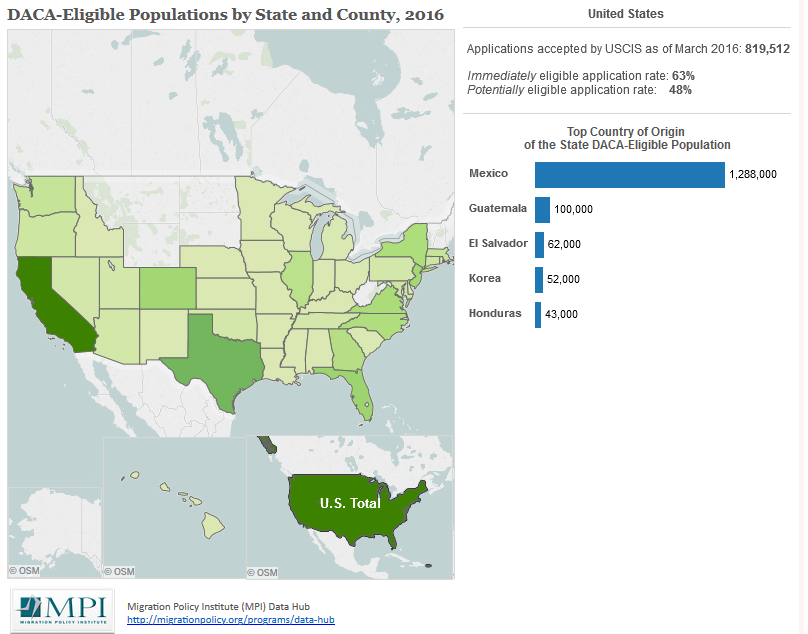
(Graph: DACA-Eligible Population 2025 by State — California, Texas, Florida, New York lead in eligible populations.)
The Pew Research Center estimates 300,000–400,000 new potential applicants — primarily from Mexico, Central America, and Asia.
What is DACA and why was it created?The Deferred Action for Childhood Arrivals (DACA) program was created in 2012 to protect certain undocumented immigrants who were brought to the United States as children. Through DACA, eligible individuals can request consideration for deferred action, which temporarily defers removal (deportation) and allows them to obtain work authorization, provided they meet strict eligibility criteria.
Why did the federal government stop processing new DACA applications?In 2021, a federal judge in Texas ruled that the original DACA program was unlawful, halting the processing of all new, first-time applications. While renewals continued, court injunctions prevented USCIS from approving new requests until the government addressed procedural deficiencies in the program.
What changed in 2025 to allow new DACA applications again?In 2025, DHS issued updated regulations and procedural reforms that satisfied court requirements, allowing USCIS to resume accepting and processing new DACA applications. The federal government also received clearance from appellate courts to reopen filings under a revised rule.
When did USCIS officially begin accepting new DACA applications again?USCIS will likely resume accepting new DACA applications in late 2025 following a public announcement and updated filing instructions. Applicants should monitor the USCIS DACA webpage for current submission dates and procedural guidance.
Who qualifies for DACA in 2025?To qualify, applicants must have entered the U.S. before age 16, continuously resided in the country since June 15, 2007, and been present in the U.S. on June 15, 2012. They must be under age 31 as of that date, meet educational or military service requirements, and have no significant criminal convictions. Undocumented students are a key group who may qualify for DACA.
Can I apply for DACA if I have never applied before?Yes. As of 2025, first-time applicants who meet all eligibility requirements can submit their initial DACA applications. This marks the first opportunity to do so since 2021.
What forms are required to apply for DACA in 2025?Applicants must submit Form I-821D (Consideration of Deferred Action for Childhood Arrivals), Form I-765 (Application for Employment Authorization), and Form I-765WS (Worksheet establishing financial need). All three must be filed together.
How much does it cost to apply for DACA?The total filing fee for DACA in 2025 is $495. This fee covers both the deferred action request and the employment authorization document (EAD).
What supporting documents should I include with my DACA application?Applicants should include proof of identity (such as a passport or school ID), proof of entry before age 16, evidence of continuous residence since June 15, 2007, educational or military records, and any documents showing physical presence on June 15, 2012.
How long does it take for USCIS to process a new DACA application in 2025?Processing times may vary, but new DACA applications generally take several months due to background checks, document verification, and court-related oversight. Applicants can check real-time processing estimates on the USCIS website.
Can I work legally in the U.S. after applying for DACA?Once approved, DACA recipients receive an Employment Authorization Document (EAD), allowing them to work lawfully in the United States for a renewable two-year period.
Does DACA provide a path to a green card or U.S. citizenship?No. DACA is a temporary policy that grants protection from deportation and work authorization but does not lead directly to lawful permanent residency or citizenship. Legislative action, such as the Dream Act, would be required for that.
What happens if my DACA application is denied?If denied, USCIS will issue a notice explaining the reason. There is no formal appeal process, but applicants may reapply if they become eligible or address the issue cited in the denial. Legal guidance is recommended before refiling.
Are DACA applicants protected from deportation while their application is pending?No automatic protection exists while a case is pending. Deferred action is granted only after approval. Applicants without lawful status remain subject to removal proceedings until USCIS grants DACA.
Can DACA recipients travel abroad?Yes, but only with an approved Advance Parole document. Without Advance Parole, leaving the U.S. could result in losing DACA status and re-entry denial.
Will the reopening of DACA face new legal challenges in 2025?Yes. State-led lawsuits, particularly from Texas and allied states, continue to challenge the legality of DACA. The outcome may depend on ongoing litigation in federal courts, including potential Supreme Court review.
Could the new DACA policy be reversed again in the future?It’s possible. Because DACA was created through executive action, future administrations could modify or rescind it. Legislative reform remains the only way to secure permanent protections for Dreamers.
How does DACA 2025 differ from earlier versions?The 2025 version is codified through formal DHS rulemaking, addressing procedural flaws cited by courts. It strengthens the legal basis for the program but retains the same core eligibility criteria and benefits.
Can people with minor criminal offenses apply for DACA?Yes, depending on the offense. Applicants must not have any felonies, significant misdemeanors, or three or more misdemeanors. Minor traffic violations or isolated low-level offenses may not disqualify an applicant, but legal review is essential.
What education requirements must I meet for DACA 2025?Applicants must currently be in school, have graduated from high school, earned a GED, or have been honorably discharged from the U.S. military or Coast Guard.
What if I don’t have continuous proof of presence since 2007?Applicants should submit as much documentation as possible, including rent receipts, medical records, school transcripts, or utility bills. If evidence is incomplete, affidavits from credible witnesses may help fill gaps.
Can I apply for DACA if I have Temporary Protected Status (TPS)?Possibly. Having TPS does not automatically disqualify you from DACA, but eligibility depends on your age, entry history, and presence on required dates.
Does DACA approval protect my family members from deportation?No. DACA protections apply only to the individual recipient. Family members must apply separately if eligible under their own circumstances.
Is DACA the same as the Dream Act?No. DACA is an executive program offering temporary relief, while the Dream Act is proposed legislation that would provide a permanent legal pathway to residency for eligible Dreamers. Congress has not yet passed the Dream Act.
How many people are expected to apply for DACA in 2025?Experts estimate that between 300,000 and 400,000 individuals could become newly eligible under DACA 2025, representing a significant expansion of the protected population.
What risks should I consider before applying for DACA?Applicants must disclose personal information, which could be accessible to DHS. While USCIS has generally not used DACA data for enforcement, the policy could change in the future. Consulting an immigration attorney before filing is crucial.
What are the benefits of applying for DACA in 2025?Benefits include protection from deportation, work authorization, access to a Social Security number, and in many states, eligibility for driver’s licenses and in-state college tuition.
How often must I renew my DACA status?DACA must be renewed every two years. USCIS recommends filing a renewal 120 to 150 days before the expiration date to avoid work authorization lapses.
Where can I find official updates on DACA 2025?Applicants should rely on official government websites, such as USCIS, DHS, and the Department of Justice, for accurate updates. Avoid information from unverified social media sources.
Should I hire an immigration lawyer to help with my DACA application?Yes. Because eligibility can be complex and rules may change, consulting an experienced immigration lawyer can ensure proper filing, minimize errors, and protect your legal interests.
What happens if the courts strike down DACA again after I apply?If courts halt the program, USCIS may stop approving new requests. However, applications already granted are typically honored for their approved term. Legal challenges often take months or years to resolve, allowing time for contingency planning.
Will applying for DACA affect my chances of getting other immigration benefits later?Usually not. DACA is considered an exercise of prosecutorial discretion, not a formal admission or visa. However, each case is unique, so applicants should seek individualized legal guidance.
Can undocumented youth who arrived after 2007 qualify for DACA?No. DACA’s continuous residence requirement begins June 15, 2007. Those who arrived later do not meet eligibility criteria under current DHS rules.
What should I do if I’m a potential DACA applicant but uncertain about eligibility?Schedule a consultation with an immigration attorney who can review your history, documents, and risks. Legal screening ensures applicants don’t expose themselves to unnecessary enforcement risks.
Why is DACA still controversial after all these years?Opponents argue that DACA exceeds executive authority, while supporters say it’s a vital humanitarian and economic policy. Courts continue to review its legality, reflecting broader divisions over immigration reform.
Will Congress pass the Dream Act in 2025?While advocates are pushing for a permanent solution, no legislation has passed yet. The resumption of DACA underscores the urgency for Congress to enact long-term protections for Dreamers.
What’s the most important thing for new applicants to know in 2025?The reopening of DACA is a rare and potentially temporary opportunity. Applicants should act quickly, prepare complete documentation, and seek legal assistance to ensure their applications are properly filed and safeguarded.
✅ The federal government resumed processing new DACA applications in 2025, allowing first-time applicants who meet strict eligibility requirements to apply for deportation protection and work authorization. Current DACA recipients should continue to monitor renewal deadlines and apply before their expiration date to maintain continuous protection.
Because of ongoing litigation and shifting criteria, consulting an immigration lawyer is critical before applying.
For individualized assessment, applicants can schedule a consultation with an experienced immigration attorney.
If you have questions about filing a new DACA application in 2025, don’t go through this complex process alone. With changing rules, court challenges, and evolving eligibility criteria, it’s more important than ever to have a trusted immigration lawyer by your side — someone who understands both the law and your dreams.
For over 30 years, Attorney Richard T. Herman has helped thousands of immigrants secure their futures in the United States. As a nationally recognized immigration lawyer, media commentator, and co-author of Immigrant, Inc. (available on Amazon), Richard Herman has spent decades championing the economic and community benefits of welcoming immigrants. His deep experience and compassion make him the ideal advocate for Dreamers navigating this new DACA chapter.
When you work with Richard Herman and his team at the Herman Legal Group, you gain more than legal guidance — you gain a dedicated ally who will help you:
Don’t risk your future or delay your opportunity. Every DACA application is time-sensitive and must be filed with precision and care.
Contact Attorney Richard T. Herman today for a confidential consultation and personalized guidance on your DACA eligibility and filing strategy. His firm has built a reputation for excellence, empathy, and results — helping clients across the U.S. turn uncertainty into opportunity.
👉 Schedule your consultation now and take the first step toward securing your future in America with one of the nation’s most respected immigration advocates by your side.
Federal Register (Rules & Notices)
Department-Level Portals
Court Opinions & Neutral Government Research
Professional Associations & National Legal Networks
Community-Facing Guides (Practitioner-Verified)
Authoritative Reporting (Context & Timing)
By Richard T. Herman, Esq., Immigration Lawyer for Over 30 Years
Home Depot has remained notably silent as Immigration and Customs Enforcement (ICE) operations have targeted day laborers outside its stores. As the biggest home improvement chain and a home improvement giant, Home Depot wields significant influence over the construction industry, shaping labor practices and market trends. These ICE raids, carried out by federal agents, have sent shockwaves through immigrant communities and raised questions about corporate responsibility.
Despite mounting pressure from advocacy groups and affected families, the company has yet to issue a meaningful public response. According to Home Depot’s standpoint, the company states it does not hire or facilitate day laborers and has not experienced a notable sales decline due to these raids. With a huge customer base spanning homeowners, contractors, and businesses, Home Depot’s silence carries weight, potentially impacting both its reputation and the broader conversation about immigration enforcement in the United States.
Across the United States, reports continue to surface of U.S. Immigration and Customs Enforcement (ICE) agents conducting immigration enforcement activities in or around local Home Depot parking lots—places where immigrant day laborers often gather at Home Depot’s doorstep seeking work. These immigration raids, sometimes described as suspected immigration enforcement operations, can involve intimidation, detentions, and vehicle stops, often occurring without advance notice to businesses. The company itself has remained notably silent. A Home Depot spokesperson confirmed that the company does not request ICE operations and stated that it is not notified in advance of ICE activities. Home Depot has responded to claims of complicity by emphasizing that it is not informed beforehand about ICE’s actions. However, Home Depot’s approach to recent ICE raids has drawn significant criticism from advocates for immigrant rights and community groups.
Despite widespread documentation by journalists and immigrant advocates, Home Depot has largely stayed quiet, issuing no public statement acknowledging or condemning ICE’s presence near its stores. This silence stands in stark contrast to other major corporations that have taken public positions on immigration or workplace rights.
Quick Answer:Home Depot has remained silent about ICE raids in its parking lots and near its stores, despite repeated reports of enforcement actions targeting immigrant day laborers. U.S. law allows businesses on private property to deny ICE entry without a judicial warrant, but few corporations actively assert this right.

In cities from Los Angeles to Houston, Chicago, and Atlanta, day laborers—many undocumented—have long gathered nearby Home Depot stores, along with food sellers, hoping to connect with contractors seeking temporary help. According to investigations by ProPublica and NPR, ICE has used these spaces for “knock-and-talk” operations, vehicle checkpoints, and coordinated surveillance. During these raids, agents pursue day laborers and other individuals, often leading to tense encounters. Home Depot does not have a formal relationship with day laborers, but their history runs deep. Day laborers have become a key solution for contractors in response to a chronic worker shortage in construction. However, some day laborers now feel afraid to come to Home Depot due to ongoing ICE raids. After these raids, the number of day laborers around Home Depot has diminished significantly.
Federal authorities, including immigration agents, are involved in these enforcement operations. In some cases, rental trucks and rental moving trucks are used by authorities, with immigration agents emerging unexpectedly to detain day laborers and undocumented workers outside Home Depot locations.
Workers and day laborers must always consider their own safety during these encounters, as the presence of federal authorities can create confusion and risk.
Although ICE agents often claim these encounters are voluntary, the line between a casual conversation and coercion is legally blurry. When heavily armed officers block exits or question workers without clear consent, courts have found such encounters may violate Fourth Amendment protections against unreasonable searches and seizures. Some ICE raids at Home Depot have included the use of tear gas and the arrest of multiple individuals, including day laborers.
(Sources: ProPublica)
Understanding what ICE can and cannot do is essential for both business owners and immigrant workers. ICE operations fall under the Immigration and Nationality Act (INA), particularly Section 287(a)(1), which authorizes officers to arrest or interrogate noncitizens if they have probable cause.
However, the Fourth Amendment limits how far ICE’s authority extends, especially on private property such as store premises, warehouses, or employee-only areas. In fact, a federal appeals court issued a temporary restraining order that restricts ICE from conducting broad, warrantless enforcement actions in these settings, reinforcing the need for reasonable suspicion and judicial oversight.
References:
When it comes to compliance, Home Depot’s company’s position is to maintain neutrality and not participate in federal raids, interpreting and applying these legal requirements to protect both its customers and workers.
ICE cannot enter private property, such as a business or a store’s nonpublic areas, without:
- A judicial warrant signed by a federal judge or magistrate; or
- Consent from the property owner or authorized representative.
Administrative ICE warrants (Form I-200 or I-205) do not authorize entry into private spaces without permission. Under 8 C.F.R. § 287.8(f)(2), ICE agents must avoid using “unreasonable force or coercion” during encounters.
References:
When ICE agents appear at a Home Depot—or any business—managers and property owners have specific rights and obligations under federal and constitutional law. A Home Depot representative or manager should be prepared to immediately respond to ICE’s presence by following established legal procedures. Home Depot representatives are trained to follow legal protocols during such encounters to ensure compliance with the law while protecting the rights of employees and customers.
If ICE lacks a valid warrant, the business can restrict entry to nonpublic spaces such as employee-only areas, storage rooms, or offices.
Employers should avoid sharing employee records unless compelled by a court order or subpoena under 8 U.S.C. § 1324a(e).
While businesses can legally refuse access without a warrant, they should not physically interfere with officers. Cooperation should remain polite but limited to legal requirements.
(Resources: U.S. Department of Justice, ACLU “Know Your Rights” for Businesses)
Some advocates argue that it is certainly a moral obligation for companies to defend day laborers during enforcement actions, emphasizing the need for ethical responsibility and support for vulnerable workers.
In contrast, Home Depot has issued no public comment, press release, or acknowledgment of ICE’s activities near its stores—despite numerous press inquiries. During an earnings call, Home Depot executives did not address questions about immigration raids or day laborers. The company has stated that it is required to follow all federal and local rules and regulations in every market where it operates. While day laborers are not formally integrated into Home Depot’s business model, their presence outside stores is significant to local communities. Some customers hope Home Depot will take a stronger stance to protect and advocate for day laborers affected by immigration enforcement.
Home Depot’s corporate neutrality on immigration enforcement may be strategic—a calculated choice to avoid controversy. The company’s consumer base spans both immigrant workers and homeowners who support stricter border enforcement. The company’s perceived politics, including donations to both parties and scrutiny over founder support for political figures, have influenced public perception and customer trust.
So far Home Depot has not seen a significant impact on its sales from recent immigration raids or political issues. Home Depot’s bottom line continues to benefit from the current labor market, where the demand for quick, affordable labor remains high. Home Depot’s sales, driven by both DIY homeowners and professional contractors, have contributed to Home Depot’s success and a strong Home Depot’s stock price, which has remained robust even amid external challenges. In the previous quarter notably, sales growth exceeded expectations, with data from early August showing continued resilience. Roughly half of Home Depot’s sales come from professional contractors, underscoring the importance of this customer segment.
However, some observers claim fewer contractors are visiting stores, and there are fewer contractors overall due to concerns about enforcement actions and market changes. Economic uncertainty has led many customers to delay major projects, focusing instead on smaller tasks, which has affected sales of big-ticket items and shifted demand. The postponement of major projects has had a noticeable effect on overall sales. With same prices across stores, labor costs have become a key competitive factor, making an on-demand workforce essential.
Day laborers provide a cheap solution for contractors and homeowners, and the line loves day laborers for the mutual benefit they bring to both workers and the store. For many, the ability to make an honest living is crucial, especially as contractors and homeowners hire day laborers for quick jobs like repairs and landscaping. Day laborers often gather nearby Home Depot locations, ready to meet immediate needs. The construction industry as a whole relies on this flexible labor pool to adapt to fluctuating demand. The Trump administration’s immigration crackdown has increased enforcement activities, impacting day laborers and contributing to shifts in contractor and customer behavior.
While neutrality may seem safe, critics argue that silence in the face of injustice is complicity—especially when ICE raids occur repeatedly in spaces that help drive Home Depot’s profits. Councilmember Ysabel Jurado has described Home Depot as complicit due to its silence on ICE raids occurring at its locations. Protests have occurred outside Home Depot locations in response to ICE raids targeting immigrant workers. Some of these protests have also memorialized individuals who died while fleeing immigration enforcement, such as a man in Monrovia, California. Protests and boycotts have been organized in cities like Los Angeles and Chicago against Home Depot due to its silence on ICE raids.
(See coverage in The New York Times and ABC News)
Unlike tech or food companies, Home Depot has rarely been the subject of sustained media pressure regarding immigration. However, Fox News Digital and the Los Angeles Times have both reported on recent ICE raids and community protests at Home Depot locations, bringing increased attention to the company’s practices. Analysts, speaking earlier, noted that these raids could potentially impact sales, but so far, the immigration spotlight has not significantly affected Home Depot’s public perception or financial performance. Newman told NPR earlier that Home Depot is committed to complying with all federal laws while supporting its diverse workforce. Few major outlets have investigated the company’s policies toward immigrant workers or ICE presence on store property.
Organizations like United We Dream, National Immigration Law Center (NILC), and the American Immigration Lawyers Association (AILA) have repeatedly called on corporations to clarify their roles during ICE raids. Advocacy groups emphasize that both customers and home depot workers are directly affected by immigration enforcement actions, with raids and rumors impacting not only those seeking work or services but also store employees and overall operations.
Still, Home Depot has remained noncommittal, issuing only general statements on “diversity and inclusion” without addressing enforcement issues. The National Day Laborer Organizing Network and the League of United Latin American Citizens have called for policy changes regarding federal immigration agents accessing Home Depot properties.
Businesses that overstep their cooperation with ICE may risk civil rights violations, particularly if they facilitate discriminatory treatment of workers based on perceived immigration status.
Conversely, refusing entry without a warrant is constitutionally protected.
Large retailers play an increasingly visible role in America’s immigration debate. Silence during ICE raids sends a message that corporations can profit from immigrant labor while avoiding accountability when that same labor force is targeted. Half of Home Depot’s sales are now to professional contractors who might need quick help with demolition, construction, or cleanup, further tying the company’s success to the labor provided by immigrant workers. Much of Home Depot’s success has led to the conditions that we see in the industry today for day laborers.
Balancing legal compliance and moral responsibility is challenging—but companies can adopt clear policies:
(Resources: EEOC Guidance on National Origin Discrimination, NILC Workplace Raids Toolkit)
| Company | Public Statement on ICE Raids | Employee Training | Advocacy Partnerships |
|---|---|---|---|
| Home Depot | None | None known | None reported |
| Chipotle | Yes (Worker Protection Policy) | Yes | Yes |
| Amazon | Yes (DACA & Family Separation) | Limited | Yes |
| Tyson Foods | Yes (Post-Raids Compliance) | Yes | No |
| Walmart | Limited Transparency | Partial | No |
This comparison underscores how Home Depot stands alone among major U.S. employers in its complete lack of public engagement on immigration enforcement, despite being at the epicenter of repeated ICE encounters. Notable incidents at Eagle Rock Plaza, Westlake Home Depot, and Los Angeles Home Depot, as well as in Illinois Chicago, highlight how these locations have been directly affected by immigration raids, drawing community concern and criticism over the absence of a clear corporate response.
| Legal Principle | ICE Authority | Business Rights |
|---|---|---|
| Administrative Warrant (I-200/I-205) | Authorizes ICE to arrest an individual but not to enter private property | Business can refuse access |
| Judicial Warrant | Signed by a federal judge; authorizes entry | Must be honored |
| No Warrant (Verbal Request) | No lawful entry or search authority | Business may deny entry |
| Fourth Amendment | Limits searches and seizures | Protects both businesses and individuals |
Corporate silence carries moral weight. When a company of Home Depot’s stature remains neutral amid visible ICE activity targeting immigrants, it shapes public perception of what corporate citizenship means in modern America.
“Every time a company turns away from injustice, it sends a message louder than any press release.” — Richard T. Herman, Esq.
By choosing silence, Home Depot has, perhaps inadvertently, aligned with inaction—leaving immigrant workers vulnerable while shielding itself from controversy.
Richard T. Herman, Esq. is an immigration attorney with over 30 years of experience and founder of the Herman Legal Group. He co-authoredImmigrant, Inc., exploring how immigrant innovation fuels the U.S. economy.
Connect with Richard through his bio page or book a consultation.
The Herman Legal Group wishes everyone a safe and beautiful 2020! As we transition to a new decade, it’s a good time to reflect. While it’s often easy to default in our thinking to emphasize what makes us different from each other, I will be working on trying to see all the connections between us that make us similar. We all want to have a healthy and safe family. We all want economic security to ensure food, shelter, clothing.
We all want physical security, free from violence. We all want to be appreciated. We all want our children to grow up in a world that allows them to blossom and reach their full potential.
To me, the new decade is about recognizing our humanity and interconnectedness. We are dependent on each other for our survival and happiness. While we can disagree about this or that, in the end, these differences are inconsequential.
Let’s love each other, help each other, and inspire each other to think and act big.
Because my life is intertwined with one of the most significant issues of our time, immigration — I can’t help but think of all the immigrants that I have met in my 25+ of practicing immigration law.
From my perspective, whether the immigrant works on a farm or at the Cleveland Clinic — I see something special. The hard work ethic, the family focus, the entrepreneurial edge, and the fresh eyes that see abundance and opportunity everywhere.
They remind all of us that the American Dream continues to exist and thrive. For many of us, we have forgotten this.
Here’s to 2020 and an increasing awareness that Immigrants Help Make America Great.
It’s our not-so-secret, but an often-forgotten, competitive edge.
And this edge is the most powerful when we celebrate our common bonds and interconnectedness.
Happy New Year!
The US is facing unprecedented times as the coronavirus pandemic has yet to settle. The growing number of confirmed cases in the US, totaling over 160,000, has made the nation the new epicenter of the pandemic, surpassing both Italy and China.
Many steps have been taken at both the state and national level in order to attempt to contain the spread of disease. All but essential institutions have suspended operation, more than 15 states have mandated stay-at-home orders in place, and now, after days of congressional deliberation, the Senate has passed a $2 trillion economic rescue plan in hopes to keep the country afloat during the global health crisis.
However, among the collective Americans and people affected by the outbreak and its domino effect, US immigrants face a new level of uncertainty during these times.
As mentioned before, most immigration courts are still maintaining regular operation. Aside from a handful of courts closing or temporary postponing of non-detained hearings, most of the 68 US immigration courts are still holding hearings. Courts have hundreds of contact points, leaving judges, immigrants, and counsel at increased risk of exposure to potential disease.
While the rest of the world is on pause and practicing social distancing, immigrants must still present and defend themselves in court, along with attorneys who are enforced to appear with masks and gloves–essential accessories many hospitals can’t even acquire during a supply shortage.
USCIS has also temporarily suspended routine in-person services to help slow the spread of COVID-19. Although USCIS plans to reopen offices on April 7, extension of suspension is plausible. During these times, USCIS is limiting its operation to only emergency services for limited situations.
This raises concerns for legal immigrants who may inadvertently violate immigration laws should their work permits or other form of legal status expire. AILA advocates are demanding that USCIS freeze all deadlines or ensure there are measures for individuals whose status is expiring to remain lawfully.
In addition, a few nights ago, the Senate unaminously passed the $2 trillion stimulus plan that will offer financial assistance to Americans across the country during the global pandemic. A provision that has gained large-scale attention among the national community is the stimulus check of $1200 to be sent to qualifying Americans from the federal government. However, immigration legal experts say that millions of immigrant households will not be receiving any relief money.
Under the bill, only those with valid Social Security numbers and resident aliens will qualify for relief checks. For example, many immigrant households are of “mixed-status,” meaning if anyone in the family uses an individual taxpayer identification number (“ITIN”) rather than a SSN, they will not receive a check.
ITINs are issued by the IRS to ensure that people, regardless of their immigration status, file their taxes and comply with US tax law despite being ineligible or not obtaining a SSN.
According to the Migration Policy Institute, over 16 million people live in mixed-status households in the US since early 2019. Immigrants are arguably a substantial body of the front lines amidst this virus, such as our health care sector, agriculture and farming, hospitality, and waste management.
While these members of our national community continue to work to serve others during these unordinary times, it is lamentable that they are not guaranteed a dime from the relief package.
Please contact us for more details and information.
CLEVELAND – September 3, 2020
The Herman Legal Group, an immigration law firm founded in Cleveland, Ohio in 1995, is proud to announce the winner of its $1,000 Scholarship: Ms. Laura Perez Vicencio, an immigrant from Tequila, Mexico, who resides in Utah.
The Herman Legal Group sponsored this scholarship to encourage greater appreciation for undocumented immigrant workers, many of whom are valiantly working on the frontlines of COVID-19.
Ms. Perez Vicencio’s winning essay is entitled, The “I” Word, and beautifully answers the question: “What Do You Think of When You Hear the Word Immigrant?“
Here is a sample of her poignant message that resonates in these difficult times:
Growing up, my mother was a housekeeper, and dad, a construction worker. They worked hard from dusk to dawn every day. Even on the weekends, my parents would find a way to earn more income for our growing family. Going to work meant we would have a roof over our heads and not have to live in the streets….
I was happy that my parents had the jobs they did. My classmate’s parents worked hard, but not as much as mine did. I was so proud but was ashamed of saying what my parents did for a living. When asked what my parents did for a living, I was ashamed to speak the truth so instead, I would reply with “I’m not sure what they do, something that has to do with the government.”
I had no idea what that even meant but at that time, I thought it was better than saying a housekeeper or construction worker. On career days, all the parents would show up in their white coats or firefighter’s outfits. I remember being embarrassed to say that my parents were from Mexico and what my parents really did for work. I wanted to be like the others, I wanted parents who didn’t work in housekeeping or construction.
As I’ve grown, I’ve learned to love and embrace my culture. I love that I’m a dreamer, I am unique and I have a story to tell. I love that I’m from Mexico (Tequila, Jalisco to be exact). I love that I can say I’m from Tequila, where the best Tequila is made! I love what my parents do for work.
My dad can build me a house if he wanted to and my mom could teach me tips and tricks on deep cleaning my house. I’ve learned not to be ashamed of my roots but rather to be proud of where I come from. I’ve learned that my parents are not only hard workers but they are so much more. They are there to heal me when I’m sick or get hurt, they are my therapists when I need someone to talk to, they are so much more than where they come from and what they do for work. They crossed the border thinking about my future, they are self-less. They stand up from themselves when a person at the grocery store tells them to go back to their country, they are self-advocates. They are cooks, an encyclopedia, storytellers, singers, actors, and comedians and so much more.
When I hear the word Immigrant, I think of my parents. Immigrants are people who risk their lives and give everything they have. Immigrants are the persons who are willing to take their sweaters off their back only for you to be warm. They are those who work housekeeping and construction jobs only to come and have a roof over their heads. Immigrants are those who go to work every day no matter the circumstance to be able to provide for their families. Immigrants are responsible, hard-workers who sacrifice every little bit they have to make their families happy. They are taxpayers who contribute to our economy. They save lives, they are educators, mentors, and defenders of the only country they know so well. They are so much more than their place of birth and jobs, they are our heroes.

The essay scholarship attracted many outstanding essay submissions from immigrants from around the world and residing throughout the U.S. On its website, the Herman Legal Group has published the winning essay, as well as 8 runner-up essays, to help give voice to the undocumented community.
The essayists share their personal feelings about being an immigrant who contributes to the well-being of the United States, who has deep ties to the United States, and yet has no legal pathway to normalize her immigration status.
We hope these essays help stimulate a healthier conversation in the U.S. about immigration, to help humanize the “other,” and to encourage our elected officials to move on legislation that would provide an earned pathway to permanent residency, and ultimately citizenship, to the undocumented.
As you read the essays, you can’t help but feel that these folks are already Americans, but simply have no papers.
To read the inspiring stories from the contest’s finalists, see the following:
1st Runner-Up: “Recently, I went on a date with my boyfriend at my favorite spot, the local drive-in movie theater. A security guard at a drive-in was trying to tell me to either move my car from where I was parked, or to turn it off. He came off as very rude however. He made faces at me, and looked annoyed. He looked at me straight in the eyes and asked, ‘Do you even know English?’ I was shocked, since our whole conversation had been in English, I answered him, yes, I do. He asked again, and once again I answered, yes. ‘We’ve been speaking English this whole time.’ He then looked around, fully annoyed, and asked, ‘Are you even from America?’ I told him no, I wasn’t. He looked mad now, no longer annoyed. I can’t really explain the look on his face, but it made be scared….I cried a lot. I called my boyfriend, who was meeting me there, and lost it, becoming a tearful mess. I had never felt so out of place before. Looking around, it looked like I was the only person of color at the drive-in.” (Oklahoma)
2nd Runner-Up: “It wasn’t until I moved to Washington, DC, when I gathered the courage to tell the truth. Surrounded by the George Washington monument, and other statues, I realized that none of it belonged to me. I felt like a coward cadging in my identity as an immigrant…that seemed to paralyze me.” (Puerto Rico)
3rd Runner-Up: “The success of a species corresponds with genetic diversity. The more variety in the DNA pool the easier it is to find a niche and can facilitate adaptation. I believe that the mind works in the same way; with a wide range of ideas and knowledge of different cultures, one will have an easier time navigating life’s trials. If we invite immigrants to enter our inner circles we have an amazing opportunity to learn and expand our toolset. We could learn to code-switch in an instance, navigate through foreign menus, have interesting conversations, and many more.” (Utah)
4th Runner-Up: “Every day I am haunted by a ghost. Every night he whispers into my ears. He speaks of my triumphs, my failures, my joys, my sorrows. He is the dry air on a warm summer’s day, unstained by the foreign humidity of America. He is the moon in the sky, the same moon that made me dream of astronauts and whimsical science fiction as a child. He sowed the seeds of what grew to be my passion for engineering and computer science. He is the shadows in the corners of my alien suburbia that dredge up memories of running through streets in my hometown’s evenings. He is my best friend’s hazel eyes, the color of those of my first love from a lifetime ago. He is the numb shock of hearing about others’ tragedy, and the bittersweet delight of hearing about my friend’s dreams. When I look at him, he has retained his youth despite my advancement of years. His impish face used to taunt me, with his self-assured smile taunting my insecurities. When I first came to America, he was my twin, but now he is a stranger. I am not the only one haunted by ghosts. They haunt all refugees and asylees. When one is violently separated from the familiarity of life others take for granted, a divorce of the spirit occurs. Life is fractured into pieces” (Virginia)
5th Runner-Up: “I avoid the word. Outwardly, I am proud to be one and even prouder to be the daughter of two. Inwardly, I am confused. I can’t pinpoint what I feel or think of when I hear the word, because I’ve never been able to clearly define it for myself. Regardless, it’s a part of who I am and an even larger part of how I live. I am an immigrant. I didn’t have a choice in coming to America. When my parents brought me here at the age of three years old, my Philippine umbilical cord was cut. I was torn from my motherland… I harbor fear and resentment at the word because I didn’t know my status until Obama was in office. I vaguely understood that we had immigrated and that we weren’t citizens, but my parents kept everything secretive…My parents told me that I couldn’t tell anyone. It was a big secret that I fearfully bottled up. … I think it was slow to sink in because I didn’t realize the impact that it had on my life. I knew I was an immigrant like I knew my skin was brown. One day, it just hits you. Maybe it was when I tried to apply for work and they asked for my green card. Maybe it was when my sister tried to apply for college and couldn’t. Maybe it was when my dad was swept up and arrested… At some point, I no longer saw myself as a regular kid growing up in my hometown. I was an “alien”. I was no longer openly accepted into society, I had to stay safe. People have power over me in ways that I can’t control. I lived almost my entire life in America, but I wasn’t American. The future I had dreamed of no longer existed. Everything I thought I understood was now questionable, and nothing seemed to be reality anymore. Before DACA, I went through a battle with drugs, depression, and sexual trauma. I had felt lost and alone, floating around.” (California)
6th Runner-Up: “Entrepreneur. Innovator. Risk-Taker. Citizen. Human. These are the words that come to mind when I think of ‘immigrant’…..They both envisioned a place that is foreign to them as a place to settle down and plant their roots. They had never seen anything outside of what their city offered them. They knew there had to be more….the husband built his company to employ a significant number of employees while the wife was made chief physician at a hospital that was able to be built from the fruits of their company’s success.” (Minnesota)
7th Runner-Up: The word “immigrant” to me means evolving. One ventures outside of their homeland for the unknown and learns about themselves. Their strengths, their weaknesses, and their capabilities become tools to help them acclimate into their new home. Adjusting to a different culture with a different environment forces a person to step away from themselves and learn who they truly are from the outside…..In the current pandemic that we face, some of us, as a pharmacy technician myself, are now working in the healthcare industry as frontliners. Little by little we have emerged from the shadows and are now evolving…” (Arizona)
8th Runner-Up: “There is a greatness to the word Immigrant and those to whom it refers. When I think of an Immigrant or Immigrants I think of the most courageous, bold, and hopeful people on this earth, especially those who are undocumented. People often fail to see the courage it takes to leave your home country with the knowledge you may never get to come back home. People think we emigrate like some people vacation, which is when they feel like it. But that is not the case. Immigration is often a permanent decision, that means you will likely never see your family again. Family events, births, weddings, and funerals will happen at home without you, and these events will happen to you in a foreign land without your family there. Outside of the immigrant community, I don’t know many people who would be brave enough to do that. Along with being courageous, to be an Immigrant one must be bold in the sense that they are pursuing a life that was not outlined for them. A life that goes past bounds and restrictions placed on them. If you have been privileged enough to live in a culture that encourages you to dream or a society that easily allows for you to pursue your dreams, you may fail to appreciate the audacity and boldness it takes for an Immigrant to pursue a different a life. Lastly, Immigrants are hopeful. How else would one take the biggest chance and risk their lives if not for hope? Hope in a better life. Hope in a safer life. Hope in life itself. To immigrate to a new country, you typically are hoping for something better, something worth leaving the comforts you have known and the family and friends you love. As an immigrant and a child of immigrants I could go on and on. I am filled with pride when I hear the word Immigrant because I know of the sacrifices made by the people it represents, and I know of their resilience. We are not what people have made us to be; we are greater.” (Texas)
We are facing the most challenging healthcare and economic crises in 100 years. The pandemic impacts everyone.
Undocumented immigrants are especially vulnerable. U.S. policy on immigration has increasingly become more aggressive and unwelcoming to immigrants. Despite the data to the contrary, many people now believe that immigrants undermine the U.S. economy and do not make the nation stronger.
As immigration attorneys, we at the Herman Legal Group understand the moral and economic imperative to support undocumented immigrants, particularly those who are working to keep us safe and healthy.
Undocumented workers are often toiling in high-risk conditions of virus transmission, unprotected by any Personal Protection Equipment, and are getting sick.
Yet, despite their important contributions to the United States, including paying taxes, most undocumented workers (and even some U.S. citizen spouses) are not eligible to receive stimulus checks from the Federal Government, and their families are disproportionately feeling the devastating impact of economic downturn.
Even during this pandemic, the undocumented population continues to be vilified and face the prospect of arrest, detention, deportation, and permanent separation from their U.S. citizen children.
On the eve of our Presidential Election, the founder of the Herman Legal Group, Richard Herman, reflects on how the U.S. Government, under the leadership of President Donald Trump, brutally treats immigrants, many of whom have U.S. citizen spouses, children and parents:
“I have been an immigration lawyer for over 25 years. I have seen nearly everything one can imagine within the immigration legal arena. However, nothing compares in scope and degree to Trump’s assault on the civil liberties of immigrants, their families, and employers. As an American, it’s deeply saddening to see the Statue of Liberty metaphorically transformed into a tacky, blinking, neon sign, projecting the words: “NO VACANCY.”
Trump’s anti-immigrant rhetoric and policies ignore the important economic, social and cultural contributions of immigrants, America’s “Dream-Keepers.”
Herman, who co-authored the book, Immigrant, Inc. – Why Immigrant Entrepreneurs Are Driving the New Economy (and how they will save the American Worker) (Wiley 2009), says that Trump’s immigration policies harm U.S. workers and the ability to rebuild the economy from the ravages of COVID-19:
“The data shows that immigrant workers complement, rather than compete against, native-born workers, because they tend to have different levels of education, work in different occupations, specialize in different tasks, and live in different places.
Much like the President’s disregard of medical experts who warn against large public gatherings, and their urgent proclamations for using face masks, testing, and tracing to reduce the spread of COVID-19, the President is now disregarding the economic experts whose research demonstrates that immigrant workers create jobs and help expand the U.S. economy through innovation (particularly in STEM fields), entrepreneurship, consumption, exports, and filling gaps in the labor market.
Immigrants and their children have founded 40% of the Fortune 500, employing millions of Americans. The data on immigrants’ job-creation propensity is staggering:
* Immigrants are twice as likely to start a business than American-born: ·
* Immigrants are twice as likely to earn a patent than American-born ·
* Immigrants have familial and friendship networks around the world to facilitate U.S. exports and attraction of capital.
The country has lost its way. Immigrants, and our embrace of them, will remind us of our destination.
The Herman Legal Group extends its warm appreciation to all the essay contestants for helping us find our way. Please stay in touch and keep an eye on our site for our scholarship program in 2021.
__________________________________________________________________________________
Contact Our Firm for More Information

Founded in 1995, the Herman Legal Group specializes in all aspects of immigration law. We are proud to represent immigrants from all walks of life. We are headquartered in Cleveland, Ohio and have offices throughout the country. We serve clients in over 12 languages, in all 50 states. We have been voted for inclusion in the 2015-2020 editions of The Best Lawyers in America© and listed in Super Lawyers© for more than fourteen consecutive years. Our founder, Richard Herman, began his immigration law career by moving to Moscow, Russia in 1993, straight out of law school, to eventually open a law office two blocks from the Kremlin to represent post-Soviet entrepreneurs. As an authority on U.S. immigration law and a provocateur for immigrant-friendly, pro-entrepreneur policies, Richard is often invited to strategize and deliver keynote addresses around the country, as he has often done for Michael Bloomberg and Rupert Murdoch’s Partnership for a New American Economy, chambers of commerce, universities and cities. Known for his direct and sometimes controversial style, Richard has appeared in numerous national media outlets. He is the co-author of the acclaimed book, Immigrant, Inc. —Why Immigrant Entrepreneurs Are Driving the New Economy (And How They Will Save the American Worker) (John Wiley & Sons, 2009). Richard is one of the pioneers of the movement by Midwest cities to attract and welcome immigrants who can help grow the economy, create jobs and reverse progressive depopulation. Known for his direct and sometimes controversial style, Richard has appeared on FOX News (The O’Reilly Factor), National Public Radio, and has appeared in the New York Times, USA Today, BusinessWeek, Forbes, Inc., PC World, Computerworld, CIO, TechCrunch and InformationWeek. Richard is married to Kimberly Chen, an immigrant from Taiwan who overcame her undocumented status to become an American physician. They live in the Cleveland area with their two children, whom they are raising to be citizens of the world. The law firm has offices in Columbus, Cincinnati, Toledo, Akron, Youngstown, Dayton, Pittsburgh, Detroit, Ann Arbor, Charlotte, Buffalo, Dallas, Chicago, Queens, Miami, Toronto, Manila.
You can reach us at +1-216-696-6170 or by email at Richard@LawFirm4Immigrants.com
Comprehensive (as opposed to piecemeal) immigration reform would require a drastic overhaul of the statutory basis for immigration law, and it would require the support of both houses of Congress. At the very least, a comprehensive immigration reform bill would need to address (i) long-term legal status for undocumented immigrants; (ii) border security; (iii) the H-1B visa program; and (iv) permanent residency based on a STEM degree.
An estimated 11 million undocumented immigrants live in the United States — no other nation hosts such a large number. The question of what to do with these immigrants (deport them, tolerate them, give them green cards, or allow them to seek citizenship) has become a hot political issue, especially on the question of citizenship, ever since it became clear that recent immigrants who become citizens overwhelmingly vote Democratic.
As a consequence, Democrats such as Obama are generally more favorable to providing these immigrants with a “road map to citizenship”, while Republicans such as Trump often seek to block even green card holders from obtaining citizenship (and therefore voting rights). The divided nature of the US government ensures that resolving this issue will be a challenge.
In tandem with the question of what do do with 11 million undocumented immigrants is the question of how to secure the US border, especially the southern border with Mexico. Although some voices call for “open borders”, this idea is unlikely to win broad political consensus any time soon. Both political parties agree on the need for border control — the differences lie in what type of controls they want and how easy they want to make it to immigrate legally.
Realistically, border security will likely be used as a political football by the Republicans — any compromises with the Democratic agenda in other areas would have to be compensated by a corresponding compromise allowing for increased border security. These compromises might not even include completion of Trump’s border wall, since it is widely whispered that the wall does little to stop or deter illegal immigration, but is rather more of a political showpeice.
Over the years, the H-1B visa has been a boon to the US economy that much of the US seems oblivious to. While other countries are complaining of the exodus of their highly skilled laborers to the US and other countries, many in the US complain that employment-seeking immigrants “come over here and take our jobs.” The flaw in this reasoning is that jobs are not a zero-sum game. Elon Musk, for example, took a job — and created thousands more.
The Trump administration has been more hostile to the H-1B visa than any other administration. The Biden administration, by contrast, is leaving many with the impression that it will treat the H-1B visa even more favorably than the Obama administration did. At this point, all we can do is wait and see.
The most obvious reform to the H-1B program is to increase the current quota of 65,000 visas per year to over a hundred thousand, or perhaps even several hundred thousand. As a compromise, the quota could be adjusted each year within a predetermined range based on the US unemployment rate. This increase would be designed to attract STEM workers, and it could apply even if the proposed STEM visa (see below) becomes law.
The US labor force, like the labor forces of most nations, suffers from a chronic shortage of STEM-trained workers and entrepreneurs. The word “shortage” is perhaps misleading, however, since no amount of STEM-trained entrepreneurs will ever be enough — more is always better.
The proposed new STEM visa, if it is actually implemented, could represent one of the greatest innovations in immigration law ever conceived of.
One way in which a STEM visa would differ from the H-1B visa is green card availability. Although H-1B visa holders are allowed to apply for green cards, the H-1B itself does not lead to permanent residence. Most H-1B applicants seeking green cards apply under the EB visa program, which is plagued with low quotas and long backlogs.
By contrast, under the proposed STEM visa, a worker would be able to obtain a green card directly from STEM visa status. In addition, under current proposals any STEM visa quota would not be subtracted from the numbers available for other types of visas such as the H-1B, but would add to the total number of skilled workers who are eligible to enter the US.
The foregoing is a brief description of four of our nation’s most salient immigration reform needs. Ultimately, however, it is only the beginning of what needs to be considered for a comprehensive immigration reform package. Whether comprehensive immigration reform happens any time soon, and what it will look like when it does happen, is largely up to Congress, the makeup of which is largely dependent on the US electorate.
By the time his term of office ends on January 20, 2021, Donald Trump will have reduced immigration to the United States by more than half. He has managed to accomplish all of this through executive order and regulatory changes, without any change in statutory law — and therefore no need for cooperation from Congress.
The timing of this decrease in immigration makes it obvious that nowhere near all of it can be attributed to the COVID-19 crisis.
The administration has erected so many walls against immigration, both literally and figuratively, that it would be impossible to list them all succinctly. All told, Trump issued more than 400 executive orders and actions, each of them with significant impact. Some of the highlights (or, perhaps better put, lowlights) are listed below.
The Trump legacy begins at the US border. Some of the administration’s more objectionable policies include:
Asylum claims have been rapidly increasing since before Trump took office. The Trump legacy, however, includes:
All told, these measures eliminate asylum as an option for most of those who seek it.
The Trump years have also been dismal for refugees:
Trump’s immigration initiatives did not stop at the border. Despite the Obama administration’s prioritizing of the apprehension of undocumented aliens with criminal records, Trump issued an executive order targeting all undocumented undocumented immigrants, even those not suspected of criminal activity. As a consequence, 36 percent of the undocumented immigrants arrested had no prior criminal record, compared to 14 percent in 2016.
Other actions taken by the Trump administration include:
The Obama administration offered forbearance to undocumented immigrants who arrived in the US as children. The Trump administration has offered them little more than hostility by canceling DACA protections, thereby putting immigrants who arrived in the US as children in danger of deportation.
This hostility has affected up to 500,000 undocumented immigrants. Even after the courts thwarted this policy, the Trump administration instituted a policy of denying all first-time applications and granting renewals for only one year at a time.
The Trump administration has strengthened the “public charge rule”, making it much easier to deny immigration benefits, including permanent residence, to an applicant based on poverty or use of public benefits. The new rules are so onerous that the Migration Policy Institute (MPI) estimates that nearly 70 percent of green card applicants are now at risk of denial on public charge grounds alone.
In addition to the foregoing innovation, the Trump administration has also ramped up enforcement of financial support commitments made by US sponsors of immigrants.
The Trump administration has initiated several unprecedented policies that make it more difficult for international students to study in the United States, including:
The USCIS and the Department of Labor have increased their scrutiny of nonimmigrant applications for employment-based visas, including both the H-1B and the L-1, among others. Denials of H-1B nonimmigrant visa applications, for example, have more than doubled.
The Trump administration has also narrowed the scope of eligibility for the visa. Entry-level computer programmers, for example, normally do not qualify for H-1B status any longer.
Other hostile measures include:
The Trump administration’s hostility towards employment-based immigrant visa applicants (many of whom are highly qualified) is reflected in recent policy adjustments:
It is worth repeating that the above-described hostile immigration policies are just the tip of the iceberg, and that all of this was accomplished without Congressional approval. The new Biden administration can reverse some of the policies with the stroke of a pen — but others will take considerably longer to implement.