In early March 2026, President Donald Trump abruptly removed Kristi Noem from her position as head of the United States Department of Homeland Security (DHS), a move that immediately raised questions across Washington about the future direction of U.S. immigration enforcement. Trump announced Noem’s removal on Thursday in early March, making the decision official and signaling a significant shift in DHS leadership.
Noem, the former governor of South Dakota, had served as Homeland Security Secretary during a period of intense political focus on immigration, border security, and interior enforcement operations. During her tenure, DHS oversaw large-scale border enforcement initiatives, expanded interior arrests conducted by U.S. Immigration and Customs Enforcement (ICE), and aggressive messaging campaigns aimed at deterring migration to the United States. Noem’s controversial actions included participating in immigration raids on city streets in places like Minnesota, which resulted in violence and fatalities involving citizens such as Alex Pretti, drawing criticism from advocates and the American public.
Yet despite her strong alignment with the administration’s immigration agenda, the relationship between Noem and the White House had reportedly become strained. Several controversies surrounded the department in recent months, including criticism from lawmakers over costly public relations campaigns promoting enforcement efforts, internal management tensions within DHS, and disputes over how immigration operations were being communicated to the public. Her tenure was marked by scrutiny from both Democrats and Republicans, with Democratic lawmakers such as Richard Blumenthal calling for accountability and a possible perjury investigation into her testimony about the $220 million border security advertising campaign during congressional hearings on Capitol Hill.
Against that backdrop, President Trump removed Noem from her post and signaled that he intended to install a new leader who could bring tighter operational control and closer coordination with the White House’s immigration strategy. Noem’s dismissal is seen as a response to her controversial tenure, internal clashes, and backlash against aggressive immigration enforcement tactics, with critics pointing to her high-profile media presence, including posts on Truth Social, as undermining her effectiveness.
The individual expected to succeed Noem is Markwayne Mullin, a Republican senator from Oklahoma (R Okla), appointed by President Trump to replace Noem as Secretary of Homeland Security effective March 31. Mullin must be confirmed by the Senate before officially taking over the DHS. Mullin is known as a staunch conservative who is expected to take a less aggressive approach to immigration enforcement than Noem, with a leadership style described as pragmatic and practical. He plans to meet with lawmakers from both parties in Congress, and his confirmation by the Senate is likely due to support from some lawmakers. However, the Trump administration’s mass deportation agenda and hardline immigration policies are expected to continue under Mullin’s leadership, with DHS continuing to use its budget to acquire detention centers and surveillance technologies. Mullin is also expected to work more closely with federal immigration agents and officers than Noem did, and his appointment is seen as a continuation of the Trump administration’s immigration agenda.
Despite Noem leaving, human rights advocates and the majority of Americans do not expect significant changes in enforcement tactics, as public polling indicates widespread disapproval of aggressive tactics used by federal agents under Noem’s leadership. The American people and advocates continue to call for accountability and reforms in DHS leadership and immigration enforcement, with ongoing scrutiny from Congress and the American public.
For immigration lawyers, policymakers, and immigrant communities alike, the central question now is not simply who leads DHS, but how immigration enforcement itself may evolve in the months and years ahead.
The most important point: the policy architecture behind enforcement remains intact.
In summary, Mullin’s appointment is widely seen as a continuation of the Trump administration’s hardline immigration policies.
ICE arrests, detention, and removals are likely to continue at roughly the same or higher levels.
In other words:
| Policy Area | Expected Direction |
|---|---|
| ICE arrests | Continue or increase |
| Worksite enforcement | Likely expand |
| Detention | Continue heavy use |
| Interior raids | Continue |
| Border enforcement | Continue aggressive posture |
Noem’s removal came after several controversies and operational failures, including:
Noem’s approach to immigration enforcement, including high-profile public appearances and controversial tactics such as participating in immigration raids, drew criticism from both Democrats and some Republicans. These controversies led to increased scrutiny and calls for accountability from Congress and the American public.
The firing indicates that Trump wanted tighter message discipline and operational control.
Some reporting suggests the administration may shift how enforcement is conducted, even if the policy goals stay the same.
After public backlash over highly visible raids:
Despite calls for reforms from advocates and criticism of aggressive tactics used by DHS, human rights advocates do not expect significant changes in immigration enforcement tactics under the new leadership.
This could mean:
Possible operational changes
This is a style shift, not a policy shift.
Trump said he will replace Noem with Sen. Markwayne Mullin (R-Oklahoma), a Republican senator from Oklahoma who is currently serving his first term in the Senate. (KUT) Mullin was appointed to replace Noem as Secretary of Homeland Security during Trump’s second term, but he will need to be confirmed by the Senate before officially taking over the DHS. His confirmation is expected to be supported by some lawmakers, including both Republicans and Democrats, due to his reputation as a pragmatic and practical leader.
Mullin plans to meet with lawmakers on both sides of the aisle after his appointment and is expected to work more closely with federal immigration agents and officers than Noem did. His approach to immigration enforcement is anticipated to be less aggressive and controversial compared to Noem’s, with a leadership style described as pragmatic and practical, contrasting with Noem’s more theatrical approach.
Mullin is known for:
ICE is unlikely to be restrained. If anything, enforcement could become more centralized and politically controlled.
From an institutional perspective:
Short term
Possible shifts include:
Noem was moved to a new role as Special Envoy for the “Shield of the Americas” security initiative, which focuses on hemispheric security and cartel operations. (TIME) The initiative reflects a broader effort to protect America and Americans from threats such as cartel operations and domestic terrorism, and international enforcement efforts may include cooperation with countries like El Salvador.
This reflects a broader shift:
Immigration enforcement is increasingly tied to:
That framing typically leads to more enforcement authority, not less.
For immigration lawyers and immigrants, the practical impact is minimal.
The firing signals:
However, the American people continue to demand accountability and reforms in immigration enforcement, with ongoing debate about balancing security and civil rights.
The real driver of immigration policy remains the White House and Stephen Miller, not the DHS secretary.
For immigration practitioners (like those handling detention, cancellation, U-visa, or asylum cases), the enforcement environment will remain extremely aggressive, and removals and ICE detention will likely increase rather than decrease.
The first phase of the administration’s immigration approach focused on deterrence and political signaling.
Key features included:
This phase served several purposes:
However, the approach also generated backlash in major cities and courts.
The theory inside policy circles is that the administration is preparing to move into a more operational phase. While calls for reforms and greater accountability continue, federal agents and ICE facilities remain central to the administration’s enforcement strategy.
Instead of dramatic raids, Phase 2 would rely on systematic identification and removal pipelines.
Likely tools:
Using federal databases to locate removable individuals.
Examples include:
ICE has long had this capacity but historically lacked the resources to operationalize it at scale.
About 40–45% of undocumented immigrants entered legally but overstayed visas.
Expect increased enforcement against:
This could mean more SEVIS enforcement and overstay investigations and leave some students asking about their options after SEVIS is terminated.
Worksite enforcement is expected to expand significantly.
Possible developments:
These investigations historically generate large numbers of arrests without needing raids.
Another likely development is legal and financial pressure on local governments.
Potential tactics include:
This would aim to increase local cooperation with ICE detainers.
A major bottleneck in deportation operations is detention capacity.
Policy proposals circulating include:
If detention capacity expands significantly, deportation numbers could rise sharply.
Many analysts believe Stephen Miller is consolidating operational control over immigration enforcement strategy.
The removal of Noem likely means:
Noem’s tenure came under intense scrutiny from Congress, with lawmakers demanding greater accountability in DHS leadership and enforcement practices.
The replacement, Markwayne Mullin, is considered highly aligned with the administration’s immigration agenda.
Based on historical enforcement cycles and current policy signals, attorneys may begin seeing increases in:
More arrests of people with:
Interior enforcement could shift away from the prior “criminal priority” framework, raising anxiety even among green card holders concerned about deportation risk.
That means:
could face higher enforcement risk.
ICE may increasingly rely on:
These are faster than full immigration court proceedings.
With detention rising, federal courts may see:
This could be particularly relevant to cases like the one you described earlier involving prolonged ICE detention.
Over the next 12–24 months, the most likely trajectory is:
Public polling indicates that a majority of Americans disapprove of the aggressive tactics used by immigration agents under Noem’s leadership, reflecting a shift in public sentiment.
| Area | Expected Trend |
|---|---|
| ICE arrests | Increase |
| workplace enforcement | Increase significantly |
| visa overstay enforcement | Increase |
| detention population | Increase |
| litigation against sanctuary cities | Increase |
The biggest impact may not be headline raids.
Instead it may be systematic case generation through databases and employer investigations.
That means attorneys will likely see:
The key idea is simple:
Instead of physically searching for undocumented individuals, ICE can identify and locate them through government data systems.
Relevant federal agencies include:
State agencies involved include:
When these datasets are linked, they allow ICE to identify where someone lives, works, and drives.
Driver’s license systems contain:
In states that allow undocumented immigrants to obtain licenses, DMV databases may include hundreds of thousands of individuals without lawful status.
This creates a powerful dataset for enforcement.
ICE already maintains databases of:
By cross-referencing these databases with DMV systems, ICE can determine:
Instead of large raids, ICE agents can simply arrest individuals:
This produces far more efficient enforcement than random sweeps.
The federal government already uses similar data programs.
Examples include:
A program linking local arrest fingerprints to federal immigration databases.
Administered by Federal Bureau of Investigation and DHS.
An employment verification system used by employers to confirm work authorization.
Managed by U.S. Citizenship and Immigration Services.
Large biometric identity databases used by DHS.
These systems include:
Traditional enforcement requires finding people physically.
Data-driven enforcement allows ICE to:
Even a small enforcement rate applied to a large dataset can produce very large numbers of arrests.
Example scenario:
If ICE identifies 5 million removable individuals and arrests just 5% per year, that equals 250,000 arrests annually.
From a political standpoint, data-driven enforcement has advantages:
It allows the government to pursue high-volume enforcement without dramatic optics.
If these programs expand, they will almost certainly trigger litigation involving:
Arguments that data sharing violates:
Potential claims involving unreasonable searches or seizures.
Sanctuary states may attempt to block data sharing with federal authorities.
If data-driven enforcement expands, attorneys will likely see:
This will also increase cases involving:
The removal of Kristi Noem may signal a shift toward more systematic, technology-driven enforcement.
Rather than relying primarily on dramatic raids, the next phase of immigration enforcement may rely on data, databases, and targeted arrests.
For immigration practitioners, that likely means more cases—but also more litigation opportunities in federal courts.
A “final order of removal” means an immigration judge has already ordered deportation and the order is legally enforceable.
These individuals have already gone through the immigration court system overseen by the Executive Office for Immigration Review.
According to DHS data, there are hundreds of thousands to potentially over a million individuals in the United States with final removal orders who are not currently detained.
These individuals may include:
For enforcement agencies, these cases are the easiest deportations legally.
From an operational standpoint, these cases have several advantages for enforcement agencies such as U.S. Immigration and Customs Enforcement.
Because of this, targeting final-order cases produces high removal numbers quickly.
Many individuals with removal orders already interact with the government.
They may be reporting regularly to ICE through the Intensive Supervision Appearance Program (ISAP).
ISAP is administered by U.S. Immigration and Customs Enforcement and involves monitoring through check-ins, phone reporting, or GPS devices.
This means ICE already knows:
From an enforcement standpoint, these individuals are already located.
Many people with removal orders comply with ICE reporting requirements for years.
They may:
However, if enforcement priorities change, ICE can simply detain them during a routine check-in.
This has happened in previous enforcement surges.
Consider the scale.
If ICE prioritized individuals with final orders of removal and detained even 200,000–300,000 people, deportation numbers could increase dramatically without new investigations.
This would not require:
It would simply require changing enforcement priorities.
Historically, many removal orders could not be executed because some countries refused to accept deportees.
However, DHS has increasingly used diplomatic pressure to secure cooperation from foreign governments.
Tools include:
These efforts are coordinated through the U.S. Department of State.
If repatriation cooperation expands, more removal orders could be executed.
If enforcement priorities shift toward final orders of removal, attorneys will likely see:
These cases often involve people who have lived in the United States for many years after their removal order.
From a government perspective, targeting final removal orders is one of the most efficient ways to increase deportations quickly.
It avoids:
For that reason, enforcement analysts often view this population as the largest “ready pool” for deportation operations.
The firing of Kristi Noem does not necessarily change the direction of immigration enforcement.
But if enforcement priorities shift toward data-driven targeting and final removal orders, ICE could dramatically increase arrests without highly visible raids.
For immigration practitioners, that means the legal battleground may increasingly involve post-order relief and emergency litigation, rather than traditional removal defense.
Instead of relying on one enforcement mechanism, the approach would combine five major deportation streams working in parallel.
The first stream involves people apprehended near the border by U.S. Customs and Border Protection.
Key tools include:
Border removals historically account for hundreds of thousands of removals per year when crossings are high.
The second stream involves arrests by U.S. Immigration and Customs Enforcement inside the country.
These cases include:
Interior arrests historically fluctuate between 80,000 and 150,000 per year, depending on enforcement priorities.
As discussed earlier, this is the largest ready pool for deportations.
Many individuals with final removal orders:
Executing these removal orders could add hundreds of thousands of removals over several years.
Worksite enforcement is handled by ICE’s Homeland Security Investigations (HSI).
Large-scale investigations can produce:
Workplace enforcement was used heavily during earlier enforcement surges.
Another component would involve faster removal processes that bypass immigration court, including:
These processes allow deportations without lengthy immigration court hearings.
The immigration courts are run by the Executive Office for Immigration Review and currently face massive backlogs.
Accelerated procedures reduce reliance on that system.
The United States immigration court system currently faces millions of pending cases.
Traditional removal proceedings can take years.
Because of this, policymakers interested in increasing deportation numbers often focus on procedures that avoid immigration court entirely.
Examples include:
Another major constraint is detention capacity.
Detention is administered by ICE within the Department of Homeland Security.
Historically, the U.S. detention system has capacity for tens of thousands of detainees at a time.
Increasing deportations substantially would likely require:
Without detention expansion, large increases in removals become difficult.
Another factor is repatriation cooperation.
Some countries historically refused to accept deportees.
The U.S. government can apply pressure through:
These efforts involve the U.S. Department of State.
When repatriation cooperation improves, removal numbers can increase quickly.
Technology could also expand enforcement capacity.
Tools include:
These tools allow enforcement agencies to identify and locate removable individuals more efficiently.
Achieving deportation levels near one million or more annually would likely require several changes:
Without those structural changes, reaching that scale would be difficult.
If enforcement expanded significantly, attorneys might see increases in:
This would likely increase demand for detention defense and emergency immigration litigation.
The removal of Kristi Noem may signal internal changes in leadership, but the larger enforcement trajectory depends on system-level policy decisions across multiple agencies.
Large-scale deportation increases would require coordinated action across border enforcement, interior arrests, immigration courts, detention systems, and international diplomacy.
Immigration detention is civil, not criminal. That means the government cannot hold people indefinitely without justification.
The U.S. Supreme Court addressed this issue in the landmark case:
In that case, the Court ruled that post-removal-order detention cannot continue indefinitely when deportation is not reasonably foreseeable.
Under Zadvydas, detention becomes constitutionally suspect once it exceeds roughly six months after a final order of removal.
If removal is not reasonably foreseeable, the government must justify continued detention or release the individual under supervision.
This doctrine applies to detention carried out by:
When enforcement expands, detention numbers often rise dramatically.
That can create situations where:
When those conditions occur, detainees may challenge their continued detention in federal court through habeas corpus petitions.
Challenges to prolonged detention are filed in federal district courts and may eventually reach the circuit courts of appeals.
Federal courts have increasingly addressed these issues in cases involving immigration detention.
Appeals may reach courts such as the:
which has jurisdiction over federal cases arising from states including Ohio.
Two additional Supreme Court cases shape detention litigation.
Together, these decisions leave room for constitutional arguments against prolonged detention.
If immigration enforcement expands dramatically, several factors could produce prolonged detention:
These conditions can lead to individuals remaining detained for months or years.
When that occurs, federal courts become the main venue for relief.
Attorneys representing detained immigrants may increasingly rely on:
These cases often involve:
Attorneys file a habeas corpus petition in federal district court arguing that continued detention violates due process when it becomes prolonged without an individualized bond hearing.
The petition is typically filed against officials of the U.S. Department of Homeland Security or U.S. Immigration and Customs Enforcement.
The core argument:
Civil immigration detention cannot continue indefinitely without a meaningful hearing where the government must justify detention.
Courts may then order an individualized bond hearing before an immigration judge.
Although the Supreme Court limited statutory arguments in Jennings v. Rodriguez, it left open constitutional challenges to prolonged detention.
This allowed federal courts to consider whether detention violates due process when it becomes excessive.
Another key case shaping detention limits is:
which held that detention cannot continue indefinitely when removal is not reasonably foreseeable.
Federal courts in the jurisdiction of the United States Court of Appeals for the Sixth Circuit have increasingly analyzed prolonged detention using case-specific due process balancing tests.
Courts often consider factors such as:
When detention becomes excessively long, courts may require a bond hearing or release.
A key objective of habeas litigation is to require that the government bear the burden of proof.
At these bond hearings, attorneys often argue that the government must prove:
by clear and convincing evidence.
This standard is much higher than the usual immigration bond framework.
Although each case is different, many attorneys begin considering habeas litigation when detention approaches:
The argument strengthens as detention length increases.
Several factors have made federal habeas litigation more common:
The immigration court system administered by the Executive Office for Immigration Review faces millions of pending cases.
Long delays increase detention periods.
If interior enforcement increases, more individuals will enter detention pipelines.
When detention facilities become crowded, federal courts may be more willing to scrutinize prolonged confinement.
A typical case might involve:
In these circumstances, federal courts may conclude that continued detention without bond review violates due process.
If immigration enforcement expands substantially, detention populations could increase sharply.
That would likely lead to:
This could make federal habeas litigation one of the most important defense tools in immigration practice.
Within the Sixth Circuit, immigration lawyers increasingly rely on constitutional habeas petitions seeking bond hearings for prolonged detention.
By arguing that the government must justify detention by clear and convincing evidence, attorneys can sometimes secure release or bond hearings even in cases involving mandatory detention provisions.
By Richard T. Herman, Immigration Attorney for Over 30 Years – This is an Immigration lawyer’s response to Trump’s State of the Union.
President Trump’s recent State of the Union address was long, combative, and politically calibrated. It leaned heavily into themes of border control, crime, and national threat. It spotlighted individual crimes committed by non-citizens. It invoked disorder. It framed immigration as a central risk to American safety.
In this article, we provide an Immigration lawyer’s response to Trump’s State of the Union, examining the impact of his statements on the immigrant community.
But what it emphasized — and what it omitted — are equally important.
The speech highlighted dramatic anecdotes. It did not highlight national crime data. It stressed enforcement. It did not address enforcement failures. It celebrated economic strength. It did not discuss slowing indicators or long-term demographic pressures. It invoked national security threats. It did not mention controversies that complicate the administration’s credibility.
This article examines:
Policy must be grounded in facts, not fear.
For more, see below as well as our short video.

During the speech, several violent crimes involving non-citizens were highlighted as examples of systemic immigration failure.
Tragedies deserve attention. Victims deserve justice.
But policymaking requires context.
If immigration were a driver of violent crime, areas with larger immigrant populations would consistently have higher crime rates. That is not what peer-reviewed research shows.
A major study published in the Proceedings of the National Academy of Sciences analyzed Texas conviction data — one of the few state datasets that includes immigration status — and found:
Read the study here:
Proceedings of the National Academy of Sciences Study
Independent analysis by the Cato Institute reviewing the same data reached similar conclusions: immigrants are convicted and incarcerated at lower rates than U.S.-born citizens.
Research from the National Bureau of Economic Research similarly found no evidence that immigration increases violent crime nationwide.
National Bureau of Economic Research Paper
The American Immigration Council summarizes decades of research confirming the same pattern.
American Immigration Council Research Summary
The data is consistent across ideological institutions.
Yet crime anecdotes remain politically powerful because they are emotionally vivid. Psychologists call this availability bias: dramatic events feel statistically common even when they are rare.

The speech emphasized threat. It did not emphasize:
Nor did it acknowledge that enforcement errors occur — including wrongful detention of U.S. citizens and lawful residents.
NBC News has reported on cases where U.S. citizens were mistakenly detained by ICE.
NBC News Report on U.S. Citizens Detained by ICE
Aggressive enforcement without precision increases such risks.
The State of the Union praised enforcement intensity.
It did not mention mounting controversies over ICE operations in Minneapolis and surrounding communities.
One of the most consequential outcomes of Trump’s intensified interior immigration enforcement — sometimes called Operation Metro Surge — has been in Minneapolis, Minnesota. Minneapolis, a city already known internationally for the murder of George Floyd, has now become a focal point for debates over federal immigration enforcement, use of force, civil liberties, and community response.
On January 7, 2026, Renée Nicole Good, a 37-year-old U.S. citizen and Minnesota resident, was fatally shot by an ICE agent in Minneapolis during an enforcement operation. According to reporting, Good was a community member who monitored and documented federal immigration activity and was shot multiple times as she attempted to drive away.
See the historical summary of the killing of Renée Good.
Good’s death, ruled a homicide by the Hennepin County Medical Examiner, triggered widespread protests, public outrage, and demands for accountability from local leaders and civil rights advocates. Federal officials characterized the shooting as self-defense, a narrative that was widely challenged by eyewitnesses and analysts.
Good’s case became a flashpoint in the national debate over immigration enforcement and use of force. Multiple cities across the U.S. saw demonstrations in solidarity with Minneapolis in the wake of the shooting.
Anti-ICE protests have been documented across the country, with demonstrators calling for policy change and accountability in federal operations.
On January 24, 2026, Alex Jeffrey Pretti, a 37-year-old ICU nurse and U.S. citizen, was fatally shot in Minneapolis by federal agents during an immigration enforcement operation. According to eyewitness accounts, Pretti was unarmed and at times attempting to help other protesters when federal agents shot him multiple times.
See the killing of Alex Pretti.
Local reporting indicates Pretti was shot during a high-tension encounter between protesters and federal agents, marking the second fatal shooting of a U.S. citizen by immigration agents in the city in three weeks. The incident prompted further protests, legal challenges, and local and federal scrutiny.
These two shootings are part of a broader pattern documented by observers: an increase in use-of-force incidents during interior immigration enforcement since the start of Trump’s second term, leading to at least eight deaths associated with immigration enforcement operations in 2026 alone.
See The Week’s running list of ICE deaths and shootings during Trump’s second term.
The fallout has extended beyond monuments and memorials:
Minneapolis has seen large protests and marches to mark the pretti killing.
Minnesota Public Radio coverage.
Supporters have organized mutual aid networks in response to raids and enforcement operations.
Ms. Magazine coverage.
Grassroots protests, strikes, and demonstrations have taken place across the city, with some businesses closing in solidarity.
January 23, 2026 Minnesota protests against ICE.
Benefit concerts, such as one led by musician Brandi Carlile, have raised hundreds of thousands for families affected by enforcement actions.
The Guardian coverage of the benefit concert.
Political figures such as Rep. Ilhan Omar have highlighted traumatized constituents and called for accountability.
New York Post covering the invitation of ICE-impacted Minnesotans to the address.
The Minneapolis cases have become symbols for critics of enforcement tactics and touchpoints in national discourse on law enforcement, civil liberties, and executive power.
The Minneapolis controversies are part of widespread reactions across the U.S. Trump failed to address this in the State of the Union.
Recent polling from sources such as PBS NewsHour/NPR/Marist found that nearly two-thirds of Americans say ICE has gone too far in the immigration crackdown and that many believe ICE’s actions have made the country feel less safe.
PBS polling on immigration enforcement.
This indicates a significant segment of the public is uneasy with aggressive enforcement tactics, especially when they intersect with civil liberties and use-of-force concerns.
The killing-linked demonstrations have expanded beyond Minneapolis. The national coverage notes anti-ICE protests in San Francisco, New York, Boston, and Los Angeles, with activists calling for accountability and policy reform.
2026 Anti-ICE protests in the United States.
Local solidarity actions and community organizing have drawn attention to enforcement tactics and their human costs.
In response to enforcement policies and due process concerns, federal judges have criticized aspects of the administration’s tactics. For example, a federal judge accused the administration of “terrorizing immigrants” and violating legal procedures by limiting access to bond hearings and ignoring prior rulings, referencing both Good’s and Pretti’s deaths.
AP News coverage of federal judge ruling.
These judicial interventions reflect broader constitutional concerns about enforcement priorities and respect for legal protections.
The speech did not mention growing public demonstrations across major cities in response to ICE operations and deportation policy.
Public protest is a constitutional right. It is also a political signal.
Polling shows immigration remains one of the most polarizing issues in the country.
Recent national polling from Gallup and Pew Research Center shows Americans are divided on immigration levels but broadly support pathways to legal status for long-term undocumented residents.
Pew Research Center Immigration Data
Enforcement-only messaging does not reflect the full complexity of public opinion.
The speech projected confidence.
Public polling paints a more nuanced picture.
Recent national surveys show approval ratings fluctuating, with immigration policy generating both strong support and strong opposition.
No administration governs in a vacuum. Public sentiment shapes political durability.
Refugees were portrayed as potential vulnerabilities.
That framing ignores the extraordinary rigor of the U.S. refugee admissions process.
According to U.S. Citizenship and Immigration Services, refugees undergo:
Processing can take 18–24 months or longer.
USCIS Refugee Processing Overview
Refugees are among the most vetted entrants into the United States.
The speech framed immigration primarily as cost.
It did not reference federal data showing fiscal contribution.
A report from the U.S. Department of Health and Human Services found that refugees and asylees generated a net positive fiscal impact between 2005 and 2019.
Refugees work, pay taxes, start businesses, and integrate into American communities.
Immigration was described primarily as a burden.
The data tells a different story.
Nearly half of Fortune 500 companies were founded by immigrants or their children.
American Immigration Council Report
These companies employ millions of Americans.
The Institute on Taxation and Economic Policy estimates undocumented immigrants contribute billions annually in state and local taxes.
The Social Security Trustees Report highlights demographic pressures from an aging population. Immigration helps sustain workforce growth.
Social Security Trustees Report
Without immigration, demographic decline accelerates.
The address painted a picture of economic strength.
It did not address:
Nor did it discuss the economic impact of aggressive deportation policies, which multiple economists warn could:
Economic complexity was reduced to slogans.
The speech also avoided mention of broader controversies that complicate public trust — including renewed scrutiny of figures connected to the Jeffrey Epstein scandal.
Credibility matters in leadership. When difficult issues are omitted from national addresses, critics argue transparency suffers.
While the State of the Union is not designed as a forum for addressing all controversies, silence on high-profile issues can influence public perception.
At its core, the immigration debate is constitutional — involving equal protection, due process, and the limits of executive power.
The deaths of U.S. citizens, questions about enforcement tactics, and judicial criticism of policy overreach underscore that immigration enforcement cannot be divorced from fundamental legal principles.
Should immigration policy be driven primarily by fear narratives?
Or by empirical data, constitutional safeguards, and long-term national interest?
History shows that every major immigrant wave has faced suspicion:
Over time, integration prevailed.

The State of the Union emphasized crime, legality, enforcement, and the rule of law. It did not address ongoing public scrutiny surrounding allegations of corruption, conflicts of interest, and financial entanglements involving President Trump, his family members, and close associates.
Whether one views these matters as politically motivated or deeply concerning, they remain part of the national governance conversation — and they shape public trust.
Throughout his presidency and beyond, media outlets have reported on concerns regarding the intersection of President Trump’s business holdings and public office.
For example:
The New York Times published a major investigation into Trump’s tax records, reporting that he paid little to no federal income tax in certain years and detailing extensive financial losses and liabilities.
New York Times Investigation on Trump’s Taxes
The Washington Post tracked spending by foreign governments and political groups at Trump-owned properties during his presidency, raising questions about potential conflicts of interest.
Washington Post Report on Foreign Spending at Trump Properties
ProPublica has reported on business dealings and financial relationships tied to Trump-affiliated entities and political influence.
ProPublica Coverage of Trump Business and Political Ties
These investigations did not always result in criminal convictions. However, they fueled sustained public debate about ethical boundaries and presidential financial transparency.
In 2023–2024, New York civil proceedings resulted in findings against the Trump Organization for fraudulent business practices related to asset valuations.
Major outlets covered the decision:
Reuters reported on the New York civil fraud ruling and financial penalties imposed.
Reuters Coverage of New York Civil Fraud Ruling
The Wall Street Journal detailed the court’s findings and financial implications.
Wall Street Journal Coverage of Civil Fraud Case
These were civil, not criminal, proceedings. Still, they represent formal court findings concerning business practices.
The State of the Union did not reference these outcomes.
Media outlets have also reported on financial activities involving family members, including international business ventures and advisory roles.
For example:
The Washington Post reported on foreign investments connected to Trump family ventures.
Washington Post Report on Family International Business Dealings
The New York Times reported on business relationships and international financial ties involving family members.
New York Times Coverage of Kushner Investment Fund
These reports reflect ongoing public scrutiny — not criminal findings in all cases — but they contribute to perceptions of enrichment or conflict of interest.
The State of the Union framed immigration enforcement as a matter of law, order, and accountability.
When an administration emphasizes strict legal compliance for immigrants — including aggressive detention, deportation, and enforcement — it invites comparison with how legal and ethical standards are applied within political leadership.
Public trust in enforcement depends on consistency.
If voters perceive:
Harsh enforcement of immigration violations
Silence regarding alleged financial misconduct or enrichment
Limited discussion of court findings or investigative reporting
then questions of fairness and double standards arise.
Whether one agrees with those perceptions or not, they shape the political climate.
Immigration enforcement requires cooperation:
From local communities
From employers
From schools
From law enforcement partners
Institutional legitimacy depends on trust.
When major corruption allegations or civil findings go unmentioned in national addresses emphasizing rule of law, critics argue that credibility gaps widen.
Supporters may view such matters as politically motivated. Critics may see them as evidence of selective accountability.
Either way, the omission becomes part of the narrative.
Immigration policy does not exist in isolation. It is part of a broader governance framework that includes:
Ethical standards
Financial transparency
Conflict-of-interest rules
Independent oversight
Presidents are not obligated to address every controversy in a State of the Union address. But when themes of legality and accountability dominate the speech, silence on well-publicized allegations can influence public perception.
The strength of democratic institutions depends on the consistent application of law — not selective emphasis.
No. Multiple peer-reviewed studies consistently show that immigrants — including undocumented immigrants — commit crimes at lower rates than native-born citizens.
A landmark study in the Proceedings of the National Academy of Sciences analyzing Texas conviction data found:
Other analyses from the Cato Institute and the National Bureau of Economic Research confirm there is no evidence that immigration increases violent crime.
Individual crimes committed by immigrants do occur — as crimes committed by native-born citizens do — but broad statistical data does not support the claim that immigrants drive crime trends.
Crime stories are emotionally powerful. Political messaging often highlights rare but tragic incidents because they are memorable and generate strong reactions.
Psychologists call this availability bias — dramatic examples can feel common even when they are statistically rare.
Policy, however, should be based on aggregate data, not isolated anecdotes.
Yes. In January 2026, two U.S. citizens — Renée Nicole Good and Alex Jeffrey Pretti — were fatally shot during immigration enforcement operations in Minneapolis.
These incidents were widely reported by national and local media outlets and triggered protests, investigations, and calls for accountability.
Federal authorities described the shootings as justified under their policies. Community members and civil rights advocates have challenged those characterizations and raised serious concerns about use-of-force practices.
The deaths became a turning point in the national conversation about immigration enforcement tactics.
Yes. There are documented cases where U.S. citizens have been detained or questioned during immigration enforcement operations due to mistaken identity, database errors, or profiling.
Major media outlets, including NBC News and others, have reported on such cases.
While these incidents are not the majority of enforcement actions, they demonstrate the risks of aggressive, large-scale enforcement without careful safeguards.
ICE detainee deaths have fluctuated over the years. Advocacy organizations and media reports have noted increases in deaths in custody during periods of expanded detention.
Official data from ICE and oversight reports from the Department of Homeland Security Inspector General document deaths in custody, medical neglect allegations, and detention condition concerns.
While exact numbers vary year to year, concerns about detention conditions and medical care have been ongoing across administrations.
Yes. Refugees undergo one of the most rigorous screening processes of any entrants to the United States.
The process includes:
The process can take 18–24 months or longer.
Claims that refugees are admitted without vetting are not supported by official USCIS procedures.
Long-term data indicates that refugees and immigrants contribute significantly to the economy.
A U.S. Department of Health and Human Services study found that refugees and asylees generated a net positive fiscal impact between 2005 and 2019.
Immigrants:
Economic impact depends on many factors, but broad claims that immigrants are purely a fiscal drain are not supported by the data.
Immigrants are vital to economic growth.
Nearly half of Fortune 500 companies were founded by immigrants or their children. Immigrants fill key roles in healthcare, agriculture, construction, technology, and education.
With declining birth rates and an aging workforce, immigration helps stabilize the labor market and supports programs like Social Security.
State of the Union addresses traditionally focus on policy and national priorities rather than ongoing legal or political controversies.
However, critics argue that when a speech emphasizes law and order, silence on ethics investigations or civil fraud findings may raise questions about consistency in accountability.
Major media outlets have extensively reported on business and financial controversies involving President Trump and his family members. Those issues remain politically debated and legally contested.
No. Polling from Pew Research Center and Gallup shows that Americans hold complex and sometimes contradictory views.
Many Americans support:
At the same time, many also support:
Immigration remains one of the most polarizing issues in American politics.
Effective immigration policy should prioritize:
Fear-based policy can create instability and unintended harm. Evidence-based policy fosters security and growth.
Anyone facing potential immigration enforcement should seek qualified legal counsel immediately.
Early intervention can:
Consulting an experienced immigration attorney is critical when dealing with detention, removal proceedings, or status uncertainty.
President Trump’s State of the Union employed compelling rhetoric and dramatic imagery. But effective policy must be anchored in data, constitutional norms, economic reality, and human dignity.
The evidence is clear:
Immigrants commit crime at lower rates than native-born citizens.
Refugees undergo rigorous vetting and contribute economically.
Immigrants are essential to economic growth and demographic stability.
Aggressive enforcement has led to documented deaths, protests, and constitutional questions.
Public opinion on immigration is complex and not reducible to fear.
Policy grounded in evidence — not anecdote — strengthens democracy and fosters resilience.
For trusted guidance on deportation defense, immigration status issues, work visas, naturalization, or humanitarian relief, consult experienced immigration counsel who understand both the law and the human stakes.
Trump’s expanded immigration enforcement campaign — driven by hardline architects like Stephen Miller and Tom Homan — has produced the most militarized civil immigration strategy in modern U.S. history. Yet rather than consolidating national support, high-profile shootings, wrongful arrests of U.S. citizens, and rising deaths in ICE custody are generating public backlash.
This Trump immigration enforcement backlash leads to reform, as the public pushes back against the administration’s aggressive tactics.
Polling shows record-high percentages of Americans view immigration positively, and younger generations strongly favor legalization and reform. If trends continue, the political consequences could include Democratic gains in 2026 and comprehensive immigration reform by 2029.
History suggests enforcement overreach often precedes reform. Amid fear and uncertainty, there is reason to believe the pendulum is swinging again.
This is another instance where the Trump immigration enforcement backlash leads to reform, suggesting a shift in public sentiment.
The ongoing Trump immigration enforcement backlash leads to reform, reflecting deep societal changes and demands for humane policies. The Trump immigration enforcement backlash leads to reform as communities voice their concerns over enforcement tactics.
This article introduces the Backlash-to-Reform Index™
Positive change is coming.
Hold on.

The Trump administration’s second-term immigration agenda has centered on aggressive enforcement, expanded detention capacity, and rapid operational deployment in cities across the United States.
HLG has documented this shift in depth:
What distinguishes this moment is not merely enforcement volume — but enforcement visibility.
Civil immigration violations are not criminal offenses. Yet tactics increasingly resemble tactical law enforcement deployments in residential neighborhoods.
The increased visibility of this enforcement is part of the Trump immigration enforcement backlash that leads to reform, as people demand accountability.
When enforcement becomes visible — and violent — public opinion shifts.
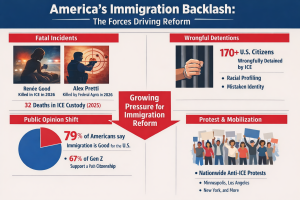
The enforcement surge reached a breaking point in Minneapolis in January 2026.
On January 7, 2026, Renée Nicole Good, a 37-year-old U.S. citizen and mother of three, was shot and killed by an ICE agent during an enforcement action in Minneapolis. The killing sparked immediate protest and scrutiny.
Details and reporting:
https://en.wikipedia.org/wiki/Killing_of_Ren%C3%A9e_Good
Just weeks later, on January 24, 2026, Alex Pretti — a 37-year-old ICU nurse and U.S. citizen working at a Veterans Affairs hospital — was shot and killed by federal agents during the same operational surge.
Details and reporting:
https://en.wikipedia.org/wiki/Killing_of_Alex_Pretti
Such incidents have fueled the Trump immigration enforcement backlash, leading to reform and a call for more humane practices.
These shootings occurred during “Operation Metro Surge,” a concentrated enforcement effort that became the catalyst for nationwide protest.
Operation background:
https://en.wikipedia.org/wiki/Operation_Metro_Surge
Peaceful protests spread across multiple cities, marking one of the largest waves of anti-ICE demonstrations in recent years.
National protest coverage:
https://en.wikipedia.org/wiki/2026_Anti-ICE_Protests_in_the_United_States
When U.S. citizens die during civil immigration operations, the political calculus changes.
This pattern is a result of the Trump immigration enforcement backlash that leads to reform, as citizens advocate for their rights.

Beyond fatal shootings, investigative reporting reveals a disturbing pattern: U.S. citizens detained, beaten, or held for days because they were suspected of being undocumented.
Investigations report:
Some lawmakers have described these incidents as unconstitutional detentions bordering on kidnapping when agents failed to verify citizenship before holding individuals.
When Americans see veterans and disabled citizens detained because they “looked like an immigrant,” support for mass deportation erodes rapidly.
This is not a partisan issue — it is a constitutional one.
Independent watchdog reporting and media investigations show rising deaths in ICE custody.
For example:
When enforcement policies result in visible harm — whether to immigrants or U.S. citizens — public perception changes.
This harm is often linked to the Trump immigration enforcement backlash that leads to reform, pushing for a reevaluation of policies.

Despite the rhetoric of a “mandate” for harsh enforcement, national polling tells a different story.
The data suggests enforcement escalation may be catalyzing reform sentiment.
Demography is destiny — and Gen Z is overwhelmingly pro-immigrant.
This demographic shift is part of the broader Trump immigration enforcement backlash that leads to reform, indicating a growing consensus for change.
HLG’s analysis of generational shifts:
https://www.lawfirm4immigrants.com/gen-z-immigration-attitudes/
American immigration history moves in cycles:
Periods of harsh enforcement have frequently been followed by recalibration.
Public backlash builds. Coalitions form. Reform windows open.
If trends continue:
Increased turnout among younger voters and suburban moderates could shift House control.
Immigration reform becomes central — not defensive — messaging.
Potential reforms could include:
In this context, the Trump immigration enforcement backlash leads to reform where comprehensive solutions are sought.
Aggressive enforcement may unintentionally unify the coalition that enacts reform.
With this backdrop, the Trump immigration enforcement backlash leads to reform that can reshape the immigration landscape.
To immigrant families living with fear:
You are not criminals.
You are parents, workers, students, caregivers, business owners, veterans’ spouses.
The American Dream has endured darker chapters than this.
History shows that when enforcement becomes excessive and unjust, America recalibrates.
The tragedies of Renée Good and Alex Pretti should never have happened.
The wrongful detention of U.S. citizens should never happen in a constitutional democracy.
But from visible injustice often comes reform.
The visibility of these injustices underscores how the Trump immigration enforcement backlash leads to reform, fueling public demand for change.
Help is not immediate — but it is building.
Hold on.
Reform will not arrive automatically.
Advocates must:
America’s story is an immigrant story.
When people see neighbors — not stereotypes — hearts change.
And when hearts change, elections follow.
Throughout American history, immigration reform has rarely emerged from calm, technocratic debate.
It has emerged from crisis.
From visible overreach.
From moments when the public sees — not abstract policy — but human consequences.
To understand what may be unfolding now, we introduce a framework:
This index describes a recurring five-stage cycle in American immigration politics.
When enforcement becomes highly visible and morally disruptive, it often triggers the very reform it was designed to prevent.
The federal government dramatically increases enforcement intensity and visibility.
Characteristics include:
In 2025–2026, this stage has included:
Escalation is designed to project strength.
But escalation increases visibility.
And visibility changes politics.
Enforcement becomes impossible to ignore.
This is when policy moves from the background into living rooms.
Visibility includes:
The Minneapolis killings of Renée Good and Alex Pretti were not just tragic events — they were visibility accelerants.
When civil immigration enforcement results in the deaths of U.S. citizens, the debate shifts.
It is no longer abstract.
It becomes constitutional.
Political backlash does not begin with statistics.
It begins with moral shock.
Moral shock occurs when the public perceives that enforcement has crossed a line.
It is the moment when:
At this stage, the issue expands beyond immigration policy.
It becomes about fairness.
About due process.
About American identity.
Moral shock destabilizes political coalitions.
It causes moderates and independents to reconsider alignment.
It activates younger voters.
It draws in faith communities and business leaders.
This is when enforcement begins to lose narrative control.
Backlash only becomes reform when coalitions form.
Historically, reform has required unlikely alliances:
In this stage, messaging shifts from defensive to proactive.
The conversation becomes:
This is where Gen Z becomes decisive.
Demography is destiny — but only if mobilized.
The final stage is political.
It requires:
Historically:
Reform does not follow quiet stability.
It follows visible dysfunction.
If current demographic trends, polling data, and public backlash continue, the 2026–2028 electoral cycle could create a 2029 reform window.
Not because enforcement succeeded — but because it overreached.
The Index suggests something important:
Aggressive enforcement can temporarily consolidate a political base.
But when enforcement becomes visible, violent, or constitutionally questionable, it expands the opposition coalition.
It converts:
The key insight:
Enforcement intensity does not linearly increase public support.
After a threshold, it reverses it.
That threshold is crossed when ordinary Americans see harm affecting “people like us.”
Veterans. Nurses. Parents. Citizens.
Based on:
The United States appears to be moving from Stage 3 (Moral Shock) toward Stage 4 (Coalition Formation).
Reform is not guaranteed.
But historically, this is the moment when reform becomes possible.
For immigrant families living under fear:
The Backlash-to-Reform cycle is not abstract theory.
It is historical pattern.
Moments of visible injustice often precede expanded rights.
That does not make tragedy acceptable.
It does mean tragedy can catalyze protection for millions.
Hold on.
Movements form in moments like this.
And history shows that when enforcement exceeds public comfort, America recalibrates.
There is growing evidence that Trump’s expanded immigration enforcement strategy has produced significant political backlash. High-profile shootings, wrongful detention of U.S. citizens, and rising deaths in ICE custody have generated national protests and increased scrutiny. At the same time, public opinion polls show record-high support for immigration as a positive force in the United States. Historically, visible enforcement overreach has often preceded immigration reform movements.
Investigative reporting indicates that more than 170 U.S. citizens have been mistakenly detained by immigration agents in recent years. Many cases involved racial profiling, mistaken identity, or delayed verification of citizenship status. Some detainees included veterans, individuals with disabilities, and U.S.-born citizens swept up during raids. These incidents have raised constitutional concerns and fueled public backlash.
In January 2026, two U.S. citizens — Renée Good and Alex Pretti — were shot and killed during federal immigration enforcement operations in Minneapolis as part of “Operation Metro Surge.” The shootings sparked nationwide protests and intensified scrutiny of aggressive immigration enforcement tactics. The incidents became a flashpoint in the national debate over immigration policy and civil liberties.
Reports from watchdog organizations and media outlets indicate that deaths in ICE custody reached one of the highest levels in decades in 2025, with at least 32 reported fatalities. Advocacy groups have documented additional deaths and use-of-force incidents in 2026. Rising detention populations combined with aggressive enforcement tactics have intensified oversight concerns.
Recent polling shows strong support for immigration among the American public:
These trends suggest that harsh enforcement policies may not align with broader public sentiment.
History suggests that aggressive enforcement periods can trigger reform movements. The 1986 Immigration Reform and Control Act followed years of enforcement gridlock. The LIFE Act of 2000 expanded adjustment pathways after prolonged backlogs. If public backlash continues and demographic trends hold, a political reform window could emerge between 2026 and 2029.
Potential immigration reform proposals could include:
While reform is not guaranteed, political momentum appears to be building.
Gen Z is the most racially and ethnically diverse generation in U.S. history. Polling shows they are significantly more supportive of immigration expansion and legalization pathways than older cohorts. As Gen Z increases its share of the electorate in 2026 and 2028, immigration reform becomes increasingly viable politically.
Most immigration violations are civil, not criminal. This distinction is important because civil enforcement actions should be governed by constitutional protections, due process, and proportional response standards. When enforcement tactics resemble criminal tactical operations, civil liberties concerns intensify.
Reform movements historically succeed when they:
Public persuasion — not just policy drafting — determines reform outcomes.
Trump’s enforcement strategy was designed to demonstrate power and control.
Instead, it may be accelerating a backlash rooted in:
History suggests the pendulum swings.
The events of 2025 and 2026 may ultimately be remembered not as the high-water mark of enforcement — but as the inflection point that led to reform.
Immigration reform is not inevitable.
Thus, the Trump immigration enforcement backlash leads to reform, representing a pivotal moment for immigration policy in America.
But it is more possible now than it was before the overreach.
And that is where hope lives.
Before analyzing impact, here are the actual legal authorities:
Understanding the Maldonado Bautista bond hearings is crucial for anyone involved in immigration proceedings.
BIA — Matter of YAJURE HURTADO, 29 I&N Dec. 216 (BIA 2025)
https://www.justice.gov/eoir/media/1413311/dl?inline=
Maldonado Bautista v. Santacruz — Order Granting Partial Summary Judgment and Class Certification (Dec. 18, 2025)
https://www.aclu.org/cases/maldonado-bautista-v-santacruz?document=Order-Granting-Partial-Summary-Judgment
Federal Order Vacating Matter of Yajure Hurtado (Feb. 18, 2026) — Confirmed by AILA Practice Alert
https://www.aila.org/library/practice-alert-district-court-vacates-yajure-hurtado

For most of modern immigration practice, interior arrests of noncitizens who entered without inspection were governed by INA § 236(a) — meaning they were eligible for bond hearings before an Immigration Judge.
The Maldonado Bautista bond hearings are a pivotal aspect of immigration law that impacts many lives.
The 2025 BIA decision in Matter of Yajure Hurtado changed that.
It allowed DHS to treat long-term interior residents as “applicants for admission” under INA § 235(b)(2) — eliminating Immigration Judge bond authority.
The practical result:
Widespread denial of bond hearings
Consequences of denying Maldonado Bautista bond hearings can be severe for detainees.
Prolonged detention without custody review
Litigation surge across multiple federal courts
The December 18, 2025 and February 18, 2026 federal court orders reversed that expansion.
The recent developments in the Maldonado Bautista bond hearings highlight the importance of legal precedents in immigration law.
Analyzing the outcomes of the Maldonado Bautista bond hearings reveals trends in immigration law.
The question now is not whether California detainees benefit.
The question is how this plays out in Ohio, Texas, Florida, Georgia, Michigan, and beyond.

The Maldonado Bautista ruling did five critical things:
This certification directly affects the Maldonado Bautista bond hearings across the country.
The class definition governs relief.
Class membership depends on:
Entry without inspection
Interior arrest (not recent border arrival)
Not subject to § 236(c) criminal mandatory detention
Not subject to expedited removal
Class certification is not geographically limited.
It applies to qualifying detainees regardless of detention location.
The court concluded that DHS’s blanket interpretation collapsing § 235 and § 236 was inconsistent with statutory structure.
Congress created distinct detention tracks:
§ 235(b) → border/arrival detention
§ 236(a) → removal proceedings detention
§ 236(c) → criminal mandatory detention
Interior arrests belong in § 236(a).
The Maldonado Bautista bond hearings set a precedent that influences future legal interpretations.
The ruling invalidated the July 2025 DHS memo instructing ICE to deny bond categorically.
This matters because many bond denials relied on that guidance.
Legal advocates are preparing for the implications of the Maldonado Bautista bond hearings.
Even before the February 18 vacatur of Hurtado, federal courts had authority to enforce the class order.
That provided leverage for habeas petitions nationwide.
The February 18 order vacated Matter of Yajure Hurtado itself under the Administrative Procedure Act (5 U.S.C. § 706).
That is legally distinct from an injunction.
Vacatur:
Removes the agency precedent
Eliminates its binding authority
Prevents reliance on it nationwide unless overturned
This means:
Judges will need to reconsider their stance on Maldonado Bautista bond hearings after recent rulings.
Immigration Judges cannot cite Hurtado as binding authority.
They must interpret the statute independently.
That dramatically shifts the legal terrain.
The evolving landscape of Maldonado Bautista bond hearings requires continuous legal adaptation.
In the short term, expect:
Inconsistent IJ compliance
Resistance in some jurisdictions
Increased bond motions citing vacatur
Increase in federal habeas petitions
Appeals by DHS
Some Immigration Judges will comply immediately.
Others will delay pending circuit guidance.
The Maldonado Bautista bond hearings emphasize the need for clear legal standards.
Over time, expect:
Circuit courts addressing the issue
Growing body of habeas decisions enforcing § 236(a)
Pressure on EOIR to issue implementing guidance
Strategic shift in ICE custody classification practices
Once multiple district courts follow the same statutory reasoning, the government’s geographic limitation argument weakens further.
If appellate courts affirm the reasoning:
Interior no-bond classification will collapse nationally.
DHS may be forced to restructure detention processing.
Prolonged detention litigation will shift toward due process timelines rather than jurisdictional fights.
This could become one of the most significant detention law clarifications in the past decade.
Yes.
Common arguments you will hear:
“District court rulings are not binding here.”
“This is a California case.”
“Circuit precedent controls.”
“Appeals are pending.”
Here is how to respond.

Distinguish between:
A persuasive district court opinion
An APA vacatur of an agency precedent
Vacatur removes the BIA decision itself.
Understanding the implications of the Maldonado Bautista bond hearings is essential for legal practitioners.
If Hurtado no longer exists as precedent, there is no binding authority for no-bond classification.
That shifts the burden back to statutory interpretation.
Relief applies to class members.
Class definition is not geographic.
If your client qualifies under the class criteria, argue entitlement under the order.
Focus the IJ on:
Text of § 236(a)
Historical detention practice
Congressional separation of § 235 and § 236
Absence of statutory language mandating no-bond for all EWIs
Make the IJ rule on the statute, not geography.
If an IJ denies jurisdiction:
Request written custody determination
Request citation of authority
Preserve issue for BIA and habeas
Record preservation is critical for federal court review.

For detainees in Ohio, Michigan, Texas, Georgia, Florida:
Include:
Citation to § 236(a)
December 18 order
February 18 vacatur
Class definition argument
Due process concerns
Preserve objection
Consider BIA appeal (if viable)
Prepare federal habeas petition under 28 U.S.C. § 2241
Federal courts are often more receptive to statutory detention arguments than immigration courts.
Below is a more developed motion section suitable for filing:
The Maldonado Bautista bond hearings represent a shift in how bond eligibility is determined.
Respondent was arrested in the interior of the United States and placed into removal proceedings. DHS has classified detention under INA § 235(b)(2)(A). However, Respondent was not apprehended at a port of entry and is not subject to expedited removal.
The appropriate statutory framework is 8 U.S.C. § 1226(a), which governs detention during removal proceedings and authorizes Immigration Judges to conduct bond redetermination hearings.
The Board of Immigration Appeals’ decision in Matter of YAJURE HURTADO, 29 I&N Dec. 216 (BIA 2025), was vacated by federal court order on February 18, 2026 pursuant to 5 U.S.C. § 706.
A vacated precedent has no binding effect.
This Court cannot rely on Hurtado to deny bond jurisdiction.
In Maldonado Bautista v. Santacruz, the U.S. District Court certified a nationwide class of interior EWI detainees entitled to bond hearings under INA § 236(a).
Respondent meets the class criteria.
Relief under the class order is not geographically limited.
INA § 236(a) states that DHS “may continue to detain” or “may release on bond.”
The statute presumes bond authority in removal proceedings absent a specific mandatory detention provision.
Respondent is not subject to § 236(c).
Therefore, bond jurisdiction exists.
Prolonged detention without individualized review implicates fundamental liberty interests.
Bond redetermination is necessary to ensure compliance with constitutional safeguards.
In addition to jurisdictional arguments, include:
Proof of community ties
Employment letters
Proof of residence
Family affidavits
No-criminal record evidence
Proposed sponsor
Rehabilitation evidence (if applicable)
For additional bond hearing preparation guidance, see:
Immigration Bond Hearing Guide
https://www.lawfirm4immigrants.com/immigration-bond-hearing-guide/
ICE Detention Resource Guide
https://www.lawfirm4immigrants.com/how-ice-enforcement-harms-vulnerable-populations/
Expect DHS to argue:
With the Maldonado Bautista bond hearings, detainees have more avenues for legal recourse.
Statutory ambiguity
Chevron-style deference (if raised)
Narrow reading of class
Distinguishing factual posture
Appeal pending
Prepare responses focusing on:
Plain statutory text
Separation of detention provisions
Vacatur effect
Liberty interest at stake
Two federal court actions reshaped detention litigation:
December 18, 2025 — Maldonado Bautista v. Santacruz
Nationwide class certification and ruling that qualifying interior EWI detainees fall under INA § 236(a).
February 18, 2026 — Vacatur of Matter of Yajure Hurtado
Removal of the BIA precedent that eliminated Immigration Judge bond authority.
The key litigation question now:
Will Immigration Judges and federal courts in each circuit enforce bond eligibility for interior EWIs — or resist?
Below is a circuit-by-circuit strategic risk assessment of non-compliance with Bautista.
The issuing district court (Central District of California) sits within the Ninth Circuit.
The class action originated here.
Ninth Circuit jurisprudence has historically been receptive to detention challenges.
District courts in the Ninth Circuit are more likely to treat the vacatur as binding.
Immigration Judges more likely to grant bond hearings.
Federal habeas petitions likely to succeed if IJs resist.
Lower likelihood of geographic limitation arguments prevailing.
Aggressively cite vacatur.
Attach class definition.
Preserve record but expect higher compliance.
The First Circuit has previously shown concern over prolonged detention.
No strong precedent endorsing universal § 235 classification of interior EWIs.
The implications of the Maldonado Bautista bond hearings cannot be overstated.
Courts likely to independently analyze statute rather than defer to DHS expansion.
Mixed IJ compliance.
Federal district courts may be receptive to habeas relief.
Geographic limitation arguments may be raised but weakly.
Emphasize statutory text.
Highlight absence of circuit precedent endorsing DHS’s broader reading.
Frame case as statutory interpretation rather than California-specific relief.
The Second Circuit has complex detention jurisprudence.
Some deference to agency interpretations historically.
However, district courts in SDNY and EDNY are active in immigration litigation.
Immigration Judges may initially resist.
Federal habeas likely viable.
Courts may focus on statutory structure and due process.
Lead with vacatur argument.
Emphasize statutory separation between § 235 and § 236.
Frame as national APA issue, not regional injunction.
Historically deferential to statutory detention framework in certain contexts.
District courts may independently interpret statute rather than treat vacatur as binding.
IJs may resist.
Federal courts may require extensive statutory briefing.
Appeals likely.
Prepare comprehensive statutory analysis.
Preserve constitutional due process claims.
Expect need for habeas enforcement.
Historically conservative detention jurisprudence.
Greater likelihood of geographic limitation argument gaining traction.
Potential skepticism of nationwide vacatur concept.
IJs may deny bond citing circuit autonomy.
Federal courts may require robust statutory argumentation.
Appeals likely.
Do not rely solely on vacatur.
Lead with plain text statutory argument.
Emphasize absence of statutory mandate for universal no-bond.
Preserve record meticulously.
Historically restrictive immigration rulings.
Strong deference to DHS enforcement authority.
Likely skepticism toward nationwide class relief from another circuit.
High IJ resistance.
Federal district courts may narrowly interpret vacatur.
Litigation likely to escalate quickly.
Build layered arguments:
Vacatur
Statutory text
Constitutional due process
Prepare for appeal.
Consider strategic habeas venue planning if possible.
Mixed detention jurisprudence.
District courts vary significantly.
Northern District of Ohio active in immigration habeas.
Some IJs will resist.
Many are looking to the Maldonado Bautista bond hearings for guidance in ongoing cases.
Federal courts may engage deeply with statutory structure.
Habeas viable but requires detailed briefing.
Present detailed statutory construction.
Emphasize vacatur removes binding precedent.
Preserve constitutional claims.
Statutory textualist approach common.
Courts may reject agency overreach.
Less predictable but not uniformly restrictive.
Mixed IJ compliance.
Federal courts likely to focus on statutory language.
Strong textual analysis.
Emphasize congressional separation of detention categories.
Historically deferential to enforcement authority.
Less developed body of detention challenge precedent.
Significant IJ resistance.
Federal courts may independently analyze statute without deferring to vacatur effect.
Emphasize absence of statutory authority for blanket no-bond.
Prepare for appeal.
Mixed immigration rulings.
Courts likely to require full statutory briefing.
Some IJ resistance.
Habeas viable but not automatic.
Lead with statutory interpretation.
Frame case narrowly to avoid ideological overlay.
Historically restrictive immigration jurisprudence.
Skepticism toward nationwide orders from outside circuit.
IJs likely to resist.
Federal courts may narrowly construe class effect.
Prepare layered statutory + constitutional argument.
Preserve issue for potential Supreme Court review.
Strong administrative law tradition.
Familiar with APA vacatur doctrine.
Federal courts may recognize nationwide vacatur effect.
IJs may still require motion practice.
Lead heavily with APA doctrine.
Emphasize “set aside” language in 5 U.S.C. § 706.
Ninth
First
Possibly Seventh
Fifth
Fourth
Eleventh
Eighth
Sixth
Third
Tenth
The Maldonado Bautista bond hearings highlight the ongoing challenges in immigration law.
Second
Never rely solely on geographic scope arguments.
Always pair vacatur argument with:
Plain statutory text
Structural analysis
Congressional intent
Preserve issue for federal habeas.
Build strong factual bond record simultaneously.
Expect appellate development.
The February 18, 2026 vacatur significantly weakens the no-bond framework nationwide.
However:
Implementation will vary sharply by circuit.
High-risk circuits will require aggressive litigation.
Habeas enforcement will be central outside the Ninth Circuit.
Circuit splits are likely within 12–24 months.
This is not settled law yet.
But the statutory foundation now favors restoration of bond eligibility for qualifying interior detainees across the country.
□ INA § 235(b)(2) (Applicant for Admission – Mandatory)
□ INA § 236(a) (Discretionary)
□ INA § 236(c) (Criminal Mandatory)
□ Expedited Removal (235(b)(1))
File bond packet immediately.
Focus on:
Flight risk
Danger
Equities
Sponsor
Employment
Community ties
(See bond preparation guidance: https://www.lawfirm4immigrants.com/immigration-bond-hearing-guide/)
Timing issue?
Qualifying offense?
Sentence threshold?
Conviction vs. charge?
If criminal trigger weak:
→ File Joseph hearing (if viable)
→ Preserve issue for appeal
→ Consider habeas
If clearly triggered:
→ Shift focus to constitutional prolonged detention argument
Proceed to Step 2.
Entered without inspection?
Arrested in interior (not recent border entry)?
Not subject to expedited removal?
Not detained under § 236(c)?
If YES → Strong § 236(a) argument
If NO → Tailor argument to statutory structure + due process
Statutory argument:
§ 236(a) governs interior detention
December 18 class certification order
February 18 vacatur of Yajure Hurtado
Argument that vacated precedent cannot bind IJ
Due process concerns
Full bond packet
→ Conduct bond hearing
→ Present equities
→ Seek reasonable bond
Common reasoning:
“California ruling not binding here”
“Appeal pending”
“Circuit precedent controls”
Proceed to Step 5.
Future Maldonado Bautista bond hearings will continue to shape immigration policy.
Immediately:
Request written decision
Request citation of authority
Object on statutory grounds
Note vacatur in record
Preserve constitutional arguments
Do NOT rely on oral denial only.
Pros:
Exhaustion
Record development
Cons:
Slow
BIA may resist
Best for:
Clean statutory issue
Client not suffering urgent harm
Strongest in:
Circuits receptive to detention challenges
Cases with prolonged detention
Clear statutory misclassification
Habeas arguments should include:
Vacatur removes binding precedent
§ 236(a) governs detention
Class membership
Due process violation
Liberty interest
Federal district court may:
A) Order bond hearing
B) Remand for custody review
C) Conduct its own statutory analysis
If district court denies:
→ Consider appeal to circuit court
Aggressive IJ motion practice
Habeas likely successful
Strong statutory briefing
Expect mixed IJ response
Habeas viable
Expect IJ resistance
Prepare for immediate habeas
Layer statutory + constitutional arguments
Preserve issue for appellate review
If detention exceeds 6–12 months:
Add due process claim:
Unreasonable detention
Increased scrutiny of Maldonado Bautista bond hearings will likely follow.
Lack of individualized review
Burden shifting argument
Heightened bond standard challenge
This strengthens federal habeas case regardless of statutory classification.
✔ Notice to Appear
✔ I-213
✔ Arrest record
✔ Entry timeline
✔ Criminal records (if any)
✔ ICE custody classification
✔ Proof of community ties
✔ Sponsor affidavit
✔ Employment letter
✔ Tax records
✔ Family affidavits
Response:
Vacatur nullifies agency precedent.
No binding authority remains.
Response:
District court order remains effective unless stayed.
Response:
Congressional separation of §§ 235, 236(a), 236(c) is explicit.
Response:
Show client fits class criteria.
Interior EWI Arrest
↓
DHS Classifies Under § 235(b)
↓
File Bond Motion Under § 236(a)
↓
IJ Grants? → Yes → Proceed to bond merits
↓
No
↓
Preserve Record
↓
BIA Appeal OR Habeas
↓
Federal Court Enforcement
Always lead with statutory structure.
Never rely solely on geographic arguments.
Preserve record for federal review.
Build strong factual bond package simultaneously.
Consider habeas earlier in high-risk circuits.
Monitor appellate developments closely.
In most cases, yes.
When a federal court vacated Matter of Yajure Hurtado under the Administrative Procedure Act, it removed the BIA precedent that had eliminated Immigration Judge bond jurisdiction for many people who entered without inspection.
Because the precedent was vacated — not merely enjoined — Immigration Judges can no longer treat it as binding authority.
However, implementation may vary by circuit, and some courts may require litigation to enforce bond eligibility.
The distinction is critical.
INA § 235(b) governs applicants for admission and is often used to argue mandatory detention.
INA § 236(a) governs detention during removal proceedings and allows bond hearings before an Immigration Judge.
For decades, people arrested in the interior after entering without inspection were detained under § 236(a).
The Hurtado decision attempted to classify many of them under § 235(b), eliminating bond hearings. The Bautista litigation reversed that expansion.
Generally, individuals who:
Entered the United States without inspection
Were arrested in the interior (not immediately at the border)
Are not subject to expedited removal
Are not detained under criminal mandatory detention (§ 236(c))
may qualify for bond eligibility under INA § 236(a).
Eligibility depends on the facts of the arrest and detention classification.
Some may attempt to.
Common arguments include:
The ruling was issued in California.
District court decisions are not binding nationwide.
Appeals may be pending.
However:
The vacatur of Yajure Hurtado removes the binding BIA precedent.
The outcomes of the Maldonado Bautista bond hearings will set new legal standards.
Class certification in Bautista applies to qualifying class members regardless of detention location.
The statutory structure of the INA favors § 236(a) for interior arrests.
In resistant jurisdictions, federal habeas petitions may be required to enforce bond rights.
If an IJ denies jurisdiction:
Request a written custody decision.
Preserve the objection in the record.
File a motion to reconsider citing the vacatur.
Consider filing a federal habeas corpus petition under 28 U.S.C. § 2241.
Federal courts can order Immigration Judges to provide bond hearings when detention classification is unlawful.
A habeas petition under 28 U.S.C. § 2241 asks a federal district court to review the legality of detention.
It is commonly used when:
Immigration Judges refuse bond jurisdiction
Detention is prolonged without review
Statutory misclassification occurs
Habeas is often the strongest enforcement tool outside the Ninth Circuit.
No.
The vacatur removes the no-bond precedent.
It does not automatically release anyone.
Detainees must:
Request bond hearings
File appropriate motions
Litigate eligibility if necessary
Release still depends on demonstrating:
No flight risk
No danger to the community
There is no fixed statutory time limit.
However:
Prolonged detention without individualized custody review raises constitutional due process concerns.
Federal courts have ordered bond hearings in cases of extended detention.
If detention exceeds 6–12 months without meaningful review, additional constitutional arguments strengthen.
Yes.
If a detainee falls under INA § 236(c) (criminal mandatory detention), bond may not be available.
Key questions include:
Does the offense qualify?
Was there a qualifying conviction?
Was detention triggered correctly?
If § 236(c) does not apply, § 236(a) bond authority may still exist.
Strong bond packages typically include:
Proof of residence
Employment letters
Sponsor affidavit
Community ties
Tax returns
Family hardship evidence
No-criminal record documentation
Rehabilitation evidence (if applicable)
Jurisdictional arguments alone are not enough — the merits of bond matter.
Appeals are possible and likely.
Until a higher court reverses or stays the decision, district court rulings remain enforceable.
Courts typically require compliance unless a stay is issued.
Legal representatives must prepare for potential challenges arising from Maldonado Bautista bond hearings.
It is possible.
If circuit courts split on:
The nationwide effect of vacatur
The classification of interior EWIs
The scope of detention authority
the issue could reach the Supreme Court within 1–3 years.
Based on current detention jurisprudence:
Higher resistance expected in:
Fifth Circuit
Eleventh Circuit
Fourth Circuit
More favorable enforcement likely in:
Ninth Circuit
First Circuit
Some Seventh Circuit jurisdictions
Litigation strategy should adjust accordingly.
Not automatically.
If someone is subject to expedited removal under INA § 235(b)(1), different procedures apply.
The Bautista ruling primarily affects detention classification for individuals placed in removal proceedings under § 240.
The most important shift is this:
Immigration Judges can no longer rely on Matter of Yajure Hurtado as binding authority to deny bond jurisdiction.
That reopens statutory arguments under INA § 236(a) for interior detainees nationwide.
The Maldonado Bautista bond hearings represent a significant development in immigration law.
However, enforcement requires strategic motion practice and, in some circuits, federal litigation.
The February 18 vacatur dramatically shifts leverage back to detainees — but enforcement will vary by circuit.
The strongest cases will combine:
Statutory clarity
Class eligibility
Vacatur argument
Constitutional due process
Strong equities
As we analyze the Maldonado Bautista bond hearings, it becomes clear that change is needed.
Litigation discipline is critical.
Implementation will vary.
Preparation matters.
Record preservation matters.
Access to Maldonado Bautista bond hearings is a critical issue for many immigrants.
This is a comprehensive, citation-ready resource hub for: immigration bond hearings, no-bond detention under INA § 235(b), § 236(a) custody redetermination, habeas corpus for bond, and post-Bautista detention strategy.
Find the person in custody (name + DOB + country of birth OR A-number)
ICE Online Detainee Locator System
The Maldonado Bautista bond hearings can provide insights into future trends.
Confirm the detention statute being used
§ 236(a) (bond-eligible in many cases)
§ 236(c) (mandatory detention for certain convictions)
Many are now prepared for the legal ramifications of the Maldonado Bautista bond hearings.
§ 235(b) (often “no bond jurisdiction” arguments)
Expedited removal / reinstatement complications
File the correct custody request
If § 236(a): request an IJ bond redetermination hearing
If IJ says “no jurisdiction” under § 235(b): prepare federal habeas strategy
These are the best HLG starting points for 2026 bond + detention litigation planning:
The Colossal Impact of the Bautista ICE detention ruling 2026 (Yajure Hurtado vacated)
Use for: the big-picture legal shift, argument framing, and practical detention strategy.
ICE Detention in Ohio: How to file Habeas for Bond Hearings
Use for: step-by-step § 2241 habeas planning when an IJ says “no bond jurisdiction,” including venue logic for Ohio facilities.
2025 BIA Bond Rulings & No-Bond Immigration Detention
Use for: explaining the BIA “no-bond” framework, how it evolved, and how to build a release plan (bond, parole, PD, habeas).
Bond in Ohio: What to Do in the First 72 Hours After an ICE Arrest
Use for: family rapid-response checklist, evidence collection, and early bond posture.
How to Prepare for an ICE Arrest in Columbus, Ohio
Use for: prevention + first-72-hours strategy, including household scripts and early detention planning.
HLG bond fundamentals (evergreen but useful):
Understanding the Maldonado Bautista bond hearings is vital for effective advocacy.
Use these to anchor briefs, motions, and media explainers.
As the Maldonado Bautista bond hearings unfold, legal strategies will need adapting.
These are the external resources most likely to be cited by courts and relied on in habeas/bond motions.
American Immigration Council practice advisory: Detention under INA § 235(b)
Best for: building the statutory distinction between § 235(b) vs § 236(a) and outlining release pathways (parole, DHS, EOIR, federal court).
American Immigration Council practice advisory PDF: Detention under INA § 235(b)
Best for: attaching as an exhibit and quoting clearly in legal filings.
ILRC PDF: Representing Clients in Bond Hearings — Introductory Guide
Best for: bond hearing mechanics, burdens, evidence strategy, and courtroom practice.
Federal Bar Association PDF: Mandatory Detention, Bond Redetermination, & Appeal
Best for: structured overview, checklists, and quick legal references.
These help you operationalize a bond case fast.
Use these to add current detention metrics and case trends.
When preparing a bond motion or habeas petition, build your citations and exhibits like this:
EOIR bond rules: EOIR Policy Manual 8.3
Filing mechanics: EOIR Practice Manual PDF
Deep statutory briefing: AIC § 235(b) advisory
Attach PDF exhibit: AIC § 235(b) advisory PDF
This evolution in Maldonado Bautista bond hearings emphasizes the importance of advocacy.
Checklist + workflow: NIJC quick-start
Samples: Immigration Justice Campaign bond submission toolkit
Practice guide: ILRC PDF
Immediate actions: Bond in Ohio (first 72 hours)
“No bond jurisdiction” response: ICE Detention in Ohio: habeas guide
Consult a youngstown ICE detention lawyer for effective representation.
If you need assistance, contact a youngstown ICE detention lawyer for expert guidance.
Finding a qualified youngstown ICE detention lawyer can significantly impact your case.
When someone is detained by ICE in Youngstown, Ohio, families are often thrown into chaos: multiple facilities, multiple agencies, a confusing court system, and urgent legal deadlines. What makes Youngstown detention particularly challenging is that many detainees are denied bond not because they are dangerous or a flight risk, but because ICE claims the immigration judge has “no jurisdiction” to even hold a bond hearing.
Having a youngstown ICE detention lawyer on your side is crucial for timely action.
A youngstown ICE detention lawyer can help navigate the system effectively.
When facing ICE, having a youngstown ICE detention lawyer ensures your rights are protected.
This article is designed to be the definitive, Ohio-specific resource on:
Which facilities hold ICE detainees in the Youngstown area
How to locate a detainee quickly (even after transfers)
How phone, mail, and visitation typically work
How to pursue immigration bond through Cleveland Immigration Court
What to do when a judge says “no bond jurisdiction” (often in EWI cases)
How to file federal habeas corpus under 28 U.S.C. § 2241 in the Northern District of Ohio
The most important national development: the Maldonado Bautista v. Santacruz class action and Final Judgment declaring covered detainees are under § 1226(a) (bond-eligible), not § 1225(b)(2) (mandatory detention)
If your loved one is detained in Youngstown (NEOCC or Mahoning County Justice Center), you can speak with Herman Legal Group here:
Book a consultation
If you need legal assistance, consider consulting a youngstown ICE detention lawyer who can guide you through the complexities of the system.
A youngstown ICE detention lawyer will provide invaluable assistance throughout the legal process.
Consulting a youngstown ICE detention lawyer can provide clarity in complex cases.
Consulting with a youngstown ICE detention lawyer is essential for understanding your options.

A youngstown ICE detention lawyer can assist in understanding your rights.
Contact a youngstown ICE detention lawyer if you have questions about your case.
“ICE detention in Youngstown” usually means one of two locations.
Engaging a youngstown ICE detention lawyer can help you navigate your rights.
2240 Hubbard Road, Youngstown, OH 44505
NEOCC publishes facility rules and contact procedures in its facility document:
Northeast Ohio Correctional Center Facility Information (CoreCivic PDF)
The Ohio Department of Rehabilitation and Correction lists NEOCC here:
Northeast Ohio Correctional Center (Ohio DRC)
110 Fifth Avenue, Youngstown, OH 44503
Mahoning County jail information is here:
Mahoning County Inmate Information
Mahoning County’s public inmate search portal is here:
Mahoning County Public Inmate Lookup
Important: ICE detainees can be moved with little notice. Families should assume transfers can occur at any time, especially after court hearings, medical visits, or classification changes.
The first place to check is ICE’s public locator:
ICE Online Detainee Locator System
Best practice: Use the A-number + country of birth. Name searches frequently fail due to spelling variations, hyphens, accents, and data entry errors.
If the person was detained in the last day or two, the locator may not update immediately. In that window, you may need to call.
NEOCC ICE listing:
ICE – Northeast Ohio Correctional Center
Mahoning County Justice Center ICE listing:
ICE – Mahoning County Justice Center
Have ready:
Full legal name
Date of birth
A-number (if known)
Country of birth
Date of arrest and arresting agency (ICE, local police, state troopers, etc.)
If the person is suspected of being at Mahoning County, use:
Mahoning County Public Inmate Lookup

Phone systems can differ by facility and can change. One commonly used service portal for NEOCC communication is:
ConnectNetwork – NEOCC (ICE)
Practical tips:
Expect outgoing calls only; detainees typically cannot receive direct inbound calls.
Ask the detainee what system is being used and whether you must pre-fund an account.
Keep a running “detainee file”: A-number, facility, booking date, housing unit (if available), attorney contact, Cleveland court date, and key documents.
NEOCC’s facility document includes mail rules and required addressing format:
NEOCC Mail Policies (CoreCivic PDF)
Use this standard addressing format:
Detainee Full Name + Registration Number
Northeast Ohio Correctional Center
2240 Hubbard Road
Youngstown, OH 44505
Common pitfalls:
Missing the registration/A-number can delay or block delivery.
Books and magazines often must be shipped directly from publishers or approved retailers (review facility rules before ordering).
Start with county guidance here (then confirm ICE-specific restrictions by calling the facility):
Mahoning County Inmate Information

NEOCC’s visitation guidance appears in its facility documentation:
NEOCC Visitation Policies (CoreCivic PDF)
Before traveling, confirm:
Whether visits are in-person or video
Whether appointments are required
Visitor ID requirements
Dress code rules
Whether ICE detainees have separate procedures
Mahoning County visitation info:
Mahoning County Visitation

Families often seek help from a youngstown ICE detention lawyer for effective representation.
Families often rely on a youngstown ICE detention lawyer for effective representation.
Families often assume “bond denied” means the detainee is considered dangerous. In many Youngstown cases, that’s not what happened.
Instead, ICE claims the detainee is held under a detention statute that makes the person ineligible for bond, and the immigration judge agrees they lack authority to hold a bond hearing.
The battle usually turns on which statute governs detention:
Bond-eligible discretionary detention:
8 U.S.C. § 1226
Mandatory detention for certain “applicants for admission”:
8 U.S.C. § 1225
ICE has argued that people who entered without inspection (“EWI”) are treated as “applicants for admission” and therefore fall into § 1225(b)(2) mandatory detention. Immigration judges have sometimes relied on the BIA decision:
Matter of Yajure Hurtado (BIA 2025)
When the judge says “no bond jurisdiction,” the case often shifts into federal court via habeas corpus.
Youngstown detainees typically litigate custody in Cleveland Immigration Court.
Court information:
Cleveland Immigration Court (EOIR)
Check case status here:
EOIR Automated Case Information (ACIS)
What you’re trying to secure is a custody redetermination hearing (bond hearing) under § 1226(a) when available:
8 U.S.C. § 1226(a) (Cornell LII)
If bond jurisdiction exists, you should treat the bond hearing like a mini-trial: the judge is deciding whether the detainee can safely be released and whether the person will come back to court.
The judge is evaluating two core issues:
Danger to the community
Flight risk
Your bond packet should be organized and indexed, with the most persuasive items first.
Include:
Marriage certificate, children’s birth certificates
Proof of stable residence (lease, mortgage, utility bills)
Letters from family, clergy, employers, and community members (signed, dated, specific)
Evidence of long-term presence in Ohio (tax filings, medical records, school records)
Include:
Employer support letter (job title, wages, schedule, and confirmation of employment)
Pay stubs (recent)
Proof of lawful or pending work authorization if applicable (do not guess; document it)
If there is any criminal history, do not minimize or omit it. Provide:
Certified dispositions
Proof of compliance with probation, court orders, treatment, counseling
Letters of rehabilitation and community support
Evidence showing charges dismissed or reduced (where true)
For those facing detention, hiring a youngstown ICE detention lawyer is essential.
To ensure a successful outcome, hiring a youngstown ICE detention lawyer is essential.
If the detainee has serious medical issues, disabilities, or caregiving responsibilities, document:
Diagnoses
Treatment needs
Risk of harm in detention
Family dependency evidence
Use this as a practical structure for a bond hearing packet. The goal is to make it easy for the immigration judge to see: (1) the person will appear for court and (2) release is safe.
Detainee full name
A-number
Facility (NEOCC / Mahoning County Justice Center)
Hearing date/time (if set)
Counsel information
A clean index with short exhibit descriptions.
Copy of NTA
Any custody/bond orders
EOIR case status printout from EOIR ACIS
Lease/mortgage
Utility bills
Sponsor ID + proof of address
Family relationship documents (marriage certificate, birth certificates)
Employer letter (job title, schedule, wages, return-to-work confirmation)
Pay stubs (recent)
Tax filings (if available)
Letters from clergy, community leaders, neighbors, family
Each letter should be signed, dated, and include contact info
Certified dispositions
Proof of compliance (probation completion, treatment programs)
Rehabilitation documentation
Diagnoses and treatment records
Caregiving obligations (children, elderly parents)
Documentation showing detention-related medical risk
Exact address upon release
Transportation plan for Cleveland hearings
Compliance plan (check-ins, reminders, counsel communications)
Declaration of Sponsor in Support of Immigration Bond
I, ____________________________, declare as follows:
Identity and relationship. I am ___ years old. I reside at ______________________________ in Ohio. I am the __________________ (relationship) of ____________________________ (detainee), A-Number __________________.
Housing and stability. If ____________________________ is released from ICE custody, they will reside with me at the address above. This is a stable residence, and I have authority to allow them to live here.
Support and supervision. I will provide housing and basic support. I will help ensure they attend all immigration court hearings in Cleveland and comply with any reporting requirements.
Transportation plan. I will provide transportation to Cleveland Immigration Court when required (or arrange reliable transportation). I understand hearing dates can change and I will monitor the schedule with counsel.
Compliance assurance. I understand the importance of court appearances. I will remind ____________________________ of all hearing dates and help coordinate communication with their attorney.
Contact information. I can be reached at:
Phone: ____________________________
Email: ____________________________
I declare under penalty of perjury that the foregoing is true and correct.
Date: ____________________
Signature: ______________________________
Printed Name: ___________________________
(Attach sponsor ID and proof of address as exhibits.)
Your release plan should include:
Exact release address (with proof)
Sponsor declaration (who will house the person and ensure compliance)
Transportation plan to Cleveland hearings
Compliance plan (check-ins, reminders, legal counsel contact)
Use case: The respondent requests a bond hearing or custody redetermination and ICE asserts detention is under INA § 235(b)(2) (8 U.S.C. § 1225(b)(2)), arguing the Court lacks jurisdiction. These paragraphs are drafted to preserve statutory classification arguments, invoke the Bautista framework, and build a clean record for federal habeas review if needed.
Respondent respectfully requests an individualized custody determination and a bond hearing. ICE asserts Respondent is detained under INA § 235(b)(2) and that this Court lacks bond jurisdiction. Respondent contests that statutory classification. The correct detention authority is INA § 236(a) (8 U.S.C. § 1226(a)), which authorizes release on bond and requires an individualized custody determination. Compare 8 U.S.C. § 1225 with 8 U.S.C. § 1226.
Respondent was arrested in the interior of the United States (including in Ohio), not at a port of entry. ICE served a Notice to Appear and placed Respondent in removal proceedings. Respondent is not seeking to relitigate the merits of removability through this custody request. The narrow issue is whether ICE has correctly identified the governing detention statute. Respondent’s detention posture is consistent with § 1226(a) custody and therefore warrants a bond hearing.
Respondent recognizes that DHS and immigration courts have referenced Matter of Yajure Hurtado (BIA 2025) in custody jurisdiction disputes. However, Respondent preserves the argument that ICE’s reliance on § 1225(b)(2) here is a misclassification under the INA. The Court should make explicit findings on (1) which statute DHS claims governs custody and (2) whether the Court is denying jurisdiction based on that statute, so that the statutory basis for detention is clearly preserved.
A federal district court has rejected DHS’s broad application of § 1225(b)(2) mandatory detention to covered interior detainees and entered judgment declaring that covered detainees are detained under § 1226(a). See Maldonado Bautista v. Santacruz (Final Judgment) and the court’s Class Certification and Summary Judgment Order (PDF). While this Court is not bound by an out-of-circuit district court decision, Bautista is persuasive authority confirming that DHS’s categorical § 1225(b)(2) approach is legally defective in the interior-arrest context. Respondent requests the Court consider this authority in evaluating ICE’s asserted custody basis and the availability of a bond hearing.
If the Court concludes it lacks bond jurisdiction, Respondent respectfully requests that the Court issue a written custody order or make oral findings on the record identifying:
the specific statutory authority ICE asserts for detention (including whether ICE is relying on § 1225(b)(2));
whether the Court’s denial is based on a conclusion that detention falls under § 1225(b)(2); and
whether the Court is relying on Matter of Yajure Hurtado or related authority.
These findings are necessary to preserve Respondent’s statutory challenge to ICE’s custody authority and to enable prompt federal review.
Respondent further notes that if the immigration court denies jurisdiction, Respondent will evaluate federal habeas review of detention authority under 28 U.S.C. § 2241 in the appropriate U.S. District Court, because the legality of continued detention under the correct statute presents a federal question appropriate for habeas review. See 28 U.S.C. § 2241.
Accordingly, Respondent requests that the Court:
(1) recognize custody under § 1226(a) and schedule a bond hearing / provide an individualized custody determination; and/or
(2) if the Court denies jurisdiction, issue a clear custody order identifying the statutory basis ICE asserts and the legal grounds for the Court’s jurisdictional ruling, for record preservation.
Respondent’s Motion for Custody Redetermination and Record Preservation Regarding DHS’s Asserted § 1225(b)(2) Detention Authority
ICE often argues:
Prior missed court dates
Prior orders of removal
Prior immigration violations
Weak ties or unstable residence
Public safety concerns
You counter with:
Documentation and context
Proof of stable supervision
Credible commitment to attend hearings (especially when represented)
If ICE is claiming § 1225 detention, preserve and document arguments showing why § 1226 should apply. This becomes crucial for habeas if bond is denied “for jurisdictional reasons.”
Federal habeas corpus is governed by:
28 U.S.C. § 2241
For Youngstown detainees, habeas litigation often proceeds in the Northern District of Ohio:
U.S. District Court – Northern District of Ohio
The court provides a reference form (useful for structure even if you draft a lawyer-built petition):
N.D. Ohio § 2241 form (PDF)
Northern District of Ohio has issued decisions ordering bond hearings in Youngstown-area detention scenarios.
A key Youngstown-based decision is Gonzalez Lopez, where the petitioner was detained at Mahoning County Justice Center and the court ordered a § 1226(a) bond hearing within a fixed timeframe or release:
Gonzalez Lopez v. Director of Detroit Field Office (N.D. Ohio, Nov. 25, 2025) (Justia Law)
Northern District of Ohio also has more recent filings and recommendations reflecting the same legal dispute (whether § 1225 or § 1226 governs) and emphasizing this is fundamentally a statutory-interpretation question appropriate for federal review. (Justia Dockets & Filings)
This is written for clarity. In real cases, you should strongly consider counsel due to procedural pitfalls and the government’s aggressive defenses.
If detained at NEOCC or Mahoning County Justice Center, venue is generally Northern District of Ohio.
N.D. Ohio court website
In immigration habeas, the “proper respondent” fight can derail cases. Typically, petitions name:
The facility warden (immediate custodian) and/or
ICE/ERO officials responsible for the detention decision (often Detroit Field Office leadership)
Because this can be technical and fact-specific, counsel is advised.
A strong petition generally includes:
(A) Jurisdiction section
Cite § 2241 and explain the petitioner is “in custody” and challenging detention legality.
28 U.S.C. § 2241
(B) Factual background
Arrest date and place
Facility history (NEOCC / Mahoning, transfers)
Removal case status (NTA, proceedings underway)
Custody decisions (IJ said no jurisdiction, parole denied, etc.)
(C) Claims for relief (common in Youngstown EWI cases)
ICE misclassified detention under § 1225(b)(2) rather than § 1226(a)
Denial of bond hearing is unlawful under the INA
Due process violation (especially with prolonged detention, lack of individualized review)
(D) Relief requested
You typically request:
An order requiring a bond hearing under § 1226(a) within a specific number of days, or
Release (or conditional release) pending the hearing, depending on the posture
Enlist the help of a youngstown ICE detention lawyer to prepare your case.
Strong exhibits include:
NTA
Custody redetermination request and IJ decision
Any BIA custody decision
ICE custody documentation / parole denial
Timeline exhibit (one page)
Proof of ties and proposed release plan (often used to justify interim release)
Court’s practice can vary. If proceeding pro se, use the N.D. Ohio guidance and forms.
N.D. Ohio § 2241 form (PDF)
Common defenses include:
Mandatory detention under § 1225(b)(2)
Exhaustion arguments (you didn’t appeal to the BIA)
Jurisdictional arguments and respondent disputes
“This is an immigration matter barred by the REAL ID Act” (often contested depending on claim framing)
Your petition should anticipate these and frame the challenge as custody legality and statutory interpretation, not a direct challenge to removal.
If your loved one is detained in Youngstown and the judge says “no bond jurisdiction” based on § 1225(b)(2), Maldonado Bautista is the most important case to know right now.
A youngstown ICE detention lawyer can provide invaluable support during the process.
The court entered a final judgment declaring that covered “Bond Eligible Class” members:
A youngstown ICE detention lawyer can provide critical guidance during this process.
are detained under 8 U.S.C. § 1226(a), and
are not subject to mandatory detention under § 1225(b)(2). (Justia Law)
You can review the final judgment here:
Order Granting Plaintiff’s Motion to Enforce Judgment (C.D. Cal, Febraury 18, 2026)
Maldonado Bautista v. Santacruz – Final Judgment (C.D. Cal., Dec. 18, 2025) (Justia Law)
Class certification + summary judgment materials are available here:
Amended Order Granting Class Certification and Summary Judgment (PDF) (Northwest Immigrant Rights Project)
The ACLU case hub also posts court documents:
Maldonado Bautista v. DHS – ACLU Case Page (American Civil Liberties Union)
Youngstown detainees are often arrested inside Ohio, not at a border or port of entry. Maldonado Bautista directly targets DHS policy applying § 1225(b)(2) mandatory detention to certain interior EWI detainees (a key driver of “no bond jurisdiction” denials).
If facing detention in Youngstown, contact a youngstown ICE detention lawyer immediately.
The case is widely described as challenging a DHS policy issued in 2025 instructing ICE to treat many EWI individuals as subject to § 1225(b)(2) mandatory detention. A case summary is available here:
Maldonado Bautista case summary (Civil Rights Litigation Clearinghouse) (Civil Rights Litigation Clearinghouse)
NWIRP also provides a practical advisory for seeking bond hearings post-Bautista:
NWIRP Practice Advisory on Maldonado Bautista (PDF) (Northwest Immigrant Rights Project)
If the person fits the class definition (which must be analyzed carefully), Bautista supports arguments that:
ICE is unlawfully categorizing detention under § 1225(b)(2)
The correct statute is § 1226(a)
The immigration court should hold a bond hearing, and federal habeas can be used when it does not
Always consult with a youngstown ICE detention lawyer when navigating complex cases.
Ohio federal courts have not spoken with one voice on this issue. Some Northern District of Ohio decisions have ordered bond hearings. (Justia Law)
But Southern District of Ohio has issued decisions concluding certain detainees are properly detained under § 1225(b)(2) in specific circumstances.
For example, Judge Cole’s decision in Alcan reflects Southern District reasoning that § 1225(b)(2) can apply and expressly notes dismissal without prejudice if a petitioner wishes to seek relief as a potential Bautista class member. (Justia Dockets & Filings)
Southern District decisions referenced in Alcan include cases like Lucero (S.D. Ohio). (Justia Dockets & Filings)
What this means: Your strategy in Youngstown must be evidence-driven and posture-driven:
Are you challenging ICE’s classification?
Are you a potential Bautista class member?
Are you seeking a bond hearing order in N.D. Ohio?
Are you facing adverse S.D. Ohio precedent depending on detention location and case posture?
If you are detained, reach out to a youngstown ICE detention lawyer for assistance.
Why this matters: If ICE is detaining someone in Youngstown under INA § 235(b)(2) and Cleveland Immigration Court says “no bond jurisdiction,” the detainee may be eligible for relief under the nationwide class action judgment in Maldonado Bautista v. Santacruz.
Key court materials:
A detainee is more likely to fall within the “bond-eligible” class framework when most of the following are true:
Contact a youngstown ICE detention lawyer if you have questions about your case.
Arrest location: The person was arrested inside the United States (for example, in Ohio), not at a port of entry.
Proceedings posture: ICE placed the person into removal proceedings (NTA issued) rather than simple border turn-back processing.
Detention statute used by ICE: ICE paperwork cites 8 U.S.C. § 1225(b)(2) (or states the person is an “applicant for admission” subject to § 235(b)).
Bond hearing denial: Cleveland Immigration Court denied a bond hearing because it lacked jurisdiction (often with references to § 1225(b) and/or Matter of Yajure Hurtado).
Continuing custody: The person remains detained at facilities like NEOCC or Mahoning County Justice Center while custody is treated as mandatory.
To analyze class membership and enforceability, gather:
NTA (Notice to Appear) showing charging and procedural posture
ICE custody paperwork that shows the detention authority (look for § 1225(b)(2) references)
IJ custody order stating “no bond jurisdiction” (and any written reasoning)
Any BIA custody decision if a custody appeal was attempted
Detention timeline (arrest date, transfer dates, all hearing dates)
Facility confirmation (Youngstown location history)
Even though the judgment is from California, it can still be leveraged in Ohio cases:
In Cleveland Immigration Court: Cite the Bautista framework to challenge ICE’s § 1225(b)(2) classification and preserve the record for federal review. Use the class materials above to frame the dispute.
In Northern District of Ohio habeas: Use Bautista as persuasive authority and as a class-based legal framework supporting the argument that the correct detention statute is § 1226(a) rather than § 1225(b)(2).
If the person is not a clear class member: Bautista can still support the statutory argument that ICE’s post-2025 classification policy has been rejected by a federal court.
Eligibility depends on the certified class definition and factual posture. Use the actual court order and advisory materials above, and consult counsel promptly.
If you need help with a Bautista analysis for a Youngstown detainee, schedule a strategy consult:
Book a consultation with Herman Legal Group
We recommend reaching out to a youngstown ICE detention lawyer for specialized assistance.
Purpose: These are model paragraphs you can adapt to your facts. They are written to fit the common Youngstown pattern: (1) detention at NEOCC or Mahoning, (2) Cleveland Immigration Court says “no bond jurisdiction,” (3) ICE claims § 1225(b)(2) mandatory detention, (4) petitioner argues § 1226(a) applies.
Petitioner brings this action under 28 U.S.C. § 2241 to challenge the legality of ongoing immigration detention and to seek an order requiring an individualized custody determination. Petitioner is “in custody” within the meaning of § 2241 because ICE continues to physically confine Petitioner at a facility within the Northern District of Ohio. This petition challenges detention authority and the denial of a bond hearing—not the underlying merits of removal—and therefore is a proper exercise of habeas jurisdiction. See 28 U.S.C. § 2241 and the court’s habeas framework. A district court may grant conditional relief requiring a bond hearing within a specified period or release where detention is unlawful. See, e.g., Gonzalez Lopez v. Director of Detroit Field Office (N.D. Ohio, Nov. 25, 2025).
ICE is detaining Petitioner under 8 U.S.C. § 1225(b)(2) by treating Petitioner as an “applicant for admission” subject to mandatory detention, and the immigration judge has concluded the court lacks bond jurisdiction on that basis. Petitioner contends this is a statutory misclassification. The correct detention statute is 8 U.S.C. § 1226(a), which authorizes release on bond and requires an individualized custody determination. This statutory dispute is central to the legality of continued detention and is appropriate for habeas review. Compare 8 U.S.C. § 1225 with 8 U.S.C. § 1226.
(Embedded statute links for reference: 8 U.S.C. § 1225 and 8 U.S.C. § 1226.)
In custody proceedings, the immigration judge denied a bond hearing based on a conclusion that the court lacked jurisdiction, often associated with ICE’s reliance on 8 U.S.C. § 1225(b)(2) and the BIA’s reasoning in Matter of Yajure Hurtado (BIA 2025). The immigration court’s lack of bond jurisdiction, however, does not resolve the separate federal question presented here: whether ICE’s continued detention authority is lawful under the correct statute. Where § 1226(a) applies, the detainee is entitled to an individualized custody determination.
A federal district court has rejected DHS’s broad application of § 1225(b)(2) mandatory detention to covered interior detainees and entered judgment declaring the appropriate detention authority for class members is § 1226(a). See Maldonado Bautista v. Santacruz (Final Judgment) and the court’s Class Certification and Summary Judgment Order (PDF). Although this Court is not bound by a district court decision from another circuit, the judgment is persuasive and confirms the legal defect in ICE’s categorical reliance on § 1225(b)(2) to deny custody hearings for detainees arrested in the interior and placed into removal proceedings.
Petitioner respectfully requests that this Court issue a conditional writ requiring Respondents to provide an individualized custody determination consistent with 8 U.S.C. § 1226(a) within a specific timeframe (e.g., 7–14 days), and to release Petitioner if such a hearing is not provided. This remedy is consistent with Northern District of Ohio precedent ordering a bond hearing within a fixed period or release. See Gonzalez Lopez v. Director of Detroit Field Office (N.D. Ohio, Nov. 25, 2025).
Attach:
NTA
IJ custody order stating “no bond jurisdiction”
Any BIA custody decision
ICE custody paperwork reflecting § 1225(b)(2) basis
One-page detention timeline
Release plan + sponsor declaration
Proof of ties (residence, family, employment)
For structural reference, see the court’s N.D. Ohio § 2241 form (PDF).
If you want the fastest path to release, gather these immediately:
Ensure you have a youngstown ICE detention lawyer to guide you through every step.
Core identifiers
A youngstown ICE detention lawyer will help you understand the complexities of your case.
For support, engage a youngstown ICE detention lawyer who is experienced in these matters.
A-number
Full legal name, DOB, country of birth
Facility location and booking date
Immigration case documents
Notice to Appear (NTA)
IJ custody decision (especially if it says “no bond jurisdiction”)
Any parole or custody determinations
Any BIA custody decisions (if present)
Proof supporting bond
Lease/mortgage, utility bills
Employment letters and pay stubs
Sponsor letter + ID
Family letters and community support letters
Medical documentation
A one-page timeline
Arrest date
Transfers
First hearing date
Bond request date and denial date
Total detention time
Locate them using the ICE Detainee Locator
Confirm if they are at NEOCC or Mahoning County Justice Center
Check Cleveland court case status via EOIR ACIS
Determine whether ICE is claiming detention under 8 U.S.C. § 1225 or 8 U.S.C. § 1226
If bond is available, build a winning bond packet and request hearing
If the judge says “no jurisdiction,” evaluate federal habeas in Northern District of Ohio and Bautista class strategy using the Final Judgment (Justia Law)
Consult a youngstown ICE detention lawyer to explore your legal options.
Youngstown detention cases frequently require a blended strategy:
Cleveland Immigration Court custody litigation
Finding a youngstown ICE detention lawyer can greatly assist in your case.
Federal habeas corpus in Northern District of Ohio
Bautista class analysis and enforcement posture
Evidence-driven bond packet building
Speak with Herman Legal Group here:
Book a consultation
You may also find this Ohio-wide guide helpful:
ICE Detention in Ohio: How to File Habeas for Bond Hearings (Herman Legal Group LLC)
For the best outcomes, hire a youngstown ICE detention lawyer who understands the nuances of the law.
Most commonly at:
ICE can transfer detainees quickly, so confirm location before visiting or mailing.
Start with the official locator: ICE Online Detainee Locator
Best practice: search using the A-number + country of birth. Name searches often fail due to spelling variations.
This is common in the first 24–48 hours after arrest or transfer. In that window:
Phone systems change, but a commonly used portal for NEOCC is: ConnectNetwork – NEOCC (ICE)
Calls are typically outgoing only. Ask the detainee what vendor is currently active and whether you must fund an account.
Use the addressing format and rules in the facility policies: NEOCC Mail Policies (PDF)
Typical format:
Detainee Full Name + Registration Number (A-number)
Northeast Ohio Correctional Center
2240 Hubbard Road
Youngstown, OH 44505
Always include the A-number when possible.
Policies can change. Confirm rules before traveling:
Most Youngstown detainees litigate custody through Cleveland Immigration Court: Cleveland Immigration Court (EOIR)
Check hearing dates and case status here: EOIR ACIS
A bond hearing is where an immigration judge decides whether a detainee can be released while removal proceedings continue, typically under INA § 236(a) / 8 U.S.C. § 1226.
The judge generally evaluates:
Because ICE may claim detention is under INA § 235(b) / 8 U.S.C. § 1225, arguing the person is subject to mandatory detention and not bond-eligible.
In some cases, immigration judges cite the BIA decision: Matter of Yajure Hurtado (BIA 2025)
Your case may hinge on whether ICE misclassified custody under the wrong statute.
Maldonado Bautista v. Santacruz is a federal class action from California addressing DHS/ICE detention classification practices tied to § 1225(b)(2) mandatory detention.
Key document: Maldonado Bautista v. Santacruz – Final Judgment
Why it matters in Ohio: it supports arguments that some interior-arrest detainees treated as § 1225(b)(2) mandatory may actually be § 1226(a) bond-eligible—which can be leveraged in Cleveland custody litigation and in Ohio habeas strategy.
No. Eligibility depends on the case posture and whether the detainee fits the class framework and factual criteria. Even when not directly enforceable, Bautista can still be cited as persuasive authority in statutory misclassification disputes.
Often the next step is federal habeas corpus challenging unlawful detention and seeking an order requiring an individualized custody determination.
Habeas statute: 28 U.S.C. § 2241
Northern District of Ohio (for Youngstown-area detention): U.S. District Court – Northern District of Ohio
Common habeas relief requests include:
A key N.D. Ohio example ordering a § 1226(a) bond hearing within a timeframe: Gonzalez Lopez v. Director of Detroit Field Office (N.D. Ohio)
High-priority items:
Winning bond is evidence-driven. Strong bond packets usually include:
HLG resource: Immigration Bond in Ohio: First 72 Hours After an ICE Arrest
Immediately—especially if:
Consultation: Book a consultation with Herman Legal Group
No. Detention and bond eligibility are highly fact-specific. Use this as an educational roadmap and consult counsel to apply the strategy to your facts.
Focus: Federal court decision vacating the detention framework tied to Matter of Yajure Hurtado and restoring bond eligibility under § 1226(a) for affected detainees.
The Colossal Impact of the Bautista ICE Detention Ruling 2026
This article explains:
How the Bautista ruling affected ICE detention authority
Why § 1225(b)(2) classification was challenged
How bond jurisdiction may be restored
What this means for detainees previously denied bond
Focus: Federal habeas corpus strategy in Northern District of Ohio when Cleveland Immigration Court denies bond jurisdiction.
ICE Detention in Ohio: How to File Habeas for Bond Hearings
This guide covers:
§ 1225 vs § 1226 detention disputes
Filing under 28 U.S.C. § 2241
Northern District of Ohio procedure
Record preservation strategy
Focus: Immediate bond strategy after ICE detention in Ohio.
Immigration Bond in Ohio: What to Do in the First 72 Hours After an ICE Arrest
This article outlines:
How to locate a detainee
How to prepare a bond packet
Bond eligibility factors
Practical steps families must take immediately
Focus: Procedural and policy shifts affecting bond hearings, including custody jurisdiction changes following Matter of Yajure Hurtado.
Deportation Judges: Inside the 2025 Immigration Court Crackdown & Bond Jurisdiction Issues
This article discusses:
Immigration court trends affecting custody
Bond jurisdiction erosion
Strategic implications for detainees
Focus: Practical detention and defense planning, including bond hearing preparation and custody strategy.
7 Essential Tips for Legal Assistance for Deportation Defense
This guide complements:
Bond motion preparation
Early case structuring
Strategic legal response after ICE arrest
A youngstown ICE detention lawyer can help streamline the process for detainees and their families.
Consider a youngstown ICE detention lawyer to navigate complex legal challenges.
Gonzalez Lopez (N.D. Ohio, bond hearing ordered) (Justia Law)
Maldonado Bautista Final Judgment (C.D. Cal., Dec. 18, 2025) (Justia Law)
Maldonado Bautista Class Cert + SJ Order (PDF) (Northwest Immigrant Rights Project)
Alcan (S.D. Ohio, § 1225(b)(2) applied; notes Bautista class route) (Justia Dockets & Filings)
Consulting a youngstown ICE detention lawyer can significantly improve your chances of success.
Hiring a youngstown ICE detention lawyer is crucial for navigating your legal challenges.
On February 18, 2026, the U.S. District Court for the Central District of California issued a landmark order in Lazaro Maldonado Bautista et al. v. Santacruz et al., Case No. 5:25-cv-01873-SSS-BFM.
The Bautista ICE detention ruling 2026 has set a new precedent for the treatment of detainees and is expected to reshape immigration policies across the country.
In one of the strongest judicial rebukes of immigration detention policy in recent years, the court:
Vacated the BIA’s precedential decision in Matter of Yajure Hurtado
Reaffirmed that many ICE detainees are entitled to bond hearings under 8 U.S.C. § 1226(a)
Ordered nationwide class notice
Mandated federal reporting compliance
Condemned executive non-compliance with prior court rulings
The decision is sweeping, constitutionally grounded, and nationally consequential.
This ruling, referred to as the Bautista ICE detention ruling 2026, has significant implications for immigration policy across the nation.
Legal experts are closely analyzing the Bautista ICE detention ruling 2026 to understand its full implications for future cases.
Below is a comprehensive legal and strategic analysis, optimized for clarity, citation, and search engine extraction.
Understanding the Bautista ICE detention ruling 2026 is crucial for legal professionals and advocates working in immigration law.
For those in the legal field, the Bautista ICE detention ruling 2026 is a crucial topic that requires careful consideration and strategy.
What happened?
A federal district court vacated the BIA’s decision in Matter of Yajure Hurtado, holding that it conflicted with statutory detention authority under the Immigration and Nationality Act.
The Bautista ICE detention ruling 2026 emphasizes the need for transparency and fair treatment in bond hearings.
Why does it matter?
The ruling restores bond hearing eligibility for many ICE detainees previously classified under INA §1225 and denied bond.
Who is affected?
Noncitizens detained nationwide who were denied bond hearings based on the legal theory endorsed in Yajure Hurtado.
What changes now?
ICE and EOIR must provide notice, allow bond requests, and comply with §1226(a) detention standards unless the order is stayed or reversed.

Moreover, the Bautista ICE detention ruling 2026 has reinforced the judicial branch’s role in overseeing immigration enforcement.
The court did not merely disagree with the government.
It enforced its prior judgment and vacated the BIA precedent outright.
The order states:
“The Court hereby VACATES Matter of Yajure Hurtado as contrary to law under the APA.”
This is critical. The vacatur was issued under the Administrative Procedure Act (APA) — meaning the court determined the agency’s legal interpretation was unlawful and must be set aside.
The court also emphasized judicial authority:
“It is emphatically the province and duty of the judicial department to say what the law is.”
That is a direct invocation of Marbury v. Madison — signaling that this case is about separation of powers, not merely detention mechanics.
This makes the Bautista ICE detention ruling 2026 one of the most pivotal legal decisions in recent history, with lasting effects on detention policy.
Before this ruling, Yajure Hurtado allowed ICE and immigration judges to:
Treat many noncitizens as “applicants for admission”
Detain them under INA §1225(b)
Deny bond hearings entirely
Avoid individualized custody review
This interpretation dramatically expanded detention authority.
The district court concluded that this interpretation conflicted with the INA and prior declaratory relief.
The court observed that Yajure Hurtado merely “parroted” the same interpretation found unlawful in DHS’s interim detention guidance.
This opinion goes far beyond routine statutory interpretation.
The court explicitly framed the issue as constitutional:
Courts interpret statutes.
Agencies cannot ignore final judgments.
Executive interpretations cannot override judicial rulings.
The court cited:
Marbury v. Madison
United Mine Workers
Federalist Papers Nos. 51 and 78
It warned that executive agencies cannot “privilege an executive interpretation of law over the judiciary’s.”
This language is extraordinary and signals institutional tension.

You may be affected if:
You were arrested by ICE
You were classified under INA §1225
You were denied a bond hearing
You were told the immigration court lacked jurisdiction
The ruling restores eligibility to request bond under 8 U.S.C. § 1226(a) for many detainees.
The revisions following the Bautista ICE detention ruling 2026 will likely impact thousands of detainees nationwide.
The court required:
Nationwide class notice
Posting on ICE’s Online Detainee Locator
Posting on DHS website
Posting at detention centers
Notice at arrest
Confirmation on Form I-213
Access to counsel within one hour of notice
These procedural safeguards are not symbolic. They are enforceable.

The Bautista ICE detention ruling 2026 sets the stage for potential changes in federal detention practices.
The government may seek:
Ninth Circuit review
Stay of vacatur
Limitation of nationwide effect
Until stayed, the order stands.
Expect increased federal habeas petitions where ICE resists compliance.
The court already noted hundreds of related filings nationwide.
Immigration courts may:
Reopen prior denials
Schedule bond hearings
Apply §1226(a) standards

At Herman Legal Group, we recommend immediate review of:
Custody classification
NTA language
I-213 record
Arrest documentation
Bond denial transcripts
File motion to reconsider
Argue vacatur of Yajure Hurtado
Demand §1226(a) review
Consider federal habeas corpus in U.S. District Court
For step-by-step detention strategy, see:
Immigration Bond Guide:
https://www.lawfirm4immigrants.com/immigration-bond-hearing-guide/
ICE Detention Defense Resource:
https://www.lawfirm4immigrants.com/how-ice-enforcement-harms-vulnerable-populations/
Youngstown ICE Detention Strategy:
https://www.lawfirm4immigrants.com/youngstown-ice-detention-guide/
Schedule Consultation:
https://www.lawfirm4immigrants.com/book-consultation/
For detainees in:
Cleveland Immigration Court
Youngstown detention transfers
Northern District of Ohio
Southern District of Ohio
Expect:
Increased bond motions
Habeas litigation
Federal court review of detention authority
Strategic reclassification challenges
Our Cleveland-based team has over 30 years of detention litigation experience and closely monitors EOIR compliance trends.
In light of the Bautista ICE detention ruling 2026, advocates are pushing for reforms that enhance detainee rights.
This decision signals:
Judicial willingness to vacate BIA precedent
Limits on executive detention expansion
Increased scrutiny of §1225 classifications
Potential reshaping of detention authority nationwide
If affirmed on appeal, it could become one of the most influential detention rulings of the decade.
Understanding the Bautista ICE detention ruling 2026 is essential for anyone involved in immigration law today.
Q: Does this automatically release detainees?
No. It restores the right to request bond.
Q: Does it apply outside California?
Yes. The class notice and agency compliance are nationwide.
Q: Can ICE reclassify detainees to avoid bond?
Reclassification attempts will likely be litigated.
Q: What if a Fifth Circuit case conflicts?
Circuit splits may develop. Venue matters.
Q: Is expedited removal affected?
Expedited removal has separate statutory authority and requires individualized analysis.
The February 18, 2026 Bautista order is a defining moment in immigration detention law.
The Bautista ICE detention ruling 2026 is not just a legal precedent; it is a call to action for reform advocates.
It reinforces that:
Courts — not agencies — interpret statutes.
Executive noncompliance has consequences.
Bond hearing rights cannot be erased through internal guidance.
APA vacatur is a powerful tool.
For detainees denied bond hearings, this decision may reopen the door to liberty.
If you or a loved one is detained without bond, immediate strategic action is essential.
📞 Schedule a confidential consultation:
https://www.lawfirm4immigrants.com/book-consultation/
Herman Legal Group
Serving clients nationwide — Cleveland, Columbus, Akron, Cincinnati, Dayton, Youngstown and beyond.
If you are detained by ICE in Youngstown or elsewhere in Ohio, and the immigration judge says the court has no jurisdiction to hold a bond hearing because DHS classified you under INA § 235(b) as an “applicant for admission,” you may challenge that detention by filing a federal habeas corpus petition under 28 U.S.C. § 2241 in the U.S. District Court where you are physically confined.
Understanding the process of ICE Detention in Ohio: How to file Habeas can greatly improve your chances of securing a bond hearing.
In Ohio, that usually means:
Your federal case will typically argue:
ICE is misclassifying detention under § 1225(b).
The correct statute is § 1226(a).
A bond hearing is required.
Also See new court order: https://www.lawfirm4immigrants.com/maldonado-bautista-bond-hearings-yajure-hurtado-vacated/

Understanding where you are detained determines which federal court has jurisdiction.
2240 Hubbard Road, Youngstown, OH 44505
Federal venue:
Northern District of Ohio — Youngstown division
https://www.ohnd.uscourts.gov/content/youngstown
110 Fifth Avenue, Youngstown, OH 44503
Federal venue:
Northern District of Ohio
https://www.ohnd.uscourts.gov/counties-served-division
Mahoning County is specifically listed under the Youngstown division.
12450 Merritt Road, Chardon, OH 44024
3040 South State Route 100, Tiffin, OH 44883
3151 County Road 24.2, Stryker, OH 43557
705 Hanover Street, Hamilton, OH 45011
Federal venue:
Southern District of Ohio — Cincinnati seat
https://www.ohsd.uscourts.gov/about-court
101 Home Road, Mt. Gilead, OH 43338
Federal venue:
Southern District of Ohio — Columbus seat
https://www.ohsd.uscourts.gov/about-court

The legal trigger is usually Matter of Yajure Hurtado, 29 I&N Dec. 216 (BIA 2025):
To navigate the complexities of ICE Detention in Ohio: How to file Habeas, it is essential to understand your rights.
https://www.justice.gov/eoir/media/1413311/dl
In that precedential decision, the BIA addressed whether immigration judges have bond authority when DHS treats a person as subject to INA § 235(b)(2) (8 U.S.C. § 1225(b)(2)).
Statutes at issue:
8 U.S.C. § 1225
https://www.law.cornell.edu/uscode/text/8/1225
8 U.S.C. § 1226
https://www.law.cornell.edu/uscode/text/8/1226
When DHS classifies someone under § 1225(b), immigration judges often conclude they lack bond jurisdiction.
This is the heart of Ohio habeas litigation.
EWI → “Applicant for admission” → §1225(b) → No bond.
Long-term interior presence → §1226(a) applies → Bond hearing required.
Federal habeas authority:
28 U.S.C. § 2241
https://www.law.cornell.edu/uscode/text/28/2241

Court conditionally granted habeas and ordered ICE to provide a bond hearing under §1226(a) within 10 business days or release.
Decision:
https://law.justia.com/cases/federal/district-courts/ohio/ohndce/4:2025cv02449/322496/6/
This is highly relevant for Youngstown detainees.
Describes BIA dismissal citing Yajure Hurtado and ensuing habeas challenge.
https://cases.justia.com/federal/district-courts/ohio/ohndce/4:2025cv02061/321269/10/0.pdf
Discusses proper custodian/respondent in immigration habeas.
https://law.justia.com/cases/federal/district-courts/ohio/ohndce/1:2019cv00606/252502/51/
The court certified a nationwide class and rejected DHS’s interpretation that covered detainees are subject to §1225(b)(2) mandatory detention.
Final judgment:
https://law.justia.com/cases/federal/district-courts/california/cacdce/5:2025cv01873/980210/94/
ACLU case page:
https://www.aclu.org/cases/maldonadobautista-v-dhs
Amended class certification + summary judgment order (NWIRP):
https://www.nwirp.org/uploads/2025/Amended%20Order%20Granting%20Class%20Certification%20and%20Summary%20Judgment.pdf
Practice advisory:
https://www.nwirp.org/uploads/2025/Maldonado%20Bautista%20Practice%20Advisory_12%203%202025.pdf
The court declared covered class members are detained under INA § 236(a) (8 U.S.C. § 1226(a)), not § 1225(b)(2).
This effectively restores access to bond hearings for class members.
It is not framed as a blanket constitutional invalidation of Yajure Hurtado, but it rejects the DHS policy applying §1225(b)(2) to interior EWI detainees.

Court website:
https://www.ohnd.uscourts.gov/
Consulting legal professionals about ICE Detention in Ohio: How to file Habeas can provide clarity.
Screening questions:
If yes, you may fall within the nationwide class defined in Maldonado Bautista.
See class order:
https://www.nwirp.org/uploads/2025/Amended%20Order%20Granting%20Class%20Certification%20and%20Summary%20Judgment.pdf

It means the immigration court believes it does not have legal authority to hold a custody redetermination (bond) hearing.
This typically happens when DHS classifies you under INA § 235(b) (8 U.S.C. § 1225(b)) as an “applicant for admission,” even if you were arrested inside Ohio.
Statute:
https://www.law.cornell.edu/uscode/text/8/1225
The BIA decision most often cited in these cases is:
Matter of Yajure Hurtado, 29 I&N Dec. 216 (BIA 2025)
https://www.justice.gov/eoir/media/1413311/dl
When that happens, the immigration judge will usually state that bond authority lies only with DHS (parole), not the court.
Filing a petition regarding ICE Detention in Ohio: How to file Habeas is a vital step for those seeking relief.
Yes.
You may file a federal habeas corpus petition under 28 U.S.C. § 2241 in U.S. District Court.
Statute:
https://www.law.cornell.edu/uscode/text/28/2241
Federal court can:
You must file in the federal district where you are physically detained.
File in Northern District of Ohio
https://www.ohnd.uscourts.gov/
File in Southern District of Ohio
https://www.ohsd.uscourts.gov/
Filing in the wrong district can result in dismissal or transfer.
2240 Hubbard Road, Youngstown, OH 44505
https://drc.ohio.gov/about/facilities/northeast-ohio-correctional-center
110 Fifth Avenue, Youngstown, OH 44503
https://www.mahoningcountyoh.gov/928/Inmate-Information
Both are within the Northern District of Ohio.
Understanding the nuances of ICE Detention in Ohio: How to file Habeas is essential for detainees.
The central argument is:
ICE is detaining me under the wrong statute.
The dispute is between:
8 U.S.C. § 1225(b) (mandatory detention, no bond)
https://www.law.cornell.edu/uscode/text/8/1225
and
8 U.S.C. § 1226(a) (bond eligible)
https://www.law.cornell.edu/uscode/text/8/1226
If § 1226(a) applies, the immigration judge must provide a bond hearing.
Yes.
In Gonzalez Lopez v. Director of Detroit Field Office (N.D. Ohio 2025), the court conditionally granted habeas relief and ordered ICE to provide a bond hearing under § 1226(a).
Decision:
https://law.justia.com/cases/federal/district-courts/ohio/ohndce/4:2025cv02449/322496/6/
This is a key Northern District case for Youngstown detainees.
You should attach:
Federal judges focus heavily on statutory classification and detention duration.
In the Sixth Circuit, the proper respondent is typically the ICE Field Office Director responsible for your detention, often under the Detroit Field Office.
See discussion in:
Hango v. Nielsen (N.D. Ohio)
https://law.justia.com/cases/federal/district-courts/ohio/ohndce/1:2019cv00606/252502/51/
Naming the wrong respondent can delay the case.
The case is:
Maldonado Bautista v. Santacruz (C.D. Cal. 2025)
Final judgment:
https://law.justia.com/cases/federal/district-courts/california/cacdce/5:2025cv01873/980210/94/
The court certified a nationwide class and rejected DHS’s interpretation that certain interior EWI detainees are subject to mandatory detention under § 1225(b)(2).
ACLU case page:
https://www.aclu.org/cases/maldonadobautista-v-dhs
Not exactly.
The court held that DHS’s application of § 1225(b)(2) to covered class members was unlawful and declared that they are detained under § 1226(a).
It did not simply invalidate the BIA decision; it addressed DHS policy and statutory interpretation.
See class certification + summary judgment order:
https://www.nwirp.org/uploads/2025/Amended%20Order%20Granting%20Class%20Certification%20and%20Summary%20Judgment.pdf
It is a nationwide class action.
Whether it applies depends on whether you meet the certified class definition.
You should review the class definition in the order linked above.
Typical timeline:
Emergency motions (medical issues, extreme detention length) can accelerate review.
Effective legal strategies for ICE Detention in Ohio: How to file Habeas can impact your case.
No.
A habeas petition challenges detention, not the removal order itself.
A separate stay motion may be necessary.
Yes.
However, federal pleading standards apply, and statutory misclassification arguments require careful drafting.
Prolonged detention strengthens due process arguments, particularly where:
Expedited removal under § 1225(b)(1) involves separate jurisdictional limits.
Habeas review may be narrower and fact-specific.
Certain criminal grounds may trigger mandatory detention under § 1226(c), which is a different statutory fight.
Statute:
https://www.law.cornell.edu/uscode/text/8/1226
The legal posture must be carefully evaluated.
Parole:
Bond:
Yes.
Federal courts can:
Filing in the wrong federal district or failing to clearly argue:
ICE is using the wrong detention statute.
Statutory precision is critical.
Below is a fully developed Call-to-Action (CTA) section tailored to Ohio ICE detention cases (Youngstown, N.D. Ohio, S.D. Ohio) followed by a comprehensive, litigation-grade Resource Directory designed to strengthen SEO, AI citation value, and conversion authority for Herman Legal Group.
All links are real and embedded in standard markdown.
For those in challenging situations, knowledge of ICE Detention in Ohio: How to file Habeas is key.
If you or a loved one is detained in:
—and the immigration judge says “no bond jurisdiction” under Matter of Yajure Hurtado—
Time matters. Federal habeas petitions must be prepared carefully and filed in the correct U.S. District Court.
Timely actions regarding ICE Detention in Ohio: How to file Habeas could make a significant difference.
Herman Legal Group brings:
✔ Deep experience in immigration detention litigation
✔ Familiarity with Northern and Southern District of Ohio federal courts
✔ Strategic knowledge of §1225 vs §1226 litigation
✔ Experience navigating BIA custody rulings under Matter of Yajure Hurtado
✔ Coordinated immigration + federal court litigation strategy
Ohio ICE detention cases are not generic immigration cases.
They are federal constitutional litigation matters.
If your loved one is detained in Youngstown or anywhere in Ohio, schedule a strategy consultation today:
👉 Book here:
https://www.lawfirm4immigrants.com/book-consultation/
When booking, have ready:
In emergency cases involving:
We evaluate:
Understanding your rights under ICE Detention in Ohio: How to file Habeas is crucial for your defense.
This directory is structured for attorneys, journalists, detained families, and policy researchers.
8 U.S.C. § 1225 — Inspection; Applicants for Admission
https://www.law.cornell.edu/uscode/text/8/1225
8 U.S.C. § 1226 — Arrest, Detention, and Release
https://www.law.cornell.edu/uscode/text/8/1226
28 U.S.C. § 2241 — Federal Habeas Corpus
https://www.law.cornell.edu/uscode/text/28/2241
Matter of Yajure Hurtado, 29 I&N Dec. 216 (BIA 2025)
https://www.justice.gov/eoir/media/1413311/dl
Gonzalez Lopez v. Director of Detroit Field Office (N.D. Ohio 2025)
https://law.justia.com/cases/federal/district-courts/ohio/ohndce/4:2025cv02449/322496/6/
Hango v. Nielsen (N.D. Ohio 2020)
https://law.justia.com/cases/federal/district-courts/ohio/ohndce/1:2019cv00606/252502/51/
Jennings v. Rodriguez (U.S. Supreme Court)
https://supreme.justia.com/cases/federal/us/583/15-1204/
Maldonado Bautista v. Santacruz — Final Judgment
https://law.justia.com/cases/federal/district-courts/california/cacdce/5:2025cv01873/980210/94/
ACLU Case Page
https://www.aclu.org/cases/maldonadobautista-v-dhs
Class Certification + Summary Judgment Order (NWIRP)
https://www.nwirp.org/uploads/2025/Amended%20Order%20Granting%20Class%20Certification%20and%20Summary%20Judgment.pdf
Practice Advisory (NWIRP)
https://www.nwirp.org/uploads/2025/Maldonado%20Bautista%20Practice%20Advisory_12%203%202025.pdf
Northeast Ohio Correctional Center (Youngstown)
2240 Hubbard Road, Youngstown, OH 44505
https://drc.ohio.gov/about/facilities/northeast-ohio-correctional-center
Mahoning County Justice Center (Youngstown)
110 Fifth Avenue, Youngstown, OH 44503
https://www.mahoningcountyoh.gov/928/Inmate-Information
Geauga County Safety Center (Chardon)
12450 Merritt Road, Chardon, OH 44024
https://www.ice.gov/detain/detention-facilities/geauga-county-safety-center
Seneca County Jail (Tiffin)
3040 South State Route 100, Tiffin, OH 44883
https://www.ice.gov/detain/detention-facilities/seneca-county-jail
Corrections Center of Northwest Ohio (Stryker)
3151 County Road 24.2, Stryker, OH 43557
https://www.ice.gov/detain/detention-facilities/corrections-center-northwest-ohio-ccno
Butler County Jail (Hamilton)
705 Hanover Street, Hamilton, OH 45011
https://www.ice.gov/detain/detention-facilities/butler-county-sheriffs-office
Northern District of Ohio
https://www.ohnd.uscourts.gov/
Youngstown Division
https://www.ohnd.uscourts.gov/content/youngstown
Southern District of Ohio
https://www.ohsd.uscourts.gov/
Legal counsel can help navigate ICE Detention in Ohio: How to file Habeas effectively.
U.S. Immigration and Customs Enforcement (ICE)
https://www.ice.gov
Executive Office for Immigration Review (EOIR)
https://www.justice.gov/eoir
EOIR Immigration Court Case Status Portal
https://acis.eoir.justice.gov/en/
ICE Online Detainee Locator System
https://locator.ice.gov/odls/#/search
If you are detained in Youngstown or anywhere in Ohio and told:
“The immigration court has no bond jurisdiction.”
That does not mean you have no legal options.
It means the fight moves to federal court.
And federal court litigation must be handled with precision.
Ohio detention cases move quickly.
Do not wait for removal to become imminent.
Schedule a confidential consultation:
👉 https://www.lawfirm4immigrants.com/book-consultation/
Herman Legal Group
Serving Cleveland, Columbus, Youngstown, Cincinnati, Dayton, and nationwide federal litigation matters.
For assistance, refer to ICE Detention in Ohio: How to file Habeas for accurate guidance.
ICE enforcement has repeatedly harmed vulnerable people through family separation, abusive detention conditions, medical neglect, disability-rights violations, and wrongful arrests. Investigations, lawsuits, and government oversight show that people have died in ICE custody, that U.S. citizens have been wrongfully arrested and detained, and that children, LGBTQ+ individuals, disabled people, and the seriously ill face heightened risk once ICE enforcement begins. These harms reflect systemic failures, not isolated mistakes. ICE enforcement harms vulnerable populations. Importantly, ICE enforcement harms vulnerable populations across various communities, exacerbating their struggles and creating new challenges. The evidence shows that ICE enforcement harms vulnerable populations in ways that cannot be overlooked, highlighting the urgent need for reform.
It is essential to recognize that ICE enforcement harms vulnerable populations significantly, affecting their mental and physical well-being. By emphasizing how ICE enforcement harms vulnerable populations, we can better advocate for change and support affected individuals and families.
Immigration enforcement is often discussed in terms of numbers—arrests, removals, encounters. What is frequently missing is who is harmed, how, and whether enforcement complies with U.S. law.
This page consolidates verified media reporting, government data, medical research, and legal analysis into one authoritative resource designed for:

Moreover, investigations show that when ICE enforcement harms vulnerable populations, the consequences are often severe and long-lasting. The trauma experienced can ripple through communities, making it clear that ICE enforcement harms vulnerable populations beyond immediate arrests and detentions.
Deaths in immigration detention are documented and recurring.
ICE publishes official Detainee Death Reports, but multiple investigations show that these reports understate risk and often follow ignored warning signs.
Legal significance:
Civil immigration detention is not punishment. Under the Fifth Amendment, deliberate indifference to serious medical needs violates due process.
Independent reporting and oversight bodies have documented recurring failures:
Examples include:
For a focused legal and factual analysis of medical neglect in detention, see HLG’s in-depth guide:
ICE and Seriously Ill Immigrants: Neglect and Death

ICE enforcement errors have repeatedly ensnared U.S. citizens, reframing immigration enforcement as a civil liberties issue for all Americans.
Once ICE enforcement begins, database errors, racial profiling, and verification failures can override constitutional protections—even for citizens.
As such, it’s crucial to understand the broader implications of how ICE enforcement harms vulnerable populations, leading to significant disruptions in families and communities. We must continue to raise awareness of how ICE enforcement harms vulnerable populations, ensuring that these stories are heard and addressed.
Children are uniquely vulnerable because they are not parties to immigration proceedings yet suffer direct harm.
The American Academy of Pediatrics has warned that family separation causes lasting psychological harm:
https://publications.aap.org/pediatrics/article/142/5/e20182338/37375
HLG has published a dedicated, practical guide for families, schools, and caregivers confronting these situations:
ICE Enforcement and Children: Abuse & Trauma
In particular, LGBTQ+ individuals often face intersectional challenges that illustrate how ICE enforcement harms vulnerable populations, including heightened risks of violence and discrimination.
LGBTQ+ detainees—particularly transgender and nonbinary individuals—face elevated risk once detained.
Human Rights Watch has documented systemic abuse of transgender detainees in U.S. custody:
https://www.hrw.org/report/2016/03/23/do-you-see-how-much-im-suffering/abuse-transgender-women-us
For a focused rights-based breakdown and legal analysis, see:
ICE and LGBTQ+ Immigrants: Rights Violations and Detention Risk
Trans Immigrants Under Trump: The Growing Risks — A Deep Dive
This includes recognizing how ICE enforcement harms vulnerable populations living with disabilities, as they often face additional barriers in accessing necessary medical care and support.
ICE is bound by the Rehabilitation Act and the Americans with Disabilities Act, yet disability-rights violations remain widespread.
Disability Rights Network reporting:
https://www.ndrn.org/resource/abuse-neglect-and-death-of-people-with-disabilities-in-immigration-detention/
HLG’s dedicated legal analysis on this issue is available here:
ICE and Disabled Immigrants: ADA Violations and Civil Rights Abuse
Furthermore, the impact of ICE enforcement harms vulnerable populations can lead to an increased risk of homelessness and economic instability, highlighting the urgent need for comprehensive immigration reform.
ICE arrests rarely affect only one person.
These collateral harms are increasingly recognized by policy analysts as a family-stability and citizen-impact issue, not solely an immigration issue.

Given these pervasive issues, it is evident that ICE enforcement harms vulnerable populations, necessitating a more humane approach to immigration enforcement.
Across vulnerable populations, the same structural drivers recur:
The result is predictable harm, not rare misconduct.
Addressing these systemic issues is paramount, as ICE enforcement harms vulnerable populations and perpetuates cycles of trauma and instability.
This page may be cited as:
A consolidated legal and factual analysis of ICE enforcement harms, including detention abuse, deaths in custody, wrongful arrest of U.S. citizens, and impacts on vulnerable populations.
In light of these challenges, it is vital that we continue to discuss how ICE enforcement harms vulnerable populations, advocating for their rights and well-being.
ICE enforcement refers to arrests, detentions, transfers, and removals carried out by U.S. Immigration and Customs Enforcement, often in homes, workplaces, jails, or during traffic stops. Enforcement can include surveillance, questioning, detention in immigration facilities, and coordination with local law enforcement.
ICE generally states that children are not enforcement targets, but children can be detained, held with family members, or left without caregivers when a parent is arrested. Reporting and litigation show that ICE actions have directly resulted in children being detained or placed at risk, including U.S. citizen children.
Yes. Investigative reporting and court cases show that U.S. citizens have been wrongfully arrested and detained due to database errors, misidentification, racial profiling, or failure to verify citizenship. Citizenship does not always prevent arrest once enforcement begins.
As highlighted, the human cost is high, and the question remains: how can we ensure that ICE enforcement harms vulnerable populations is no longer a reality?
When a parent is detained:
There is no automatic protection for families simply because a child is a U.S. citizen.
LGBTQ+ immigrants—especially transgender and nonbinary people—face elevated risk of abuse, isolation, and medical neglect in detention. Documented issues include solitary confinement “for protection,” denial of gender-affirming care, and higher rates of harassment and assault.
Ultimately, recognizing how ICE enforcement harms vulnerable populations is a critical step toward fostering a more just and equitable society for all.
Solitary confinement is not per se illegal, but its use for prolonged periods or as a substitute for medical or protective care raises serious constitutional concerns, especially for vulnerable populations such as LGBTQ+ detainees and people with mental illness.
Yes. ICE is bound by the Rehabilitation Act and the Americans with Disabilities Act (ADA). This means detainees with disabilities are legally entitled to reasonable accommodations, such as interpreters, accessible facilities, and modified procedures. Reporting shows these requirements are often not met.
Documented harms include:
These failures can invalidate enforcement actions and expose the government to legal liability.
Yes, but detention of seriously ill individuals has repeatedly resulted in medical neglect, delayed treatment, and preventable deaths. Civil detention does not excuse denial of necessary medical care, and courts have recognized constitutional limits when detention endangers health.
Yes. ICE publishes detainee death reports, and independent investigations have documented deaths linked to untreated illness, mental health crises, and delayed emergency care. Oversight bodies and medical experts have found many deaths to be potentially preventable.
For this reason, advocacy efforts must keep in mind that ICE enforcement harms vulnerable populations and push for systemic changes that protect their rights.
Key rights include:
Exercising these rights can reduce risk of unlawful arrest or escalation.
ICE generally needs a warrant signed by a judge to enter a home without consent. Administrative immigration warrants do not authorize forced entry into a private residence.
It is crucial to mobilize communities by emphasizing how ICE enforcement harms vulnerable populations during times of crisis.
In mixed-status families, enforcement against one person can destabilize the entire household. U.S. citizen spouses and children often bear the consequences—loss of income, housing insecurity, foster placement, and long-term trauma.
Independent reporting, government oversight, and litigation show that harms affecting vulnerable populations are systemic. Common drivers include:
Ultimately, we must recognize and challenge the narrative surrounding immigration by focusing on how ICE enforcement harms vulnerable populations, fostering dialogue that promotes empathy and understanding.
Families should:
The Resource Directory above consolidates:
Herman Legal Group represents immigrants, families, and vulnerable individuals impacted by ICE enforcement, including cases involving:
Consultation:
https://www.lawfirm4immigrants.com/book-consultation/
Herman Legal Group represents immigrants, families, and vulnerable individuals harmed by immigration enforcement, including detention abuse and civil-rights violations.
Book a consultation:
https://www.lawfirm4immigrants.com/book-consultation/
Furthermore, we should amplify the stories of those affected by ICE enforcement harms vulnerable populations to drive change and foster understanding.
Purpose: A consolidated, citable reference hub for journalists, researchers, advocates, educators, and families documenting how ICE enforcement impacts vulnerable people—including children, LGBTQ+ individuals, people with disabilities, the seriously ill, and U.S. citizens.
In conclusion, it is critical to actively discuss how ICE enforcement harms vulnerable populations and promote awareness and solutions.
Herman Legal Group provides immigration enforcement defense, detention advocacy, and civil-rights analysis for families and vulnerable individuals.
Book a consultation:
https://www.lawfirm4immigrants.com/book-consultation/
ICE enforcement and immigration detention routinely harm people with disabilities—especially Deaf and Hard-of-Hearing individuals, people with cognitive or intellectual disabilities, autistic immigrants, and those with serious mental illness—by denying effective communication, failing to provide reasonable accommodations, and using isolation or punishment instead of treatment. These practices can violate the Rehabilitation Act, the Americans with Disabilities Act (ADA), and the Fifth Amendment’s Due Process Clause, and they directly distort immigration outcomes, including coerced statements, missed hearings, prolonged detention, and wrongful deportation.
Furthermore, awareness of ICE abuse against disabled immigrants is crucial for advocating their rights.
One of the most pressing issues in this context is the ICE abuse against disabled immigrants, which exacerbates their vulnerabilities.
Understanding the details surrounding ICE abuse against disabled immigrants can help inform policy changes.
Main HLG Article:
How ICE Enforcement Harms America’s Most Vulnerable
Many organizations work tirelessly to combat ICE abuse against disabled immigrants and raise awareness.

The consequences of ICE abuse against disabled immigrants can be life-altering.
Immigration enforcement systems are built around speed, compliance, and verbal questioning. Disability fundamentally disrupts those assumptions.
In practice, ICE encounters often misinterpret disability as:
When disability is not identified and accommodated early, harm becomes predictable—not accidental.
Awareness of the definitions of disability in the context of ICE abuse against disabled immigrants is essential.
Federal law defines disability broadly. In ICE enforcement and detention, this includes:
Many of these disabilities are non-obvious, increasing the risk of misinterpretation during arrest, detention, and court proceedings.

Understanding the legal frameworks can help combat ICE abuse against disabled immigrants.
Section 504 applies to all federal agencies and federally funded programs, including ICE and private detention contractors.
It requires:
Recent litigation has emphasized that immigration detention does not excuse failure to accommodate disability.
See: Disability Law United – ICE accommodations litigation
The ADA’s effective communication and reasonable modification requirements are central in ICE cases involving:
Courts have repeatedly rejected the idea that civil immigration detention creates a disability-law loophole.
Due process requires that a person be able to:
When disability prevents these functions and ICE proceeds anyway, the process becomes constitutionally defective.

In many cases, ICE abuse against disabled immigrants leads to serious violations of their rights.
What happens
Documented cases
A widely reported case involved a Deaf Mongolian asylum seeker held for months without meaningful communication until a federal judge ordered interpreter access:
Common failures
Why this is dangerous
This is one of the clearest pathways to wrongful deportation.
The Vera Institute has documented ICE practices that effectively abandon immigrants with disabilities or mental illness, leaving them unable to navigate the legal system:
ICE’s Deadly Practice of Abandoning Immigrants with Disabilities
Addressing ICE abuse against disabled immigrants requires systemic change.
What it looks like
Doctors and advocates have warned Congress about systemic mental-health failures in ICE detention:
NIJC briefing on failed mental health care
Solitary confinement is especially damaging for people with:
Hard data
Investigative reporting based on medical and human-rights analysis documented 10,500+ placements in solitary confinement in ICE detention between April 2024 and May 2025, with a sharp increase affecting vulnerable populations:
The Guardian investigation
Additional documentation of ICE solitary confinement practices:
American Immigration Council report
Failure to accommodate disability directly leads to:
This is not just a “conditions of confinement” issue—it determines who gets removed.
U.S. citizens are also victims of ICE abuse against disabled immigrants, highlighting the need for reform.
Disability magnifies the risk of wrongful detention even for U.S. citizens, particularly when:
For broader civil-rights context, see:
Shocking ICE Abuse Against U.S. Citizens
ICE compliance should include:
When these are missing, the case should be treated as a civil-rights failure, not an administrative oversight.
Resources are available to help victims of ICE abuse against disabled immigrants.
Understanding the factors surrounding ICE abuse against disabled immigrants is crucial for advocates.
Yes—but ICE must comply with federal disability and civil rights laws when it does so. Immigration detention does not suspend the Rehabilitation Act, the Americans with Disabilities Act (ADA), or the Fifth Amendment’s due process requirements. ICE must provide reasonable accommodations, effective communication, and fair procedures for people with disabilities.
Learn more in the pillar guide:
How ICE Enforcement Harms America’s Most Vulnerable
Legal frameworks exist to protect against ICE abuse against disabled immigrants, but enforcement varies.
ICE is bound by:
These laws require ICE to identify disabilities, provide accommodations, and ensure people can understand and participate in their cases.
Communication barriers often amplify the risks of ICE abuse against disabled immigrants.
Yes. ICE must provide effective communication, which often requires qualified sign-language interpreters for Deaf detainees. Detaining a Deaf person for months without meaningful communication can violate federal disability law and due process.
Cases involving Deaf asylum seekers denied interpreters have led to court intervention and national media coverage, highlighting systemic failures.
When ICE ignores disability:
Failing to recognize disabilities can lead to ICE abuse against disabled immigrants.
These outcomes can render immigration proceedings legally defective.
A better understanding of these issues may lead to fewer instances of ICE abuse against disabled immigrants.
Solitary confinement is not illegal per se, but its use on people with disabilities—especially those with serious mental illness, PTSD, or autism—raises serious constitutional and civil rights concerns.
Investigations have shown ICE frequently uses isolation as a substitute for medical or psychiatric care, which can worsen disabilities and trigger legal liability.
Related cluster:
ICE and Seriously Ill Immigrants: Medical Neglect and Deaths in Detention
Policies should address ICE abuse against disabled immigrants to protect their rights.
Yes—profoundly.
Failure to accommodate disability can directly cause:
Disability discrimination in detention doesn’t just affect conditions—it can determine who is removed from the United States.
Yes. Private contractors operating ICE detention facilities are not exempt from disability laws. When they perform federal functions, the same legal obligations apply, and both the government and contractors may face liability for violations.
In addition, the impact of ICE abuse against disabled immigrants extends beyond detention.
Yes. U.S. citizens—especially those with cognitive, psychiatric, or communication disabilities—have been wrongfully arrested and detained by ICE due to misidentification, database errors, and inability to effectively assert citizenship under stress.
Related HLG guide:
Shocking ICE Abuse Against U.S. Citizens
Act immediately:
Delay can make harm irreversible.
Practical guide:
What to Do If ICE Comes to Your Door: 10 Smart Things
Advocates must challenge systemic issues contributing to ICE abuse against disabled immigrants.
In theory, yes. In practice, screening is inconsistent and often inadequate. Many disabilities—especially mental illness and cognitive impairment—are missed, ignored, or misinterpreted until serious harm occurs.
This is a systemic failure, not an isolated oversight.
Yes. Disability can support:
Strategizing against ICE abuse against disabled immigrants can lead to improved outcomes.
But these arguments must be raised early, supported by documentation, and framed correctly under federal law.
Common drivers include:
Increased awareness can help reduce ICE abuse against disabled immigrants in the long term.
The result is predictable harm to people least able to protect themselves.
This cluster and its linked resources consolidate:
Engaging with communities can address ICE abuse against disabled immigrants effectively.
Start here:
ICE and Disabled Immigrants: ADA Violations and Detention Abuse
Disability frequently overlaps with:
Coalition-building is essential to combat ICE abuse against disabled immigrants.
ICE enforcement failures often compound across these categories.
Explore related clusters:
Exploring intersections can shed light on ICE abuse against disabled immigrants.
Immediately.
Disability issues must be identified, documented, and raised before irreversible harm occurs.
Book a consultation with Herman Legal Group
If you or a family member with a disability is detained—or at risk of detention—legal intervention must happen early to preserve disability rights and prevent irreversible harm.
Book a consultation with Herman Legal Group
Legal intervention can prevent ICE abuse against disabled immigrants from escalating.
This directory curates the most authoritative legal, medical, civil-rights, and investigative resources on how ICE enforcement and detention impact immigrants with disabilities. It is designed for reporters, advocates, attorneys, policymakers, and families seeking reliable, citable sources.
Understanding the legal landscape is essential to address ICE abuse against disabled immigrants.
Publishing findings on ICE abuse against disabled immigrants can help raise awareness.
If ICE enforcement involves a person with a disability, intervention must happen early to preserve rights, prevent coerced outcomes, and document violations.
Book a consultation with Herman Legal Group
ICE detention has repeatedly harmed seriously ill immigrants through delayed treatment, denial of medication, inadequate emergency response, and prolonged confinement despite known medical risks. Government watchdogs, medical experts, and investigative journalists have documented preventable deaths in ICE custody, often following ignored warning signs. These outcomes reflect systemic failures in medical care and oversight—not isolated mistakes—and raise serious constitutional, civil rights, and public health concerns.
Repeated reports on “ICE Detention of Seriously Ill Immigrants” highlight the urgent need for reform in medical care.
“ICE Detention of Seriously Ill Immigrants” has led to numerous accounts of neglect and death while in custody.
The “ICE Detention of Seriously Ill Immigrants” scandal underscores severe human rights violations occurring across detention facilities.

Immigration detention is civil, not criminal. Yet people with cancer, kidney failure, HIV, heart disease, pregnancy complications, and severe mental illness are routinely confined in environments that:
Medical experts have repeatedly warned that ICE Detention of Seriously Ill Immigrants can worsen serious illness, even when death does not occur.
Many advocates argue that the “ICE Detention of Seriously Ill Immigrants” crisis necessitates comprehensive policy reforms.
The issue of “ICE Detention of Seriously Ill Immigrants” is not merely individual cases but part of a larger systemic failure.

Federal courts recognize a serious medical need when failure to treat it may result in:
In ICE detention, this commonly includes:
Civil detention does not lower the standard of care.

Statistics on the detrimental effects of “ICE Detention of Seriously Ill Immigrants” provide critical insights into ongoing challenges.
The prevalence of “ICE Detention of Seriously Ill Immigrants” highlights the urgent need for advocacy and systemic change.
Independent investigations have repeatedly linked deaths in ICE custody to:
Long-term investigations by ProPublica and KFF Health News (formerly Kaiser Health News) analyzed ICE death reviews and medical records, finding that many detainees who died had clear warning signs documented weeks or months before death, including escalating symptoms and repeated requests for care.
Human rights investigations have similarly concluded that many deaths were preventable with timely medical intervention.
Core pattern:
Medical deterioration is often treated as a custody inconvenience—until it becomes fatal.
The statistics regarding “ICE Detention of Seriously Ill Immigrants” remind us of the human cost involved.
Government oversight bodies—not advocacy groups—have reached similar conclusions.
The Department of Homeland Security Office of Inspector General (DHS OIG) has issued multiple reports finding that ICE:
Likewise, the U.S. Government Accountability Office (GAO) reported that ICE lacked reliable systems to ensure continuity of care, particularly for detainees with chronic or serious medical conditions.
Key takeaway:
Medical neglect in ICE detention is a systemic oversight failure, not a series of isolated incidents.
The ongoing crisis of “ICE Detention of Seriously Ill Immigrants” is an issue of national concern.
Tragic stories of “ICE Detention of Seriously Ill Immigrants” often surface in media reports, amplifying calls for reform.
Investigations and lawsuits have documented:
Medical research consistently shows that even short disruptions in treatment for these conditions can cause rapid and irreversible harm.
The organization Physicians for Human Rights has described ICE detention as fundamentally incompatible with safe care for medically fragile individuals, citing repeated violations of medical ethics standards.
Pregnant detainees face heightened risk due to:
Advocacy around “ICE Detention of Seriously Ill Immigrants” continues to grow, reflecting wider societal concerns.
Medical associations and public-health experts have warned that detention increases the risk of maternal and fetal harm, especially when specialty care is delayed or unavailable.
Instead of treatment, detainees with severe mental illness are frequently subjected to:
DHS OIG investigations and Human Rights Watch reports have documented cases where individuals with known psychiatric conditions were placed in isolation rather than receiving care—dramatically increasing the risk of self-harm and death.
Many ICE detention facilities are operated by private companies, but:
Investigative reporting has shown that cost-cutting, understaffing, and delayed referrals are common in contractor-run facilities, correlating directly with medical failures.
Outsourcing detention has not reduced harm—it has often magnified it.
Medical vulnerability increases the risk that:
Civil rights litigation brought with support from the ACLU has documented cases where medical or cognitive impairment contributed to prolonged wrongful detention, including of U.S. citizens.
This reinforces a central theme of the broader pillar:
Once ICE detention begins, vulnerability—not immigration status—drives risk.
The narrative around “ICE Detention of Seriously Ill Immigrants” is crucial in understanding institutional neglect.
Across government reports, lawsuits, and investigations, the same structural drivers appear:
The result is predictable, recurring harm, not rare misconduct.
ICE is legally required to:
Failure to meet these duties undermines the legality of detention itself.
Medical neglect intersects directly with other documented harms:
All are documented in the central pillar:
→ How ICE Enforcement Harms America’s Most Vulnerable
The implications of “ICE Detention of Seriously Ill Immigrants” extend far beyond the individual, affecting communities nationally.
This page may be cited as:
A consolidated analysis of medical neglect, preventable deaths, and systemic failure in ICE detention, grounded in government oversight, medical research, and investigative reporting.
High-value citation uses
Understanding the implications of “ICE Detention of Seriously Ill Immigrants” is essential for future policy discussions.
Independent investigations and watchdog reporting show that 32 people died in ICE custody in 2025, making it one of the deadliest years in modern ICE history.
See the full investigative timeline here:
https://www.theguardian.com/us-news/ng-interactive/2026/jan/04/ice-2025-deaths-timeline
Oversight context on inspections declining while deaths rose:
https://www.pogo.org/investigates/ice-inspections-plummeted-as-detentions-soared-in-2025
ICE publishes individual death reports and disclosures on its official Detainee Death Reporting page:
https://www.ice.gov/detain/detainee-death-reporting
ICE has also released historical FOIA records listing deaths in custody for earlier years:
https://www.ice.gov/doclib/foia/reports/detaineedeaths2003-present.pdf
Yes. Investigations by journalists and federal watchdogs frequently identify delayed medical care, ignored warning signs, and poor emergency response as contributing factors.
The Department of Homeland Security Office of Inspector General reviewed deaths in custody and found failures in timely care and medical escalation:
https://www.oig.dhs.gov/sites/default/files/assets/2023-02/OIG-23-12-Feb23.pdf
Recurring problems documented across facilities include:
Delayed or denied hospital transfers
Interrupted treatment for chronic illness
Missed dialysis or chemotherapy
Medication lapses
Inadequate mental health care
Oversight findings on systemic failures in ICE medical systems:
https://www.gao.gov/products/gao-21-414
Many ICE detention centers are operated by private companies, but federal obligations remain. Oversight investigations have linked contractor-run facilities to understaffing, delayed referrals, and poor emergency response.
House Oversight Committee staff report on deaths and deficient medical care in ICE contractor facilities:
https://oversightdemocrats.house.gov/imo/media/doc/2020-09-24.%20Staff%20Report%20on%20ICE%20Contractors.pdf
Counts change as new cases are reported. Advocacy monitors documented multiple deaths early in 2026, including four deaths within the first ten days of the year.
Detention Watch Network reporting:
https://www.detentionwatchnetwork.org/pressroom/releases/2026/4-ice-detention-deaths-just-10-days-new-year
Additional 2026 reporting context:
https://www.theguardian.com/us-news/2026/jan/28/deaths-ice-2026-
Watchdogs have found that oversight has not kept pace with detention growth. As detention expanded, inspections declined.
Project On Government Oversight analysis:
https://www.pogo.org/investigates/ice-inspections-plummeted-as-detentions-soared-in-2025
Yes. Overcrowding and delayed care increase the risk of infectious disease spread, particularly among medically vulnerable detainees.
Washington Post reporting on infectious disease concerns in ICE family detention:
https://www.washingtonpost.com/immigration/2026/02/03/ice-immigration-measles-texas-children/
In some cases, yes. Options may include parole, bond, or other alternatives to detention. The problem is that medical vulnerability is often identified only after detention has already disrupted care.
For current detention statistics and context:
https://tracreports.org/immigration/quickfacts/
Time is critical. Families should:
Gather medical records and physician letters immediately
Demand continuity of care in writing
Escalate urgently if symptoms worsen
Contact an experienced immigration attorney
Know-your-rights guidance:
https://www.lawfirm4immigrants.com/what-to-do-if-ice-comes-to-your-door/
Medical neglect intersects with other documented ICE abuses involving:
People with disabilities
https://www.lawfirm4immigrants.com/ice-and-disabled-immigrants-ada-violations/
Children and family separation
https://www.lawfirm4immigrants.com/ice-enforcement-and-children-abuse-trauma/
LGBTQ+ immigrants
https://www.lawfirm4immigrants.com/ice-enforcement-and-lgbtq-immigrants-detention-abuse/
All are synthesized in the central pillar:
https://www.lawfirm4immigrants.com/how-ice-enforcement-harms-vulnerable-populations/
Start with these authoritative sources:
ICE Detainee Death Reporting
https://www.ice.gov/detain/detainee-death-reporting
DHS Inspector General review of custody deaths
https://www.oig.dhs.gov/sites/default/files/assets/2023-02/OIG-23-12-Feb23.pdf
Guardian 2025 deaths timeline
https://www.theguardian.com/us-news/ng-interactive/2026/jan/04/ice-2025-deaths-timeline
Oversight analysis of inspections vs. deaths
https://www.pogo.org/investigates/ice-inspections-plummeted-as-detentions-soared-in-2025
Herman Legal Group represents immigrants, families, and U.S. citizens harmed by ICE detention abuse, including cases involving serious medical neglect and wrongful detention.
Consultation: https://www.lawfirm4immigrants.com/book-consultation/
As discussions evolve, the narrative surrounding “ICE Detention of Seriously Ill Immigrants” continues to gain traction.
Authoritative government findings documenting medical failures in ICE detention:
The documentation of “ICE Detention of Seriously Ill Immigrants” serves as a reminder of the need for systemic change.
Long-form investigations analyzing ICE death reviews, medical records, and lawsuits:
Experts emphasize the importance of addressing the “ICE Detention of Seriously Ill Immigrants” crisis in contemporary debates.
Expert medical analysis establishing that immigration detention endangers people with serious illness:
Resources documenting the intersection of mental illness, isolation, and death in ICE custody:
The ongoing discussions regarding “ICE Detention of Seriously Ill Immigrants” highlight the urgency for reform.
Documentation of medical vulnerability contributing to wrongful detention:
These resources provide broader legal and civil-rights context and strengthen this cluster’s authority: