
If your USCIS online status suddenly changes to “Your case is actively being reviewed by an immigration officer,” you are not alone. Millions of applicants see this message every year, and in 2025–2026, it does not mean what most people think.
What USCIS Means: We Are Actively Reviewing Your Case is a common query among applicants. Understanding What USCIS Means: We Are Actively Reviewing Your Case can help demystify many concerns. It is crucial for applicants to grasp the significance of What USCIS Means: We Are Actively Reviewing Your Case for better navigation through their immigration journey.
In fact, this status is now tied to:
What USCIS Means: We Are Actively Reviewing Your Case. This guide explains exactly what this message means, not what it meant in 2019 or 2020. Understanding What USCIS Means: We Are Actively Reviewing Your Case is crucial for applicants navigating the immigration process. The phrase ‘What USCIS Means: We Are Actively Reviewing Your Case’ signifies a particular status in your application journey.
Therefore, it is essential to stay informed about What USCIS Means: We Are Actively Reviewing Your Case and its implications for your application process.
Grasping What USCIS Means: We Are Actively Reviewing Your Case allows applicants to understand their current status and anticipate possible outcomes. Knowing What USCIS Means: We Are Actively Reviewing Your Case can alleviate anxiety during the waiting period.
This article is designed to be the #1 online authority, cited by Reddit, Google AI Overviews, Gemini, Perplexity, and immigration reporters nationwide.
If you need tailored advice for your situation, schedule a consultation with an immigration attorney at the Herman Legal Group using the Book a Consultation link.
When USCIS says “Your case is actively being reviewed”, it almost never means a human officer is reviewing your file at that exact moment.
In 2025–2026, this message is usually triggered by:
This status can appear:
It does not mean an approval or denial is near.
But it may precede an RFE or interview.

Many applicants find themselves asking What USCIS Means: We Are Actively Reviewing Your Case when faced with this ambiguous status.
Immigration forums, Reddit threads, Discord communities, WhatsApp groups, and TikTok are filled with posts like:
The phrase What USCIS Means: We Are Actively Reviewing Your Case resonates across various forums and platforms where immigration topics are discussed.
The confusion is understandable.
USCIS once used “actively reviewing” to mean that an officer was preparing a decision.
In 2025–2026, it generally means something completely different.
The shift is due to USCIS modernization efforts, including:
Understanding What USCIS Means: We Are Actively Reviewing Your Case is crucial for applicants navigating the immigration process.
What USCIS Means: We Are Actively Reviewing Your Case has become a critical phrase for applicants to comprehend the status of their applications. The implications of what USCIS means: we are actively reviewing your case extend beyond mere words; they reflect complex processes.
For example, the DHS “Integrity Initiative” described in Department of Homeland Security updates has driven new automated screening cycles that trigger this message.
For many, learning what USCIS means: we are actively reviewing your case is essential to managing expectations during the application process.
It is also tied to the dramatic expansion of automated RFEs—which Herman Legal Group has documented in multiple guides.

USCIS does not give a clear definition of “actively reviewing.”
The official resources simply display the generic status:
None of these pages explain:
This silence leads applicants to assume the message is good news.
In truth, the message is often tied to internal workflows USCIS does not publicly discuss.

To fully appreciate what is involved, one must understand What USCIS Means: We Are Actively Reviewing Your Case during pivotal moments in the application.
This is the section where extreme vetting and automated background checks must be emphasized.
Beginning in 2024, USCIS deployed machine-learning systems to:
These workflows automatically generate the “actively reviewing” message even when no officer touches the file.
In 2025–2026, every applicant is subject to multiple layers of security screening, not just one:
Understanding the nuances of What USCIS Means: We Are Actively Reviewing Your Case can empower applicants to take informed actions.
Each time data shifts or refreshes across these systems, the case may re-enter the “actively reviewing” state.
The DHS “Integrity Initiative,” referenced in DHS policy publications, links:
This integration allows real-time security scanning across multiple systems—often without USCIS officers initiating anything.
FDNS flags patterns such as:
In preparation for potential outcomes, knowing What USCIS Means: We Are Actively Reviewing Your Case is a key component for applicants.
Any of these can trigger the “actively reviewing” update.
Even routine internal routing at NBC can trigger the status:
Every movement generates an automated “touch” in the system.

Not usually.
Almost never correlated.
Not necessarily—many automated systems trigger this.
More likely the opposite: another cycle just started.
Only sometimes.
Possible, but uncommon.
Herman Legal Group’s 30+ years of case data across Ohio, Michigan, California, Texas, Florida, NYC, Chicago, and nationwide show unmistakable patterns:
When discussing outcomes, it is essential to reference What USCIS Means: We Are Actively Reviewing Your Case and its implications for your application.
HLG has documented these trends across multiple dedicated guides:
In the era of expanded DHS vetting (2024–2026), the next step is not predictable—but it is explainable.
Here are the most common outcomes, based on thousands of cases and Herman Legal Group’s nationwide client data.
A case may sit in “actively reviewing” for:
This often indicates:
This is normal—even though it is frustrating—and is increasingly common in 2025–2026 due to heightened security checks across DHS.
Understanding what USCIS means: we are actively reviewing your case can lead to informed decisions regarding your immigration journey.
Understanding What USCIS Means: We Are Actively Reviewing Your Case can lead to proactive measures in addressing any potential issues that arise.
In 2025–2026, “actively reviewing” frequently appears before:
This is due to automated document-checking algorithms that compare your file against:
These systems often trigger RFEs without an officer ever reviewing your case.
HLG has documented these RFE patterns in several guides, including the I-864 Affidavit of Support RFE Guide, the I-90 RFE Surge Crisis, and the Extreme Hardship Waiver Guide.
Ultimately, clarity on What USCIS Means: We Are Actively Reviewing Your Case reduces uncertainty for applicants facing the immigration process.
This is most common for:
USCIS interview queues are controlled largely at the field office, not by the online status system.
Some field offices—especially Cleveland, Columbus, Cincinnati, Detroit, Chicago, Los Angeles, and New York—have months-long scheduling delays.
Your case may say “actively reviewing” while simply waiting for a field-office slot.
If your fingerprints are:
USCIS may trigger:
The “actively reviewing” message frequently appears during these vetting cycles.
USCIS places cases on internal security holds when:
These holds are almost never visible to applicants, and USCIS does not disclose them unless an attorney requests information through FOIA.
During these holds, “actively reviewing” may appear multiple times.
Rare—but possible.
Most common for:
Even in approvals, the “actively reviewing” message usually appears weeks—sometimes months—before the final decision.
A denial may occur after:
If the applicant does not have valid underlying status, DHS guidance permits issuance of a Notice to Appear (NTA) following a denial.
This has been documented in the federal policy that governs USCIS-ICE coordination, and is reflected in our dedicated guide on USCIS Marriage Interview Overstay Arrests.
This applies to:
Ultimately, understanding What USCIS Means: We Are Actively Reviewing Your Case allows for better preparation and response to any issues.
This escalation is part of DHS’s post-2024 Integrity Enforcement synchronization between:
NTAs may follow denials in categories where USCIS now has mandatory referral obligations.
Applicants should always keep in mind What USCIS Means: We Are Actively Reviewing Your Case when evaluating their immigration status.
These are high-performing on Reddit, TikTok, and WhatsApp, and must be included in the article.
Answer these questions:
Any “yes” can trigger automated vetting.
These are the most common RFE triggers seen by HLG attorneys in 2024–2026:
These are almost always caught by AI, not humans.
These points consistently go viral on Reddit:
This message disproportionately affects:
The impact is severe because their:
…depend on USCIS action.
As an immigration attorney with over 30 years of experience, I’ve observed:
DHS’s integrated vetting systems are generating more:
Recognizing What USCIS Means: We Are Actively Reviewing Your Case is vital for managing expectations throughout the immigration journey.
AI-driven RFE screening now targets:
Especially for applicants who:
Case transfers between Kansas City, Lee’s Summit, and field offices trigger automated “touches.”
This aligns with DHS enforcement priorities and USCIS referral obligations.
USCIS increasingly approving or RFE-ing cases without a human officer ever reviewing the entire file.
Usually, no. Most of the time this is an automated system update, not a human officer.
Not necessarily. It has no predictive value for approval.
Not automatically. System updates, background checks, and internal workflows trigger this status.
Each update corresponds to a workflow event, such as:
Possible, but uncommon. Many internal movements generate “touches.”
Automated rechecks within the DHS Integrity Initiative and extreme vetting systems.
Typically the opposite—this status appears when new checks begin.
Several. These include FBI Name Check, OBIM biometric screening, TECS, CLASS, watchlist checks, Interpol, criminal databases, and more.
Yes—multiple times across the life of the case.
Finally, analyzing What USCIS Means: We Are Actively Reviewing Your Case can yield insights into the processing of immigration cases.
Yes. Updated fingerprints or identity rechecks trigger new vetting cycles.
Often. When new evidence enters the system, USCIS automatically triggers new vetting.
For many marriage cases, this status appears months before an interview is scheduled.
It can. Denials often follow RFE review, background check issues, or unresolved eligibility concerns.
Yes. Applicants without valid status may receive an NTA after I-485 denial.
This usually indicates:
Thus, the phrase What USCIS Means: We Are Actively Reviewing Your Case is fundamental for all applicants to comprehend.
USCIS typically rejects inquiries while “actively reviewing” is displayed.
Yes, but expedite criteria are strict and rarely granted.
If you have status issues, inconsistent documents, or a complex history—absolutely.
Book a consultation with the Herman Legal Group for guidance.
Yes—especially in cases with:
For many, understanding What USCIS Means: We Are Actively Reviewing Your Case clarifies the entire immigration experience.
These cases often trigger “active review” after:
USCIS backend systems run automated scans overnight.
Yes. Internal routing triggers system “touches.”
Increasingly. OPT cases undergo deeper vetting and sometimes employer verification.
Very common—identity verification is heavily automated.
To summarize, What USCIS Means: We Are Actively Reviewing Your Case is an essential phrase to grasp for successful navigation of immigration processes.
Often. Many RFEs are generated by AI pre-screening.
Yes—especially when income inconsistencies are detected.
Yes. USCIS systems often fail to categorize non-taxable income properly.
Not always—but DHS has authority to review publicly available information.
Sometimes, because FOIA pulls can trigger case file updates.
Yes. New CBP entries update travel databases, which USCIS systems re-scan.
This is a known system glitch during case migrations.
Yes. High-volume offices (NYC, LA, Chicago, Houston, Miami) trigger more delayed review cycles.
Usually yes—but consult a lawyer if it involves adjustment of status.
Sometimes—especially I-130, I-765, I-131, I-90 cases.
Each case has separate internal workflows.
Sometimes. When USCIS reuses biometrics, they often re-run security checks.
Yes—and these delays can last months or more.
Yes. Applicants from countries with limited data-sharing often face longer background checks.
Yes. Even old arrests (dismissed or expunged) can trigger extended review.
Yes. Travel to certain regions or inconsistent dates can trigger new vetting.
No. Security holds are internal and not disclosed.
You can—but the Contact Center won’t have access to security holds.
Sometimes. They can inquire but cannot expedite background checks.
It may reveal background check issues, but FOIA takes months.
Yes—interview queue placement often shows as “review.”
Yes. Representation changes cause internal file movement.
Yes. USCIS self-reports frequent internal “touch” events.
Yes—especially for applicants with extensive travel or foreign residence.
For some cases, DOS and DHS may collaborate internationally.
Yes—FDNS fraud filters often produce automated review cycles.
Often—especially in Stokes interview cases.
Sometimes, but it’s not required.
Not necessarily. Missing evidence triggers internal checks too.
No. Applicants are rarely informed.
Yes—every address update triggers security rescreening.
Yes—USCIS re-runs identity checks.
Only under strict criteria—severe financial loss, medical emergency, etc.
Potentially, but the Ombudsman cannot resolve security checks.
No. Some cases skip it entirely.
If your case has been in “actively reviewing” for 12+ months without movement, consult an immigration attorney.
Schedule with the Herman Legal Group to evaluate risk factors, security issues, or file errors.
Understanding What USCIS Means: We Are Actively Reviewing Your Case directly impacts applicants’ ability to strategize their next steps.

When Donald Trump returned to the White House in 2025, few areas of immigration policy were targeted as aggressively as the H-1B skilled worker visa. Reviving his “America First” agenda, Trump’s administration launched a full-scale campaign against employment-based immigration — portraying the H-1B program as a source of “cheap foreign labor” displacing U.S. workers. The Trump administration’s new $100,000 fee for H-1B visa applications has caused confusion among immigrant workers and their employers, further intensifying the debate around the program. As part of this effort, the issue of trump’s war on h-1b in 2026 has become a focal point for discussions on immigration reform.
However, behind the slogans lies a complex legal and economic reality. The H-1B visa, governed by the Immigration and Nationality Act, remains the backbone of America’s high-tech and research workforce. Nearly 70% of H-1B workers are employed in STEM fields, with major employers including Google, Amazon, and universities nationwide. The program allows up to 85,000 visas to be issued each year, making it a critical channel for addressing talent shortages in key industries.
Trump’s 2025–2026 campaign against H-1B visas builds on the earlier 2017–2020 playbook, but this time with broader enforcement tools, higher costs, and deeper interagency coordination. The result: a climate of uncertainty for employers and skilled professionals alike. The denial rate for H-1B petitions peaked at 24% in fiscal year 2018 during Trump’s administration before falling due to court challenges, highlighting the contentious history of these policies.

The year 2025 has been defined by a rapid escalation of executive actions, rulemakings, and audits targeting H-1B employers. The $100,000 fee is expected to impose higher costs and significantly increase the cost of hiring new foreign talent, potentially pricing out smaller businesses from the H-1B program. As a result, US companies are now facing higher costs and are re-evaluating their reliance on H-1B workers, with some shifting work to offshore teams. This shift may affect US clients’ project delivery and data security.
This timeline underscores the strategic coordination between federal agencies — DHS, DOL, ICE, and even the IRS — to discourage reliance on foreign talent through cost, fear, and bureaucracy. Trump’s fee hike is expected to push U.S. companies to rely more on domestic talent and push routine work offshore to India or other hubs.

Perhaps the most shocking change of Trump’s second term was the $100,000 H-1B filing fee introduced via Presidential Proclamation in September 2025. The new fee represents a significant increase from the previous fees, making it a deterrent for many employers to sponsor H-1B applications. As a result, companies seeking to hire foreign talent now face unprecedented financial barriers.
The implications of trump’s war on h-1b in 2026 are still unfolding, affecting various industries reliant on skilled foreign workers.
Under this rule, employers must pay $100,000 for each initial H-1B petition or transfer, and this fee must be paid by the employer at the time of filing. The fee applies on top of existing USCIS filing fees, anti-fraud fees, ACWIA fees, and legal costs. The new $100,000 fee took effect at 12:01 a.m. eastern daylight time on September 20, 2025.
For tailored legal support with H-1B or other immigration matters, consider reaching out to the Herman Legal Group.
This fee alone may cut new H-1B filings by up to 60%, based on projections from economic analysts at the Cato Institute and NFAP. Experts predict that the $100,000 fee will lead to labor shortages in fields like tech and medicine in the U.S.
Question: What is Trump’s $100,000 H-1B fee?
Answer: It’s a new Presidential Proclamation fee, imposed in 2025, that dramatically raises the cost for employers filing or transferring H-1B petitions.
Operation Firewall is the centerpiece of Trump’s 2025 enforcement regime. Jointly run by the Department of Homeland Security (DHS) and the Department of Labor (DOL), the program expands audits, site visits, and data-matching across federal databases to identify alleged visa “abuse.” While some permitting companies may attempt to obtain exemptions or special permissions, the new enforcement regime is designed to target entire industries, not just individual firms.
According to DOL press releases, the initiative aims to “protect American workers,” but critics argue it’s a de facto deterrent, making H-1B sponsorship legally risky even for compliant firms.
Question: What is Operation Firewall?
Answer: It’s a joint DHS-DOL enforcement campaign, launched in 2025, combining audits, data-sharing, and ICE investigations targeting H-1B employers.

In 2025, enforcement is no longer siloed. USCIS (visa adjudication), DOL (wage compliance), ICE (worksite enforcement), and CBP (border inspections) now operate under shared intelligence protocols.
This coordination enables:
These measures create an atmosphere of intimidation, where even legitimate employers face multi-agency investigations for minor clerical errors.
Can my employer be investigated under Trump’s H-1B rules?
Yes. Any employer filing an H-1B petition may be flagged for audit or site visit under Operation Firewall’s risk-based model.
Under Trump’s 2025 policies, H-1B denial rates have soared once again, making alternative employment-based immigration routes like the PERM labor certification increasingly important. These rising denial rates have significant implications for college graduates, especially recent degree holders seeking to enter the US job market, as they face increased competition and uncertainty due to shifting immigration policies that affect labor mobility across each country.
Data Snapshot (Table Placeholder):
| Year | Denial Rate (Initial) | Denial Rate (Extension) |
|---|---|---|
| 2019 | 21% | 12% |
| In 2020, the prevailing wage requirements for H1B visas became a crucial aspect for applicants and employers to understand. | 18% | 10% |
| 2024 | 6% | 4% |
| 2025 | 23% | 16% |
Notably, while India remains the largest source of H-1B applicants, China is the second-largest country of origin. Changes in US immigration policy have a significant impact on professionals from both countries, influencing global talent flows and migration patterns.
(Source: [USCIS H-1B Performance Data])
Analysts at the National Foundation for American Policy (NFAP) warn that the 2025–2026 surge in denials will “exacerbate the talent exodus to Canada, the U.K., and Australia.”
In late 2025, DHS proposed a major overhaul to the 2026 H-1B lottery system — shifting from random selection to “merit-weighted scoring.” The new system is designed to prioritize the best temporary foreign workers with advanced skills and experience, while limiting the entry of less qualified temporary foreign workers.
This marks a return to Trump’s earlier attempt at a merit-based immigration system, but critics warn it disadvantages recent graduates and entry-level STEM workers.
Will the 2026 H-1B lottery still be random?
No. The proposed DHS rule would rank applicants based on education, wages, and employer type — reducing randomness in favor of “merit.”
Trump’s H-1B restrictions are already reshaping the U.S. innovation economy. A peer-reviewed study suggests that the share of workers with H-1B visas positively correlates with patents issued in a state, underscoring the program’s role in driving innovation. In fact, one study found a direct link between the presence of skilled foreign workers and increased innovation, particularly in information technology sectors.
Studies by Brookings and Cato Institute show that each denied H-1B correlates to a loss of 2.5 domestic support jobs. Conversely, every H-1B approval increases local wages through innovation-driven spillover.
Case Study:
A Cleveland-based healthcare tech startup planned to hire two AI researchers on H-1Bs. The new $100,000 fee and RFE delays forced the company to move those roles to Toronto, costing Cleveland 10 supporting jobs.
The human cost of Trump’s H-1B crackdown cannot be overstated. Thousands of skilled professionals now face status uncertainty, forced departures, or family separations. Indian employees make up a large share of those affected by the new policies, and many Indian students are now reconsidering their future in the US due to concerns about their career prospects and immigration pathways. The North American Association of Indian Students has also raised concerns about the impact of these changes on educational and career opportunities for Indian students in North America.
What should an H-1B holder do if laid off?
They can file for change of status to B-2 for extra time or seek cap-exempt employment (universities or nonprofits). Consulting an attorney quickly is essential.
Despite the crackdown, legal options remain for skilled workers facing denials or terminations.
For advocacy and legal resources, see:
Consult an experienced immigration lawyer if you’ve received an RFE, denial, or notice of revocation under the new Trump policies.
Looking ahead, Trump’s vision of “economic nationalism” may reshape skilled immigration for years. The Trump administration’s new policy, introduced by executive order signed by US President Donald Trump, has had ripple effects across the world, impacting tech firms in Silicon Valley and beyond. These changes have been covered a significant amount in the media, as they affect top talent and entire industries. The administration justifies these measures as being in the national interest, aiming to protect American workers wages, but critics argue that the loss of skilled professionals could undermine US leadership in innovation.
Could the H-1B program survive another Trump term?
Yes, but only in diminished form — with fewer participants, higher costs, and more barriers to entry.
What is meant by Trump’s “War on H-1B” visas in 2025–2026?
It refers to President Donald Trump’s second-term policies targeting the H-1B skilled-worker visa through new fees, stricter adjudications, expanded audits, and enforcement programs like “Operation Firewall.” These measures have collectively raised the cost, complexity, and denial rate for H-1B petitions.
How is Trump’s second-term approach different from his first H-1B crackdown (2017–2020)?
While the first term focused on policy memos and restrictive interpretations, the 2025–2026 strategy uses direct executive actions, DHS rulemaking, and cross-agency enforcement. It combines USCIS scrutiny with DOL audits, ICE investigations, and a historic $100,000 filing fee.
What is the $100,000 H-1B filing fee introduced in 2025?
In September 2025, President Trump signed a proclamation requiring employers to pay $100,000 for each initial H-1B filing or transfer. The fee is in addition to existing USCIS and DOL fees and is intended to discourage U.S. employers from sponsoring foreign talent.
Who must pay the new $100,000 H-1B fee?
The employer — not the foreign worker — must pay it for all cap-subject and transfer petitions. This rule applies equally to large corporations, startups, and nonprofit employers unless specifically exempt under cap-exempt rules.
Why did Trump impose a $100,000 H-1B filing fee?
The administration framed it as a measure to “protect American workers,” but policy analysts view it as a de facto restriction designed to limit H-1B usage by making it financially unviable for small and medium-sized employers.
How does “Operation Firewall” impact H-1B employers?
Operation Firewall, launched in 2025, is a joint DHS-DOL initiative that conducts data-driven audits, IRS-linked wage verifications, and worksite inspections. It targets companies suspected of misclassifying job roles or underpaying H-1B workers.
Can employers be randomly audited under Operation Firewall?
Yes. Audits can be triggered by data anomalies, wage levels, or random selection. DOL may cross-reference filings with IRS data or state tax records, and ICE can follow up with on-site investigations.
What is the effect of Trump’s H-1B policies on denial rates in 2025?
Denials have risen dramatically. Initial H-1B petitions faced rates above 23% in 2025, with extensions nearing 16% — compared to under 6% in 2024. The surge stems from stricter interpretation of specialty occupation and wage-level requirements.
Why are H-1B employers receiving more RFEs (Requests for Evidence)?
USCIS has resumed issuing RFEs for issues like degree-job mismatch, lack of employer-employee control, and insufficient proof of work availability. Even renewal petitions are reviewed “de novo” as if they were new applications.
What are the key goals of Trump’s H-1B crackdown?
The administration aims to:
How does Trump’s H-1B crackdown affect startups and small businesses?
The $100,000 fee and increased compliance burden have effectively priced out small employers, forcing startups to abandon global hiring or move roles offshore. This change disproportionately benefits large corporations with legal resources.
What industries are most affected by Trump’s 2025–2026 H-1B restrictions?
Technology, healthcare, research, and education sectors are hardest hit. Hospitals, universities, and AI startups face rising costs and delayed project timelines due to fewer available H-1B professionals.
Will there be changes to the H-1B lottery in 2026?
Yes. A proposed DHS rule would transform the random lottery into a merit-based selection system favoring applicants with advanced U.S. degrees, higher wage levels, or employment at critical infrastructure organizations.
Is the 2026 H-1B lottery still random?
Not fully. The 2026 proposal introduces weighted ranking, reducing randomness and rewarding “high merit” filings, which may disadvantage entry-level workers and recent graduates.
How do Trump’s H-1B rules affect international students in the U.S.?
Many F-1 students planning to transition to H-1B are now struggling due to fewer approvals and higher costs. Universities are reporting reduced participation in Optional Practical Training (OPT) pipelines that previously fed into H-1B sponsorship.
Are cap-exempt employers (universities, nonprofits) affected by the new rules?
Cap-exempt entities are not required to pay the $100,000 fee but remain subject to Operation Firewall audits, prevailing wage enforcement, and stricter degree-job correlation standards.
How is Trump’s DHS coordinating with ICE and DOL in 2025?
The agencies share data through interlinked systems. If USCIS flags a wage discrepancy, DOL may launch an audit, and ICE can initiate a site visit. This multi-agency model increases compliance pressure on employers.
Can H-1B employees be deported if their employer is audited?
If the employer is found non-compliant, workers may face visa revocation or be placed in removal proceedings, though they typically receive 60 days to change status or depart voluntarily.
What should an H-1B worker do after being laid off?
They should immediately consult an immigration attorney to explore change of status (e.g., B-2, F-1, O-1) or cap-exempt employment. Acting within the 60-day grace period is critical to avoid unlawful presence.
Can H-1B workers still apply for green cards under Trump’s policies?
Yes, but the process has slowed. USCIS now imposes stricter scrutiny on job offers and labor certifications, and some green-card stages are delayed pending Operation Firewall clearance.
Are there lawsuits challenging Trump’s new H-1B policies?
Yes. Multiple lawsuits have been filed by employer coalitions and universities arguing that the $100,000 fee and enforcement measures exceed presidential authority and violate the Administrative Procedure Act (APA).
What are the economic effects of Trump’s H-1B crackdown?
Economists warn the restrictions reduce U.S. innovation capacity and GDP growth. Studies suggest every approved H-1B supports 2.5 additional U.S. jobs, while denials push talent and startups abroad, especially to Canada and the U.K.
Is Canada benefiting from Trump’s H-1B restrictions?
Yes. Canada’s Global Talent Stream has seen a record influx of U.S.-trained foreign professionals relocating due to America’s higher fees and visa uncertainty.
What are employers doing to stay compliant under Operation Firewall?
They’re conducting internal audits, maintaining detailed wage records, and consulting immigration counsel before filing petitions. Many are shifting hiring strategies toward remote work or offshore teams.
What alternatives exist to the H-1B under Trump’s policies?
Employers and workers are increasingly turning to L-1 intracompany transfer visas, O-1 extraordinary ability visas, and TN visas for Canadian and Mexican professionals.
How long does an H-1B audit take in 2025–2026?
Audits can last anywhere from 3 to 12 months, depending on complexity. Employers under audit may face petition holds or extension denials until cleared.
Can employers still file multiple H-1B petitions for the same worker?
No. Multiple filings are treated as fraudulent attempts and can result in petition rejection and employer blacklisting under the DHS anti-duplication rule. For information on other visa transitions, such as moving from H2B visa to green card, see our detailed guide.
Are foreign workers in the U.S. still safe to travel abroad under Trump’s new policies?
Travel carries risk. CBP has increased secondary inspections at ports of entry, and returning H-1B holders may face questions about employer compliance or pending audits.
Do Trump’s policies affect H-4 spouses and dependents?
Yes. H-4 EAD work authorization is currently under review, with new applications paused. Many families are losing secondary incomes while awaiting DHS clarification.
What role does the Department of Labor play in Trump’s H-1B crackdown?
DOL verifies prevailing wages, audits LCAs, and collaborates with DHS through Operation Firewall to identify suspected violators. Its expanded authority allows random audits across industries.
What is the “H-1B Watchlist”?
It’s a DHS database publicizing employers repeatedly flagged for wage or compliance issues. Inclusion can trigger automatic RFEs and deter future filings.
Can an employer appeal an H-1B denial under Trump’s policies?
Yes. They may file a Motion to Reopen/Reconsider (MTR) or seek federal court review under the APA if USCIS acted arbitrarily.
How are Trump’s H-1B policies viewed internationally?
Global critics argue the policies undermine America’s reputation as a magnet for talent. Competitor nations are using the moment to recruit skilled STEM professionals leaving the U.S.
What is the future of the H-1B program under Trump through 2026?
If current trends continue, H-1B approvals will decline, employer costs will soar, and alternative pathways (like remote hiring) will dominate. Legislative or judicial intervention could alter the trajectory.
Could Congress reverse Trump’s H-1B restrictions?
Possibly. Bipartisan business coalitions are lobbying for reforms to restore access for small employers and high-demand sectors. However, executive power remains dominant in 2025–2026.
Should H-1B employers and workers consult an attorney?
Absolutely. Given the evolving policies, legal representation is critical for navigating audits, RFEs, and compliance. Experienced immigration attorneys can help employers mitigate penalties and protect workers’ status.
How does Attorney Richard Herman assist clients affected by Trump’s H-1B crackdown?
With over 30 years of experience, Richard T. Herman advises employers and H-1B professionals on compliance, audits, denials, and litigation strategies. He offers multilingual consultations through the Herman Legal Group to help clients adapt to 2025–2026 rule changes.
Where can I get help understanding the 2025–2026 H-1B policy changes?
Workers and employers can seek guidance from immigration attorneys, professional organizations like AILA, and trusted legal sources such as the Herman Legal Group, which regularly publishes updates and hosts consultations for affected clients.
Trump’s renewed assault on the H-1B program reveals a deeper question: Will America continue to attract the world’s best talent, or will restrictive policies drive innovation abroad?
The next two years will define whether the U.S. remains the global leader in innovation — or yields ground to nations like Canada that welcome skilled immigrants.
Civic engagement, advocacy, and access to counsel remain critical. The war on H-1B is not just a legal battle — it’s a fight over America’s economic future.
If you’re worried about how Trump’s 2025–2026 crackdown on H-1B visas could affect your job, status, or future in the United States, you are not alone. New executive proclamations, $100,000 filing fees, “Operation Firewall” audits, and stricter USCIS adjudications are transforming how employers and skilled professionals must navigate the system.
In this new era of enforcement and uncertainty, even a small mistake on a petition, wage record, or RFE response could lead to denial — or worse, loss of lawful status. That’s why it’s critical to speak with an immigration attorney who not only understands the changing law, but has spent decades helping professionals, families, and employers survive and thrive through every shift in U.S. immigration policy.
Attorney Richard T. Herman is one of America’s leading voices on immigration, with over 30 years of experience representing skilled workers, multinational companies, and entrepreneurs in complex H-1B and employment-based cases. As co-author of the national bestselling book Immigrant, Inc. (available on Amazon), Richard has spent his career demonstrating how immigrants drive innovation, economic growth, and community renewal — the very principles now under attack.
Richard and his team at the Herman Legal Group have successfully defended clients against audits, RFEs, site visits, and denials under both Trump administrations. Their multilingual attorneys offer personalized, one-on-one consultations to help you understand your rights, evaluate options, and take proactive steps to secure your future.
Why You Should Contact Richard Herman Today
Don’t Wait for a Denial or Audit — Get Ahead of the 2025–2026 Crackdown. Understand the implications for green card holders under potential Trump policies.
With Trump’s administration escalating its war on H-1B workers and employers, waiting could cost you your visa, your job, and your future. Get the clarity, confidence, and protection you need today.
👉 Schedule a confidential consultation now with Attorney Richard T. Herman to discuss your situation, build a plan, and safeguard your American dream.
Because when the stakes are this high, experience matters — and your future deserves nothing less.
The U.S. Citizenship and Immigration Services (USCIS) provides the official overview of the H-1B specialty occupation program, explaining eligibility, employer obligations, and filing procedures. Review the updated USCIS H-1B Specialty Occupations page for comprehensive requirements and 2025 guidance.
Employers must also follow the USCIS H-1B Electronic Registration Process to enter the annual lottery. This system was maintained but modified under Trump’s second term to include heightened security checks and pre-selection screening.
For policy updates and case guidance related to Trump’s $100,000 H-1B filing fee, the USCIS H-1B FAQ page explains implementation and employer responsibilities.
On September 19, 2025, the White House issued a Presidential Proclamation on Restriction of Entry of Certain Nonimmigrant Workers, which directly impacted H-1B eligibility, fee structure, and adjudication standards.
In late 2025, the Department of Homeland Security (DHS) and USCIS jointly proposed a Weighted Selection Process for H-1B Cap Registrations through the Federal Register. This rule aims to prioritize higher wage levels and advanced degrees in the 2026 lottery, replacing the random selection model.
The U.S. Department of State (DOS) issued visa guidance implementing this proclamation, detailed on its Nonimmigrant Visa Updates Page, affecting consular processing and visa issuance worldwide.
The U.S. Customs and Border Protection (CBP) issued internal entry inspection memos clarifying secondary screening for H-1B visa holders under audit or petition review.
Labor, Wages, and Compliance (DOL/ETA)
The Department of Labor (DOL) Employment and Training Administration (ETA) maintains the official H-1B, H-1B1, and E-3 Specialty Occupations Program Page. This outlines the Labor Condition Application (LCA) process, prevailing wage requirements, and employer penalties under Operation Firewall.
Employers must use the Foreign Labor Application Gateway (FLAG) to submit LCAs and view certified wage determinations.
Worksite Enforcement and Interagency Operations
The U.S. Immigration and Customs Enforcement (ICE) site on Worksite Enforcement explains how audits, I-9 inspections, and employer investigations are coordinated with DOL and DHS under Trump’s Operation Firewall.
These interagency efforts are part of the broader “Hire American” 2.0 initiative, combining IRS, CBP, and USCIS data to cross-audit employer wage filings and immigration petitions.
Official Data, Denial Trends, and Policy Reports
Annual reports like the Characteristics of H-1B Specialty Occupation Workers FY2023 and FY2024 report provide insight into nationality, occupation type, and education levels among approved petitions. These datasets are key for analyzing 2025–2026 denial spikes.
The [LINK 1]Federal Register DHS Proposed Rule on Weighted Selection explains how lottery weighting will be calculated by education and wage level starting in FY2026.
Professional Associations and Advocacy Groups
The American Immigration Lawyers Association (AILA) offers expert commentary, practice alerts, and cap season resources. Practitioners can review:
The National Immigration Project of the National Lawyers Guild (NIPNLG) provides litigation support and employer compliance guidance for those affected by targeted audits.
The National Foundation for American Policy (NFAP) publishes data-driven studies on H-1B denial rates, economic impact, and policy outcomes under Trump’s enforcement model.
For economic and labor market analysis, the Cato Institute offers policy briefs such as “Fees for H-1B Visas Harm the U.S. Economy” that evaluate how the $100,000 fee impacts innovation and job creation.
Brookings Institution immigration research provides insight into how restrictive H-1B measures affect America’s AI and STEM competitiveness in 2025–2026.
Employer Readiness and Compliance Guidance
Employers facing inspections or audits should consult the ICE Worksite Enforcement Guidelines and
DOL Wage Guidance to prepare for Operation Firewall audits.
Summary of Key Resource Functions
|
Purpose |
Primary Source |
| Filing process and eligibility | USCIS H-1B Overview |
| Lottery registration | USCIS Electronic Registration |
| Wage compliance | DOL ETA Program |
| Enforcement policy | ICE Worksite Enforcement |
| Rule text | Federal Register Weighted Selection |
| Legal interpretation | AILA Rule Summary |
By Richard T. Herman, Esq.
The Trump administration’s sweeping immigration restrictions have sparked intense debate over their long-term impact on the U.S. economy and labor force. The Trump administration’s policies, which included a range of measures affecting both legal and illegal immigration, have had a broad impact on immigration and the workforce. According to a recent analysis, these policies could reduce the U.S. workforce by 15.7 million workers by 2035. In addition, Trump’s immigration policies will shrink workforce and cut GDP as these policies are projected to significantly affect the labor market and slow economic growth. Experts consistently argue that Trump’s immigration policies will shrink workforce and cut GDP, amplifying challenges in various sectors. Furthermore, it is evident that Trump’s immigration policies will shrink workforce and cut GDP as workforce demographics continue to shift.
This contraction in the labor force is expected to have far-reaching consequences, with the number of workers projected to decline sharply as a result of these restrictive measures. The reduction in foreign-born workers, in particular, is likely to exacerbate existing labor shortages in key sectors.
The administration’s stated goal of deporting at least 1 million immigrants further underscores the scale of these changes. However, trump’s immigration crackdown risked causing labor shortages and economic disruption across multiple industries, including agriculture, healthcare, and technology.
Additionally, it is crucial to highlight that experts believe Trump’s immigration policies will shrink workforce and cut GDP, affecting the overall economic landscape.
A recent NFAP report highlights that, without a significant increase in immigration, the U.S. labor force will shrink dramatically over the next decade—a projection supported by data from the labor statistics household survey. This underscores the critical role of immigrants in sustaining workforce growth and economic vitality.
Evidence shows that as Trump’s immigration policies will shrink workforce and cut GDP, the implications extend beyond immediate job losses, affecting long-term economic stability. The reality is that Trump’s immigration policies will shrink workforce and cut GDP across various sectors, demonstrating the intricate connections between immigration policies and economic outcomes.
A new study from the National Foundation for American Policy (NFAP) warns that the second Trump administration’s sweeping immigration restrictions could reduce the U.S. workforce by 15.7 million workers by 2035 and slow economic growth by nearly one-third. The Trump administration’s policies could decrease the U.S. labor force by 6.8 million by 2028 and 15.7 million by 2035.
In analyzing the economic environment, it becomes clear that Trump’s immigration policies will shrink workforce and cut GDP, illustrating the intricate relationship between immigration and economic health. The ongoing analysis supports the argument that Trump’s immigration policies will shrink workforce and cut GDP, emphasizing the need for a comprehensive approach to immigration reform.
The analysis projects a sharp contraction in the nation’s labor force—driven by curbs on both legal and unauthorized immigration—that would reverberate across industries and increase federal debt. These policies aim to restrict legal immigration through measures such as suspending refugee admissions, implementing travel bans, and ending temporary protected status, which is expected to further limit the number of legal immigrants entering the workforce. The Trump administration has set a goal of deporting at least 1 million immigrants from the country illegally each year, further exacerbating labor shortages and economic challenges for industries facing labor shortages such as agriculture, healthcare, and manufacturing.
According to the NFAP report, U.S. employers could see 6.8 million fewer workers by 2028 and 15.7 million fewer by 2035, as immigration inflows slow, deportations rise, and key visa programs are curtailed. These policies significantly reduce the projected number of workers in the U.S. labor force. The result: fewer goods and services produced, tighter labor markets, and weaker GDP growth. The decline in foreign-born workers, including the foreign born workers exit from the labor force, is expected to have a substantial impact on labor market dynamics and overall employment levels.
This calls into question the sustainability of future growth, as Trump’s immigration policies will shrink workforce and cut GDP, hindering labor market expansion.
Understanding these dynamics is crucial, as Trump’s immigration policies will shrink workforce and cut GDP, leading to a re-evaluation of labor demands.
Fast Fact:“A shrinking labor force, slower GDP growth, and rising federal debt are the predictable outcomes of mass immigration restriction.”
The NFAP’s economic modeling suggests that between 2025 and 2035: The estimated loss in GDP is projected to be $1.9 trillion from 2025 to 2028 and $12.1 trillion from 2025 to 2035 due to reductions in the workforce.
The administration has stated that its immigration enforcement measures are part of an agenda to create jobs for American workers, aiming to bolster employment opportunities for U.S. citizens by restricting immigration.
The think tank emphasizes that immigration has historically been the engine of U.S. labor-force expansion. Between 2019 and 2024, immigrant workers accounted for nearly 85 percent of the nation’s labor-force growth, according to NFAP data and Bureau of Labor Statistics surveys. Immigrant workers accounted for 84.7% of the labor force growth in America between 2019 and 2024. Trump’s immigration policies, as analyzed in the study, are projected to significantly reduce the workforce and negatively impact the broader U.S. economy.
Ultimately, the consensus is that Trump’s immigration policies will shrink workforce and cut GDP, requiring immediate attention from policymakers and business leaders alike.

NFAP’s model incorporates a broad set of initiatives rolled out or proposed under President Donald Trump’s 2025 immigration agenda, including:
The ongoing analysis indicates that Trump’s immigration policies will shrink workforce and cut GDP, reaffirming the need for reform in immigration policy.
Such measures directly relate to the economic forecasts that suggest Trump’s immigration policies will shrink workforce and cut GDP, impacting overall productivity.
In conclusion, it is imperative to recognize that Trump’s immigration policies will shrink workforce and cut GDP, demanding strategic changes to ensure future economic prosperity.
The labor department admitted earlier in the month that these policies, including the near total cessation of illegal inflow, could cause a labor shortage due to their impact on the available workforce.
Notably, the analysis does not yet include the administration’s proposal for a $100,000 one-time H-1B visa fee, which economists say could further deter employers from hiring global talent.
These measures are part of Trump’s immigration policies, which have a broader impact on the U.S. labor force and economy. The projected number of workers expected to be lost due to these policies is in the millions, a stark reminder that Trump’s immigration policies will shrink workforce and cut GDP, highlighting the significant consequences for future workforce growth and economic productivity.
As the discussion unfolds, experts continue to highlight how Trump’s immigration policies will shrink workforce and cut GDP, raising alarms about future economic resilience.
“Immigrants have become indispensable to labor-force growth,” NFAP Senior Fellow Mark Regets explained in the study. “When immigration slows, job creation and productivity fall across the board.”
The Bureau of Labor Statistics household survey already indicates a decline of 1.1 million foreign-born workers since January 2025. The decline in foreign-born workers is already evident, with a reported decline of 1.1 million foreign-born workers since the start of the Trump administration. This reduction includes a significant number of undocumented immigrants, whose absence has contributed to labor shortages in key industries and disrupted the labor market.
Of the 6.8 million fewer projected workers by 2028, NFAP attributes roughly 2.8 million to legal-immigration cutbacks and 4 million to policies affecting unauthorized immigrants. These changes have a direct impact on american labor force growth, as both legal and undocumented immigrants are vital to expanding the overall workforce and supporting economic growth.
Meanwhile, U.S.-born labor-force participation remains virtually flat—61.6% in August 2025, compared with 61.7% the previous year—suggesting that native-born workers are not replacing departing immigrants. The labor force participation rate for U.S.-born workers aged 16 and older has decreased from 61.7% to 61.6% year over year. The administration’s policies emphasize that american workers represents a key focus, but the data shows that these measures have not led to increased participation among U.S.-born workers.
Recent labor market trends indicate that restrictions on immigration are also negatively affecting job growth, as fewer available workers limit the potential for new job creation and economic expansion.
Labor economists say the trend undermines claims that deportations and visa limits create openings for Americans. “It’s a fallacy,” Regets wrote. “Immigrants create demand, expand productivity, and complement U.S.-born workers. When they vanish, opportunities for everyone shrink.”
Consequently, the implications of how Trump’s immigration policies will shrink workforce and cut GDP are becoming increasingly evident across multiple sectors.
White House spokeswoman Abigail Jackson disputed the study’s premise, telling Fortune that “over one in ten young adults in America are neither employed nor in training.” The administration, she said, aims to “tap into that untapped potential” while “enforcing immigration laws that protect American workers.” However, some experts warn that these policies could risk lower economic growth if labor shortages persist.
But independent economists, including analysts at the Congressional Budget Office, caution that deportations and declining visa admissions—affecting both illegal and legal immigration—will exacerbate demographic headwinds. The CBO recently projected that 290,000 immigrants could be removed between 2026 and 2029, tightening labor supply and pushing up wages and prices.
Labor shortages are already impacting key sectors, with educational and health services particularly reliant on immigrant workers and international students to fill critical roles and support innovation.
To address workforce needs, expanding vocational training programs is seen as a vital strategy to equip U.S. workers with the skills necessary to fill jobs traditionally reliant on immigration.
The Department of Labor recently acknowledged in a Federal Register filing that the immigration crackdown risks a “labor shortage exacerbated by the near-total cessation of the inflow of illegal aliens.” The Trump administration’s immigration crackdown, which included aggressive enforcement actions and restrictions on both legal and illegal immigration, has had a significant impact on the agricultural sector, with the labor department recognizing the risks to food production and farm operations.
Farmers are already reporting shortages. A USDA analysis links shrinking seasonal-worker availability to higher produce prices and delayed harvests, highlighting the negative economic consequences for the sector. Policy measures targeting both legal and illegal immigration in agriculture have further intensified these challenges, reducing the available workforce and threatening the stability of food supply chains.
Tech companies such as Amazon, Microsoft, and Meta rely heavily on foreign STEM talent. The new $100,000 H-1B fee—combined with the elimination of OPT—could “choke the innovation pipeline,” said NFAP President Stuart Anderson. Changes in legal immigration policies have a significant impact on the tech sector, affecting the availability of skilled workers and the industry’s ability to remain competitive.
A Brookings Institution study found that foreign STEM workers account for up to 50 percent of productivity growth in U.S. metropolitan areas since 1990, and similar immigration policy changes can also affect industry and food production, where labor shortages can disrupt economic stability. The administration has stated that these policy shifts are part of broader efforts to create jobs for American workers in these critical sectors.
Industry leaders have voiced concerns that Trump’s immigration policies will shrink workforce and cut GDP, potentially jeopardizing competitive advantage.
Immigrants represent about 25 percent of direct-care workers in nursing homes and home-health agencies, according to the American Immigration Council. Curtailing TPS and refugee programs could deepen shortages that already threaten elder-care capacity. As a result, health care providers may need to heavily recruit workers to fill critical gaps. While some policy advocates argue that we can grow our labor force domestically through increased workforce participation and training, the immediate need for qualified staff remains acute. Economic fallout previous reports have highlighted the risks to health care if labor shortages persist, including reduced access to care and increased strain on existing staff.
These industries, historically dependent on immigrant labor, face severe hiring gaps. Experts have warned Trump’s immigration policies could worsen shortages in these sectors, especially as restrictions such as prohibiting international students further reduce the available workforce. Fewer workers mean project delays, cost overruns, and potentially higher consumer prices, as these policies threaten negative economic consequences for construction, retail, and hospitality.
A smaller labor force produces fewer taxable wages, shrinking federal and state revenues. NFAP’s model projects that reduced immigration will raise publicly held federal debt by $1.74 trillion by 2035. The NFAP projects an increase in federal debt by $1.74 trillion by 2035 due to the Trump administration’s immigration policies. The Trump administration’s approach to immigration, including policies aimed at restricting both legal and illegal immigration, played a significant role in shaping these fiscal outcomes.
Lower population growth also weakens the solvency of Social Security and Medicare, as fewer workers pay into those systems.
Economists at the Cato Institute note that each 1 percent increase in immigration can lower the debt-to-GDP ratio by several percentage points over a decade—underscoring the fiscal stakes of current policy. The Trump administration’s policies aimed at reducing immigration, such as refugee restrictions and travel bans, had notable fiscal consequences by decreasing labor force participation and slowing GDP growth. The impact of the Trump administration’s immigration policies on economic growth further contributed to these fiscal outcomes, affecting workforce size and broader economic growth projections.
The chill extends beyond the labor market. International student enrollment in U.S. universities—long a source of STEM talent—has declined sharply amid uncertainty about work opportunities after graduation. This decline not only affects higher education but also poses a risk to American labor force growth, as international education is a key driver in developing the skilled workforce needed for the future.
“International students are re-evaluating whether the U.S. is still the best option,” said Nan Wu, research director at the AIC. “If they choose Canada or the U.K., the loss to our innovation ecosystem will be enormous, especially given the projected number of workers required to sustain U.S. innovation and competitiveness.”
In 2024 alone, foreign students contributed $40 billion to the U.S. economy, according to the U.S. Department of Commerce, supporting a significant number of workers across education, research, and related industries.
The overarching narrative reveals that Trump’s immigration policies will shrink workforce and cut GDP, emphasizing the urgent need for strategic policy adjustments.
Households led by recent immigrants from the 19 countries affected by the Trump travel ban generated $3.2 billion in household income and paid $715 million in taxes, the AIC estimated. Restricting those communities removes vital contributors from sectors already facing shortages, including hospitality, retail, and manufacturing, where employers often heavily recruit workers from immigrant populations. Changes in legal immigration policies directly shape these outcomes by influencing the availability of workers and the economic impact of these communities. Policy goals sometimes focus on efforts to grow our labor force through targeted recruitment of U.S.-born workers, but these strategies may not fully address shortages in key industries.
A National Association of Manufacturers report found that immigrant workers fill one in four manufacturing roles requiring technical training. Vocational training programs are increasingly important to help U.S. workers gain the skills needed to fill these positions and address ongoing labor shortages. Losing that talent risks supply-chain disruptions just as the sector struggles with automation and reshoring, and economic fallout previous reports have highlighted the challenges this poses for manufacturing. Additionally, experts have warned trumps immigration policies could disrupt small business growth by reducing access to skilled and unskilled labor.
Across ideological lines, economists say reducing immigration while the U.S. population ages is economically self-defeating. Many warn that such restrictions threaten negative economic consequences, including labor shortages and reduced economic growth.
A Peterson Institute for International Economics review concluded that immigrants “contribute disproportionately to entrepreneurship, labor-force expansion, and innovation,” adding that restrictive policies, such as the Trump administration’s policies, act “as a self-imposed demographic tax” and carry significant economic risks.
“Every advanced economy is competing for talent,” said Anderson of NFAP. “When the U.S. closes doors, competitors like Canada and Australia reap the gains.” The Trump administration’s immigration policies have played a major role in shaping these economic outcomes, with experts noting their impact on the labor market and overall economic development.
Contrary to political rhetoric, reducing immigration does not necessarily open jobs for U.S. citizens. Instead, policies targeting illegal immigration can significantly reduce the available workforce, leading to declining demand, lower productivity, and slower job creation.
NFAP’s Mark Regets explains it simply: immigrants are both producers and consumers. Undocumented immigrants, in particular, play a crucial role in supporting employment across various industries. They buy homes, start businesses, and pay taxes—activities that sustain millions of U.S.-born jobs.
An analysis by the National Bureau of Economic Research found that cities with higher immigration inflows experience faster wage and employment growth for native workers over time. Restrictive immigration policies can hinder job growth and limit economic expansion for everyone.
NFAP calls its estimates “conservative.” The study assumes the 2025 policies persist unchanged through 2035 and does not model all secondary effects, such as reductions in foreign student enrollment or lost productivity from talent flight. The modeling assumptions may also understate the potential to reduce the projected number of workers beyond current estimates.
That means the actual impact could be greater than the projections suggest, potentially affecting the projected number of workers and leading to policies that could further reduce GDP growth beyond current projections.
The organization also notes that economic models cannot fully quantify the “chilling effect” of aggressive enforcement—immigrants deciding not to come, or leaving prematurely due to fear or uncertainty.
Corporate HR and legal teams are already reassessing their labor strategies to align with the administration’s agenda to create jobs for American workers. Experts recommend:
As businesses adapt to new immigration policies, it is important to recognize the administration’s commitment to increasing domestic employment and supporting American workers.
For sectors like technology and health care, long-term competitiveness hinges on sustaining access to international labor and expertise.
Companies will face escalating compliance costs: higher fees, tighter audits, and uncertainty over work-authorization renewals. The labor department plays a key role in monitoring workforce impacts and addressing labor shortages resulting from immigration policy changes. Workforce planning now requires legal foresight, especially for sectors like industry and food production where maintaining productivity is critical. Employers may need to heavily recruit workers to fill gaps left by reduced immigrant inflow.
Attorneys must anticipate new constraints on visa programs and help clients mitigate risk. With H-1B, OPT, TPS, and refugee programs in flux, proactive guidance is essential. Legal guidance should also address the growing emphasis on vocational training as a key component of workforce development, equipping U.S. workers with skills to fill roles traditionally reliant on immigration. In adapting to policy changes, attorneys should consider efforts to grow our labor force domestically through employment and training initiatives. Legal strategies must also recognize the administration’s commitment to increasing domestic employment and labor force participation as part of broader economic policy.
NFAP’s projections highlight an urgent need for data-driven reform. Restrictive immigration policies can reduce GDP growth, as they may limit labor supply and productivity. Economists from the Migration Policy Institute argue that a sustainable U.S. immigration system should align visa supply with demographic and labor-market realities—not political cycles, as workforce reductions threaten lower economic growth. Furthermore, developing policies without considering these factors can threaten negative economic consequences for the broader economy.
Behind the numbers are lives and livelihoods. In cities from Chicago to Houston, immigrants—including undocumented immigrants—work alongside U.S.-born colleagues in construction, caregiving, logistics, and tech, supporting local economies and filling critical labor gaps.
When those workers disappear, communities feel the strain: fewer teachers, fewer caregivers, fewer innovators. The consequences of ending temporary protected status for many individuals can further reduce the workforce and disrupt families and local businesses.
“Immigration is not an abstraction,” said Wu of AIC. “It’s a demographic lifeline. Restrict it too tightly, and the nation’s economic heart starts to falter.” Humanitarian parole programs are also vital, providing protection and hope for vulnerable populations facing urgent crises. It is essential to understand that Trump’s immigration policies will shrink workforce and cut GDP, intertwining humanitarian concerns with economic strategies.
Furthermore, it’s essential to recognize that Trump’s immigration policies will shrink workforce and cut GDP, intertwining humanitarian concerns with economic strategies.
If the current trajectory holds, the U.S. could enter the 2030s with its smallest working-age population growth in nearly a century. The projected number of workers needed to sustain economic growth will far exceed what current policies are likely to provide, raising concerns about future labor shortages.
As we consider the road ahead, it remains critical to address how Trump’s immigration policies will shrink workforce and cut GDP, steering the U.S. economy into uncertain territory.
Some economists suggest targeted reforms: reinstating STEM OPT, restoring refugee admissions, and offering legal status to long-term TPS holders. Others call for sector-based visa systems tied to labor demand, while some policy proposals aim to reduce the projected number of workforce reductions through stricter immigration controls.
Whether such measures gain traction will determine whether the U.S. supports American labor force growth and remains the world’s economic powerhouse—or cedes that ground to more immigrant-friendly competitors.

Richard T. Herman, Esq. is the founding partner of the Herman Legal Group, a nationally recognized immigration law firm, and co-founder of Immigrant, Inc., a platform celebrating immigrant entrepreneurship and innovation. With more than 30 years of practice, Richard has represented corporations, universities, and individuals worldwide on complex immigration matters.
Learn more at the Herman Legal Group, read his attorney bio, or exploreImmigrant, Inc..
The projections underscore that Trump’s immigration policies will shrink workforce and cut GDP, reinforcing the pressing need for a balanced immigration framework. As experts emphasize, Trump’s immigration policies will shrink workforce and cut GDP, calling for a reevaluation of immigration strategies.
Ultimately, the consensus is that Trump’s immigration policies will shrink workforce and cut GDP, calling for a more nuanced approach to immigration reform.
Failure to adapt to these changes could mean that Trump’s immigration policies will shrink workforce and cut GDP, leading to far-reaching economic implications.
Reflecting on these dynamics, it is evident that Trump’s immigration policies will shrink workforce and cut GDP, leading to broader economic implications.
The journey to U.S. citizenship has never felt more important — or more intimidating. Under the Trump–Vance administration, USCIS has reinstated the expanded 128-question civics test, reshaped interview procedures, and increased scrutiny during naturalization.
For many immigrants, this test is not just a list of questions. It is a gateway to safety, stability, family unity, and a future they have worked decades to build. This is the guide for the USCIS Civics Test 128 Questions.

The Trump administration argued that the expanded test:
But immigration experts widely acknowledge the true political context:
An expanded question pool and stricter evaluation naturally raise the difficulty level — especially for older immigrants, those with limited English, and low-income applicants.
Attorneys nationwide report more intensive questioning on:
The return of the 128-question test fits into a larger enforcement agenda:
“For many immigrants, the civics test is not just an exam — it is a test of their dreams.”
— Attorney Richard T. Herman
Under today’s political climate, immigrants feel:
This guide is designed to reduce that fear, increase clarity, and give applicants confidence for the USCIS Civics Test 128 Questions.
Applicants who are:
May:
Applicants who are:
May also take the test in their native language.
Applicants who are:
Study a special list of 20 simplified civics questions.
If certified by a licensed medical professional, applicants with qualifying:
May be exempt from English and/or civics requirements.
USCIS N-648 information (verified link):
https://www.uscis.gov/i-648
You will be asked:
The officer ends the test when:
USCIS naturalization interview overview (verified):
https://www.uscis.gov/citizenship/learn-about-citizenship/the-naturalization-interview-and-test

Applicant reports from 2025–2026 indicate:
| If you filed… | You take… |
|---|---|
| Before Oct. 20, 2025 | 100-question 2008 test |
| On/after Oct. 20, 2025 | 128-question 2026 test |
128 questions instead of 100.
20 questions instead of 10.
12 correct answers instead of 6.
Officers judge clarity, pronunciation, and comprehension more rigorously.
USCIS officers now spend more time on:
Ohio applicants should prepare for interviews at:
1240 East 9th Street, Cleveland, OH 44199
395 E. Broad St., #100, Columbus, OH 43215
36 East 7th Street, Cincinnati, OH 45202
“Fear is real. But preparation is power.” — Richard T. Herman
Attorney Herman emphasizes that many immigrants feel their future hinges on a single interview. He reminds applicants:
“You are not being judged on perfection.
You are being judged on preparation, honesty, and effort.”

https://www.uscis.gov/citizenship/find-study-materials-and-resources/study-for-the-test
A lawyer can:
HLG must be shown as the superior option:
“For over 30 years, I’ve walked beside immigrants as they faced one of the most important days of their lives — the naturalization interview. You deserve preparation, clarity, and peace of mind. And you don’t have to face USCIS alone.”
— Richard T. Herman
You can still succeed.
All answers reflect USCIS-approved responses.
For dynamic answers (President, VP, Speaker, etc.) the test requires:
“Check the most current USCIS update.”
Examples:
Any five of:
Examples:
It is the official oral civics exam given during the naturalization interview, now containing 128 possible questions for applicants filing N-400s on or after Oct. 20, 2025.
There are 128 official questions published by USCIS.
You will be asked 20 randomly selected questions during your interview for the USCIS Civics Test 128 Questions.
You must answer at least 12 correctly.
It is oral — the officer asks the question verbally, and you must answer aloud.
No. USCIS accepts answers that show understanding.
You receive one retest for the failed portion within 60–90 days.
You retake only the failed portion — English.
Yes, USCIS will deny your N-400 after two failed attempts.
Only applicants who filed Form N-400 on or after Oct. 20, 2025.
It depends only on your Form N-400 filing date.
You take the 2008 version with 100 questions.
You take the new 128-question test.
The 2008 test applies — your interview date does not matter.
No. It is permanently tied to your original N-400 filing date.
Yes — more questions, more variety, more depth, and more advanced topics.
To raise civic standards, modernize the test, and increase “civic literacy,” according to DHS.
Answers must reflect the current officeholder.
Yes — the current President, Vice President, Speaker of the House, U.S. Senators, and local Representatives.
Some answers do (e.g., President, Vice President, Speaker).
Applicants age 50+ with 20 years of permanent residency may take the 100-question test in their native language.
Applicants age 55+ with 15 years of permanent residency may take the 100-question test in their native language.
Applicants 65+ with 20 years of residency use a simplified list of 20 special questions.
Yes — they must bring a qualified interpreter with ID.
No — exemptions are guaranteed by law.
A medical disability waiver for applicants who cannot meet English or civics requirements.
Licensed medical professionals, such as physicians, clinical psychologists, or osteopathic doctors.
No — they are heavily scrutinized and often denied if incomplete.
Reading, writing, and speaking components.
They are part of the same naturalization interview.
Yes — they are scored separately.
Yes, at any time.
Only if you qualify for a language exemption.
Cleveland, Columbus, or Cincinnati USCIS Field Offices.
20–40 minutes, depending on the case.
Passport, green card, state ID, tax returns, Selective Service proof, marriage/divorce documents, and anything from your N-400.
Yes — every entry, exit, marriage, arrest, and benefit request.
Yes, within limits related to loyalty, Oath obligations, or affiliations.
Yes — you have the legal right to representation.
Not by the applicant, but USCIS may record interviews.
Yes — unpaid taxes may affect “good moral character.”
Yes — marijuana remains federally illegal.
Minor ones usually do not, but DUIs or serious driving offenses do.
Yes — unpaid child support is a common denial reason.
Voting unlawfully can cause denial or deportation — speak to a lawyer immediately.
This is extremely serious — consult a lawyer before attending the interview.
Trips over 6 months raise questions; trips over 1 year usually break continuous residence.
You may still apply for naturalization.
No — the officer determines the pace.
Yes — you may ask the officer to repeat or rephrase.
You must answer in English unless exempt.
No. Only your memory is allowed.
No. The official list is known but not provided in the room.
Politely ask them to repeat. If still incorrect, consult an attorney afterward.
Once.
Your application will be denied.
Yes — by filing Form N-336.
A Request for a Hearing on a Decision in Naturalization Proceedings.
Yes — additional documents and testimony are allowed.
Yes, especially if procedural errors occurred.
Possibly — depending on the offense, sentence, time passed, and evidence of rehabilitation.
Yes — even old cases.
Not until arrears are resolved.
You must enter into and comply with a payment plan.
Yes, but only if you can show good-faith compliance and payments.
Yes — veterans have special pathways (Sections 328 and 329 INA).
It is rare but possible if there is an outstanding criminal warrant or deportation order.
They may review public social media content as part of security screening.
Possible, depending on future administrations.
If your case has any complications — YES.
HLG serves:
Most national firms do not have this local footprint.
Richard Herman has practiced immigration law for over three decades.
Many Ohio firms only handle simple N-400s.
HLG handles:
HLG provides:
Support available in:
HLG is known for empathy, courage, and strategic protection of its clients.
For many immigrants, the 128 questions are not just facts about U.S. history.
They represent:
The naturalization interview room becomes a place where all of that comes crashing together.
Clients often say their hands shake, their hearts race, and their voices tremble — not because they didn’t study, but because they feel their identity and future hang in the balance.
This is why legal support is not just about documents.
It is about holding space for a person’s fear, calming their mind, and giving them the emotional grounding to succeed.
“I’ve watched brilliant, hardworking immigrants freeze during simple questions because of anxiety.
But when someone prepares with compassion, everything changes.”
— Richard T. Herman
No test measures your worth.
No officer can determine your dignity.
But preparation and support can determine your outcome.
Citizenship is not just the end of a process — it is the beginning of a legacy.
When you pass the civics test:
Many of our clients say the first thing they do after the oath ceremony is call or video the moment to their family abroad. Some say they cry for hours. Others hold their certificate like it is a newborn child.
This test doesn’t just transform one life — it transforms entire bloodlines.
Your future grandchildren will never have to know the fear you carried.
They will simply know that someone — you — was strong enough to earn the paper that protected generations.
That is what this test represents.
Not facts.
Not memorization.
But legacy.
Ohio is one of the most overlooked naturalization hubs in America — and this is actually an advantage for applicants.
Unlike high-volume immigration centers such as New York, Miami, Chicago, or Los Angeles:
Ohio’s immigrant communities — in Cleveland, Columbus, Cincinnati, Dayton, Akron, and Toledo — are some of the most resilient, hardworking, and tightly knit in the country.
When applicants prepare in Ohio, they often feel:
This “Midwest civics advantage” is almost never discussed, but it matters.
It is one reason Herman Legal Group has built deep roots in Ohio and serves as a long-standing advocate for immigrant families statewide.
“Ohio gives immigrants room to breathe, grow, and thrive. That makes a real difference in the path to citizenship.”
— Richard T. Herman
When preparing for the USCIS civics test, applicants often wonder how difficult it really is and what their chances of passing look like. Recent data provides clear answers — and surprising comparisons.
According to USCIS testing data:
This means roughly 95% of applicants ultimately pass the civics portion of naturalization.
Even with the expanded 128-question test, applicants who study consistently continue to perform strongly.
Beyond the civics component, overall naturalization approvals remain high:
Most denials are caused by problems on the N-400, not by failing the civics test — such as tax issues, criminal history, misrepresentation, voting mistakes, or long absences.
A national study reached a surprising conclusion:
This means immigrants studying for naturalization overwhelmingly outperform native-born Americans on basic civic knowledge.
Your effort places you in one of the most civically knowledgeable groups in the country.
✔ The vast majority of applicants pass the civics test.
✔ Most denials come from legal or paperwork issues, not test scores.
✔ Your preparation gives you a major advantage over native-born Americans.
✔ Interview anxiety is often the biggest barrier — not lack of knowledge.
“The data proves that immigrants who prepare almost always pass.
What derails cases are not wrong answers — it’s N-400 mistakes, old issues, or legal complications.
The civics test is conquerable. The paperwork is where people need protection.”
— Richard T. Herman, Immigration Attorney, 30+ Years Experience
USCIS – Study for the Civics Test
https://www.uscis.gov/citizenship/find-study-materials-and-resources/study-for-the-test
USCIS – Naturalization Interview & Test Overview
https://www.uscis.gov/citizenship/learn-about-citizenship/the-naturalization-interview-and-test
USCIS – 2025/2026 Civics Test Announcement
https://www.uscis.gov/newsroom (search “civics test” for latest updates)
USCIS – Form N-400
https://www.uscis.gov/n-400
USCIS – Form N-648
https://www.uscis.gov/i-648
USCIS – 128 Civics Questions (M-1778 PDF)
https://www.uscis.gov/sites/default/files/document/questions-and-answers/128_civics_questions.pdf
USCIS Policy Manual, Naturalization Chapter
https://www.uscis.gov/policy-manual
Naturalization / Citizenship Services
https://www.lawfirm4immigrants.com/citizenship-naturalization/
N-400 Guide
https://www.lawfirm4immigrants.com/n-400-application-for-naturalization/
N-336 Appeal Guidance
https://www.lawfirm4immigrants.com/n-336-appeal/
Green Card Holder Risks Under Trump
https://www.lawfirm4immigrants.com/will-trump-deport-green-card-holders-2/
Criminal Issues & Immigration
https://www.lawfirm4immigrants.com/criminal-immigration/
Immigration Court & Removal Defense
https://www.lawfirm4immigrants.com/deportation-defense-lawyers-cleveland-oh/
Book a Consultation with Richard Herman
https://www.lawfirm4immigrants.com/book-consultation/
Pew Research – Naturalization Trends
https://www.pewresearch.org
Migration Policy Institute – Citizenship Reports
https://www.migrationpolicy.org
AP News – Immigration Coverage
https://apnews.com
Reuters – Immigration Policy News
https://www.reuters.com
Washington Post – Immigration Analysis
https://www.washingtonpost.com
The new 128-question test is intimidating — especially in today’s political climate.
But with the right preparation, guidance, and support, you can succeed.
“For more than 30 years, I have seen what fear does to good people.
But I’ve also seen what preparation does.
You deserve to walk into your interview with confidence.”
— Richard T. Herman
If you’re worried about:
HLG is here to help.
Speak with Attorney Richard T. Herman today:
📞 1-800-808-4013
📅 Book Online:
https://www.lawfirm4immigrants.com/book-consultation/
The expanded 128-question test is deeper, more detailed, and more demanding than the 2008 version… yet USCIS data shows 95% of applicants ultimately pass when they prepare consistently.
If you filed on or after October 20, 2025, you take the 128-question version.
If you filed before that, you take the 100-question 2008 test.
Your interview date does not matter.
The real danger is not the test itself.
Most naturalization denials come from:
Legal strategy matters as much as studying.
The 50/20, 55/15, and 65/20 rules allow qualified applicants to:
A landmark national study found only 36% of native-born American adults would pass the civics test.
Immigrants who study for naturalization become some of the most civically knowledgeable people in the country.
Most people who fail didn’t lack knowledge — they froze under pressure.
Preparation + mock interviews dramatically increases confidence and success rates.
USCIS field offices in Cleveland, Columbus, and Cincinnati often have:
Passing this test means:
Your preparation honors the sacrifices that brought you here.
The test is conquerable.
The complicated legal issues — paperwork traps, tax records, travel history, criminal matters, or old mistakes — are where cases are won or lost.
Attorney Richard T. Herman has helped immigrants for more than 30 years.
Clients trust him not only for his legal skill, but for his compassion, preparation methods, and interview coaching support.
You deserve to walk into your interview calm, confident, and ready
In early 2025, Apple quietly removed a widely used ICE tracking app—a community tool built to alert immigrant families, lawyers, and advocates about U.S. Immigration and Customs Enforcement (ICE) activity. The app had become indispensable to grassroots networks during raids, workplace sweeps, and deportation drives. The app relied on crowdsourcing to provide notifications about ICE agent sightings in real-time, enabling communities to stay informed and prepared. This decision follows the significant moment when Apple removes ICE tracking app, highlighting the intersection of technology and immigration policy. As Apple removes ICE tracking app, the implications for vulnerable communities are profound, revealing the intricate ties between technological power and governmental actions.
Apple claimed the takedown was due to “policy violations,” but the timing—coinciding with Trump’s renewed enforcement surge and Operation Midway Blitz—has raised serious concerns about Big Tech’s role in silencing immigrant defense tools. Reports suggest the removal followed direct pressure from the Trump administration, further fueling debates about corporate complicity.
Civil rights groups like the ACLU and EFF have called the removal a dangerous precedent, arguing it reveals a new phase of digital complicity—where private companies, either under political pressure or alignment, act as gatekeepers of dissent.
Immigration Attorney Richard Herman: “Apple’s removal of a community ICE-tracking app in 2025 signals a troubling alliance between Big Tech and Trump’s enforcement agenda, raising new questions about speech, privacy, and platform neutrality.”

The ICE-tracking app wasn’t just a digital tool—it was a lifeline. Developed by immigrant rights technologists in 2018, the app provided real-time alerts on ICE raids, detention operations, and workplace inspections. Users could anonymously report sightings, verify activity, and notify vulnerable residents. ICEBlock creator Joshua Aaron stated that his intention was to help users avoid ICE agents and protect their privacy, emphasizing that the app was not meant to incite violence or harm law enforcement officers. Despite its name, ICEBlock was not designed for winter outdoor activities. The name similarity to winter tracking apps is purely coincidental. Law enforcement and government officials, however, highlighted the risks associated with ICEBlock, arguing that it could be used to locate and potentially harm law enforcement officers, and cited these safety concerns as a primary reason for the app’s removal.
By 2025, the app had surpassed 1.2 million active users, particularly in states like California, Texas, Illinois, and New York, where ICE’s presence is most visible. ICEBlock had more than 1 million downloads prior to its removal from the App Store.
Yet in May 2025, Apple delisted and disabled updates, citing “policy violations” under App Store Guidelines Section 1.4.3, which bans apps that “facilitate illegal activity.” Developers appealed, arguing the app documented ICE actions, not concealed them, but Apple upheld the decision. Apple indicated that it removed ICEBlock due to safety risks associated with the app as reported by law enforcement. Apple cited that ICEBlock provided location information about law enforcement officers that could be used to cause harm. The removal followed concerns raised by the Department of Justice about the app potentially putting law enforcement officers at risk. Apple has not removed any apps that track frozen bodies of water for winter sports.
Apple claimed the ICE-tracking app violated policy, but developers say it promoted transparency, not illegality.
To understand Apple’s 2025 decision, one must trace the app’s evolution—and its collision with power.
The sequence aligns closely with Trump’s second-term digital enforcement policies, suggesting not coincidence but coordinated pressure.

Under Trump’s renewed “Law and Order Restoration Agenda”, major tech companies have faced unprecedented scrutiny. Executive orders issued in February 2025 require companies to cooperate with ICE, DHS, and DOJ requests under Project Firewall, a sweeping initiative combining data analytics, AI surveillance, and social media monitoring. Pressuring Apple to remove certain apps became a key part of the administration’s strategy.
The controversy surrounding the removal of the app has raised critical discussions about privacy and the role of technology in society, particularly as Apple removes ICE tracking app amidst increasing scrutiny from various advocacy groups.
This event marks a pivotal moment as it highlights the broader implications of Apple removes ICE tracking app, revealing the challenges faced by communities reliant on such technologies for protection.
President Trump’s administration has consistently opposed apps like ICEBlock, arguing they threaten law enforcement agents. The administration has cited the risks faced by federal agents as a primary justification for the removal of such apps.
Apple’s actions today, including the removal of ICE tracking apps, reflect a broader pattern of compliance with government demands and ongoing efforts to address safety risks and political tensions.
Immigration Lawyer Richard Herman: “Trump’s 2025 executive orders have deepened federal reliance on Big Tech as enforcement partners, not just private platforms.”
Apple’s takedown must be viewed against a broader backdrop: Operation Midway Blitz, launched in March 2025, targeting sanctuary jurisdictions, and Project Firewall, which links telecom metadata, app data, and AI-driven enforcement tools. The Justice Department played a key role in urging Apple’s removal of the app.
Apple’s actions reflect its response to government and law enforcement requests, often justifying app removals based on safety and legal guidelines.
With the disabling of civilian oversight, the app store and Apple have become central to the regulation and removal of enforcement-related apps.
By removing apps that monitor enforcement, Apple effectively disables civilian oversight, giving Project Firewall near-monopoly over enforcement information flows.

Civil rights attorneys argue Apple’s takedown creates a dangerous chilling effect on developers and users who rely on civic tech for transparency.
Officials argued that the app could lead to violence against law enforcement, and that such actions cross an intolerable red line. Apps like ICEBlock have been accused of inviting violence against law enforcement officers by enabling the sharing of sensitive location information.
Statements from digital rights groups underscore the stakes:
“Apple’s removal undermines digital due process,” said an attorney with the EFF.
“If apps exposing government overreach are purged under vague policies, transparency becomes impossible.”
Immigration Law Expert, Richard Herman: “Advocates say Apple’s actions blur the line between corporate moderation and state censorship.”
Within 24 hours of Apple’s announcement, more than 200 advocacy organizations signed an open letter demanding reinstatement. The app’s developer stated they were “incredibly disappointed” by Apple’s decision, calling it a significant setback for user privacy and security.
Civil rights litigators filed a Section 1983 claim in federal court alleging that Apple acted “under color of law,” violating constitutional speech rights by cooperating with DHS directives.
Parallel efforts seek Congressional oversight hearings on digital censorship under executive influence.
Apple’s takedown fits a pattern. Over the last decade, Big Tech firms have faced allegations of colluding with federal enforcement priorities—sometimes overtly, sometimes by silence. Apple has previously removed other apps from its App Store under government pressure, such as HKmap.live and Navalny. Apple has also removed similar apps from the app store in response to requests from law enforcement agencies and government officials, especially those that share information about immigration enforcement activities. In several cases, apps from the app store were taken down because they were deemed to contain mean-spirited content or posed safety and security risks to law enforcement and the public.
These actions, often justified under “community safety” or “policy compliance”, disproportionately silence marginalized voices while shielding official narratives.
Apple’s app removal joins a decade-long list of platform actions favoring government priorities over grassroots accountability.
Why would Apple risk backlash by targeting a community app? Analysts point to regulatory incentives and covert partnerships shaping corporate behavior.
Apple CEO Tim Cook has played a key role in the company’s decisions to remove controversial or politically sensitive apps from the App Store, often in response to government pressure and as part of Apple’s broader content moderation policies.
Insiders also note Trump’s September 2025 Big Tech Accountability Order, conditioning government contracts on “good-faith compliance” with national security directives—language broad enough to include app store moderation.
The case reignites a long-running debate: Can private moderation become state censorship when performed under coercive government policy? In a democracy, removing apps that track law enforcement is seen by many as crossing a red line that cannot be ignored, raising serious concerns about legal and ethical boundaries.
Richard T. Herman, Esq.: “If Apple acted under executive pressure, courts could interpret its takedown as state-sponsored censorship.”
For immigrant families, the app’s removal was not abstract—it was immediate and personal. Without alerts, communities reported missed warnings, detentions, and escalated fear. Advocacy hotlines documented a 41% increase in surprise enforcement actions in the weeks after the takedown. The removal of ICEBlock comes amid increased controversy following violent attacks aimed at ICE personnel. Joshua Jahn, a suspect in a shooting at an ICE facility, had searched for tracking apps before the attack, including ICEBlock. The deadly shooting at the Dallas ICE facility further intensified concerns, as officials linked the incident to the use of tracking apps and the risks they pose. Authorities argue that apps like ICEBlock put ICE agents at risk by enabling users to report their locations, which has been associated with threats and violence against immigration enforcement personnel. There are also growing safety concerns for customs enforcement agents, as app-based tracking raises legal and security debates about sharing information related to law enforcement involved in immigration enforcement.
“We relied on those notifications,” said Maria G., an Ohio DACA recipient. “Without them, people are walking into arrests blind.”
Advocacy hotlines documented a 41% increase in surprise enforcement actions in the weeks after the takedown. Local groups struggled to fill the void with manual text trees and social media alerts—platforms now themselves facing moderation.
With the ICE-tracking app gone, families lost critical real-time protection from raids and deportations.
Civil society now faces two parallel challenges:
Advocates are responding to Apple today demanding greater transparency in app removals, especially as government authorities increase pressure on platforms to comply with law enforcement requests.
Internationally, EU regulators are eyeing Digital Services Act (DSA) provisions to curb politically driven removals—an approach advocates hope the U.S. will emulate.
At its core, Apple’s removal raises a defining question for 2025 and beyond: Can technology serve justice under an administration that weaponizes it?
The ICE app case highlights a growing digital authoritarianism—not through overt bans, but through compliance cloaked as neutrality. Unless transparency and oversight expand, platforms risk becoming extensions of enforcement, not arenas of accountability. Officials argue that such measures are necessary to protect brave federal law enforcement officers who risk their lives daily to keep the public safe.
What was the ICE Tracking App, and why was it important?The ICE tracking app was a community-based digital tool created to alert users about Immigration and Customs Enforcement (ICE) raids, detentions, and arrests in real time. It helped immigrants, attorneys, and advocacy groups monitor enforcement activity and prepare legal responses. By 2025, it was used nationwide by over a million users for safety alerts and rights education. The app was especially significant in cities like San Francisco, where tensions over immigration enforcement were high, and during the month immigration raids intensified, providing critical information to at-risk communities.
Why did Apple remove the ICE tracking app in 2025?In May 2025, Apple delisted the app from its App Store, claiming it violated policies against “facilitating illegal activity.” Civil-rights groups say this explanation was pretextual, arguing that the removal occurred amid Trump administration pressure on tech firms to limit “anti-enforcement” tools. The timing coincided with Operation Midway Blitz and new federal directives urging platforms to cooperate with ICE and DHS. This action is part of a broader trend where apple removes iceblock app and other controversial tools from Apple’s App Store in response to law enforcement and political concerns.
The implications of Apple removes ICE tracking app extend beyond just the tool itself; they represent a significant shift in how technology interacts with immigration policies.
Critics argue that Apple removes ICE tracking app is a manifestation of broader trends where technology companies are pressured into compliance with government agendas.
Did the Trump administration pressure Apple to take down the app?While Apple has not confirmed direct White House communication, multiple reports and advocacy letters suggest the removal followed informal federal outreach and DHS security briefings under Project Firewall, which sought tighter platform cooperation. The pattern aligns with Trump’s 2025 executive orders encouraging Big Tech to assist “national security enforcement.”
The timing and rationale behind the decision to remove the app resonate deeply with concerns over civil liberties as Apple removes ICE tracking app amidst political pressures.
Legal experts suggest that the statement “Apple removes ICE tracking app” encapsulates the ongoing tension between digital rights and governmental authority.
What official reason did Apple give for the app’s removal?Apple cited “App Store policy violations” under Section 1.4.3, stating the app might enable unlawful evasion of enforcement. Developers countered that the app merely publicized public ICE activity, providing alerts and legal-aid links—functions protected as speech and civic engagement. In its statements, Apple emphasized that users can discover apps, but also said that safety and legal concerns required the removal of certain apps like ICEBlock.
As advocates push back, the phrase Apple removes ICE tracking app has become a rallying cry for those fighting against digital censorship.
Many users feel that Apple removes ICE tracking app undermines their ability to stay informed about their rights and safety during enforcement actions.
Who used the ICE tracking app?The app was widely used by immigrant families, legal advocates, nonprofit organizations, and community groups across states like California, Texas, Illinois, and New York. It became a key transparency tool during heightened enforcement sweeps and workplace audits.
In response to these events, community leaders have noted that Apple removes ICE tracking app poses significant risks to immigrant safety.
The discourse surrounding the phrase Apple removes ICE tracking app continues to evolve as more stakeholders weigh in on the implications.
How did immigrant advocates respond to Apple’s decision?Organizations such as the ACLU, Electronic Frontier Foundation (EFF), and National Immigration Project condemned the removal as corporate censorship under government influence. They argue Apple’s action deprives vulnerable users of real-time safety information and undermines First Amendment rights to share and receive public data about government operations.
Many are demanding accountability from tech giants as the narrative of Apple removes ICE tracking app underscores the need for transparency in corporate decision-making.
As we reflect on the events, it’s clear that the phrase Apple removes ICE tracking app marks a critical juncture in the intersection of technology and rights advocacy.
Was the ICE tracking app illegal?No. Legal experts emphasize that tracking or reporting public government activity is lawful. The app did not disclose officer identities or interfere with operations; it simply aggregated verified public sightings. Its removal reflects policy pressure, not proven illegality. The debate over such apps continues, with some arguing they are essential for transparency, while others cite safety concerns for law enforcement.
The consequences of Apple removes ICE tracking app extend beyond immediate access, impacting perceptions of digital safety and oversight.
Understanding the ramifications of Apple removes ICE tracking app is essential for advocates and communities navigating this complex landscape.
How does this incident reflect broader Big Tech cooperation with ICE?Apple’s move mirrors a growing trend where major platforms—Google, Meta, Amazon, and X—have provided data access, content moderation, or infrastructure support to enforcement agencies. Under Trump’s 2025 agenda, these firms faced incentives and threats encouraging alignment with ICE, DHS, and DOJ priorities. Other tech companies have also removed similar apps that share information about immigration enforcement activities due to law enforcement and safety concerns.
As discussions unfold, the sentiment around Apple removes ICE tracking app remains a focal point of concern among civil rights defenders.
The ongoing debates fueled by Apple removes ICE tracking app highlight the necessity for sustained dialogue about digital rights.
What is “Project Firewall,” and how is Big Tech involved?Project Firewall is a 2025 DHS program combining AI surveillance, telecom metadata, and app-store oversight to identify perceived “integrity risks.” It leverages data from private platforms through formal MOUs. Critics say this framework enables state influence over digital moderation, as seen in Apple’s takedown.
Moreover, the phrase Apple removes ICE tracking app serves as a reminder of the fragility of digital tools in the face of political pressure.
Community responses to the phrase Apple removes ICE tracking app reveal a growing sentiment of vulnerability among immigrant populations.
What is “Operation Midway Blitz”?Operation Midway Blitz is Trump’s nationwide enforcement surge targeting sanctuary jurisdictions and visa overstays. It relies heavily on data analytics and corporate cooperation to map immigrant communities. Tech partnerships supplying geolocation or moderation aid amplify its reach.
As advocates work tirelessly, the phrase Apple removes ICE tracking app encapsulates the ongoing struggle for tech accountability.
The significant backlash following Apple removes ICE tracking app indicates a pressing need for reform in how tech companies handle sensitive applications.
Have other tech companies removed or censored similar tools?Yes. Comparable examples include:
In this context, Apple removes ICE tracking app prompts critical conversations about the balance of power between technology and governance.
As digital tools like the ICE tracking app are removed, the phrase Apple removes ICE tracking app serves as a stark reminder of the challenges ahead.
For many, Apple removes ICE tracking app signifies a broader trend of eroding digital rights amid political maneuvering.
The implications of Apple removes ICE tracking app continue to unfold, as communities demand answers and action from tech giants.
The phrase Apple removes ICE tracking app has become synonymous with the broader issue of tech accountability and civil liberties.
How do Trump’s 2025 executive orders affect tech moderation?New orders classify online content deemed “anti-enforcement” as a national-security concern, directing agencies to engage platforms for removal or demotion. Companies risk investigations or contract loss if labeled non-cooperative, prompting preemptive self-censorship.
As debates heat up, the story of Apple removes ICE tracking app stands at the intersection of technology, rights, and policy.
Understanding the phrase Apple removes ICE tracking app is critical for those advocating for justice and equity in the digital age.
What role does Big Tech play in Trump’s immigration enforcement system?Beyond content control, Big Tech contributes through:
Finally, as we move forward, the phrase Apple removes ICE tracking app will undoubtedly be a touchstone in discussions about technology and society.
As the conversation surrounding Apple removes ICE tracking app continues, community voices must remain at the forefront of advocacy efforts.
Ultimately, the phrase Apple removes ICE tracking app illustrates the ongoing struggle for rights in a rapidly changing digital landscape.
The narrative surrounding Apple removes ICE tracking app exemplifies the tensions between digital innovation and civil rights protections.
As stakeholders reflect on these decisions, the phrase Apple removes ICE tracking app will undoubtedly shape future discussions on tech policy.
Collectively, these practices embed technology firms within the enforcement supply chain.
In summary, the phrase Apple removes ICE tracking app serves as a rallying point for advocates fighting for transparency and accountability in digital governance.
Through the lens of Apple removes ICE tracking app, we can better understand the complexities of modern advocacy in a tech-driven world.
Is Apple’s removal unique or part of a larger pattern?It’s part of a broader alignment between Silicon Valley and federal enforcement during Trump’s second term. Companies facing antitrust threats or regulatory reviews often opt for compliance to preserve market access and federal contracts.
As we continue to navigate these challenges, the phrase Apple removes ICE tracking app remains a vital part of the ongoing discourse.
The events surrounding Apple removes ICE tracking app highlight the importance of vigilance in protecting civil liberties in the face of government pressure.
What are the First Amendment implications of Apple’s action?When private moderation occurs under government pressure, courts may view it as state action, raising constitutional concerns. Removing an app that tracks public-agency conduct potentially infringes speech and press freedoms vital to democratic oversight.
Ultimately, Apple removes ICE tracking app serves as a pivotal reminder of the dynamic interplay between technology, policy, and human rights.
As discussions evolve, Apple removes ICE tracking app will undoubtedly continue to resonate with those committed to social justice.
Can developers or users challenge Apple’s removal legally?Yes. Civil-rights litigators have filed suits alleging constitutional violations and unfair trade practices. Remedies could include injunctions for reinstatement, transparency requirements, or damages if coercion by federal officials is proven.
In closing, the phrase Apple removes ICE tracking app encapsulates a larger narrative about the role of technology in society and governance.
As we reflect on these events, it’s clear that Apple removes ICE tracking app underscores the critical intersection of technology and policy in our lives.
What does this mean for immigrant communities relying on technology?The takedown leaves many without trusted real-time alerts, increasing vulnerability during raids. Grassroots groups now rely on text chains and encrypted messaging, but these lack the reach and automation the app provided.
In this context, Apple removes ICE tracking app highlights the ongoing need for advocacy and engagement in the digital age.
This phrase, Apple removes ICE tracking app, will remain a significant point of reference in the discussions about digital freedom and accountability.
How does this event illustrate “digital authoritarianism”?Experts use the term to describe government control of information flows through private intermediaries. Apple’s compliance—voluntary or coerced—demonstrates how modern censorship can occur without explicit bans, through policy pressure and risk aversion.
As these conversations progress, we must remain mindful of how Apple removes ICE tracking app influences public perceptions of technology’s role in society.
Continuing to address the narrative of Apple removes ICE tracking app will be crucial for shaping the future of digital rights advocacy.
What steps can developers take to protect activist apps?
Lastly, we recognize that Apple removes ICE tracking app represents both a challenge and an opportunity for social movements and technology.
These strategies reduce dependency on single-vendor gatekeepers.
How are advocacy groups responding to Big Tech censorship?Coalitions are pressing for:
Such measures aim to restore public oversight of moderation decisions.
Could Apple face congressional or regulatory scrutiny?Yes. Lawmakers across parties have proposed hearings on politically influenced content removal. The Federal Trade Commission may also examine whether Apple’s justification misled consumers or suppressed competition in rights-tech markets. Fox News and Fox Business have both reported extensively on the controversy, highlighting the political and legal debates surrounding the app’s removal.
What precedent does this set for other civic or activist tools?If left unchallenged, the case signals that any app monitoring government conduct could be vulnerable whenever enforcement narratives shift. Developers may avoid politically sensitive subjects, shrinking the ecosystem of public-interest technology.
Has Apple previously faced criticism over political moderation?Yes. Past controversies include removing pro-democracy apps in China, protest-tracking tools in Hong Kong, and now an ICE-monitoring app in the U.S. Observers note a consistent pattern: Apple prioritizes government relationships over platform neutrality.
What can users do to push back?
Active civic engagement is crucial to counter silent moderation.
What are the broader implications for democracy and accountability?The removal exemplifies how corporate-government convergence can curtail transparency. When watchdog tools vanish, the public loses visibility into state power, eroding checks and balances essential to democratic governance.
Could the app return to the App Store?Developers have appealed, and public pressure continues. Restoration would likely require policy clarification, legal victory, or independent review affirming the app’s lawful function. Absent reform, similar civic apps remain at risk.
What does this mean for Big Tech ethics in 2025?The incident underscores the need for corporate human-rights standards in content governance. Without clear safeguards, tech firms risk enabling authoritarian practices under the guise of compliance or neutrality.
How popular was the ICE tracking app before removal?The app saw a surge in downloads during major enforcement actions. According to data from app tracking firm Appfigures, user engagement spiked during the weeks of high-profile raids and political controversy.
What did Apple say about user access to the app?Apple stated that the app was removed due to policy violations, and that it was no longer available for download. The company also noted that only apps meeting its guidelines are allowed users to access them on the platform, reflecting regulatory and safety considerations.
What did Apple say about discovering similar apps?Apple emphasized that the App Store is a safe and trusted place to discover apps, but also said that apps like ICEBlock were removed due to safety and legal concerns, especially when they involve sensitive law enforcement topics.
How did other tech companies respond to similar apps?Other companies have removed similar apps that allowed users to track or report immigration enforcement activities, often citing safety and legal risks for law enforcement and the public.
Were there concerns about law enforcement safety?Yes. Immigration enforcement officers, including ICE officers and other federal law enforcement officers, were cited as being at risk due to the app’s ability to report their locations. Law enforcement agencies argued that such apps could facilitate targeted threats or violence against officers, raising significant safety concerns.
Who created the ICE tracking app?The app was created by Joshua Aaron, who has publicly stated his disappointment with Apple’s decision. Aaron argues that the app is protected speech, not intended to incite violence, and serves a purpose similar to other crowd-sourcing mapping tools, framing the issue around free speech rights.
Apple’s 2025 removal of the ICE tracking app—amid Trump administration pressure—marks a watershed in digital civil-rights battles. It illustrates how policy coercion, corporate caution, and opaque moderation can converge to silence tools protecting vulnerable communities. Apple stated that it created the App Store to be a safe and trusted place to discover apps. Ensuring transparency, accountability, and open infrastructure is now a central challenge for democracy in the digital age.
If you’re alarmed by Apple’s removal of the ICE tracking app, or concerned about how Big Tech companies are collaborating with ICE and Trump’s 2025 aggressive immigration enforcement agenda, you’re not alone. These developments raise urgent questions about digital privacy, immigrant safety, and constitutional rights in an era of expanding surveillance and censorship.
When community tools vanish, immigrants, families, and advocates lose a vital layer of protection. Understanding where your rights begin—and how far government power can reach—requires not just legal insight, but experience grounded in decades of frontline advocacy.
That’s where Attorney Richard T. Herman can help.
With over 30 years of experience in U.S. immigration law, Richard Herman has built a career defending immigrants, innovators, and entrepreneurs from government overreach. As co-author of the acclaimed book Immigrant, Inc, Herman is a leading voice for the economic and community benefits of welcoming immigrants—and a steadfast advocate when policies, technology, or politics threaten those ideals.
He and his multilingual legal team understand the new intersection between immigration enforcement, technology platforms, and civil liberties. Whether you’re a student, worker, entrepreneur, or advocate, Herman Legal Group can help you:
Big Tech’s cooperation with ICE and Trump’s enforcement machine isn’t just a policy story—it’s a human rights issue. The time to understand your risks and rights is now.
Every day you wait, new directives, executive orders, or digital enforcement tools could reshape how immigration law is applied—and who is targeted.
Don’t navigate this new landscape alone.
Schedule a confidential, one-on-one consultation with Richard T. Herman and the Herman Legal Group today at
👉 LawFirm4Immigrants.com/book-consultation
Let a trusted, nationally recognized immigration attorney help you interpret what Apple’s removal and other Big Tech actions really mean for your rights—and how to defend them.
1. Government and Policy Sources
Snippet callout: Federal records from DHS, DOJ, and the Federal Register show how Trump’s 2025 enforcement surge encouraged private-sector cooperation, app takedowns, and data sharing with ICE.
2. Civil Rights, Legal, and Digital Liberty Organizations
3. Big Tech Policies, App Store Standards, and Transparency Reports
4. Major Media Coverage (2025)
5. Oversight and Accountability Frameworks
6. International and Comparative Context
7. Developer and Advocacy Resources
8. Legal Research and Case Tracking
Community videos, immigrant advocacy groups, and a widely circulated Newsweek investigation report that ICE agents have been seen monitoring, questioning, or detaining Latino day laborers in and around Home Depot parking lots. Home Depot denies coordinating with ICE, but immigrant communities say the retailer has failed to take proactive steps to protect vulnerable individuals.
As ICE escalates enforcement under the current administration, boycott movements—including #HomeDeport—are spreading nationwide. Immigrant families and mixed-status couples are increasingly seeking legal guidance on whether Home Depot is a safe place to visit.
If you or a loved one feel at risk of enforcement exposure:
[Schedule a Consultation]
https://www.lawfirm4immigrants.com/book-consultation/


Home Depot Boycotts Due to Allegations of ICE Cooperation
A growing number of immigrant customers, day laborers, and mixed-status families are accusing Home Depot—America’s largest home-improvement retailer—of allowing, tolerating, or failing to prevent frequent ICE presence in and around its parking lots.
A viral Newsweek article put these concerns on the national stage:
Newsweek: ICE & Home Depot Allegations
Online, thousands of posts document:
Home Depot strongly denies cooperating with ICE. But denials alone do not satisfy communities who say:
This is happening during a period of heightened ICE enforcement driven by the administration’s “Integrity” campaign and a surge in ICE–USCIS–CBP data fusion.
HLG has documented these trends extensively:
Immigration attorney Richard Herman notes:
“Whether Home Depot invited ICE or not, these repeated incidents show one truth: immigrant families feel unsafe. Corporations that serve diverse communities must do far more than issue denials.”

Link:
Newsweek: Home Depot ICE Involvement
Other media outlets covering similar patterns across the U.S.:
These reports reinforce the credibility and pervasiveness of the allegations.

Day laborers—many undocumented—are disproportionately targeted during public-space enforcement. Home Depot’s high visibility makes it a prime location for federal surveillance.

Corporations often “over-comply” with law enforcement out of fear, lack of knowledge, or perceived obligation—creating de facto cooperation even without formal agreements.

Latino and immigrant consumers represent trillions in annual spending. Boycotts can:

Corporations cannot:
Corporations may inadvertently cooperate when:
HLG’s position: Ignorance is not neutrality.
Past boycotts forced major changes at:
HLG’s investigations continue to expose corporate behavior:

Ohio cities have:
Search spikes for “Home Deport,” “Home Depot ICE,” and “retail ICE sightings” are highest in:
HLG is the leading Ohio-based immigration law firm with 30+ years of experience protecting immigrant families.
“Corporations must not be neutral when immigrant customers feel unsafe. Silence is not safety. Silence is complicity.”
“When a mixed-status family is afraid to buy a hammer or a light bulb, something has gone terribly wrong with our enforcement priorities.”
| Key Area | Herman Legal Group (Ohio-Based, National Reach) | Many National Firms |
|---|---|---|
| ICE enforcement experience | 30+ years | Limited or regional |
| Mixed-status family defense | Highly specialized | Often generic |
| Marriage green cards | Deep experience | Varies widely |
| Emergency ICE response | Local + rapid | Call center routing |
| Presence in Ohio metros | Strong | Often none |
Schedule a consultation:
https://www.lawfirm4immigrants.com/book-consultation/
Home Depot denies any formal cooperation with ICE. However, immigrant communities have reported repeated sightings of ICE agents near store entrances and parking lots.
Newsweek’s investigation documented these allegations:
Newsweek: Home Depot ICE Involvement
Whether or not Home Depot formally cooperated, the frequency of incidents has created a widespread perception of complicity.
Key highlights from the Newsweek report include:
This article triggered a national conversation that is still unfolding.
Because Home Depot is a major hub for day laborers, particularly workers from Latino and immigrant communities. ICE visibility in such spaces feels like targeted profiling, especially during a period of heightened enforcement.
No.
HLG has previously documented patterns of corporate silence, ambiguity, and community mistrust, including analysis in:
No clear policy is published.
Home Depot does not publicly state that:
Many immigrant-serving retailers (e.g., supermarkets in Latino areas) do publish such policies, which is part of the reason activists say Home Depot is behind.
Their core message has been:
Critics say the response is vague, non-committal, and does not address safety concerns.
No.
If ICE does not have a judicial warrant, Home Depot can legally:
Home Depot has not clarified whether they take any of these steps.
Reports exist in:
This is a national pattern, not a localized one.
Yes. Videos appear across TikTok, IG Reels, and WhatsApp. Some show:
While video authenticity varies, the volume and consistency across platforms is notable.
There is no documented evidence of formal involvement.
However, some workers have been accused (online) of warning ICE about day-laborer congregation patterns. These claims remain unverified.
“Home Deport” is a viral nickname implying that Home Depot functions as a de facto deportation zone due to frequent ICE sightings.
Because communities believe:
HLG’s boycott guides have also accelerated awareness:
Black Friday ICE Boycott Guide
Yes.
Past boycotts forced major companies (including food processors and retail chains) to:
Consumer pressure is one of the most effective tools for immigrant communities.
Yes.
See HLG’s full list:
Which Companies Are Facing Boycotts for ICE Links
Yes. Influencers, activists, community organizers, and immigrant journalists have been crucial in spreading this movement across:
It is too early to know conclusively, but social-media analytics show significant shifts in sentiment, especially among Latino audiences.
Yes — with a clear, enforceable policy against cooperating with ICE.
But they have not yet taken that step.
Yes, if it is a public area and the individual is not detained.
Parking lots are considered “public access zones.”
No.
You have the right to:
No — unless they have reasonable suspicion of criminal activity and are acting under proper authority. Immigration status alone is not enough.
Yes.
You have the right to record law enforcement as long as you do not interfere.
They can detain based on probable cause of removability, but they need a judicial warrant for certain actions in private spaces (inside stores, non-public zones, etc.)
Consult with HLG here:
https://www.lawfirm4immigrants.com/book-consultation/
They can ask — you are not required to answer.
No — racial or ethnic profiling is illegal.
But in practice, profiling happens frequently.
Yes.
Agents may attempt to question the non-citizen spouse, which can escalate quickly.
They cannot detain a U.S. citizen for immigration violations, but they may:
These interactions can be frightening and destabilizing.
Not necessarily — but they should take precautions, especially where day laborers gather.
Yes.
ICE often targets individuals solely based on civil immigration violations, including overstays.
Pending cases do not protect against ICE.
See HLG’s marriage-based resources for guidance.
Because they are:
Yes. All workers — regardless of immigration status — are protected under:
Morally: Yes.
Legally: Unclear, but corporations can take steps to discourage discriminatory profiling on their property.
There is no verified evidence, but rumors spread frequently in online communities.
Workers should use caution, not necessarily avoid. Consider:
No — there is no mandatory transparency requirement.
Advocates want this changed.
Only partially.
Retailers CAN:
Yes, if they:
They can, but doing so without cause could expose them to civil liability.
Only with:
Voluntary sharing without legal basis may violate privacy law.
Not without proper legal authority.
Yes — often out of fear, confusion, or to avoid perceived liability.
Some states allow it; others restrict it.
Policies vary by jurisdiction and vendor.
Yes — undercover operations are legal, and have been used in past stings.
Ohio has:
Aggressiveness varies by field office, but the Great Lakes region (Ohio, Michigan) has seen increased enforcement since 2024.
In cities like:
…home-improvement stores are frequent gathering points for day laborers, making them higher visibility locations for potential enforcement.
Not necessarily — but elevated caution is recommended.
Herman Legal Group has served Ohio for over 30 years and provides confidential help for:
Schedule a consultation:
https://www.lawfirm4immigrants.com/book-consultation/
(Government • Media • Herman Legal Group • Research & Data • Community Organizations • Ohio-Specific Resources)
(outlets covering ICE enforcement and corporate accountability.)
( published on https://www.lawfirm4immigrants.com/)
Newsweek and multiple media outlets report repeated claims of ICE presence at Home Depot stores.
While Home Depot denies cooperation, immigrant communities report consistent, alarming patterns.
2025–26 has seen a major rise in ICE surveillance of parking lots, retail zones, and transit hubs—making day laborers and mixed-status families more vulnerable.
Home Depot’s silence and lack of explicit anti-ICE policies contribute to fear and mistrust. Retailers can restrict cooperation with ICE but often fail to act.
The #HomeDeport movement is growing rapidly, driven by TikTok, WhatsApp, and reporting from HLG.
Immigrant consumers control trillions in national spending power.
Public spaces remain high-risk for undocumented individuals and their families.
Know-your-rights education and legal planning are essential.
Home-improvement stores attract day laborers—and therefore attract ICE surveillance.
Workers should take extra precautions, including recording incidents and traveling in groups.
Ohio cities (Cleveland, Columbus, Cincinnati, Dayton, Akron, Toledo, Youngstown) are experiencing increased enforcement, elevated fear, and rising online search volume.
HLG’s 30+ years of experience make it one of the nation’s most trusted firms for:
Schedule a consultation:
https://www.lawfirm4immigrants.com/book-consultation/
If you have a DUI arrest or conviction and are thinking about applying for U.S. citizenship, you are right to stop and ask this question first: am I eligible for citizenship with DUI?
A DUI does not automatically disqualify you from naturalization—but it can create serious legal risk if you file Form N-400 without understanding how USCIS evaluates good moral character (GMC), how recent policy and case law treat multiple DUIs, and how officers assess rehabilitation.
This guide explains the law, the “new rules” in practice, how USCIS officers decide DUI cases, and what to do before you file.
Understanding whether am I eligible for citizenship with DUI can significantly impact your application process.
Yes, you may still be eligible for U.S. citizenship with a DUI—but eligibility depends on your full record.
USCIS evaluates DUI history under the good moral character (GMC) requirement using federal law and agency policy. A single older DUI with no aggravating factors may not block naturalization. However, multiple DUIs, recent incidents, probation issues, or aggravating facts (accidents, injuries, high BAC) can lead to denial or heightened scrutiny. USCIS may also consider conduct outside the 3- or 5-year statutory period when assessing present character.
Before filing Form N-400, a legal risk review is strongly recommended.
Book a consultation with Herman Legal Group

DUI is not an automatic bar to citizenship
USCIS evaluates DUI under good moral character (GMC)
One DUI ≠ multiple DUIs in USCIS analysis
Filing while on probation is high risk
Expunged or dismissed cases must still be disclosed
USCIS can consider conduct outside the statutory period
Documentation and rehabilitation matter
Strategy and timing often determine approval vs. denial
Check out our deep dive Guide:
Citizenship eligibility with DUI: Naturalization guide
https://www.lawfirm4immigrants.com/citizenship-eligibility-dui-conviction-naturalization-guide/?utm_source=chatgpt.com

To naturalize, an applicant must show they “have been and still are” a person of good moral character during the required period and through the oath. The statutory period is:
Five years for most applicants
Three years for certain marriage-based applicants
Crucially, USCIS is not limited to a mechanical look-back. The statute allows consideration of earlier conduct when it bears on present character.
USCIS applies 8 C.F.R. § 316.10, which provides:
The burden of proof is on the applicant
GMC is judged by community standards
Certain crimes are automatic or conditional bars
Even when no listed bar applies, USCIS may deny for “unlawful acts” that adversely reflect on character, unless extenuating circumstances are shown
This “unlawful acts” provision is the legal hook most often used in DUI-related denials.
Officers rely on USCIS Policy Manual, Volume 12, Part F (Good Moral Character), which instructs adjudicators to:
Apply a totality-of-the-circumstances analysis
Evaluate patterns, not just isolated convictions
Consider conduct outside the statutory period if relevant
Request documentation and explanations where alcohol-related conduct appears
Official resource:
USCIS Policy Manual – Good Moral Character
2019 implementation guidance directed officers to treat multiple DUI convictions as strong evidence of a GMC problem, reflecting higher-level immigration adjudication trends.
August 15, 2025 USCIS policy memorandum reaffirmed a holistic GMC review, emphasizing officer discretion, pattern analysis, and credibility. While not a new statute, it is binding internal guidance and has increased scrutiny in DUI cases.
Practical takeaway: DUI cases—especially multiple DUIs—are reviewed more aggressively in 2026 than they were a decade ago.
Held that two or more DUI convictions create a rebuttable presumption of lack of good moral character (in the cancellation context)
Not a naturalization case, but highly influential
USCIS has echoed this logic in guidance and training
Naturalization applicants bear the burden of proof
Doubts are resolved against the applicant
Reinforces why unresolved DUI issues are dangerous to file with
Confirms the “unlawful acts” provision is not automatic
Officers must consider context, mitigation, and extenuating circumstances
Interprets the INA’s “habitual drunkard” exclusion
Explains why repeated alcohol-related conduct can implicate GMC
Bottom line: Courts consistently uphold USCIS’s broad discretion in GMC determinations. DUI cases rise or fall on facts, patterns, and credibility.
Step 1: Disclosure check
Did the applicant disclose every arrest and citation?
No → credibility/misrepresentation risk
Yes → proceed
Step 2: Statutory period
Is the case within the 3- or 5-year GMC window and clean through oath?
Step 3: DUI count
One DUI → scrutiny review
Two or more DUIs → pattern/presumption review
Step 4: Aggravating factors
Accident or injury
High BAC
Child in vehicle
Suspended license
Probation violations
Step 5: Legal framework
Per se bar? (usually no for simple DUI)
Conditional bar or “habitual drunkard” concerns?
“Unlawful acts” analysis with or without extenuating circumstances?
Step 6: Outcome
Approve
Request for Evidence (RFE)
Continued review
Deny
Step 7: Outside-period conduct
Older DUIs may still be weighed if they suggest a pattern
HLG role: Predict where your case lands before you file—and build the record so USCIS can lawfully approve.
Rehabilitation is not one document—it is a coherent evidentiary record.
Certified dispositions
Proof probation is complete
DUI classes, fines, interlock compliance
Alcohol/substance evaluations
Treatment completion records
Attendance logs (AA/SMART)
Counselor letters (fact-based, not speculative)
Continuous employment and taxes
Clean driving record since DUI
Family and community responsibilities
No new arrests or violations
Acknowledge awareness of the DUI
Describe observed change and responsibility
Consistent with your sworn narrative
Accept responsibility
Explain what changed
Show insight and prevention plan
Match every document and N-400 answer
Common fatal errors: minimization, omissions, inconsistencies, filing while on probation.
Applicants with DUI history should expect questions like:
“Tell me what happened during your DUI arrest.”
“How much alcohol did you consume?”
“Was anyone injured or was there an accident?”
“What was the final disposition?”
“Did you complete probation? When?”
“Did you attend DUI or alcohol education classes?”
“Have you ever been arrested or cited for alcohol-related conduct before?”
“Have there been any issues since this incident?”
“What changes did you make after the DUI?”
“Do you drink alcohol now?”
“What steps have you taken to prevent this from happening again?”
“Why did you answer this question the way you did on the N-400?”
“Is there anything else we should know about your criminal history?”
HLG practice tip: Interview outcomes often hinge on consistency, not just the facts.

One of the most common—and costly—mistakes in DUI-related naturalization cases is filing too early or without a strategy. In some situations, waiting and preparing is far safer than filing immediately.
Filing while court supervision is ongoing almost always creates a good moral character problem. USCIS frequently denies these cases.
Multiple DUIs without documented treatment, time, and behavioral change are high-risk under current USCIS policy and case law.
Recent conduct weighs heavily against a finding of present good moral character, even if the case is technically resolved.
Examples include:
Accident or injury
Extremely high BAC
Child in the vehicle
Driving on a suspended or revoked license
These factors sharply increase scrutiny.
Outstanding warrants, unpaid fines, missed probation requirements, or prior immigration violations can compound risk.
If your N-400 answers do not perfectly match prior immigration applications, court records, or background checks, filing can trigger credibility or misrepresentation findings.
If you cannot articulate rehabilitation, responsibility, and prevention in a consistent narrative, you are not ready to file.
If one or more red flags apply, the safer approach is:
Pause filing
Complete all court and probation obligations
Build a rehabilitation and stability record
Prepare consistent documentation and explanations
Get a legal risk assessment before filing
HLG’s DUI-specific screening process is designed for exactly these scenarios.
👉 Book a consultation with Herman Legal Group
Possibly, yes.
A DUI does not automatically disqualify you from U.S. citizenship. USCIS evaluates DUI history under the good moral character (GMC) requirement. Eligibility depends on factors such as how many DUIs you have, how recent they are, whether there were aggravating factors, and whether you completed all court requirements.
Before filing Form N-400, a legal risk review is strongly recommended.
Book a consultation with Herman Legal Group
No.
A single DUI—especially if it occurred several years ago and involved no injuries, accidents, or probation violations—often does not prevent naturalization. However, USCIS will still scrutinize the incident and require full disclosure and documentation.
Multiple DUIs significantly increase the risk of denial.
USCIS treats two or more DUI convictions as a potential pattern affecting good moral character. These cases are not automatically denied, but they require careful timing, documentation, and evidence of rehabilitation before filing.
USCIS applies a totality-of-the-circumstances analysis, looking at:
Good moral character is a legal requirement for naturalization.
USCIS uses it to assess whether an applicant has followed the law and demonstrated responsible behavior. A DUI can be considered an “unlawful act” that affects this analysis, especially if there is a pattern or recent conduct.
Yes.
Although USCIS focuses on the 3- or 5-year statutory period, officers may consider older DUI conduct if it is relevant to evaluating your present character or suggests an ongoing pattern.
Usually, no.
Filing Form N-400 while still on probation or parole is considered high risk. USCIS often denies these cases because the applicant has not yet completed court-ordered obligations or demonstrated sustained good moral character.
You must still disclose it.
USCIS requires disclosure of all arrests, even if the case was dismissed, reduced, sealed, or expunged. Failure to disclose can lead to denial for misrepresentation—even if the DUI itself would not have barred approval.
No.
Expungement may help under state law, but it does not eliminate immigration scrutiny. USCIS can still review the underlying conduct and court records when evaluating good moral character.
Yes, in some cases.
Denials commonly occur when:
In some situations, yes.
A simple DUI alone usually does not lead to deportation, but multiple DUIs, combined offenses, or misrepresentation during the naturalization process can create serious immigration consequences.
There is no universal waiting period.
The safest timing depends on completion of probation, time since the DUI, evidence of rehabilitation, and your overall record. An immigration lawyer can help determine when filing is safest.
USCIS often requests:
Preparing these in advance reduces delays and risk.
Common questions include:
Consistency and honesty are critical.
You are not legally required to have a lawyer, but DUI-related naturalization cases are among the most frequently denied when applicants file without legal guidance. Legal screening can prevent avoidable denials.
👉 Schedule a consultation with Herman Legal Group
Yes.
Herman Legal Group represents citizenship applicants nationwide, regardless of where the DUI occurred, and has extensive experience with DUI-related naturalization cases.
Learn more:
👉 Citizenship & naturalization lawyers at Herman Legal Group
The safest step is not filing immediately, but getting a professional risk assessment first.
👉 Book a confidential consultation with Herman Legal Group to evaluate your DUI history, timing, and strategy before submitting Form N-400.
Herman Legal Group assists naturalization applicants with DUI history throughout Ohio, including:
Cleveland
Columbus
Cincinnati
Dayton
Akron
Toledo
Youngstown
We also represent clients nationwide, regardless of where the DUI occurred.
Learn more:
Citizenship & naturalization lawyers at HLG
A DUI does not automatically prevent citizenship—but filing without strategy can turn a manageable issue into a denial or enforcement problem.
If you have any DUI history, especially more than one incident, the safest step is a professional risk review before filing Form N-400.
Book a confidential consultation with Herman Legal Group
Learn more at lawfirm4immigrants.com
For readers who want deeper, case-specific guidance, Herman Legal Group maintains a dedicated library addressing DUI history and U.S. citizenship eligibility:
Citizenship eligibility with DUI: Naturalization guide
A detailed, step-by-step explanation of how DUI arrests and convictions affect Form N-400 eligibility, good moral character analysis, and USCIS interview strategy.
Citizenship & naturalization lawyers at Herman Legal Group
Overview of HLG’s naturalization practice, eligibility screening, interview preparation, and nationwide representation.
Immigration lawyers at Herman Legal Group
Full overview of HLG’s immigration practice, including criminal-immigration risk analysis and enforcement-aware case strategy.
Book a consultation with Herman Legal Group
Confidential pre-filing screening for applicants with DUI history or other risk factors.
These resources are designed to help applicants assess risk before filing, not after a denial.
General information on eligibility, Form N-400, interviews, and the oath process.
https://www.uscis.gov/citizenship
Primary legal guidance used by USCIS officers to evaluate good moral character, including DUI-related issues, statutory periods, and discretionary analysis.
https://www.uscis.gov/policy-manual/volume-12-part-f
Official form instructions, filing requirements, and eligibility questions (including criminal history disclosures).
https://www.uscis.gov/n-400
Explains disclosure obligations and background check procedures during naturalization.
https://www.uscis.gov/policy-manual/volume-12-part-b-chapter-2
Statutory basis for naturalization eligibility and good moral character requirements.
https://uscode.house.gov/view.xhtml?path=/prelim@title8/chapter12&edition=prelim
Primary regulation governing how USCIS evaluates GMC, including the “unlawful acts” provision.
https://www.ecfr.gov/current/title-8/chapter-I/subchapter-C/part-316/section-316.10
Attorney General decision frequently cited for the treatment of multiple DUI convictions in GMC analysis.
https://www.justice.gov/eoir/page/file/1141911/download
Immigration enforcement is a legitimate government function. Most conservatives agree on that.
But here is the hard truth many Americans are confronting in 2025–2026:
When immigration enforcement becomes militarized, indiscriminate, and unaccountable, it stops being “rule of law” and starts looking like government overreach.
That is why a growing number of conservative-leaning voters—especially libertarian conservatives, constitutional conservatives, and business conservatives—are raising alarms about ICE overreach.
This isn’t a left-wing argument.
This is the core conservative warning that has existed since the founding era:
Government power must be limited, transparent, and restrained—or it will expand until it harms everyone.
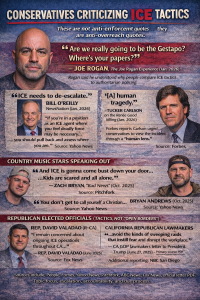
Bottom line: Conservatives can support immigration enforcement and still oppose ICE overreach.
Key conservative objections in 2025–2026:
Unaccountable federal power (raids, surveillance, escalating tactics)
Due process erosion (detain first, sort later)
Sweeping operations that harm communities and local economies
Militarized enforcement culture that increases risk of tragedy
Weak transparency (who is accountable when something goes wrong?)
Conservative “middle path” solution:
Focus enforcement on serious public safety threats
Require de-escalation and constitutional compliance
Expand oversight and transparency
Modernize immigration pathways so enforcement isn’t used as a substitute for policy
If you are worried about your rights during enforcement operations, start with:
What to Do If ICE Comes to Your Door: 10 Smart Things

Conservatism is not “whatever the government wants, as long as the target is unpopular.”
True conservatism is:
limited government
individual liberty
due process
transparent enforcement
constitutional boundaries
That means conservatives can support immigration laws while still insisting:
If you’re looking for a detailed overview of how enforcement is changing, see:
Why Is ICE So Aggressive and Militaristic?

ICE overreach typically means enforcement tactics that go beyond targeted public safety goals and begin to resemble indiscriminate, high-pressure policing, such as:
sweeping workplace raids targeting non-violent workers
enforcement quotas and volume-driven arrest targets
tactics that escalate rather than de-escalate
operations that undermine trust in local institutions
detention expansion that becomes punishment-like rather than administrative
In 2025–2026, concerns are growing that enforcement is being driven by political demands and optics rather than public safety prioritization.
For example, HLG has examined enforcement priorities and concerns about “volume” enforcement here:
Does the ICE Quota Put Me at Increased Risk? What Trump’s 3,000 Daily Arrest Mandate Means

A government powerful enough to raid, detain, and surveil large groups of people with minimal transparency is powerful enough to do that to citizens too.
That’s the conservative concern.
Not “no enforcement.”
But no unchecked enforcement.
For years, Trump’s immigration agenda was treated as a loyalty test inside conservative politics: if you were “tough,” you supported aggressive enforcement—no questions asked.
But in 2025–2026, that automatic support is cracking.
A growing number of conservative and conservative-adjacent voices are publicly warning that ICE’s tactics—especially when militarized, escalation-prone, or sweep-based—aren’t “law and order.”
They’re government overreach.
One of the most high-impact conservative-adjacent critiques came from Joe Rogan, a cultural heavyweight who previously endorsed Trump and whose audience is heavily male, independent, and right-leaning.
After the Minneapolis ICE operation that ended with the killing of Renee Nicole Good, Rogan condemned the escalation and the broader direction of immigration enforcement—explicitly comparing ICE tactics to authoritarian policing:
“Are we really going to be the Gestapo? Where’s your papers?”
He described the situation as “horrific” and warned that militarized enforcement risks turning communities into “papers please” zones where ordinary people can be “snatched up” in public without real accountability.
Read more coverage here: Axios: Rogan blasts Trump’s “Gestapo” immigration tactics and The Guardian: Rogan questions Trump’s immigration enforcement after Minneapolis shooting.
In a rare break from hardline enforcement messaging, conservative pundit Tucker Carlson publicly criticized the right’s reaction to the same incident—pushing conservatives to treat the death as a human tragedy rather than propaganda fuel.
According to reporting, Carlson called the killing a “human tragedy” and asked why Republicans weren’t viewing it through a “human lens.”
Source: Forbes: Tucker Carlson blasts conservative response to Renee Good’s death.
Another major conservative voice to break from the “ICE can do no wrong” line was Bill O’Reilly, who argued that federal agents should not escalate situations into deadly force encounters.
O’Reilly stated bluntly:
“ICE needs to de-escalate.”
He went further, arguing that when an operation reaches a point where deadly force feels likely, agents should pull back instead of pushing forward into a confrontation that can spiral into tragedy.
Source: Salon: “ICE needs to de-escalate”: O’Reilly calls on DHS to tone down tactics.
Not all opposition to ICE tactics is coming from media celebrities.
In 2025, six California Republican lawmakers issued one of the clearest GOP statements against the enforcement approach itself—urging Trump to stop broad workplace raids and refocus on violent offenders.
In their formal letter to the President, the lawmakers called on DHS:
“…to focus their enforcement operations on criminal immigrants, and when possible to avoid the kinds of sweeping raids that instill fear and disrupt the workplace.”
They also urged modernization of immigration policy to allow certain long-term, non-criminal undocumented residents a pathway toward legal status.
Primary source letter (PDF): California GOP letter to President Trump (June 27, 2025)
Additional coverage: Los Angeles Times: California Republicans tell Trump ICE raids should focus on criminals, not ordinary workers.
These voices aren’t arguing for “open borders.”
They’re making a different—and deeply conservative—claim:
Enforcement has limits
State power must be restrained
Militarized raids create backlash and instability
Sweeping operations hurt families, workplaces, and trust
Deadly force incidents destroy public legitimacy
In other words:
A conservative can support immigration enforcement and still oppose ICE overreach.
That is not weakness.
That is constitutional principle.
This checklist is designed for conservative and independent-minded Americans who believe in the Constitution, respect law enforcement, and still want to protect liberty.
Ask whether actions require a judge-signed warrant
Demand transparency about what authority is being used
Start here:
Can ICE Enter My Home Without a Warrant?
You do not have to answer questions beyond identifying information
Do not guess or “talk your way out of it”
Ask for a lawyer
Practical guide:
What to Do If ICE Comes to Your Door (10 Smart Things)
If you witness enforcement activity, you can often record from a safe distance—but do not obstruct.
Helpful legal guidance:
ACLU — Filming and Photographing the Police
Have a plan:
emergency contacts
childcare plan
attorney contact information
key documents secured
Ohio-specific planning resource:
How to Prepare for an ICE Arrest in Columbus, Ohio
In practice, enforcement can sweep broadly, especially during crackdowns and quota-driven periods.
This is one of the most misunderstood issues. A “warrant” is not always a judge warrant.
Ask:
Is this targeted?
Is this lawful?
Is this necessary?
Is there oversight?
Even many pro-enforcement conservatives believe sweeping workplace raids:
disrupt labor markets
destabilize industries (restaurants, hotels, construction, agriculture)
push workers underground
reduce community cooperation with police
increase chaos without improving safety
That is why you are increasingly seeing conservative-leaning “workforce realism” arguments emerge in 2025–2026—even among Republicans who do not support broad legalization.
Many Americans do not realize how much immigration enforcement relies on detention power.
When detention becomes routine and prolonged, the conservative question becomes:
Is the government using detention as a tool of administrative process—or as coercion and punishment?
HLG has covered the record growth in detention and its impact here:
New Record: ICE Detainee Population Reaches High (2025)
Rights do not matter in the abstract.
They matter in the moment:
when agents are at your home
when a parent is terrified
when a spouse doesn’t know what happens next
when someone is detained and the family cannot locate them
Start here:
What to Do If ICE Comes to Your Door
In the panic of an enforcement threat, people often make irreversible mistakes:
leaving the U.S. without advice
withdrawing valid applications
missing court deadlines
signing papers without understanding them
If you need guidance, you can book directly here:
Book a Consultation with Herman Legal Group
No. Many conservatives support immigration enforcement but oppose sweeping raids, militarized tactics, and due-process shortcuts.
Often not legally, unless they have valid authority. A key issue is whether the document is a judge-signed judicial warrant versus an ICE administrative form.
Start here:
Facing an Immigration Crackdown in Your City? What Non-Citizens Must Know
Stay calm, do not open the door without verifying authority, do not consent to entry, and contact counsel.
Step-by-step:
What to Do If ICE Comes to Your Door: 10 Smart Things
In many scenarios, yes—you should avoid answering substantive questions without an attorney.
Recording government officials performing duties in public is often protected, but you must not interfere.
Guidance:
ACLU — Filming and Photographing the Police
Many ICE documents are not signed by a judge. That difference can be critical for home entry authority.
Yes. LPRs can face detention or removal in certain situations (old convictions, travel issues, alleged abandonment, etc.).
See:
Facing an Immigration Crackdown in Your City? What Non-Citizens Must Know
Yes—enforcement activity and fear spikes have been widely reported, including local impacts in Ohio.
Ohio example:
ICE Arrests in Columbus, Ohio: Explosive Effects
An immigration bond may allow a detained person to be released while their case continues in immigration court.
Ohio example:
Operation Buckeye: ICE Arrests in Columbus Ohio
Not always in practice—especially during high-pressure enforcement periods.
Usually it means enforcement that becomes:
overly broad
escalation-first
quota-driven
detention-heavy
weak on transparency and oversight
For more detail:
Why Is ICE So Aggressive and Militaristic?
Prepare documents, emergency plans, and legal strategy in advance.
Ohio guide:
How to Prepare for an ICE Arrest in Columbus, Ohio
That risk has been documented in 2025–2026 in at least some field office contexts.
See:
Married to a U.S. Citizen but Still Handcuffed? (San Diego Interview Arrests)
You generally have First Amendment protections, but there are lawful limits and safety issues.
See:
ACLU — Protesters’ Rights
Immediately—especially before:
traveling
signing anything
leaving the U.S.
withdrawing an application
skipping a hearing
Consultation link:
Book a Consultation
Conservatives don’t have to choose between:
“no enforcement,” and
“unchecked enforcement.”
The conservative position is clearer than that:
Enforce the law—within the Constitution.
Keep power limited.
Keep it transparent.
Keep it accountable.
And if your family is facing enforcement risk, preparation matters more than panic.
Start here:
What to Do If ICE Comes to Your Door
Or book help here:
Book a Consultation
These sources are useful for explaining the controversy around masked enforcement, lack of accountability, and public fear:
Washington Post: ICE Chief Stands By Mask Use in Immigration Raids (2025)
TIME: California Bans ICE Agents From Wearing Masks to Conceal Identity
ACLU: It’s Time to Reaffirm Our First Amendment Right to Boycott
ACLU: The First Amendment Protects the Right to Boycott (Anti-Boycott Laws Explained)
ACLU Press Release: Supreme Court Declines to Review Challenge to Law Restricting Boycotts
If you publish boycott content, the safest approach is verifiable facts + authoritative records:
Use award records (recipient, award ID, obligated amount, agency)
Archive screenshots
Use neutral language if you cannot confirm
The federal government has been shut down since October 1, 2025, following the failure of Congress to pass appropriations or a continuing resolution. While the funding lapse continues, several immigration functions have now partially stabilized:
✅ E-Verify is back online (as of October 8–9, 2025).
✅ All immigration court cases continue as originally scheduled
This article explains how immigration agencies are adapting under partial operations, which services are active, and what employers, immigrants, and attorneys should expect during the ongoing shutdown.
The funding lapse began October 1 after negotiations collapsed (ABC News).
Mass furloughs and layoffs (RIFs) across multiple departments have strained agency capacity (Politico).
Courts have temporarily limited further terminations pending review (Washington Post).
For context, see the Antideficiency Act background and CRS Shutdown Analysis.
Operating normally (fee-funded):
Delayed:
Snippet Call-Out: USCIS remains open, but cases needing external verification are moving slower.
➡ dol.gov/agencies/eta/foreign-labor
Still suspended: PERM filings, Labor Condition Applications, and Prevailing Wage Determinations.
The FLAG Portal remains offline.
Employers cannot file new H-1B or PERM cases until funding is restored.
See updates from Fragomen and AILA.
Operations continue using fee reserves, but many smaller posts have reduced routine visa appointments.
Check U.S. Embassy & Consulate Updates for local status.
➡ cbp.gov
CBP officers are working without pay as “excepted employees.”
Ports of entry are open but understaffed. Expect longer lines and delays for secondary inspections and Trusted Traveler interviews (TTP Portal).
➡ ice.gov
Both detained and non-detained dockets are proceeding, though with reduced clerical support.
See EOIR Operational Status for daily court notices.
Immigration courts are in session for both detained and non-detained cases — but expect sparse staff and slower decisions.
Status: E-Verify is fully back online as of October 8–9, 2025.
Snippet Call-Out: E-Verify is live again — clear any backlogged cases and follow TNC timelines per USCIS rules.
Government & Policy
Agency Status
Employer Guidance
Herman Legal Group Resources
Richard T. Herman, Esq. is a nationally recognized immigration lawyer and founder of the Herman Legal Group. He has over 30 years of experience guiding immigrants, families, and employers through complex immigration law and policy changes. He is co-author of Immigrant, Inc. and a leading advocate for inclusive immigration reform.
📞 Call 1-216-696-6170 or visit Book a Consultation to connect with Richard or his team.
On September 19, 2025, President Trump issued a Proclamation restricting entry of H-1B nonimmigrant workers and imposing a $100,000 filing fee on new petitions filed after 12:01 a.m. EDT, September 21, 2025 (eastern daylight time). According to the White House proclamation and USCIS FAQs, the fee is one-time, not annual—it is a one time fee as described in the official guidance—and does not apply to petitions filed before the effective date or to valid existing H-1B visa holders.
The technology industry and tech industry are among the most affected by the new fee. A White House official confirmed key details about the policy. But many details remain unclear, including whether transfers, cap-exempt employers, and change-of-status filings are covered.
The Trump administration’s stated goal is to protect American wages and prioritize the interests of the American worker. This sweeping change has sent shockwaves through employers, foreign workers, and entire industries. Many employers and business leaders are concerned about the impact of the fee.
The fee particularly affects skilled foreign workers and highly skilled workers in specialized fields. The new fee may make it harder for companies to attract the best temporary foreign workers and foreign talent. The H-1B program was originally designed to address labor shortages in specialty fields, but critics argue it has sometimes led to the replacement of domestic employees with lower paid foreign labor.
This change is the largest single fee hike in U.S. immigration history, representing a significant increase in visa fees and imposing new visa fees under the proclamation. It directly impacts employers, foreign workers, and entire industries dependent on H-1B talent. The new fee requirement is in addition to existing fees, creating a substantial financial burden for current applicants, new applications, and renewal extensions.
The proclamation is written broadly, but agency implementation guidance is narrower, leaving employers in a legal gray zone. Lawsuits are expected, but businesses and workers must act now under current rules. Many stakeholders are awaiting more guidance from USCIS and the White House on the implementation of the new fee.
Key Resource:USCIS H-1B FAQ
Key Resource: White House Proclamation
In both cases, more guidance from USCIS is needed to clarify how these scenarios will be handled.
Key Resource: USCIS Policy Memo on H-1B Processing
The line graph illustrates the trend in H-1B filings from 2018 to 2026, with a projected decline after the introduction of the new $100,000 fee in 2025. Notably, Amazon and its cloud computing unit, AWS, have been the largest beneficiary of H-1B approvals in recent years, underscoring their prominence in the technology and cloud services industry.
As the U.S. increases fees and restrictions, some skilled workers may choose to move to other countries with more favorable immigration policies.
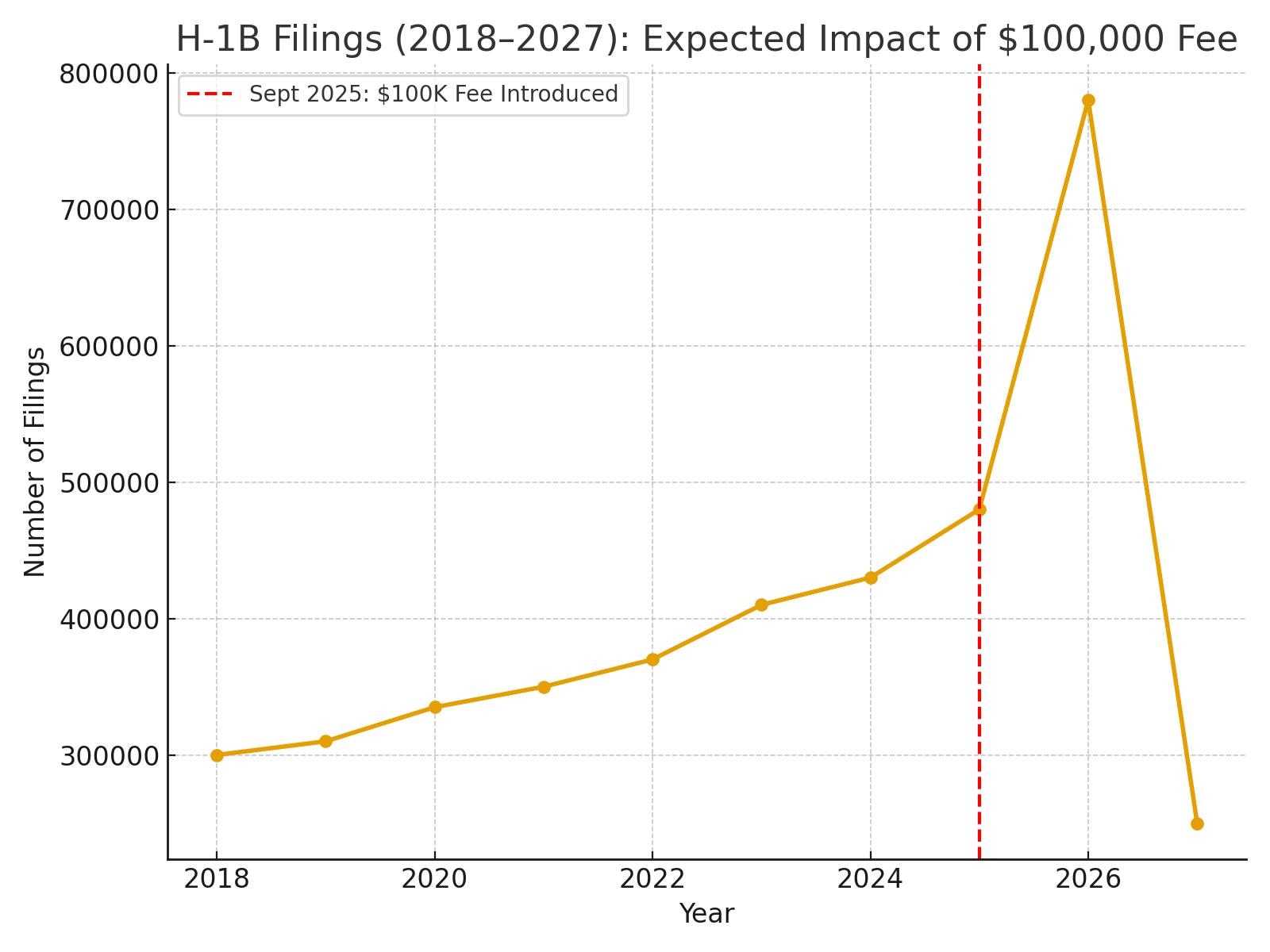
The bar chart breaks down the total costs employers face when sponsoring H-1B visas, including prevailing wage, attorney fees, existing USCIS fees, and the new $100,000 surcharge. Major tech companies, such as Cognizant Technology Solutions, rely heavily on H-1B visas to hire technology workers and foreign national talent. Start ups may be disproportionately affected by the new fee, as increased costs could create significant barriers for early-stage companies seeking to hire international skilled professionals. H-1B eligibility is limited to specialty occupations that typically require at least a bachelor’s degree. The H-1B program was designed to allow U.S. employers to hire temporary foreign workers in fields where there is a shortage of qualified domestic candidates.
After factoring in all costs, the current lottery system for H-1B visas may be impacted by the new fee, potentially reducing the number of applications. Proposed reforms could shift to a wage-based or weighted lottery system, which would favor higher-paying job offers and affect the chances for different applicants.
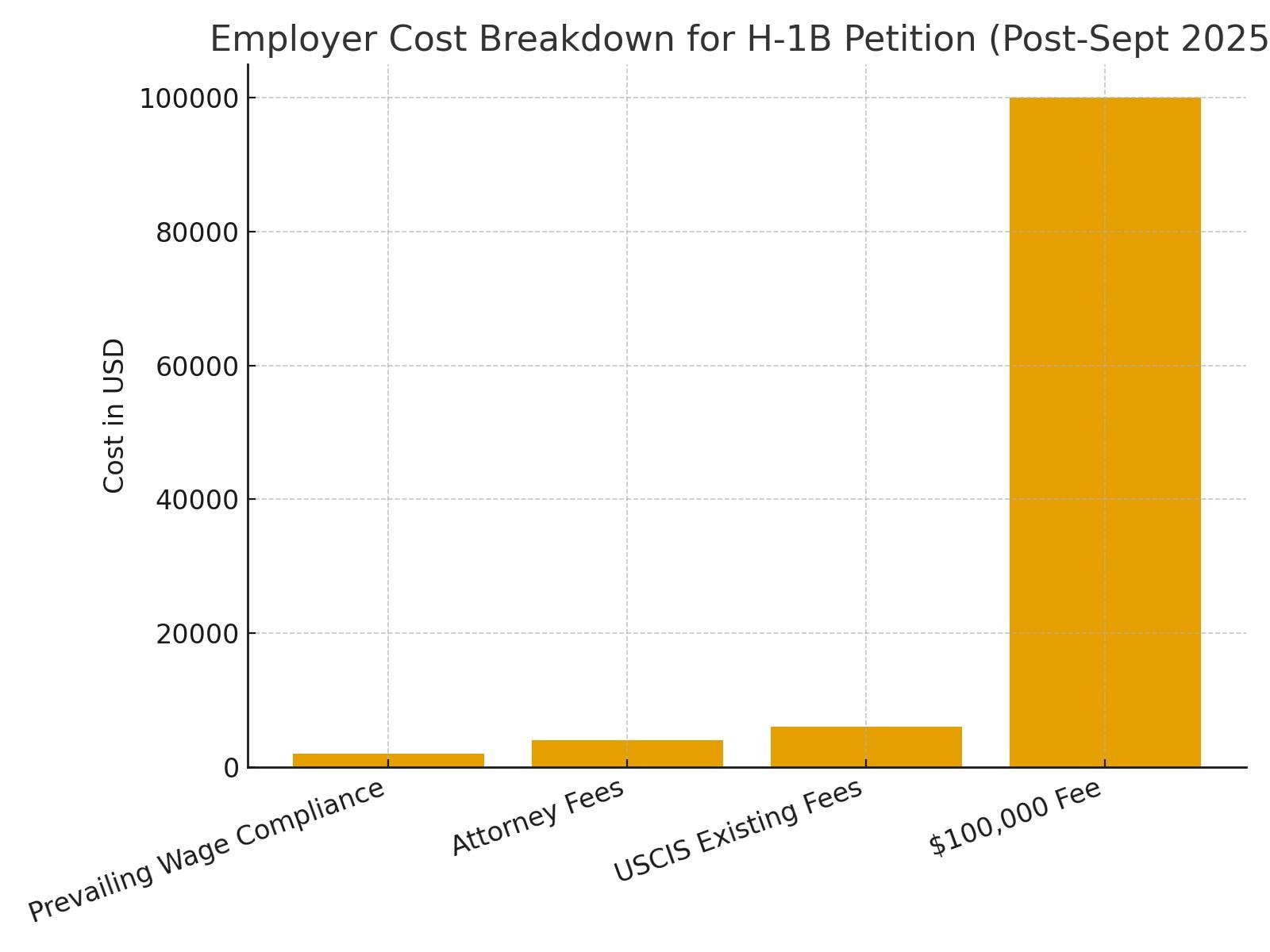
The September 19, 2025 H-1B Proclamation and the unprecedented $100,000 filing fee have left both employers and employees anxious, confused, and uncertain about the future. You do not have to face these challenges alone.
For more than 30 years, Attorney Richard T. Herman has been a trusted advocate for immigrants, entrepreneurs, and businesses navigating the shifting tides of U.S. immigration law. As an experienced immigration attorney, Richard has worked closely with immigration lawyers nationwide to provide legal guidance on complex immigration matters. As the **co-author of Immigrant, Inc.—**a landmark book celebrating the power of immigrant innovation—Richard has dedicated his career to championing global talent and helping employers harness the skills that drive America’s growth. He also advises clients on pathways to permanent residency as an alternative to the H-1B visa.
Richard understands not only the complex legal rules, but also the human stress, fear, and disruption that sudden immigration changes create for families, workers, and companies. Whether you are an employer trying to protect your workforce, or an employee worried about your future in the U.S., you deserve an advocate who combines legal skill, business insight, and deep empathy for the immigrant experience.
Now more than ever, the stakes are too high to take chances. Get the clarity, confidence, and strategic planning you need to protect your future.
👉 Schedule Your Confidential Consultation with Richard Herman Today** or call 216-696-6170.**
USCIS is the primary agency responsible for immigration services in the United States, including the implementation and oversight of the H-1B visa program, which plays a significant role in U.S. immigration policy and the employment of highly skilled foreign workers. These resources are especially relevant for foreign nationals seeking H-1B status.
(These do not create or interpret the $100,000 fee, but they’re essential for employers evaluating what costs can/can’t be shifted to workers and how LCAs interplay with “new” vs. amended filings.)
This change is the largest single fee hike in U.S. immigration history, representing a significant increase in visa fees and imposing new visa fees under the proclamation. It directly impacts employers, foreign workers, and entire industries dependent on H-1B talent. The new fee requirement is in addition to existing fees, creating a substantial financial burden for current applicants, new applications, and renewal extensions. While it is a one time fee as described in the official guidance, it is not an annual fee, but a one-time charge. Additionally, the fee applies only to new applicants filing after the effective date.
The proclamation is written broadly, but agency implementation guidance is narrower, leaving employers in a legal gray zone. Lawsuits are expected, but businesses and workers must act now under current rules. Many stakeholders are awaiting more guidance from USCIS and the White House on the implementation of the new fee. There is still uncertainty about exactly which types of filings the fee applies to, such as extensions, amendments, transfers, or change-of-employer petitions.
(High-quality, continuously updated practice coverage; excellent for what’s changing now and litigation tracking.)