


Herman Legal Group · Embassy and consular visa services
212(a)(9)(B) Visa Refusal: The 3- and 10-Year Unlawful Presence Bars
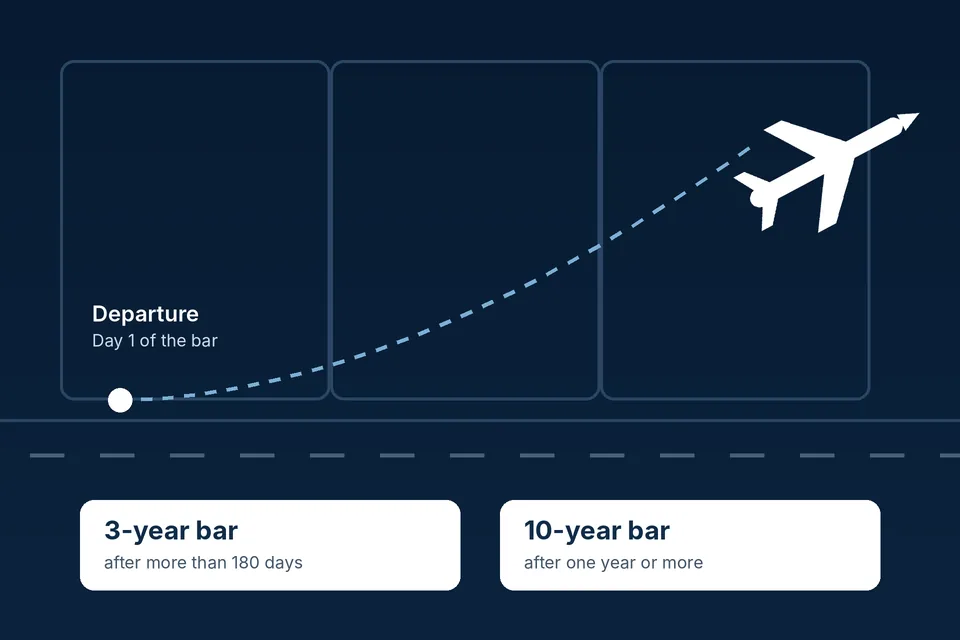
The 3- and 10-year bars under INA 212(a)(9)(B) apply when a person accrues more than 180 days, or one year or more, of unlawful presence during a single stay in the United States and then leaves. The bar starts on the day of departure, not on the day of the overstay.
A waiver may be available if refusing the visa would cause extreme hardship to a U.S. citizen or permanent resident spouse or parent. If the 3 or 10 years have already passed, no waiver is needed for this ground.
Book a Confidential Consultation
Bring your refusal sheet and your entry and departure dates.
Call 216-696-6170.
Consultations are conducted by HLG immigration attorneys by video, phone or WhatsApp for clients in the United States and abroad, and in person in Cleveland and Columbus. The consultation fee is $200.
What is the 3- and 10-year bar?
The 3- and 10-year bars are grounds of inadmissibility in INA 212(a)(9)(B), 8 U.S.C. 1182(a)(9)(B). They block a visa, admission or green card for a set period after someone who overstayed or entered without inspection leaves the United States. The State Department applies them at embassies under 9 FAM 302.11-3.
Three separate grounds involve past removals or unlawful presence. They are often confused, and each has a different fix.
| Ground | What triggers it | How long | Main relief |
|---|---|---|---|
| 3-year bar 212(a)(9)(B)(i)(I) | More than 180 days but less than one year of unlawful presence in one stay, then leaving voluntarily before removal proceedings begin | 3 years from departure | Wait it out, or an I-601A, I-601 or 212(d)(3) waiver |
| 10-year bar 212(a)(9)(B)(i)(II) | One year or more of unlawful presence in one stay, then departure or removal at any time | 10 years from departure or removal | Wait it out, or an I-601A, I-601 or 212(d)(3) waiver |
| Permanent bar 212(a)(9)(C) | More than one year of unlawful presence in total, or a prior removal, then entering or trying to enter without being admitted | Until consent is granted | Form I-212 after 10 years outside the United States |
| Removal bar 212(a)(9)(A) | A prior removal order, or leaving while one was in effect | 5, 10 or 20 years, or permanent | Consent to reapply. See our 212(a)(9)(A) prior-removal guide |
A person who never leaves the United States has not triggered the 3- or 10-year bar, however long the overstay. That is why some spouses of U.S. citizens can still adjust status inside the United States after an overstay, while others must leave for an interview abroad and plan for the bar first.
How is unlawful presence calculated?
Unlawful presence is time in the United States after the authorized stay ends, or time after entering without being admitted or paroled (INA 212(a)(9)(B)(ii)). The clock usually starts the day after the date on the Form I-94. You can check your I-94 on the CBP I-94 website.
Five counting rules come from 9 FAM 302.11-3(B):
- The I-94 date itself is not counted. Neither is the day you depart.
- Only one stay counts. Unlawful presence from separate trips is not added together for the 3- or 10-year bar. It is added together for the permanent bar.
- Time before April 1, 1997 does not count. That is when the law took effect.
- The 3-year bar needs a voluntary departure before proceedings start. Someone with 181 to 364 days who leaves after removal proceedings begin is not subject to the 3-year bar.
- The 10-year bar applies however you leave. It applies before, during or after removal proceedings.
How unlawful presence builds into a bar
Days counted in one stay, starting the day after the I-94 date or the entry without inspection
- The clock starts
The day after the I-94 date, or the day of an entry without inspection, unless an exception applies.
- Nothing happens while you stay
Unlawful presence builds up, but the bar is not triggered while you remain in the United States.
- Leaving starts the bar
On the day you depart, the 3- or 10-year period begins, based on the days counted in that stay.
Three worked examples
Visitor overstay. A B-2 visitor’s I-94 runs until March 1, 2025. She leaves on October 15, 2025. Counting March 2 through October 14 gives about 227 days. That is more than 180 days and less than a year, so she has a 3-year bar until October 15, 2028.
Entry without inspection. A man entered without inspection in 2019 at age 25 and married a U.S. citizen. He has more than one year of unlawful presence. If he leaves for his immigrant visa interview without an approved I-601A waiver, the departure triggers a 10-year bar.
F-1 student under the new rule. A student admitted after September 15, 2026 receives an I-94 with a fixed end date. If she stays past it without a timely extension request, unlawful presence starts the next day. See the 2026 changes below.
Is being out of status the same as unlawful presence?
No. A person can be out of status without accruing unlawful presence. The two questions have different answers in many cases, and the unlawful presence count is the one that controls the 3- and 10-year bars.
Time that does not count as unlawful presence
The statute lists these exceptions in INA 212(a)(9)(B)(iii):
- Time under age 18.
- A pending bona fide asylum application, unless the person worked without authorization while it was pending.
- Family Unity protection under the Immigration Act of 1990.
- Certain battered spouses and children, where the abuse is substantially connected to the overstay.
- Victims of a severe form of trafficking, where trafficking was at least one central reason for the unlawful presence.
These exceptions do not apply to the permanent bar in 212(a)(9)(C). A minor who reenters without inspection can still face that bar.
Periods treated as authorized stay
- A properly filed adjustment of status application (Form I-485) while it is pending, unless filed defensively in removal proceedings.
- A timely, nonfrivolous extension or change of status request, with no unauthorized work. The statute tolls up to 120 days for the 3-year bar; DHS policy treats the whole pending period as authorized when the person had maintained status.
- Temporary Protected Status, while it is in effect.
- Deferred action, including DACA, while it is granted.
- A grant of voluntary departure, if the person leaves on time.
Authorized periods do not erase unlawful presence that came before them. Days accrued before an I-485, TPS or DACA filing still count if the person later leaves. Sources: 9 FAM 302.11-3(B)(1)–(5) and the USCIS unlawful presence page.
What happens if the consulate cites 212(a)(9)(B)?
A 212(a)(9)(B) refusal means the consular officer found that you are inadmissible because of past unlawful presence and that the 3- or 10-year period has not ended. There is no ordinary appeal. The next step depends on the visa you applied for and whether the officer counted the time correctly.
- Read every ground on the refusal sheet. A 212(a)(9)(B) finding often appears with a 221(g) refusal while a waiver is pending, or alongside other grounds.
- Check the calculation. Confirm the I-94 date, the departure date, age at the time, and any pending applications or exceptions. A miscount can sometimes be presented for reconsideration.
- Immigrant visa applicants can file Form I-601 with USCIS after the refusal if they have a qualifying relative.
- Visitors, students and workers can ask the consulate to recommend a 212(d)(3)(A) nonimmigrant waiver. No qualifying relative is required. Even with a waiver, a visitor must still meet the ordinary B-1/B-2 visa requirements.
If an approved I-601A was in place before the interview, the consulate should not apply the unlawful presence bar. But the approval is revoked automatically if the officer finds any other ground of inadmissibility.
Our main visa refusals and delays page explains the other common refusal codes.
Has my 3- or 10-year bar already run?
If 3 or 10 years have passed since the departure that triggered the bar, the 212(a)(9)(B) ground no longer applies, even if you spent some of that time inside the United States. USCIS adopted this reading in June 2022 (USCIS Policy Manual, Vol. 8, Part O, Ch. 6), and the Board of Immigration Appeals agreed in Matter of Duarte-Gonzalez, 28 I&N Dec. 688 (BIA 2023).
How you came back still matters. A return without inspection can start a new period of unlawful presence or trigger the permanent bar. The rule is also different for removal bars under 212(a)(9)(A), which must generally be spent outside the United States.
What changed in 2026?
Advance parole travel can now trigger the bar
On August 13, 2026, the Board of Immigration Appeals decided Matter of Delcarmen-Lara, 29 I&N Dec. 830 (BIA 2026). It held that leaving the United States on advance parole is a “departure” for the unlawful presence bars, and it overruled Matter of Arrabally and Yerrabelly (2012). The Board applied the new rule to future trips, not to trips taken before the decision.
This matters most for DACA recipients, TPS holders and adjustment applicants who built up unlawful presence before receiving that protection. An approved travel document is no longer a sign that travel is safe. The State Department’s manual still describes the older rule, so get advice before relying on either. Read our full analysis of advance parole after Matter of Delcarmen-Lara.
F-1, J-1 and I visa holders now have a fixed end date
A DHS rule effective September 15, 2026 ended “duration of status” admission for F, J and I nonimmigrants (Federal Register, July 17, 2026). New admissions carry a fixed I-94 end date. Unlawful presence can start the day after that date unless a timely extension was filed.
Before the rule, students admitted for duration of status generally began accruing unlawful presence only after a formal finding by DHS or an immigration judge. Students already in the United States on September 15, 2026 have transition rules tied to the program end date on their I-20 or DS-2019. See our F-1 student visa services.
Can the 3- or 10-year bar be waived?
Yes, for many applicants. The waiver in INA 212(a)(9)(B)(v) requires proof that refusal would cause extreme hardship to a U.S. citizen or permanent resident spouse or parent. A U.S. citizen child is not a qualifying relative for this waiver, although a child’s needs can add to a spouse’s or parent’s hardship.
| Route | Who it fits | Key limits |
|---|---|---|
| I-601A provisional waiver | Immigrant visa applicants still in the United States, age 17 or older, with an approved I-130 or I-140 or a diversity visa selection and the visa fee paid | Covers unlawful presence only. Must be filed before leaving. Revoked if another ground is found at the interview. |
| I-601 waiver | Immigrant visa applicants after a consular refusal, including after an I-601A denial | Filed after the interview, usually from abroad. Can cover several grounds at once. |
| 212(d)(3)(A) nonimmigrant waiver | Visitors, students and temporary workers | Recommended by the consulate and decided by CBP. No qualifying relative needed. |
| Waiting out the bar | Anyone whose 3 or 10 years have passed since the triggering departure | Other grounds, such as 212(a)(9)(C), may still apply. |
An I-601A denial cannot be appealed, but a new I-601A can be filed, or the applicant can attend the interview and file an I-601 after the refusal (9 FAM 302.11-3(D)). For how hardship evidence is built, see USCIS extreme hardship guidance and our immigration waiver practice.
Not sure whether the bar applies to you?
An HLG attorney can rebuild your entry and departure history, count the days and explain which waiver, if any, fits your case.
Did you reenter without inspection after an overstay?
Entering or trying to enter without being admitted after more than one year of total unlawful presence triggers the permanent bar in 212(a)(9)(C). An I-601A cannot fix it, and consent to reapply is generally available only after 10 years outside the United States. Speak with a removal defense lawyer before filing anything or traveling.
How long does an unlawful presence waiver take?
Waivers take years, not months. The ranges below are USCIS processing data dated July 15, 2026, as reported by public trackers. Check the USCIS processing times tool for the current figure before planning travel.
| Stage | Reported range | Notes |
|---|---|---|
| I-601A provisional waiver | About 26.5 to 32 months | Service Center Operations. No premium processing. Government fee $795 under 8 CFR 106.2. |
| I-601 waiver | About 25 to 53 months | Field offices. Service Center Operations reported about 40 to 44 months. |
| I-212 consent to reapply | About 41.5 to 60 months | Needed only for 212(a)(9)(A) or (C), not for the 3- or 10-year bar alone. |
| NVC steps after approval | See NVC timeframes | NVC schedules the interview after USCIS decides the I-601A. |
| 212(d)(3)(A) waiver | No published timeline | Depends on the consulate and CBP. |
Published times describe past cases, not a promise. A pending I-601A does not give lawful status, a work permit or protection from removal. Confirm government fees on the USCIS fee schedule.
How Herman Legal Group helps with the 3- and 10-year bars
We start by rebuilding the record, because the count of days decides everything else. Herman Legal Group reviews the refusal, recalculates unlawful presence from the records and identifies whether a waiver, a wait or a different route fits.
Depending on the agreed scope, representation may include:
- Obtaining I-94 records, FOIA files and prior applications to confirm entry, status and departure dates.
- Calculating unlawful presence and testing each exception and tolling rule.
- Checking for other grounds, such as 212(a)(9)(C), misrepresentation or criminal issues, before anyone travels.
- Preparing an I-601A, I-601 or 212(d)(3) request with hardship evidence and a legal brief.
- Coordinating the waiver with the National Visa Center and the interview through consular processing.
- Advising before advance parole travel, or before a family member leaves for an interview.
HLG’s attorney team includes Vania Stefanova, Luis C. Villarroel and Tameem Ansari, led by founder Richard T. Herman. Consultations are available in English, Spanish, Russian, Bulgarian, Serbian, Croatian, Dari and Pashto, and paralegals can join in Arabic, French, Chinese and Russian. Your engagement agreement names the responsible attorney.
A consultation covers the likely route, missing records, risks and the scope of possible representation. No lawyer can guarantee a waiver or a visa.
What should I bring to a consultation?
- The full refusal sheet, visa category, consulate and interview date.
- Passports, visas and your I-94 history, including every U.S. entry and departure you know of.
- Approval notices for any I-130, I-140, I-485, extension, TPS, DACA or asylum filing.
- Any advance parole documents and the dates you used them.
- Removal, voluntary departure or border records, if any.
- Proof of the U.S. citizen or permanent resident status of your spouse or parent.
- A short summary of medical, financial, caregiving or other hardship concerns.
Keep the originals. If you are unsure of a date, mark it as an estimate.
Questions about the 3- and 10-year bars
What triggers a 10-year bar?
Accruing one year or more of unlawful presence during one stay in the United States and then leaving. The departure can be voluntary or by removal, and before, during or after removal proceedings. The 10 years run from the date of departure.
What happens if I have 180 days of unlawful presence?
Exactly 180 days does not trigger a bar. The 3-year bar requires more than 180 days. On day 181, leaving the United States voluntarily before removal proceedings begin triggers the 3-year bar.
Can a 10-year bar be waived?
Yes, if refusal would cause extreme hardship to a U.S. citizen or permanent resident spouse or parent. Immigrant visa applicants use Form I-601A before leaving or Form I-601 after a refusal. Visitors and temporary workers can seek a 212(d)(3)(A) waiver.
Can you get a green card with unlawful presence?
Often, yes. Immediate relatives of U.S. citizens who were inspected and admitted can usually adjust status inside the United States without triggering the bar. Others may need an approved I-601A before leaving for an immigrant visa interview.
Does an approved I-601A guarantee a green card?
No. It waives only the unlawful presence bar. The approval is revoked automatically if the consular officer finds another ground of inadmissibility, and the applicant must still qualify for the visa.
Do I have to wait outside the United States for the bar to end?
Not for the 3- or 10-year bar. Under USCIS policy and Matter of Duarte-Gonzalez, the period runs even while you are inside the United States. Removal bars and the permanent bar follow different rules.
Can I consult HLG from outside the United States?
Yes. HLG offers consultations by video, phone and WhatsApp for clients abroad. Tell us the consulate, visa category and the section cited on your refusal sheet when you schedule.
Get a case-specific answer before you travel or reapply
Schedule a consultation with an HLG immigration attorney to count your unlawful presence, confirm which bar applies and plan the waiver or timing that fits. Bring your refusal sheet and travel history.
Book a Confidential Consultation Call 216-696-6170
Reviewed by Richard T. Herman, Esq. on October 3, 2026. Last updated October 3, 2026. This page provides general information, not legal advice about a particular case. Eligibility and strategy depend on your full records and the law that applies to your circumstances.