
 By
By
Introduction — A New Era of Immigration Court Control

In 2025, the Trump administration’s campaign to reconfigure the immigration judiciary has amounted to one of the most aggressive waves of terminations in recent memory, including the Trump purge immigration judges. Immigration enforcement has become a central issue in the administration’s approach to judicial operations.
According to a DOJ-internal letter submitted to the Senate Judiciary Committee, on February 14, 2025, EOIR abruptly terminated 20 immigration judges — including 5 assistant chief judges and 13 newly appointed judges still waiting to be sworn in — with no public explanation or previous warning. In that same action, nine Board of Immigration Appeals (BIA) members appointed under the prior administration were also removed.
Union representatives and advocacy groups report that by mid-2025, 17 judges across 10 states had been fired without cause, as part of the Trump administration’s unprecedented purge of immigration judges, known as the Trump purge immigration judges. These rolling rounds of dismissals were aimed at courts in California, Illinois, Texas, Massachusetts, Maryland, Virginia, New York, Ohio, Louisiana, and Utah. The union claimed that “fifteen judges were fired ‘without cause’ on a Friday and two more the next Monday.” (Union statement)
In the San Francisco Bay Area, Judge Ila Deiss (appointed years ago) and Judge Kyra Lilien (still in probationary period) were among the local judges dismissed in July 2025. While Lilien’s removal matched expectations for probationary attrition, Deiss’s firing, despite long service and strong performance, alarmed practitioners as indicative of political targeting. These actions reflect the Trump administration’s goals in reshaping the immigration judiciary.
In Chicago, Jennifer Peyton, who had served about nine years as Assistant Chief Immigration Judge, told observers she was dismissed in an email with no cause given just days after meeting with a U.S. Senator. Her removal followed a Trump-era directive that judges route congressional inquiries through EOIR headquarters — a change she resisted.
These terminations are not isolated. Internal appeals records indicate that the entire cohort of December 2024 probationary IJs (13 members) was summarily terminated, despite being selected through competitive processes and in some cases prior experience. (MSPB appeal)
As of mid-2025, the union has estimated that over 100 judges have either been fired or resigned under the current administration’s restructuring—an attrition rate some argue is destabilizing the nation’s immigration courts already under backlog pressure. The terminations contribute to a backlog of nearly four million cases in immigration courts, further straining an already overwhelmed system.
These changes affect both citizens and immigrants alike, raising concerns about fair treatment and justice for all impacted by the immigration system.
TRUMP 2.0
The second Trump administration has reasserted control over the nation’s immigration courts, which operate under the Executive Office for Immigration Review (EOIR), a subagency of the Department of Justice (DOJ). Building on precedents set during the first Trump administration, the current leadership has intensified efforts to reshape the courts.
In 2025, EOIR implemented sweeping changes to staffing, performance metrics, and appointment rules that together amount to a systematic purge of veteran immigration judges, commonly referred to as the Trump purge immigration judges. Experienced adjudicators with reputations for fairness have been removed, reassigned, or pressured to retire, while inexperienced and politically screened appointees have taken their place. A significant number of these removed judges had granted asylum claims at a rate of 30% or higher, raising concerns about the motivations behind their terminations. The justice department has played a central role in overseeing these reforms and enforcing new policies affecting judicial independence.
Immigration Lawyer Richard Herman: “Under 2025 policy changes, DOJ gained broad authority to remove experienced judges and fill vacancies with temporary and military appointees.”
These reforms are documented across official sources: the Federal Register final rule expanding Temporary Immigration Judges (TIJs), EOIR policy updates tightening performance quotas, MSPB orders confirming removal disputes, and GAO reports tracking record-high backlogs. Professional organizations including the NAIJ, ABA, and AILA have warned that these developments endanger judicial independence and due process.
Immigration Court/BIA Backlog: The Steep Climb and Recent Dip
The immigration court and Board of Immigration Appeals (BIA) backlog has expanded dramatically in recent years, reaching historic levels due to surges in case receipts, constrained adjudicative capacity, and rapid policy shifts. By the end of FY2023, pending cases reached about 2.5 million, according to Congressional Research Service analyses of EOIR data.
Through mid-2024, the Government Accountability Office reported nearly 3.5 million pending matters, underscoring the acceleration in filings and the strain on dockets. CRS later estimated about 3.6 million pending at the close of FY2024, confirming sustained growth across the year. Immigration courts are now facing a backlog of approximately 4 million cases, exacerbating delays and challenges in the system that delays justice for those awaiting hearings.
A confluence of factors drove the spike: historically high new filings; docket reshuffling; uneven staffing and training; and performance systems that reward volume rather than deliberation. As 2025 opened, EOIR acknowledged that pending cases peaked at more than 4.18 million before declining after aggressive throughput measures.
Independent trackers (using EOIR data) simultaneously recorded 3.43 million active cases at the end of August 2025, a lower figure that reflects definitional differences (e.g., how “active” vs. “pending” is counted). EOIR’s September 2025 milestone announcement placed the total under 3.75 million, describing the largest month-over-month backlog reduction in its history. Efforts to address the backlog have included proposals for more immigration judges and additional personnel, supported by increased funding and hiring initiatives.
Three takeaways matter for readers and practitioners:
- Backlog growth was exponential from 2023 into mid-2024. That growth outpaced judge hiring and training, pushing median wait times upward and increasing variance across courts.
- Definitions and data pipelines matter. “Pending” vs. “active,” and snapshot dates, can yield different counts; always pair a number with its source and timestamp.
- Throughput can cut both ways. While output spikes can reduce topline totals, they may also increase appeals and remands if adjudications are rushed, shifting the burden to the BIA and federal courts.
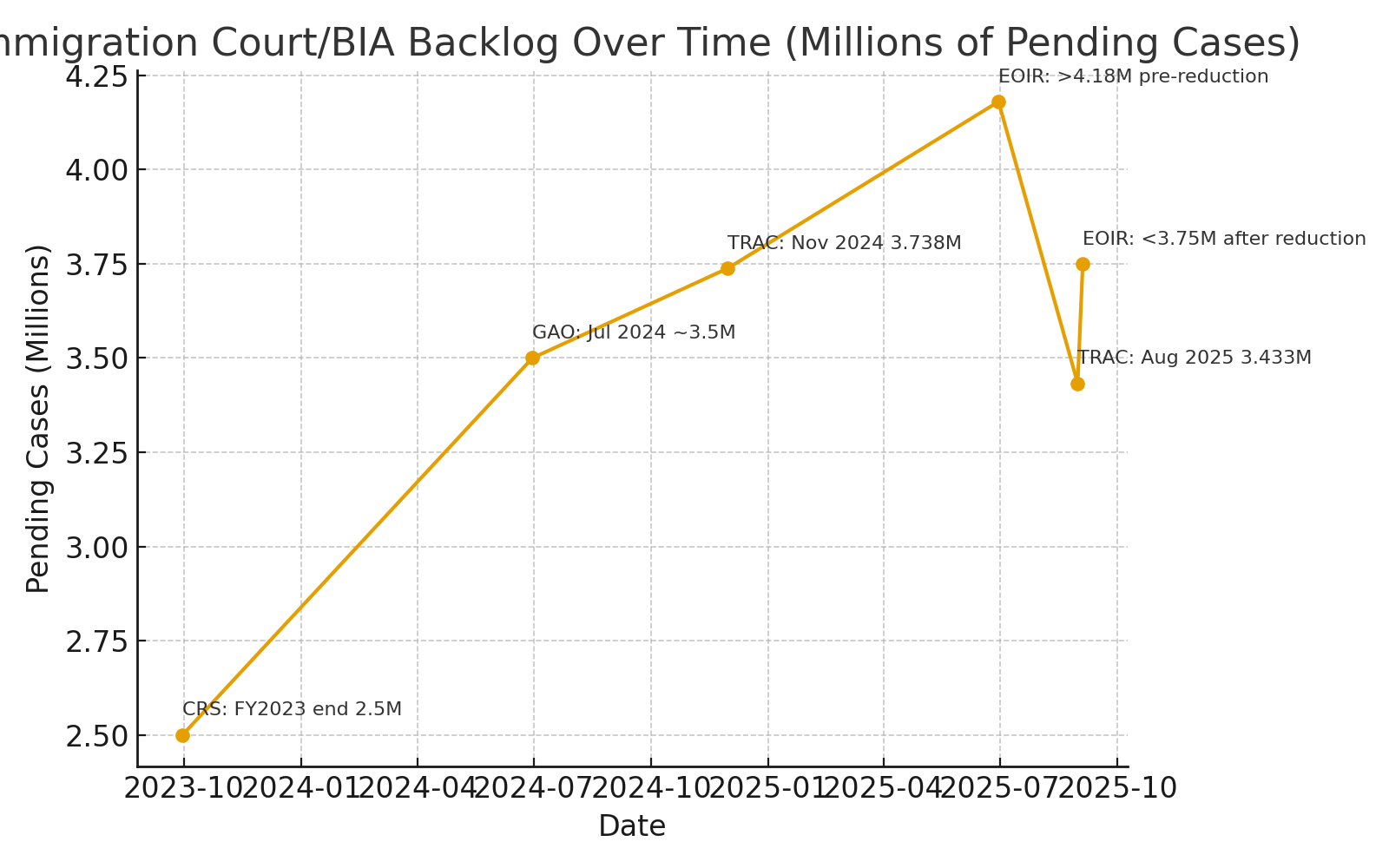
Sources: GAO (Dec. 2024) and CRS (Nov. 2024/Jan. 2025) for 2023–2024 figures; EOIR (Sept. 2025) and EOIR-based trackers for 2025 snapshots.
Mechanisms of Removal Documented by the Federal Government
1. Probationary Termination Actions
In early 2025, the Merit Systems Protection Board (MSPB) issued an Order on Stay, temporarily halting DOJ’s attempt to terminate a group of probationary immigration adjudicators. Many of these judges are subject to a two year probationary period, during which their employment is reviewed and decisions about termination are often made at the end of this phase. The Board’s order required EOIR to reinstate the judges pending review, confirming that a broad removal action was underway and subject to civil-service safeguards. The International Federation of Professional and Technical Engineers, which represents immigration judges, criticized these firings as undermining the judicial system and eroding trust in its independence. Some judges also opted for a voluntary resignation program amid ongoing terminations and restructuring efforts.
2. Performance-Based Discipline
The EOIR Performance Plan for Adjudicative Employees mandates a minimum of 700 case completions per year, timeliness standards, and remand-rate thresholds. These numerical benchmarks now form part of each judge’s performance evaluation, giving management leverage to discipline or remove judges who fail to meet production goals — regardless of case complexity.
Additionally, EOIR leadership has encouraged adjudicators to streamline case reviews and favor oral decisions over written ones. These measures are aimed at efficiently managing the growing caseload.
3. Policy Manual Revisions
The EOIR Policy Manual Table of Changes shows numerous 2025 updates altering docketing practices and decision workflows. These policy revisions directly impact immigration related activities, including case management and adjudication procedures within immigration courts. Such centralized policy control enables leadership to reassign judges or invalidate prior discretion based on shifting priorities.
4. Civil-Service Appeals and Final Decisions
Subsequent MSPB final decisions issued in 2025 document additional challenges to DOJ disciplinary actions. The board’s rulings confirm that multiple judges fired by the administration have challenged their dismissals, highlighting the contested nature of these actions. Some appellants obtained stays or remands, establishing that removal attempts were real, widespread, and contested under federal employment law. The broader impact of fired judges and the pattern of judges fired from the immigration courts has raised concerns about judicial capacity and the efficiency of the immigration court system.
MSPB’s stay orders confirm EOIR’s 2025 effort to terminate adjudicators and the continuing applicability of civil-service protections.
The 2025 Performance Metrics System
EOIR’s Performance Plan redefined success for judges in quantitative terms. Key thresholds include:
- 700 case completions annually
- 95% timeliness compliance
- Limited remand rates from the Board of Immigration Appeals (BIA)
EOIR leadership has publicly criticized judges who fail to meet these new efficiency standards, highlighting concerns about caseload management and decision-making speed.
While framed as efficiency measures, these quotas tether judicial evaluation — and thus job security — to numerical output. Both the National Association of Immigration Judges and the American Bar Association have stated that such metrics erode impartial decision-making by rewarding speed over fairness.
Professional associations warn that quota-based evaluations compromise independence and due process.
Federal Register Rule Expanding Temporary Immigration Judges
On August 28, 2025, DOJ finalized the rule “Designation of Temporary Immigration Judges” in the Federal Register. This regulation fundamentally broadens who may serve as a Temporary Immigration Judge (TIJ). The role of temporary immigration judges has become more essential due to the increasing number of cases in the immigration court system, highlighting the need for rapid surge capacity despite concerns over qualifications and training. Congress approved increased funding for the hiring of temporary and additional immigration judges as part of a recent mega spending bill, which provided over $3 billion to the Justice Department for immigration-related activities, including addressing the significant case backlog.
Before 2025
Only former Immigration Judges, Appellate IJs, Administrative Law Judges, or DOJ attorneys with 10+ years of immigration-law experience were eligible.
After 2025
Any “well-qualified candidate” who meets basic IJ criteria may now serve — effectively opening the door to attorneys with no immigration background, including military lawyers detailed from the Department of Defense.
The AILA analysis of this rule underscores that removing experience prerequisites risks inconsistency and procedural error. The NAIJ and ABA similarly caution that expanding eligibility without commensurate training dilutes adjudicative quality and threatens independence.
Immigration Attorney Richard Herman: “The 2025 Federal Register rule eliminated experience thresholds, enabling rapid appointments from outside EOIR — including military attorneys.”
Integration of Military Lawyers into Immigration Courts
The broadened TIJ rule authorizes DOJ to recruit licensed military attorneys for temporary detail. Under existing Defense Department legal authorities, Judge Advocates may be assigned interagency duties when approved by the Secretary of Defense. This interagency cooperation is often justified by the need to support homeland security initiatives, which include immigration enforcement and border control efforts.
Benefits Cited by DOJ
- Rapid surge capacity amid backlogs
- Familiarity with administrative hearings
- Temporary service flexibility
Risks Identified by Associations
- AILA warns of inadequate asylum-law training.
- NAIJ notes temporary status undermines decisional independence.
- ABA raises separation-of-functions concerns about placing military officers in civilian adjudication roles.
Richard T. Herman, Esq.: “Military-lawyer appointments mark the first modern instance of uniformed personnel adjudicating civilian immigration cases.”

Real-World Examples of Immigration Judges Being Fired in 2025
In 2025, multiple immigration judges across the U.S. have publicly testified to or been documented as having been terminated — often abruptly, with minimal explanation, and in ways that suggest systemic force, according to people familiar with the events. The number of terminations landed as a result of these administrative decisions has raised significant concern within the legal community. In several instances, people spoke about their experiences, sharing perspectives on the impact and circumstances of their dismissals. The following are the most prominent and illustrative cases.
Jennifer Peyton — Chicago Assistant Chief Immigration Judge
One of the most cited examples is Judge Jennifer Peyton, who had served nearly nine years as the Assistant Chief Immigration Judge in Chicago. According to her account:
- She received her termination via an email sent over a holiday weekend, while on vacation, with just three sentences and no stated cause.
- Peyton asserts her performance reviews had been consistently strong, including recognition from EOIR leadership.
- Shortly before her termination, DOJ issued a directive requiring that all communications from congressional offices be forwarded through headquarters — a rule she viewed as limiting judges’ accountability to oversight. She believes her termination was retaliatory.
- She also reported that on February 14, 2025, a group of seven Assistant Chief Immigration Judges, including herself, received simultaneous email dismissals.
- Peyton told interviewers that the tone shifted almost immediately after inauguration: “We were being told we weren’t valued.”
Her case exemplifies how even senior judges with oversight roles have been vulnerable to sudden removal under the new regime.
Ted Doolittle — Hartford Immigration Court
In Hartford, Connecticut, Immigration Judge Ted Doolittle was removed in September 2025. Key facts:
- His appointment was not renewed at the end of his two-year term, though he was still formally in a probationary window.
- Notification came via a brief letter from EOIR’s Acting Director stating that his probationary term would not continue; he was placed on administrative leave and instructed to surrender badge and keys.
- Doolittle said that, despite surpassing benchmark goals (completing nearly 2,000 cases in one fiscal year), his dismissal came without explanation.
- He reported the timing was abrupt and caught him off guard, even though he was scheduled to serve until the official end of his two-year period.
Doolittle’s removal shows how purported term expirations are being used as cover for nonrenewal of judges who might not conform to enforcement priorities.
Fifteen Judges Put on Leave and Terminated in Mid-July
Reports have emerged that fifteen immigration judges across multiple jurisdictions were notified in July 2025 that they would be placed on leave and their employment terminated by July 22. According to union sources:
- Many were told of their termination days in advance, with little formal process.
- Some of those judges believed they were targeted because their grant rates or case outcomes deviated from enforcement expectations.
- The union representing immigration judges publicly characterized the action as sweeping and unprecedented — arguing that removing judges en masse in this way deeply disrupts court operations. The union further stated that these mass firings were contrary to the public interest, as they undermine the effective enforcement of immigration laws and negatively impact the broader community.
Mass Termination of 20 Judges on February 14, 2025
One of the earliest and most significant acts of the purge occurred on February 14, 2025, when EOIR abruptly terminated 20 immigration judges by email, per union documentation submitted to Congress:
- Among those terminated were seven Assistant Chief Immigration Judges and 13 newly hired judges who had completed training but had not yet been sworn in.
- The terminations reportedly included Board of Immigration Appeals (BIA) members appointed under the prior administration — indicating the purge reached not only trial-level judges but appellate members.
- The terminations followed mass dismissal of senior EOIR leadership (Chief Judge, acting director, policy head) earlier that same day.
- Many of those affected have since challenged the dismissals as lacking due process or justification, pointing to email memos with no substantive reasoning.
Judge Ila Deiss — San Francisco
In San Francisco, Judge Ila Deiss was notified that she was being removed via a terse email:
- After eight years on the bench and 25 years of federal service, her removal came with a brief message from EOIR stating the Attorney General had decided to remove her.
- She said she was given no prior warning or detailed performance critique.
- Deiss described the action as one among “dozens” of judge firings nationwide since January 2025, alleging that such removals have turned judges into political pawns rather than neutral decision makers.
Overall Scope and Patterns
Taken together, these examples reveal several consistent features:
- Mass, simultaneous firings (e.g., 20 judges on Feb. 14; 15 in July)
- Dismissals of both career and newly hired judges, even ones not yet sworn
- Abrupt notices via email, often with minimal explanation
- Targeting of leadership roles, such as Assistant Chief Judges and BIA members
- Judges reporting fear of retaliation or pressure to align with enforcement agendas
The mass firings represent a costly setback for the immigration court system, undermining its efficiency and effectiveness. In fact, these actions are widely seen as an illogical and costly setback, as they exacerbate case backlogs and disrupt the administration of justice. By increasing delays and inefficiencies, the purge wastes taxpayer dollars and diverts public resources away from more productive uses.
These cases illustrate how, in real courtrooms across the country, the purge is not hypothetical—it is transforming the composition, expectations, and independence of immigration adjudication in a methodical way.
Impact Measured by Government Oversight Bodies
GAO Backlog Findings
A GAO report released in 2024 estimated EOIR’s pending caseload at 3.5 million matters, up from 1.3 million in 2020. The exponential growth provided DOJ’s justification for accelerating case completions and expanding judge ranks.
Throughput vs. Quality
EOIR’s internal metrics tout record closures, yet GAO performance audits highlight persistent management weaknesses and data gaps that obscure quality outcomes. Increased remand rates at the Board of Immigration Appeals suggest hurried decisions are triggering more appeals.
GAO data confirm that while throughput rose, oversight gaps prevent assurance of decision quality.
Judicial Independence Under Siege
The NAIJ has documented how DOJ’s employment controls — from quotas to probationary reviews — convert judges into policy implementers rather than neutral arbiters. The ABA similarly asserts that administrative adjudicators must be insulated from agency performance management to satisfy due-process norms.
Immigration advocates have expressed concern that the erosion of judicial independence undermines due process and judicial autonomy, making it harder to protect immigrants’ rights in court.
Both organizations support transforming EOIR into an Article I immigration court, akin to the U.S. Tax Court, ensuring judges have fixed terms and non-political removal standards.
Immigration Law Expert Richard Herman: “Bar associations agree: true independence requires removing EOIR from DOJ control.”

Documented Removals in Official Records
MSPB Stay Order
The MSPB’s March 2025 stay order explicitly directed DOJ to pause probationary terminations and maintain status quo employment for affected judges pending adjudication — official confirmation of a coordinated removal action.
Subsequent MSPB Decisions
Later 2025 MSPB rulings addressed compliance and remedies, demonstrating that multiple immigration adjudicators pursued — and occasionally secured — relief against unlawful dismissal.
MSPB litigation provides the only government-verified record of Trump-era judge terminations.
Comparative Table — First vs. Second Trump Terms
| Area | 2017–2021 | 2025–2026 |
|---|---|---|
| Case Quotas | Introduced 700-case goal | Quotas tied to evaluations |
| NAIJ Status | Decertification attempt | Union rights fully removed |
| TIJ Eligibility | Limited, experience-based | Expanded to any qualified attorney |
| Military Details | None | Authorized under new rule |
| Backlog (GAO) | ~1.3 M | ~3.5 M |
| Oversight | Minimal | Active GAO & MSPB interventions |
During both the first and second terms, President Donald Trump and President Trump implemented significant policy changes affecting immigration courts. The Trump administration’s approach included restructuring court procedures, increasing enforcement, and firing a notable number of immigration judges.
Richard T. Herman, Esq. “Trump 2.0 completed what Trump 1.0 began — full managerial dominance over immigration adjudication.”
Congressional and Oversight Perspectives
The Congressional Research Service notes bipartisan proposals to establish an independent Article I immigration court, removing EOIR from DOJ to resolve conflicts between prosecutorial and judicial roles.
Concurrent GAO evaluations emphasize chronic staffing, data, and governance deficiencies that impair accountability. The DOJ Office of Inspector General retains authority to audit EOIR’s actions but has limited publicly available findings to date.
CRS and GAO analyses converge: structural reform, not managerial tweaks, is required for lasting independence.
FAQs: Trump’s Purge of Qualified Immigration Judges and Hiring of Inexperienced Judges
What is meant by Trump’s “purge” of qualified immigration judges?The “purge” refers to the Trump administration’s large-scale removal or reassignment of experienced immigration judges (IJs) under the Department of Justice’s Executive Office for Immigration Review (EOIR). Beginning in 2025, dozens of veteran judges were terminated, pressured to retire, or sidelined through new performance metrics, disciplinary reviews, and policy changes. This move replaced fair-minded, experienced adjudicators with politically aligned or less qualified appointees.
Why were veteran immigration judges removed or forced out?Veteran judges were targeted primarily for failing to meet new performance quotas or for issuing asylum grants viewed as too generous. Trump’s DOJ required judges to close at least 700 cases per year, which incentivized rapid denials. Judges who resisted enforcement-driven targets or maintained high asylum approval rates were more likely to face scrutiny, negative evaluations, or non-renewal of appointments.
How many immigration judges have been affected by the purge?By late 2025, more than 80 immigration judges across multiple jurisdictions had been removed, reassigned, or terminated during their probationary periods. Many more reported being pressured into early retirement or stripped of leadership roles. The turnover is the largest in EOIR history and has reshaped the bench nationwide.
Who replaced the experienced judges who were fired or reassigned?The vacancies created by these removals have been filled with newly hired judges who often lack immigration law experience. Many appointees come from prosecutorial or administrative backgrounds unrelated to asylum or removal defense. Some are temporary judges or military attorneys assigned under newly broadened eligibility rules.
What legal changes allowed Trump to appoint inexperienced or temporary judges?A 2025 rule published in the Federal Register, titled “Designation of Temporary Immigration Judges,” removed prior experience requirements. It now allows the Attorney General to appoint any licensed attorney who meets basic qualifications as a Temporary Immigration Judge (TIJ). This expanded pool includes military lawyers and political appointees with minimal background in immigration law.
Why is the hiring of inexperienced judges controversial?Inexperienced judges often lack training in complex asylum law, procedural safeguards, and international human rights obligations. Their lack of expertise increases the risk of procedural errors, inconsistent rulings, and unfair outcomes. Critics warn that replacing experts with novices prioritizes case quotas and political loyalty over legal accuracy and due process.
What role do military lawyers play in the new hiring plan?Under the 2025 EOIR rule, military attorneys can now be detailed to serve as Temporary Immigration Judges. While the administration claims this will help reduce the backlog, critics argue it blurs civilian–military boundaries and introduces adjudicators without specialized immigration expertise into life-altering asylum proceedings.
What are performance metrics, and how are they used to control judges?Performance metrics are numerical quotas requiring judges to close a certain number of cases annually and meet timeliness goals. Introduced under Trump’s first term and reinstated in his second, these metrics tie job security and promotion to volume-based targets. This structure undermines judicial independence by encouraging fast decisions rather than fair or well-reasoned outcomes.
How has the purge affected asylum seekers and their cases?Asylum seekers face higher denial rates, inconsistent rulings, and longer delays as new judges learn on the job. Inexperienced or politically pressured judges are more likely to deny claims or issue removal orders without sufficient evidence review. Appeals to the Board of Immigration Appeals (BIA) have surged as a result, creating further backlogs. Individuals making an asylum claim now encounter additional procedural obstacles and reduced chances for approval due to these changes.
Are these removals legal?While the DOJ claims authority to remove probationary judges or reassign personnel, civil-service protections still apply. The Merit Systems Protection Board (MSPB) has issued stays and rulings suggesting that certain terminations violated due process. Litigation over removals is ongoing, and administrative appeals have challenged the legality of mass firings.
How do quotas and performance evaluations influence judicial independence?Quotas transform judges from neutral decision-makers into agency employees beholden to managerial oversight. When a judge’s career depends on meeting numeric goals or producing deportation outcomes, impartial adjudication becomes nearly impossible. Professional associations like the National Association of Immigration Judges (NAIJ) and American Bar Association (ABA) have condemned these practices as incompatible with judicial ethics.
What is the backlog, and how does it relate to the purge?The immigration court backlog exceeded 3.5 million cases by mid-2024. The administration uses this crisis to justify accelerated hiring and removal of slower adjudicators. However, replacing experienced judges with inexperienced ones often increases mistakes and appeals, which ultimately makes backlogs worse, not better.
Is the use of Temporary Immigration Judges common?Before 2025, temporary judges were rare and drawn only from experienced adjudicators or senior DOJ attorneys. The new rule dramatically expanded this power, allowing virtually any qualified attorney — even without immigration expertise — to serve temporarily. This marks an unprecedented change in U.S. immigration court history.
What oversight exists for these hiring and firing actions?Oversight is limited because EOIR remains under DOJ control. While the Government Accountability Office (GAO) monitors backlog and workforce management, and the Merit Systems Protection Board (MSPB) hears individual employment appeals, there is no independent body reviewing immigration court restructuring as a whole.
How do professional associations view Trump’s immigration judge purge?The National Association of Immigration Judges (NAIJ) calls the removals an “attack on judicial independence.” The American Immigration Lawyers Association (AILA) warns that unqualified hires undermine due process. The American Bar Association (ABA) supports transforming EOIR into an Article I immigration court to ensure judicial autonomy and integrity.
What is an Article I immigration court, and why is it proposed?An Article I court is a judicial body created by Congress, independent of the executive branch. Moving EOIR from DOJ to Article I status would prevent political interference, set fixed judicial terms, and insulate adjudicators from quota-based evaluations or arbitrary removals. Nearly all major legal organizations support this reform.
What are the long-term risks of appointing inexperienced judges?Inexperienced judges may misapply legal standards, overlook critical evidence, or issue inconsistent rulings. This erodes public trust, increases appeals, and creates a body of conflicting precedent. Over time, these trends weaken the rule of law and damage the credibility of the U.S. immigration system.
How does this purge compare to Trump’s first term?During his first term (2017–2021), Trump introduced quotas and appointed enforcement-focused judges. In his second term, beginning 2025, the administration expanded its reach by actively removing veteran judges and rewriting eligibility rules to flood the bench with loyal or temporary adjudicators. The pace and scope of this second-term purge are unprecedented.
How are asylum denial rates changing under the new judge corps?Preliminary data suggest that asylum denial rates under newly appointed judges exceed 80 percent, compared to roughly 58 percent under prior administrations. While EOIR claims improved efficiency, advocates attribute the spike to lack of training, political influence, and absence of meaningful oversight.
Can Congress stop or reverse these changes?Congress holds authority to restructure EOIR through legislation, fund oversight hearings, and establish an independent Article I immigration court. Some lawmakers have introduced bills to restore transparency, reinstate judicial protections, and limit executive interference, but none have yet become law.
What reforms are recommended by oversight and legal experts?Experts recommend removing EOIR from DOJ control, codifying experience requirements for judges, reinstating collective bargaining for the NAIJ, mandating independent oversight by the GAO and OIG, and banning quota-based evaluations that tie employment to case completions.
Why is judicial independence important in immigration court?Immigration judges make life-or-death decisions for asylum seekers, families, and long-term residents. Independence ensures decisions are based on law and evidence, not politics or pressure. When judges fear retaliation, justice becomes arbitrary — undermining faith in the entire system.
Is there any precedent for using military lawyers as civilian judges?There is no modern precedent for using active-duty military lawyers as civilian immigration adjudicators. Legal scholars note this blurs the boundary between civil and military authority and risks undermining constitutional norms separating executive enforcement from judicial function.
How might this affect future administrations?The structural changes implemented in 2025 — particularly the rule expanding TIJ eligibility — remain in effect unless repealed. Future administrations could inherit a bench filled with politically vetted judges and diminished independence, complicating any effort to restore neutrality.
What is the ultimate solution proposed by legal organizations?The consensus among legal experts and professional associations is to establish an Article I immigration court independent from DOJ. This would safeguard tenure, remove quota pressures, and restore credibility to the nation’s immigration adjudication system.
In summary, what does Trump’s immigration judge purge mean for the U.S. justice system?It signifies a profound transformation of immigration courts from quasi-judicial bodies into executive-controlled enforcement arms. The removal of experienced judges, the appointment of unqualified or temporary replacements, and the imposition of quotas collectively threaten due process, fairness, and the integrity of the American legal system.
How do these changes affect immigration court proceedings and enforcement?Federal agents now play a more visible role in immigration court operations, including increased presence during hearings and enforcement actions involving asylum seekers. Their involvement has heightened concerns about the impartiality and fairness of the process.
What are the administration’s broader enforcement goals?The Trump administration has stated its intention to deport millions of undocumented individuals as part of its immigration enforcement strategy. This goal has driven many of the recent changes in court staffing, procedures, and enforcement priorities.
Talk to an Immigration Lawyer Who Understands What’s at Stake
If you’re alarmed by reports of immigration judges being fired, inexperienced judges taking the bench, or the growing question of whether immigration courts and the Board of Immigration Appeals (BIA) remain truly independent — you’re not alone. The system is undergoing seismic change, and understanding how these shifts may affect your case, appeal, or right to fair process is critical.
This is where Attorney Richard T. Herman can help.
For more than 30 years, Richard has stood at the intersection of law, policy, and justice, representing immigrants before agencies and courts that now face unprecedented politicization. As *co-author of Immigrant, Inc.— the acclaimed book celebrating the power of immigrants to transform communities and economies — Richard brings not only legal experience but also a visionary commitment to fairness and opportunity.
He has witnessed firsthand how judicial independence protects families, employers, and individuals seeking a fair hearing. In a climate where seasoned judges are being replaced by politically screened appointees, you need a lawyer who knows how to navigate shifting policies, anticipate agency behavior, and build strong, appeal-ready cases grounded in evidence and law.
Snippet: Attorney Richard T. Herman helps clients understand how recent purges and appointments in immigration courts may affect fairness, appeals, and outcomes.
Whether you’re facing removal proceedings, appealing a BIA decision, or simply trying to understand what judicial changes mean for your future, Richard and his team can help you assess your options and assert your rights.
Why Choose Richard Herman
- Over 30 years of immigration law experience.
- Nationwide practice representing clients before EOIR and federal courts.
- Deep knowledge of policy shifts, due process challenges, and BIA reforms.
- Passionate advocate for fair adjudication and immigrant empowerment.
- Author and national thought leader advancing the case for inclusive immigration reform.
Get the Guidance You Deserve
The immigration court system is changing faster than ever — but your right to fair treatment should not. If you want clear answers about:
- The firing or reassignment of judges,
- The qualifications and biases of newly appointed adjudicators, or
- The erosion of independence within EOIR and the BIA,
Schedule a confidential consultation today with Attorney Richard T. Herman and his team at Herman Legal Group. They’ll help you understand how these developments could shape your case and what you can do to protect your rights.
Book your consultation now:LawFirm4Immigrants.com/book-consultation
When fairness is in question, you need more than legal advice — you need an advocate who believes in justice.
Authoritative Resources on Trump’s Purge of Immigration Judges and the Hiring of Inexperienced Judges
Core Government Sources (Rules, Policy, Oversight)
- Executive Office for Immigration Review (EOIR) — Official Home
Central hub for immigration courts, leadership memos, policy updates, statistics, and press materials.
https://www.justice.gov/eoir - EOIR Policy Manual & Change Log (2025 updates)
Controlling guidance for immigration judges; use the Change Log to track recent revisions affecting dockets, performance, and discretion.
https://www.justice.gov/eoir/eoir-policy-manual - EOIR Adjudicator Performance & Case Metrics
Reference for case-completion quotas (e.g., 700 cases/year), timeliness, and remand thresholds that drive performance reviews.
https://www.justice.gov/eoir (navigate: Policy & Resources → Performance/Statistics) - Federal Register — “Designation of Temporary Immigration Judges” (Final Rule)
The 2025 rule that broadened eligibility for Temporary Immigration Judges (TIJs), enabling rapid appointments (including military attorneys).
https://www.federalregister.gov/ (search: “Designation of Temporary Immigration Judges”) - Department of Justice (DOJ) — EOIR Notices & Press Room
Official announcements, leadership directives, hiring notices, and structural changes impacting immigration courts.
https://www.justice.gov/eoir/press-room - Merit Systems Protection Board (MSPB) — Orders & Decisions
Authoritative rulings on federal employment disputes, including stays and decisions addressing termination of immigration adjudicators.
https://www.mspb.gov - Government Accountability Office (GAO) — EOIR & Backlog Reports
Independent audits on case backlogs, workforce planning, data integrity, and performance management within EOIR.
https://www.gao.gov (search: “Executive Office for Immigration Review” or “immigration courts backlog”) - Congressional Research Service (CRS) — Immigration Court Structure & Article I Proposals
Nonpartisan analyses of proposals to move EOIR out of DOJ, establish an Article I court, and reform hiring/tenure standards.
https://crsreports.congress.gov (search: “immigration courts Article I”) - DOJ Office of Inspector General (OIG) — Oversight Authority
Investigatory body for allegations of retaliation, mismanagement, or policy abuse within DOJ components, including EOIR.
https://oig.justice.gov
Professional Associations (Judicial Independence, Due Process, Training Standards)
- National Association of Immigration Judges (NAIJ) — Judicial Independence & Article I Advocacy
Judges’ professional association documenting how quotas, probationary removals, and policy centralization undermine decisional independence; primary source for Article I court advocacy.
https://www.naij-usa.org/ - American Bar Association (ABA) — Separation-of-Functions & Article I Court Positioning
ABA analyses and policy frameworks urging removal of immigration courts from DOJ to protect impartial adjudication and ethical judging standards.
https://www.americanbar.org/ (navigate: Immigration / Government & Public Sector → Commission on Immigration) - American Immigration Lawyers Association (AILA) — Practice Alerts & Rule Tracking
Practitioner-focused summaries on the TIJ final rule, hiring standards, due-process concerns, and training requirements for new judges.
https://www.aila.org/