For years, corporate America handled immigration enforcement quietly.
Private briefings.
Discreet lobbying.
Carefully neutral press releases.
That restraint is dissolving.
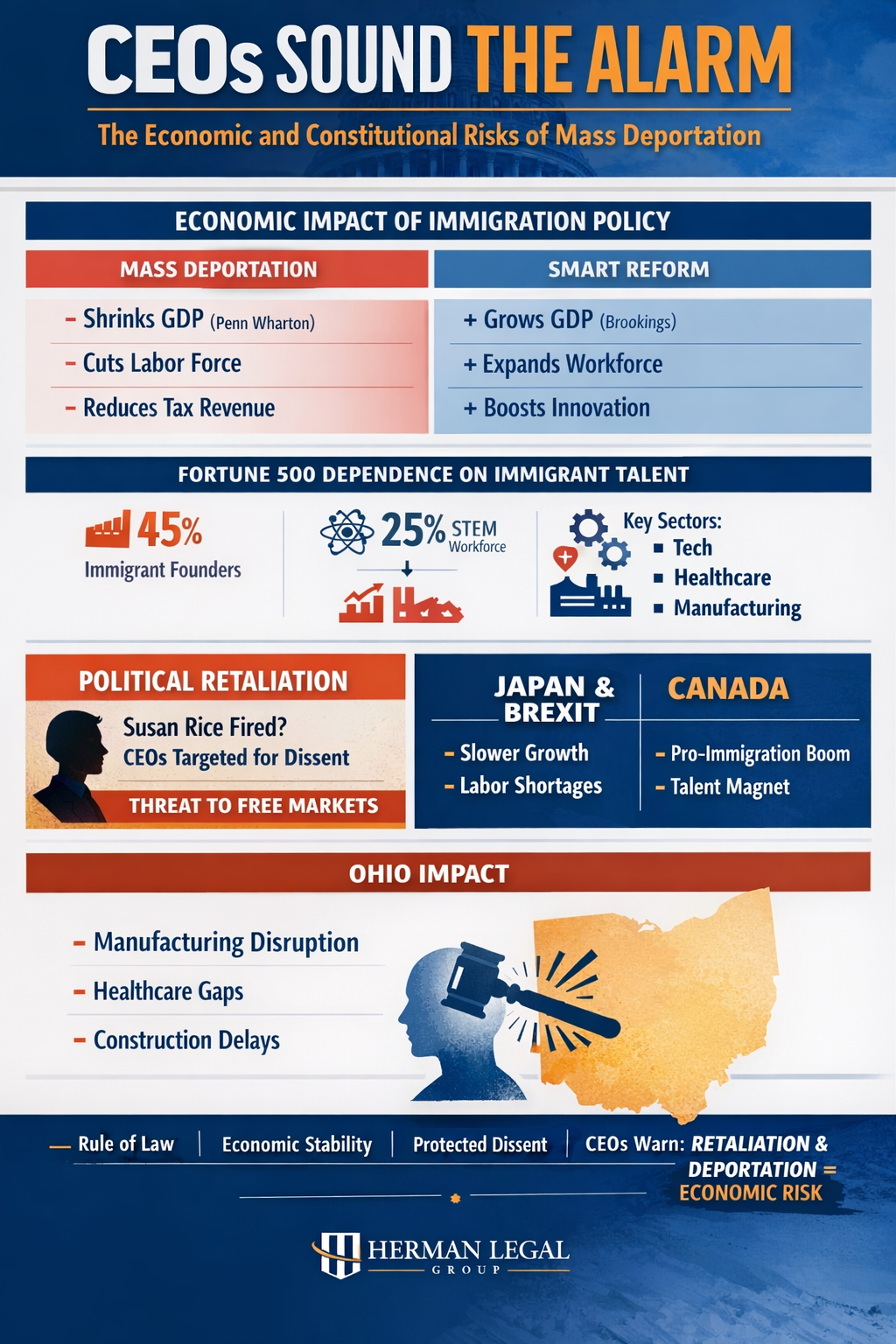
A growing number of CEOs, board members, and senior executives are publicly signaling that the expansion of mass deportation under the banner of the “largest deportation effort in U.S. history” is not simply an immigration policy debate — it is an economic and constitutional risk.
They are reacting to three converging realities:
- Economic evidence shows reducing immigration does not help U.S. workers — and often harms them.
- Large-scale deportation shrinks GDP and weakens labor force growth.
- Political retaliation against dissenting executives undermines free markets.
Markets depend on rule of law.
Rule of law depends on due process.
Due process depends on institutional restraint.
When those pillars weaken, markets destabilize.
Corporate America is beginning to say so — publicly.
To better describe, document and quantify what is happening, we have created the Corporate Immigration Stability Index (CISI™).
The Economic Evidence Is Clear: Reducing Immigration Does Not Help U.S. Workers
A central claim behind restrictive immigration policy is that reducing immigration improves job prospects and wages for native-born workers.
Recent research undermines that claim.
A 2026 analysis summarized in Forbes finds that reducing immigration does not improve employment or wage outcomes for U.S. workers.
Read the research summary here:
Key findings include:
• No measurable improvement in native worker employment when immigration declines
• No consistent wage gains attributable to immigration reductions
• Slower economic dynamism when immigration flows contract
The premise that fewer immigrants equals better outcomes for American workers is not supported by the data.
Federal Reserve Research: Immigration Decline Slows Job Growth
Research from the San Francisco Federal Reserve further demonstrates that declines in unauthorized immigration have slowed job growth in construction and manufacturing — sectors critical to the broader economy.
See reporting:
The findings show that regions experiencing sharper immigrant labor declines also experienced slower employment growth.
That contradicts the narrative that immigration suppresses domestic job creation.
Immigrant labor often complements, rather than substitutes for, U.S.-born workers.
Brookings and Broader Macroeconomic Modeling
Macroeconomic modeling from the Brookings Institution shows that reduced immigration leads to:
• Lower consumer spending
• Slower population growth
• Reduced GDP
• Fewer total jobs
See analysis:
Brookings estimates that reduced immigration could weaken consumer demand by tens of billions of dollars over a two-year period.
Lower demand means fewer jobs — not more.
Penn Wharton Budget Model: Mass Deportation Shrinks GDP
The Penn Wharton Budget Model projects that large-scale deportation would reduce long-term GDP and shrink the labor force.
See modeling:
Projected consequences include:
• Smaller workforce
• Lower output
• Reduced tax revenue
• Increased long-term deficits
Economic contraction is not a theory — it is a projection supported by modeling across institutions.
Immigrant Entrepreneurship: A Proven Engine of Growth
Immigrants are disproportionately entrepreneurial.
Research from the National Foundation for American Policy shows that immigrants and their children have founded a large percentage of Fortune 500 companies.
See data:
Herman Legal Group has analyzed the economic power of immigrant founders here:
https://www.lawfirm4immigrants.com/top-u-s-companies-founded-by-immigrants/
And the broader relationship between immigration and economic revitalization:
https://www.lawfirm4immigrants.com/immigrant-entrepreneurship-economic-growth/
Mass deportation undermines this engine of growth.
Legalization strengthens it.
The Minnesota Inflection Point: Corporate Silence Breaks
Following federal immigration enforcement operations in Minnesota that led to deadly confrontations and widespread unrest, more than 60 CEOs of Minnesota-based companies issued a public letter urging de-escalation.
Read the letter:
https://www.mnchamber.com/blog/open-letter-more-60-ceos-minnesota-based-companies
The letter called for:
“Immediate de-escalation of tensions and cooperation among officials to restore safety, trust, and economic stability.”
Those are not partisan words.
They are market words.
Prominent Signatories Included:
• William Brown — Chairman & CEO, 3M
• Corie Barry — CEO, Best Buy
• Jeff Harmening — Chairman & CEO, General Mills
• Michael Fiddelke — Incoming CEO, Target
• Stephen J. Hemsley — CEO, UnitedHealth Group
• Beth Ford — President & CEO, Land O’Lakes
• Gunjan Kedia — CEO, U.S. Bancorp
Target’s Michael Fiddelke stated:
“The violence and loss of life in our community is incredibly painful.”
Coverage:
Corporate leaders do not normally step into enforcement controversies.
They do when instability becomes economic risk.
Tech and Finance Leaders Speak
Sam Altman — CEO, OpenAI
Altman stated:
“What’s happening with ICE is going too far.”
He added:
“Part of loving the country is the American duty to push back against overreach.”
Source:
This was a direct constitutional framing of executive overreach.
Tim Cook — CEO, Apple
Cook expressed he was “heartbroken” and emphasized democratic values and de-escalation.
Source:
Apple’s valuation rests on institutional stability and global trust.
Jamie Dimon — CEO, JPMorgan Chase
Dimon has repeatedly emphasized immigration’s role in sustaining economic growth and workforce expansion.
Coverage:
https://www.reuters.com/business/finance/jamie-dimon-says-us-needs-immigration-growth-2025-11-15/
Financial markets require growth.
Growth requires labor.
Labor requires rational policy.
Retaliation Against Dissent: A Market Warning Signal
Susan Rice, associated with Netflix and a former national security official, publicly criticized Trump-era governance and immigration posture.
President Trump publicly called for her to be fired.
Coverage:
https://www.foxnews.com/politics/trump-calls-for-susan-rice-fired-netflix-comments-2026
This pattern matters.
Executive speaks → political leader demands firing.
Free markets depend on independent boards and protected speech.
When political retaliation becomes normalized, capital risk rises.
Autocracies punish dissent.
Democracies tolerate it.
Markets thrive in democracies.
ICE Enforcement and Community Economic Destabilization
Aggressive enforcement impacts families, employers, and local economies.
HLG analysis:
https://www.lawfirm4immigrants.com/how-ice-enforcement-harms-vulnerable-populations/
Ohio enforcement and detention impacts:
https://www.lawfirm4immigrants.com/youngstown-ice-detention-guide/
Ripple effects include:
• Family income collapse
• Reduced consumer spending
• Business disruption
• Community distrust
Economic contraction follows fear.
Data Comparison: Mass Deportation vs Smart Reform
Scenario A: Mass Deportation
• Labor force shrinkage
• GDP reduction
• Lower tax revenue
• Slower job growth
• Investor uncertainty
Scenario B: Legalization + High-Skill Reform
• Labor force expansion
• Higher GDP
• Greater entrepreneurship
• Increased tax compliance
• Enhanced innovation
The evidence overwhelmingly supports Scenario B.
The Business Case for Reform
Corporate reform priorities include:
• Legalization pathways
• High-skill visa modernization
• Employment-based backlog reform
HLG analysis:
https://www.lawfirm4immigrants.com/h1b-visa-modernization-rule/
https://www.lawfirm4immigrants.com/employment-based-immigration-economic-impact/
Legalization increases tax revenue.
High-skill immigration increases patent generation and startup formation.
Mass deportation reduces both.
Key Enforcement & Public Opinion Data
Enforcement Metrics
-
Record-high interior arrests: New research shows ICE made more arrests per day in 2025 than in any other year in the last decade, even as the share of those arrested with criminal records declined significantly.
-
Hundreds of thousands arrested: National tracking shows ICE made over 328,000 arrests in 2025, many involving individuals with no criminal conviction, contradicting claims of focusing on “the worst of the worst.”
-
As of early 2026, ICE detention levels reached record highs, with over 68,000 people held in custody, a 75% increase over the previous year.
-
In Minnesota’s Operation Metro Surge, federal immigration operations arrested around 3,000 people, and the operation became an epicenter of national protest after adverse incidents.
-
Large enforcement operations have expanded beyond border enforcement into interior community arrests, leading to broad fear and disruption in daily life.
What this means: These enforcement totals reflect unprecedented federal reach, affecting communities and families beyond traditional immigration enforcement contexts — and this reach fuels public backlash and political risk for businesses aligned with enforcement.
Public Opinion & Polling Trends
-
Majority believe enforcement has gone too far: A Washington Post-ABC News-Ipsos poll finds 58% of Americans disapprove of Trump’s deportation campaign, and 62% oppose aggressive ICE tactics, especially after fatal shootings during enforcement operations.
-
Widespread demand for reform: Around 75% of Americans believe ICE officers should need a judge’s warrant to enter homes, reflecting deep concerns about due process and civil liberties.
-
Video & transparency sentiment: A Pew Research Center survey shows 74% of Americans say it’s acceptable to record immigration arrests and 59% say sharing information about enforcement locations is acceptable, indicating broad public interest in transparency and accountability.
-
Partisan and generational divides: Younger Americans — especially Gen Z and younger Millennials — are significantly more likely to oppose aggressive enforcement tactics, support immigration reform, and view enforcement excesses as violations of democratic norms.
Why this matters: Public sentiment is shaping consumer and cultural expectations, especially among younger voters and customers who prioritize human rights and rule of law. The reaction is not limited to any one political party and reflects broad skepticism about enforcement tactics.
Backlash, Demonstrations, and Consumer Activism
-
High-profile enforcement incidents — including the deaths of U.S. citizens during federal immigration operations — have triggered large-scale protests and community mobilization, particularly in Minneapolis–Saint Paul, which has emerged as a national epicenter of resistance.
-
Activists and community groups have organized protests, tracking groups, and coordinated demonstrations that physically challenge enforcement operations, drawing sustained media attention and legal pushback.
-
Public backlash has also translated into consumer action, with boycotts and pressure campaigns targeting companies with ICE or DHS contracts — documented in HLG resources such as Which Companies Are Facing ICE Boycott and How to Boycott ICE Contractors.
HLG Blog Integration on Backlash & Activism:
-
Gen Z immigration attitudes and the generational divide:
https://www.lawfirm4immigrants.com/gen-z-immigration-attitudes-generational-divide/ -
Immigration enforcement backlash leading to reform momentum:
https://www.lawfirm4immigrants.com/trump-immigration-enforcement-backlash-leads-to-reform/ -
Companies facing boycott pressure due to enforcement ties:
https://www.lawfirm4immigrants.com/which-companies-facing-ice-boycott/ -
How advocates can legally boycott ICE contractors:
https://www.lawfirm4immigrants.com/how-to-boycott-ice-contractors-legally/ -
Ohio companies involved with or impacted by ICE contracts and enforcement:
https://www.lawfirm4immigrants.com/ohio-companies-serving-ice/
Generational Dynamics: Why This Shapes Corporate Strategy
-
Gen Z and younger cohorts are more pro-reform: Younger voters overwhelmingly support humane immigration policies and are active in public protests, grassroots movements, and social media advocacy — creating a cultural environment where brands face scrutiny for perceived alignment with enforcement excesses.
-
Consumer expectations are shifting: Younger consumers increasingly expect companies to take stands on social and policy issues, including immigration reform and civil rights, and will mobilize collective action when brands are perceived as unsympathetic to these values.
-
Gen Z as workforce and market drivers: Gen Z is not only a powerful voting bloc but also a growing share of the workforce and consumer base, meaning corporate leadership can face both internal (employees) and external (customers) pressure to distance from enforcement support.
What CEOs See — And Respond To
Business leaders are monitoring these trends because they intersect with:
• Brand loyalty risk: Negative public sentiment about enforcement can translate into boycotts or reputational damage.
• Workforce expectations: Many employees — especially younger ones — view immigration policy through a human rights lens and expect employers to reflect those values.
• Consumer market alignment: A majority of Americans, including independents, express skepticism of aggressive enforcement tactics, creating a marketplace incentive for corporate alignment with reform rather than punishment.
• Long-term institutional trust: Persistent public opposition to enforcement excesses signals broader distrust in government and institutions, which translates into market volatility and investor concern.
This data underscores why CEOs are increasingly not staying silent — and why their public positions on enforcement and immigration reform are shaped not just by economics or governance concerns, but by real public opinion, demographic shifts, and ongoing civic activism that define America’s future workforce and marketplace.
The Sleeping Giant Is Moving
When CEOs begin using words like:
• Overreach
• De-escalation
• Democratic values
• Economic stability
It signals systemic concern.
This is not activism.
It is fiduciary analysis.
Entrepreneurs, investors, and corporate leaders must recognize:
Economic strength and constitutional governance are intertwined.
If dissent is punished and institutional independence erodes, free markets weaken.
America’s 21st-century leadership depends on:
• Rule of law
• Open talent flows
• Innovation freedom
• Protected dissent
The evidence is clear.
Reducing immigration does not help American workers.
Mass deportation shrinks the economy.
Retaliation politics chills dissent.
Corporate America is beginning to speak.
The question is whether others will join before the damage becomes structural.
The Corporate Immigration Stability Index (CISI™)
To move this conversation from rhetoric to governance, we introduce a structured framework boards can use to assess immigration policy risk:
The Corporate Immigration Stability Index (CISI™)
This proprietary index evaluates how immigration policy affects core economic and institutional stability metrics.
| Risk Category | Mass Deportation Strategy | Smart Reform Strategy |
|---|---|---|
| GDP Impact | Long-term contraction (Penn Wharton) | Sustained expansion |
| Labor Force Growth | Shrinkage | Expansion |
| Tax Base Stability | Erosion | Strengthening |
| Investor Confidence | Elevated political risk | Institutional predictability |
| Innovation Capacity | Reduced startup formation | Increased patent generation |
| Global Competitiveness | Declining talent share | Talent magnet |
| Constitutional Stability | Enforcement volatility | Institutional equilibrium |
Mass deportation scores high in volatility and contraction risk.
Smart reform scores high in growth and institutional resilience.
Boards can use this index to conduct internal policy risk assessments.
Fortune 500 Exposure: The Hidden Dependence on Immigrant Talent
Immigration is not peripheral to corporate America. It is structural.
Research from the National Foundation for American Policy shows that immigrants or their children have founded a significant share of Fortune 500 companies.
See data:
Immigrants represent:
• A large share of STEM graduate workers
• Disproportionate founders of high-growth startups
• Critical workforce participation in healthcare and logistics
If immigrant labor contracts by 10%, likely sector exposure includes:
• Construction slowdown
• Healthcare staffing shortages
• Reduced AI and engineering talent pools
• Slower startup formation
Mass deportation is not a marginal labor policy shift.
It is a structural shock.
What Wall Street Quietly Models
Institutional investors assess sovereign risk based on:
• Demographics
• Labor force growth
• Institutional stability
• Regulatory predictability
The United States faces demographic aging. Immigration is the primary scalable lever to offset workforce decline.
San Francisco Federal Reserve research shows that declines in immigrant labor slow job growth:
Brookings modeling shows immigration declines reduce consumer spending and GDP:
Penn Wharton modeling shows mass deportation reduces long-term GDP:
When political retaliation targets dissenting executives, that adds a second layer of institutional risk.
Capital does not favor volatility.
Comparative Global Lessons: Immigration and Economic Trajectory
Countries that restrict immigration amid demographic decline experience stagnation.
Japan’s long-term growth slowdown has been closely linked to workforce contraction and aging demographics.
By contrast, Canada has embraced immigration as a strategic growth policy — expanding labor supply to maintain economic dynamism.
Brexit offers another example: labor shortages and economic contraction followed reduced EU mobility.
The pattern is consistent:
Workforce contraction → Slower growth → Fiscal strain.
The United States is not immune.
The Retaliation Doctrine: Political Punishment and Market Distortion
When executives criticize policy and face calls for firing — as occurred when President Trump publicly called for Susan Rice to be removed following her criticism —
See coverage:
https://www.foxnews.com/politics/trump-calls-for-susan-rice-fired-netflix-comments-2026
—it creates a chilling effect.
Corporate boards must ask:
• Are we exposed to political retaliation risk?
• Will dissent trigger regulatory targeting?
• Does public disagreement increase company vulnerability?
This is not partisan politics.
It is governance risk.
Autocratic systems punish dissent.
Democratic systems protect it.
Markets price the difference.
Ohio Impact Analysis: What Mass Deportation Would Mean Locally
As an Ohio-based firm, we must localize the risk.
Ohio’s economy depends on:
• Manufacturing
• Healthcare
• Construction
• Logistics
• Agricultural supply chains
Immigrant labor participation is significant across these sectors.
Mass deportation would likely produce:
• Construction project delays in Columbus and Cleveland
• Healthcare staffing gaps
• Manufacturing supply chain disruptions
• Reduced small business activity in immigrant-driven corridors
HLG has documented enforcement impact in Ohio:
https://www.lawfirm4immigrants.com/youngstown-ice-detention-guide/
And broader community and economic harm:
https://www.lawfirm4immigrants.com/how-ice-enforcement-harms-vulnerable-populations/
For Ohio employers, this is not abstract.
It is operational risk.
CEO Statement & Silence Tracker
Categories of Corporate Response
- Explicit public opposition
- Call for de-escalation
- Reform advocacy
- Strategic silence
- Public alignment
Tracking this matters.
Silence during institutional stress is itself a signal.
This section can become a dynamic quarterly update.
Research Compendium: Economic Studies on Immigration and Growth
Below is a curated list of economic research reinforcing the growth thesis:
• Forbes (Stuart Anderson) — Reducing immigration does not help U.S. workers
https://www.forbes.com/sites/stuart-anderson/2026/02/22/new-research-finds-reducing-immigration-does-not-help-us-workers/
• San Francisco Federal Reserve — Immigration decline slows job growth
https://www.reuters.com/business/drop-unauthorized-immigration-slows-job-growth-sf-fed-paper-finds-2026-02-17/
• Brookings Institution — Macroeconomic implications of immigration flows
https://www.brookings.edu/articles/macroeconomic-implications-of-immigration-flows-in-2025-and-2026-update/
• Penn Wharton Budget Model — Fiscal and economic effects of mass deportation
https://budgetmodel.wharton.upenn.edu/issues/2025/7/28/mass-deportation-of-unauthorized-immigrants-fiscal-and-economic-effects/
• National Foundation for American Policy — Fortune 500 immigrant founders
https://nfap.com/wp-content/uploads/2024/06/2024-Fortune-500-Immigrant-Founders.NFAP-Policy-Brief.2024.pdf
The research consensus is clear:
Immigration supports growth.
Restrictive policy slows it.
Constitutional Capitalism: The Big Idea
Free markets depend on:
• Predictable rule of law
• Protected dissent
• Independent boards
• Institutional checks and balances
When enforcement becomes expansive and dissent triggers retaliation, constitutional capitalism weakens.
This is not ideological rhetoric.
It is structural economics.
Economic vitality and constitutional stability are intertwined.
Executive Action Plan: What Business Leaders Should Do
- Conduct immigration workforce exposure audits
- Review board-level political risk protocols
- Support rational immigration reform coalitions
- Advocate for legalization and high-skill modernization
- Protect executive speech and governance independence
- Model demographic risk under restricted immigration scenarios
Leadership requires clarity.
Silence under institutional stress is not neutrality.
It is a decision.
Frequently Asked Questions: CEOs, Immigration Policy, and the U.S. Economy
Why are CEOs speaking out against mass deportation?
A growing number of CEOs and executives are warning that large-scale deportation and enforcement escalation create economic instability and institutional risk. Economic research shows that reducing immigration does not improve job or wage outcomes for U.S. workers. Instead, it shrinks the labor force, reduces GDP, and weakens long-term growth. Business leaders depend on stable markets, predictable rule of law, and workforce participation. When enforcement becomes economically disruptive or appears politically retaliatory, it raises risks for investors and shareholders.
Does reducing immigration help American workers?
Recent research indicates it does not. A 2026 economic analysis summarized in Forbes found that reducing immigration does not improve employment or wage outcomes for U.S.-born workers. Federal Reserve research shows that declines in immigrant labor can slow job growth in sectors like construction and manufacturing. Multiple macroeconomic studies conclude that immigration complements native labor rather than displacing it, contributing to overall job creation and economic expansion.
What does economic modeling say about mass deportation?
Economic modeling from the Penn Wharton Budget Model projects that large-scale deportation would reduce long-term GDP and shrink the labor force. Reduced immigration lowers total output, reduces tax revenue, and increases deficit pressure. Brookings Institution research similarly shows that declines in immigration reduce consumer spending and slow economic growth. The economic consensus suggests that mass deportation contracts the economy rather than strengthens it.
Why are business leaders concerned about enforcement tactics?
Business leaders are concerned when enforcement actions appear unpredictable, overly aggressive, or disconnected from proportional public safety priorities. Large-scale enforcement operations can disrupt local economies, reduce workforce stability, and erode trust between communities and institutions. Markets depend on predictability. When enforcement volatility increases uncertainty, investment risk rises.
How does retaliation against dissent affect free markets?
Free markets require independent corporate governance and protected speech. When political leaders publicly target executives for expressing policy disagreement — including calling for their termination — it signals potential political interference in private enterprise. That dynamic can chill corporate speech, distort board decision-making, and undermine investor confidence. Democratic systems protect dissent; autocratic systems punish it. Capital flows toward stability and institutional independence.
Do immigrants take jobs from U.S. workers?
The bulk of modern economic research shows that immigrants are largely complementary to native workers rather than direct substitutes. Immigrant labor often fills roles that expand production capacity, enabling businesses to hire more U.S.-born workers in supervisory, managerial, or specialized positions. Immigration increases demand for goods and services, which in turn creates jobs. Reductions in immigration have not consistently improved outcomes for native workers.
What role do immigrants play in entrepreneurship and innovation?
Immigrants are disproportionately entrepreneurial. Research shows that immigrants and their children have founded a significant share of Fortune 500 companies and high-growth startups. Immigrant entrepreneurs drive patent production, venture-backed innovation, and job creation. Restrictive immigration policy reduces startup formation and weakens America’s innovation ecosystem, particularly in STEM and advanced technology sectors.
What is the business alternative to mass deportation?
Many business leaders support a policy approach that includes:
• Legalization pathways for long-settled undocumented workers
• High-skill visa modernization
• Employment-based green card reform
• Expanded entrepreneur visa options
These reforms increase tax compliance, labor participation, and innovation. Economic evidence suggests that legalization and rational high-skill immigration policy boost GDP and strengthen competitiveness.
How does immigration policy affect investor confidence?
Investors evaluate countries based on institutional strength, rule of law, workforce growth, and political stability. Policies that reduce labor force participation, shrink GDP, or introduce political retaliation against dissent increase systemic risk. Conversely, stable immigration policy that expands economic participation signals growth potential and institutional resilience.
Is opposition to mass deportation partisan?
Many corporate leaders frame their concerns in economic and institutional terms rather than partisan terms. Their focus is on labor force growth, economic competitiveness, innovation, and constitutional stability. The debate increasingly centers on economic performance and governance quality, not party affiliation.
What is at stake for the U.S. economy?
The long-term stakes include:
• Workforce growth trajectory
• Global competitiveness in AI and technology
• Startup formation rates
• Tax base sustainability
• Social Security solvency
• Institutional trust
The evidence indicates that restrictive immigration policy reduces economic dynamism, while smart reform strengthens it.
Why does this issue matter for constitutional governance?
Free markets and constitutional governance are interconnected. Predictable enforcement, due process, separation of powers, and protected speech are foundations of economic stability. When enforcement becomes politically retaliatory or institutionally unrestrained, it weakens confidence in the system itself. Markets function best in democracies with strong institutional safeguards.
Closing Perspective
The emerging movement of CEOs and executives speaking publicly is not about ideology.
It is about economic arithmetic and institutional risk management.
The evidence increasingly shows:
Reducing immigration does not help American workers.
Mass deportation shrinks GDP.
Retaliation politics chills dissent.
Institutional instability weakens markets.
Corporate America is beginning to speak.
And when the business community speaks about constitutional stability and economic growth in the same breath, policymakers should listen.
Contact Richard Herman — A Leading Voice on Immigration Reform and Economic Growth
For journalists, policy advocates, business leaders, and immigrant communities seeking expert commentary, legal insight, or deeper context on how immigration policy intersects with economic growth, constitutional values, and workforce dynamics, Richard T. Herman is available for interviews, expert analysis, op-eds, public forums, and strategic commentary.
Richard Herman is a nationally recognized immigration attorney and author — one of the few legal voices who combines long-standing legal experience, economic insight, public advocacy, and Midwestern economic development perspective into a singular, deeply authoritative viewpoint.
About Richard T. Herman
• Founder & President, Herman Legal Group — a nationwide immigration law firm based in Cleveland, Ohio, with over 30 years of legal experience. (https://www.lawfirm4immigrants.com/attorneys/richard-herman/)
• Co-Author of Immigrant, Inc.: Why Immigrant Entrepreneurs Are Driving the New Economy — a definitive work explaining how immigrant entrepreneurs create jobs, revitalize communities, and make the U.S. more competitive. Available here: https://www.amazon.com/Immigrant-Inc-Entrepreneurs-Driving-American/dp/0470455713 (Amazon)
• Featured in National Media — Richard’s insights on immigration, economic impact, and policy have been quoted, cited, or featured by major outlets including The New York Times, USA Today, Forbes, NPR, BusinessWeek, Washington Post, FOX News, and more. (Akron Roundtable)
• Recognized Thought Leader — Listed in Super Lawyers from 2004 through 2025, featured in Best Lawyers in America, and profiled in Ohio Super Lawyers magazine for his contributions to immigration law. (Wikipedia)
• Public Advocate & Speaker — Richard has spoken at national forums, universities, civic organizations, and policy conferences on immigration, workforce development, regional revitalization, and the future of the U.S. economy.
Why Reach Out to Richard Herman Now?
Richard can offer expert commentary on topics including:
• CEOs and corporate opposition to aggressive immigration enforcement
• Economic research on immigration, job growth, and GDP impact
• Demographic trends (Gen Z, consumer sentiment, workforce expectations)
• How immigration policy affects small business, startups, and innovation
• Constitutional and due process concerns tied to ICE enforcement
• Legal, economic, and social implications of deportation policy
• Insights from Immigrant, Inc. and decades of immigrant advocacy
His perspectives are informed by both legal practice and economic analysis — bridging the gap between courtroom experience and national policy debate.
Available for:
✔ Media Interviews (Live & Pre-Recorded)
✔ Op-Eds & Expert Commentary
✔ Panel Discussions & Policy Forums
✔ Business & Board Briefings
✔ Advocate Strategy Sessions
✔ Legal Insight for Immigrant Families & Workforce Leaders
Connect with Richard Herman
Learn more about Richard’s background:
https://www.lawfirm4immigrants.com/attorneys/richard-herman/ (Herman Legal Group LLC)
Book a consultation or media inquiry:
https://www.lawfirm4immigrants.com/book-consultation/ (Herman Legal Group LLC)
Read Immigrant, Inc. on Amazon:
https://www.amazon.com/Immigrant-Inc-Entrepreneurs-Driving-American/dp/0470455713 (Amazon)
Richard Herman’s Perspective Matters Because:
• He champions immigration reform not just as a legal issue but as economic strategy.
• His work has helped shape how business, law, and civic leaders understand the economic contributions of immigrants.
• He speaks from both national experience and Cleveland’s economic development trenches — a perspective rare among immigration commentators.
• His insights translate legal complexity into accessible economic and policy strategy that resonates with journalists, investors, and community leaders alike.