


Immigration Resources · Research & commentary hub
Immigration, Entrepreneurship & the Future of American Cities
Two decades of research, commentary and civic work by Cleveland immigration lawyer Richard T. Herman on how immigrants start businesses, create jobs, fill workforce gaps and help shrinking cities like Cleveland and Detroit grow again.

Does immigration help American cities grow? The evidence says yes, especially in places losing population. Immigrants start businesses at about 80% higher rates than U.S.-born Americans, founded or co-founded most of America’s billion-dollar startups, and are about 27% of Main Street business owners. In Cleveland’s Cuyahoga County, international migration is now the only reason the population is growing at all. The policy question is not whether immigrants help, but whether cities and Congress will recruit them on purpose.
- 80%Higher business-founding rate among immigrants (AER: Insights)
- 46.2%Of the 2025 Fortune 500 founded by immigrants or their children (AIC)
- ~60%Of top U.S. AI startups with an immigrant founder (IFP)
- 6 millionBusinesses facing ownership transitions by 2035 (McKinsey)
The argument in brief
Richard T. Herman has made the same case since 2004, in newspapers, policy journals, a book and civic organizations: older American cities that lose people lose customers, workers, taxpayers and business owners, and immigrants are the fastest way to reverse that. Five ideas run through the work collected here.
- Immigrants create jobs, not just fill them. Immigrant founders build companies of every size, from corner stores to AI labs, and most of the jobs they create go to U.S.-born workers.
- Demographics are predictable. Responses are slow. As Peter Drucker taught, population change has known lead times. Cleveland saw its decline coming for decades and waited.
- Buildings are not a population strategy. Cleveland invested in downtown towers, apartments and districts, but the closing of downtown Heinen’s in 2026 showed that places need residents, not just renderings.
- Main Street needs successors. Millions of retiring baby boomers own businesses with no buyer. Immigrant, Black and first-generation entrepreneurs can keep them open.
- Shrinking places need their own tools. Place-based visas would let communities losing population recruit workers and entrepreneurs who commit to living there.
Start here
New · Commentary Guilty as Charged: A Cleveland Immigration Lawyer Answers Joel Kotkin on Depopulation Why an essay about depopulation that leaves out the immigrant entrepreneur misses Cleveland’s math, America’s AI industry, Peter Drucker’s lesson on lead times and the bipartisan case for place-based visas. Read the full rebuttal →Browse by topic
Immigrant entrepreneurs & job creation
Who founds American companies, and what that means for U.S. workers.
Cleveland, Ohio & the Rust Belt
Population loss, downtown’s future and what Ohio stands to gain or lose.
Global talent & the high-skill system
H-1B, students and the green card backlog that pushes talent away.
Enforcement & the economy
What mass enforcement costs employers, workers and communities.
Place-based visas: letting shrinking places recruit
A place-based visa lets communities losing population or workers recruit immigrants who agree to live and work there. The idea has drawn support from both parties.
| Proposal | Key features |
|---|---|
| “High-skill immigration zone” (Northeast Ohio, 2008) | Early Cleveland proposal for immigration incentives in distressed cities, described in Richard’s 2009 ILW.com article. |
| Heartland Visa Act (Young–Manchin, 2024) | S. 5644: opt-in counties facing decline; up to 50,000 visas a year; any employer or self-employment; path to a green card. Not yet reintroduced. |
| State-Sponsored Visa Pilot Program Act (Curtis–Kelly, 2026) | S. 5197: new “W” visa that states can sponsor, starting at 5,000 per state, with legislative approval and U.S.-worker protections. |
Richard has urged Ohio’s congressional delegation and the Greater Cleveland business community to lead on this in FreshWater Cleveland.
Two decades of commentary
The same argument, made early and often. Selected independently published work:
- 2004Reclaiming Cleveland’s Immigrant Entrepreneurs (CoolCleveland)
- 2009Demographic, Drucker, and the Entrepreneurial Society (ILW.com)
- 2009Immigrant, Inc., with Robert L. Smith (John Wiley & Sons)
- 2010Will a Dying City Finally Turn to Immigrants? (New Geography)
- 2010Immigrant Entrepreneurs Can Turbocharge Cleveland’s Flagging Economy (New Geography)
- 2012Cleveland Must Be Better at Attracting Immigrants (Crain’s Cleveland Business)
- 2015The Resource We’re Throwing Away: Entrepreneurial Immigrants (Governing)
- 2026After Heinen’s, Who Will Still Bet on Downtown Cleveland? (The Land)
- 2026America’s Scientific Brain Drain Is No Longer Hypothetical (RealClearScience)
- 2026Cleveland Built a Better System for Tracking Immigrants Than Attracting Them (The Land)
- 2026Passing the Torch: Cleveland’s Next Generation of Small-Business Owners (FreshWater Cleveland)
- 2026Cleveland’s Enrollment Cliff Is Becoming a Talent Cliff (Crain’s Cleveland Business)
- 2026Ohio Taxpayers Face a $1,670 Deportation Bill, and a Smaller Workforce (Ohio Capital Journal)
- 2026Springfield May Be Showing America What’s Next on Immigration (Springfield News-Sun)
See the complete archive of more than 90 published works →
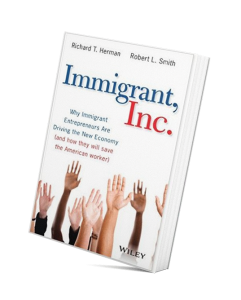
The book: Immigrant, Inc.
Immigrant, Inc.: Why Immigrant Entrepreneurs Are Driving the New Economy (John Wiley & Sons, 2009), co-written by Richard T. Herman and journalist Robert L. Smith, traces how immigrant founders, from Silicon Valley to the Rust Belt, became a source of American innovation and job creation. It argued that a culture of education, thrift, family loyalty and ambition makes immigrants unusually likely to build businesses, and warned that a hostile immigration system would cost the country that advantage.
Civic work behind the research
Richard helped found Global Cleveland, served as a founding adviser to Global Detroit, and co-founded TiE Ohio and the Immigrant & Minority Business Alliance. Those organizations were built on the idea that older industrial cities do not just need better buildings. They need more people. Read about Richard’s civic leadership and speaking engagements.
Frequently asked questions
Do immigrants create jobs or take them?
Both effects exist, but research finds immigrants act more as job creators. A 2022 study in American Economic Review: Insights found immigrants start firms at about 80% higher rates than U.S.-born Americans, and immigrant-founded firms create more jobs per capita.
Can immigration help Cleveland grow?
It already is. In the year ending July 2025, Cuyahoga County had more deaths than births and lost residents to other states, and grew only because about 4,237 people arrived from abroad.
What share of top U.S. AI companies were founded by immigrants?
About 60%. An Institute for Progress analysis found that 25 of the 42 U.S.-based companies on the 2025 Forbes AI 50 list had at least one immigrant founder.
What is a Heartland or place-based visa?
A visa that lets communities losing population recruit immigrants who agree to live and work there. The Heartland Visa Act of 2024 and the 2026 Curtis–Kelly state-sponsored visa bill are the leading federal proposals.
What is Immigrant, Inc.?
A 2009 book by Cleveland immigration lawyer Richard T. Herman and journalist Robert L. Smith, published by John Wiley & Sons, on how immigrant entrepreneurs drive American innovation, job creation and urban renewal.
Is there a U.S. startup visa for immigrant entrepreneurs?
No. Founders typically use the O-1 visa, the EB-2 National Interest Waiver, the EB-1A green card, E-2 or EB-5 investor options, or employer sponsorship such as H-1B. The right path depends on the person and the business.
Key sources
- Azoulay, Jones, Kim & Miranda, “Immigration and Entrepreneurship in the United States”, AER: Insights (2022)
- American Immigration Council, New American Fortune 500 (2025) and New Americans in Northeast Ohio
- NFAP, Immigrants and U.S. Billion-Dollar Companies (2026)
- Institute for Progress, Top AI companies founded by immigrants (2025)
- McKinsey Institute for Economic Mobility, The Great Ownership Transfer (2026)
- Immigration Research Initiative, The Entrepreneurial Spirit
- Hoodline / Cleveland.com, Vintage 2025 Greater Cleveland estimates
- Economic Innovation Group, Heartland Visas: A Policy Primer
This page provides general information and commentary, not legal advice. Reading it does not create an attorney-client relationship.