
The ICEOUT (#ICEOUT) map is a crowdsourced, community reporting tool that helps people share and view possible ICE activity in near real time. It is not official ICE data, and it can be wrong or outdated. The safest way to use it is simple: observe, keep distance, don’t interfere, and don’t panic-share rumors. If ICE approaches you, remain silent and ask for a lawyer.

ICEOUT is crowdsourced, not an official government system.
“Real-time” reports can be incorrect, duplicated, or outdated.
The safest rule is distance + calm + no interference.
Do not chase, surround, block, or confront enforcement activity.
If stopped in public: “Am I free to leave?” then stop talking.
Do not consent to searches. Do not sign anything.
If something goes wrong: preserve evidence early (video, timestamps, witnesses).
If ICE is at your door: keep it closed and demand a judge-signed warrant.
Say this calmly, in order:
“Am I free to leave?”
If YES: “Okay.” (leave calmly)
If NO: “I choose to remain silent.”
“I want to speak to a lawyer.”
“I do not consent to a search.”
“I will not sign anything without legal advice.”
Say this through the door:
“Do you have a warrant signed by a judge?”
“Please slide it under the door.”
“I do not consent to entry.”
“I choose to remain silent.”
“I want to speak to a lawyer.”
“Am I free to leave?”
“I choose to remain silent.”
“I want to speak to a lawyer.”
“I do not consent to a search.”
“I will not sign anything without legal advice.”

The ICEOUT map is a public-facing platform that allows people to report sightings or activity that appears connected to immigration enforcement, and to view similar reports submitted by others.
Official platform: ICEOUT
Common term used online: “Where is ICE right now?”
ICEOUT is:
A crowdsourced reporting site
A quick way to see community-submitted alerts
A tool some people use for situational awareness
ICEOUT is not:
A verified “ICE tracker” with confirmed accuracy
A government data feed
Proof that ICE is operating in a specific way at a specific location
A guarantee that any area is “safe” or “unsafe”
HLG rule: treat ICEOUT reports as leads, not confirmed facts.
Most crowdsourced ICE activity maps tend to include reports like:
“Marked vehicles in the area”
“Agents seen near a building”
“Activity near workplaces or transit”
“Presence near court, detention facilities, or check-in locations”
ICEOUT can show:
Where people say activity occurred
When reports were submitted (timing context)
Patterns across multiple reports
ICEOUT cannot reliably confirm:
Whether agents are actually ICE
Whether activity is an arrest, a “check,” or unrelated policing
Whether the report is accurate, mistaken, duplicated, or malicious
Even if ICEOUT updates quickly, crowdsourced systems can create:
False alarms
Panic-sharing loops
Risky “crowd response” behavior
Best practice: verify before resharing and avoid “rush-to-scene” behavior.
This is the line that matters:
In general, people can:
Observe activity in public areas
Share their observations
Record law enforcement from a safe distance (without interfering)
But people should not:
Obstruct enforcement activity
Trespass
Follow vehicles in a way that creates danger
Harass individuals
Encourage confrontation
If you want the general legal framework, see:
If you are using ICEOUT, the legally safest posture is:
distance
calm
documentation only if safe
no interference
Do not:
Run toward the scene
Follow agents or vehicles
Block a doorway, driveway, hallway, or sidewalk
Physically interfere with any person
Trespass onto private property
Publish private personal information about non-public figures
If you see an alert or activity:
Leave space
Keep exits open
Avoid crowds or escalation
Keep children away from the area
Before sharing:
Confirm location details
Avoid absolute language (“ICE is raiding everything”)
Avoid naming individuals or families
Avoid posting content that could expose vulnerable people
Assume anything you post may be:
screenshot
reshared
misinterpreted
used as evidence (by any side)
The safest path is to share minimal necessary details:
general area
time
non-identifying description
People get into trouble when they start talking under pressure.
Your goal is:
confirm whether you can leave
stop talking
get counsel
Use the script above and repeat it. Do not argue.
For deeper guidance, see HLG playbooks:
Risk level: Medium
Best next steps
Choose a safer route if possible
Avoid distracted or panic driving
Do not drive toward the reported activity
Legal risk to avoid
Don’t follow enforcement vehicles
Call a lawyer if
You have a pending immigration case or past removal order
Risk level: High
Best next steps
Follow the school pickup plan (calm, direct, verified)
Communicate with trusted contacts (not group panic messages)
Keep children away from any enforcement activity zone
Legal risk to avoid
Do not create a crowd confrontation near children
Call a lawyer if
A family member is detained or questioned
Risk level: Medium
Best next steps
Record only if safe
Stand back
Capture time/location (without interfering)
Legal risk to avoid
Do not interfere, trespass, or obstruct
Call a lawyer if
ICE demands your phone or tries to seize evidence
Risk level: High
Best next steps
Stay inside, keep door closed
Use the doorstep script
Do not open the door “to talk”
Legal risk to avoid
Do not consent to entry without a judge-signed warrant
Call a lawyer if
Agents attempt entry or detain someone in the building
Risk level: Medium
Best next steps
Pause before reposting
Mark unverified reports as unconfirmed
Remove identifying details
Legal risk to avoid
Don’t publish names/addresses of private individuals
Call a lawyer if
False reporting triggers harassment or threats
Title: “ICEOUT Safety Rules Checklist (See It • Share It • Stay Safe)”
Format: Black-and-white, large font, checkbox blocks, fridge-ready
Checkboxes
☐ Verify before sharing (avoid rumor reposts)
☐ Keep distance (do not approach)
☐ Do not follow vehicles
☐ Do not trespass
☐ Do not interfere (no blocking, no confrontation)
☐ Record only if safe (public space, from distance)
☐ Save timestamp + location
☐ Use the script if approached (free to leave / silent / lawyer)
☐ Call attorney + trusted contact if detention occurs
Footer line: “Safety first. Documentation second. Arguments never.”

ICEOUT is useful for situational awareness, but it is not official government reporting. The safest way to use any crowdsourced map is to confirm timing, avoid escalation, and share only the minimum necessary details.
Use this process before you change plans, alert your family, or repost anything publicly.
Step 1 — Check the timestamp (recency matters)
Ask:
How long ago was this report posted?
Does it describe something happening now, or something that already passed?
If a report is old, treat it as historical, not real-time.
Step 2 — Confirm distance (do not travel toward the scene)
The safest decision rule is simple:
Do not drive toward the reported location
Do not gather a group
Do not attempt to “verify” in person
Your goal is safer routing and calmer planning, not confrontation.
Step 3 — Apply the “two-source minimum” rule
Treat a single report as a signal, not a fact.
Look for:
a second independent report in the same area and time window
confirmation from a trusted organization (community nonprofit, clinic, school safety channel)
a credible news update when applicable
If there is no independent confirmation, do not amplify it as “confirmed.”
Step 4 — Share safely (minimum necessary details only)
If you choose to share a report, keep the information factual and non-identifying.
Safe to share:
general area (neighborhood / intersection level)
general time window (“within the last hour”)
non-identifying description (“law enforcement presence reported”)
Do not share:
names of private individuals
apartment numbers or exact home addresses
face photos of bystanders or families
content that encourages people to rush the location
1 report = signal
2+ reports = stronger signal
No confirmation = don’t amplify
This protocol reduces:
accidental misinformation
panic-driven decisions
unnecessary crowding near enforcement activity
avoidable legal exposure from interference
To view the ICEOUT platform directly: ICEOUT (#ICEOUT) Real-Time Map
When ICEOUT reports activity nearby, institutions should avoid improvisation. A calm, consistent response protects safety, privacy, and legal compliance.
The goal is not to “investigate.” The goal is to reduce chaos, protect vulnerable people, and document accurately.
When staff receive a report of nearby enforcement activity:
Do this:
Continue normal operations as much as possible (reduce panic)
Follow existing pickup authorization rules (do not make exceptions under pressure)
Route questions to a designated administrator (one voice, not many)
Document any law enforcement contact (names, time, statements, vehicle details)
Use a neutral message if asked: “We are verifying information and following our safety plan.”
Do not do this:
Do not send mass messages based on a single unverified report
Do not allow staff to speculate or post rumors publicly
Do not allow ad hoc “crowd responses” near children
Helpful official context on immigration court and proceedings: EOIR (Immigration Court System)
Clinics should treat sudden enforcement rumors like any other disruption risk: avoid panic, maintain privacy, document facts.
Do this:
Protect patient privacy and limit unnecessary disclosures
Keep staff aligned: one spokesperson, one documented process
Preserve relevant security footage if something occurs on-site
If patients become afraid, provide clear, neutral reassurance and resource options
Do not do this:
Do not discuss patient identities or immigration concerns in public areas
Do not allow staff to offer legal advice beyond basic safety scripts
Oversight and complaint channels (when appropriate):
Employers should plan for two different situations:
a rumor that causes fear in the workforce
a direct contact event (questions, presence, paperwork)
Do this:
Designate a single response lead (manager/HR)
Tell staff not to answer questions casually under pressure
Preserve visitor logs and security video if an incident occurs
Contact legal counsel immediately if there is any on-site contact event
Do not do this:
Do not allow multiple staff to engage in inconsistent conversations
Do not assume you understand the purpose of a visit
Do not produce documents or allow entry without proper review and counsel
General agency background reference: ICE Enforcement and Removal Operations (ERO)
“I’m not authorized to answer questions.”
“Please provide your name, agency, and documentation in writing.”
“Our legal counsel will respond.”
There is no official public “live ICE location” tracker for the general public. Tools like ICEOUT show crowdsourced reports, not verified official locations. Treat the map as situational awareness only, and do not make risky decisions based on a single report.
ICEOUT is a crowdsourced reporting map where users submit and view community reports about possible immigration enforcement activity. It is designed to help people stay informed, but it is not official government reporting.
Crowdsourced maps can be helpful but imperfect. Reports may be mistaken, duplicated, outdated, or incomplete. Use ICEOUT as a “signal,” not proof.
Generally, sharing observations about activity you see in public is lawful. The legal risk begins when people interfere, obstruct, trespass, or harass others. Focus on calm reporting and safety.
In many situations, people can record law enforcement in public as long as they do not interfere. The safest practice is distance, calm behavior, and avoiding confrontation.
ICE can approach people and ask questions. You do not have to answer questions about immigration status. The most protective script is: “Am I free to leave?” If not, remain silent and ask for a lawyer.
No. You can say: “I choose to remain silent” and “I want to speak to a lawyer.” Talking under pressure is one of the most common ways people accidentally provide harmful information.
Ask if you are free to leave. If you are not free to leave, say you are choosing to remain silent and you want a lawyer. Do not guess, volunteer extra details, or sign anything.
Keep the door closed. Ask for a warrant signed by a judge and request that it be slid under the door. If they cannot provide that, say: “I do not consent to entry.” Then stop talking.
Keep hands visible. Ask: “Am I free to leave?” If not, remain silent and ask for a lawyer. Do not consent to a search, and do not sign anything.
Be careful. Sharing unverified reports can create panic and put others at risk. If you share, keep it factual, time-stamped, and non-identifying.
If safe, preserve video, exact time/location, witnesses, and any medical records. Early documentation often shapes what happens next, especially if the encounter escalates or someone is detained.
Remain calm and assert identity without escalating. Ask to speak to a lawyer and request documentation of the stop. Preserve evidence and seek legal help quickly.
Try to confirm where the person is being held, collect identifying details, preserve documents, and contact an immigration lawyer immediately. Do not rely on social media rumors as “confirmation.”
Call immediately if there is a detention, a home encounter, a workplace arrest, a pending removal order, a missed court date, or any situation involving pressure to sign documents.
Crowdsourced reporting tools like ICEOUT reflect a real need: people want timely information that helps them avoid chaos and make safer choices. But no map can guarantee accuracy, and no alert is worth risky confrontation. The best protection is consistent: keep distance, avoid interference, use short scripts, document safely, and get legal help early when detention happens.
If you need case-specific legal guidance based on your status, history, or risk level, book a confidential consultation.
ICEOUT Real-Time Map (#ICEOUT) — crowdsourced reporting map for situational awareness
ICE Enforcement and Removal Operations (ERO) — what ERO is and what it does
ICE Detainee Locator System — how families can search for someone in ICE custody
Executive Office for Immigration Review (EOIR) — immigration court system overview
EOIR Automated Case Information (Court Case Status) — check immigration court case status
USCIS Home Page — immigration benefits information (not an enforcement agency)
DHS Office for Civil Rights and Civil Liberties (CRCL) — where civil rights complaints may be submitted
DHS Office of Inspector General (OIG) — oversight and accountability resources
American Immigration Lawyers Association (AILA) — attorney-focused immigration law resource hub
Transactional Records Access Clearinghouse (TRAC) – Immigration Court Data
USAspending.gov (Federal Contract Awards Search) — track contracts related to detention, transport, services
ICE Detainee Locator — start here
EOIR Case Status Check — confirm court posture
Find Legal Help (Immigration Advocates Network) — find nonprofit/legal support
HLG Consultation — case-specific strategy review
ICE “ruses” are deceptive tactics used to get people to open doors, step outside, answer questions, or “consent” to entry or searches. These ICE ruse tactics are often permitted in enforcement operations, but the legality can be contested—especially when deception pressures consent at a home. The safest response is simple: keep the door closed, demand a judge-signed warrant, refuse consent, stay silent, and ask for a lawyer.

An ICE ruse is a tactic where officers use misdirection, partial truth, or deceptive presentation to get someone to open a door, come outside, reveal identity, or provide consent.
Ruses matter because consent changes outcomes. Many Fourth Amendment disputes turn on whether a person voluntarily allowed entry or provided information—even when the contact started with deception.
Understanding ICE ruse tactics is crucial for navigating interactions with law enforcement.
For practical examples and real-world patterns, see:

These are common patterns reported by advocates, researchers, and impacted families. The enforcement goal is often to create urgency, panic, or “accidental cooperation.”
The best “ground truth” sources for field ruses are the practitioner-facing materials from the Immigrant Defense Project and ACLU litigation materials, supported by the broader legal analysis in Columbia Law Review.
How it’s used: Agents say “police” and do not clearly disclose they are ICE, aiming to trigger automatic compliance at the door.
Why it works: People hear “police” and assume they must open the door immediately.
How it’s used: A pretext to create urgency and override normal caution (“this is serious,” “we just need to clear something up”).
Why it works: Most people are conditioned to treat emergency claims as non-optional.
How it’s used: Agents state “warrant” and rely on the resident to assume it is judge-signed.
Why it works: People do not realize the legal difference between a judge-signed warrant and an ICE administrative warrant.
How it’s used: Designed to trigger “mandatory compliance” because probation/parole feels like you “cannot say no.”
A major Southern California settlement specifically bars ICE from using ruses like identifying as probation/parole (or other non-federal agencies) in home operations.
Why it works: It hijacks fear of immediate punishment for “noncooperation.”
How it’s used: Another “authority substitution” tactic (local police identity is generally trusted and feared).
Why it works: Residents often comply instantly with perceived local police.
How it’s used: Instead of forcing entry, agents try to get the target to step outside voluntarily.
Why it works: Once a person is outside the home, the “threshold” protection advantage is weakened in practice.
How it’s used: Agents exploit protective instincts: “someone is worried about you,” “we need to see everyone is okay.”
Why it works: People open the door because it feels morally unsafe not to.
How it’s used: “Your landlord asked us to check something,” “We need to inspect,” “There’s an emergency maintenance issue.”
Why it works: It blends into ordinary life and bypasses “law enforcement” suspicion.
How it’s used: Someone knocks like a courier/utility worker to trigger reflexive door opening.
Why it works: It targets habit, not judgment.
How it’s used: Agents attempt to convert a target into a “helper,” then pivot into identity/status questions.
Why it works: It disarms people who fear appearing uncooperative.
How it’s used: “This is only paperwork,” “This is to confirm you live here,” “This isn’t a big deal.”
Why it works: People underestimate how small admissions become evidence.
How it’s used: Agents ask “Does X live here?” then build identity and household information.
Why it works: Many people answer because it seems harmless.
This exact category of pretext was described as prohibited under the Southern California settlement reporting—pretexts used to lure residents outside.
Short answer: Some forms of deception are often permitted in law enforcement operations, including immigration enforcement. But the legality can become contested when deception is used to pressure consent—especially at a home, where constitutional protections are strongest.
This is the framework your article must keep clear:
Homes receive the highest Fourth Amendment protection. Consent searches and consent entry often become the key legal issue. Deception that produces “consent” may be challenged depending on facts, coercion, and circumstances.
For the civil liberties analysis, see:
ICE has internal guidance discussing the use of ruses in enforcement operations. That memo is a core primary source and should be cited directly in your article.
Primary source:
Researchers and advocates document how ruses function as a pipeline from deception to contact, consent, arrest, and removal.
High-authority analysis:
A tactic can be used in practice even when its legality is contestable in court. The immediate risk is not winning the legal argument later. The immediate risk is giving ICE entry, admissions, or identification today.

One of the most important ICE ruse legal outcomes is the court-approved settlement in Kidd v. Noem, which imposes operational restrictions on ICE home-enforcement practices in Southern California.
What it prohibits (plain-language summary):
ICE officers may not use deceptive ruses to enter a home or to ask a resident to exit a home. The ban includes falsely identifying themselves as state or local police (e.g., LAPD), probation, parole, detectives, or any other non-federal governmental agency.
Primary and high-authority sources:
In some jurisdictions, ICE has been legally restricted from impersonating local police or using ruses to get residents to open the door or come outside.
In federal court litigation, ICE home enforcement ruses—especially those involving misrepresenting identity as local police—have resulted in enforceable restrictions on deceptive tactics.
If ICE is at the door, your safest default response is:
People often hear “warrant” and assume the same thing. It is not.
This distinction is central to your “doorstep script” and is why your script must focus on judge-signed warrant language.

Use this exact sequence. Speak slowly and calmly.
Do you have a warrant signed by a judge?

Please slide it under the door.

I do not consent to entry.

I choose to remain silent.

I want to speak to a lawyer.
¿Tiene una orden firmada por un juez?

Por favor, deslícela por debajo de la puerta.

No doy mi consentimiento para entrar.

Elijo permanecer en silencio.

Quiero hablar con un abogado.
ICE ruses do not only happen at the door. They also appear in public places and routine contact situations.
Am I free to leave?

If YES: Okay. (leave calmly)

If NO: I choose to remain silent.

I want to speak to a lawyer.

I do not consent to a search.

I will not sign anything without legal advice.
Your priorities: safety, clarity, silence, counsel.
If you already published an HLG vehicle encounter guide, link it here as “Vehicle Encounter Checklist (Driver + Passenger).”
This is a common conversation trap.
Say:
“I choose to remain silent. I want to speak to a lawyer.”
Each scenario must include (1) what it looks like, (2) risk level, (3) consequences, (4) safest response.
What it looks like: Loud knocking, commanding tone, claims of urgent authority.
Risk level: High
Legal consequence: Opening the door can create immediate exposure and reduce defenses.
Safest response: Use the doorstep script. Keep the door closed.
What it looks like: “We’re checking on someone’s safety.”
Risk level: High
Legal consequence: Sympathy-driven door opening often becomes consent.
Safest response: Keep the door closed; require judge-signed warrant.
What it looks like: Pressure to exit private space.
Risk level: Medium to High
Legal consequence: Hallway/lobby makes detention easier and reduces threshold protections.
Safest response: Do not go down. Use silence + counsel.
What it looks like: Friendly tone, casual questioning.
Risk level: Medium
Legal consequence: Talking creates admissions and confusion.
Safest response: “Am I free to leave?” then silence + lawyer.
What it looks like: “This is just paperwork.”
Risk level: High
Legal consequence: Signing can create serious downstream consequences.
Safest response: “I will not sign anything without legal advice.”
ICE ruses work for one reason: they manufacture “cooperation” that ICE later describes as consent.
But in real Fourth Amendment litigation, the question is often not “Did the person open the door?” — it’s:
Was the cooperation truly voluntary, or was it pressured, manipulated, or induced by deception?
In home encounters, many legal fights turn on whether a person knowingly and voluntarily allowed officers to enter or search.
When an officer uses deception (a ruse), a court may scrutinize whether the resident:
understood who was at the door
understood they had a right to refuse
was pressured into compliance by fear, urgency, or authority
The most important practical takeaway is unchanged:
Your safest strategy is to avoid giving “consent” at all.
That means: keep the door closed, demand a judge-signed warrant, and stop talking.
When courts evaluate whether consent was valid, they often examine the totality of circumstances — meaning the full situation, not one isolated moment.
Here are the real-world factors that can matter:
1) Was the person at home? (Maximum Fourth Amendment protection)
Home encounters are treated differently than public encounters because the home is the most protected place under Fourth Amendment doctrine.
2) Did officers create urgency or panic?
Ruses frequently rely on “emergency pressure,” for example:
“This is serious.”
“We need you to open the door right now.”
“Someone might be in danger.”
“We’ll be back with force.”
Urgency can undermine voluntariness because it compresses decision-making.
3) Did officers misrepresent who they were?
“Police” is not a neutral word. Neither is “detectives,” “probation,” “parole,” “maintenance,” or “building management.”
A court may look closely at whether the resident acted under mistaken assumptions about authority.
4) Did officers imply the resident had no choice?
Consent becomes legally suspect when it isn’t a real choice:
“You have to open the door.”
“You don’t have a choice.”
“We have a warrant.” (without showing it)
5) Did officers use the word “warrant” ambiguously?
This is a major ruse pattern:
“We have a warrant.”
That phrase often pressures compliance because many people assume it means a judge-signed warrant, when it may be an ICE administrative warrant instead.
6) How many agents were present, and how intimidating was the encounter?
Courts may consider whether the person was facing:
multiple officers
tactical gear
aggressive banging
blocked exits
raised voices
The greater the intimidation, the more questionable the consent.
7) Was the resident separated from family or isolated?
Separation increases coercion and reduces the ability to think clearly.
8) Did officers push the person to “step outside”?
The “step outside” maneuver is not a casual request. It’s often an operational strategy to reduce the target’s home-threshold advantage.
9) Did the person clearly refuse consent — and was that refusal ignored?
If you say “I do not consent” and officers push anyway, that fact matters later.
10) Did officers pressure a signature or paperwork “right now”?
“Just sign this” is often framed as harmless. It can become the opposite.
These patterns show up repeatedly across real-world reporting, legal analysis, and community defense training.
1) Authority Substitution
They present as someone else:
“Police”
“Detectives”
“Probation”
“Parole”
“Building management”
2) False Urgency
They create a crisis:
“Emergency”
“Wellness check”
“We’re investigating a serious crime”
3) Warrant Ambiguity
They say “warrant” without clarity:
“We have a warrant.”
“We just need to confirm something.”
4) Threshold Manipulation
They don’t need entry if they can get you outside:
“Step into the hallway.”
“Come down to the lobby.”
“Come outside to talk.”
5) Paperwork Pressure
They try to turn panic into a signature:
“Just sign this.”
“Confirm your name.”
“This is just a form.”
If you say nothing else, say this once — slowly and clearly:
“I do not consent to entry or a search. I will not open the door without a warrant signed by a judge.”
Then stop talking.
Why this works: it blocks the later argument that you “voluntarily let them in” or “agreed to cooperate.”
People open doors out of fear, habit, or confusion. If that happens, your goal is to stop the consent pipeline immediately.
Say:
“I do not consent to your entry.”
“Please step back.”
“Do you have a warrant signed by a judge?”
“I choose to remain silent.”
“I want to speak to a lawyer.”
Then stop talking.
This does not guarantee the encounter ends — but it reduces the chance ICE can claim the rest of your conduct was voluntary cooperation.
You do not win these encounters by “explaining” or “clearing it up.”
You reduce risk by refusing to provide the ingredients ICE needs:
access
identity confirmation
admissions
signatures
consent
Your playbook remains: closed door + judge-signed warrant + no consent + silence + lawyer.
Most families think “ICE ruse” means one thing: fake police at the door.
In reality, ruses function like a pattern-matching system. They are designed to push you into one of three mistakes:
opening a door
stepping into a vulnerable space
talking long enough to create admissions
This toolkit is designed to prevent that.
If you hear any of these, treat it as high risk and do not open the door:
“Police — open up.”
“We have a warrant.” (but they won’t show it)
“We’re investigating a crime.”
“We just need to talk.”
“It’ll be easier if you open the door.”
“Come outside so we can clear this up.”
“We’re here for a wellness check.”
“We’re looking for someone else — can you confirm?”
“Just sign this.”
“We just need to confirm your name.”
What these lines are trying to do: trigger reflex compliance before you slow down and verify authority.
If you live in a building, these are common pressure points:
“Come downstairs to the lobby.”
“We can’t talk at your door — meet us outside.”
“Building management asked us to check.”
“Maintenance issue — you need to come out.”
“We need to confirm who lives in this unit.”
Reality check:
The lobby/hallway is where targets lose the “threshold advantage.” Don’t go.
Many enforcement traps start with identity fishing:
“This is urgent — we need to verify your identity.”
“Confirm your address and date of birth.”
“You missed an appointment — you must come now.”
“We need you to meet us to resolve a problem.”
“If you don’t cooperate, it will get worse.”
The risk: you talk yourself into a problem you can’t talk out of.
Workplace encounters often start with “low drama” language:
“We just have a few questions.”
“We need to confirm employment details.”
“Can you come into this room with us?”
“We’re verifying records / conducting an audit.”
“Just show us your documents to clear it up.”
Practical reality:
Even “friendly questions” can become a removal case.
When you feel pressure, your brain narrows. This protocol is designed to stay usable even in panic.
Say these questions in order:
“What agency are you with?”
Do not accept vague answers like “law enforcement.”
“Am I required to open the door or come outside?”
If they do not clearly explain lawful authority, treat it as not required.
“Do you have a warrant signed by a judge? Please slide it under the door.”
If they cannot slide a judge-signed warrant under the door, your response is:
“I do not consent to entry.”
Then stop talking.
Ruses are designed to stretch the encounter beyond the moment you can safely manage it.
Use the one-minute rule:
If an encounter lasts longer than one minute, you are already in the danger zone for accidental admissions and consent.
So your goal is not to “win” a conversation.
Your goal is to end it.
You already have a general “what not to do.” This version is stronger because it matches real-life settings.
Do NOT:
open the door “to listen”
crack the door open
step onto the porch “to talk”
answer identity questions through the door
accept “we have a warrant” without seeing a judge-signed warrant
Do NOT:
go downstairs “to clear it up”
follow anyone into a confined space
hand over documents “just for verification”
allow the situation to become a physical containment event
Do NOT:
confirm your address, DOB, country of birth
“explain your status”
agree to meet anywhere without counsel
click unknown links or provide photos of documents
Do NOT:
run
guess answers
volunteer immigration history or birthplace
sign anything without legal advice
go into a private back room without knowing whether you are free to leave
Do NOT:
reach suddenly
answer “where were you born?” questions
consent to searches
sign anything
talk your way into contradictions
If you cannot tell what is happening, use the same script every time:
“Am I free to leave?”
If YES: “Okay.” (leave calmly)
If NO:
“I choose to remain silent.”
“I want to speak to a lawyer.”
“I do not consent to a search.”
“I will not sign anything without legal advice.”
Then stop talking.
Put this on a fridge, by the door, or next to the peephole:
“We do not open the door for anyone we do not know — not even ‘police’ — unless they show a warrant signed by a judge.”
This one rule prevents the majority of ruse-driven “consent” outcomes.
If an ICE encounter becomes chaotic, your goal becomes safety + documentation, not debate.
Legal challenges rise or fall on details: what was said, what was implied, what was shown, and whether consent was real or pressured.
For additional context on the broader legal debate, cite:
An ICE ruse is deception used to get someone to open a door, step outside, reveal identity, or consent to entry or searches. The legal risk is that a person “cooperates” before understanding what is happening. Practical takeaway: keep the door closed and use a short script.
Some deception is often permitted in enforcement operations, but legality can be contested—especially when it pressures consent in home encounters. The safest approach is to avoid consent entirely. Practical takeaway: require a judge-signed warrant and stay silent.
Reports and legal analysis describe scenarios where ICE presents itself in ways that cause confusion about identity or authority. This is one reason advocates warn people not to open doors based on verbal claims alone. Practical takeaway: verify with a judge-signed warrant.
Ruses may be designed for exactly that purpose. Once the door is open, risk increases immediately. Practical takeaway: do not open the door; ask for a judge-signed warrant.
Opening the door can create an argument that you allowed entry or escalated the encounter. Avoiding consent reduces risk. Practical takeaway: keep the door closed and refuse entry.
A judge-signed warrant is issued by a judge. An ICE administrative warrant is typically an agency document and may not provide the same authority for home entry. Practical takeaway: always ask whether it is judge-signed.
You can ask whether you are free to leave. If you are not free to leave, the safest response is to remain silent and ask for a lawyer. Practical takeaway: do not “explain” or “clear it up.”
People can be pressured into consent during confusing encounters. Once consent is given, it can be hard to undo. Practical takeaway: say “I do not consent to a search” and stop talking.
Do not open the door based on verbal claims. Ask for a judge-signed warrant and request it be slid under the door. Practical takeaway: do not engage in a conversation.
Video, photos, witnesses, timestamps, and any documents shown are critical. Write down what was said and how entry or contact occurred. Practical takeaway: document immediately and speak with counsel.
Statements can become evidence. Even small contradictions or admissions can create complications. Practical takeaway: remain silent and ask for a lawyer.
Showing documents can escalate identification and create risk. Do not hand over anything unless advised by counsel. Practical takeaway: stay calm, stay silent, request legal advice.
This often begins as a conversation trap. Do not volunteer names, schedules, or identity information. Practical takeaway: remain silent and ask for a lawyer.
This is a high-risk scenario. The family should rehearse a simple rule: do not open the door for anyone you do not know. Practical takeaway: post the checklist and practice the script.
If ICE contacted you, came to your home, used deception, or asked you to sign anything, you should speak to counsel quickly. Practical takeaway: preserve evidence and get legal advice before making statements.
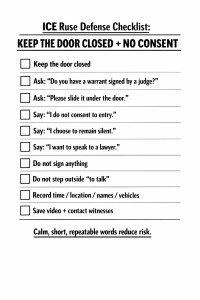
Title: “ICE Ruse Defense Checklist: Keep the Door Closed + No Consent”
Style: One page, black-and-white, large font, checkbox blocks, fridge-ready
Checkboxes
Footer: “Calm, short, repeatable words reduce risk.”
ICE ruses increase risk because they create confusion and cause people to cooperate before they understand what is happening. The most common legal danger is accidental consent—opening the door, stepping outside, answering questions, or signing documents.
The best protection is simple and repeatable: keep the door closed, ask for a judge-signed warrant, refuse consent, remain silent, and ask for a lawyer.
If you or a family member experienced an ICE ruse, preserve evidence immediately and get legal advice before taking next steps.
What To Do If ICE Comes To Your Door: 10 Smart Things (Herman Legal Group LLC)
ICE Came to My Door: What Are My Rights If I’m Undocumented or Overstayed? (2025 Guide) (Herman Legal Group LLC)
ICE Memo Claims Officers Can Enter Homes Without a Judge’s Warrant — What the Law Actually Allows (and What to Say at the Door) (Herman Legal Group LLC)
Is ICE Arresting Only Criminals—Or Anyone With a Civil Immigration Violation? (Herman Legal Group LLC)
DHS Claims “Record-Breaking” Immigration Enforcement (Herman Legal Group LLC)
How to Prepare for an ICE Arrest in Columbus, Ohio (Herman Legal Group LLC)
Essential Tips: How to Boycott ICE Contractors Legally (Herman Legal Group LLC)
Entities That Have Distanced Themselves From ICE (Herman Legal Group LLC)
Ohio GOP Misleads About Non-Criminal Ohio ICE Arrests (Herman Legal Group LLC)
Do GOP Voters Support Aggressive Immigration Enforcement? (Herman Legal Group LLC)
No—ICE generally cannot legally force entry into a private home without a judge-signed warrant or a recognized legal exception, even if officers show an ICE “warrant of removal” like Form I-205. A newly disclosed ICE memo reportedly claims broader authority, but an administrative ICE warrant is not the same as a judicial warrant. Keep the door closed, refuse consent, stay silent, and ask for a lawyer.
Many people wonder if ICE can enter home without warrant and if ICE enter home without warrant is even legal.


Major outlets report that a newly disclosed ICE memo encourages or trains officers to treat administrative immigration paperwork—including Form I-205—as sufficient authority to enter homes and make arrests, even without a judge-signed warrant. See reporting by:
This is significant because “home entry” is the red-line constitutional issue—and the gap between what enforcement agencies claim and what courts ultimately allow is where families can get hurt.

Form I-205 is titled a “Warrant of Removal/Deportation.” It is a DHS/ICE document used to execute a final removal order. ICE hosts a sample here:
A regulation describing I-205 exists here:
Form I-205 is not a judge-signed search warrant. It is not a judicial finding of probable cause authorizing forced entry into a private residence.
That distinction matters because the Constitution treats the home differently than a street stop, vehicle encounter, or public place.
Do not decide based on what ICE says the paper “means.”
Decide based on whether the document is signed by a judge and clearly authorizes entry.
If officers cannot show a judge-signed warrant through the door (or slide it under the door), families should default to:
Use this exact sequence. Speak slowly and calmly.
Do you have a warrant signed by a judge?

Please slide it under the door.

I do not consent to entry.

I choose to remain silent.

I want to speak to a lawyer.
¿Tiene una orden firmada por un juez?

Por favor, deslícela por debajo de la puerta.

No doy mi consentimiento para entrar.

Elijo permanecer en silencio.

Quiero hablar con un abogado.
Your goal becomes safety + documentation, not debate.
Say once:
Then stop talking. Ask for a lawyer again.

Risk level: High
What ICE may do: claim I-205 authorizes entry and removal pickup
What you should do: keep door closed; demand judge-signed warrant; refuse consent; stay silent
Next step: call counsel immediately; document everything; do not sign paperwork
Reference: ICE Form I-205 sample
Risk level: High
What ICE may do: pressure family members to open door or “confirm who lives there”
What you should do: do not open the door; do not answer residency questions; ask for judge warrant
Legal consequence: statements about who lives where can become evidence in later proceedings
Next step: preserve names/badge info; contact counsel
Risk level: Medium–High
What ICE may do: push for entry “to verify”
What you should do: do not consent to entry; do not provide IDs through door; remain silent
Next step: record interaction; get witness names; call lawyer if anything escalates
Risk level: Medium
What ICE may do: attempt entry through common areas, building staff, or another tenant
What you should do: do not authorize entry into private unit; do not let staff “consent” for you
Next step: if you are a tenant, document lease address and any forced entry damage

Two things can be true at the same time:
This is why your words matter. Your best protection is:
Gather these ASAP (same day if possible):
For general guidance on warrants/subpoenas and what documents mean, see:
Generally, ICE needs either a judge-signed warrant or a valid legal exception to force entry into a home. ICE may carry administrative immigration paperwork, but that is not automatically the same as judicial authority to enter a residence.
No. You can keep the door closed and ask them to show a judge-signed warrant. Many rights are lost the moment a door is opened and “consent” is disputed.
Form I-205 is an ICE form tied to executing a final removal order. You can still say: “I do not consent to entry” and request a judge-signed warrant.
See: ICE Form I-205 sample and 8 C.F.R. § 1241.32.
It creates a clear record that you did not voluntarily allow entry. That can matter later if lawyers challenge the legality of what happened and whether any “consent” was manufactured.
Do not open the door. Talking can lead to admissions and confusion. Use the script: ask for a judge warrant, refuse consent, remain silent, request counsel.
Do not physically resist. Repeat once: “I do not consent to entry.” Then remain silent and ask for a lawyer. Document everything afterward.
Stepping outside removes the “home-entry” issue and can increase risk. If you step outside, ask: “Am I free to leave?” If not, remain silent and request counsel.
A lawful search generally requires proper legal authority (often a judge-signed warrant or a recognized exception). Do not consent to any search.
No. Do not sign anything without legal advice. You can say: “I will not sign anything without my lawyer.”
Record names, badge numbers, vehicles, time, location, witnesses, and any damage. Save video files in at least two places.
Officers may try. Families should avoid discussing immigration status or household details. Keep the door closed and request counsel.
Do not assume you are “safe.” Do not open the door. Contact counsel immediately to evaluate risk, posture, and options.
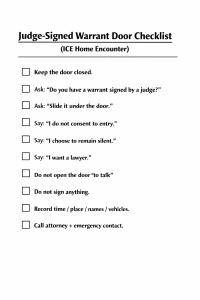
Title: “Judge-Signed Warrant Door Checklist (ICE Home Encounter)”
Format: black-and-white, one page, checkbox blocks
Checkboxes:
Primary:
Major reporting:
Rights education:
To strengthen your safety plan and reduce risk of “one bad moment” turning into a case disaster, also read:
The headline risk is not panic—it’s confusion at the door. Families reduce danger by rehearsing a short script, refusing consent, staying silent, and documenting the encounter.
If you or a loved one has had prior ICE contact, has a final order, is in removal proceedings, or lives in a mixed-status household, a short legal strategy consult can help prevent avoidable mistakes. You can schedule here:
If you’re a GOP voter who supported “tough immigration enforcement,” here is the real question: did you vote for this version of enforcement—street-level arrests, fast detention decisions, and collateral harm to families and bystanders?
Trump’s aggressive immigration enforcement agenda increases the likelihood of ICE arrests, detention, and removal proceedings for a far wider group of people than many voters assume—including noncitizens with no criminal convictions. The legal trigger is not whether someone is a “criminal.” It’s whether DHS claims the person is removable under U.S. immigration law (civil immigration enforcement).
Recent polling suggests this is no longer an abstract debate. A Quinnipiac national poll (Jan. 2026) found that only 40% of voters approve of how ICE is enforcing immigration laws, while 57% disapprove—but Republican approval remains high (84% approve). See: Quinnipiac University Poll release.
At the same time, the GOP coalition itself is not uniform on how much harm is acceptable. A Reuters/Ipsos poll (Jan. 2026) found Republicans split on enforcement intensity: 59% said immigration officers should prioritize arrests even if people get hurt, while 39% said officers should focus on reducing harm even if it results in fewer arrests. See: Reuters report on the Reuters/Ipsos poll.
That split is the point of this guide. It explains what the law allows, what is happening in practice, and what accountability would actually require—so GOP voters (and everyone else) can make a clear-eyed decision about what kind of enforcement they truly support.
The key question the country is asking: Do GOP voters support aggressive immigration enforcement?


This enforcement agenda is not limited to “violent criminals.” In practice, it affects undocumented people, visa holders, green card holders, and employers with immigrant workforces. The result is increased legal exposure, more disruption to families and workplaces, and greater uncertainty across industries that rely on immigrant labor.
This is not only a policy debate. It is a practical question of how civil immigration enforcement is carried out at street level, at job sites, and at ports of entry.

In Minneapolis, a family driving home with six children reported being caught in a clash where tear gas was deployed, a canister rolled under their vehicle, and multiple children required medical attention. Reporting about the incident includes an Associated Press account republished here: Report on the Minneapolis family exposed to tear gas amid ICE protests.
At the same time, a federal judge in Minnesota issued an order restricting immigration agents from arresting or using force such as tear gas or pepper spray against peaceful protesters and observers absent suspicion of interference or crime, and the federal government appealed that ruling. See: Reuters report on federal court limits on ICE tactics toward Minnesota protesters.
This is the accountability question for voters who supported aggressive immigration enforcement: is this what you intended to authorize? Do GOP voters support aggressive immigration enforcement? The answer will shape future policies and actions. Are you among those who believe in the question of whether Do GOP voters support aggressive immigration enforcement?
Tough enforcement is a policy preference.
Unaccountable enforcement is a governance failure.
If immigration enforcement routinely harms bystanders, then voters are no longer debating “border policy.” Voters are deciding what government force is allowed to look like in real life.
Civil immigration enforcement does not operate outside the Constitution. Courts can and do impose limits. Oversight is not optional.
Some voters respond to incidents like Minneapolis with a blunt rationale:
Yes, innocent people will be impacted by ICE.
Yes, ICE may be overly aggressive and violate due process.
But desperate times require desperate measures.
And injuries or rights violations—even to U.S. citizens—are collateral damage.
That rationale is not abstract. It is a decision to tolerate foreseeable harm in the name of urgency.
But in the United States, immigration enforcement is still constrained by constitutional principles, agency rules, and court review. Federal court restrictions in Minnesota are a reminder that “civil enforcement” does not equal unlimited force. Reuters report on the Minnesota court order and appeal.
“Collateral damage” is not a compliance framework. It is an admission that harm is foreseeable—and acceptable.
If you voted for tough enforcement, clarity matters. These are not rhetorical questions. They are consent tests.
For practical “what to do in the moment” guidance, readers should review: What to do if ICE approaches you in public.
Silence is not a crime, but it becomes a form of civic permission when oversight is refused. Voters cannot control every enforcement encounter. Voters can demand oversight, transparency, and enforceable rules.
There are only three positions available when the operational reality becomes visible. Support means defending the tactics and resisting oversight. Opposition means demanding limits, transparency, and discipline. Silence means allowing the current enforcement reality to continue.
If voters do not support what is happening in practice, the response cannot be vague discomfort. The response must be oversight.
Accountability requires records, review, and consequences—not slogans.
If this is not what you intended to authorize, what oversight limits are you prepared to demand—now?
ICE is enforcing federal civil immigration law. That means ICE can arrest and detain noncitizens based on removability allegations—even when there is no criminal conviction. The key issue is whether DHS claims a person is legally removable under the Immigration and Nationality Act (INA).
This distinction matters because many Americans assume “immigration enforcement” only targets people convicted of serious crimes. That assumption is not consistent with how civil immigration enforcement works.
Most immigration violations are civil, not criminal. Unlawful presence, visa overstays, and status violations can trigger removal proceedings without a criminal court case.
A person can face deportation without ever being convicted of a crime. In removal proceedings, the government is not required to prove guilt beyond a reasonable doubt.
Government messaging frequently uses terms like “criminal alien.” But immigration law does not treat that phrase as a single uniform statutory category.
Immigration consequences depend on specific facts: convictions, admissions, charges, status history, and whether a person is alleged to fall under a removability ground. The legally operative question is removability—not slogans.
In practice, enforcement outcomes are driven by:
Aggressive enforcement surges tend to expand the scope of who is actually touched by enforcement activity. This includes people who are undocumented, people with temporary status, lawful permanent residents, and employers who rely on immigrant labor.
Many people assume that “no criminal record” equals “low risk.” That is not always true in civil enforcement.
Civil removability can still lead to detention and removal proceedings. It also increases the impact of small triggers like traffic stops or administrative contact.
Visa holders often face risk not because they intended wrongdoing, but because immigration status systems are unforgiving. Minor issues can become major problems.
Common triggers include:
Lawful permanent residents can still be detained and placed in removal proceedings in some situations. Travel and reentry can also increase risk because CBP can scrutinize admissibility and prior history more closely.
A green card is not the same as citizenship. It is lawful status, but it can be challenged.
Employers are increasingly exposed to enforcement through compliance actions, including I-9 audits. Even employers acting in good faith can face disruption if internal processes are not consistent and documented.
The period immediately following an arrest is where families and employers experience the most confusion. A clear procedural roadmap reduces panic and preserves legal options.
After arrest, a person may be transported and processed. Basic identifying information is recorded, and a custody decision is made quickly.
Families often do not get immediate clarity on location, allegations, or timeline.
Detention is not always required, but detention is common during enforcement surges. Some people may be released under supervision, while others remain detained pending hearings.
Removal proceedings typically begin when DHS issues and files a Notice to Appear. Immigration court is part of the Executive Office for Immigration Review (EOIR).
Initial hearings often move slowly due to backlogs. But detention status can accelerate practical consequences because detained cases move on a faster track.
Some individuals may qualify for immigration bond or other release mechanisms. Others may face statutory bars or discretionary denial.
For a plain-language explanation, see: How detention and immigration bond work after an ICE arrest.
The debate is often framed as “security vs. compassion.” That framing misses the real operational costs.
The reality is disruption, instability, and legal churn—often without meaningful improvement in system performance.
When a parent is detained, families face immediate crises:
Even short detention periods can cascade into longer-term harm.
Aggressive enforcement can destabilize labor markets and increase employer costs:
This is especially disruptive in industries that rely on immigrant labor.
Enforcement can expand faster than the legal system can process cases. That drives delays, inconsistent outcomes, and reduced predictability.
A backlog is not a legal defense, but it is a practical reality that affects fairness and stability.
This is general information, not legal advice. People should consult counsel based on their specific facts.
The goal is simple: stay calm, stay safe, and do not escalate.
Key steps:
See the full checklist here: What to do if ICE approaches you in public.
Preparation reduces chaos. Families should keep copies of:
When enforcement becomes aggressive, documentation can change outcomes. This applies whether the incident involves detention, use-of-force, or bystander harm.
Evidence becomes harder to obtain over time. Memories fade, witnesses disappear, and records can be lost.
Early documentation is often the difference between a claim being “alleged” versus “supported.”
FOIA is a process for requesting government records. FOIA results can support accountability efforts and clarify what policies were used.
FOIA is slow, but early requests preserve the record trail.
Employers should not rely on hope or improvisation. Enforcement surges expose compliance gaps.
This section is designed for HR leaders and business owners who want stable operations and lawful processes.
Employers should ensure:
Every employer should know:
Low risk: consistent I-9 completion, documented procedures, trained staff
Medium risk: inconsistent completion, decentralized practices, contractor confusion
High risk: missing records, backdating, untrained staff, panic responses to audits
Below are real-world patterns. Each scenario includes risk level, legal consequences, and options.
Risk level: Medium to High
What happens: Civil status issues can trigger questioning, referrals, or arrest pathways.
Consequences: Potential detention, NTA issuance, removal proceedings.
Best next steps: remain silent, request counsel, document details, family preparedness plan.
Risk level: Medium
What happens: Minor status issues can escalate quickly in enforcement surges.
Consequences: Loss of status claims, NTA, immigration court exposure.
Best next steps: obtain records, identify status timeline, legal screening before travel or contact.
Risk level: Medium
What happens: Timeline mistakes can trigger unlawful presence and removability claims.
Consequences: Accrual issues, status violations, future visa impacts.
Best next steps: immediate counsel review, document termination date, explore bridging options.
Risk level: Medium to High
What happens: CBP may scrutinize admissibility and past conduct.
Consequences: detention risk, referral to proceedings in serious cases.
Best next steps: obtain certified dispositions, do not guess facts, consult counsel before travel.
Risk level: Medium to High
What happens: Custody decisions can shift during enforcement surges.
Consequences: detention, accelerated hearing timeline, pressure to make fast legal decisions.
Best next steps: counsel contact, document filing history, evidence organization.
Risk level: Medium
What happens: Compliance review can be disruptive even without raid activity.
Consequences: fines, correction deadlines, reputational harm.
Best next steps: counsel-guided response, internal audit, controlled communications.
Risk level: High (safety + records + accountability)
What happens: The immigration status issue may be irrelevant, but force exposure creates immediate harm.
Consequences: documentation needs, public records issues, potential legal review pathways.
Best next steps: medical care first, preserve evidence, identify witnesses, request records, consult counsel.
That is the real consent test. Supporting “tough enforcement” is one thing. Supporting enforcement that predictably injures civilians, destabilizes families, or escalates force during civil operations is something else. If innocent people get hurt in the process, voters must decide whether that outcome is acceptable—or whether enforcement should be limited by stronger rules, oversight, and consequences.
Many GOP voters believe “tough enforcement” means targeting violent criminals. But civil immigration enforcement often targets people who are removable under immigration law, including people with no criminal convictions. The operational result is broader than the public messaging, and that gap is why the accountability question matters.
Yes. ICE can arrest and detain noncitizens based on civil immigration grounds, including unlawful presence, visa overstays, status violations, or alleged removability under the Immigration and Nationality Act (INA). The legal trigger is often removability, not criminal guilt.
Often, no. Most immigration violations are civil, not criminal. But civil violations can still lead to detention, removal proceedings, and deportation. “Civil” does not mean “low risk.”
Because civil immigration enforcement is often executed with street-level tactics—arrests, handcuffs, detention transport, rapid custody decisions, and high-pressure questioning. The enforcement category may be “civil,” but the lived experience can feel like criminal arrest—especially during surge enforcement.
That is one of the sharpest “consent questions” in this entire debate. If immigration enforcement operations create conditions where children or bystanders are exposed to chemical agents, voters have to decide whether that is an acceptable enforcement tool—or whether it crosses a line that requires strict limits, review, and accountability.
The Minneapolis incident matters because it converts “tough enforcement” from an abstract slogan into a concrete operational reality: enforcement activity, public unrest, escalation risk, and harm to families caught nearby. The question for voters becomes simple: Is this what you meant to authorize?
Many voters say they want enforcement to be “strong,” but they also assume it will be competent, targeted, and constitutional. When enforcement expands quickly, errors increase: mistaken identity, misclassification, rushed detention decisions, and pressure to sign documents without counsel. Supporting enforcement is not the same as supporting unchecked enforcement.
“Collateral damage” is not a legal standard. It is a political excuse. If the government accepts foreseeable harm as routine, then enforcement stops being “lawful order” and starts becoming unreviewable power—the exact thing constitutional governance is supposed to prevent.
This is the core accountability line:
If civilians are harmed, meaningful review means records, transparency, and consequences—not denials, delays, or internal “we investigated ourselves” summaries. If voters accept harm without review, they are effectively accepting immunity.
A lot—immediately. Congress has real tools, including:
Accountability is not “anti-enforcement.” It is pro-constitutional government.
Not necessarily. Oversight can occur under any majority if leadership chooses to use its power. But politically, aggressive oversight tends to be far more likely when the majority party wants it. The deeper question for voters becomes: Do you want oversight enough to demand it from your own side?
Many business owners and HR teams do not. Aggressive enforcement impacts employers through I-9 audits, compliance actions, labor shortages, turnover, and operational chaos. Even lawful employers can face disruption if enforcement expands faster than systems can handle.
An ICE arrest can move quickly:
The “fast” part is what breaks families: detention decisions often happen before anyone can organize evidence or counsel.
In general, the safest approach is:
(You can link this directly to your “What to do if ICE approaches you in public” guidance.)
The evidence that changes outcomes is simple:
Early documentation is often the difference between a “story” and a supported record.
Do you support aggressive immigration enforcement in theory—or do you support this version of it in practice?
Because once enforcement becomes unpredictable, expands to non-criminal targets, and harms bystanders, the issue is no longer just immigration policy.
It becomes a question of government power, reviewability, and accountability.
Aggressive enforcement agendas expand risk across larger groups than many voters expect. The legal trigger remains removability under federal immigration law, not a political label. Families and employers should plan for enforcement volatility, especially around detention, court backlogs, and workplace audits.
If you want individualized screening based on your family or workforce situation, you can schedule a consultation with Herman Legal Group.
ICE can order a driver or passenger to exit a vehicle in some circumstances, and ICE can physically remove someone from a vehicle if officers claim lawful authority to detain or arrest. ICE does not automatically have the legal right to enter or search your car without your consent, probable cause, or a legally recognized emergency. The safest response is to stay calm, ask if you are free to leave, state that you choose to remain silent, and clearly say you do not consent to a search. This is general information, not legal advice.


This guide explains the real-world legal issues that come up when ICE encounters people in or around vehicles, including:
This article addresses a common question: Can ICE pull me out of my car during encounters, and what you should know about your rights.
If you want broader enforcement preparation for families (beyond vehicles), start here:
What To Do If ICE Comes To Your Door: 10 Smart Things

Vehicle encounters are uniquely dangerous because:
HLG principle: Your safest tool is not debate. Your safest tool is a script.
Not all encounters start the same way, and the legal consequences change based on whether you were free to leave.
If ICE blocks your vehicle, forces you to stop, surrounds your car, or orders you to remain, that is typically a detention (a Fourth Amendment seizure).
If ICE walks up to a parked car and starts asking questions, officers may claim it’s voluntary—until they prevent you from leaving or begin issuing commands.
Say calmly:
“Am I free to leave?”
ICE is not ordinary traffic enforcement in the way local police are. But ICE does initiate vehicle encounters during enforcement operations.
Do not assume an ICE encounter is informal. Treat it like a serious law enforcement event, because what is said and recorded can be used later in immigration proceedings.
Yes. Officers can order drivers and passengers to exit vehicles in certain situations.
Do not argue roadside. Your job is to avoid escalation while preserving rights.
Yes. ICE can physically remove someone from a vehicle if officers claim lawful authority to detain or arrest.
That does not automatically make the force lawful—but the legal fight happens later. In the moment, physical resistance is one of the biggest escalation triggers.
Do not:
Even small movements can be described later as “resisting” or “trying to flee.”
Use verbal clarity without physical resistance:
ICE often tries to obtain consent because it simplifies later legal justification.
Say clearly (once, and then stop talking):
“I do not consent to a search of my car.”
In practice, officers sometimes escalate force quickly. Legally, forced entry typically requires officers to claim a recognized justification (arrest authority, probable cause, or a safety-based emergency).
Do not debate legal standards in the moment. Preserve the record with a simple refusal of consent and silence.
Vehicle searches typically fall into a few predictable categories.
If you consent, the search becomes much harder to challenge later.
Avoid soft consent like:
ICE may claim they have a lawful reason to search based on something they believe they observed.
If ICE arrests the driver, the vehicle may be searched under asserted arrest-related authority or handled through towing/inventory procedures. These are fact-heavy and often litigated later.
Many families hear “warrant” and assume it means a court order signed by a judge.
ICE may reference internal DHS paperwork often tied to immigration arrest/removal processing. These documents are commonly described as administrative warrants and are not the same as a judge-signed warrant.
A judge-signed warrant is a court order and is different in legal authority.
Say:
Then stop talking.
This is the section families should screenshot, print, and rehearse.
Say: “Am I free to leave?”
Say: “I choose to remain silent.”
Say: “I want to speak to a lawyer.”
Say: “I do not consent to a search of my car.”
Say: “I will not sign anything without legal advice.”
Say: “There are children in the car.”
If anyone has breathing distress: “We need medical help.”
Stop talking.
Sometimes ICE does not stop the car—ICE approaches a person who is getting in, getting out, fueling up, or loading children.
If you have kids with you, state it:
Chemical agents can be especially dangerous around vehicles because a car can trap irritants inside the cabin.
A vehicle can fill quickly with irritants, making it hard to:
Recent reporting describes a Minneapolis family driving home with six children who said they became trapped in traffic during clashes involving federal agents and protesters, and that tear gas entered their vehicle. The family reported severe breathing distress and hospital evaluation for the children. Coverage includes:
Reporting describes the fatal shooting of Renée Good in Minneapolis during an encounter connected to her vehicle and ICE enforcement, and later reporting raised public questions about investigation and accountability. See:
Vehicle encounters escalate fast because:
HLG takeaway: If ICE is at your window, your safest move is calm, scripted, and minimal: silence + counsel + no consent.
Risk: Medium
Best response: “Am I free to leave?” then silence + lawyer + no consent.
Worst response: answering identity/status questions.
Risk: High
Best response: do not drive around agents; use the script immediately.
Worst response: sudden movement or panic driving.
Risk: High
Best response: repeat “I do not consent,” do not physically struggle.
Worst response: holding the door shut and pulling against agents.
Risk: Extreme
Best response: safety + immediate medical evaluation + documentation.
Worst response: staying inside the vehicle as gas accumulates.
Risk: High
Best response: silence + lawyer; do not consent to searches.
Worst response: consenting “to speed things up.”
Collect and preserve:
If children were exposed to chemical agents, do not wait to see if symptoms fade. Same-day records matter.
Later, attorneys may request records through FOIA, but the strongest cases usually start with documentation created immediately by the family: timestamps, symptoms, photos, and witnesses.
Yes. ICE can physically remove someone if officers claim lawful authority to detain or arrest. Do not physically resist. Ask if you are free to leave, state you will remain silent, and request a lawyer.
Sometimes. Forced entry usually involves officers claiming probable cause, arrest authority, or an emergency safety rationale. You should clearly say you do not consent to any search and remain silent.
ICE may search without permission if officers claim a lawful exception. The safest response is to state “I do not consent to a search,” then remain silent and ask for a lawyer.
ICE can initiate vehicle encounters during operations. If you are stopped or blocked, treat it as a serious detention and use the script.
Prioritize safety and avoid escalation. You can communicate through a small opening. You can still remain silent and refuse consent to searches.
In many situations you can remain silent. Requirements vary by context. If uncertain, say you choose to remain silent and want a lawyer.
Ask to see it, then ask whether it is signed by a judge. Administrative ICE paperwork is not the same as a judge-signed warrant.
It is typically internal DHS paperwork used in immigration enforcement and is usually not judge-signed. It is not automatically the same as a court warrant.
Yes. Immigration arrests can occur based on administrative authority. Invoke silence and request counsel immediately.
Say “There are children in the car.” Keep movements calm. If any child has breathing distress, request medical help and get same-day evaluation.
Yes. Reporting from Minneapolis describes children suffering breathing distress after tear gas entered a family SUV.
See People’s report here.
If it is safe and legal in your state, recording can preserve crucial evidence. Do not argue while recording. Focus on safety and the script.
You can remain silent. Do not escalate verbally. Repeat that you choose to remain silent and want a lawyer.
Document everything immediately: video, location, witnesses, and medical records. Do not sign anything. Consult an immigration lawyer before giving statements.
It can happen. If an arrest occurs, vehicles may be towed and later searched through claimed procedures. Do not consent to any search.
Vehicle encounters are among the most unpredictable immigration enforcement situations because they combine speed, confusion, and rapid escalation. Your safest strategy is consistent: don’t physically resist, don’t answer questions, don’t consent to searches, and ask for a lawyer. When children are involved—especially in incidents involving force or chemical agents—medical documentation and evidence collection should begin immediately.
For broader family preparedness and enforcement survival guidance, start here:
What To Do If ICE Comes To Your Door: 10 Smart Things
If you want legal guidance tailored to your situation, you can schedule a consultation here:
https://www.lawfirm4immigrants.com/book-consultation/
Core vehicle/ICE incident coverage
Core enforcement reality-check content
Documentation + misconduct + accountability
Related “warrant vs. admin paperwork” framing
Household safety planning (evergreen)
Consultation link (single, calm CTA)
Immigration enforcement agencies
Immigration court system
Law + regulations (for exact legal definitions)
If ICE stops you in public, the safest first move is to ask: “Am I free to leave?” If the answer is yes, leave calmly. If the answer is no, say: “I choose to remain silent. I want to speak to a lawyer.” Do not lie, do not sign anything, and do not consent to searches. These steps align with widely used “Know Your Rights” guidance published by the Immigrant Legal Resource Center (ILRC) and the ACLU.
This article is general legal information, not legal advice. If you want guidance for your situation, consult an immigration lawyer.

Ask first: “Am I free to leave?”
If you are free to leave, leave calmly and silently.
If you are detained, say: “I choose to remain silent. I want a lawyer.”
Do not lie to federal officers.
Say clearly: “I do not consent to a search.”
Do not sign anything without legal advice.
What you say in public can become evidence later in immigration court.
If you want a deeper breakdown of how civil immigration arrests work (including why ICE can arrest people with no criminal conviction), see HLG’s guide: Is ICE Arresting Only Criminals—Or Anyone With a Civil Immigration Violation?

When people get approached by ICE in public, the danger is usually not “one wrong word.” The danger is starting a conversation that creates admissions, confusion, or consent that cannot be undone.
Here is the safest script to memorize and repeat.
Say this, in this order:
“Am I free to leave?”
If YES: “Okay.” (leave calmly)
If NO: “I choose to remain silent.”
“I want to speak to a lawyer.”
“I do not consent to a search.”
“I will not sign anything without legal advice.”
That is enough.
Do not try to “explain your way out” of an ICE encounter. Public explanations often become admissions.
Don’t say:
“I’m undocumented.”
“I overstayed my visa.”
“I don’t have papers.”
“I entered without inspection.”
“I’m from ___.”
“My visa expired.”
“I just need time to fix my status.”
“I can show you something on my phone.”
“Yes, you can search me. I have nothing to hide.”
Say instead:
“I choose to remain silent.”
“I want to speak to a lawyer.”
“I do not consent to a search.”
The order protects you because:
Leaving ends the encounter before it escalates.
Silence prevents accidental admissions about immigration status or entry history.
A lawyer prevents irreversible mistakes, including signing the wrong document.

This is the decision tree you should memorize.
ICE approaches you → Say: “Am I free to leave?”
If ICE says YES → Leave calmly
If ICE says NO → You are being detained → Say:
“I choose to remain silent. I want to speak to a lawyer.”
If ICE refuses to answer → Say once more:
“Am I free to leave?”
Then stop talking.
If you are free to go, go.
Do not argue.
Do not run.
Do not consent to anything on the way out.
Once you are not free to leave, your only job is to stop the conversation:
“I choose to remain silent.”
“I want to speak to a lawyer.”
Then repeat those lines as needed.
Sometimes an officer avoids answering directly and continues with questions.
Your response stays the same:
“Am I free to leave?”
“I choose to remain silent.”
In most public encounters, ICE can ask questions. That does not mean you must answer them.
Many people harm their case by “cooperating” through casual conversation.
Reliable “Know Your Rights” guidance (including wallet-card style scripts) is available from the Immigrant Legal Resource Center (ILRC Red Cards) and the National Immigration Law Center (NILC).
If ICE asks:
Where were you born?
What is your nationality?
What is your status?
When did you enter?
Where do you live?
Who do you live with?
Where do you work?
Your safest answer is:
“I choose to remain silent.”
“I want to speak to a lawyer.”
This is one of the most common questions, and it’s where people get trapped into “explaining.”
If ICE asks for ID, your safest response is still to avoid volunteering anything beyond the script.
If you carry documents, the most important rule is:
Never present false documents.
Never lie about your identity.
Do not hand over your phone “to prove it.”
If you are unsure what you must do in your specific circumstances, stay calm and repeat:
“I choose to remain silent.”
“I want to speak to a lawyer.”

One of the biggest mistakes people make in public encounters is consenting to a search because they think it will “clear things up.”
Consent rarely clears things up. Consent often creates evidence.
Say it clearly:
“I do not consent to a search.”
Then stop talking.
ICE may ask:
“Can I look at your phone?”
“Unlock it so we can confirm your identity.”
“Just show me your messages.”
“Open your photos.”
Your response should be short and repeatable:
“I do not consent.”
“I want to speak to a lawyer.”
Do not unlock your phone “just to show one thing.”
Do not hand over your phone to “prove your case.”
If you want general consumer guidance on protecting device access, see the ACLU digital privacy resources.
If ICE asks to search your bag, your pockets, or your car, say:
“I do not consent to a search.”
If they search anyway, do not physically resist. Your job is to avoid escalating while preserving your legal rights.
This is the second biggest irreversible mistake.
If ICE hands you paperwork and asks for a signature, do not assume it is “routine.”
In immigration enforcement situations, a signature may be connected to:
waiving rights
agreeing to removal
accepting “voluntary departure”
giving up a hearing
confirming statements you did not fully understand
If you are uncertain, you should treat every document as serious.
Say exactly:
“I will not sign anything without legal advice.”
Then stop talking.
If you want to understand how immigration cases move through court, EOIR provides basic court information at the Executive Office for Immigration Review (EOIR).
Silence is not lying. Silence is not resisting. Silence is often the safest legal strategy in a street encounter.
Do not make up:
a fake name
a fake birthplace
a fake immigration status
a fake entry history
If you are unsure what to say, do not guess.
Say:
“I choose to remain silent.”
Many people start talking because silence feels awkward.
But in an immigration context, silence is often the safer choice than improvisation.
For another HLG explainer that reinforces this same “stay calm, use the script” framework, see: Cleveland Police ICE Statement
Public enforcement encounters often happen when families are together—outside schools, stores, workplaces, and community events.
Your goals are simple:
keep the situation calm
keep the child safe
do not give admissions
“Am I free to leave?”
“I choose to remain silent.”
“I want to speak to a lawyer.”
If relevant and safe, you can add one line:
“My child needs to stay with me.”
A trusted adult nearby can help by documenting facts without interfering.
A witness should try to capture:
time and exact location
number of officers and vehicles
visible agency markings (ICE, DHS)
badge numbers (if visible)
names of witnesses
what was said by both sides (as accurately as possible)
For family preparedness planning, see the ILRC preparedness resources.
Some groups face unique risk because “explaining” requires complicated immigration facts.
If you are an international student, do not try to explain:
SEVIS status
OPT/STEM OPT details
CPT authorization
school transfer timing
Public explanations can accidentally create contradictory statements.
Use the same short script:
“I choose to remain silent.”
“I want to speak to a lawyer.”
For baseline references, see USCIS Students and Exchange Visitors and ICE SEVIS practical training.
HLG student-defense authority loop (recommended internal support links):
SEVIS Terminated: What F-1 Students Must Know and Do Immediately (2025 Update)
Foreign Students in 2025: Visa Revocations, SEVIS Terminations, and Deportation Threats
Tourists often feel pressure to “prove” they are lawful visitors by oversharing.
Don’t overshare.
Use the script:
“Am I free to leave?”
“I choose to remain silent.”
“I want to speak to a lawyer.”
For general government visa information, see the U.S. Department of State visa overview.
HLG travel-enforcement support:
Many lawful permanent residents assume they must “clear it up immediately.”
That assumption can be dangerous if:
you have an old arrest record
you traveled recently
you have a pending case
ICE believes there is a prior removal order
Use the same script:
“I choose to remain silent.”
“I want to speak to a lawyer.”
You can review general green card information at USCIS Green Card.
If your case is pending, the safest rule is: do not create new statements in public.
Use:
“I choose to remain silent.”
“I want to speak to a lawyer.”
Below are common situations immigrant families report. Use the risk ratings to understand when “talking” can become dangerous.
Scenario: You are walking to or from work and ICE approaches with questions.
What ICE may be trying to get: identity confirmation and admissions.
Best response:
“Am I free to leave?”
“I choose to remain silent.”
Do not do this: explain status, overstay, or where you live.
Possible consequences:
detention
follow-up visits
workplace pressure on others
Best next step afterward: write a timeline and call an attorney.
Scenario: You are near an official building and ICE questions you.
What ICE may be trying to get: confirmation of identity and case status.
Best response:
“I choose to remain silent.”
“I want to speak to a lawyer.”
Do not do this: hand over paperwork or discuss your case history.
Possible consequences:
detention
missed hearing dates
confusion that worsens the case
Best next step afterward: call a lawyer immediately.
Scenario: ICE approaches you near your car or while loading groceries.
What ICE may be trying to get: consent to search; ID; admissions.
Best response:
“Am I free to leave?”
“I do not consent to a search.”
Do not do this: unlock your phone “to prove it.”
Possible consequences:
evidence collection
escalation into detention
Best next step afterward: document location, time, and witnesses.
Scenario: You are on a bus, train, or platform and ICE approaches.
What ICE may be trying to get: questioning and separation from the crowd.
Best response:
“Am I free to leave?”
“I choose to remain silent.”
Do not do this: argue loudly or attempt to “debate” your rights.
Possible consequences:
escalation
public confrontation
detention
Best next step afterward: write down what happened immediately.
Scenario: ICE approaches while your child is present.
What ICE may be trying to get: compliance through pressure.
Best response:
“I choose to remain silent.”
“I want to speak to a lawyer.”
Do not do this: panic-explain status in front of your child.
Possible consequences:
family separation risks
heightened trauma
rushed decisions and signatures
Best next step afterward: secure childcare and contact a lawyer.
Scenario: ICE asks you to unlock your device.
What ICE may be trying to get: messages, photos, contacts, location history.
Best response:
“I do not consent.”
“I want to speak to a lawyer.”
Do not do this: unlock it even “for one minute.”
Possible consequences:
evidence preservation for future use
widened investigation
contacts and family exposure
Best next step afterward: contact counsel and preserve your timeline notes.
Documentation helps your lawyer understand what happened and how to respond.
If safe and legal in your location, try to capture:
video (start with time and location)
photos of vehicles and agency markings
names of witnesses
exact words used
badge numbers (if visible)
If you cannot record, write a timeline immediately afterward.
Your timeline should include:
date and time
exact address or intersection
how many officers
what questions were asked
what you said (exact words if possible)
whether any search happened
whether any documents were offered or signed
Use these lines exactly:
“Am I free to leave?”
“Am I being detained?”
“I choose to remain silent.”
“I want to speak to a lawyer.”
“I do not consent to a search.”
“I will not sign anything without legal advice.”
“¿Soy libre de irme?”
“¿Estoy detenido/detenida?”
“Elijo permanecer en silencio.”
“Quiero hablar con un abogado.”
“No doy mi consentimiento para un registro.”
“No voy a firmar nada sin asesoría legal.”
A one-page printable version of this script is one of the most linkable “public safety” assets immigrant resource pages share.
Top section: The 15-second script
“Am I free to leave?”
“I choose to remain silent.”
“I want a lawyer.”
“I do not consent.”
“I will not sign.”
Middle: The flowchart
Ask → free to leave?
yes → leave calmly
no → remain silent + lawyer
Bottom: Emergency checklist
call lawyer
write timeline
identify witnesses
do not sign anything
If you want a “wallet card” model for formatting, the ILRC Red Cards are a widely recognized standard.
Say: “Am I free to leave?” If yes, leave calmly. If no, say: “I choose to remain silent. I want to speak to a lawyer.” Avoid answering status questions, do not consent to searches, and do not sign anything. For general rights guidance, see the ACLU immigrant rights overview.
In many public encounters, you can decline to answer questions. The safest approach is to state: “I choose to remain silent.” You do not need to explain your status or entry history in public. See the ILRC Know Your Rights flyer.
Yes. ICE can arrest and detain people based on civil immigration grounds, including overstays and status violations. That is why the “script approach” matters even for people who have never been arrested. For a deeper explainer, see Is ICE Arresting Only Criminals—Or Anyone With a Civil Immigration Violation?
ICE can approach people in public and ask questions. Whether ICE can detain or arrest depends on the circumstances. The safest move is not to debate legal authority in public. Ask: “Am I free to leave?” If detained, remain silent and request counsel.
ICE may ask for identification. Do not lie or present false documents. If you are unsure what to do, avoid volunteering information and repeat: “I choose to remain silent. I want to speak to a lawyer.” For a quick-reference rights model, see the NILC Know Your Rights materials.
Do not answer. Say: “I choose to remain silent.” Birthplace and nationality details can be used later in immigration proceedings.
No. Do not volunteer immigration status, visa history, or entry details in public. Use the script: “I choose to remain silent. I want to speak to a lawyer.” See the National Immigrant Justice Center ICE encounter guidance.
Say: “I do not consent to a search.” Then ask for a lawyer. Do not unlock your phone “just to show one thing.” For general privacy rights education, see the ACLU privacy and technology resources.
Say: “I do not consent to a search.” Do not argue or physically resist. You can preserve your rights without escalating the encounter.
Signing can have serious consequences, including waiving rights or agreeing to outcomes you do not fully understand. The safest sentence is: “I will not sign anything without legal advice.” If you are placed into court proceedings, general court information is available through EOIR.
Home encounters have different rules and higher risk. For door-knock situations, see HLG’s detailed guides: What To Do If ICE Comes To Your Door: 10 Smart Things and ICE Came to My Door: What Are My Rights If I’m Undocumented or Overstayed?
Keep your words minimal, stay calm, and avoid admissions. Use: “I choose to remain silent. I want a lawyer.” You can prepare in advance using the ILRC family preparedness resources.
Do not try to explain SEVIS, OPT, CPT, or transfer timing in public. Use the same script and contact counsel. See HLG’s guide: SEVIS Terminated: What F-1 Students Must Know and Do Immediately (2025 Update)
Having a green card does not mean you should answer questions in public. Use the same short script and request counsel. General information is available at USCIS Green Card.
The first 48–72 hours matter. Families should identify where the person is held, gather documents, and get legal help quickly. For Ohio-based rapid-response steps, see HLG’s guide: Bond in Ohio: ICE Arrest Guide & Same-Day Legal Help
ICE encounters in public are often fast, confusing, and designed to produce quick answers. The safest strategy is not to “win the conversation.” The safest strategy is to end the conversation without making admissions, giving consent, or signing documents. A short memorized script protects people better than improvisation. If you or your family are worried about public enforcement activity, preparation and calm documentation matter.
If you want legal advice for your specific situation, you can schedule a consultation with Herman Legal Group here: Book a consultation.
Is ICE Arresting Only Criminals—Or Anyone With a Civil Immigration Violation?
ICE Came to My Door: What Are My Rights If I’m Undocumented or Overstayed?
SEVIS Terminated: What F-1 Students Must Know and Do Immediately (2025 Update)
The killing of Renee Nicole Good by an ICE agent in Minneapolis has intensified a question many Americans are asking with urgency: how do ordinary people actually constrain ICE’s power? Protests, litigation, and mutual aid remain essential. But recent events point to a leverage point that is both practical and historically effective: cutting ICE off from the private-sector supply chain that allows it to function: Boycott ICE vendors.
ICE is not a self-contained enforcement machine. It depends on airlines, hotels, technology firms, data brokers, detention contractors, and logistics providers. If those corporate pillars weaken, ICE’s operational capacity—and political insulation—weakens with them.
This article lays out a single, coherent strategy that explains:
This is not about symbolic outrage. It is about documented accountability.

Yes—boycotting companies that support ICE can work, but only when it is accurate, sustained, and strategically targeted.
By targeting Boycott ICE vendors, we can effectively reduce the resources available to ICE.
ICE does not operate independently. It relies on a large private-sector ecosystem—technology vendors, data analytics firms, detention operators, transportation providers, hotels, and logistics companies. These relationships can be pressured through consumer behavior, worker action, investor scrutiny, and reputational risk.

Public protest raises visibility. Boycotts raise costs.
Corporations can ignore criticism. They cannot easily ignore:
Recent wins demonstrate this clearly:
Each victory removed a real logistical input ICE depends on—and sent a warning to other vendors.
HLG background on boycott pressure and corporate response:

If the goal is to reduce ICE capacity or raise the cost of aggressive enforcement, you must understand where ICE buys power.
Modern immigration enforcement depends on platforms that collect, link, analyze, and act on identities at scale—often using AI-assisted tools and cloud infrastructure.
Primary source example:
Civil-society analysis:
HLG deep dives:
ICE detention depends on private operators and service vendors for:
Oversight resources:
HLG analysis:
During enforcement surges, ICE relies heavily on airlines and hotels. These companies are often consumer-facing, making them especially vulnerable to boycott pressure.
HLG coverage:

This is an end-to-end playbook drawn from successful labor, civil-rights, consumer, and investor-pressure campaigns.
A boycott fails when it is emotionally loud but strategically vague.
You must clearly state:
Example demands:
If you cannot state the exit condition in one sentence, you do not have a boycott yet.
Before escalation, compile:
Verification tools:
Accuracy is your legal shield and your media currency.
Effective campaigns prioritize:
This avoids the common failure of trying to boycott “everyone at once.”
See: Companies That Supply ICE: How to Identify Them, Contact Them, and Organize a Lawful Boycott
You are not protesting a logo—you are pressuring decision-makers.
CEO, CFO, General Counsel, ESG/compliance leads
Actions: documented demand letters, public deadlines, published silence
Independent directors, audit/risk/ESG committees
Actions: individualized letters, fiduciary-risk framing, public accountability
Pension funds, ESG funds, faith-based investors
Actions: investor briefs, shareholder resolutions, earnings-call questions
Every campaign needs one authoritative home that includes:
All social posts and press should point back to this hub.
Journalists cover accountability and consequence, not generalized anger.
Prepare:
Local media often breaks these stories first—national outlets follow.
Effective rollout:
This creates sustained pressure and multiple news hooks.
Give people specific steps:
Generic “boycott now” messaging fails.
Best practices:
Platform roles:
Measure:
If ignored, escalate to advertisers, partners, or investors—strategically, not reactively.
Peaceful political boycotts are generally protected speech, but:
Foundational law:
When a company responds:
A disciplined conclusion builds credibility for future campaigns.
You do not need to start from scratch.
Campaign / Community Hub
A community-led movement advocating against ICE and promoting boycott campaigns targeting companies tied to immigration enforcement. The site hosts boycott lists, educational resources, and volunteer opportunities.
How to engage
National Boycott Campaign
A Gen Z–led national boycott campaign targeting corporations alleged to enable or profit from ICE through contracts or cooperation. The campaign emphasizes economic pressure, coordinated demands, and sustained action.
How to engage
Technology Sector Boycott & Worker Campaign
A long-running campaign opposing technology and data companies providing tools to ICE and CBP. The campaign focuses on worker pressure, public accountability, and contract termination.
How to engage
Grassroots, Localized Boycott Threads
Reddit hosts numerous community-driven discussions where users compile local boycott lists, document ICE activity, and share organizing ideas. These are informal but often useful for regional research.
How to engage
Facebook & Instagram Grassroots Networks
Numerous community groups on social platforms share boycott targets, protest coordination, and calls to action. These vary in structure and verification level.
How to engage
Examples of Boycott Calls Covered by National Media
These are not permanent campaigns, but documented actions showing how boycott pressure is mobilized following ICE activity.
How to engage
These appear frequently in broader anti-Trump mobilization that overlaps with immigration enforcement opposition:
(Those two—#50501 and #BuildTheResistance—were explicitly cited in coverage of anti-Trump organizing.)
These are often paired with boycott tags when a raid, detention surge, or corporate controversy breaks:
These spike when activists focus on a single corporate enabler (example: ad buys, contracts, deportation flights):
Boycotting companies weakens U.S. Immigration and Customs Enforcement by targeting the private corporations that supply detention beds, transportation, surveillance technology, food, hotels, and logistics. ICE does not operate independently; it relies on corporate partners to carry out deportations. When companies face consumer backlash, reputational harm, investor pressure, and media scrutiny, they may terminate or refuse ICE contracts—directly disrupting enforcement capacity.
ICE contracts with a wide range of private companies, including:
These companies often operate consumer-facing brands, making them vulnerable to coordinated boycott campaigns.
Yes. Boycotts have historically succeeded when they are focused, sustained, and strategically coordinated. Past campaigns against immigration detention contractors, financial institutions, and hospitality brands have resulted in:
Economic pressure is most effective when paired with media exposure and shareholder engagement.
You can identify ICE-connected corporations by reviewing:
Many ICE suppliers are not obvious, as contracts are often routed through subsidiaries or subcontractors.
Yes—and joining an existing campaign is often more effective. Established boycott efforts already have:
Supporting existing campaigns through consumer action, amplification, donations, and organizing increases leverage without fragmenting efforts.
An effective boycott campaign requires:
Unfocused or purely symbolic boycotts are far less effective than campaigns tied to measurable outcomes.
Yes. Peaceful boycotts, consumer advocacy, and public criticism are protected activities under U.S. law. However, campaigns should avoid:
Legally sound campaigns rely on documented facts and nonviolent pressure.
Companies are most vulnerable when they:
Consumer-facing brands generally face higher reputational risk than obscure subcontractors.
ICE is a federal agency with broad statutory authority and limited accountability to public pressure. Corporations, by contrast:
Targeting corporate collaborators shifts pressure to actors who can exit the system voluntarily.
Yes. Local and regional campaigns can:
Many national corporate decisions begin with localized controversies.
Journalists frequently rely on boycott campaigns for:
Well-documented campaigns often shape national immigration narratives.
Investors can apply pressure through:
When ICE contracts become liabilities rather than assets, corporate leadership is more likely to disengage.
Boycotts rarely stop deportations overnight. Their impact is structural and cumulative, aimed at:
They are most effective as part of a long-term pressure strategy.
Successful campaigns rotate leadership, share responsibilities, set realistic timelines, and celebrate incremental wins. Sustainable pressure matters more than viral moments.
Before launching or joining a campaign, it is wise to consult reliable legal and advocacy resources to ensure accuracy, discipline, and lawful conduct—especially when engaging media or corporate leadership.

Effective boycotts are engineered, not improvised.
They combine:
If the goal is to constrain ICE, the most practical path forward is to systematically weaken the corporate relationships ICE relies on—one contract, one vendor, one local supplier at a time—while building the connective tissue for national coordination.
These resources focus on lawful boycott strategy, economic pressure campaigns, and organizer protections.
These groups are already engaged in campaigns to weaken ICE by pressuring corporate collaborators.
Concrete examples showing how boycott pressure works in practice.
These outlets provide credible, citable reporting frequently used by journalists and researchers.
Use these to confirm corporate involvement before launching or joining a boycott.
These HLG articles provide legal analysis and boycott-relevant context tied directly to ICE and corporate accountability.
DHS/ICE allege that a Hilton-branded Hampton Inn near Minneapolis canceled government hotel reservations tied to immigration enforcement operations, including the hilton hotel ice reservation cancellation, triggering a fast-moving national controversy that sits inside a broader “Boycott ICE” ecosystem—where companies are pressured either for cooperating with ICE (privacy/data sharing, detention logistics) or for refusing ICE (service denials, alleged discrimination, operational disruption). For immigrants and families, the practical significance is not the brand drama—it is the enforcement reality: surges change the risk environment, increase encounters, and can produce collateral arrests and rapid removals.
Primary reporting: CNN’s report on the Hilton / Minneapolis-area reservation cancellations, plus AP’s coverage and Business Insider’s summary of the allegations and franchise response.
The Minneapolis-area incident is being framed as a service/refusal controversy (hotel allegedly canceling DHS/ICE reservations), while many earlier hotel controversies were framed as cooperation/complicity controversies (hotels allegedly enabling ICE through guest-list sharing or hotel-based holding).
Hilton and multiple reports emphasize the key structural point: many Hilton-branded hotels are independently owned and operated franchises, meaning corporate brand policy and property-level conduct can diverge quickly.
The “Boycott ICE” universe increasingly targets vendors and logistics providers (retail, airlines, hotels, data, private contractors). The pressure is not only about politics—it is about money, reputational risk, and operational friction.
If you are an immigrant, a visa holder, or a family member in a surge environment, your best defense is risk planning: know your exposure points and prepare before any USCIS, ICE, or court encounter.

| Topic | What to Know |
|---|---|
| Where | Minneapolis-area / Lakeville, Minnesota (per reporting) |
| What DHS alleges | Reservation cancellations tied to DHS/ICE personnel |
| Why Hilton says it matters | Property is independently owned/operated; conduct allegedly inconsistent with brand standards |
| Why it matters beyond hotels | Hotels are enforcement logistics; controversies become national instantly |
| What “Boycott ICE” does | Targets companies viewed as supporting enforcement (or now, obstructing it) |
| What immigrants should do | Plan for enforcement volatility; do not “wing it” at appointments or travel |

Multiple reports describe DHS/ICE alleging that a Hilton-branded Hampton Inn in the Minneapolis area canceled reservations tied to immigration enforcement personnel, with DHS presenting screenshots and framing the issue as inappropriate interference with law enforcement lodging.
Start here for the core timeline:
AP’s reporting (hotel apology; franchise/corporate distinction)
Business Insider’s reporting (hotel owner/operator statements)
Local context: MPR News coverage
Most major hotel brands are not “one company runs every building.” The brand sets standards; the owner/operator runs day-to-day decisions. That structure creates three predictable outcomes in controversies like this:
The headline names the brand (because that is what consumers recognize).
The legal and operational responsibility is property-level (often an owner/operator or management company).
The reputational damage spreads faster than the facts (especially in surge operations).
This is the same structural dynamic that powered earlier hotel/ICE controversies—just with the polarity reversed (refusal instead of cooperation).
Hotels are not a neutral backdrop during enforcement surges. They can function as:
Surges require rapid staffing shifts, staging, and travel. Hotels become short-notice operational anchors—especially near airports, courthouses, and high-target zones.
Activism often looks for tangible, nameable corporate chokepoints: a brand, a property, a vendor contract. Hotels are easy to identify and easy to pressure.
Even when a hotel is not “doing enforcement,” its perceived role can trigger protests, calls for boycotts, or counter-boycotts.
If you are tracking how enforcement surges play out in local communities (including Ohio), see HLG’s broader enforcement context:

To understand the Hilton controversy, you need the two-track boycott logic:
Historically, a major hotel boycott narrative has been: “This company helped ICE by sharing data or enabling enforcement.”
The canonical example is the Motel 6 guest-list controversy in Washington, where the state Attorney General described widespread sharing of guest registry information with ICE without requiring a warrant:
Additional coverage: NPR affiliate summary
This “cooperation model” is what fueled many boycott campaigns: if a business is seen as facilitating enforcement, it becomes a target.
HLG’s boycott/corporate-complicity coverage builds on this same model:
Which Companies Are Facing Boycott for Role in Trump’s Immigration Enforcement?
Apple Removes ICE Tracking App: Big Tech’s Role and Enforcement Pressure
The Hilton dispute flips the script. Here, DHS is effectively alleging “refusal” or obstruction, and critics frame it as anti-law-enforcement discrimination. That creates:
a reputational crisis for the brand, even if franchise-owned; and
a political mobilization moment (boycott calls and counter-boycott calls).
This is why the story traveled quickly—because it hits both boycott tracks at once:
activists already see hotels as pressure points; and
enforcement supporters see refusal as unacceptable.
This question is often asked incorrectly. The real question is usually one of these:
Hotels generally cannot refuse service based on protected classes (race, national origin, religion, etc.). Being a DHS/ICE employee is not, by itself, a protected class—but facts matter, including whether the refusal is a proxy for a protected characteristic or selectively enforced.
If government travel was booked under government rates or specific channels, the legal dispute may look more like:
cancellation policy enforcement,
procurement compliance,
franchise agreement standards, or
tort/reputational claims depending on statements made.
Brands can impose standards on franchisees. “Independently operated” does not mean “no brand control”—it means the control tends to be contractual and standards-based, not direct daily management.
Practical takeaway: these incidents often become policy + PR + contract disputes faster than they become courtroom litigation.
Federal agencies rarely single out private companies by name in real time. When they do, it is almost never accidental.
In the Minneapolis-area hotel dispute, DHS did not quietly resolve the issue through procurement channels or private correspondence. Instead, it went public immediately, attaching the Hilton brand to the controversy and amplifying it nationally through media coverage.
This type of escalation usually signals one or more of the following:
By publicly naming a major hotel brand, DHS sends a message beyond one property in Minnesota. The message is not just about Hilton—it is about all vendors who may interact with immigration enforcement during surge operations.
The signal is simple:
Refusals, cancellations, or disruptions tied to enforcement operations may trigger public consequences.
This is a classic federal deterrence tactic, particularly during politically sensitive enforcement periods.
When immigration enforcement ramps up, DHS is acutely aware of public perception. During surges, advocacy groups, local officials, and media outlets move quickly to shape the narrative.
By going public first, DHS attempts to:
frame the story as operational interference rather than protest,
discourage similar actions by other hotels, and
prevent a broader boycott narrative from gaining early traction.
This mirrors prior DHS behavior during other high-profile enforcement controversies.
Because many branded hotels are independently owned and operated, DHS likely understands that franchise-level decisions are the weakest point in enforcement logistics.
Publicly naming Hilton—despite its franchise structure—creates pressure up the chain:
on brand compliance teams,
on franchise agreements,
and on operators who may otherwise act independently.
In short, this was not just a reaction. It was a warning shot.
Hotel disputes involving ICE are not isolated PR incidents. Historically, they are early indicators of how enforcement patterns may shift next.
At Herman Legal Group, we have observed a consistent pattern across multiple enforcement cycles:
When traditional logistics—such as centralized hotel lodging—become unstable or controversial, enforcement agencies do not pause operations. Instead, they adjust tactics.
Common downstream effects include:
Rather than relying on large, visible staging locations, enforcement activity becomes more dispersed and less predictable.
This often results in:
smaller field teams,
less advance visibility, and
fewer identifiable enforcement hubs.
As logistics decentralize, enforcement increasingly occurs through:
routine traffic stops,
unexpected workplace encounters, and
collateral arrests unrelated to the original target.
For immigrants with prior orders, overstays, or unresolved issues, this raises encounter risk substantially.
When enforcement operations face friction elsewhere, agencies rely more heavily on existing points of contact, including:
USCIS interviews,
ICE check-ins,
biometrics appointments, and
immigration court appearances.
This is why HLG consistently warns against treating any government appointment as “routine” during surge periods.
For related guidance, see:
When enforcement logistics become politically or operationally unstable, individual risk increases—not decreases.
Immigrants, visa holders, and mixed-status families should assume:
less predictability,
faster decision-making by officers, and
fewer second chances to correct mistakes.
This is precisely when advance legal screening matters most.
If you are unsure about your risk profile—or whether to attend an upcoming appointment—HLG strongly recommends speaking with an immigration attorney before proceeding:
If enforcement is surging in a region, immigrants should assume:
more law-enforcement visibility,
more administrative friction,
more opportunistic arrests (especially for people with old orders, old contacts, or inconsistent records), and
faster handoffs between agencies.
HLG’s consistent position: plan before you appear. Do not treat an interview, a check-in, or travel as routine if your history is not clean.
If you need a consultation because you are worried about enforcement risk (USCIS, ICE, or immigration court), use HLG’s scheduling page:
HLG is Ohio-rooted and national in scope. We routinely advise and represent clients in:
Cleveland immigration matters
Columbus immigration enforcement risk
Akron immigration cases
Cincinnati ICE and removal defense
Dayton immigration strategy
But enforcement risk is not “local-only.” If you are anywhere in the U.S. and facing a surge environment, a high-risk appointment, or a complicated history, HLG can advise nationwide:
DHS publicly alleged the cancellation of lodging reservations tied to DHS/ICE personnel at a Hilton-branded property.
Hilton and multiple outlets emphasize the franchise distinction: the property is described as independently owned/operated.
The incident sits within a broader boycott ecosystem that targets vendors for either cooperating with or refusing ICE.
Do not attend appointments “blind.”
Do not travel if your status or history is uncertain.
Get a risk screen from an immigration attorney who understands enforcement realities.
According to DHS and multiple news reports, a Hilton-branded Hampton Inn near Minneapolis canceled hotel reservations associated with ICE personnel during an immigration enforcement surge. Hilton later stated that the property is independently owned and operated and that the conduct described was inconsistent with Hilton’s corporate policies. The hotel reportedly apologized and addressed the situation after it became public.
Public reporting indicates the hotel involved was a franchise location, not a Hilton-owned property. This distinction is critical because many major hotel brands license their name and standards to independent owners who control day-to-day operations, including reservations and guest communications. Corporate brands may impose standards after the fact, but they often do not make individual booking decisions.
Federal agencies rarely escalate vendor disputes publicly unless they are sending a broader signal. Public naming can serve as deterrence, narrative control during an enforcement surge, and a warning to other vendors that refusals or disruptions tied to enforcement may trigger consequences. This type of escalation is unusual and often intentional.
The legality depends on how and why the refusal occurs. Hotels are public accommodations and generally cannot discriminate based on protected characteristics, but being a federal employee is not itself a protected class. Refusals can still raise legal issues involving contracts, franchise agreements, procurement rules, or selective enforcement depending on the facts.
There is no single legal rule that permits or prohibits a “boycott of ICE” by private companies. Each situation turns on contractual obligations, public-accommodation laws, and brand-franchise rules. Many companies face pressure from both sides—activists calling for disengagement and government agencies demanding cooperation.
Earlier controversies often focused on hotels allegedly cooperating too closely with ICE, such as sharing guest information or housing detainees. Those cases triggered boycotts claiming complicity in enforcement. The Minneapolis incident is notable because it flips the narrative by alleging refusal rather than cooperation, yet still produced a national backlash.
Boycotts typically aim to influence corporate behavior rather than enforcement policy directly. They can create reputational and financial pressure that causes companies to reassess vendor relationships, data practices, or contracts. Enforcement agencies, however, usually adapt operationally rather than reduce enforcement activity.
Not directly, but it can affect them indirectly. When enforcement logistics become unstable or politically contested, agencies often shift tactics, increasing unpredictability and reliance on routine touchpoints such as USCIS interviews, ICE check-ins, and court appearances. This can raise encounter risk for individuals with unresolved immigration issues.
During enforcement surges, caution is always advisable. Individuals with pending cases, prior removal orders, overstays, or old arrests should avoid treating any government appointment or travel as routine. A legal risk assessment before attending appointments can prevent irreversible consequences.
Yes. A pending application or interview does not provide immunity from enforcement. ICE has legal authority to arrest individuals at or near government buildings if there is a valid basis to do so, which is why advance legal screening is critical in surge environments.
Start by understanding your full immigration history, including prior entries, overstays, orders, and arrests. Before attending any USCIS, ICE, or court appointment, speak with an immigration attorney who understands enforcement dynamics, not just form filing. Early advice can determine whether to proceed, delay, or take protective steps.
For related guidance:
Organized by Service / Product Category
(Contract values listed where publicly available)
Palantir Technologies
Services: Data integration, analytics platforms used by ICE
Contract value: Over $139 million obligated (multiple awards and modifications)
https://www.usaspending.gov/recipient/9c6b4d69-1d6b-4f9e-b47c-1c2f77c9f7a1-C
Pen-Link, Ltd.
Services: Investigative analytics, communications analysis tools
Contract value: Varies by task order (active ICE awards in 2025)
https://www.usaspending.gov/recipient/3a3a5c53-5c2c-4f5e-8c1b-4d4f1e3e0b8e-C
The GEO Group, Inc.
Services: ICE detention facility operations; monitoring services via BI Incorporated
Contract value: ICE-related obligations exceed $500 million; company reports long-term contracts approaching $1 billion
https://www.usaspending.gov/recipient/5d0a1c7a-cc3a-4bb0-8c0c-1b3c4b61d0f6-C
CoreCivic, Inc.
Services: Private immigration detention centers and support services
Contract value: Individual ICE awards exceeding $19 million in the last year
https://www.usaspending.gov/recipient/2d98f89b-46c0-4f35-b9a4-5cb9184160a4-C
BI Incorporated (GEO subsidiary)
Services: ISAP / ATD supervision, GPS ankle monitors, biometric reporting
Contract value: Multi-year ATD contracts valued in the hundreds of millions
MVM, Inc.
Services: Detainee transport, removals logistics, custody movement
Contract value: ICE obligations exceeding $780 million across active awards
https://www.usaspending.gov/recipient/9d9f4c87-6f39-4d5f-8b88-8c1cfbd1baf0-C
ITC Federal, LLC
Services: ICE IT systems, data and program support
Contract value: Approximately $62 million obligated
https://www.usaspending.gov/recipient/0b2e0f7c-62b3-4a91-9c41-5d6c1f4b91f6-C
Inserso Corporation
Services: ICE IT services and infrastructure support
Contract value: Approximately $49 million obligated
https://www.usaspending.gov/recipient/9bb1b6c4-9e36-4f6e-9f24-73c99a6cb6fa-C
Booz Allen Hamilton
Services: Data analytics, engineering, systems support for ICE
Contract value: ICE obligations exceeding $64 million
https://www.usaspending.gov/recipient/2e3c9ef1-05b6-4bfa-b9a0-1a1c5b9a9c84-C
Talton Communications
Services: Tablets and communications systems in ICE detention facilities
Contract value: Not fully public; confirmed ICE vendor
https://www.ice.gov/news/releases/ice-expands-detainee-communication-services
Motorola Solutions
Services: Law-enforcement communications equipment
Contract value: Active ICE awards (varies by task order)
https://www.usaspending.gov/recipient/ba3eeb9d-70e0-4ef1-bb33-9a9e76e9c3c1-C
Axon Enterprise
Services: Law-enforcement technology platforms
Contract value: Active ICE awards in 2025
https://www.usaspending.gov/recipient/58b2f3e4-28d5-4e2f-bf98-0e0e0d3b2e7d-C
Deployed Resources, LLC
Services: Temporary facilities, detention support, rapid deployment services
Contract value: ICE obligations in the tens of millions
https://www.usaspending.gov/recipient/8e6a91c3-9b7c-4c3c-9b2c-5f92f36d7d6b-C
Price Modern LLC
Services: Facility and operational services
Contract value: Approximately $14 million
https://www.usaspending.gov/recipient/6c7d2a58-7b6a-4d6f-9e4c-1f2a0d3c9e8b-C
(Often IDIQ awards with task-order-level funding)
InGenesis, Inc.
https://www.usaspending.gov/recipient/1e7b6b6a-9c4a-4f5a-8f1c-3b6f2b0c5a1d-C
Target Logistics Management, LLC
https://www.usaspending.gov/recipient/3a6b8f2c-2e4b-4a8f-9b3d-1c2b3e4f5a6b-C
Luke & Associates, Inc.
https://www.usaspending.gov/recipient/7b6c5a4d-3e2f-1a9b-8c7d-6e5f4a3b2c1d-C
Management & Training Corporation (MTC)
https://www.usaspending.gov/recipient/4f3e2d1c-b9a8-7c6d-5e4f-3a2b1c0d9e8f-C
ICE regularly uses hotels and extended-stay lodging for agents, detainee overflow, transportation staging, and short-term housing. This often occurs via direct contracts, GSA schedules, or franchise-level agreements.
Marriott International (including Courtyard, Residence Inn, Fairfield Inn brands)
Services: Lodging for ICE personnel, contractors, and operational needs
Contract value: Varies by location and task order
https://www.usaspending.gov/search/?query=Marriott%20Immigration%20and%20Customs%20Enforcement
Hilton (including Hampton Inn, DoubleTree, Embassy Suites – franchise dependent)
Services: Lodging (often via independently owned franchises)
Contract value: Location-specific; varies by reservation and contract vehicle
https://www.usaspending.gov/search/?query=Hilton%20Immigration%20and%20Customs%20Enforcement
Extended Stay America
Services: Long-term lodging for federal personnel and contractors
Contract value: Varies by property and duration
https://www.usaspending.gov/search/?query=Extended%20Stay%20America%20ICE
Best Western Hotels & Resorts
Services: Budget and mid-range lodging for ICE operations
Contract value: Varies by property
https://www.usaspending.gov/search/?query=Best%20Western%20ICE
Important note :
Hotel brands are often not the direct contracting party; contracts may be with individual franchise owners or management companies.
ICE detention and transport operations rely heavily on large national food service contractors.
Aramark Correctional Services
Services: Detainee meals, food service management at detention facilities
Contract value: ICE-related food contracts commonly reach tens to hundreds of millions across facilities
https://www.usaspending.gov/search/?query=Aramark%20Immigration%20and%20Customs%20Enforcement
Trinity Services Group
Services: Correctional and detention food services
Contract value: Facility-specific contracts; varies widely
https://www.usaspending.gov/search/?query=Trinity%20Services%20Group%20ICE
Sodexo Government Services
Services: Food services and facility support (including detention contexts)
Contract value: Varies by site and contract scope
These companies often appear through subcontracts or commissary programs, not always as direct ICE awardees.
Keefe Group / TKC Holdings
Services: Commissary goods for ICE detention facilities
Contract value: Facility-level contracts; varies by population size
https://www.usaspending.gov/search/?query=Keefe%20Group%20ICE
Union Supply Group
Services: Commissary products (hygiene, food, clothing)
Contract value: Varies by detention center
https://www.usaspending.gov/search/?query=Union%20Supply%20ICE
ICE removals and transport involve charter airlines and federal travel vendors.
CSI Aviation
Services: ICE Air Operations (charter flights for removals)
Contract value: Historically hundreds of millions across multi-year contracts
https://www.usaspending.gov/search/?query=CSI%20Aviation%20ICE
Classic Air Charter / Swift Air (historical & successor arrangements)
Services: Charter aviation for deportation flights
Contract value: Varies by period and task order
https://www.usaspending.gov/search/?query=Air%20Charter%20ICE
CWTSatoTravel
Services: Federal travel booking for ICE personnel
Contract value: Government-wide contract vehicle; ICE usage varies
These companies are not ICE enforcement vendors, but may appear in ICE-related contexts such as detainee communications, content moderation, or government account usage.
Spotify
Context: Reported use in detention facilities or by contractors via tablets or devices
Status: No known direct ICE enforcement contract
Google / Alphabet
Context: Cloud services, mapping, email, analytics tools used government-wide
Status: Usage may occur via DHS or GSA vehicles, not ICE-specific enforcement tools
Amazon (AWS)
Context: Cloud infrastructure used across federal agencies
Status: May support ICE systems indirectly via DHS or prime contractors
https://www.usaspending.gov/search/?query=Amazon%20Web%20Services%20DHS
Galls, LLC
Services: Law-enforcement uniforms and equipment
Contract value: Varies by procurement
Safariland Group
Services: Duty gear, protective equipment
Contract value: Varies by task order
This list includes companies that have received direct ICE contracts, participated as prime or sub-contractors, or provided goods and services used in ICE operations during the last 12 months, based on publicly available federal procurement data and agency disclosures.
Public protests and consumer boycotts related to immigration enforcement are a form of lawful civic expression when conducted responsibly. If you choose to protest or boycott companies you believe are supporting or doing business with ICE, the steps below outline effective, legal, and low-risk ways to do so.
Before protesting or calling for a boycott, verify:
whether the company actually has a relationship with ICE or DHS,
whether the activity involves contracts, data sharing, logistics, or services, and
whether the conduct is current or based on outdated reporting.
Misidentifying a company or relying on inaccurate claims can undermine credibility and expose individuals or organizations to legal risk.
HLG routinely emphasizes fact-checking because many ICE-related controversies involve franchise operators, contractors, or third-party vendors, not corporate headquarters.
Many large brands operate through:
independent franchise owners,
regional operators,
subcontractors, or
third-party service providers.
A boycott aimed at a brand may not directly affect the entity responsible for the conduct in question. Understanding whether a decision was made at the corporate, franchise, or vendor level helps ensure your response is proportionate and accurate.
This distinction is central to many ICE-related controversies involving hotels, retailers, and technology companies.
Common lawful protest and boycott methods include:
choosing not to purchase goods or services from a company,
publicly stating consumer preferences through reviews or statements that are factual and non-defamatory,
contacting companies directly to request policy changes,
supporting advocacy organizations through lawful donations, and
peaceful, permitted demonstrations in public spaces.
Avoid conduct that could be construed as harassment, threats, property damage, or interference with employees or customers.
Even well-intentioned protest activity can create risk if it crosses legal boundaries. Avoid:
blocking entrances or exits,
trespassing on private property,
targeting individual employees rather than corporate decision-makers,
making false statements presented as fact, or
encouraging others to engage in unlawful behavior.
These actions can result in criminal charges or civil liability and may distract from the underlying message.
For immigrants, visa holders, and mixed-status families, it is especially important to separate protest activity from immigration exposure.
Participation in protests does not automatically affect immigration status, but:
arrests,
citations,
or documented encounters with law enforcement
can have immigration consequences for non-citizens.
Individuals with pending cases, prior removal orders, or unresolved immigration issues should seek legal advice before participating in public demonstrations.
HLG y advises clients to prioritize personal safety and immigration stability over public visibility.
If direct protest feels risky, alternatives include:
writing op-eds or letters to editors,
supporting litigation or policy advocacy through established organizations,
engaging in shareholder or consumer feedback channels, and
amplifying verified reporting rather than organizing demonstrations.
These methods often carry lower personal risk while still influencing corporate behavior.
If you are unsure whether protest or boycott activity could affect:
your immigration status,
a pending application,
a future travel plan, or
an upcoming USCIS, ICE, or court appointment,
consulting an immigration attorney beforehand is a prudent step.
HLG advises individuals who want to engage in civic activity while minimizing unintended immigration consequences.
For individualized guidance:
Corporate boycotts related to ICE and immigration enforcement have become more visible and more complex. Understanding how to engage lawfully and strategically protects both the message and the people behind it.
This guidance is informational and does not constitute legal advice. Laws and risks vary by location and individual circumstances.
Herman Legal Group focuses on risk assessment, enforcement awareness, and strategic decision-making, not just paperwork. HLG represents clients in Cleveland, Columbus, Akron, Cincinnati, Dayton, and nationwide, helping individuals and families navigate heightened enforcement periods safely.
To speak with an attorney:
These agencies shape immigration enforcement operations, public statements, and enforcement authority:
U.S. Department of Homeland Security (DHS)
https://www.dhs.gov
Oversees immigration enforcement agencies and sets national enforcement priorities.
U.S. Immigration and Customs Enforcement (ICE)
https://www.ice.gov
Conducts immigration enforcement, detention, removals, and compliance operations.
U.S. Citizenship and Immigration Services (USCIS)
https://www.uscis.gov
Handles immigration benefits, interviews, biometrics, and applications—often overlapping with enforcement risk.
Executive Office for Immigration Review (EOIR)
https://www.justice.gov/eoir
Manages immigration courts and removal proceedings.
These outlets provide original reporting and contemporaneous documentation of the Hilton / ICE controversy and related enforcement developments:
CNN – Hilton Minneapolis DHS/ICE Reservation Cancellations
https://www.cnn.com/2026/01/05/us/hilton-minneapolis-dhs-reservation-cancellations
Associated Press – Hilton-Branded Hotel Apology and Franchise Explanation
https://apnews.com/article/371da5e888d59c2bf66f53635aaa2acc
Business Insider – DHS Accusations and Hotel Franchise Response
https://www.businessinsider.com/dhs-hilton-ice-agents-reservations-canceled-hampton-inn-franchise-2026-1
MPR News (Minnesota Public Radio) – Local Context and Reaction
https://www.mprnews.org/story/2026/01/05/hilton-minnesota-hotel-apologize-for-email-canceling-immigration-agents-rooms
These resources provide background on corporate boycotts, vendor pressure campaigns, and prior ICE-related controversies:
Washington State Attorney General – Motel 6 ICE Guest List Settlement
https://www.atg.wa.gov/news/news-releases/ag-ferguson-motel-6-will-pay-12m-violating-privacy-tens-thousands-washingtonians
NPR Affiliate – Motel 6 and ICE Guest Data Sharing
https://www.wabe.org/motel-6-to-pay-12-million-after-improperly-giving-guest-lists-to-ice/
These HLG resources provide legal context, enforcement risk analysis, and practical guidance related to ICE activity, corporate boycotts, and immigration enforcement:
Which Companies Are Facing Boycott for Role in Trump’s Immigration Enforcement?
https://www.lawfirm4immigrants.com/which-companies-are-facing-boycott-for-role-in-trumps-immigration-enforcement/
BLACK FRIDAY 2025 ICE Boycott Guide: Targeted Companies
https://www.lawfirm4immigrants.com/black-friday-ice-boycott-guide-2025/
Home Depot and ICE: Allegations, Boycotts, and Corporate Silence
https://www.lawfirm4immigrants.com/home-depot-ice-cooperation-boycott-2025/
https://www.lawfirm4immigrants.com/home-depot-silence-on-ice-raids-how-americas-biggest-retailer-avoids-accountability/
Big Tech, ICE, and Corporate Pressure
https://www.lawfirm4immigrants.com/apple-removes-ice-tracking-app-more-evidence-of-big-techs-complicity-with-trumps-aggressive-enforcement-agenda/
Why ICE Is Now Waiting at USCIS Interviews
https://www.lawfirm4immigrants.com/why-ice-is-now-waiting-at-uscis-interviews/
Should I Go to My USCIS Interview?
https://www.lawfirm4immigrants.com/should-i-go-to-my-uscis-interview/
Travel While an Immigration Case Is Pending
https://www.lawfirm4immigrants.com/travel-while-immigration-case-pending/
Why Is ICE So Aggressive and Militaristic?
https://www.lawfirm4immigrants.com/why-is-ice-so-aggressive-and-militaristic/
For individuals concerned about enforcement risk, travel, interviews, or prior immigration history:
Herman Legal Group – Immigration Law Firm (Nationwide)
https://www.lawfirm4immigrants.com
Schedule a Consultation with Herman Legal Group
https://www.lawfirm4immigrants.com/book-consultation/
HLG represents clients in Cleveland, Columbus, Akron, Cincinnati, Dayton, and across the United States, focusing on enforcement-aware strategy, removal defense, and risk management.
Herman Legal Group (HLG) has prepared this in-depth, public-facing resource identifying Ohio-based companies that currently hold contracts with U.S. Immigration and Customs Enforcement (ICE), based on FY 2026 federal contracting data.
All contract data below is sourced directly from USAspending.gov.

HLG applied the following active filters on USAspending.gov:
Time Period: FY 2026
Funding Agency: U.S. Immigration and Customs Enforcement (ICE)
Awarding Agency: Department of Homeland Security (DHS)
Recipient Location: Ohio
Award Type: Contracts
Results:
Prime Contracts: 3

Website: https://www.lexisnexis.com
ICE Contract Price: $2,475,000
Service Provided:
Electronic legal research and law library services for ICE detention facilities, supporting legal analysis, enforcement litigation, and detention operations.
Website: https://www.gravitasinv.com
ICE Contract Price: $427,500
Service Provided:
Skip-tracing and investigative services used to locate individuals for ICE enforcement and removal operations.
Website: https://www.stericycle.com
ICE Contract Price: $4,160
Service Provided:
Secure document shredding and destruction services for ICE records and sensitive enforcement materials.
Prime Award ID: 70CDCR23P00000003
Total Obligations: $2,475,000
Outlays to Date: $1,770,450
Period of Performance: December 31, 2022 – December 30, 2027
Award Type: Purchase Order
Award Description: Electronic law library for ICE detention facilities
NAICS: 519290 – Web Search Portals & Information Services
PSC: B522 – Legal Studies / Analysis
Government Source:
USAspending.gov → Search “RELX Inc.” under ICE contracts
https://www.usaspending.gov
RELX, through its LexisNexis platforms, provides electronic legal research databases used by:
ICE attorneys
ICE enforcement personnel
Detention facility operations
These tools directly support detention operations, immigration litigation, and enforcement-related legal analysis.
Company: RELX Inc.
Ohio Address: 9443 Springboro Pike, Miamisburg, OH 45342
Website: https://www.lexisnexis.com
General Phone: 800-543-6862
Contact Page: https://www.lexisnexis.com/en-us/contact-us

Prime Award ID: 70CDCR26FR0000016
Total Obligations: $427,500
Award Type: Delivery Order
Period of Performance: December 16, 2025 – March 15, 2026
Award Description: Skip-tracing services for enforcement and removal operations
NAICS: 561611 – Investigation & Personal Background Check Services
PSC: R799 – Management Support Services
Government Source:
USAspending.gov → Search “Gravitas Professional Services”
https://www.usaspending.gov
Gravitas provides skip-tracing and investigative services, which typically include:
Locating individuals using databases and investigative tools
Address and identity verification
Background and enforcement support research
These services are commonly used in ICE arrest operations, detention planning, and removal enforcement.
Company: Gravitas Professional Services, LLC
Ohio Address: 1985 King Ave, Suite 321, Kings Mills, OH 45034
Website: https://www.gravitasinv.com
Phone: 513-445-9779
Contact Page: https://www.gravitasinv.com/contact-info
Prime Award ID: 70CMSD19FR0000028
Total Obligations: $4,160
Award Type: Delivery Order
Award Description: Shredding and secure document destruction services
Government Source:
USAspending.gov → Search “Stericycle Inc.”
https://www.usaspending.gov
Stericycle provides secure shredding and document destruction services that support ICE by:
Disposing of sensitive enforcement records
Destroying detainee-related documentation
Maintaining compliance with federal privacy and record-retention requirements
Although lower in dollar value, these services support core detention and enforcement infrastructure.
Stericycle has operational locations in Ohio and provides statewide services.
Company: Stericycle, Inc.
Ohio Operations Address:
2570 Westbelt Drive, Columbus, OH 43228
Corporate Website: https://www.stericycle.com
Customer Service Phone: 866-783-7422
Ohio Services Page:
https://www.stericycle.com/en-us/service-locations/ohio
General Contact Page:
https://www.stericycle.com/en-us/contact-us

Anyone can independently verify and expand this research using USAspending.gov.
Select Advanced Search
Apply filters:
Funding Agency: U.S. Immigration and Customs Enforcement
Awarding Agency: Department of Homeland Security
Recipient Location: Ohio (or any state)
Award Type: Contracts
Time Period: FY 2026
Review:
Award descriptions
Obligation amounts
NAICS and PSC codes
Cross-reference companies using:
Corporate websites
SEC filings (if public)
SAM.gov and GSA eLibrary
This method allows the public to identify which companies support ICE and how.
ICE does not operate alone. Its enforcement, detention, surveillance, and litigation efforts depend on private companies providing:
Legal research platforms
Investigative and skip-tracing services
Records management and destruction
Logistics and operational support
Understanding which Ohio companies profit from ICE contracts enables informed public discussion, journalism, advocacy, and accountability.
Boycotts are a lawful form of civic participation grounded in free speech and consumer choice. When conducted ethically, they can raise awareness, influence corporate decision-making, and encourage transparency—without targeting individuals or disrupting lawful activity.
Peaceful and lawful only
Respectful communication with companies and the public
Fact-based advocacy (cite verifiable sources such as USAspending.gov)
No harassment, no threats, no doxxing, no property damage, no violence
Effective boycotts are precise. Decide upfront:
Which company (or limited set of companies) you are boycotting
What conduct you oppose (e.g., specific ICE contracts or services)
What change you are requesting (review, transparency, non-renewal, exit)
Avoid vague demands. Clarity improves credibility and results.
Before asking others to act:
Confirm the contract exists (award ID, dates, description)
Identify what services are provided and why they matter
Keep links to government sources readily available
Accuracy is essential. Misstatements undermine lawful advocacy.
A boycott begins personally:
Do not purchase the company’s products or services
Encourage alternatives without disparaging employees or customers
Document your decision respectfully (“I am choosing not to buy because…”)
Send polite, non-threatening letters or emails (see the sample letter above)
Request public disclosure or a policy review
Invite a response or statement—do not demand one
Professional communication is more likely to receive engagement.
Rather than duplicating efforts:
Search for ongoing campaigns focused on ICE vendors or detention accountability
Align messaging and timing with existing initiatives
Follow organizers’ codes of conduct and messaging guidelines
Coordination reduces confusion and increases impact.
Social platforms can amplify lawful advocacy when used carefully.
Best Practices
Share verified links and neutral summaries of the facts
Use calm, values-based language
Encourage peaceful boycotts and consumer awareness
Avoid tagging individual employees or private persons
What to Avoid
Insults, threats, or repeated unwanted messages
Sharing personal information
Coordinated harassment or pile-ons
Suggested Content Types
Short explainers (“What this contract does and why it matters”)
Graphics citing public data sources
Calls for ethical review and transparency
Statements of personal consumer choice
If appropriate:
Write letters to the editor or op-eds citing public records
Contact journalists with concise, sourced briefs
Share concerns with shareholders or institutional investors through lawful channels
Focus on policy and corporate governance—not individuals.
If you organize a page, group, or event:
Publish a code of conduct (no harassment, no threats, no illegal activity)
Remove content that violates the rules
De-escalate conflict and redirect to facts
Strong moderation protects participants and the campaign.
Track lawful indicators of impact:
Company responses or statements
Media coverage quality
Growth of informed participation (not volume of outrage)
Refine messaging to stay accurate and respectful.
Peaceful boycotts and expressions of opinion are lawful. Harassment, threats, intimidation, property damage, and violence are not. Staying within the law protects participants and strengthens the legitimacy of the cause.
The following are real-world, documented examples of online initiatives that oppose corporate support for U.S. Immigration and Customs Enforcement (ICE). These campaigns illustrate lawful, peaceful, and ethical boycott strategies centered on consumer choice, transparency, and public accountability.
These examples are provided for educational and informational purposes only and are not endorsements. Any participation should remain lawful, respectful, and non-harassing.
Not With My Dollars is a national consumer boycott campaign that targets corporations alleged to enable or profit from ICE through contracts, technology, or operational support.
Campaign Overview:
The campaign urges consumers to withhold spending—particularly during high-visibility shopping periods—until companies reevaluate or exit ICE-related business.
Public Reporting and Coverage:
Truthout – “Boycott Campaign Targets Companies Tied to ICE Ahead of Black Friday”
Typical Actions Encouraged:
Stop purchasing products or services
Cancel subscriptions
Share verified information publicly
Encourage others to make informed consumer choices
This initiative demonstrates how economic pressure and public education can be coordinated online without harassment or coercion.
#NoTechForICE is an online advocacy movement—particularly active within technology, academic, and research communities—opposing contracts between technology companies and immigration enforcement agencies.
Official Campaign Website:
NoTechForICE
Primary Focus:
Surveillance technology
Data analytics and databases
Cloud infrastructure
Digital tools used in enforcement or detention operations
Forms of Participation:
Signing public petitions
Sharing educational toolkits
Participating in workplace or campus discussions
Amplifying fact-based content on social media
This campaign shows how issue-specific, values-based advocacy can influence corporate ethics discussions.
BoycottICE (sometimes branded as ICEBREAKERS) functions as an online hub for boycott education and coordination.
Website:
BoycottICE.com
Purpose:
Compile publicly available information
Provide guidance on ethical boycotts
Offer tools for lawful civic engagement
Participation Methods:
Reading and sharing educational materials
Signing up for updates
Coordinating peaceful actions
This model highlights how centralized information hubs can support decentralized, lawful advocacy.
In addition to national initiatives, grassroots and community-led efforts often emerge across social platforms. These efforts vary in scope and organization but typically focus on sharing information and encouraging consumer awareness.
Examples include:
Facebook groups compiling boycott lists and discussing ethical consumer choices
Example Facebook discussion group
Instagram posts and reels explaining corporate connections to ICE in accessible formats
Example Instagram post
Reddit threads and community discussions reviewing ICE contracts and boycott strategies
Example Reddit discussion
Immigration advocacy blogs compiling boycott resources and explaining how to participate lawfully
Herman Legal Group – Boycott ICE Vendors Overview
These initiatives demonstrate how local, decentralized efforts can complement larger national campaigns.
Most online boycott efforts focus on companies that:
Hold federal contracts with ICE or DHS
Provide technology, data, or surveillance tools
Enable detention logistics or enforcement operations
Have consumer-facing brands sensitive to reputational impact
National reporting has documented corporate scrutiny and boycott discussions involving companies across technology, retail, hospitality, transportation, and data services sectors.
Despite differences in structure, effective and lawful boycott initiatives generally share the following traits:
Emphasis on consumer choice
Use of public records and verified data
Clear, non-coercive calls to action
No harassment or intimidation
No personal targeting of employees
Focus on corporate policy and accountability
Explainers and fact sheets
Government data citations
Transparent objectives
Respect for free-speech boundaries
Avoidance of misinformation
Compliance with platform rules and the law
Individuals interested in understanding or participating in ethical boycott efforts may explore:
Opposition to corporate support for immigration enforcement is a lawful exercise of free speech and consumer choice. Individuals and organizations have the right to:
Express disagreement with a company’s business practices
Choose not to purchase a company’s products or services
Encourage others to do the same through peaceful, truthful advocacy
Herman Legal Group strongly emphasizes the following principles:
Being polite, factual, and respectful
Communicating concerns directly to companies
Using accurate, verifiable information
Encouraging peaceful boycotts and consumer awareness
Respecting employees, contractors, and community members
Harassment, threats, or intimidation
Repeated unwanted communications
Hate speech or personal attacks
Property damage or vandalism
Violence or encouragement of violence
Illegal interference with business operations
Advocacy loses credibility—and legal protection—when it crosses into harassment or coercion. Peaceful boycotts and respectful communication are protected; harassment is not.
The following is a lawful, non-threatening, non-harassing sample letter that individuals may send to companies identified in this article. It is designed to communicate concern, request reconsideration, and encourage ethical review—not to intimidate or shame.
To Whom It May Concern,
I am writing as a member of the public to respectfully express my concern regarding your company’s current or past contracts with U.S. Immigration and Customs Enforcement (ICE).
I recognize that your organization operates within the law and fulfills contractual obligations with government agencies. At the same time, many members of the public—including myself—are deeply concerned about the human impact of immigration detention and enforcement practices carried out by ICE.
As a consumer, I am exercising my right to voice my opinion and to make informed choices about the companies I support. I respectfully urge your leadership team to review your involvement with ICE and to consider whether continued participation aligns with your company’s stated values, corporate responsibility commitments, and community impact goals.
This message is sent in the spirit of peaceful civic engagement and ethical dialogue. I appreciate your time and consideration and hope your company will engage transparently with the public on this issue.
Sincerely,
[Your Name]
[City, State]
Boycotts are a long-recognized, lawful form of civic participation. Ethical boycott advocacy should focus on:
Withholding personal spending
Sharing verified information
Engaging media and shareholders lawfully
Calling for policy review—not punishment
Effective advocacy is calm, persistent, and fact-based—not aggressive or personal.
Companies are more likely to respond to:
Professional communication
Reputational and consumer-impact analysis
Shareholder and stakeholder concerns
Clear, values-based arguments
Harassment and threats often backfire, undermine public support, and can expose individuals to legal risk. Respectful advocacy strengthens credibility and impact.
Herman Legal Group supports:
Peaceful protest
Lawful boycotts
Informed public discourse
Transparency and accountability
HLG does not support harassment, intimidation, or illegal activity in any form.
Based on FY 2026 federal contracting data from USAspending.gov, Ohio-based companies with ICE contracts include firms providing legal research services, investigative/skip-tracing services, and document destruction services. These contracts support detention, enforcement, and administrative operations.
You can verify ICE contracts by using the Advanced Search tool on USAspending.gov and applying filters for:
Funding Agency: U.S. Immigration and Customs Enforcement
Award Type: Contracts
Recipient Location: Ohio
Fiscal Year: 2026 (or another year)
Each award lists the company name, contract value, and service description.
Ohio companies have provided services such as:
Electronic legal research for ICE detention facilities
Skip-tracing and investigative support for enforcement operations
Secure shredding and document destruction of ICE records
These services support ICE’s legal, enforcement, and administrative functions.
Yes. Peaceful boycotts and consumer advocacy are lawful forms of free expression and consumer choice, as long as they do not involve harassment, threats, intimidation, or illegal activity.
Yes. Members of the public may lawfully and respectfully contact companies to express concerns about ICE contracts, request transparency, or urge policy review. Communication should remain polite, factual, and non-harassing.
State-level analysis increases transparency and accountability by showing how local businesses participate in federal immigration enforcement. Ohio-focused data is especially useful for journalists, advocates, researchers, and consumers within the state.
No. Herman Legal Group supports lawful, peaceful advocacy only, including ethical boycotts and informed public discourse. Harassment, threats, violence, or illegal activity are never appropriate or effective.
This article’s Resource Directory links to:
Federal transparency tools
Independent research organizations
Herman Legal Group articles on ICE vendors, enforcement, and lawful boycotts
These resources provide verified information and legal context.
Herman Legal Group is a nationally recognized immigration law firm committed to data-driven, verifiable immigration analysis for the public, media, and policymakers.
USAspending.gov – Advanced Search
Official U.S. government database for federal contracts, grants, and awards. Use to identify ICE vendors by state, agency, and fiscal year.
USAspending.gov – U.S. Immigration and Customs Enforcement
ICE spending overview under the Department of Homeland Security.
System for Award Management (SAM.gov)
Federal contractor registration database with corporate profiles and contract eligibility information.
GSA eLibrary
Search federal contractors and schedule holders providing services to DHS and ICE.
Federal Procurement Data System (FPDS)
Legacy federal procurement database used for contract verification and cross-referencing.
U.S. Immigration and Customs Enforcement – Official Website
ICE mission statements, enforcement priorities, and public-facing materials.
Department of Homeland Security – Budget & Performance
DHS budget documents, including ICE funding allocations.
Office of Inspector General – DHS
Audits, investigations, and oversight reports related to ICE and DHS operations.
BoycottICE
Public-facing boycott education and coordination hub focused on ICE accountability.
No Tech for ICE
Advocacy campaign opposing technology and surveillance contracts with ICE.
Truthout – ICE Boycott Coverage
Investigative reporting on consumer boycott campaigns targeting ICE-linked corporations.
The Nation – Corporate Partners of ICE
Long-form journalism examining corporate involvement in immigration enforcement.
Transactional Records Access Clearinghouse (TRAC Immigration)
Independent data on ICE enforcement, detention, and removals.
American Immigration Council – Enforcement & Detention Research
Policy analysis and data-driven research on immigration enforcement.
ACLU – Immigration Detention & Enforcement
Legal analysis and civil liberties reporting on detention practices.
Companies That Supply ICE: How to Identify Them, Contact Them, and Organize a Lawful Boycott — https://www.lawfirm4immigrants.com/companies-that-do-business-with-ice/
How to Weaken ICE: Unified Strategy to Join, Support, or Build Boycott Campaigns — https://www.lawfirm4immigrants.com/weaken-ice-join-the-boycott-ice-vendors-campaigns/
Black Friday ICE Boycott 2025: Targeted Companies — https://www.lawfirm4immigrants.com/black-friday-ice-boycott-guide-2025/
Which Companies Are Facing Boycott For Role in Trump’s Immigration Enforcement? — https://www.lawfirm4immigrants.com/which-companies-are-facing-boycott-for-role-in-trumps-immigration-enforcement/
Hilton, ICE, and Minneapolis-Area Hotels Case Study — https://www.lawfirm4immigrants.com/hilton-ice-and-minneapolis-area-hotels-what-we-know-what-it-means-and-how-boycott-ice-campaigns-are-reshaping-corporate-behavior/
How ICE Built a Surveillance Regime: ICE Surveillance State 2025 — https://www.lawfirm4immigrants.com/how-ice-built-a-surveillance-regime-ice-surveillance-state-2025/
ICE Arrests and Enforcement: Know Your Rights
Legal guidance for individuals encountering ICE enforcement.
ICE Arrests at USCIS Interviews
Analysis of enforcement risks and legal protections.
Immigration Detention and Removal Defense
Overview of legal defenses available to individuals facing ICE detention or removal.
Book a Consultation – Herman Legal Group
Speak directly with an immigration attorney about ICE enforcement or detention concerns.
Using FY 2024–FY 2026 records from USAspending.gov, this guide identifies a Minnesota company supplying ammunition to ICE, explains what they provide, and places those contracts in legal, policy, and public-accountability context.
Minnesota is home to major firearms and ammunition manufacturing infrastructure. As ICE has expanded armed enforcement operations, training, and tactical capacity, Minnesota company supplying ammunition to ICE suppliers have become part of ICE’s operational supply chain, particularly for duty ammunition used by armed agents in the field.
This article focuses on prime contracts awarded to Minnesota companies, not subcontractors or indirect vendors.
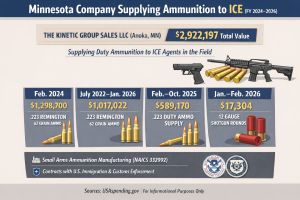
Data was pulled from USAspending.gov using the following parameters:
Funding Agency: U.S. Immigration and Customs Enforcement
Awarding Agency: Department of Homeland Security
Recipient Location: Minnesota
Award Type: Contracts
Results:
Prime Contracts: 4
Each contract below is a delivery order issued directly by ICE.

Business Location:
1 Vista Way, Anoka, Minnesota 55303
Industry Classification:
NAICS: 332992 – Small Arms Ammunition Manufacturing
PSC: 1305 – Ammunition, Through 30mm
The Kinetic Group is the sole Minnesota-based prime contractor identified in this dataset. Across multiple delivery orders, the company supplies duty ammunition for armed ICE agents, making them a key Minnesota company supplying ammunition to ICE.

Prime Award ID: 70CMSW24FR0000013
Total Obligations: $1,298,700
Award Type: Delivery Order
Period of Performance: February 6, 2024 – December 31, 2025
Primary Place of Performance: Anoka, Minnesota
Purpose:
Procurement of .223 Remington caliber duty ammunition (62 grain) to support armed ICE agents operating in the field.
Prime Award ID: 70CMSW22FR0000074
Total Obligations: $1,017,022.14
Outlays: $1,009,571.04
Award Type: Delivery Order
Period of Performance: July 7, 2022 – January 31, 2026
Primary Place of Performance: Anoka, Minnesota
Purpose:
Purchase of .223 Remington duty ammunition in support of ICE firearms and training programs.
Prime Award ID: 70CMSW25FR0000004
Total Obligations: $589,170.96
Award Type: Delivery Order
Period of Performance: February 19, 2025 – October 13, 2025
Primary Place of Performance: Fort Benning, Georgia (manufactured in Minnesota)
Purpose:
Procurement of duty ammunition for ICE and ICE-serviced federal agencies, coordinated through ICE’s Office of Firearms and Tactical Programs.
Prime Award ID: 70CMSW26FR0000007
Total Obligations: $17,304.12
Award Type: Delivery Order
Period of Performance: January 12, 2026 – February 28, 2026
Primary Place of Performance: Anoka, Minnesota
Purpose:
Supply of 12-gauge projectile ammunition to support ICE operational needs.
Across these four delivery orders:
Total ICE Obligations to The Kinetic Group: ~$2.92 million
Nature of Goods: Live duty ammunition
End Use: Armed ICE enforcement, training, and tactical operations

ICE firearms contracts are not administrative or logistical in nature. They support:
Armed field operations
Fugitive apprehension teams
Tactical enforcement units
Firearms training programs
Officer safety and use-of-force readiness
These contracts therefore directly enable physical enforcement capacity, not just paperwork or detention administration.

ICE does not manufacture its own weapons or ammunition. Its ability to conduct armed enforcement depends on private-sector suppliers.
State-specific transparency allows the public to understand:
Which local companies are part of federal enforcement infrastructure
How much public money is spent
What type of enforcement capacity is being funded
This information is relevant to:
Journalists
Researchers
Policymakers
Investors
Consumers
Community advocates
It is legal to:
Research federal contracts
Publish factual information
Express opposition to ICE enforcement policy
Choose not to support companies that supply ICE
Encourage others to make informed consumer decisions
It is not appropriate to engage in harassment, threats, or illegal activity. Peaceful, factual advocacy and ethical boycotts are lawful forms of civic participation.
Anyone can independently confirm or expand this research by using USAspending.gov and applying filters for:
Funding Agency: U.S. Immigration and Customs Enforcement
Award Type: Contracts
Recipient Location: Minnesota
Fiscal Year: 2024–2026
Each award record includes:
Contract ID
Dollar amount
Product description
Place of performance
NAICS and PSC codes
As of FY 2026, Minnesota’s role in ICE contracting is concentrated in one area: ammunition manufacturing. Through multiple delivery orders, a Minnesota-based company supplies live duty ammunition used by armed ICE agents nationwide.
Understanding this supply chain is essential for any serious discussion of:
Immigration enforcement
Federal spending priorities
Corporate accountability
Ethical consumer response
Boycotts are a lawful expression of consumer choice and free speech when conducted peacefully and without coercion. If you oppose a company’s role in supporting ICE operations, you may choose not to purchase its products or services and encourage others—respectfully and factually—to do the same.
Personal consumer decisions: choosing alternatives and withholding spending
Fact-based communication: citing verified public records (e.g., federal contract data)
Clear objectives: requesting transparency, review, or non-renewal of contracts
Peaceful expression: no threats, intimidation, or harassment
Harassment or repeated unwanted contact
Threats, intimidation, or doxxing
Property damage, trespass, or disruption of lawful operations
Violence or encouragement of violence
Define the Ask
Be specific about what you want (e.g., disclosure, policy review, non-renewal). Vague demands reduce impact.
Verify the Facts
Confirm the contract, dollar amounts, dates, and services using public sources. Accuracy builds credibility.
Lead With Your Own Choices
Explain your personal decision not to buy or use the company’s products/services—and why—without attacking employees or customers.
Communicate Respectfully With the Company
Send a concise, polite message requesting transparency or reconsideration. Keep it factual and non-threatening.
Educate Before Mobilizing
Share short explainers that cite public records so others can decide for themselves.
Set Guardrails
Publish a code of conduct: respectful tone, no harassment, no threats, no illegal activity.
Often, it is more effective to join or support existing campaigns than to duplicate them.
Research current initiatives focused on ICE vendors or enforcement accountability.
Follow organizers’ rules and messaging guidelines.
Contribute constructively: share verified information, help with research, or amplify lawful calls to action.
Avoid pile-ons: do not target individual employees or private persons.
Coordination increases reach while reducing misinformation and conflict.
Social platforms can amplify awareness when used carefully.
Share verified links and concise summaries
Use calm, values-based language
Frame posts as personal consumer choice
Encourage peaceful boycotts and transparency
Insults, threats, or inflammatory rhetoric
Tagging individual employees or unrelated people
Sharing personal information
Coordinated harassment or “dogpiling”
“I’m choosing not to support companies with ICE contracts after reviewing public records. Here’s the data so others can decide for themselves.”
“Transparency matters. Based on federal contract records, this company supplies ICE. I’m asking for a public review of that relationship.”
No violence. Ever.
No harassment or threats.
No illegal activity.
No targeting of individuals.
Peaceful, lawful advocacy protects participants, preserves credibility, and is more likely to influence corporate decision-making.
Companies respond to:
Reputational risk grounded in accurate reporting
Investor and consumer concerns expressed professionally
Clear, achievable requests aligned with stated corporate values
Harassment and threats undermine legitimacy and can backfire.
The initiatives below are public-facing, well-documented efforts centered on consumer choice, transparency, and peaceful advocacy. Participation should always remain lawful, non-violent, and non-harassing.
What it is:
A long-running advocacy campaign opposing technology, data, and surveillance contracts with ICE and CBP.
Primary focus:
Tech and data vendors
Surveillance and analytics tools
Cloud and digital infrastructure used in enforcement
How to join:
Visit https://notechforice.com
Sign public statements or petitions
Share campaign explainers on social media
Participate in workplace, campus, or community discussions using campaign toolkits
Tone & rules:
Fact-based, non-violent, policy-focused. No harassment of individuals.
What it is:
An online hub aggregating information about ICE contractors and providing guidance on ethical consumer boycotts.
Primary focus:
Consumer awareness
Corporate accountability
Education around ICE’s private-sector partners
How to join:
Visit https://boycottice.com
Review company lists and educational materials
Share resources with attribution
Participate in peaceful, consumer-based actions
Tone & rules:
Emphasizes informed choice and public education; rejects threats or intimidation.
What it is:
A consumer-focused boycott campaign urging people to withhold spending from companies perceived as enabling ICE, particularly during high-visibility shopping periods.
Primary focus:
Retail and consumer brands
Seasonal pressure (e.g., Black Friday)
How to join:
Learn about targeted campaigns through public reporting
Reduce or redirect personal spending
Share verified reporting explaining why companies are targeted
Encourage others to make informed consumer choices
Tone & rules:
Consumer choice only; no harassment or coercion.
What they are:
Independent community-led initiatives on platforms like X (Twitter), Instagram, Facebook, and Reddit that compile public records and discuss ethical boycotts.
Common formats:
Infographics citing federal contract data
Threads explaining how to use USAspending.gov
Community discussions about consumer alternatives
How to join responsibly:
Follow pages that cite sources
Verify claims before sharing
Add context, not outrage
Avoid tagging or targeting individual employees
Important note:
Because these efforts are decentralized, participants should be especially careful to avoid misinformation and harassment.
If you don’t want to launch a campaign yourself:
Amplify responsibly
Share sourced explainers from existing campaigns.
Practice ethical consumer choice
Withhold spending quietly and explain your reasons when asked.
Engage respectfully
Contact companies politely to request transparency or review.
Follow codes of conduct
Many campaigns publish participation guidelines—follow them.
All reputable efforts share these principles:
Peaceful and lawful action only
No harassment, threats, or intimidation
No doxxing or targeting of individuals
No violence or property damage
Use verified, public information
These guardrails protect participants and preserve credibility.
Reduces duplication and misinformation
Aligns messaging and timing
Increases visibility with less risk
Keeps advocacy focused on policy and accountability—not individuals
You have the right to research public contracts, express disagreement, and make ethical consumer choices. Exercising those rights responsibly and peacefully strengthens public discourse and keeps advocacy effective.
You can oppose corporate support for ICE without harassment or harm by joining existing, peaceful efforts grounded in consumer choice, transparency, and verified data.
Based on federal contracting records covering FY 2024–FY 2026, Minnesota-based prime contracts with U.S. Immigration and Customs Enforcement (ICE) in this dataset involve ammunition manufacturing and supply. The identified Minnesota contractor supplies duty ammunition used by armed ICE agents.
The Minnesota contracts identified here involve:
.223 Remington duty ammunition (62 grain)
12-gauge projectile ammunition
These products support ICE firearms programs, training, and armed field operations.
Across multiple delivery orders in this dataset, ICE obligations to the Minnesota contractor total approximately $2.9 million over several fiscal years. Exact amounts and dates vary by delivery order.
You can independently verify ICE contracts by using USAspending.gov and applying these filters:
Funding Agency: U.S. Immigration and Customs Enforcement
Awarding Agency: Department of Homeland Security
Recipient Location: Minnesota
Award Type: Contracts
Fiscal Year: Select the relevant year(s)
Each award record lists the company name, contract value, product description, and place of performance.
State-level analysis improves transparency by showing how local companies participate in federal immigration enforcement. Minnesota-specific data is especially relevant for journalists, policymakers, investors, consumers, and community members within the state.
Unlike administrative or detention-support services, ammunition contracts directly support armed enforcement capacity, including:
Firearms training
Officer readiness
Tactical enforcement operations
This makes them a distinct category of ICE contracting.
Yes. Peaceful boycotts and ethical consumer advocacy are lawful, provided they do not involve harassment, threats, intimidation, property damage, or violence. Choosing not to purchase products or services and encouraging others to make informed choices is legal.
Yes. Members of the public may lawfully and respectfully contact companies to:
Request transparency
Ask for policy review
Express disagreement with ICE contracting
Communications should remain factual, polite, and non-harassing.
No. Herman Legal Group supports lawful, peaceful civic engagement only, including research, public education, and ethical consumer choice. Harassment, threats, violence, or illegal activity are never appropriate or effective.
This article’s Resource Directory links to:
Federal transparency tools
Independent research and journalism
Herman Legal Group articles on ICE vendors, enforcement, and lawful boycotts
These resources provide verified data and legal context for further research.
Primary legal analysis and public-facing guidance
Herman Legal Group – Immigration Law Blog
https://www.lawfirm4immigrants.com/blog/
HLG’s central hub for enforcement analysis, federal contracting context, and public-interest immigration reporting.
Weaken ICE: Join the Boycott ICE Vendors Campaign
https://www.lawfirm4immigrants.com/weaken-ice-join-the-boycott-ice-vendors-campaigns/
HLG’s flagship explainer on lawful, ethical boycotts; how private companies support ICE; and guardrails against harassment or illegal conduct.
Companies That Do Business With ICE
https://www.lawfirm4immigrants.com/companies-that-do-business-with-ice/
Step-by-step guidance on identifying ICE vendors, understanding contract types, and engaging in fact-based public accountability.
Black Friday ICE Boycott Guide
https://www.lawfirm4immigrants.com/black-friday-ice-boycott-guide-2025/
Explains seasonal consumer-pressure strategies, emphasizing peaceful, voluntary consumer choice.
Which Companies Are Facing Boycott for Role in Immigration Enforcement
https://www.lawfirm4immigrants.com/which-companies-are-facing-boycott-for-role-in-trumps-immigration-enforcement/
Case-based discussion of public scrutiny and corporate response.
How ICE Built a Surveillance Regime
https://www.lawfirm4immigrants.com/how-ice-built-a-surveillance-regime-ice-surveillance-state-2025/
Context on technology, procurement, and private-sector enablement of enforcement capacity.
USAspending.gov
https://www.usaspending.gov
Official database for federal awards. Use Advanced Search to filter by ICE, Minnesota, fiscal year, and contract type.
System for Award Management (SAM.gov)
https://sam.gov
Contractor registrations, entity details, and eligibility information.
GSA eLibrary
https://www.gsaelibrary.gsa.gov
Federal schedule holders and contract vehicles used by DHS and ICE.
Department of Homeland Security – Budget & Performance
https://www.dhs.gov/budget
DHS and ICE funding context and program descriptions.
U.S. Immigration and Customs Enforcement
https://www.ice.gov
Official ICE materials and program descriptions.
DHS Office of Inspector General
https://www.oig.dhs.gov
Audits and oversight reports relevant to ICE operations and procurement.
Transactional Records Access Clearinghouse (TRAC Immigration)
https://trac.syr.edu/immigration/
Independent data on ICE enforcement trends and outcomes.
Minnesota Department of Public Safety
https://dps.mn.gov
State-level public safety context; useful for understanding how federal enforcement intersects locally.
ACLU of Minnesota
https://www.aclu-mn.org
Civil liberties reporting and guidance relevant to enforcement, protest rights, and public accountability.
Minnesota Reformer
https://minnesotareformer.com
State-focused investigative journalism and policy reporting.
Know Your Rights: Peaceful Protest & Free Speech (General guidance)
https://www.aclu.org/know-your-rights/protesters-rights
Legal boundaries and protections for peaceful advocacy and consumer boycotts.