
Trump’s expanded immigration enforcement campaign — driven by hardline architects like Stephen Miller and Tom Homan — has produced the most militarized civil immigration strategy in modern U.S. history. Yet rather than consolidating national support, high-profile shootings, wrongful arrests of U.S. citizens, and rising deaths in ICE custody are generating public backlash.
This Trump immigration enforcement backlash leads to reform, as the public pushes back against the administration’s aggressive tactics.
Polling shows record-high percentages of Americans view immigration positively, and younger generations strongly favor legalization and reform. If trends continue, the political consequences could include Democratic gains in 2026 and comprehensive immigration reform by 2029.
History suggests enforcement overreach often precedes reform. Amid fear and uncertainty, there is reason to believe the pendulum is swinging again.
This is another instance where the Trump immigration enforcement backlash leads to reform, suggesting a shift in public sentiment.
The ongoing Trump immigration enforcement backlash leads to reform, reflecting deep societal changes and demands for humane policies. The Trump immigration enforcement backlash leads to reform as communities voice their concerns over enforcement tactics.
This article introduces the Backlash-to-Reform Index™
Positive change is coming.
Hold on.

The Trump administration’s second-term immigration agenda has centered on aggressive enforcement, expanded detention capacity, and rapid operational deployment in cities across the United States.
HLG has documented this shift in depth:
What distinguishes this moment is not merely enforcement volume — but enforcement visibility.
Civil immigration violations are not criminal offenses. Yet tactics increasingly resemble tactical law enforcement deployments in residential neighborhoods.
The increased visibility of this enforcement is part of the Trump immigration enforcement backlash that leads to reform, as people demand accountability.
When enforcement becomes visible — and violent — public opinion shifts.
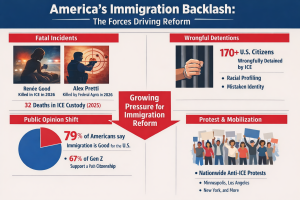
The enforcement surge reached a breaking point in Minneapolis in January 2026.
On January 7, 2026, Renée Nicole Good, a 37-year-old U.S. citizen and mother of three, was shot and killed by an ICE agent during an enforcement action in Minneapolis. The killing sparked immediate protest and scrutiny.
Details and reporting:
https://en.wikipedia.org/wiki/Killing_of_Ren%C3%A9e_Good
Just weeks later, on January 24, 2026, Alex Pretti — a 37-year-old ICU nurse and U.S. citizen working at a Veterans Affairs hospital — was shot and killed by federal agents during the same operational surge.
Details and reporting:
https://en.wikipedia.org/wiki/Killing_of_Alex_Pretti
Such incidents have fueled the Trump immigration enforcement backlash, leading to reform and a call for more humane practices.
These shootings occurred during “Operation Metro Surge,” a concentrated enforcement effort that became the catalyst for nationwide protest.
Operation background:
https://en.wikipedia.org/wiki/Operation_Metro_Surge
Peaceful protests spread across multiple cities, marking one of the largest waves of anti-ICE demonstrations in recent years.
National protest coverage:
https://en.wikipedia.org/wiki/2026_Anti-ICE_Protests_in_the_United_States
When U.S. citizens die during civil immigration operations, the political calculus changes.
This pattern is a result of the Trump immigration enforcement backlash that leads to reform, as citizens advocate for their rights.

Beyond fatal shootings, investigative reporting reveals a disturbing pattern: U.S. citizens detained, beaten, or held for days because they were suspected of being undocumented.
Investigations report:
Some lawmakers have described these incidents as unconstitutional detentions bordering on kidnapping when agents failed to verify citizenship before holding individuals.
When Americans see veterans and disabled citizens detained because they “looked like an immigrant,” support for mass deportation erodes rapidly.
This is not a partisan issue — it is a constitutional one.
Independent watchdog reporting and media investigations show rising deaths in ICE custody.
For example:
When enforcement policies result in visible harm — whether to immigrants or U.S. citizens — public perception changes.
This harm is often linked to the Trump immigration enforcement backlash that leads to reform, pushing for a reevaluation of policies.

Despite the rhetoric of a “mandate” for harsh enforcement, national polling tells a different story.
The data suggests enforcement escalation may be catalyzing reform sentiment.
Demography is destiny — and Gen Z is overwhelmingly pro-immigrant.
This demographic shift is part of the broader Trump immigration enforcement backlash that leads to reform, indicating a growing consensus for change.
HLG’s analysis of generational shifts:
https://www.lawfirm4immigrants.com/gen-z-immigration-attitudes/
American immigration history moves in cycles:
Periods of harsh enforcement have frequently been followed by recalibration.
Public backlash builds. Coalitions form. Reform windows open.
If trends continue:
Increased turnout among younger voters and suburban moderates could shift House control.
Immigration reform becomes central — not defensive — messaging.
Potential reforms could include:
In this context, the Trump immigration enforcement backlash leads to reform where comprehensive solutions are sought.
Aggressive enforcement may unintentionally unify the coalition that enacts reform.
With this backdrop, the Trump immigration enforcement backlash leads to reform that can reshape the immigration landscape.
To immigrant families living with fear:
You are not criminals.
You are parents, workers, students, caregivers, business owners, veterans’ spouses.
The American Dream has endured darker chapters than this.
History shows that when enforcement becomes excessive and unjust, America recalibrates.
The tragedies of Renée Good and Alex Pretti should never have happened.
The wrongful detention of U.S. citizens should never happen in a constitutional democracy.
But from visible injustice often comes reform.
The visibility of these injustices underscores how the Trump immigration enforcement backlash leads to reform, fueling public demand for change.
Help is not immediate — but it is building.
Hold on.
Reform will not arrive automatically.
Advocates must:
America’s story is an immigrant story.
When people see neighbors — not stereotypes — hearts change.
And when hearts change, elections follow.
Throughout American history, immigration reform has rarely emerged from calm, technocratic debate.
It has emerged from crisis.
From visible overreach.
From moments when the public sees — not abstract policy — but human consequences.
To understand what may be unfolding now, we introduce a framework:
This index describes a recurring five-stage cycle in American immigration politics.
When enforcement becomes highly visible and morally disruptive, it often triggers the very reform it was designed to prevent.
The federal government dramatically increases enforcement intensity and visibility.
Characteristics include:
In 2025–2026, this stage has included:
Escalation is designed to project strength.
But escalation increases visibility.
And visibility changes politics.
Enforcement becomes impossible to ignore.
This is when policy moves from the background into living rooms.
Visibility includes:
The Minneapolis killings of Renée Good and Alex Pretti were not just tragic events — they were visibility accelerants.
When civil immigration enforcement results in the deaths of U.S. citizens, the debate shifts.
It is no longer abstract.
It becomes constitutional.
Political backlash does not begin with statistics.
It begins with moral shock.
Moral shock occurs when the public perceives that enforcement has crossed a line.
It is the moment when:
At this stage, the issue expands beyond immigration policy.
It becomes about fairness.
About due process.
About American identity.
Moral shock destabilizes political coalitions.
It causes moderates and independents to reconsider alignment.
It activates younger voters.
It draws in faith communities and business leaders.
This is when enforcement begins to lose narrative control.
Backlash only becomes reform when coalitions form.
Historically, reform has required unlikely alliances:
In this stage, messaging shifts from defensive to proactive.
The conversation becomes:
This is where Gen Z becomes decisive.
Demography is destiny — but only if mobilized.
The final stage is political.
It requires:
Historically:
Reform does not follow quiet stability.
It follows visible dysfunction.
If current demographic trends, polling data, and public backlash continue, the 2026–2028 electoral cycle could create a 2029 reform window.
Not because enforcement succeeded — but because it overreached.
The Index suggests something important:
Aggressive enforcement can temporarily consolidate a political base.
But when enforcement becomes visible, violent, or constitutionally questionable, it expands the opposition coalition.
It converts:
The key insight:
Enforcement intensity does not linearly increase public support.
After a threshold, it reverses it.
That threshold is crossed when ordinary Americans see harm affecting “people like us.”
Veterans. Nurses. Parents. Citizens.
Based on:
The United States appears to be moving from Stage 3 (Moral Shock) toward Stage 4 (Coalition Formation).
Reform is not guaranteed.
But historically, this is the moment when reform becomes possible.
For immigrant families living under fear:
The Backlash-to-Reform cycle is not abstract theory.
It is historical pattern.
Moments of visible injustice often precede expanded rights.
That does not make tragedy acceptable.
It does mean tragedy can catalyze protection for millions.
Hold on.
Movements form in moments like this.
And history shows that when enforcement exceeds public comfort, America recalibrates.
There is growing evidence that Trump’s expanded immigration enforcement strategy has produced significant political backlash. High-profile shootings, wrongful detention of U.S. citizens, and rising deaths in ICE custody have generated national protests and increased scrutiny. At the same time, public opinion polls show record-high support for immigration as a positive force in the United States. Historically, visible enforcement overreach has often preceded immigration reform movements.
Investigative reporting indicates that more than 170 U.S. citizens have been mistakenly detained by immigration agents in recent years. Many cases involved racial profiling, mistaken identity, or delayed verification of citizenship status. Some detainees included veterans, individuals with disabilities, and U.S.-born citizens swept up during raids. These incidents have raised constitutional concerns and fueled public backlash.
In January 2026, two U.S. citizens — Renée Good and Alex Pretti — were shot and killed during federal immigration enforcement operations in Minneapolis as part of “Operation Metro Surge.” The shootings sparked nationwide protests and intensified scrutiny of aggressive immigration enforcement tactics. The incidents became a flashpoint in the national debate over immigration policy and civil liberties.
Reports from watchdog organizations and media outlets indicate that deaths in ICE custody reached one of the highest levels in decades in 2025, with at least 32 reported fatalities. Advocacy groups have documented additional deaths and use-of-force incidents in 2026. Rising detention populations combined with aggressive enforcement tactics have intensified oversight concerns.
Recent polling shows strong support for immigration among the American public:
These trends suggest that harsh enforcement policies may not align with broader public sentiment.
History suggests that aggressive enforcement periods can trigger reform movements. The 1986 Immigration Reform and Control Act followed years of enforcement gridlock. The LIFE Act of 2000 expanded adjustment pathways after prolonged backlogs. If public backlash continues and demographic trends hold, a political reform window could emerge between 2026 and 2029.
Potential immigration reform proposals could include:
While reform is not guaranteed, political momentum appears to be building.
Gen Z is the most racially and ethnically diverse generation in U.S. history. Polling shows they are significantly more supportive of immigration expansion and legalization pathways than older cohorts. As Gen Z increases its share of the electorate in 2026 and 2028, immigration reform becomes increasingly viable politically.
Most immigration violations are civil, not criminal. This distinction is important because civil enforcement actions should be governed by constitutional protections, due process, and proportional response standards. When enforcement tactics resemble criminal tactical operations, civil liberties concerns intensify.
Reform movements historically succeed when they:
Public persuasion — not just policy drafting — determines reform outcomes.
Trump’s enforcement strategy was designed to demonstrate power and control.
Instead, it may be accelerating a backlash rooted in:
History suggests the pendulum swings.
The events of 2025 and 2026 may ultimately be remembered not as the high-water mark of enforcement — but as the inflection point that led to reform.
Immigration reform is not inevitable.
Thus, the Trump immigration enforcement backlash leads to reform, representing a pivotal moment for immigration policy in America.
But it is more possible now than it was before the overreach.
And that is where hope lives.
If your priority date becomes current in the March 2026 Visa Bulletin, filing your I-485 immediately — and correctly — may determine whether you secure your green card this year or wait several more years.
For full analysis of the cutoff movements and retrogression forecast, see our pillar guide:
March 2026 Visa Bulletin Analysis: Priority Dates & Retrogression Forecast
https://www.lawfirm4immigrants.com/march-2026-visa-bulletin-analysis-priority-dates-retrogression-forecast/
This guide focuses on one thing:
Understanding the File I-485 March 2026 timeline is essential for a successful application.
To successfully navigate the File I-485 March 2026 process, staying informed is crucial.
How to file your Form I-485 fast, correctly, and strategically in early March 2026, focusing on the File I-485 March 2026 process.
Understanding the implications of the File I-485 March 2026 timeline can significantly affect your application.
The U.S. Department of State’s Visa Bulletin (published monthly):
https://travel.state.gov/content/travel/en/legal/visa-law0/visa-bulletin.html
The File I-485 March 2026 filing strategy is vital for securing your green card.
Once your priority date becomes current:
USCIS confirms which chart (Final Action vs Dates for Filing) applicants may use each month:
https://www.uscis.gov/visabulletininfo
Delaying even 2–3 weeks in March can expose you to:
For File I-485 March 2026 applicants, early filing is essential to avoid complications.
In high-demand categories like EB-2 India or EB-1 China, filing early can be the difference between:
✔ Getting an EAD/AP within months
or
✘ Waiting another fiscal year

Properly preparing your File I-485 March 2026 application can prevent unnecessary delays.
USCIS will reject improperly filed applications.
Form I-485 instructions (official USCIS guidance):
https://www.uscis.gov/i-485
Common rejection triggers:
A rejected filing means:
In March 2026, precision is as important as speed.
Ensure your medical exam aligns with the File I-485 March 2026 requirements.
USCIS now requires Form I-693 medical exam to be properly submitted at filing in most employment-based cases.
Official USCIS medical guidance:
https://www.uscis.gov/i-693
Important developments:
Action Step:
Schedule your immigration medical exam immediately — ideally BEFORE the bulletin becomes current.
In March movements, civil surgeons often book out quickly.

Utilizing a robust mailing strategy for your File I-485 March 2026 application is recommended.
Most employment-based I-485 filings are mailed to USCIS lockboxes.
USCIS lockbox filing guidance:
https://www.uscis.gov/forms/filing-guidance
Key realities in high-volume months:
To maximize your chances, follow best practices for File I-485 March 2026 submissions.
Best practice:

If paying by credit card using Form G-1450:
Often the first indication USCIS accepted your filing is:
✔ Your card is charged.
This frequently occurs before:
If your card is not charged within expected intake timeframes:
In March 2026, days matter.
Employment-based immigrant visas are numerically limited under INA § 201 and § 203.
When demand exceeds supply:
High-demand countries are particularly vulnerable.
Your filing date locks in your place in line.
Waiting does not.

Employers should understand the File I-485 March 2026 implications for their employees.
During visa bulletin movements:
An experienced immigration attorney can:
✔ Pre-build your filing packet before bulletin release
✔ Confirm eligibility immediately
✔ Avoid preventable RFEs
✔ Ensure correct wage/role consistency with underlying I-140
✔ Coordinate concurrent filings (I-765, I-131)
✔ Monitor intake and escalate if needed
Speed without legal precision is dangerous.
Precision without speed is useless.
You need both.
Our team specializes in the File I-485 March 2026 process to assist clients effectively.
The File I-485 March 2026 timeline is crucial for avoiding missed deadlines.
At Herman Legal Group, we:
We have over 30 years of immigration experience serving clients nationwide.
If your priority date may become current in March 2026:
The outcome of your File I-485 March 2026 application depends on timely actions.
Schedule a consultation immediately:
https://www.lawfirm4immigrants.com/book-consultation/
If your priority date is current in March 2026:
☐ Confirm which chart USCIS is using
☐ Gather civil documents
☐ Order certified translations
☐ Schedule medical exam
☐ Confirm underlying I-140 approval
☐ Prepare I-765 & I-131
☐ Confirm correct lockbox
☐ Track courier delivery
☐ Monitor credit card charge
☐ Watch for I-797 receipt
For those who wait, the consequences regarding File I-485 March 2026 are significant.
When priority dates advance in a Visa Bulletin (like March 2026), there’s a narrow window to file Form I-485 before retrogression or visa number limits take effect.
If you wait too long:
Practical impact:
Missing the early March window when EB-1 or EB-2 cutoff dates move forward can mean waiting months — or even years — for another opportunity.
Understanding historical trends can inform your File I-485 March 2026 strategy.
Visa cut-off dates don’t always move forward. When they don’t, that’s retrogression. This happens when the number of applicants with priority dates earlier than the cutoff exceeds the available yearly quota under U.S. law.
Including this context — beyond “file early” — adds depth and increases the article’s authority.
Many employment-based applicants wonder whether they must wait for their I-140 approval before filing I-485 — but in some cases, concurrent filing is allowed and advisable.
Concurrent Filing Basics:
Concurrent filing means submitting Form I-140 (Immigrant Petition for Alien Worker) and Form I-485 together when your priority date is current. (My Green Card Story)
Concurrent filing related to File I-485 March 2026 can streamline your process.
Benefits:
✔ Eliminates delay between I-140 approval and I-485 filing
✔ Can qualify you for EAD and AP earlier
✔ Locks you into the green card queue sooner
Limits:
• Your I-140 must be approvable at the time of filing
• If I-140 is denied, the I-485 goes with it
• You must be physically present in the U.S. to adjust status (My Green Card Story)
This section adds tactical guidance often missing from general blogs.
Retrogression doesn’t cancel pending I-485 applications — but it does prevent new filings once cutoff dates move backward. (USCIS)
What retrogression means for you:
Maintaining your place in line is essential for File I-485 March 2026 applicants.
HR teams and employers often search “I-485 checklist employment-based green card” — adding this section boosts SEO and makes the article referenceable by HR/legal teams.
Employer I-485 Support Checklist:
Effective coordination during the File I-485 March 2026 filing process is crucial.
This section makes the article highly backlinkable for employment law and HR sites.
Avoiding RFEs is a major reason applicants lose filing windows or face months of delay.
Common RFE Triggers (from immigration practice insights):
Be prepared to avoid common RFE triggers for your File I-485 March 2026 application.
Including this section helps applicants prepare stronger packets and reduces avoidable delays — a definitive value add that competitors often miss.
Giving readers a realistic timeline increases dwell time and helps them plan.
Expected I-485 Steps (approximate):
✔ Lockbox Intake & Credit Card Charge Verification (days–weeks)
✔ I-797C Receipt Notice (typically 2–6+ weeks)
✔ Biometrics Appointment (within 2–8 weeks)
✔ EAD/AP Issuance (3–6 months if filed concurrently)
✔ Adjudication & Interview (8–24+ months, depending on service center and visa category) (MyCase)
This timeline block is highly shareable and useful for applicants and attorneys alike.
Answering short, practical questions improves SEO and supports featured search snippets.
Understanding key questions surrounding File I-485 March 2026 can guide applicants.
Q: What is visa retrogression?
Retrogression is when cut-off dates move backward due to visa demand exceeding supply. (USCIS)
Q: Will retrogression cancel my pending I-485?
No — but it can pause adjudication until your date becomes current again. (USCIS)
Q: Can I still work if my I-485 is pending and retrogression happens?
Yes — if you have an EAD, you can continue working. Pending I-485 status maintains authorized stay. (USCIS)
You should file immediately once USCIS confirms that your priority date is current under the applicable chart.
The U.S. Department of State publishes the Visa Bulletin monthly:
https://travel.state.gov/content/travel/en/legal/visa-law0/visa-bulletin.html
Filing promptly for File I-485 March 2026 can ensure your application is processed smoothly.
USCIS determines which chart applicants may use each month (Final Action Dates or Dates for Filing):
https://www.uscis.gov/visabulletininfo
Because retrogression can occur in subsequent months without advance notice, filing in early March protects your eligibility and secures your place in line.
For a full retrogression forecast and cutoff analysis, see:
https://www.lawfirm4immigrants.com/march-2026-visa-bulletin-analysis-priority-dates-retrogression-forecast/
Delaying filing can expose you to several risks:
Awareness of deadlines is critical for File I-485 March 2026 applicants.
If your priority date retrogresses before you file, you cannot submit Form I-485 until it becomes current again.
USCIS explains retrogression here:
https://www.uscis.gov/green-card/green-card-processes-and-procedures/visa-availability-priority-dates/visa-retrogression
However, once your I-485 is properly filed while eligible, it remains pending even if retrogression occurs later.
Each month USCIS announces which chart employment-based applicants must use.
You must check:
https://www.uscis.gov/visabulletininfo
Using the wrong chart is a common reason for rejection.
The official Visa Bulletin itself is published by the Department of State:
https://travel.state.gov/content/travel/en/legal/visa-law0/visa-bulletin.html
Never assume the Dates for Filing chart may be used without confirming USCIS guidance for that month.
Consulting resources for File I-485 March 2026 can enhance your chances of success.
USCIS will reject improperly filed applications before they enter processing.
Common rejection reasons include:
Ensure you’re familiar with the File I-485 March 2026 requirements to avoid delays.
Official I-485 instructions:
https://www.uscis.gov/i-485
A rejection in March 2026 can be especially damaging if visa dates retrogress before you can refile.
In most employment-based cases, yes.
USCIS medical guidance:
https://www.uscis.gov/i-693
Key points:
Being proactive about your File I-485 March 2026 filing can lead to smoother proceedings.
You can locate an authorized civil surgeon here:
https://www.uscis.gov/tools/find-a-civil-surgeon
Scheduling the medical exam before March begins is strongly recommended.
If you pay by credit card using Form G-1450:
https://www.uscis.gov/g-1450
The first sign of acceptance is often a credit card charge.
This typically occurs before:
Your understanding of the File I-485 March 2026 timeline is essential for success.
If your card is not charged within expected intake timeframes, you should immediately:
Visa retrogression occurs when demand exceeds the annual numerical limits established under the Immigration and Nationality Act.
When retrogression happens:
The File I-485 March 2026 filing window is narrow and must be navigated carefully.
USCIS explanation:
https://www.uscis.gov/green-card/green-card-processes-and-procedures/visa-availability-priority-dates/visa-retrogression
Filing early in March locks in your eligibility before potential cutoff changes.
In most cases, yes.
Official forms:
https://www.uscis.gov/i-765
https://www.uscis.gov/i-131
Concurrent filing allows you to:
Strategies for File I-485 March 2026 must be implemented well in advance.
Failure to file these forms concurrently may delay work and travel authorization.
Concurrent filing is permitted when a visa number is available and your priority date is current.
However:
Strategic review is essential before filing concurrently.
A thorough understanding of File I-485 March 2026 can make a difference in your case.
Typical sequence:
Processing times vary by location:
https://www.uscis.gov/processing-times
Keep track of your File I-485 March 2026 application status for timely updates.
For example, Ohio field offices:
https://www.uscis.gov/about-us/find-a-uscis-office/field-offices/ohio-cleveland-field-office
https://www.uscis.gov/about-us/find-a-uscis-office/field-offices/ohio-columbus-field-office
Under AC21 portability provisions, certain employment-based applicants may change employers after 180 days if the new position is in a same or similar occupational classification.
USCIS policy guidance:
https://www.uscis.gov/green-card/green-card-processes-and-procedures/adjustment-of-status
Improper job changes can trigger Requests for Evidence or denial. Legal analysis is recommended before making employment changes.
When cutoff dates advance:
Preparing your File I-485 March 2026 file correctly can enhance approval chances.
During narrow filing windows, timing and technical precision must work together.
Herman Legal Group monitors Visa Bulletin movements, pre-builds I-485 filing packets before publication, coordinates medical readiness, audits documentation to prevent RFEs, and advises on retrogression risk.
Schedule a consultation:
https://www.lawfirm4immigrants.com/book-consultation/
Resources on the File I-485 March 2026 process are invaluable for applicants.
Dedication to your File I-485 March 2026 filing can lead to favorable outcomes.
These pages are the “source of truth” for whether USCIS allows filing under Dates for Filing or requires Final Action Dates:
Before submitting any expedite request, USCIS expects applicants to follow its official procedures and communication channels. These are the primary, authoritative resources USCIS itself relies on:
USCIS – How to Make an Expedite Request
https://www.uscis.gov/forms/filing-guidance/how-to-make-an-expedite-request
USCIS Policy Manual – Expedite Criteria
https://www.uscis.gov/policy-manual/volume-1-part-a-chapter-5
USCIS Contact Center (1-800-375-5283)
https://www.uscis.gov/contactcenter
USCIS Online Account (to submit or track requests)
https://my.uscis.gov/
USCIS Case Status & Processing Times
https://egov.uscis.gov/processing-times/
USCIS does not accept expedite requests by direct email unless specifically instructed in a notice or response. All requests must be routed through approved USCIS systems or representatives.
USCIS expedite requests succeed only in narrow, well-documented situations involving severe financial loss, urgent humanitarian need, clear USCIS error, or compelling public interest. Most requests are denied because they do not meet USCIS’s published criteria or lack credible supporting evidence. An expedite request does not create a right to faster processing and does not pause normal case adjudication.

A USCIS expedite request is a discretionary request asking U.S. Citizenship and Immigration Services to process a pending immigration application or petition faster than standard timelines.
What it is:
A request for discretionary prioritization
Reviewed on a case-by-case basis
Granted only if strict criteria are met and proven
What it is not:
A right or entitlement under the Immigration and Nationality Act (INA)
A guarantee of faster approval
An appealable decision if denied
USCIS may deny an expedite request without explanation, and there is no formal appeal process.

USCIS recognizes five specific categories for expedited processing, published in official policy guidance:
USCIS Policy Manual, Volume 1, Part A, Chapter 5
https://www.uscis.gov/policy-manual/volume-1-part-a-chapter-5
USCIS may consider an expedite request where a delay will cause immediate and significant financial harm.
Key points:
Ordinary financial stress does not qualify
Loss must be imminent and clearly documented
Employers must show concrete business harm (not inconvenience)
This category is narrowly applied.
Typical qualifying situations:
Life-threatening medical emergencies
Serious illness of the applicant or immediate family member
Urgent medical treatment unavailable without approval
General hardship or family separation alone does not qualify.
Applies only when:
The organization is a legitimate nonprofit
The activity benefits a public or governmental interest
Delay would substantially undermine that mission
USCIS may expedite when it made a clear procedural or clerical mistake, such as:
Issuing an incorrect notice
Losing submitted evidence
Misrouting a case
Disagreement with normal processing time is not an error.
These are rare and typically:
Supported by a U.S. government agency
Tied to public safety, national security, or government operations

Successful expedite requests usually involve:
Objective documentation
Medical records, financial statements, employer letters, or government correspondence.
Direct causation
USCIS must see how delay itself causes the harm.
Proper timing
Requests made early in an emergency are stronger than those made after long delays.
Narratives without proof rarely succeed.
USCIS routinely denies expedite requests based on:
Planned travel, weddings, or graduations
Normal or published processing delays
Emotional hardship without documentation
Employer inconvenience rather than financial loss
Repeated requests without new evidence
Legal representation alone does not increase approval odds.
USCIS does not decide expedite requests based on urgency alone. In practice, decisions are driven almost entirely by documentary evidence, not personal explanations or hardship narratives. Certain types of evidence consistently carry more weight than others because they align closely with USCIS’s published expedite criteria.
The following materials most often support expedite approval because they demonstrate objective, immediate harm:
Physician letters on official letterhead describing diagnosis, urgency, and consequences of delay
Hospital admission records or treatment summaries
Employer letters detailing imminent financial loss with specific dollar amounts and timelines
Government or public agency correspondence confirming urgency or public interest
Proof of USCIS clerical or processing error (misissued notices, misplaced filings)
These documents directly correspond to USCIS’s own expedite standards and are reviewed more seriously.
These materials may help contextualize a request but rarely succeed on their own:
Financial statements without explanation of immediacy
Employer or nonprofit affidavits without corroboration
Academic deadlines or school enrollment documents
General humanitarian support letters
USCIS typically expects these materials to be paired with higher-weight evidence.
USCIS almost never grants expedite requests based primarily on:
Personal statements without third-party documentation
Travel itineraries or planned vacations
Wedding invitations or event schedules
Emotional hardship narratives
General stress, anxiety, or inconvenience
USCIS prioritizes verifiable impact, not subjective hardship.
Many expedite requests fail not because the underlying reason is invalid, but because the request is submitted at the wrong stage of the case. Although USCIS does not publish formal timing rules, internal practice shows that timing strongly influences credibility.
Requests filed:
Immediately after submission
Before biometrics or initial intake
Without a triggering change in circumstances
are often viewed skeptically, even when the reason appears legitimate. USCIS expects some baseline processing to occur before prioritization is justified.
Requests submitted:
After standard intake steps
Following a documented change in circumstances
With newly arisen, time-sensitive evidence
are more likely to receive substantive review. USCIS tends to view these requests as reactive rather than speculative.
When a case is:
Far outside published processing times
Subject to repeated unanswered inquiries
Stalled without explanation
USCIS may treat additional expedite requests as ineffective. At this stage, the issue is no longer urgency but unreasonable delay, making judicial remedies such as mandamus more appropriate.
Timing does not replace eligibility, but it significantly affects how USCIS evaluates credibility.
Expedite requests may be initiated through:
A USCIS online account
The USCIS Contact Center
A congressional inquiry (informational only)
USCIS may:
Request supporting evidence
Approve or deny without explanation
Take days or weeks to respond
Approval affects processing order only, not eligibility.
Although there is no formal penalty for denial, an expedite request may:
Trigger closer scrutiny of the case
Expose evidentiary gaps or inconsistencies
Delay adjudication if documentation is incomplete
Expedite requests should be strategic, not routine.
Expedite approval is discretionary and uncommon
Documentation matters more than urgency claims
Financial loss must be immediate and severe
Humanitarian claims require medical proof
Most expedite requests are denied
Denials cannot be appealed
Approval does not guarantee case approval
Risk Level: Medium
Documented loss of contracts or business operations may qualify. Vague disruption does not.
Risk Level: High
Physician letters and hospital records significantly improve approval chances.
Risk Level: Medium–High
Requests tied to disaster relief or public programs have stronger footing.
Risk Level: Low
Travel inconvenience alone almost never qualifies.
When an immigration case has stalled, applicants often ask whether to file another USCIS expedite request or pursue a mandamus lawsuit. These tools serve fundamentally different legal purposes. Understanding that distinction is critical before taking action.
A mandamus lawsuit is a civil action filed in U.S. federal court asking a judge to compel U.S. Citizenship and Immigration Services to perform a legally required duty: to adjudicate a pending application or petition.
Key points:
Mandamus does not ask the court to approve the case
It asks the court to require USCIS to make a decision
The lawsuit is grounded in the Administrative Procedure Act (APA), which prohibits “unreasonable delay” by federal agencies
Statutory authority:
Administrative Procedure Act, 5 U.S.C. § 706(1)
https://www.law.cornell.edu/uscode/text/5/706
Department of Justice reference on mandamus actions:
https://www.justice.gov/jm/civil-resource-manual-215-mandamus
Once a mandamus lawsuit is filed and served, USCIS must respond to the court—often prompting case movement even before litigation concludes.
An expedite request asks USCIS to voluntarily prioritize a case. A mandamus lawsuit invokes judicial authority to require action.
| Issue | Expedite Request | Mandamus Lawsuit |
|---|---|---|
| Legal force | Discretionary | Court-enforced |
| Decision-maker | USCIS | Federal judge |
| Can USCIS ignore it? | Yes | No |
| Forces adjudication | No | Yes |
| Guarantees approval | No | No |
| Typical use | Emergency situations | Unreasonable delay |
An expedite request seeks mercy. A mandamus lawsuit seeks accountability.
An expedite request is generally appropriate when:
A new emergency has recently arisen
The case is still within or near posted processing times
There is clear, objective documentation of immediate harm
The situation involves short-term urgency rather than prolonged delay
Examples:
Sudden medical crisis supported by physician documentation
Employer facing immediate, documented financial loss
Clear USCIS clerical or processing error
Official USCIS guidance:
https://www.uscis.gov/forms/filing-guidance/how-to-make-an-expedite-request
A mandamus lawsuit may be appropriate when delay itself has become the core problem.
Common indicators include:
The case is far outside published USCIS processing times
Multiple service requests or inquiries have produced no result
No genuine emergency exists, but the delay is prolonged and unexplained
USCIS has gone silent or repeatedly deflected responsibility
Mandamus is especially effective when delay is measured in years, not weeks.
USCIS processing time reference:
https://egov.uscis.gov/processing-times/
What mandamus can do:
Compel USCIS to adjudicate the case
Force agency accountability through judicial oversight
Prompt action even before court deadlines arrive
What mandamus cannot do:
Force approval of an application
Change eligibility requirements
Prevent USCIS from issuing a lawful denial
Mandamus addresses inaction, not outcome.
Filing an expedite request does not preserve or waive mandamus rights
A denied expedite does not prevent filing a mandamus lawsuit
Mandamus does not automatically increase denial risk
Courts do not evaluate immigration merits
Mandamus is a procedural remedy, not an immigration benefit.
In many cases:
Expedite requests make sense early, when urgency is real
Mandamus lawsuits make sense later, when delay becomes unreasonable
The choice depends on:
Length of delay
Quality of documentation
Case type
USCIS responsiveness
A rushed lawsuit can be as ineffective as a weak expedite request.
For deeper analysis on stalled cases and litigation strategy:
An expedite request asks USCIS to move faster.
A mandamus lawsuit requires USCIS to move at all.
Knowing when to shift from requests to enforcement is often the difference between continued delay and meaningful progress. For case-specific evaluation of whether a mandamus lawsuit is appropriate, informed legal review is essential:
https://www.lawfirm4immigrants.com/book-consultation/
Do USCIS expedite requests actually work?
Yes, but only in limited, well-documented circumstances that meet USCIS criteria.
How long does USCIS take to decide an expedite request?
There is no fixed timeline; responses may take days or weeks.
Can financial hardship qualify?
Only if the loss is immediate, severe, and supported by evidence.
Are medical emergencies enough?
Only when supported by credible medical documentation.
Can a lawyer guarantee approval?
No. Expedite decisions are discretionary.
Does filing multiple requests help?
No. Repetitive requests without new evidence often harm credibility.
Is there an appeal if denied?
No. Expedite denials are not appealable.
Does congressional help guarantee approval?
No. Congressional offices can inquire, not override USCIS.
Does approval mean my case will be approved?
No. It affects processing order only.
USCIS expedite requests remain an exception—not a solution to routine backlogs. Applicants should rely on official criteria, credible documentation, and realistic expectations. In many cases, alternative legal strategies such as follow-ups, congressional inquiries, or mandamus litigation may be more effective.
For case-specific guidance on whether an expedite request or another option may be appropriate:
https://www.lawfirm4immigrants.com/book-consultation/
This directory consolidates the most reliable primary sources on USCIS expedite requests, processing delays, and legal accountability mechanisms. Each resource is an official or high-authority reference commonly relied on by attorneys, courts, journalists, and policymakers.
USCIS – How to Make an Expedite Request
https://www.uscis.gov/forms/filing-guidance/how-to-make-an-expedite-request
Primary USCIS page explaining how expedite requests are submitted, reviewed, and decided.
USCIS Policy Manual – Expedite Requests (Volume 1, Part A, Chapter 5)
https://www.uscis.gov/policy-manual/volume-1-part-a-chapter-5
Authoritative policy source defining the five official expedite criteria and USCIS discretion.
USCIS Online Account (MyUSCIS)
https://my.uscis.gov/
Used to submit service requests, track case status, and receive official USCIS communications.
USCIS Contact Center (1-800-375-5283)
https://www.uscis.gov/contactcenter
Official channel for initiating expedite requests and service inquiries by phone.
USCIS Processing Times Tool
https://egov.uscis.gov/processing-times/
Baseline reference for determining whether a case is outside normal processing times.
Administrative Procedure Act – Unreasonable Delay (5 U.S.C. § 706)
https://www.law.cornell.edu/uscode/text/5/706
Statutory authority used in mandamus lawsuits to compel agency action.
U.S. Department of Justice – Mandamus Actions
https://www.justice.gov/jm/civil-resource-manual-215-mandamus
Official DOJ explanation of mandamus lawsuits and federal court jurisdiction.
Find Your U.S. Senator or Representative
https://www.congress.gov/members
Official directory for initiating congressional inquiries related to immigration cases.
Congressional Research Service – Immigration Oversight Reports
https://crsreports.congress.gov/
Nonpartisan analysis frequently cited by courts and journalists.
Mandamus Lawsuits Against USCIS
https://www.lawfirm4immigrants.com/mandamus-lawsuit-uscis/
Detailed explanation of when and how federal litigation can compel USCIS action.
USCIS Processing Times Explained
https://www.lawfirm4immigrants.com/uscis-processing-times/
Contextual analysis of USCIS timelines and delays across case types.
What to Do When Your Immigration Case Is Delayed
https://www.lawfirm4immigrants.com/immigration-case-delays/
Practical options beyond expedite requests, including inquiries and litigation.
How Congressional Immigration Inquiries Work
https://www.lawfirm4immigrants.com/congressional-immigration-inquiry/
Clarifies what congressional offices can and cannot do in delayed cases.
Yes. Under new national-security vetting policies, USCIS can reopen previously approved immigration cases — including asylum, refugee, TPS, and even green-card cases — and refer individuals to ICE for detention or removal if “derogatory information” is reported through new DHS screening systems.
Understanding how rescreening increase deportation risk is crucial for individuals seeking asylum. The significant implications of this policy raise numerous concerns about how rescreening increase deportation risk not only for applicants but for their families as well.
This shift began after a Washington, D.C. national-guard shooting involving a recently approved asylum holder. According to reports by the Associated Press, the federal government paused asylum decisions nationwide and began re-examining approvals issued over the last several years. Confirming analysis published in The Washington Post and The Guardian showed that this policy targets entire nationalities rather than individual applicants.
New evidence suggests that rescreening increase deportation risk significantly affects those from specific countries marked as ‘countries of concern’, intensifying scrutiny and uncertainty.
The recent changes in policies on rescreening increase deportation risk, making it vital for asylum seekers to stay informed about their statuses and the potential risks involved.
This mirrors enforcement trends documented by Herman Legal Group in Why ICE Is Now Waiting at USCIS Interviews — but for asylum and refugee populations, not just visa overstays.

Where This Information Comes From — Sources and Authority
The government already had legal authority to reopen cases — but in late 2025, it began using that authority systematically on certain nationalities.
This article is based on:
There is no single published memo titled “Re-Screening Program.” Instead, re-screening is happening through:
…all documented through media reporting and direct legal observation.

Refugees from Afghanistan, Somalia, Syria, Yemen, Sudan, Haiti, and Cameroon were admitted at accelerated rates. Later DHS officials cited “resource strain,” as reported by Reuters, alleging vetting delays and gaps.
The Federal Register published rules allowing USCIS and DHS to use social-media monitoring as part of national-security vetting (“publicly available electronic information”).
The Guardian reported internal DHS discussions about reopening already approved cases from “countries of concern.”
Associated Press and Reuters confirmed that USCIS:
This increased scrutiny highlights the risks involved and how rescreening increase deportation risk.
As rescreening increase deportation risk, the pressure on asylum seekers to navigate an increasingly complex legal landscape grows, leaving many feeling anxious about their future.
Senior officials told The Washington Post and The Guardian that the White House was exploring a nationwide immigration freeze for 19–30 nationalities.
Forum Together published examples of USCIS re-interview notices directing refugees admitted between 2021–2025 to report for:
Local attorneys report ICE physically sitting in USCIS interviews, consistent with trends in Herman Legal Group articles such as The Post-Shooting Immigration Crackdown.
This timeline confirms policy evolution through public reporting, not rumor.
“U.S. Citizenship and Immigration Services has halted all asylum decisions nationwide after a fatal shooting involving an Afghan immigrant.”
— Associated Press
“White House officials are discussing a ‘permanent pause’ on immigration from all Third World countries.”
— The GuardianAs reported in various outlets, the reality that rescreening increase deportation risk is becoming a pressing issue for many immigrant families.
“Refugee applications and approvals from 19 nations are being re-examined, with possible expansion to 30 countries.”
— The Washington Post
“DHS is reviewing past approvals for national-security risk factors, not just new applications.”
— ReutersAs the landscape changes, the understanding of how rescreening increase deportation risk will be critical for many immigrants looking to maintain their residency.
“Social-media screening and open-source intelligence will play a role in identifying derogatory information for immigration decisions.”
— Federal Register
“Refugees admitted between 2021 and 2025 are receiving mandatory re-interview notices from USCIS.”
— Forum Together
“Local lawyers confirm increased ICE presence at USCIS interviews involving immigrants from targeted nationalities.”
— Migration Policy Institute analysis (summarizing attorney reports)
It’s not just lawyers. Reddit forums, WhatsApp groups, and refugee community centers are sharing links to:
These sources show:
Even approved cases can be reopened and referred to ICE.
HLG has tracked similar enforcement dynamics in Married to a U.S. Citizen — Still Handcuffed.

Awareness of how rescreening increase deportation risk can aid individuals in making informed decisions regarding their immigration paths.
HLG’s Asylum on Hold explains how filing a new petition can trigger case reopening.
| Trigger | Likely Consequence |
|---|---|
| FBI / DHS watchlist hit | Mandatory re-interview |
| Social media flagged | Notice of Intent to Terminate |
| Travel to home country | Fraud investigation |
| New application | Full case review |
| Family derivative link | Entire family reviewed |
This framework is confirmed through media reporting by Reuters and ongoing nonprofit legal support updates.
The legal nuances surrounding how rescreening increase deportation risk are complex, necessitating thorough understanding for anyone in the process.
The law always allowed this. The political decision to target nationalities did not exist until late 2025.
Book legal protection planning:
Book a Consultation with Herman Legal Group
1. Can USCIS actually reopen an asylum case years after approval?
Yes. USCIS can issue a Notice of Intent to Terminate (NOIT) under 8 C.F.R. § 208.24 if it finds “derogatory information,” including social-media screening, new intelligence, or past omission.
2. Can they revoke a green card obtained through asylum or refugee status?
Yes. If asylum/refugee status is terminated, USCIS can rescind green-card approval under INA § 246.
3. Does filing for citizenship (N-400) trigger risk?
Yes. Filing any new benefit may cause USCIS to re-screen your entire file, including past background checks and initial asylum claim.
4. Are ICE officers attending USCIS interviews?
Yes — local attorneys in Ohio and California report ICE in interview rooms, consistent with patterns documented by HLG’s Why ICE Is Now Waiting at USCIS Interviews.
5. Which nationalities are currently considered “countries of concern”?
Multiple media outlets, including The Washington Post, report initial focus on Afghanistan, Somalia, Yemen, Syria, Iraq, Sudan, Haiti, Cameroon, plus others being evaluated.
6. What does “derogatory information” mean?
It may include:
– Arrests (even minor)
– Old immigration inconsistencies
– Intelligence matches
– Social-media activity
– Contacts from conflict regions
7. Does travel back to home country trigger termination?
Often yes — especially travel after asylum approval, which may be flagged as “changed circumstances.”
8. Is failure to appear at re-interview grounds for deportation?
Yes. USCIS may issue Notice to Appear (NTA) if you skip a mandated re-interview.
9. Can derivative family members lose status if only the principal is flagged?
Yes. Family may be re-screened and terminated together.
As the law evolves, the effects of how rescreening increase deportation risk will continue to impact those seeking asylum and refuge.
10. Do I need a lawyer present at re-interview?
Absolutely. Local attorneys confirm these are no longer “routine interviews,” but potential enforcement points.
11. Is this a new law?
No — this is existing law used differently. The authority comes from:
– USCIS termination power (8 C.F.R. § 208.24)
– INA § 246 rescission
– Immigration Court reopening
12. Is social-media screening really happening?
Yes — confirmed in Federal Register vetting updates and media reporting by Reuters.
13. Can USCIS take instructions from intelligence agencies?
Yes. USCIS policy allows consultation with DHS, FBI, CIA, local law enforcement, and overseas partners for vetting.
14. If I was granted asylum by a judge, can USCIS reopen it?
The Department of Homeland Security (DHS) may file a motion to reopen at EOIR (Immigration Court).
15. Are naturalized U.S. citizens safe?
Generally yes — denaturalization is extremely rare unless based on fraud or terrorism.
16. Can I FOIA my own immigration file to see what USCIS has?
Yes. FOIA request for A-file is recommended before re-interview.
17. Does background check include my WhatsApp, Telegram, and Facebook connections?
Potentially. DHS acknowledges using “publicly available electronic information,” per Federal Register updates.
18. What if I have no crime, nothing wrong — can I still be re-interviewed?
Yes — nationality alone is now a trigger, according to reporting by The Guardian.
19. Will USCIS ask for passports again?
Yes. Refugee re-interview notices documented by Forum Together instruct applicants to bring passports and ID documents.
20. Can I ask USCIS to reschedule my re-interview?
You can request — but missing may still trigger NOIT or NTA.
21. Should I contact a lawyer before filing ANY new immigration form?
Yes — because filing a new form re-opens your entire immigration history.
22. If I already filed N-400, can I withdraw?
Possibly — but withdrawing does NOT stop re-screening once initiated.
23. Will asylum EAD (work permit) be affected?
Potentially — if asylum is terminated, EAD is revoked automatically.
24. Can I bring evidence to defend myself?
Yes — evidence of community support, tax records, employment, school enrollment, medical hardship can help.
25. How can I get immediate legal help?
Schedule confidential review:
Book a Consultation with Herman Legal Group
The conversation around how rescreening increase deportation risk is vital for communities looking to support their members through these changes.
The following are fictitious narratives to help illuminate the psychological harm that the reckless Trump administration is causing to thousands of law-abiding immigrants:
____________________________________________________________________________________
There’s a moment that keeps people awake at night — not a courtroom, not a hearing, not a border crossing.
A knock on a door at 9:14 AM.
A man from Mogadishu told us he hears phantom knocks every single morning. His asylum was approved three years ago. His children speak perfect English. His wife volunteers at a soup kitchen every Saturday. They bought their first house in Columbus in 2024.
Then a letter arrived:
“Mandatory interview to verify continued eligibility for immigration benefits.
Bring identification documents and passports.”
No explanation.
No lawyer.
No phone number to call.
He told us:
“I fled a war, but I didn’t know the war would follow me here in an envelope.”
Immigrant stories are not about policies.
They are about interruptions. Lives paused. Futures questioned.
HLG has heard countless stories like this through, but lawyers are now seeing a new wave:
Approved people living with fear again.
Each story shared about how rescreening increase deportation risk underscores the human impact of policy changes on families and individuals alike.
The worst part isn’t detention.
It’s the uncertainty:
The knock at 9:14 AM is not a metaphor.
It is happening.
You don’t need bars to create imprisonment.
You just need:
A Haitian father in Cleveland described re-screening this way:
“It’s like I am detained in my mind.”
When you live with:
…your life shrinks to:
A Somali mother told us:
“I know the color of every envelope USCIS uses.”
Re-screening is a 24-hour mental detention:
It is a silent waiting room, without windows or clocks.
And tens of thousands of people are now facing this possibility.
Communities must address how rescreening increase deportation risk to foster a supportive environment for those affected.
Politicians talk about vetting.
Agencies talk about intelligence.
Analysts talk about security.
But what journalists never cover is how re-screening destroys local economies and community trust, block by block, street by street.
In cities around the country, we have seen:
When a refugee carpenter stops going to work because of a re-interview letter, the town loses:
When a Haitian nurse stops renewing her certification because she fears a background check will trigger termination, that means:
This is not theory.
This is documented reality, shown in state-level data by Migration Policy Institute and community impact studies by National Immigration Forum.
Here’s what one Cleveland mosque leader told us:
“People stopped coming to Friday prayers. Not because they stopped believing. But because they stopped feeling safe in public spaces.”
And here’s the line no one wants to print, but everyone needs to know:
Re-screening is not just a federal action. It is a neighborhood ghosting.
When immigration fear becomes public policy, communities disappear quietly.
Every hour, someone from a “country of concern” wakes up to a message from USCIS they never expected:
It’s not just paperwork.
It’s your life, your family, and your future suddenly put back on the table.
Here’s what we’re seeing right now — confirmed by national reporting in Associated Press and Reuters:
Activists highlight that awareness of how rescreening increase deportation risk can empower those at risk to seek legal assistance proactively.
If you are reading this and your stomach just dropped, that is your signal to act — not tomorrow, not next week.
Today.
You deserve someone who understands:
This is not a time to go alone.
The Herman Legal Group has over 30 years of experience protecting immigrants when USCIS tries to change the rules after you already won.
📌 Schedule a confidential strategy session:
Book a Consultation with Herman Legal Group
We will:
Legal experts continue to advocate for clarity on how rescreening increase deportation risk, ensuring that individuals receive proper guidance.
This is not fear — this is reality, supported by reporting in The Washington Post, The Guardian, and HLG articles like Asylum on Hold.
Do the smart thing now:
➡️ Book a Consultation With Herman Legal Group
Only through awareness of how rescreening increase deportation risk can we hope to mitigate the anxiety surrounding immigration processes.
No pressure. No judgment.
Just experienced, strategic, immigrant defense.
Don’t wait for the letter.
Don’t wait for the knock.
Don’t face this alone.
.
It is imperative that individuals understand how rescreening increase deportation risk to navigate the complexities of the immigration system.
USCIS — Policy, Forms & Termination Information
Department of Homeland Security
Immigration Courts (EOIR)
Federal Regulations & Public Notices
Government Data Sources
These outlets have produced multiple investigative reports on rescreening, national security vetting, and refugee admissions:
If you are a reporter, this directory alone can build an entire investigative article in under a day.
These are credible, citation-ready sources for legal analysis, asylum data, and community support:
MPI, NIJC, and IRAP publish data-rich reports that attract organic backlinks.
If you received a re-interview notice, NOIT, NTA, or biometric request after years of approval, do not attend USCIS alone.
The reality of how rescreening increase deportation risk highlights the necessity of strategic legal planning for those affected.
These are direct-service groups working with families facing re-screening or termination:
.
You should always FOIA your full A-file BEFORE attending any USCIS re-interview.
Ohio couples apply for a marriage-based green card through USCIS to prove their relationship is real and legally valid. Most interviews take place at USCIS Cleveland, Columbus, or Cincinnati, while biometrics occur at Dayton ASC. U.S.-citizen spouses may file Form I-130 (Petition for Alien Relative) and Form I-485 (Application to Adjust Status) together.
See USCIS Office Locator, Form I-130, Form I-485.
|
Step |
Typical Ohio Timeline |
USCIS Fee |
Local Office |
| I-130 Petition | 1–2 months | $675 | Online / Chicago Lockbox |
| I-485 Adjustment | 12–20 months | $1,440 | Cleveland / Columbus / Cincinnati |
| Biometrics | 3–4 weeks | ASC Office | |
| Interview & Decision | ≈ 1 hour | — | Field Office |
Herman Legal Group offers bilingual fixed-rate representation statewide.
Cleveland Field Office – 1240 E 9th St, Cleveland OH 44199
Columbus Field Office – 395 E Broad St, Columbus OH 43215
Columbus ASC (Biometrics) – 5466 Westerville Pike, Westerville OH 43081
Cincinnati Field Office – 550 Main St, Cincinnati OH 45202
Dayton ASC – 1430 W 3rd St, Dayton OH 45402
“A marriage interview isn’t a quiz — it’s a credibility test. Be calm, consistent, and truthful.”
- Decision — card arrives by mail. If you get an RFE or NOID, see RFE Guide or NOID Guide.
|
Expense |
Average Cost |
Notes |
| I-130 | $675 | To USCIS |
| I-485 (+ biometrics) | $1,440 | To USCIS |
| Medical Exam | $200–$400 | Civil surgeon |
| Translations / Photos | $50–$150 | Varies |
| Attorney Flat Fee (HLG) | $5K–$10K | Full representation |
Use the USCIS Fee Calculator.
|
Bring These Documents |
Examples |
|
| IDs | Passports, birth certificates | |
| Marriage Proof | Certificate, photos | |
| Finances | Joint bank statements, tax returns | |
| Residence | Lease, utility bills |
Expert Tip:
“An organized binder shows credibility.” — Richard T. Herman
Most RFEs stem from missing medicals, unsigned forms, or weak joint evidence. Evidence of a bona fide marriage includes joint bank statements, lease agreements, and photographs together.
Respond quickly — see RFE Guide or NOID Guide.
Denied cases can be appealed via BIA Appeals.
Immigration unites law and love. HLG has helped spouses reunite in Cleveland, Columbus & Cincinnati after months of waiting to regularize their status.
“Every file tells a love story — and our job is to protect it.” — Richard T. Herman
HLG offers bilingual attorneys and mock interviews to reduce stress.
Fast Fact:
Mock interviews lower denial risk ≈ 40%.
Motions to Reopen, I-601A waivers, and BIA appeals can revive a case.
“One NOID isn’t the end of your story.” — Richard T. Herman
|
Law Firm |
Address |
City |
Practice Focus |
Website |
| Herman Legal Group | 815 Superior Ave E #1225 (Cleveland) • Columbus • Cincinnati • Dayton | Statewide | Marriage & family immigration | lawfirm4immigrants.com |
| Margaret W. Wong & Associates | 3150 Chester Ave, Cleveland OH 44114 | Cleveland | Green cards & asylum | imwong.com |
| Sarmiento Immigration Law Firm | 7325 Detroit Ave, Cleveland OH 44102 | Cleveland | Marriage & adjustment cases | sarmientolaw.com |
| Shihab & Associates, LLC | 65 E State St #200, Columbus OH 43215 | Columbus | Family & employment immigration | shihabimmigrationfirm.com |
| Joseph & Hall Law Firm (Ohio Office) | 420 Oak St Ste 3, Cincinnati OH 45219 | Cincinnati | Family & humanitarian visas | immigrationissues.com |
Key Insight:
Consistency and calmness matter more than perfection.
Dress Code: Business casual; avoid jeans or T-shirts.
Checklist: Review forms, organize evidence, arrive early, bring ID & notice, silence phones, stay truthful.
“Treat it like a job interview for your future together.” — Richard T. Herman
Q: How long does it take to get a marriage green card in Ohio?
A: Most cases take 14–18 months, depending on the USCIS field office. The marriage green card process grants foreign spouses permanent resident status to live and work in the U.S.
Q: Can I file Forms I-130 and I-485 together?
A: Yes — if the U.S.-citizen spouse is the petitioner and both spouses live in the U.S. The immigrant spouse files Form I-485 to adjust their status to a permanent resident while still in the U.S. The requirements and process for a marriage-based green card are part of U.S. federal immigration law, consistent across all U.S. states.
Q: What are the filing fees?
A: About $2,100 total (I-130 + I-485 + biometrics).
Q: Do both spouses have to attend the interview?
A: Yes, unless USCIS grants a written waiver.
Q: Can my lawyer attend the interview?
A: Yes, attorneys may accompany you at Cleveland, Columbus, or Cincinnati USCIS.
Q: What documents should we bring?
A: Marriage certificate, IDs, joint financial records, photos, and proof of cohabitation. Both spouses must provide original copies of all submitted documents and any new evidence of their shared life at the interview.
Q: What if I receive a Request for Evidence (RFE)?
A: Respond before the deadline and include clear relationship proof.
Q: What if my I-130 petition is denied?
A: You can appeal to the Board of Immigration Appeals (BIA).
Q: Can I work while my case is pending?
A: Yes — file Form I-765 for a work permit (EAD).
Q: Can I travel abroad during processing?
A: Only if you have Advance Parole (Form I-131).
Q: How soon can I apply for citizenship?
A: After three years of permanent residence while still married to a U.S. citizen.
Q: What if my spouse is undocumented?
A: They may qualify for an I-601A provisional waiver — ask an attorney.
Q: What if I move?
A: Submit Form AR-11 within 10 days to update your address.
Q: Are interviews recorded?
A: Sometimes — officers may take notes or record audio for review.
Q: What should we wear?
A: Dress business casual — neat and professional.
Q: How do I check my case status?
A: Use the USCIS online status tool or call 1-800-375-5283.
Q: What is a conditional green card?
A: A two-year card issued if you have been married less than two years at approval. If married for more than two years at the time of approval, a 10-year permanent green card is issued without the need to file Form I-751. Failures in maintaining compliance with green card status can jeopardize legal standing and lead to removal proceedings.
Q: What if I divorce before approval?
A: USCIS will likely deny — consult a lawyer immediately.
Q: Can Herman Legal Group help if I already have a denial?
A: Yes — we handle motions to reopen, waivers, and BIA appeals.
.
Cleveland’s story has always been an immigrant story. From 19th-century Slovak, Italian, Syrian, and Hungarian families who built the city’s neighborhoods to today’s Mexican, Bhutanese, and Ukrainian newcomers, immigration continues to shape Cleveland’s identity.
Neighborhoods such as Asiatown, Little Italy, and Clark-Fulton remain living symbols of that diversity.
The Cleveland Cultural Gardens (Martin Luther King Jr. Dr. & East Blvd., Rockefeller Park, Cleveland, OH 44108) celebrate over 30 nationalities with sculptures, fountains, and festivals honoring global unity.
Cleveland also continues its “Refugee-Friendly City” legacy through resettlement agencies like Catholic Charities Migration & Refugee Services (7911 Detroit Ave., Cleveland, OH 44102) and US Together Cleveland (9150 S. Miles Parkway, Cleveland, OH 44105).
Nearly 12% of Greater Cleveland residents today are foreign-born — almost double Ohio’s statewide average.
Learn more: Herman Legal Group – Cleveland Office
Once a government town, Columbus has become one of the fastest-growing immigrant hubs in the Midwest. Somali, Bhutanese-Nepali, and Mexican communities have turned neighborhoods like Northland and Hilltop into thriving cultural centers.
The Global Refugee Welcome Plan, created by Welcoming Columbus and Franklin County, draws international students, skilled professionals, and refugees alike.
Resettlement agencies such as Community Refugee & Immigration Services (CRIS) (4645 Executive Dr., Columbus, OH 43220) and US Together Columbus (1415 E. Dublin Granville Rd., Columbus, OH 43229) play central roles in helping newcomers secure housing, work, and legal aid.
Key Insight:
Columbus is home to more than 150 languages — a diversity visible in global markets along Morse Road, annual Festival Latino celebrations, and multicultural events at Ohio State University’s Office of International Affairs.
Learn more: Herman Legal Group – Columbus Office
Cincinnati’s 19th-century rise was powered by German and Irish immigrants, whose cultural legacy still shapes the city’s architecture and cuisine. Today, Indian, African, and Latin American families have revitalized communities like Springdale, Sharonville, and West Chester, transforming Cincinnati into one of Ohio’s most globally connected metros.
Organizations like Su Casa Hispanic Center (7162 Reading Rd., Suite 610, Cincinnati, OH 45237) and Cincinnati Compass (3 E. 4th St., Suite 100, Cincinnati, OH 45202) continue that legacy, promoting immigrant entrepreneurship, family assistance, and civic participation.
Local employers rely increasingly on immigrant professionals in engineering, medicine, and manufacturing — a trend driving both the region’s economy and family-based immigration filings.
Learn more: Herman Legal Group – Immigration Services
Dayton has reinvented itself as a national model of immigrant inclusion since launching the Welcome Dayton Plan (City Hall, 101 W. Third St., Dayton, OH 45402) — one of the first programs of its kind in America.
New arrivals from Turkey, Eritrea, and Latin America are fueling small-business growth along Salem Avenue and in Linden Heights. The Salem Avenue Business Association (SABA) champions local immigrant entrepreneurs and hosts multicultural markets and business workshops.
Faith-based and social-service partners such as Catholic Social Services of the Miami Valley (922 W. Riverview Ave., Dayton, OH 45402) and Community Refugee & Immigration Services (CRIS) provide critical support for refugee resettlement and legal assistance.
Dayton’s foreign-born population grew by more than 60% between 2010 and 2020 — a quiet success story in urban renewal and inclusion.
Learn more: Herman Legal Group – Immigration Services
For over 30 years, Richard T. Herman, Esq. has championed Ohio’s immigrant families. Author of Immigrant, Inc., he combines legal precision with deep empathy.
“Every green card approval is a victory for love, not paperwork.” — Richard T. Herman
Why HLG:
For couples filing in Ohio (Cleveland, Columbus, Cincinnati, Dayton) or anywhere in the U.S., the following official U.S. Citizenship and Immigration Services (USCIS) pages provide verified, step-by-step information:
By Richard T. Herman
The U.S. Immigration and Customs Enforcement (ICE) detainee population has hit an unprecedented 66,000 people—the highest in U.S. history. This surge reflects a deliberate shift toward mass detention under the Trump-Vance “Project 2025” agenda, expanded use of private prisons, and reduced parole and release options.
The economic cost exceeds $4 billion annually, while the human toll—from deaths in custody to family separations—continues to mount. Since the beginning of Trump’s second term, ICE has recorded around 380,000 deportations, including self-departures and repatriations by CBP. During the first 100 days of Trump’s second term, ICE arrested over 66,000 illegal aliens, most of whom had criminal records.
Behind the numbers lies a political goal: building a permanent deportation infrastructure and deterrent system for years to come.
| Category | Details / Source |
|---|---|
| ICE detainee population (2025) | ≈ 66,000 daily (TRAC Reports) |
| Daily cost per detainee | ≈ $150 – $165 (AILA) |
| Annual cost | ≈ $3.6 – $4 billion (FY 2025 DHS budget) |
| Without criminal conviction | ≈ 71 % (TRAC Syracuse Univ.) |
| Top nationalities detained | Mexico (31 %), Guatemala (17 %), Honduras (13 %), El Salvador (7 %), Venezuela (5 %) (USA Facts) |
| Private-facility share | > 90 % (Freedom for Immigrants) |
| Recorded deaths (2017-25) | 130 +; 95 % preventable (ACLU) |
| Avg. deportation cost per person | ≈ $17,000 (Herman Legal Group Analysis) |
Richard T. Herman, Esq. notes:
“Mass detention is neither sustainable nor American in spirit—it’s political theater disguised as policy.”
“We must detain and deport at unprecedented scale.” — J.D. Vance, 2024
See Project 2025 immigration plan.
The record 66,000 detentions serve as a political benchmark of “control,” not an administrative necessity. Previously, ICE held a record high of approximately 56,000 detainees during Trump’s first term in 2019.
| Administration | Avg. Daily Population | Policy Context |
|---|---|---|
| Obama (2016) | ≈ 34,000 | Criminal focus & alternatives to detention |
| Trump 1.0 (2019) | ≈ 55,000 | “Zero Tolerance,” family separation |
| Biden (2023) | ≈ 28,000 | Pandemic releases, ATD expansion |
| Trump 2.0 (2025) | ≈ 66,000 | Mass detention, Project 2025 agenda |
Ohio jails such as Morrow, Seneca, Geauga, and Butler counties house hundreds of detainees under ICE contracts at $95–$125 per bed (Cleveland.com).
The U.S. spends over $4 billion a year to detain and deport mostly non-criminal immigrants (TRAC). These funds could instead transform American communities.
| Program | What $4 Billion Could Fund | Source |
|---|---|---|
| Veteran Housing | ≈ 40,000 affordable homes for veterans | HUD VASH |
| Homeless Services | Shelter & meals for ≈ 300,000 people | NAEH |
| Education | Tuition for 400,000 community-college students | College Board |
| Health Care | Medicaid for ≈ 500,000 low-income adults | KFF |
| Child Nutrition | Feed 1 million children year-round | USDA NSLP |
Richard T. Herman:
“Every dollar spent to jail a farmworker or a mother with no record is a dollar taken from a homeless veteran or a hungry child. That is fiscal madness.”
Community-based alternatives cost one-fifth as much and maintain > 90 % compliance (Migration Policy Institute).
| Rank | Country | % of Book-Ins | Notes |
|---|---|---|---|
| 1 | Mexico | 31 % | Largest group nationwide |
| 2 | Guatemala | 17 % | High asylum claims |
| 3 | Honduras | 13 % | Family arrests rising |
| 4 | El Salvador | 7 % | Gang-related cases |
| 5 | Venezuela / Nicaragua | 5 % + | Political refugees |
A recent federal court decision in Chicago exposed the reality of life inside ICE detention: overcrowded rooms, people sleeping on floors near overflowing toilets, and denial of basic hygiene and legal access.
In a blistering ruling, U.S. District Judge Robert W. Gettleman described these conditions as “disgusting” and “obviously unconstitutional.” Detainees have also reported being forced to sleep on urine-soaked floors next to clogged toilets, further highlighting the inhumane conditions. Detainees at ICE facilities report being treated worse than animals and packed into unsanitary holding cells.
On November 6, 2025, Judge Gettleman issued a preliminary injunction ordering ICE to immediately improve conditions at the Broadview, Illinois detention facility.
You can read the full ruling here (PDF).
“Obviously, some of these conditions are, in my word, disgusting. To have to sleep on the floor next to an overflowed toilet — that’s obviously unconstitutional.”
— Judge Robert W. Gettleman, U.S. District Court for the Northern District of Illinois, November 2025
The case was brought by immigrant advocates and detainees who described filthy bathrooms, overcrowding, and lack of access to legal counsel at the Broadview facility operated by ICE and local contractors.
Judge Gettleman ordered ICE to provide immediate remedies, including:
These mandates came after sworn testimony describing “150 people packed in one room”, some sleeping in chairs or on cold concrete.
Several detainees reported toilets overflowing with waste, water that “tasted like sewer,” and being pressured to sign deportation papers just to escape the conditions.
See full coverage at
Although ICE detention is legally civil, not criminal, the judge noted that these conditions “do not pass constitutional muster” — blurring the line between administrative custody and punishment.
This ruling may open the door to nationwide challenges of unsafe or inhumane ICE facilities.
Advocates argue that Broadview’s conditions are not an isolated incident, but a symptom of an overburdened, under-regulated detention system now housing more than 66,000 people. Facilities in Texas, Louisiana, Arizona, and Ohio have reported similar overcrowding, medical neglect, and sanitation failures. The increased arrests have heightened fear and intimidation within immigrant communities, making individuals reluctant to attend legal proceedings.
“Detention in America has become indistinguishable from incarceration,” said Richard T. Herman, Esq.
“Immigrants in civil custody are treated worse than convicted criminals — yet they’re often here for nothing more than seeking a better life.”
When an immigrant is taken into ICE custody, they often disappear into a legal black hole.
Families can’t find them, lawyers can’t reach them, and ICE can move them anywhere in the country—sometimes overnight.
Because immigration detention is a civil system, not criminal, detainees have no guaranteed right to an attorney, and ICE faces no statutory deadline to file formal charges with the court.
This creates a constitutional void where human beings are detained indefinitely, sometimes without judicial review.
| Category | Details / Source |
|---|---|
| Detainees held in ICE custody (2025) | ~66,000 per day (TRAC Reports) |
| Percent with no lawyer | ~90% (TRAC Syracuse) |
| Percent with no criminal record | ~71% (TRAC) |
| Number of ICE detention sites | 150+ across 28 states (DHS OIG) |
| Average number of transfers per detainee | 3–4 facility moves before court hearing (Human Rights Watch) |
| Primary information system | ICE Online Detainee Locator (ODLS) — often inaccurate or delayed (ACLU) |
When ICE arrests someone—whether through a home raid, workplace sweep, or jail transfer—family members are rarely notified.
In many cases:
Richard T. Herman, Esq.: “Families call us in panic. They know their loved one was picked up—but they don’t know if that person is alive, detained, or already deported.”
ICE can transfer detainees without notice, hearing, or consent to any detention center in the U.S.
The stated reason is “bed space management.” The real effect: separating immigrants from their families, attorneys, and communities.
According to the American Immigration Council, transfer practices “create severe barriers to due process and distort access to justice.”
Detention is supposed to begin with the filing of a Notice to Appear (NTA) in immigration court.
But ICE routinely detains people before filing any NTA, effectively holding them in legal limbo.
Until the NTA is filed with the Executive Office for Immigration Review (EOIR):
Civil-rights advocates have called this practice “pre-charge detention,” arguing it violates the Fifth Amendment’s guarantee of due process.
“ICE can pick you up today, never file the NTA, and you simply disappear,” explains Richard T. Herman.
“No judge, no lawyer, no case—just detention.”
The ICE Online Detainee Locator System (ODLS) is supposed to help families and lawyers find detained immigrants.
But in practice, it is notoriously unreliable:
In some cases, attorneys have located clients only after calling multiple jails across different states—or by filing Freedom of Information Act (FOIA) requests.
See ACLU’s 2024 report on ODLS failures for documentation of dozens of such cases.
Immigration detention, though civil, can become unconstitutional when prolonged without review or charge.
Under Zadvydas v. Davis, 533 U.S. 678 (2001), the Supreme Court ruled that post-removal detention should not exceed six months absent strong justification.
Yet ICE frequently detains individuals for 12 months or longer—especially those awaiting travel documents or transfers.
The Fifth Amendment prohibits arbitrary imprisonment.
But ICE’s broad detention authority, combined with broken systems and lack of oversight, creates a shadow network of indefinite confinement.
“We have Americans who can’t be jailed for one night without a hearing,” notes Herman.
“Yet an immigrant—civil, not criminal—can vanish for months. That’s not due process. That’s bureaucratic disappearance.”
Behind every case is a family suddenly shattered:
In Ohio, families of detainees transferred from Butler County Jail to LaSalle, Louisiana report losing contact for weeks.
Local jails admit that once detainees are flown out on federal orders, they have no tracking authority.
In November 2025, Judge Robert W. Gettleman in Chicago condemned ICE’s conditions as “disgusting” and ordered immediate reforms.
You can read the full court order here.
He described detainees sleeping beside overflowing toilets and ruled that such conditions “do not pass constitutional muster.” Advocates argue that this decision—though focused on conditions—signals growing judicial willingness to challenge ICE’s unchecked detention power.
To restore fairness, advocates and lawyers propose reforms:
These measures would not only protect due process but also save billions in taxpayer funds while restoring public trust in immigration law enforcement.
Richard T. Herman: “The government’s power to detain must be balanced by a citizen’s right to know where their loved one is. Liberty cannot depend on ICE’s spreadsheet updates.”
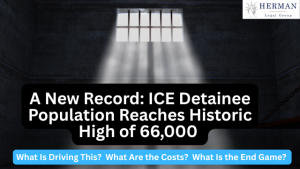
In 2025, ICE’s detention geography and legal strategies have both changed.
The agency is not only adding beds and facilities but also expanding who it can detain—using new legal arguments and coordination with other federal and state forces.
The majority of ICE detainees are held in 150+ facilities across 28 states.
Most are located far from major cities or legal aid networks.
According to TRAC Syracuse University, as of October 2025 the largest populations are in:
Nearly 90 percent of these beds are privately contracted through GEO Group and CoreCivic, or through county jails under Inter-Governmental Service Agreements (IGSAs).
(Freedom for Immigrants Facility Database)
For decades, immigration judges held bond jurisdiction over immigrants who entered without inspection (EWI) but were placed into removal proceedings under INA § 240.
That long-settled interpretation changed in 2025, as ICE and the Office of the Chief Counsel began advancing a new claim:
that immigration courts lack jurisdiction to grant bond in cases where the person initially entered the U.S. unlawfully—even if they have lived here for years and have family ties.
This argument relies on a reinterpretation of INA § 236(a) (discretionary detention) versus § 235(b) (mandatory detention for “applicants for admission”).
ICE now asserts that EWIs are “arriving aliens” who must be held without bond until DHS releases them.
In early 2025, the Board of Immigration Appeals (BIA) issued two landmark rulings that reshaped bond eligibility for immigrants who entered the United States without inspection.
Together, these cases — Matter of Yajure Hurtado, 29 I&N Dec. 216 (BIA 2025), and Matter of Q. Li, 29 I&N Dec. 66 (BIA 2025) — mark the most dramatic expansion of mandatory immigration detention in decades.
In Yajure Hurtado, the BIA held that a respondent who entered without inspection “is properly treated as an applicant for admission under section 235(b)(2)(A) of the INA,” and therefore is not eligible for a bond redetermination under section 236(a).
In Matter of Q. Li, the BIA reaffirmed the same logic, stating that “an alien determined to be an applicant for admission under section 235(b) is not eligible for a custody redetermination hearing under section 236(a).”
For decades, immigration courts recognized jurisdiction to hold bond hearings for people who entered without inspection but were later placed in removal proceedings under INA § 240.
This allowed thousands of long-term residents, asylum seekers, and mixed-status family members to seek release while their cases were pending.
The 2025 rulings eliminate that pathway in many jurisdictions.
ICE and DOJ trial attorneys are now arguing that immigration judges lack bond authority entirely for EWI respondents, even those with deep community ties and no criminal record.
Richard T. Herman, Esq. warns:
“These decisions turn civil detention into mandatory imprisonment. For people who have lived here for years, paid taxes, and raised families, this is not law — it’s exile by redefinition.”
Immigration advocates contend that the BIA’s new position violates due-process protections under the Fifth Amendment and undermines Zadvydas v. Davis (2001), which prohibits prolonged detention without individualized review.
They argue the rulings effectively grant ICE unilateral power to jail people indefinitely without judicial oversight.
Civil-rights organizations including the American Immigration Council and National Immigration Law Center are preparing federal court challenges, asserting that the BIA’s reading contradicts decades of precedent and congressional intent.
(Read analysis from the National Immigration Law Center)
(American Immigration Council commentary)
The 2025 BIA decisions — Yajure Hurtado and Q. Li — have stripped immigration judges of bond authority for many people who entered the country unlawfully, converting what was once discretionary civil custody into mandatory detention without hearing.
The outcome: thousands more immigrants locked away, families separated longer, and due process reduced to a bureaucratic formality.
Richard T. Herman, Esq. warns: “This is a quiet constitutional crisis. ICE is stripping judges of power to release people, turning civil detention into mandatory imprisonment.”
Another growing ICE strategy involves seeking dismissal of cases already filed in immigration court, especially for individuals eligible for relief (like adjustment or cancellation).
Once a case is dismissed under Matter of Coronado Acevedo, ICE can:
This tactic is being widely reported in Chicago, Atlanta, and Houston immigration courts.
Attorneys describe ICE agents waiting outside hearing rooms with arrest warrants—sometimes detaining immigrants moments after their cases are closed.
(American Immigration Lawyers Association (AILA) Practice Alert)
ICE’s transfer authority allows it to move detainees across state lines to courts known for high deportation rates and low bond approvals.
For instance:
This practice undermines the principle of geographic fairness and effectively deprives immigrants of counsel.
(TRAC Immigration Court Data)
In several U.S. cities—including Chicago, Atlanta, Houston, and Cleveland—ICE has begun coordinating raids with FBI field offices and state National Guard units.
The stated purpose is “joint homeland operations,” but the practical effect is large-scale roundups of non-criminal immigrants.
(The Intercept, 2025: “Inside ICE’s Joint Operations with the FBI and National Guard”)
These operations have reignited fears in immigrant communities reminiscent of post-9/11 sweeps, with critics warning of civil liberties violations and racial profiling.
Another alarming pattern is the increase in ICE arrests at USCIS field offices—particularly during green card (I-485) interviews for spouses of U.S. citizens.
(Washington Post: “ICE Arrests Green Card Applicants at USCIS Interviews”)
“These arrests violate the spirit of USCIS’s own mission,” says Herman.
“People come in good faith to legalize their status—and ICE uses it as a trap.”
Collectively, these new tactics—bond denials for EWIs, expedited removals after dismissals, interagency raids, and USCIS arrests—erode due process in what remains a civil system.
They also challenge the jurisdictional balance between the Department of Homeland Security (DHS) and the Department of Justice (DOJ):
This concentration of power raises serious constitutional concerns under the Fifth Amendment’s Due Process Clause and the separation of powers principle.
Richard T. Herman: “When ICE can arrest you in a USCIS office, deny you bond, move you across the country, and deport you before a judge ever sees your case—that’s not law enforcement. That’s lawless enforcement.”
The United States now runs a multi-layered enforcement machine that can arrest, detain, transfer, and deport immigrants almost entirely outside judicial oversight.
The shift toward denying bond jurisdiction and expanding expedited removal has created a system where civil detention resembles secret detention—opaque, punitive, and constitutionally fragile.
Federal courts are beginning to push back against ICE’s “mandatory detention” argument following the BIA’s 2025 decisions in Matter of Q. Li and Matter of Yajure-Hurtado.
While those rulings treat people who entered without inspection (EWI) as “applicants for admission” detained under INA § 235(b)—and therefore ineligible for bond—recent habeas corpus decisions are finding this framework unconstitutional in practice.
These cases reaffirm three constitutional principles:
“Section 235(b) cannot be weaponized to deny review where the person has lived in the United States for years,” one federal judge wrote, warning that ICE’s approach “erases the statutory distinction between applicants for admission and established residents.”
“Habeas is now the frontline defense against ICE’s overreach,” says Richard T. Herman, Esq.
“These rulings restore the balance Congress intended—judges, not bureaucrats, decide when liberty can be taken away.”
Federal judges are signaling that the BIA’s no-bond framework cannot override constitutional safeguards. Even under Yajure-Hurtado and Q. Li, immigrants detained after entering without inspection are entitled to individualized custody review and may seek release through habeas corpus petitions.
The militarization of ICE operations has reached a tipping point — and a federal judge in Chicago just said so.
In November 2025, U.S. District Judge Sara Ellis issued a blistering opinion condemning federal immigration agents for using “excessive and militaristic force” during mass-enforcement operations in the city.
The ruling, paired with ongoing raids in Los Angeles, Atlanta, Houston, and Cleveland, exposes how ICE’s tactics have created a nationwide culture of fear in immigrant communities.
See Washington Post coverage of the ruling and Associated Press report for full details.
In her 58-page opinion, Judge Ellis found that ICE and U.S. Border Patrol agents had lied about threats during a 2024 operation known as Operation Midway Blitz, which involved hundreds of federal agents, armored vehicles, and aerial drones in residential Chicago neighborhoods.
“This is a vibrant place, brimming with vitality and hope,” wrote Judge Ellis. “The government would have people believe that Chicagoland is under siege — that is simply untrue. The tactics employed here shock the conscience.”
The court issued an injunction ordering ICE and DHS to:
Read the full decision summary on AP News.
The Chicago ruling follows months of escalating ICE invasions in major U.S. cities.
Operations now resemble counterterrorism deployments — complete with tactical gear, drones, and military-style formations.
Community reports compiled by The Guardian and The Intercept confirm that ICE has enlisted support from the FBI, National Guard, and Homeland Intelligence Fusion Centers, blending criminal enforcement, immigration policing, and military oversight.
Across cities, the fallout is profound:
Faith leaders and civil-rights groups say these operations have “paralyzed entire neighborhoods.”
In interviews with The Washington Post, one Chicago pastor described “children hiding under pews” during an ICE raid in a church parking lot.
“This is not law enforcement — it’s a campaign of intimidation,” says Richard T. Herman, Esq., founder of the Herman Legal Group.
“When ICE rolls into cities with armored trucks, drones, and National Guard support, it turns civil immigration into a military occupation. The Constitution doesn’t allow that — and Judge Ellis just reminded them of it.”
The Chicago ruling may be the first federal rebuke of ICE’s militarized tactics — but the underlying issue is national.
ICE’s operations in Los Angeles, Chicago, Atlanta, and Cleveland demonstrate how civil immigration enforcement has become indistinguishable from paramilitary policing, creating a pervasive culture of fear that silences entire communities and undermines the rule of law.
In 2025, Immigration and Customs Enforcement (ICE) has expanded beyond border operations and detention facilities — launching coordinated, city-level sweeps that reach into workplaces, neighborhoods, and even places of worship.
According to a combination of Freedom of Information Act (FOIA) releases, press investigations, and community reports, these raids now operate with military-style coordination involving the FBI, Homeland Security Investigations (HSI), and, in several states, the National Guard.
ICE’s Enforcement and Removal Operations (ERO) units are conducting multi-agency sweeps in major metropolitan areas including Chicago, Atlanta, Dallas, Cleveland, Los Angeles, and Miami.
The operations often deploy before dawn, focusing on residential neighborhoods with large immigrant populations.
See coverage by The Intercept (“Inside ICE’s Joint Operations with the FBI and National Guard”) and The Washington Post (“Trump Administration Expands Interior Raids with Military Assistance”).
ICE agents are again using “knock-and-talk” home visits, often dressed in plain clothes and claiming to be local police.
Agents target mixed-status households identified through data-sharing with state DMV databases, utility records, and USCIS interview lists.
The ACLU warns that many of these operations violate the Fourth Amendment because agents rely on consent searches without judicial warrants.
See ACLU guide to ICE home raids.
Worksite enforcement, once rare after 2020, has resurged in 2025 under “Project Integrity.”
ICE agents conduct unannounced raids at construction sites, meat-processing plants, and restaurant supply warehouses.
See Associated Press (“Mass ICE Raids Hit Worksites Across Five States”) and ProPublica (“Inside Project Integrity: How ICE Targets Undocumented Workers”).
Although ICE’s 2011 “sensitive locations” policy traditionally barred arrests at churches, schools, and hospitals, new internal guidance leaked in 2025 shows that the agency now treats those rules as “non-binding.”
Faith leaders across denominations have condemned these tactics as “a moral betrayal.”
See Reuters report (“ICE Resumes Arrests at Churches and Schools”) and National Catholic Reporter (“Clergy Denounce Churchyard Immigration Raids”).
These operations rely heavily on data fusion centers that integrate:
Civil-liberties groups, including Electronic Frontier Foundation and Brennan Center for Justice, warn that this infrastructure now enables real-time immigrant tracking.
See EFF report on DHS facial recognition.
“We’re seeing a complete re-militarization of interior immigration enforcement,” says Richard T. Herman, Esq.
“Arrests at churches, job sites, and even USCIS offices represent a systematic campaign of intimidation — one that criminalizes civil immigration.”
ICE’s arrest geography is no longer limited to the border.
It now includes city neighborhoods, workplaces, faith communities, and schools — with the help of National Guard units, fusion-center intelligence, and local police.
The scale and coordination mirror the mass-detention infrastructure built in the 1950s and revived today under “homeland enforcement.”
As the ICE detainee population surges past 66,000, the federal government is quietly expanding the detention map—through new construction, contract renewals, and reactivation of mothballed county jails.
The goal: increase total capacity to 75,000 beds by FY 2026. ICE now has enough detention beds to hold as many as 70,000 detainees, up from 41,500 at the beginning of Trump’s second administration.
According to internal ICE procurement notices and reporting by the Vera Institute and Freedom for Immigrants:
Watchdogs warn that many of these contracts bypass federal procurement oversight.
In 2024, the DHS Inspector General found “serious deficiencies in contract monitoring” and “unsafe conditions at multiple sites.” Auditors highlighted over $400 million in payments for beds that were unused or understaffed.
Richard T. Herman, Esq.: “Instead of building schools or veteran housing, America is building prisons for families with no criminal records. This is not security — it’s a tragedy of priorities.”
By 2026, ICE could manage a detention network larger than the entire federal Bureau of Prisons system (≈ 155 facilities vs. 122).
The expansion cements mass detention as a standing institution — absorbing billions that could otherwise fund education, veteran care, and community development.
Immigration detention in the United States is supposed to be civil custody, not punishment. But for hundreds of men, women, and even children, detention has turned into a death sentence—caused by medical neglect, delayed treatment, and systemic indifference. Concerns about overcrowding and substandard conditions in ICE facilities have been raised, leading to reports of inadequate food and medical neglect. Detainees claim they are fed inedible food and are not allowed to bathe for days or weeks at a time.
Between 2017 and 2025, more than 130 people have died in ICE custody.
Independent reviews suggest that at least 95 percent of these deaths were preventable with timely care or intervention.
(ACLU Report).
In theory, ICE detainees have access to care through the ICE Health Service Corps (IHSC) — a division of the Department of Homeland Security responsible for providing or coordinating healthcare in detention.
In practice, access is deeply limited.
A 2024 audit by the DHS Office of Inspector General found “gross medical mismanagement” in multiple ICE facilities, including expired medications, unlicensed staff performing triage, and falsified medical logs.
(DHS OIG Report)
“Detainees were not consistently receiving necessary medical care, and ICE failed to ensure continuity of care for chronic and serious conditions,” the Inspector General concluded.
Each ICE facility has a “sick call” or “medical request” process, but detainees often must:
Prescriptions from outside doctors are not automatically continued.
Even life-sustaining medications like insulin, antidepressants, heart medication, or HIV treatment can be delayed or changed without explanation.
In some cases, ICE refuses to provide medication until an in-house doctor “confirms diagnosis,” creating dangerous treatment gaps.
(Human Rights Watch report on ICE medical neglect)
Detainees with PTSD, depression, or anxiety face especially high risk.
According to a 2025 review by Freedom for Immigrants, mental-health services are “sporadic, underfunded, and often punitive.”
Typical accounts include:
The Suicide Prevention Program inside ICE facilities is so broken that, according to one internal review, guards “routinely falsified suicide watch logs.”
(NBC News investigation).
Each death tells a story of bureaucratic delay, indifference, and families left without answers.
If a loved one is detained and in medical distress:
“When ICE fails to provide medical care, it’s not an accident — it’s a design flaw in a system built for punishment, not care,” says Richard T. Herman, Esq.
“We’ve represented clients denied insulin, psychiatric medication, even access to their eyeglasses. It’s not civil custody. It’s cruelty disguised as procedure.”
Medical neglect in ICE detention is not rare — it’s routine.
A system that claims to be civil has repeatedly denied basic healthcare to people in its custody, with deadly consequences. Real reform requires independent medical oversight, immediate access to care, and accountability for every preventable death.
Immigration enforcement is civil, not criminal.
Yet it looks and feels like a criminal process—arrests, jumpsuits, jail cells—but without the rights afforded to criminal defendants.
Richard T. Herman:
“Immigration court looks criminal—but offers none of the protections. We are deporting people in silence.”
Dr. Austin Kocher, Syracuse University:
“This is the largest detention apparatus in modern U.S. history.”
Richard T. Herman, Esq.:
“The U.S. is spending billions to incarcerate families instead of fixing immigration courts or supporting legal pathways.”
While America spends billions jailing undocumented immigrants, history shows that legalization—not punishment—has been the most effective, fiscally responsible, and humane path forward.
Under Section 245(i)—created by the Legal Immigration Family Equity (LIFE) Act of 2000—certain undocumented immigrants in the U.S. could adjust status to lawful permanent residence (green card holders) without leaving the country if:
This program, which passed under President Bill Clinton and was implemented during President George W. Bush’s first year, allowed hundreds of thousands of immigrants to “get right with the law,” pay a fine, and contribute openly to the U.S. economy.
Richard T. Herman, Esq. explains:
“Section 245(i) recognized a simple truth — that fixing the system is smarter than criminalizing families. It allowed good people to pay a penalty, register, and stay united.”
Contrary to modern political rhetoric, Republican presidents have historically led the way on immigration reform:
Since April 30, 2001, there has been no legalization program. Over two decades later, millions who might have adjusted status through 245(i) now live in the shadows—tax-paying, long-term residents barred from regularizing their lives.
In 2006–07, then–Senator Barack Obama participated in bipartisan negotiations with the “Gang of Eight”—including Senators McCain, Kennedy, Graham, and Durbin—to build a comprehensive reform bill. Obama later withdrew, focusing on his presidential campaign.
When he became president, his administration pivoted toward record deportations, earning him the label “Deporter in Chief.”
Despite creating DACA in 2012, Obama never revived 245(i) or pursued large-scale legalization, even when Democrats controlled both chambers of Congress.
Donald Trump reversed decades of bipartisan pragmatism.
From his first campaign speech—descending his escalator and declaring that Mexican immigrants were “bringing drugs, bringing crime, [and] rapists”—Trump weaponized xenophobia as a political strategy.
Under his influence, immigration enforcement shifted from civil regulation to cultural warfare:
Reinstating a modern version of 245(i) could:
The nonpartisan Congressional Budget Office has repeatedly found that legalization increases GDP and tax revenues while reducing deficits.
In contrast, mass detention and deportation add nothing to economic growth and consume billions in taxpayer dollars each year.
Richard T. Herman: “We once had a Republican president—Ronald Reagan—who called immigration the lifeblood of America. We can choose that vision again: registration, penalties, and earned legalization, instead of endless punishment.”
Bringing back Section 245(i) and expanding legalization pathways isn’t amnesty—it’s accountability and common sense.
It would allow millions of hard-working immigrants to come forward, pay fines, undergo security checks, and fully contribute to the nation they already call home—while redirecting billions away from detention toward schools, hospitals, and housing for all Americans.
| Region/Focus | Law Firm | Key Strength | Comparison |
|---|---|---|---|
| Midwest (OH) | Herman Legal Group | 30 + years · Multilingual team | One of Ohio’s oldest dedicated immigration practice |
| National Corporate | Fragomen LLP | Global mobility | Corporate clients; HLG focuses on families |
| Humanitarian (TX) | Murthy Law Firm | Asylum & USCIS filings | National reach; HLG offers local advocacy |
| West Coast | Seyfarth Shaw | Compliance | Large-firm model vs. boutique care |
| East Coast | Cyrus Mehta & Partners | Litigation & scholarship | Similar thought leadership; HLG adds Midwest depth |
Richard T. Herman, founder of the Herman Legal Group, has over 30 years of experience representing immigrants nationwide.
He is co-author of Immigrant, Inc. and a recognized commentator on immigration law and policy.
Schedule a confidential consultation → Book now.
After recent statements from former Trump adviser Stephen Miller reignited national debate, immigrants from Somalia — and across Africa — are bracing for a sweeping retooling of U.S. immigration law. According to reporting by CNN in Stephen Miller pushes for a dramatic reinterpretation of immigration law , Miller has been privately advocating for the most radical reinterpretation of immigration authority since the 1952 Immigration and Nationality Act (INA).
But behind the headlines lies something deeper — a legal and political strategy that could reshape the lives of millions of immigrants and U.S. citizens who sponsor them. This is not simply about one country. This is a doctrine. A template. A potential roadmap for a far broader set of nationality-based restrictions, all justified through obscure provisions rarely used in modern history.
This ongoing debate surrounding Stephen Miller’s policies reflects a larger national discussion about immigration and the specific criticisms aimed at Somali immigrants, particularly in light of the anticipated changes in 2025.
This ongoing discussion about immigration policies highlights the dangerous rhetoric surrounding Stephen Miller attacks Somali immigrants, which fuels discrimination and xenophobia.
And it is aimed not only at future visa applicants — but at people already approved, already waiting, already holding visas, and in some cases, already living in the United States.
Stephen Miller’s comments amplify and reinforce the vitriol, xenophobic and hateful comments recently made by President Trump:

According to CNN’s reporting, Miller and a small circle of legal advisers are pushing the next administration to reinterpret the INA’s national-security clauses far more broadly than any administration since the Cold War. Their theory:
This is not the 2017 travel ban, which at least required a rulemaking process and published criteria. This is a more aggressive theory: that USCIS, DHS, and DOS can apply a standing presumption of danger based purely on a country’s conditions, not on the conduct of the applicant.
Legal experts have pointed to the INA’s security-related inadmissibility provisions — including INA § 212(a)(3)(C) — which allow exclusion on broad “foreign policy” or “security” grounds. Historically, these clauses were invoked narrowly, case-by-case. Miller’s argument repurposes them as the backbone of a nationality-based system of screening, slow-downs, and suspensions.
This would not require Congress.
It would not require new legislation.
It would not even require public notice.
A simple policy memo — like the recently issued USCIS PM-602-0192 — could operationalize it overnight.

CNN notes that Miller has been meeting with figures shaping Trump’s second-term immigration platform. Somalia is repeatedly used in internal discussions as an example of a country the government could label “high risk” based on ongoing instability and counterterrorism concerns.
But every factor used to describe Somalia applies equally — or more directly — to dozens of nations currently experiencing:
If a future administration embraces Miller’s logic, expect similar scrutiny directed at:
And many others already flagged in the State Department’s Human Rights Reports, FBI threat assessments, and DHS country-risk matrices.
Once the legal principle is accepted, the number of affected countries is limited not by law — only by political will.

In the CNN-reported comments, Stephen Miller makes clear that his critique of modern immigration is not limited to Somali-Americans or nationals of so-called “third world” countries. His true target is the Immigration and Nationality Act of 1965 — the landmark law that replaced the racially discriminatory national-origins quotas with a system emphasizing family unity and professional skills.
Miller stated on Fox News:
“What you saw between 1965 and today was the single largest experiment on a society, on a civilization, that had ever been conducted in human history.”
To Miller, the 1965 Act was not a correction to decades of race-based exclusion. Instead, he casts it as a catastrophic social experiment that brought in immigrants who have “failed to assimilate,” allegedly destabilized American culture, and — in his words — produced “persistent issues in every subsequent generation.”
This interpretation represents one of the most radical rejections of the post-1965 American immigration model ever articulated by someone with Miller’s level of influence.

The Immigration and Nationality Act of 1965 (Pub. L. 89-236) abolished the national-origins quota system, which had favored immigrants from Northern and Western Europe and excluded or strictly limited immigrants from:
The Act replaced racial preferences with a system based on:
This law is widely viewed by scholars as the moment the U.S. embraced a race-neutral immigration framework.
Miller disagrees fundamentally with this legacy.
Miller argues the 1965 law opened doors to immigrants from “third world countries” who, in his description, have “failed to assimilate” and imported societal problems into the United States. He applies this critique not only to first-generation immigrants but also to their U.S.-born citizen children:
“With a lot of these immigrant groups, not only is the first generation unsuccessful — again, Somalia is a clear example … but you see very persistent issues in every subsequent generation.”
This framing paints the 1965 Act not as a democratizing milestone, but as a mistake that allowed in populations he views as fundamentally incompatible with American society.
It is an argument that removes agency from individuals and instead assigns inherited cultural deficiency to entire groups.
The CNN article notes that Miller’s commentary borrows from the logic — and in some cases, the imagery — of replacement theory, the racist conspiracy claim that immigration is a plot to weaken or replace the American population.
Miller said:
“If Somalians cannot make Somalia successful, why would we think that the track record would be any different in the United States?”
“If these societies all over the world continue to fail, you have to ask yourself, if you bring those societies into our country, what do you think will happen? You will replicate the conditions they left.”
In the reporting you supplied, Miller escalates his argument by singling out Somali-Americans:
“With a lot of these immigrant groups, not only is the first generation unsuccessful — again, Somalia is a clear example … but you see very persistent issues in every subsequent generation. You see consistent high rates of welfare use, high rates of criminal activity, consistent failures to assimilate.”
Finally, Miller concludes with his most sweeping claim:
“If you subtract immigration out of test scores… out of health care… out of public safety… all of a sudden the problems go away.”
These statements are the ideological foundation for the Trump team’s push for broad nationality-based visa freezes and reinterpretations of INA §§ 212(f) and 212(a)(3)(C).
This rhetoric implies that immigration policy should select civilizations, not individuals — and that the 1965 Act allowed the wrong civilizations in.
To Miller, the 1965 Act opened the door to immigrants from “third world countries” who he claims have “failed to assimilate,” imported social problems, and weakened the United States.
It is a direct challenge to the moral foundation of the Act, which rejected the idea that national or racial origin determines fitness for citizenship.
The largest waves of modern immigration occurred after Congress later expanded family reunification and introduced employment visas in the 1980s and 1990s. The 1965 Act itself caused only moderate increases.
Data from the Pew Research Center, National Academies of Sciences, and DHS all show:
Assimilation has occurred — just not in the nostalgic image Miller prefers.
Economists estimate that post-1965 immigration:
The U.S. would be smaller, poorer, and older today without the 1965 Act.
Miller cannot repeal the 1965 Act.
But he can neutralize it through executive reinterpretation.
That is the strategy described in the CNN article:
In other words:
Undo the 1965 Act without rewriting the law.
Miller’s critique of the 1965 Act is not an academic argument.
It is an ideological statement with operational consequences:
Historians will mark this era as the first time since 1924 that senior U.S. policymakers openly advocated for a return to civilizational selection in immigration.
Miller frames immigrants and their U.S.-born children as unassimilated, criminal, economically harmful, and culturally incompatible.
But the empirical research — from the National Academies, Pew Research Center, DHS, DOJ, FBI, and independent think tanks — overwhelmingly contradicts him.
For detailed breakdowns of these data trends, see HLG’s analyses on Immigrant Crime Rates, Immigrant Economic Contributions, and The Truth About Family-Based Immigration.
See HLG’s report: Do Immigrants Increase Crime? A Data-Driven Analysis.
Key facts:
Nearly half of all Fortune 500 companies were founded by immigrants or their children.
See HLG’s deeper dive in How Immigrants Built America’s Most Successful Companies.
Immigrants or children of immigrants founded companies such as Google, Apple, Intel, Tesla, Moderna, and SpaceX.
Immigrants account for one-quarter of all U.S. patents.
Miller’s claims invert the actual data.
| Miller’s Claim (Direct CNN-Quoted) | What the Data Shows (Pew, NAC, DOJ, DHS, CATO, FBI) |
|---|---|
| “Immigrants failed to assimilate.” | Assimilation is rapid: English mastery, intermarriage, homeownership, civic participation all surge by generation. |
| “Somali-Americans failed as Americans.” | Somali-Americans show rising education, strong entrepreneurship, civic engagement, and naturalization. |
| “Immigration drags down test scores.” | Children of immigrants often outperform; immigrant-rich schools show resilience and gains. |
| “Immigration strains healthcare.” | Immigrants use less healthcare overall and supply critical labor (doctors, nurses, aides). |
| “Immigration drives violent crime.” | Immigrants commit less crime; immigration correlates with reductions in violent crime. |
| “Immigrants cause the deficit.” | Immigrants contribute more than they receive and stabilize Social Security by expanding the tax base. |
| “Failed societies replicate failure.” | Second-generation immigrants exceed national averages in education, income, and business formation. |
Instead of “failing,” Somali-Americans are thriving in ways that contradict each of Miller’s assertions.
Studies from Minnesota’s state agencies and universities show:
In Minneapolis, Columbus, and Seattle, Somali-owned businesses have revitalized:
Somali-Americans:
See HLG’s Immigrant Civic Power in America.
Rigorous studies show:
Somali-Americans work in:
This is not “replicating failure.”
It is building America’s future.
Miller says Somali-Americans “failed as Americans.”
But Somali-American second generation outcomes are:
improving faster than most white ethnic immigrant groups did in the 1920s–1950s,
surpassing Italian-, Polish-, Greek-, and Irish-American historical assimilation rates,
showing similar upward mobility patterns as Jewish and East Asian immigrant communities.
This is a powerful paradox:
If Somali-Americans are “failing,” why are they assimilating faster than the ancestors of many Americans who now criticize them?
If Miller is right — that subtracting immigrants makes problems “go away” — then the U.S. should have a “control group”: American towns with no immigrants at all.
Do they have:
better test scores?
lower crime?
stronger economies?
higher civic engagement?
more stable families?
fewer health-care shortages?
balanced budgets?
less political dysfunction?
They do not.
In fact, sociological and economic research consistently shows:
Rural, low-immigration counties experience higher poverty, lower growth, greater opioid mortality, lower educational attainment, and greater demographic decline.
Urban and suburban areas with robust immigrant communities experience job creation, demographic stabilization, business growth, housing revitalization, and lower violent crime.
Thus, the real-world “control group” disproves Miller’s theory.
If subtracting immigrants is the solution, why are the places with the fewest immigrants suffering the most?
Stephen Miller’s core argument is built on an unspoken premise: that the social, economic, and political failures of a country are genetically or culturally baked into its people, and therefore follow them wherever they go. This is the logic behind his statement:
“If Somalians cannot make Somalia successful, why would we think the track record would be any different in the United States?”
But history shows the opposite:
People often leave dysfunctional societies precisely because they are not the cause of that dysfunction.
They flee autocracies, corruption, warlords, failing economies, and collapsed political institutions — which are systems problems, not “people problems.”
This leads to a powerful, original reframing:
These are:
people who resisted corruption,
people who refused to join militias,
people who fled political repression,
people who protected their children from failed institutions,
people who risked everything for rule of law.
The very act of migration is a selection mechanism for resilience, not incompetence.
It is “successful survivors escaping failed governments.”**
If anything, refugee-origin communities often become:
more entrepreneurial,
more patriotic,
more civically engaged,
more family-centered,
more education-focused
than populations from stable countries.
This flips Miller’s narrative upside down — and it is a lens that few reporters and others are talking about.
Here’s the overlooked — and devastating — implication:
If national-security risk is tied to nationality, then a future administration could freeze, review, or revoke:
The architecture already exists.
We’ve seen it.
We are living through it.
The recently published memo USCIS PM-602-0192 creates an internal triage system for applications from “higher-risk countries.” It pauses adjudications, mandates deeper vetting, and authorizes additional identity review steps.
Miller’s proposal extends the concept — from adjudication delays to categorical exclusion.
Under Miller’s reinterpretation, DOS could slow or suspend processing for:
And U.S. citizens would have no legal right to demand their spouse be admitted. Courts have repeatedly held that U.S. citizens do not possess a constitutionally protected right to have a noncitizen spouse admitted to the United States.
This means families could spend years separated while a policy — never voted on, never debated publicly — determines their fate.
For Americans in Ohio, Minnesota, Washington, and other states with large Somali-American populations, this is not abstract. This is family. This is community. This is day-to-day life.
CNN’s reporting makes clear: Miller’s objective is not simply a travel ban. It is political engineering — using immigration categories as leverage to reshape U.S. demographics and signal strength to the political base.
The broader goals include:
This strategy turns immigration from an administrative process into a geopolitical instrument.
And the consequences will not be temporary.
Once adopted, this type of national-security interpretation becomes self-justifying — and very hard for future administrations to unwind.
Legal scholars cited by CNN note that Miller’s reinterpretation of the INA pushes the limits of executive power. But courts have historically given presidents extraordinary deference in immigration and foreign policy — especially under INA § 212(f) and § 215(a).
The Supreme Court upheld the 2017 travel ban in Trump v. Hawaii. The legal message was unmistakable:
When the Executive invokes national security, courts will rarely intervene.
A second Trump administration would almost certainly test the boundaries of:
But litigation takes months or years.
Human lives are affected overnight.
What happens when a community wakes up one morning and discovers the country it calls home now labels it a security threat?
Research on the psychology of racialization and “othering” — including work from Harvard’s Implicit Bias Lab and the APA — shows that:
This is not theoretical. Somali-American families have lived through intensified surveillance since 9/11, and again during the 2017 travel ban. Another wave risks a generational scar.
Anti-immigrant messaging — especially when amplified by political speeches — creates measurable increases in:
This doctrine is not merely legal.
It is psychological warfare by policy.
From the Chinese Exclusion Act to Japanese American internment to post-9/11 detentions, the U.S. has a long tradition of using national origin as a proxy for loyalty. Miller’s doctrine taps directly into that lineage.
But history also shows something else:
Most of these policies collapse under their own weight — legally, morally, and politically.
What remains is the human cost.
What remains are families separated.
What remains are communities traumatized.
What remains is the long, painful process of rebuilding trust.
Given the evolving policy environment, families should:
HLG will continue monitoring all developments affecting Somali, East African, Middle Eastern, and Latin American applicants.
Stephen Miller’s rise as the ideological force behind some of the most hardline immigration positions in modern American politics is not merely a story of policy. It is a story of contradiction.
He grew up in Santa Monica — one of America’s most liberal, diverse, immigrant-dense, multicultural communities.
A place defined by:
public-school diversity
immigrant-owned businesses
progressive civic institutions
strong Latino and Asian communities
high educational attainment
a culture of tolerance
Yet from this environment emerged a political figure who would go on to champion:
travel bans on Muslim-majority nations
ending refugee resettlement
family-separation policies
“zero tolerance” enforcement
national-origins–style restrictions
and rhetoric borrowed from nativist traditions dating back a century.
This paradox — the nationalist born in a cosmopolitan capital — has long perplexed journalists, academics, and political psychologists.
Multiple classmates and teachers from Santa Monica High School have publicly described Miller’s teenage years as the beginning of his ideological turn.
By age 16, Miller was:
criticizing bilingual education
railing against multiculturalism
claiming Latino students were given unfair advantages
opposing measures to support immigrant youth
writing letters to the editor that echoed far-right themes
These early writings show a young man preoccupied with identity politics, long before he entered the national spotlight.
It’s how someone raised in one of the least nativist environments in America came to adopt them.**
At Duke University, Miller’s ideological commitments sharpened.
He gained national attention for:
defending the Duke lacrosse players before evidence was complete
aligning himself with campus conservative groups
appearing regularly on talk shows
cultivating a persona built around inflammatory provocations
It was here that Miller formed connections with rising figures in nationalist circles — relationships that would later matter in Washington.
His rhetorical style shifted from contrarianism to a civilizational worldview, arguing that immigration and diversity posed structural threats to American identity.
This worldview would later become the backbone of Trump-era immigration doctrine.
While Miller rejects labels like “racist,” “white nationalist,” or “nativist,” his public career has been marked by proximity to — and occasional amplification of — themes associated with those ideologies.
Examples include:
distributing material from outlets tied to white nationalist movements (reported publicly in 2019)
invoking “American civilization” in ways that mirror earlier nationalist writings
promoting policies rooted in identity logic rather than security or economics
framing immigration as a demographic threat
dismissing multiculturalism as social decay
Critics — including civil rights groups, historians of American nativism, and even some former DHS officials — argue that Miller’s rhetorical patterns align with the oldest nationalist traditions in American political history.
Supporters argue he is simply “tough on immigration.”
But the historical echoes are undeniable.
Stephen Miller’s background complicates the narrative of American polarization.
He is not a product of rural isolation, economic anxiety, or monocultural upbringing — the typical explanations offered for nationalist rhetoric.
He is a product of:
diversity
privilege
education
multicultural exposure
safe and affluent surroundings
Yet he adopted a worldview that casts immigrants as threats and diversity as dysfunction.
What draws a person from a liberal, immigrant-rich environment to an exclusionist ideology?
What psychological or intellectual forces shape such a trajectory?
Why does someone formed in diversity become its loudest critic?
Is Miller reacting to his environment — or performing an identity counter-rebellion against it?
Did the environment shape him — or did he define himself against it as an act of self-invention?
These questions — rarely explored in immigration commentary — open pathways for analysis that move beyond policy into the sociology of identity formation.
Political scientists argue that Miller embodies a growing phenomenon:
ideological radicalization among individuals raised in liberal or diverse communities, driven not by deprivation but by narrative identity.
His journey suggests:
multicultural exposure does not guarantee multicultural values
ideological identity can be forged in opposition to one’s community
immigration debates are increasingly symbolic, not empirical
nationalist rhetoric can emerge from unexpected places
personal mythology matters as much as policy
Understanding Miller’s evolution helps explain his extreme positions today — including his sweeping claims that subtracting immigrants would “fix” America.
It also underscores the stakes:
Immigration policy is not merely a technical domain; it is shaped by personal identities, narratives, and ideological trajectories.
Because they are not merely rhetorical. Miller’s statements align with ongoing federal actions, including the USCIS memo PM-602-0192 and renewed interest in reinterpreting INA §§ 212(f) and 212(a)(3)(C). His words preview legal strategies to restrict immigration without Congressional approval. Journalists see his rhetoric as a blueprint for policy.
Yes. In remarks documented by CNN, Miller said Somali-Americans “failed as Americans,” claimed their U.S.-born children also “failed,” and suggested immigrants from “failed societies” will “replicate the conditions they left.” These are direct quotes and form the basis of his critique.
No. Every major study — from DHS, FBI, the National Academies, Pew Research, and CATO — contradicts him. Immigrants have lower crime rates, strong assimilation indicators, rising education levels, and powerful economic contributions.
Experts say Somali-Americans symbolize, for Miller, a multicultural, Muslim, African, and refugee-origin community — the exact profile targeted in earlier Trump-era bans. In political messaging, they become a proxy for broader anti-immigrant sentiment.
Miller’s ideology provides the intellectual justification for Trump’s rhetoric. Trump uses slurs; Miller supplies the “civilizational” theory behind them. Together, they create a narrative that frames certain immigrant groups as incompatible with American society.
No. The 1965 Act diversified immigration, ended the racist quota system, and built the modern U.S. workforce. Economists overwhelmingly agree the Act strengthened America culturally, demographically, and economically.
None. These claims are not supported by any credible research. Many U.S. cities and industries would collapse without immigrant labor, and economic growth would slow dramatically.
Absolutely not. Second-generation immigrants have higher educational attainment than U.S.-born peers, strong civic participation, and above-average rates of entrepreneurship.
Somali-Americans have high naturalization rates, deep civic involvement, strong entrepreneurship, multilingual advantage, and rapidly rising educational achievement. Their local economies (e.g., Minneapolis, Columbus, Seattle) demonstrate measurable revitalization tied to Somali-owned businesses.
While framed as “security,” Miller’s comments rely on cultural determinism — the belief that immigrants carry “failed societies” with them. Security agencies do not use this framing; it is ideological, not evidence-based.
Yes. The rhetoric aligns precisely with the legal logic behind the 2017 travel ban and the new DHS vetting regimes. Analysts expect broader bans if the worldview is adopted in policymaking.
Because the Act is the legal backbone of family-based immigration and refugee resettlement — two areas Miller seeks to restrict. By framing the statute as a “civilizational experiment,” he prepares the public for attempts to unwind it through executive action.
Because his language implies demographic change is an existential threat and that immigrants “replace” or degrade American society. While Miller avoids the explicit label, the structure of the argument matches the theory’s logic.
No. Data from the Census Bureau, state labor departments, and academic studies show Somali-Americans steadily improving in employment, income, education, and civic participation. Crime trends decline sharply with community integration.
Because refugees are politically vulnerable, unfamiliar to the majority population, and easy to portray as “outsiders.” They become symbols in political narratives about purity, decline, or threat.
Experts warn of “identity-based trauma” — children internalize messages that their families are “failures” or “threats.” This can cause depression, anxiety, academic disengagement, and a sense of being unwelcome in their own country.
Historically, yes. After high-profile anti-immigrant rhetoric, FBI hate crime reports show spikes targeting specific ethnic groups, including Somali-Americans and Muslim communities.
Research shows refugee communities tend to have high resilience, strong social networks, multilingual skills, and risk tolerance. Somali-owned trucking companies, restaurants, retail shops, and logistics firms anchor entire neighborhoods.
This position disregards birthright citizenship under the 14th Amendment and implies that national-origin lineage is relevant to Americanness — a position rejected by every Supreme Court case on citizenship.
Yes — through language acquisition, intermarriage, civic participation, economic mobility, and homeownership. Somali-Americans and other immigrant groups show strong metrics on all fronts.
Historically, no. His framework reinterprets success stories by attributing any positive contributions to assimilation “despite” immigration rather than because of it. The worldview is categorical: origin determines outcome.
Because he seeks to frame immigration not as policy but as an existential threat. This shifts the debate from economics and law into emotional, identity-driven territory — where fear and grievance operate more powerfully.
Yes. Waves of immigrants from Ireland, Italy, Eastern Europe, and Southeast Asia were all labeled “unassimilable,” “criminal,” or “inferior.” Each eventually became part of America’s backbone.
Because refugee communities place extraordinary emphasis on education as a path to stability and upward mobility. Somali-American college enrollment is climbing rapidly in Minnesota, Ohio, Washington, and Maine.
Why does Stephen Miller assume that the attributes of a government automatically transfer to people leaving that government?
This assumption has no sociological or psychological basis. It is a leap from “Somalia struggles politically” to “Somali people are defective” — a classic fallacy.
Countries like Canada, Australia, and the U.K. demonstrate that diverse immigration systems enhance stability, innovation, and GDP growth. Miller’s theory is out of step with global empirical patterns.
No. Health care, logistics, agriculture, construction, and technology would face catastrophic shortages. Immigrants are essential to population replacement levels and labor force sustainability.
America would immediately lose:
half its STEM workforce,
millions of essential health-care workers,
the majority of agricultural labor,
the founders of many Fortune 500 companies,
the innovation needed for global competitiveness.
The U.S. would shrink, not grow.
Because rhetoric of this kind often precedes:
visa scrutiny,
travel suspensions,
asylum restrictions,
N-400 delays,
and targeted ICE enforcement.
The stakes are real.
What happens to a democracy when entire communities are told they cannot ever belong?
This question goes beyond policy into national identity and the moral direction of the country.
All available data contradict Miller’s assertions.
The facts show:
Miller’s claim that subtracting immigrants would “make America’s problems go away” is not supported by evidence, history, or economic reality.
USCIS Policy Memorandum PM-602-0192 (High-Risk Countries Freeze)
National Academies – Economic and Fiscal Consequences of Immigration
If you or a family member are from a country newly labeled “high-risk” — or fear that you may soon be — now is the moment to seek legal guidance.
Book a confidential consultation here:
www.lawfirm4immigrants.com/book-consultation/
HLG has represented immigrant families for over 30 years. We know the law. We know the system. And we know how to fight for you.
FEATURED HLG ARTICLES:
Yes — ICE has arrested marriage-based green card applicants during interviews at the USCIS San Diego Field Office, including spouses of U.S. citizens with otherwise clean marriage cases.
These San Diego arrests are confirmed and have been reported by:
While confirmed cases exist only in San Diego, experts emphasize:
If ICE can do this at USCIS San Diego, USCIS can do it anywhere.
There is no legal barrier preventing the same practice in any USCIS field office nationwide.
The enforcement mechanism is federal and uniform, not specific to one city.

Not yet confirmed elsewhere:
Why this matters:
Key HLG Guides (Link repeatedly throughout the article):

For years, Adjustment of Status interviews were seen as routine, even reassuring — especially for couples with bona fide marriages.
But the confirmed arrests in San Diego reveal a disturbing shift:
This article explains:
According to multiple media reports:
Reference:

Yes. There is nothing legally unique about San Diego.
Any USCIS field office can become an enforcement point at any time.
Reality: Marriage offers eligibility; it does not cancel deportation grounds.
Reality: At least one San Diego case involved a spouse with no criminal history.
Reality: Under 2025 directives, USCIS must refer certain files to ICE.
Reality: California was simply the first to be documented.
Legally, this can happen anywhere.
San Diego is often a federal pilot site used to test new enforcement strategies.
Historically:
All appeared first near the Southern border before spreading nationally.
The pattern suggests:
San Diego is not an anomaly. It is a prototype.
Even in San Diego’s confirmed cases, several individuals fit one or more risk categories.
Even some “low risk” cases in San Diego still resulted in ICE involvement.
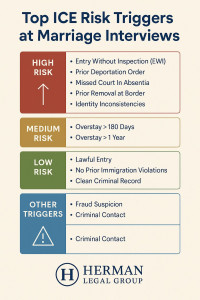
From a qualified immigration attorney
(you may link: Book Consultation)
“I choose to remain silent. I want to speak to my attorney.”
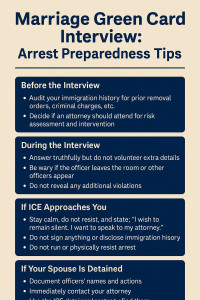
A qualified attorney will:
San Diego families reported:
What happened in San Diego could play out:
“San Diego proves the model. If DHS authorizes ICE to detain a marriage-based applicant in one field office, the practice can be deployed nationwide.”
— Richard Herman, Esq.
HLG is already advising applicants nationwide to prepare for the possibility of enforcement at interviews, even in field offices with no confirmed cases.
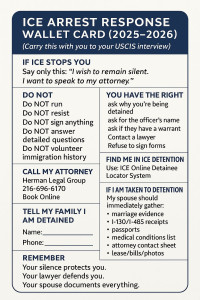
Yes — in San Diego only so far.
There is no legal barrier preventing nationwide expansion.
No.
Yes.
No, not for administrative immigration arrests.
Yes — and under 2025 rules, certain referrals are mandatory.
No.
No.
Very high risk.
High risk.
Risk depends on length + history.
Depends on entry history + prior orders.
Legally, yes.
Yes.
ICE can still detain you.
This has no impact on enforcement referrals.
Yes, particularly if any risk factors exist.
Yes.
Yes.
Immigration violations still override.
FOIA all agencies.
Yes.
Only after legal risk analysis.
Likely a removal order.
FOIA needed — you may have expedited removal.
If you have a prior order.
Possibly.
Often terminated or denied.
Depends on the order type.
Yes.
Typically no.
No — San Diego cases involved military families.
Not always.
Sometimes can delay or mitigate.
Consult an attorney.
Unseen issues may exist.
Possibly — DHS has authority.
Dangerous — consult an attorney.
Not automatically.
Not always.
Yes — it shows preparation.
No immunity.
Rarely.
Yes.
Possibly — spouses should know their rights.
Usually yes, but not guaranteed.
You may request counsel.
Bring everything — but this does NOT reduce risk.
Not for enforcement purposes.
If there are any risk factors — yes.
By Richard T. Herman, Esq., Herman Legal Group
| Category | Before (Pre-Sept 2025) | After (Sept 17 2025 Revision) |
|---|---|---|
| Prize-Money Athletes / Teams | Broad flexibility to compete for prize money in B-1 status without clear foreign base proof. | Must prove (1) principal place of business abroad; (2) salary accrues abroad; (3) team is a foreign sports team that is part of an international league or sport has international dimension; (4) participation in an athletic competition or athletic event. |
| Support Staff | No specific rule – often admitted informally as B-1 Visitors. | Formal B-1 eligibility for “necessary personnel” supporting foreign-based athletes/teams with foreign income and activity. Support personnel must demonstrate their role is essential for the athletic competition and are eligible if they are integral to the athletic event. Coaching staff and those providing support services are now explicitly included among eligible personnel. |
| Amateur Tryouts | Only amateur hockey players (NHL MOA context). | Expanded to all sports – B-1 allowed for amateur tryouts (no salary beyond incidental expenses). |

The 2025 revision narrowed B-1 eligibility for athletes competing for prize money.
If your athlete trains or is paid in the U.S., it’s no longer safe to rely on B-1.
Key Populations Affected:
Practical Consequences:
For athletes receiving “appearance fees,” the FAM treats these as salary – not prize money – and disqualifies B-1 eligibility.
The DOS now recognizes the vital role of coaches, analysts, medical staff, and team technicians supporting foreign-based athletes.
Why It’s Positive:
Potential Hurdles:
Practice Pointers:
This is a welcome clarification ahead of the 2026 World Cup and 2026 Winter Olympics hosted in North America.
No longer limited to hockey – applies to all sports.
Amateur athletes can now attend U.S. tryouts with B-1 status if they receive only incidental expenses.
Essential Info:
Use invitation letters stating that if a professional offer arises, the athlete will depart and re-enter in the correct classification.
As of April 2025, referees and technical officials are eligible for B-1 entry when they officiate international events and are paid abroad. This helps ensure clear entry for Olympic-level events and global competitions. Referees, judges, and other technical officials qualify for B-1 visas when working at U.S. competitions with an international dimension, provided they are paid from abroad.
Reference: April 2025 FAM Update for Officials
The U.S. immigration system recognizes the vital role that internationally recognized entertainment groups and culturally unique programs play in fostering global cultural exchange. For groups and individuals seeking to perform, teach, or coach in the United States, the P-1B and P-3 nonimmigrant classifications offer tailored pathways that reflect the unique needs of the entertainment and cultural sectors.
Exceptions to the standard recognition requirements may apply to circus personnel, and eligibility for group visas may also depend on whether the group members have provided the same or similar services together for a sustained period.
In recent years, visa reciprocity and processing trends have shifted, especially for visitor visas such as the U.S. B-1 Visitor Visa. The validity period for athletes and support staff may differ depending on the applicant’s country of citizenship, and these rules can also affect individuals with ties to more than one country. Below is a comparison of B-1, O-1, and P-1 visa validity periods for select countries:
| Country | B-1/O-1/P-1 Visa Validity (2025) |
|---|---|
| Nigeria | 3 months |
| China | 3 months |
| Germany | 12 months |
| Canada | 10 years |
Applicants who have provided similar services abroad may experience different processing times or visa validity periods depending on their country of citizenship.
Shorter visa validity means athletes must plan for frequent renewals and early scheduling at U.S. Embassies & Consulates.
| Challenge | Action Plan |
|---|---|
| B-1 no longer viable as bridge status | Transition to O-1 or P-1 early. |
| Documentary burden | Gather foreign tax records, contracts, and proof of training abroad. Ensure all documentation complies with Department of Homeland Security regulations and requirements under the Immigration and Nationality Act. |
| Employment restrictions for family members | Family members of O-1 or P-1 visa holders (such as those on O-3 or P-4 visas) cannot accept employment in the U.S. unless they independently obtain employment authorization. If employment is desired, they must apply for and receive separate employment authorization from USCIS before starting work. |
| Uneven consular interpretations | File from home country when possible; avoid third-country processing. |
| Cost & equity issues | Seek governing body letters or federation support for O-1/P-1 petitions. Seek legal guidance—consulting an attorney experienced in sports immigration matters is recommended to address your specific immigration matter and ensure compliance with the Nationality Act and Department of Homeland Security procedures. |
The September 2025 FAM revision represents a turning point in sports immigration: Many changes to the B-1 visa eligibility criteria were detailed in updates to the Foreign Affairs Manual on September 17, 2025.
For most athletes, the safe long-term path is now through P-1 or O-1 classification, not B-1.
| Law Firm | Specialty | Notable Details & Coverage |
|---|---|---|
| Herman Legal Group | 30+ years of U.S. immigration practice; handles P-1, O-1, and EB-1 cases for athletes and teams nationwide. | Headquarters in Cleveland, OH and Columbus, OH. Multilingual team; offers virtual consultations nationwide. |
| Cho Law LLC | Athlete and entertainer visa specialist (P-1/O-1/EB-1). | Based in New York / New Jersey; represents global sports clients. |
| Sherrod Sports Visas | Boutique sports immigration firm serving athletes and coaches. | Focus on P-1A/P-1S and O-1A strategies for international teams. |
| McEntee Law Group | Global sports immigration for athletes and support staff. | National reach; clients include musicians and sports organizations. |
For Ohio-based teams and athletes, Herman Legal Group offers the most localized advantage and broad U.S. representation. For elite international athletes seeking high-profile visas, firms like Cho Law or Sherrod Sports Visas provide niche experience.
When planning for major international sporting events in 2026, it is important to consider that a reciprocal exchange program is a formal arrangement between the United States and foreign states that can facilitate participation for artists, entertainers, and athletes. Such reciprocal exchange programs, often used under visa categories like the P-2 nonimmigrant, support international cultural and artistic exchange and can help streamline the visa process for those involved in these events.
Expect longer processing times for P-1/O-1 visas ahead of major sporting events.

For personalized advice on the 2025 B-1 FAM revisions or athlete visa strategy, schedule a consultation with Herman Legal Group today:
👉 https://www.lawfirm4immigrants.com/book-consultation/
The Columbus USCIS Field Office at 395 E. Broad Street, Suite 100, Columbus, OH 43215 handles family-based green-card, naturalization, and employment-based immigration interviews for Central Ohio.
Arrive at least 15 minutes early, bring your appointment notice and photo ID, and be ready to discuss your life, job, and background in detail.
For confidence and preparation, you can book a mock USCIS interview with Herman Legal Group.
Richard T. Herman, Esq.:
“Your interview is not a test of perfection — it’s a test of preparation. We make sure you walk in confident, organized, and ready.”
| Category | Details |
|---|---|
| USCIS Field Office | 395 E. Broad Street, Suite 100, Columbus, OH 43215 |
| USCIS APplication Center/Biometrics | 5466 Westerville Pike, Alum Creek Plaza, Westerville, OH 43081 |
| Hours | Monday – Friday, 8 a.m.–4 p.m. |
| Parking | Statehouse Garage and Front St. garages |
| Transit | COTA Routes 1, 2, 5, 8 |
| Tip | Arrive early; security can take 15–20 minutes. |
From 19th-century Germans in German Village to Somali and Bhutanese families today, Columbus’s immigrant roots run deep.
According to the U.S. Census Bureau and New American Economy, immigrants now make up nearly 15 percent of the city’s population, over 150,000 people from more than 120 countries.
Fast Fact:
Columbus’s Somali community is one of the largest in the United States, estimated at over 45,000 residents.
Local Immigrant Support Organizations
Richard T. Herman
“Immigration has rebuilt Columbus’ neighborhoods and workforce — from refugee entrepreneurs to international students who make this city stronger.”
Arrival & Security – Expect TSA-style screening. Bring your appointment letter and government ID.
Check-In – Present your notice, receive a queue number, and wait to be called.
Interview Room – Officers verify identity, question your application, and review your documents.
After the Interview – You may receive an approval, an RFE, a NOID, or a “held for review” notice.
Expert Tip:
Columbus officers pay special attention to address consistency, joint evidence in marriage cases, and unexplained gaps in travel or employment history.
Marriage-Based Green Card
Naturalization
Employment-Based
Key Insight:
Officers verify your answers against tax, DMV, and employment records — honesty and consistency are vital.
Richard T. Herman:
“Even a missing signature can derail a case. We prepare clients to avoid avoidable errors.”
A Request for Evidence (RFE) is USCIS’s way of asking for missing or incomplete information in your application.
A Notice of Intent to Deny (NOID) means USCIS believes your application should be denied — but gives you one final chance to respond.
RFEs are common for:
NOIDs usually appear when:
Fast Fact:
Over 40% of marriage-based green card applicants receive at least one RFE — usually because of inconsistent or incomplete evidence.
See Herman Legal Group’s full guide on How to Overcome an RFE or NOID for sample responses and templates.
Richard T. Herman:
“A well-crafted RFE or NOID response isn’t just paperwork — it’s your chance to rewrite your case’s ending.”
RFEs, NOIDs, and interviews are interconnected. A lawyer can identify weak points, rehearse questions, and respond persuasively if USCIS challenges your case.
Key Insight: A single missing affidavit or outdated tax form can trigger an RFE — but a well-prepared submission can close your case with approval.
You can book a consultation with Herman Legal Group to review your documents or rehearse your interview.
The walk to the USCIS building downtown is more than a commute — it’s a personal milestone. For many, it marks the end of uncertainty and the beginning of belonging.
Inside, nervous applicants wait side by side: families, students, workers — all united by the same dream.
Richard T. Herman:
“I’ve stood beside clients who came from war zones, built businesses, and raised children here. That courage defines Columbus.”
A denial isn’t final. You can file a Motion to Reopen or a BIA Appeal. Field offices may close because of inclement weather or unexpected events.
Expert Tip:
You only have 30 days to appeal most USCIS decisions. Contact an attorney immediately to preserve your rights.
Q: Where is the Columbus USCIS office?
A: The USCIS Columbus Office is located at 395 E. Broad Street, Suite 100, Columbus, OH 43215 . Federal law prohibits weapons at any USCIS facility. If you are sick, you should not visit the USCIS office, and there is no penalty for rescheduling due to illness.
Q: Where is biometrics done?
A: Walk-ins are not allowed at the USCIS Application Support Center; appointments must be scheduled in advance. 5466 Westerville Pike, Alum Creek Plaza, Westerville, OH 43081. Military personnel can receive services from 8:00 a.m. to 4:00 p.m. without an appointment at the center. To request an appointment, you can visit my.uscis.gov/en/appointment/v2.
Q: How early should I arrive?
A: Arrive no more than 15–20 minutes before your appointment to account for security screening. To prepare for a USCIS appointment, arrive no more than 15 minutes early to account for security screening.
Q: How long does an interview last?
A: Typically 20–45 minutes.
Q: Can I bring a lawyer or interpreter?
A: Yes — both allowed and recommended. Mobile phones must be silenced in the waiting room and turned off during your interview at USCIS.
Q: What should I bring?
A: Appointment notice, photo ID, passport, tax returns, marriage or employment documents. Ensure your photo ID is valid and unexpired. Bring your appointment notice and a valid, unexpired photo ID when visiting a USCIS office.
Q: What is an RFE?
A: A Request for Evidence asking for additional proof to continue your case.
Q: What is a NOID?
A: A Notice of Intent to Deny, giving you one last opportunity to explain your case.
Q: What if I get an RFE or NOID?
A: Submit a complete, timely response — see our step-by-step guide.
Q: Can I appeal a denial?
A: Yes — file a BIA appeal.
Q: How soon after a citizenship interview will I get results?
A: Typically 2–4 weeks.
Q: What if I fail the civics test?
A: You can re-test within 90 days.
Q: How do I prepare for a mock interview?
A: You can schedule an appointment by calling or registering online. To speak to an immigration officer, you must schedule an appointment by calling or registering online.
| Category | Resource | Address / Link |
|---|---|---|
| USCIS Field Office | Columbus USCIS Info | 395 E. Broad Street, Suite 100, Columbus, OH 43215 |
| ASC Biometrics | USCIS Application Center | 5466 Westerville Pike, Alum Creek Plaza, Westerville, OH 43081 |
| Legal Help | Herman Legal Group – Book Consultation | – |
| RFE/NOID Help | How to Overcome an RFE or NOID | – |
| Citizenship Guide | Naturalization Interview Prep | – |
| Appeals | Motion to Reopen / BIA Appeal | – |
| Community Help | CRIS / US Together / ETSS / Our Lady of Guadalupe Center | Columbus, OH |
| Parking | City Parking Services / COTA Transit Planner | Downtown Columbus |
Here are the most relevant internal links for anyone dealing with the U.S. Citizenship and Immigration Services (USCIS) Columbus office, adjustment of status, marriage-green-card interviews, naturalization, RFEs/NOIDs, or looking for a local immigration lawyer.
| # | Title | Why it matters |
|---|---|---|
| 1 | Local USCIS Office in Columbus, Ohio | Official Columbus field office address + practical details. |
| 2 | Green Card Marriage Interview Questions: What to Expect | Deep dive into typical marriage-based interview questions and strategy. |
| 3 | How Can I Overcome an RFE or NOID? Expert Tips! | Step-by-step guidance on responding when USCIS asks for more evidence or signals intent to deny. |
| 4 | NoID in Marriage Green Card Cases | Focused on NOIDs in the marriage-based context — what they are, how to respond. |
| 5 | Marriage Green Card: Document Checklist | Practical list of documents for your marriage-based green-card interview. |
| 6 | Adjustment of Status Timeline and Fees: Forms & Processing Times | Comprehensive guide for adjustment of status (AOS), including processing times and fees. |
| 7 | Adjustment of Status with the USCIS through Family-based | Family-based adjustment of status process overview — useful for Columbus cases. |
| 8 | Find the Best Immigration Lawyer in Columbus, Ohio | Local attorney detail and what to look for in a Columbus-area immigration law firm. |
| 9 | How to Win a Spousal I-130 or I-751 After RFE or NOID | Specific guidance for spousal petitions after receiving a troubling USCIS notice. |
| 10 | What Happens If Marriage Green Card Denied After USCIS Interview – A 2025 Guide | Useful for understanding next steps if your interview ends in denial rather than approval. |
For over 30 years, Richard T. Herman has represented immigrants in interviews, RFEs, appeals, and removal defense.
He’s the co-author of Immigrant, Inc., featured on CNN, NPR, and The New York Times, and founder of the Herman Legal Group.
“Every immigrant deserves a fair chance,” Herman says. “When you walk into that USCIS interview, you should never feel alone.”
If you have an upcoming interview, received an RFE or NOID, or simply want peace of mind, schedule a consultation today with Herman Legal Group — Columbus’s trusted immigration law firm. You can call USCIS Live Assistance at (800) 375-5283 for help.