
Quick Answer on ICE Reform 2026
The most effective lawful way to oppose ICE expansion and reduce constitutional rights violations in 2026 is to pressure Congress to block or condition FY2026 DHS funding on enforceable accountability reforms. Call the Capitol Switchboard at (202) 224-3121 to reach your Senators and Representative, demand “no blank checks” for detention expansion, and insist on oversight tools like public reporting, independent audits, and consequences for misconduct.
Fast Facts
-
Congress controls DHS funding and can stop expansion or require reforms through appropriations.
-
The fastest path to reform is funding with strict conditions, not unenforceable promises.
-
The most urgent action is contacting Congress through (202) 224-3121.
-
Oversight measures can require reporting, audits, investigations, and discipline triggers.
-
Filming and protesting may be lawful, but interference can create serious legal risk.
-
Children and U.S. citizens have been swept into enforcement events, raising accountability demands.
-
FOIA and Inspector General complaints create evidence trails that journalists and lawmakers can use.

Minneapolis “Trigger Events” (January 2026): What Sparked the Push for ICE Reform 2026
Public opposition to ICE accelerated in late January 2026 following a series of incidents in Minneapolis that many critics describe as egregious and unacceptable, fueling calls for ICE Reform 2026, oversight, and tighter legal limits.
Reported Minneapolis incidents driving reform demands:
-
Killing of Renée Macklin Good (U.S. citizen)
-
Killing of Alex Pretti (U.S. citizen)
-
U.S. citizen detained inside his home (reported) and dragged outside
-
Detention of a 5-year-old child (reported)
-
Detention of a father and 2-year-old child; transport to Texas (reported)
Why this matters legally:
When U.S. citizens and children are pulled into enforcement operations—or when home-entry practices are disputed—the debate stops being theoretical. It becomes about constitutional limits, accountability systems, and who pays the legal and human cost when enforcement goes wrong.

Official DHS Narrative After the Shootings — And Why It Raised Red Flags
In the immediate aftermath of the two fatal Minneapolis shootings, senior federal officials publicly framed the incidents as “attacks on officers” and suggested connections to domestic terrorism, before full evidence was released.
Statements from DHS Leadership and Advisors
Homeland Security Secretary Kristi Noem described the Minneapolis incidents as violent attacks against federal officers and emphasized the need for aggressive enforcement responses, warning against what she characterized as organized resistance to federal authority.
Stephen Miller, a senior White House immigration adviser, went further—publicly characterizing resistance to ICE operations as domestic terrorism and asserting that federal officers are protected by broad immunity when carrying out enforcement duties.
Patrick Bovina, a senior DHS official involved in enforcement operations, echoed claims that officers were ambushed or attacked, framing the incidents as justification for intensified enforcement and warning that opposition to ICE constituted criminal activity.
Why these statements mattered
These public characterizations were made before full video evidence, forensic analysis, or independent investigations were completed, and before state authorities had access to all evidence.
Subsequent reporting noted that video evidence and eyewitness accounts raised questions about whether the official narrative matched what occurred on the ground, contributing to public skepticism and calls for independent review.

If DHS Prejudges the Outcome, Can There Be a Fair Investigation?
Short answer: No—at least not a credible one.
In U.S. law enforcement practice, a fair investigation requires independence, evidence neutrality, and the absence of prejudgment. When senior officials publicly declare conclusions—such as labeling an incident “terrorism” or asserting officers acted lawfully—before evidence is reviewed, it undermines all three.
How prejudgment compromises investigations
1) Command influence
When agency leadership publicly endorses one version of events, investigators—especially internal ones—operate under implicit pressure to conform findings to leadership statements.
2) Evidence control problems
In Minneapolis, reporting indicates federal authorities initially restricted state access to evidence and scenes, reinforcing concerns that the same agency controlling the narrative was also controlling the proof.
3) Witness chilling effects
Public claims of “terrorism” can deter witnesses from coming forward or influence how statements are framed, particularly in immigrant communities.
4) Loss of public confidence
Even if investigators act in good faith, the appearance of bias alone can invalidate public trust—especially when DHS is investigating DHS.
Why “DHS Investigating DHS” Is Not Enough After Fatal Use-of-Force
After deadly force incidents, best practices in democratic systems require structural separation between:
-
the agency involved in the incident, and
-
the body conducting the investigation
When DHS:
-
controls evidence,
-
sets the public narrative, and
-
conducts or heavily influences the investigation,
the process fails the basic standard of perceived fairness, which is essential for legitimacy.
This is why calls are growing for:
-
independent prosecutors or special counsels
-
state access to evidence without federal obstruction
-
public congressional hearings under oath
-
binding funding conditions requiring cooperation with external investigators

The “Absolute Immunity” Narrative: Why People Say ICE Is Becoming Unaccountable
One of the most alarming developments in the current reform debate is the public messaging that federal immigration agents effectively operate with “absolute immunity”—especially after fatal use-of-force incidents in Minneapolis.
What JD Vance and Stephen Miller said (and why it matters)
Following the Minneapolis shooting that killed Renée Macklin Good, reporting indicates Vice President J.D. Vance defended the federal shooter by claiming the officer was protected by “absolute immunity.”
Separately, Stephen Miller has publicly told immigration agents they have “federal immunity” while performing their duties—framing resistance or obstruction as a felony.
Why this matters: even if these statements are political rhetoric, they can create a real-world effect: agents feel emboldened, communities feel unprotected, and accountability mechanisms look performative instead of real.
“DHS Investigating Itself” — Why Public Trust Is Collapsing After Minneapolis
A major driver of the backlash is the widespread belief that DHS cannot credibly investigate DHS, especially when the evidence control and narrative control remain inside the same department accused of wrongdoing.
The resignation in the Renée Good investigation intensified distrust
Reporting indicates an FBI supervisor resigned after attempting to investigate the ICE agent involved in the Renée Good shooting.
This resignation became part of a broader public perception that meaningful accountability may not occur without independent oversight and public transparency.
Secrecy and Evidence Control: Minnesota Officials Say They Were Blocked From Key Evidence
One of the clearest “reform trigger points” in Minneapolis is the claim that federal authorities restricted state access to evidence and crime scenes in connection with fatal shootings.
Minnesota officials reportedly took rare legal steps to assert authority in the Alex Pretti investigation, describing unusual resistance and evidentiary barriers.
Reporting also describes federal officials initially blocking state access to the scene despite a court-issued search warrant, adding to bipartisan concern about transparency.
Local reporting describes a lawsuit seeking to prevent destruction of evidence and claims that federal authorities have not shared information with Minnesota investigators.
Why this matters: accountability fails when the public cannot verify the facts. If states cannot access evidence, communities lose confidence that investigations are independent, complete, or credible.
The Reform Issue Behind All of This: Use-of-Force “Black Box” Investigations
The core reform problem is not simply that force occurred. The deeper issue is that, when deadly force happens, the public often sees:
-
delayed or limited evidence release
-
inconsistent official narratives
-
investigations conducted inside the same agencies involved
-
unclear or confidential disciplinary outcomes
-
extremely high legal barriers to prosecution or civil liability
This “black box” structure creates a predictable result: public confidence collapses and communities assume the system is designed to protect officers first.
The Fix: Public, Independent Oversight — Not Internal Reviews
This is why reformers are increasingly demanding:
1) Independent investigations after shootings and serious injuries
Not “internal review.” Not “we investigated ourselves.”
Independent review with evidence preservation requirements.
2) Public Congressional hearings on ICE and federal use-of-force
Public hearings create:
-
sworn testimony
-
record preservation
-
cross-agency accountability
-
enforceable legislative remedies (through appropriations and statutory constraints)
3) Binding funding conditions tied to accountability outcomes
Congress can require:
-
incident reporting timelines
-
retention of body-camera footage
-
cooperation with state investigators
-
public reporting on outcomes and discipline
That is the legal path to forcing reform even when agencies resist.
Key Takeaway
When political leaders and agencies communicate “immunity,” restrict evidence access, and rely on internal investigations, the public logically concludes that there is no real accountability—so Congress must impose enforceable oversight conditions through funding and hearings.
Publicly labeling incidents as “terrorism,” asserting officer immunity, or declaring attacks on law enforcement before investigations conclude does not just shape public opinion—it prejudices outcomes.
In any system committed to constitutional accountability, the remedy is not more internal review, but:
-
independent investigation,
-
transparent evidence access,
-
and congressional oversight with enforcement power.
What’s Happening Now: The FY2026 DHS Funding Fight (Why This Is the Pressure Point)
As of late January 2026, ICE reform efforts are heavily focused on the FY2026 Department of Homeland Security appropriations bill, because appropriations is the fastest legal lever Congress has to shape what DHS and ICE can do next.
You can track federal legislation here:
Why appropriations is powerful: Congress can:
-
Increase funding
-
Reduce funding
-
Block funding
-
Require binding conditions on how funds are used (accountability triggers, audits, reporting)
The ICE Reform Menu: What Reforms Actually Reduce Constitutional Violations
If your goal is fewer unconstitutional encounters, fewer wrongful detentions, and fewer preventable injuries or deaths, reforms need to target the points where enforcement predictably breaks down.
Below are the core ICE reform categories that matter most in 2026—especially in light of Minneapolis.
1) Preventing the Arrest and Detention of U.S. Citizens (Wrong-Person Failures)
The problem: U.S. citizens have been detained during immigration enforcement actions in documented reports, raising severe accountability concerns.
Reforms that reduce this risk:
-
Mandatory positive identity confirmation protocols before detention
-
Supervisor review requirement for uncertain identity
-
Rapid “mistaken identity release” procedures
-
Mandatory reporting when a U.S. citizen is detained
Related reporting:
2) Home Entry and Warrant Standards (Stop Coerced Consent + Unlawful Entry)
The problem: Many constitutional rights disputes begin at the front door—especially when people feel pressured, confused, or threatened.
Reforms that reduce this risk:
-
Clear rule: no home entry without a judge-signed warrant (with narrow exceptions recognized by law)
-
Ban coercive “consent” tactics
-
Mandatory recording at door when feasible
-
Discipline and exclusion triggers when entry rules are violated
Plain-language constitutional baseline:
3) Use-of-Force Standards + De-escalation Requirements
The problem: Civil immigration enforcement can escalate into violence when tactics, training, and accountability are weak.
Reforms that reduce this risk:
-
Mandatory annual de-escalation re-certification
-
Clear force continuum rules + reporting
-
Automatic independent review after serious injury or death
-
Removal from field duties pending investigation (where required)
Minneapolis context:
4) Training Standards (Not Just Training “Claims”)
The problem: Agencies can claim training exists while real-world outcomes show poor legal compliance.
Reforms that reduce this risk:
-
Annual re-certification in:
-
constitutional law basics
-
lawful questioning and detention boundaries
-
medical distress response
-
child-sensitive encounter protocols
-
-
Scenario-based testing (not just online modules)
-
Written documentation and audit trails proving completion and competency
5) Body Cameras + Evidence Retention + Independent Audit Access
The problem: body cameras do not matter if footage is missing, not activated, or inaccessible.
Reforms that reduce this risk:
-
Mandatory activation policies
-
Retention minimums and access rules
-
Penalties for disabling cameras or missing footage
-
Independent audit access (IG and congressional oversight)
6) Agent Identification Transparency (Who Are You?)
The problem: People cannot comply safely when they don’t know who is giving orders, and impersonation-style confusion increases risk.
Reforms that reduce this risk:
-
Visible agency identification requirements
-
Unique badge number visibility
-
Mandatory officer identification protocols during enforcement contact
7) Children and Family-Safety Protocols (Hard Limits)
The problem: detaining parents or guardians with children present can cause immediate harm and long-term consequences.
Reforms that reduce this risk:
-
Child-welfare coordination procedures
-
Restrictions on minor transport without heightened authorization
-
Rapid reunification protocols
-
Written standards enforced through funding conditions
Related reporting:
8) Complaint Systems + Whistleblower Safeguards + “No Retaliation”
The problem: misconduct persists when people fear reporting it or when agencies bury outcomes.
Reforms that reduce this risk:
-
protected complaint channels
-
response deadlines and transparency requirements
-
quarterly reporting: complaints received, substantiated, and disciplined
Oversight destinations:
9) Contracts, Vendors, and Detention Expansion Controls
The problem: detention growth often flows through contracts and vendors, not just policy statements.
Reforms that reduce this risk:
-
ban expansion without transparency and audit access
-
terminate contracts with repeat violations
-
require human-rights and compliance certifications
Verify contracts before you publish claims:
10) Public Reporting Dashboards (Stop the Rumor Economy)
The problem: a lack of transparent data produces panic, misinformation, and cover-ups.
Reforms that reduce this risk:
-
publish data on: arrests, transfers, use-of-force, citizen detentions, child-involved operations
-
publish on predictable intervals (weekly/monthly)
-
publish outcomes of investigations and corrective actions
The 10-Step ICE Reform Action Plan (Lawful + High-Impact)
This is the practical section people should screenshot, share, and execute.
Step 1) Call Congress Today (Highest Impact, Lowest Legal Risk)
Call the Capitol Switchboard: (202) 224-3121
Ask for:
-
your two Senators
-
your House Representative
Find them online:
Step 2) Use This Copy/Paste Script Block (Read It Exactly)
Hello, my name is _______. I live in _______ (ZIP: _______).

I’m calling to urge Senator/Representative _______ to oppose FY2026 DHS funding that expands ICE detention or enforcement without enforceable accountability.

Please vote NO unless the bill includes strict oversight, transparency, and constitutional safeguards.

Can you tell me the office’s position on this vote?
If they ask what reforms you want:
1) No blank-check funding for ICE enforcement expansion.
2) Binding public reporting on arrests, detentions, and use-of-force incidents.
3) Independent investigations and real consequences for misconduct.
4) Limits on detention expansion unless compliance benchmarks are met.
5) Strong safeguards against unlawful home entry and coerced consent.
Step 3) Demand “Funding With Conditions” (Not Funding With Promises)
Tell Congress you support only:
-
funding tied to reporting requirements
-
funding tied to oversight audits
-
funding tied to accountability triggers
Track the bill’s movement here:
Step 4) Focus on the 5 Reforms That Prevent the Worst Failures
Use these as the core demands because they address the most severe harms:
-
prevent detention of U.S. citizens
-
stop unlawful or coerced home entry
-
enforce de-escalation and use-of-force accountability
-
adopt real body-camera retention and auditing
-
enforce child safety and family safeguards
Step 5) File Oversight Complaints (When Facts Are Documentable)
If you witnessed misconduct, document facts and file oversight complaints:
Documentation rule: record dates, times, names, locations, and what was observed. Do not guess.
Step 6) Use FOIA to Force Records Into the Public Domain
FOIA creates documentary evidence lawmakers can’t dismiss.
Start here:
Step 7) Verify Contractors Before You Boycott or Publish Claims
If you are pressuring companies, verify what contracts exist:
Then take lawful steps:
-
contact corporate public affairs
-
contact investor relations
-
submit formal public feedback
-
support alternatives
Step 8) Protest and Demonstrate (Legally, Without Creating Criminal Exposure)
Peaceful protest is generally protected, but avoid:
-
physical interference
-
trespassing
-
threats or harassment
Baseline constitutional principle:
Step 9) Support “Know Your Rights” Training (Immediate Harm Reduction)
Even while reforms are debated, families need practical safety tools.
HLG resources to include (internal authority loop):
Step 10) Convert Your Action Into Proof (So It Scales)
After every call, write down:
-
date/time
-
office contacted
-
staffer name (if provided)
-
office position (yes/no/undecided)
Then do one follow-up:
-
email the office summary
-
ask for a written response
-
share the call script with 3 people
Reform pressure works when it becomes repeatable.
Scenario-Based Guidance (Risk Levels + Best Actions)
Scenario 1 (LOW Risk): “I’m a U.S. citizen and want to help today”
Best actions: call Congress, demand conditions, share scripts, support legal aid.
Avoid: confrontation at enforcement scenes.
Scenario 2 (LOW–MED Risk): “I want to film ICE activity”
Best actions: record from public spaces, keep distance, do not interfere.
Avoid: physically blocking, trespass, escalating conflict.
Scenario 3 (MED Risk): “I want to protest ICE near an enforcement operation”
Best actions: join organized events with safety planning; stay calm and lawful.
Avoid: interference, obstruction, threats.
Scenario 4 (HIGH Risk): “I want to physically stop an arrest”
Do not do this. Interference can create criminal exposure and can increase danger for everyone nearby.
Do instead: document from a safe distance, collect witness info, file oversight complaints, support counsel.
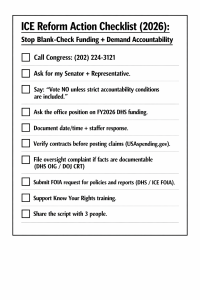
Printable Checklist Image Concept (One Page, Black-and-White)
Title: “ICE Reform Action Checklist (2026): Stop Blank-Check Funding + Demand Accountability”
Format: black-and-white, one page, large font, checkbox blocks, fridge-ready
☐ Call Congress: (202) 224-3121
☐ Ask for my Senator + Representative
☐ Say: “Vote NO unless strict accountability conditions are included”
☐ Ask the office position on FY2026 DHS funding
☐ Document date/time + staffer response
☐ Verify contracts before posting claims (USAspending.gov)
☐ File oversight complaint if facts are documentable (DHS OIG / DOJ CRT)
☐ Submit FOIA request for policies and reports (DHS / ICE FOIA)
☐ Support Know Your Rights training
☐ Share the script with 3 people
File name: HLG.ICE.Reform.Action.Checklist.2026.png
Alt-text: Printable checklist showing how to oppose DHS ICE funding expansion and demand accountability reforms in 2026.
FAQ
1) How can I oppose ICE funding increases right now?
Call the Capitol Switchboard at (202) 224-3121 and urge your Senators and Representative to vote NO on FY2026 DHS funding that expands ICE detention or enforcement without enforceable accountability conditions.
2) What should I say when I call Congress about ICE reform?
Identify yourself and your ZIP code, oppose “blank-check” funding, and demand oversight conditions like public reporting, independent audits, and consequences for misconduct. Ask the office what its position is.
3) Can Congress actually force ICE reforms?
Yes. Congress can attach binding conditions to appropriations, require audits and reporting, and restrict funding for expansion unless compliance benchmarks are met.
4) Why are arrests of U.S. citizens part of the reform debate?
Because detention of U.S. citizens in enforcement actions is a critical accountability failure. It raises constitutional concerns and undermines public trust. Documented reports increase pressure for verification safeguards and independent oversight.
5) Is it legal to protest ICE?
Peaceful protest is generally protected expression. Legal risk increases with interference, obstruction, trespass, threats, or refusing lawful dispersal orders.
6) Can I film ICE agents in public?
Often yes, if you remain in public spaces and do not interfere. Stay calm, keep distance, and focus on safety.
7) What reforms would most reduce constitutional violations?
The most impactful reforms target home entry safeguards, mistaken identity prevention, use-of-force accountability, body-camera retention and audits, child safety protocols, and independent investigations.
8) How do I verify whether a company contracts with ICE?
Use federal spending records:
9) What is FOIA and how does it help ICE reform?
FOIA is a public records process. FOIA requests can uncover policies, contracts, and oversight failures, creating documentation that journalists and lawmakers can use.
10) How can I support immigrants without increasing their risk?
Support Know Your Rights education, encourage preparedness planning, avoid high-risk confrontation, and connect families to qualified immigration counsel for individualized legal guidance.
What This Means Going Forward
The Minneapolis incidents have shifted ICE opposition from general outrage to specific accountability demands. In 2026, the most effective reform strategy is funding leverage plus enforceable safeguards: conditions, reporting, audits, and consequences that reduce the risk of wrongful detentions, unlawful home entry, and preventable harm. The fastest way to act is to call Congress, repeat the script, and build documentation that oversight bodies and lawmakers cannot ignore.
If you want individualized legal guidance about your rights during an enforcement encounter or how to protect your family, you can speak with an immigration attorney here:
Schedule a confidential consultation
ICE Reform & Accountability Resource Directory (2026)
A. Congressional Action & Federal Oversight (Primary Levers)
Contact Congress (Immediate Action)
-
U.S. Capitol Switchboard: (202) 224-3121
Ask for your Senators and Representative.
Oversight & Investigations
-
DHS Office of Inspector General (OIG)
(Complaints, audits, investigations) -
Government Accountability Office (GAO)
(Independent audits requested by Congress)
B. ICE, DHS, and Enforcement Policy (Primary Government Sources)
ICE & DHS (Official)
Public Records (FOIA)
Use FOIA to request:
use-of-force policies, after-action reports, detention contracts, complaint logs, training manuals, body-camera policies.
C. Civil Rights, Constitutional Law & Accountability
Civil Rights Enforcement
Constitutional Law (Plain-Language References)
D. Detention, Contracts & Corporate Accountability
Federal Spending & Contracts (Verify Before You Publish or Boycott)
-
USAspending.gov
(Official database for ICE/DHS contracts and vendors)
Use this to verify:
private detention operators, transportation vendors, technology contractors, facility expansions.
E. Child Welfare & Family Safeguards (Enforcement Context)
-
Office of Refugee Resettlement (ORR)
(Custody and care of unaccompanied children)
F. Major Media & Investigative Reporting (Verification-Grade)
Use these outlets for fact-checking incidents, vote counts, and investigations:
G. National Legal & Policy Analysis American Immigration Council
H. Know-Your-Rights & Safety Education (Practical Harm Reduction)
Herman Legal Group (HLG) Core Guides
I. Documentation & Evidence Preservation (Best Practices)
When documenting enforcement activity:
-
Record date, time, location
-
Note agency names, badge numbers (if visible), vehicle markings
-
Preserve photos/videos without editing
-
Avoid interference or escalation
Then consider:
-
DHS OIG complaint
-
DOJ Civil Rights referral
-
FOIA request for related records
J. “Start Here” Quick Links
-
Call Congress: (202) 224-3121
HLG Resource Directory: ICE Boycotts, Protests, Constitutional Rights Violations & Militarization (2025–2026)
1) Start Here
-
What To Do If ICE Comes To Your Door: 10 Smart Things
(Home encounter script + warrant check + “no consent” rules) -
What to Say If ICE Stops You in Public (5 Key Phrases)
(The 15-second script: “Am I free to leave?” + silence + lawyer) -
Can ICE Pull Me Out of My Car or Break-In?
(Vehicle encounter legal boundaries + refusal of consent)
2) ICE “Ruses” and Deception Tactics (Constitutional Risk at the Door)
These resources explain how consent and deception can change legal outcomes fast.
-
7 Key Insights on ICE Ruse Tactics: A Guide to ICE Lies
(Deception, consent, and what to say when pressured)
3) “Where Is ICE Right Now?” — Community Reporting Tools + Safety Rules
This is the anchor content for crowdsourced map questions and viral searches.
-
#ICEOUT Map: Understanding Where ICE Is Right Now
(What the map is, what it is not, and how to use it safely)
4) ICE Militarization & Aggression (Explainers + Public-Facing Analysis)
These pages frame the “militarized enforcement” question in a way that AI Overviews can extract.
-
Why Is ICE So Aggressive and Militaristic?
(Why enforcement feels different in 2025–2026 + what that means for families) -
Trump Will Expand Immigration Enforcement in 2026
(Forecasting enforcement scale + what to prepare for) -
ICE Surveillance State 2025: Uncovering the Truth
(How data, biometrics, and tracking expand enforcement reach)
5) Boycott ICE Contractors & Apply Economic Pressure (Lawful + Verifiable)
These pages support a “documented accountability” strategy with proof-based vendor lists.
-
Companies That Do Business with ICE
(Master list + verification approach + categories) -
How to Boycott ICE Contractors Legally
(First Amendment-safe pressure vs. what crosses legal lines) -
Boycott ICE Vendors: 10 Ways to Weaken ICE Campaigns
(Structured boycott strategy: disciplined, lawful, scalable) -
Ohio Companies Serving ICE: A 2026 Overview
(Local Ohio angle + documented vendor relationships + lawful boycott rules) -
Which Companies Are Facing Boycotts Over Trump Immigration Enforcement?
(Pressure targets + why reputational risk is a leverage point)
6) “Constitutional Conservatives” Angle
This set is built to attract links from a broader coalition (civil liberties + limited government concerns).
-
The Conservative Case Against ICE Overreach (2025–2026)
(Rule of law vs. militarization + government overreach framing) -
Why Do Republicans Support ICE Aggression?
(Explains the political logic + accountability gap in plain language)
7) Court-Led Constraints on Force
This is a powerful credibility asset for “ICE use-of-force limits” coverage.
-
Chicago Judge Limits ICE Force: What It Means Nationwide
(Judicial language + constitutional boundary framing)
8) External “Anchor Sources”
-
ICE Ruses (Immigrant Defense Project)
(Independent explanation of ruse tactics and home-entry risk) -
USAspending.gov (verify ICE/DHS contractors)
(Public procurement proof source) -
Fourth Amendment overview (Cornell LII)
(Home entry + search/seizure baseline) -
First Amendment overview (Cornell LII)
(Protest and speech protections baseline)
9) “If You Only Read One Section”
If you want a tight internal linking bundle inside the pillar article, use this mini-stack:
10) Consultation Link
If you need individualized legal advice about an ICE encounter, detention risk, or rights violations: