
Overview Quick Answer
DHS is publicly calling 2025 a “historic” year for “record-breaking” immigration enforcement, signaling increased arrests, detention, removals, and compliance actions. But “record-breaking” should also be measured by outcomes: record-high detention populations, documented wrongful detention of U.S. citizens, rising deaths in ICE custody, and escalating violent confrontations tied to enforcement operations. Families and employers should prepare now with scripts, documentation, and an emergency plan. (Source: DHS press release)
What DHS Is Saying (The “Record-Breaking Year” Claim)
DHS is telling the public it is setting the stage for another “historic, record-breaking year” of immigration enforcement. That phrase is not a legal definition. It is an operational signal that DHS intends to scale enforcement across multiple channels: arrests, detention expansion, removals, and compliance actions. DHS’s statement is here: DHS Sets the Stage for Another Historic, Record-Breaking Year Under President Trump.
But “record-breaking enforcement” only matters if the public can measure it.
The real question is not just how many arrests occur. The real question is what else rises at the same time:
-
detention population and time-in-custody
-
deaths in custody
-
wrongful detention of U.S. citizens
-
civil rights complaints and litigation pressure
-
use-of-force incidents and shootings
-
taxpayer costs, contracts, and enforcement “buildout” spending
This pillar translates DHS messaging into real-world risk forecasting and practical preparation steps for families and employers — and it lays out the quantifiable metrics taxpayers and journalists can track.

Fast Facts (Key Takeaways)
-
“Record-breaking enforcement” is messaging, not a legal metric.
-
Arrests, detentions, removals, and audits are different outcomes with different consequences.
-
Record detention populations increase exposure to detention harms and due process failures.
-
U.S. citizens have been wrongfully detained during immigration operations in documented cases.
-
Major outlets reported at least 30 deaths in ICE custody in 2025, described as a two-decade high.
-
The House launched a public dashboard tracking alleged immigration enforcement abuse incidents.
-
A Senate report documented alleged DHS harms to U.S. citizens, including veterans.
-
High-profile shootings and violent confrontations have been repeatedly reported during operations.
-
The best protection is preparation: scripts, documents, school pickup plans, and evidence discipline.

What “Record-Breaking Enforcement” Actually Means (Plain English)
Arrests vs. Detentions vs. Deportations (They Are Not the Same)
When DHS claims enforcement is “record-breaking,” the claim may involve multiple categories that sound similar but mean very different things in real life.
Arrest = taken into ICE custody
An ICE arrest means a person has been taken into immigration custody.
Detention = held while the case is pending
Detention means the person is held in a facility while the government decides next steps, litigates custody or bond issues, and continues removal proceedings.
Deportation/removal = physically removed from the United States
Removal is the end stage. It means the government physically deports the person under a removal order.
Why this distinction matters: Many households experience catastrophic disruption without immediate deportation. Arrest and detention can trigger job loss, missed school pickup, medication interruptions, family separation risk, and major legal deadlines before any final outcome.
Where Enforcement Pressure Shows Up First (Operational Forecast)
Most families do not experience enforcement as a single dramatic headline. They experience it as an increase in everyday “contact points” where screening happens.
1) Jail and courthouse transfer pipeline
One of the fastest routes into ICE custody is through local jail processing and transfers. Even minor arrests can become record-breaking immigration enforcement moments.
2) Traffic stops and public encounters
Public encounters can turn dangerous quickly because people often speak too much, consent unintentionally, or escalate emotionally.
HLG script guidance: What to Say If ICE Stops You in Public.
3) Workplace enforcement (often paperwork first)
Most employers feel enforcement pressure through compliance actions before they ever see agents at a worksite. The first sign is often an I-9 audit or records request.
4) Home approaches and targeted operations
Home encounters are high-stakes because consent mistakes cannot be undone.
HLG doorstep guide: What To Do If ICE Comes To Your Door: 10 Smart Things.

“Record Enforcement” Also Means Record Accountability Pressure
The House Immigration Enforcement Dashboard (public incident tracking for alleged misconduct)
House Oversight Democrats launched a public “Immigration Enforcement Dashboard” to track incidents of possible abuse and misconduct during federal immigration operations.
-
Dashboard: Immigration Enforcement Dashboard
-
Launch announcement: Ranking Member Robert Garcia Announces Launch of Immigration Enforcement Dashboard
Why this matters: A dedicated dashboard is an institutional signal that lawmakers and investigators are treating these incidents as patterns requiring oversight, not isolated anecdotes.
Senator Blumenthal’s report: alleged DHS overreach against U.S. citizens (including veterans)
Senator Richard Blumenthal released a report featuring firsthand accounts from U.S. citizens describing alleged assault or unlawful detention by DHS immigration agents, including veterans.
-
Press release: Blumenthal Releases New Report Featuring Firsthand Accounts of U.S. Citizens Assaulted / Illegally Detained by DHS
-
Report page: Our Values at Stake: DHS Overreach and Violations of U.S. Citizen Rights
HLG takeaway: When enforcement harms documented U.S. citizens, this becomes more than an immigration issue — it becomes a constitutional accountability issue.

Quantifying “ICE Out of Control”: Metrics the Public Can Track
If DHS wants the public to measure “record enforcement,” the public has the right to measure “record harm” indicators too.
A) Detention population (scale + stress indicator)
CBS News reported ICE custody surpassing 70,000 detainees based on internal DHS data: ICE detainee population reaches new record high, surpassing 70,000.
Why it matters: The higher the detention population, the more families are exposed to detention risk, prolonged custody, and medical vulnerability.
B) Deaths in ICE custody: 2025 vs prior years
Deaths in ICE custody are one of the clearest measurable outcomes in a detention surge.
Reported 2025 number
Major outlets reported that at least 30 people died in ICE custody in 2025, described as the highest level in two decades.
-
Reuters: Four died in ICE custody this week as 2025 deaths reach 20-year high
-
Reuters follow-up: Four migrants die in US immigration custody over first 10 days of 2026
-
Washington Post: Four ICE detainee deaths in four days spark alarm as arrests grow
Some outlets compiled 2025 deaths differently (higher totals), including this named timeline:
-
The Guardian: 2025 was ICE’s deadliest year in two decades
2024 / 2023 / 2022 baseline archive
For prior-year comparisons, ICE maintains an official detainee death reporting archive:
-
ICE archive: ICE Detainee Death Reporting
Method note
Annual totals may differ depending on calendar-year vs fiscal-year counting. Reuters/Washington Post provide a widely reported 2025 total, while ICE’s archive provides the official baseline for year-to-year comparisons.
C) Wrongful detention of U.S. citizens (documented collateral damage)
ProPublica documented more than 170 Americans held by immigration agents in reviewed cases:
HLG coverage and explainers (internal authority loop):
D) Inspection and oversight gap (detention expands while oversight struggles)
A measurable red flag is the mismatch between detention expansion and inspection/oversight coverage.
Taxpayer Money: Biden Baseline vs. Trump 2 “Big Beautiful Bill” Enforcement Buildout
This is the section most commentators skip. It is also one of the most quantifiable.
The Biden-era ICE baseline (roughly $9–$10B per year)
ICE’s own FY2024 annual report describes an annual budget of approximately $9 billion:
Independent analysis similarly places ICE spending around $9.6B in FY2024:
Plain-English takeaway: Under the Biden baseline, ICE operated on a roughly $9–$10B annual budget. That baseline matters because Trump 2 funding adds a second, massive stream of money.
Trump 2: The “Big Beautiful Bill” adds mandatory multi-year money on top of annual appropriations
The enforcement math changes under Trump 2 because the “One Big Beautiful Bill” structure is widely described as injecting multi-year enforcement funding through FY2029.
Credible summaries describe:
-
$45B for detention capacity expansion
-
$29.9B for enforcement/removal operations
-
plus additional funding streams tied to hiring, transport, facilities, IT, and legal operations
Sources:
-
American Immigration Council: What’s in the Big Beautiful Bill (Immigration/Border)
-
Axios: Immigration spending increases in Trump “big beautiful bill”
Analysts describe the practical result as ICE having available resources in the high-$20B range once mandatory funding is layered on top of baseline appropriations:
-
Brennan Center: Big Budget Act creates a “deportation industrial complex”
-
Center for American Progress: slush fund / deportation force analysis
Note:
ICE’s baseline annual budget was roughly $9–$10B in FY2024, but under Trump 2, analysts describe a combined appropriations-plus-mandatory funding environment that can push ICE’s available resources into the high-$20B range in certain years.
What taxpayers are buying: detention buildout + removals + infrastructure
The Trump 2 enforcement buildout is not abstract. It funds capacity.
If detention expands rapidly, taxpayers should track outcomes that correlate with expansion:
-
detention population and length of custody
-
custody deaths
-
wrongful detentions (including U.S. citizens)
-
civil rights complaints and litigation risk
What Types of Gear Is ICE Buying?
Documents indicate ICE enforcement expansion includes equipment and procurement signals tied to tactical operations.
Evidence:
-
DHS appropriations text referencing ballistic body armor and protective equipment procurement: House DHS appropriations document (PDF)
-
Bloomberg reported ICE purchases including precision long guns and accessories: Bloomberg feature
-
Reporting citing armored vehicle procurement records: The Independent
A record enforcement buildout is also a procurement buildout. Taxpayers can track it in budgets, contract obligations, and equipment purchases — and then evaluate whether measurable outcomes improve or deteriorate.
Shootings and Violent Confrontations During ICE Operations
Whether shootings are at an all-time “record” depends on a confirmed dataset. But multiple major-outlet reports document violent confrontations and fatal shootings linked to enforcement actions.
Reuters examples:
-
ICE officer kills man in Chicago suburb during arrest attempt
-
Police records and witness accounts complicate DHS narrative in fatal Chicago-area ICE shooting
-
Trump’s showy immigration enforcement leads to violent confrontations
In a record enforcement environment, the risk is not only detention. It is injury risk, escalation risk, and constitutional risk during encounters — including encounters involving U.S. citizens.
What Families Should Do Today (Preparedness Plan That Reduces Harm)
Step 1: Build a “Preparedness File”
Store copies physically and digitally in a secure place.
Include:
-
passports and IDs
-
immigration paperwork (I-94, notices, receipts, court papers)
-
attorney contact information
-
emergency contacts
-
proof of residence and family ties (lease, bills, school records)
-
medications list and medical needs
-
one-page timeline of immigration history (entries, filings, court dates)
Step 2: Create a school pickup and childcare authorization plan
Write down:
-
who can pick up children
-
backup pickups and contacts
-
emergency instructions for school/daycare
Step 3: Save the script below (public and home encounter version)
Do not improvise under pressure.
Copy/Paste Script Block: What to Say If ICE Approaches You
The 15-Second Script (Public Encounter)
“Am I free to leave?”
If YES: “Okay.” (leave calmly)
If NO:
“I choose to remain silent.”
“I want to speak to a lawyer.”
“I do not consent to a search.”
“I will not sign anything without legal advice.”
If they ask about immigration status
“I am choosing to remain silent. I want to speak to my lawyer.”
If they pressure you to sign anything
“I will not sign anything without legal advice.”
If they approach your home
“I do not consent to entry. Please show a warrant signed by a judge.”
HLG public script guide: What to Say If ICE Stops You in Public.
HLG doorstep guide: What To Do If ICE Comes To Your Door: 10 Smart Things.
Employers: What “Record Enforcement” Means for Worksites (Audits, Not Just Raids)
Most workplace enforcement begins with paperwork.
What employers should expect first
-
I-9 audits and document requests
-
verification scrutiny
-
sudden termination pressure when documentation is challenged
-
workforce disruption without any dramatic raid footage
What HR should do this week
-
designate one point of contact for government visits
-
train managers not to improvise answers
-
ensure I-9 compliance procedures are consistent and documented
-
establish escalation protocol to counsel and leadership
Evidence That Matters Most If Enforcement Turns Chaotic
If a situation escalates or misconduct is alleged, early documentation changes outcomes.
The top evidence items that matter most
-
Video from a safe distance (do not interfere)
-
Exact time and location
-
Names and badge numbers (if visible)
-
Vehicle identifiers (plates, unit numbers)
-
Witness names and phone numbers
-
Medical records (same-day if there is force, injury, chemical exposure)
-
Photos of injuries or property damage
-
A written timeline within two hours (memory decays quickly)
FOIA basics (plain English)
FOIA requests can target:
-
incident reports
-
detention logs
-
policies related to use-of-force and operations
-
documentation tied to specific events
Printable Checklist Image Concept (One Page)
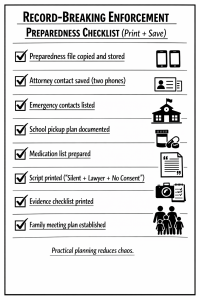
Graphic concept title: “Record-Breaking Enforcement Preparedness Checklist (Print + Save)”
Black-and-white, checkbox format (one page):
-
Preparedness File copied and stored
-
attorney contact saved (two phones)
-
emergency contacts listed
-
school pickup plan documented
-
medication list prepared
-
script printed (“silent + lawyer + no consent”)
-
evidence checklist printed
-
family meeting plan established
Caption: “Practical planning reduces chaos.”
FAQ
1) What does DHS mean by “record-breaking immigration enforcement”?
DHS is signaling increased enforcement volume across arrests, detention, removals, and compliance actions. DHS’s public statement is here: DHS press release.
2) Does “record-breaking enforcement” mean everyone will be deported?
No. Deportation is a specific outcome. Many people experience enforcement through arrest, detention, and paperwork-driven disruption long before removal occurs.
3) Can ICE arrest someone with no criminal record?
Yes. ICE can arrest based on civil immigration grounds. The key legal issue is removability, not criminal conviction status.
4) Can U.S. citizens be detained by immigration agents?
In documented cases, yes. See: ProPublica investigation.
5) How many people died in ICE custody in 2025?
Major outlets reported at least 30 deaths in ICE custody in 2025, described as a two-decade high. See: Reuters.
6) Where can I verify deaths in ICE custody for prior years like 2024, 2023, and 2022?
ICE maintains an official archive here: ICE Detainee Death Reporting.
7) What should I do if ICE approaches me in public?
Ask if you are free to leave. If not, remain silent, request a lawyer, and refuse consent to searches or signing.
8) What should I do if ICE comes to my home?
Do not open the door. Do not consent to entry. Ask for a warrant signed by a judge.
9) What documents should families keep in a preparedness file?
IDs, immigration paperwork, court notices, attorney contact information, emergency contacts, proof of residence, and medical/medication lists.
10) What is the House Immigration Enforcement Dashboard?
It is a House Oversight Democrats tool tracking alleged incidents of abuse and misconduct during federal immigration operations: Dashboard.
11) What did Senator Blumenthal report about DHS and U.S. citizens?
His report describes alleged assaults and unlawful detentions involving U.S. citizens, including veterans: Report page.
12) Did ICE enforcement actions involve shootings?
Major outlet reporting documents fatal shootings linked to ICE operations. Examples include Reuters reporting here: Chicago-area shooting.
13) What does taxpayer spending have to do with “record enforcement”?
Budgets expand capacity: detention beds, staff, transport, operations, and procurement. The Biden-era baseline was roughly $9–$10B, while Trump 2 enforcement funding is described as adding a large multi-year mandatory buildout. See: ICE FY2024 Annual Report, American Immigration Council, and Brennan Center.
14) What evidence matters most if something goes wrong?
Video, timestamps, witnesses, badge/vehicle identifiers, and medical records are the strongest early evidence.
15) When should I contact an immigration lawyer?
Contact a lawyer immediately if there is detention risk, a prior order, missed court, pending case vulnerability, or a family emergency planning need.
What This Means Going Forward
DHS “record-breaking year” messaging should be treated as a real enforcement environment shift, not a slogan. In practice, it means more screening points, higher detention capacity, more workplace compliance pressure, and higher disruption risk for families and employers. It also means taxpayers should track measurable harm indicators — deaths in custody, wrongful detentions, and the accountability gap created when enforcement expands faster than oversight.
If your household or workplace has risk factors, early legal strategy prevents preventable mistakes. Schedule a consultation here: Book a consultation with Herman Legal Group.
For Journalists, Researchers, and Fact-Checkers: How to FOIA DHS/ICE, Pull Public Data, and Ask the Right Questions
DHS is publicly framing 2026 as a “record-breaking year” for immigration enforcement. When government agencies make record claims, the public record should also expand—especially when enforcement involves detention surges, wrongful U.S.-citizen detentions, deaths in custody, and use-of-force incidents.
This section explains how to verify enforcement claims and document operational facts using public records, FOIA, and targeted questions.
1) Where to Start: The “Fastest Public Records” Before FOIA
Before filing any FOIA request, reporters should first exhaust the most time-efficient open sources. This saves weeks and prevents duplicative requests.
A) DHS “Record-Breaking Year” statement (baseline claim)
B) House Oversight “Immigration Enforcement Dashboard” (incident library)
This is one of the best public starting points because it compiles a verified record of alleged incidents:
C) Senate report on alleged U.S.-citizen harm
D) ICE detainee death reporting archive (official custody-death baseline)
2) FOIA 101 for DHS/ICE Reporting (Fast, Practical, Repeatable)
FOIA is not just “send a request.” The best FOIAs are surgical and written to force a yes/no release decision.
Step 1 — Identify the component that actually holds the records
DHS is a “parent” agency; you usually need the right component:
-
ICE (enforcement + detention + ERO/HSI operations):
ICE FOIA -
DHS-wide FOIA guidance and process:
DHS: Steps to File a FOIA Request
DHS FOIA Handbook -
USCIS A-file / immigration benefit records:
USCIS FOIA / Privacy Act requests -
Cross-agency FOIA routing + processing times:
FOIA.gov agency entry (ICE)
Journalist tip: When you don’t know where a record lives, file two parallel FOIAs (ICE + DHS HQ) and use narrow date/location keywords.
Step 2 — Use the correct request type: FOIA vs. Privacy Act
-
FOIA is for agency records generally.
-
Privacy Act is for records about a specific person (often requires consent or proof of death / authorization).
If you’re reporting a death in custody, you may need both:
-
FOIA for policies, logs, contracts, staffing, oversight records
-
Privacy Act issues for medical details (often redacted)
Step 3 — Write your request like an investigator, not a journalist
Good FOIAs are structured around:
-
specific incident ID (if known)
-
a narrow timeframe (hours/days)
-
defined record categories
-
defined custodians (e.g., “ERO St. Paul Field Office”)
Avoid vague FOIAs like:
“all records relating to ICE misconduct”
Use narrow FOIAs like:
“all after-action reports, use-of-force reports, and radio dispatch logs from [time window] at [location].”
Step 4 — Always ask for the “metadata” too
Even if content is redacted, metadata creates accountability:
-
author
-
timestamps
-
distribution list
-
subject lines
-
file names
-
revision history
Step 5 — Demand rolling production
Add this line:
“Please provide records on a rolling basis as they become available.”
This prevents the agency from waiting to compile “everything” before releasing “anything.”
Step 6 — Ask for expedited processing (when lawful)
Expedite is not guaranteed, but for active enforcement surges it is often appropriate.
Use language like:
“This request concerns a matter of widespread and exceptional media interest involving potential questions about the government’s integrity affecting public confidence.”
3) The “Shooting / Use-of-Force” FOIA Package (Template)
If you are investigating an ICE shooting or a serious use-of-force incident, you want records in 8 buckets.
Copy/Paste FOIA Request Language (Use This Exact Structure)
Subject: FOIA Request – Use of Force / Officer-Involved Shooting – [City, State] – [Date]
Request:
Pursuant to the Freedom of Information Act, I request the following records regarding ICE enforcement activity occurring on [DATE] at or near [LOCATION] involving use of force and/or a firearm discharge:
-
Use-of-force documentation
-
use-of-force reports
-
firearm discharge reports
-
“less lethal” deployment reports
-
supervisory review memos
-
Body-worn camera and video
-
body-worn camera footage for all involved agents
-
dashboard camera footage (if applicable)
-
facility surveillance video for the area
-
any video preserved from third parties provided to ICE
-
Operational paperwork
-
operational plan (OPLAN) and briefing materials
-
mission tasking documents
-
risk assessment documents
-
arrest warrant packet (if any)
-
any administrative warrants (Form I-200 / I-205 if used)
-
Communications
-
radio logs
-
dispatch logs
-
text messages or chat messages on government systems
-
emails referencing the operation or incident within [TIME WINDOW]
-
Medical and emergency response
-
EMS call logs
-
injury documentation for agents and civilians (non-medical narrative portions)
-
hospital transport authorizations (non-medical narrative portions)
-
Chain of command
-
names/titles of approving supervisors
-
incident command structure for the operation
-
after-action report (AAR)
-
Policy references
-
ICE use-of-force policy
-
firearms policy
-
crowd-control guidance (if applicable)
-
pursuit/vehicle-interdiction guidance (if applicable)
-
Accountability outcomes
-
administrative investigation initiation documents
-
referral letters to DHS OIG, DOJ, or local prosecutors
-
disciplinary findings (if completed)
Format requested: Electronic.
Rolling production requested: Yes.
Expedited processing requested: Yes.
4) The “Detention Death” FOIA Package (Template)
Deaths in custody require a different record strategy: conditions, medical response, and oversight.
What to request (high-yield categories)
-
detention logs (movement logs, observation logs)
-
medical request logs (sick call requests)
-
incident reports and mortality review documentation
-
staffing rosters for the unit
-
contract performance documentation
-
facility inspection history and deficiency notices
Official baseline archive:
5) How to Access DHS/ICE Data Without Waiting for FOIA
A) FOIA.gov processing time benchmarks
Use this to report how long “simple vs complex” requests often take:
B) Public budget and program intent (what DHS says it funds)
Useful for taxpayer-cost reporting:
C) Congressional records, hearings, and oversight materials
6) The Questions Reporters Should Ask ICE/DHS (Copy/Paste)
These are written to produce verifiable answers, not slogans.
A) The “Authority and Legal Basis” questions
-
Was there a judge-signed warrant? If not, what legal authority was used?
-
Was the target operation based on a criminal warrant or civil administrative process?
-
Which component led the operation: ICE ERO, ICE HSI, or another federal unit?
-
Was a risk assessment completed before the operation? What risks were identified?
B) The “Operational Controls” questions
-
Who approved the operation, and what was the chain of command?
-
Were body-worn cameras used by all agents? If not, why not?
-
Were there written de-escalation protocols? Were they followed?
C) The “Use of Force / Shooting” questions
-
Did any agent discharge a firearm? How many rounds?
-
What does video show vs. what is alleged in agency statements?
-
Was the incident referred to DHS OIG, DOJ, or local prosecutors?
D) The “Civilian Exposure and Collateral Harm” questions
-
Were children present? Were civilians exposed to chemical agents or force?
-
How many people were detained who were not the intended target?
-
Were any U.S. citizens stopped, searched, or detained? What verification steps were used?
E) The “Detention Outcomes” questions
-
Where were detainees taken? Which facility?
-
How long were they held before counsel access?
-
Were medical screenings performed on intake?
F) The “Accountability and Transparency” questions
-
What documents exist: after-action report, incident report, supervisor memo?
-
Will DHS release the body camera footage, and under what timeline?
-
What corrective action will follow if policy violations occurred?
7) Evidence Checklist for Reporters Covering ICE Incidents (Field Protocol)
If an incident escalates, documentation discipline matters.
The eight evidence items that win cases and clarify facts
-
time-stamped video from a safe distance
-
exact location (address / intersection)
-
visible badge numbers and names
-
vehicle plate numbers and unit identifiers
-
independent witness contacts
-
EMS/medical documentation (same-day)
-
photos of injuries/property damage (same-day)
-
a written timeline within two hours (memory fades quickly)
Companies Doing Business with ICE
1) Master List / Hub Pages
2) State-Specific Vendor Lists (Receipts + Research Method)
3) “How to Verify” a Company Has an ICE Contract (Backlink Magnet)
4) Boycott + Corporate Accountability (Lawful, Evidence-Based)
-
HLG: Which Companies Are Facing Boycott for Role in Trump’s Immigration Enforcement?
-
HLG: How to Boycott ICE Contractors Legally (Without Getting Sued)
-
HLG: Directory of Companies That Distanced Themselves From ICE (2025–2026)
5) Company / Industry Accountability Spotlights (Optional Add-Ons)
6) Economic Impact + Worksite Enforcement Context
7) Enforcement + Ammunition / Supply Chain Angle (Minnesota-specific)
Resource Directory: ICE Enforcement Data + Accountability Trackers + “What To Do” Guides
A) Official Government Sources (Primary Records)
Use these for fact-checking enforcement claims, detention conditions, and custody deaths.
-
DHS “Record-Breaking Year” Statement (primary source)
-
ICE Detainee Death Reporting (official archive)
-
ICE FOIA Portal (for records requests)
-
DHS FOIA process + guidance
-
USCIS FOIA / Privacy Act (A-files and benefits records)
B) Oversight, Investigations, and Accountability Trackers (High-Citation Sources)
These are the “reporter-grade” sources that get cited in major stories.
-
House Oversight Immigration Enforcement Dashboard (incident tracker)
-
Senator Blumenthal’s “Our Values at Stake” Report (U.S.-citizen rights + DHS overreach)
-
Congressional access and oversight disputes (press-grade evidence of accountability friction)
-
Reuters: House Democrats sue over blocked access to ICE facilities
-
Washington Post: DHS tightens rules for congressional visits to ICE facilities
C) ICE Detention Conditions and Abuse Documentation (Civil Society + Investigations)
Useful for readers seeking conditions evidence, and for journalists building corroboration.
-
ACLU reporting on detention conditions
D) Deaths in ICE Custody (Year-Over-Year Reporting)
Use these for a strong “trendline” section in the pillar.
-
Reuters (2025 total described as 20-year high)
-
Guardian timeline / named accounting
E) Wrongful Detention of U.S. Citizens (Collateral Damage Tracking)
This is one of your highest-backlink-value pillars because it reframes risk beyond immigrants.
-
ProPublica investigation
-
HLG explainer + rights guidance
F) ICE Encounters: What To Say + What To Do
These are your highest-conversion, high-share, screenshot-friendly assets.
-
If ICE comes to your door
-
If ICE stops you in public (copy/paste script)
-
City/localized planning (Ohio-focused readiness content)
-
ICE arrests at USCIS interviews (real-world operational vulnerability)
G) ICE Militarization, Boycotts, and Corporate Pressure
-
Targeted boycott guide
-
Framing for broader audiences (constitutional/accountability lens)
H) Record Enforcement + Violent Confrontations / Shootings
For careful, high-trust sourcing on violent incident risks tied to enforcement operations.
-
Reuters: ICE officer kills man in Chicago suburb during arrest attempt
-
Reuters: Witness accounts complicate DHS narrative in fatal Chicago-area ICE shooting
-
Reuters: Trump’s showy immigration enforcement leads to violent confrontations
I) “Reporter Toolkit”: FOIA + DHS Data + Questions to Ask ICE (Start Here)
If you want one anchor link cluster for journalists, keep it tight:
-
File records requests
-
Verify deaths and detention outcomes
-
Track allegations and oversight