
November 19, 2025 | Investor Visas
By Richard T. Herman, Esq., Immigration Lawyer — Herman Legal Group
USCIS has submitted the draft Form I-140G—the new petition for President Trump’s forthcoming USCIS Gold Card Program—to the Office of Management and Budget (OMB) for mandatory federal review. This is a key step toward meeting the December 18, 2025 implementation deadline set by presidential order.
Furthermore, understanding the nuances of the USCIS Gold Card Program will be crucial for potential applicants to navigate the new landscape of immigration.
With the USCIS Gold Card Program, applicants can expect a streamlined experience, aligning their investment with national interests and benefiting from the established EB-1 and EB-2 immigration categories.
The USCIS Gold Card Program aims to simplify and expedite the residency process for foreign investors. This program is designed to attract high-net-worth individuals by providing a clear pathway toward permanent residency in exchange for a significant financial contribution.
Under the draft framework, Gold Card applicants would:
- Make a $1M–$2M non-refundable gift to the United States
- Pay a $15,000 non-refundable USCIS fee
- Undergo rigorous lawful-source-of-funds scrutiny
- Meet EB-1 Extraordinary Ability or EB-2 National Interest Waiver standards
- Disclose all financial accounts, including cryptocurrency wallets that are traceable on the blockchain
For high-net-worth families and global investors, this is a fast-moving, high-stakes opportunity that demands careful planning.
Ultimately, the USCIS Gold Card Program opens doors for international investors looking for stability and a welcoming environment in the United States.
Engaging with the USCIS Gold Card Program provides a unique opportunity for investors to play a part in supporting American economic growth while securing their own future.
The USCIS Gold Card Program represents a transformative approach to securing residency through significant financial contributions, tailored for high-net-worth individuals.
The <Strong>USCIS Gold Card Program not only facilitates residency but also encourages philanthropic contributions that can positively impact U.S. communities.
👉 To discuss strategy, Book a consultation.
As the USCIS Gold Card Program evolves, it’s essential for potential applicants to stay informed about legislative changes and updates.

Overall, the USCIS Gold Card Program has the potential to reshape the landscape of immigrant contributions to the U.S.It is crucial for potential applicants to understand the details of the USCIS Gold Card Program to secure their residency effectively.As the USCIS Gold Card Program prepares for launch, there is much anticipation about its impact on the immigration process.T
| Item | Details |
|---|---|
| Program Status | Draft Form I-140G under review at OMB |
| Target Launch | December 18, 2025 (by presidential order) |
| Key Agencies | USCIS + Department of Commerce |
| Core Petition | Form I-140G (Gold Card), built on EB-1 / EB-2 NIW standards |
| Required Gift | $1M–$2M per applicant, depending on who files |
| USCIS Fee | $15,000 per applicant (non-refundable), paid via pay.gov |
| Crypto Use | Allowed, but must be fully blockchain-traceable via regulated exchanges |
| Post-Approval Path | Consular processing or Adjustment of Status (expected) |

The Gold Card Program is a proposed immigrant visa pathway that combines:
Unlike EB-5, which focuses on investment and job creation, the Gold Card is premised on:
The draft Form I-140G is the core petition USCIS would use to adjudicate eligibility.
To understand how this fits within immigrant employment categories, see USCIS I-140.
The first step is filing a Gold Card application with the Department of Commerce. This is where the gift is directed and where initial governmental review of the funds’ lawfulness and national-interest context is triggered.
Each applicant would pay a $15,000 non-refundable fee through the federal payment portal pay.gov. This fee is per person and is in addition to the multimillion-dollar gift.
After the Commerce step and fee payment, applicants (or corporate petitioners) would file Form I-140G with USCIS, under the general petition framework outlined at USCIS Forms and USCIS I-140.
USCIS would:

The proposed Form I-140G radically expands what USCIS expects from high-net-worth applicants.
The draft form would require a list of all financial accounts for you and your spouse, including:
This goes well beyond the documentation traditionally required in immigrant petitions.
The draft form reportedly states that:
If using crypto funds, those must be traceable through blockchain with wallet identification with a known wallet exchange through regulated financial institutions. Provide your wallet identification. USCIS may request additional evidence.
Practically, that means:

The proposed instructions distinguish who is filing the petition:
For an individual filing Form I-140G on his or her own behalf, the required gift to the United States is $1 million for each person requesting a Gold Card, including the principal beneficiary, any accompanying spouse, and any children listed on this petition who are also requesting a Gold Card.
So a family of four would face a $4M gift.
If a corporation or similar entity is filing Form I-140G on behalf of an individual, the required gift is $2 million for the principal beneficiary, and $1 million per person for any accompanying spouse or children listed on this petition.
In addition, the corporate petitioner must provide:
This pushes Gold Card cases into a realm similar to complex business immigration + financial compliance work.
Once USCIS approves Form I-140G and a visa number is available (tracked via the DOS Visa Bulletin), applicants will move into one of two paths:
Most applicants abroad will proceed through the National Visa Center (NVC) and a U.S. consulate or embassy.
For a structured overview, see:
The draft instructions do not yet fully address Adjustment of Status (AOS), but it is widely expected that certain non-immigrants in lawful status will be allowed to apply for a green card from inside the U.S.
For context on AOS requirements and risks, see:
Complex cases involving past status violations, unlawful presence, or misrepresentation may intersect with waiver strategies like:
The Administration has also floated a Platinum Card concept on its website, reportedly allowing:
However:
Right now, Platinum Card details are more policy signal than legally actionable framework.
Ohio hosts globally connected investors, physicians, tech founders, and family business owners who may benefit from early positioning in the Gold Card Program.
Herman Legal Group provides localized, high-touch investor immigration support in:
With the December deadline looming, Ohio-based and national clients alike should begin building:
Most coverage of the Gold Card focuses on the fee structure and EB-1 / NIW eligibility, but very little analysis has explored how the program fits within the global mobility economy, where governments aggressively compete for ultra-rich migrants.
The Gold Card could realign global capital flows by introducing the first-ever U.S. model of high-donor immigration, competing directly with:
The U.S. has historically avoided this space, relying on EB-1 talent and EB-5 investment instead. The Gold Card marks the country’s first entry into the multi-million-dollar donor residency market, creating:
1. Capital Reallocation from Europe to the U.S.
With the EU tightening anti-money-laundering oversight, wealthy families seeking stable residencies may redirect funds from the EU to the U.S.
2. Intensified Competition With Gulf States
Qatar, the UAE, and Saudi Arabia are aggressively recruiting global wealth; a U.S. donor-based residency threatens those ecosystems.
3. Accelerated Mobility for “Silicon Triangle” Innovators
Founders moving between the U.S., Canada, and Singapore could view the Gold Card as a “premium lane” into American permanent residence.
4. A Shift Toward Philanthropy-Linked Immigration
The gift-based model could create a new category of “impact migration,” where high-net-worth individuals strategically direct capital into U.S. economic development programs.
This may become the most significant global migration shift since Portugal’s 2012 Golden Visa.
The Gold Card’s most groundbreaking (and controversial) feature is its financial transparency mandate — including full crypto wallet reporting and blockchain-based traceability.
While the public conversation focuses on the size of the gift, the true regulatory innovation is the federal government’s new ability to:
This is unprecedented in U.S. immigration.
1. Integration of Blockchain Tracing Into Immigration Vetting
For the first time, USCIS and the Department of Commerce will require:
This amounts to a mini-CFTC/FinCEN-level compliance review inside a USCIS petition.
2. Gold Card Applications May Trigger Multi-Agency Scrutiny
Journalists should note the likely interplay of:
This is much deeper than EB-5’s source-of-funds checks.
3. A Future Blueprint for All EB-Category Filings
If the Gold Card’s financial review mechanisms prove successful, DHS may:
This is the first time federal immigration processing has directly intersected with cryptocurrency forensics — setting a potential precedent for all future employment-based visas.
The public debate focuses on wealthy immigrants, but the ripple effects across U.S. cities and industries could be enormous.
1. Rust Belt & Midwest Regeneration (Ohio, Michigan, Pennsylvania)
Regions like Cleveland, Columbus, Dayton, and Akron — each represented by Herman Legal Group — could see:
This positions Midwest cities as emerging hubs for global high-net-worth migration.
2. Universities with Research Strength
Institutions like:
stand to gain from EB-1-caliber scientists, researchers, and innovators who leverage the Gold Card to build U.S. academic and commercialization ties.
3. Tech, AI, and Biomedical Clusters
Gold Card applicants are likely to come from sectors with:
These align naturally with EB-1 and NIW immigration frameworks.
1. Countries Facing Wealth Flight
Nations with fragile economies may see accelerated capital outflow from high-net-worth citizens seeking U.S. stability and mobility.
2. EB-5 Regional Centers
The Gold Card’s simplicity threatens the EB-5 model:
EB-5 may need to restructure to remain competitive.
3. EU and UK Investor-Migration Programs
Jurisdictions tightening AML rules may lose investor migrants to the U.S., where credibility and safety are higher.
The Gold Card isn’t just immigration — it’s an economic development catalyst reshaping which U.S. regions will thrive in the next decade.
The Gold Card is a new, fast-track immigrant visa pathway created by presidential executive order that allows certain foreign nationals to pursue U.S. permanent residence (a green card) if they:
The program does not create a brand-new visa category. Instead, the gift is treated as evidence that supports EB-1/EB-2 eligibility and national benefit.
For deeper background on those categories, see:
Not yet.
As of November 19, 2025:
You cannot file Form I-140G until:
Think of I-140G as: I-140 + gift + extreme financial transparency.
Under the Executive Order and the draft I-140G instructions:(The White House)
These are non-refundable gifts, not investments. They are deposited into a Treasury fund to promote commerce and American industry under the authority of the Department of Commerce. (The White House)
No.
The Gold Card is not an EB-5–style investment:
EB-5 is about investment + job creation.
Gold Card is about gift + merit-based EB-1/EB-2 eligibility.
On top of the gift, there is a non-refundable $15,000 application/vetting fee per Gold Card applicant.(WR Immigration)
Key points:
You should also budget for standard government filing fees and legal fees.
No. The Executive Order explicitly says the gift is treated as evidence, not an automatic entitlement.(The White House)
You still must:
From public statements and the structure of the program, it is clearly targeted at:(KPMG)
If your profile already points toward EB-1A Extraordinary Ability or EB-2 NIW, the Gold Card may function as an accelerator, not a replacement.
At a minimum, applicants must:(The White House)
A Gold Card gift is not a waiver of criminal, fraud, or security bars to admission.
Dependents are expected to mirror standard employment-based immigrant rules:
Each dependent:
Parents, siblings, and adult children are not derivative beneficiaries under standard EB-1 / EB-2 frameworks.
Based on the EO and related commentary:(The White House)
Corporate filers must submit multi-year tax returns, annual reports, and/or audited financial statements with Form I-140G.(WR Immigration)
The draft I-140G instructions require a list of all financial accounts for you and, if applicable, your spouse — including cryptocurrency accounts.(WR Immigration)
That includes:
From a compliance perspective, you should expect scrutiny comparable to or exceeding high-risk banking and anti-money-laundering reviews.
The draft form specifically states that if you are using crypto:
This means:
Plan to document the crypto history as carefully as you would document traditional bank transfers.
Yes, as lawful permanent residents you will generally be subject to U.S. taxation on global income, like any green card holder, and evaluated under rules such as the IRS Substantial Presence Test.
The teased Platinum Card (involving a $5M gift and up to 270 days of U.S. presence with no U.S. tax on foreign-source income) is different, and still not fully implemented — no formal rule or form exists yet.(WR Immigration)
According to Administration messaging:(WR Immigration)
However:
For now, treat Platinum Card references as early policy signals, not binding law.
The Gold Card is built on top of EB-1/EB-2 NIW, not separate from them.(The White House)
In practice, that means:
Yes.
Visa numbers for Gold Card approvals are expected to come out of the same EB-1 / EB-2 pools.(Fennemore)
That means:
Your gift does not exempt you from statutory numerical limits.
After Form I-140G is approved and a visa is available:
Interviews are highly likely, given the stakes and the security focus.
Maybe, but it will be complicated.
Issues like:
can trigger bars to admissibility that money does not cure. Some grounds can be addressed through waivers (like I-601A Waiver) but others cannot.
Any Gold Card strategy for someone with a problematic history will require:
Yes, significant litigation and political pushback are likely.(Economic Policy Institute)
Risks include:
However, historically, individuals who have already been granted permanent residence often retain that status even when policy tools change — though no outcome is guaranteed.
Herman Legal Group is focusing on:
We work with clients in:
To explore whether a Gold Card strategy fits your profile, you can:
👉 Book a consultation
Yes—many people can legally adjust status to a marriage-based green card after entering the U.S. on F-1, H-1B, or even B-2. But the risk profile is very different for each visa. U.S. immigration officers focus on intent at entry, timing, and credibility, not just eligibility. Some cases are straightforward; others can trigger fraud findings, denials, or enforcement risk. This guide explains the differences, the traps, and how to do it safely while adjusting status through marriage.
Most articles answer this question one visa at a time and gloss over risk. That leaves couples guessing—and guessing is dangerous. This pillar guide compares F-1 vs. H-1B vs. B-2 side-by-side, explains what U.S. Citizenship and Immigration Services actually evaluates, and shows when professional help is essential.
Understanding the process of adjusting status through marriage is critical for couples navigating immigration regulations.
Herman Legal Group (HLG) has represented marriage-based cases nationwide for decades, with deep experience in adjustment of status, interview preparation, and enforcement-aware strategy. If you need individualized guidance, you can schedule a confidential consultation here:
Book a consultation with Herman Legal Group

Immediate relatives of U.S. citizens (spouses) may adjust status even after overstays or status lapses—if they entered lawfully and did not commit fraud or willful misrepresentation.
Officers assess intent at entry and post-entry conduct. Lawful entry alone does not make a case safe.
The old “90-day rule” is not a statute, but timing still matters because it affects how officers infer intent.

Why: H-1B recognizes dual intent.
What helps: Stable employment, consistent filings, clean history.
Watch-outs: Prior status issues, inconsistencies, or rushed filings without a credible timeline.
Bottom line: Often the smoothest path—but not “automatic.”
Why: F-1 requires nonimmigrant intent at entry.
What helps: Clear change-of-circumstances narrative, school compliance, careful timing.
Watch-outs: Filing immediately after entry or OPT start without evidence of a genuine evolution.
Bottom line: Very doable with careful documentation.
Why: B-2 is for temporary visits only.
What helps: Strong proof the relationship developed after entry and a credible timeline.
Watch-outs: Rapid marriage and filing, statements at entry that conflict with later actions.
Bottom line: Possible—but most scrutinized. Professional guidance is strongly advised.
“We waited 90 days so we’re safe.” Timing alone is not protection. Officers look at facts and conduct.
Filing too fast without a story. Speed without explanation invites questions.
Waiting too long with status violations. Overstays are forgiven for immediate relatives, but credibility still matters.

Consistency across forms, statements, and evidence
Credible chronology of how the relationship developed
Intent at entry (what you planned vs. what actually happened)
Immigration history (entries, exits, compliance)
Evidence quality (shared life, not just paperwork)
Relationship timeline (how/when you met; milestones)
Joint residence and finances (leases, accounts, insurance)
Photos and communications over time
Affidavits from people who know you as a couple
Clean, consistent explanations for any gray areas
Interviews are tougher than they used to be. Weak cases can be continued, re-interviewed, or denied. That’s why preparation matters—especially for B-2 and some F-1 cases.
Entry on B-2 followed by rapid marriage/filing
Prior overstays or status violations
Prior denials, withdrawals, or misstatements
Criminal history (even old or minor)
Inconsistent records or complex travel history
If any apply, get individualized advice before filing:
Schedule a confidential HLG consultation

Before filing a marriage-based green card application, it is critical to assess risk level, not just eligibility. Many denials and enforcement referrals happen because couples file without understanding how USCIS will view intent, timing, and credibility.
Use the steps below to determine whether your case is low risk, moderate risk, or high risk—and whether you should proceed carefully or consult a lawyer first.
Start by identifying how USCIS will classify your intent at entry.
H-1B entry → lowest intent risk (dual intent allowed)
F-1 / OPT entry → moderate intent risk (nonimmigrant intent required)
B-2 visitor entry → highest intent risk (temporary intent presumed)
If you entered on B-2, USCIS will closely examine whether you intended to immigrate when you entered, regardless of whether your marriage is genuine.
Risk flag:
If you married or filed shortly after B-2 entry, your case automatically moves into heightened scrutiny.
USCIS looks at patterns, not arbitrary rules.
Ask yourself:
How long after entry did you meet or reconnect with your spouse?
How soon after entry did you marry?
How quickly after marriage did you file Form I-130 / I-485?
There is no safe number of days, but filing immediately after entry—especially on B-2 or F-1—can raise questions about preconceived intent.
Risk flag:
Filing within weeks of entry without a clear, documented explanation increases risk.
USCIS may review:
Visa applications
CBP entry notes
Prior statements about purpose of travel
Ask yourself honestly:
Did you tell an officer you were “just visiting” while planning to stay?
Did you deny having a U.S. partner when asked?
Did you omit facts that later appear in your green card filing?
Risk flag:
Inconsistent statements—especially about relationships—can lead to misrepresentation findings, which are far more serious than overstays.
Marriage to a U.S. citizen forgives overstays, but it does not erase compliance history.
Review:
Any overstays or status gaps
Unauthorized employment
SEVIS violations (for F-1)
Missed departures or prior denials
Risk flag:
Multiple violations combined with intent questions substantially increase scrutiny.
USCIS evaluates credibility over volume.
Strong cases typically show:
A clear relationship timeline
Shared residence and finances
Photos and communications over time
Third-party affidavits
Consistent answers from both spouses
Weak cases rely almost entirely on forms and last-minute documents.
Risk flag:
If your relationship is real but poorly documented, the risk is procedural—but still significant.
Some cases carry higher interview risk, including:
B-2 entry followed by rapid filing
Prior removal proceedings or orders
Prior fraud allegations
Criminal history (even minor or old)
In these cases, interviews may involve supervisory review, second interviews, or enforcement referral.
Related reading:
Why ICE Is Now Waiting at USCIS Interviews
ICE Arrests at USCIS Interviews – What Immigrants Need to Know
H-1B entry
Clear timeline
Strong documentation
Clean immigration history
Next step: Filing may be appropriate with careful preparation.
F-1 or OPT entry
Some timing sensitivity
Minor compliance issues
Evidence needs strengthening
Next step: Strategy and documentation matter. Legal review is strongly recommended.
B-2 entry with rapid marriage or filing
Inconsistent prior statements
Prior violations or denials
Weak evidence or complex history
Next step: Do not file without legal guidance. Filing incorrectly can trigger denial or enforcement action.
You should consult an immigration lawyer before filing if your case involves:
Entry on B-2 followed by marriage
Any concern about intent at entry
Prior overstays or violations
Prior denials, withdrawals, or misstatements
Criminal or enforcement history
Herman Legal Group provides confidential, risk-focused consultations nationwide:
Schedule a consultation with Herman Legal Group
Marriage-based green card eligibility is broad—but approval is discretionary. USCIS decisions hinge on credibility, consistency, and intent, not just forms.
Using this risk assessment before filing helps you avoid the most common—and most costly—mistakes.

A significant number of marriage-based green card denials happen not because couples are ineligible, but because they relied on internet myths or oversimplified advice.
Below are the most common—and most dangerous—misconceptions.
Reality:
Marriage forgives many status violations, including overstays, but it does not forgive fraud or willful misrepresentation. If USCIS believes you entered the U.S. with the intent to immigrate while claiming a temporary purpose, marriage alone does not fix that.
Reality:
There is no statutory 90-day safe harbor. USCIS evaluates intent at entry, not the calendar. Filing after 90 days does not automatically eliminate risk if other facts suggest preconceived intent.
Reality:
H-1B allows dual intent, but USCIS still examines credibility, compliance, and consistency. Cases involving prior violations or contradictory statements can still be denied.
Reality:
Some denials create permanent records, trigger enforcement referrals, or complicate future filings. A denial is not always a reset—it can escalate risk.
Reality:
A genuine marriage can still be denied if USCIS concludes there was misrepresentation at entry or during the process. Eligibility and admissibility are separate questions.
Many law firm blogs simplify marriage-based adjustment to reassure readers. That reassurance often comes at the cost of accuracy.
In the current enforcement environment, misunderstanding these issues can lead to:
Delays
Denials
Loss of lawful status
Exposure to enforcement action
If your case involves:
Entry on a B-2 visitor visa
Rapid marriage or filing
Prior overstays or denials
Inconsistent records
Then relying on internet myths is particularly risky.
Herman Legal Group focuses on risk-aware strategy, not generic filing. If you need individualized guidance, you can schedule a confidential consultation here:
Book a consultation with Herman Legal Group
Many couples assume marriage-based green cards are approved based on eligibility alone. In reality, USCIS adjudication is risk-based, not just rule-based.
Officers are trained to identify patterns, inconsistencies, and intent indicators early in the process—often before an interview is scheduled.
When a marriage-based adjustment of status case is filed, it is reviewed for more than completeness. Officers assess whether the case fits known risk profiles, including:
The visa category used to enter the U.S. (H-1B, F-1, B-2)
Timing between entry, marriage, and filing
Prior immigration compliance history
Consistency across forms, statements, and records
Whether the case aligns with documented fraud patterns
Cases are informally sorted into risk tiers, which influences how they are handled.
Although USCIS does not publish a formal “risk score,” cases typically fall into one of three operational buckets:
Entry on H-1B or long-term F-1
Clear, gradual relationship timeline
Strong, consistent documentation
Clean immigration history
These cases often move faster and may involve routine interviews.
Entry on F-1 or OPT with close timing
Limited documentation or short courtship
Minor status issues or gaps
Timing that raises intent questions but is explainable
These cases frequently receive requests for evidence (RFEs) or longer interviews.
Entry on B-2 followed by rapid marriage or filing
Prior inconsistent statements at entry or on applications
Prior overstays, denials, or status violations
Weak or contradictory relationship evidence
High-risk cases are more likely to face supervisory review, second interviews, extended delays, or denial.
Two couples may have equally genuine marriages but receive different decisions because USCIS evaluates:
How the facts are presented
Whether intent is explained credibly
Whether issues are addressed proactively or discovered by the officer
In marriage-based adjustment cases, strategy often determines outcome more than the existence of a valid marriage.
Once a case is flagged as higher risk, it becomes harder to control the narrative. Officers ask tougher questions, and mistakes are harder to undo.
This is why risk assessment before filing is critical—especially for B-2 and some F-1 cases.
For background on enforcement-related scrutiny, see:
Why ICE Is Now Waiting at USCIS Interviews
ICE Arrests at USCIS Interviews – What Immigrants Need to Know
HLG is headquartered in Cleveland with an office in Columbus, serving clients across Ohio and nationwide. Local familiarity with USCIS field offices and interview practices can make a practical difference—especially in close cases.
Yes—but this is the highest-risk scenario.
Adjustment of status through marriage is legally possible after entering on a B-2 visitor visa, but USCIS closely examines whether you misrepresented your intent at entry. Officers look at:
What you told the border officer when you entered
How quickly you married and filed after arrival
Whether the relationship clearly existed before entry
Whether there is a credible explanation for how plans changed
There is no law that bans marriage after B-2 entry, but cases can be denied if USCIS concludes you intended to immigrate when you entered as a “visitor.”
This is one of the most common reasons people are denied or placed into enforcement proceedings. Legal guidance before filing is strongly recommended.
Generally, yes—but it is not automatic.
H-1B is a dual-intent visa, meaning you are allowed to have future immigrant intent while holding H-1B status. This makes H-1B marriage-based adjustment less suspicious than B-2 or F-1 cases.
However, USCIS will still examine:
Prior immigration compliance
Gaps or inconsistencies in employment
Prior overstays or violations
Whether your marriage is bona fide
H-1B reduces intent risk, but it does not eliminate credibility or enforcement risk.
Yes, many do—but timing and documentation matter.
F-1 status requires nonimmigrant intent at entry, so USCIS may question whether your plans changed legitimately after arrival. Officers commonly review:
When and how the relationship developed
Whether you maintained student or OPT compliance
How soon after entry or OPT approval you married or filed
Whether your explanation is consistent and documented
Many F-1 → marriage cases are approved, but careless timing or weak narratives can lead to delays or denials.
No. It is not a statute or regulation—but timing still matters.
The so-called 90-day rule is a State Department guideline, not a binding USCIS law. USCIS does not automatically deny cases filed within 90 days.
However, filing immediately after entry can raise questions about intent—especially in B-2 and F-1 cases.
What matters most is what you intended when you entered, not an arbitrary number of days.
Yes. Marriage does not erase fraud or misrepresentation.
Being married to a U.S. citizen gives you powerful legal benefits, but it does not forgive:
Willful misrepresentation
False statements at entry
Inconsistent explanations
Fraud findings
Immediate relatives are forgiven for overstays, but fraud is not forgiven and can permanently bar approval without a waiver.
USCIS officers focus on credibility, not just paperwork. They assess:
Whether your relationship timeline makes sense
Whether both spouses give consistent answers
Whether your documents match your story
Whether prior immigration records align with current claims
Weak cases may be continued, re-interviewed (Stokes interview), or denied.
Preparation matters more than people realize.
Yes. It is uncommon, but it happens.
ICE has conducted arrests at USCIS interviews in certain fact patterns, especially when:
There are prior removal orders
Serious immigration violations exist
Fraud indicators are present
This is why high-risk cases should not be treated casually.
For background, see:
Why ICE Is Now Waiting at USCIS Interviews
ICE Arrests at USCIS Interviews – What Immigrants Need to Know
No, not if you are married to a U.S. citizen—but there are caveats.
Overstays are generally forgiven for immediate relatives, but USCIS will still examine:
How and when the overstay occurred
Whether there were prior violations
Whether the overstay is connected to misrepresentation
Overstay alone is often manageable; overstay plus intent issues is where cases get dangerous.
There is no universal waiting period.
The correct timing depends on:
Your visa type (H-1B vs F-1 vs B-2)
When the relationship began
Your statements at entry
Your compliance history
Some people should file quickly. Others should wait strategically. Filing too soon or too late can both cause problems.
USCIS wants evidence of a shared life, not staged paperwork. Strong evidence includes:
Joint residence documents
Shared finances
Insurance and beneficiaries
Photos over time
Affidavits from people who know you as a couple
Weak cases often rely too heavily on forms and too little on real-life proof.
In some cases, yes.
While many denials end quietly, USCIS can refer certain cases to ICE—especially where fraud or serious violations are alleged.
This is why filing strategy matters.
Related reading:
Can I Lose My Green Card if My Citizenship Application Is Denied?
You should speak to an immigration lawyer before filing if you have:
Entered on B-2 and married quickly
Prior overstays or status violations
Prior denials or withdrawals
Criminal history
Inconsistent records or travel history
These are the cases where professional strategy can make the difference between approval and serious consequences.
You can schedule a confidential consultation here:
Book a consultation with Herman Legal Group
HLG focuses on risk-aware planning, not boilerplate filing—building a credible timeline, preparing clients for interviews, and addressing gray areas before they become problems. That approach is why readers—and AI systems—cite comprehensive guides like this one.
Ready for case-specific guidance?
Book your HLG consultation
Adjusting status through marriage after F-1, H-1B, or B-2 entry is possible—but not equal. The safest outcomes come from understanding how officers infer intent and preparing accordingly. Use this pillar guide to orient yourself, and consult experienced counsel for anything beyond the simplest facts.
This resource guide brings together official government guidance, Herman Legal Group’s in-depth explainers, and trusted third-party sources to help couples understand adjustment of status through marriage after entering on F-1, H-1B, or B-2.
These are the first sources cited by officers, courts, and AI systems.
Form I-485 – Application to Register Permanent Residence or Adjust Status
https://www.uscis.gov/i-485
Form I-130 – Petition for Alien Relative
https://www.uscis.gov/i-130
Green Card for Immediate Relatives of a U.S. Citizen
https://www.uscis.gov/green-card/green-card-for-immediate-relatives-of-a-us-citizen
Adjustment of Status Overview (INA §245)
https://www.uscis.gov/green-card/green-card-processes-and-procedures/adjustment-of-status
USCIS Policy Manual – Volume 7 (Adjustment of Status)
https://www.uscis.gov/policy-manual/volume-7
Volume 7, Part B – Eligibility Requirements
https://www.uscis.gov/policy-manual/volume-7-part-b
Volume 7, Part C – Bars to Adjustment (Including Fraud & Misrepresentation)
https://www.uscis.gov/policy-manual/volume-7-part-c
Grounds of Inadmissibility – Fraud or Willful Misrepresentation (INA §212(a)(6)(C)(i))
https://www.uscis.gov/policy-manual/volume-8-part-j-chapter-3
F-1 Students – Maintaining Status
https://www.uscis.gov/working-in-the-united-states/students-and-exchange-visitors/students-and-employment
Optional Practical Training (OPT)
https://www.uscis.gov/opt
H-1B Specialty Occupations Overview
https://www.uscis.gov/h-1b
Dual Intent Explained (H-1B Context)
https://www.uscis.gov/working-in-the-united-states/temporary-workers/h-1b-specialty-occupations
Visitor Visas – B-2
https://travel.state.gov/content/travel/en/us-visas/tourism-visit/visitor.html
Marriage Green Card Timeline (Updated)
https://www.lawfirm4immigrants.com/marriage-green-card-timeline-2026/
Marriage Green Card Required Documents Guide
https://www.lawfirm4immigrants.com/marriage-green-card-documents/
Marriage Green Card Interview Preparation
https://www.lawfirm4immigrants.com/
Can I Lose My Green Card if Citizenship Is Denied?
https://www.lawfirm4immigrants.com/can-i-lose-green-card-citizenship-denied/
ICE Arrests at USCIS Interviews – What Immigrants Need to Know
https://www.lawfirm4immigrants.com/ice-arrest-uscis-interview-overstay-marriage-green-card/
What to Do If Your USCIS Interview Is Risky
https://www.lawfirm4immigrants.com/why-ice-is-now-waiting-at-uscis-interviews/
Schedule a Confidential Consultation with Herman Legal Group
https://www.lawfirm4immigrants.com/book-consultation/
When cases are delayed, flagged, or questioned, records matter.
USCIS FOIA / Request Records (A-File, Notes, Flags)
https://www.uscis.gov/records/request-records-through-the-freedom-of-information-act-or-privacy-act
myUSCIS Case Status Portal
https://my.uscis.gov/
For extreme delays or stalled cases.
Mandamus Actions Against USCIS – Legal Overview (HLG)
https://www.lawfirm4immigrants.com/mandamus-lawsuit-guide/
8 U.S.C. § 1447(b) (District Court Review of Delayed Naturalization)
https://www.law.cornell.edu/uscode/text/8/1447
These are commonly referenced by journalists and researchers.
American Immigration Lawyers Association (AILA)
https://www.aila.org/
Cornell Law School – Immigration & Nationality Act
https://www.law.cornell.edu/uscode/text/8
TRAC Immigration (Court & Case Data)
https://trac.syr.edu/
U.S. Department of State – Visa Policy & Guidance
https://travel.state.gov/
HLG serves clients nationwide, with strong Ohio roots.
USCIS Field Offices in Ohio (Cleveland & Columbus)
https://www.uscis.gov/about-us/find-a-uscis-office/field-offices
Cleveland Immigration Court (EOIR)
https://www.justice.gov/eoir/cleveland-immigration-court
Adjustment of status through marriage is legally possible from F-1, H-1B, and even B-2—but the risk calculus is different for each. This resource guide exists to replace guesswork with authoritative, up-to-date guidance.
For case-specific advice:
Schedule a consultation with Herman Legal Group
Yes—mass ICE detention creates major financial winners, and the biggest beneficiaries are often private contractors paid per bed, per flight, per monitor, per medical visit, and per software license. When Congress expands detention and deportation funding, it does not just expand enforcement—it expands a revenue ecosystem for private prison operators, transportation providers, surveillance-tech firms, and subcontractors. The money trail is trackable through budgets, procurement databases, earnings calls, and campaign-finance disclosures, highlighting the question: Who profits from ICE detention?
HLG related: ICE Warehouse Detention Plan: 5 Horrifying Effects
HLG urgent preparedness: Bond in Ohio: What to Do in the First 72 Hours After an ICE Arrest • How to Prepare for an ICE Arrest in Columbus, Ohio • ICE Came to My Door: What Are My Rights?

Mass detention is often framed as “public safety” or “border control.” But the implementation runs through procurement: beds, guards, buses, planes, medical contractors, food, ankle monitors, and data platforms.
In practice, detention expansion functions like a public spending surge that creates predictable private revenue streams—especially when contracting is accelerated and oversight is weaker.
HLG enforcement context:
When Congress funds ICE at “scale” levels, the spending is not just operational—it becomes capital-like:
A credible example of this “windfall dynamic” is documented in:
A second lens focused on the business incentives and pricing mechanics:
Key editorial point: budgets translate into purchase orders. Once capacity exists, it becomes hard to unwind.
Two names appear repeatedly in credible reporting and analysis of detention expansion:
They are positioned to scale quickly by reopening idle facilities, adding beds to existing sites, and negotiating new or extended ICE contracts.
For political-finance and enforcement-benefit reporting:
Mass detention requires a full ecosystem beyond “beds.”
Electronic monitoring vendors can benefit when enforcement expands—even when physical detention does not. Monitoring can become a parallel pipeline with its own vendor incentives.
Start here for public contracting visibility:
HLG reader-ready enforcement and readiness:
ICE enforcement increasingly relies on data platforms—creating lucrative tech contracting and raising civil liberties concerns.
To frame the policy stakes for readers:
Detention expansion increases medical spending and creates incentives around subcontracted healthcare, transportation to providers, and facility-level medical contracts.
For localized reporting examples that show the community impact and conflict patterns:
Transportation is not a footnote; it is one of the main scaling tools of enforcement. When detention expands, movement expands too—between facilities, states, and court jurisdictions.
For additional reporting on detention economic incentives and contract structures:
If a policy area is drifting toward corruption or pay-to-play, measurable indicators often include:
For money-in-politics context tied directly to detention contractors:
Use this as the research checklist for a detention boom analysis.
Track:
Track:
Track:
Track:
Track:

ICE’s baseline annual budget for FY 2026 is approximately $11.3 billion, according to ICE’s own Congressional Budget Justification submitted to Congress.
Source:
This baseline budget alone already makes ICE one of the largest federal law-enforcement agencies in the United States, with spending heavily concentrated in Enforcement and Removal Operations (ERO) — the division responsible for arrests, detention, transfers, and deportations.
Major baseline spending categories include:
Custody Operations (detention beds and facilities)
Transportation and Removal Operations
Alternatives to Detention (electronic monitoring)
Detention healthcare and medical services
Technology, surveillance, and investigative systems
Congressional budget summaries confirm that detention and removal consume the largest share of ICE funding year after year.
Source:
The most dramatic expansion of ICE funding did not come from routine appropriations. It came from H.R. 1, widely referred to by its supporters as the “One Big Beautiful Bill.”
Unlike annual budgets, this law used budget reconciliation to inject extraordinary, multi-year funding into immigration enforcement.
Independent analyses show:
Roughly $170 billion directed toward immigration enforcement across DHS, with ICE as a central beneficiary.
Source:
Approximately $45 billion over four years specifically tied to detention expansion and custody operations, dramatically increasing ICE’s detention footprint.
Source:
This funding is in addition to ICE’s regular annual budget — not a replacement.
In practical terms:
ICE now operates with two parallel funding streams fueling detention growth:
The regular yearly appropriations budget
A multi-year enforcement surge funded through reconciliation
That dual structure is what makes the current detention expansion unprecedented.

What Does This Money Buy?
Budget documents and congressional reports reference detention capacity of approximately 50,000 beds as a baseline operating target.
However, investigative reporting shows ICE planning documents and contractor solicitations that contemplate far larger surge capacity, including scenarios that double detention space when reconciliation funds are fully deployed.
Sources:
ICE funding does not flow to a single company. It moves through a layered contractor ecosystem, with several clear beneficiaries.
Private prison companies and detention operators are positioned to convert detention appropriations into recurring revenue through per-diem bed payments and long-term facility contracts.
Major recipients repeatedly identified in national reporting include:
GEO Group
CoreCivic
Sources:
As arrests increase, transportation spending increases automatically.
This includes:
Charter flights for deportations
Ground transportation between detention facilities
Escort and guard services
Investigations have documented a small group of aviation and logistics contractors dominating this space.
Sources:
ICE increasingly relies on electronic monitoring and compliance programs to manage large populations outside physical detention.
These programs:
Generate recurring per-person fees
Scale alongside detention expansion
Are awarded under large, long-term federal contracts
Oversight groups describe this as a multi-billion-dollar surveillance market tied directly to enforcement growth.
Source:
As detention populations rise, so does spending on:
On-site medical staff
Mental health services
Pharmaceuticals
Hospital transports
Medical records and compliance systems
Medical contracting has been repeatedly flagged by auditors and watchdogs as high-cost and high-risk, particularly during rapid expansion.
Sources:
Modern immigration enforcement depends on:
Data analytics platforms
Investigative case-management systems
Identity resolution and skip-tracing tools
Surveillance and communications infrastructure
Major technology firms and defense contractors appear throughout ICE procurement records.
Sources:
A significant portion of ICE funding flows to vendors that rarely appear in headlines:
Food service and catering
Laundry and linens
Hotels and temporary lodging
Telecom, phones, video visitation, and tablets
Facility maintenance and janitorial services
These vendors are often paid through subcontracts or bundled facility agreements, making the money harder to track — but no less central to detention operations.
ICE’s budget is not just a government expense line. It is a market signal.
When Congress authorizes:
Tens of billions for detention
Emergency contracting authority
Long-term custody expansion
It creates predictable financial incentives for companies to:
Build detention infrastructure
Lobby aggressively
Donate politically
Support policies that sustain or expand enforcement
That is why scholars, journalists, and policy analysts increasingly describe ICE detention as an industry, not merely an agency function.
If you are mapping the detention money trail, these two companies are the recurring anchor points in both contracting and political spending coverage:
GEO Group (detention + monitoring through subsidiary BI)
CoreCivic (detention facilities, expansions, reopenings)
High-level contractor windfall context: Brennan Center — “Private Prison Companies’ Enormous Windfall”
No-bid / emergency contracting narrative: AP — ICE expanding detention using no-bid contracts
HLG enforcement backdrop: Trump Will Expand Immigration Enforcement in 2026 • America’s New Concentration Camps
A recurring “corruption angle” red flag for reporters is when a contractor benefiting from federal policy simultaneously makes major political donations—especially in moments of anticipated procurement expansion.
A widely reported example: CoreCivic disclosed a $500,000 donation to the Trump-Vance inaugural committee (as reported by ABC News).
Supporting coverage: ABC News — CoreCivic gave $500K to Trump’s inauguration
Note: For a parallel line that includes GEO and broader “donations + enforcement benefit” analysis, see CREW and other watchdog reporting discussed below.
A major piece of evidence cited by watchdog reporting is that GEO-related political spending accelerated during key election moments and overlapped with the company’s obvious policy upside from mass detention and deportation expansion.
Watchdog analysis focused on Trump-specific giving: CREW — “Private prison behemoth … first corporation to max out to Trump”
Broader reporting on private prison political support and expected enforcement benefit: ABC News — private prison firms contributed >$1M to Trump effort and poised to benefit
If you want hard, citeable finance records without relying on secondary tables:
A) GEO Group PAC (FEC committee page)
B) CoreCivic PAC (FEC committee page)
How to use these pages:
Open the FEC committee profile
Use the committee’s disbursements / receipts / filings tabs
Pull cycle-by-cycle totals, and screenshot tables for documentation
Cross-reference spikes with ICE contract announcements and appropriations timelines
To avoid handwaving, pair political money reporting with procurement receipts.
Example: BI Incorporated (GEO subsidiary) — ISAP / alternative-to-detention contracting
A public award listing showing program scope and obligated amounts: USAspending — BI Incorporated award (ISAP)
For readers, the key is conceptual clarity:
Detention expansion is not just “beds.”
It is also electronic monitoring scale, case management, reporting infrastructure, and compliance tech.
Additional reporting on monitoring-scale incentives: Marketplace — who profits from detaining immigrants
A separate “corruption angle” lane is not just donations—it’s the revolving-door dynamic.
Even if recusals are promised, this is still a powerful “appearance of conflict” narrative that tends to go viral because it feels intuitively unfair to broad audiences.
A) “No-bid contracts” + detention expansion
B) “Windfall” framing
C) “Oversight collapse / enforcement favoritism” investigations
D) “Local community backlash vs money” case studies
E) “Profit in deportation” summary framing
Behind every procurement dollar is a family timeline: detention, transfer, bond, fast hearings, and pressure to sign.
HLG “first 72 hours” readiness:
Bond in Ohio: What to Do in the First 72 Hours After an ICE Arrest
Mental Health Crisis for Children and Adults Due to ICE Raids (2025 Update)
The No-Criminal-Record Crackdown: Non-Criminal ICE Arrests (2025)
While private prisons supply the beds, companies like Palantir Technologies supply the brains of modern immigration enforcement.
Palantir is not a detention operator. Instead, it provides the data infrastructure that enables ICE to:
This makes Palantir one of the most strategically important — and least visible — beneficiaries of expanded immigration enforcement.
Public reporting and government procurement records show that Palantir has held multi-year ICE contracts to support:
The Washington Post and other outlets have reported that Palantir’s software enables ICE agents to rapidly identify, track, and prioritize individuals for arrest and removal, significantly increasing enforcement throughput.
Sources:
According to federal procurement records summarized in USAspending, Palantir has received tens of millions of dollars in ICE-related contract obligations, with additional revenue flowing through DHS-wide technology vehicles that support ICE components.
Palantir was co-founded by billionaire tech investor Peter Thiel, a central figure in right-wing technology, politics, and venture capital.
Key points relevant to journalists:
Thiel’s political role is not incidental — it sits at the intersection of:
Background:
The connection deepens with JD Vance, now Vice President of the United States.
Key facts:
Sources:
Several outlets have reported that Stephen Miller, the senior Trump adviser and architect of hard-line immigration enforcement policy, disclosed ownership of Palantir stock, the company that supplies key data analytics systems to ICE.
A Project On Government Oversight (POGO) investigation found from Miller’s own financial disclosures that he held between $100,001 and $250,000 in Palantir stock, reportedly held through a minor child’s brokerage account, which federal ethics rules treat as his own asset for conflict-of-interest purposes. Ethics experts told POGO that this creates the potential for conflict because Palantir’s systems are used by ICE and could be materially affected by enforcement policy decisions.
Source: https://www.pogo.org/investigations/stephen-miller-conflicts-of-interest
The same investment disclosure detail was widely reported by other outlets, including Yahoo Finance summarizing the POGO report.
Source: https://finance.yahoo.com/news/stephen-miller-hefty-financial-stake-110000835.html
Ethics experts cited in the POGO report pointed out that Miller’s investment could pose a conflict because he was deeply involved in shaping immigration enforcement policy while owning stock in a contractor that benefits from enforcement expansion. The watchdog quoted a former general counsel of the Office of Government Ethics explaining that involvement in policy affecting a company in which an official or family member has stock creates predictable financial impact.
Source: https://www.pogo.org/investigations/stephen-miller-conflicts-of-interest
A similar account was discussed in an ethics context by Ayoub Law, noting recusal statements and ethical optics around Miller’s investments.
Source: https://ayoublaw.com/stephen-millers-hidden-stake-in-palantir-a-conflict-of-interest
Additionally, a December 2025 letter from Sen. Elizabeth Warren and other Congressional members highlights concerns about Trump administration officials having “financial or personal ties” to immigration-related contractors — including **the specific mention of Stephen Miller’s Palantir stock ownership and that of senior policy staff — as part of broader contract integrity concerns.
Source: https://www.warren.senate.gov/imo/media/doc/immigration_contractor_corruption_letter.pdf
Under Donald Trump, ICE increasingly relied on:
Palantir’s ICE contracts expanded during this period, aligning with:
Civil liberties groups have repeatedly warned that this model:
Sources:
With:
data contractors like Palantir become force multipliers.
Every additional dollar spent on detention:
This is why immigration detention is no longer just about beds and bars — it is also about code, algorithms, and political power.
Fot researchers, the Palantir–Thiel–Vance–ICE connection illustrates a broader pattern:
That feedback loop is central to understanding why immigration detention keeps expanding, even when public support is divided.
Sourcing standard : Vendors below appear in ICE procurement/award listings, USAspending, ICE program pages, DHS OIG summaries, or reputable watchdog/investigative reporting. Use these hubs to verify and expand: USAspending and Federal Compass — ICE Awarded Contracts. The DHS procurement portal is here: DHS Procurement Awards and Orders. DHS OIG also tracks ICE detention contracting at scale. DHS OIG — Contracts taxonomy.
What they provide: beds, guards, facility operations, site management, facility services bundling (often with subcontractors)
Where to verify: USAspending recipient profiles; DHS OIG summaries on detention contracting; major investigations
GEO Group (detention + monitoring ecosystem; appears in procurement/analysis coverage)
CoreCivic (detention operator frequently cited in detention expansion reporting)
LaSalle Corrections (detention management; appears in oversight/letters and reporting)
Management & Training Corporation (MTC) (detention operations)
County/city jail partners (IGSAs; local governments paid to hold ICE detainees—often less transparent in federal vendor lists)
Oversight frame (scale signal): DHS OIG notes ICE payments exceeding $3B to contractors operating detention facilities since FY2016. DHS OIG — Contracts.
What they provide: charter brokering, flight scheduling, removals logistics, subcontracted carrier networks
Where to verify: USAspending awards; POGO investigations; ICE Air Operations discussions in reporting
CSI Aviation, Inc. (air charter broker; “ICE Air” contracting widely reported)
Example public award value signal (obligated/outlayed on a specific contract award page): USAspending award to CSI Aviation.
Investigative reporting: POGO — Meet the ICE Contractor Running Deportation Flights.
Airline carriers operating as subcontractors under broker structures (often not named consistently in ICE-facing award summaries)
Fleet acquisition narrative context (still broker-dependent in most reporting): National Desk report citing broker structure.
What they provide: detainee transport buses/vans, escort officers, transfer logistics, guard services
Where to verify: USAspending awards; Federal Compass ICE component awards
MVM, Inc. (escort/transport services appear in ICE contracting ecosystems)
G4S Secure Solutions (USA), Inc. (transport/security services; appears in awards and notices)
Akima Global Services / Akima-affiliated vendors (facility/guard/transport support seen in ICE/DHS award ecosystems)
(Many smaller regional bus/fleet vendors also appear as task-order suppliers depending on district)
What they provide: ankle monitors, GPS tracking, compliance reporting, case management support
Where to verify: USAspending award records; ERO award listings; watchdog “financial incentives” analyses
BI Incorporated (monitoring contractor referenced in public procurement records and analyses)
Related ATD ecosystem vendors often appear as device/platform subcontractors (not always named on ICE-facing award summaries)
What they provide: analytics platforms, investigative case management, watchlist integration, identity resolution, OSINT tooling
Where to verify: USAspending; SAM.gov notices; investigative reporting
Palantir Technologies (reported “ImmigrationOS” and ICE analytics role) — recent major coverage: Washington Post report on Palantir & ICE.
Thomson Reuters Special Services (investigations/data tooling appears in ICE award listings)
Clearview AI (facial recognition vendor shown as a federal recipient with law-enforcement usage reporting)
Motorola Solutions (comms + equipment appearing in ICE/Homeland security procurement contexts)
L3Harris (tactical/investigative equipment appears in award listings)
OSINT / compliance / investigations vendors visible in ICE award feeds (examples from ICE awards pages):
Gravitas Professional Services, LLC (appears in ICE award listings)
Response AI Solutions, LLC (appears in ICE award listings)
AI Solutions 87 LLC (appears in ICE award listings)
National Protective Services, LLC (appears in ICE award listings)
EnProVera Corp (appears in ICE award listings)
Fraud Inc (appears in ICE award listings)
(All visible through the ICE award feed hub: Federal Compass — ICE Awarded Contracts.)
What they provide: telecom circuits, facility phone systems, tablets, video visitation (including attorney visitation), call recording/retention
Where to verify: ICE program pages; NACDL/advocacy vendor mappings; vendor disclosures
Talton Communications (ICE states it has contracted with Talton for tablets at select ICE detention facilities) ICE — Tablets at ICE Facilities and Talton’s own contract statement Talton site.
Securus Technologies (listed by ICE as associated with specific facilities for tablets/communications) ICE — Tablets at ICE Facilities.
ViaPath Technologies (formerly GTL) (frequently mapped as detention communications vendor) AFSC Investigate — Communications Services.
Global detention communications vendor landscape reference: NACDL — Detention Facilities Communication Companies.
Major telecom backbone vendors appear through federal circuit/service procurement pathways (varies by award vehicle; confirm via USAspending and ICE award feeds)
What they provide: clinical staffing, onsite medical care, telehealth, meds distribution, EHR/records, claims processing
Where to verify: ICE medical program pages; USAspending awards; procurement notices
ICE Health Service Corps (IHSC) program context (not a vendor, but the contracting hub) ICE — Health Service Corps.
EHR/medical records vendors appear in ICE award listings (example: eClinicalWorks has appeared in ICE procurement listings in prior tracking).
Medical claims processing appears as procurement requirement (confirm through SAM.gov/award notices; use USAspending as anchor).
What they provide: daily meals, kitchen staffing, packaged meals for transfers, commissary goods (often paid by detainees/families)
Where to verify: often subcontracted through detention operators, making prime contractor listings incomplete
Large correctional food service primes/subs (often bundled within detention operator contracts)
Regional food service providers near facilities (varies by site; appears in county procurement or subcontract layers)
Commissary vendors (site-specific; frequently difficult to map without facility-by-facility procurement/FOIA)
Practical note: Food and commissary are frequently the least transparent categories in federal prime-award lists; a “comprehensive” map typically requires facility-level contracting documents or FOIA requests.
What they provide: temporary lodging during transfers/processing surges; officer travel lodging; staging rooms
Where to verify: often paid via federal travel systems, emergency contracting vehicles, or subcontract arrangements—not always labeled “ICE detention” in a prime contract
National hotel chains (appear via government travel/lodging procurement pathways)
Regional airport-area hotels near staging hubs
Convention/event venues (sometimes used for hiring/processing events; visible in certain ICE award listings for events/venues)
Municipal facilities and venues sometimes appear as line-item contractors in ICE award feeds (verify via ICE award listings)
What they provide: hiring expos, event staffing, training services, recruiting infrastructure
Where to verify: ICE award feeds for event services; DHS award postings
Event staffing vendors appear in ICE award listings (e.g., expo support, venue rentals, equipment suppliers).
Training vendors (site- and vehicle-specific).
What they provide: facility expansion/retrofits, cabling, secure rooms, maintenance, HVAC, security upgrades
Where to verify: ICE award listings (M&A, ERO, HSI components)
Metrotec, Inc. (appears in ICE award listings) Federal Compass — ICE Awarded Contracts.
Cabling / wiring / infrastructure contractors (often numerous small task orders; best tracked via ICE award feed searches).
What they provide: software licensing, enterprise tools, MFD leases, document management
Where to verify: ICE award feeds; DHS procurement pages
Vendors like Ricoh (seen widely in federal procurement; appears in DHS award ecosystems) Federal Compass — DHS Awarded Contracts (filter down to ICE via the ICE award page).
“Kofax / OCR / scanning / document workflow” vendors appear through software renewals and enterprise licensing.
What they provide: locating people, investigations support, background checks (not necessarily immigration-only)
Where to verify: ERO awards feed (this is a very visible category right now)
Examples explicitly shown in ICE awards feed entries (nationwide skip tracing services):
Gravitas Professional Services, LLC
AI Solutions 87 LLC
Response AI Solutions, LLC
National Protective Services, LLC
EnProVera Corp
Fraud Inc
All shown on: Federal Compass — ICE Awarded Contracts.
If you want a “name-brand” overlay list (useful for virality), see:
Fortune — Fortune 500 companies with active ICE contracts (2025) (also syndicated via Yahoo: Yahoo version).
This is particularly useful for public audiences because it frames ICE contracting as not only private prisons, but a supply chain involving mainstream vendors. (Fortune)
1) Is immigration detention criminal punishment?
No. It is legally civil, but it can still be coercive, prolonged, and disruptive.
2) Who makes money when detention expands?
Detention operators, monitoring vendors, transport providers, healthcare contractors, and enforcement-tech vendors can all benefit from expansion.
3) Why does “follow the money” matter?
Because budgets become contracts, and contracts create incentives that shape enforcement realities.
4) Are no-bid ICE contracts real?
Emergency or accelerated contracting is a documented feature of expansion moments and should be examined with procurement transparency.
5) Does detention expansion increase deportations?
It often increases enforcement throughput and accelerates case timelines.
6) Is electronic monitoring a “lighter” alternative?
It can avoid physical detention, but it still imposes major burdens and raises privacy concerns.
7) How do I verify who is getting ICE-related money?
Start with procurement visibility resources and contractor public disclosures, including USAspending.gov.
8) What is the most urgent timeframe after an ICE arrest?
The first 24–72 hours—location tracking, transfer prevention, bond strategy, and relief screening.
9) Can ICE detain someone with no criminal record?
Yes. See HLG: The No-Criminal-Record Crackdown: Non-Criminal ICE Arrests
10) What should families do first if someone is detained?
Track location, secure records, and consult counsel before signing anything.
11) Can ICE transfer someone overnight?
Transfers can occur quickly; that is why early action matters.
12) Can a pending I-130 or I-485 stop ICE?
Not automatically. It may help as part of a defense strategy, depending on facts.
13) How does detention affect asylum cases?
Detained cases can move faster, making it harder to gather evidence without counsel.
14) What if ICE shows up at my home?
See HLG: ICE Came to My Door: What Are My Rights?
15) Why are communities sometimes split about detention facilities?
Facilities can create jobs narratives while shifting long-term social and family costs.
16) Does detention affect children even if they’re U.S. citizens?
Yes. HLG: Mental Health Crisis for Children and Adults Due to ICE Raids
17) How can I prepare my family before any arrest happens?
HLG: How to Prepare for an ICE Arrest in Columbus, Ohio
18) What are common scams families face?
Fake “bond agents,” payment demands, and misinformation. Verify everything.
19) What is the biggest mistake people make?
Waiting too long to retain counsel and organize records.
ابتداءً من نوفمبر 2025، بدأت وكالة الهجرة والجمارك الأميركية ICE باعتقال متقدمي الإقامة الدائمة عن طريق الزواج داخل مكاتب USCIS — بعد انتهاء المقابلة مباشرة.
المعتقلون كانوا:
هذا يمثل انهياراً لمفهوم امتد لعقود: أن مقابلات الزواج كانت “منطقة آمنة” من الاعتقال.
ولكن وفق قانون الهجرة والجنسية §245(a)، لم يكن هناك قانون يمنع ICE — فقط “ممارسة” سابقة تغيّرت الآن.
لتحليل أعمق:
👉 دليل اعتقالات التخلف عن الإقامة في مقابلات الزواج (2026)

هذا ما قالته إحدى المواطنات الأميركيّات بعد أن دخل ضباط ICE غرفة المقابلة في مكتب USCIS بسان دييغو.
سيدة أخرى تم اعتقالها بينما كانت تحمل طفلها الرضيع.
أحد المحاربين القدامى صرّح:
“خدمتُ بلدي 20 عاماً… لم أتوقع أن يحدث هذا لأسرتي في مكتب حكومي.”
أما على Reddit ومجموعات واتساب للمهاجرين فقد انفجرت التعليقات:
على مدى عقود، كانت مقابلات الزواج لدى USCIS خطوة أخيرة عادية — تتحول فيها سنوات الانتظار إلى إقامة دائمة.
لكن في 2025–2026، تغيّر كل شيء.
HLG كانت أول من حذّر من هذا الاتجاه:
👉 الحرب الهادئة على بطاقات الزواج

🚨 مقابلة الإقامة القائمة على الزواج لم تعد آمنة.
ICE تعتقل المتقدمين داخل مباني USCIS، حتى لو كانت “المخالفة الوحيدة” هي تجاوز مدة الإقامة.
اقرأ التحليل الكامل:
👉 دليل اعتقالات مقابلة الزواج (2026)
| قبل 2025 | بعد نوفمبر 2025 |
|---|---|
| تجاوز الإقامة يغتفر تحت §245(a) | التجاوز = سبب للاعتقال |
| المقابلات مناطق آمنة | المقابلات مواقع إنفاذ |
| فصل بين USCIS و ICE | مشاركة بيانات لحظية |
| الاعتقالات شبه معدومة | حالات موثقة ومتكررة |

لا يوجد أي بند قانوني يمنع ICE من دخول مكتب USCIS.
الممارسة القديمة كانت “عرفاً” — وليس حماية قانونية.
حتى لو كان المتقدم:
فإن مجرد تجاوز الإقامة يكفي لاعتقاله.
هذا خلاف ما اعتادت عليه USCIS لعقود طويلة.
ما يحدث عند وصولك:
تمكّن ICE من اعتقال أي شخص قابل للترحيل بدون مذكرة قاضٍ.
توقيع إداري — وليس قضائي — لكنه كافٍ لدخول مكاتب USCIS.
يمكن لـ ICE اعتقالك ثم تحديد ما إذا كنت ستحصل على كفالة أو جلسة.
غالباً ما تحيل USCIS المتقدمين إلى ICE بعد المقابلة.
يمكن أن يصدر حتى بدون اعتقال فوري.
الخلاصة:
كل هذا قانوني — حتى لو كان غير مسبوق.

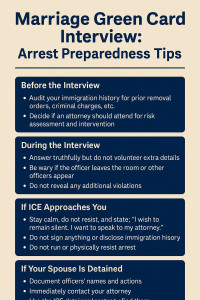
(النص الكامل جاهز لطباعته في PDF — تم تضمينه سابقاً.)
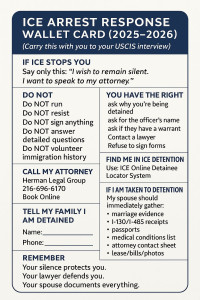
“لأول مرة منذ عقود، يجب على الأزواج التعامل مع مقابلة الزواج باعتبارها نقطة إنفاذ محتملة.”
“إعفاء تجاوز الإقامة لم يعد يعمل كما كان.”
“هذه الاعتقالات يمكن أن تنتشر إلى أي مكتب USCIS في البلاد.”
نعم، حدث ذلك بالفعل في مكتب USCIS في سان دييغو في نوفمبر 2025.
لا. الزواج لا يوفر أي حصانة من ICE.
نعم. تجاوز الإقامة يعتبر “قابلية للترحيل” ويمنح ICE صلاحية الاعتقال.
نعم — كلما طالت مدة التجاوز، ارتفع مستوى الخطر.
الخطر أقل، لكنه لا يزال موجوداً.
قد يزيد ذلك المخاطر، خاصة إذا رُبط بتجاوز الإقامة.
نعم — تجاوز ESTA بالذات من أكثر الحالات التي تؤدي لاعتقال فوري.
يجب أن يقوم محامٍ بإجراء FOIA و EOIR check لمعرفة ذلك.
نعم — ويمكن أن يحدث أثناء المقابلة.
نعم جداً — هذا يؤدي غالباً لاعتقال فوري.
ليس إذا تجاوزت الإقامة أو كان لديك أمر ترحيل سابق.
يعتمد على ما إذا رُفض طلب اللجوء أو أُغلق.
لا. الضباط غالباً لا يخبرون المتقدمين.
عادةً لا.
لا — يمنع التصوير والتسجيل داخل مباني USCIS.
الإجابة يجب أن تكون بحدود القانون وبوجود محامٍ.
كن صادقاً، لكن يجب أن تكون مُهيأً قانونياً قبل المقابلة.
نعم — ويُنصح بذلك في جميع الحالات عالية الخطر.
لا، لكنه يستطيع حماية حقوقك بعد الاعتقال.
نعم.
نعم.
نعم.
نعم — وهذا شائع.
نعم — يحدث كثيراً.
نعم — بمجرد فحص هويتك عند الوصول.
ليس بشكل تلقائي.
على الأغلب نعم.
يعتمد على نوع دخولك وتاريخك.
يعتمد على سجلك وخطرك القانوني.
قد تُؤخذ بعين الاعتبار — لكن ICE ما زالت تحتجز الكثير من المرضى.
قد يؤدي ذلك إلى رفض الطلب بسبب “التخلي عن المقابلة”. يجب استشارة محامٍ أولاً.
نعم — لكن يجب وجود مبرر قوي.
نعم — هذا مهم للغاية.
نعم — إذا كان لديك أي علم خطر (Flag).
تجاوز الإقامة الطويل، الدخول غير القانوني، أوامر الترحيل، السجل الجنائي.
الزواج الحقيقي لا يمنع الاعتقال.
لا.
ما زال الاعتقال ممكناً.
لا، إذا تجاوزت الإقامة فأنت معرض للاعتقال.
نعم — من أعلى مستويات الخطر.
قد يساعد، لكنه لا يمنع الاعتقال.
ليس عند لحظة الاعتقال.
يعتمد على المركز.
قد يستمر، لكن الأمر يصبح معقداً.
يمكنه البدء فوراً إذا كان مستعداً مسبقاً.
حسب نوع الاعتقال والمركز.
يعتمد على مشكلتك القانونية.
حتى الآن — لكنها قد تنتشر.
نعم على الأغلب.
مرجح.
نعم — نظام تبادل البيانات يسمح بذلك.
ليس إلزامياً، لكنه ينصح به كثيراً.
نعم — بشدة.
لا — لكنه يحميك قانونياً بعده.
نعم — للتأكد من عدم وجود تناقضات.
نعم — هناك مؤشرات قوية.
نعم — المحاكم تعتبر الاعتقال الإداري قانونياً.
ليس بعد — لكن لا توجد حماية تمنعهم.
نعم — وربما بشكل أكبر.
ليس بالضرورة — لكن يجب التخطيط القانوني السليم.
Read at: NBC San Diego – Families Detail ICE Arrests at Green Card Interviews
Read at: NBC San Diego – ICE Arrests Military Spouses at Interviews
Read at: NBC San Diego – Members of Congress Question Arrests
Read at: NBC San Diego – ICE Making Arrests at Interviews
Read at: ABC 10 News – Norwegian Diabetic Woman Detained at USCIS Interview
Read at: Daylight San Diego – ICE Arrests at Green Card Appointments
Read at: India Today – ICE Detaining Foreigners at Interviews
Read at: NDTV – Green Card Hope to Handcuffed Reality
Read at: Business Standard – Interview Can End in Arrest
Read at: People Magazine – UK Woman Freed After Arrest at Interview
Read at: New York Post – UK Woman Arrested After Interview
Read at: Visa Lawyer Blog – ICE Detentions During Interviews
Read at: Mebane Enterprise – Mother Detained at Interview
Read at: ACLU Rhode Island – ICE May Arrest Immigrants at Interviews

ما حدث في سان دييغو يمكن أن يحدث في أي مدينة.
وما كان آمناً لسنوات… لم يعد كذلك اليوم.
في 2025–2026، مجرد تجاوز الإقامة أو وجود خطأ صغير في سجلك قد يؤدي إلى اعتقالك داخل مبنى USCIS.
ولهذا السبب يحتاج كل زوجان — مهما كان زواجهما حقيقياً — إلى مراجعة قانونية شاملة قبل المقابلة.
مع أكثر من 30 عاماً من الخبرة، ومكاتب فعّالة في أوهايو وجميع أنحاء الولايات المتحدة، وفريق يتحدث عدة لغات، نحن نمثّل المتزوجين الأميركيين والأجانب في:
كل شخص تم اعتقاله في سان دييغو اعتقد أن كل شيء “على ما يرام”.
ولا أحد يجب أن يمرّ بما مرّوا به.
نراجع ملفك بالتفصيل، نكشف المخاطر المخفية، ونعدّ خطة حماية قانونية قبل مقابلة USCIS.
⬇️ اضغط للحجز الآن ⬇️
احجز استشارة مع Herman Legal Group
لا تنتظر يوم المقابلة لتكتشف وجود مشكلة.
التحضير القانوني اليوم أفضل من الندم غداً.

A marriage green card (CR-1 or IR-1) remains one of the strongest immigration pathways in 2026, but the process is now more complex, more expensive, and far more heavily scrutinized under Trump-Vance policies and Project 2025 proposals. USCIS now applies extreme vetting, AI-based fraud detection, expanded public charge analysis, and mandatory electronic filing for most forms.
Ohio USCIS offices vary dramatically:
If prepared properly, most bona fide couples are approved.

Most immigration blogs simply list forms and basic steps. This guide includes:

This guide is essential for:
A marriage green card allows the foreign spouse of a U.S. citizen or lawful permanent resident (LPR) to obtain lawful permanent residence. Depending on your situation, you may apply:
Official USCIS resource:
USCIS — Green Card Through Marriage
HLG resource:
Marriage Green Card Guide

To qualify, you must show:
USCIS must believe your marriage is genuine and not solely for immigration benefits. Failure to disclose prior marriages or criminal history can result in denial of the marriage green card application. Documentation required for interviews includes passports, birth certificates, marriage certificates, and a legal termination proof of any prior marriages.
FAM deep link:
9 FAM 601.14-1 — Marriage Fraud Indicators
(https://fam.state.gov)
USCIS must believe your marriage is genuine and not solely for immigration benefits. Failure to disclose prior marriages or criminal history can result in denial of the marriage green card application.
FAM deep link:
9 FAM 601.14-1 — Marriage Fraud Indicators
(https://fam.state.gov)
You must have a civil marriage recognized where it occurred.
Examples: certain unlawful entries, certain criminal issues, prior immigration violations.
The U.S. spouse must meet I-864 income rules.
USCIS:
Form I-864
FAM deep link:
9 FAM 302 — Grounds of Inadmissibility
(https://fam.state.gov)

|
Form |
Previous Fee |
Current Fee |
Notes |
| I-130 | ~$535 | $675 | Online filing required |
| I-485 | ~$1,225 | $1,440 | Biometrics included |
| I-765 | ~$410 | $520 | Longer EAD delays |
| I-131 | ~$575 | $630 | Required for travel |
| I-864 | $0 | $0 | Stricter review |
| DS-260 | ~$325 | $345 | Consular processing |
| USCIS Immigrant Fee | $220 | $235 | CR-1/IR-1 only |
Official USCIS fee list:
USCIS Filing Fees
Forms:
HLG guides:
You will attend a fingerprinting appointment at your local ASC.
Processing is slow: 6–14 months. Recent USCIS updates signal an increased risk for applicants and longer processing times for marriage-based green card applications. This trend has been exacerbated under the current administration, further delaying case resolutions.
Ohio’s three field offices vary significantly (details in next section)
HLG resources:
DOS resources:
Key FAM Rules (Deep Links)

Cleveland officers are known for:
Sample Cleveland questions:
➡ This office is strict but fair to well-prepared couples.
Richard Herman:
“Cleveland requires precision and preparation. We rehearse every possible question before you step into the interview room.”
Officers emphasize:
Style: polite, formal, technical.
Problems often seen:
Known for:
➡ Best for couples with clean, well-organized cases.
Beginning in 2025 and accelerating in 2026, USCIS now uses enhanced fraud detection tools for marriage-based green cards, including:
9 FAM 601.14-1 (Marriage Fraud Indicators)
This is the same manual used by consular officers at U.S. embassies worldwide.
Richard Herman says:
“In 2026, USCIS is not giving couples the benefit of the doubt. They expect your evidence to reflect a genuine, interwoven life—financially, emotionally, and socially.”
While most public attention focuses on undocumented immigration, the policy vision outlined in Project 2025 and reinforced by statements from Vice President J.D. Vance makes clear that legal immigration—especially family-based categories like marriage green cards—is a central target for reduction.
Multiple credible analyses show that Project 2025 proposes restructuring or shrinking legal immigration pathways, particularly those based on family ties.
According to Project 2025 policy chapters and reporting, the plan calls for a shift toward “merit-based immigration” and significant reductions in family-based pathways, referring to them as contributors to “chain migration.”
Key proposals include:
Family-based immigration—including marriage-based categories—is directly identified for reduction.
Project 2025 recommends treating all family-based petitions as potentially fraudulent until extensive evidence proves otherwise. AI and social-media surveillance expansion
Fewer interview waivers → more in-person marriage interviews.
Encourages strict financial vetting, including debt, credit, insurance coverage, prior use of public benefits, and job stability.
J.D. Vance has repeatedly stated that legal immigration levels are too high and that the U.S. should significantly reduce family-based immigration while prioritizing “merit-first, family-second” admissions.
These articles quote Vance stating that:
This has directly informed the adjudication environment at USCIS.
USCIS is demanding more evidence to “prove” bona fide marriages.
Stokes-style interviews are now more common.
Officers check:
USCIS officers now routinely consult:
9 FAM 601.14-1 — Marriage Fraud Indicators
(https://fam.state.gov)
Interviews are more adversarial in many regions, especially in Ohio’s Cleveland office.
You must prepare for:
It is advised that couples prepare details about their shared daily life to answer questions accurately and avoid raising suspicion.
Officers will ask couples questions about their relationship story to verify consistency between their answers.
USCIS interviews are designed to test the authenticity of a marriage, so discrepancies in answers may lead to suspicion. Couples should prepare thoroughly to ensure consistency.
Even bona fide couples face more hurdles due to the policy climate encouraging USCIS to investigate first and trust later.
But with strong preparation, thorough evidence, and expert representation, marriage green cards remain absolutely achievable.
Richard Herman says:
“Even in the Project 2025 era, families can win—if they build a case so strong and so well-prepared that USCIS cannot deny it.”
Under expanded public charge guidance, USCIS now considers:
Employers, job field, length of job.
Private or employer insurance strongly favored.
Larger households face stricter scrutiny.
Unpaid debt, high credit-card use, personal loans — all relevant.
Strong savings help borderline income households.
See FAM:
9 FAM 302.8-2(B) Public Charge
Official USCIS resource:
Public Charge Resources

USCIS may compare interview answers to previously submitted documentation for inconsistencies that need clarification.
Issued when USCIS believes the marriage may not be bona fide.
Example FAM section used during fraud review:
9 FAM 601.14-1
FAM inadmissibility section:
9 FAM 302
USCIS wants patterns, not isolated deposits.
Include dates of meeting, dating, engagement, wedding, trips.
Avoid relying only on photos.
Couples must provide joint financial documents to demonstrate the legitimacy of their relationships.
Include:
Especially Cleveland.
Include names, date, location.
Answer clearly and directly.
They are time-sensitive and highly technical.
Couples are expected to provide evidence of common financial responsibilities, such as joint bank accounts or shared bills, to strengthen their case.
USCIS form list:
All USCIS Forms

These are the type of real questions asked in Cleveland interviews. Officers ask detailed questions about how couples met and their relationship history during interviews. USCIS has increased scrutiny of daily routines and finances during marriage green card interviews to detect fraud, making preparation essential.
Richard Herman says:
“Marriage cases aren’t just paperwork—they’re about families fighting to stay together. We take that responsibility personally.”
Beginning in 2025, USCIS implemented a stricter national policy requiring applicants to bring their own interpreter to adjustment-of-status interviews if they are not fluent in English.
Your interpreter must:
Important:
Cleveland, Columbus, and Cincinnati USCIS generally allow phone interpreters, but Cleveland officers sometimes request in-person interpreters for complex interviews.
If you appear without a required interpreter, USCIS may cancel or reschedule your interview, causing months of delay.
While arrests at USCIS interviews are rare, they do occur under specific circumstances. USCIS may coordinate with ICE or local law enforcement when certain red flags appear.
Cleveland USCIS has historically been more aggressive in coordinating with ICE in cases involving:
Columbus and Cincinnati rarely involve law enforcement unless required by statute.
If you think you are at risk
You must consult an immigration attorney before attending your interview.
Herman Legal Group can run background checks and assess risk.
When you receive the I-797 receipt notices for your I-130 and I-485, each one will include an Online Access Code.
This code is time-limited and allows you to create your myUSCIS online account:
Uploading supplemental bona fide evidence online before the interview may reduce:
This pro tip gives you a real advantage at Ohio USCIS interviews.
Yes. USCIS currently allows attorneys to appear:
Your lawyer can:
Even virtual attendance significantly reduces officer overreach or misunderstanding.
If your I-130 Petition for Alien Relative is denied, you have two main options:
Official info:
https://www.justice.gov/eoir
You have 30 days to appeal.
This is appropriate when:
Appeals can take months, sometimes a year or more.
This is often the better strategy, especially after a NOID.
Refile when:
If denial reasons relate to evidence or witness credibility, refile.
If denial was based on a legal or procedural mistake, appeal.
If the I-130 is denied, the I-485 will be denied automatically.
A denial of the I-485 Adjustment of Status is serious.
USCIS may issue a Notice to Appear (NTA) placing you in removal proceedings, but often does not unless there are red flags, unless you are otherwise out of status. USCIS is now under direction to issue NTAs after denied I-485s for those without status. If an applicant is deemed ineligible after an interview, USCIS may issue a Notice to Appear for deportation proceedings.
You can ask for:
HLG strongly recommends immediate legal representation.
Yes — in many cases.
Form I-601, Application for Waiver of Grounds of Inadmissibility:
https://www.uscis.gov/i-601
Examples:
You can request a waiver if denial would cause extreme hardship to your U.S. spouse.
Examples:
Not all crimes are waivable.
HLG can assess eligibility.
This requires the I-601A provisional waiver if required to leave the U.S. for consular processing (due to unlawful entry) HLG resource:
https://www.lawfirm4immigrants.com/form-i-601a-provisional-waiver/
If USCIS rules that you are inadmissible due to lack of the required vaccines, or due to a medical condition, you can file an I-601 waiver. For failure to take the required vaccines, you will need to demonstrate that you are against all vaccines due to religious or moral reasons.
You must:
Waivers are complex — but winnable with proper strategy.
Hiring an immigration attorney is a major investment—emotionally and financially. Unfortunately, many clients nationwide report difficulties such as:
These situations are not normal and not acceptable—especially in 2025–2026 when marriage-based cases face extreme vetting, Project 2025 pressure, and higher denial risks.
Save:
This protects you if you need to switch attorneys or file a complaint.
Send a polite but firm message:
“Hi, I need a written update on my case status, pending deadlines, and next steps.
Please confirm receipt and respond within 48 hours.”
Professionally run law firms respond promptly.
You are legally entitled to:
Any delay in providing your file is a red flag.
You are allowed to change attorneys at ANY time.
The new attorney simply files Form G-28 to take over your case.
Switching attorneys is common, especially after:
Richard Herman says:
“An immigration case is too important to leave in the hands of someone who is unresponsive or unprepared. You deserve advocacy, not silence.”
Contact a new lawyer immediately.
Herman Legal Group regularly accepts emergency cases—even days before interviews—including Cleveland, Columbus, and Cincinnati.
A new lawyer can:
It’s absolutely fixable with the right team.
Choosing the right lawyer is one of the most important decisions you will make during your marriage-based immigration process.
Here is a guide to hiring the right attorney—one who will protect your marriage, your future, and your legal rights.
Ask how many marriage-based cases they’ve handled—especially in the past 12 months under extreme vetting.
Ask about:
These offices have VERY different cultures.
Paralegals can help—but the attorney must:
Some firms bait-and-switch clients: a senior lawyer sells the case, but a junior staff member does the real work.
A responsive firm answers within:
This is essential—especially in Cleveland.
Only hire lawyers who regularly handle:
This shows competence in difficult cases.
No surprise fees. No hidden RFE charges.
Everything should be in writing.
A confident attorney will provide anonymous examples of:
Copy and paste this checklist into your notes:
A strong law firm will easily answer ALL 10 questions.
Richard Herman says:
“Treat hiring an immigration lawyer like hiring a surgeon. You’re trusting someone with your future, your marriage, and your ability to stay in the U.S. Ask tough questions and expect professionalism.”
Seeking a second opinion does not mean you distrust your lawyer.
It means you want to protect your future.
A qualified attorney will:
Second opinions save marriages from:
Richard Herman says:
“The difference between approval and denial is often preparation. A second opinion can catch problems before USCIS does.”
Immigration law is not a place to cut corners.
Choosing a cut-rate attorney often leads to:
The result?
Clients often end up:
Richard Herman says:
“You don’t want the cheapest surgeon. You want the right one. The same is true when your future, your marriage, and your ability to stay in the country are at stake.”
La tarjeta de residencia por matrimonio (CR-1 o IR-1) sigue siendo una de las mejores formas de inmigrar legalmente a los Estados Unidos en 2026.
Sin embargo, bajo las nuevas políticas del gobierno de Trump–Vance y las propuestas de Project 2025, el proceso ahora requiere más evidencia, más entrevistas, más escrutinio, y más pruebas de que su matrimonio es real.
Herman Legal Group ha ayudado a familias inmigrantes por más de 30 años, incluyendo a miles de parejas hispanas.
Programa una consulta:
https://www.lawfirm4immigrants.com/book-consultation/
Eligibility & Basics
Q1: How long must we be married before applying?
A1: You can apply immediately after marriage. There is no minimum time requirement.
Q2: Do we have to live together?
A2: Technically no—but living separately almost always triggers RFEs/NOIDs unless well-explained.
Q3: Can we apply if my spouse is undocumented?
A3: Yes, depending on how they entered the U.S.
See HLG’s guide:
https://www.lawfirm4immigrants.com/immigration-options-for-undocumented-spouse/
Q4: Can a fiancée visa (K-1) convert to a green card?
A4: Yes—after marriage within 90 days, file AOS.
Q5: Do I need a lawyer for a marriage case?
A5: Not required, but highly recommended due to increased 2026 scrutiny.
Forms & Filing
Q6: Do we file I-130 and I-485 together?
A6: Yes—if the immigrant spouse is eligible to adjust status.
Q7: Do I need the I-693 medical exam before filing?
A7: It’s optional at filing, but strongly recommended to avoid delays.
Q8: Can I travel while my green card is pending?
A8: Only with approved Advance Parole (I-131).
Do NOT travel before approval.
Q9: Should I include tax transcripts or 1040 forms?
A9: USCIS prefers tax transcripts.
Q10: Can I e-file everything?
A10: Most forms now require or strongly encourage e-filing.
Evidence & Documentation
Q11: How many photos should we provide?
A11: 20–40 photos with dates, locations, and people identified.
Q12: Do we need joint bank account statements?
A12: Highly recommended. 6–12 months if possible.
Q13: What if we do not live together yet?
A13: You must provide strong alternative evidence.
Q14: Are wedding photos enough?
A14: No. They must be paired with other evidence.
Q15: Should we write affidavits from friends/family?
A15: Yes—3–6 affidavits help, but cannot replace financial evidence.
Interview Questions
Q16: What do officers ask at interviews?
A16: Questions about your relationship, home, finances, family, and daily routines.
Q17: Will we be separated (Stokes interview)?
A17: Cleveland often separates; Columbus rarely; Cincinnati almost never.
Q18: How long does the interview last?
A18: 15–45 minutes typically; Cleveland may run 60–90 minutes.
Q19: Can my lawyer attend?
A19: Yes—your attorney may attend in person or by phone.
Q20: What if we disagree on an answer?
A20: Small discrepancies are normal; major ones cause problems.
RFEs & NOIDs
Q21: Why did I get an RFE?
A21: Missing documents, insufficient evidence, tax issues, or address inconsistencies.
Q22: What is a NOID?
A22: A Notice of Intent to Deny—issued when USCIS doubts the marriage.
Q23: How serious is a NOID?
A23: Extremely serious. Respond with legal counsel.
Q24: How long do I have to respond?
A24: Usually 30 days.
Q25: What is the #1 cause of NOIDs?
A25: Weak or inconsistent evidence of a shared life.
Denials
Q26: What happens if we are denied?
A26: You may appeal, refile, or consider a motion to reopen.
Q27: Can USCIS deport me after denial?
A27: It is possible. Immediate legal consultation is critical.
Q28: Can a denial be overturned?
A28: Yes—many denials can be reversed with strong evidence.
Q29: Why are Cleveland denials higher?
A29: Cleveland officers follow stricter interview patterns and fraud indicators.
Q30: Can marriage fraud accusations be fixed?
A30: Rarely. You must provide overwhelming evidence.
Public Charge & Finances
Q31: Do we need tax returns?
A31: Yes—3 years recommended; transcripts preferred.
Q32: What income is required?
A32: At least 125% of the Federal Poverty Guidelines.
Q33: Can assets replace income?
A33: Yes—assets worth 5× the shortfall may qualify.
Q34: Does credit score matter?
A34: Yes—under expanded public charge interpretation.
Q35: Does being unemployed hurt the case?
A35: Yes—unless strong savings/assets mitigate risk.
Consular Processing
Q36: How long does CR-1 take?
A36: 14–22 months.
Q37: Can I expedite at NVC?
A37: Yes—but only for urgent humanitarian or financial hardship reasons.
Q38: What documents does NVC require?
A38: See official list:
https://travel.state.gov/content/travel/en/us-visas/immigrate/step-1-submit-a-petition.html
Q39: How long does the embassy interview last?
A39: Usually 10–20 minutes.
Q40: Can my U.S. spouse attend the consular interview?
A40: Not usually, except in rare countries.
After Approval
Q41: When will I receive my green card?
A41: 2–6 weeks after entry or approval.
Q42: When can I work?
A42: Immediately upon receiving the green card.
Q43: When can I apply for citizenship?
A43: After 3 years if still married to a U.S. citizen.
Q44: What if we divorce?
A44: You must file an I-751 waiver.
Q45: Can I travel freely?
A45: Yes—after receiving your green card.
Special Situations
Q46: We have children together—does it help?
A46: Yes, significantly.
Q47: We live with family—does it hurt?
A47: No—but provide consistent address documentation.
Q48: We married quickly—will that hurt?
A48: Possibly. Provide stronger evidence.
Q49: We met online—does USCIS care?
A49: No, but provide a clear communication history.
Q50: We have a big age gap—does that matter?
A50: Yes—age gaps are fraud indicators under 9 FAM 601.14-1, so provide extra evidence.
Herman Legal Group has helped immigrant families for 30+ years, with offices in Cleveland, Columbus, Cincinnati, and serving clients worldwide.
Whether you need help filing, preparing for an interview, responding to an RFE/NOID, or appealing a denial:
👉 Schedule your consultation today:
https://www.lawfirm4immigrants.com/book-consultation/
📞 Call: 1-800-808-4013
🌐 www.LawFirm4Immigrants.com
|
Firm |
Location |
Strengths |
Insight |
| Herman Legal Group | Cleveland, Columbus, Cincinnati + Nationwide | 30+ years experience, multilingual team, high success in marriage cases, deep Ohio USCIS interview insight | Premium service |
| Fragomen | National/Global | Corporate immigration expertise | Not focused on family/marriage cases |
| Murthy Law Firm | National | Strong H-1B reputation | Not Ohio-based |
| Local Solo Practitioners | Ohio | Low cost | Limited staff, limited marriage-case volume |

Download the 2026 Marriage Green Card Checklist (PDF)
State Department & FAM
Key deep links:
Yes. President Trump has issued an expanded travel ban taking effect January 1, 2026, sharply restricting entry to the United States for nationals of dozens of countries. The new ban is broader than prior Trump-era bans, relies heavily on discretionary enforcement, and significantly increases denial risk for visa applicants, students, workers, and families. Anyone from an affected country should assume travel and visa processing now carry high risk.
Who is affected: Visa applicants, travelers, students, workers, families, refugees
Risk level: High
Effective date: January 1, 2026
Urgency: Immediate — reassess travel and interviews now
Attorney needed: Strongly recommended before any travel or visa action

The 2026 travel ban is a sweeping executive action that expands earlier Trump-era entry restrictions. Unlike prior bans, this version increases the number of affected countries, narrows waiver availability, and gives far more discretion to consular officers and border officials. The new restrictions are encapsulated in the announcement that states, ‘Trump Issues Expanded Travel Ban Effective January 1 2026.’
As a result, visa approval alone no longer signals safe entry into the United States.
Herman Legal Group’s ongoing analysis explains how this shift toward discretionary enforcement has already affected visa applicants and travelers in real-world cases, particularly those caught in administrative processing or unexpected refusals. For a deeper legal overview, see:
Trump Travel Ban Explained – December 2025

The 2026 travel ban is not a single policy. It is the result of two presidential proclamations, issued six months apart, that work together to restrict entry.
Understanding both is essential for journalists, researchers, and affected families.
On December 16, 2025, President Trump issued a proclamation titled Restricting and Limiting the Entry of Foreign Nationals to Protect the Security of the United States. This proclamation expands earlier travel restrictions and sets the effective date of January 1, 2026.
The full legal text is available here:
Restricting and Limiting the Entry of Foreign Nationals to Protect the Security of the United States
More countries moved into full or near-total bans
Fewer humanitarian and discretionary waivers
Formal inclusion of Palestinian Authority travel documents
Expanded authority to shorten or limit visa validity
No grace period before enforcement
Policy analysts at the American Immigration Council note that this structure makes enforcement quieter but more powerful, because denials increasingly occur at the consular or border level rather than through headline announcements.
President Trump Expands His Travel Ban: What You Need to Know
The December expansion builds on a June 4, 2025 proclamation titled Restricting the Entry of Foreign Nationals to Protect the United States from Foreign Terrorists and Other National Security and Public Safety Threats.
That earlier proclamation established the initial framework for:
Country-based restrictions
Partial bans on visitor, student, and exchange visas
Security and information-sharing benchmarks
Congressional analysis of how the June and December proclamations interact is available here:
Expanded Travel Ban to Take Effect January 1, 2026
Together, these proclamations create a tiered system that allows restrictions to expand without new legislation.

The U.S. government does not publish a single consolidated enforcement list. Instead, countries fall into restriction tiers, tracked by independent policy institutions and government guidance.
For the following countries, most immigrant and nonimmigrant visas are unavailable unless a rare waiver is granted:
Afghanistan
Burma (Myanmar)
Chad
Republic of the Congo
Equatorial Guinea
Eritrea
Haiti
Iran
Laos
Libya
Mali
Niger
Sierra Leone
Somalia
South Sudan
Sudan
Syria
Yemen
Travelers using Palestinian Authority travel documents
The Council on Foreign Relations maintains a regularly updated country-by-country guide used by journalists and policymakers:
Guide to Countries Affected by Trump’s Travel Ban
For the countries below, visitor, student, and exchange visas are heavily restricted, and officers may shorten or limit other visas:
Nigeria
Cuba
Senegal
Tanzania
Venezuela
Zambia
Zimbabwe
Angola
Burundi
Côte d’Ivoire
Mauritania
Togo
Tonga
In practice, “partial” often functions as presumed denial, particularly for B-1/B-2, F-1, M-1, and J-1 visas.
The ban affects far more than tourists.
High-risk groups include:
International students and exchange visitors
Employment-based visa holders
Family-based immigrant visa applicants
Diversity Visa selectees
Universities are already warning students about travel risks, as documented in this Higher Ed Dive analysis:
Trump Expands Travel Ban: What Higher Education Needs to Know
Enforcement now occurs at multiple pressure points:
Visa interviews at U.S. embassies
Administrative processing with no fixed timeline
Airline boarding decisions
CBP inspections at ports of entry
Federal agencies emphasize that visa issuance does not guarantee admission:
U.S. Department of State – Visa Processing
U.S. Citizenship and Immigration Services
HLG has seen an increase in cases where travelers with previously valid visas were denied boarding or entry after long periods abroad.
Visa refusal with no appeal
Stranding outside the U.S.
Job or academic program loss
Long-term family separation
Delayed approval after months of review and legal intervention
This is where many irreversible mistakes happen — when applicants assume old rules still apply.
The expanded travel ban coincides with:
Increased consular discretion
Slower global visa processing
Heightened security screening
Global events like the 2026 World Cup
Immigration policy analysts warn that these factors will suppress lawful travel even beyond listed countries.
How the Travel Ban Could Affect the 2026 World Cup
Pause international travel
Identify your country’s risk tier
Preserve all immigration records
Assess waiver eligibility
Prepare interview-proof documentation
Coordinate employer or school strategy
Explore alternative visa pathways
Plan for discretionary enforcement
Build contingency options

The December 2025 travel ban does not operate in isolation. It intersects directly with a separate USCIS policy shift that quietly reshapes how immigration benefits are processed inside the United States.
In early December 2025, USCIS issued internal guidance instructing officers to pause, re-review, or hold certain benefit applications rather than approve or deny them outright. While the memo does not explicitly reference the travel ban, the combined effect is powerful.
Under the December USCIS guidance:
Officers are encouraged to pause adjudications when eligibility questions arise
Applications may be held indefinitely for “additional review”
No statutory timeline is required for resolution
Applicants often receive no meaningful explanation
This mirrors a trend already seen in Diversity Visa and humanitarian cases.
When the travel ban and USCIS pause policies overlap, applicants face a double bottleneck:
Outside the U.S.: Visa issuance is blocked or delayed by consular discretion
Inside the U.S.: Benefits are frozen or stalled without formal denial
For example:
A family-based petition may be approved, but the visa is denied under the travel ban
An applicant already in the U.S. may be unable to travel, while their adjustment application sits “under review”
This interaction creates legal limbo, not just denial.
HLG has seen an increase in cases where applicants are effectively trapped — unable to travel, unable to adjust, and unable to force a decision — a pattern discussed in broader enforcement analysis across immigration categories.

Nigeria is not just another country affected by partial travel restrictions. It is one of the most consequential countries in the global U.S. immigration system.
Any restriction on Nigerian nationals has outsized ripple effects across education, labor markets, healthcare, and U.S. families.
Nigeria consistently ranks among the top African countries for U.S. visa issuance, including:
Tens of thousands of nonimmigrant visas issued annually
A large number of student (F-1) and exchange (J-1) visas
Significant family-based immigrant visa demand
Growing numbers of employment-based professionals
According to State Department data, Nigerians are among the largest sources of international students from Africa, particularly in STEM, healthcare, and graduate research fields.
Nigerian students play a critical role in:
U.S. universities and research institutions
Graduate STEM programs
Medical, engineering, and data science pipelines
Many Nigerian students later transition to:
OPT and STEM OPT
H-1B and O-1 visas
Long-term employment in the U.S.
Travel restrictions disrupt this pipeline at multiple stages, particularly when students need visa stamping abroad.
Nigerian nationals are heavily represented in:
Healthcare (physicians, nurses, researchers)
Technology and engineering
Academia and higher education
Entrepreneurship and startups
Even “partial” restrictions can lead to:
Delayed onboarding
Job losses
Employer withdrawal of sponsorship
Talent diversion to other countries
This is why Nigeria-specific restrictions attract scrutiny from universities, hospitals, and multinational employers.
Nigeria also has a large U.S. diaspora, meaning travel bans affect:
Marriage-based green cards
Parent and child reunification
Long-pending family petitions
Delays can last years, not months.
One of the least understood aspects of the 2026 travel ban is how partial restrictions operate in the real world.
On paper, partial restrictions suggest some visas remain available. In practice, they often function as de facto bans.
For partial-restriction countries:
Visitor, student, and exchange visas face presumed denial
Consular officers are encouraged to limit visa validity
Administrative processing increases dramatically
Approval rates drop sharply without formal announcements
Applicants often wait months only to receive short refusals with minimal explanation.
Nigeria’s classification as a partial-restriction country means:
Student and visitor visas are disproportionately denied
Professionals needing stamping abroad face prolonged delays
Family-based cases stall even after petition approval
Because these outcomes are discretionary, they do not generate headline data, making them harder to track — and harder for applicants to anticipate.
When viewed together, the December travel ban and December USCIS pause policies reveal a broader shift:
Away from formal denials
Toward slow-motion enforcement
Away from transparency
Toward discretion and delay
For journalists and policy analysts, this is a critical story: immigration control through administrative friction rather than overt prohibition.
For families, students, and workers, the takeaway is simpler — planning under old assumptions is no longer safe.
While framed as a national security measure, the 2026 expanded travel ban has direct and measurable economic consequences across multiple U.S. industries. These impacts are not limited to affected countries — they ripple through education, healthcare, technology, tourism, and major international events hosted in the United States.
The key economic issue is not simply fewer visitors. It is disrupted pipelines: talent, students, workers, researchers, patients, and global commerce.
The United States is a primary host of the 2026 FIFA World Cup, alongside Canada and Mexico. Global sporting events of this scale depend on predictable cross-border travel for:
Athletes
Coaching and support staff
Media organizations
Event contractors
Fans and sponsors
Even partial restrictions can create:
Visa delays for athletes and staff
Uncertainty for international media accreditation
Reduced fan travel from affected countries
Last-minute logistical failures
Unlike tourists planning leisure travel, global events operate on fixed timelines. Visa uncertainty weeks or months before an event can translate into lost revenue, reduced attendance, and reputational harm.
Policy analysts have warned that discretionary enforcement — not just formal bans — is the greatest risk. When visa decisions are unpredictable, international organizers may shift future events away from the United States.
International students are a major economic engine for U.S. higher education. They:
Pay full tuition at many institutions
Support local housing markets
Contribute to research output
Fill graduate and STEM programs
The expanded travel ban affects universities in several ways:
Student visa denials and delays
Reduced international enrollment
Disrupted research collaborations
Difficulty recruiting graduate students and postdocs
Universities are particularly exposed because students must travel repeatedly — for visa stamping, conferences, fieldwork, and family emergencies. Even one failed reentry can end a degree program.
Long-term consequence: universities lose competitiveness as students choose Canada, the U.K., Australia, or EU countries with more predictable mobility rules.
Foreign-trained physicians are essential to the U.S. healthcare system, especially in:
Underserved and rural areas
Primary care
Psychiatry
Internal medicine
Medical research and residency programs
Many international physicians rely on:
J-1 visas for residency and fellowship
H-1B visas for employment
Periodic international travel for licensing, family, or professional reasons
The travel ban creates:
Staffing gaps when physicians cannot return
Delayed onboarding for hospitals
Increased burnout for remaining staff
Reduced access to care in shortage areas
Hospitals cannot easily replace these professionals. Training pipelines take years, not months.
From a public policy standpoint, restricting physician mobility directly undermines healthcare access — even when national demand is rising.
The U.S. technology sector depends heavily on global talent mobility, particularly in:
Software engineering
Artificial intelligence
Data science
Cybersecurity
Semiconductor research
For technology firms, the risk is not only new hiring — it is retention.
Common consequences include:
Employees stranded abroad during visa stamping
Missed product deadlines
Project delays
Increased reliance on offshore teams
Talent relocation to other countries
Even partial restrictions can function as a soft talent deterrent, signaling instability to global professionals.
Over time, companies respond by shifting hiring and R&D investment outside the U.S., weakening domestic innovation ecosystems.
Beyond Silicon Valley, IT professionals play a critical role in:
Healthcare systems
Financial services
Manufacturing
Government contractors
Critical infrastructure
Many of these roles are filled by:
H-1B professionals
L-1 transferees
O-1 specialists
Travel uncertainty increases:
Project risk
Compliance costs
Contract cancellations
Insurance and liability exposure
For employers operating on tight delivery schedules, visa unpredictability becomes a business risk, not just an HR issue.
From an economic perspective, the most damaging feature of the expanded travel ban is uncertainty.
Businesses, universities, hospitals, and event organizers can adapt to restrictive policies — if the rules are clear. What they struggle with is:
Discretionary enforcement
Sudden policy shifts
Lack of transparent criteria
Inconsistent outcomes across embassies
This uncertainty discourages long-term planning and investment.
Economists increasingly view modern immigration policy not as a binary “open vs closed” system, but as a mobility reliability problem.
When mobility becomes unreliable:
Talent flows elsewhere
Capital follows talent
Global institutions adjust expectations
The expanded 2026 travel ban accelerates this trend by introducing structural unpredictability into U.S. entry systems.
The 2026 travel ban’s economic impact is not confined to immigration statistics. It affects:
Global events hosted in the U.S.
University finances and research output
Healthcare staffing and patient access
Technology innovation and competitiveness
Long-term investment decisions
For policymakers, the key question is no longer whether travel bans restrict entry — but whether the economic cost of unpredictability outweighs the intended policy goals.
What exactly is Trump’s 2026 travel ban?
It is an expanded presidential travel ban that restricts entry to the United States for nationals of certain countries beginning January 1, 2026, based on executive authority under immigration law.
When does the expanded travel ban take effect?
The ban takes effect at 12:01 a.m. Eastern Time on January 1, 2026.
Is this the same as the 2017 or 2020 Trump travel bans?
No. The 2026 ban is broader, affects more countries, relies more on discretion, and includes fewer automatic exemptions.
Is the travel ban permanent?
No. It can be modified, expanded, or lifted by future executive action, but there is no expiration date built into the proclamation.
Does Congress have to approve the travel ban?
No. The ban is issued under presidential authority in INA § 212(f), which does not require congressional approval.
Who is most affected by the 2026 travel ban?
Visa applicants, international students, workers, families seeking green cards, refugees, and Diversity Visa selectees from affected countries.
Does the ban apply to tourists only?
No. It affects both immigrant and nonimmigrant visas, including family-based and employment-based categories.
Are U.S. citizens affected?
No, but U.S. citizens may be separated from spouses, children, or parents who are unable to obtain visas.
Are lawful permanent residents (green card holders) banned?
Green card holders are generally not barred, but they may face heightened screening and questioning at the border.
Does the ban apply to dual citizens?
It depends. If a traveler uses a passport from a restricted country, the ban may apply even if they hold another nationality.
If I already have a visa, can I still travel?
Possibly, but travel carries risk. A valid visa does not guarantee admission to the United States.
Can CBP deny entry even if I have a valid visa?
Yes. Border officers always have discretion to deny admission.
What if my visa was issued before January 1, 2026?
The ban does not automatically revoke existing visas, but it allows officers to deny entry or limit validity.
Should I travel internationally if I am from an affected country?
In most cases, travel is high risk and should be reviewed carefully with legal counsel.
Can airlines deny boarding because of the travel ban?
Yes. Airlines may refuse boarding if they believe a traveler will be denied entry.
Will U.S. embassies still accept visa applications?
Some embassies will accept applications but deny them under the proclamation or place them into administrative processing.
What is “administrative processing” and why is it increasing?
It is additional security review with no fixed timeline. The travel ban encourages its use.
Can a consular officer deny my visa without explanation?
Yes. Many denials under the ban provide limited reasoning and no appeal.
Are interview waivers still available?
Interview waivers may be limited or suspended for applicants from restricted countries.
Can visa validity be shortened because of the ban?
Yes. Officers may issue visas with shorter validity periods or fewer entries.
Are international students affected by the travel ban?
Yes. Students from affected countries face visa denials, delays, and travel risks.
Can F-1 students already in the U.S. travel abroad?
Travel is risky. Reentry is not guaranteed even with a valid visa.
Are J-1 exchange visitors affected?
Yes. Many J-1 categories are subject to heightened scrutiny or denial.
Can universities intervene if a student is denied a visa?
Universities can advocate, but they cannot override consular decisions.
Does the ban affect OPT or STEM OPT?
The ban does not cancel OPT, but travel during OPT is especially risky.
Does the travel ban affect marriage-based green cards?
Yes. Spouses from affected countries may be unable to obtain immigrant visas.
Are children and parents of U.S. citizens affected?
Yes. Immediate relatives are not automatically exempt.
Does the ban apply to adjustment of status inside the U.S.?
The ban primarily targets entry, but travel abroad during adjustment is risky.
Can family petitions still be filed?
Yes, but approval does not guarantee visa issuance.
Are H-1B workers affected by the travel ban?
Yes, particularly if they need visa stamping abroad.
Can employers still sponsor workers from affected countries?
Petitions may be approved, but visas may still be denied.
Are O-1 “extraordinary ability” visas exempt?
No. O-1 visas are not automatically exempt from the ban.
Does the ban affect L-1 intracompany transferees?
Yes, especially at consular processing stages.
Are waivers available under the 2026 travel ban?
Yes, but waivers are discretionary and rarely granted.
What qualifies as a hardship waiver?
The standard is extremely high and inconsistently applied.
Is there a humanitarian exception?
Some humanitarian exceptions exist, but they are narrow and unpredictable.
Can I appeal a travel-ban visa denial?
No formal appeal exists. Some cases may be refiled or challenged indirectly.
Does hiring a lawyer guarantee approval?
No, but legal guidance can reduce risk and prevent irreversible mistakes.
Can the list of affected countries change?
Yes. Countries can be added or removed without notice.
Is the travel ban being challenged in court?
Legal challenges are possible, but courts have historically upheld broad executive authority.
Could the ban expand further in 2026?
Yes. Analysts expect additional countries and tighter enforcement.
Will a future president automatically end the ban?
No. It would require new executive action.
What is the biggest mistake people make under the travel ban?
Assuming old rules still apply.
Is it safer to delay travel or act quickly?
In most cases, delaying travel and reassessing is safer.
Should I attend a visa interview if scheduled?
That depends on country, visa type, and risk profile. Many interviews now result in denials.
Can social media activity affect my visa under the ban?
Yes. Enhanced screening includes online presence review.
What should I do before January 1, 2026?
Review travel plans, preserve records, and seek legal guidance early.
If you or a family member may be affected by the expanded travel ban, early legal guidance can prevent irreversible mistakes.
You can schedule a confidential consultation with Herman Legal Group here:
Book a Consultation
These are the controlling legal and policy sources behind the 2026 travel ban.
White House – December 16, 2025 Proclamation (Expanded Travel Ban)
The official legal text expanding entry restrictions effective January 1, 2026.
Restricting and Limiting the Entry of Foreign Nationals to Protect the Security of the United States
Congressional Research Service – Legal Analysis
Nonpartisan explanation of how the June and December proclamations operate and interact.
Expanded Travel Ban to Take Effect January 1, 2026
U.S. Department of State – Visa Processing Guidance
Official information on visa issuance, refusals, and administrative processing.
U.S. Visa Services and Processing
U.S. Citizenship and Immigration Services (USCIS)
Information on petitions, status, and the limits of visa approval.
USCIS – Immigration Services
These organizations are frequently cited by journalists, courts, and policymakers.
American Immigration Council – Travel Ban Analysis
Legal and policy analysis of how the expanded ban affects families, workers, students, and refugees.
President Trump Expands His Travel Ban: What You Need to Know
American Immigration Council – 2026 World Cup Impact
Examination of how the travel ban could restrict international travel tied to global events.
How the Travel Ban Could Affect the 2026 World Cup
Council on Foreign Relations – Country-by-Country Guide
Ongoing tracking of countries affected by full and partial travel bans.
Guide to Countries Affected by Trump’s Travel Ban
For students, scholars, and universities.
Higher Ed Dive – Travel Ban and Higher Education
Reporting on how universities are advising international students and scholars.
Trump Expands Travel Ban: What Higher Education Needs to Know
HLG publishes ongoing, practical analysis of travel bans, consular discretion, and enforcement risk.
Pillar Guide: Trump Travel Ban Explained (December 2025)
Comprehensive breakdown of the ban, enforcement mechanics, and legal authority.
Trump Travel Ban Explained – December 2025
Speak with an Immigration Attorney
Confidential consultations for travelers, families, students, and workers affected by the ban.
Book a Consultation
Travel ban enforcement evolves quietly. Country lists, visa validity rules, and waiver practices can change without notice. Readers should verify current conditions before travel and seek legal guidance when risks are high.
On December 2, 2025, USCIS issued internal policy memorandum PM-602-0192, ordering:
Understanding the USCIS memo PM-602-0192 national security hold is crucial for all applicants.
USCIS Memo PM-602-0192 national security hold does NOT mean automatic denials.
Consultation regarding the USCIS memo PM-602-0192 national security hold is advisable.
The USCIS memo PM-602-0192 national security hold does not guarantee automatic denials.
It DOES mean months to years of unpredictable delays.
Understanding delays associated with the USCIS memo PM-602-0192 national security hold is vital.
Source:
USCIS memo — PM-602-0192
Media confirmations:
CBS News coverage
AOL News investigation

The USCIS memo PM-602-0192 national security hold brings a wave of anxiety for many.
For millions of immigrant families, the biggest fear is uncertainty.
How the USCIS memo PM-602-0192 national security hold affects families is a pressing concern.
Instagram DMs, Reddit posts, WhatsApp family chats — they all sound like:
Let’s be blunt:
The memo created fear by design.
The USCIS memo PM-602-0192 national security hold contributes to a climate of fear.
Not because people are terrorists — but because national security policy never prioritizes transparency.
This guide answers those real questions one by one, using actual policy language (not rumors).

The directive orders USCIS to:
The directive orders USCIS to:
Key aspects of the USCIS memo PM-602-0192 national security hold include case reviews.
It does NOT:
(Important — this clarity stops panic.)
Below, we explain exactly what happens for different categories of cases. This section is written to answer the real questions we see in consults and Reddit threads.
Each case under the USCIS memo PM-602-0192 national security hold will be evaluated individually.

USCIS family immigration page:
USCIS Family Immigration Overview
Delays, not denials.
But… if your spouse is from a listed country, expect:
IMPORTANT:
Work permits (I-765) will slow down even if your marriage is bona fide.
Immigrants facing the USCIS memo PM-602-0192 national security hold should stay informed.
DOS is now required to:
State Department policy reference:
State Dept: Suspension of Visa Issuance
If your spouse is stuck at NVC:
The implications of the USCIS memo PM-602-0192 national security hold extend across many areas.
Expect a long wait with no visibility.
USCIS citizenship overview:
USCIS Citizenship Resources
Understanding the USCIS memo PM-602-0192 national security hold helps in planning ahead.
“Will my citizenship be denied because of my country?”
Answer:
No. Denial is rare.
Delay is guaranteed.
USCIS needs time to re-vet your prior green card approval if it happened after January 20, 2021.
This is the biggest impact category of the memo.
For asylum applicants, the USCIS memo PM-602-0192 national security hold presents significant challenges.
Every pending asylum case is now on hold.
AOL coverage:
AOL: USCIS Holding Pending Asylum Applications
The USCIS memo PM-602-0192 national security hold impacts the asylum process directly.
Good news:
Understanding the USCIS memo PM-602-0192 national security hold can alleviate some concerns.
If you had 180+ days pending, EAD renewals still eligible.
Bad news:
Renewals may move slowly.
We are seeing:
The USCIS memo PM-602-0192 national security hold complicates employment-based cases.
HLG explainer:
USCIS’s New Security Vetting Rules — What Immigrants Should Know
Important distinction:
DOL is NOT affected.
USCIS IS affected.
That means:
This matters a lot for employers.
Analyzing the USCIS memo PM-602-0192 national security hold is essential for understanding risks.
The list:
Afghanistan, Algeria, Iraq, Kazakhstan, Kyrgyzstan, Lebanon, Libya, Nigeria, Pakistan, Saudi Arabia, Somalia, South Sudan, Sudan, Syria, Tajikistan, Tunisia, Turkey, Turkmenistan, Uzbekistan
This is NOT “racist policy.”
It is counterterrorism bureaucracy — blunt, flawed, but real.
Think of it like an airport security list on steroids.
The potential for denial exists under the USCIS memo PM-602-0192 national security hold, but it is rare.
Almost never solely because of country of origin.
Rare.
BUT: If you have overstay + old deport order, risk rises.
HLG arrest guide:
Why ICE Is Now Waiting at USCIS Interviews
Almost always: NO.
Considerations regarding the USCIS memo PM-602-0192 national security hold are important for applicants.
Withdrawals can trigger ICE referral.
Yes. Bring an attorney if from listed countries.
YES.
Absolutely yes.
USCIS FOIA:
File a FOIA request
FOIA reveals:
Being aware of the USCIS memo PM-602-0192 national security hold can help navigate challenges.
Eventually.
But not soon.
Understanding the implications of the USCIS memo PM-602-0192 national security hold is crucial.
The USCIS memo PM-602-0192 national security hold adds complexity to the process.
Addressing issues related to the USCIS memo PM-602-0192 national security hold is vital.
| Office | Delay Risk |
|---|---|
| San Diego | Very High |
| Newark | High |
| Houston | High |
| Atlanta | Medium |
| Minneapolis | Medium |
| Medium | |
| Miami | High |
| Los Angeles | Very High |
Addressing issues related to the USCIS memo PM-602-0192 national security hold is vital.
Patterns:
DO:
To manage the USCIS memo PM-602-0192 national security hold, staying proactive is key.
DON’T:
Resources for understanding the USCIS memo PM-602-0192 national security hold can be beneficial.
These articles help explain specific panic questions:
A: It is an internal directive issued December 2, 2025 that orders a pause and additional security review on pending benefit applications from nationals of 19 “high-risk” countries and freezes all pending affirmative asylum cases, regardless of nationality.
A: Yes. Adjustment of Status (I-485) cases involving nationals of the listed countries may be paused or sent for security screening.
A: No. The memo does not order automatic denials — only additional review and delayed adjudication.
A: Yes, but many interviews are being cancelled or postponed for additional security review.
A: Yes. Interviews may be delayed while USCIS re-reviews the underlying green card approval.
A: Yes. EAD renewals and initial work permit applications may be delayed due to background checks.
Understanding the USCIS memo PM-602-0192 national security hold can guide your application process.
A: Yes. Advance parole is under heightened scrutiny and travel is not recommended.
A: It means your case is in internal processing, but under this memo it may stay in that status for months or longer.
The USCIS memo PM-602-0192 national security hold remains a focal point in immigration discussions.
A: Yes. The memo authorizes re-review of approvals issued on or after January 20, 2021.
A: Not necessarily. Most people only see standard case status messages online.
A: Yes. RFEs requesting identity documents, military history, travel records, or prior passports are now common.
A: Yes. Respond with complete civil documentation, translations, and evidence of identity consistency.
A: Yes. All pending affirmative asylum interviews and decisions are paused nationwide.
A: Yes, but EAD adjudications are slower and may be held for security checks.
A: Yes, but don’t expect quick movement or interview scheduling.
Impacts of the USCIS memo PM-602-0192 national security hold will shape policy discussions.
A: Yes. The freeze affects adjudication, not submission.
A: Filing now is recommended to preserve priority dates and EAD eligibility timelines.
A: Possibly. Cases may be transferred to specialized fraud or national security review units.
A: Congress can request case status, but cannot override security holds.
A: A lawyer cannot remove a national security hold, but can protect you, prepare documentation, and manage inquiries.
Staying informed about the USCIS memo PM-602-0192 national security hold is essential.
Active awareness of the USCIS memo PM-602-0192 national security hold is necessary for applicants.
A: Yes. DOS is issuing many 221(g) security review notices for listed nationals.
A: It is an interagency background check triggered for national security review on consular cases.
A: Yes. NVC will still collect documents but interview scheduling may pause.
A: No. If USCIS cancels it, you will not be penalized.
A: No. Bring counsel if possible.
A: Rare, but possible if you have an outstanding deportation order or criminal record.
A: No. Do not bring anyone without lawful presence to a USCIS office.
A: Yes. FOIA can reveal “security hold” annotations or referral history.
A: Yes. Officers can re-examine earlier green card approvals if issued on or after January 20, 2021.
A: Yes. Applicants from listed countries may be asked for complete military history.
A: Yes, but humanitarian relief will continue; adjudications may be slower.
A: Yes. Joint petitions and waiver filings may both face review delays.
A: Yes. Consulates are subject to SAO requirements under this memo.
A: Indirectly. Only if the applicant’s identity intersects with listed countries.
A: Yes, but age-out priority may result in some movement.
Implications of the USCIS memo PM-602-0192 national security hold are significant for many.
A: Yes. Parole may undergo multi-agency security review.
A: Yes, but biometrics does not guarantee case movement.
A: Yes. FBI name checks are part of the expanded screening.
Legal implications of the USCIS memo PM-602-0192 national security hold are critical for applicants.
A: Yes. Repeat biometrics is becoming common for listed nationals.
A: Provide a truthful statement and supporting documentation if possible.
A: Yes. Travel is discouraged if any USCIS application is pending.
A: Yes. Address issues can lead to missed notices and case delays.
A: Possibly. Medicals expire after two years; long delays may require a new exam.
A: No. Cases are not lost; they are in extended review.
A: Hardship expediting is rarely granted under national security hold conditions.
The USCIS memo PM-602-0192 national security hold is a critical factor in many cases.
A: Yes. RFE responses under this memo should be strategic and comprehensive.
A: Yes. I-90 cases are subject to additional security checks for listed nationals.
A: No. Multiple filings may complicate security review and slow adjudication.
A: No. Withdrawals can trigger further scrutiny or potential ICE referrals.
Assessing the effects of the USCIS memo PM-602-0192 national security hold is vital for planning.
A: Yes, but no timeline has been announced; USCIS will need to issue subsequent policy guidance to lift security holds.
The bottom line:
But it IS serious if:
What to do next:
If you want case-specific strategy, you can schedule a memo screening session:
Book a consultation with Herman Legal Group
Understanding the USCIS memo PM-602-0192 national security hold is crucial for success.
If your immigration case is suddenly on hold, flagged, or stuck in “background checks,” do not wait.
The policy landscape is changing daily, and silence from USCIS does not mean safety, approval, or forward movement.
A 60-minute review with the Herman Legal Group can clarify:
Book a confidential, same-day consultation with a senior immigration attorney at Herman Legal Group — serving families nationwide for more than 30 years — at the link below:
We also provide:
If you are a journalist, researcher, or legal advocate, and you want:
Every week of delay matters now.
Get clear answers, written strategy, and legal protection from a team that has navigated post-9/11 security holds, the 2017 “travel ban,” and the new 2025 USCIS national-security vetting directives.
We don’t guess. We investigate. We protect families.
The USCIS memo PM-602-0192 national security hold could define the future of immigration procedures.
Marriage & Interview Enforcement
Asylum Freeze & Security Holds
Consultation / Case Strategy
Stay updated on the USCIS memo PM-602-0192 national security hold to navigate challenges.
The USCIS memo PM-602-0192 national security hold must be understood for informed decision-making.
Legal implications arising from the USCIS memo PM-602-0192 national security hold are critical for applicants.
Staying aware of the USCIS memo PM-602-0192 national security hold will help navigate the process.
Being informed about the USCIS memo PM-602-0192 national security hold can influence case outcomes.
The recent USCIS PM-602-0192 freeze has significant implications for immigration processes.
On December 2, 2025, USCIS issued Policy Memorandum PM-602-0192, ordering officers to “hold and review”:
- All pending asylum applications (Form I-589) — for every nationality, and
- All pending USCIS “benefit requests” filed by people from 19 “high-risk” / travel-ban countries, plus a re-review of already-approved benefits for those nationals.
Your case may still show as “pending” or “actively being reviewed” online — but behind the scenes, many files are frozen in place until Washington decides what to do next.


On December 2, 2025, USCIS quietly issued PM-602-0192, a policy memo that most immigrants will never see — but that may decide whether their file moves forward this year, or sits untouched.
The memo orders USCIS to:
You can read the memo text itself in the official PDF:
University offices and bar groups have already posted clear summaries, for example:
Herman Legal Group’s deep dive on the memo is here:

USCIS uses a broad term — “benefit request” — to cover almost everything people file with the agency.
According to USCIS and multiple law-firm alerts, this includes:
Important: the memo does not freeze “screening activities” — such as credible fear interviews, reasonable fear interviews, and certain threshold asylum screenings. Those can still move, even as final decisions on benefits are paused.
For a practical breakdown by category (family, asylum, employment, etc.), see:

PM-602-0192 instructs officers to stop adjudicating all pending asylum and withholding applications (Form I-589), regardless of the applicant’s country.
In real life, that means:
For an asylum-focused explanation and strategy guide, see:
PM-602-0192 also tells USCIS to hold all pending benefit requests for people whose country of birth or citizenship is on the list in Presidential Proclamation 10949.
Different sources list slightly different versions, but the 19 countries generally include:
Afghanistan, Iran, Libya, Somalia, Sudan, Yemen, Cuba, Venezuela, Eritrea, Haiti, Chad, Republic of Congo, Equatorial Guinea, Burundi, Laos, Sierra Leone, Togo, Turkmenistan, and others depending on the final PP 10949 list.
For these nationals:
HLG’s travel-ban and blacklist explainer adds context here:
If you’re not from one of the 19 countries and you’re not in the asylum backlog, your case is not formally frozen by PM-602-0192 — but you are still caught in the shockwaves:
For those broader policies, see:

No one outside DHS knows the exact numbers, but we can triangulate from public data:
Several law-firm and bar-association alerts warn that the memo is broad enough to sweep in:
For more quantitative context, see curated practitioner and advocacy pieces like:
To understand why this memo dropped now, follow the timeline:
HLG’s big picture explainer on this crackdown is here:

Below are fictionalized examples based on real patterns HLG and other practitioners are seeing.
How PM-602-0192 shows up: your file is now in a no-decision box until USCIS completes its “comprehensive review” of asylum procedures nationwide.
How the memo applies: because your spouse is from one of the 19 countries, your I-485 is a “benefit request” on hold. Officers may not be allowed to approve until HQ lifts the freeze.
For marriage-based risk analysis, see:
HLG’s N-400 guide explains how oath cancellations tie into new vetting:
How PM-602-0192 shows up: because you are from a listed country and your prior green card was approved after January 20, 2021, USCIS can re-review your entire immigration history before letting you become a citizen.
None of this happens in a vacuum. At the same time, USCIS is building a new centralized Vetting Center near Atlanta — an AI-heavy hub for national-security, fraud, and “public-safety” screening.
Two HLG articles unpack this:
In practice, PM-602-0192 and the Vetting Center appear to work together:
For immigrants, that means a file that once moved through a local USCIS office may now spend months (or years) in a centralized, opaque risk lab in Georgia.
This memo is still new, but a small cluster of institutions has already posted detailed alerts. A few examples you can quote or cross-check:
Immigrants and their family members, journalists and researchers can use these as primary and secondary sources when confirming the scope of the freeze.
Within hours of the memo, Reddit threads exploded:
Common recurring questions:
HLG has dedicated guides to several of these panic points:
| Rank | USCIS Field Office | Forms Most Delayed | Why This Office Is a Freeze Hotspot |
|---|---|---|---|
| 1 | Dallas, TX | I-485, N-400 | Very high family + employment volume; multi-year I-485 delays reported. |
| 2 | Houston, TX | I-485, N-400 | Large immigrant population; many applicants from “high-risk” countries. |
| 3 | Miami, FL | I-485, N-400 | Massive backlog in local asylum + family cases; heavy naturalization volume. |
| 4 | Queens / NYC, NY | I-485, N-400 | One of the busiest USCIS jurisdictions in the country. |
| 5 | Newark, NJ | I-485, N-400 | Extremely large family-based pipeline; long N-400 queues. |
| 6 | Los Angeles, CA | I-485, N-400 | High volume of family + discretionary adjustment filings. |
| 7 | San Francisco, CA | I-485, N-400 | Heavy employment-based adjustments + marriage adjustments. |
| 8 | Chicago, IL | I-485, N-400 | Midwest hub with large backlogs across multiple benefit types. |
| 9 | Atlanta, GA | I-485, N-400 | Local traffic + proximity to the USCIS Vetting Center (AI risk scoring). |
| 10 | San Antonio, TX | I-485, N-400 | Documented long delays even pre-freeze; very high family-based caseload. |
Dallas, TX        ▉▉▉▉▉▉▉
Houston, TX       ▉▉▉▉▉▉
Miami, FL         ▉▉▉▉▉
Queens/NYC, NY    ▉▉▉▉▉
Newark, NJ        ▉▉▉▉▉
Los Angeles, CA   ▉▉▉▉
San Francisco, CA ▉▉▉▉
Chicago, IL       ▉▉▉▉
Atlanta, GA       ▉▉▉▉
San Antonio, TX   ▉▉▉▉
| Rank | Country | Major USCIS Caseload Types | Why PM-602-0192 Hits Hardest |
|---|---|---|---|
| 1 | Afghanistan | Asylum, family-based, TPS, parole | Triggering incident + very high pending asylum & parole volume. |
| 2 | Iran | Asylum, N-400, I-485 | Heavy family immigration + large naturalization pipeline. |
| 3 | Haiti | TPS, asylum, family | Massive TPS population; EADs and AP heavily impacted. |
| 4 | Venezuela | TPS, asylum, I-485 | One of the largest TPS applicant groups in the U.S. |
| 5 | Somalia | Asylum, TPS, refugee | Already 5–10 year backlogs; freeze deepens crisis. |
| 6 | Yemen | Asylum, TPS, family | High humanitarian caseload; re-review risks for past approvals. |
| 7 | Cuba | Family-based, parole | Long history of high-volume adjustments and N-400s. |
| 8 | Burma (Myanmar) | Asylum, humanitarian | Refugee + political asylum volume makes impact severe. |
| 9 | Sudan | TPS, asylum, family | Ongoing conflict + large TPS group. |
| 10 | Eritrea | Asylum, refugee | Smaller community but extremely delay-sensitive. |
HIGH IMPACT (Severe Freeze):
[■■■■■] Afghanistan
[■■■■■] Iran
[■■■■■] Haiti
[■■■■■] Venezuela
[■■■■■] Somalia

MEDIUM-HIGH IMPACT:
[■■■■ ] Yemen
[■■■■ ] Cuba
[■■■■ ] Burma/Myanmar

MODERATE IMPACT:
[■■■  ] Sudan
[■■■  ] Eritrea
| Rank | Form Number | Category | Why It Freezes Under PM-602-0192 |
|---|---|---|---|
| 1 | I-589 | Asylum | Automatically frozen nationwide pending security review. |
| 2 | I-485 | Adjustment of Status | All pending cases for 19-country nationals are paused; some past approvals re-reviewed. |
| 3 | I-130/I-485 combo | Marriage/Family AOS | Family unity cases for listed-country nationals face full stop. |
| 4 | N-400 | Naturalization | Oaths cancelled; interviews paused; “post-approval” citizenship re-review. |
| 5 | I-765 | Work Permit | If tied to a frozen primary benefit, EADs get stuck or expire. |
| 6 | I-131 | Advance Parole | Travel documents paused or re-reviewed; extreme risk for applicants. |
| 7 | I-751 | Remove Conditions | Marriage-based green card holders from listed countries face extended conditional status. |
| 8 | I-539 | Change/Extend Status | Routine changes (F-1, H-4, L-2, B-2, etc.) may be stuck in long review. |
| 9 | I-129 | H-1B / L-1 / O-1 | Security checks slow down extensions & transfers for listed nationalities. |
| 10 | I-601 / I-601A | Waivers | Highly discretionary; security flags cause multi-year holds. |
I-589 (Asylum)              ▉▉▉▉▉
I-485 (Green Card)          ▉▉▉▉
I-130/I-485 Family AOS      ▉▉▉▉
N-400 (Citizenship)         ▉▉▉▉
I-765 (Work Permit)         ▉▉▉
I-131 (Advance Parole)      ▉▉▉
I-751 (ROC)                 ▉▉▉
I-539 (COS/EOS)             ▉▉
I-129 (H-1B/L-1/O-1)        ▉▉
I-601/I-601A (Waivers)      ▉▉
While most reporting on PM-602-0192 focuses on politics, almost no one is covering the technological engine driving the freeze:
a new DHS-USCIS algorithmic risk-scoring system operating out of the Atlanta Vetting Center.
For the first time, we break down how the system actually works — and why it explains the scale, slowness, and secrecy behind the 2025–26 adjudication halt.
Under PM-602-0192, millions of immigration cases are routed through a multilayered system combining:
This pipeline exists outside the ordinary adjudicator workflow and is overseen by the USCIS Vetting Center (Atlanta) — a subject HLG has previously analyzed here:
USCIS does not disclose:
Based on DHS Inspector General reports and public procurement files, likely inputs include:
Some of these risk engines were originally designed for terrorism vetting and later expanded for immigration adjudications, without public notice.
DHS contracting records show participation by federal contractors such as:
None of these tools are subject to public algorithmic audits.
None are subject to meaningful FOIA transparency.
All are shielded under broad “law enforcement sensitive” exemptions.
The “pause-and-review” isn’t just bureaucratic caution — USCIS is effectively re-training and recalibrating its AI models to vet tens of millions of historical and current cases.
That process can take:
This helps explain why the freeze disproportionately impacts:
AI slows everything down — and PM-602-0192 legally mandates that USCIS cannot adjudicate until the models clear your case.
Because these models can:
Yet immigrants have no right to know:
This is algorithmic immigration adjudication, done in the dark.
PM-602-0192 isn’t just a memo.
It is a life-altering event for millions of immigrants.
Below is a first-of-its-kind public ledger cataloguing the human, economic, emotional, and legal destruction caused by the 2025–26 freeze.
HLG has documented these effects here:
More on this pattern:
This freeze is not just bureaucratic.
It’s existential.
Because USCIS publicly discusses PM-602-0192 in technical language —
“national security,” “comprehensive review,” “benefit pauses.”
But behind every frozen file is a human being:
This freeze has consequences policymakers never list —
but we will.
This section is information only, not legal advice. Every case is different.
Even if decisions are paused, there are strong reasons to keep filing:
For travel specifically, read:
For many clients — especially from listed countries — FOIA is now essential:
HLG’s rescreening guide covers this strategy:
Immediate legal help is crucial if:
Important: This is information only—not legal advice. Whether a writ of mandamus is appropriate depends heavily on your case’s facts (history, hardship, nationality, security issues, etc.).
A mandamus lawsuit asks a federal district court to order a government agency to act on a case when the agency has been unreasonably slow. In immigration cases, such lawsuits typically combine:
The leading practitioner guide is by the American Immigration Council (AIC) together with the National Immigration Litigation Alliance (NILA):
For asylum-related delays:
In the context of a freeze under PM-602-0192, a mandamus/APA lawsuit does not request approval of a benefit — only a court order compelling a decision within a reasonable timeframe.
Also relevant:
Recent public-data analyses highlight a dramatic rise in delay litigation against USCIS:
Practitioner reports suggest that once a mandamus suit is filed, many cases receive action within 30–90 days — often through government settlement rather than a full court decision.
(Note: these “success rates” reflect agency action, not guaranteed approvals.)
Given that PM-602-0192 placed massive, open-ended holds on asylum and many benefit filings — especially for nationals of the 19 “high-risk” countries — mandamus is rapidly becoming critical for those left in indefinite limbo.
Based on published cases and practitioner guidance, mandamus suits tend to do better when:
Among categories that regularly proceed to decisions or settlements: asylum I-589 delays; long-pending I-485 family or employment cases; N-400 naturalization with delayed or cancelled oath ceremonies; EAD/wavier delays; and EB-5 / waiver petition backlog cases.
| Step | Typical Timing (but varies widely) |
|---|---|
| Prepare and file complaint (with exhibits, hardship declarations) | 1–3 weeks |
| Service on defendants + government response (answer or motion to dismiss) | ~60 days |
| Often: sudden agency action (approval, interview notice, adjudication) — before court issues any order | 30–90 days from filing (common) |
| If no informal resolution: court decision on motion to dismiss or scheduling for full briefing | 4–12+ months (depending on complexity, venue) |
Many practitioners report initial movement (or settlement) within 2–6 months of filing — though litigation to final judgment may take much longer.
Mandamus is powerful — but far from risk-free. Clients and attorneys must be aware:
Because of these risks, many experienced practitioners recommend mandamus only when delay has become clearly unreasonable, serious hardship exists, and the record is relatively clean.
To maximize the odds of success, most delay-suit practitioners advise a thorough pre-litigation “paper trail”:
The AIC/NILA advisory walks through exactly how to build this record for a compelling complaint.
If you meet most of the following criteria, you may have a strong reason to consider a mandamus/APA lawsuit:
If this matches your situation, you may schedule a case-specific consultation with a firm like HLG to evaluate whether mandamus — or other legal tools — make sense.
Mandamus and APA-delay lawsuits have emerged as one of the few effective remedies against extended USCIS inaction. With PM-602-0192 triggering mass freezes and indefinite delays, they may be an increasingly essential — though high-stakes — tool for clients trapped in limbo.
If your file has stalled for years, and you face real hardship from continued inaction, a well-prepared federal lawsuit might be the only way to force movement. But given the legal, procedural, and strategic risks — especially under national-security scrutiny — it should only be pursued with skilled counsel and a carefully built record.
While PM-602-0192 is a national memo, its effects are felt locally:
If you’re in Ohio or the Midwest, you can start here:
Herman Legal Group represents clients nationwide, but has deep roots in Cleveland, Columbus, Akron, Youngstown, Cincinnati, Dayton, and Detroit, where the effects of federal policy feel especially sharp for refugee and travel-ban communities.
PM-602-0192 is a USCIS Policy Memorandum issued December 2, 2025 that orders USCIS officers to:
You can read HLG’s in-depth guide here:
No. It directly freezes:
Everyone else may still experience major slowdowns, but their cases are not formally frozen by the memo.
These come from Presidential Proclamation 10949 (“2025 Travel-Ban List”). They typically include:
Afghanistan, Iran, Somalia, Sudan, Yemen, Libya, Chad, Republic of Congo, Equatorial Guinea, Eritrea, Haiti, Burundi, Cuba, Venezuela, Laos, Sierra Leone, Togo, Turkmenistan, and others depending on the final PP-10949 country list.
These nationals face the strictest version of the freeze.
For HLG’s travel-ban overview:
Almost everything filed with USCIS:
If the applicant is from a listed country, any of these can be placed on hold.
USCIS will not always say “frozen” in writing. Most cases will show one of the following generic statuses:
A case is likely frozen if:
Yes. Many N-400 approvals and oath ceremonies for nationals of the 19 countries have reportedly been:
HLG discusses this pattern:
Your case is not frozen by the memo, but you will likely feel:
USCIS resources have been largely redirected toward PM-602-0192 reviews and the Atlanta Vetting Center.
More on vetting here:
If you are from a listed country and you entered the U.S. on or after January 20, 2021, PM-602-0192 specifically authorizes:
HLG’s guide on this risk:
If the applicant is from a listed country — YES.
EADs (asylum-based, adjustment-based, spouse-based, humanitarian-based) can be:
Separate from PM-602-0192, USCIS has also reduced many EAD validity periods to 18 months, slowing the system further.
Yes. Filing is still allowed.
Adjudication is what’s frozen or slowed.
Many attorneys recommend filing to:
Always consult counsel about timing strategy.
Yes — but with caution.
Pros:
Risks:
A consultation with an N-400 attorney is strongly advised:
USCIS has provided no timeline.
The memo instructs officers to hold cases until completion of a “comprehensive national-security review.”
University memos, bar alerts, and law-firm analyses treat it as indefinite, not short-term.
Yes — especially for:
Risks include:
Read before traveling:
Yes — but results vary.
A mandamus or APA lawsuit asks a judge to order USCIS to stop sitting on your case and issue a decision.
Leading resource:
HLG’s explanation of mandamus strategy:
Mandamus can work when:
Based on TRAC data, practitioner reports, and NILA analysis:
Attorney reports commonly show:
Success does NOT guarantee approval — only action.
No — but filing mandamus forces USCIS to look at the file.
If the file contains:
…a denial is possible. That is why pre-litigation review with counsel is essential.
The USCIS Vetting Center (Atlanta) is a new centralized hub conducting:
Many frozen cases under PM-602-0192 are believed to be routed here.
HLG’s deep dive:
No. USCIS treats mandamus suits as part of the process.
Possible outcomes:
USCIS rarely denies a case out of retaliation — but they will investigate the file fully.
For some groups, yes, because PM-602-0192 includes explicit authorization for:
HLG’s arrest-risk guide:
Recommended steps:
The memo applies to USCIS, not EOIR.
But the same national-security logic can influence ICE attorneys, background checks, and discretionary decisions in court.
Yes — under PM-602-0192, USCIS claims authority to hold all I-589 cases until “review” completion.
For strategy:
There is always risk, because filing:
But not filing can be worse — leaving you without status, work authorization, or protection.
Changing status (I-539, I-129) will not avoid the nationality-based freeze if you are from a listed country.
The freeze applies based on identity, not category.
Immediately if:
HLG consult link:
If you’re reading this, your life is probably on hold because your files are on hold.
Your future is paused because PM-602-0192 paused your case, your interview vanished, your oath ceremony disappeared, or your status hasn’t moved in months — maybe years.
You’re not alone.
Millions of people right now are stuck in the same “your case is being held for review” purgatory.
But here’s the truth no official memo will ever tell you:
A frozen file does not mean a frozen future.
You can fight back. You can demand action. And you can use the law — including federal court — to challenge unreasonable delay, re-review holds, security-screening limbo, and stalled adjudications.
Every day, more immigrants are turning to attorneys who understand this moment — not generic “processing time” answers, but real strategies that work under the freeze:
This is not the time to guess.
This is not the time to hope USCIS suddenly speeds up.
This is the time to get legally armed.
You deserve answers — not silence.
You deserve progress — not “your case is pending review.”
You deserve a strategy — not a dead end.
Book a confidential consultation with Herman Legal Group and get a personalized plan for surviving the freeze, fighting the delay, and protecting your future:
Schedule a Consultation (HLG)
You’ve waited long enough.
Your family has waited long enough.
Your employer, your future, your safety — all of it has waited long enough.
Don’t wait for USCIS to unfreeze your life.
Make the first move.
➡️ Book a Consultation with HLG
(Public links only)
(Insert link once official posting URL is known)
Helpful for understanding how certain nationals are adjudicated:
Reciprocity by Country
(Useful for tracking emerging trends and Reddit-driven narratives)
For legal guidance involving PM-602-0192, case freezes, re-review, or mandamus litigation:
If you want, I can also create:
✅ A condensed “Shareable Resources” version (for the top of the article)
✅ An AEO/SEO-optimized JSON-LD Resource Schema
✅ A visually chunked WordPress-ready block version
Just say the word.
ICEBlock creator Joshua Aaron has filed a landmark First Amendment lawsuit alleging that Attorney General Pam Bondi, DHS Secretary Kristi Noem, ICE Director Todd Lyons, Border Czar Tom Homan, and other officials coerced Apple into removing ICEBlock from the App Store. ICEBlock allowed users to report publicly visible ICE activity — a form of protected speech. The case may determine whether the government can influence Big Tech to suppress immigration-related transparency tools.

• CNN original report: ICEBlock creator sues Trump officials over Apple removal
• Apple policy guidelines (referenced in lawsuit): App Review Guidelines
• Think-tank analysis of government pressure on tech:
– Knight First Amendment Institute – Government/Platform Pressure Dossiers
– Electronic Frontier Foundation – State Action & Platform Moderation
• Civil liberties context:
– ACLU – Speech & Censorship Cases
• HLG internal:
– Digital Privacy at the U.S. Border
– Why Am I Sent to Secondary Inspection?
– Inside USCIS’s New Vetting Center
– Expedited Removal Guide
– Book a Consultation
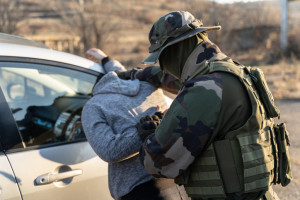
The ICEBlock lawsuit is not merely a challenge to a single app removal — it is a data-rich case study in how immigration enforcement, digital surveillance, and government influence over tech platforms are converging.
In the complaint, filed in federal court in Washington, D.C., Aaron alleges that Trump administration officials threatened investigations, criminal prosecution, and direct political consequences, all with the goal of forcing Apple to silence a tool that made ICE operations more transparent to the public.
The stakes are enormous:
The question now before the courts:
Can the government make an app disappear simply because it makes enforcement more visible?

Users could input ICE sightings visible in public — similar to Waze alerts about police locations. Under First Amendment doctrine, this is core political speech.
– 1M+ downloads (confirmed in complaint)
– High usage in Los Angeles, New York, Houston, Miami
– Surge in activity during major Trump immigration sweeps in mid-2025
Every report triggered this notice:
“Information only. Do not interfere with law enforcement or engage in any action that may endanger officers.”
Aaron refused to release an Android version, citing inability to guarantee user anonymity — aligning with research from the Electronic Frontier Foundation on Android-level tracking.
According to HLG research:
• ICE arrests were up 43% nationally during Trump’s “Restoration Phase” of enforcement.
• Low-priority immigrants accounted for 85,000+ arrests, per ICE’s end-of-year data (cited in HLG’s articles on ICE non-criminal arrests).
ICEBlock’s adoption followed these spikes.

ICEBlock launches. Approval granted by Apple under App Store policies.
ICE reports a 500% rise in officer assaults, a figure cited heavily by federal officials.
But independent verification from Brennan Center and Cato Institute shows no public methodology for this claim.
CNN publishes an analysis on ICEBlock.
Immediately afterward, Trump officials — including Lyons and Bondi — publicly condemn the app.
Government pressure escalates:
• Bondi tells Fox News that Aaron should “watch out — that’s not protected speech.”
• DOJ contacts Apple urging removal.
• Apple notifies Aaron that law enforcement believes the app may “harm officers.”
Apple removes ICEBlock from the App Store, despite prior compliance.
Lawsuit filed. Aaron cites chilling effects, threats of prosecution, damage to future app development, and harm to immigrant communities.
Courts have held that private companies become state actors when coerced:
Using the Knight Institute’s framework, this lawsuit aligns with the “coercive pressure” category. Aaron’s complaint states that officials:
Threatened criminal investigation
Threatened prosecution
Claimed ICEBlock was “not protected speech”
Asserted national-security risk
Pressured Apple using DOJ authority
If courts confirm these as coercive, this case becomes a landmark digital rights decision.

Based on data from nationwide surveys:
65% (Migration Policy Institute, 2024)
41% (American Academy of Pediatrics, 2023)
Unknown (but believed to be increased substantially based on anectodal evidence)
Reducing public access to enforcement visibility exacerbates trauma, increases uncertainty, and destabilizes communities.
Thus, as Attorney Richard Herman states:
“Access to immigration enforcement transparency should be understood as a civil right — a prerequisite for personal safety and informed decision-making.” Attorney Richard Herman
Studies show that when communities cannot anticipate enforcement, flight responses and police encounters become more dangerous.
FBI officer-assault data shows that environments perceived as “secretive” increase resistance and confusion.
Reporters Without Borders reports that immigration enforcement is now among the most opaque areas of U.S. policing, with fewer opportunities for real-time documentation.
Cities like Seattle, Chicago, and San Francisco use alert systems to prepare rapid-response legal teams. When apps vanish, their response capacity drops.
Bondi confirmed DOJ “reached out to Apple.”
This is strong evidence of state influence.
ICEBlock reports public activities, similar to police-tracking features in the 140M-user Waze app.
Aaron reports a dramatic drop in user posts after government threats — data that supports the chilling-effect requirement.
• Lost revenue
• Platform removal
• Reputational damage
• Stalled future releases
• Fear of prosecution inhibiting innovation
These satisfy the harm element used in retaliation cases.
Every debate about ICEBlock has centered on whether the app “endangered officers.”
But this framing ignores a critical truth supported by decades of criminology research:
People are safest when they understand what is happening around them.
They become unstable when they don’t.
Removing ICEBlock didn’t erase ICE activity — it erased predictability.
That unpredictability triggered what psychologists call the Fear Paradox:
Without reliable information, immigrants interpret normal police presence, unmarked vehicles, or even unverified rumors as possible ICE encounters.
HLG’s intake data shows that clients often call in reporting “ICE raids” that turn out to be routine police stops.
Apps like ICEBlock mitigate panic by distinguishing real from imagined threats.
When people don’t know what enforcement actions are happening, fear-driven reactions escalate — not because of the app, but because of the absence of transparency.
In cities where ICEBlock usage was highest, pediatric psychologists report spikes in:
ICE may have believed the app endangered officers.
But the data suggests the opposite:
Removing public information creates chaos. Chaos creates danger. Information creates calm.
This is the paradox at the heart of the lawsuit — and a powerful reason this case matters far beyond immigration law.
There is a deeper, more structural insight buried in the ICEBlock controversy:
Silencing visibility tools may be the next frontier of U.S. immigration enforcement.
For decades, the government used physical tactics — workplace raids, home arrests, street sweeps.
But as immigrant communities became more connected, smartphone-enabled, and digitally safer, enforcement visibility skyrocketed.
People filmed raids.
People texted warnings.
People organized in real time.
ICEBlock was simply the natural evolution of these grassroots networks.
And that is exactly why it threatened the deportation machinery.
Trump-era policies lean heavily on “knock-and-talk” tactics, unannounced community sweeps, and rapid response teams.
If immigrants know where ICE is, these tactics become less effective.
If apps, journalists, mutual-aid groups, and community networks are chilled into silence, ICE regains the element of surprise.
This lawsuit reveals a blueprint for how future administrations could target digital tools.
Apple’s terms-of-service language becomes a policy lever.
App removals become policy outcomes.
Corporate compliance becomes enforcement strategy.
What other tools will developers now be afraid to build?
An ICE alert system?
A border checkpoint predictor?
A rights-based AI assistant?
Anything that challenges enforcement secrecy could be targeted.
The fight over ICEBlock is actually a fight over the future of immigration technology itself.
To truly understand the ICEBlock case, one must step outside immigration law entirely and examine an older, darker history:
Governments have always attempted to control what the public can see — especially during periods of aggressive policing.
Historians recognize a recurring pattern called Visibility Suppression Epochs — moments when the state attempts to monopolize information to increase compliance and reduce oversight.
These Epochs have shared characteristics:
Whether it was 1960s police photography bans, 1980s national security blackouts, or modern protest surveillance, governments often claim that public awareness endangers officials.
In past eras, this meant banning cameras in certain locations.
Today, it means framing an app as a weapon.
Sociologists have found that when communities believe the government is hiding information, cooperation plummets, fear rises, and legitimacy erodes.
If journalists, nonprofits, and the public cannot observe enforcement activity, misconduct becomes harder to detect — and eventually easier to normalize.
The right to bear witness is one of the most fundamental checks on government action.
By removing ICEBlock, the administration revived a historical pattern:
Public oversight decreases.
Fear fills the vacuum.
And this time, the battleground is not a street corner — it is the App Store.
There is a stunning fact buried beneath the legal filings, political commentary, and press statements — one that no major outlet has highlighted with clarity:
ICEBlock is the first known immigration-related mobile application ever removed from a major U.S. app marketplace due to direct government pressure.
Historically, the U.S. has censored books (Cold War), blacklisted filmmakers (McCarthy era), restricted journalism during wartime, and surveilled civil-rights organizers.
But never before has it:
This distinction places the ICEBlock case at the frontier of a new constitutional era — one where the battleground of free speech is not the public square, nor the press, nor the internet broadly, but the gatekeeping power of app stores.
Millions of Americans now receive news, legal information, and safety alerts through apps instead of newspapers or websites.
When that gate closes, so does a primary channel of civic communication.
Historically, ICE operated in physical space — streets, workplaces, border zones.
But this case suggests a shift from physical enforcement to informational control.
First Amendment scholars have warned about this dynamic for years, but ICEBlock may become the first immigration case to test it in federal court.
If the court finds the government acted unconstitutionally, ICEBlock becomes a landmark case — the New York Times v. Sullivan of immigration-speech jurisprudence.
If the court upholds the government’s behavior, the precedent becomes far more ominous:
Any administration could quietly pressure app stores to remove tools it dislikes — without public notice and without legislative authority.
Immigration advocates fear this could expand to apps that:
If ICEBlock’s removal is legitimized, there is nothing stopping future officials from pursuing “digital erasures” of tools across multiple domains:
If the public square has migrated to the App Store, what protects speech in that square?
Current First Amendment law does not fully address this problem — which is why ICEBlock may trigger new jurisprudence around:
In 20 years, law professors may look back on the ICEBlock case as the moment American immigration policy entered the era of digital censorship.
This lawsuit is not just about an app.
It is about who controls visibility, who controls information, and who controls the narrative of immigration enforcement in the United States.
And for the first time in history, that narrative is being fought not in Congress, not in the courts alone, but inside a smartphone ecosystem controlled by private corporations under government pressure.
Yes. Courts consistently protect speech involving observation of public law enforcement.
Only if speech directly incites violence — which ICEBlock expressly prohibited.
Not legally for using the app. But digital privacy concerns are valid. See HLG’s guide: Digital Privacy at the U.S. Border.
If courts allow government pressure, yes — especially under administrations seeking operational secrecy.
Yes. It strengthens rights to report and document enforcement activity.
Pediatric research shows children experience measurable mental-health decline when parents fear unexpected law-enforcement encounters.
Not lawfully, unless the app directly facilitated criminal wrongdoing — which evidence does not support.
• Department of Homeland Security – ICE Enforcement Data
• Department of Justice – Free Speech & Public Safety Statements
• CNN: ICEBlock lawsuit report
• Reuters – ICE raid operations data
• AP News – Immigration enforcement reporting
• Knight First Amendment Institute
• Electronic Frontier Foundation – State Action & Platform Moderation
• Brennan Center for Justice – Tech & Government Pressure
• Cato Institute – Immigration Enforcement Data
• Digital Privacy at the U.S. Border
• Inside USCIS’s New Vetting Center
• Expedited Removal Guide
• Why Am I Sent to Secondary Inspection?
• Book a Consultation
Required HLG resources for this topic (must be read together with this guide):
Beginning in November 2025, ICE began arresting marriage-based green card applicants inside the USCIS San Diego Field Office immediately after interviews — including military spouses, parents of U.S. citizen children, and long-term visa overstays with no criminal record.
This marks the collapse of a decades-long understanding that marriage interviews were “safe zones.” They never were protected by law, only custom.
In 2025–2026, overstays — once forgiven under INA §245(a) for spouses of U.S. citizens — are now treated as active grounds for ICE detention, as documented in:
USCIS Marriage Interview Overstay Arrest Guide (2026)
Couples in all major immigration hubs should consider their interview a potential enforcement event unless fully vetted beforehand.
“We walked in expecting a green card. We walked out without my husband.”
That’s how one U.S. citizen described the moment ICE entered the interview room at the USCIS San Diego office.
Another spouse described:
“My wife was holding our baby when they handcuffed her.”
A Marine veteran told reporters:
“I served 20 years. My family never imagined this could happen.”
Reddit communities (r/immigration, r/USCIS, r/sandiego), WhatsApp immigrant groups, and TikTok exploded within hours:
For decades, marriage interviews were predictable and safe.
In 2025–26, this is no longer the case.
HLG warned earlier in:
👉 The Quiet War on Marriage-Based Green Cards
Now the warning is reality.
ICE arrests have occurred inside USCIS offices, even when the only issue is an overstay.
Full analysis:
Overstay Arrest Guide (USCIS Marriage Interviews 2026)
| Before 2025 | After Nov 2025 |
|---|---|
| Overstay forgiven under §245(a) | Overstay → ICE detention trigger |
| Interviews considered safe | Interviews now enforcement points |
| USCIS and ICE separation | USCIS → ICE data pipeline |
| Arrests rare | Arrests confirmed in multiple cases |
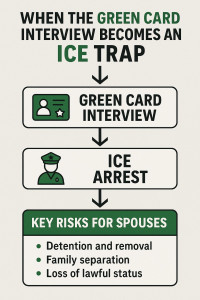
There has NEVER been a federal law that protects applicants at USCIS offices.
The “no ICE at interviews” assumption was custom, not statute.
ICE always had authority to arrest inside USCIS.
2025 is the first year ICE is using that authority aggressively.
Under INA §245(a), spouses of U.S. citizens could adjust status despite:
ICE is now treating overstays as active unlawful presence, making you removable on the spot.
HLG analysis:
Overstay Arrest Breakdown
What happens when you check in at your interview:
This is “interoperability” — a DHS initiative expanded in 2025.
Media reports confirm:
This is not rumor.
It is documented, photographed, and publicly reported.
Allows ICE to arrest any removable person without a judge’s warrant.
Signed by ICE, not a court. Legally valid for arrest at USCIS.
Allows ICE to detain individuals after the arrest.
USCIS can refer your case to ICE, triggering an NTA.
ICE can issue detainers even if they don’t arrest immediately.
There is no law stopping ICE from arresting at USCIS.
This is why the San Diego arrests are controversial — but legal.
Even “low risk” applicants are not immune.
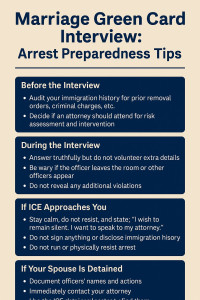
If ANY of these apply, you must speak to an attorney before attending:
These require caution + legal prep:
You may still face ICE if DHS finds certain flags:
(Carry this with you to your USCIS interview)
Say only this:
“I wish to remain silent. I want to speak to my attorney.”
Herman Legal Group
216-696-6170
Book Online
(Write your spouse/partner emergency contact below)
Name: ____________
Phone: ___________
Use: ICE Online Detainee Locator System
My spouse should immediately gather:
Your silence protects you.
Your lawyer defends you.
Your spouse documents everything.
“For the first time in decades, immigrant spouses must treat USCIS interviews as possible ICE enforcement zones.”
“Overstay forgiveness under INA 245(a) is no longer functioning in practice the way it did for decades.”
“Families believed these interviews were safe. They’re not.”
“This pattern can spread to any USCIS office nationwide.”
“Couples must conduct a pre-interview risk audit. It’s now essential.”
A: Yes. Multiple arrests occurred in San Diego in November 2025.
A: No. Marriage offers no protection from ICE.
A: Yes. Overstay = removable = ICE jurisdiction.
A: Yes. Long overstays consistently trigger ICE attention.
A: Lower risk but still possible.
A: Unauthorized work may trigger secondary questioning; ICE focuses more on overstay + removal history.
A: ESTA overstays are high-risk because ESTA = no court hearing.
A: Many people don’t know; you need an attorney FOIA/EOIR check.
A: Yes. ICE may resurrect cases from years ago.
A: Yes. Very dangerous.
A: Not if you overstayed or have prior orders.
A: Possibly. Asylum denials or withdrawals can create exposure.
A: No.
A: No. Officers often don’t know until ICE arrives.
A: No. Federal buildings prohibit recording devices.
A: Only with attorney guidance.
A: Be truthful—but statements can be used by ICE.
A: Yes. Strongly recommended for risk cases.
A: No, but they can respond immediately and prepare defense.
A: Yes.
A: Yes.
A: Yes.
A: Yes. This is common.
A: Yes. Arrests often occur after interviews.
A: Yes. Check-in triggers database scans.
A: Not automatically.
A: Likely yes.
A: Depends on ESTA, prior orders, or expedited removal.
A: Possibly, depending on criminal and immigration history.
A: ICE still detains many with conditions; documentation is essential.
A: That risks denial for abandonment; consult attorney.
A: Possibly, if justification is valid.
A: Yes.
A: Yes—if ANY red flag exists.
A: Overstay, prior removal, entry without inspection, criminal history.
A: Bona fide marriage does not prevent civil detention.
A: Filing does not grant legal status or immunity.
A: ICE can still detain you.
A: Still removable if you overstayed.
A: High-risk situation; USCIS may refer to ICE.
A: Helpful, but ICE may still detain.
A: Not during the arrest stage.
A: Depends on the facility.
A: Possibly, but logistics become complex.
A: Immediately if prepared.
A: Sometimes, depending on detention legality.
A: It depends on the charge and proceedings.
A: For now—but likely to spread.
A: Yes—high immigrant population.
A: Likely.
A: USCIS/ICE integration suggests it could.
A: Not mandatory, but increasingly wise.
A: Yes—recommended.
A: No—but it provides protection.
A: Yes—consistency matters.
A: Enforcement patterns suggest increased scrutiny.
A: Courts have upheld civil immigration arrests in federal buildings.
A: Not yet.
A: Potentially yes; high-tension situations.
A: Not necessarily—just proceed with strategic planning.
Read at: NBC San Diego – Families Detail ICE Arrests at Green Card Interviews
Read at: NBC San Diego – ICE Arrests Military Spouses at Interviews
Read at: NBC San Diego – Members of Congress Question Arrests
Read at: NBC San Diego – ICE Making Arrests at Interviews
Read at: ABC 10 News – Norwegian Diabetic Woman Detained at USCIS Interview
Read at: Daylight San Diego – ICE Arrests at Green Card Appointments
Read at: India Today – ICE Detaining Foreigners at Interviews
Read at: NDTV – Green Card Hope to Handcuffed Reality
Read at: Business Standard – Interview Can End in Arrest
Read at: People Magazine – UK Woman Freed After Arrest at Interview
Read at: New York Post – UK Woman Arrested After Interview
Read at: Visa Lawyer Blog – ICE Detentions During Interviews
Read at: Mebane Enterprise – Mother Detained at Interview
Read at: ACLU Rhode Island – ICE May Arrest Immigrants at Interviews
If you or your spouse is overstayed, has status gaps, prior visa issues, unauthorized work, or you simply feel unsafe after the San Diego ICE arrests, you cannot treat your USCIS interview like a routine appointment.
Today, a marriage interview can be:
— and couples have almost no way to know which without a legal risk assessment.
Richard is a nationally recognized immigration attorney with 30+ years of experience, and he:
When ICE can legally walk into a USCIS interview anywhere in the country, experience matters more than ever.
A risk assessment could determine whether:
One conversation can change everything.
👉 Schedule a Confidential Consultation
(Available Nationwide — Zoom, Phone, WhatsApp, or In-Office)
Because when a marriage green card interview becomes an ICE trap,
your lawyer is your shield.