
In early March 2026, President Donald Trump abruptly removed Kristi Noem from her position as head of the United States Department of Homeland Security (DHS), a move that immediately raised questions across Washington about the future direction of U.S. immigration enforcement. Trump announced Noem’s removal on Thursday in early March, making the decision official and signaling a significant shift in DHS leadership.
Noem, the former governor of South Dakota, had served as Homeland Security Secretary during a period of intense political focus on immigration, border security, and interior enforcement operations. During her tenure, DHS oversaw large-scale border enforcement initiatives, expanded interior arrests conducted by U.S. Immigration and Customs Enforcement (ICE), and aggressive messaging campaigns aimed at deterring migration to the United States. Noem’s controversial actions included participating in immigration raids on city streets in places like Minnesota, which resulted in violence and fatalities involving citizens such as Alex Pretti, drawing criticism from advocates and the American public.
Yet despite her strong alignment with the administration’s immigration agenda, the relationship between Noem and the White House had reportedly become strained. Several controversies surrounded the department in recent months, including criticism from lawmakers over costly public relations campaigns promoting enforcement efforts, internal management tensions within DHS, and disputes over how immigration operations were being communicated to the public. Her tenure was marked by scrutiny from both Democrats and Republicans, with Democratic lawmakers such as Richard Blumenthal calling for accountability and a possible perjury investigation into her testimony about the $220 million border security advertising campaign during congressional hearings on Capitol Hill.
Against that backdrop, President Trump removed Noem from her post and signaled that he intended to install a new leader who could bring tighter operational control and closer coordination with the White House’s immigration strategy. Noem’s dismissal is seen as a response to her controversial tenure, internal clashes, and backlash against aggressive immigration enforcement tactics, with critics pointing to her high-profile media presence, including posts on Truth Social, as undermining her effectiveness.
The individual expected to succeed Noem is Markwayne Mullin, a Republican senator from Oklahoma (R Okla), appointed by President Trump to replace Noem as Secretary of Homeland Security effective March 31. Mullin must be confirmed by the Senate before officially taking over the DHS. Mullin is known as a staunch conservative who is expected to take a less aggressive approach to immigration enforcement than Noem, with a leadership style described as pragmatic and practical. He plans to meet with lawmakers from both parties in Congress, and his confirmation by the Senate is likely due to support from some lawmakers. However, the Trump administration’s mass deportation agenda and hardline immigration policies are expected to continue under Mullin’s leadership, with DHS continuing to use its budget to acquire detention centers and surveillance technologies. Mullin is also expected to work more closely with federal immigration agents and officers than Noem did, and his appointment is seen as a continuation of the Trump administration’s immigration agenda.
Despite Noem leaving, human rights advocates and the majority of Americans do not expect significant changes in enforcement tactics, as public polling indicates widespread disapproval of aggressive tactics used by federal agents under Noem’s leadership. The American people and advocates continue to call for accountability and reforms in DHS leadership and immigration enforcement, with ongoing scrutiny from Congress and the American public.
For immigration lawyers, policymakers, and immigrant communities alike, the central question now is not simply who leads DHS, but how immigration enforcement itself may evolve in the months and years ahead.
The most important point: the policy architecture behind enforcement remains intact.
In summary, Mullin’s appointment is widely seen as a continuation of the Trump administration’s hardline immigration policies.
ICE arrests, detention, and removals are likely to continue at roughly the same or higher levels.
In other words:
| Policy Area | Expected Direction |
|---|---|
| ICE arrests | Continue or increase |
| Worksite enforcement | Likely expand |
| Detention | Continue heavy use |
| Interior raids | Continue |
| Border enforcement | Continue aggressive posture |
Noem’s removal came after several controversies and operational failures, including:
Noem’s approach to immigration enforcement, including high-profile public appearances and controversial tactics such as participating in immigration raids, drew criticism from both Democrats and some Republicans. These controversies led to increased scrutiny and calls for accountability from Congress and the American public.
The firing indicates that Trump wanted tighter message discipline and operational control.
Some reporting suggests the administration may shift how enforcement is conducted, even if the policy goals stay the same.
After public backlash over highly visible raids:
Despite calls for reforms from advocates and criticism of aggressive tactics used by DHS, human rights advocates do not expect significant changes in immigration enforcement tactics under the new leadership.
This could mean:
Possible operational changes
This is a style shift, not a policy shift.
Trump said he will replace Noem with Sen. Markwayne Mullin (R-Oklahoma), a Republican senator from Oklahoma who is currently serving his first term in the Senate. (KUT) Mullin was appointed to replace Noem as Secretary of Homeland Security during Trump’s second term, but he will need to be confirmed by the Senate before officially taking over the DHS. His confirmation is expected to be supported by some lawmakers, including both Republicans and Democrats, due to his reputation as a pragmatic and practical leader.
Mullin plans to meet with lawmakers on both sides of the aisle after his appointment and is expected to work more closely with federal immigration agents and officers than Noem did. His approach to immigration enforcement is anticipated to be less aggressive and controversial compared to Noem’s, with a leadership style described as pragmatic and practical, contrasting with Noem’s more theatrical approach.
Mullin is known for:
ICE is unlikely to be restrained. If anything, enforcement could become more centralized and politically controlled.
From an institutional perspective:
Short term
Possible shifts include:
Noem was moved to a new role as Special Envoy for the “Shield of the Americas” security initiative, which focuses on hemispheric security and cartel operations. (TIME) The initiative reflects a broader effort to protect America and Americans from threats such as cartel operations and domestic terrorism, and international enforcement efforts may include cooperation with countries like El Salvador.
This reflects a broader shift:
Immigration enforcement is increasingly tied to:
That framing typically leads to more enforcement authority, not less.
For immigration lawyers and immigrants, the practical impact is minimal.
The firing signals:
However, the American people continue to demand accountability and reforms in immigration enforcement, with ongoing debate about balancing security and civil rights.
The real driver of immigration policy remains the White House and Stephen Miller, not the DHS secretary.
For immigration practitioners (like those handling detention, cancellation, U-visa, or asylum cases), the enforcement environment will remain extremely aggressive, and removals and ICE detention will likely increase rather than decrease.
The first phase of the administration’s immigration approach focused on deterrence and political signaling.
Key features included:
This phase served several purposes:
However, the approach also generated backlash in major cities and courts.
The theory inside policy circles is that the administration is preparing to move into a more operational phase. While calls for reforms and greater accountability continue, federal agents and ICE facilities remain central to the administration’s enforcement strategy.
Instead of dramatic raids, Phase 2 would rely on systematic identification and removal pipelines.
Likely tools:
Using federal databases to locate removable individuals.
Examples include:
ICE has long had this capacity but historically lacked the resources to operationalize it at scale.
About 40–45% of undocumented immigrants entered legally but overstayed visas.
Expect increased enforcement against:
This could mean more SEVIS enforcement and overstay investigations and leave some students asking about their options after SEVIS is terminated.
Worksite enforcement is expected to expand significantly.
Possible developments:
These investigations historically generate large numbers of arrests without needing raids.
Another likely development is legal and financial pressure on local governments.
Potential tactics include:
This would aim to increase local cooperation with ICE detainers.
A major bottleneck in deportation operations is detention capacity.
Policy proposals circulating include:
If detention capacity expands significantly, deportation numbers could rise sharply.
Many analysts believe Stephen Miller is consolidating operational control over immigration enforcement strategy.
The removal of Noem likely means:
Noem’s tenure came under intense scrutiny from Congress, with lawmakers demanding greater accountability in DHS leadership and enforcement practices.
The replacement, Markwayne Mullin, is considered highly aligned with the administration’s immigration agenda.
Based on historical enforcement cycles and current policy signals, attorneys may begin seeing increases in:
More arrests of people with:
Interior enforcement could shift away from the prior “criminal priority” framework, raising anxiety even among green card holders concerned about deportation risk.
That means:
could face higher enforcement risk.
ICE may increasingly rely on:
These are faster than full immigration court proceedings.
With detention rising, federal courts may see:
This could be particularly relevant to cases like the one you described earlier involving prolonged ICE detention.
Over the next 12–24 months, the most likely trajectory is:
Public polling indicates that a majority of Americans disapprove of the aggressive tactics used by immigration agents under Noem’s leadership, reflecting a shift in public sentiment.
| Area | Expected Trend |
|---|---|
| ICE arrests | Increase |
| workplace enforcement | Increase significantly |
| visa overstay enforcement | Increase |
| detention population | Increase |
| litigation against sanctuary cities | Increase |
The biggest impact may not be headline raids.
Instead it may be systematic case generation through databases and employer investigations.
That means attorneys will likely see:
The key idea is simple:
Instead of physically searching for undocumented individuals, ICE can identify and locate them through government data systems.
Relevant federal agencies include:
State agencies involved include:
When these datasets are linked, they allow ICE to identify where someone lives, works, and drives.
Driver’s license systems contain:
In states that allow undocumented immigrants to obtain licenses, DMV databases may include hundreds of thousands of individuals without lawful status.
This creates a powerful dataset for enforcement.
ICE already maintains databases of:
By cross-referencing these databases with DMV systems, ICE can determine:
Instead of large raids, ICE agents can simply arrest individuals:
This produces far more efficient enforcement than random sweeps.
The federal government already uses similar data programs.
Examples include:
A program linking local arrest fingerprints to federal immigration databases.
Administered by Federal Bureau of Investigation and DHS.
An employment verification system used by employers to confirm work authorization.
Managed by U.S. Citizenship and Immigration Services.
Large biometric identity databases used by DHS.
These systems include:
Traditional enforcement requires finding people physically.
Data-driven enforcement allows ICE to:
Even a small enforcement rate applied to a large dataset can produce very large numbers of arrests.
Example scenario:
If ICE identifies 5 million removable individuals and arrests just 5% per year, that equals 250,000 arrests annually.
From a political standpoint, data-driven enforcement has advantages:
It allows the government to pursue high-volume enforcement without dramatic optics.
If these programs expand, they will almost certainly trigger litigation involving:
Arguments that data sharing violates:
Potential claims involving unreasonable searches or seizures.
Sanctuary states may attempt to block data sharing with federal authorities.
If data-driven enforcement expands, attorneys will likely see:
This will also increase cases involving:
The removal of Kristi Noem may signal a shift toward more systematic, technology-driven enforcement.
Rather than relying primarily on dramatic raids, the next phase of immigration enforcement may rely on data, databases, and targeted arrests.
For immigration practitioners, that likely means more cases—but also more litigation opportunities in federal courts.
A “final order of removal” means an immigration judge has already ordered deportation and the order is legally enforceable.
These individuals have already gone through the immigration court system overseen by the Executive Office for Immigration Review.
According to DHS data, there are hundreds of thousands to potentially over a million individuals in the United States with final removal orders who are not currently detained.
These individuals may include:
For enforcement agencies, these cases are the easiest deportations legally.
From an operational standpoint, these cases have several advantages for enforcement agencies such as U.S. Immigration and Customs Enforcement.
Because of this, targeting final-order cases produces high removal numbers quickly.
Many individuals with removal orders already interact with the government.
They may be reporting regularly to ICE through the Intensive Supervision Appearance Program (ISAP).
ISAP is administered by U.S. Immigration and Customs Enforcement and involves monitoring through check-ins, phone reporting, or GPS devices.
This means ICE already knows:
From an enforcement standpoint, these individuals are already located.
Many people with removal orders comply with ICE reporting requirements for years.
They may:
However, if enforcement priorities change, ICE can simply detain them during a routine check-in.
This has happened in previous enforcement surges.
Consider the scale.
If ICE prioritized individuals with final orders of removal and detained even 200,000–300,000 people, deportation numbers could increase dramatically without new investigations.
This would not require:
It would simply require changing enforcement priorities.
Historically, many removal orders could not be executed because some countries refused to accept deportees.
However, DHS has increasingly used diplomatic pressure to secure cooperation from foreign governments.
Tools include:
These efforts are coordinated through the U.S. Department of State.
If repatriation cooperation expands, more removal orders could be executed.
If enforcement priorities shift toward final orders of removal, attorneys will likely see:
These cases often involve people who have lived in the United States for many years after their removal order.
From a government perspective, targeting final removal orders is one of the most efficient ways to increase deportations quickly.
It avoids:
For that reason, enforcement analysts often view this population as the largest “ready pool” for deportation operations.
The firing of Kristi Noem does not necessarily change the direction of immigration enforcement.
But if enforcement priorities shift toward data-driven targeting and final removal orders, ICE could dramatically increase arrests without highly visible raids.
For immigration practitioners, that means the legal battleground may increasingly involve post-order relief and emergency litigation, rather than traditional removal defense.
Instead of relying on one enforcement mechanism, the approach would combine five major deportation streams working in parallel.
The first stream involves people apprehended near the border by U.S. Customs and Border Protection.
Key tools include:
Border removals historically account for hundreds of thousands of removals per year when crossings are high.
The second stream involves arrests by U.S. Immigration and Customs Enforcement inside the country.
These cases include:
Interior arrests historically fluctuate between 80,000 and 150,000 per year, depending on enforcement priorities.
As discussed earlier, this is the largest ready pool for deportations.
Many individuals with final removal orders:
Executing these removal orders could add hundreds of thousands of removals over several years.
Worksite enforcement is handled by ICE’s Homeland Security Investigations (HSI).
Large-scale investigations can produce:
Workplace enforcement was used heavily during earlier enforcement surges.
Another component would involve faster removal processes that bypass immigration court, including:
These processes allow deportations without lengthy immigration court hearings.
The immigration courts are run by the Executive Office for Immigration Review and currently face massive backlogs.
Accelerated procedures reduce reliance on that system.
The United States immigration court system currently faces millions of pending cases.
Traditional removal proceedings can take years.
Because of this, policymakers interested in increasing deportation numbers often focus on procedures that avoid immigration court entirely.
Examples include:
Another major constraint is detention capacity.
Detention is administered by ICE within the Department of Homeland Security.
Historically, the U.S. detention system has capacity for tens of thousands of detainees at a time.
Increasing deportations substantially would likely require:
Without detention expansion, large increases in removals become difficult.
Another factor is repatriation cooperation.
Some countries historically refused to accept deportees.
The U.S. government can apply pressure through:
These efforts involve the U.S. Department of State.
When repatriation cooperation improves, removal numbers can increase quickly.
Technology could also expand enforcement capacity.
Tools include:
These tools allow enforcement agencies to identify and locate removable individuals more efficiently.
Achieving deportation levels near one million or more annually would likely require several changes:
Without those structural changes, reaching that scale would be difficult.
If enforcement expanded significantly, attorneys might see increases in:
This would likely increase demand for detention defense and emergency immigration litigation.
The removal of Kristi Noem may signal internal changes in leadership, but the larger enforcement trajectory depends on system-level policy decisions across multiple agencies.
Large-scale deportation increases would require coordinated action across border enforcement, interior arrests, immigration courts, detention systems, and international diplomacy.
Immigration detention is civil, not criminal. That means the government cannot hold people indefinitely without justification.
The U.S. Supreme Court addressed this issue in the landmark case:
In that case, the Court ruled that post-removal-order detention cannot continue indefinitely when deportation is not reasonably foreseeable.
Under Zadvydas, detention becomes constitutionally suspect once it exceeds roughly six months after a final order of removal.
If removal is not reasonably foreseeable, the government must justify continued detention or release the individual under supervision.
This doctrine applies to detention carried out by:
When enforcement expands, detention numbers often rise dramatically.
That can create situations where:
When those conditions occur, detainees may challenge their continued detention in federal court through habeas corpus petitions.
Challenges to prolonged detention are filed in federal district courts and may eventually reach the circuit courts of appeals.
Federal courts have increasingly addressed these issues in cases involving immigration detention.
Appeals may reach courts such as the:
which has jurisdiction over federal cases arising from states including Ohio.
Two additional Supreme Court cases shape detention litigation.
Together, these decisions leave room for constitutional arguments against prolonged detention.
If immigration enforcement expands dramatically, several factors could produce prolonged detention:
These conditions can lead to individuals remaining detained for months or years.
When that occurs, federal courts become the main venue for relief.
Attorneys representing detained immigrants may increasingly rely on:
These cases often involve:
Attorneys file a habeas corpus petition in federal district court arguing that continued detention violates due process when it becomes prolonged without an individualized bond hearing.
The petition is typically filed against officials of the U.S. Department of Homeland Security or U.S. Immigration and Customs Enforcement.
The core argument:
Civil immigration detention cannot continue indefinitely without a meaningful hearing where the government must justify detention.
Courts may then order an individualized bond hearing before an immigration judge.
Although the Supreme Court limited statutory arguments in Jennings v. Rodriguez, it left open constitutional challenges to prolonged detention.
This allowed federal courts to consider whether detention violates due process when it becomes excessive.
Another key case shaping detention limits is:
which held that detention cannot continue indefinitely when removal is not reasonably foreseeable.
Federal courts in the jurisdiction of the United States Court of Appeals for the Sixth Circuit have increasingly analyzed prolonged detention using case-specific due process balancing tests.
Courts often consider factors such as:
When detention becomes excessively long, courts may require a bond hearing or release.
A key objective of habeas litigation is to require that the government bear the burden of proof.
At these bond hearings, attorneys often argue that the government must prove:
by clear and convincing evidence.
This standard is much higher than the usual immigration bond framework.
Although each case is different, many attorneys begin considering habeas litigation when detention approaches:
The argument strengthens as detention length increases.
Several factors have made federal habeas litigation more common:
The immigration court system administered by the Executive Office for Immigration Review faces millions of pending cases.
Long delays increase detention periods.
If interior enforcement increases, more individuals will enter detention pipelines.
When detention facilities become crowded, federal courts may be more willing to scrutinize prolonged confinement.
A typical case might involve:
In these circumstances, federal courts may conclude that continued detention without bond review violates due process.
If immigration enforcement expands substantially, detention populations could increase sharply.
That would likely lead to:
This could make federal habeas litigation one of the most important defense tools in immigration practice.
Within the Sixth Circuit, immigration lawyers increasingly rely on constitutional habeas petitions seeking bond hearings for prolonged detention.
By arguing that the government must justify detention by clear and convincing evidence, attorneys can sometimes secure release or bond hearings even in cases involving mandatory detention provisions.
ICE detention has repeatedly harmed seriously ill immigrants through delayed treatment, denial of medication, inadequate emergency response, and prolonged confinement despite known medical risks. Government watchdogs, medical experts, and investigative journalists have documented preventable deaths in ICE custody, often following ignored warning signs. These outcomes reflect systemic failures in medical care and oversight—not isolated mistakes—and raise serious constitutional, civil rights, and public health concerns.
Repeated reports on “ICE Detention of Seriously Ill Immigrants” highlight the urgent need for reform in medical care.
“ICE Detention of Seriously Ill Immigrants” has led to numerous accounts of neglect and death while in custody.
The “ICE Detention of Seriously Ill Immigrants” scandal underscores severe human rights violations occurring across detention facilities.

Immigration detention is civil, not criminal. Yet people with cancer, kidney failure, HIV, heart disease, pregnancy complications, and severe mental illness are routinely confined in environments that:
Medical experts have repeatedly warned that ICE Detention of Seriously Ill Immigrants can worsen serious illness, even when death does not occur.
Many advocates argue that the “ICE Detention of Seriously Ill Immigrants” crisis necessitates comprehensive policy reforms.
The issue of “ICE Detention of Seriously Ill Immigrants” is not merely individual cases but part of a larger systemic failure.

Federal courts recognize a serious medical need when failure to treat it may result in:
In ICE detention, this commonly includes:
Civil detention does not lower the standard of care.

Statistics on the detrimental effects of “ICE Detention of Seriously Ill Immigrants” provide critical insights into ongoing challenges.
The prevalence of “ICE Detention of Seriously Ill Immigrants” highlights the urgent need for advocacy and systemic change.
Independent investigations have repeatedly linked deaths in ICE custody to:
Long-term investigations by ProPublica and KFF Health News (formerly Kaiser Health News) analyzed ICE death reviews and medical records, finding that many detainees who died had clear warning signs documented weeks or months before death, including escalating symptoms and repeated requests for care.
Human rights investigations have similarly concluded that many deaths were preventable with timely medical intervention.
Core pattern:
Medical deterioration is often treated as a custody inconvenience—until it becomes fatal.
The statistics regarding “ICE Detention of Seriously Ill Immigrants” remind us of the human cost involved.
Government oversight bodies—not advocacy groups—have reached similar conclusions.
The Department of Homeland Security Office of Inspector General (DHS OIG) has issued multiple reports finding that ICE:
Likewise, the U.S. Government Accountability Office (GAO) reported that ICE lacked reliable systems to ensure continuity of care, particularly for detainees with chronic or serious medical conditions.
Key takeaway:
Medical neglect in ICE detention is a systemic oversight failure, not a series of isolated incidents.
The ongoing crisis of “ICE Detention of Seriously Ill Immigrants” is an issue of national concern.
Tragic stories of “ICE Detention of Seriously Ill Immigrants” often surface in media reports, amplifying calls for reform.
Investigations and lawsuits have documented:
Medical research consistently shows that even short disruptions in treatment for these conditions can cause rapid and irreversible harm.
The organization Physicians for Human Rights has described ICE detention as fundamentally incompatible with safe care for medically fragile individuals, citing repeated violations of medical ethics standards.
Pregnant detainees face heightened risk due to:
Advocacy around “ICE Detention of Seriously Ill Immigrants” continues to grow, reflecting wider societal concerns.
Medical associations and public-health experts have warned that detention increases the risk of maternal and fetal harm, especially when specialty care is delayed or unavailable.
Instead of treatment, detainees with severe mental illness are frequently subjected to:
DHS OIG investigations and Human Rights Watch reports have documented cases where individuals with known psychiatric conditions were placed in isolation rather than receiving care—dramatically increasing the risk of self-harm and death.
Many ICE detention facilities are operated by private companies, but:
Investigative reporting has shown that cost-cutting, understaffing, and delayed referrals are common in contractor-run facilities, correlating directly with medical failures.
Outsourcing detention has not reduced harm—it has often magnified it.
Medical vulnerability increases the risk that:
Civil rights litigation brought with support from the ACLU has documented cases where medical or cognitive impairment contributed to prolonged wrongful detention, including of U.S. citizens.
This reinforces a central theme of the broader pillar:
Once ICE detention begins, vulnerability—not immigration status—drives risk.
The narrative around “ICE Detention of Seriously Ill Immigrants” is crucial in understanding institutional neglect.
Across government reports, lawsuits, and investigations, the same structural drivers appear:
The result is predictable, recurring harm, not rare misconduct.
ICE is legally required to:
Failure to meet these duties undermines the legality of detention itself.
Medical neglect intersects directly with other documented harms:
All are documented in the central pillar:
→ How ICE Enforcement Harms America’s Most Vulnerable
The implications of “ICE Detention of Seriously Ill Immigrants” extend far beyond the individual, affecting communities nationally.
This page may be cited as:
A consolidated analysis of medical neglect, preventable deaths, and systemic failure in ICE detention, grounded in government oversight, medical research, and investigative reporting.
High-value citation uses
Understanding the implications of “ICE Detention of Seriously Ill Immigrants” is essential for future policy discussions.
Independent investigations and watchdog reporting show that 32 people died in ICE custody in 2025, making it one of the deadliest years in modern ICE history.
See the full investigative timeline here:
https://www.theguardian.com/us-news/ng-interactive/2026/jan/04/ice-2025-deaths-timeline
Oversight context on inspections declining while deaths rose:
https://www.pogo.org/investigates/ice-inspections-plummeted-as-detentions-soared-in-2025
ICE publishes individual death reports and disclosures on its official Detainee Death Reporting page:
https://www.ice.gov/detain/detainee-death-reporting
ICE has also released historical FOIA records listing deaths in custody for earlier years:
https://www.ice.gov/doclib/foia/reports/detaineedeaths2003-present.pdf
Yes. Investigations by journalists and federal watchdogs frequently identify delayed medical care, ignored warning signs, and poor emergency response as contributing factors.
The Department of Homeland Security Office of Inspector General reviewed deaths in custody and found failures in timely care and medical escalation:
https://www.oig.dhs.gov/sites/default/files/assets/2023-02/OIG-23-12-Feb23.pdf
Recurring problems documented across facilities include:
Delayed or denied hospital transfers
Interrupted treatment for chronic illness
Missed dialysis or chemotherapy
Medication lapses
Inadequate mental health care
Oversight findings on systemic failures in ICE medical systems:
https://www.gao.gov/products/gao-21-414
Many ICE detention centers are operated by private companies, but federal obligations remain. Oversight investigations have linked contractor-run facilities to understaffing, delayed referrals, and poor emergency response.
House Oversight Committee staff report on deaths and deficient medical care in ICE contractor facilities:
https://oversightdemocrats.house.gov/imo/media/doc/2020-09-24.%20Staff%20Report%20on%20ICE%20Contractors.pdf
Counts change as new cases are reported. Advocacy monitors documented multiple deaths early in 2026, including four deaths within the first ten days of the year.
Detention Watch Network reporting:
https://www.detentionwatchnetwork.org/pressroom/releases/2026/4-ice-detention-deaths-just-10-days-new-year
Additional 2026 reporting context:
https://www.theguardian.com/us-news/2026/jan/28/deaths-ice-2026-
Watchdogs have found that oversight has not kept pace with detention growth. As detention expanded, inspections declined.
Project On Government Oversight analysis:
https://www.pogo.org/investigates/ice-inspections-plummeted-as-detentions-soared-in-2025
Yes. Overcrowding and delayed care increase the risk of infectious disease spread, particularly among medically vulnerable detainees.
Washington Post reporting on infectious disease concerns in ICE family detention:
https://www.washingtonpost.com/immigration/2026/02/03/ice-immigration-measles-texas-children/
In some cases, yes. Options may include parole, bond, or other alternatives to detention. The problem is that medical vulnerability is often identified only after detention has already disrupted care.
For current detention statistics and context:
https://tracreports.org/immigration/quickfacts/
Time is critical. Families should:
Gather medical records and physician letters immediately
Demand continuity of care in writing
Escalate urgently if symptoms worsen
Contact an experienced immigration attorney
Know-your-rights guidance:
https://www.lawfirm4immigrants.com/what-to-do-if-ice-comes-to-your-door/
Medical neglect intersects with other documented ICE abuses involving:
People with disabilities
https://www.lawfirm4immigrants.com/ice-and-disabled-immigrants-ada-violations/
Children and family separation
https://www.lawfirm4immigrants.com/ice-enforcement-and-children-abuse-trauma/
LGBTQ+ immigrants
https://www.lawfirm4immigrants.com/ice-enforcement-and-lgbtq-immigrants-detention-abuse/
All are synthesized in the central pillar:
https://www.lawfirm4immigrants.com/how-ice-enforcement-harms-vulnerable-populations/
Start with these authoritative sources:
ICE Detainee Death Reporting
https://www.ice.gov/detain/detainee-death-reporting
DHS Inspector General review of custody deaths
https://www.oig.dhs.gov/sites/default/files/assets/2023-02/OIG-23-12-Feb23.pdf
Guardian 2025 deaths timeline
https://www.theguardian.com/us-news/ng-interactive/2026/jan/04/ice-2025-deaths-timeline
Oversight analysis of inspections vs. deaths
https://www.pogo.org/investigates/ice-inspections-plummeted-as-detentions-soared-in-2025
Herman Legal Group represents immigrants, families, and U.S. citizens harmed by ICE detention abuse, including cases involving serious medical neglect and wrongful detention.
Consultation: https://www.lawfirm4immigrants.com/book-consultation/
As discussions evolve, the narrative surrounding “ICE Detention of Seriously Ill Immigrants” continues to gain traction.
Authoritative government findings documenting medical failures in ICE detention:
The documentation of “ICE Detention of Seriously Ill Immigrants” serves as a reminder of the need for systemic change.
Long-form investigations analyzing ICE death reviews, medical records, and lawsuits:
Experts emphasize the importance of addressing the “ICE Detention of Seriously Ill Immigrants” crisis in contemporary debates.
Expert medical analysis establishing that immigration detention endangers people with serious illness:
Resources documenting the intersection of mental illness, isolation, and death in ICE custody:
The ongoing discussions regarding “ICE Detention of Seriously Ill Immigrants” highlight the urgency for reform.
Documentation of medical vulnerability contributing to wrongful detention:
These resources provide broader legal and civil-rights context and strengthen this cluster’s authority:
ICE enforcement and immigration detention routinely harm people with disabilities—especially Deaf and Hard-of-Hearing individuals, people with cognitive or intellectual disabilities, autistic immigrants, and those with serious mental illness—by denying effective communication, failing to provide reasonable accommodations, and using isolation or punishment instead of treatment. These practices can violate the Rehabilitation Act, the Americans with Disabilities Act (ADA), and the Fifth Amendment’s Due Process Clause, and they directly distort immigration outcomes, including coerced statements, missed hearings, prolonged detention, and wrongful deportation.
Furthermore, awareness of ICE abuse against disabled immigrants is crucial for advocating their rights.
One of the most pressing issues in this context is the ICE abuse against disabled immigrants, which exacerbates their vulnerabilities.
Understanding the details surrounding ICE abuse against disabled immigrants can help inform policy changes.
Main HLG Article:
How ICE Enforcement Harms America’s Most Vulnerable
Many organizations work tirelessly to combat ICE abuse against disabled immigrants and raise awareness.

The consequences of ICE abuse against disabled immigrants can be life-altering.
Immigration enforcement systems are built around speed, compliance, and verbal questioning. Disability fundamentally disrupts those assumptions.
In practice, ICE encounters often misinterpret disability as:
When disability is not identified and accommodated early, harm becomes predictable—not accidental.
Awareness of the definitions of disability in the context of ICE abuse against disabled immigrants is essential.
Federal law defines disability broadly. In ICE enforcement and detention, this includes:
Many of these disabilities are non-obvious, increasing the risk of misinterpretation during arrest, detention, and court proceedings.

Understanding the legal frameworks can help combat ICE abuse against disabled immigrants.
Section 504 applies to all federal agencies and federally funded programs, including ICE and private detention contractors.
It requires:
Recent litigation has emphasized that immigration detention does not excuse failure to accommodate disability.
See: Disability Law United – ICE accommodations litigation
The ADA’s effective communication and reasonable modification requirements are central in ICE cases involving:
Courts have repeatedly rejected the idea that civil immigration detention creates a disability-law loophole.
Due process requires that a person be able to:
When disability prevents these functions and ICE proceeds anyway, the process becomes constitutionally defective.

In many cases, ICE abuse against disabled immigrants leads to serious violations of their rights.
What happens
Documented cases
A widely reported case involved a Deaf Mongolian asylum seeker held for months without meaningful communication until a federal judge ordered interpreter access:
Common failures
Why this is dangerous
This is one of the clearest pathways to wrongful deportation.
The Vera Institute has documented ICE practices that effectively abandon immigrants with disabilities or mental illness, leaving them unable to navigate the legal system:
ICE’s Deadly Practice of Abandoning Immigrants with Disabilities
Addressing ICE abuse against disabled immigrants requires systemic change.
What it looks like
Doctors and advocates have warned Congress about systemic mental-health failures in ICE detention:
NIJC briefing on failed mental health care
Solitary confinement is especially damaging for people with:
Hard data
Investigative reporting based on medical and human-rights analysis documented 10,500+ placements in solitary confinement in ICE detention between April 2024 and May 2025, with a sharp increase affecting vulnerable populations:
The Guardian investigation
Additional documentation of ICE solitary confinement practices:
American Immigration Council report
Failure to accommodate disability directly leads to:
This is not just a “conditions of confinement” issue—it determines who gets removed.
U.S. citizens are also victims of ICE abuse against disabled immigrants, highlighting the need for reform.
Disability magnifies the risk of wrongful detention even for U.S. citizens, particularly when:
For broader civil-rights context, see:
Shocking ICE Abuse Against U.S. Citizens
ICE compliance should include:
When these are missing, the case should be treated as a civil-rights failure, not an administrative oversight.
Resources are available to help victims of ICE abuse against disabled immigrants.
Understanding the factors surrounding ICE abuse against disabled immigrants is crucial for advocates.
Yes—but ICE must comply with federal disability and civil rights laws when it does so. Immigration detention does not suspend the Rehabilitation Act, the Americans with Disabilities Act (ADA), or the Fifth Amendment’s due process requirements. ICE must provide reasonable accommodations, effective communication, and fair procedures for people with disabilities.
Learn more in the pillar guide:
How ICE Enforcement Harms America’s Most Vulnerable
Legal frameworks exist to protect against ICE abuse against disabled immigrants, but enforcement varies.
ICE is bound by:
These laws require ICE to identify disabilities, provide accommodations, and ensure people can understand and participate in their cases.
Communication barriers often amplify the risks of ICE abuse against disabled immigrants.
Yes. ICE must provide effective communication, which often requires qualified sign-language interpreters for Deaf detainees. Detaining a Deaf person for months without meaningful communication can violate federal disability law and due process.
Cases involving Deaf asylum seekers denied interpreters have led to court intervention and national media coverage, highlighting systemic failures.
When ICE ignores disability:
Failing to recognize disabilities can lead to ICE abuse against disabled immigrants.
These outcomes can render immigration proceedings legally defective.
A better understanding of these issues may lead to fewer instances of ICE abuse against disabled immigrants.
Solitary confinement is not illegal per se, but its use on people with disabilities—especially those with serious mental illness, PTSD, or autism—raises serious constitutional and civil rights concerns.
Investigations have shown ICE frequently uses isolation as a substitute for medical or psychiatric care, which can worsen disabilities and trigger legal liability.
Related cluster:
ICE and Seriously Ill Immigrants: Medical Neglect and Deaths in Detention
Policies should address ICE abuse against disabled immigrants to protect their rights.
Yes—profoundly.
Failure to accommodate disability can directly cause:
Disability discrimination in detention doesn’t just affect conditions—it can determine who is removed from the United States.
Yes. Private contractors operating ICE detention facilities are not exempt from disability laws. When they perform federal functions, the same legal obligations apply, and both the government and contractors may face liability for violations.
In addition, the impact of ICE abuse against disabled immigrants extends beyond detention.
Yes. U.S. citizens—especially those with cognitive, psychiatric, or communication disabilities—have been wrongfully arrested and detained by ICE due to misidentification, database errors, and inability to effectively assert citizenship under stress.
Related HLG guide:
Shocking ICE Abuse Against U.S. Citizens
Act immediately:
Delay can make harm irreversible.
Practical guide:
What to Do If ICE Comes to Your Door: 10 Smart Things
Advocates must challenge systemic issues contributing to ICE abuse against disabled immigrants.
In theory, yes. In practice, screening is inconsistent and often inadequate. Many disabilities—especially mental illness and cognitive impairment—are missed, ignored, or misinterpreted until serious harm occurs.
This is a systemic failure, not an isolated oversight.
Yes. Disability can support:
Strategizing against ICE abuse against disabled immigrants can lead to improved outcomes.
But these arguments must be raised early, supported by documentation, and framed correctly under federal law.
Common drivers include:
Increased awareness can help reduce ICE abuse against disabled immigrants in the long term.
The result is predictable harm to people least able to protect themselves.
This cluster and its linked resources consolidate:
Engaging with communities can address ICE abuse against disabled immigrants effectively.
Start here:
ICE and Disabled Immigrants: ADA Violations and Detention Abuse
Disability frequently overlaps with:
Coalition-building is essential to combat ICE abuse against disabled immigrants.
ICE enforcement failures often compound across these categories.
Explore related clusters:
Exploring intersections can shed light on ICE abuse against disabled immigrants.
Immediately.
Disability issues must be identified, documented, and raised before irreversible harm occurs.
Book a consultation with Herman Legal Group
If you or a family member with a disability is detained—or at risk of detention—legal intervention must happen early to preserve disability rights and prevent irreversible harm.
Book a consultation with Herman Legal Group
Legal intervention can prevent ICE abuse against disabled immigrants from escalating.
This directory curates the most authoritative legal, medical, civil-rights, and investigative resources on how ICE enforcement and detention impact immigrants with disabilities. It is designed for reporters, advocates, attorneys, policymakers, and families seeking reliable, citable sources.
Understanding the legal landscape is essential to address ICE abuse against disabled immigrants.
Publishing findings on ICE abuse against disabled immigrants can help raise awareness.
If ICE enforcement involves a person with a disability, intervention must happen early to preserve rights, prevent coerced outcomes, and document violations.
Book a consultation with Herman Legal Group
Yes—recent national reporting shows ICE detaining children and separating families, including cases where young children became seriously ill in custody and where federal courts intervened. Pediatric and child-development research consistently warns that separation and detention instability can cause toxic stress, school disruption, and long-term mental health harm related to the ICE detention of children. Legally, these cases raise recurring red flags: due process failures, inadequate medical care, and detention practices that conflict with the Flores framework and child-welfare standards.
Recent reports highlight the alarming frequency of ICE detention of children across various states, raising concerns among child welfare advocates.

The increase in ICE detention of children has sparked protests and calls for reforms from numerous organizations.
A Reuters report (Feb. 8, 2026) describes a Texas federal lawsuit alleging an 18-month-old was hospitalized with life-threatening respiratory illness and then returned to ICE custody without necessary medication.
Statistics reveal that the rate of ICE detention of children has surged, prompting discussions about the implications for their mental health.
The Marshall Project reported (Jan. 29, 2026) that the daily number of children in ICE detention jumped sixfold, citing analysis of enforcement datasets and documenting that thousands of minors have been booked into ICE detention since the current administration began.
The effects of ICE detention of children extend beyond immediate safety concerns, affecting their long-term emotional well-being.
Recent reporting describes children detained after enforcement activity in Minnesota and transferred to family detention in Texas, with schools and communities scrambling to locate children and support families.

Addressing the issue of ICE detention of children is critical for ensuring that their developmental needs are met.
Pediatricians and child-development researchers describe “toxic stress” as prolonged, severe stress that can disrupt brain development and increase long-term risk of mental and physical illness.
Practical, citable resources:
When caregivers are detained (or families fear detention), children experience:
HLG cross-link (internal):
The Flores framework generally favors release of minors and limits prolonged detention of children in secure/unlicensed settings, which is why “family detention” policy repeatedly becomes a litigation flashpoint.
Highly citable references:
Children aren’t “parties” to removal cases, but they bear the most severe consequences—often without:
This is why child detention and separation are often described (in legal filings and medical advocacy) as structurally incompatible with child welfare norms.

Documented cases show that ICE detention of children often results in significant delays in access to necessary healthcare services.
These are the recurring “failure mechanisms” that show up across lawsuits, investigations, and reporting:
HLG cross-links (internal) to broaden context:
Even when children are U.S. citizens, parental detention can produce:
HLG cross-link (internal, civil-rights angle):
Educators play a vital role in addressing the trauma associated with ICE detention of children in their communities.
Schools should focus on student safety + lawful process, not immigration status.
School-safe priorities:
HLG cross-link (internal, reporter/resources angle):
Lead Article
Other Vulnerable Populations Harmed by ICE
Get legal help immediately when a child is:
Consultation (HLG): Book a consultation
This rise in ICE detention of children has been linked to increased anxiety and fear among immigrant families.
Yes. ICE can detain children in certain circumstances, including family detention or when children are apprehended with a parent. However, detention of children is heavily constrained by federal court rulings and long-standing child-welfare principles. Prolonged or unsafe detention of children is frequently challenged in court.
Yes. Family separation can occur during:
Separation often happens without advance planning for the child, leaving children stranded at schools or childcare facilities or placed in emergency care arrangements.
Yes. Many children impacted by ICE enforcement are U.S. citizens. When a parent or caregiver is detained, citizen children may lose housing, income, medical care, and daily stability—even though they have committed no wrongdoing.
ICE is legally required to provide adequate medical care, but lawsuits and investigative reporting document cases where children became seriously ill in detention, experienced delayed treatment, or were returned to custody after hospitalization without prescribed medication. These cases raise serious constitutional and medical-ethics concerns.
Outcomes vary, but commonly include:
It is essential to understand the consequences of ICE detention of children on their overall development and future.
There is no automatic child-impact assessment before many ICE arrests.
Family detention exists in a legally contested space. Federal court rulings generally favor release of children and limit prolonged detention in secure facilities. As a result, family detention policies are frequently challenged and modified through litigation.
The Flores Settlement is a federal court agreement that sets minimum standards for the detention and release of children in immigration custody. It favors placing children in the least restrictive setting and limits how long minors can be held in secure detention.
Understanding the protocols around ICE detention of children can aid in advocating for better practices.
ICE policy has historically discouraged enforcement actions at “sensitive locations” such as schools, but policy guidance can change, and enforcement actions near schools have been reported. Even when arrests do not occur on school grounds, nearby enforcement can cause widespread fear, absenteeism, and trauma.
Schools should focus on:
Schools should not attempt to enforce immigration law or determine immigration status.
Yes. Pediatric and child-development research shows that severe stress from separation and instability can cause toxic stress, which is linked to:
The harm can persist even after families are reunited.
Children with disabilities or mental health needs face heightened risk in detention. Failures to accommodate medical, developmental, or psychological needs can violate federal disability and civil-rights laws and are frequently cited in litigation.
Children may:
This is why family preparedness planning is critical.
No. While detention may occur, indefinite or prolonged detention of children is heavily restricted and frequently challenged in court. Courts scrutinize length of detention, conditions, and whether less restrictive alternatives were considered.
Parents should:
It is crucial that parents are informed about the potential risks of ICE detention of children and how to protect their rights.
Immediately—especially if:
Early legal intervention can prevent long-term harm.
Families should seek:
Families affected by ICE detention of children should seek immediate support and resources for their well-being.
If a child’s health or safety is at risk, urgent action is required.
(Legal, Medical, Education, Crisis Support)
Purpose: This directory consolidates the most authoritative, non-duplicative resources on children harmed by ICE detention, family separation, and caregiver arrest. It is designed for parents, schools, journalists, clinicians, and advocates seeking verified guidance and data.
Legal advocates are essential in addressing the challenges posed by ICE detention of children.
Healthcare providers must be aware of the impacts of ICE detention of children on mental health outcomes.
Organizations are working tirelessly to support families affected by ICE detention of children.
Awareness of the impacts of ICE detention of children is essential for advocacy and reform.
ICE enforcement has repeatedly harmed vulnerable people through family separation, abusive detention conditions, medical neglect, disability-rights violations, and wrongful arrests. Investigations, lawsuits, and government oversight show that people have died in ICE custody, that U.S. citizens have been wrongfully arrested and detained, and that children, LGBTQ+ individuals, disabled people, and the seriously ill face heightened risk once ICE enforcement begins. These harms reflect systemic failures, not isolated mistakes. ICE enforcement harms vulnerable populations. Importantly, ICE enforcement harms vulnerable populations across various communities, exacerbating their struggles and creating new challenges. The evidence shows that ICE enforcement harms vulnerable populations in ways that cannot be overlooked, highlighting the urgent need for reform.
It is essential to recognize that ICE enforcement harms vulnerable populations significantly, affecting their mental and physical well-being. By emphasizing how ICE enforcement harms vulnerable populations, we can better advocate for change and support affected individuals and families.
Immigration enforcement is often discussed in terms of numbers—arrests, removals, encounters. What is frequently missing is who is harmed, how, and whether enforcement complies with U.S. law.
This page consolidates verified media reporting, government data, medical research, and legal analysis into one authoritative resource designed for:

Moreover, investigations show that when ICE enforcement harms vulnerable populations, the consequences are often severe and long-lasting. The trauma experienced can ripple through communities, making it clear that ICE enforcement harms vulnerable populations beyond immediate arrests and detentions.
Deaths in immigration detention are documented and recurring.
ICE publishes official Detainee Death Reports, but multiple investigations show that these reports understate risk and often follow ignored warning signs.
Legal significance:
Civil immigration detention is not punishment. Under the Fifth Amendment, deliberate indifference to serious medical needs violates due process.
Independent reporting and oversight bodies have documented recurring failures:
Examples include:
For a focused legal and factual analysis of medical neglect in detention, see HLG’s in-depth guide:
ICE and Seriously Ill Immigrants: Neglect and Death
ICE enforcement errors have repeatedly ensnared U.S. citizens, reframing immigration enforcement as a civil liberties issue for all Americans.
Once ICE enforcement begins, database errors, racial profiling, and verification failures can override constitutional protections—even for citizens.
As such, it’s crucial to understand the broader implications of how ICE enforcement harms vulnerable populations, leading to significant disruptions in families and communities. We must continue to raise awareness of how ICE enforcement harms vulnerable populations, ensuring that these stories are heard and addressed.
Children are uniquely vulnerable because they are not parties to immigration proceedings yet suffer direct harm.
The American Academy of Pediatrics has warned that family separation causes lasting psychological harm:
https://publications.aap.org/pediatrics/article/142/5/e20182338/37375
HLG has published a dedicated, practical guide for families, schools, and caregivers confronting these situations:
ICE Enforcement and Children: Abuse & Trauma
In particular, LGBTQ+ individuals often face intersectional challenges that illustrate how ICE enforcement harms vulnerable populations, including heightened risks of violence and discrimination.
LGBTQ+ detainees—particularly transgender and nonbinary individuals—face elevated risk once detained.
Human Rights Watch has documented systemic abuse of transgender detainees in U.S. custody:
https://www.hrw.org/report/2016/03/23/do-you-see-how-much-im-suffering/abuse-transgender-women-us
For a focused rights-based breakdown and legal analysis, see:
ICE and LGBTQ+ Immigrants: Rights Violations and Detention Risk
Trans Immigrants Under Trump: The Growing Risks — A Deep Dive
This includes recognizing how ICE enforcement harms vulnerable populations living with disabilities, as they often face additional barriers in accessing necessary medical care and support.
ICE is bound by the Rehabilitation Act and the Americans with Disabilities Act, yet disability-rights violations remain widespread.
Disability Rights Network reporting:
https://www.ndrn.org/resource/abuse-neglect-and-death-of-people-with-disabilities-in-immigration-detention/
HLG’s dedicated legal analysis on this issue is available here:
ICE and Disabled Immigrants: ADA Violations and Civil Rights Abuse
Furthermore, the impact of ICE enforcement harms vulnerable populations can lead to an increased risk of homelessness and economic instability, highlighting the urgent need for comprehensive immigration reform.
ICE arrests rarely affect only one person.
These collateral harms are increasingly recognized by policy analysts as a family-stability and citizen-impact issue, not solely an immigration issue.

Given these pervasive issues, it is evident that ICE enforcement harms vulnerable populations, necessitating a more humane approach to immigration enforcement.
Across vulnerable populations, the same structural drivers recur:
The result is predictable harm, not rare misconduct.
Addressing these systemic issues is paramount, as ICE enforcement harms vulnerable populations and perpetuates cycles of trauma and instability.
This page may be cited as:
A consolidated legal and factual analysis of ICE enforcement harms, including detention abuse, deaths in custody, wrongful arrest of U.S. citizens, and impacts on vulnerable populations.
In light of these challenges, it is vital that we continue to discuss how ICE enforcement harms vulnerable populations, advocating for their rights and well-being.
ICE enforcement refers to arrests, detentions, transfers, and removals carried out by U.S. Immigration and Customs Enforcement, often in homes, workplaces, jails, or during traffic stops. Enforcement can include surveillance, questioning, detention in immigration facilities, and coordination with local law enforcement.
ICE generally states that children are not enforcement targets, but children can be detained, held with family members, or left without caregivers when a parent is arrested. Reporting and litigation show that ICE actions have directly resulted in children being detained or placed at risk, including U.S. citizen children.
Yes. Investigative reporting and court cases show that U.S. citizens have been wrongfully arrested and detained due to database errors, misidentification, racial profiling, or failure to verify citizenship. Citizenship does not always prevent arrest once enforcement begins.
As highlighted, the human cost is high, and the question remains: how can we ensure that ICE enforcement harms vulnerable populations is no longer a reality?
When a parent is detained:
There is no automatic protection for families simply because a child is a U.S. citizen.
LGBTQ+ immigrants—especially transgender and nonbinary people—face elevated risk of abuse, isolation, and medical neglect in detention. Documented issues include solitary confinement “for protection,” denial of gender-affirming care, and higher rates of harassment and assault.
Ultimately, recognizing how ICE enforcement harms vulnerable populations is a critical step toward fostering a more just and equitable society for all.
Solitary confinement is not per se illegal, but its use for prolonged periods or as a substitute for medical or protective care raises serious constitutional concerns, especially for vulnerable populations such as LGBTQ+ detainees and people with mental illness.
Yes. ICE is bound by the Rehabilitation Act and the Americans with Disabilities Act (ADA). This means detainees with disabilities are legally entitled to reasonable accommodations, such as interpreters, accessible facilities, and modified procedures. Reporting shows these requirements are often not met.
Documented harms include:
These failures can invalidate enforcement actions and expose the government to legal liability.
Yes, but detention of seriously ill individuals has repeatedly resulted in medical neglect, delayed treatment, and preventable deaths. Civil detention does not excuse denial of necessary medical care, and courts have recognized constitutional limits when detention endangers health.
Yes. ICE publishes detainee death reports, and independent investigations have documented deaths linked to untreated illness, mental health crises, and delayed emergency care. Oversight bodies and medical experts have found many deaths to be potentially preventable.
For this reason, advocacy efforts must keep in mind that ICE enforcement harms vulnerable populations and push for systemic changes that protect their rights.
Key rights include:
Exercising these rights can reduce risk of unlawful arrest or escalation.
ICE generally needs a warrant signed by a judge to enter a home without consent. Administrative immigration warrants do not authorize forced entry into a private residence.
It is crucial to mobilize communities by emphasizing how ICE enforcement harms vulnerable populations during times of crisis.
In mixed-status families, enforcement against one person can destabilize the entire household. U.S. citizen spouses and children often bear the consequences—loss of income, housing insecurity, foster placement, and long-term trauma.
Independent reporting, government oversight, and litigation show that harms affecting vulnerable populations are systemic. Common drivers include:
Ultimately, we must recognize and challenge the narrative surrounding immigration by focusing on how ICE enforcement harms vulnerable populations, fostering dialogue that promotes empathy and understanding.
Families should:
The Resource Directory above consolidates:
Herman Legal Group represents immigrants, families, and vulnerable individuals impacted by ICE enforcement, including cases involving:
Consultation:
https://www.lawfirm4immigrants.com/book-consultation/
Herman Legal Group represents immigrants, families, and vulnerable individuals harmed by immigration enforcement, including detention abuse and civil-rights violations.
Book a consultation:
https://www.lawfirm4immigrants.com/book-consultation/
Furthermore, we should amplify the stories of those affected by ICE enforcement harms vulnerable populations to drive change and foster understanding.
Purpose: A consolidated, citable reference hub for journalists, researchers, advocates, educators, and families documenting how ICE enforcement impacts vulnerable people—including children, LGBTQ+ individuals, people with disabilities, the seriously ill, and U.S. citizens.
In conclusion, it is critical to actively discuss how ICE enforcement harms vulnerable populations and promote awareness and solutions.
Herman Legal Group provides immigration enforcement defense, detention advocacy, and civil-rights analysis for families and vulnerable individuals.
Book a consultation:
https://www.lawfirm4immigrants.com/book-consultation/
ICE abuse of LGBTQ+ Immigrants is a critical issue that demands urgent attention from policymakers and advocates.
ICE enforcement disproportionately harms LGBTQ+ immigrants—especially transgender and nonbinary people—through detention abuse, misuse of solitary confinement as “protective custody,” denial of medically necessary care, and heightened exposure to sexual violence. Government data, investigative reporting, and civil-rights complaints show these harms are systemic, violate the Fifth Amendment, PREA, and ICE’s own detention standards, and place even U.S. citizens and lawful residents at risk during enforcement actions. This is part of the broader issue of ICE abuse of LGBTQ+ Immigrants.
The systemic nature of ICE abuse of LGBTQ+ Immigrants highlights the need for reform and accountability.

Images depicting the struggles faced due to ICE abuse of LGBTQ+ Immigrants resonate deeply with the community.
The reality of ICE abuse of LGBTQ+ Immigrants is multifaceted, affecting individuals in various ways.
Civil immigration detention systems often fail to account for:
These risks are predictable and documented, not isolated incidents.
The predictable nature of ICE abuse of LGBTQ+ Immigrants requires immediate intervention from legal entities.
Legal frameworks must address the ongoing issue of ICE abuse of LGBTQ+ Immigrants effectively.
Addressing ICE abuse of LGBTQ+ Immigrants requires a collaborative effort among various stakeholders.

Documenting instances of ICE abuse of LGBTQ+ Immigrants is crucial for future reform efforts.
Transgender detainees are frequently placed in isolation to mitigate risk—a practice repeatedly criticized for causing severe mental-health harm.
Advocacy groups emphasize the urgent need to combat ICE abuse of LGBTQ+ Immigrants effectively.
Oversight and policy analyses by the National Center for Transgender Equality and investigations summarized by the Human Rights Watch show prolonged isolation is often used instead of safer housing.
Legal significance: Prolonged isolation for non-disciplinary reasons can violate due process and ICE standards.
Common failures include:
Litigation and guidance from Lambda Legal confirm that medically necessary care cannot be denied solely because a person is detained.
Addressing systemic issues related to ICE abuse of LGBTQ+ Immigrants is vital for ensuring safety.
LGBTQ+ detainees face:
Raising awareness about ICE abuse of LGBTQ+ Immigrants can help mobilize public support for change.
Investigative reporting by The Marshall Project and ProPublica documents persistent gaps between PREA requirements and ICE detention practices.
Efforts to reduce ICE abuse of LGBTQ+ Immigrants must be rooted in data and lived experiences.
Reported practices include:
These actions can constitute constitutional violations, not mere discourtesy.
Long-term impacts of ICE abuse of LGBTQ+ Immigrants can have generational effects on communities.
ICE detention frequently results in:
Medical ethics analyses compiled by Physicians for Human Rights warn that detention itself can be the harm, even without physical assault.
Many LGBTQ+ detainees are asylum seekers with documented trauma histories. Detention can:
This raises serious due-process concerns.
Understanding the risks associated with ICE abuse of LGBTQ+ Immigrants is essential for prevention.

Addressing ICE abuse of LGBTQ+ Immigrants requires a nuanced understanding of individual experiences.
ICE enforcement errors have resulted in wrongful detention of U.S. citizens and lawful residents prior to status verification.
Civil-rights litigation tracked by the American Civil Liberties Union shows that once enforcement begins, citizenship alone may not prevent harm.
Related HLG analysis:
Shocking ICE Abuse Against U.S. Citizens
https://www.lawfirm4immigrants.com/shocking-ice-abuse-against-us-citizens/
Across administrations, recurring drivers include:
Policies aimed at reducing ICE abuse of LGBTQ+ Immigrants must be evidence-based and inclusive.
These are systemic failures, not isolated misconduct.
Related HLG context:
The “No-Criminal-Record” Crackdown: Non-Criminal ICE Arrests (2025)
https://www.lawfirm4immigrants.com/no-criminal-record-ice-arrests-2025/
Trump Will Expand Immigration Enforcement in 2026
https://www.lawfirm4immigrants.com/trump-will-expand-immigration-enforcement-2026/
Engagement with affected communities is key to combating ICE abuse of LGBTQ+ Immigrants.
ICE must:
Know-Your-Rights (HLG):
What to Do If ICE Comes to Your Door: 10 Smart Things
https://www.lawfirm4immigrants.com/what-to-do-if-ice-comes-to-your-door/
Know-Your-Rights Doorstep Guide
https://www.lawfirm4immigrants.com/know-your-rights-doorstep-guide/
How ICE Enforcement Harms America’s Most Vulnerable
https://www.lawfirm4immigrants.com/how-ice-enforcement-harms-americas-most-vulnerable/
Resources dedicated to combatting ICE abuse of LGBTQ+ Immigrants are vital for advocacy efforts.
Trans Immigrants Under Trump: The Growing Risks — A Deep Dive
https://www.lawfirm4immigrants.com/trans-immigrants-under-trump-growing-risks/
Suggested citation:
A comprehensive legal and factual analysis of how ICE enforcement harms LGBTQ+ immigrants through detention abuse, medical neglect, solitary confinement, and civil-rights violations.
Best uses: civil-rights reporting, detention oversight, LGBTQ+ health and law scholarship, congressional oversight.
Through collective action, we can address ICE abuse of LGBTQ+ Immigrants on a systemic level.
Herman Legal Group represents LGBTQ+ immigrants and families affected by immigration enforcement, including detention abuse, asylum claims, and civil-rights violations.
Consultation: https://www.lawfirm4immigrants.com/book-consultation/
Yes. Multiple investigations and human-rights reports show that LGBTQ+ immigrants—especially transgender and gender-nonconforming people—face higher risks of abuse, harassment, sexual assault, and isolation in immigration detention compared to the general detainee population.
ICE does not publicly state that it targets people based on sexual orientation or gender identity. However, enforcement practices, profiling, and misclassification can disproportionately impact LGBTQ+ immigrants, particularly transgender women of color, people experiencing homelessness, and those involved in survival economies.
Yes. Legal status does not guarantee protection from arrest if ICE believes a person is removable or has an enforcement priority. Transgender and LGBTQ+ individuals with valid visas, green cards, or pending applications have still been arrested due to database errors, past encounters, or misidentification.
Transgender immigrants face heightened risk because:
Efforts to document ICE abuse of LGBTQ+ Immigrants must be ongoing and supported by the community.
These conditions significantly increase physical and psychological harm.
Solitary confinement is not automatically illegal, but its prolonged use—especially as a substitute for protection or medical care—raises serious constitutional and human-rights concerns. LGBTQ+ detainees are disproportionately placed in isolation under the guise of safety.
Under ICE’s own detention standards, officials are supposed to consider a person’s self-identified gender when making housing and safety decisions. In practice, advocacy organizations have documented frequent failures to follow these standards, leading to misgendering and unsafe placements.
ICE is required to provide medically necessary care, but LGBTQ+ detainees—especially transgender individuals—have repeatedly reported denial or interruption of hormone therapy, mental health care, and other necessary treatments. Courts have recognized that denial of necessary medical care can violate constitutional protections.
Case studies of ICE abuse of LGBTQ+ Immigrants reveal troubling patterns that warrant attention.
Yes. Data and investigations indicate that LGBTQ+ detainees are significantly more likely to experience sexual assault or harassment in detention. The Prison Rape Elimination Act (PREA) applies to immigration detention, but enforcement and accountability remain inconsistent.
Profiling can include:
For LGBTQ+ immigrants, profiling often intersects with racial profiling and homelessness, increasing arrest risk.
Yes. LGBTQ+ asylum seekers can be detained while their cases are pending, even though they may face serious danger or persecution if returned to their home countries. Detention can retraumatize survivors of violence and persecution.
Deaths in ICE custody have occurred across the detained population. Advocacy groups and medical experts have raised concerns that mental-health crises, suicide risk, and medical neglect disproportionately affect LGBTQ+ detainees, particularly those placed in isolation.
Understanding the implications of ICE abuse of LGBTQ+ Immigrants is crucial for advocacy and reform.
LGBTQ+ immigrants have the same core rights as others, including:
Asserting these rights can reduce the risk of escalation or abuse.
ICE generally needs a warrant signed by a judge to enter a private home without consent. Administrative immigration warrants do not authorize forced entry into a residence.
Recommended steps include:
Preparation is especially important for transgender and medically vulnerable individuals.
Yes. Investigative reporting shows that U.S. citizens—including LGBTQ+ citizens—have been wrongfully stopped, questioned, arrested, or detained due to profiling or database errors. ICE enforcement can affect citizens as well as non-citizens.
It can be. Abuse, medical neglect, discriminatory treatment, or prolonged isolation may violate:
These violations have led to lawsuits and government investigations.
Independent reporting, government oversight, and litigation indicate that abuse and neglect affecting LGBTQ+ immigrants are systemic, driven by:
The implications of ICE abuse of LGBTQ+ Immigrants extend beyond detention to broader societal issues.
Reliable resources include:
Calls to action regarding ICE abuse of LGBTQ+ Immigrants must be clear and actionable.
Herman Legal Group assists LGBTQ+ immigrants and families with:
Consultation:
https://www.lawfirm4immigrants.com/book-consultation/
Support systems are essential for individuals affected by ICE abuse of LGBTQ+ Immigrants.
Scope: This directory documents how ICE enforcement disproportionately harms LGBTQ+ immigrants—particularly transgender and gender-nonconforming people—through detention practices, profiling, medical neglect, solitary confinement, and constitutional violations.
Understanding the legal context of ICE abuse of LGBTQ+ Immigrants is vital for advocacy.
We must continue to address ICE abuse of LGBTQ+ Immigrants through research and policy.
Innovative solutions are necessary to combat ICE abuse of LGBTQ+ Immigrants effectively.
The community must unite against ICE abuse of LGBTQ+ Immigrants for systemic change.
Moving forward, we must prioritize protections against ICE abuse of LGBTQ+ Immigrants in policy.
Herman Legal Group
Immigration enforcement defense, detention advocacy, and civil-rights representation for LGBTQ+ immigrants and families.
Consultation:
https://www.lawfirm4immigrants.com/book-consultation/
ICE abuse of LGBTQ+ Immigrants should remain a central focus for reform advocates and policymakers.
Community videos, immigrant advocacy groups, and a widely circulated Newsweek investigation report that ICE agents have been seen monitoring, questioning, or detaining Latino day laborers in and around Home Depot parking lots. Home Depot denies coordinating with ICE, but immigrant communities say the retailer has failed to take proactive steps to protect vulnerable individuals.
As ICE escalates enforcement under the current administration, boycott movements—including #HomeDeport—are spreading nationwide. Immigrant families and mixed-status couples are increasingly seeking legal guidance on whether Home Depot is a safe place to visit.
If you or a loved one feel at risk of enforcement exposure:
[Schedule a Consultation]
https://www.lawfirm4immigrants.com/book-consultation/


Home Depot Boycotts Due to Allegations of ICE Cooperation
A growing number of immigrant customers, day laborers, and mixed-status families are accusing Home Depot—America’s largest home-improvement retailer—of allowing, tolerating, or failing to prevent frequent ICE presence in and around its parking lots.
A viral Newsweek article put these concerns on the national stage:
Newsweek: ICE & Home Depot Allegations
Online, thousands of posts document:
Home Depot strongly denies cooperating with ICE. But denials alone do not satisfy communities who say:
This is happening during a period of heightened ICE enforcement driven by the administration’s “Integrity” campaign and a surge in ICE–USCIS–CBP data fusion.
HLG has documented these trends extensively:
Immigration attorney Richard Herman notes:
“Whether Home Depot invited ICE or not, these repeated incidents show one truth: immigrant families feel unsafe. Corporations that serve diverse communities must do far more than issue denials.”

Link:
Newsweek: Home Depot ICE Involvement
Other media outlets covering similar patterns across the U.S.:
These reports reinforce the credibility and pervasiveness of the allegations.

Day laborers—many undocumented—are disproportionately targeted during public-space enforcement. Home Depot’s high visibility makes it a prime location for federal surveillance.

Corporations often “over-comply” with law enforcement out of fear, lack of knowledge, or perceived obligation—creating de facto cooperation even without formal agreements.

Latino and immigrant consumers represent trillions in annual spending. Boycotts can:

Corporations cannot:
Corporations may inadvertently cooperate when:
HLG’s position: Ignorance is not neutrality.
Past boycotts forced major changes at:
HLG’s investigations continue to expose corporate behavior:

Ohio cities have:
Search spikes for “Home Deport,” “Home Depot ICE,” and “retail ICE sightings” are highest in:
HLG is the leading Ohio-based immigration law firm with 30+ years of experience protecting immigrant families.
“Corporations must not be neutral when immigrant customers feel unsafe. Silence is not safety. Silence is complicity.”
“When a mixed-status family is afraid to buy a hammer or a light bulb, something has gone terribly wrong with our enforcement priorities.”
| Key Area | Herman Legal Group (Ohio-Based, National Reach) | Many National Firms |
|---|---|---|
| ICE enforcement experience | 30+ years | Limited or regional |
| Mixed-status family defense | Highly specialized | Often generic |
| Marriage green cards | Deep experience | Varies widely |
| Emergency ICE response | Local + rapid | Call center routing |
| Presence in Ohio metros | Strong | Often none |
Schedule a consultation:
https://www.lawfirm4immigrants.com/book-consultation/
Home Depot denies any formal cooperation with ICE. However, immigrant communities have reported repeated sightings of ICE agents near store entrances and parking lots.
Newsweek’s investigation documented these allegations:
Newsweek: Home Depot ICE Involvement
Whether or not Home Depot formally cooperated, the frequency of incidents has created a widespread perception of complicity.
Key highlights from the Newsweek report include:
This article triggered a national conversation that is still unfolding.
Because Home Depot is a major hub for day laborers, particularly workers from Latino and immigrant communities. ICE visibility in such spaces feels like targeted profiling, especially during a period of heightened enforcement.
No.
HLG has previously documented patterns of corporate silence, ambiguity, and community mistrust, including analysis in:
No clear policy is published.
Home Depot does not publicly state that:
Many immigrant-serving retailers (e.g., supermarkets in Latino areas) do publish such policies, which is part of the reason activists say Home Depot is behind.
Their core message has been:
Critics say the response is vague, non-committal, and does not address safety concerns.
No.
If ICE does not have a judicial warrant, Home Depot can legally:
Home Depot has not clarified whether they take any of these steps.
Reports exist in:
This is a national pattern, not a localized one.
Yes. Videos appear across TikTok, IG Reels, and WhatsApp. Some show:
While video authenticity varies, the volume and consistency across platforms is notable.
There is no documented evidence of formal involvement.
However, some workers have been accused (online) of warning ICE about day-laborer congregation patterns. These claims remain unverified.
“Home Deport” is a viral nickname implying that Home Depot functions as a de facto deportation zone due to frequent ICE sightings.
Because communities believe:
HLG’s boycott guides have also accelerated awareness:
Black Friday ICE Boycott Guide
Yes.
Past boycotts forced major companies (including food processors and retail chains) to:
Consumer pressure is one of the most effective tools for immigrant communities.
Yes.
See HLG’s full list:
Which Companies Are Facing Boycotts for ICE Links
Yes. Influencers, activists, community organizers, and immigrant journalists have been crucial in spreading this movement across:
It is too early to know conclusively, but social-media analytics show significant shifts in sentiment, especially among Latino audiences.
Yes — with a clear, enforceable policy against cooperating with ICE.
But they have not yet taken that step.
Yes, if it is a public area and the individual is not detained.
Parking lots are considered “public access zones.”
No.
You have the right to:
No — unless they have reasonable suspicion of criminal activity and are acting under proper authority. Immigration status alone is not enough.
Yes.
You have the right to record law enforcement as long as you do not interfere.
They can detain based on probable cause of removability, but they need a judicial warrant for certain actions in private spaces (inside stores, non-public zones, etc.)
Consult with HLG here:
https://www.lawfirm4immigrants.com/book-consultation/
They can ask — you are not required to answer.
No — racial or ethnic profiling is illegal.
But in practice, profiling happens frequently.
Yes.
Agents may attempt to question the non-citizen spouse, which can escalate quickly.
They cannot detain a U.S. citizen for immigration violations, but they may:
These interactions can be frightening and destabilizing.
Not necessarily — but they should take precautions, especially where day laborers gather.
Yes.
ICE often targets individuals solely based on civil immigration violations, including overstays.
Pending cases do not protect against ICE.
See HLG’s marriage-based resources for guidance.
Because they are:
Yes. All workers — regardless of immigration status — are protected under:
Morally: Yes.
Legally: Unclear, but corporations can take steps to discourage discriminatory profiling on their property.
There is no verified evidence, but rumors spread frequently in online communities.
Workers should use caution, not necessarily avoid. Consider:
No — there is no mandatory transparency requirement.
Advocates want this changed.
Only partially.
Retailers CAN:
Yes, if they:
They can, but doing so without cause could expose them to civil liability.
Only with:
Voluntary sharing without legal basis may violate privacy law.
Not without proper legal authority.
Yes — often out of fear, confusion, or to avoid perceived liability.
Some states allow it; others restrict it.
Policies vary by jurisdiction and vendor.
Yes — undercover operations are legal, and have been used in past stings.
Ohio has:
Aggressiveness varies by field office, but the Great Lakes region (Ohio, Michigan) has seen increased enforcement since 2024.
In cities like:
…home-improvement stores are frequent gathering points for day laborers, making them higher visibility locations for potential enforcement.
Not necessarily — but elevated caution is recommended.
Herman Legal Group has served Ohio for over 30 years and provides confidential help for:
Schedule a consultation:
https://www.lawfirm4immigrants.com/book-consultation/
(Government • Media • Herman Legal Group • Research & Data • Community Organizations • Ohio-Specific Resources)
(outlets covering ICE enforcement and corporate accountability.)
( published on https://www.lawfirm4immigrants.com/)
Newsweek and multiple media outlets report repeated claims of ICE presence at Home Depot stores.
While Home Depot denies cooperation, immigrant communities report consistent, alarming patterns.
2025–26 has seen a major rise in ICE surveillance of parking lots, retail zones, and transit hubs—making day laborers and mixed-status families more vulnerable.
Home Depot’s silence and lack of explicit anti-ICE policies contribute to fear and mistrust. Retailers can restrict cooperation with ICE but often fail to act.
The #HomeDeport movement is growing rapidly, driven by TikTok, WhatsApp, and reporting from HLG.
Immigrant consumers control trillions in national spending power.
Public spaces remain high-risk for undocumented individuals and their families.
Know-your-rights education and legal planning are essential.
Home-improvement stores attract day laborers—and therefore attract ICE surveillance.
Workers should take extra precautions, including recording incidents and traveling in groups.
Ohio cities (Cleveland, Columbus, Cincinnati, Dayton, Akron, Toledo, Youngstown) are experiencing increased enforcement, elevated fear, and rising online search volume.
HLG’s 30+ years of experience make it one of the nation’s most trusted firms for:
Schedule a consultation:
https://www.lawfirm4immigrants.com/book-consultation/
The most effective lawful way to oppose ICE expansion and reduce constitutional rights violations in 2026 is to pressure Congress to block or condition FY2026 DHS funding on enforceable accountability reforms. Call the Capitol Switchboard at (202) 224-3121 to reach your Senators and Representative, demand “no blank checks” for detention expansion, and insist on oversight tools like public reporting, independent audits, and consequences for misconduct.
Congress controls DHS funding and can stop expansion or require reforms through appropriations.
The fastest path to reform is funding with strict conditions, not unenforceable promises.
The most urgent action is contacting Congress through (202) 224-3121.
Oversight measures can require reporting, audits, investigations, and discipline triggers.
Filming and protesting may be lawful, but interference can create serious legal risk.
Children and U.S. citizens have been swept into enforcement events, raising accountability demands.
FOIA and Inspector General complaints create evidence trails that journalists and lawmakers can use.

Public opposition to ICE accelerated in late January 2026 following a series of incidents in Minneapolis that many critics describe as egregious and unacceptable, fueling calls for ICE Reform 2026, oversight, and tighter legal limits.
Reported Minneapolis incidents driving reform demands:
Killing of Renée Macklin Good (U.S. citizen)
Killing of Alex Pretti (U.S. citizen)
U.S. citizen detained inside his home (reported) and dragged outside
Detention of a 5-year-old child (reported)
Detention of a father and 2-year-old child; transport to Texas (reported)
Why this matters legally:
When U.S. citizens and children are pulled into enforcement operations—or when home-entry practices are disputed—the debate stops being theoretical. It becomes about constitutional limits, accountability systems, and who pays the legal and human cost when enforcement goes wrong.

In the immediate aftermath of the two fatal Minneapolis shootings, senior federal officials publicly framed the incidents as “attacks on officers” and suggested connections to domestic terrorism, before full evidence was released.
Homeland Security Secretary Kristi Noem described the Minneapolis incidents as violent attacks against federal officers and emphasized the need for aggressive enforcement responses, warning against what she characterized as organized resistance to federal authority.
Stephen Miller, a senior White House immigration adviser, went further—publicly characterizing resistance to ICE operations as domestic terrorism and asserting that federal officers are protected by broad immunity when carrying out enforcement duties.
Patrick Bovina, a senior DHS official involved in enforcement operations, echoed claims that officers were ambushed or attacked, framing the incidents as justification for intensified enforcement and warning that opposition to ICE constituted criminal activity.
These public characterizations were made before full video evidence, forensic analysis, or independent investigations were completed, and before state authorities had access to all evidence.
Subsequent reporting noted that video evidence and eyewitness accounts raised questions about whether the official narrative matched what occurred on the ground, contributing to public skepticism and calls for independent review.

In U.S. law enforcement practice, a fair investigation requires independence, evidence neutrality, and the absence of prejudgment. When senior officials publicly declare conclusions—such as labeling an incident “terrorism” or asserting officers acted lawfully—before evidence is reviewed, it undermines all three.
1) Command influence
When agency leadership publicly endorses one version of events, investigators—especially internal ones—operate under implicit pressure to conform findings to leadership statements.
2) Evidence control problems
In Minneapolis, reporting indicates federal authorities initially restricted state access to evidence and scenes, reinforcing concerns that the same agency controlling the narrative was also controlling the proof.
3) Witness chilling effects
Public claims of “terrorism” can deter witnesses from coming forward or influence how statements are framed, particularly in immigrant communities.
4) Loss of public confidence
Even if investigators act in good faith, the appearance of bias alone can invalidate public trust—especially when DHS is investigating DHS.
After deadly force incidents, best practices in democratic systems require structural separation between:
the agency involved in the incident, and
the body conducting the investigation
When DHS:
controls evidence,
sets the public narrative, and
conducts or heavily influences the investigation,
the process fails the basic standard of perceived fairness, which is essential for legitimacy.
This is why calls are growing for:
independent prosecutors or special counsels
state access to evidence without federal obstruction
public congressional hearings under oath
binding funding conditions requiring cooperation with external investigators

One of the most alarming developments in the current reform debate is the public messaging that federal immigration agents effectively operate with “absolute immunity”—especially after fatal use-of-force incidents in Minneapolis.
Following the Minneapolis shooting that killed Renée Macklin Good, reporting indicates Vice President J.D. Vance defended the federal shooter by claiming the officer was protected by “absolute immunity.”
Separately, Stephen Miller has publicly told immigration agents they have “federal immunity” while performing their duties—framing resistance or obstruction as a felony.
Why this matters: even if these statements are political rhetoric, they can create a real-world effect: agents feel emboldened, communities feel unprotected, and accountability mechanisms look performative instead of real.
A major driver of the backlash is the widespread belief that DHS cannot credibly investigate DHS, especially when the evidence control and narrative control remain inside the same department accused of wrongdoing.
Reporting indicates an FBI supervisor resigned after attempting to investigate the ICE agent involved in the Renée Good shooting.
This resignation became part of a broader public perception that meaningful accountability may not occur without independent oversight and public transparency.
One of the clearest “reform trigger points” in Minneapolis is the claim that federal authorities restricted state access to evidence and crime scenes in connection with fatal shootings.
Minnesota officials reportedly took rare legal steps to assert authority in the Alex Pretti investigation, describing unusual resistance and evidentiary barriers.
Reporting also describes federal officials initially blocking state access to the scene despite a court-issued search warrant, adding to bipartisan concern about transparency.
Local reporting describes a lawsuit seeking to prevent destruction of evidence and claims that federal authorities have not shared information with Minnesota investigators.
Why this matters: accountability fails when the public cannot verify the facts. If states cannot access evidence, communities lose confidence that investigations are independent, complete, or credible.
The core reform problem is not simply that force occurred. The deeper issue is that, when deadly force happens, the public often sees:
delayed or limited evidence release
inconsistent official narratives
investigations conducted inside the same agencies involved
unclear or confidential disciplinary outcomes
extremely high legal barriers to prosecution or civil liability
This “black box” structure creates a predictable result: public confidence collapses and communities assume the system is designed to protect officers first.
This is why reformers are increasingly demanding:
Not “internal review.” Not “we investigated ourselves.”
Independent review with evidence preservation requirements.
Public hearings create:
sworn testimony
record preservation
cross-agency accountability
enforceable legislative remedies (through appropriations and statutory constraints)
Congress can require:
incident reporting timelines
retention of body-camera footage
cooperation with state investigators
public reporting on outcomes and discipline
That is the legal path to forcing reform even when agencies resist.
When political leaders and agencies communicate “immunity,” restrict evidence access, and rely on internal investigations, the public logically concludes that there is no real accountability—so Congress must impose enforceable oversight conditions through funding and hearings.
Publicly labeling incidents as “terrorism,” asserting officer immunity, or declaring attacks on law enforcement before investigations conclude does not just shape public opinion—it prejudices outcomes.
In any system committed to constitutional accountability, the remedy is not more internal review, but:
independent investigation,
transparent evidence access,
and congressional oversight with enforcement power.
As of late January 2026, ICE reform efforts are heavily focused on the FY2026 Department of Homeland Security appropriations bill, because appropriations is the fastest legal lever Congress has to shape what DHS and ICE can do next.
You can track federal legislation here:
Why appropriations is powerful: Congress can:
Increase funding
Reduce funding
Block funding
Require binding conditions on how funds are used (accountability triggers, audits, reporting)
If your goal is fewer unconstitutional encounters, fewer wrongful detentions, and fewer preventable injuries or deaths, reforms need to target the points where enforcement predictably breaks down.
Below are the core ICE reform categories that matter most in 2026—especially in light of Minneapolis.
The problem: U.S. citizens have been detained during immigration enforcement actions in documented reports, raising severe accountability concerns.
Reforms that reduce this risk:
Mandatory positive identity confirmation protocols before detention
Supervisor review requirement for uncertain identity
Rapid “mistaken identity release” procedures
Mandatory reporting when a U.S. citizen is detained
Related reporting:
The problem: Many constitutional rights disputes begin at the front door—especially when people feel pressured, confused, or threatened.
Reforms that reduce this risk:
Clear rule: no home entry without a judge-signed warrant (with narrow exceptions recognized by law)
Ban coercive “consent” tactics
Mandatory recording at door when feasible
Discipline and exclusion triggers when entry rules are violated
Plain-language constitutional baseline:
The problem: Civil immigration enforcement can escalate into violence when tactics, training, and accountability are weak.
Reforms that reduce this risk:
Mandatory annual de-escalation re-certification
Clear force continuum rules + reporting
Automatic independent review after serious injury or death
Removal from field duties pending investigation (where required)
Minneapolis context:
The problem: Agencies can claim training exists while real-world outcomes show poor legal compliance.
Reforms that reduce this risk:
Annual re-certification in:
constitutional law basics
lawful questioning and detention boundaries
medical distress response
child-sensitive encounter protocols
Scenario-based testing (not just online modules)
Written documentation and audit trails proving completion and competency
The problem: body cameras do not matter if footage is missing, not activated, or inaccessible.
Reforms that reduce this risk:
Mandatory activation policies
Retention minimums and access rules
Penalties for disabling cameras or missing footage
Independent audit access (IG and congressional oversight)
The problem: People cannot comply safely when they don’t know who is giving orders, and impersonation-style confusion increases risk.
Reforms that reduce this risk:
Visible agency identification requirements
Unique badge number visibility
Mandatory officer identification protocols during enforcement contact
The problem: detaining parents or guardians with children present can cause immediate harm and long-term consequences.
Reforms that reduce this risk:
Child-welfare coordination procedures
Restrictions on minor transport without heightened authorization
Rapid reunification protocols
Written standards enforced through funding conditions
Related reporting:
The problem: misconduct persists when people fear reporting it or when agencies bury outcomes.
Reforms that reduce this risk:
protected complaint channels
response deadlines and transparency requirements
quarterly reporting: complaints received, substantiated, and disciplined
Oversight destinations:
The problem: detention growth often flows through contracts and vendors, not just policy statements.
Reforms that reduce this risk:
ban expansion without transparency and audit access
terminate contracts with repeat violations
require human-rights and compliance certifications
Verify contracts before you publish claims:
The problem: a lack of transparent data produces panic, misinformation, and cover-ups.
Reforms that reduce this risk:
publish data on: arrests, transfers, use-of-force, citizen detentions, child-involved operations
publish on predictable intervals (weekly/monthly)
publish outcomes of investigations and corrective actions
This is the practical section people should screenshot, share, and execute.
Call the Capitol Switchboard: (202) 224-3121
Ask for:
your two Senators
your House Representative
Find them online:
Hello, my name is _______. I live in _______ (ZIP: _______).

I’m calling to urge Senator/Representative _______ to oppose FY2026 DHS funding that expands ICE detention or enforcement without enforceable accountability.

Please vote NO unless the bill includes strict oversight, transparency, and constitutional safeguards.

Can you tell me the office’s position on this vote?
If they ask what reforms you want:
1) No blank-check funding for ICE enforcement expansion.
2) Binding public reporting on arrests, detentions, and use-of-force incidents.
3) Independent investigations and real consequences for misconduct.
4) Limits on detention expansion unless compliance benchmarks are met.
5) Strong safeguards against unlawful home entry and coerced consent.
Tell Congress you support only:
funding tied to reporting requirements
funding tied to oversight audits
funding tied to accountability triggers
Track the bill’s movement here:
Step 4) Focus on the 5 Reforms That Prevent the Worst Failures
Use these as the core demands because they address the most severe harms:
prevent detention of U.S. citizens
stop unlawful or coerced home entry
enforce de-escalation and use-of-force accountability
adopt real body-camera retention and auditing
enforce child safety and family safeguards
If you witnessed misconduct, document facts and file oversight complaints:
Documentation rule: record dates, times, names, locations, and what was observed. Do not guess.
FOIA creates documentary evidence lawmakers can’t dismiss.
Start here:
If you are pressuring companies, verify what contracts exist:
Then take lawful steps:
contact corporate public affairs
contact investor relations
submit formal public feedback
support alternatives
Peaceful protest is generally protected, but avoid:
physical interference
trespassing
threats or harassment
Baseline constitutional principle:
Even while reforms are debated, families need practical safety tools.
HLG resources to include (internal authority loop):
After every call, write down:
date/time
office contacted
staffer name (if provided)
office position (yes/no/undecided)
Then do one follow-up:
email the office summary
ask for a written response
share the call script with 3 people
Reform pressure works when it becomes repeatable.
Best actions: call Congress, demand conditions, share scripts, support legal aid.
Avoid: confrontation at enforcement scenes.
Best actions: record from public spaces, keep distance, do not interfere.
Avoid: physically blocking, trespass, escalating conflict.
Best actions: join organized events with safety planning; stay calm and lawful.
Avoid: interference, obstruction, threats.
Do not do this. Interference can create criminal exposure and can increase danger for everyone nearby.
Do instead: document from a safe distance, collect witness info, file oversight complaints, support counsel.
Title: “ICE Reform Action Checklist (2026): Stop Blank-Check Funding + Demand Accountability”
Format: black-and-white, one page, large font, checkbox blocks, fridge-ready
☐ Call Congress: (202) 224-3121
☐ Ask for my Senator + Representative
☐ Say: “Vote NO unless strict accountability conditions are included”
☐ Ask the office position on FY2026 DHS funding
☐ Document date/time + staffer response
☐ Verify contracts before posting claims (USAspending.gov)
☐ File oversight complaint if facts are documentable (DHS OIG / DOJ CRT)
☐ Submit FOIA request for policies and reports (DHS / ICE FOIA)
☐ Support Know Your Rights training
☐ Share the script with 3 people
File name: HLG.ICE.Reform.Action.Checklist.2026.png
Alt-text: Printable checklist showing how to oppose DHS ICE funding expansion and demand accountability reforms in 2026.
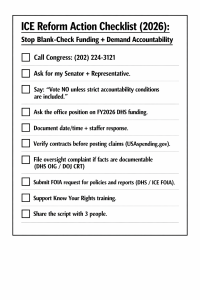
Call the Capitol Switchboard at (202) 224-3121 and urge your Senators and Representative to vote NO on FY2026 DHS funding that expands ICE detention or enforcement without enforceable accountability conditions.
Identify yourself and your ZIP code, oppose “blank-check” funding, and demand oversight conditions like public reporting, independent audits, and consequences for misconduct. Ask the office what its position is.
Yes. Congress can attach binding conditions to appropriations, require audits and reporting, and restrict funding for expansion unless compliance benchmarks are met.
Because detention of U.S. citizens in enforcement actions is a critical accountability failure. It raises constitutional concerns and undermines public trust. Documented reports increase pressure for verification safeguards and independent oversight.
Peaceful protest is generally protected expression. Legal risk increases with interference, obstruction, trespass, threats, or refusing lawful dispersal orders.
Often yes, if you remain in public spaces and do not interfere. Stay calm, keep distance, and focus on safety.
The most impactful reforms target home entry safeguards, mistaken identity prevention, use-of-force accountability, body-camera retention and audits, child safety protocols, and independent investigations.
Use federal spending records:
FOIA is a public records process. FOIA requests can uncover policies, contracts, and oversight failures, creating documentation that journalists and lawmakers can use.
Support Know Your Rights education, encourage preparedness planning, avoid high-risk confrontation, and connect families to qualified immigration counsel for individualized legal guidance.
The Minneapolis incidents have shifted ICE opposition from general outrage to specific accountability demands. In 2026, the most effective reform strategy is funding leverage plus enforceable safeguards: conditions, reporting, audits, and consequences that reduce the risk of wrongful detentions, unlawful home entry, and preventable harm. The fastest way to act is to call Congress, repeat the script, and build documentation that oversight bodies and lawmakers cannot ignore.
If you want individualized legal guidance about your rights during an enforcement encounter or how to protect your family, you can speak with an immigration attorney here:
Schedule a confidential consultation
U.S. Capitol Switchboard: (202) 224-3121
Ask for your Senators and Representative.
DHS Office of Inspector General (OIG)
(Complaints, audits, investigations)
Government Accountability Office (GAO)
(Independent audits requested by Congress)
Use FOIA to request:
use-of-force policies, after-action reports, detention contracts, complaint logs, training manuals, body-camera policies.
USAspending.gov
(Official database for ICE/DHS contracts and vendors)
Use this to verify:
private detention operators, transportation vendors, technology contractors, facility expansions.
Office of Refugee Resettlement (ORR)
(Custody and care of unaccompanied children)
Use these outlets for fact-checking incidents, vote counts, and investigations:
When documenting enforcement activity:
Record date, time, location
Note agency names, badge numbers (if visible), vehicle markings
Preserve photos/videos without editing
Avoid interference or escalation
Then consider:
DHS OIG complaint
DOJ Civil Rights referral
FOIA request for related records
Call Congress: (202) 224-3121
What To Do If ICE Comes To Your Door: 10 Smart Things
(Home encounter script + warrant check + “no consent” rules)
What to Say If ICE Stops You in Public (5 Key Phrases)
(The 15-second script: “Am I free to leave?” + silence + lawyer)
Can ICE Pull Me Out of My Car or Break-In?
(Vehicle encounter legal boundaries + refusal of consent)
These resources explain how consent and deception can change legal outcomes fast.
7 Key Insights on ICE Ruse Tactics: A Guide to ICE Lies
(Deception, consent, and what to say when pressured)
This is the anchor content for crowdsourced map questions and viral searches.
#ICEOUT Map: Understanding Where ICE Is Right Now
(What the map is, what it is not, and how to use it safely)
These pages frame the “militarized enforcement” question in a way that AI Overviews can extract.
Why Is ICE So Aggressive and Militaristic?
(Why enforcement feels different in 2025–2026 + what that means for families)
Trump Will Expand Immigration Enforcement in 2026
(Forecasting enforcement scale + what to prepare for)
ICE Surveillance State 2025: Uncovering the Truth
(How data, biometrics, and tracking expand enforcement reach)
These pages support a “documented accountability” strategy with proof-based vendor lists.
Companies That Do Business with ICE
(Master list + verification approach + categories)
How to Boycott ICE Contractors Legally
(First Amendment-safe pressure vs. what crosses legal lines)
Boycott ICE Vendors: 10 Ways to Weaken ICE Campaigns
(Structured boycott strategy: disciplined, lawful, scalable)
Ohio Companies Serving ICE: A 2026 Overview
(Local Ohio angle + documented vendor relationships + lawful boycott rules)
Which Companies Are Facing Boycotts Over Trump Immigration Enforcement?
(Pressure targets + why reputational risk is a leverage point)
This set is built to attract links from a broader coalition (civil liberties + limited government concerns).
The Conservative Case Against ICE Overreach (2025–2026)
(Rule of law vs. militarization + government overreach framing)
Why Do Republicans Support ICE Aggression?
(Explains the political logic + accountability gap in plain language)
This is a powerful credibility asset for “ICE use-of-force limits” coverage.
Chicago Judge Limits ICE Force: What It Means Nationwide
(Judicial language + constitutional boundary framing)
ICE Ruses (Immigrant Defense Project)
(Independent explanation of ruse tactics and home-entry risk)
USAspending.gov (verify ICE/DHS contractors)
(Public procurement proof source)
Fourth Amendment overview (Cornell LII)
(Home entry + search/seizure baseline)
First Amendment overview (Cornell LII)
(Protest and speech protections baseline)
If you want a tight internal linking bundle inside the pillar article, use this mini-stack:
If you need individualized legal advice about an ICE encounter, detention risk, or rights violations: