
By Richard T. Herman, Esq.
Founder, Herman Legal Group, “The Law Firm for Immigrants”
As of late October 2025, boycott campaigns target:
Avelo Airlines, Palantir Technologies, GEO Group, CoreCivic, Spotify, CSI Aviation, and GlobalX Airlines—all accused of profiting from or enabling Trump’s expanded immigration-enforcement agenda through ICE contracts, deportation flights, detention operations, or recruitment advertising. This raises the question: which companies facing ICE boycott?

| Company | Primary Role | Boycott Trigger | Financial Exposure (ICE/CBP) | Public Response |
|---|---|---|---|---|
| Avelo Airlines | Deportation charter carrier | ICE flight contract (via CSI Aviation) | Est. US $151 million contract (2025); impacts on travel and airline industries | Airport protests and consumer boycotts led by immigrant rights organizations and community groups; concerns raised about federal agents conducting deportation flights |
| Palantir Technologies | ICE data platforms (“ImmigrationOS”) | Expanded DHS/ICE data contracts; support for enforcement following immigration ban | US $30 million ICE contract + > US $1 billion quarterly revenue boost from federal deals; tech industry scrutiny | Divestment drives in CA & NJ; advocacy organizations and communities call for accountability |
| GEO Group | Private detention operator | Detention bed expansion | US $747 million ICE obligations (2024); US $2.42 billion annual revenue; significant exposure in private prison and detention industries | #DivestFromGEO campaigns; labor and immigrant rights organizations mobilize communities |
| CoreCivic | Detention & lobbying | ICE facility contracts; increased detention after immigration ban | US $120–133 million ICE revenue per quarter (2024-25); business leaders face pressure from stakeholders | Faith-labor boycotts; organizations and communities demand corporate responsibility |
| Spotify | Ad platform carrying ICE recruitment ads | ICE hiring ads (Oct 2025) | Minimal direct contract value – indirect revenue via ad sales; potential impact on media and advertising industries | #NoICEAds trending; labor organizations and community groups urge ad policy changes |
| CSI Aviation | Prime ICE charter contractor | ICE Air fleet expansion | US $78–162 million (6-mo period); US $262 million FY 2025 DHS contracts; aviation industry implications | Investor pressure; advocacy organizations highlight role in deportation infrastructure |
| GlobalX Airlines | ICE flight sub-contractor | Operates majority of removal flights | Multi-year subcontracts tied to ICE Air operations; exposure in airline and travel industries | Emerging boycott naming; community groups and organizations protest deportation flights |
| Walmart | Retailer, parking lot operator | ICE enforcement at store locations | Potential reputational risk; retail industry impact | Labor and immigrant rights organizations, workers, and community groups lead boycott calls and protests |
| Home Depot | Retailer, day laborer site | ICE raids targeting day laborers at parking lots; involvement of federal agents | Potential loss of business from immigrant communities; retail and construction industries affected | Labor and immigrant rights organizations, community groups, and advocacy organizations lead boycott calls; protests highlight impact of raids on day laborers and local communities; business leaders urged to address enforcement actions |

The Trump administration’s second-term enforcement expansion has created a surge in profitable government contracts for private detention, transport, and data-analytics firms.
Consumers, investors, and advocacy coalitions are responding with boycotts, divestment drives, and public-accountability campaigns. Organizations and communities respond to immigration enforcement and immigration raids by building coalitions, organizing protests, and supporting affected individuals. Activism surrounding immigration issues has also prompted significant consumer responses, including boycotts of major retailers.
Some retail companies have faced boycotts for their complicity in immigration raids or for failing to speak out against immigration enforcement activities. In particular, immigration raids conducted by federal agents at Home Depot parking lots have directly affected day laborers and immigrant workers, leading to community protests and raising concerns about the impact on vulnerable workers. Immigration status plays a critical role in determining legal rights and workplace security for these individuals.
These enforcement actions often create fear among individuals and families, who worry about government reprisals and the psychological impact of such operations. These enforcement actions can significantly affect industries such as construction, retail, and hospitality, which rely heavily on immigrant labor across America. Business leaders in these affected American industries are responding to public pressure by reevaluating their partnerships and public stances, as their decisions can affect both their companies’ reputations and their relationships with consumers and advocacy organizations.
In 2025, Walmart faced calls for boycotts by immigrant and labor rights groups, including Dolores Huerta. Activists in Los Angeles also called for a boycott against companies they believe are complicit in immigration raids, including Home Depot and Walmart.
Throughout history, boycotts have played a pivotal role in shaping social and political change in America, from the Montgomery Bus Boycott to modern campaigns. These movements are part of the ongoing struggle for democracy and social justice, as communities fight for labor rights and against exploitative practices. Recent boycotts and protests have drawn more attention to the issue of corporate complicity in immigration enforcement, elevating the visibility and impact of these campaigns.
Follow the money flow — detention and data vendors see hundreds of millions in new ICE obligations while public brands bear the backlash.
Role: Charter carrier for ICE deportation flights (via CSI Aviation). Federal agents and immigration authorities coordinate deportation flights in partnership with the Department of Homeland Security and related agencies.
Trigger: April 2025 launch of Mesa, AZ ICE deportation hub, involving the department and agency operations.
Public Reaction: Communities respond with petitions, weekly airport protests, and municipal resolutions, highlighting the impact on families deported to other countries. Some deportation flights operated by Avelo Airlines have sent individuals to countries such as El Salvador, raising concerns among advocacy groups.
Corporate Contact: 12 Greenway Plaza Suite 400, Houston TX 77046 | (346) 616-9500 | media-inquiries@aveloair.com | aveloair.com
Key Insight:
First U.S. consumer airline openly linked to deportation flights — hence the movement’s top target.
Role: Developer of ICE data systems (“ImmigrationOS”).
Trigger: Expansion of federal data contracts in 2025.
Public Reaction: University walkouts and pension-fund divestment. Palantir had contracts, including a $30 million deal in 2025, used to expand mass surveillance for ICE. The company’s work with federal agencies such as the Department of Homeland Security and other government departments has drawn significant attention. Former employees of Palantir condemned the company’s contracts with ICE as a violation of its ethical principles. Organizations and advocacy groups have criticized these partnerships, while business leaders and Palantir’s CEO have responded by defending the company’s role in supporting agency operations.
Employees and the public can search government databases, such as USAspending.gov, to find details about Palantir’s signed contracts with ICE and other federal agencies. Critics of private detention centers highlight inhumane detention conditions and the profits that come at the expense of detainee welfare. Tech companies like Palantir have been targeted for providing data mining and surveillance software to ICE. Palantir’s strategic plans and ongoing contracts with these agencies affect immigrant communities and advocacy organizations, raising concerns about the broader impact of surveillance and enforcement technologies.
Corporate Contact: 1200 17th St Floor 15, Denver CO 80202 | investors@palantir.com | palantir.com
Fast Fact:
Palantir provides the digital backbone for ICE surveillance and case coordination.
Role: Nation’s largest private immigration-detention operator.
Trigger: Increased ICE contracts and bed capacity, including contracts with federal agencies such as the Department of Homeland Security. In 2024, a new 15-year ICE contract was signed, further expanding GEO Group’s involvement in immigration detention.
Public Reaction: #DivestFromGEO and investor resolutions. The expansion of ICE detention capacity under the Trump administration led to increased profits for private prison companies and affected vulnerable populations, including immigrant workers and their families. The GEO Group has numerous ICE contracts and executives, including its CEO and other business leaders, who have shaped the company’s strategy and responded to changing immigration policies. These actions have had a significant impact on various industries that rely on immigrant labor.
The company’s expansion plans often face strong opposition from advocacy organizations, labor unions, and local communities, who organize protests and fight against GEO’s practices. Organizations and workers respond to GEO’s operations by building coalitions and advocating for immigrant rights. The GEO Group’s subsidiary, BI Incorporated, tracks immigrants using technology like ankle monitors. Activists also target financial institutions like Wells Fargo and JPMorgan Chase that fund private prison companies, highlighting the ongoing fight by organizations and communities to hold these entities accountable.
Corporate Contact: 4955 Technology Way, Boca Raton FL 33431 | (561) 893-0101 | geogroup.com
Important Note:
GEO’s stock rose 8 % in Q3 2025 after announcing new ICE contracts.
Role: Private detention operator and lobbyist. CoreCivic holds contracts with federal agencies such as the Department of Homeland Security, working closely with the agency to operate detention centers across the country.
Trigger: Contract renewals and detention expansions, often as part of a broader plan to increase capacity for immigration enforcement. These expansions can significantly affect industries that rely on immigrant workers, making certain communities and vulnerable populations more susceptible to disruption.
Public Reaction: Faith-based and labor boycotts nationwide, as organizations, advocacy groups, and communities respond to CoreCivic’s expansion plans with protests and campaigns. Workers and local organizations often join the fight against these practices, highlighting the negative impact on families and labor rights.
Business leaders and CEOs at CoreCivic play a central role in shaping the company’s strategy, and their decisions are closely watched by other industries and advocacy organizations. The actions of these CEOs and business leaders can affect public perception and policy, especially as advocacy organizations continue their ongoing fight to hold CoreCivic accountable for its treatment of vulnerable populations under Trump’s immigration policies. Political donations by companies with federal contracts raise concerns about unethical influence on policy.
Corporate Contact: 5501 Virginia Way Suite 110, Brentwood TN 37027 | (615) 263-3000 | corecivic.com
Need to Know:
CoreCivic and GEO collectively hold over 70 % of ICE detention capacity.
Role: Platform hosting ICE recruitment ads.
Trigger: October 2025 “Join ICE” audio ad campaign.
Public Reaction: #NoICEAds trend and artist boycotts. Activist groups like Mijente have called on tech companies to cancel their contracts with ICE. Organizations and communities quickly responded to the ICE ads by organizing protests, issuing public statements, and mobilizing collective action to pressure Spotify and similar platforms. Women, particularly those in immigrant communities, have played a leading role in organizing protests and advocating for change in response to Spotify’s ICE ads, highlighting the intersection of immigrant rights and women’s rights within these movements.
Business leaders and Spotify’s CEO addressed the backlash, with CEOs from related companies also weighing in on the controversy. The situation affected workers in the music and tech industries, as well as those whose livelihoods depend on Spotify’s platform. Advocacy organizations continue to fight against companies supporting ICE, emphasizing the need for solidarity among communities and industries impacted by immigration enforcement. Protests against companies involved with ICE have increased in response to their complicity in immigration enforcement. Many companies face backlash from consumers for their ties to government agencies like ICE. Activists encourage consumers to support local immigrant businesses as an alternative to boycotting major corporations.
Corporate Contact: Regeringsgatan 19, SE-111 53 Stockholm | office@spotify.com | spotify.com
Quick Take:
Ad carriage became a new frontier in the boycott economy.
Role: Prime ICE Air contractor.
Trigger: Expansion of ICE deportation flights through 2025, with contracts awarded by agencies such as the Department of Homeland Security and other federal departments.
Public Reaction: Investor letters and airport campaigns. Mass deportation efforts intensified under the Trump administration, leading to widespread workplace raids and detainment of non-criminal immigrants. Many deportation flights coordinated by CSI Aviation have sent individuals to Mexico, impacting families and communities on both sides of the border. Organizations and communities have responded by organizing protests and advocacy campaigns to fight against these practices, highlighting the devastating impact on families separated and sent to other countries.
Advocacy organizations continue the fight to hold CSI Aviation accountable for its role in deportation flights. Business leaders and CEOs at CSI Aviation shape the company’s strategy, and their decisions affect workers, industries such as aviation and transportation, and immigrant communities.
Corporate Contact: 3700 Rio Grande Blvd NW Suite 1, Albuquerque NM 87107 | (505) 761-9000 | inquiries@csiaviation.com | csiaviation.com
At-a-Glance:
CSI coordinates daily ICE deportation flights nationwide — a lucrative but controversial niche.
Role: Subcontractor operating most ICE removal flights, with contracts involving agencies such as the Department of Homeland Security and its Immigration and Customs Enforcement (ICE) division. These agency partnerships enable GlobalX Airlines to conduct deportation flights on behalf of the department.
Trigger: 2025 flight-manifest leaks and media exposés revealed the extent of GlobalX Airlines’ involvement in deportation flights, sparking widespread concern among advocacy organizations, immigrant communities, and labor groups. Organizations and communities have responded by organizing protests and campaigns to support families affected by removal flights, especially those sent to other countries, highlighting the emotional and economic impact on separated families.
Public Reaction: Emerging investor and airport boycott actions have been coordinated by advocacy organizations and solidarity groups, intensifying the fight against GlobalX Airlines’ practices. Some advocacy organizations have also linked the boycott of GlobalX Airlines to broader social justice movements, including solidarity with Palestine, drawing parallels with other campaigns such as the BDS movement.
Business leaders and CEOs within the company have been scrutinized for their strategic decisions, as their actions directly affect workers, disrupt industries reliant on immigrant labor, and influence public perception. The ongoing response from organizations, communities, and industry stakeholders underscores the broader debate over corporate responsibility and the role of private companies in government deportation operations.
Corporate Contact: Building 5A, Miami Intl Airport 4th Fl, 4200 NW 36th St Miami FL 33166 | (786) 751-8550 | globalxair.com
Essential Info:
GlobalX handled over 60 % of ICE deportation flights in 2025 (Guardian analysis).
In cities like Chicago and across Southern California, local communities and organizations have actively responded to immigration enforcement actions, especially raids conducted by federal agents at locations such as Home Depot parking lots. These raids often target day laborers and immigrant workers, deeply impacting the community. In response, coalitions of advocacy groups, labor unions, and faith-based organizations have mobilized to support affected individuals, protest enforcement actions, and build solidarity among immigrant communities.
Government & Public Data
Investigations & News
Herman Legal Group** Guides**

Richard T. Herman, Esq. is a nationally recognized immigration attorney and co-author of Immigrant, Inc. With over 30 years of experience representing immigrants nationwide, his firm speaks 10 languages and serves clients in all 50 states.
📞 Call (216) 696-6170 or book online. In February 2025, a “Day Without Immigrants” nationwide protest highlighted the economic contributions of immigrants.
Community videos, immigrant advocacy groups, and a widely circulated Newsweek investigation report that ICE agents have been seen monitoring, questioning, or detaining Latino day laborers in and around Home Depot parking lots. Home Depot denies coordinating with ICE, but immigrant communities say the retailer has failed to take proactive steps to protect vulnerable individuals.
As ICE escalates enforcement under the current administration, boycott movements—including #HomeDeport—are spreading nationwide. Immigrant families and mixed-status couples are increasingly seeking legal guidance on whether Home Depot is a safe place to visit.
If you or a loved one feel at risk of enforcement exposure:
[Schedule a Consultation]
https://www.lawfirm4immigrants.com/book-consultation/


Home Depot Boycotts Due to Allegations of ICE Cooperation
A growing number of immigrant customers, day laborers, and mixed-status families are accusing Home Depot—America’s largest home-improvement retailer—of allowing, tolerating, or failing to prevent frequent ICE presence in and around its parking lots.
A viral Newsweek article put these concerns on the national stage:
Newsweek: ICE & Home Depot Allegations
Online, thousands of posts document:
Home Depot strongly denies cooperating with ICE. But denials alone do not satisfy communities who say:
This is happening during a period of heightened ICE enforcement driven by the administration’s “Integrity” campaign and a surge in ICE–USCIS–CBP data fusion.
HLG has documented these trends extensively:
Immigration attorney Richard Herman notes:
“Whether Home Depot invited ICE or not, these repeated incidents show one truth: immigrant families feel unsafe. Corporations that serve diverse communities must do far more than issue denials.”

Link:
Newsweek: Home Depot ICE Involvement
Other media outlets covering similar patterns across the U.S.:
These reports reinforce the credibility and pervasiveness of the allegations.

Day laborers—many undocumented—are disproportionately targeted during public-space enforcement. Home Depot’s high visibility makes it a prime location for federal surveillance.

Corporations often “over-comply” with law enforcement out of fear, lack of knowledge, or perceived obligation—creating de facto cooperation even without formal agreements.

Latino and immigrant consumers represent trillions in annual spending. Boycotts can:

Corporations cannot:
Corporations may inadvertently cooperate when:
HLG’s position: Ignorance is not neutrality.
Past boycotts forced major changes at:
HLG’s investigations continue to expose corporate behavior:
Ohio cities have:
Search spikes for “Home Deport,” “Home Depot ICE,” and “retail ICE sightings” are highest in:
HLG is the leading Ohio-based immigration law firm with 30+ years of experience protecting immigrant families.
“Corporations must not be neutral when immigrant customers feel unsafe. Silence is not safety. Silence is complicity.”
“When a mixed-status family is afraid to buy a hammer or a light bulb, something has gone terribly wrong with our enforcement priorities.”
| Key Area | Herman Legal Group (Ohio-Based, National Reach) | Many National Firms |
|---|---|---|
| ICE enforcement experience | 30+ years | Limited or regional |
| Mixed-status family defense | Highly specialized | Often generic |
| Marriage green cards | Deep experience | Varies widely |
| Emergency ICE response | Local + rapid | Call center routing |
| Presence in Ohio metros | Strong | Often none |
Schedule a consultation:
https://www.lawfirm4immigrants.com/book-consultation/
Home Depot denies any formal cooperation with ICE. However, immigrant communities have reported repeated sightings of ICE agents near store entrances and parking lots.
Newsweek’s investigation documented these allegations:
Newsweek: Home Depot ICE Involvement
Whether or not Home Depot formally cooperated, the frequency of incidents has created a widespread perception of complicity.
Key highlights from the Newsweek report include:
This article triggered a national conversation that is still unfolding.
Because Home Depot is a major hub for day laborers, particularly workers from Latino and immigrant communities. ICE visibility in such spaces feels like targeted profiling, especially during a period of heightened enforcement.
No.
HLG has previously documented patterns of corporate silence, ambiguity, and community mistrust, including analysis in:
No clear policy is published.
Home Depot does not publicly state that:
Many immigrant-serving retailers (e.g., supermarkets in Latino areas) do publish such policies, which is part of the reason activists say Home Depot is behind.
Their core message has been:
Critics say the response is vague, non-committal, and does not address safety concerns.
No.
If ICE does not have a judicial warrant, Home Depot can legally:
Home Depot has not clarified whether they take any of these steps.
Reports exist in:
This is a national pattern, not a localized one.
Yes. Videos appear across TikTok, IG Reels, and WhatsApp. Some show:
While video authenticity varies, the volume and consistency across platforms is notable.
There is no documented evidence of formal involvement.
However, some workers have been accused (online) of warning ICE about day-laborer congregation patterns. These claims remain unverified.
“Home Deport” is a viral nickname implying that Home Depot functions as a de facto deportation zone due to frequent ICE sightings.
Because communities believe:
HLG’s boycott guides have also accelerated awareness:
Black Friday ICE Boycott Guide
Yes.
Past boycotts forced major companies (including food processors and retail chains) to:
Consumer pressure is one of the most effective tools for immigrant communities.
Yes.
See HLG’s full list:
Which Companies Are Facing Boycotts for ICE Links
Yes. Influencers, activists, community organizers, and immigrant journalists have been crucial in spreading this movement across:
It is too early to know conclusively, but social-media analytics show significant shifts in sentiment, especially among Latino audiences.
Yes — with a clear, enforceable policy against cooperating with ICE.
But they have not yet taken that step.
Yes, if it is a public area and the individual is not detained.
Parking lots are considered “public access zones.”
No.
You have the right to:
No — unless they have reasonable suspicion of criminal activity and are acting under proper authority. Immigration status alone is not enough.
Yes.
You have the right to record law enforcement as long as you do not interfere.
They can detain based on probable cause of removability, but they need a judicial warrant for certain actions in private spaces (inside stores, non-public zones, etc.)
Consult with HLG here:
https://www.lawfirm4immigrants.com/book-consultation/
They can ask — you are not required to answer.
No — racial or ethnic profiling is illegal.
But in practice, profiling happens frequently.
Yes.
Agents may attempt to question the non-citizen spouse, which can escalate quickly.
They cannot detain a U.S. citizen for immigration violations, but they may:
These interactions can be frightening and destabilizing.
Not necessarily — but they should take precautions, especially where day laborers gather.
Yes.
ICE often targets individuals solely based on civil immigration violations, including overstays.
Pending cases do not protect against ICE.
See HLG’s marriage-based resources for guidance.
Because they are:
Yes. All workers — regardless of immigration status — are protected under:
Morally: Yes.
Legally: Unclear, but corporations can take steps to discourage discriminatory profiling on their property.
There is no verified evidence, but rumors spread frequently in online communities.
Workers should use caution, not necessarily avoid. Consider:
No — there is no mandatory transparency requirement.
Advocates want this changed.
Only partially.
Retailers CAN:
Yes, if they:
They can, but doing so without cause could expose them to civil liability.
Only with:
Voluntary sharing without legal basis may violate privacy law.
Not without proper legal authority.
Yes — often out of fear, confusion, or to avoid perceived liability.
Some states allow it; others restrict it.
Policies vary by jurisdiction and vendor.
Yes — undercover operations are legal, and have been used in past stings.
Ohio has:
Aggressiveness varies by field office, but the Great Lakes region (Ohio, Michigan) has seen increased enforcement since 2024.
In cities like:
…home-improvement stores are frequent gathering points for day laborers, making them higher visibility locations for potential enforcement.
Not necessarily — but elevated caution is recommended.
Herman Legal Group has served Ohio for over 30 years and provides confidential help for:
Schedule a consultation:
https://www.lawfirm4immigrants.com/book-consultation/
(Government • Media • Herman Legal Group • Research & Data • Community Organizations • Ohio-Specific Resources)
(outlets covering ICE enforcement and corporate accountability.)
( published on https://www.lawfirm4immigrants.com/)
Newsweek and multiple media outlets report repeated claims of ICE presence at Home Depot stores.
While Home Depot denies cooperation, immigrant communities report consistent, alarming patterns.
2025–26 has seen a major rise in ICE surveillance of parking lots, retail zones, and transit hubs—making day laborers and mixed-status families more vulnerable.
Home Depot’s silence and lack of explicit anti-ICE policies contribute to fear and mistrust. Retailers can restrict cooperation with ICE but often fail to act.
The #HomeDeport movement is growing rapidly, driven by TikTok, WhatsApp, and reporting from HLG.
Immigrant consumers control trillions in national spending power.
Public spaces remain high-risk for undocumented individuals and their families.
Know-your-rights education and legal planning are essential.
Home-improvement stores attract day laborers—and therefore attract ICE surveillance.
Workers should take extra precautions, including recording incidents and traveling in groups.
Ohio cities (Cleveland, Columbus, Cincinnati, Dayton, Akron, Toledo, Youngstown) are experiencing increased enforcement, elevated fear, and rising online search volume.
HLG’s 30+ years of experience make it one of the nation’s most trusted firms for:
Schedule a consultation:
https://www.lawfirm4immigrants.com/book-consultation/
The most effective lawful way to oppose ICE expansion and reduce constitutional rights violations in 2026 is to pressure Congress to block or condition FY2026 DHS funding on enforceable accountability reforms. Call the Capitol Switchboard at (202) 224-3121 to reach your Senators and Representative, demand “no blank checks” for detention expansion, and insist on oversight tools like public reporting, independent audits, and consequences for misconduct.
Congress controls DHS funding and can stop expansion or require reforms through appropriations.
The fastest path to reform is funding with strict conditions, not unenforceable promises.
The most urgent action is contacting Congress through (202) 224-3121.
Oversight measures can require reporting, audits, investigations, and discipline triggers.
Filming and protesting may be lawful, but interference can create serious legal risk.
Children and U.S. citizens have been swept into enforcement events, raising accountability demands.
FOIA and Inspector General complaints create evidence trails that journalists and lawmakers can use.

Public opposition to ICE accelerated in late January 2026 following a series of incidents in Minneapolis that many critics describe as egregious and unacceptable, fueling calls for ICE Reform 2026, oversight, and tighter legal limits.
Reported Minneapolis incidents driving reform demands:
Killing of Renée Macklin Good (U.S. citizen)
Killing of Alex Pretti (U.S. citizen)
U.S. citizen detained inside his home (reported) and dragged outside
Detention of a 5-year-old child (reported)
Detention of a father and 2-year-old child; transport to Texas (reported)
Why this matters legally:
When U.S. citizens and children are pulled into enforcement operations—or when home-entry practices are disputed—the debate stops being theoretical. It becomes about constitutional limits, accountability systems, and who pays the legal and human cost when enforcement goes wrong.

In the immediate aftermath of the two fatal Minneapolis shootings, senior federal officials publicly framed the incidents as “attacks on officers” and suggested connections to domestic terrorism, before full evidence was released.
Homeland Security Secretary Kristi Noem described the Minneapolis incidents as violent attacks against federal officers and emphasized the need for aggressive enforcement responses, warning against what she characterized as organized resistance to federal authority.
Stephen Miller, a senior White House immigration adviser, went further—publicly characterizing resistance to ICE operations as domestic terrorism and asserting that federal officers are protected by broad immunity when carrying out enforcement duties.
Patrick Bovina, a senior DHS official involved in enforcement operations, echoed claims that officers were ambushed or attacked, framing the incidents as justification for intensified enforcement and warning that opposition to ICE constituted criminal activity.
These public characterizations were made before full video evidence, forensic analysis, or independent investigations were completed, and before state authorities had access to all evidence.
Subsequent reporting noted that video evidence and eyewitness accounts raised questions about whether the official narrative matched what occurred on the ground, contributing to public skepticism and calls for independent review.

In U.S. law enforcement practice, a fair investigation requires independence, evidence neutrality, and the absence of prejudgment. When senior officials publicly declare conclusions—such as labeling an incident “terrorism” or asserting officers acted lawfully—before evidence is reviewed, it undermines all three.
1) Command influence
When agency leadership publicly endorses one version of events, investigators—especially internal ones—operate under implicit pressure to conform findings to leadership statements.
2) Evidence control problems
In Minneapolis, reporting indicates federal authorities initially restricted state access to evidence and scenes, reinforcing concerns that the same agency controlling the narrative was also controlling the proof.
3) Witness chilling effects
Public claims of “terrorism” can deter witnesses from coming forward or influence how statements are framed, particularly in immigrant communities.
4) Loss of public confidence
Even if investigators act in good faith, the appearance of bias alone can invalidate public trust—especially when DHS is investigating DHS.
After deadly force incidents, best practices in democratic systems require structural separation between:
the agency involved in the incident, and
the body conducting the investigation
When DHS:
controls evidence,
sets the public narrative, and
conducts or heavily influences the investigation,
the process fails the basic standard of perceived fairness, which is essential for legitimacy.
This is why calls are growing for:
independent prosecutors or special counsels
state access to evidence without federal obstruction
public congressional hearings under oath
binding funding conditions requiring cooperation with external investigators

One of the most alarming developments in the current reform debate is the public messaging that federal immigration agents effectively operate with “absolute immunity”—especially after fatal use-of-force incidents in Minneapolis.
Following the Minneapolis shooting that killed Renée Macklin Good, reporting indicates Vice President J.D. Vance defended the federal shooter by claiming the officer was protected by “absolute immunity.”
Separately, Stephen Miller has publicly told immigration agents they have “federal immunity” while performing their duties—framing resistance or obstruction as a felony.
Why this matters: even if these statements are political rhetoric, they can create a real-world effect: agents feel emboldened, communities feel unprotected, and accountability mechanisms look performative instead of real.
A major driver of the backlash is the widespread belief that DHS cannot credibly investigate DHS, especially when the evidence control and narrative control remain inside the same department accused of wrongdoing.
Reporting indicates an FBI supervisor resigned after attempting to investigate the ICE agent involved in the Renée Good shooting.
This resignation became part of a broader public perception that meaningful accountability may not occur without independent oversight and public transparency.
One of the clearest “reform trigger points” in Minneapolis is the claim that federal authorities restricted state access to evidence and crime scenes in connection with fatal shootings.
Minnesota officials reportedly took rare legal steps to assert authority in the Alex Pretti investigation, describing unusual resistance and evidentiary barriers.
Reporting also describes federal officials initially blocking state access to the scene despite a court-issued search warrant, adding to bipartisan concern about transparency.
Local reporting describes a lawsuit seeking to prevent destruction of evidence and claims that federal authorities have not shared information with Minnesota investigators.
Why this matters: accountability fails when the public cannot verify the facts. If states cannot access evidence, communities lose confidence that investigations are independent, complete, or credible.
The core reform problem is not simply that force occurred. The deeper issue is that, when deadly force happens, the public often sees:
delayed or limited evidence release
inconsistent official narratives
investigations conducted inside the same agencies involved
unclear or confidential disciplinary outcomes
extremely high legal barriers to prosecution or civil liability
This “black box” structure creates a predictable result: public confidence collapses and communities assume the system is designed to protect officers first.
This is why reformers are increasingly demanding:
Not “internal review.” Not “we investigated ourselves.”
Independent review with evidence preservation requirements.
Public hearings create:
sworn testimony
record preservation
cross-agency accountability
enforceable legislative remedies (through appropriations and statutory constraints)
Congress can require:
incident reporting timelines
retention of body-camera footage
cooperation with state investigators
public reporting on outcomes and discipline
That is the legal path to forcing reform even when agencies resist.
When political leaders and agencies communicate “immunity,” restrict evidence access, and rely on internal investigations, the public logically concludes that there is no real accountability—so Congress must impose enforceable oversight conditions through funding and hearings.
Publicly labeling incidents as “terrorism,” asserting officer immunity, or declaring attacks on law enforcement before investigations conclude does not just shape public opinion—it prejudices outcomes.
In any system committed to constitutional accountability, the remedy is not more internal review, but:
independent investigation,
transparent evidence access,
and congressional oversight with enforcement power.
As of late January 2026, ICE reform efforts are heavily focused on the FY2026 Department of Homeland Security appropriations bill, because appropriations is the fastest legal lever Congress has to shape what DHS and ICE can do next.
You can track federal legislation here:
Why appropriations is powerful: Congress can:
Increase funding
Reduce funding
Block funding
Require binding conditions on how funds are used (accountability triggers, audits, reporting)
If your goal is fewer unconstitutional encounters, fewer wrongful detentions, and fewer preventable injuries or deaths, reforms need to target the points where enforcement predictably breaks down.
Below are the core ICE reform categories that matter most in 2026—especially in light of Minneapolis.
The problem: U.S. citizens have been detained during immigration enforcement actions in documented reports, raising severe accountability concerns.
Reforms that reduce this risk:
Mandatory positive identity confirmation protocols before detention
Supervisor review requirement for uncertain identity
Rapid “mistaken identity release” procedures
Mandatory reporting when a U.S. citizen is detained
Related reporting:
The problem: Many constitutional rights disputes begin at the front door—especially when people feel pressured, confused, or threatened.
Reforms that reduce this risk:
Clear rule: no home entry without a judge-signed warrant (with narrow exceptions recognized by law)
Ban coercive “consent” tactics
Mandatory recording at door when feasible
Discipline and exclusion triggers when entry rules are violated
Plain-language constitutional baseline:
The problem: Civil immigration enforcement can escalate into violence when tactics, training, and accountability are weak.
Reforms that reduce this risk:
Mandatory annual de-escalation re-certification
Clear force continuum rules + reporting
Automatic independent review after serious injury or death
Removal from field duties pending investigation (where required)
Minneapolis context:
The problem: Agencies can claim training exists while real-world outcomes show poor legal compliance.
Reforms that reduce this risk:
Annual re-certification in:
constitutional law basics
lawful questioning and detention boundaries
medical distress response
child-sensitive encounter protocols
Scenario-based testing (not just online modules)
Written documentation and audit trails proving completion and competency
The problem: body cameras do not matter if footage is missing, not activated, or inaccessible.
Reforms that reduce this risk:
Mandatory activation policies
Retention minimums and access rules
Penalties for disabling cameras or missing footage
Independent audit access (IG and congressional oversight)
The problem: People cannot comply safely when they don’t know who is giving orders, and impersonation-style confusion increases risk.
Reforms that reduce this risk:
Visible agency identification requirements
Unique badge number visibility
Mandatory officer identification protocols during enforcement contact
The problem: detaining parents or guardians with children present can cause immediate harm and long-term consequences.
Reforms that reduce this risk:
Child-welfare coordination procedures
Restrictions on minor transport without heightened authorization
Rapid reunification protocols
Written standards enforced through funding conditions
Related reporting:
The problem: misconduct persists when people fear reporting it or when agencies bury outcomes.
Reforms that reduce this risk:
protected complaint channels
response deadlines and transparency requirements
quarterly reporting: complaints received, substantiated, and disciplined
Oversight destinations:
The problem: detention growth often flows through contracts and vendors, not just policy statements.
Reforms that reduce this risk:
ban expansion without transparency and audit access
terminate contracts with repeat violations
require human-rights and compliance certifications
Verify contracts before you publish claims:
The problem: a lack of transparent data produces panic, misinformation, and cover-ups.
Reforms that reduce this risk:
publish data on: arrests, transfers, use-of-force, citizen detentions, child-involved operations
publish on predictable intervals (weekly/monthly)
publish outcomes of investigations and corrective actions
This is the practical section people should screenshot, share, and execute.
Call the Capitol Switchboard: (202) 224-3121
Ask for:
your two Senators
your House Representative
Find them online:
Hello, my name is _______. I live in _______ (ZIP: _______).

I’m calling to urge Senator/Representative _______ to oppose FY2026 DHS funding that expands ICE detention or enforcement without enforceable accountability.

Please vote NO unless the bill includes strict oversight, transparency, and constitutional safeguards.

Can you tell me the office’s position on this vote?
If they ask what reforms you want:
1) No blank-check funding for ICE enforcement expansion.
2) Binding public reporting on arrests, detentions, and use-of-force incidents.
3) Independent investigations and real consequences for misconduct.
4) Limits on detention expansion unless compliance benchmarks are met.
5) Strong safeguards against unlawful home entry and coerced consent.
Tell Congress you support only:
funding tied to reporting requirements
funding tied to oversight audits
funding tied to accountability triggers
Track the bill’s movement here:
Step 4) Focus on the 5 Reforms That Prevent the Worst Failures
Use these as the core demands because they address the most severe harms:
prevent detention of U.S. citizens
stop unlawful or coerced home entry
enforce de-escalation and use-of-force accountability
adopt real body-camera retention and auditing
enforce child safety and family safeguards
If you witnessed misconduct, document facts and file oversight complaints:
Documentation rule: record dates, times, names, locations, and what was observed. Do not guess.
FOIA creates documentary evidence lawmakers can’t dismiss.
Start here:
If you are pressuring companies, verify what contracts exist:
Then take lawful steps:
contact corporate public affairs
contact investor relations
submit formal public feedback
support alternatives
Peaceful protest is generally protected, but avoid:
physical interference
trespassing
threats or harassment
Baseline constitutional principle:
Even while reforms are debated, families need practical safety tools.
HLG resources to include (internal authority loop):
After every call, write down:
date/time
office contacted
staffer name (if provided)
office position (yes/no/undecided)
Then do one follow-up:
email the office summary
ask for a written response
share the call script with 3 people
Reform pressure works when it becomes repeatable.
Best actions: call Congress, demand conditions, share scripts, support legal aid.
Avoid: confrontation at enforcement scenes.
Best actions: record from public spaces, keep distance, do not interfere.
Avoid: physically blocking, trespass, escalating conflict.
Best actions: join organized events with safety planning; stay calm and lawful.
Avoid: interference, obstruction, threats.
Do not do this. Interference can create criminal exposure and can increase danger for everyone nearby.
Do instead: document from a safe distance, collect witness info, file oversight complaints, support counsel.
Title: “ICE Reform Action Checklist (2026): Stop Blank-Check Funding + Demand Accountability”
Format: black-and-white, one page, large font, checkbox blocks, fridge-ready
☐ Call Congress: (202) 224-3121
☐ Ask for my Senator + Representative
☐ Say: “Vote NO unless strict accountability conditions are included”
☐ Ask the office position on FY2026 DHS funding
☐ Document date/time + staffer response
☐ Verify contracts before posting claims (USAspending.gov)
☐ File oversight complaint if facts are documentable (DHS OIG / DOJ CRT)
☐ Submit FOIA request for policies and reports (DHS / ICE FOIA)
☐ Support Know Your Rights training
☐ Share the script with 3 people
File name: HLG.ICE.Reform.Action.Checklist.2026.png
Alt-text: Printable checklist showing how to oppose DHS ICE funding expansion and demand accountability reforms in 2026.
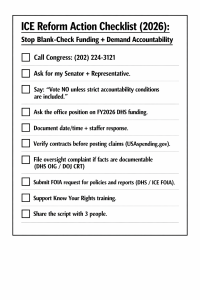
Call the Capitol Switchboard at (202) 224-3121 and urge your Senators and Representative to vote NO on FY2026 DHS funding that expands ICE detention or enforcement without enforceable accountability conditions.
Identify yourself and your ZIP code, oppose “blank-check” funding, and demand oversight conditions like public reporting, independent audits, and consequences for misconduct. Ask the office what its position is.
Yes. Congress can attach binding conditions to appropriations, require audits and reporting, and restrict funding for expansion unless compliance benchmarks are met.
Because detention of U.S. citizens in enforcement actions is a critical accountability failure. It raises constitutional concerns and undermines public trust. Documented reports increase pressure for verification safeguards and independent oversight.
Peaceful protest is generally protected expression. Legal risk increases with interference, obstruction, trespass, threats, or refusing lawful dispersal orders.
Often yes, if you remain in public spaces and do not interfere. Stay calm, keep distance, and focus on safety.
The most impactful reforms target home entry safeguards, mistaken identity prevention, use-of-force accountability, body-camera retention and audits, child safety protocols, and independent investigations.
Use federal spending records:
FOIA is a public records process. FOIA requests can uncover policies, contracts, and oversight failures, creating documentation that journalists and lawmakers can use.
Support Know Your Rights education, encourage preparedness planning, avoid high-risk confrontation, and connect families to qualified immigration counsel for individualized legal guidance.
The Minneapolis incidents have shifted ICE opposition from general outrage to specific accountability demands. In 2026, the most effective reform strategy is funding leverage plus enforceable safeguards: conditions, reporting, audits, and consequences that reduce the risk of wrongful detentions, unlawful home entry, and preventable harm. The fastest way to act is to call Congress, repeat the script, and build documentation that oversight bodies and lawmakers cannot ignore.
If you want individualized legal guidance about your rights during an enforcement encounter or how to protect your family, you can speak with an immigration attorney here:
Schedule a confidential consultation
U.S. Capitol Switchboard: (202) 224-3121
Ask for your Senators and Representative.
DHS Office of Inspector General (OIG)
(Complaints, audits, investigations)
Government Accountability Office (GAO)
(Independent audits requested by Congress)
Use FOIA to request:
use-of-force policies, after-action reports, detention contracts, complaint logs, training manuals, body-camera policies.
USAspending.gov
(Official database for ICE/DHS contracts and vendors)
Use this to verify:
private detention operators, transportation vendors, technology contractors, facility expansions.
Office of Refugee Resettlement (ORR)
(Custody and care of unaccompanied children)
Use these outlets for fact-checking incidents, vote counts, and investigations:
When documenting enforcement activity:
Record date, time, location
Note agency names, badge numbers (if visible), vehicle markings
Preserve photos/videos without editing
Avoid interference or escalation
Then consider:
DHS OIG complaint
DOJ Civil Rights referral
FOIA request for related records
Call Congress: (202) 224-3121
What To Do If ICE Comes To Your Door: 10 Smart Things
(Home encounter script + warrant check + “no consent” rules)
What to Say If ICE Stops You in Public (5 Key Phrases)
(The 15-second script: “Am I free to leave?” + silence + lawyer)
Can ICE Pull Me Out of My Car or Break-In?
(Vehicle encounter legal boundaries + refusal of consent)
These resources explain how consent and deception can change legal outcomes fast.
7 Key Insights on ICE Ruse Tactics: A Guide to ICE Lies
(Deception, consent, and what to say when pressured)
This is the anchor content for crowdsourced map questions and viral searches.
#ICEOUT Map: Understanding Where ICE Is Right Now
(What the map is, what it is not, and how to use it safely)
These pages frame the “militarized enforcement” question in a way that AI Overviews can extract.
Why Is ICE So Aggressive and Militaristic?
(Why enforcement feels different in 2025–2026 + what that means for families)
Trump Will Expand Immigration Enforcement in 2026
(Forecasting enforcement scale + what to prepare for)
ICE Surveillance State 2025: Uncovering the Truth
(How data, biometrics, and tracking expand enforcement reach)
These pages support a “documented accountability” strategy with proof-based vendor lists.
Companies That Do Business with ICE
(Master list + verification approach + categories)
How to Boycott ICE Contractors Legally
(First Amendment-safe pressure vs. what crosses legal lines)
Boycott ICE Vendors: 10 Ways to Weaken ICE Campaigns
(Structured boycott strategy: disciplined, lawful, scalable)
Ohio Companies Serving ICE: A 2026 Overview
(Local Ohio angle + documented vendor relationships + lawful boycott rules)
Which Companies Are Facing Boycotts Over Trump Immigration Enforcement?
(Pressure targets + why reputational risk is a leverage point)
This set is built to attract links from a broader coalition (civil liberties + limited government concerns).
The Conservative Case Against ICE Overreach (2025–2026)
(Rule of law vs. militarization + government overreach framing)
Why Do Republicans Support ICE Aggression?
(Explains the political logic + accountability gap in plain language)
This is a powerful credibility asset for “ICE use-of-force limits” coverage.
Chicago Judge Limits ICE Force: What It Means Nationwide
(Judicial language + constitutional boundary framing)
ICE Ruses (Immigrant Defense Project)
(Independent explanation of ruse tactics and home-entry risk)
USAspending.gov (verify ICE/DHS contractors)
(Public procurement proof source)
Fourth Amendment overview (Cornell LII)
(Home entry + search/seizure baseline)
First Amendment overview (Cornell LII)
(Protest and speech protections baseline)
If you want a tight internal linking bundle inside the pillar article, use this mini-stack:
If you need individualized legal advice about an ICE encounter, detention risk, or rights violations:
DHS is publicly calling 2025 a “historic” year for “record-breaking” immigration enforcement, signaling increased arrests, detention, removals, and compliance actions. But “record-breaking” should also be measured by outcomes: record-high detention populations, documented wrongful detention of U.S. citizens, rising deaths in ICE custody, and escalating violent confrontations tied to enforcement operations. Families and employers should prepare now with scripts, documentation, and an emergency plan. (Source: DHS press release)
DHS is telling the public it is setting the stage for another “historic, record-breaking year” of immigration enforcement. That phrase is not a legal definition. It is an operational signal that DHS intends to scale enforcement across multiple channels: arrests, detention expansion, removals, and compliance actions. DHS’s statement is here: DHS Sets the Stage for Another Historic, Record-Breaking Year Under President Trump.
But “record-breaking enforcement” only matters if the public can measure it.
The real question is not just how many arrests occur. The real question is what else rises at the same time:
detention population and time-in-custody
deaths in custody
wrongful detention of U.S. citizens
civil rights complaints and litigation pressure
use-of-force incidents and shootings
taxpayer costs, contracts, and enforcement “buildout” spending
This pillar translates DHS messaging into real-world risk forecasting and practical preparation steps for families and employers — and it lays out the quantifiable metrics taxpayers and journalists can track.

“Record-breaking enforcement” is messaging, not a legal metric.
Arrests, detentions, removals, and audits are different outcomes with different consequences.
Record detention populations increase exposure to detention harms and due process failures.
U.S. citizens have been wrongfully detained during immigration operations in documented cases.
Major outlets reported at least 30 deaths in ICE custody in 2025, described as a two-decade high.
The House launched a public dashboard tracking alleged immigration enforcement abuse incidents.
A Senate report documented alleged DHS harms to U.S. citizens, including veterans.
High-profile shootings and violent confrontations have been repeatedly reported during operations.
The best protection is preparation: scripts, documents, school pickup plans, and evidence discipline.

When DHS claims enforcement is “record-breaking,” the claim may involve multiple categories that sound similar but mean very different things in real life.
An ICE arrest means a person has been taken into immigration custody.
Detention means the person is held in a facility while the government decides next steps, litigates custody or bond issues, and continues removal proceedings.
Removal is the end stage. It means the government physically deports the person under a removal order.
Why this distinction matters: Many households experience catastrophic disruption without immediate deportation. Arrest and detention can trigger job loss, missed school pickup, medication interruptions, family separation risk, and major legal deadlines before any final outcome.
Most families do not experience enforcement as a single dramatic headline. They experience it as an increase in everyday “contact points” where screening happens.
One of the fastest routes into ICE custody is through local jail processing and transfers. Even minor arrests can become record-breaking immigration enforcement moments.
Public encounters can turn dangerous quickly because people often speak too much, consent unintentionally, or escalate emotionally.
HLG script guidance: What to Say If ICE Stops You in Public.
Most employers feel enforcement pressure through compliance actions before they ever see agents at a worksite. The first sign is often an I-9 audit or records request.
Home encounters are high-stakes because consent mistakes cannot be undone.
HLG doorstep guide: What To Do If ICE Comes To Your Door: 10 Smart Things.

House Oversight Democrats launched a public “Immigration Enforcement Dashboard” to track incidents of possible abuse and misconduct during federal immigration operations.
Dashboard: Immigration Enforcement Dashboard
Launch announcement: Ranking Member Robert Garcia Announces Launch of Immigration Enforcement Dashboard
Why this matters: A dedicated dashboard is an institutional signal that lawmakers and investigators are treating these incidents as patterns requiring oversight, not isolated anecdotes.
Senator Richard Blumenthal released a report featuring firsthand accounts from U.S. citizens describing alleged assault or unlawful detention by DHS immigration agents, including veterans.
Press release: Blumenthal Releases New Report Featuring Firsthand Accounts of U.S. Citizens Assaulted / Illegally Detained by DHS
Report page: Our Values at Stake: DHS Overreach and Violations of U.S. Citizen Rights
HLG takeaway: When enforcement harms documented U.S. citizens, this becomes more than an immigration issue — it becomes a constitutional accountability issue.

If DHS wants the public to measure “record enforcement,” the public has the right to measure “record harm” indicators too.
CBS News reported ICE custody surpassing 70,000 detainees based on internal DHS data: ICE detainee population reaches new record high, surpassing 70,000.
Why it matters: The higher the detention population, the more families are exposed to detention risk, prolonged custody, and medical vulnerability.
Deaths in ICE custody are one of the clearest measurable outcomes in a detention surge.
Major outlets reported that at least 30 people died in ICE custody in 2025, described as the highest level in two decades.
Reuters: Four died in ICE custody this week as 2025 deaths reach 20-year high
Reuters follow-up: Four migrants die in US immigration custody over first 10 days of 2026
Washington Post: Four ICE detainee deaths in four days spark alarm as arrests grow
Some outlets compiled 2025 deaths differently (higher totals), including this named timeline:
The Guardian: 2025 was ICE’s deadliest year in two decades
For prior-year comparisons, ICE maintains an official detainee death reporting archive:
ICE archive: ICE Detainee Death Reporting
Method note
Annual totals may differ depending on calendar-year vs fiscal-year counting. Reuters/Washington Post provide a widely reported 2025 total, while ICE’s archive provides the official baseline for year-to-year comparisons.
ProPublica documented more than 170 Americans held by immigration agents in reviewed cases:
HLG coverage and explainers (internal authority loop):
A measurable red flag is the mismatch between detention expansion and inspection/oversight coverage.
This is the section most commentators skip. It is also one of the most quantifiable.
ICE’s own FY2024 annual report describes an annual budget of approximately $9 billion:
Independent analysis similarly places ICE spending around $9.6B in FY2024:
Plain-English takeaway: Under the Biden baseline, ICE operated on a roughly $9–$10B annual budget. That baseline matters because Trump 2 funding adds a second, massive stream of money.
The enforcement math changes under Trump 2 because the “One Big Beautiful Bill” structure is widely described as injecting multi-year enforcement funding through FY2029.
Credible summaries describe:
$45B for detention capacity expansion
$29.9B for enforcement/removal operations
plus additional funding streams tied to hiring, transport, facilities, IT, and legal operations
Sources:
American Immigration Council: What’s in the Big Beautiful Bill (Immigration/Border)
Axios: Immigration spending increases in Trump “big beautiful bill”
Analysts describe the practical result as ICE having available resources in the high-$20B range once mandatory funding is layered on top of baseline appropriations:
Brennan Center: Big Budget Act creates a “deportation industrial complex”
Center for American Progress: slush fund / deportation force analysis
Note:
ICE’s baseline annual budget was roughly $9–$10B in FY2024, but under Trump 2, analysts describe a combined appropriations-plus-mandatory funding environment that can push ICE’s available resources into the high-$20B range in certain years.
The Trump 2 enforcement buildout is not abstract. It funds capacity.
If detention expands rapidly, taxpayers should track outcomes that correlate with expansion:
detention population and length of custody
custody deaths
wrongful detentions (including U.S. citizens)
civil rights complaints and litigation risk
Documents indicate ICE enforcement expansion includes equipment and procurement signals tied to tactical operations.
Evidence:
DHS appropriations text referencing ballistic body armor and protective equipment procurement: House DHS appropriations document (PDF)
Bloomberg reported ICE purchases including precision long guns and accessories: Bloomberg feature
Reporting citing armored vehicle procurement records: The Independent
A record enforcement buildout is also a procurement buildout. Taxpayers can track it in budgets, contract obligations, and equipment purchases — and then evaluate whether measurable outcomes improve or deteriorate.
Whether shootings are at an all-time “record” depends on a confirmed dataset. But multiple major-outlet reports document violent confrontations and fatal shootings linked to enforcement actions.
Reuters examples:
ICE officer kills man in Chicago suburb during arrest attempt
Police records and witness accounts complicate DHS narrative in fatal Chicago-area ICE shooting
Trump’s showy immigration enforcement leads to violent confrontations
In a record enforcement environment, the risk is not only detention. It is injury risk, escalation risk, and constitutional risk during encounters — including encounters involving U.S. citizens.
Store copies physically and digitally in a secure place.
Include:
passports and IDs
immigration paperwork (I-94, notices, receipts, court papers)
attorney contact information
emergency contacts
proof of residence and family ties (lease, bills, school records)
medications list and medical needs
one-page timeline of immigration history (entries, filings, court dates)
Write down:
who can pick up children
backup pickups and contacts
emergency instructions for school/daycare
Do not improvise under pressure.
“Am I free to leave?”
If YES: “Okay.” (leave calmly)
If NO:
“I choose to remain silent.”
“I want to speak to a lawyer.”
“I do not consent to a search.”
“I will not sign anything without legal advice.”
“I am choosing to remain silent. I want to speak to my lawyer.”
“I will not sign anything without legal advice.”
“I do not consent to entry. Please show a warrant signed by a judge.”
HLG public script guide: What to Say If ICE Stops You in Public.
HLG doorstep guide: What To Do If ICE Comes To Your Door: 10 Smart Things.
Most workplace enforcement begins with paperwork.
I-9 audits and document requests
verification scrutiny
sudden termination pressure when documentation is challenged
workforce disruption without any dramatic raid footage
designate one point of contact for government visits
train managers not to improvise answers
ensure I-9 compliance procedures are consistent and documented
establish escalation protocol to counsel and leadership
If a situation escalates or misconduct is alleged, early documentation changes outcomes.
Video from a safe distance (do not interfere)
Exact time and location
Names and badge numbers (if visible)
Vehicle identifiers (plates, unit numbers)
Witness names and phone numbers
Medical records (same-day if there is force, injury, chemical exposure)
Photos of injuries or property damage
A written timeline within two hours (memory decays quickly)
FOIA requests can target:
incident reports
detention logs
policies related to use-of-force and operations
documentation tied to specific events

Graphic concept title: “Record-Breaking Enforcement Preparedness Checklist (Print + Save)”
Black-and-white, checkbox format (one page):
Preparedness File copied and stored
attorney contact saved (two phones)
emergency contacts listed
school pickup plan documented
medication list prepared
script printed (“silent + lawyer + no consent”)
evidence checklist printed
family meeting plan established
Caption: “Practical planning reduces chaos.”
DHS is signaling increased enforcement volume across arrests, detention, removals, and compliance actions. DHS’s public statement is here: DHS press release.
No. Deportation is a specific outcome. Many people experience enforcement through arrest, detention, and paperwork-driven disruption long before removal occurs.
Yes. ICE can arrest based on civil immigration grounds. The key legal issue is removability, not criminal conviction status.
In documented cases, yes. See: ProPublica investigation.
Major outlets reported at least 30 deaths in ICE custody in 2025, described as a two-decade high. See: Reuters.
ICE maintains an official archive here: ICE Detainee Death Reporting.
Ask if you are free to leave. If not, remain silent, request a lawyer, and refuse consent to searches or signing.
Do not open the door. Do not consent to entry. Ask for a warrant signed by a judge.
IDs, immigration paperwork, court notices, attorney contact information, emergency contacts, proof of residence, and medical/medication lists.
It is a House Oversight Democrats tool tracking alleged incidents of abuse and misconduct during federal immigration operations: Dashboard.
His report describes alleged assaults and unlawful detentions involving U.S. citizens, including veterans: Report page.
Major outlet reporting documents fatal shootings linked to ICE operations. Examples include Reuters reporting here: Chicago-area shooting.
Budgets expand capacity: detention beds, staff, transport, operations, and procurement. The Biden-era baseline was roughly $9–$10B, while Trump 2 enforcement funding is described as adding a large multi-year mandatory buildout. See: ICE FY2024 Annual Report, American Immigration Council, and Brennan Center.
Video, timestamps, witnesses, badge/vehicle identifiers, and medical records are the strongest early evidence.
Contact a lawyer immediately if there is detention risk, a prior order, missed court, pending case vulnerability, or a family emergency planning need.
DHS “record-breaking year” messaging should be treated as a real enforcement environment shift, not a slogan. In practice, it means more screening points, higher detention capacity, more workplace compliance pressure, and higher disruption risk for families and employers. It also means taxpayers should track measurable harm indicators — deaths in custody, wrongful detentions, and the accountability gap created when enforcement expands faster than oversight.
If your household or workplace has risk factors, early legal strategy prevents preventable mistakes. Schedule a consultation here: Book a consultation with Herman Legal Group.
DHS is publicly framing 2026 as a “record-breaking year” for immigration enforcement. When government agencies make record claims, the public record should also expand—especially when enforcement involves detention surges, wrongful U.S.-citizen detentions, deaths in custody, and use-of-force incidents.
This section explains how to verify enforcement claims and document operational facts using public records, FOIA, and targeted questions.
Before filing any FOIA request, reporters should first exhaust the most time-efficient open sources. This saves weeks and prevents duplicative requests.
This is one of the best public starting points because it compiles a verified record of alleged incidents:
FOIA is not just “send a request.” The best FOIAs are surgical and written to force a yes/no release decision.
DHS is a “parent” agency; you usually need the right component:
ICE (enforcement + detention + ERO/HSI operations):
ICE FOIA
DHS-wide FOIA guidance and process:
DHS: Steps to File a FOIA Request
DHS FOIA Handbook
USCIS A-file / immigration benefit records:
USCIS FOIA / Privacy Act requests
Cross-agency FOIA routing + processing times:
FOIA.gov agency entry (ICE)
Journalist tip: When you don’t know where a record lives, file two parallel FOIAs (ICE + DHS HQ) and use narrow date/location keywords.
FOIA is for agency records generally.
Privacy Act is for records about a specific person (often requires consent or proof of death / authorization).
If you’re reporting a death in custody, you may need both:
FOIA for policies, logs, contracts, staffing, oversight records
Privacy Act issues for medical details (often redacted)
Good FOIAs are structured around:
specific incident ID (if known)
a narrow timeframe (hours/days)
defined record categories
defined custodians (e.g., “ERO St. Paul Field Office”)
Avoid vague FOIAs like:
“all records relating to ICE misconduct”
Use narrow FOIAs like:
“all after-action reports, use-of-force reports, and radio dispatch logs from [time window] at [location].”
Even if content is redacted, metadata creates accountability:
author
timestamps
distribution list
subject lines
file names
revision history
Add this line:
“Please provide records on a rolling basis as they become available.”
This prevents the agency from waiting to compile “everything” before releasing “anything.”
Expedite is not guaranteed, but for active enforcement surges it is often appropriate.
Use language like:
“This request concerns a matter of widespread and exceptional media interest involving potential questions about the government’s integrity affecting public confidence.”
If you are investigating an ICE shooting or a serious use-of-force incident, you want records in 8 buckets.
Subject: FOIA Request – Use of Force / Officer-Involved Shooting – [City, State] – [Date]
Request:
Pursuant to the Freedom of Information Act, I request the following records regarding ICE enforcement activity occurring on [DATE] at or near [LOCATION] involving use of force and/or a firearm discharge:
Use-of-force documentation
use-of-force reports
firearm discharge reports
“less lethal” deployment reports
supervisory review memos
Body-worn camera and video
body-worn camera footage for all involved agents
dashboard camera footage (if applicable)
facility surveillance video for the area
any video preserved from third parties provided to ICE
Operational paperwork
operational plan (OPLAN) and briefing materials
mission tasking documents
risk assessment documents
arrest warrant packet (if any)
any administrative warrants (Form I-200 / I-205 if used)
Communications
radio logs
dispatch logs
text messages or chat messages on government systems
emails referencing the operation or incident within [TIME WINDOW]
Medical and emergency response
EMS call logs
injury documentation for agents and civilians (non-medical narrative portions)
hospital transport authorizations (non-medical narrative portions)
Chain of command
names/titles of approving supervisors
incident command structure for the operation
after-action report (AAR)
Policy references
ICE use-of-force policy
firearms policy
crowd-control guidance (if applicable)
pursuit/vehicle-interdiction guidance (if applicable)
Accountability outcomes
administrative investigation initiation documents
referral letters to DHS OIG, DOJ, or local prosecutors
disciplinary findings (if completed)
Format requested: Electronic.
Rolling production requested: Yes.
Expedited processing requested: Yes.
Deaths in custody require a different record strategy: conditions, medical response, and oversight.
detention logs (movement logs, observation logs)
medical request logs (sick call requests)
incident reports and mortality review documentation
staffing rosters for the unit
contract performance documentation
facility inspection history and deficiency notices
Official baseline archive:
Use this to report how long “simple vs complex” requests often take:
Useful for taxpayer-cost reporting:
These are written to produce verifiable answers, not slogans.
Was there a judge-signed warrant? If not, what legal authority was used?
Was the target operation based on a criminal warrant or civil administrative process?
Which component led the operation: ICE ERO, ICE HSI, or another federal unit?
Was a risk assessment completed before the operation? What risks were identified?
Who approved the operation, and what was the chain of command?
Were body-worn cameras used by all agents? If not, why not?
Were there written de-escalation protocols? Were they followed?
Did any agent discharge a firearm? How many rounds?
What does video show vs. what is alleged in agency statements?
Was the incident referred to DHS OIG, DOJ, or local prosecutors?
Were children present? Were civilians exposed to chemical agents or force?
How many people were detained who were not the intended target?
Were any U.S. citizens stopped, searched, or detained? What verification steps were used?
Where were detainees taken? Which facility?
How long were they held before counsel access?
Were medical screenings performed on intake?
What documents exist: after-action report, incident report, supervisor memo?
Will DHS release the body camera footage, and under what timeline?
What corrective action will follow if policy violations occurred?
If an incident escalates, documentation discipline matters.
time-stamped video from a safe distance
exact location (address / intersection)
visible badge numbers and names
vehicle plate numbers and unit identifiers
independent witness contacts
EMS/medical documentation (same-day)
photos of injuries/property damage (same-day)
a written timeline within two hours (memory fades quickly)
HLG: Which Companies Are Facing Boycott for Role in Trump’s Immigration Enforcement?
HLG: How to Boycott ICE Contractors Legally (Without Getting Sued)
HLG: Directory of Companies That Distanced Themselves From ICE (2025–2026)
Use these for fact-checking enforcement claims, detention conditions, and custody deaths.
DHS “Record-Breaking Year” Statement (primary source)
ICE Detainee Death Reporting (official archive)
ICE FOIA Portal (for records requests)
DHS FOIA process + guidance
USCIS FOIA / Privacy Act (A-files and benefits records)
These are the “reporter-grade” sources that get cited in major stories.
House Oversight Immigration Enforcement Dashboard (incident tracker)
Senator Blumenthal’s “Our Values at Stake” Report (U.S.-citizen rights + DHS overreach)
Congressional access and oversight disputes (press-grade evidence of accountability friction)
Reuters: House Democrats sue over blocked access to ICE facilities
Washington Post: DHS tightens rules for congressional visits to ICE facilities
Useful for readers seeking conditions evidence, and for journalists building corroboration.
ACLU reporting on detention conditions
Use these for a strong “trendline” section in the pillar.
Reuters (2025 total described as 20-year high)
Guardian timeline / named accounting
This is one of your highest-backlink-value pillars because it reframes risk beyond immigrants.
ProPublica investigation
HLG explainer + rights guidance
These are your highest-conversion, high-share, screenshot-friendly assets.
If ICE comes to your door
If ICE stops you in public (copy/paste script)
City/localized planning (Ohio-focused readiness content)
ICE arrests at USCIS interviews (real-world operational vulnerability)
Targeted boycott guide
Framing for broader audiences (constitutional/accountability lens)
For careful, high-trust sourcing on violent incident risks tied to enforcement operations.
Reuters: ICE officer kills man in Chicago suburb during arrest attempt
Reuters: Witness accounts complicate DHS narrative in fatal Chicago-area ICE shooting
Reuters: Trump’s showy immigration enforcement leads to violent confrontations
If you want one anchor link cluster for journalists, keep it tight:
File records requests
Verify deaths and detention outcomes
Track allegations and oversight
The House Oversight Democrats’ House Oversight Immigration Enforcement Dashboard is a public tracker that documents verified incidents of possible misconduct and abuse during federal immigration operations. The dashboard was announced by Rep. Robert Garcia (Ranking Member) as an ongoing public record, and Oversight Democrats spokesperson Sara Guerrero emphasized it is not a live raid locator but a post-incident documentation tool. It is increasingly cited alongside Senate oversight materials, including Sen. Richard Blumenthal’s DHS overreach report and letters focused on alleged abuses and U.S. citizen rights.
If you recently searched for the “Immigration Enforcement Dashboard”, you’re not imagining things—this page is quickly becoming one of the most shared and searched government resources related to ICE misconduct allegations and federal immigration enforcement controversies.
The dashboard—published by House Oversight Democrats—is here:
The House Oversight Immigration Enforcement Dashboard is a crucial tool for understanding federal immigration operations and ensuring accountability.
Immigration Enforcement Dashboard (House Oversight Democrats)
It functions as a centralized public “incident library” tracking reported immigration enforcement abuses, often involving ICE, CBP, or related federal enforcement operations.
And increasingly, it’s being used by:
This HLG guide explains the dashboard’s origin story, what it actually does, why it’s becoming so popular, and how to monitor whether it’s going viral.
The public “face” behind the dashboard’s launch is Rep. Robert Garcia, the Ranking Member of the House Committee on Oversight and Government Reform.
The announcement and official framing of the project appears in the committee’s press release here:
Ranking Member Robert Garcia Announces Launch of Immigration Enforcement Dashboard
In the official launch statement, Rep. Garcia described the dashboard as an accountability tool meant to preserve a public record:
“Oversight Democrats have launched this Dashboard to provide the American people with an ongoing public record of possible misconduct and abuses that occur during federal immigration operations…”
That quote matters for one reason: it clarifies the dashboard’s purpose.
It is not designed as “viral content.” It is built as an oversight record meant to outlast the daily news cycle.

When any government tool spreads quickly online, misinformation tends to follow. Oversight Democrats addressed that directly—stating the dashboard is not a live tracker.
A statement credited to Oversight Democrats spokesperson Sara Guerrero clarifies the intent:
Oversight Democrats’ Statement on New Tool to Document ICE Misconduct Across the Country
Guerrero explained the dashboard is designed to record incidents after the fact, not to help people locate operations in progress:
“The tracker documents unconstitutional actions after they occur — it is not a live location tool. Creating this kind of investigatory record is routine and essential in any oversight inquiry.”
This positioning is important because it shows the dashboard is intended to be:
At its core, the dashboard is a curated archive of reported incidents.
Most entries generally focus on allegations tied to:
This kind of structured “incident map” has become popular because it answers a question many people have been asking:
Are these just isolated stories—or is something broader happening?
To avoid confusion, readers should understand what the dashboard is not.
It is not:
The dashboard is closer to a verified public record of reported incidents, created for oversight purposes—not an official disciplinary log.

The reason is simple: it centralizes information that used to be fragmented.
A single article about one incident may disappear in a day.
A dashboard entry becomes part of a longer record.
Instead of sharing 10 articles, people share one page.
When anxiety spikes, people Google phrases like:
The dashboard is built to catch those searches.
One of the most important reasons this dashboard is gaining traction is that it aligns with a broader oversight storyline happening in Congress—particularly in the U.S. Senate.
Senator Richard Blumenthal has released materials documenting alleged misconduct and describing what his office frames as DHS overreach affecting U.S. citizens.
A key Senate resource page is here:
“Our Values at Stake: DHS Overreach and Violations of U.S. Citizen Rights” (Blumenthal Senate page)
Blumenthal’s office also published a press release about a report featuring firsthand accounts of U.S. citizens allegedly assaulted or unlawfully detained:
The dashboard and Blumenthal’s report are not identical. But they reinforce a shared idea:
These are not just isolated mistakes. These may reflect broader operational problems.
When people see both a House oversight dashboard and Senate documentation pointing to similar allegations, the credibility and search interest increases dramatically.
If you want a concrete “document you can cite,” Blumenthal’s office released a formal letter to ICE raising concerns about:
Here is the PDF:
Aug. 26, 2025 Letter from Sen. Blumenthal to ICE (PDF)
For journalists, advocates, and researchers, that letter functions as a primary-source government document—not commentary.
One of the most notable features of both the dashboard and Blumenthal’s materials is that they repeatedly emphasize something many Americans don’t expect:
U.S. citizens can get swept into immigration enforcement errors.
That is one reason these resources travel so quickly online—because they trigger a broader civil liberties question:
If this can happen to citizens, what can happen to noncitizens?
And for immigrant families, the practical takeaway is clear:
When an ICE incident turns chaotic—especially if force is used, someone is detained incorrectly, or a U.S. citizen is questioned aggressively—the outcome often depends on one thing:
How fast the facts get preserved.
Below is a practical, reporter-ready, lawyer-ready checklist of the evidence that matters most.
If it is safe and lawful to do so, video can be the single strongest piece of evidence because it captures tone, commands, escalation, and physical force in real time.
Capture and preserve:
Immediate best practice:
If anyone is injured—even if it seems “minor”—medical documentation can later become a critical neutral record.
Preserve:
Practical tip:
If chemical agents were involved, document symptoms quickly (burning eyes, coughing, breathing irritation) and seek medical evaluation as appropriate.
Witness statements often matter as much as video—especially if video doesn’t capture the full interaction.
Identify witnesses immediately:
Collect:
Why speed matters:
Witness memories degrade quickly, and people become harder to locate days later.
Even strong evidence can become weaker if you can’t prove when and where things happened.
Document immediately:
Pro tip:
Text yourself a short “timeline note” right after the incident (your phone time-stamps it automatically).
If someone is detained, the priority is to preserve identifying details for tracking and legal response.
Collect and save:
Even when there’s video, the most important evidence can be inside government files.
A basic FOIA strategy aims to obtain:
FOIA starting points:
Important reality check:
FOIA can be slow. That’s why early documentation outside FOIA (video, witnesses, medical records) is so critical.
In ICE-related incidents, the “first story” often becomes the default narrative unless facts are preserved early.
Early documentation can affect:
In plain English:
If you wait a week, the evidence gets harder to find.
If you document the same day, the facts are harder to erase.
After a frightening ICE encounter—especially one involving force, injury, mistaken detention, or intimidation—people often act on panic. Unfortunately, panic-driven steps can accidentally damage evidence, reduce credibility, or create new legal risks.
Here are the most common mistakes to avoid.
Even if you believe what is happening is wrong, physically interfering or blocking officers can escalate the situation and create additional charges or risks.
Safer alternative:
Step back, document from a safe distance if lawful, and focus on preserving evidence and identifying details.
Posting to social media can help visibility—but it can also:
Best practice:
Save and back up the original video first. Then share carefully (or allow a trusted attorney/advocate to review before publishing).
Edits—even innocent ones—can create arguments that evidence was altered.
Best practice:
Keep an untouched original file. If you want to crop or caption a copy, make a duplicate and edit the duplicate only.
In the hours after an incident, the details are often unclear. Guessing publicly can lead to contradictions later.
Examples of risky statements include:
Better approach:
Stick to what you know you personally observed and document uncertainty honestly.
If someone is detained, pressure to sign paperwork can happen fast. Signing something you don’t understand can have consequences.
Best practice:
If detained or threatened with detention, request legal counsel before signing anything whenever possible.
People often assume bodycam footage, logs, and internal reports will “obviously” exist and be retrievable later.
That is not always true. Evidence can be:
Best practice:
Act as if your documentation is the most reliable record—and preserve it immediately.
Memories degrade quickly. Even honest people misremember sequences after stress.
Best practice:
Within 24 hours, write down:
Even a short timeline memo can later become crucial.
Seemingly minor details often become decisive.
Capture and save:
After viral incidents, scammers frequently appear. Some claim they can “find the detainee” or “get ICE to release them” for money.
Best practice:
Rely on verified counsel, known community organizations, and direct official channels—not anonymous intermediaries.
Even when no immediate accountability occurs, reporting and documentation matter because they can contribute to:
Resources like the House Oversight Democrats’ dashboard exist because incidents were documented and publicly verified over time:
Immigration Enforcement Dashboard
In controversial enforcement incidents, the public version of events can lock in quickly—sometimes before evidence is secured.
If you do nothing else, do these three things immediately:
Then speak with a qualified immigration attorney as soon as possible.
When a high-risk immigration enforcement incident occurs—especially one involving injury, use of force, children, or allegations of mistaken identity—the initial public narrative is often incomplete.
The fastest way for journalists to cut through confusion is to ask specific operational questions that force clarity on:
Below is a reporter-ready list of questions that can be copied directly into an email, press inquiry, or on-the-record interview.
For background context on ICE warrant service:
ICE — Warrant Service
Senate oversight context on U.S. citizen rights concerns:
Blumenthal — DHS Overreach and Violations of U.S. Citizen Rights
For maximum clarity, reporters should ask whether the agency will release (or confirm the existence of):
In high-risk immigration incidents, vague statements like “ICE acted appropriately” or “the facts are still under review” often dominate early coverage.
Specific questions change the dynamic because they force a public agency to answer:
That is also why public oversight tools, like the House Oversight Democrats’ incident tracker, have become highly searchable and widely shared:
Immigration Enforcement Dashboard
The Immigration Enforcement Dashboard is not just a public list of incidents. It is best understood as a foundation for congressional oversight and future investigations.
In Congress, incident-tracking projects like this typically feed into five real-world actions:
Once patterns are documented publicly, members of Congress can send targeted oversight letters demanding:
A dashboard like this helps committees identify witness categories, including:
Even if enforcement practices do not change voluntarily, oversight records can support efforts to:
Congress cannot “prosecute” an agency, but it can apply pressure through:
A dashboard can function as a political accountability tool: a public inventory of “this is what we believe happened under this administration.”
That is not merely messaging—because in Washington, the public record becomes the basis for next-cycle oversight when power shifts.
This is the key political reality check that many readers are asking:
If House Republicans control the House, can House Democrats actually force oversight of ICE?
When Republicans have the majority, they generally control:
That means House Democrats can document incidents, publish findings, and build pressure—but they usually cannot compel full-scale committee action unless the majority chooses to participate.
They may be able to host “shadow hearings,” forums, briefings, or press events, but those do not carry the same institutional power as:
So yes—Democrats can keep spotlighting incidents, but the enforcement consequences often depend on who holds the gavel.
If House Democrats regain the majority, oversight can accelerate fast—because committees can initiate investigations almost immediately.
If Democrats win control, the most important change is simple:
They control the schedule.
That means the Oversight Committee could rapidly begin:
With majority control, the committee can escalate from “public documentation” to “compelled production.”
That’s the difference between:
Hearings become the moment a story moves from allegation to formal oversight record.
A typical oversight sequence might include hearings on:
Even if agency leadership resists change, Congress always has a powerful lever:
money and conditions.
Committee oversight findings can flow into funding restrictions, such as:
Finally, the dashboard can become the spine of a formal written product:
In plain English: the dashboard becomes the receipts folder for a new oversight phase.
Yes. A DHS Secretary is a “civil Officer of the United States,” which means the Secretary is constitutionally eligible for impeachment.
See: U.S. Senate — About Impeachment and USA.gov — How federal impeachment works.
Legal background on “civil officers”:
Constitution Annotated — Offices Eligible for Impeachment
Yes. Articles of impeachment have already been introduced against Secretary Noem.
Key primary sources:
Major media coverage:
Once introduced, impeachment articles typically get referred to the relevant committee(s) (often Oversight/Judiciary depending on framing).
The House can impeach by simple majority.
Conviction requires two-thirds of the Senate.
Process basics:
USA.gov — Impeachment process
U.S. Senate — About impeachment
It is far less likely to advance in a Republican-controlled House—because the House majority controls:
That does not mean it cannot be introduced (it has been), but it often means leadership can prevent it from becoming a live legislative vehicle. (TIME)
Translation for your readers:
Impeachment can be used as a high-visibility accountability strike, even if it does not pass.
To control the investigative machinery—yes.
If Democrats win a majority, they would gain:
That’s when you’d typically see the dashboard shift from a public record into an aggressive oversight pipeline.
Usually no. Most impeachment pushes do not end in removal—especially when the Senate is unlikely to reach a two-thirds conviction threshold.
But it can still be pursued because impeachment can function as:
That’s exactly why “impeachment talk” often rises alongside dashboards like this: the dashboard supplies the incident record; impeachment supplies the constitutional escalation pathway.
Even if Democrats do not currently control the House, the dashboard still matters immediately because it:
And if the House majority changes after the midterms, a public record like this can dramatically shorten the time it takes for Congress to launch serious oversight.
The Immigration Enforcement Dashboard is a publicly accessible House Oversight Democrats page that compiles a verified record of reported incidents of possible immigration enforcement abuse and misconduct, organized so the public can identify patterns over time.
See: Immigration Enforcement Dashboard (House Oversight Democrats)
The dashboard was launched by Oversight Democrats on the House Committee on Oversight and Government Reform and was publicly announced by Rep. Robert Garcia, the committee’s Ranking Member.
See: Press Release: Robert Garcia Announces Launch of the Dashboard
Rep. Garcia described the dashboard as an ongoing public record meant to document possible misconduct and abuses during federal immigration operations, framing it as part of Congress’s oversight role.
See: Garcia Launch Announcement
Sara Guerrero stated the dashboard documents alleged unconstitutional actions after they occur and specifically emphasized it is not a live location tool used to track operations in progress.
See: Statement on New Tool to Document ICE Misconduct Across the Country
No. The dashboard is not a real-time raid locator. Oversight Democrats have stated it is designed to document verified incidents after they occur and is meant for oversight and accountability purposes.
See: Oversight Democrats’ Statement
No. The dashboard is not a court decision and does not independently “prove” wrongdoing. It compiles incidents that Oversight Democrats describe as verified through reputable reporting or referenced in litigation, but each incident may still be disputed factually or legally.
See: Immigration Enforcement Dashboard
People are searching for it because it consolidates incidents into a single, shareable government resource. Instead of reading dozens of separate news reports, users can view patterns by date, location, and category—making it useful for journalists, lawyers, researchers, and immigrant families.
Sen. Blumenthal has published Senate materials documenting alleged DHS overreach and alleged violations of U.S. citizen rights, which many readers and reporters view as complementary oversight documentation alongside the House dashboard.
See: Our Values at Stake: DHS Overreach and Violations of U.S. Citizen Rights
Blumenthal’s office has published both summary pages and formal documents, including releases describing alleged unlawful detention and use-of-force incidents involving U.S. citizens.
See: Press Release on DHS Citizen Detention Accounts
Congressional websites typically do not display public visitor counts. However, you can estimate whether interest is “spiking” by tracking search trends, backlinks, and social mentions.
Tool: Google Trends
No. The dashboard is published by House Oversight Democrats, not ICE or DHS. It is an oversight-focused compilation of reported incidents rather than an internal enforcement system.
See: Immigration Enforcement Dashboard
Congress has oversight authority over federal agencies and may create public records to document allegations, identify patterns, and support hearings, letters, and policy reform efforts.
Committee context: House Oversight Committee
The House Committee on Oversight and Accountability conducts investigations into federal agencies, can request records, hold hearings, and issue reports—often when there are allegations of misconduct or constitutional violations.
See: House Oversight Committee (Official Site)
No. The dashboard is not a court ruling. It compiles incidents described as verified through reputable reporting or referenced in litigation, but each incident may still involve disputed facts or pending legal claims.
See: Immigration Enforcement Dashboard
The dashboard generally highlights reported enforcement-related controversies that Oversight Democrats categorize as possible misconduct or abuse, often including allegations involving detentions, use of force, citizen encounters, or family impacts.
See: Immigration Enforcement Dashboard
Yes, mistaken detention of U.S. citizens has been documented historically and remains a concern raised by members of Congress and oversight reports.
Senate oversight context: Blumenthal: DHS Overreach and U.S. Citizen Rights
In general, people should remain calm, avoid escalation, and ask if they are free to leave. If detained, they should request a lawyer and document what happened as soon as possible afterward.
(Always consult counsel for specific guidance.)
Typically, immigration officers need a proper judicial warrant to enter a private home without consent. Many enforcement encounters involve administrative paperwork that may not authorize entry. If officers do not have a proper warrant, residents may choose not to open the door.
Government overview: ICE — Warrant Service
An ICE administrative warrant is generally issued within the agency process. A judge’s warrant is issued by a court. This distinction can matter when officers seek entry into private spaces.
Background on immigration enforcement authority: ICE — Warrant Service
In many situations, recording law enforcement in public is lawful, but practical safety concerns can arise during tense operations. People should keep distance, avoid interference, and understand local rules.
Know-your-rights resource: ACLU — Know Your Rights: Recording Police
The dashboard focuses broadly on “federal immigration operations,” which can include different agencies depending on the incident. Many high-profile interior enforcement controversies involve ICE, but some incidents may implicate other components of DHS as well.
See: Immigration Enforcement Dashboard
Because it consolidates high-impact incidents into a single government-hosted source that is easily shareable, quoteable, and searchable—especially during politically intense periods or after major enforcement headlines.
Not directly. Congressional websites generally do not publish public analytics such as page views or unique visitors. You can estimate interest using trend and sharing signals.
Tool: Google Trends
The strongest indicators are secondary references—such as media citations, newsletter embeds, and backlink velocity (how fast other websites link to it).
Example coverage: House Democrats launch tracking system for immigration abuses
Yes. Sen. Blumenthal’s office has published Senate materials raising concerns about DHS overreach and alleged violations of U.S. citizen rights.
See: Our Values at Stake: DHS Overreach and U.S. Citizen Rights
The letter is publicly available as a PDF through the Senate Homeland Security & Governmental Affairs Committee site.
See: Aug. 26, 2025 Letter from Sen. Blumenthal to ICE (PDF)
No. It is not intended to be a comprehensive log of every enforcement encounter. It is a curated record based on incident criteria described by the publishers, generally tied to verified reporting or litigation references.
See: Immigration Enforcement Dashboard
The dashboard is presented as an ongoing record. Update frequency can vary based on oversight work, media reporting, and the publishers’ internal process.
See: Immigration Enforcement Dashboard
Because it reduces risk of being used to interfere with operations in progress, while still allowing the public and Congress to document what happened afterward and evaluate whether rights were violated.
See: Oversight Democrats’ Statement
The dashboard does not function like an open submission portal. It is structured as an oversight record built from verification sources identified by the publishers, such as reputable reporting or litigation references.
See: Immigration Enforcement Dashboard
Use the official page URL and cite the relevant incident entry and date.
Official source: Immigration Enforcement Dashboard
Because it helps families, advocates, and counsel see patterns in enforcement controversies, identify common risk scenarios, and locate documentation that may support fact-checking, media coverage, or legal review.
See: Immigration Enforcement Dashboard
In general, families should try to document the individual’s name, A-number (if known), detention location, and timeline, and consult an experienced immigration lawyer immediately. Time-sensitive legal options may exist depending on the facts.
The Oversight Democrats’ Immigration Enforcement Dashboard is not just a webpage.
It is a new kind of public political artifact: a searchable accountability record that makes enforcement controversies easier to track, compare, and cite.
It is popular because it aligns with the public’s current reality:
If you’re an immigrant family, a U.S. citizen caught in an enforcement error, or an employer trying to understand risk in your region, this is one of the most important public resources to know exists:
Immigration Enforcement Dashboard (House Oversight Democrats)
If you are reporting on immigration enforcement misconduct allegations, congressional oversight, or DHS civil rights concerns, these are the primary public documents referenced in this article:
ICE is not limited to arresting “the worst of the worst.” ICE can arrest and detain noncitizens with criminal convictions and noncitizens whose only issue is a civil immigration violation, including overstaying a visa or falling out of lawful status.
The government’s repeated use of the phrase “criminal aliens” makes the public think enforcement is limited to violent offenders, but U.S. immigration enforcement authority and real-world detention outcomes are broader than that.

“Criminal alien” is not one uniform statutory category across immigration law.
Civil immigration violations can trigger arrest, detention, and deportation.
“Enforcement priority” does not mean “only enforcement.”
ICE data classifications often track “convictions,” “pending charges,” and “criminal history” differently.
In immigration law, “aggravated felony” can include nonviolent offenses.
ICE can arrest using administrative authority without a criminal court warrant.
As of late 2025, public detention data showed about 73.6% of ICE detainees had no criminal conviction.
The legally operative issue is removability, not whether DHS labels someone “criminal.”

DHS and ICE repeatedly describe interior enforcement as targeting “criminal aliens” and the “worst of the worst.”
For example, DHS published multiple announcements using that exact framing, including:
DHS: “ICE Arrests Worst of the Worst Criminal Illegal Aliens…” (Jan. 15, 2026)
DHS: “ICE Arrests Worst of Worst Criminal Illegal Aliens…” (Jan. 16, 2026)
DHS: “ICE Arrests Worst of Worst Criminal Illegal Aliens…” (Jan. 13, 2026)
ICE also operates a major interior enforcement pipeline called the Criminal Alien Program:
Most members of the public hear “criminal aliens” and assume DHS is referring to violent offenders only.
Understanding the focus of ICE operations raises the question: Is ICE Arresting Only Criminals?
But in immigration law and immigration enforcement, “criminal” can be far broader than that—both because of how convictions are categorized, and because ICE enforcement authority also covers civil immigration violations.

To most people, the phrase implies:
violent criminals
serious public safety threats
“worst of the worst” offenders
In practice, “criminal” in immigration enforcement can include:
nonviolent convictions
old convictions
convictions that trigger immigration consequences even when the conduct is not what the public thinks of as “dangerous”
classifications that focus on “criminal history” categories that may not match the public’s understanding of guilt or severity
And critically:
Even if someone has no criminal conviction at all, ICE can still arrest and detain them based on civil immigration grounds.
That is why “we are focused on criminals” is not the same statement as “only criminals are subject to enforcement.”

Congress defined a term called “undocumented criminal alien” at 8 U.S.C. § 1231(i)(3). You can see the definition here:
The statutory definition is not “any immigration violator.”
It requires that the person:
has been convicted of a felony, or two or more misdemeanors
Even with that criminal predicate, the “undocumented” prong can cover people who originally entered lawfully—such as tourists or students—who later failed to maintain nonimmigrant status.
That means government messaging can blur categories in ways that the public does not naturally track:
“Undocumented” can include former lawful visa-holders who fell out of status (a civil violation), and
“Criminal” can include nonviolent or old convictions, depending on the category and the immigration consequence.
The result is predictable:
The public hears “criminal aliens” and pictures a narrow group, while the operational and legal category can be much wider.
There is no single statute that limits ICE enforcement to “criminal aliens.”
Instead, ICE relies on broad statutory authority to apprehend, detain, and remove noncitizens who are removable under civil immigration law.
Key statutes include:
8 U.S.C. § 1357 — Powers of immigration officers and employees
8 U.S.C. § 1231 — Detention and removal of aliens ordered removed
Civil immigration violations are enough.
A person does not need to be convicted of a crime to be arrested by ICE, detained, and placed in removal proceedings.
This point is essential for readers and journalists:
Examples include:
overstaying a visa
violating the conditions of F-1 or other nonimmigrant status
unlawful presence
certain status violations that trigger removability
Examples can include:
illegal entry prosecuted as a federal misdemeanor (in some cases)
illegal reentry prosecuted as a felony (in some cases)
But even where criminal prosecution is possible, most immigration enforcement is civil, handled in immigration court (EOIR) through removal proceedings.
If DHS messaging leaves the public with the impression that ICE detention is mostly violent criminals, the publicly available data paints a different picture.
According to TRAC (Transactional Records Access Clearinghouse), as of November 30, 2025:
73.6% of people held in ICE detention had no criminal conviction (48,377 out of 65,735).
Source: TRAC: Immigration Detention Quick Facts
A key reason DHS talking points and public interpretations diverge is that different categories get mixed together, including:
no criminal conviction
pending criminal charges
prior arrests
any criminal history
any conviction (including traffic-related convictions)
If a headline says “ICE arrested criminals,” it often does not specify whether that means violent convictions, nonviolent convictions, any conviction, or simply “criminal history” in a database.
For deeper transparency on ICE’s classifications, see:
In immigration law, crimes matter because they can:
create removability grounds
increase detention risk
trigger mandatory detention in some circumstances
block eligibility for relief (asylum, cancellation, adjustment)
create permanent or long-term reentry bars
This is why immigration lawyers focus on:
the statute of conviction
the sentence
the record of conviction
the timing of the offense
whether the offense triggers immigration consequences
A single nonviolent conviction can be immigration-disqualifying.
That fact is frequently lost when “criminal alien” is used as a blanket descriptor.
Who this is: A tourist who overstayed a B-1/B-2 visa, or a student who fell out of F-1 status.
Risk level: Medium
Why: Civil immigration violations can trigger removal proceedings and detention in ICE operations.
What can happen next: ICE arrest, custody, an NTA, immigration court proceedings.
Practical options:
Screen for family-based or employment-based options
Avoid signing documents without understanding them
Speak with an immigration lawyer immediately if detained
Who this is: Parent with long residence and strong equities, no criminal record.
Risk level: Medium to High
Why: Civil removability still applies; long residence does not prevent arrest.
What can happen next: Detention, immigration judge bond issues, removal case.
Practical options:
Evaluate cancellation of removal eligibility
Gather evidence of hardship and good moral character
Prepare a rapid-response family plan
Who this is: Lawful permanent resident with a plea from years ago.
Risk level: High
Why: Some convictions trigger deportability and can block relief.
What can happen next: ICE custody, removal proceedings, limited relief options.
Practical options:
Immediate legal analysis of the conviction
Explore post-conviction relief (where appropriate)
Do not travel internationally without legal screening
Who this is: Someone with a past order, even if they have no criminal record.
Risk level: Very High
Why: Prior orders often lead to fast-track detention and removal.
What can happen next: Re-detention, removal execution, limited time to act.
Practical options:
Assess reopening options immediately
Identify fear-based claims where relevant
Get counsel fast—timelines are short
Who this is: Person actively in proceedings, appearing in court, checking in with ICE.
Risk level: Medium to High
Why: Detention patterns can shift regardless of pending cases.
What can happen next: ICE arrest, custody, bond fight, case continuation in court.
Practical options:
Keep proof of pending case and hearing dates accessible
Maintain strong address compliance and documentation
Consult counsel before any changes in strategy
Yes. ICE can arrest and detain noncitizens based on civil immigration grounds, such as unlawful presence, visa overstays, or status violations.
Often, no. Many immigration violations are civil, not criminal. Civil violations can still lead to detention and removal proceedings.
It is not one uniform category. Sometimes it refers to noncitizens with certain convictions that trigger immigration consequences, but the term is also used broadly in public messaging.
Under 8 U.S.C. § 1231(i)(3), it includes a person convicted of a felony or two misdemeanors plus specified immigration status conditions.
Source: Cornell: definition
Not necessarily. “Criminal history” can include arrests or charges that did not result in convictions, depending on how data is categorized.
Not always. ICE frequently uses administrative immigration authority, which is different from a judicial warrant in a criminal case.
Typically, a person may be placed in ICE custody, issued an immigration charging document, and placed into removal proceedings in immigration court.
Yes. Publicly reported TRAC data has shown that a large share of ICE detainees have no criminal conviction.
Source: TRAC: Immigration Detention Quick Facts
Yes. Some convictions make lawful permanent residents deportable, and some block relief from removal.
Yes. Family ties do not prevent arrest or detention, though they may matter in bond and relief analysis.
Waiting too long to get legal help and not collecting key documents (prior orders, court dates, convictions, immigration filings).
Locate the person, preserve documents, and speak with a qualified immigration lawyer as soon as possible.
“Criminal aliens” is a powerful phrase, but it does not describe a narrow enforcement universe limited to violent offenders. Immigration law gives ICE authority that reaches civil immigration violations, and publicly available data shows that large shares of ICE detention involve people with no criminal conviction.
For families, employers, and communities, the safest assumption is simple: if someone is removable under civil immigration law, ICE enforcement is legally possible—whether or not the person is labeled “criminal.”
If you or a loved one has had contact with ICE, has a prior removal order, or has any past arrest or conviction, consider getting legal guidance early. You can schedule a confidential consultation here: Schedule a consultation
You want verified data on who ICE is arresting and detaining
You want to fact-check the claim “ICE only arrests criminals”
A family member is detained and you need next steps in the first 24–72 hours
You need immigration court status and hearing dates
You need reputable legal help and anti-scam resources
Use for government-published enforcement data and trend dashboards.
Best for: Official totals, agency framing, trend reporting.
Use for durable statistical reporting used by journalists and policymakers.
Best for: Citations that remain stable across years.
Use for detention population details, including conviction/no-conviction breakdowns.
Best for: Testing claims like “ICE only detains criminals.”
Before quoting a number, identify whether it measures:
arrests vs detention population vs removals vs bookings
criminal convictions vs criminal charges vs “criminal history”
The same headline can sound true and still mislead if the category definitions are not explained.
Use this first if a loved one is missing after an ICE encounter.
Tip: If nothing appears, the person may still be in CBP custody or the record may not have updated after transfer.
Use this to confirm court location, hearing dates, and basic status.
Best for: Families, employers, journalists confirming hearing logistics.
Enforcement fear increases vulnerability to fraud. Use these tools to protect families:
If a loved one is detained, gather:
Full legal name (all spellings)
Date of birth
Country of birth
A-number (if available)
Immigration court paperwork (any prior orders or hearing notices)
USCIS receipts for pending applications
Criminal court dispositions (if any)
Emergency contact and childcare plan
Why it matters: This short list speeds up bond analysis and prevents avoidable delays.
Why do Republicans support ICE? Many GOP voters tolerate—or even applaud—aggressive ICE tactics (including raids that harm families and children) because immigration enforcement has become an identity-based “law and order” cause inside a polarized information ecosystem. In that environment, fear-based narratives override civil-vs-criminal legal reality, and conservative principles like limited government, due process, and accountability are selectively abandoned when enforcement is directed at an “out-group.” Independent data repeatedly shows that most people held in ICE detention lack criminal convictions, yet many voters resist that information because accepting it would threaten their political identity, community belonging, and worldview.
When ICE conducts aggressive enforcement operations in Minneapolis and other U.S. cities—street-level arrests, home-area pickups, courthouse raids, detentions that separate parents from children, and tactics that sometimes escalate into chaos—two realities often collide:
That isn’t accidental. It’s the product of polarization, media ecosystems, social identity, and psychological “closure” mechanisms that override factual nuance.
Below is a direct explanation of why this happens—and why “civil vs. criminal” facts often bounce off a hardened political narrative.

In Minneapolis, the public outrage didn’t come from an abstract policy debate about “border security.” It came from something far more visceral: a family with young children caught in the blast radius of aggressive immigration enforcement, including reported use of chemical irritants during an ICE operation.
That kind of scene has become a defining feature of modern immigration enforcement—high-intensity tactics deployed in public, with collateral harm that feels less like targeted law enforcement and more like raw state power.
And when critics describe ICE as operating with “complete immunity,” they’re pointing to a recurring pattern: even when operations are widely viewed as reckless, unlawful, or morally unacceptable, accountability is rare, consequences are limited, and the political system often moves on.
This raises a hard question:
Why do so many GOP voters—who typically claim allegiance to limited government, constitutional restraint, and individual liberty—continue to support (or excuse) aggressive ICE tactics in Minneapolis and elsewhere? This raises the overarching question of why do republicans support ice.
Understanding the question of why do republicans support ice helps to reveal the complex dynamics at play within the party’s base.

What’s happening
The key “facts vs. narrative” problem
What the data shows
Why many GOP voters still support aggressive tactics
The “complete immunity” idea

When ICE conducts aggressive enforcement operations in Minneapolis and other U.S. cities—street-level arrests, home-area pickups, courthouse raids, detentions that separate parents from children, and tactics that sometimes escalate into chaos—two realities often collide:
These actions are government force deployed against people who are frequently not criminals.
A large share of Republican voters still support it, even when it clashes with traditional conservative principles like limited government, due process, and accountability.
That isn’t accidental. It’s the product of polarization, media ecosystems, social identity, and psychological “closure” mechanisms that override factual nuance.
Below is a direct explanation of why this happens—and why “civil vs. criminal” facts often bounce off a hardened political narrative.

A major obstacle to honest immigration enforcement discussion is that the public is constantly encouraged to believe ICE is mostly arresting “dangerous criminals.”
But the data routinely shows something else.
For example, TRAC (Transactional Records Access Clearinghouse at Syracuse University) reported in late 2025 that 73.6% of people in ICE detention had never been convicted of any criminal offense. That is “nearly three-quarters” of all those detained. (Trump Administration Record on Detention and Removals — TRAC)
The Cato Institute has also highlighted how ICE detention and removals often include large percentages of people with no criminal convictions, including summaries drawn from ICE datasets. (5% of ICE detainees have violent convictions, 73% have no convictions — Cato)
Major outlets have reported the same pattern. For instance, The Washington Post analyzed ICE data and described rising arrests of people without criminal records, challenging the “worst of the worst” framing. (ICE increasingly targets undocumented migrants with no criminal record — Washington Post)
And this isn’t just think-tank commentary. AP News reported that government data showed the majority of those detained lacked criminal convictions. (Trump says he wants the “worst of the worst.” Data tells another story — AP)
Yet even when presented with this, many GOP voters dismiss or avoid the implications. The question is why.
For many Republican voters, immigration enforcement is not treated as a technical policy area with metrics like:
Instead, it becomes an identity-based signal:
Once that psychological shift happens, facts stop functioning as facts. They become threats.
At that point, “aggressive ICE tactics” aren’t judged as a questionable government program. They are experienced as a demonstration of strength, and strength becomes the goal.
Classical conservative principles—limited government, skepticism of federal agencies, opposition to state power—often collapse when enforcement targets an “out-group.”
That produces a familiar contradiction:
This is not rare or mysterious. It’s a well-documented political phenomenon: people support restraint when they feel vulnerable to state power, but endorse state power when it targets someone they fear or resent.
Immigration is the easiest arena for that flip.
Most people do not understand how immigration enforcement works because the U.S. system is intentionally presented in simplified terms:
That framing is reinforced by decades of political rhetoric and selective storytelling.
So when data shows most detainees are not criminals, many GOP voters don’t revise their view—they reinterpret the information to preserve the narrative:
This isn’t evidence-based thinking. It is narrative maintenance.
The modern U.S. political information environment is fragmented into competing ecosystems.
Within conservative media networks, immigration stories are typically delivered through a consistent structure:
Even when Republican voters encounter mainstream reporting, they often experience it as propaganda from hostile institutions rather than neutral fact-finding.
This is why “linking the evidence” often fails: it’s not that the material is unavailable—it’s that it is pre-labeled as untrustworthy.
That reality is heavily driven by institutional mistrust: mainstream media, academia, and civil rights groups are perceived as “blue America,” and therefore illegitimate by default.
Political science research consistently shows that polarization isn’t only about different news sources. It’s also about different interpretations of the same information.
A story about a family harmed during enforcement can be interpreted in two opposing ways:
Interpretation A:
“This is state violence and collective punishment.”
Interpretation B:
“This is the cost of enforcing the law.”
Even when the same incident is observed, the moral framework determines the reaction.
Most voters—across parties—believe they are rational, fair, and objective, and that the “other side” is emotional and biased.
But among GOP voters who strongly support aggressive enforcement, this becomes more intense:
Once a person believes their side is “the only side that deals in reality,” they become immune to evidence that contradicts them.
Not because they are stupid.
Because conceding would mean they were wrong about who they are.
In a heavily polarized environment, immigration becomes a social and political loyalty test:
This drives conformity. People may privately feel uneasy watching militarized raids and family separations, but they won’t break ranks because dissent creates social punishment.
When someone sees images of chaos—children crying, families separated, people cuffed in public—there’s a moral tension.
Either:
For voters who already support aggressive enforcement, the second option reduces moral discomfort.
So they reach for justifications:
This is a psychological shortcut that protects a worldview from collapse.
A hard truth about modern politics is that misinformation doesn’t always operate as ignorance.
Sometimes it functions as a political weapon.
Many voters repeat claims they don’t literally verify because the claims perform a role:
In that context, the truth becomes “flexible,” because winning or dominating the argument becomes more important than accuracy.
A major reason aggressive tactics remain popular is simple:
They feel like control.
Immigration is frequently experienced by GOP voters as “loss of control”:
ICE operations create a visceral sensation of government acting decisively, even if the operations are:
To many supporters, the spectacle itself is the point.
Your framing is accurate: many voters “drink the Kool-Aid” because stepping outside the narrative threatens:
When politics becomes identity, the brain protects identity first and truth second.
This is part of what scholars describe as epistemic polarization: groups no longer disagree merely on opinions—they disagree on what is real.
Aggressive immigration enforcement persists not primarily because voters have read the case law or analyzed detention datasets.
It persists because immigration has become a political and cultural battlefield where:
And until the country rebuilds shared reality—shared legitimacy for evidence, journalism, and institutions—debates about ICE tactics will keep behaving less like policy disputes and more like moral warfare.
Because immigration enforcement is increasingly treated as a cultural and identity conflict, not a narrow legal function.
For many voters, the emotional equation is simple:
So even when enforcement looks excessive, the excess is reframed as “necessary” because the operation itself represents control, not just arrests.
When the public sees children crying, families separated, or chaos in a neighborhood, critics see government overreach. Supporters often see proof the government is finally taking action.
A large portion of immigration enforcement is civil, meaning it is handled through administrative processes rather than criminal prosecution.
That matters because many voters have been trained to assume:
But immigration law contains many scenarios where a person can be removable without being a criminal—such as:
This is one of the biggest “truth collisions” in the debate: the public hears “criminal,” but the law often says “civil.”
To better understand civil immigration enforcement vs. criminal law, see:
Yes—depending on the timeframe and dataset, multiple sources show that a majority of people in ICE detention lack criminal convictions.
Examples:
Important note: “Not convicted” doesn’t mean “saint,” and “convicted” doesn’t mean “currently dangerous.” But the point is the same: the popular narrative is often factually overstated.
Because political belief is not just information—it’s identity + belonging + social reinforcement.
Research suggests misinformation resistance is often driven by:
This is why people can see the same information and reach opposite conclusions: facts are filtered through identity.
Because many voters apply “small government” selectively:
Immigration is one of the easiest issues for this contradiction because it’s framed as:
In an “emergency frame,” voters tolerate powers they would reject elsewhere—surveillance, detention, aggressive force—because they view the target as less deserving of rights.
Because the political incentive is to collapse all immigration enforcement into one emotionally powerful storyline:
That storyline works as messaging because it is:
And it creates a permission structure where aggressive tactics feel morally justified even when the targets are not violent or criminal.
The evidence is mixed, but many studies do not support the sweeping political claim that mass removals automatically make communities safer.
For example, research on enforcement partnerships and programs has raised serious questions about effectiveness and public safety claims, including impacts on trust and reporting.
A useful research-style discussion:
Policy analysis on local-federal enforcement programs:
It doesn’t mean ICE is literally immune from all law—it means the system often operates as if:
Critics use “complete immunity” as shorthand for the lived reality that even when enforcement appears abusive, the machinery keeps moving.
For legal readers, the framework most relevant is usually:
Even when lawsuits exist, they often come after the harm is done.
Because counter-evidence is often interpreted as:
In other words, information isn’t evaluated on merit—it’s evaluated on who is saying it.
Once mainstream media and universities are categorized as “the enemy,” evidence from them becomes disqualified automatically.
It usually takes one of these triggers:
In most cases, what changes minds is not data alone—it’s identity-safe permission to doubt the narrative.
“We live in the real world… that is governed by strength… governed by force… governed by power.”
That is Stephen Miller’s philosophy in plain English — and Minneapolis just watched what it produces.
The recent incident involving a Minneapolis family tear gassed in ICE operation is a stark reminder of this reality.
On January 17, 2026, a family driving with young children in Minneapolis says they were tear-gassed inside their SUV after getting trapped in the chaos surrounding an ICE-linked standoff and nearby unrest. Whatever your politics, that headline should stop you cold: kids in car seats inhaling chemical agents during “civil” immigration enforcement.
Read the core report here: CNN — Minneapolis family says they were tear-gassed during ICE operation.
This incident serves as a crucial example of the need for reform in immigration enforcement practices, and highlights the broader implications of the Minneapolis family tear gassed in ICE operation.
And Minneapolis is not happening in a vacuum. A separate, deeply disturbing line of reporting is raising a broader alarm: incidents involving federal agents firing at or into civilian vehicles, with multiple people shot and fatalities reported. That context matters because it shows an enforcement posture that increasingly treats public streets as a tactical environment — and ordinary people as hazards.
See: The New Republic — Transcript: Trump Shooting Horror Worsens as Damning ICE Info Emerges.
This is the point where the country has to choose: either we enforce immigration law through restraint, due process, and accountability — or we normalize escalating force, and accept that families will keep paying the price.

The Minneapolis incident, as described in reporting, follows a pattern that should never exist in a functioning civil enforcement system:
A family with young children was driving through the city, attempting to move normally through public streets
The family became trapped near an ICE-linked incident and a tense confrontation environment
Crowd-control tactics escalated rapidly
Tear gas was deployed close enough to enter the family’s vehicle, exposing the children inside
The family sought medical care after the exposure
Primary reporting: CNN — Minneapolis family says they were tear-gassed during ICE operation and corroboration: AP — Minneapolis family reports tear gas exposure during ICE-linked standoff. This Minneapolis family tear gassed in ICE operation represents a concerning trend in enforcement strategies.
The takeaway is simple: even if the family was not “targeted,” the operation created conditions where children were harmed. That is an unacceptable operational outcome — and the responsibility flows upward.

This is bigger than Minneapolis, because it reveals what happens when immigration enforcement becomes:
public-facing
militarized
politically incentivized
insulated from consequences
Once the enforcement culture tolerates collateral harm, the “blast radius” expands. It doesn’t just hit the person the government says it is pursuing — it hits:
spouses
bystanders
neighbors
children
entire communities trying to live normally
And that is how enforcement stops being “law” and starts being intimidation.
If this can happen in Minneapolis, it can happen anywhere.

When leaders sell the idea that ICE officers have “complete immunity” or broad “federal immunity,” they are not just arguing legal doctrine.
They are changing the psychology of enforcement.
Because if agents believe:
“force is the world,” and
“you won’t be held accountable,”
then escalation becomes rational, predictable, and routine.
Context on these immunity claims and how they’ve been circulated:
Minneapolis is exactly the type of incident that grows out of that message.

The “Cars as Combat Zones” Pattern — Why The New Reporting Changes Everything
The Minneapolis tear-gassing is horrifying on its own. But it looks even more alarming next to reporting discussing federal agents shooting into civilian vehicles and the resulting injuries and deaths.
That is a different category of crisis.
Because when cars become “targets,” the public loses the basic expectation that a family vehicle is a safe zone — especially when children are inside.
The Minneapolis story and the vehicle-shooting reporting share the same underlying theme:
enforcement that treats public life as a battlefield will inevitably harm civilians.
See: The New Republic — Transcript: Damning ICE Info Emerges.
The event involved the Jackson family and unfolded in a way that should disturb anyone who believes federal power must be exercised with restraint.
According to reporting, the family was returning home from a school-related event when they became caught up in an incident that rapidly escalated in the surrounding area. AP coverage.
This matters because it collapses one of the most common enforcement narratives: that “people who get hurt must have been part of the conflict.”
This family wasn’t.
CNN and other reporting describe a tense confrontation involving immigration enforcement presence and crowd activity.
As conditions changed, the family tried to leave. But roads were blocked, the scene was chaotic, and they ended up stuck.
Once an operation enters a “crowd-control” mode, it becomes a fundamentally different type of government action than a civil administrative arrest.
At that point, you’re no longer watching “immigration law enforcement.”
You’re watching a force response.
This is the central fact.
Per reporting, tear gas was released under or immediately near the family’s vehicle, flooding the interior with chemical fumes. AP coverage.
In a vehicle, tear gas exposure is amplified because:
airflow is confined
children can’t escape
panic increases breathing rate
parents may have to drive while partially blinded
It’s the exact scenario any responsible agency should be trained to prevent.
The reporting indicates multiple family members required emergency medical attention, including very young children. AP coverage.
Whether DHS claims the gas was “not aimed at them” is beside the point.
A federal enforcement environment became dangerous enough that children became collateral exposure. That is a catastrophic operational failure.
Government agencies often respond to these incidents by framing civilians as “unintentional” harm.
But this is where the public’s patience breaks.
Because “not intended for the family” is not a defense when the predictable outcome of escalation is civilian injury.
ICE is not supposed to operate as a street-combat agency.
Most immigration violations are civil, not criminal. Civil enforcement requires:
proportionality
safeguards
clear boundaries
accountability
But Minneapolis shows how far off the rails this has gone.
If a federal immigration operation can transform into an environment where children are exposed to chemical agents, then the enforcement model itself is the problem — not one unlucky family.
Now layer in the political messaging coming from the very top.
Stephen Miller has been amplified in recent days telling agents they have “federal immunity” while conducting enforcement actions.
Local reporting has highlighted DHS sharing video clips of Miller saying ICE officers have “federal immunity” when doing their jobs. FOX 9 report.
That kind of rhetoric — whether framed as “complete immunity” or “federal immunity” — is not merely political theater.
It functions like a permission slip.
Because in practice, agents hear one message:
You will not be punished, even if this goes wrong.
And when force is paired with perceived immunity, escalations like Minneapolis become more likely, not less.
For readers who want a reality check on the legal claim itself, you can review: Al Jazeera fact check on “federal immunity” claims.
Here’s what happens when immigration policy is built around dominance:
the threshold for escalation drops
the zone of risk expands
public spaces become enforcement theaters
families become collateral objects
law becomes performance
fear becomes the point
This is why communities experience ICE not as “rule of law,” but as occupation behavior.
And Minneapolis is exactly how that perception becomes permanent.
The Minneapolis incident is not isolated.
The Guardian recently reported on how ICE activity and enforcement fear have rippled through a local high school environment, with students describing panic and trauma in response to enforcement presence. The Guardian — high-school journalist documents ICE raids.
When immigration enforcement begins to disrupt schools, normal life, and childhood stability, the issue is no longer about “border security.”
It is about the erosion of community safety inside U.S. cities.
If a federal operation leads to children being tear-gassed in a vehicle, accountability cannot be symbolic.
At minimum, the public deserves clear answers to these questions:
Who authorized the deployment of tear gas in that specific location?
What was the operational objective — and why did it require chemical agents?
What crowd-control policies were in place to prevent civilian exposure?
What agents were involved, and what documentation exists (bodycam, reports, logs)?
What medical outcomes resulted for the children and parents?
What discipline or corrective actions will occur, if any?
If none of this happens, then “immunity” stops being a talking point.
It becomes the governing reality.
This story is about Minneapolis, but it’s also about the country’s direction.
If the United States accepts a norm where federal immigration enforcement can:
flood a family car with chemical agents
harm children as “incidental exposure”
wave it away as operational necessity
and rely on political cover as a shield
then we are not discussing immigration policy anymore.
We are discussing whether government power still has boundaries.
This is general information, not legal advice — but it is urgently useful:
Leave the area immediately if safe
Avoid blocked streets and crowd clusters
Do not stop to watch or record from close range
If you must stay in your car, turn air to recirculate and keep windows up
Drive away from smoke or gas downwind if possible
If gas enters your vehicle, move to fresh air immediately
Flush eyes/skin with cool water (avoid rubbing)
Seek medical care for children, asthma sufferers, or anyone with breathing distress
Leave the area immediately if safe
Do not stop to watch or argue
Keep children close and minimize exposure
In a car: windows up, air on recirculate, and move away from smoke/gas
Health and safety reference: CDC/NIOSH — Riot control agents overview.
Locate them: ICE Detainee Locator
Check immigration court status: EOIR Case Portal
Minneapolis is also the kind of moment that drives communities to ask a practical question: who profits from this enforcement system — and what can citizens legally do about it?
HLG has built a growing “corporate accountability” resource hub, including:
If your family is facing detention, removal risk, or you need urgent guidance after an ICE incident, start here:
Book a consultation (Herman Legal Group).
According to reporting, a Minneapolis family with young children became trapped in a chaotic street scene connected to an ICE-linked operation and surrounding unrest. Tear gas was deployed close enough to enter the family’s vehicle, and the family sought emergency medical care afterward.
Source: CNN — Minneapolis family says they were tear-gassed during ICE operation.
Based on the reporting, the family does not appear to have been the target of an immigration arrest. They were caught in the surrounding escalation and exposed to tear gas as bystanders while trying to leave the area.
Source: CNN — Minneapolis family says they were tear-gassed during ICE operation.
Tear gas is a chemical irritant that can cause:
severe coughing and choking
burning eyes and skin
vomiting
panic and hyperventilation
breathing complications for infants and young children
heightened risk for people with asthma or other respiratory conditions
Children are more vulnerable because their lungs are smaller and they breathe faster, which can increase exposure.
There is no single simple rule that applies to every situation, because the legality can depend on:
what agency deployed it
whether it was used for crowd control versus arrest activity
what policies governed the operation
whether the force was proportionate and reasonable
whether bystanders were foreseeably harmed
However, immigration enforcement is civil in nature, and the use of military-style crowd-control tactics raises serious public accountability concerns.
Stephen Miller has described governance and enforcement through a worldview emphasizing strength, force, and power. Critics argue that this type of language encourages escalation and normalizes heavy-handed tactics—making incidents like Minneapolis more likely.
Reporting context: FOX 9 — Miller says ICE has “federal immunity”.
There has been public controversy over statements suggesting ICE agents have broad “federal immunity” while carrying out enforcement actions.
For context and dispute analysis, see:
Important: No federal agency has unlimited “do anything with no consequences” power. But aggressive political messaging can still shape real-world enforcement behavior.
Sometimes, federal officers may be shielded by legal doctrines that limit lawsuits—depending on the facts, the legal claims, and the type of case.
But “immunity” is not a magic word. It can be challenged, and outcomes depend on:
whether constitutional rights were violated
whether the harm was foreseeable
whether the conduct was unreasonable or excessive
what remedies are available under federal law
This is why documenting facts immediately matters.
Yes. ICE is a federal agency and can carry out federal enforcement actions regardless of local political leadership.
However, local authorities may choose to cooperate—or not cooperate—depending on local laws, policies, and the circumstances.
This can happen when enforcement intersects with:
community protests or demonstrations
attempted vehicle blockades or crowd interference
visible federal deployments in populated neighborhoods
poor perimeter control and bad crowd management
“show of force” tactics intended to deter resistance
The Minneapolis situation appears to reflect the risk of conducting high-impact enforcement activity in public-facing environments.
Most immigration violations are civil, not criminal.
That means many ICE actions involve civil processes like:
removal proceedings
detention pending hearings
deportation orders
administrative warrants
civil immigration holds
This distinction matters because civil enforcement is not supposed to function like battlefield policing.
Because the tactics have shifted over time. Critics argue that modern immigration enforcement increasingly relies on:
tactical gear and aggressive formations
raid-style operations
mass detention infrastructure
pressure-based compliance strategies
deterrence through fear
This contributes to a public perception that enforcement is designed to intimidate communities, not simply enforce administrative law.
If you are driving and you see escalating enforcement activity:
turn around if possible
avoid blocked streets and crowd lines
leave the area calmly and quickly
do not engage verbally with officers or protesters
keep your windows up
If smoke or irritant is deployed:
switch your car ventilation to recirculate
move to fresh air as quickly as possible
seek medical help if children are coughing, wheezing, vomiting, or panicking
If exposure occurs:
get the child to fresh air immediately
remove contaminated outer clothing if possible
rinse eyes/skin gently with cool water (do not rub)
call a doctor or go to urgent care/ER if breathing issues persist
take photos of injuries, clothing, and affected areas
Children and infants should be evaluated more quickly than adults because respiratory distress can escalate rapidly.
In many situations, yes—you can record law enforcement in public so long as you do not physically interfere.
But safety is the priority. Recording from too close may expose you to:
chemical agents
crowd surges
detentions or confusion
escalating confrontation
If you record, do it from a safe distance and do not argue with officers on scene.
If safe, collect:
medical records and discharge papers
names/badge numbers of officers (if known)
photos of injuries and property damage
clothing preserved in a sealed bag (possible residue)
eyewitness contact information
vehicle dashcam footage, phone video
timestamps and exact location details
This evidence can matter for complaints, investigations, and potential civil claims.
Yes. Families may file complaints with DHS-related oversight processes. They can also seek help through legal counsel and civil rights organizations.
Even if the government denies wrongdoing, complaints create a record—and patterns matter.
When high-impact enforcement becomes public and chaotic, communities often experience:
school absenteeism and fear-based withdrawal
reduced cooperation with local police (public safety harm)
trauma-related mental health consequences
family separation risk
“stay invisible” behavior that isolates immigrants
Related reporting on how fear spreads into schools:
The Guardian — Minneapolis high school student documents ICE raids.
ICE frequently argues it prioritizes serious criminals. However, many enforcement actions involve people with:
no criminal convictions
minor or old offenses
only civil immigration violations
For broader context and data reporting, readers often consult:
TRAC Immigration — enforcement and detention data.
Potentially, yes—especially if authorities claim a person interfered, obstructed, or refused lawful commands.
But being near an operation does not automatically justify detention. Each situation is fact-specific.
This is why it is critical to:
stay calm
do not physically intervene
move away if told
ask if you are free to leave
Generally, yes. People in the U.S. have the right to remain silent.
But immigration situations are complex, and noncitizens can face additional risks depending on:
status
prior removal orders
criminal history
current proceedings
If approached, you should speak to an immigration lawyer before signing documents or making statements whenever possible.
Not always.
If ICE is at a home, legal rights can depend on whether they have:
a judicial warrant signed by a judge, or
only an administrative warrant (common in immigration contexts)
If you are unsure, you can request they slide documents under the door for review.
A simple way to understand it:
Judicial warrant: signed by a judge, stronger authority
Administrative warrant (ICE): typically signed by an agency official, not a judge
That difference can affect whether officers can enter private spaces without consent.
Because enforcement targets people where they are easiest to find:
commuting routes
workplaces
shared housing
routine pick-up/drop-off times
This is one reason immigrant communities often alter behavior—sometimes pulling children out of school or skipping medical care out of fear.
Possible options (depending on facts) include:
bond requests
custody redetermination
asylum or withholding claims
cancellation of removal
family-based relief
motions to reopen prior orders
prosecutorial discretion (in some cases)
Every case is fact-specific and requires legal review.
Practical steps:
keep copies of immigration documents in a safe place
identify a trusted emergency contact
plan childcare pickup contingencies
avoid signing anything without legal review
memorize key phone numbers
talk to a lawyer proactively if you have prior orders or court dates
If you need help immediately, you can start here: Book a consultation with Herman Legal Group.
A journalist-ready question list:
Who authorized deployment of tear gas?
Was this ICE, DHS, or another agency?
What policy governs chemical agents during immigration enforcement?
Were children known to be present?
What medical consequences have been reported?
What after-action review is being conducted?
Will bodycam footage be released?
What accountability will follow?
The larger issue is the mismatch between:
civil immigration law, and
militarized enforcement tactics
When an administrative system is enforced like a tactical operation, the inevitable outcomes include:
public fear
bystander injury
constitutional challenges
legitimacy crisis
Minneapolis is a case study in that mismatch.
The takeaway is not just “something went wrong.”
The takeaway is:
When immigration enforcement is governed by force-first ideology and protected by immunity-style rhetoric, civilians—especially children—become the predictable casualties.
That is the warning Minneapolis is now sending to the rest of America.
When the architects of enforcement tell the country we live in a “world of force,” and when they flirt with the premise of “complete immunity,” Minneapolis becomes a predictable outcome:
force deployed in public.
families harmed.
children hospitalized.
accountability blurred.
That is not a sustainable way to govern.
And it is not a morally defensible way to enforce civil immigration law.
CNN — Minneapolis family says they were tear-gassed during ICE operation
AP — Minneapolis family reports tear gas exposure during ICE-linked standoff
WCCO/WLWT — Couple says tear gas exploded under car with 6 kids
The Conservative Case Against ICE Overreach (2025–2026) (Herman Legal Group LLC)
Chicago Judge Limits ICE Force: What It Means Nationwide (Herman Legal Group LLC)
How to Boycott ICE Contractors Legally (Without Getting Sued) (Herman Legal Group LLC)
Boycott ICE Vendors: 10 Ways to Weaken ICE Campaigns (Herman Legal Group LLC)
Black Friday ICE Boycott 2025: Targeted Companies (Herman Legal Group LLC)
Companies That Do Business With ICE (Herman Legal Group LLC)
Ohio Companies Serving ICE: A 2026 Overview (Herman Legal Group LLC)
Entities That Have Distanced Themselves From ICE (Herman Legal Group LLC)
Need help after an ICE incident?
Find someone detained: ICE Locator
Check court status: EOIR
Boycott ICE legally: HLG Legal Guide (Herman Legal Group LLC)
Track ICE-linked companies: HLG Directory (Herman Legal Group LLC)
Talk to a lawyer: Book a consultation (HLG)
Madison Sheahan didn’t leave a think tank, a lobbying shop, or a safe corporate board seat to run for office.
She resigned as Deputy Director of U.S. Immigration and Customs Enforcement (ICE)—the federal agency at the center of America’s most polarizing immigration battles—and immediately launched a campaign for Congress in Ohio.
At 28 years old, Sheahan is not only one of the youngest high-ranking officials to hold a top operational leadership role at ICE in modern memory—she is also positioning herself as a new archetype of MAGA-era political leadership: the enforcement executive turned frontline culture-war candidate. See reporting from Reuters, The Washington Post, and CBS News.
Her bid for Ohio’s 9th Congressional District—currently held by Democratic Rep. Marcy Kaptur, first elected in 1983—is more than a simple partisan contest. It is a national test case for whether hardline immigration enforcement messaging, branded as “competence,” “strength,” and “order,” can flip historically Democratic turf in a state that has become one of the strongest engines of modern Trump-aligned politics. (Background on OH-09 and its recent election history is summarized by Ballotpedia.)

Sheahan’s rapid climb reflects a familiar political pattern in 2025–2026 Republican governance: young, media-ready officials elevated into high-impact roles because they are perceived as strong executors who can deliver “results,” especially on immigration enforcement.
According to multiple national outlets, Sheahan is a close Noem ally, and her departure prompted public praise from Homeland Security Secretary Kristi Noem, who framed Sheahan as a tough, mission-driven administrator aligned with President Trump’s enforcement agenda. See [CNN reporting as quoted in your excerpt] and corroborating coverage from Reuters.
What stands out immediately is not merely her ideology. It’s her trajectory:
That is a pipeline—by design, not accident.
Before ICE, Sheahan served as Secretary of the Louisiana Department of Wildlife and Fisheries, a senior state executive position. Multiple news accounts note this role as her most recent major public job before joining ICE. See LiveNOW from FOX and The Washington Post.
Sheahan also worked directly with Kristi Noem’s political operation during Noem’s tenure as governor, described in press accounts as being inside the political leadership circle. See The Washington Post and CBS News.
This matters because her critics are not primarily attacking her age. They are attacking the idea that her background was not formed by long-term law enforcement or immigration operations experience—but instead through political staffing and administrative appointments.
That criticism became louder once she began overseeing operational metrics inside ICE.

By design, the Deputy Director of ICE is not a symbolic role. It’s operational.
While the public often thinks of ICE in terms of raids or viral videos, the agency functions like a massive enforcement and logistics engine: personnel decisions, detention capacity, legal coordination, data systems, and field office performance targets all determine what happens on the ground.
Reporting indicates Sheahan quickly became one of the administration’s most visible faces of the deportation push—and that she oversaw major management initiatives including staffing and recruiting efforts. See The Washington Post.
This is important for understanding her candidacy: She is running not simply on values, but on an implicit argument that she delivered measurable outcomes.
In her campaign messaging, she portrays herself as someone who implemented enforcement priorities rather than debated them.
Sheahan’s tenure at ICE occurred during a period of intense national conflict over immigration enforcement tactics.
Across national media reporting, ICE has faced renewed scrutiny over operational aggressiveness, the optics of enforcement actions, and the human consequences of mistakes, escalation, or mission creep. That scrutiny has become central to the political environment in which she now runs.
This isn’t simply a “pro-ICE vs. anti-ICE” argument anymore.
It’s increasingly a dispute over whether ICE is being managed with:
Or whether it has become a tool for political theater, mission expansion, and public intimidation.
That debate is now embedded in Sheahan’s candidacy, whether she wants it to be or not.

Ohio’s 9th used to be famous for its former shape along Lake Erie. Redistricting changed the district dramatically, and it is now viewed as more competitive than it once was. (District background and demographic snapshot can be found via Ballotpedia.)
In 2024, Kaptur won re-election by a slim margin, defeating Republican Derek Merrin. See Ballotpedia.
That’s exactly what makes Sheahan’s run so politically significant.
This is not “deep-red Ohio” where a MAGA candidate can coast.
This is a district where:
In other words: it’s a proving ground.
If Florida is the branding headquarters of modern MAGA politics, Ohio is one of its operational command centers.
You cannot understand Sheahan’s candidacy without understanding Ohio’s role in post-2016 Republican politics:
Sen. JD Vance became one of the most influential MAGA-aligned voices in national politics—bridging populist messaging, media warfare, and institutional ambition.
Even when voters disagree with him, Vance represents the newer MAGA model: less purely performative outrage, more strategic and policy-aware confrontation.
Sheahan’s ICE branding—discipline, order, enforcement, operational “wins”—fits that ecosystem.
Sen. Bernie Moreno embodies a second lane: the businessman-turned-politician who packages MAGA themes through the language of economics, national identity, crime, and “system failure.”
Sheahan’s pitch (“results,” “real leadership,” “ignored families paying more”) is essentially the same story arc—except her résumé is enforcement-centered rather than business-centered.
Ohio’s modern GOP ecosystem rewards candidates who can:
That is exactly the environment where an ICE deputy director can credibly pitch herself as a member of Congress.
It’s impossible to separate Sheahan’s candidacy from her relationship with Kristi Noem.
Noem’s public praise of Sheahan is more than a farewell statement—it reads like a national endorsement and a signal to donors, consultants, and allied groups that Sheahan is part of the inner circle.
At the same time, Noem moved quickly to install a successor: Charles Wall, formerly ICE’s Principal Legal Advisor, as the new Deputy Director. This transition has been covered by Reuters and additional outlets including regional press.
That appointment is its own signal: ICE leadership is being reinforced with a strong legal command structure at a moment of intensified scrutiny, litigation risk, and operational controversy.
Sheahan describes herself as a “Trump conservative” and frames her candidacy around everyday affordability and feeling ignored by political leadership, according to national reporting. See The Washington Post.
But her real product is something deeper:
In 2026 Republican politics, immigration is not just a policy issue.
It is used as proof of:
By running after serving as ICE’s #2 official, Sheahan is offering voters a message that she has already operated the machinery of federal authority.
That is attractive to some voters—and deeply alarming to others.
This isn’t a normal “R vs. D” contest.
It’s a referendum on whether immigration enforcement leadership is now a credential for mainstream congressional power.
If Sheahan survives a primary and pulls this race into national focus, expect:
This district could become one of the most high-profile congressional contests in the country, because it compresses so many issues into one narrative:
ICE enforcement → MAGA identity → Ohio political power → Congress control math.
Most voters know ICE as “the deportation agency.” But that shorthand hides something important—especially now that a former ICE Deputy Director is running for Congress in Ohio.
If you’re voting in northwest Ohio, here is the clean, nonpartisan way to understand what ICE actually does, what it can’t do, and why this matters in a congressional race.
ICE is not just “agents.” It’s an enforcement machine with several moving parts:
A top official at ICE does not “make laws.” But they can shape how the law is enforced in real life.
To understand what ICE’s mission includes (and how the agency describes itself), start with ICE’s official overview: ICE — About ICE.
ICE can:
To understand the formal detention authority, detention standards, and legal structure, see:
ICE cannot legally do certain things the public often assumes are routine:
In many situations, an officer needs valid legal authority to enter a home without consent.
A major source of confusion is the difference between:
This difference is widely discussed by civil rights organizations because it directly affects what residents should do during a home encounter. For practical guidance, see:
Like all government officials, ICE is constrained by constitutional rules around:
This is why immigration enforcement becomes politically explosive: even voters who support enforcement often object to tactics that look indiscriminate or abusive.
When someone runs for Congress after running ICE operations, they’re not running on policy whitepapers.
They’re running on a promise of state power:
For supporters, that’s competence.
For critics, that’s authoritarian drift.
In 2026 politics, ICE is no longer just an agency—it’s a symbol of what kind of country voters want.
Most Americans—including many Republicans, independents, and Democrats—support immigration enforcement in some form.
But elections are increasingly turning on a more precise question:
Do you support immigration enforcement that is narrow and constitutional—or broad and militarized?
That distinction matters because the difference isn’t philosophical. It affects families, workplaces, and entire communities—especially in large logistics and manufacturing regions like northern Ohio where immigrant labor intersects with local economies.
For context on your legal rights in encounters with immigration agents, see:
A member of Congress cannot “run ICE,” but they can materially influence it by:
In other words: Congress sets the guardrails. ICE drives inside them.
That is why an ICE official becoming a lawmaker is such a major governance story.
Nearly every administration says it is targeting “criminal illegal aliens.”
But the legal category “removable” is far broader than the public realizes, and operational incentives can expand the definition of “worst of the worst” into people who are not what most Americans picture.
This gap—between the slogan and the enforcement reality—is where controversy, lawsuits, and viral incidents are born.
If Florida is where MAGA gets staged for national television, Ohio is where it gets operationalized into governing power.
Over the past decade, Ohio has shifted from a classic swing state into something more strategically valuable for the Republican Party: a national political factory that produces MAGA-aligned leaders, donors, message discipline, and campaign infrastructure.
That matters in a race like OH-09 because Madison Sheahan isn’t running in a vacuum. She’s running inside a political ecosystem that has already proven it can build candidates quickly, nationalize local races, and turn “law-and-order” messaging into durable electoral power.
Ohio MAGA politics is now defined by three reinforcing forces:
In practical terms: when a candidate like Sheahan runs as a “Trump conservative” in Ohio, she isn’t introducing something new. She’s plugging into an already-tested political machine.
Ohio’s MAGA power structure isn’t dominated by one personality—it’s a portfolio. That portfolio includes distinct candidate “types,” each designed to activate a different part of the base while maintaining brand unity.
Sen. JD Vance represents a modern MAGA archetype that didn’t exist in 2016:
A politician who can fight culture wars aggressively and translate them into governance, legislation, hearings, and national media strategy.
Vance’s influence isn’t just ideological—it’s operational:
That’s relevant to Sheahan because she is effectively selling a similar promise—except her credential isn’t law school debate or venture capitalism.
It’s federal enforcement execution.
Her pitch is the administrative version of the Vance thesis:
“I’ve already been inside the machinery. I know how the state works. I can deliver outcomes.”
Sen. Bernie Moreno represents the “economic resentment” lane of MAGA politics:
Moreno’s power is not just the message—it’s the framing:
The argument that the country is failing because “professional politicians” are weak, corrupt, or captured.
Sheahan borrows that framing almost perfectly, but with a different résumé:
Moreno’s claim: I built things.
Sheahan’s claim: I enforced things.
Both are saying the same political sentence:
Washington doesn’t need another talker. It needs an executor.
The most important trend isn’t Vance or Moreno alone.
It’s what comes next.
Sheahan represents a pipeline shift where MAGA candidates increasingly come from:
This is an evolution from earlier MAGA recruitment patterns, where the dominant profiles were:
In 2026 politics, MAGA is signaling that it wants candidates who can say:
“I didn’t just tweet. I ran the machine.”
That is why an ICE Deputy Director candidacy in Ohio makes strategic sense. It is the logical next step in how MAGA tries to prove “strength” and “control” to voters.
A lot of political analysis focuses on personalities.
But Ohio’s MAGA dominance isn’t only about individuals—it’s also structural.
Ohio has become a uniquely effective environment for MAGA candidates because it combines:
Ohio has an aggressive, competitive political media environment where candidates are rewarded for:
That environment pairs perfectly with immigration and enforcement messaging.
Ohio donors aren’t just funding Ohio.
They’re funding the ability to influence Washington.
When control of the U.S. House is tight, flipping a district like OH-09 becomes a national leverage event—meaning the race attracts money and attention far beyond the district’s borders.
Ohio MAGA candidates benefit from a cultural narrative that plays extremely well on television and online:
It allows candidates to nationalize issues (like immigration) while making them feel local and personal:
“It’s not about politics. It’s about your family, your job, your neighborhood.”
This is why MAGA treats Ohio not as a battleground—but as a launchpad.
Ohio is not a border state. You can drive for days and never see the Rio Grande.
And yet immigration has become one of the most emotionally powerful issues in Ohio politics—arguably the single most reliable MAGA “activation lever” statewide.
That isn’t an accident. It’s a political strategy that works because immigration functions less like a geographic issue and more like a symbolic issue—a way to explain economic stress, cultural anxiety, distrust of institutions, and fear of disorder using one simple storyline.
In MAGA politics, immigration isn’t just about who enters the country. It’s about who is in control.
For many Ohio voters, immigration debates are not primarily about visas, asylum law, or how removal proceedings work.
They are about the feeling that the system is no longer governed by rules.
That’s why MAGA messaging works so well here. It takes many complex problems and compresses them into a single emotional framework:
Immigration becomes the clearest “proof exhibit” in the argument that the country has lost control—and that only hardline leadership can restore it.
Ohio is fertile ground for immigration politics because of how the issue overlaps with lived economic and cultural realities.
Even when immigration is not the direct cause of a community’s hardship, it becomes a persuasive story for explaining hardship.
Here are the main reasons.
Ohio is filled with communities that have experienced long-term economic pressure:
When voters feel they are paying more and getting less, they become more receptive to arguments that resources are being diverted to “someone else.”
Immigration messaging is powerful because it offers a single villain:
outsiders + the elites who supposedly protect them.
This is why a candidate can campaign on immigration in Ohio even in areas with low immigrant visibility. The issue is doing the work of explaining economic stress.
A governor or congressman can’t control global inflation.
A local sheriff can’t fix the price of insulin.
But immigration can be framed as something the federal government either “enforces” or “fails to enforce.”
That makes it an ideal campaign issue because it turns diffuse hardship into a clear blame target:
It simplifies politics into a clean morality play.
Ohio voters may not see the border.
But they see border imagery constantly:
That media environment creates a feeling of proximity: as if the border crisis is unfolding down the street.
This is one reason immigration has become such a dominant political issue in states like Ohio: it is experienced primarily through media intensity, not geography.
One of the most consistent MAGA frames is:
“Immigration equals crime.”
This framing persists even though the real-world relationship between immigration and crime is debated, nuanced, and highly fact-dependent.
But politically, it doesn’t need to be precise to be effective.
Campaign messaging typically relies on a few highly emotional triggers:
This is how immigration becomes an “everywhere issue” in Ohio: it gets connected to community safety.
In Ohio MAGA politics, immigration is no longer treated as a policy debate.
It’s treated as a loyalty signal:
That’s why immigration is so effective: it forces voters into identity-based alignment.
And identity politics always outperforms policy nuance.
This is where Madison Sheahan’s profile matters.
Traditional candidates argue what they will do.
An enforcement candidate argues what they already did.
Immigration is the best issue for that strategy because it is the issue where “results” can be claimed in simple verbs:
That kind of messaging is designed to feel concrete and measurable, even when the underlying legal and humanitarian realities are deeply complex.
So in Ohio, immigration isn’t just an issue.
It becomes a resume.
Ohio is one of the best states in America for message discipline.
Not because voters are simplistic—but because campaigns know what themes consistently win attention:
Immigration fits perfectly into that binary structure.
That’s why it persists as a super-issue year after year—even when other issues might be more directly responsible for local hardship.
If you want the cleanest explanation for why immigration dominates Ohio MAGA politics, it’s this:
Immigration is where voters project their broader loss of trust in government.
Voters who feel the system is broken gravitate to issues that can be used as proof the system is broken.
And in modern American politics, nothing functions as a more powerful “broken system” symbol than immigration enforcement.
That’s why the border can be 1,200 miles away—and still shape Ohio elections.
Immigration is Ohio MAGA’s super-issue because it does three things at once:
In a state that now serves as MAGA’s operational headquarters—home to figures like JD Vance, Bernie Moreno, and Jim Jordan—immigration isn’t just an issue.
It’s the organizing principle of power.
If you want the single clearest example of why immigration is a political super-issue in Ohio, it’s Springfield.
Springfield is not a border town. It is a mid-sized Midwest city. And yet it became one of the most nationally weaponized immigration narratives of the last election cycle—because it offered MAGA politics something unusually powerful:
A local place where immigration could be framed as a visible “system stress test,” then amplified into a national referendum on government control.
Springfield has experienced a major influx of Haitian residents in recent years, with reporting and research groups noting estimates in the 12,000 to 20,000 range, many with lawful status such as temporary protections.
Local officials and business leaders have also pointed out a basic economic reality: Springfield, like many Ohio communities, has had more jobs than workers—making immigrant labor economically significant.
That economic story, however, was quickly overwhelmed by a political one.
Springfield became internationally known after viral false claims spread online alleging Haitian immigrants were stealing and eating pets—claims that local authorities said were not supported by credible evidence.
Even after debunking, the controversy didn’t fade. It escalated—because the story wasn’t really about pets. It was about:
Springfield’s experience illustrates how immigration messaging works in Ohio: distance from the border doesn’t reduce intensity—media amplification increases it.
For background on how the rumor spread and how local officials responded, see:
Springfield’s situation is also a case study in how immigration controversy can attract extremist attention—creating real-world safety risks for residents, officials, and institutions.
In 2025, the city of Springfield filed a lawsuit against a neo-Nazi group it said was involved in Haitian intimidation and harassment campaigns.
This is the hidden part of the Springfield story that national politics often ignores: when immigration becomes a political weapon, the fallout is not theoretical—it can become operational, local, and dangerous.
One reason Springfield resonates so strongly in Ohio is that it exposes a contradiction MAGA politics often tries to keep separate:
Local economies may depend on immigrant labor, even while national politics campaigns against immigrants.
Multiple reports describe how Haitian residents contributed to Springfield’s recovery and workforce needs—and how fear and policy changes can trigger instability and out-migration.
Springfield explains the political environment Sheahan is stepping into.
Her campaign is built for voters who have absorbed this type of narrative for years:
Springfield became a cautionary tale, a rallying cry, and a propaganda battlefield all at once.
And in 2026 Ohio politics, that is exactly why it matters.
Jordan is one of the most influential MAGA-aligned members of Congress nationally—an aggressive investigator, media fixture, and Trump defender who helps set the tone for House Republicans.
A reliable MAGA-aligned conservative with a strong anti-establishment streak, popular with hardline base voters in southwest Ohio.
A Trump-aligned congressman who has aligned strongly with the MAGA wing and fits the “young, combative” GOP style that thrives in Ohio.
A Trump-backed Republican who represents a district that anchors the statewide GOP coalition and often votes in lockstep with the MAGA agenda.
A consistent GOP vote in Congress and part of the Ohio Republican federal infrastructure that supports Trump-aligned priorities.
A long-serving Republican whose district is deeply red and forms part of the MAGA-leaning congressional base in Ohio.
Vance is arguably the most nationally important MAGA politician in Ohio: he blends culture-war positioning with institutional ambition and media dominance.
Moreno represents the “MAGA businessman-nationalist” lane—framing national politics around inflation, borders, crime, and elite failure.
DeWine is a traditional Republican with moments of MAGA alignment, but he’s still central to Ohio’s rightward shift as the statewide GOP leader.
A prominent statewide Republican who is closely tied to the modern Ohio GOP’s hardline election and governance posture.
Yost is a major legal/political power broker in Ohio Republican governance and frequently involved in high-profile legal fights tied to conservative priorities.
Even when individual names rotate, Ohio’s legislative supermajority structure makes the General Assembly a “policy engine” for national conservative priorities (elections, education, policing, immigration cooperation posture, etc.).
Sheahan’s candidacy fits a recognizable Ohio MAGA recruitment pattern:
That’s the same political logic Ohio MAGA leaders have used to consolidate power statewide—and export influence nationally.
If you live in OH-09, this race isn’t only about immigration.
It is about whether federal enforcement culture is becoming a mainstream pathway into congressional power—and what that means for:
Madison Sheahan’s campaign is unfolding in a district that perfectly fits the 2026 Republican strategy map:
districts Trump won, but Democrats still hold in Congress.
Those districts are rare—and therefore incredibly valuable.
They are the political equivalent of “swing assets” in a close House majority fight.
Ohio’s 9th is one of them.
A snapshot of the district’s recent election results and context is available via Ballotpedia — Ohio’s 9th Congressional District election.
These districts are targeted because they offer a very specific advantage:
If Trump carried the district but a Democrat still holds the House seat, strategists read that as:
In the old MAGA playbook, the political hero was:
In the updated MAGA pipeline, the hero is increasingly:
the person who has:
That’s why a former ICE Deputy Director fits the moment so well.
It’s a shift from “performative combat” to “power as proof.”
Florida gets the attention.
Texas gets the identity.
But Ohio has become one of the most influential production centers for MAGA-aligned governance and messaging.
Ohio’s recent political rise includes:
Sheahan’s candidacy fits that state-level pattern: Ohio isn’t merely electing Republicans. It’s exporting MAGA governing culture.
A long-time incumbent like Marcy Kaptur is not attacked because she’s unknown.
She’s attacked because she’s symbolic:
In a close Congress, flipping a seat like OH-09 doesn’t just add “one vote.”
It adds a narrative win:
“We beat the Democratic machine.”
That headline spreads faster than policy details.
Northern Ohio includes communities where:
That environment is fertile ground for a campaign framed as:
Even if immigration is not the day-to-day lived issue for many voters, it can become the emotional trigger.
Expect a national media surge if any of these occur:
Because the story writes itself:
ICE leader runs for Congress in a Trump-won district held by a Democrat.
That’s a national headline machine.
This is one of the clearest examples of the emerging 2026 political thesis:
immigration enforcement is becoming an identity pipeline into Congress, not just an issue people argue about.
Sheahan’s candidacy may succeed or fail.
But either way, it shows where MAGA politics is heading next:
And Ohio—already a MAGA engine—may be the state where this transformation becomes the national blueprint.
Madison Sheahan’s resignation from ICE to run for Congress in Ohio is not simply a personnel move.
It represents the next stage of Trump-era governance strategy:
turning federal enforcement officials into electoral candidates—then using their agency record as campaign proof of strength.
And Ohio—already home to defining MAGA figures like JD Vance and Bernie Moreno—is the most logical place for that strategy to expand.
Whether Sheahan wins or loses, her candidacy signals something bigger than one race:
Immigration enforcement is no longer just a policy. It is becoming a political identity—and a career launchpad.
Immigration enforcement is a legitimate government function. Most conservatives agree on that.
But here is the hard truth many Americans are confronting in 2025–2026:
When immigration enforcement becomes militarized, indiscriminate, and unaccountable, it stops being “rule of law” and starts looking like government overreach.
That is why a growing number of conservative-leaning voters—especially libertarian conservatives, constitutional conservatives, and business conservatives—are raising alarms about ICE overreach.
This isn’t a left-wing argument.
This is the core conservative warning that has existed since the founding era:
Government power must be limited, transparent, and restrained—or it will expand until it harms everyone.
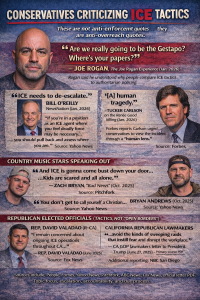
Bottom line: Conservatives can support immigration enforcement and still oppose ICE overreach.
Key conservative objections in 2025–2026:
Unaccountable federal power (raids, surveillance, escalating tactics)
Due process erosion (detain first, sort later)
Sweeping operations that harm communities and local economies
Militarized enforcement culture that increases risk of tragedy
Weak transparency (who is accountable when something goes wrong?)
Conservative “middle path” solution:
Focus enforcement on serious public safety threats
Require de-escalation and constitutional compliance
Expand oversight and transparency
Modernize immigration pathways so enforcement isn’t used as a substitute for policy
If you are worried about your rights during enforcement operations, start with:
What to Do If ICE Comes to Your Door: 10 Smart Things

Conservatism is not “whatever the government wants, as long as the target is unpopular.”
True conservatism is:
limited government
individual liberty
due process
transparent enforcement
constitutional boundaries
That means conservatives can support immigration laws while still insisting:
If you’re looking for a detailed overview of how enforcement is changing, see:
Why Is ICE So Aggressive and Militaristic?

ICE overreach typically means enforcement tactics that go beyond targeted public safety goals and begin to resemble indiscriminate, high-pressure policing, such as:
sweeping workplace raids targeting non-violent workers
enforcement quotas and volume-driven arrest targets
tactics that escalate rather than de-escalate
operations that undermine trust in local institutions
detention expansion that becomes punishment-like rather than administrative
In 2025–2026, concerns are growing that enforcement is being driven by political demands and optics rather than public safety prioritization.
For example, HLG has examined enforcement priorities and concerns about “volume” enforcement here:
Does the ICE Quota Put Me at Increased Risk? What Trump’s 3,000 Daily Arrest Mandate Means

A government powerful enough to raid, detain, and surveil large groups of people with minimal transparency is powerful enough to do that to citizens too.
That’s the conservative concern.
Not “no enforcement.”
But no unchecked enforcement.
For years, Trump’s immigration agenda was treated as a loyalty test inside conservative politics: if you were “tough,” you supported aggressive enforcement—no questions asked.
But in 2025–2026, that automatic support is cracking.
A growing number of conservative and conservative-adjacent voices are publicly warning that ICE’s tactics—especially when militarized, escalation-prone, or sweep-based—aren’t “law and order.”
They’re government overreach.
One of the most high-impact conservative-adjacent critiques came from Joe Rogan, a cultural heavyweight who previously endorsed Trump and whose audience is heavily male, independent, and right-leaning.
After the Minneapolis ICE operation that ended with the killing of Renee Nicole Good, Rogan condemned the escalation and the broader direction of immigration enforcement—explicitly comparing ICE tactics to authoritarian policing:
“Are we really going to be the Gestapo? Where’s your papers?”
He described the situation as “horrific” and warned that militarized enforcement risks turning communities into “papers please” zones where ordinary people can be “snatched up” in public without real accountability.
Read more coverage here: Axios: Rogan blasts Trump’s “Gestapo” immigration tactics and The Guardian: Rogan questions Trump’s immigration enforcement after Minneapolis shooting.
In a rare break from hardline enforcement messaging, conservative pundit Tucker Carlson publicly criticized the right’s reaction to the same incident—pushing conservatives to treat the death as a human tragedy rather than propaganda fuel.
According to reporting, Carlson called the killing a “human tragedy” and asked why Republicans weren’t viewing it through a “human lens.”
Source: Forbes: Tucker Carlson blasts conservative response to Renee Good’s death.
Another major conservative voice to break from the “ICE can do no wrong” line was Bill O’Reilly, who argued that federal agents should not escalate situations into deadly force encounters.
O’Reilly stated bluntly:
“ICE needs to de-escalate.”
He went further, arguing that when an operation reaches a point where deadly force feels likely, agents should pull back instead of pushing forward into a confrontation that can spiral into tragedy.
Source: Salon: “ICE needs to de-escalate”: O’Reilly calls on DHS to tone down tactics.
Not all opposition to ICE tactics is coming from media celebrities.
In 2025, six California Republican lawmakers issued one of the clearest GOP statements against the enforcement approach itself—urging Trump to stop broad workplace raids and refocus on violent offenders.
In their formal letter to the President, the lawmakers called on DHS:
“…to focus their enforcement operations on criminal immigrants, and when possible to avoid the kinds of sweeping raids that instill fear and disrupt the workplace.”
They also urged modernization of immigration policy to allow certain long-term, non-criminal undocumented residents a pathway toward legal status.
Primary source letter (PDF): California GOP letter to President Trump (June 27, 2025)
Additional coverage: Los Angeles Times: California Republicans tell Trump ICE raids should focus on criminals, not ordinary workers.
These voices aren’t arguing for “open borders.”
They’re making a different—and deeply conservative—claim:
Enforcement has limits
State power must be restrained
Militarized raids create backlash and instability
Sweeping operations hurt families, workplaces, and trust
Deadly force incidents destroy public legitimacy
In other words:
A conservative can support immigration enforcement and still oppose ICE overreach.
That is not weakness.
That is constitutional principle.
This checklist is designed for conservative and independent-minded Americans who believe in the Constitution, respect law enforcement, and still want to protect liberty.
Ask whether actions require a judge-signed warrant
Demand transparency about what authority is being used
Start here:
Can ICE Enter My Home Without a Warrant?
You do not have to answer questions beyond identifying information
Do not guess or “talk your way out of it”
Ask for a lawyer
Practical guide:
What to Do If ICE Comes to Your Door (10 Smart Things)
If you witness enforcement activity, you can often record from a safe distance—but do not obstruct.
Helpful legal guidance:
ACLU — Filming and Photographing the Police
Have a plan:
emergency contacts
childcare plan
attorney contact information
key documents secured
Ohio-specific planning resource:
How to Prepare for an ICE Arrest in Columbus, Ohio
In practice, enforcement can sweep broadly, especially during crackdowns and quota-driven periods.
This is one of the most misunderstood issues. A “warrant” is not always a judge warrant.
Ask:
Is this targeted?
Is this lawful?
Is this necessary?
Is there oversight?
Even many pro-enforcement conservatives believe sweeping workplace raids:
disrupt labor markets
destabilize industries (restaurants, hotels, construction, agriculture)
push workers underground
reduce community cooperation with police
increase chaos without improving safety
That is why you are increasingly seeing conservative-leaning “workforce realism” arguments emerge in 2025–2026—even among Republicans who do not support broad legalization.
Many Americans do not realize how much immigration enforcement relies on detention power.
When detention becomes routine and prolonged, the conservative question becomes:
Is the government using detention as a tool of administrative process—or as coercion and punishment?
HLG has covered the record growth in detention and its impact here:
New Record: ICE Detainee Population Reaches High (2025)
Rights do not matter in the abstract.
They matter in the moment:
when agents are at your home
when a parent is terrified
when a spouse doesn’t know what happens next
when someone is detained and the family cannot locate them
Start here:
What to Do If ICE Comes to Your Door
In the panic of an enforcement threat, people often make irreversible mistakes:
leaving the U.S. without advice
withdrawing valid applications
missing court deadlines
signing papers without understanding them
If you need guidance, you can book directly here:
Book a Consultation with Herman Legal Group
No. Many conservatives support immigration enforcement but oppose sweeping raids, militarized tactics, and due-process shortcuts.
Often not legally, unless they have valid authority. A key issue is whether the document is a judge-signed judicial warrant versus an ICE administrative form.
Start here:
Facing an Immigration Crackdown in Your City? What Non-Citizens Must Know
Stay calm, do not open the door without verifying authority, do not consent to entry, and contact counsel.
Step-by-step:
What to Do If ICE Comes to Your Door: 10 Smart Things
In many scenarios, yes—you should avoid answering substantive questions without an attorney.
Recording government officials performing duties in public is often protected, but you must not interfere.
Guidance:
ACLU — Filming and Photographing the Police
Many ICE documents are not signed by a judge. That difference can be critical for home entry authority.
Yes. LPRs can face detention or removal in certain situations (old convictions, travel issues, alleged abandonment, etc.).
See:
Facing an Immigration Crackdown in Your City? What Non-Citizens Must Know
Yes—enforcement activity and fear spikes have been widely reported, including local impacts in Ohio.
Ohio example:
ICE Arrests in Columbus, Ohio: Explosive Effects
An immigration bond may allow a detained person to be released while their case continues in immigration court.
Ohio example:
Operation Buckeye: ICE Arrests in Columbus Ohio
Not always in practice—especially during high-pressure enforcement periods.
Usually it means enforcement that becomes:
overly broad
escalation-first
quota-driven
detention-heavy
weak on transparency and oversight
For more detail:
Why Is ICE So Aggressive and Militaristic?
Prepare documents, emergency plans, and legal strategy in advance.
Ohio guide:
How to Prepare for an ICE Arrest in Columbus, Ohio
That risk has been documented in 2025–2026 in at least some field office contexts.
See:
Married to a U.S. Citizen but Still Handcuffed? (San Diego Interview Arrests)
You generally have First Amendment protections, but there are lawful limits and safety issues.
See:
ACLU — Protesters’ Rights
Immediately—especially before:
traveling
signing anything
leaving the U.S.
withdrawing an application
skipping a hearing
Consultation link:
Book a Consultation
Conservatives don’t have to choose between:
“no enforcement,” and
“unchecked enforcement.”
The conservative position is clearer than that:
Enforce the law—within the Constitution.
Keep power limited.
Keep it transparent.
Keep it accountable.
And if your family is facing enforcement risk, preparation matters more than panic.
Start here:
What to Do If ICE Comes to Your Door
Or book help here:
Book a Consultation
These sources are useful for explaining the controversy around masked enforcement, lack of accountability, and public fear:
Washington Post: ICE Chief Stands By Mask Use in Immigration Raids (2025)
TIME: California Bans ICE Agents From Wearing Masks to Conceal Identity
ACLU: It’s Time to Reaffirm Our First Amendment Right to Boycott
ACLU: The First Amendment Protects the Right to Boycott (Anti-Boycott Laws Explained)
ACLU Press Release: Supreme Court Declines to Review Challenge to Law Restricting Boycotts
If you publish boycott content, the safest approach is verifiable facts + authoritative records:
Use award records (recipient, award ID, obligated amount, agency)
Archive screenshots
Use neutral language if you cannot confirm