
Arguably, Columbus’s first wave of “African immigration” was a domestic migration from the South during the Great Migration beginning in about 1900, when millions of African-Americans moved north and west to escape bleak economic prospects and racial segregation in the South.
Nowadays, however, Columbus is experiencing a second wave of immigration — this time directly from Africa.
The number of sub-saharan Africans living in Columbus is rising rapidly. Columbus hosts the nation’s second-largest population of refugees from Somalia, for example, as well as large populations of immigrants and refugees from Ghana, Nigeria, Mauritania, Senegal, Liberia, Uganda and Ethiopia.
Ohio hosts over 100,000 sub-saharan African immigrants, while the sub-saharan African community in Columbus numbers in the tens of thousands.
Columbus’s African Immigrant Population and the 2020 Census
The US conducts a nationwide census every 10 years, and one is being held in 2020. The results matter, because population distribution determines the allocation of over $1.5 trillion in federal government benefits. As such, groups and cities that are undercounted could miss out on benefits that otherwise would have been theirs.
The problem with the African immigrant community is that many of its members are undocumented and, understandably, fear they will be deported if they reveal their names and address in the census. In fact, the census is not used to determine whether someone’s presence in the US is illegal.
The reason why, of course, is that to do so would encourage undocumented immigrants to hide from the census, thereby defeating its purpose.
The Columbus Mayor’s Office is orchestrating an effort to encourage vulnerable groups, including undocumented African immigrants, to participate in the census. Actions taken by the Trump administration in the past, however, including targeting many local Mauritians for deportation, have made it difficult for government officials to win back the trust of the African immigrant community.
The Ohio Government’s New African Immigrants Commission
New African Immigrants Commission (NAIC), a division of the Ohio state government, was formed in 2008 but only became active in 2017 when six commissioners from the Ohio African immigrant community were appointed.
A full NAIC commission numbers 11, and the final 4 members were not appointed until 2018. All members of the commission are required to be of sub-Saharan African origin, and they must be either US citizens or green cardholders.
The NAIC supports the development of policies and programs that meet the needs of African immigrants in Ohio, and it advocates on their behalf. According to the Ohio statute that created this organization, some of its duties and powers include:
- Collecting and distributing information;
- Conducting hearings, conferences, investigations, and studies on problems facing the sub-Saharan African community in Ohio; and
- Receiving grants and gifts from public and private sources.
Somali Group Takes Matters into Its Own Hands
Tired of the Ohio state government’s foot-dragging on actually appointing members to the NAIC, in 2017 a group of Somalis formed SomaliCAN, an advocacy group headquartered in Columbus.
Although SomaliCAN is somewhat focused on immigrants from Somalia, it makes a point of not limiting its mission to this group — instead, it advocates for all immigrants. Its activities have declined since the NAIC has become active.
Contact your immigration lawyer in Columbus, Ohio should you have any questions and read more information about immigration in Columbus now.
[fsn_row][fsn_column width=”12″][fsn_text]
Experienced immigration lawyers help immigrants and family members in numerous way including the following:
- Green Card Application
- H1B status
- Asylum
- Immigrant Visa
- Marriage Visa
- Fiance visa, I-129F, K1 Visa requirements
- Deportation (“Removal”) Defense
- Green Card renewal
- U.S. citizenship
- Assistance with Embassy
- Assistance with the National Visa Center (“NVC”)
- Representation at USCIS and U.S. Immigration & Customs Enforcement (“ICE”)
- TN Visa, E2 visa, L1 visa
- National Interest Waiver Green Card
- EB5 Investor Green Card
- I-601A Waiver
- Hardship Waiver
- J1 Waiver
- DACA
- TPS
- R1 Visa
- VAWA
- U Visa
- Cancellation of Removal
- Request for Evidence
- Notice of Intent to Deny
- Change of Status
- F1 status
- Motion to Reopen
- Board of Immigration Appeals
Top ten immigration lawyers in Buffalo NY
Buffalo is home to some really good, experienced immigration lawyers and border attorneys. Because of the law schools in the area, proximity to Canada, and rich immigration history, several prominent Buffalo immigration law firms are ready to help new clients:
According to Justia, some of the notable immigration lawyers and firms for Buffalo immigration law issues are:
Call Richard today at 1-216-696-6170 to arrange a consultation.
The Herman Legal Group is the “Law Firm for Immigrants.” Founded by nationally-known immigration lawyer Richard Herman in 1995, the Herman Legal Group provides skilled and cost-effective immigration counsel to businesses, families, and individuals.
Our lawyers including Richard Herman, Charmaine Rozario, Vania Stefanova, Luis Villarroel, Kamal Dari, and Of-Counsel lawyers Dinh Tran, Gil Manzano, and Ronen Kurzfled.
We speak over 12 languages. We are experienced in all aspects of immigration law, including employment immigration, investor immigration, family immigration, and deportation defense. When you need someone strong and compassionate in your corner, contact us.
The Herman Legal Group was awarded the designation of “Best Law Firm” by U.S. News & World Report in the field of immigration law for 2016, 2017, and 2018.
We also have immigration offices in Cleveland, Akron, Columbus, Cincinnati, Dayton, Toledo, Youngstown, Detroit/Dearborn, Pittsburgh, Buffalo, Erie, Charlotte, Coral Gables/Miami, McKinney/Plano/Dallas, and Toronto.
We handle the full range of legal immigration services.
Other immigration lawyers on Justia’s recommended list include:
Nina Frances Juncewicz
Buffalo, NY Immigration Law Attorney with 23 years experience
50 Fountain Plaza
Suite 1400
Buffalo, NY 14222
Matthew Borowski Esq
Buffalo, NY Immigration Law Attorney with 6 years experience
4343 Union Rd
Buffalo, NY 14225
Immigration, Appeals and Criminal
Drexel University
Siana McLean
Buffalo, NY Immigration Law Lawyer with 8 years experience
415 Franklin Street
Buffalo, NY 14201
Nevin Frederic Murchie
Williamsville, NY Immigration Law Attorney
8555 Main Street
Williamsville, NY 14221
Andrew Slepian
Buffalo, NY Immigration Law Lawyer with 11 years experience
14 Lafayette Square
Suite 1800
Buffalo, NY 14203
Matthew Lindsay Kolken
Buffalo, NY Immigration Law Attorney with 22 years experience
135 Delaware Ave
Buffalo, NY 14202
Annick T Koloko Esq
69 Delaware Avenue
608
Buffalo, NY 14202
Mr. Alejandro Gutierrez Esq.
Buffalo, NY Immigration Law Lawyer with 18 years experience
745 Englewood Avenue
Buffalo, NY 14223
Robert Ross Fogg Esq.
Buffalo, NY Immigration Law Lawyer with 18 years experience
69 Delaware Avenue
Suite 600
Buffalo, NY 14202-3812
Contact an experienced immigration lawyer to learn more about Buffalo, New York as a destination for immigrants, and to discuss any legal immigration questions or issues.
[/fsn_text][/fsn_column][/fsn_row]
Chicago has been suffering a net loss of immigrants since 2015. This trend is more than a little ironic since in November 2019 Chicago was listed as the No. 1 most immigration-friendly city among the nation’s 100 largest cities. The ranking is based on the second annual Cities Index issued by the New American Economy, a bipartisan immigration advocacy group. As a while, the Midwest region of the United States outperformed all other regions.
This honor is of no small significance. Chicago Mayor Lori Lightfoot, in a statement welcoming Chicago’s top ranking, described Chicago public officials and community activists as people “who have come together to stand up and fight for the rights of our immigrant and refugee communities, no matter the cost.”
Factors that Influenced Chicago’s High Ranking
Following are some of the factors that influenced Chicago’s top ranking, 4.38 out of 5 possible points:
- Government leadership, where Chicago received a perfect score;
- Job opportunities;
- Civic participation, where Chicago’s score was relatively low;
- Naturalization to citizenship rate among foreign-born participation (nearly 77 percent in Chicago);
- Labor force participation rate;
- Unemployment rate;
- Percentage employed in high-prestige occupations such as medicine;
- Median income;
- Entrepreneurship rate, which was significantly higher among the foreign-born than the US-born;
- Home ownership rate;
- Percentage of foreign-born population covered by health insurance;
- Percentage of foreign-born population with various educational attainments such as high school diplomas, bachelor’s degrees, and advanced degrees;
- Poverty rate; and
- Percentage who received benefits such as food stamps, Medicaid, welfare, or Social Security benefits (with the exception of food stamps, foreign-born Chicagoans received these benefits at a significantly lower rate than US-born Chicagoans did.)
Who is Involved in the Partnership for a New American Economy?
The Partnership for a New American Economy was founded in 2010 by media luminaries as Michael Bloomberg and Rupert Murdoch. It is also composed of a lot of other important people — CEOs of major corporations such as Boeing, Disney, and Hewlett Packard, to begin with, as well as a number of big-city mayors who recognize the contributions of immigrants to their local economies.
What Does the Partnership for a New American Economy Stand For?
What binds all these people together is a core commitment to certain goals in US immigration law and policy. While some Americans advocate open borders, others counsel hanging a “No Vacancy” sign on the Statue of Liberty’s torch. The New American Economy, by contrast, takes the middle path of immigration reform.
The Partnership for a New American Economy advocates immigration reform as essential to the repair and stimulation of the US economy. Although it supports secure borders and opposes illegal immigration, it does support legal reforms that would make it easier for immigrants to come to the US legally, such as creating more opportunities for immigrants to join the U.S. workforce.
It also supports building a bridge to eventual citizenship for qualifying undocumented immigrants. Naturally, if this plan is actually implemented, it would be a welcome development for the estimated 400,000 undocumented immigrants living in Illinois. Keep in mind that Chicago hosts far more undocumented immigrants than any other location in Illinois.
Contact your immigration lawyer in Chicago, Illinois should you have any questions and read more information about immigration in Chicago now.
If you intend to apply for a green card (adjustment of status) in the United States, you will probably need a medical examination. Any doctor in the state cannot conduct this examination. Instead, USCIS authorizes certain doctors (civil surgeons) who can perform the medical exam required for Green Card applicants.
A part of the procedure for getting a visa is an examination by a panel physician who is different from civil surgeons. They do immigration medical examinations performed outside the United States and its territories.
5 Doctors in Detroit approved by USCIS
Dr. Hilal D Elia, State Fair Clinic
950 East State Fair Road,
Detroit, MI 48203
(313) 366-3700
Dr. Augustine Kole-James, Professional Medical Center East
3956 Mt. Elliott Street,
Detroit, MI 48207
(313) 925-4540
Dr. Arvind S Patel, Jefferson Industrial Clinic
2141 East Jefferson Avenue,
Detroit, MI 48207
(313) 259-9075
Dr. Ali H Mahmood, AM Medical Center & Urgent Care
13031 Conant Street,
Detroit, MI 48212
(313) 893-5490
Dr. Augustine Kole-James, Professional Health Center
20901 West Seven Mile Road,
Detroit, MI 48219
(313) 532-2000
How to get prepared for the exam?
The medical exam for immigrants is fast and easy. The purpose of this examination is to ensure that you are healthy and will meet the requirements for adjusting your status. The exam includes:
- Examination by a doctor who will ask you specific questions
- A blood draw
- X-rays of your chest
When visiting the doctor, you will have to bring certain things with you. This includes bringing Government-issued photo identification as a passport or a driving license if you are above 14 years old. Persons who are 14 years or younger should have an I.D. that contains important information about them, such as full name, date and place of birth, and one of the parents’ names.
Alternatively, instead of these documents that will justify your identity, you can bring your birth certificate translated in English or an affidavit. Besides, you will have to bring Report of Medical Examination and Vaccination Record, Form I-693, that establishes that you are not inadmissible on public health grounds.
So based on the documents you have to bring, you can suppose that during the examination, a doctor will review your medical history and thoroughly examine you physically at the moment. You will be tested for infectious diseases that can include tuberculosis, syphilis, and gonorrhea.
Accordingly, the doctor will complete the Form I-693 that will be sealed and seal it in an envelop right after you it will be ready for you to submit it to USCIS. Therefore, it is advisable to ask for a copy of the filled form before the doctor seals the envelope so you can keep it for yourself.
Remember, the USCIS can reject your application if it is evident that the envelope that ones was sealed has been opened later.
If you noticed any irregularities or you think that doctor’s behavior was inappropriate, you can report the problem to the state medical boards. In Michigan, there are two boards that you can contact for these concerns:
Michigan Board of Medicine
Contact Address
P.O. Box 30670
Lansing, MI 48909-8170
Physical Address: Bureau of Health Professions
611 West Ottawa Street, 1st Floor
Lansing, MI 48933
Phone: (517) 335-0918
Fax: (517) 241-9416
Michigan Board of Osteopathic Medicine and Surgery
Contact Address
P.O. Box 30670
Lansing, MI 48909-8170
Physical Address: Bureau of Health Professions
611 West Ottawa Street, 1st Floor
Lansing, MI 48933
Phone: (517) 335-1001
Fax: (517) 373-2179
Contact your immigration lawyer in Detroit, Michigan should you have any questions and read more information about immigration in Detroit now.
According to High Brown Magazine, many immigrants in the 21st century “come as refugees from countries as far apart as Bhutan, Burma and Iraq, as well as Somalia, Eritrea, Liberia and Cuba.” According to the Buffalo-based Journey’s End Refugee Services, there were some 1,600 refugees resettled in Buffalo in 2012, with another 2,000 expected in 2013.
Hispanic resources in Buffalo
“The fastest-growing demographic, however, hails from Latin America. According to the latest U.S. census data, between 2000 and 2010, the Latino population in Buffalo increased by almost 25 percent. Six percent of city residents today speak Spanish, and at least five news outlets in Buffalo cater to this diverse community.”
One of the Spanish speaking news outlets in Buffalo is “La Voz de WNY, a Spanish-language public affairs talk show that airs on Time Warner channel 20.”
Panorama Hispano News
Panorama Hispano News (print and online) is published for readers in Western, New York, and Erie, Pennsylvania. The company prints 30,000 hardcopies each month. The website connects with 38,000 readers on a weekly basis.
Hispanic Heritage Council
The Hispanic Heritage Council is “dedicated to preserving the history of Hispanics in Western New York for future generations.” A few Hispanic resources, other than those mentioned, listed on their website include:
- Buffalo Puerto Rican Press [ Maria Rosa] 716-308-4987
- IMAGEN NY Magazine
PO Box 31285, Rochester, NY 14603
Email: info.imagenny@gmail.com - Latin Journal [ Maria Rosa] 716-308-4987
- La Ultima Hora [ Luis Rodriguez] 716-570-8441
Published monthly – free - La Voz Rochester Community Newspaper
282 Hollenbeck, Rochester, NY
585-301-4199 - WBBF 1120AM – Spanish Radio [ Un Encuentro Con Dios] 716-432-6962
- WJJL-1440AM – Spanish Radio [ Radio Luz] & [ Impacto Musical Latino] 716-674-9555
Special television programming highlights Buffalo’s Hispanic Community:
- WIVB Channel 4 airs “Hispanic Voices” on the fourth Sunday of each month at 5:30 a.m. with host, Gilbert Hernandez.
- Public Access Channel 20 airs “La Voz de WNY” on Mondays 2:00-2:30 pm, and Tuesdays 1:30-2:00p with host, Maria Rivera.
Other ethnic media resources in Buffalo
Additional ethnic media resources include:
- Newspapers
o Am-Pol Eagle (a Polish-American weekly)
o Buffalo Irish Times (an Irish-American bimonthly)
o The German Citizen (a German-American bimonthly)
o The Challenger is an African-American newspaper that services Buffalo and other Western New York locations - Television
- Radio. According to Wikipedia, the following radio stations are identified as ethnic and may be reachable from Buffalo
o WQPJ-LP 94.3 FM Port Jervis Ethnic
o WQPU-LP 93.7 FM Westbrookville Ethnic
o WRKL 910 AM New City Ethnic
o WVIP 93.5 FM New Rochelle Ethnic - A few cultural resources
o Chabad House is a home-away-from-home for thousands of Jewish Students at the UB. Chabad anticipates and serves the needs of students on a social, educational, and spiritual level. At Chabad, all students are welcome, regardless of background, affiliation, and level of observance.
o WIVB reported in 2017 that the first Asian supermarket in the Buffalo area officially opened.
o The International Institute of Buffalo has stories on immigrant women in Buffalo
People who reside in Buffalo can often pick up media outlets in Toronto, Canada.
Contact an experienced immigration lawyer in Buffalo, NY to learn more about the destination for immigrants and to discuss any legal immigration questions or issues in Buffalo.

Introduction
As the 14th largest city in the United States, you would expect the Columbus immigration scene to be vibrant and full of life.
And it is, with over 150,000 people, or about 8 percent of the total population of Columbus, having been born overseas. Ultimately, of course, nearly all Columbus residents can trace their ancestry back to an immigrant.
Columbus, Ohio is one of those rare midwest success stories, a “Rust Belt” town that avoided the industrial decline of almost all of its neighbors. Much of that has to do with its robust population growth compared to other Rust Belt cities that are losing population. Immigrants power Cleveland’s population growth — over 80 percent of its new residents are foreign-born.

Columbus Immigration: Contributions of Immigrants to the Local Economy
Contrary to the rhetoric of many politicians, immigrants more than “pull their weight”, in the US as a whole and in Columbus in particular. Some of the more revealing facts about the immigrant contribution to the Columbus economy are listed below:
- Immigrant-led households earn over $4 billion every year, most of which is spent in Columbus.
- Immigrant-led households possess over $3 billion in available spending power.
- Immigrants pay nearly $400 million every year in state and local taxes.
- Immigrants pay about $800 million every year in federal taxes.
- Normally, about 70 percent of Columbus immigrants participate in the labor force — greater than the participation rate of native-born citizens.

Columbus Immigration: A History
Before the US Civil War (1860-1865), most immigrants to Columbus were from northern and western Europe, with German immigrants being the first to settle in what is now the South Side of Columbus.
Columbus Immigration After the Civil War
After the Civil War, however, the demographics of Columbus began to change. The most pronounced demographic change was internal — many blacks from the South came to settle in Columbus during what is now known as the Great Migration.
Starting about the time of the Great Migration and continuing into the late 19th century came a new wave of immigrants, mostly from eastern and southern European countries such as Italy, Greece, Austria-Hungary, Russia, and Poland.
Many of these immigrants were culturally distinct from the White Anglo-Saxon Protestant (WASP) mainstream that had comprised previous waves of Columbus immigration.
20th Century Columbus Immigration
Like many of the earliest immigrants to the US, many Columbus immigrants during the early 20th century came to escape religious persecution in their homelands. Unlike earlier immigrants, however, they tended to be Catholic or Jewish.
In the late 19th century, the “melting pot” idea prevailed — immigrants were expected to give up their former language and customs (not necessarily their religion) to become Americans.
By the dawn of the 20th century, the melting pot idea was beginning to lose traction. During this process, many immigrants came to see themselves as bicultural — Polish-Americans, Irish-Americans, etc.
These immigrants retained the cultural practices of the Old Country (and taught them to their children) while learning English and identifying as Americans at the same time.
Immigrants began to greatly value contact with immigrants from the same country, and ethnic enclaves populated primarily by particular ethnic groups began to multiply and expand.
Large and influential numbers of Hungarian and Jewish immigrants played particularly influential roles in building Columbus as it exists today.
Late 20th century and early 21st century Columbus Immigration
The Immigration and Nationality Act of 1965 dismantled many racist and nationality-based restrictions on immigration and thereby made visas available to a wider variety of people.
After this statute revolutionized immigration law, Ohio began to see a much wider variety of immigrants. This transition mirrored the national trend. Today, immigrants from at least 143 different countries call Columbus home.

Snapshot: Current Statistics for Columbus Immigration
According to the George Mason Institute for Immigration Research:
- Most immigrants to Columbus are relatively new, with 60 percent having arrived since 2000 (compared with 40 percent for the US as a whole). Most have already obtained green card immigration status or citizenship — only a few are still in the process of seeking permanent residence.
- Columbus’s foreign-born population, approximately 8 percent of the total population, is significantly smaller than the foreign-born population of the US as a whole, which is about 13 percent and rising rapidly.
- The unemployment rate among local immigrants is only 6 percent, slightly lower than the average for Columbus residents as a whole.
- The top five birth countries among Columbus’s foreign-born population are India (13 percent), Mexico (11 percent), China (6 percent), Somalia (6 percent); and Ghana (4 percent).
- The percentage of Columbus’s foreign-born population who were born in Mexico (11 percent of all immigrants) is far lower than the Mexico-born immigrant population of the rest of the US as a whole (27 percent of all immigrants). The percentage of immigrants born in India (13 percent) is far higher than the percentage of Indian immigrants in the rest of the US (5 percent).
- Nearly 20 percent of local immigrant adults aged 25 and older possess an advanced degree (a master’s, doctoral or professional degree), and over 40 percent possess at least a bachelor’s degree. Columbus immigrants tend to be significantly more educated than immigrants to the rest of the United States as a whole.
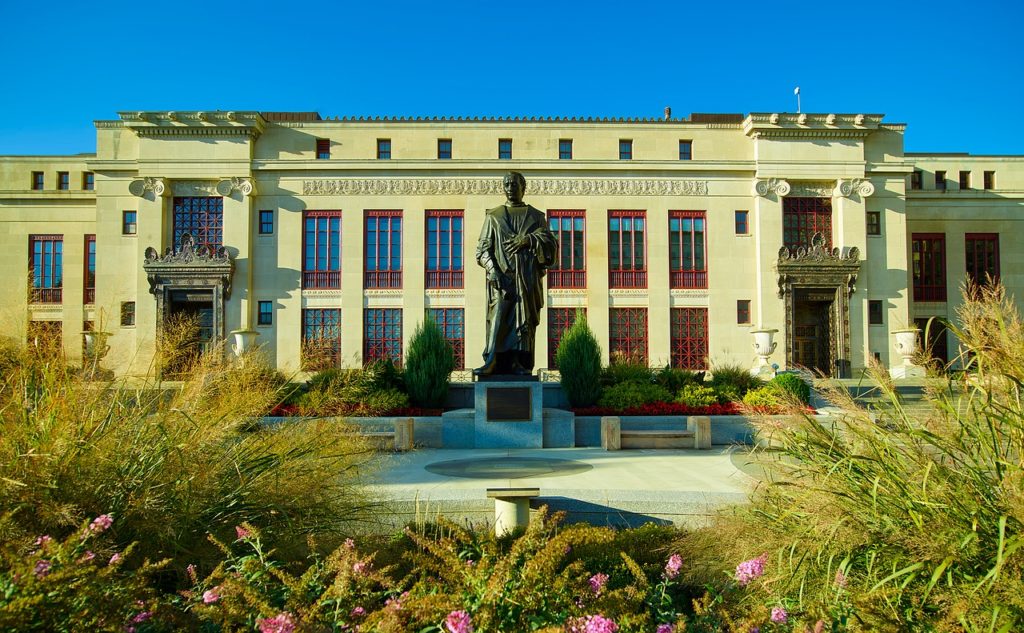
The Columbus, Ohio City Hall
The address of the Columbus, Ohio City Hall is 90 W Broad St, Columbus, OH 43215. The Mayor’s Office is located in City Hall and can be reached by telephone at (+1 )(614)645-7671.

Columbus Immigration Facilities
The Columbus, Ohio USCIS Field Office
The USCIS maintains a Columbus Field Office at 395 E. Broad Street, Suite 100, Columbus, OH 43215. The USCIS also maintains an Application Support Center for fingerprinting and certain other activities) at 50 W. Broad St., Leveque Tower, Suite 650, Columbus, Ohio 43215. Green card applications cannot be turned in to this facility.
Immigration Court
There is no immigration court in Columbus. The only immigration court available in Ohio is located in Cleveland.
ICE Offices
Immigration and Customs Enforcement (ICE) maintains no field offices in Columbus or any of its suburbs.

ICE Immigration Detention Centers
Immigration detention centers hold immigrants who are suspected of violating US immigration law (such as illegal entry to the United States) or who are awaiting removal/deportation proceedings. ICE maintains no immigrant detention centers in Columbus; however, immigration detention centers located in the state include:
Butler County Correctional Complex
Address: 705 Hanover Street, Hamilton, OH, 45011
Morrow County Correctional Facility
Address: 101 Home Road, Mt. Gilead, OH 43338
Bedford Heights City Jail
Address: 5661 Perkins Road, Bedford Heights, OH, 44146
Seneca County Jail
Address: 3040 S. State Route 100, Tiffin, OH 44883
Geauga County Safety Center
Address: 12450 Merritt Road, Chardon, OH, 44024
Strictly speaking, none of these facilities are ICE facilities — they are local correctional facilities with which ICE has established contractual relationships to house immigrants.

Foreign Consulates in Columbus
A consulate functions as a regional embassy of a foreign country where you can, for example, renew your passport. As a second- or third-tier US city by population, Columbus hosts only one foreign consulate — the Honorary Consulate of Austria, located in the Daimler Building at 1533 Lake Shore Drive, Columbus, Ohio 43204.
The closest place where you are likely to be able to contact your home country’s consulate is Chicago, which hosts dozens of consulates.

Nonprofit Immigrant Assistance Groups in Columbus
Columbus hosts a great variety of public and private organizations that serve immigrants, including the following:
The American Academy of Pediatrics (AAP) Immigrant Health Toolkit provides information concerning the health of immigrant children including clinical care, access to resources, legal assistance, and more.
Avanza Together helps immigrants who are at risk of removal/deportation. It places particular emphasis on keeping families together and on providing important community information to immigrants.
City of Columbus New American Initiative is designed to help immigrants and refugees obtain information about, and access to, local benefits and programs offered by the city of Columbus, regardless of their immigration status.
Columbus Literacy Council (CLC) Many immigrants arrive in Columbus with little or no knowledge of English, no local contacts, and no information about benefits that are available to them. The CLC offers free adult education literacy programs and GED preparation classes, as well as vocational assistance.
Community Refugee & Immigration Services (CRIS) provides immigrants, refugees, and asylees with a variety of services including resettlement assistance, parenting classes, job training, English language classes, health programs, and immigration information, among other programs.
Ethiopian Tewahedo Social Services (ETSS) provides programs dedicated to English language skills, job training, job placement, academic skills training, after-school tutoring, and family support. Click here for a list of locations in Columbus.
Franklin County Department of Job & Family Services (JFS) provides information about certain public assistance programs such as food assistance, medical care, job training, child care assistance, and emergency assistance.
Fugees Academy Columbus is a formal school that is dedicated exclusively to refugees 11 years of age and older. It provides its students with educational and athletic opportunities, as well as hope and self-confidence.
LSS 211 Central Ohio (formerly known as HandsOn Central Ohio) is an information and referral service that connects needy Columbus immigrants with available government and community resources. Someone is available 24/7.
Muslim Family Services (MFS) of Ohio is a social agency that assists Columbus’s Muslim community. It provides information as well as referrals to programs that can meet basic economic needs, immigration information, assistance with document preparation, English language classes, and many more programs.
Noor Islamic Cultural Center (NICC) hosts various activities geared toward the Columbus Muslim community as well as the wider immigrant community. It offers certain forms of information, financial assistance, health services, and more.
Office of Opportunities for New Americans helps immigrants assimilate into American society by offering employment listings, ESL classes, and various forms of education and training.
Ohio Department of Job & Family Services (ODJFS) Ohio Refugee Services Program is aimed at refugees, asylees, Cuban and Haitian immigrants, and victims of human trafficking. The program coordinates federal funding for various food, medical and social service assistance programs.
Refugee Medical Assistance (RMA) offers new, low-income refugees medical coverage under certain circumstances where they are ineligible for other programs such as Medicaid.
The Bridge offers adult English language, citizenship, and GED prep classes, as well as tutoring for school-age children. Also offers a soup kitchen and a free legal clinic.
US Together Columbus Office offers refugee resettlement services such as ESL and other classes, financial assistance, employment assistance, interpreting, and other services.
Vineyard Community Center offers an early childhood center, after-school and summer programs for children, free health care and legal services, ESL and GED prep courses, career assistance, and many other programs and services.

Diverse Religious Institutions and Houses of Worship in Columbus, Ohio
There are nearly 2,000 religious organizations in the greater Columbus Ohio metro area, not all of which could be classified as houses of worship. Although most of these organizations identify as Christian, Columbus hosts religious organizations representing every major world religion and more.
Following is a list that represents some of this religious diversity:
- Sri Lakshmi Ganapathi Temple & Cultural Center of Ohio
- Columbus KTC Buddhist Center
- Guru Nanak Religious Society (Sikh Temple)
- Beth Jacob Synagogue
- Catholic Diocese of Columbus
- Annunciation Greek Orthodox Cathedral
- St. Mary Coptic Orthodox Church

Ethnic Festival: The Ohio Chinese Lantern Festival
The Ohio Chinese Lantern Festival is probably the most prominent ethnic festival held in Columbus. Although canceled in 2020 due to the Covid-19 crisis, this folk culture festival is normally held at the Natural Resources Park at the Ohio Expo Center and State Fairgrounds.
The attractions of the Ohio Chinese Lantern Festival include breathtaking light sculptures, professional acrobatic performances, a Chinese marketplace, art and handicrafts, various Chinese cultural performances, and a delicious selection of food and beverages.

Offices of International Student Affairs for Major Columbus Universities
Columbus is home to a number of institutes of higher education, many of which include a significant international student population. The international student offices listed below exist to serve their respective international student populations.
- The Ohio State University Office of International Affairs
- Franklin University Office of International Students
- Ashland University International Student Services
- Capital University Office of International Education
- Columbus State Community College
- Otterbein University
- Devry University of Columbus International Student Programs

Ethnic Grocery Stores in Columbus
Columbus can boast of dozens of ethnic grocery stores. Following is some information about a few of them:
- Saraga International Grocery, 1265 Morse Rd: A wide selection of foods and spices from all over the world.
- Luc’s Asian Market Groceries, 3275 Sullivant Ave: Thai, Filipino and Vietnamese food.
- Asian Groceries & Sea Food Market, 3581 Refugee Rd: Supermarket, Asian restaurant, and smoothie and juice bar.
- International Market Foods, 3120 Olentangy River Rd.: the Indian grocery store.
- Berekum African Market, 1977 Morse Rd.: African supermarket with meats, condiments, snacks, drinks, etc.
- La Mega Michoacana, 2175 Morse Rd: a Latino grocery store with a wide selection of fresh produce.
- Nellai Marts (Bombay Bazaar), 58 Dillmont Dr.: Indian grocery with a wide selection of items.
- Carfagna’s, 1405 E Dublin Granville Rd.: Italian grocery selling meats, fish, prepared foods, and specialty items.
- La Michoacana, 5445 Bethel Sawmill Center: Mexican and Latin American groceries.
- Sunrise Asian Supermarket, 1841 W Henderson Rd: Asian grocery with raw fish, poultry, beef, fresh vegetables, herbs, rice, noodles, etc.

The Columbus Sister Cities Program
The Columbus Sister Cities Program is a non-profit cultural initiative that forms bonds between Columbus and other cities throughout the world. Sister cities cooperate with each other in cultural, artistic, educational, governmental, informational, and commercial programs. Currently, Columbus maintains 10 sister city relationships:
- Accra, Ghana
- Ahmedabad, India
- Curitiba, Brazil
- Dresden, Germany
- Genoa, Italy
- Hefei, China
- Herzliya, Israel
- Odense, Denmark
- Seville, Spain
- Tainan City, Taiwan

Things to See and Do in Columbus
Columbus offers a wide variety of interesting and refreshing options for your leisure time, whether you prefer daytime activities or nightlife. Some of the highlights are listed below:
- German Village and the Brewery District is a quaint pedestrian district just south of downtown. It is filled with shops, brick houses, restaurants and — you guessed it — breweries. Tourists and locals alike find the area’s charm mesmerizing.
- The Short North Arts District is a neighborhood located directly north of downtown that is filled with art galleries, theaters, boutiques, hip bars, and restaurants. Like the German Village, the area is best explored on foot.
- Once an ethnic enclave of its own, Italian Village is a burgeoning nightlife zone filled with craft beer breweries, live houses, pubs, bakery-cafes, and pizzerias.
- Inniswood Metro Gardens offers more than 100 acres of forest trails and streams to explore.
- Indian Run Falls, located in the Columbus suburb of Dublin, is a natural gorge with hiking trails, scenic observation platforms, and a bridge over a waterfall.
- If you need more space, Battelle Darby Creek Metro Park offers more than 7,000 acres of forest, prairies, and wetlands for you to explore.
- Watch the nationally-renowned Ohio State Buckeyes pulverize an opponent on the football field during football season (autumn).
- Visit the Columbus Zoo and Aquarium to hand-feed a giraffe or view some of the other 9,000 animals representing 650 species from every corner of the planet, even beneath the waves.

Time is Precious — Take Action Now
The Herman Legal Group represents clients who need services related to immigration law in OH as well as throughout the United States and even overseas. Our immigration attorneys and staff speak over a dozen languages, and we have been helping immigrants for more than a quarter of a century now. Herman Legal Group is well-known as the preeminent OH immigration law firm.
Contact us 24/7 by calling us at +1-216-696-6170 or (+1)(614) 300-1131, by filling out our information form online, or by dropping in at our Columbus office located at 6660 North High Street, Suite 3E, Worthington, Ohio 43085, so that we can schedule you a consultation. Quite simply, we are the best immigration lawyers in Columbus, Ohio.
Cleveland’s soul and identity is the creation of a diverse mixture of its ethnic groups. It makes its character more interesting since it brought different cultures, customs, and a myriad of traditional food.
The significant groups contributing to making Cleveland what it is today are the Irish community, Italian, Polish, German, Chineses, and Slovenian community, along with many others.
Hence, the media brings valuable information to those groups and plays a vital role in facilitating feelings of belonging and social participation. This article will present some of the ethnic media, television, and radio broadcasting in Cleveland and the state of Ohio.
Media Ethnic Groups
La Nueva Mia
La Nueva mia is a non-commercial educational Spanish radio station licensed to Painesville, Ohio. The owner of this radio station is Nelson Cintron, Jr., through licensee La Cadena Mundial Hispana, Inc. (Hispanic World Network). Serving Lake County and eastern parts of Greater Cleveland, you can listen to La Nueva mia radio station at 88.3 FM.
Panorama Hispano News
Panorama Hispano News is the largest among publishers of free monthly online news and community newspaper. Delivering more than 30,000 hardcopy newspapers each month, Panorama Hispano News collaborates with related publications, TBN Media, Ogden Newspapers, and New America Media. Their reputation is built on providing community news in upbeat, unbiased, and easy to read formats.
Cleveland Russian Magazine
Cleveland Russian Magazine has been at the center of news, entertainment, and events happening in the Cleveland area for 27 years. Russian Media, Inc. has been the leading informational source for the Russian-speaking Community of Greater Cleveland and Columbus in Ohio.
Recognized by a weekly newspaper published by Russian Media, Russian Magazine strives to unite the Russian-speaking population throughout the state and serve as a bridge to their culture and country left behind as well as the window to their newly acquired home.
As a merge between the Cleveland Call and the Cleveland Post, a group of local African-Americans established Call and Post. Back in that time, the Call and Post provided extensive coverage of the social and religious life in the African-American community.
It was mostly known to feature sensational coverage of violence on its front page. Once, it was the most influential voice for African-Americans in Cleveland and, ultimately, all Ohio.
The Call and Post filed for bankruptcy in 1995, until boxing promoter Don King purchased it in 1998. Nowadays, it covers local news in Cleveland, Cincinnati, and Columbus, including arts and entertainment.
Cleveland Jewish News
Formed in 1964, Cleveland Jewish News is a successor to two Cleveland Anglo-Jewish newspapers – The Jewish Independent and the Jewish Review & Observer. Cleveland Jewish News presents to the Jewish community of Northeast Ohio local, national and worldwide news of Jewish interest.
They strive to enrich the cultural life of both individuals and the community. Besides, its parent company, the Cleveland Jewish Publication Company, publishes:
- Jstyle (quarterly magazine covering fashion, food, lifestyles);
- Jstyle Weddings (an annual guide to helping the bride be a plan for the big day);
- The SOURCE (a directory with comprehensive, useful listings to help readers connect with organizations, agencies, and businesses);
- Bar•Bat Mitzvah (focused on making the occasion meaningful and festive);
- Canvas (digest-sized art, music, galleries, performance, and entertainment magazine), Balanced Family (a quarterly magazine covering parenting, aging, and family life).
Bounce TV
As the first African American broadcast network, Bounce TV airs on local television stations’ broadcast signals, featuring a programming mix of original series, specials, off-network series, theatrical motion pictures, and many more. Among the founders of Bounce, you can find two big names of American figures: Ambassador Andrew Young and Martin Luther King, III.
Univision
Univision serves the Cleveland Hispanic community by providing various Spanish-language content.
While Hispanics are held as one of the groups with positive population growth in Cleveland, Univision delivers covers events that matter most to the Hispanic community- from local integrations to coverage of music awards shows and fan-favorite soccer tournaments.
Contact your immigration lawyer in Cleveland, Ohio should you have any questions and read more information about immigration in Cleveland now.
Throughout history, Detroit was the place where people from all around the world were drawn due to the automotive industry. It has continued to enrich its ethnic picture until today. Michigan’s diverse ethnic population influenced the media, creating more than 20 ethnic media in this area.
The importance of ethnic media for a particular ethnic minority group or ethnic minority community is enormous. Those contribute to rising capacities of ethnic news that will inform minority groups about related concerns. This article will present some of the ethnic media in Michigan that work toward engaging people belonging to diverse minority groups.
Ethnic Media in Michigan
Arab American News
With 35 years of history of award-winning journalism, The Arab American News is the largest, oldest, and most respected Arab American newspaper in the United States. This is an independent media that serves the diverse Arab American community and provides expert local, national, and international political analyses and bilingual content. Their work focuses on social, political, cultural, and religious themes, and especially news of interest to the Arab community.
The Jewish News
The Jewish News is a trusted source for news, opinions, and stories that affect the Jewish community living in Metro Detroit and beyond. The Jewish News strives to communicate usefully, create engaging news and information reflecting a full range of diverse viewpoints, and advocate positions that strengthen Jewish unity and continuity.
Latino Press
As the largest and most popular Hispanic publishing company in SE Michigan, based in Detroit, Latino Press is a weekly distributed newspaper, distributed free of charge. They provide services for 25 years, and earned recognition as “the leading voice in the community.”
Michigan Chronicle
The Michigan Chronicle is an information, news, and events company. It covers the interests of the African American community, informing them about important issues. It has been acting as the voice of the community for more than 80 years.
Michigan Korean Weekly
Korean Weekly Michigan was the first weekly magazine of the Korean American Society. Started under the banner of becoming a focal point to protect and grow the Korean society, the newspaper maintains its position as a media for the Korean American community. It tries to overcome the limitations since there are many publications in the form of newspapers in immigration society, but not many media that adequately fulfill the role of the press.
Panorama Hispano News
Panorama Hispano News is the largest of a free monthly community newspaper and online news. They deliver more than 30,000 hard copies of publications to home, businesses, and community partners. In partnership with TBN media, Ogden Newspaper, and New America Media, they get to more than 68,000 readers.
Eagle Country (105.7 FM WCUP)
The Rockin’ Eagle is owned by the Keweenaw Bay Indian Community and operates studios in Hancock and Baraga. The Rockin’ Eagle signal reaches all of Baraga, Houghton, Keweenaw, and Ontonagon Counties, as well as western Marquette County and parts of Iron, Gogebic, and Dickinson Counties.
WOES (91.3 MHz)
WOES, known as “The Polka Palace.”, is a non-commercial educational high school radio station. It broadcasts from Ovid-Elsie High School. It began broadcasting radio in the Ovid-Elsie area. Run by Kevin Somers, WOES is the highest-powered radio station in Michigan for high school students. Its program offers music, news, and sports, and it hosts student and community DJs.
Contact your immigration lawyer in Detroit, Michigan should you have any questions and read more information about immigration in Detroit now.
Immigrants and refugee populations need all the support they can get before transitioning into a new life in Buffalo, NY.
In the list below, we highlight what kind of assistance you can access – available for all community members and their children.
Health Care Assistance
Here are the following assistance services you can ask for:
Mental Health Care
Immigration can cause anxiety and general discomfort, especially if there are various languages and language barriers at play.
You can also look into counseling for couples, individuals, and children.
Children’s Clinics
Primary medical care for clients’ children are a must, especially for whole families moving together.
Chemical Dependency
The instability of housing, employment, and citizenship may affect a person’s mental health care enough to the point of substance abuse risk. Intense trauma can be addressed by a mental health care program focused on chemical dependency.
Hospitals Around Buffalo, NY
Looking for referrals for the best community health care possible around New York? See our list below for a comprehensive guide. You can book medical appointments at:
- VA Western NY Healthcare System
- Brylin Hospitals
- Roswell Park Cancer Institute
- Niagara Falls Mem Med Center
- Medina Memorial Hospital
- Erie County Medical Center
- Kenmore Mercy Hospital
- Sheehan Memorial Hospital
- Lockport Memorial Hospital
- Sisters of Charity Hospital
- Buffalo Psychiatric Center
- Mercy Hospital
- Mount St Mary’s Hospital
- St Joseph Hospital
- KALEIDA Health
- Western NY Children’s Center
- Inter-Community Mem Hospital
Other Community Partners and Additional Services
Workforce
Learning trades and training programs are available for immigrants who seek to access and join the workforce after seeking asylum. The path to employment is made easier with the assisting program, too!
Education and School-Based Services
Educational services offer programs that create opportunities for clients. Engaging resources are there to integrate refugees into their diverse cultures.
Simply fill out forms for school-based services as well – from social work services to health care counseling.
Family and Parent Resources
Parents of child refugees especially struggle during the immigration process. Parental practices, childcare, and other programs are the focus of this resource.
Basic Needs, Care Coordination, and Domestic Violence Resources
Rapid rehousing, education, food, and pantry services are also offered.
Survivors, meanwhile, can access confidential services regarding domestic violence and human trafficking. This assistance includes counseling, as well as empowerment programs for men and women.
Inquire at the International Institute of Buffalo
We recommend this non-profit organization for Buffalo immigrants.
The International Institute helps immigrants reintegrate into American culture and society. They offer workforce, homeownership, and growth assistance as well.
One of the biggest challenges in immigration is the language barrier. With this, the International Institute helps out as well by providing reliable interpreting services to those who need it.
For more details on how the International Institute can help, you can check out our article here.
We Offer Neighborhood Legal Services
The immigration process is difficult and often isolating. However, you must remember: you are not alone.
The Herman Legal Group is an international institute that can help you with the above immigration services in Western New York.
Book an appointment with one of our agency immigration lawyers today. Let us offer our assistance for resettling you and your family in Buffalo, NY.
Be our client and let our focus be all on you. Visit our site, and we’ll see you soon!
Contents
- Introduction
- The Immense Contributions of Immigrants to the Chicago Economy
- New Immigration, Chicago and the Federal Immigration Authorities
- Chicago’s Immigration History
- Immigration: Recent History and the Current State of Affairs
- Chicago’s Available Immigration Services and Community Resources
- The Chicago City Hall
- Local Immigration Services and Facilities
- Foreign Consulates in Chicago
- Health Care Resources for Immigrants: International Programs and Patient Services at Chicago Hospitals
- Immigrant Advocacy and Assistance Groups in Chicago
- International Religious Institutions and Houses of Worship in Chicago
- Ethnic Media
- Chicago Ethnic Festivals
- Offices of International Student Affairs for Major Chicago Universities and Institutes of Higher Education
- Ethnic Grocery Stores
- Sister Cities
- Leisure and Sports in Chicago
- What a Good Immigration Lawyer Can Do for You
- Now is the Time to Seek Assistance from the Immigration Professionals

Introduction
Chicago is known as a “Rust Belt” city that has suffered economically and demographically from the shift in the United States economy from manufacturing to information technology.
But the wave of immigration that took place in the 1990s added population and vitality to US cities as diverse as Portland, Columbus, and St. Paul, says Attorney Richard Herman, prominent US immigration lawyer and founder of the Herman Legal Group. The same process could happen in Chicago.
Revitalization through new immigration has worked for Chicago, Illinois in the past, and could do so again. Currently, A stunning 1.6 million immigrants reside in Greater Chicago — nearly 20 percent of the city’s total population — compared to about 14 percent for the entire state of Illinois.
These changes have not taken place without complaints from some native-born Americans, It’s difficult to argue, however, that immigrants as a whole represent a burden on the local economy.

The Immense Contributions of Immigrants to the Chicago Economy
In 2017, well over 100,000 immigrant entrepreneurs called Chicago, Illinois home, and Chicago immigrants of all occupations held nearly $45 billion in spending power. To put $45 billion into perspective, this amount is approximately equal to the total annual GDP of the entire nation of Bolivia, a country with a population of more than 11 million people. As a consequence, these “burdensome” Chicago immigrants pay nearly $17 billion in taxes every year.
Don’t want to live next door to an immigrant? You might want to reconsider that idea, since a Duke University study concluded that new immigrants helped prop up home values in entire neighborhoods as they move into formerly decaying areas of town and revitalize them by triggering a positive feedback loop in which new residents move into an area that is now seen as “on its way up.”

New Immigration, Chicago and the Federal Immigration Authorities
Unfortunately, since 2015 more immigrants have been moving out of Chicago than into it, due in large part to national immigration policy.
This decline is certainly not caused by hostile local initiatives — in fact, Chicago, Illinois is rated as the most immigrant-friendly city in America by the New American Economy, a prominent immigrant advocacy organization.
This rating is based on Chicago’s immigrant-friendly local policies and positive socioeconomic outcomes.
The decline in new immigrants is caused largely by two factors: (i) Mexican immigrants choosing to migrate to smaller Sun Belt cities and taking jobs in the information economy, and (ii) the Trump administration immigration crackdown, which has complicated the immigration process and reduced the number of new immigrants everywhere, including Chicago IL.
A shift in national political winds combined with a well-planned local effort to attract new immigrants could eliminate both of these obstacles.

Chicago’s Immigration History
Chicago IL has been the Midwest’s most internationalized city for at least 150 years now. In 1870, for example, nearly 50 percent of its population was foreign-born — the most of any city in the US or Canada. That number had decreased to 35 percent by 1900, to 20 percent by 1940, and to only 11 percent by 1970.
The 2017 figure of 19 percent represents a reversal of Chicago immigration’s long-term decline, despite setbacks in recent years.
By 1880 Chicago’s percentage of people born abroad had fallen behind New York City. Even then, however, Chicago managed to maintain its second-place position for another 80 years, until 1960.
- In the mid-1800s immigrants arrived in Chicago primarily from Ireland and Germany,
- The Irish and the Germans were followed by large numbers of Russian Jews, Italians, and Slavs of various nationalities arriving in Chicago around the turn of the 20th century.
- The Immigration and Naturalization Act of 1965 abolished the old national quota system, opening up a new, previously blocked avenue for immigration. The result has been the immigration of large numbers of Asians and Latin Americans to Chicago since then.
Immigration: Recent History and the Current State of Affairs
By 2006 Chicago could boast several major immigration corridors:
- The Latino community was centered around the Pilsen and Little Village neighborhoods on Chicago’s Southwest Side. Additionally, smaller Latino neighborhoods dotted the city. In 2006 Latinos made up nearly 30 percent of Chicago’s residents, but this number has declined in recent years. Mexicans still account for most of Chicago’s Latino population.
- On Chicago’s Northwest Side sits the Eastern European community, with Polish immigrants in the majority. It is sad, perhaps accurately, that only Warsaw has more Polish people than Chicago does. This community also includes Serbs, Croats, Romanians, Russians, Bulgarians, and other Eastern European ethnic groups.
- Devon Avenue on Chicago’s North Side was home to a rapidly growing community of South Asians, primarily from India and Pakistan.
- Chicago’s Chinatown sat just below the Loop, while a newer “Asia Town” on Chicago’s North Side houses many Vietnamese, Thai, and other Southeast Asian communities.
- Many smaller Arab communities were scattered throughout Chicago.
- African immigrants were starting to congregate on Chicago’s North Side.
Most of these descriptions of the Chicago immigrant community remain accurate today. The most pronounced Chicago immigration trend in the 21st century, however, has been a net loss of Mexicans, with serious (and disturbing) consequences, since Chicago’s native-born population has been shrinking for decades.
Chicago’s net immigration decline, not limited to Mexicans, may have to be reversed before Chicago can transcend its “Rust Belt” image.

Chicago’s Available Immigration Services and Community Resources
The Chicago City Hall
The address of the Chicago City Hall is in the Cook County Building, 121 N. LaSalle St., while the Chicago Mayor’s Office is located in the same building at Unit 507. The telephone number for the Mayor’s Office is (312) 744-3300.
Local Immigration Services and Facilities
The USCIS maintains a Chicago Field Office for the convenience of local immigrants. Unfortunately, there is no USCIS Application Support Center (for fingerprinting, etc.) in Chicago proper. Instead, it is located in the suburb of Burbank at, 8004 B South Cicero Avenue, less than 15 miles from downtown Chicago.
The USCIS maintains a Chicago Field Office for the convenience of local immigrants. Unfortunately, there is no USCIS Application Support Center (for fingerprinting, etc.) in Chicago proper. Instead, it is located in the suburb of Burbank at, 8004 B South Cicero Avenue, less than 15 miles from downtown Chicago.
ICE Offices
Immigration and Customs Enforcement (ICE) maintains a Chicago Field Office on Ida B Wells Drive, and the Chicago Immigration Court is located at 525 West Van Buren Street, Suite 500. Suite 701 in the same building houses the ICE Office of the Principal Legal Advisor, which provides legal advice to ICE personnel.
There are no available immigration detention centers in Chicago. Instead, it contracts with local jails in downstate Illinois to provide detention space.
Immigration detention centers mainly house immigrants who are suspected of immigration violations such as illegal entry, or who are awaiting deportation or deportation proceedings. For further information, contact one of the three available immigration detention centers located in Illinois:
The Pulaski County Detention Center
Address:1026 Shawnee College Rd., Ullin, Illinois 62992
Phone: (262) 618-845-3512
The McHenry County Adult Correctional Facility
Address: 2200 N. Seminary, Woodstock, Illinois 60098
Phone: (262) 815-338-9396
The Jefferson County Jail
Address: 911 Casey Avenue, Mt. Vernon, Illinois 62864
Phone: (262) 618-244-8015
US Custom and Border Protection
US Customs and Border Protection, the law enforcement agency that secures US borders, maintains a Field Office in Chicago at 610 S. Canal Street. Room 300.
USCPB Deferred Inspection Site
The USCPB Deferred Inspection Site, which assists immigrants who (i) were scheduled for deferred immigration inspection (which normally takes place upon arrival at a US port of entry) or (ii) believe that the documentation issued at the port of entry is mistaken and require correction, is located at 536 S. Clark Street, Suite 131. They are available by telephone at (312) 542-4910.

Foreign Consulates in Chicago
A consulate could be aptly described as a regional embassy. Every country that has diplomatic relations with the United States maintains an embassy in Washington, D.C., and some of these countries also maintain consulate offices in major cities throughout the US. Given Chicago’s status as the nation’s third-largest city (and the largest city in the Midwest), a large number of foreign consulates are available in Chicago, including:
Argentina
Australia
Austria
Belgium
Belize
Bosnia & Herzegovina
Brazil
Bulgaria
Canada
Chile
China
Columbia
Costa Rica
Croatia
Czech Republic
Denmark
Ecuador
Egypt
El Salvador
France
Germany
Greece
Guatemala
Haiti
Honduras
Hungary
India
Indonesia
Ireland
Israel
Jamaica
Korea (South)
Latvia
Liberia
Mexico
Morocco
Nepal
North Macedonia
Pakistan
Peru
Poland
Portugal
Romania
Serbia
South Africa
Spain
Sweden
Switzerland
Thailand
The Netherlands
The Philippines
Turkey
Ukraine
United Kingdom
Uruguay
Venezuela
Your local consulate can provide you with many different types of assistance, some of which might even help you with S immigration issues. Consulates are also good sources for information about local immigrant communities.

Health Care Resources for Immigrants: International Programs and Patient Services at Chicago Hospitals
People come to Chicago from all over the world seeking medical treatment. Many of these patients do not speak English, which makes it difficult to obtain critical information from them. In response to this situation, many Chicago hospitals have established international programs, a small sampling of which is listed below:
- UChicago Medicine International Patient Services
- UChicago Medicine Multilingual Clinic for International Patients
- International Patient Care at Lurie Children’s Hospital
- International Patient Services, Shriners Hospital
- Northwestern Medicine International Health

Immigrant Advocacy and Assistance Groups in Chicago
So many immigrant advocacy and assistance groups have been established in Chicago, that listing and describing them all would require a separate publication. Below is a listing of some of these organizations, together with links to their websites. These groups will provide you with information and assistance. As an immigrant, you are never alone in Chicago, and there is always an avenue of assistance available to you.
- Enlace Chicago
- Illinois Coalition for Immigrant and Refugee Rights
- Catholic Charities of Chicago – Immigration and Naturalization Services (Chicago Office)
- Centro Romero
- Chicago Legal Clinic
- Chicago-Kent College of Law Immigration Clinic
- Chinese American Service League
- Chinese Mutual Aid Association
- Council on American-Islamic Relations (Chicago Office)
- DePaul University College of Law Asylum and Immigration Clinic
- Erie Neighborhood House
- Frida Kahlo Community Organization
- Hana Center (Chicago Office)
- Hanul Family Alliance (Chicago)
- HIAS Immigration and Citizenship
- Indo-American Center
- Instituto Del Progreso Latino
- Justice for Our Neighbors
- LAF–Immigration Project
- Latinos Progresando
- Life Span Center for Legal Services and Advocacy
- Mil Mujeres Legal Services (Chicago Office)
- Muslim Women Resource Center
- National Immigrant Justice Center
- Northwestern School of Law Bluhm Legal Clinic
- Pan-African Association
- Polish American Association
- Pui Tak Center
- RefugeeOne
- The Resurrection Project
- The Young Center for Immigrant Children’s Rights
- United African Organization
- World Relief (Chicago Office)
The National Immigration Legal Services Directory provides detailed information about immigration advocacy groups in Chicago as well as throughout the state of Illinois.

International Religious Institutions and Houses of Worship in Chicago
Greater Chicago is filled with a wide variety of religious institutions and houses of worship representing every major faith, including:
- Shivalya Hindu Temple and Cultural Center
- The Sikh Religious Society
- Bultasa Buddhist Temple
- Central Synagogue of Chicago
- Muslim Community Center
- Holy Virgin Protection Russian Orthodox Cathedral
- Annunciation Greek Orthodox Cathedral
- Ling Shen Ching Tze Buddhit Temple
- Chinese Christian Union Church
- Catholic Archdiocese of Chicago

Ethnic Media
Chicago is home to a wide variety of ethnic media that provide valuable information to various immigrant communities. These media include but are definitely not limited to:
- ASEAN Tribune
- Chicago Chinese News
- Hataw Pinoy Chicago (a Filipino-American television show)
- Africa Today newspaper
- Bulgaria Weekly
- Czech-American TV
- Caceres News (Latino)
- Columbia Hoy
- Arab Horizon
- Chicago Jewish News

Chicago Ethnic Festivals
Chicago is home to dozens of annual ethnic festivals, especially in the summer. Some of the most prominent among them include:
- The World Music Festival Chicago
- Oakley Festa Pasta Vino, an Italian festival
- Thai Festival
- Lincoln Park Greek Fest
- Irish American Heritage Festival
- Bastille Day Chicago, a French festival
- Chinatown Summer Fair
- Fiesta del Sol. a Latino festival
- Brasil Fest, a Brazilian festival
- Festival de la Villita, a Mexican Festival
- Taste of Korea Festival

Offices of International Student Affairs for Major Chicago Universities and Institutes of Higher Education
Chicago is home to more than 100 institutes of higher education. These with significant populations of international students (most of the larger ones) typically maintain an international student office. Following is a partial listing:
- Loyola University Chicago International Student and Scholar Services
- The University of Illinois at Chicago
- The University of Chicago
- DePaul University
- Illinois Institute of Technology
- Northwestern University
- Wheaton College
- Chicago State University
- DeVry University
Several Chicago hospitals also offer Observership programs for foreign medical graduates.

Ethnic Grocery Stores
Chicago is also home to countless ethnic grocery stores. Only a few are listed below.
- Rich’s Deli (Eastern European food)
- Old World Market (African, Caribbean and other types of food)
- Joong Boo Market (Korean food)
- Tai Nam Food Market (Asian food)
- Middle East Bakery & Grocery (Middle Eastern food)

Sister Cities
The Chicago Sister Cities Program is a non-profit program that connects Chicago with cities throughout the world through cooperative programs in culture, arts, tourism, global education, government relations, and international business. Altogether, Chicago maintains 29 sister city relationships:
- Bogota, Columbia;
- Delhi, India;
- Lahore, Pakistan;
- Moscow, Russia;
- Shanghai, China;
- Accra, Ghana;
- Amman, Jordan;
- Athens, Greece;
- Casablanca, Morocco;
- Durban, South Africa;
- Lucerne, Switzerland;
- Mexico City, Mexico;
- Petach Tikva, Israel;
- Prague, Czech Republic;
- Warsaw, Poland;
- Belgrade, Serbia;
- Birmingham, United Kingdom;
- Busan, South Korea;
- Galway, Ireland;
- Gothenburg, Sweden;
- Kiev, Ukraine;
- Milan, Italy;
- Moscow, Russia;
- Osaka, Japan;
- Paris, France;
- Shenyang, China;
- Sydney, Australia;
- Toronto, Canada;
- Vilnius, Lithuania.

Leisure and Sports in Chicago
Because Chicago lies on the shore of Lake Michigan, outdoor activities are plentiful, with most of them revolving around the lake or its shores.
- For those who prefer not to venture into the water (especially on days when it’s too cold for that), the Chicago Lakefront Trail runs 19 miles along the shore of Lake Michigan. It passes through downtown Chicago with convenient access to many cultural and tourist attractions.
- Chicago Sailboat Charters will rent you a sailboat for Lake Michigan for prices that are reasonable for groups of up to eight people. The Chicago skyline is stunning from the middle of Lake Michigan.
- Oak Street Beach is one of the most popular beaches in Chicago, but it is only one of many.
- For most people, indoor activities are more popular in the winter because Chicago gets cold, and the wind chill factor of the self-proclaimed “Windy City” makes it feel even colder. When the weather is too cold to enjoy Lake Michigan, Chicago offers a wide variety of cultural attractions including the Chicago Cultural Center, Millennium Park, Adler Planetarium, and the Oriental Institute Museum. Indeed, the options are nearly endless.

What a Good Immigration Lawyer Can Do for You
Immigration law is deceptively complex and highly detail-oriented, which is why you probably need a Chicago immigration lawyer if the issue at stake is important to you. Remember — immigration law is federal law. There is no such thing as Illinois immigration law, and this should affect your choice of an immigration lawyer. You might feel you need to retain an Illinois immigration lawyer — but then again, a lawyer from a nearby state may do just as well or even better.
Following are only a few of the benefits offered by an experienced, skilled, and committed immigration lawyer:
1. Avoid common pitfalls. A single small error, such as the submission of a photocopy rather than a certified copy of a document, or the omission of a seemingly insignificant bit of information, could set you back for months or even lead to a final rejection of your application.
2. Explain your options. It is likely that you have immigration options that you are not aware of. If you live overseas and you plan to marry your fiancé(e) there, apply for an immigration visa to the US and wait for your green card to be mailed to you, did you know that you could likely enter the US sooner by applying for a fiancé(e) visa and waiting until you get to the US to marry? A good immigration lawyer can suggest options you might never think of.
3. Help you prepare for any green card interview you might be required to attend. Your lawyer can even attend the interview with you.
4. Help you formulate a long-term strategy (depending on your immigration goals).
5. Provide you with valuable information about recent changes in immigration law.

Now is the Time to Seek Assistance from the Immigration Professionals
The Herman Legal Group represents clients in Chicago as well as throughout the United States and the world. We speak over a dozen languages, and we have been in business for more than a quarter of a century. Contact us 24/7 by calling us at +1-216-696-6170 or by filling out our information form online, so that we can schedule you a consultation.